JP2005291896A - Composition for measuring residual chlorine - Google Patents
Composition for measuring residual chlorine Download PDFInfo
- Publication number
- JP2005291896A JP2005291896A JP2004106750A JP2004106750A JP2005291896A JP 2005291896 A JP2005291896 A JP 2005291896A JP 2004106750 A JP2004106750 A JP 2004106750A JP 2004106750 A JP2004106750 A JP 2004106750A JP 2005291896 A JP2005291896 A JP 2005291896A
- Authority
- JP
- Japan
- Prior art keywords
- composition
- water
- group
- chlorine concentration
- concentration
- Prior art date
- Legal status (The legal status is an assumption and is not a legal conclusion. Google has not performed a legal analysis and makes no representation as to the accuracy of the status listed.)
- Granted
Links
- 239000000460 chlorine Substances 0.000 title claims abstract description 112
- 229910052801 chlorine Inorganic materials 0.000 title claims abstract description 109
- ZAMOUSCENKQFHK-UHFFFAOYSA-N Chlorine atom Chemical compound [Cl] ZAMOUSCENKQFHK-UHFFFAOYSA-N 0.000 title claims abstract description 107
- 239000000203 mixture Substances 0.000 title claims abstract description 68
- NLKNQRATVPKPDG-UHFFFAOYSA-M potassium iodide Chemical compound [K+].[I-] NLKNQRATVPKPDG-UHFFFAOYSA-M 0.000 claims abstract description 81
- 239000002253 acid Substances 0.000 claims abstract description 13
- 150000001875 compounds Chemical class 0.000 claims description 24
- XLYOFNOQVPJJNP-UHFFFAOYSA-N water Substances O XLYOFNOQVPJJNP-UHFFFAOYSA-N 0.000 abstract description 67
- -1 benzidine compound Chemical class 0.000 abstract description 16
- 238000004321 preservation Methods 0.000 abstract 1
- 238000005259 measurement Methods 0.000 description 35
- 238000002835 absorbance Methods 0.000 description 27
- 239000003153 chemical reaction reagent Substances 0.000 description 23
- 238000000034 method Methods 0.000 description 18
- 238000012360 testing method Methods 0.000 description 18
- 238000004040 coloring Methods 0.000 description 16
- 239000000243 solution Substances 0.000 description 16
- NBIIXXVUZAFLBC-UHFFFAOYSA-N Phosphoric acid Chemical compound OP(O)(O)=O NBIIXXVUZAFLBC-UHFFFAOYSA-N 0.000 description 12
- QAOWNCQODCNURD-UHFFFAOYSA-N Sulfuric acid Chemical compound OS(O)(=O)=O QAOWNCQODCNURD-UHFFFAOYSA-N 0.000 description 12
- 238000003860 storage Methods 0.000 description 11
- 125000000217 alkyl group Chemical group 0.000 description 10
- 125000002887 hydroxy group Chemical group [H]O* 0.000 description 10
- 238000011088 calibration curve Methods 0.000 description 9
- IJGRMHOSHXDMSA-UHFFFAOYSA-N Atomic nitrogen Chemical compound N#N IJGRMHOSHXDMSA-UHFFFAOYSA-N 0.000 description 8
- 102100031974 CMP-N-acetylneuraminate-beta-galactosamide-alpha-2,3-sialyltransferase 4 Human genes 0.000 description 8
- 101000703754 Homo sapiens CMP-N-acetylneuraminate-beta-galactosamide-alpha-2,3-sialyltransferase 4 Proteins 0.000 description 8
- 239000007864 aqueous solution Substances 0.000 description 8
- 125000004432 carbon atom Chemical group C* 0.000 description 8
- BTWUORFYKAZQHW-UHFFFAOYSA-L disodium;2-hydroxy-3-[4-[4-[(2-hydroxy-3-sulfonatopropyl)amino]-3-methylphenyl]-2-methylanilino]propane-1-sulfonate Chemical compound [Na+].[Na+].C1=C(NCC(O)CS([O-])(=O)=O)C(C)=CC(C=2C=C(C)C(NCC(O)CS([O-])(=O)=O)=CC=2)=C1 BTWUORFYKAZQHW-UHFFFAOYSA-L 0.000 description 8
- 229910052757 nitrogen Inorganic materials 0.000 description 8
- 239000005708 Sodium hypochlorite Substances 0.000 description 7
- 238000002360 preparation method Methods 0.000 description 7
- SUKJFIGYRHOWBL-UHFFFAOYSA-N sodium hypochlorite Chemical compound [Na+].Cl[O-] SUKJFIGYRHOWBL-UHFFFAOYSA-N 0.000 description 7
- HEMHJVSKTPXQMS-UHFFFAOYSA-M Sodium hydroxide Chemical compound [OH-].[Na+] HEMHJVSKTPXQMS-UHFFFAOYSA-M 0.000 description 6
- 229910000147 aluminium phosphate Inorganic materials 0.000 description 6
- 238000011161 development Methods 0.000 description 6
- 125000002496 methyl group Chemical group [H]C([H])([H])* 0.000 description 6
- 239000001488 sodium phosphate Substances 0.000 description 6
- RYFMWSXOAZQYPI-UHFFFAOYSA-K trisodium phosphate Chemical compound [Na+].[Na+].[Na+].[O-]P([O-])([O-])=O RYFMWSXOAZQYPI-UHFFFAOYSA-K 0.000 description 6
- 125000001495 ethyl group Chemical group [H]C([H])([H])C([H])([H])* 0.000 description 5
- 125000004964 sulfoalkyl group Chemical group 0.000 description 5
- NLXLAEXVIDQMFP-UHFFFAOYSA-N Ammonia chloride Chemical compound [NH4+].[Cl-] NLXLAEXVIDQMFP-UHFFFAOYSA-N 0.000 description 4
- 238000010521 absorption reaction Methods 0.000 description 4
- 238000000862 absorption spectrum Methods 0.000 description 4
- 229910052783 alkali metal Inorganic materials 0.000 description 4
- 125000004181 carboxyalkyl group Chemical group 0.000 description 4
- 239000003795 chemical substances by application Substances 0.000 description 4
- 230000007423 decrease Effects 0.000 description 4
- 125000004435 hydrogen atom Chemical group [H]* 0.000 description 4
- 239000010453 quartz Substances 0.000 description 4
- VYPSYNLAJGMNEJ-UHFFFAOYSA-N silicon dioxide Inorganic materials O=[Si]=O VYPSYNLAJGMNEJ-UHFFFAOYSA-N 0.000 description 4
- 229910000162 sodium phosphate Inorganic materials 0.000 description 4
- 235000011008 sodium phosphates Nutrition 0.000 description 4
- 238000006467 substitution reaction Methods 0.000 description 4
- ZCYVEMRRCGMTRW-UHFFFAOYSA-N 7553-56-2 Chemical compound [I] ZCYVEMRRCGMTRW-UHFFFAOYSA-N 0.000 description 3
- QTBSBXVTEAMEQO-UHFFFAOYSA-N Acetic acid Chemical compound CC(O)=O QTBSBXVTEAMEQO-UHFFFAOYSA-N 0.000 description 3
- MUBZPKHOEPUJKR-UHFFFAOYSA-N Oxalic acid Chemical compound OC(=O)C(O)=O MUBZPKHOEPUJKR-UHFFFAOYSA-N 0.000 description 3
- 230000002378 acidificating effect Effects 0.000 description 3
- 230000000844 anti-bacterial effect Effects 0.000 description 3
- 125000003178 carboxy group Chemical group [H]OC(*)=O 0.000 description 3
- KRKNYBCHXYNGOX-UHFFFAOYSA-N citric acid Chemical compound OC(=O)CC(O)(C(O)=O)CC(O)=O KRKNYBCHXYNGOX-UHFFFAOYSA-N 0.000 description 3
- 230000000249 desinfective effect Effects 0.000 description 3
- 239000011630 iodine Substances 0.000 description 3
- 229910052740 iodine Inorganic materials 0.000 description 3
- 230000001590 oxidative effect Effects 0.000 description 3
- 125000000542 sulfonic acid group Chemical group 0.000 description 3
- RYKQVXOGIQWCHT-UHFFFAOYSA-N 2-hydroxy-3-[4-[4-[(2-hydroxy-3-sulfopropyl)amino]-3-methylphenyl]-2-methylanilino]propane-1-sulfonic acid Chemical compound C1=C(NCC(O)CS(O)(=O)=O)C(C)=CC(C=2C=C(C)C(NCC(O)CS(O)(=O)=O)=CC=2)=C1 RYKQVXOGIQWCHT-UHFFFAOYSA-N 0.000 description 2
- OKTJSMMVPCPJKN-UHFFFAOYSA-N Carbon Chemical compound [C] OKTJSMMVPCPJKN-UHFFFAOYSA-N 0.000 description 2
- VEXZGXHMUGYJMC-UHFFFAOYSA-N Hydrochloric acid Chemical compound Cl VEXZGXHMUGYJMC-UHFFFAOYSA-N 0.000 description 2
- 235000019270 ammonium chloride Nutrition 0.000 description 2
- 125000000484 butyl group Chemical group [H]C([*])([H])C([H])([H])C([H])([H])C([H])([H])[H] 0.000 description 2
- 238000012790 confirmation Methods 0.000 description 2
- 230000003247 decreasing effect Effects 0.000 description 2
- 230000006866 deterioration Effects 0.000 description 2
- 239000008235 industrial water Substances 0.000 description 2
- 150000007522 mineralic acids Chemical class 0.000 description 2
- 150000007524 organic acids Chemical class 0.000 description 2
- 150000003839 salts Chemical class 0.000 description 2
- 159000000000 sodium salts Chemical class 0.000 description 2
- 239000000126 substance Substances 0.000 description 2
- 229910000406 trisodium phosphate Inorganic materials 0.000 description 2
- 235000019801 trisodium phosphate Nutrition 0.000 description 2
- XKCGVXOJQOVXDZ-UHFFFAOYSA-N 2-[2-methyl-4-[3-methyl-4-(2-sulfoethylamino)phenyl]anilino]ethanesulfonic acid Chemical compound C1=C(NCCS(O)(=O)=O)C(C)=CC(C=2C=C(C)C(NCCS(O)(=O)=O)=CC=2)=C1 XKCGVXOJQOVXDZ-UHFFFAOYSA-N 0.000 description 1
- FUALCAMGEPIZCK-UHFFFAOYSA-N 2-[4-(4-amino-3,5-dimethylphenyl)-2,6-dimethylanilino]ethanesulfonic acid Chemical compound CC1=C(N)C(C)=CC(C=2C=C(C)C(NCCS(O)(=O)=O)=C(C)C=2)=C1 FUALCAMGEPIZCK-UHFFFAOYSA-N 0.000 description 1
- BYABUPNXFQPJJS-UHFFFAOYSA-N 2-[4-[3,5-dimethyl-4-(2-sulfoethylamino)phenyl]-2,6-dimethylanilino]ethanesulfonic acid Chemical compound CC1=C(NCCS(O)(=O)=O)C(C)=CC(C=2C=C(C)C(NCCS(O)(=O)=O)=C(C)C=2)=C1 BYABUPNXFQPJJS-UHFFFAOYSA-N 0.000 description 1
- LBHVENJJSMSDGP-UHFFFAOYSA-N 2-hydroxy-3-[4-[4-[(2-hydroxy-3-sulfopropyl)amino]-3,5-dimethylphenyl]-2,6-dimethylanilino]propane-1-sulfonic acid Chemical compound CC1=C(NCC(O)CS(O)(=O)=O)C(C)=CC(C=2C=C(C)C(NCC(O)CS(O)(=O)=O)=C(C)C=2)=C1 LBHVENJJSMSDGP-UHFFFAOYSA-N 0.000 description 1
- 125000004493 2-methylbut-1-yl group Chemical group CC(C*)CC 0.000 description 1
- YNAKESQZGPZDDZ-UHFFFAOYSA-N 2-n,2-n-diethylbenzene-1,2-diamine Chemical compound CCN(CC)C1=CC=CC=C1N YNAKESQZGPZDDZ-UHFFFAOYSA-N 0.000 description 1
- NUIURNJTPRWVAP-UHFFFAOYSA-N 3,3'-Dimethylbenzidine Chemical compound C1=C(N)C(C)=CC(C=2C=C(C)C(N)=CC=2)=C1 NUIURNJTPRWVAP-UHFFFAOYSA-N 0.000 description 1
- GKBJKGONWWXFTG-UHFFFAOYSA-N 3-[2-methyl-4-[3-methyl-4-(3-sulfopropylamino)phenyl]anilino]propane-1-sulfonic acid Chemical compound C1=C(NCCCS(O)(=O)=O)C(C)=CC(C=2C=C(C)C(NCCCS(O)(=O)=O)=CC=2)=C1 GKBJKGONWWXFTG-UHFFFAOYSA-N 0.000 description 1
- PDZPIHCIACYCEI-UHFFFAOYSA-N 3-[4-(4-amino-3,5-diethylphenyl)-2,6-diethylanilino]propane-1-sulfonic acid Chemical compound CCC1=C(N)C(CC)=CC(C=2C=C(CC)C(NCCCS(O)(=O)=O)=C(CC)C=2)=C1 PDZPIHCIACYCEI-UHFFFAOYSA-N 0.000 description 1
- RZCGXNDSQZUYKI-UHFFFAOYSA-N 3-[4-(4-amino-3,5-dimethylphenyl)-2,6-dimethylanilino]-2-hydroxypropane-1-sulfonic acid Chemical compound CC1=C(N)C(C)=CC(C=2C=C(C)C(NCC(O)CS(O)(=O)=O)=C(C)C=2)=C1 RZCGXNDSQZUYKI-UHFFFAOYSA-N 0.000 description 1
- GZNAFYJQMXPVSY-UHFFFAOYSA-N 3-[4-(4-amino-3,5-dimethylphenyl)-2,6-dimethylanilino]propane-1-sulfonic acid Chemical compound CC1=C(N)C(C)=CC(C=2C=C(C)C(NCCCS(O)(=O)=O)=C(C)C=2)=C1 GZNAFYJQMXPVSY-UHFFFAOYSA-N 0.000 description 1
- CNKQMJRJRRDCPZ-UHFFFAOYSA-N 3-[4-[3,5-diethyl-4-(3-sulfopropylamino)phenyl]-2,6-diethylanilino]propane-1-sulfonic acid Chemical compound CCC1=C(NCCCS(O)(=O)=O)C(CC)=CC(C=2C=C(CC)C(NCCCS(O)(=O)=O)=C(CC)C=2)=C1 CNKQMJRJRRDCPZ-UHFFFAOYSA-N 0.000 description 1
- PZNKFYBILBFRRB-UHFFFAOYSA-N 3-[4-[3,5-dimethyl-4-(3-sulfopropylamino)phenyl]-2,6-dimethylanilino]propane-1-sulfonic acid Chemical compound CC1=C(NCCCS(O)(=O)=O)C(C)=CC(C=2C=C(C)C(NCCCS(O)(=O)=O)=C(C)C=2)=C1 PZNKFYBILBFRRB-UHFFFAOYSA-N 0.000 description 1
- OILSUQUKJHWJHA-UHFFFAOYSA-N 3-[n-ethyl-4-[4-[ethyl(3-sulfopropyl)amino]-3-methylphenyl]-2-methylanilino]propane-1-sulfonic acid Chemical compound C1=C(C)C(N(CCCS(O)(=O)=O)CC)=CC=C1C1=CC=C(N(CC)CCCS(O)(=O)=O)C(C)=C1 OILSUQUKJHWJHA-UHFFFAOYSA-N 0.000 description 1
- NVKLBOVBGVTCHI-UHFFFAOYSA-N 4-[4-(4-amino-3,5-dimethylphenyl)-2,6-dimethylanilino]butane-1-sulfonic acid Chemical compound CC1=C(N)C(C)=CC(C=2C=C(C)C(NCCCCS(O)(=O)=O)=C(C)C=2)=C1 NVKLBOVBGVTCHI-UHFFFAOYSA-N 0.000 description 1
- QDHHCQZDFGDHMP-UHFFFAOYSA-N Chloramine Chemical compound ClN QDHHCQZDFGDHMP-UHFFFAOYSA-N 0.000 description 1
- 239000004743 Polypropylene Substances 0.000 description 1
- YZOKUHPVENFFGL-UHFFFAOYSA-N S(=O)(=O)(O)CCCCNC=1C(CC(=CC1C)C1=CC=C(NCCCCS(=O)(=O)O)C(=C1)C)(C)C Chemical compound S(=O)(=O)(O)CCCCNC=1C(CC(=CC1C)C1=CC=C(NCCCCS(=O)(=O)O)C(=C1)C)(C)C YZOKUHPVENFFGL-UHFFFAOYSA-N 0.000 description 1
- KDYFGRWQOYBRFD-UHFFFAOYSA-N Succinic acid Natural products OC(=O)CCC(O)=O KDYFGRWQOYBRFD-UHFFFAOYSA-N 0.000 description 1
- 150000007513 acids Chemical class 0.000 description 1
- 150000001412 amines Chemical class 0.000 description 1
- KDYFGRWQOYBRFD-NUQCWPJISA-N butanedioic acid Chemical compound O[14C](=O)CC[14C](O)=O KDYFGRWQOYBRFD-NUQCWPJISA-N 0.000 description 1
- 239000002738 chelating agent Substances 0.000 description 1
- 150000001804 chlorine Chemical class 0.000 description 1
- 230000000052 comparative effect Effects 0.000 description 1
- 238000013329 compounding Methods 0.000 description 1
- 239000003814 drug Substances 0.000 description 1
- 229940079593 drug Drugs 0.000 description 1
- 230000000694 effects Effects 0.000 description 1
- 230000002708 enhancing effect Effects 0.000 description 1
- 238000011156 evaluation Methods 0.000 description 1
- 125000004051 hexyl group Chemical group [H]C([H])([H])C([H])([H])C([H])([H])C([H])([H])C([H])([H])C([H])([H])* 0.000 description 1
- QWPPOHNGKGFGJK-UHFFFAOYSA-N hypochlorous acid Chemical compound ClO QWPPOHNGKGFGJK-UHFFFAOYSA-N 0.000 description 1
- 238000002347 injection Methods 0.000 description 1
- 239000007924 injection Substances 0.000 description 1
- 125000000959 isobutyl group Chemical group [H]C([H])([H])C([H])(C([H])([H])[H])C([H])([H])* 0.000 description 1
- 125000001972 isopentyl group Chemical group [H]C([H])([H])C([H])(C([H])([H])[H])C([H])([H])C([H])([H])* 0.000 description 1
- 125000001449 isopropyl group Chemical group [H]C([H])([H])C([H])(*)C([H])([H])[H] 0.000 description 1
- 239000007788 liquid Substances 0.000 description 1
- 235000006408 oxalic acid Nutrition 0.000 description 1
- 238000010525 oxidative degradation reaction Methods 0.000 description 1
- 125000003538 pentan-3-yl group Chemical group [H]C([H])([H])C([H])([H])C([H])(*)C([H])([H])C([H])([H])[H] 0.000 description 1
- 125000001147 pentyl group Chemical group C(CCCC)* 0.000 description 1
- 229920001155 polypropylene Polymers 0.000 description 1
- 229910052700 potassium Inorganic materials 0.000 description 1
- 239000011591 potassium Substances 0.000 description 1
- 239000000843 powder Substances 0.000 description 1
- 125000001436 propyl group Chemical group [H]C([*])([H])C([H])([H])C([H])([H])[H] 0.000 description 1
- 230000001603 reducing effect Effects 0.000 description 1
- 125000002914 sec-butyl group Chemical group [H]C([H])([H])C([H])([H])C([H])(*)C([H])([H])[H] 0.000 description 1
- 125000003548 sec-pentyl group Chemical group [H]C([H])([H])C([H])([H])C([H])([H])C([H])(*)C([H])([H])[H] 0.000 description 1
- 239000001509 sodium citrate Substances 0.000 description 1
- NLJMYIDDQXHKNR-UHFFFAOYSA-K sodium citrate Chemical compound O.O.[Na+].[Na+].[Na+].[O-]C(=O)CC(O)(CC([O-])=O)C([O-])=O NLJMYIDDQXHKNR-UHFFFAOYSA-K 0.000 description 1
- 238000013112 stability test Methods 0.000 description 1
- 238000004659 sterilization and disinfection Methods 0.000 description 1
- 239000004094 surface-active agent Substances 0.000 description 1
- 239000000725 suspension Substances 0.000 description 1
Images
Landscapes
- Investigating Or Analyzing Non-Biological Materials By The Use Of Chemical Means (AREA)
Abstract
Description
本発明は、水中に含まれる残留塩素の濃度を測定するための組成物に関する。 The present invention relates to a composition for measuring the concentration of residual chlorine contained in water.
生活用水には、殺菌や消毒を目的として次亜塩素酸ナトリウムなどの塩素剤が添加されている。また、工業用水においても、しばしば同様の目的から塩素剤が添加される。この塩素剤は、水中で次亜塩素酸等の遊離塩素、あるいは水中のアミン類と反応してクロラミン等の結合塩素を生成する。このように塩素剤は、いろいろな物質と反応して殺菌作用や消毒作用を発揮するが、水中においては懸濁物や有機物等との反応、あるいは大気中への拡散などにより、経時的にその作用が低減する。このため、衛生管理の面からは、水中の残留塩素濃度を定期的に検査する必要がある。また、活性炭フィルタなどの残留塩素除去を目的とした水処理機器を使用している場合も、機器の性能や処理水質を管理するため、水中の残留塩素濃度を定期的に検査する必要がある。 Chlorine agents such as sodium hypochlorite are added to domestic water for the purpose of sterilization and disinfection. In industrial water, a chlorine agent is often added for the same purpose. This chlorine agent reacts with free chlorine such as hypochlorous acid in water or amines in water to produce bound chlorine such as chloramine. In this way, the chlorine agent reacts with various substances to exert bactericidal and disinfecting effects, but in water it reacts with suspensions, organic substances, etc. or diffuses into the atmosphere over time. The action is reduced. For this reason, in terms of hygiene management, it is necessary to periodically check the residual chlorine concentration in the water. In addition, even when using water treatment equipment such as activated carbon filter for the purpose of removing residual chlorine, it is necessary to periodically check the residual chlorine concentration in water in order to manage the performance of the equipment and the quality of the treated water.
従来から、水中の残留塩素濃度の測定方法としては、発色色素としてo−トリジンを用いる方法、またはDPD(N,N−ジエチルフェニレンジアミン)を用いる方法が採用されており、近年では、DPDよりも安全性および水溶性に優れたジアルキルベンジジン化合物やテトラアルキルベンジジン化合物を用いる方法が提案されている(特許文献1,2参照)。 Conventionally, as a method for measuring the residual chlorine concentration in water, a method using o-tolidine as a coloring dye or a method using DPD (N, N-diethylphenylenediamine) has been adopted. A method using a dialkylbenzidine compound or a tetraalkylbenzidine compound excellent in safety and water solubility has been proposed (see Patent Documents 1 and 2).
前記特許文献1では、ジアルキルベンジジン化合物の水溶液中での保存安定性を高めることを目的として、組成物中にジアルキルベンジジン化合物の他に、キレート剤や界面活性剤を含有させている。そして、この組成物を37℃で2時間保存したときに、前記化合物が発色したときの極大吸収である674nmの吸光度の上昇が抑制されることをもって保存安定性の指標としている。したがって、例えば組成物を使用直前まで冷暗所に保存して使用する場合においては、前記組成物は実用上十分な保存安定性を有しているといえる。 In Patent Document 1, a chelating agent or a surfactant is contained in the composition in addition to the dialkylbenzidine compound for the purpose of enhancing the storage stability of the dialkylbenzidine compound in an aqueous solution. And when this composition is stored at 37 ° C. for 2 hours, an increase in absorbance at 674 nm, which is the maximum absorption when the compound is colored, is suppressed, and this is used as an index of storage stability. Therefore, for example, when the composition is stored and used in a cool and dark place until just before use, it can be said that the composition has practically sufficient storage stability.
ところが、例えば組成物を室外で、または温度調整のなされていない屋内で長期間保存して使用する場合には、季節にもよるが通常は5〜50℃の温度条件で保存される。しかしながら、このような過酷な保存条件では、前記ジアルキルベンジジン化合物を配合した組成物の保存安定性は実用上不十分である。したがって、従来の組成物に比べて保存安定性に優れる組成物が要望されていた。 However, for example, when the composition is stored outdoors for a long period of time or used indoors where temperature adjustment is not performed, it is usually stored under a temperature condition of 5 to 50 ° C., depending on the season. However, under such severe storage conditions, the storage stability of the composition containing the dialkylbenzidine compound is insufficient in practice. Therefore, there has been a demand for a composition that is superior in storage stability as compared with conventional compositions.
また、前記で説明したように、結合塩素にも殺菌作用や消毒作用があるため、水中の殺菌作用や消毒作用をより詳細に評価するには、遊離塩素濃度に加えて結合塩素濃度も検査する必要がある。そこで、前記DPD法を用いる公定法では、結合塩素濃度の測定に際して、検水100重量部に対してヨウ化カリウム1重量部を添加して全塩素濃度を測定し、全塩素濃度から遊離塩素濃度を差し引いた量を結合塩素濃度としている。しかしながら、前記DPD法による全塩素濃度の測定においては、発色色素とヨウ化カリウムとを別々に添加するため、測定操作に手間がかかる。このため、DPD法よりも安全性に優れたジアルキルベンジジン化合物等を発色色素に用い、かつ全塩素の測定を容易に行うことのできる組成物が要望されていた。
本発明は前記問題点に鑑みてなされたものであり、その目的は、5〜50℃の温度条件で長期間保存した場合でも保存安定性に優れるとともに、水中の全塩素濃度を測定できる一液の組成物を提供することにある。 The present invention has been made in view of the above-mentioned problems, and its purpose is one solution that can measure the total chlorine concentration in water while being excellent in storage stability even when stored at a temperature of 5 to 50 ° C. for a long period of time. It is in providing the composition of this.
本発明者は前記課題を解決するため鋭意検討した結果、組成物を酸性領域に調整するとともに、この組成物にヨウ化カリウムを含有させることで前記課題が解決されることを見出し、本発明を完成した。 As a result of intensive studies to solve the above problems, the present inventors have found that the above problems can be solved by adjusting the composition to an acidic region and adding potassium iodide to the composition. completed.
すなわち、請求項1の残留塩素測定用組成物は、ジアルキルベンジジン化合物および/またはテトラアルキルベンジジン化合物と、酸と、ヨウ化カリウムとを含むことを特徴とする。 That is, the residual chlorine measuring composition according to claim 1 is characterized by containing a dialkylbenzidine compound and / or a tetraalkylbenzidine compound, an acid, and potassium iodide.
本発明の組成物によれば、5〜50℃の温度条件で長期間保存した場合でも保存安定性に優れるとともに、検水中の全塩素濃度を正確に測定することができる。また、本発明の組成物は一液であるため、とくに全塩素濃度の検査を自動で行う機器に適した組成物とすることができる。 According to the composition of the present invention, the storage stability is excellent even when stored at a temperature of 5 to 50 ° C. for a long time, and the total chlorine concentration in the test water can be accurately measured. Moreover, since the composition of this invention is one liquid, it can be set as the composition suitable especially for the apparatus which test | inspects a total chlorine concentration automatically.
本発明の残留塩素測定用組成物は、ジアルキルベンジジン化合物またはテトラアルキルベンジジン化合物から選択される発色色素と、酸と、ヨウ化カリウムを含む点に特徴を有する。 The residual chlorine measuring composition of the present invention is characterized in that it contains a coloring dye selected from a dialkylbenzidine compound or a tetraalkylbenzidine compound, an acid, and potassium iodide.
ジアルキルベンジジン化合物またはテトラアルキルベンジジン化合物とは、式(I) The dialkylbenzidine compound or the tetraalkylbenzidine compound is a compound represented by the formula (I)
(式中、R1およびR2は、それぞれ独立して、炭素数1〜6のアルキル基を示す。R3およびR4は、それぞれ独立して、炭素数1〜6のアルキル基を示すか、あるいは同時に水素原子を示す。R5およびR6は、それぞれ独立して、水素原子または炭素数1〜6のアルキル基を示す。R7およびR8は、それぞれ独立して、水素原子,1個以上の水酸基を有することもある炭素数1〜6のスルホアルキル基、または1個以上の水酸基を有することもある炭素数1〜6のカルボキシアルキル基を示すが、R7とR8が同時に水素原子であることはない。)で表される化合物をいう。 (In the formula, R 1 and R 2 each independently represent an alkyl group having 1 to 6 carbon atoms. Do R 3 and R 4 each independently represent an alkyl group having 1 to 6 carbon atoms? Or R 5 and R 6 each independently represent a hydrogen atom or an alkyl group having 1 to 6 carbon atoms, R 7 and R 8 each independently represent a hydrogen atom, 1 A C1-C6 sulfoalkyl group that may have one or more hydroxyl groups, or a C1-C6 carboxyalkyl group that may have one or more hydroxyl groups, but R 7 and R 8 are simultaneously It is not a hydrogen atom.)
前記一般式(I)のR1およびR2における炭素数1〜6のアルキル基としては、例えばメチル基,エチル基,プロピル基,イソプロピル基,ブチル基,イソブチル基、sec-ブチル基,tert-ブチル基,ペンチル基,1−メチルブチル基,2−メチルブチル基,3−メチルブチル基,1−エチルプロピル基,ヘキシル基等が挙げられる。これらの中では、ジアルキルベンジジン化合物の場合、R1およびR2のいずれかがメチル基であることが好ましく、R1およびR2がともにメチル基であることがより好ましい。また、テトラアルキルベンジジン化合物の場合、R1およびR2がともにメチル基またはエチル基であることがより好ましい。 Examples of the alkyl group having 1 to 6 carbon atoms in R 1 and R 2 of the general formula (I) include, for example, methyl group, ethyl group, propyl group, isopropyl group, butyl group, isobutyl group, sec-butyl group, tert- Examples include butyl group, pentyl group, 1-methylbutyl group, 2-methylbutyl group, 3-methylbutyl group, 1-ethylpropyl group, hexyl group and the like. Among these, in the case of the dialkyl benzidine compound, it is preferable that one of R 1 and R 2 are methyl groups, and more preferably R 1 and R 2 are both methyl groups. In the case of a tetraalkylbenzidine compound, it is more preferable that both R 1 and R 2 are a methyl group or an ethyl group.
前記一般式(I)のR3およびR4における炭素数1〜6のアルキル基としては、前記R1およびR2と同じものが挙げられる。これらの中では、テトラアルキルベンジジン化合物の場合、R3およびR4がともにメチル基またはエチル基であることが好ましい。 Examples of the alkyl group having 1 to 6 carbon atoms in R 3 and R 4 in the general formula (I) include the same as those in R 1 and R 2 . Among these, in the case of a tetraalkylbenzidine compound, it is preferable that R 3 and R 4 are both a methyl group or an ethyl group.
前記一般式(I)のR5およびR6における炭素数1〜6のアルキル基としては、前記R1およびR2と同じものが挙げられ、これらの中では、R5およびR6がともにメチル基またはエチル基であることが好ましい。本発明では、R5およびR6がともに水素原子である場合、またはR5およびR6がともにエチル基である場合が特に好ましい。 Examples of the alkyl group having 1 to 6 carbon atoms in R 5 and R 6 of the general formula (I) include the same groups as those in R 1 and R 2. Among these, R 5 and R 6 are both methyl. It is preferably a group or an ethyl group. In the present invention, it is particularly preferred that R 5 and R 6 are both hydrogen atoms, or that R 5 and R 6 are both ethyl groups.
前記一般式(I)のR7およびR8における1個以上の水酸基を有することもある炭素数1〜6のスルホアルキル基とは、前記R1およびR2と同じアルキル基がスルホン酸基で置換された誘導体をいう。スルホン酸基の置換位置は特に限定されないが、通常はアルキル基の末端に置換されていることが好ましい。前記スルホアルキル基は、1個以上の水酸基を有してもよい。該水酸基の置換位置およびその個数は特に限定されない。また、水酸基を有しない炭素数1〜6のスルホアルキル基も本発明に好適に用いることができる。本発明に好適なスルホアルキル基としては、例えば2−スルホエチル基,3−スルホプロピル基,2−ヒドロキシ−3−スルホプロピル基,2−ヒドロキシ−2−スルホエチル基,4−スルホブチル基等が挙げられる。 The sulfoalkyl group having 1 to 6 carbon atoms which may have one or more hydroxyl groups in R 7 and R 8 of the general formula (I) is a sulfonic acid group in which the same alkyl group as R 1 and R 2 is Refers to a substituted derivative. The substitution position of the sulfonic acid group is not particularly limited, but it is usually preferred that the sulfonic acid group is substituted at the terminal of the alkyl group. The sulfoalkyl group may have one or more hydroxyl groups. The substitution position of the hydroxyl group and the number thereof are not particularly limited. Moreover, the C1-C6 sulfoalkyl group which does not have a hydroxyl group can also be used suitably for this invention. Examples of the sulfoalkyl group suitable for the present invention include 2-sulfoethyl group, 3-sulfopropyl group, 2-hydroxy-3-sulfopropyl group, 2-hydroxy-2-sulfoethyl group, 4-sulfobutyl group and the like. .
前記一般式(I)のR7およびR8における1個以上の水酸基を有することもある炭素数1〜6のカルボキシアルキル基とは、前記R1およびR2と同じアルキル基がカルボキシル基で置換された誘導体をいう。カルボキシル基の置換位置は特に限定されないが、通常はアルキル基の末端に置換されていることが好ましい。該カルボキシアルキル基は、1個以上の水酸基を有していてもよい。該水酸基の置換位置およびその個数は特に限定されない。水酸基を有しない炭素数1〜6のカルボキシアルキル基も本発明に好適に用いることができる。 The carboxyalkyl group having 1 to 6 carbon atoms which may have one or more hydroxyl groups in R 7 and R 8 of the general formula (I) is the same alkyl group as in R 1 and R 2 is substituted with a carboxyl group Derivatives. The substitution position of the carboxyl group is not particularly limited, but it is usually preferable that the carboxyl group is substituted at the terminal of the alkyl group. The carboxyalkyl group may have one or more hydroxyl groups. The substitution position of the hydroxyl group and the number thereof are not particularly limited. A C1-C6 carboxyalkyl group which does not have a hydroxyl group can also be used suitably for this invention.
前記一般式(I)で表されるジアルキルベンジジン化合物の好ましい例としては、例えばN,N’−ビス(2−スルホエチル)−3,3’−ジメチルベンジジン、N,N’−ビス(3−スルホプロピル)−3,3’−ジメチルベンジジン、N,N’−ビス(2−ヒドロキシ−3−スルホプロピル)−3,3’−ジメチルベンジジン、N,N’−ビス(4−スルホブチル)−3,3’−ジメチルベンジジン、N,N’−ビス(3−スルホプロピル)−N,N’−ジエチル−3,3’−ジメチルベンジジン等が挙げられる。 Preferable examples of the dialkylbenzidine compound represented by the general formula (I) include, for example, N, N′-bis (2-sulfoethyl) -3,3′-dimethylbenzidine, N, N′-bis (3-sulfo Propyl) -3,3′-dimethylbenzidine, N, N′-bis (2-hydroxy-3-sulfopropyl) -3,3′-dimethylbenzidine, N, N′-bis (4-sulfobutyl) -3, Examples thereof include 3′-dimethylbenzidine, N, N′-bis (3-sulfopropyl) -N, N′-diethyl-3,3′-dimethylbenzidine and the like.
また、前記一般式(I)で表されるテトラアルキルベンジジン化合物の好ましい例としては、例えばN−(2−スルホエチル)−3,3’,5,5’−テトラメチルベンジジン、N−(3−スルホプロピル)−3,3’,5,5’−テトラメチルベンジジン、N−(4−スルホブチル)−3,3’,5,5’−テトラメチルベンジジン、N−(3−スルホプロピル)−3,3’,5,5’−テトラエチルベンジジン、N−(2−ヒドロキシ−3−スルホプロピル)−3,3’,5,5’−テトラメチルベンジジン、N,N’−ビス(2−スルホエチル)−3,3’,5,5’−テトラメチルベンジジン、N,N’−ビス(3−スルホプロピル)−3,3’,5,5’−テトラメチルベンジジン、N,N’−ビス(4−スルホブチル)−3,3’,5,5’−テトラメチルベンジジン、N,N’−ビス(3−スルホプロピル)−3,3’,5,5’−テトラエチルベンジジン、N,N’−ビス(2−ヒドロキシ−2−スルホエチル)−3,3’,5,5’−テトラメチルベンジジン、N,N’−ビス(2−ヒドロキシ−3−スルホプロピル)−3,3’,5,5’−テトラメチルベンジジン等が挙げられる。 Preferred examples of the tetraalkylbenzidine compound represented by the general formula (I) include N- (2-sulfoethyl) -3,3 ′, 5,5′-tetramethylbenzidine, N- (3- Sulfopropyl) -3,3 ′, 5,5′-tetramethylbenzidine, N- (4-sulfobutyl) -3,3 ′, 5,5′-tetramethylbenzidine, N- (3-sulfopropyl) -3 , 3 ′, 5,5′-tetraethylbenzidine, N- (2-hydroxy-3-sulfopropyl) -3,3 ′, 5,5′-tetramethylbenzidine, N, N′-bis (2-sulfoethyl) -3,3 ', 5,5'-tetramethylbenzidine, N, N'-bis (3-sulfopropyl) -3,3', 5,5'-tetramethylbenzidine, N, N'-bis (4 -Sulfobutyl) -3,3 , 5,5′-tetramethylbenzidine, N, N′-bis (3-sulfopropyl) -3,3 ′, 5,5′-tetraethylbenzidine, N, N′-bis (2-hydroxy-2-sulfoethyl) ) -3,3 ′, 5,5′-tetramethylbenzidine, N, N′-bis (2-hydroxy-3-sulfopropyl) -3,3 ′, 5,5′-tetramethylbenzidine and the like. .
前記ジアルキルベンジジン化合物および前記テトラアルキルベンジジン化合物は、それぞれ単独で、あるいは混合して用いることができる。また、前記ジアルキルベンジジン化合物および前記テトラアルキルベンジジン化合物は、塩の形態でも用いることができる。塩としては、例えばナトリウム塩等が代表的なものとして挙げられる。 The dialkylbenzidine compound and the tetraalkylbenzidine compound can be used alone or in combination. The dialkylbenzidine compound and the tetraalkylbenzidine compound can also be used in the form of a salt. As a salt, a sodium salt etc. are mentioned as a typical thing, for example.
前記発色色素の配合割合は特に限定されず、通常は組成物中0.1〜2.0重量%の範囲で適宜設定することができる。 The mixing ratio of the coloring dye is not particularly limited, and can be appropriately set in the range of 0.1 to 2.0% by weight in the composition.
本発明の組成物中に含有される酸は、該組成物のpHを酸性領域に調整するために用いられる。具体的には、組成物のpHは3.5以下が好ましく、3.0以下がより好ましく、1.9以下が特に好ましい。組成物のpHを酸性領域、特に3.5以下に調整することにより、5〜50℃の温度条件で長期間保存した場合でも発色色素が発色したときの極大吸収波長付近における吸光度の経時的な上昇を抑制し、安定した残留塩素濃度の測定を行うことができる。酸としては、無機酸または有機酸を単独で、またはこれらを適宜組み合わせて用いることができる。無機酸としては、例えば硫酸,塩酸,リン酸等の酸化性や還元性を示さない酸が挙げられる。有機酸としては、例えばクエン酸,酢酸,コハク酸,シュウ酸等が挙げられる。 The acid contained in the composition of the present invention is used to adjust the pH of the composition to the acidic region. Specifically, the pH of the composition is preferably 3.5 or less, more preferably 3.0 or less, and particularly preferably 1.9 or less. By adjusting the pH of the composition to the acidic region, particularly 3.5 or less, the absorbance over time near the maximum absorption wavelength when the coloring dye developed even when stored for a long time at a temperature of 5 to 50 ° C. It is possible to suppress the increase and perform stable residual chlorine concentration measurement. As the acid, an inorganic acid or an organic acid can be used alone or in combination. Examples of inorganic acids include acids that do not exhibit oxidizing or reducing properties such as sulfuric acid, hydrochloric acid, and phosphoric acid. Examples of the organic acid include citric acid, acetic acid, succinic acid, oxalic acid and the like.
本発明では、前記組成物のpHを微調整するために、必要に応じて、例えば酸のアルカリ金属塩を含有させることができる。酸のアルカリ金属塩としては、例えばリン酸ナトリウム,クエン酸ナトリウム等が挙げられる。例えば、組成物のpHを1.0以下(例えば0.6)に設定したい場合、硫酸とリン酸でpH0.6未満の組成物を調製し、ついでリン酸ナトリウムを加えることで簡単に所望のpHとすることができる。 In the present invention, in order to finely adjust the pH of the composition, for example, an alkali metal salt of an acid can be contained as necessary. Examples of the alkali metal salt of acid include sodium phosphate and sodium citrate. For example, when it is desired to set the pH of the composition to 1.0 or less (for example, 0.6), a composition having a pH of less than 0.6 is prepared with sulfuric acid and phosphoric acid, and then sodium phosphate is added to obtain a desired composition. The pH can be set.
ヨウ化カリウムは、水中の結合塩素と反応させてヨウ素を生成させ、発色色素にヨウ素を作用させて発色させるために用いられる。ヨウ化カリウムの配合割合は特に限定されず、通常は組成物中0.00002〜1.0重量%の範囲で適宜設定することができる。 Potassium iodide is used for reacting with bound chlorine in water to produce iodine and causing iodine to act on the coloring dye to cause color development. The compounding ratio of potassium iodide is not particularly limited, and can be appropriately set in the range of 0.00002 to 1.0% by weight in the composition.
本発明の組成物は、発色色素,酸,ヨウ化カリウムおよび必要に応じて酸のアルカリ金属塩を均一に混合することで製造することができる。例えば、酸の水溶液に発色色素およびヨウ化カリウムを溶解し、必要に応じて酸のアルカリ金属塩を溶解することにより製造することができる。 The composition of the present invention can be produced by uniformly mixing a coloring dye, an acid, potassium iodide and, if necessary, an alkali metal salt of an acid. For example, it can be produced by dissolving a coloring dye and potassium iodide in an acid aqueous solution, and if necessary, dissolving an alkali metal salt of the acid.
本発明の組成物は、水中の全塩素濃度の測定に用いることができる。また、測定対象となる水の種類は特に限定されず、例えば工業用水や生活用水に広く適用することができる。 The composition of the present invention can be used to measure the total chlorine concentration in water. Moreover, the kind of water used as a measuring object is not specifically limited, For example, it can apply widely to industrial water or domestic water.
全塩素濃度の測定にあたっては、典型的には、測定対象の水から採取した検水に対して発色色素が残留塩素の当量以上含まれるように本発明の組成物が添加される。そして、発色色素が発色したときの極大吸収波長付近の吸光度を測定し、あらかじめ求めておいた遊離塩素濃度と吸光度の検量線に基づいて、検水中の全塩素濃度が測定される。そして、全塩素濃度と、別途ヨウ化カリウムを含有しない組成物を用いて測定した遊離塩素濃度との差を求めることで結合塩素濃度を求めることができる。 In measuring the total chlorine concentration, typically, the composition of the present invention is added so that the coloring dye is contained in an amount equal to or greater than the residual chlorine with respect to the sample water collected from the water to be measured. Then, the absorbance near the maximum absorption wavelength when the coloring dye develops color is measured, and the total chlorine concentration in the test water is measured based on the previously obtained free chlorine concentration and absorbance calibration curve. Then, the combined chlorine concentration can be determined by determining the difference between the total chlorine concentration and the free chlorine concentration measured using a composition that does not contain potassium iodide.
本発明では、前記組成物を検水に添加したときに、検水中のヨウ化カリウムの含有量が0.003〜100mg/リットル,好ましくは0.03〜10mg/リットルになるように設定することが好ましい。ヨウ化カリウムの含有量をかかる範囲に設定することにより、遊離塩素濃度を測定するときと同じ検量線を用いて検水中の全塩素濃度を測定することができる。さらに、全塩素濃度の測定精度を高めるためには、組成物に含まれる発色色素の濃度,測定時における組成物の添加量および採取する検水の容量等の測定条件をあらかじめ決めた上で測定することが好ましい。 In the present invention, when the composition is added to the test water, the potassium iodide content in the test water is set to 0.003 to 100 mg / liter, preferably 0.03 to 10 mg / liter. Is preferred. By setting the potassium iodide content in such a range, the total chlorine concentration in the test water can be measured using the same calibration curve as that used for measuring the free chlorine concentration. Furthermore, in order to increase the measurement accuracy of total chlorine concentration, the measurement conditions such as the concentration of coloring dye contained in the composition, the amount of composition added at the time of measurement, and the volume of sample water to be collected are determined in advance. It is preferable to do.
以下、本発明を実施例によりさらに詳細に説明するが、本発明はこれらの実施例により何ら限定されるものではない。 EXAMPLES Hereinafter, although an Example demonstrates this invention further in detail, this invention is not limited at all by these Examples.
(組成物を高温で長期間保存したときの吸収スペクトルに及ぼす組成物調製時のpHの影響)
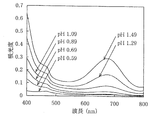
発色色素としてN,N’−ビス(2−ヒドロキシ−3−スルホプロピル)−3,3’−ジメチルベンジジンのナトリウム塩(株式会社同仁化学研究所;商品名SAT−3)を0.5重量%,硫酸(47%)を7.5重量%,リン酸を5重量%,リン酸ナトリウムを4重量%,ヨウ化カリウムを0.00027重量%,水を残部とする組成物を調製した。この組成物のpHは0.59であった。つぎに、前記組成物に水酸化ナトリウム水溶液を加えて、pH0.69〜1.49の組成物をさらに調製した。調製した組成物20ミリリットルをポリプロピレン製容器に入れ、40℃で4ヶ月保存したときの波長400〜800nmにおける吸光度を分光光度計(株式会社日立製作所製U−2010、石英セル長:10mm)で測定した。得られた吸収スペクトルを図1に示す。図1から、組成物調製時のpHが大きくなるほど、SAT−3が発色したときの極大吸収である674nm前後の吸光度が上昇することが分かった。
(Effect of pH at the time of preparing the composition on the absorption spectrum when the composition is stored at a high temperature for a long period of time)
0.5% by weight of sodium salt of N, N′-bis (2-hydroxy-3-sulfopropyl) -3,3′-dimethylbenzidine (Dojindo Laboratories, Inc .; trade name SAT-3) as a coloring dye A composition was prepared that contained 7.5% by weight of sulfuric acid (47%), 5% by weight of phosphoric acid, 4% by weight of sodium phosphate, 0.00027% by weight of potassium iodide, and the balance water. The pH of this composition was 0.59. Next, an aqueous sodium hydroxide solution was added to the composition to further prepare a composition having a pH of 0.69 to 1.49. 20 ml of the prepared composition was put into a polypropylene container, and the absorbance at a wavelength of 400 to 800 nm when stored at 40 ° C. for 4 months was measured with a spectrophotometer (U-2010 manufactured by Hitachi, Ltd., quartz cell length: 10 mm). did. The obtained absorption spectrum is shown in FIG. From FIG. 1, it was found that the absorbance at around 674 nm, which is the maximum absorption when SAT-3 was colored, increased as the pH during composition preparation increased.
(pHの上限値の決定)
図1の吸収スペクトルから、市販LEDで測定可能な波長655nmにおける吸光度の実測値を用いて、組成物のpHと吸光度の三次近似式を求め、この式を用いてpH0.59〜3.9の吸光度を近似計算した。つぎに、検水4ミリリットルに対して組成物60マイクロリットルを添加する測定条件を設定し、組成物添加時の検水の吸光度を、pH0.59〜3.9について計算により求めた。すなわち、この吸光度は、組成物が添加された残留塩素濃度0mg/リットルの検水が示す吸光度に相当する。さらに、この吸光度に対し、あらかじめ求めておいたpH0.6の組成物を用いたときの検量線に基づいて検水の残留塩素濃度判定値を計算した。結果を表1に示す。
(Determination of the upper limit of pH)
From the absorption spectrum of FIG. 1, the measured value of the absorbance at a wavelength of 655 nm that can be measured with a commercial LED is used to obtain a third-order approximation of the pH and absorbance of the composition, and this formula is used to determine the pH of 0.59 to 3.9. Absorbance was approximated. Next, measurement conditions for adding 60 microliters of the composition to 4 milliliters of the test water were set, and the absorbance of the test water at the time of adding the composition was determined by calculation for pH 0.59 to 3.9. That is, this absorbance corresponds to the absorbance indicated by the test water having a residual chlorine concentration of 0 mg / liter to which the composition has been added. Furthermore, the residual chlorine concentration judgment value of test water was calculated with respect to this absorbance based on a calibration curve obtained using a composition having a pH of 0.6 determined in advance. The results are shown in Table 1.
表1に記載されている吸光度(計算値)は、組成物を検水に添加したときの吸光度のバックグラウンドを示し、この吸光度のバックグラウンドが小さいほど、発色色素の酸化劣化度合いが小さいことを意味する。ここで、本発明の組成物を使用する残留塩素濃度測定においては、測定精度を確保する観点から、バックグラウンドの残留塩素濃度判定値が0.1mg/リットル以下であることが好ましい。組成物のpHが小さくなるほど波長655nmの吸光度が小さくなることを考慮すると、表1より、バックグラウンドの吸光度が0.05以下ないし0.08以下であれば、0.1mg/リットル以下の誤差で測定できることが分かる。したがって、組成物のpHを3.0以下ないし3.5以下に調整すれば、発色色素の酸化劣化による残留塩素濃度判定値への影響を抑制することができる。 The absorbance (calculated value) shown in Table 1 indicates the background of absorbance when the composition is added to the test water. The smaller the background of absorbance, the smaller the degree of oxidative degradation of the coloring dye. means. Here, in the measurement of residual chlorine concentration using the composition of the present invention, the background residual chlorine concentration determination value is preferably 0.1 mg / liter or less from the viewpoint of ensuring measurement accuracy. Considering that the absorbance at a wavelength of 655 nm decreases as the pH of the composition decreases, from Table 1, if the background absorbance is 0.05 to 0.08, an error of 0.1 mg / liter or less occurs. It can be seen that it can be measured. Therefore, by adjusting the pH of the composition to 3.0 or less to 3.5 or less, it is possible to suppress the influence on the residual chlorine concentration judgment value due to the oxidative deterioration of the coloring dye.
(保存安定性試験)
SAT−3を0.5重量%,硫酸(47%)を7.5重量%,リン酸を5重量%,リン酸ナトリウムを4重量%,ヨウ化カリウムを0.00027重量部,水を残部とする組成物を調製した。この組成物のpHは0.59であった。この調製した組成物を5℃,25℃,40℃,50℃の4通りの温度条件下で保存した。そして、組成物の調製時,74日および120日経過時の組成物を残留塩素濃度の測定用組成物とした。残留塩素濃度の測定に際しては、残留塩素濃度0mg/リットルの検水および残留塩素濃度約1.6mg/リットルの検水4ミリリットルに対して前記組成物を60マイクロリットル添加し、波長655nmの吸光度を分光光度計(株式会社日立製作所製U−2010、石英セル長:10mm)で測定した。そして、あらかじめ求めておいた検量線から検水中の残留塩素濃度判定値を計算した。また、比較例として、測定時に使用した検水中の残留塩素濃度をハック社(HACH Company)製ポケット水質計Cl2(DPD法による残留塩素測定キット)を用いて測定した。ここで、DPD法は発色色素を粉末で保存するため酸化劣化がほとんどなく、また水道法で指定された方法であるため、実施例との比較対象として選定した。結果を表2と表3に示す。
(Storage stability test)
SAT-3 0.5% by weight, sulfuric acid (47%) 7.5% by weight, phosphoric acid 5% by weight, sodium phosphate 4% by weight, potassium iodide 0.00027 parts by weight, water remaining A composition was prepared. The pH of this composition was 0.59. The prepared composition was stored under four temperature conditions of 5 ° C, 25 ° C, 40 ° C and 50 ° C. Then, at the time of preparation of the composition, the composition after 74 days and 120 days elapsed was used as a composition for measuring the residual chlorine concentration. In measuring the residual chlorine concentration, 60 microliters of the above composition was added to 4 ml of test water having a residual chlorine concentration of 0 mg / liter and 4 ml of test water having a residual chlorine concentration of about 1.6 mg / liter, and the absorbance at a wavelength of 655 nm was measured. The measurement was made with a spectrophotometer (U-2010 manufactured by Hitachi, Ltd., quartz cell length: 10 mm). And the residual-chlorine density | concentration judgment value in test water was computed from the analytical curve calculated | required beforehand. Moreover, as a comparative example, the residual chlorine concentration in the test water used at the time of measurement was measured using a pocket water quality meter Cl 2 (residual chlorine measurement kit by DPD method) manufactured by HACH Company. Here, since the DPD method preserves the coloring dye as a powder, there is almost no oxidative deterioration, and since it is a method specified by the water supply method, it was selected as a comparison target with the examples. The results are shown in Tables 2 and 3.
表2から、SAT−3を配合した組成物を5〜50℃で120日保存した場合、残留塩素濃度の測定に際して、波長655nmにおける吸光度の上昇がほぼゼロを示し、残留塩素濃度判定値もほぼゼロとなった。このことは、前記組成物は、5〜50℃で120日保存した場合でも保存安定性に極めて優れ、残留塩素濃度の測定に際して、バックグラウンドの上昇をほぼゼロにできることを示している。また、表3から、SAT−3を用いる方法で得られた残留塩素濃度判定値と、DPD法により得られた残留塩素濃度判定値との差は保存温度によらずほぼ一致していた。したがって、SAT−3を配合した組成物によれば、5〜50℃で120日保存した場合でも、検水中の残留塩素濃度を精度良く測定できることが分かった。 From Table 2, when the composition containing SAT-3 was stored at 5 to 50 ° C. for 120 days, when measuring the residual chlorine concentration, the increase in absorbance at a wavelength of 655 nm showed almost zero, and the residual chlorine concentration judgment value was almost the same. It became zero. This indicates that the composition is extremely excellent in storage stability even when stored at 5 to 50 ° C. for 120 days, and the background increase can be made substantially zero when measuring the residual chlorine concentration. Further, from Table 3, the difference between the residual chlorine concentration judgment value obtained by the method using SAT-3 and the residual chlorine concentration judgment value obtained by the DPD method was almost the same regardless of the storage temperature. Therefore, according to the composition which mix | blended SAT-3, even when it preserve | saved at 5-50 degreeC for 120 days, it turned out that the residual chlorine density | concentration in test water can be measured with a sufficient precision.
(ヨウ化カリウムの添加量の評価)
〔結合塩素含有サンプル水の調製〕
次亜塩素酸ナトリウム溶液を用いて、残留塩素濃度0.53,1.53mg/リットルの塩素水溶液を調製した(濃度確認:ハック社(HACH Company)製ポケット水質計Cl2、DPD法による残留塩素測定キット)。つぎに、塩化アンモニウム0.191gを純水500ミリリットルに溶解し、アンモニア性窒素水溶液(0.1mg−N/ミリリットル)を調製した。そして、塩素水溶液100ミリリットルにアンモニア性窒素水溶液をそれぞれ0.6ミリリットル,1.6ミリリットル添加して結合塩素含有サンプル水を調製した。
(Evaluation of the amount of potassium iodide added)
[Preparation of bound chlorine-containing sample water]
A chlorine aqueous solution having a residual chlorine concentration of 0.53, 1.53 mg / liter was prepared using a sodium hypochlorite solution (concentration confirmation: a pocket water quality meter Cl 2 manufactured by HACH Company, residual chlorine by DPD method. Measurement kit). Next, 0.191 g of ammonium chloride was dissolved in 500 ml of pure water to prepare an aqueous ammoniacal nitrogen solution (0.1 mg-N / ml). Then, 0.6 ml and 1.6 ml of an ammoniacal nitrogen aqueous solution were added to 100 ml of the chlorine aqueous solution, respectively, to prepare bound chlorine-containing sample water.
〔全塩素測定用試薬の調製〕
SAT−3を0.5重量%,硫酸(47%)を7.5重量%,リン酸を5重量%,リン酸三ナトリウム・12H20を4重量%,純水を83重量%配合した残留塩素測定用試薬を調製した(pH:0.6)。つぎに、ヨウ化カリウムを純水に溶解して、ヨウ化カリウムの含有量が0,0.0005,0.005,0.05,0.1,0.5,1,20重量%のヨウ化カリウム溶液(KI溶液)を調製した。そして、残留塩素測定用試薬700マイクロリットルに各KI溶液を40マイクロリットル混合し、全塩素測定用試薬とした。
[Preparation of total chlorine measurement reagent]
SAT-3 0.5% by weight, sulfuric acid (47%) 7.5% by weight, phosphoric acid 5% by weight,
〔全塩素の測定〕
結合塩素含有サンプル水30ミリリットルに全塩素測定用試薬350マイクロリットルを添加し、波長655nmの吸光度の時間変化を分光光度計(株式会社日立製作所製U−2010、石英セル長:10mm)で測定した。薬注後のpHは2.13であった。全塩素測定用試薬中のKI濃度,該試薬を結合塩素含有サンプル水に添加したときのサンプル水中のKI濃度および吸光度の測定結果を表4と表5に示す。また、前記した残留塩素測定用試薬および所定濃度の次亜塩素酸ナトリウム含有溶液を用いて遊離塩素濃度測定用の検量線を求め、この検量線に基づいて前記結合塩素含有サンプル中の全塩素濃度を求めた。さらに、前記結合塩素含有サンプル水を調整する際に用いた次亜塩素酸ナトリウム溶液中の残留塩素濃度を基準として、前記で得られた全塩素濃度の増減率を誤差(%)として求めた。得られた全塩素濃度の判定値と誤差を表4と表5に併せて示す。
[Measurement of total chlorine]
350 microliters of total chlorine measurement reagent was added to 30 milliliters of bound chlorine-containing sample water, and the time change in absorbance at a wavelength of 655 nm was measured with a spectrophotometer (U-2010 manufactured by Hitachi, Ltd., quartz cell length: 10 mm). . The pH after drug injection was 2.13. Tables 4 and 5 show the measurement results of the KI concentration in the total chlorine measurement reagent and the KI concentration and absorbance in the sample water when the reagent was added to the combined chlorine-containing sample water. Further, a calibration curve for measuring free chlorine concentration is obtained using the above-mentioned reagent for measuring residual chlorine and a sodium hypochlorite-containing solution having a predetermined concentration, and based on this calibration curve, the total chlorine concentration in the combined chlorine-containing sample is determined. Asked. Furthermore, on the basis of the residual chlorine concentration in the sodium hypochlorite solution used when adjusting the combined chlorine-containing sample water, the increase / decrease rate of the total chlorine concentration obtained above was determined as an error (%). Table 4 and Table 5 show the determination values and errors of the total chlorine concentration obtained.
表4と表5のNo.9は、公定法であるDPD法と同じKI濃度1%のデータである。この場合、吸光度はほぼゼロであり、発色が起こっていないことが分かる。これに対し、表4のNo.2〜8および表5のNo.2〜7における吸光度に示されるように、KI濃度が1%よりも少なくなるにつれて発色の程度が増し、あるところでピークをむかえた後再び発色が低下することが確認された。また、吸光度の判定値は時間経過とともにある程度ばらつく傾向にあった。 No. in Table 4 and Table 5. 9 is data having the same KI concentration of 1% as the DPD method which is an official method. In this case, the absorbance is almost zero, indicating that no color development has occurred. On the other hand, No. in Table 4 2-8 and No. 5 in Table 5. As shown by the absorbance at 2 to 7, it was confirmed that the degree of color development increased as the KI concentration decreased below 1%, and the color development decreased again after a peak was reached at a certain point. Further, the determination value of absorbance tended to vary to some extent with time.
いずれにせよ、遊離塩素濃度を測定するときと同じ検量線を使用して全塩素濃度が測定できれば非常に便宜である。このように遊離塩素濃度測定用の検量線を用いて全塩素濃度を測定する場合、測定誤差の許容範囲としては±10%以下が一つの目安となる。また、全塩素濃度の測定時間が3分を超えると測定効率が悪くなる。したがって、測定誤差が±10%以内、かつ測定時間が3分以内になるように測定条件を設定する場合には、全塩素濃度の測定レンジの上限を2mg/リットルとし、サンプル水中のKI濃度としては、1分後判定時に0.01〜1.5mg/リットル,2分後判定時に0.01〜2.5mg/リットル,3分後判定時に0.01〜3.7mg/リットルが好ましいといえる。 In any case, it would be very convenient if the total chlorine concentration could be measured using the same calibration curve as when measuring the free chlorine concentration. When the total chlorine concentration is measured using the calibration curve for measuring the free chlorine concentration in this way, an allowable range of measurement error is ± 10% or less as one standard. Moreover, when the measurement time of total chlorine concentration exceeds 3 minutes, measurement efficiency will worsen. Therefore, when setting the measurement conditions so that the measurement error is within ± 10% and the measurement time is within 3 minutes, the upper limit of the total chlorine concentration measurement range is 2 mg / liter, and the KI concentration in the sample water is Is preferably 0.01 to 1.5 mg / liter when judged after 1 minute, 0.01 to 2.5 mg / liter when judged after 2 minutes, and 0.01 to 3.7 mg / liter when judged after 3 minutes. .
(サンプル水のpHの影響)
〔結合塩素含有サンプル水の調製〕
次亜塩素酸ナトリウム溶液を用いて、残留塩素濃度1.13mg/リットルの塩素水溶液を調製した(濃度確認:ハック社(HACH Company)製ポケット水質計Cl2、DPD法による残留塩素測定キット)。つぎに、塩化アンモニウム0.191gを純水500ミリリットルに溶解し、アンモニア性窒素水溶液(0.1mg−N/ミリリットル)を調製した。そして、塩素水溶液100ミリリットルにアンモニア性窒素水溶液をそれぞれ1.2ミリリットル添加して結合塩素含有サンプル水を調製した。
(Influence of pH of sample water)
[Preparation of bound chlorine-containing sample water]
A chlorine aqueous solution having a residual chlorine concentration of 1.13 mg / liter was prepared using a sodium hypochlorite solution (concentration confirmation: a pocket water quality meter Cl 2 manufactured by HACH Company, a residual chlorine measurement kit by the DPD method). Next, 0.191 g of ammonium chloride was dissolved in 500 ml of pure water to prepare an aqueous ammoniacal nitrogen solution (0.1 mg-N / ml). Then, 1.2 ml of an ammoniacal nitrogen aqueous solution was added to 100 ml of the chlorine aqueous solution to prepare sample water containing bound chlorine.
〔全塩素測定用試薬の調製〕
SAT−3を0.5重量%,硫酸(47%)を7.5重量%,リン酸を5重量%,リン酸三ナトリウム・12H20を4重量%,純水を83重量%配合した残留塩素測定用の基準試薬を調製し、ついでこの基準試薬に水酸化ナトリウムを加えて表6に示す試薬A,Bを調製した。つぎに、ヨウ化カリウムを純水に溶解して、ヨウ化カリウムの含有量が0.05,0.1重量%のヨウ化カリウム溶液(KI溶液)を調製した。そして、試薬Aおよび試薬Bの700マイクロリットルに各KI溶液を40マイクロリットル混合し、全塩素測定用試薬とした。
[Preparation of total chlorine measurement reagent]
SAT-3 0.5% by weight, sulfuric acid (47%) 7.5% by weight, phosphoric acid 5% by weight,
〔全塩素の測定〕
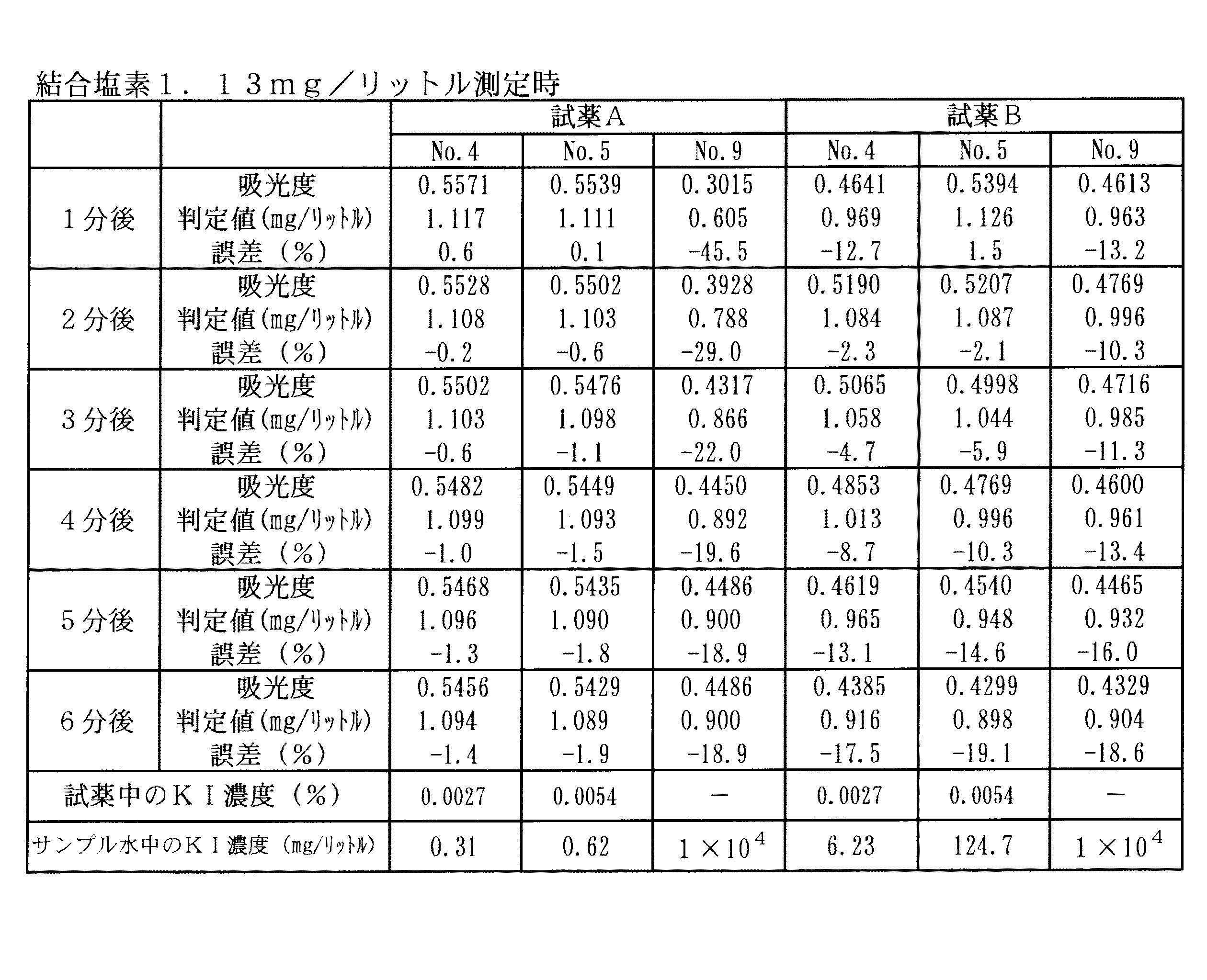
結合塩素含有サンプル水30ミリリットルに全塩素測定用試薬350マイクロリットルを添加し、波長655nmの吸光度の時間変化を分光光度計(株式会社日立製作所製U−2010、石英セル長:10mm)で測定した。全塩素測定用試薬中のKI濃度,該試薬を結合塩素含有サンプル水に添加したときのサンプル水中のKI濃度および吸光度の測定結果を表7に示す。また、前記した残留塩素測定用の基準試薬および所定濃度の次亜塩素酸ナトリウム含有溶液を用いて遊離塩素濃度測定用の検量線を求め、この検量線に基づいて前記結合塩素含有サンプル中の全塩素濃度を求めた。さらに、前記結合塩素含有サンプル水を調整する際に用いた次亜塩素酸ナトリウム溶液中の残留塩素濃度を基準として、前記で得られた全塩素濃度の増減率を誤差(%)として求めた。得られた全塩素濃度の判定値と誤差を表7に併せて示す。
[Measurement of total chlorine]
350 microliters of total chlorine measurement reagent was added to 30 milliliters of bound chlorine-containing sample water, and the time change in absorbance at a wavelength of 655 nm was measured with a spectrophotometer (U-2010 manufactured by Hitachi, Ltd., quartz cell length: 10 mm). . Table 7 shows the measurement results of the KI concentration in the total chlorine measurement reagent, and the KI concentration and absorbance in the sample water when the reagent was added to the combined chlorine-containing sample water. Further, a calibration curve for measuring free chlorine concentration is obtained using the above-mentioned reference reagent for measuring residual chlorine and a sodium hypochlorite-containing solution having a predetermined concentration, and based on this calibration curve, all of the combined chlorine-containing samples are determined. Chlorine concentration was determined. Furthermore, on the basis of the residual chlorine concentration in the sodium hypochlorite solution used when adjusting the combined chlorine-containing sample water, the increase / decrease rate of the total chlorine concentration obtained above was determined as an error (%). Table 7 shows the determination values and errors of the obtained total chlorine concentration.
表7の試薬Aおよび試薬BにおけるNo.9の結果と表4および表5におけるNo.9の結果を比較すると、サンプル水中のpHが上昇すると発色の程度が増すことが分かった。しかしながら、発色の程度は十分ではなくやはり公定法で採用されている添加割合(検水100重量部に対してヨウ化カリウム1重量部を添加)は、本発明において過大であり、採用し得ないことが分かった。また、表7の試薬Aおよび試薬BにおけるNo.4とNo.5の結果を比較すると、サンプル水中のKI濃度が同量ならば、サンプル水のpHが低いほど誤差が小さくなる傾向にあった。 No. in Reagent A and Reagent B in Table 7 9 and No. in Table 4 and Table 5. When the results of 9 were compared, it was found that the degree of color development increased as the pH in the sample water increased. However, the degree of color development is not sufficient, and the addition ratio (added 1 part by weight of potassium iodide to 100 parts by weight of test water) is excessive in the present invention and cannot be adopted. I understood that. Further, No. in Reagent A and Reagent B in Table 7 4 and no. When the results of 5 are compared, if the KI concentration in the sample water is the same amount, the error tends to be smaller as the pH of the sample water is lower.
Claims (1)
Priority Applications (1)
| Application Number | Priority Date | Filing Date | Title |
|---|---|---|---|
| JP2004106750A JP4144550B2 (en) | 2004-03-31 | 2004-03-31 | Residual chlorine measurement composition |
Applications Claiming Priority (1)
| Application Number | Priority Date | Filing Date | Title |
|---|---|---|---|
| JP2004106750A JP4144550B2 (en) | 2004-03-31 | 2004-03-31 | Residual chlorine measurement composition |
Publications (2)
| Publication Number | Publication Date |
|---|---|
| JP2005291896A true JP2005291896A (en) | 2005-10-20 |
| JP4144550B2 JP4144550B2 (en) | 2008-09-03 |
Family
ID=35324987
Family Applications (1)
| Application Number | Title | Priority Date | Filing Date |
|---|---|---|---|
| JP2004106750A Expired - Fee Related JP4144550B2 (en) | 2004-03-31 | 2004-03-31 | Residual chlorine measurement composition |
Country Status (1)
| Country | Link |
|---|---|
| JP (1) | JP4144550B2 (en) |
Cited By (7)
| Publication number | Priority date | Publication date | Assignee | Title |
|---|---|---|---|---|
| JP2005291895A (en) * | 2004-03-31 | 2005-10-20 | Miura Co Ltd | Composition for measuring residual chlorine |
| JP2005291891A (en) * | 2004-03-31 | 2005-10-20 | Miura Co Ltd | Composition for measuring residual chlorine |
| EP1837653A1 (en) * | 2006-03-23 | 2007-09-26 | Miura Co., Ltd. | Composition for measuring concentration of residual chlorine |
| JP2007286044A (en) * | 2006-03-23 | 2007-11-01 | Miura Co Ltd | Composite for measuring residual chlorine concentration |
| WO2012053028A1 (en) * | 2010-10-19 | 2012-04-26 | 日本曹達株式会社 | Reagent for measurement of residual chlorine |
| CN103293121A (en) * | 2013-05-29 | 2013-09-11 | 上海市计量测试技术研究院 | Residual chlorine standard substance, application of residual chlorine standard substance and residual chlorine tester correction or calibration method |
| WO2020257930A1 (en) * | 2019-02-23 | 2020-12-30 | OneStep Technologies Inc. | Stable alkyl benzidine composition and methods of making and using same |
Citations (3)
| Publication number | Priority date | Publication date | Assignee | Title |
|---|---|---|---|---|
| JPH09133671A (en) * | 1995-09-05 | 1997-05-20 | Konica Corp | Method and kit for discriminating quantity of residual chlorine and kit for detecting oxide |
| JP2005291895A (en) * | 2004-03-31 | 2005-10-20 | Miura Co Ltd | Composition for measuring residual chlorine |
| JP2005291891A (en) * | 2004-03-31 | 2005-10-20 | Miura Co Ltd | Composition for measuring residual chlorine |
-
2004
- 2004-03-31 JP JP2004106750A patent/JP4144550B2/en not_active Expired - Fee Related
Patent Citations (3)
| Publication number | Priority date | Publication date | Assignee | Title |
|---|---|---|---|---|
| JPH09133671A (en) * | 1995-09-05 | 1997-05-20 | Konica Corp | Method and kit for discriminating quantity of residual chlorine and kit for detecting oxide |
| JP2005291895A (en) * | 2004-03-31 | 2005-10-20 | Miura Co Ltd | Composition for measuring residual chlorine |
| JP2005291891A (en) * | 2004-03-31 | 2005-10-20 | Miura Co Ltd | Composition for measuring residual chlorine |
Non-Patent Citations (2)
| Title |
|---|
| TROJANOWICZ, M., ET AL.: "Flow-injected potentiometric determination of residual chlorine in water", ANALYTICA CHIMICA ACTA, vol. 136, JPN6008024794, 1982, pages 85 - 92, XP026590618, ISSN: 0001048862, DOI: 10.1016/S0003-2670(01)95366-8 * |
| 菊地 秀明 他: "し尿処理水中残留塩素の測定および消去方法 ヨウ化カリウム法とオルトトリジン法", 宮城県衛生研究所年報, vol. No.55(1979), JPN6008024759, 1980, pages 126 - 129, ISSN: 0001048863 * |
Cited By (7)
| Publication number | Priority date | Publication date | Assignee | Title |
|---|---|---|---|---|
| JP2005291895A (en) * | 2004-03-31 | 2005-10-20 | Miura Co Ltd | Composition for measuring residual chlorine |
| JP2005291891A (en) * | 2004-03-31 | 2005-10-20 | Miura Co Ltd | Composition for measuring residual chlorine |
| EP1837653A1 (en) * | 2006-03-23 | 2007-09-26 | Miura Co., Ltd. | Composition for measuring concentration of residual chlorine |
| JP2007286044A (en) * | 2006-03-23 | 2007-11-01 | Miura Co Ltd | Composite for measuring residual chlorine concentration |
| WO2012053028A1 (en) * | 2010-10-19 | 2012-04-26 | 日本曹達株式会社 | Reagent for measurement of residual chlorine |
| CN103293121A (en) * | 2013-05-29 | 2013-09-11 | 上海市计量测试技术研究院 | Residual chlorine standard substance, application of residual chlorine standard substance and residual chlorine tester correction or calibration method |
| WO2020257930A1 (en) * | 2019-02-23 | 2020-12-30 | OneStep Technologies Inc. | Stable alkyl benzidine composition and methods of making and using same |
Also Published As
| Publication number | Publication date |
|---|---|
| JP4144550B2 (en) | 2008-09-03 |
Similar Documents
| Publication | Publication Date | Title |
|---|---|---|
| JP4144550B2 (en) | Residual chlorine measurement composition | |
| JP4120606B2 (en) | Reagent for hardness measurement | |
| JP4618932B2 (en) | Composition for measuring chlorine concentration | |
| WO2011100789A1 (en) | Reagent for analysis | |
| JP4211660B2 (en) | Residual chlorine measurement composition | |
| JP4211661B2 (en) | Residual chlorine measurement composition | |
| JP4656603B2 (en) | Residual chlorine concentration measurement composition | |
| US10634656B2 (en) | Storage stable standards for aqueous chlorine analysis | |
| CA2582002A1 (en) | Composition for measuring concentration of residual chlorine | |
| JP5013313B2 (en) | Residual chlorine concentration measurement composition | |
| JP5949822B2 (en) | Hardness measuring composition, hardness measuring reagent kit, hardness measuring method, and antifouling method in hardness measuring apparatus | |
| JP3997265B2 (en) | Hydrogen peroxide concentration measuring reagent and method for measuring hydrogen peroxide concentration using the same | |
| EP3190155B1 (en) | Stabilised formazin composition, method of preparation and diluent for formazin composition | |
| ES2986777T3 (en) | Procedure for determining ammonium | |
| US10597352B1 (en) | Stable alkyl benzidine composition and methods of making and using same | |
| JP2006284206A (en) | Reagent for judging iron component, presence judging method of iron component and concentration measuring method of iron component | |
| JP4179207B2 (en) | Reagent for hardness measurement | |
| JP2004085453A (en) | Solid residual chlorine measuring reagent | |
| CN111795962A (en) | Composition with function of detecting residual chlorine content in water body and method for detecting residual chlorine content in water body | |
| Palin | Analytical Note: A New DPD‐Steadifac Method for Specific Determination of Free Available Chlorine in the Presence of High Monochloramine | |
| WO2024144968A1 (en) | Stabilized n,n-diethyl-p-phenylenediamine solution and method for detecting chlorine | |
| JP6038685B2 (en) | Lithium measurement method |
Legal Events
| Date | Code | Title | Description |
|---|---|---|---|
| A621 | Written request for application examination |
Free format text: JAPANESE INTERMEDIATE CODE: A621 Effective date: 20060920 |
|
| TRDD | Decision of grant or rejection written | ||
| A01 | Written decision to grant a patent or to grant a registration (utility model) |
Free format text: JAPANESE INTERMEDIATE CODE: A01 Effective date: 20080527 |
|
| A01 | Written decision to grant a patent or to grant a registration (utility model) |
Free format text: JAPANESE INTERMEDIATE CODE: A01 |
|
| A61 | First payment of annual fees (during grant procedure) |
Free format text: JAPANESE INTERMEDIATE CODE: A61 Effective date: 20080609 |
|
| R150 | Certificate of patent or registration of utility model |
Free format text: JAPANESE INTERMEDIATE CODE: R150 |
|
| FPAY | Renewal fee payment (event date is renewal date of database) |
Free format text: PAYMENT UNTIL: 20110627 Year of fee payment: 3 |
|
| FPAY | Renewal fee payment (event date is renewal date of database) |
Free format text: PAYMENT UNTIL: 20120627 Year of fee payment: 4 |
|
| FPAY | Renewal fee payment (event date is renewal date of database) |
Free format text: PAYMENT UNTIL: 20120627 Year of fee payment: 4 |
|
| FPAY | Renewal fee payment (event date is renewal date of database) |
Free format text: PAYMENT UNTIL: 20130627 Year of fee payment: 5 |
|
| FPAY | Renewal fee payment (event date is renewal date of database) |
Free format text: PAYMENT UNTIL: 20140627 Year of fee payment: 6 |
|
| LAPS | Cancellation because of no payment of annual fees |