JP2005290587A - Water-absorbing/water-retaining knitted fabric - Google Patents
Water-absorbing/water-retaining knitted fabric Download PDFInfo
- Publication number
- JP2005290587A JP2005290587A JP2004104396A JP2004104396A JP2005290587A JP 2005290587 A JP2005290587 A JP 2005290587A JP 2004104396 A JP2004104396 A JP 2004104396A JP 2004104396 A JP2004104396 A JP 2004104396A JP 2005290587 A JP2005290587 A JP 2005290587A
- Authority
- JP
- Japan
- Prior art keywords
- water
- knitted fabric
- absorbing
- pile
- retaining
- Prior art date
- Legal status (The legal status is an assumption and is not a legal conclusion. Google has not performed a legal analysis and makes no representation as to the accuracy of the status listed.)
- Granted
Links
- 239000004744 fabric Substances 0.000 title claims abstract description 160
- 229920002994 synthetic fiber Polymers 0.000 claims abstract description 45
- 239000012209 synthetic fiber Substances 0.000 claims abstract description 45
- XLYOFNOQVPJJNP-UHFFFAOYSA-N water Substances O XLYOFNOQVPJJNP-UHFFFAOYSA-N 0.000 claims abstract description 42
- 230000002441 reversible effect Effects 0.000 claims abstract description 11
- 238000009940 knitting Methods 0.000 claims description 12
- 238000000034 method Methods 0.000 claims description 6
- 238000001035 drying Methods 0.000 abstract description 11
- 238000001704 evaporation Methods 0.000 abstract 1
- 239000000835 fiber Substances 0.000 description 39
- 229920000728 polyester Polymers 0.000 description 18
- 239000010410 layer Substances 0.000 description 17
- 238000010521 absorption reaction Methods 0.000 description 16
- 229920005989 resin Polymers 0.000 description 15
- 239000011347 resin Substances 0.000 description 15
- 239000000463 material Substances 0.000 description 12
- 230000001788 irregular Effects 0.000 description 11
- 230000000052 comparative effect Effects 0.000 description 9
- 230000009471 action Effects 0.000 description 8
- 230000000694 effects Effects 0.000 description 8
- 238000004043 dyeing Methods 0.000 description 7
- 238000011156 evaluation Methods 0.000 description 7
- -1 polyethylene terephthalate Polymers 0.000 description 7
- 229920002978 Vinylon Polymers 0.000 description 6
- 230000008520 organization Effects 0.000 description 6
- 238000009792 diffusion process Methods 0.000 description 5
- 230000014759 maintenance of location Effects 0.000 description 4
- QTBSBXVTEAMEQO-UHFFFAOYSA-N Acetic acid Chemical compound CC(O)=O QTBSBXVTEAMEQO-UHFFFAOYSA-N 0.000 description 3
- DNIAPMSPPWPWGF-UHFFFAOYSA-N Propylene glycol Chemical compound CC(O)CO DNIAPMSPPWPWGF-UHFFFAOYSA-N 0.000 description 3
- 239000011248 coating agent Substances 0.000 description 3
- 238000000576 coating method Methods 0.000 description 3
- MTHSVFCYNBDYFN-UHFFFAOYSA-N diethylene glycol Chemical compound OCCOCCO MTHSVFCYNBDYFN-UHFFFAOYSA-N 0.000 description 3
- 238000009826 distribution Methods 0.000 description 3
- 230000002209 hydrophobic effect Effects 0.000 description 3
- 239000000203 mixture Substances 0.000 description 3
- 241000894006 Bacteria Species 0.000 description 2
- LYCAIKOWRPUZTN-UHFFFAOYSA-N Ethylene glycol Chemical compound OCCO LYCAIKOWRPUZTN-UHFFFAOYSA-N 0.000 description 2
- 206010021639 Incontinence Diseases 0.000 description 2
- 239000000853 adhesive Substances 0.000 description 2
- 230000001070 adhesive effect Effects 0.000 description 2
- 239000002131 composite material Substances 0.000 description 2
- 239000012153 distilled water Substances 0.000 description 2
- 229920006015 heat resistant resin Polymers 0.000 description 2
- QQVIHTHCMHWDBS-UHFFFAOYSA-N isophthalic acid Chemical compound OC(=O)C1=CC=CC(C(O)=O)=C1 QQVIHTHCMHWDBS-UHFFFAOYSA-N 0.000 description 2
- 238000010030 laminating Methods 0.000 description 2
- 230000000474 nursing effect Effects 0.000 description 2
- 229920005749 polyurethane resin Polymers 0.000 description 2
- 238000003825 pressing Methods 0.000 description 2
- 238000012545 processing Methods 0.000 description 2
- 230000001737 promoting effect Effects 0.000 description 2
- 238000004080 punching Methods 0.000 description 2
- 230000000717 retained effect Effects 0.000 description 2
- 239000007787 solid Substances 0.000 description 2
- 239000004094 surface-active agent Substances 0.000 description 2
- 210000004243 sweat Anatomy 0.000 description 2
- 238000012360 testing method Methods 0.000 description 2
- PUPZLCDOIYMWBV-UHFFFAOYSA-N (+/-)-1,3-Butanediol Chemical compound CC(O)CCO PUPZLCDOIYMWBV-UHFFFAOYSA-N 0.000 description 1
- YZTJKOLMWJNVFH-UHFFFAOYSA-N 2-sulfobenzene-1,3-dicarboxylic acid Chemical compound OC(=O)C1=CC=CC(C(O)=O)=C1S(O)(=O)=O YZTJKOLMWJNVFH-UHFFFAOYSA-N 0.000 description 1
- 229920002972 Acrylic fiber Polymers 0.000 description 1
- 229920001634 Copolyester Polymers 0.000 description 1
- 229920000742 Cotton Polymers 0.000 description 1
- 206010016322 Feeling abnormal Diseases 0.000 description 1
- YCKRFDGAMUMZLT-UHFFFAOYSA-N Fluorine atom Chemical compound [F] YCKRFDGAMUMZLT-UHFFFAOYSA-N 0.000 description 1
- 229920001410 Microfiber Polymers 0.000 description 1
- 239000004677 Nylon Substances 0.000 description 1
- 229920002292 Nylon 6 Polymers 0.000 description 1
- 229920002302 Nylon 6,6 Polymers 0.000 description 1
- 239000004698 Polyethylene Substances 0.000 description 1
- 239000004743 Polypropylene Substances 0.000 description 1
- 229920005830 Polyurethane Foam Polymers 0.000 description 1
- 230000032683 aging Effects 0.000 description 1
- 229920003232 aliphatic polyester Polymers 0.000 description 1
- 239000003513 alkali Substances 0.000 description 1
- 229920003233 aromatic nylon Polymers 0.000 description 1
- 230000008901 benefit Effects 0.000 description 1
- 230000015556 catabolic process Effects 0.000 description 1
- 239000003795 chemical substances by application Substances 0.000 description 1
- 239000002361 compost Substances 0.000 description 1
- 150000001875 compounds Chemical class 0.000 description 1
- 230000006835 compression Effects 0.000 description 1
- 238000007906 compression Methods 0.000 description 1
- 230000008094 contradictory effect Effects 0.000 description 1
- 239000012792 core layer Substances 0.000 description 1
- VEIOBOXBGYWJIT-UHFFFAOYSA-N cyclohexane;methanol Chemical compound OC.OC.C1CCCCC1 VEIOBOXBGYWJIT-UHFFFAOYSA-N 0.000 description 1
- 230000007613 environmental effect Effects 0.000 description 1
- 230000002349 favourable effect Effects 0.000 description 1
- 239000002657 fibrous material Substances 0.000 description 1
- 239000011737 fluorine Substances 0.000 description 1
- 229910052731 fluorine Inorganic materials 0.000 description 1
- 235000013305 food Nutrition 0.000 description 1
- 238000007429 general method Methods 0.000 description 1
- 239000012761 high-performance material Substances 0.000 description 1
- 238000010335 hydrothermal treatment Methods 0.000 description 1
- WGCNASOHLSPBMP-UHFFFAOYSA-N hydroxyacetaldehyde Natural products OCC=O WGCNASOHLSPBMP-UHFFFAOYSA-N 0.000 description 1
- 230000001771 impaired effect Effects 0.000 description 1
- 239000007788 liquid Substances 0.000 description 1
- 238000002074 melt spinning Methods 0.000 description 1
- 244000005700 microbiome Species 0.000 description 1
- 239000004745 nonwoven fabric Substances 0.000 description 1
- 229920001778 nylon Polymers 0.000 description 1
- 230000035699 permeability Effects 0.000 description 1
- 229920003207 poly(ethylene-2,6-naphthalate) Polymers 0.000 description 1
- 229920000747 poly(lactic acid) Polymers 0.000 description 1
- 229920001495 poly(sodium acrylate) polymer Polymers 0.000 description 1
- 229920002961 polybutylene succinate Polymers 0.000 description 1
- 239000004631 polybutylene succinate Substances 0.000 description 1
- 229920001707 polybutylene terephthalate Polymers 0.000 description 1
- 229920001610 polycaprolactone Polymers 0.000 description 1
- 239000004632 polycaprolactone Substances 0.000 description 1
- 229920000515 polycarbonate Polymers 0.000 description 1
- 239000004417 polycarbonate Substances 0.000 description 1
- 229920001692 polycarbonate urethane Polymers 0.000 description 1
- 229920001225 polyester resin Polymers 0.000 description 1
- 239000004645 polyester resin Substances 0.000 description 1
- 229920000573 polyethylene Polymers 0.000 description 1
- 239000011112 polyethylene naphthalate Substances 0.000 description 1
- 229920000139 polyethylene terephthalate Polymers 0.000 description 1
- 239000005020 polyethylene terephthalate Substances 0.000 description 1
- 239000004626 polylactic acid Substances 0.000 description 1
- 229920001155 polypropylene Polymers 0.000 description 1
- 229920002635 polyurethane Polymers 0.000 description 1
- 239000004814 polyurethane Substances 0.000 description 1
- 239000011496 polyurethane foam Substances 0.000 description 1
- 230000008569 process Effects 0.000 description 1
- 150000003839 salts Chemical class 0.000 description 1
- 238000009991 scouring Methods 0.000 description 1
- 230000001953 sensory effect Effects 0.000 description 1
- NNMHYFLPFNGQFZ-UHFFFAOYSA-M sodium polyacrylate Chemical compound [Na+].[O-]C(=O)C=C NNMHYFLPFNGQFZ-UHFFFAOYSA-M 0.000 description 1
- 229910001220 stainless steel Inorganic materials 0.000 description 1
- 239000010935 stainless steel Substances 0.000 description 1
- 230000001954 sterilising effect Effects 0.000 description 1
- 238000004659 sterilization and disinfection Methods 0.000 description 1
- 239000000126 substance Substances 0.000 description 1
- 230000035900 sweating Effects 0.000 description 1
- 229920003002 synthetic resin Polymers 0.000 description 1
- 239000000057 synthetic resin Substances 0.000 description 1
- 229910052714 tellurium Inorganic materials 0.000 description 1
- PORWMNRCUJJQNO-UHFFFAOYSA-N tellurium atom Chemical compound [Te] PORWMNRCUJJQNO-UHFFFAOYSA-N 0.000 description 1
- KKEYFWRCBNTPAC-UHFFFAOYSA-L terephthalate(2-) Chemical compound [O-]C(=O)C1=CC=C(C([O-])=O)C=C1 KKEYFWRCBNTPAC-UHFFFAOYSA-L 0.000 description 1
- 229920002803 thermoplastic polyurethane Polymers 0.000 description 1
- 238000005406 washing Methods 0.000 description 1
Images
Landscapes
- Laminated Bodies (AREA)
- Knitting Of Fabric (AREA)
Abstract
Description
本発明は、吸水性及び保水性に優れた吸水保水性編物並びに積層シートに関するものであり、詳しくは、カジュアル・レディース用シューズ、ランニングシューズ、長靴や安全靴といった靴の内張りや中敷き等の靴内装用途、防水シーツ等の介護用品用途、あるいはスポーツシャツ等のスポーツウエア用途等に好適な、表面に快適なドライ感をもたらすことのできる吸水保水性編物並びに積層シートに関するものである。 TECHNICAL FIELD The present invention relates to a water-absorbing and water-knit fabric and a laminated sheet excellent in water absorption and water retention, and more specifically, shoe interiors such as linings and insoles of shoes such as shoes for casual ladies, running shoes, boots and safety shoes. The present invention relates to a water-absorbing water-knit fabric and a laminated sheet that can provide a comfortable dry feeling on the surface, which is suitable for uses, for use in nursing supplies such as waterproof sheets, or in sportswear such as sports shirts.
従来、靴の内装の内張りや中敷きに用いる材料としては、ポリエステルやナイロン等の合成繊維、または合成繊維と綿等の天然繊維を混紡した混紡糸を用い交編・交織した布帛を用いたものが数多く提案されてきた。 Conventionally, materials used for lining and insoles of shoe interiors include fabrics that are knitted and woven using synthetic fibers such as polyester and nylon, or blended yarns of synthetic fibers and natural fibers such as cotton. Many have been proposed.
最近では、靴の内張り材として、汗を吸収し発散させるような素材が求められており、軟質ポリウレタンフォームシートに微細孔を有する極細繊維をニードルパンチした内張り材(例えば特許文献1参照)や、表地と裏地の間に吸湿発熱素材を挿入した内張り材(例えば特許文献2参照)、天然繊維と繊維断面が十字型、L型等の水分拡散性を有する繊維をニードルパンチした複合繊維材(例えば特許文献3参照)、ポリアクリル酸ナトリウムからなる超吸水繊維と脱臭繊維との混繊シートを芯層として不織布で覆った靴内張り材(例えば特許文献4参照)等の積層シートが提案されている。 Recently, as a lining material for shoes, a material that absorbs and wicks sweat is required, and a lining material obtained by needle punching ultrafine fibers having fine holes in a flexible polyurethane foam sheet (see, for example, Patent Document 1), A lining material in which a hygroscopic exothermic material is inserted between the outer material and the lining (see, for example, Patent Document 2), a composite fiber material obtained by needle punching natural fibers and fibers having a moisture diffusibility such as a cross-shaped or L-shaped fiber cross section (for example, Patent Document 3), and a laminated sheet such as a shoe lining material (see, for example, Patent Document 4) in which a mixed fiber sheet made of sodium polyacrylate and a deodorized fiber is covered with a nonwoven fabric as a core layer has been proposed. .
しかしながら、上記した従来の内張り材は、歩行による靴内の蒸れを解消する程度のことに重点をおいたものと思われる。したがって、より過酷な条件、例えばマラソン等の長時間にわたる激しい運動による多量の発汗、あるいは、悪天候時の雨や、海辺や川辺での水遊び、湿潤地での作業等の外的要因で靴内に水が浸入した場合等には、ベトツキ感を感じることがある。このため、水分を速やかに吸水して人体と接触する表面では濡れを感じさせないような高性能のものが求められるところである。 However, the above-described conventional lining material seems to have focused on the degree to eliminate the stuffiness in the shoes due to walking. Therefore, a lot of sweating due to severe conditions such as marathon, etc. for a long time, rain in bad weather, water play on the seaside or riverside, work in wet areas, etc. When water enters, it may feel sticky. For this reason, there is a demand for a high-performance material that quickly absorbs moisture and does not feel wet on the surface that comes into contact with the human body.
また、上記したような靴の内張り材の分野だけでなく、例えば介護用品の分野でも、被介護者の失禁による寝具の濡れを防ぐ防水シート等について、水分を速やかに吸収して表面に濡れを感じさせず、かつ乾燥し易いものが求められている。 Moreover, not only in the field of shoe lining materials as described above, but also in the field of care products, for example, a waterproof sheet that prevents the bedding from getting wet due to incontinence of the care recipient, quickly absorbs moisture and wets the surface. There is a need for something that does not feel and is easy to dry.
また、例えばスポーツシャツ等のスポーツ衣料の分野でも、汗の水分を吸収し、肌面に接触する面でベトつかず、かつ乾燥し易いものが求められている。
かかる状況に鑑み、本発明は、優れた吸水性及び保水性を有していて吸水時に表面の良好なドライ感(サラッとした感じ)を保持することができ、かつ吸収した水分が発散して乾燥し易い吸水保水性積層編物及びこれを用いてなる積層シートを提供することを課題とするものである。 In view of such a situation, the present invention has excellent water absorption and water retention, can maintain a good dry feeling (smooth feeling) on the surface at the time of water absorption, and the absorbed moisture diverges. It is an object of the present invention to provide a water-absorbing water-retaining laminated knitted fabric that is easy to dry and a laminated sheet using the same.
本発明は、上記課題を達成するために、以下のように構成される。
1.合成繊維からなる編物において、表面にはパイル長0.5mm以上のパイルを20個/cm2以上の密度で有し、裏面には異形断面合成繊維が配されて構成されていることを特徴とする吸水保水性編物。
2.裏面を構成する異形断面合成繊維の質量が、編物全体の質量の10%以上を占めることを特徴とする上記1の吸水保水性編物。
3.表面編地と、これに対向する裏面編地と、両編地間を連結する連結部とからなる立体構造編物であることを特徴とする上記1又は2の吸水保水性編物。
4.連結部が異形断面合成繊維からなることを特徴とする上記3の吸水保水性編物。
5.表面編地においてパイルを形成する合成繊維の単糸繊度(FA)と、連結部を構成する合成繊維の単糸繊度(FB)とが、下記式(1)を満足して構成されていることを特徴とする上記3〜4いずれかの吸水保水性編物。
In order to achieve the above-mentioned object, the present invention is configured as follows.
1. The knitted fabric made of synthetic fibers is characterized in that the surface has piles with a pile length of 0.5 mm or more at a density of 20 pieces / cm 2 or more, and the back surface is formed with a modified cross-section synthetic fiber. Water-absorbing water knitted fabric.
2. The water-absorbing water-knit fabric according to 1 above, wherein the mass of the modified cross-section synthetic fiber constituting the back surface occupies 10% or more of the mass of the entire knitted fabric.
3. 3. The water-absorbing water-retaining knitted fabric according to 1 or 2 above, wherein the knitted fabric is a three-dimensional structure knitted fabric comprising a surface knitted fabric, a back knitted fabric facing the knitted fabric, and a connecting portion that connects both knitted fabrics.
4). 3. The water-absorbing water-knit fabric according to 3 above, wherein the connecting portion is made of a modified cross-section synthetic fiber.
5. The single yarn fineness (FA) of the synthetic fiber forming the pile in the surface knitted fabric and the single yarn fineness (FB) of the synthetic fiber constituting the connecting portion satisfy the following formula (1). The water-absorbing water-knit fabric according to any one of 3 to 4 above.

7.上記1〜6いずれかに記載の吸水保水性編物の裏面側に、防水層が積層されてなることを特徴とする吸水保水性積層シート。
7). A water-absorbing and water-retaining laminate sheet, wherein a waterproof layer is laminated on the back side of the water-absorbing and water-retaining knitted fabric according to any one of 1 to 6 above.
本発明の吸水保水性編物及び吸水保水性積層シートは、吸水性及び保水性に優れ、表面に快適なドライ感をもたらすことができ、しかも乾燥させ易い。したがって、吸水保水性の要求される各種用途、例えば靴の内装、防水シーツ等の介護用品、スポーツウェア等に好適である。特に、靴の内張りや中敷きといった靴の内装用に最適であり、快適な使用感が得られ、乾燥させ易いのでカビ等の発生も抑えることができて取り扱い易いものとなる。 The water-absorbing and water-absorbing knitted fabric and the water-absorbing and water-absorbing laminated sheet of the present invention are excellent in water absorption and water retention, can provide a comfortable dry feeling on the surface, and are easy to dry. Therefore, it is suitable for various uses requiring water-absorbing water retention properties, such as shoes interiors, nursing articles such as waterproof sheets, and sportswear. In particular, it is optimal for shoe interiors such as shoe linings and insoles, provides a comfortable feeling of use, and is easy to dry, so that generation of mold and the like can be suppressed and handling is easy.
本発明の吸水保水性編物(以下、単に「本発明の編物」ということがある)は、合成繊維からなる編物であり、その表面においてパイルを有するものである。本発明の編物は、このパイルが凸部となって、編地表面に凹凸状の構造を有することになる。 The water-absorbing water-knit fabric of the present invention (hereinafter sometimes simply referred to as “knitted fabric of the present invention”) is a knitted fabric made of synthetic fibers, and has a pile on the surface thereof. In the knitted fabric of the present invention, this pile becomes a convex portion, and the surface of the knitted fabric has an uneven structure.
本発明の編物は、このようなパイルによる表面の凹凸状の構造(以下、表面凹凸構造ということがある)を有することにより、ひとつには、外部から編地表面にもたらされた液体状の水分が、速やかに編物の内部に侵入し、裏面側への移動が促進されるという作用効果を奏することができる。また、それに加えて、この表面側を手肌に触れる側の面として使用されたときに、表面凹凸構造のために編物表面と手肌との実質的な接触面積が少なくなるので、水分によるベトツキ感を軽減し、編物表面における面方向(面に沿った方向)の通気性も大きいので、ドライ感を向上させるという作用効果も奏することができる。 The knitted fabric of the present invention has such a surface uneven structure (hereinafter, sometimes referred to as a surface uneven structure) due to such a pile. It is possible to achieve an effect that moisture quickly enters the inside of the knitted fabric and promotes movement toward the back side. In addition to this, when this surface side is used as the surface on the side touching the hand skin, the substantial contact area between the knitted surface and the hand skin is reduced due to the surface uneven structure. Since the feeling is reduced and the air permeability in the surface direction (direction along the surface) on the surface of the knitted fabric is large, the effect of improving the dry feeling can also be achieved.
表面のパイルは、良好なドライ感を得るために、一般的に疎水性繊維として知られている合成繊維を好ましく用いることができる。そのような合成繊維を例示すれば、ポリエチレンテレフタレート、ポリメチレンテレフタレート、ポリブチレンテレフタレート、ポリオキシエトキシベンゾエート、ポリエチレンナフタレート、シクロヘキサンジメチレンテレフタレート等のポリエステル、及びこれらのポリエステルにイソフタル酸、スルホイソフタル酸成分、プロピレングリコール、ブチレングリコール、シクロヘキサンジメタノール、ジエチレングリコールのような第3グリコール成分を共重合した共重合ポリエステルからなるポリエステル系繊維が挙げられる。また、ナイロン6、ナイロン66、芳香族ナイロン等からなるポリアミド系繊維、ポリエチレン、ポリプロピレン等からなるポリオレフィン系繊維及びアクリル系繊維が挙げられる。さらには、ポリカプロラクトン、ポリブチレンサクシネート、ポリ乳酸等の脂肪族ポリエステル化合物等からなる生分解性合成繊維が挙げられ、このような生分解性合成繊維を用いた場合には、土壌中や水中に長時間放置されて、あるいはコンポストで処理されて、微生物等の作用により分解させることができるので、用済み後廃棄時の環境負荷がより低減される。 For the surface pile, in order to obtain a good dry feeling, a synthetic fiber generally known as a hydrophobic fiber can be preferably used. Examples of such synthetic fibers include polyesters such as polyethylene terephthalate, polymethylene terephthalate, polybutylene terephthalate, polyoxyethoxybenzoate, polyethylene naphthalate, cyclohexanedimethylene terephthalate, and these polyesters with isophthalic acid and sulfoisophthalic acid components. , Polyester fibers made of a copolyester obtained by copolymerizing a third glycol component such as propylene glycol, butylene glycol, cyclohexane dimethanol or diethylene glycol. Moreover, the polyamide-type fiber which consists of nylon 6, nylon 66, aromatic nylon etc., the polyolefin-type fiber and acrylic fiber which consist of polyethylene, a polypropylene, etc. are mentioned. Furthermore, biodegradable synthetic fibers composed of aliphatic polyester compounds such as polycaprolactone, polybutylene succinate, polylactic acid, and the like can be mentioned. When such biodegradable synthetic fibers are used, Can be allowed to stand for a long time or treated with compost and decomposed by the action of microorganisms, etc., so that the environmental load at the time of disposal after use is further reduced.
なお、合成繊維のラスターに関しては、特に限定されるものではなく、ブライト、セミダル、フルダルのいずれでもよい。 The raster of the synthetic fiber is not particularly limited, and any of bright, semidal, and fulldal may be used.
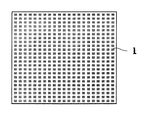
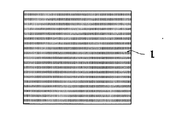
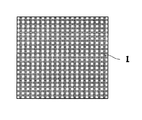
表面のパイルの分布形態としては、表面に凹凸構造を具現できる形態であればよく、特に限定されるものではない。例えば図1に示すようにドット状で略均一に分布していてもよい。また、図2に示すようなストライプ状、あるいは図3に示すような格子状に分布していてもよい。用途にもよるが、ドット状で略均一に分布していることが好ましい。また、 個々のパイルの形態としてはループパイルが特に好ましい。 The distribution form of the piles on the surface is not particularly limited as long as the uneven structure can be realized on the surface. For example, as shown in FIG. 1, the dots may be distributed substantially uniformly. Further, it may be distributed in a stripe shape as shown in FIG. 2 or a lattice shape as shown in FIG. Although it depends on the application, it is preferable that the dots are distributed substantially uniformly. Moreover, as a form of each pile, a loop pile is particularly preferable.
なお、上記において言及した図1〜図3は、パイルの分布形態を例示した、あくまでも模式的な図であり、実際の外観を必ずしも忠実に表したものではない。すなわち、上記したドット状、ストライプ状及び格子状とは、表面を上方から眺めたときに、パイルによりそのような模様を呈して見えるということである。したがって、例えばパイルがドット状に分布しているという場合、ドットが幾何学的に厳密な意味で点であることを要するわけではなく、例えばパイルのひとつひとつがそれぞれ実質的に独立した凸部を形成するように分布していればよい。また、当業者であれば、図1中にドットとして表されたもののひとつひとつがパイルにより形成されているような外観をイメージできるはずである。 Note that FIGS. 1 to 3 mentioned above are merely schematic views illustrating the pile distribution form, and do not necessarily faithfully represent the actual appearance. That is, the above-mentioned dot shape, stripe shape, and lattice shape means that when the surface is viewed from above, such a pattern appears by a pile. Therefore, for example, when piles are distributed in dots, it is not necessary that the dots are dots in a geometrically strict sense. For example, each pile forms a substantially independent convex portion. As long as it is distributed. Moreover, those skilled in the art should be able to imagine the appearance that each of the dots represented in FIG. 1 is formed by a pile.
また、パイルがブロック状に比較的密集している部分と、パイルが存在しない部分とが交互に現れるような分布形態であってもよい。 Moreover, the distribution form may be such that portions where piles are relatively dense in a block shape and portions where piles do not exist appear alternately.
本発明の編物において、表面のパイル密度すなわち単位面積あたりのパイル個数としては、20個/cm2以上であり、70〜150個/cm2程度が好ましく、30〜100個/cm2が特に好ましい。そのようなパイル密度とすることにより、表面に適度な凹凸構造が具現され、ドライ感の良好な表面とすることができる。 In knitting of the present invention, the pile number per pile density or unit area of the surface, is 20 / cm 2 or more, preferably about 70 to 150 pieces / cm 2, particularly preferably 30 to 100 pieces / cm 2 . By setting it as such a pile density, a moderate uneven structure is embodied on the surface and it can be set as the surface with a favorable dry feeling.
表面のパイル長としては、0.5mm以上とする。このパイル長とは、編地のグランド部から出ているパイル部分の長さをいい、編地の断面を撮影した写真より測定することができる。 The pile length on the surface is 0.5 mm or more. This pile length means the length of the pile part which has come out from the ground part of the knitted fabric, and can be measured from the photograph which image | photographed the cross section of the knitted fabric.
パイル長が0.5mm未満では、本発明の編物の表面が人体(手肌)と接触した際に、人体から編物の裏面までの距離が近くなって十分に距離を保てないことにより、良好なドライ感を具現できなくなるからである。また、本発明の編物を靴の中敷きや内張りに使用した場合、表面のパイルのクッション性が靴着用時の摩擦軽減に効果的であることを本発明者らは見出したところ、パイル長が0.5mm未満では、パイルのクッション性が不足して、素足又は靴下を着用した足との摩擦を軽減させることができず、摩擦が靴の生地に直接加わって、靴の生地や靴下が破れやすくなるからである。 When the pile length is less than 0.5 mm, when the surface of the knitted fabric of the present invention is in contact with the human body (hand skin), the distance from the human body to the back surface of the knitted fabric is so close that the distance cannot be maintained sufficiently. This is because a dry feeling cannot be realized. Further, when the present inventors have found that when the knitted fabric of the present invention is used for an insole or lining of a shoe, the cushioning property of the pile on the surface is effective for reducing friction when wearing the shoe, the pile length is 0. If it is less than 5 mm, the cushioning property of the pile is insufficient, and friction with the foot wearing bare feet or socks cannot be reduced. Because it becomes.
一方、パイル長があまりに長すぎても、表面の摩擦が極端に低くなって靴の中で足が滑ってしまったり、パイルからピリングが生じるといった点で不都合となる場合がある。したがって、表面のパイル長としては0.5〜3.0mmが好ましく、1.0〜2.0mmが特に好ましい。 On the other hand, if the pile length is too long, it may be inconvenient in that the friction on the surface becomes extremely low and the foot slips in the shoe, or pilling occurs from the pile. Accordingly, the pile length on the surface is preferably 0.5 to 3.0 mm, particularly preferably 1.0 to 2.0 mm.
本発明の編物の表面にパイルを形成する際には、上記した合成繊維からなる糸条を用いて、パイルを有する編地組織を編成するのであるが、このときの糸条としては、吸水性、ソフト感、ドライ感を向上させる観点から繊維間に空隙を有する糸条が好ましい。そのような糸条を例示すれば、2種類以上の異なる熱収縮性を有するマルチフィラメント糸からなる異収縮混繊糸条や、自己捲縮糸条、仮撚加工糸条、ニットデニット等の捲縮糸条、短繊維からなる紡績糸等が挙げられる。特に好ましく用いられるのは、適度な伸縮性を有し、保温効果のある仮撚捲縮加工糸条である。 When forming a pile on the surface of the knitted fabric of the present invention, a knitted fabric structure having a pile is knitted using the above-described yarns made of synthetic fibers. From the viewpoint of improving the soft feeling and the dry feeling, a yarn having voids between the fibers is preferable. Examples of such yarns include different shrinkage mixed yarns made of multifilament yarns having two or more different heat shrinkability, self-crimped yarns, false twisted yarns, knit denits, etc. Examples thereof include crimped yarns and spun yarns made of short fibers. Particularly preferably used are false twisted yarns having moderate stretchability and a heat retaining effect.
なお、表面の編地組織の種類としては、表面にパイルを形成できるものであれば特に限定されるものではなく、例えばツイル、ストライプ、カノコ、ボーダー、ジャガード組織等を採用することができる。 The type of knitted fabric structure on the surface is not particularly limited as long as a pile can be formed on the surface, and for example, twill, stripes, canopy, border, jacquard structure, etc. can be employed.
また、表面のパイルを形成するための糸条としては、マルチフィラメントが好ましく、その単糸繊度としては、0.5〜5.0dtexが好ましく、全繊度としては、10〜500dtexが好ましい。単糸繊度が0.5dtex未満では、ヨレやカラミが生じて品位が低下する傾向にあり、一方、5.0dtexを超えると風合いが粗硬となったり、表面が極端に滑りやすいものとなる傾向があるので好ましくない。また、全繊度が10dtex未満では、パイルのクッション性が低下する傾向にあり、一方、500dtexを超えると風合いが粗硬となったり、表面が極端に滑りやすいものとなる傾向があるので好ましくない。 The yarn for forming the surface pile is preferably a multifilament, the single yarn fineness is preferably 0.5 to 5.0 dtex, and the total fineness is preferably 10 to 500 dtex. If the single yarn fineness is less than 0.5 dtex, twist and / or pallet tend to occur and the quality tends to deteriorate. On the other hand, if the single yarn fineness exceeds 5.0 dtex, the texture becomes coarse and the surface tends to be extremely slippery. This is not preferable. Further, if the total fineness is less than 10 dtex, the cushioning property of the pile tends to be lowered. On the other hand, if it exceeds 500 dtex, the texture tends to become coarse or the surface tends to be extremely slippery, which is not preferable.
次に、裏面について説明する。本発明の編物の裏面においては、異形断面合成繊維が配されて編地が構成されている。本発明において、裏面に異形断面合成繊維を配するのは、表面側から移動してきた水分を、異形断面合成繊維により具現される毛細管現象を利用して繊維間空隙に吸水し、速やかに拡散させるためである。 Next, the back surface will be described. On the back surface of the knitted fabric of the present invention, a knitted fabric is formed by arranging modified cross-section synthetic fibers. In the present invention, the modified cross-section synthetic fibers are arranged on the back surface by absorbing the water that has moved from the front side into the inter-fiber voids using the capillary phenomenon embodied by the modified cross-section synthetic fibers and quickly diffusing them. Because.
本発明の編物において、裏面の編地を構成するのに用いられる異形断面合成繊維の質量としては、本発明の編物の質量、すなわち本発明の編物を構成するのに使用されている全繊維の質量のうち10%以上を占めることが好ましい。 In the knitted fabric of the present invention, the mass of the modified cross-section synthetic fiber used for constituting the back side knitted fabric is the mass of the knitted fabric of the present invention, that is, the total fibers used to constitute the knitted fabric of the present invention. It is preferable to occupy 10% or more of the mass.
異形断面合成繊維の占める割合が10%未満では、大量の吸水時に拡散能力が不足し、表面における良好なドライ感が得られなくなる傾向にある。 If the proportion of the modified cross-section synthetic fiber is less than 10%, the diffusion capacity is insufficient when a large amount of water is absorbed, and a good dry feeling on the surface tends not to be obtained.
ただし、異形断面合成繊維の比率が高すぎても、ベトツキを感じるという問題を生じる場合がある。したがって、用途にもよるが、異形断面合成繊維の比率としては、10〜90%が好ましく、20〜70%が特に好ましい。 However, even if the ratio of the modified cross-section synthetic fiber is too high, a problem of feeling sticky may be caused. Therefore, although it depends on the application, the proportion of the modified cross-section synthetic fiber is preferably 10 to 90%, particularly preferably 20 to 70%.
上記のような目的で本発明に用いられる異形断面合成繊維とは、異形断面を有し、前述したパイルに用いられる合成繊維と同様の各種合成樹脂からなる合成繊維であり、異形断面とは、丸断面以外の断面形状をいう。 The modified cross-section synthetic fiber used in the present invention for the purpose as described above is a synthetic fiber having various cross-sections and made of various synthetic resins similar to the synthetic fiber used in the pile described above. A cross-sectional shape other than a round cross-section.
異形断面としては、例えば、略三角形、四角形、五角形等の多角形断面、くさび形断面、矢形断面、あるいは略C型、H型、I型、W型等のアルファベット文字を象った断面が挙げられる。なお、異形断面を具現する手段としては、特に限定されるものではなく、従来公知の各種の手段、例えば溶融紡糸時に直接に異形断面が得られる紡糸口金を使用したり、分割型複合繊維を機械的方法や化学的方法(染色加工時のアルカリ処理等)で分割したりすることにより、所望の異形断面形状を得ることができる。 Examples of irregular cross-sections include polygonal cross-sections such as substantially triangular, quadrilateral, and pentagonal shapes, wedge-shaped cross-sections, arrow-shaped cross-sections, and cross sections simulating alphabet letters such as substantially C-type, H-type, I-type, and W-type. It is done. The means for embodying the irregular cross section is not particularly limited, and various conventionally known means such as a spinneret that directly obtains an irregular cross section at the time of melt spinning can be used, or a split type composite fiber can be machined. The desired irregular cross-sectional shape can be obtained by dividing by a general method or a chemical method (such as alkali treatment during dyeing).
異形断面合成繊維としては、毛細管現象により水分の拡散移動を促進するという点から、マルチフィラメント糸条として用いられることが好ましく、異形異繊度マルチフィラメント糸条として用いられることが特に好ましい。異形断面合成繊維からなるマルチフィラメント糸条の繊度としては、単糸繊度を0.3〜4.0dtex、全繊度を10〜500dtex程度としたものが好ましい。また、その単糸繊度としては、表面のパイルに用いる糸条における単糸繊度の0.8倍以下とすることが好ましく、0.6倍以下とすることがより好ましい。これは、単糸繊度が小さいほうが毛細管現象を発現しやすいことを利用して、裏面の吸水作用を表面と比較してより強くするためである。 The deformed cross-section synthetic fiber is preferably used as a multifilament yarn, and particularly preferably used as a multifilament yarn having a deformed shape and a different shape, from the viewpoint of promoting the diffusion and movement of moisture by capillary action. As the fineness of the multifilament yarn composed of the modified cross-section synthetic fiber, those having a single yarn fineness of 0.3 to 4.0 dtex and a total fineness of about 10 to 500 dtex are preferable. The single yarn fineness is preferably 0.8 times or less, more preferably 0.6 times or less the single yarn fineness of the yarn used for the surface pile. This is to make the water absorption action on the back surface stronger than that on the surface by utilizing the fact that the smaller the single yarn fineness, the more easily the capillary phenomenon is developed.
なお、異形断面合成繊維のラスターに関しても、特に限定されるものではなく、ブライト、セミダル、フルダルのいずれでもよい。 The raster of the irregular cross-section synthetic fiber is not particularly limited, and any of bright, semidal, and fulldal may be used.
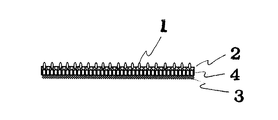
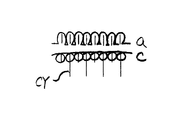
本発明の編物は、上記したような表面と裏面を有して構成されていればよく、その他の構成については特に限定されるものではないが、好ましい態様としては、図4に示すように、表面編地2とこれに対向する裏面編地3と、この両者を連結する連結糸4からなる連結部とを有する立体構造編物である。立体構造編物の組織としては、ダブルニット、トリコット、ダブルラッセル等を採用することができる。特にリバーシブルダブルニットが好ましく、例えば、編物編成時に表地の一部に水溶性ビニロン繊維を使用してパイル状編物を編成し、染色工程等を利用して熱水により水溶性ビニロン繊維を溶解除去することにより、リバーシブルダブルニット組織を有する本発明の編物を得ることができる。
The knitted fabric of the present invention only needs to be configured to have the above-described front and back surfaces, and other configurations are not particularly limited, but as a preferred embodiment, as shown in FIG. This is a three-dimensional knitted fabric having a front knitted
そのような立体構造編物とすることにより、外部から編物表面にもたらされた液体の水分は、連結部の繊維間空隙を利用して、好ましくは毛細管現象により拡散され、異形断面合成繊維を含む裏面編地への移動・吸収を速やかならしめる効果が大となる。また、表裏編地間に連結部が存在することにより、裏面編地に吸水保持された水分が、編地表面に加えられた圧力等によって表面側に逆戻りすることを抑制する効果が大となる。 By forming such a three-dimensional knitted fabric, the liquid moisture brought from the outside to the knitted surface is preferably diffused by a capillary phenomenon using inter-fiber gaps of the connecting portion, and includes a modified cross-section synthetic fiber. The effect of speeding up the movement / absorption to the back knitted fabric is increased. In addition, the presence of the connecting portion between the front and back knitted fabrics has a great effect of suppressing the moisture retained by the back knitted fabric from being returned to the front side by the pressure applied to the knitted fabric surface. .
さらに、上記したような立体構造編物においては、表面から見て、パイルが存在しない部分においては連結部が露出していることが好ましい。これは、連結部が表面編地によって覆われている場合に比べて、編物内部への水分の拡散が容易になるためである。 Further, in the above-described three-dimensional knitted fabric, it is preferable that the connecting portion is exposed at a portion where no pile exists as viewed from the surface. This is because the diffusion of moisture into the knitted fabric becomes easier than in the case where the connecting portion is covered with the surface knitted fabric.
また、立体構造編物における連結部において、毛細管現象により水分の拡散移動を促進するという観点から、連結部はマルチフィラメント糸条により編成されていることが好ましく、異繊度のマルチフィラメント糸条により編成されていることがより好ましい。また、同様の観点から、連結部に用いる繊維の断面としては異形断面の繊維が好ましい。特に好ましくは、異繊度異形断面マルチフィラメント糸条を用いることである。 Moreover, in the connection part in a three-dimensional structure knitted fabric, it is preferable that the connection part is knitted with multifilament yarns from the viewpoint of promoting the diffusion and movement of moisture by capillary action, and is knitted with multifilament yarns of different fineness. More preferably. From the same viewpoint, the cross section of the fiber used for the connecting portion is preferably a fiber having an irregular cross section. It is particularly preferable to use a multifilament yarn having a different fineness and a modified cross section.
また、毛細管現象により水分の移動拡散を促進するためには、単糸繊度の小さい繊維を用いることも好ましく、具体的には単糸繊度5デシテックス以下の繊維を用いることが好ましい。編物の表面においては、肌触りのソフト感、フィット感の点からも単糸繊度5デシテックス以下を用いることが好ましい。また、連結部に用いる繊維の単糸繊度を、表面部に用いる繊維の単糸繊度以下にして構成すれば、相対的に連結部の方が毛細管現象の効果が大きいという構成を具現でき、これにより表面部から連結部への水分移動をさらに促進できるという利点がある。 In order to promote the movement and diffusion of moisture by capillary action, it is also preferable to use a fiber having a small single yarn fineness, and specifically, to use a fiber having a single yarn fineness of 5 dtex or less. On the surface of the knitted fabric, it is preferable to use a single yarn fineness of 5 dtex or less from the viewpoint of soft touch and fit. In addition, if the single yarn fineness of the fiber used for the connecting portion is set to be equal to or less than the single yarn fineness of the fiber used for the surface portion, a configuration in which the effect of the capillary phenomenon is relatively greater in the connecting portion can be realized. Thus, there is an advantage that moisture movement from the surface portion to the connecting portion can be further promoted.
したがって、本発明の編物が立体構造編物の場合、表面編地においてパイルを形成する合成繊維の単糸繊度(FA)と、連結部を構成する合成繊維の単糸繊度(FB)とが、下記式(1)を満足して構成されていることが好ましい。さらにいえば、下記式(1)と(2)を同時に満足していることがより好ましく、下記式(3)を同時に満足していることが特に好ましい。 Therefore, when the knitted fabric of the present invention is a three-dimensional structure knitted fabric, the single yarn fineness (FA) of the synthetic fiber forming the pile in the surface knitted fabric and the single yarn fineness (FB) of the synthetic fiber constituting the connecting portion are as follows. It is preferable to satisfy the formula (1). Furthermore, it is more preferable that the following formulas (1) and (2) are satisfied at the same time, and it is particularly preferable that the following formula (3) is satisfied at the same time.
本発明の編物の厚さとしては、特に限定されるものではなく、用途において適宜設定すればよいが、表面のドライ感を良好に保つという観点から、異形断面合成繊維を含む裏面の層の厚さを、編物全体の厚さの50%未満にとどめることが好ましい。 The thickness of the knitted fabric of the present invention is not particularly limited, and may be set as appropriate in use. From the viewpoint of maintaining a good dry feeling on the surface, the thickness of the back layer containing the modified cross-section synthetic fiber It is preferable to limit the thickness to less than 50% of the total thickness of the knitted fabric.
本発明にいう吸水保水性編物とは、単に水分を吸収するという吸水性だけでなく、吸収した水分を保持することのできる編物という意味である。すなわち、本発明の編物は、単に多くの水分を吸収するという吸水性だけでなく、一旦編物に浸透して裏面側に吸収された水分が、容易には表面に滲み出してこないという保水性に優れている編物である。 The water-absorbing water-knit fabric referred to in the present invention means not only water-absorbing water that simply absorbs moisture but also a knitted fabric that can retain absorbed moisture. That is, the knitted fabric of the present invention is not only water-absorbing that absorbs a large amount of water, but also has water retention that moisture that has once penetrated into the knitted fabric and absorbed on the back side does not easily ooze out to the surface. Excellent knitting.
従来の通常の編物においては、たとえ吸水性に優れていて多量の水分を吸収しても、その水分を保持する保水性が劣っていれば、編地に身体等による圧力がかかると水分が編物の表面に逆戻りしてしまい、表面が濡れてドライ感が損なわれてしまうという問題があった。しかし、本発明の編物は、そのような問題を克服できる吸水保水性を有する編物である。 In conventional ordinary knitted fabrics, even if they are excellent in water absorption and absorb a large amount of water, if the water holding capacity is poor, the moisture will be knitted if pressure is applied to the knitted fabric by the body, etc. There is a problem that the surface of the film is reverted to the surface and the surface becomes wet and the dry feeling is impaired. However, the knitted fabric of the present invention is a knitted fabric having water-absorbing water retention ability that can overcome such problems.
この点について、本発明の編物の構成中、表面のドライ感を担うパイルを形成する合成繊維と、裏面の吸水保水性を担う合成繊維とのいずれにおいても、ポリエステル繊維等の一般的に疎水性繊維として知られている合成繊維を用いて構成できるということは、一見矛盾しているように思われるかも知れないが、そうではない。なぜなら、例えば表面のパイルと、裏面とのパイルがいずれもポリエステル繊維から構成されていても、裏面を構成するポリエステル繊維として、異形断面繊維を、好ましくは単糸繊度の小さい異繊度異形断面マルチフィラメント糸条を用いると、裏面は毛細管現象による水分の吸引力が強くなり、表面側から水分を吸収し、その水分を繊維間空隙に保持することができる。本発明にいう吸水保水性とは、裏面のこのような作用により具現されるものである。一方、表面においては、裏面に水分を奪われるので、ドライ感が保たれる。したがって、表面のパイルには、毛細管現象による水分の吸引力が裏面よりも弱いものとするために、異形断面ではなく、丸断面の繊維を用いることが好ましいが、相対的に裏面より水分の吸収力を弱くすることができればよいので、必ずしも丸断面に限定されるわけではない。 In this regard, in the composition of the knitted fabric of the present invention, the polyester fiber or the like is generally hydrophobic in any of the synthetic fiber forming the pile responsible for the dryness of the surface and the synthetic fiber responsible for water absorption and water retention on the back surface. It may seem seemingly contradictory that it can be constructed using synthetic fibers known as fibers, but it is not. This is because, for example, even if the pile on the front surface and the pile on the back surface are both made of polyester fiber, as the polyester fiber constituting the back surface, a modified cross-section fiber, preferably a single fiber fineness, a different fineness, a modified cross-section multifilament When the yarn is used, the back surface has a strong moisture suction force due to capillary action, absorbs moisture from the front surface side, and can retain the moisture in the interfiber spaces. The water-absorbing water retention referred to in the present invention is embodied by such an action on the back surface. On the other hand, on the front surface, moisture is removed from the back surface, so that a dry feeling is maintained. Therefore, it is preferable to use a fiber with a round cross-section instead of a deformed cross-section so that the surface pile has a weaker water suction force due to capillary action than the back surface. Since it is sufficient if the force can be weakened, it is not necessarily limited to the round cross section.
本発明の編物の吸水保水性は、次のような方法で評価できる。
(吸水保水性の評価方法)
編物からタテ25cm×ヨコ20cmの大きさに裁断したものを試料として準備する。試料の質量(m1)を測定する。別途、濾紙(東洋濾紙株式会社製、ADVANTEC No.2)を試料と同じ大きさに裁断したもの2枚を用意し、その2枚の合計質量(M2)を測定する。編物表面を上にしてステンレス製バット上においた試料の中央部に、保水率100%に相当する、試料と同じ質量(m1)の蒸留水をシリンジより滴下する。5分間放置後、上記した2枚の濾紙を試料の上に覆うように重ねて置き、その上から試料全体に1.96kPaの圧力がかかるように圧縮荷重を3秒間加えることにより、加圧により編物表面に逆戻りした水分を濾紙に吸水させ、吸水した濾紙2枚の合計質量(m3)を測定する。以上のようにして測定された値m1、m2、m3から、下記式(4)により逆戻り水分率(GS)を求め、これを吸水保水性の指標とする。
The water absorption retention of the knitted fabric of the present invention can be evaluated by the following method.
(Evaluation method for water retention)
A sample cut from a knitted fabric to a size of 25 cm (vertical) × 20 cm (wide) is prepared as a sample. Measure the mass (m 1 ) of the sample. Separately, two sheets of filter paper (ADVANTEC No. 2 manufactured by Toyo Roshi Kaisha, Ltd.) cut into the same size as the sample are prepared, and the total mass (M 2 ) of the two sheets is measured. Distilled water having the same mass (m 1 ) as the sample, corresponding to a water retention rate of 100%, is dropped from the syringe into the center of the sample placed on the stainless steel bat with the knitted surface facing up. After leaving for 5 minutes, the above two filter papers are placed on top of the sample so as to cover them, and a compression load is applied for 3 seconds so that a pressure of 1.96 kPa is applied to the whole sample from above, thereby applying pressure. Water that has returned to the surface of the knitted fabric is absorbed by the filter paper, and the total mass (m 3 ) of the two filter papers that have absorbed water is measured. From the values m 1 , m 2 , and m 3 measured as described above, a reverse moisture content (GS) is obtained by the following formula (4), and this is used as an index of water absorption retention.
本発明者らの知見によれば、好ましい逆戻り水分率(GS)は30%以下、より好ましくは20%以下であり、30%以下であれば実用上十分な吸水保水性能が具現される。 According to the knowledge of the present inventors, the preferred reverse moisture content (GS) is 30% or less, more preferably 20% or less, and if it is 30% or less, practically sufficient water retention and retention performance is realized.
本発明の編物は、上記したように吸水保水性に優れているが、吸水保水後は、乾燥させ易いものでもある。これは、異形断面合成繊維の使用により水分が拡散移動し易いことが寄与しているものと考えられる。一旦吸水した水分がいつまでも乾燥せずに編物中に残っていると、カビや細菌などの温床になって衛生面からも好ましくない。この乾燥させ易さの目安としては、下記の方法で評価される乾燥率において、90分後の乾燥率が90%以上であることが好ましい。乾燥率が90%未満では、吸水した水分の10%を超える量が残留しており、湿った状態であるため、再度着用するとムレを感じるおそれがあり、また、夏季等の比較的高温で高湿度状態で放置した場合には、カビや細菌が繁殖し易く不衛生で好ましくない。衣料品その他の用途に用いる場合を考慮すると、近年は室内で乾燥を行なうことも増加しており、かかる観点からも、上記90分後の乾燥率としては90%以上が好ましく、95%以上がより好ましい。
(乾燥率の評価)
10cm×10cmの正方形状に裁断した編物を試料として、温度20℃、湿度65%の条件下(常圧)で24時間調湿した後に質量を測定し、これを標準質量Xとする。次に、各試料をシャーレ上に水平に置き、試料の表面にシリンジにて純水約1mlを滴下したときの試料の質量Y(シャーレ込みの質量からシャーレの質量を差し引いたもの)を測定する。そして、この状態で温度20℃、湿度65%の条件下(常圧)に放置し、90分後の試料の質量Zを測定する。そして、これらの測定値から、下記式(5)により乾燥率を算出する。
The knitted fabric of the present invention is excellent in water absorption and water retention as described above, but is also easy to dry after water absorption and retention. This is considered to be attributable to the fact that moisture is easily diffused and transferred by using the modified cross-section synthetic fiber. If the moisture once absorbed remains in the knitted fabric without drying forever, it becomes a hotbed of mold, bacteria, etc., which is not preferable from the viewpoint of hygiene. As a measure of the ease of drying, the drying rate after 90 minutes is preferably 90% or more in the drying rate evaluated by the following method. When the drying rate is less than 90%, more than 10% of the absorbed water remains and is in a damp state, so there is a risk that it will feel dull when worn again, and it is high at relatively high temperatures such as in summer. When left in a humidity state, mold and bacteria are easy to propagate and are unsanitary and undesirable. Considering the case where it is used for clothing and other uses, in recent years, the drying in the room is also increasing. From this viewpoint, the drying rate after 90 minutes is preferably 90% or more, and 95% or more. More preferred.
(Dry rate evaluation)
Using a knitted fabric cut into a 10 cm × 10 cm square shape as a sample, the mass is measured for 24 hours under conditions of temperature 20 ° C. and humidity 65% (normal pressure), and this is defined as standard mass X. Next, each sample is placed horizontally on a petri dish, and the mass Y of the sample when the approximately 1 ml of pure water is dropped on the surface of the sample with a syringe is measured (the mass of the petri dish minus the petri dish mass). . In this state, the sample is left under conditions of 20 ° C. and 65% humidity (normal pressure), and the mass Z of the sample after 90 minutes is measured. And from these measured values, a drying rate is computed by following formula (5).
本発明の編物を使用する際においては、他の織編物、例えば主として疎水性繊維で構成された織編物を積層したり、各種シート類を積層してもよい。また、本発明の編物を2枚用意して、裏面同士を合わせて積層してもよい。特に、裏面側からの他の物や人体への水分の付着を防ぐ必要がある場合には、裏面側に防水層として遮水性のフィルムやシートを積層すればよい。これらのうち、本発明の編物の裏面側に防水層が積層されてなる本発明の吸水保水性積層シートについて次に述べる。 When using the knitted fabric of the present invention, other woven or knitted fabrics, for example, woven or knitted fabrics mainly composed of hydrophobic fibers may be laminated, or various sheets may be laminated. Further, two knitted fabrics of the present invention may be prepared and the back surfaces may be laminated together. In particular, when it is necessary to prevent moisture from adhering to other objects or the human body from the back side, a water-proof film or sheet may be laminated as a waterproof layer on the back side. Among these, the water-absorbing water-retaining laminated sheet of the present invention in which a waterproof layer is laminated on the back side of the knitted fabric of the present invention will be described next.
本発明の吸水保水性積層シート(以下、単に「本発明の積層シート」ということがある)は、上記したような本発明の編物の裏面側に防水層が積層されてなるものであり、本発明の編物の表面が人体の肌面に触れる側の面となるような態様で使用される。本発明の積層シートは、このような構成により、上記した本発明の編物の有する優れた吸水保水性、快適なドライ感に加えて、編物表面から吸水され裏面側に保水された水分が本発明の積層シートの外部に漏れ出すことが防水層により防がれる。したがって、本発明の積層シートが失禁用等の防水シーツ等に使用された場合には、寝具等が濡れることや、バスマットに使用された場合に床が濡れることが防止できる効果がある。靴の中敷きや内張り材に使用した場合には、上記の効果に加えて、靴に水がかかったり、水溜まりに突っ込んだりした場合に、逆に裏面側から水が入り込むのを防ぐ効果もある。 The water-absorbing water-retaining laminated sheet of the present invention (hereinafter sometimes simply referred to as “laminated sheet of the present invention”) is formed by laminating a waterproof layer on the back side of the knitted fabric of the present invention as described above. It is used in such a manner that the surface of the knitted fabric of the invention is a surface on the side that touches the skin surface of the human body. The laminated sheet of the present invention has such a structure, in addition to the excellent water-absorbing water retention and comfortable dry feeling of the knitted fabric of the present invention described above, the moisture absorbed from the knitted surface and retained on the back surface side is the present invention. Leakage outside the laminated sheet is prevented by the waterproof layer. Therefore, when the laminated sheet of the present invention is used for waterproof sheets for incontinence and the like, it is possible to prevent the bedding and the like from getting wet and the floor from getting wet when used for a bath mat. In addition to the above effects, when used for shoe insoles or lining materials, there is also an effect of preventing water from entering from the back side when the shoe is splashed with water or pushed into a puddle.
防水層としては、公知の樹脂フィルムや樹脂皮膜を用いればよく、それらを本発明の編物の裏面側にラミネート又はコーティングすることにより積層することができる。防水層を形成する樹脂としては、特に限定されるものではなく、公知の樹脂から目的に応じて適宜選択すればよいが、例えばポリエステル系樹脂、ポリウレタン系樹脂、フッ素系樹脂等が好ましく採用される。 As the waterproof layer, a known resin film or resin film may be used, and they can be laminated by laminating or coating them on the back side of the knitted fabric of the present invention. The resin forming the waterproof layer is not particularly limited and may be appropriately selected from known resins according to the purpose. For example, polyester resins, polyurethane resins, fluorine resins, and the like are preferably employed. .
防水層の厚さとしては、3〜60μmが好ましく、5〜40μmがより好ましい。また、防水層の目付けとしては、3〜100g/m2が好ましく、5〜60g/m2がより好ましい。なお、防水層としては、本発明の編物の裏面に直接積層すればよいが、必要に応じて本発明の編物と防水層との間に他の布帛やシート類を介在させても差し支えない。また、本発明の積層シートの外観や手触りの向上、あるいは防水層の保護を目的として、防水層の外側にさらに他の布帛やフィルム、シート類が積層されていてもよい。 As thickness of a waterproof layer, 3-60 micrometers is preferable and 5-40 micrometers is more preferable. Moreover, as a fabric weight of a waterproof layer, 3-100 g / m < 2 > is preferable and 5-60 g / m < 2 > is more preferable. The waterproof layer may be laminated directly on the back surface of the knitted fabric of the present invention, but other fabrics and sheets may be interposed between the knitted fabric of the present invention and the waterproof layer as necessary. Further, for the purpose of improving the appearance and feel of the laminated sheet of the present invention or protecting the waterproof layer, other fabrics, films and sheets may be laminated on the outer side of the waterproof layer.
防水層としては、ムレを防止するために透湿性樹脂フィルムや透湿性樹脂皮膜等からなる防水透湿層が好ましく、特に防水シーツ類、靴の中敷きや内張り材には好適である。また、食品等を扱う衛生管理が求められる現場で使用する衛生用靴製品等に使用される場合においては、80℃以上の工業洗濯、高温滅菌処理に耐えうる耐熱性の樹脂フィルムや樹脂皮膜からなるものが好ましい。耐熱性の樹脂フィルムや樹脂皮膜としては、耐熱性ウレタン系樹脂からなるものが好ましく、例えばポリカーボネート系ウレタン樹脂からなるフィルムや皮膜が挙げられる。 As the waterproof layer, a waterproof moisture-permeable layer made of a moisture-permeable resin film, a moisture-permeable resin film or the like is preferable in order to prevent stuffiness, and particularly suitable for waterproof sheets, shoe insoles and lining materials. In addition, when used in sanitary shoe products used in the field where hygiene management is required to handle foods, etc., heat-resistant resin films and resin films that can withstand industrial washing at 80 ° C or higher and high-temperature sterilization treatment Is preferred. As the heat resistant resin film or resin film, those made of a heat resistant urethane resin are preferable, and for example, a film or film made of a polycarbonate urethane resin can be mentioned.
また、防水層の耐水圧としては、本発明の積層シートに人体の体重等による負荷がかかったときに圧迫された水が外部に漏れ出さない程度の耐水圧を備えていることが好ましく、具体的には20kPa以上が好ましい。 Further, as the water pressure resistance of the waterproof layer, it is preferable that the laminated sheet of the present invention has a water pressure pressure sufficient to prevent the compressed water from leaking to the outside when a load due to the weight of the human body is applied. Specifically, 20 kPa or more is preferable.
次に、本発明を実施例により具体的に説明する。 Next, the present invention will be specifically described with reference to examples.
なお、実施例に記載の編物の特性は、次にように評価したものである。
1.逆戻り水分率(GS)
上記本文中で説明したした吸水保水性の評価方法により求めたものであるが、1つの編物あたり3点の試料について行ない、その平均値を採用した。また、圧縮荷重を加える際には、空気圧駆動式のプレス試験機(大阪アサヒ社製、盤面サイズ30×30cm、ストローク長13.5cm)を使用して常温にて行なった。
2.ドライ感
編物からタテ25cm×ヨコ20cmの大きさに裁断したものを試料として準備した。編物表面を上にして机上に置いた試料の中央部に、編物の質量に相当する量の蒸留水をシリンジより滴下した。5分間放置後、滴下した箇所を中心に手のひらでやや強めに押さえてみて、濡れを感じるかどうかという官能試験により評価した。試験は10人のパネラーにより行ない、下記の基準で評価して、最も人数の多かった評価結果を採用した。
(評価基準)
◎:濡れを感じず、水分が手に全くつかない。
○:濡れは感じないが、水分が僅かに手につくのが目視できる。
△:濡れを感じ、かなりの水分が手につくのが目視できる。
×:軽く触れるだけで手に水分がつき、押さえるとベトベトする。
3.乾燥率
上記した本文中で説明した評価方法により求めたが、1つの編物あたり3点の試料について行ない、その平均値を採用した。
4.パイル長
編物を裁断した断面の拡大写真を撮影し、この写真により、編地のグランド部から出ているパイル部分の長さを測定した。
In addition, the characteristics of the knitted fabric described in the examples are evaluated as follows.
1. Reverse moisture content (GS)
Although it was calculated | required with the evaluation method of the water absorption water retention demonstrated in the said text, it carried out about 3 samples per knitted fabric, and adopted the average value. Further, when applying the compressive load, it was carried out at room temperature using a pneumatically driven press tester (manufactured by Osaka Asahi Co., Ltd., board surface size 30 × 30 cm, stroke length 13.5 cm).
2. A feeling of dryness Cut from a knitted fabric to a size of 25 cm (vertical) × 20 cm (wide) was prepared as a sample. An amount of distilled water corresponding to the mass of the knitted fabric was dropped from a syringe onto the center of the sample placed on the desk with the knitted surface facing up. After leaving it for 5 minutes, it was evaluated by a sensory test to determine whether or not it felt wet by pressing it slightly with a palm around the dropped part. The test was conducted by 10 panelists and evaluated according to the following criteria, and the evaluation result with the largest number of people was adopted.
(Evaluation criteria)
(Double-circle): It does not feel wet and water does not touch at all.
○: Wetness is not felt, but it can be visually observed that water is slightly attached.
(Triangle | delta): Wetness is felt and it can visually observe that considerable moisture gets on a hand.
X: Moisture is applied to the hand just by lightly touching and sticky when pressed.
3. Drying rate Although it calculated | required by the evaluation method demonstrated in the above-mentioned text, it carried out about three samples per knitted fabric, and adopted the average value.
4). Pile length An enlarged photograph of the cross section of the knitted fabric was taken, and the length of the pile portion coming out from the ground portion of the knitted fabric was measured from this photograph.
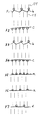
実施例1
編物表面組織にはポリエステル仮撚加工糸(ユニチカファイバー株式会社製、167デシテックス/48フィラメント)を、編物裏面組織には異繊度異形断面ポリエステル加工糸(ユニチカファイバー株式会社製、「ルミエース(商標名)」、73デシテックス/44フィラメント)を使用し、30"*28Gの丸編機(福原精機製、VX-ZPL型)により、図5に示すパイル編成組織にて編物を製編した。この編物に対し、サーキュラー染色試験機(日阪製作所製、CUT-T-S型)にて、界面活性剤(日華化学株式会社製、サンモールFL)を1g/リットルの濃度で使用して、浴比1:25で80℃、30分間のリラックス精練を行った。この段階で水溶性ビニロン繊維は溶解除去されていた。次いで、上記と同じサーキュラー染色試験機にて、編地のポリエステル繊維の染色と吸水加工を行なう目的で、染料(ダイスター社製、Dianix Blue UN−SE)を1%o.m.f.、染色助剤としての酢酸を0.2ml/リットル、均染剤(日華化学株式会社製、ニッカサンソルトSN−130)を0.5g/リットルの割合で用いて、130℃、30分間の熱水処理を行なった後に、仕上げセットを行ない、本発明の編物を得た。
Example 1
Polyester false twisted yarn (Unitika Fiber Co., Ltd., 167 dtex / 48 filament) is used for the surface of the knitted fabric, while polyester fabric yarn with different fineness and deformed cross section (Unitika Fiber Co., Ltd., “Lumiace (trade name)” is used for the back surface of the knitted fabric. ”, 73 decitex / 44 filament), and a 30” * 28G circular knitting machine (Fukuhara Seiki, model VX-ZPL) was used to knit the knitted fabric with the pile knitting structure shown in FIG. On the other hand, in a circular dyeing tester (manufactured by Nisaka Seisakusho, CUT-TS type), a surfactant (Nikka Chemical Co., Ltd., Sunmol FL) was used at a concentration of 1 g / liter, and a bath ratio of 1: Then, relaxed scouring was performed for 30 minutes at 80 ° C. at 25. At this stage, the water-soluble vinylon fibers had been dissolved and removed. For the purpose of dyeing and water-absorbing the tellurium, 1% omf of dye (Dianx Blue UN-SE, manufactured by Dystar), 0.2 ml / liter of acetic acid as a dyeing assistant, leveling agent (The Nikka Chemical Co., Ltd. product, Nikka Sun Salt SN-130) was used at a rate of 0.5 g / liter, and after hydrothermal treatment at 130 ° C. for 30 minutes, a finishing set was performed, and the knitted fabric of the present invention Got.
この編物は、表面にドット状で略均一に分布したパイルを122個/cm2の密度で有しており、平均的なパイル長は1.1mmであった。また、裏面組織の異形断面ポリエステル繊維の含有率は編物全体の18.2質量%であった。 This knitted fabric had a dot-like pile distributed on the surface substantially uniformly at a density of 122 pieces / cm 2 , and the average pile length was 1.1 mm. Moreover, the content rate of the irregular cross-section polyester fiber of a back surface structure | tissue was 18.2 mass% of the whole knitted fabric.
実施例2
立体構造編物を得るため、表面編地にはポリエステル仮撚加工糸(ユニチカファイバー株式会社製、167デシテックス/48フィラメント)と水溶性ビニロン繊維(株式会社ニチビ製、30デシテックス/9フィラメント)を使用し、連結部には異繊度異形断面ポリエステル加工糸(ユニチカファイバー株式会社製、「ルミエース(商標名)」、73デシテックス/44フィラメント)を使用し、編地裏面には連結部に用いたものと同じ異繊度異形断面ポリエステル加工糸を2本引き揃えて使用して、33"*22Gの丸編機(福原精機製、LPJ-H型)により、図6に示す編成組織にて、表面編地、裏面編地及び連結部からなる立体構造編物を製編した。この編物に対し、サーキュラー染色試験機(日阪製作所製、CUT-T-S型)にて、界面活性剤(日華化学株式会社製、サンモールFL)を1g/リットルの濃度で使用して、浴比1:25で80℃、30分間のリラックス精練を行った。この段階で水溶性ビニロン繊維は溶解除去されていた。次いで、実施例1で行なったのと同様にして、染色と吸水加工を目的とした処理及び仕上げセットを行ない、本発明の編物を得た。この編物は、表面にドット状で略均一に分布したパイルを36個/cm2の密度で有しており、平均的なパイル長は2.3mmであった。また、異形断面ポリエステル繊維の含有率は編物全体の45.6質量%であり、その内訳は連結部に7.0質量%、裏面編地に38.6質量%であった。
Example 2
In order to obtain a three-dimensional knitted fabric, polyester false twisted yarn (Unitika Fiber Co., Ltd., 167 decitex / 48 filament) and water-soluble vinylon fiber (Nichibi Co., Ltd., 30 decitex / 9 filament) are used for the surface knitted fabric. , Polyester processed yarn with different fineness and irregular cross-section ("Lumiace (trade name)", 73 dtex / 44 filament) manufactured by Unitika Fiber Co., Ltd. is used for the connecting part, and the same as that used for the connecting part on the back of the knitted fabric Using two polyester yarns with a different fineness profile and a modified cross-section, a surface knitted fabric with a knitting structure shown in Fig. 6 using a 33 "* 22G circular knitting machine (Fukuhara Seiki, LPJ-H type) A three-dimensional knitted fabric consisting of a back knitted fabric and a connecting part was knitted, and this knitted fabric was subjected to a surface active agent (Nikkahua) using a circular dyeing tester (manufactured by Nisaka Seisakusho, CUT-TS type). Sunmall FL) manufactured by Co., Ltd. was used at a concentration of 1 g / liter, and relaxed and scoured for 30 minutes at a bath ratio of 1:25 at 80 ° C. At this stage, the water-soluble vinylon fiber was dissolved and removed. Next, processing and finishing set for dyeing and water absorption processing were performed in the same manner as in Example 1. Thus, the knitted fabric of the present invention was obtained. The piles were distributed at a density of 36 pieces / cm 2 , the average pile length was 2.3 mm, and the content of the irregular cross-section polyester fiber was 45.6% by mass of the entire knitted fabric. The breakdown was 7.0% by mass for the connecting portion and 38.6% by mass for the back knitted fabric.
比較例1
実施例1において、裏面編地に用いる糸を、異繊度異形断面繊維ではなく表面編地と同じポリエステル仮撚加工糸として編成した以外は、実施例1と同様にして、比較用の編物を得た。この編物のパイル密度及びパイル長は、実施例1のものと同等であった。
Comparative Example 1
A knitted fabric for comparison is obtained in the same manner as in Example 1 except that the yarn used for the back knitted fabric is knitted as the same polyester false twisted yarn as that of the surface knitted fabric instead of the fiber having a different fineness and an irregular cross section. It was. The pile density and pile length of this knitted fabric were the same as those of Example 1.
比較例2
実施例1で使用したのと同じ糸及び編機にて、パイルを構成しない添え糸組織にて編成を行なった以外は、実施例1と同様にして、比較用の編物を得た。この編物の異形断面ポリエステル繊維の含有率は30.5質量%であった。
Comparative Example 2
A comparative knitted fabric was obtained in the same manner as in Example 1, except that the same yarn and knitting machine as used in Example 1 were used to perform knitting with a spliced yarn structure not constituting a pile. The content of the irregular cross-section polyester fiber in this knitted fabric was 30.5% by mass.
比較例3
実施例1とは異なる33"*14Gの丸編機(福原精機製、V−8E型、)を用いる他は、実施例1と同様にして比較用の編物を得た。この編物は、表面にドット状で略均一に分布したパイルを18個/cm2の密度で有しており、平均的なパイル長は2.1mmであった。また、裏面組織の異形断面ポリエステル繊維の含有率は編物全体の36.0質量%であった。
Comparative Example 3
A comparative knitted fabric was obtained in the same manner as in Example 1 except that a 33 "* 14G circular knitting machine (V-8E type, manufactured by Fukuhara Seiki Co., Ltd.) different from that of Example 1 was used. The pile has a density of 18 pieces / cm 2 in a dot-like manner and a uniform pile length, and the average pile length is 2.1 mm. It was 36.0 mass% of the whole knitted fabric.
以上の実施例1〜2及び比較例1〜3で得られた編物について、特性を評価した結果を下記表1に示す。 The results of evaluating the characteristics of the knitted fabrics obtained in Examples 1-2 and Comparative Examples 1-3 are shown in Table 1 below.
表1から分かるように、実施例1及び2の本発明の編物は、逆戻り水分率が低く吸水保水性に優れており、表面の快適なドライ感を実現するものであった。これに対して比較例1については、異形断面合成繊維を含まないため、全評価項目で劣っていた。比較例2は表面にパイルを有さないため、比較例3はパイル密度が不足するため、いずれも逆戻り水分率と表面ドライ感において劣っていた。 As can be seen from Table 1, the knitted fabrics of the present invention of Examples 1 and 2 had a low reverse moisture content and excellent water absorption and water retention, and realized a comfortable dry feeling on the surface. On the other hand, Comparative Example 1 was inferior in all evaluation items because it did not include the modified cross-section synthetic fiber. Since Comparative Example 2 did not have pile on the surface, Comparative Example 3 was inferior in reverse moisture content and surface dryness because of insufficient pile density.
実施例3
離型紙(リンテック株式会社製、EV130TPO)の離型面に、コンマコータを用いて、ポリカーボネート系ポリウレタン樹脂(セイコー化成株式会社製、「ラックスキン(商品名)U−390」、固形分20%)を、塗布量50g/m2で塗布した後、100℃で2分間乾燥させることにより、透湿防水性樹脂被膜を離型紙上に形成した。さらに、上記の樹脂皮膜上に、25メッシュ、深度250μmのドット状(ドットの幅0.7mm、ド
ット間隔0.35mm)の塗布パターンを有するグラビアロールを用いて、下記表2に示す
組成のポリウレタン系接着剤組成物(固形分36%)をドット状に塗布した後、130℃で2分間乾燥させた。
Example 3
Using a comma coater on the release surface of the release paper (Lintech Co., Ltd., EV130TPO), polycarbonate polyurethane resin (Seiko Kasei Co., Ltd., “Rack Skin (trade name) U-390”, solid content 20%) Then, after applying at a coating amount of 50 g / m 2 , drying at 100 ° C. for 2 minutes formed a moisture permeable waterproof resin coating on the release paper. Furthermore, a polyurethane having a composition shown in Table 2 below using a gravure roll having a dot pattern (dot width 0.7 mm, dot interval 0.35 mm) of 25 mesh and a depth of 250 μm on the above resin film. The system adhesive composition (solid content 36%) was applied in the form of dots and then dried at 130 ° C. for 2 minutes.
このようにして接着剤を付与した樹脂皮膜上に上記実施例1〜3で得られた本発明の編物を重ねて30kPaの圧力を印加した後に巻取った。そして、40℃で3日間エージングした後に、離型紙を剥離させることにより、編物と樹脂皮膜とを積層させた本発明の積層シートを得た。 The knitted fabrics of the present invention obtained in Examples 1 to 3 were overlaid on the resin film provided with the adhesive in this way, and wound after applying a pressure of 30 kPa. And after aging at 40 degreeC for 3 days, the release sheet | seat was peeled and the laminated sheet of this invention which laminated | stacked the knitted fabric and the resin film was obtained.
これらの積層シートは、本発明の編物と同様に良好な吸水保水性を有し、表面の快適なドライ感を実現するものであった。また、裏面側には樹脂皮膜が積層されているので、裏面から水分が漏れ出て机上を濡らすというようなこともなかった。 These laminated sheets had good water absorption and water retention like the knitted fabric of the present invention, and realized a comfortable dry feeling on the surface. In addition, since the resin film is laminated on the back side, moisture did not leak out from the back side and wet the desk.
1 パイル
2 表面編地
3 裏面編地
4 連結糸
CY シリンダー針
DY ダイヤル針
a 表面組織に用いるポリエステル糸条
b 連結部に用いる糸条
c 裏面組織に用いる異形断面ポリエステル糸条
d 表面編地を編成する際に用いる水溶性ビニロン糸条
F1〜F7 給糸口
1
CY cylinder needle
DY Dial needle a Polyester yarn b used for surface structure b Yarn used for connecting part c Deformed cross-section polyester yarn used for back structure d Water-soluble vinylon yarn used for knitting surface knitted fabric
F1 to F7 Yarn feeder
Claims (7)
A water-absorbing and water-retaining laminate sheet, wherein a waterproof layer is laminated on the back side of the water-absorbing and water-retaining knitted fabric according to any one of claims 1 to 6.
Priority Applications (1)
| Application Number | Priority Date | Filing Date | Title |
|---|---|---|---|
| JP2004104396A JP4436709B2 (en) | 2004-03-31 | 2004-03-31 | Water-absorbing knitted fabric |
Applications Claiming Priority (1)
| Application Number | Priority Date | Filing Date | Title |
|---|---|---|---|
| JP2004104396A JP4436709B2 (en) | 2004-03-31 | 2004-03-31 | Water-absorbing knitted fabric |
Publications (2)
| Publication Number | Publication Date |
|---|---|
| JP2005290587A true JP2005290587A (en) | 2005-10-20 |
| JP4436709B2 JP4436709B2 (en) | 2010-03-24 |
Family
ID=35323840
Family Applications (1)
| Application Number | Title | Priority Date | Filing Date |
|---|---|---|---|
| JP2004104396A Expired - Fee Related JP4436709B2 (en) | 2004-03-31 | 2004-03-31 | Water-absorbing knitted fabric |
Country Status (1)
| Country | Link |
|---|---|
| JP (1) | JP4436709B2 (en) |
Cited By (11)
| Publication number | Priority date | Publication date | Assignee | Title |
|---|---|---|---|---|
| JP2007162189A (en) * | 2005-12-16 | 2007-06-28 | Asahi Kasei Fibers Corp | Knitted fabric |
| JP2011214173A (en) * | 2010-03-31 | 2011-10-27 | Gunze Ltd | Wet-return prevention fabric, underwear fabric and underwear |
| CN102965804A (en) * | 2012-11-26 | 2013-03-13 | 江苏申利实业股份有限公司 | Waterproof elastic monomer-resisting fabric and production method thereof |
| JP2014214408A (en) * | 2013-04-30 | 2014-11-17 | ミツカワ株式会社 | Double tubular-knitted fabric |
| JP2016067367A (en) * | 2014-09-26 | 2016-05-09 | クラレトレーディング株式会社 | Double raschel cloth and shoe upper material using the same |
| JP2018111898A (en) * | 2017-01-12 | 2018-07-19 | 美津濃株式会社 | Jacket |
| JP2018197405A (en) * | 2017-05-24 | 2018-12-13 | 株式会社ユニチカテクノス | Inner cap for protective cap |
| CN109115648A (en) * | 2018-08-06 | 2019-01-01 | 东华大学 | The test method of fiber moisture absorption heating performance |
| KR102018990B1 (en) * | 2018-07-30 | 2019-09-06 | (주)텍스밀 | Method of Producing High Density Knit Having Excellent Sweat-absorption and Rapid-drying Function And Blocking Transmission |
| JP2020059963A (en) * | 2018-10-05 | 2020-04-16 | ユニチカトレーディング株式会社 | Single pile knitted fabric, and shoe interior material |
| JP2023064528A (en) * | 2021-10-26 | 2023-05-11 | デサントジャパン株式会社 | Wear and its manufacturing method |
-
2004
- 2004-03-31 JP JP2004104396A patent/JP4436709B2/en not_active Expired - Fee Related
Cited By (13)
| Publication number | Priority date | Publication date | Assignee | Title |
|---|---|---|---|---|
| JP2007162189A (en) * | 2005-12-16 | 2007-06-28 | Asahi Kasei Fibers Corp | Knitted fabric |
| JP2011214173A (en) * | 2010-03-31 | 2011-10-27 | Gunze Ltd | Wet-return prevention fabric, underwear fabric and underwear |
| CN102965804A (en) * | 2012-11-26 | 2013-03-13 | 江苏申利实业股份有限公司 | Waterproof elastic monomer-resisting fabric and production method thereof |
| JP2014214408A (en) * | 2013-04-30 | 2014-11-17 | ミツカワ株式会社 | Double tubular-knitted fabric |
| JP2016067367A (en) * | 2014-09-26 | 2016-05-09 | クラレトレーディング株式会社 | Double raschel cloth and shoe upper material using the same |
| JP2018111898A (en) * | 2017-01-12 | 2018-07-19 | 美津濃株式会社 | Jacket |
| JP2018197405A (en) * | 2017-05-24 | 2018-12-13 | 株式会社ユニチカテクノス | Inner cap for protective cap |
| KR102018990B1 (en) * | 2018-07-30 | 2019-09-06 | (주)텍스밀 | Method of Producing High Density Knit Having Excellent Sweat-absorption and Rapid-drying Function And Blocking Transmission |
| CN109115648A (en) * | 2018-08-06 | 2019-01-01 | 东华大学 | The test method of fiber moisture absorption heating performance |
| CN109115648B (en) * | 2018-08-06 | 2023-12-12 | 东华大学 | Test method for fiber moisture absorption and heating properties |
| JP2020059963A (en) * | 2018-10-05 | 2020-04-16 | ユニチカトレーディング株式会社 | Single pile knitted fabric, and shoe interior material |
| JP7477266B2 (en) | 2018-10-05 | 2024-05-01 | ユニチカトレーディング株式会社 | Single pile knitted fabric and shoe interior materials |
| JP2023064528A (en) * | 2021-10-26 | 2023-05-11 | デサントジャパン株式会社 | Wear and its manufacturing method |
Also Published As
| Publication number | Publication date |
|---|---|
| JP4436709B2 (en) | 2010-03-24 |
Similar Documents
| Publication | Publication Date | Title |
|---|---|---|
| US5879487A (en) | Absorbent material and method for making same | |
| US6770581B1 (en) | Absorbent fabrics, products, and methods | |
| JP5197382B2 (en) | Coating for viscoelastic foam mattress | |
| JP4436709B2 (en) | Water-absorbing knitted fabric | |
| TW201731412A (en) | Hook and loop fastener and textile products | |
| KR100973539B1 (en) | Multifunctional fabric with dual structure with quick drying and water repellency | |
| JP2017148422A (en) | Knitted fabric for footwear | |
| JP4464146B2 (en) | Water-absorbing water-knit fabric and laminated sheet | |
| JP4390514B2 (en) | Multilayer structure knitted fabric | |
| JP7477266B2 (en) | Single pile knitted fabric and shoe interior materials | |
| US20050159721A1 (en) | Body fluid absorbing product and diaper | |
| JP2005029904A (en) | Stretch water-absorbing and holding knitted fabric and laminated knitted fabric | |
| JP7374113B2 (en) | Double-layer knitted fabrics and clothing | |
| JP4487511B2 (en) | Knitted fabric and laminated sheet for shoe interior | |
| JP2004190151A (en) | Water holding knitted fabric | |
| JP2002165829A (en) | Diapers and urine collection pads | |
| JP2003342862A (en) | Water absorbing material and method for producing the same | |
| JP2019072295A (en) | Foot wiping mat | |
| JP2005009026A (en) | Bra pads | |
| JP3285650B2 (en) | insole | |
| JP2001340102A (en) | Polyester shoe materials and shoes | |
| CN217430295U (en) | Anti-mite and antibacterial urine pad for people | |
| JP2004041385A (en) | Deodorized sock | |
| JP2004049725A (en) | Biodegradable sock | |
| US20240044074A1 (en) | Faux Hide Material |
Legal Events
| Date | Code | Title | Description |
|---|---|---|---|
| A621 | Written request for application examination |
Free format text: JAPANESE INTERMEDIATE CODE: A621 Effective date: 20061220 |
|
| A977 | Report on retrieval |
Free format text: JAPANESE INTERMEDIATE CODE: A971007 Effective date: 20090513 |
|
| A131 | Notification of reasons for refusal |
Free format text: JAPANESE INTERMEDIATE CODE: A131 Effective date: 20090526 |
|
| A521 | Request for written amendment filed |
Free format text: JAPANESE INTERMEDIATE CODE: A523 Effective date: 20090727 |
|
| A131 | Notification of reasons for refusal |
Free format text: JAPANESE INTERMEDIATE CODE: A131 Effective date: 20090811 |
|
| A521 | Request for written amendment filed |
Free format text: JAPANESE INTERMEDIATE CODE: A523 Effective date: 20091013 |
|
| A711 | Notification of change in applicant |
Free format text: JAPANESE INTERMEDIATE CODE: A712 Effective date: 20091102 |
|
| TRDD | Decision of grant or rejection written | ||
| A01 | Written decision to grant a patent or to grant a registration (utility model) |
Free format text: JAPANESE INTERMEDIATE CODE: A01 Effective date: 20091215 |
|
| A01 | Written decision to grant a patent or to grant a registration (utility model) |
Free format text: JAPANESE INTERMEDIATE CODE: A01 |
|
| A61 | First payment of annual fees (during grant procedure) |
Free format text: JAPANESE INTERMEDIATE CODE: A61 Effective date: 20091228 |
|
| R150 | Certificate of patent or registration of utility model |
Ref document number: 4436709 Country of ref document: JP Free format text: JAPANESE INTERMEDIATE CODE: R150 Free format text: JAPANESE INTERMEDIATE CODE: R150 |
|
| FPAY | Renewal fee payment (event date is renewal date of database) |
Free format text: PAYMENT UNTIL: 20130108 Year of fee payment: 3 |
|
| FPAY | Renewal fee payment (event date is renewal date of database) |
Free format text: PAYMENT UNTIL: 20130108 Year of fee payment: 3 |
|
| FPAY | Renewal fee payment (event date is renewal date of database) |
Free format text: PAYMENT UNTIL: 20140108 Year of fee payment: 4 |
|
| LAPS | Cancellation because of no payment of annual fees |