JP2005290152A - Flame retardant thermoplastic resin composition and molded article comprising the same - Google Patents
Flame retardant thermoplastic resin composition and molded article comprising the same Download PDFInfo
- Publication number
- JP2005290152A JP2005290152A JP2004105698A JP2004105698A JP2005290152A JP 2005290152 A JP2005290152 A JP 2005290152A JP 2004105698 A JP2004105698 A JP 2004105698A JP 2004105698 A JP2004105698 A JP 2004105698A JP 2005290152 A JP2005290152 A JP 2005290152A
- Authority
- JP
- Japan
- Prior art keywords
- weight
- vinyl
- thermoplastic resin
- monomer
- resin composition
- Prior art date
- Legal status (The legal status is an assumption and is not a legal conclusion. Google has not performed a legal analysis and makes no representation as to the accuracy of the status listed.)
- Pending
Links
Landscapes
- Compositions Of Macromolecular Compounds (AREA)
Abstract
Description
本発明は、難燃性、耐衝撃性、成形加工性、帯電防止性に優れた難燃性熱可塑性樹脂組成物およびそれからなる成形品に関するものである。 The present invention relates to a flame retardant thermoplastic resin composition excellent in flame retardancy, impact resistance, molding processability, and antistatic properties, and a molded article comprising the same.
ゴム質重合体にスチレン、α−メチルスチレン等の芳香族ビニル化合物を重合したグラフト重合体を含有してなるスチレン系樹脂、および、ゴム質重合体にアクリロニトリル、メタアクリロニトリル等のシアン化ビニル化合物とスチレン、α−メチルスチレン等の芳香族ビニル化合物を共重合したグラフト共重合体を含有してなるABS系樹脂は、機械的強度および成形加工性に優れていることから、汎用樹脂とエンジニアリング樹脂との中間的な特性を持つ準エンジニアリングプラスチックスとして、OA機器や家電製品用途に幅広く使用されている。 A styrene resin comprising a graft polymer obtained by polymerizing an aromatic vinyl compound such as styrene or α-methylstyrene with a rubber polymer, and a vinyl cyanide compound such as acrylonitrile or methacrylonitrile with the rubber polymer; ABS resin containing a graft copolymer obtained by copolymerizing an aromatic vinyl compound such as styrene or α-methylstyrene is excellent in mechanical strength and molding processability. As semi-engineering plastics with intermediate characteristics, they are widely used for OA equipment and home appliances.
スチレン系樹脂(ABS系樹脂は、スチレン系樹脂に含まれる)は、本来易燃性であるため、安全性の観点から種々の難燃化技術が提案されてきた。 Since styrene resins (ABS resins are included in styrene resins) are inherently flammable, various flame retardant techniques have been proposed from the viewpoint of safety.
スチレン系樹脂の一般的な難燃化技術としては、難燃化効率の高い塩素化合物や臭素化合物などのハロゲン系難燃剤と酸化アンチモンを樹脂に配合して難燃化する方法が採用されているが、この方法により得られる難燃性熱可塑性樹脂組成物は、成形時や燃焼時にハロゲン系難燃剤が分解しガスが発生する欠点を有していた。 As a general flame-retarding technology for styrene-based resins, a method of flame-retarding by combining halogen-based flame retardants such as chlorine compounds and bromine compounds with high flame retardancy efficiency and antimony oxide is adopted. However, the flame retardant thermoplastic resin composition obtained by this method has a drawback that a halogen-based flame retardant decomposes and gas is generated during molding or combustion.
近年、これらのハロゲン系難燃剤を含む難燃性熱可塑性樹脂組成物の欠点を克服するために、ハロゲンを全く含まない難燃性熱可塑性樹脂組成物が強く望まれるようになった。 In recent years, in order to overcome the drawbacks of flame retardant thermoplastic resin compositions containing these halogen-based flame retardants, flame retardant thermoplastic resin compositions containing no halogen have been strongly desired.
ハロゲン系難燃剤を使用せずに熱可塑性樹脂を難燃化する方法としては、ゴム強化ポリスチレン系樹脂にポリ燐酸アンモニウムとペンタエリスリトールなどのポリヒドロキシ化合物およびシランカップリング剤を添加する方法(例えば、特許文献1参照)、熱可塑性樹脂にメラミン被覆ポリリン酸アンモニウムと特定の含窒素有機化合物を添加する方法(例えば、特許文献2参照)、熱可塑性樹脂にフェノール樹脂とりん系難燃剤を添加する方法(例えば、特許文献3や特許文献4参照)などが提案されている。 As a method of flame-retarding a thermoplastic resin without using a halogen-based flame retardant, a method of adding a polyhydroxy compound such as ammonium polyphosphate and pentaerythritol and a silane coupling agent to a rubber-reinforced polystyrene resin (for example, Patent Document 1), a method of adding melamine-coated ammonium polyphosphate and a specific nitrogen-containing organic compound to a thermoplastic resin (see, for example, Patent Document 2), a method of adding a phenol resin and a phosphorus-based flame retardant to a thermoplastic resin (For example, refer to Patent Document 3 and Patent Document 4).
しかしながら、特許文献1記載の方法で得られる組成物においては、十分な難燃性が得られず、さらには機械的特性が低下するばかりか、揮発特性が高い多価アルコールの使用により、成形時の金型汚染や成形品の「べとつき」が発生するといった問題点を有していた。 However, in the composition obtained by the method described in Patent Document 1, sufficient flame retardancy cannot be obtained, and further, mechanical properties are deteriorated, and the use of a polyhydric alcohol having high volatility properties causes molding. There were problems such as mold contamination and “stickiness” of molded products.
また、特許文献2で得られる組成物は、十分な難燃性が得られず、特許文献3および特許文献4のフェノール系樹脂を使用した場合には、乾燥機内での加熱着色や耐光性が悪いといった問題を有していた。
本発明の目的は、上記した従来技術の欠点を解消し、難燃性、耐衝撃性、成形加工性、帯電防止性に優れた難燃性熱可塑性樹脂組成物およびそれからなる成形品を提供することにある。 An object of the present invention is to provide a flame retardant thermoplastic resin composition excellent in flame retardancy, impact resistance, molding processability, and antistatic properties, and a molded article comprising the same, by eliminating the drawbacks of the prior art described above. There is.
本発明者らは、上記課題を解決すべく鋭意検討した結果、ゴム含有スチレン系熱可塑性樹脂組成物に、特定の芳香族リン酸エステル化合物、ポリリン酸アンモニウム、ポリアミドエラストマー、および変性ビニル系共重合体のそれぞれ特定量を配合することにより、上記目的が効率的に達成されることを見出し本発明に到達した。 As a result of intensive studies to solve the above-mentioned problems, the present inventors have added a specific aromatic phosphate compound, ammonium polyphosphate, polyamide elastomer, and modified vinyl copolymer to a rubber-containing styrene-based thermoplastic resin composition. The inventors have found that the above object can be efficiently achieved by blending specific amounts of the coalesced materials, and have reached the present invention.
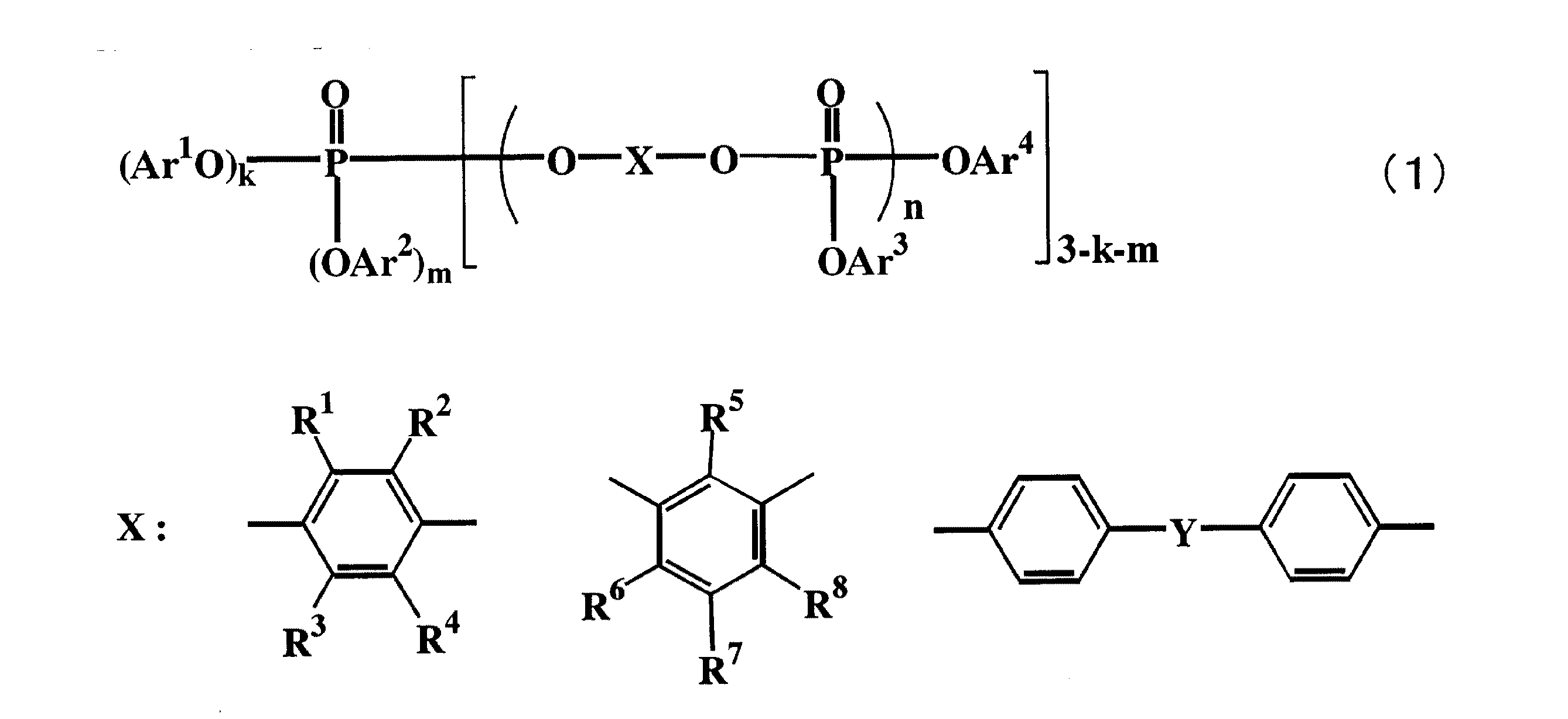
すなわち、上記目的を達成するために本発明によれば、ゴム質重合体(a)に対し、芳香族ビニル系単量体(b)、シアン化ビニル系単量体(c)および共重合可能なその他のビニル系単量体(d)から選ばれた1種類以上の単量体をグラフト共重合せしめたグラフト共重合体(A)と、芳香族ビニル系単量体(b)、シアン化ビニル系単量体(c)および共重合可能なその他のビニル系単量体(d)から選ばれた1種以上の単量体からなるビニル系(共)重合体(B)とを、重量比で(A):(B)=10:90〜60:40の割合で含む熱可塑性樹脂組成物(I)100重量部に対し、下記一般式(1)で表される芳香族リン酸エステル化合物(II) 1〜20重量部とポリリン酸アンモニウム(III)1〜30重量部(ただし、(II)と(III)の重量比{(II)/(III)}が1以上)、ポリアミドエラストマー(IV)3〜30重量部、およびさらにカルボキシル基、エポキシ基、アミノ基およびアミド基からなる群から選ばれた少なくとも一種類以上の官能基を有する変性ビニル系共重合体(V)0.1〜15重量部を添加してなる難燃性熱可塑性樹脂組成物が提供される。 That is, in order to achieve the above object, according to the present invention, an aromatic vinyl monomer (b), a vinyl cyanide monomer (c) and a copolymer can be copolymerized with the rubber polymer (a). A graft copolymer (A) obtained by graft copolymerizing one or more monomers selected from other vinyl monomers (d), an aromatic vinyl monomer (b), and cyanide A vinyl (co) polymer (B) comprising at least one monomer selected from the vinyl monomers (c) and other copolymerizable vinyl monomers (d); The aromatic phosphate ester represented by the following general formula (1) with respect to 100 parts by weight of the thermoplastic resin composition (I) contained in a ratio of (A) :( B) = 10: 90 to 60:40 1 to 20 parts by weight of compound (II) and 1 to 30 parts by weight of ammonium polyphosphate (III) (however, (II) and (III Weight ratio {(II) / (III)} is 1 or more), polyamide elastomer (IV) 3 to 30 parts by weight, and at least one selected from the group consisting of carboxyl group, epoxy group, amino group and amide group There is provided a flame retardant thermoplastic resin composition obtained by adding 0.1 to 15 parts by weight of a modified vinyl copolymer (V) having at least two types of functional groups.
なお、本発明の難燃性熱可塑性樹脂組成物においては、前記ゴム質重合体(a)の重量平均粒子径が0.1〜0.5μmであり、かつ、グラフト共重合体(A)を構成するゴム質重合体(a)と単量体との重量比が20:80〜80:20の割合であること、
前記グラフト共重合体(A)を構成する単量体組成が、芳香族ビニル系単量体(b)10〜90重量%、シアン化ビニル系単量体(c)0〜50重量%およびその他の共重合可能なビニル系単量体(d)0〜90重量%からなるものであること、
前記ビニル系(共)重合体(B)を構成する単量体組成が、芳香族ビニル系単量体(b)10〜90重量%、シアン化ビニル系単量体(c)0〜50重量%およびその他の共重合可能なビニル系単量体(d)0〜90重量%からなるものであること、
前記ポリアミドエラストマー(IV)が、ポリアミドエラストマーであること、および、
前記変性ビニル系共重合体(V)が、少なくとも芳香族ビニル、シアン化ビニルおよびメタクリル酸とが共重合されてなる共重合体であること
が、いずれも好ましい形態であり、これらの場合にはさらに優れた効果の取得が期待できる。
In the flame retardant thermoplastic resin composition of the present invention, the rubbery polymer (a) has a weight average particle diameter of 0.1 to 0.5 μm, and the graft copolymer (A) is The weight ratio of the rubbery polymer (a) and the monomer is 20:80 to 80:20,
The monomer composition constituting the graft copolymer (A) is aromatic vinyl monomer (b) 10 to 90% by weight, vinyl cyanide monomer (c) 0 to 50% by weight and others. A copolymerizable vinyl monomer (d) of 0 to 90% by weight,
The monomer composition constituting the vinyl (co) polymer (B) is 10 to 90% by weight of the aromatic vinyl monomer (b), 0 to 50% by weight of the vinyl cyanide monomer (c). % And other copolymerizable vinyl monomers (d) 0 to 90% by weight,
The polyamide elastomer (IV) is a polyamide elastomer, and
The modified vinyl copolymer (V) is preferably a copolymer obtained by copolymerizing at least aromatic vinyl, vinyl cyanide and methacrylic acid. In these cases, Furthermore, the acquisition of an excellent effect can be expected.
また、本発明の成形品は、上記の難燃性熱可塑性樹脂製組成物からなることを特徴とする。 Moreover, the molded article of the present invention is characterized by comprising the above-mentioned flame retardant thermoplastic resin composition.
本発明によれば、難燃性、耐衝撃性、成形加工性、帯電防止性に優れた難燃性熱可塑性樹脂組成物およびそれからなる成形品を得ることができる。 ADVANTAGE OF THE INVENTION According to this invention, the flame-retardant thermoplastic resin composition excellent in the flame retardance, impact resistance, molding processability, and antistatic property, and a molded article consisting thereof can be obtained.
以下、本発明を具体的に説明する。
本発明におけるグラフト共重合体(A)に用いられるゴム質重合体(a)には特に制限はないが、ジエン系ゴム、アクリル系ゴム、エチレン系ゴム等が使用できる。具体例として、ポリブタジエン、ポリ(ブタジエン−スチレン)、ポリ(ブタジエン−アクリロニトリル)、ポリイソプレン、ポリ(ブタジエン−アクリル酸ブチル)、ポリ(ブタジエン−メタクリル酸メチル)、ポリ(アクリル酸ブチル−メタクリル酸メチル)、ポリ(ブタジエン−アクリル酸エチル)、エチレン−プロピレンラバー、エチレン−プロピレン−ジエンラバー、ポリ(エチレン−イソプレン)、およびポリ(エチレン−アクリル酸メチル)等が挙げられる。これらのゴム質重合体(a)は、1種または2種以上の混合物で使用される。これらのゴム質重合体(a)のなかでも、ポリブタジエン、ポリ(ブタジエン−スチレン)、ポリ(ブタジエン−アクリロニトリル)、およびエチレン−プロピレンラバーが、いずれも耐衝撃性の点で好ましく用いられる。
The present invention will be specifically described below.
The rubbery polymer (a) used for the graft copolymer (A) in the present invention is not particularly limited, but diene rubber, acrylic rubber, ethylene rubber, and the like can be used. Specific examples include polybutadiene, poly (butadiene-styrene), poly (butadiene-acrylonitrile), polyisoprene, poly (butadiene-butyl acrylate), poly (butadiene-methyl methacrylate), poly (butyl acrylate-methyl methacrylate). ), Poly (butadiene-ethyl acrylate), ethylene-propylene rubber, ethylene-propylene-diene rubber, poly (ethylene-isoprene), poly (ethylene-methyl acrylate), and the like. These rubbery polymers (a) are used in one kind or a mixture of two or more kinds. Among these rubbery polymers (a), polybutadiene, poly (butadiene-styrene), poly (butadiene-acrylonitrile), and ethylene-propylene rubber are all preferably used in terms of impact resistance.
本発明におけるグラフト共重合体(A)を構成するゴム質重合体(a)の重量平均粒子径には特に制限はないが、0.1〜0.5μmの範囲であることが好ましい。この範囲であれば、得られる難燃性熱可塑性樹脂組成物は衝撃強度と成形性のバランスが良好なものとなる。 Although there is no restriction | limiting in particular in the weight average particle diameter of the rubber-like polymer (a) which comprises the graft copolymer (A) in this invention, It is preferable that it is the range of 0.1-0.5 micrometer. If it is this range, the flame-retardant thermoplastic resin composition obtained will have a good balance between impact strength and moldability.
本発明におけるグラフト共重合体(A)およびビニル系(共)重合体(B)に用いられる芳香族ビニル系単量体(b)には特に制限はないが、具体例として、スチレン、α−メチルスチレン、オルソメチルスチレン、パラメチルスチレン、パラ−t−ブチルスチレンおよびハロゲン化スチレン等が挙げられ、1種または2種以上用いることができる。なかでも、スチレンおよびα−メチルスチレンが、機械特性、生産性、経済性などのバランスの点で好ましく、特に好ましくはスチレンである。 The aromatic vinyl monomer (b) used in the graft copolymer (A) and the vinyl (co) polymer (B) in the present invention is not particularly limited, but specific examples include styrene, α- Examples thereof include methyl styrene, orthomethyl styrene, paramethyl styrene, para-t-butyl styrene, and halogenated styrene, and one or more can be used. Of these, styrene and α-methylstyrene are preferable from the viewpoint of balance of mechanical properties, productivity, economy, and the like, and styrene is particularly preferable.
本発明におけるグラフト共重合体(A)およびビニル系(共)重合体(B)に用いるシアン化ビニル系単量体(c)は特に制限はないが、具体例として、アクリロニトリル及びメタクリロニトリル等が挙げられ、1種または2種以上用いることができる。なかでもアクリロニトリルが耐衝撃性の点で好ましい。 The vinyl cyanide monomer (c) used in the graft copolymer (A) and vinyl (co) polymer (B) in the present invention is not particularly limited, but specific examples include acrylonitrile and methacrylonitrile. 1 type or 2 types or more can be used. Of these, acrylonitrile is preferable in terms of impact resistance.
本発明におけるグラフト共重合体(A)およびビニル系(共)重合体(B)に用いられる共重合可能なその他のビニル系単量体(d)には特に制限はないが、具体例として、(メタ)アクリル酸メチル、(メタ)アクリル酸エチル、(メタ)アクリル酸n−プロピル、(メタ)アクリル酸n−ブチル、(メタ)アクリル酸t−ブチル、(メタ)アクリル酸n−ヘキシル、(メタ)アクリル酸シクロヘキシル、(メタ)アクリル酸クロロメチルおよび(メタ)アクリル酸2−クロロエチル等の炭素数1〜6のアルキル基または置換アルキル基を持つアクリル酸エステルおよび/またはメタクリル酸エステル、N−メチルマレイミド、N−シクロヘキシルマレイミド、N−フェニルマレイミド等のマレイミド化合物、マレイン酸等の不飽和ジカルボン酸、無水マレイン酸等の不飽和ジカルボン酸無水物およびアクリルアミド等の不飽和アミド化合物に代表される共重合可能なビニル化合物等を挙げることができ、これらは単独ないし2種以上を用いることができる。 There are no particular restrictions on the copolymerizable other vinyl monomer (d) used in the graft copolymer (A) and vinyl (co) polymer (B) in the present invention. Methyl (meth) acrylate, ethyl (meth) acrylate, n-propyl (meth) acrylate, n-butyl (meth) acrylate, t-butyl (meth) acrylate, n-hexyl (meth) acrylate, (Meth) acrylic acid cyclohexyl, (meth) acrylic acid chloromethyl and (meth) acrylic acid 2-chloroethyl acrylic acid ester and / or methacrylic acid ester having 1-6 carbon atoms or substituted alkyl group, N -Maleimide compounds such as methylmaleimide, N-cyclohexylmaleimide, N-phenylmaleimide, and unsaturated dicarls such as maleic acid Examples thereof include copolymerizable vinyl compounds represented by unsaturated dicarboxylic acid anhydrides such as acid and maleic anhydride, and unsaturated amide compounds such as acrylamide. These may be used alone or in combination of two or more. it can.
グラフト共重合体(A)に用いる単量体組成は、芳香族ビニル系単量体(b)10〜90重量%を含むことが好ましい。より好ましくは20〜80重量%である。また、グラフト共重合体(A)は、シアン化ビニル系単量体(c)を、必要に応じて、0〜50重量%、好ましくは0〜40重量%含むことができる。さらに、グラフト共重合体は、必要に応じて、その他の共重合可能なビニル系単量体(d)0〜90重量%、好ましくは0〜80重量%を含むことができる。かかる組成においては、成形性よび耐衝撃性がバランスのとれたものとなり好ましい。 The monomer composition used for the graft copolymer (A) preferably contains 10 to 90% by weight of the aromatic vinyl monomer (b). More preferably, it is 20 to 80% by weight. The graft copolymer (A) can contain 0 to 50% by weight, preferably 0 to 40% by weight, of the vinyl cyanide monomer (c) as necessary. Furthermore, the graft copolymer may contain 0 to 90% by weight, preferably 0 to 80% by weight, of another copolymerizable vinyl monomer (d) as necessary. Such a composition is preferable because the moldability and impact resistance are balanced.
また、グラフト共重合体(A)におけるゴム質重合体(a)の含有量は特に制限はないが、20〜80重量部が好ましい。20重量部未満では得られる難燃性熱可塑性樹脂組成物の衝撃強度が低下し、80重量部を越えると溶融粘度が上昇して成形性が悪くなるため好ましくない。さらに好ましくは35重量部〜60重量部である。なお、グラフト共重合体(A)に配合された単量体混合物は、そのすべてが、ゴム質重合体(a)と結合してグラフト化している必要はなく、単量体混合物の単量体同士で結合し、グラフト化していない重合体として含まれていても良い。しかし、グラフト率は好ましくは、10〜100%、特に好ましいのは20〜50%である。 The content of the rubbery polymer (a) in the graft copolymer (A) is not particularly limited, but is preferably 20 to 80 parts by weight. If it is less than 20 parts by weight, the impact strength of the obtained flame-retardant thermoplastic resin composition is lowered, and if it exceeds 80 parts by weight, the melt viscosity is increased and the moldability is deteriorated. More preferably, it is 35 to 60 parts by weight. The monomer mixture blended in the graft copolymer (A) does not have to be all grafted by being bonded to the rubber polymer (a). They may be bonded together and included as an ungrafted polymer. However, the graft ratio is preferably 10 to 100%, particularly preferably 20 to 50%.
本発明におけるビニル系(共)重合体(B)を構成する芳香族ビニル系単量体(b)、シアン化ビニル系単量体(c)、および必要に応じて共重合可能なその他のビニル系単量体(d)の組成には特に制限はないが、成形性と耐衝撃性とのバランスをとる点で、好ましくは芳香族ビニル系単量体(b)10〜90重量%、シアン化ビニル系単量体(c)0〜50重量%、および共重合可能なその他のビニル系単量体(d)0〜90重量%である。さらに好ましくは芳香族ビニル系単量体(b)20〜80重量%、シアン化ビニル系単量体(c)0〜40重量%、および共重合可能なその他のビニル系単量体(d)0〜80重量%である。 Aromatic vinyl monomer (b), vinyl cyanide monomer (c) constituting vinyl (co) polymer (B) in the present invention, and other vinyls copolymerizable as required The composition of the monomer (d) is not particularly limited, but is preferably 10 to 90% by weight of an aromatic vinyl monomer (b) and cyan in terms of balancing moldability and impact resistance. The vinyl fluoride monomer (c) is 0 to 50% by weight, and the other copolymerizable vinyl monomer (d) is 0 to 90% by weight. More preferably, the aromatic vinyl monomer (b) is 20 to 80% by weight, the vinyl cyanide monomer (c) is 0 to 40% by weight, and other copolymerizable vinyl monomers (d). 0 to 80% by weight.
本発明におけるビニル系(共)重合体(B)の還元粘度(ηsp/c)は特に制限はないが、0.1〜0.8dl/gがの範囲が好ましい。これ以外の場合には、耐衝撃性が低下し、或いは溶融粘度が上昇して成形性が悪くなりやすい。さらに好ましくは0.3〜0.7dl/gの範囲である。 The reduced viscosity (ηsp / c) of the vinyl (co) polymer (B) in the present invention is not particularly limited, but is preferably in the range of 0.1 to 0.8 dl / g. In other cases, the impact resistance is lowered, or the melt viscosity is increased and the moldability tends to be deteriorated. More preferably, it is the range of 0.3-0.7 dl / g.
なおビニル系(共)重合体(B)は複数種類用いることが出来る。 A plurality of types of vinyl-based (co) polymers (B) can be used.
本発明におけるグラフト共重合体(A)およびビニル系(共)重合体(B)の製造方法については特に制限はなく、塊状重合、溶液重合、懸濁重合および乳化重合等のいずれでもよい。単量体の仕込み方法にも特に制限はなく、初期一括仕込み、単量体の一部または全てを連続仕込み、あるいは単量体の一部または全てを分割仕込みのいずれの方法を用いてもよい。 There is no restriction | limiting in particular about the manufacturing method of the graft copolymer (A) and vinyl type (co) polymer (B) in this invention, Any of block polymerization, solution polymerization, suspension polymerization, emulsion polymerization, etc. may be sufficient. There is no particular limitation on the monomer charging method, and any method of initial batch charging, continuous charging of part or all of the monomer, or partial charging of part or all of the monomer may be used. .
本発明の熱可塑性樹脂(I)を構成するグラフト共重合体(A)とビニル系(共)重合体(B)との混合比は、グラフト共重合体(A)10〜60重量部、ビニル系(共)重合体(B)40〜90重量部の割合である。グラフト共重合体(A)が10重量部未満もしくはビニル系(共)重合体(B)が90重量部を越えると、衝撃強度が低下する。また、グラフト共重合体(A)が60重量部を越えると溶融粘度が上昇して成形性が悪くなる。好ましくはグラフト共重合体(A)20〜50重量部、ビニル系(共)重合体(B)50〜80重量部の割合である。 The mixing ratio of the graft copolymer (A) and the vinyl (co) polymer (B) constituting the thermoplastic resin (I) of the present invention is 10 to 60 parts by weight of the graft copolymer (A), vinyl. It is a ratio of 40 to 90 parts by weight of the system (co) polymer (B). When the graft copolymer (A) is less than 10 parts by weight or the vinyl (co) polymer (B) is more than 90 parts by weight, the impact strength is lowered. On the other hand, if the graft copolymer (A) exceeds 60 parts by weight, the melt viscosity increases and the moldability deteriorates. The ratio is preferably 20 to 50 parts by weight of the graft copolymer (A) and 50 to 80 parts by weight of the vinyl (co) polymer (B).
本発明で使用する難燃剤である芳香族リン酸エステル化合物(II)とは、上記式(1)で表されるものである。 The aromatic phosphate compound (II), which is a flame retardant used in the present invention, is represented by the above formula (1).
まず、前記式(1)で表される難燃剤の構造について説明する。 First, the structure of the flame retardant represented by the formula (1) will be described.
前記式(1)の式中、R1〜R8は同一または相異なる水素または炭素数1〜5のアルキル基を表す。 In the formula (1), R 1 to R 8 represent the same or different hydrogen or an alkyl group having 1 to 5 carbon atoms.
ここで炭素数1〜5のアルキル基の具体例としては、メチル基、エチル基、n−プロピル基、イソプロピル基、n−ブチル基、sec−ブチル基、tert−ブチル基、n−イソプロピル、ネオペンチル、tert−ペンチル基、2−イソプロピル、ネオペンチル、tert−ペンチル基、3−イソプロピル、ネオペンチル、tert−ペンチル基、ネオイソプロピル、ネオペンチル、tert−ペンチル基などが挙げられるが、水素、メチル基、エチル基が好ましく、とりわけ水素が好ましい。 Specific examples of the alkyl group having 1 to 5 carbon atoms include methyl group, ethyl group, n-propyl group, isopropyl group, n-butyl group, sec-butyl group, tert-butyl group, n-isopropyl and neopentyl. , Tert-pentyl group, 2-isopropyl, neopentyl, tert-pentyl group, 3-isopropyl, neopentyl, tert-pentyl group, neoisopropyl, neopentyl, tert-pentyl group, etc., hydrogen, methyl group, ethyl group Are preferable, and hydrogen is particularly preferable.
また、Ar1、Ar2、Ar3、Ar4は同一または相異なるフェニル基あるいはハロゲンを含有しない有機残基で置換されたフェニル基を表す。具体例としては、フェニル基、トリル基、キシリル基、クメニル基、メシチル基、ナフチル基、インデニル基、アントリル基などが挙げられるが、フェニル基、トリル基、キシリル基、クメニル基、ナフチル基が好ましく、特にフェニル基、トリル基、キシリル基が好ましい。 Ar 1 , Ar 2 , Ar 3 and Ar 4 represent the same or different phenyl groups or phenyl groups substituted with an organic residue containing no halogen. Specific examples include phenyl group, tolyl group, xylyl group, cumenyl group, mesityl group, naphthyl group, indenyl group, anthryl group, etc., but phenyl group, tolyl group, xylyl group, cumenyl group, naphthyl group are preferable. In particular, a phenyl group, a tolyl group, and a xylyl group are preferable.
また、式中のYは直接結合、O、S、SO2、C(CH3)2、CH2、CHPhを表し、Phはフェニル基を表す。 Y in the formula represents a direct bond, O, S, SO 2 , C (CH 3 ) 2 , CH 2 , or CHPh, and Ph represents a phenyl group.
また、nは0以上の整数である。また、k、mはそれぞれ0以上2以下の整数であり、かつk+mは、0以上2以下の整数であるが、好ましくはk、mはそれぞれ0以上1以下の整数、特に好ましくはk、mはそれぞれ1である。 N is an integer of 0 or more. K and m are each an integer of 0 or more and 2 or less, and k + m is an integer of 0 or more and 2 or less, preferably k or m is an integer of 0 or more and 1 or less, particularly preferably k or m. Is 1 respectively.
芳香族りん酸エステル化合物(II)の含有量は、グラフト共重合体(A)およびビニル系共重合体(B)の合計100重量部に対して1〜30重量部が好ましく、より好ましくは3〜20重量部である。芳香族りん酸エステル化合物(II)の含有量が1重量部未満では難燃性が不十分であり、30重量部を越えると得られる難燃性熱可塑性樹脂の耐衝撃性が低下する。 The content of the aromatic phosphate ester compound (II) is preferably 1 to 30 parts by weight, more preferably 3 parts by weight with respect to 100 parts by weight in total of the graft copolymer (A) and the vinyl copolymer (B). ~ 20 parts by weight. When the content of the aromatic phosphate compound (II) is less than 1 part by weight, the flame retardancy is insufficient, and when it exceeds 30 parts by weight, the impact resistance of the obtained flame-retardant thermoplastic resin is lowered.
本発明のポリリン酸アンモニウム(III)は、下記一般式(2)で表される化合物であり、分岐したものや末端の一部が他の基によって置換されたものも使用できる。さらに望ましくは、リン含有量が25〜32重量%程度の化合物であり、例えば、ヘキストジャパン(株)製“hostaflameAP422”あるいは住友化学工業(株)製“スミセーフP”などとして市販されているものなどを用いることができる。 Ammonium polyphosphate (III) of the present invention is a compound represented by the following general formula (2), and a branched one or one having a terminal partially substituted with another group can also be used. More desirably, it is a compound having a phosphorus content of about 25 to 32% by weight, such as those marketed as “hostaflame AP422” manufactured by Hoechst Japan Co., Ltd. or “Sumisafe P” manufactured by Sumitomo Chemical Co., Ltd. Can be used.
一般式(2)中、nはポリリン酸アンモニウムの重合度を表し、その値は通常1〜5,000、好ましくは3〜2,000、特に好ましくは5〜1,000である。 In general formula (2), n represents the polymerization degree of ammonium polyphosphate, and the value thereof is usually 1 to 5,000, preferably 3 to 2,000, particularly preferably 5 to 1,000.
また、本発明は上記ポリリン酸アンモニウム(III)をメラミン、ベンゾグアナミン化合物などのトリアジン誘導体で表面処理した変性ポリリン酸アンモニウム、例えば、チッソ(株)製“terrajuC60”などとして市販されているものも含むことができる。ポリリン酸アンモニウムの平均粒子径は特に制限されないが、難燃性の点から、50μm以下、特に好ましくは20μm以下である。 The present invention also includes a modified ammonium polyphosphate obtained by surface-treating the above ammonium (III) polyphosphate with a triazine derivative such as melamine or a benzoguanamine compound, for example, commercially available as “terrajuC60” manufactured by Chisso Corporation. Can do. The average particle diameter of ammonium polyphosphate is not particularly limited, but is 50 μm or less, particularly preferably 20 μm or less from the viewpoint of flame retardancy.
上記ポリリン酸アンモニウム(III)の含有量は、グラフト共重合体(A)およびビニル系共重合体(B)の合計100重量部に対して1〜30重量部が好ましく、より好ましくは3〜20重量部である。ポリリン酸アンモニウム(III)の含有量が1重量部未満では得られる難燃性熱可塑性樹脂組成物の難燃性不十分であり、30重量部を超えるものは耐衝撃性が低下する。 The content of the ammonium polyphosphate (III) is preferably 1 to 30 parts by weight, more preferably 3 to 20 parts per 100 parts by weight in total of the graft copolymer (A) and the vinyl copolymer (B). Parts by weight. When the content of ammonium polyphosphate (III) is less than 1 part by weight, the flame-retardant thermoplastic resin composition obtained is insufficient in flame retardancy, and when it exceeds 30 parts by weight, impact resistance is lowered.
また、本発明において芳香族リン酸エステル化合物(II)とポリリン酸アンモニウム(III)の添加量は、その重量比{(II)/(III)}が1以上である。重量比が1未満では、得られる難燃性熱可塑性樹脂組成物の難燃性が低下する。 In the present invention, the addition amount of the aromatic phosphate compound (II) and ammonium polyphosphate (III) is such that the weight ratio {(II) / (III)} is 1 or more. When the weight ratio is less than 1, the flame retardancy of the obtained flame retardant thermoplastic resin composition is lowered.
本発明におけるポリアミドエラストマー(IV)としては、例えば炭素数が6以上のポリアミド形成成分(a)、ポリ(アルキレンオキシド)グリコール(b)との反応によるグラフトまたはブロック共重合体が挙げられる。ここで、炭素数が6以上のアミド形成成分(a)としては、具体的には、ω−アミノカプロン酸、ω−アミノエナント酸、ω−アミノカプリル酸、ω−アミノペルゴン酸、ω−アミノカプリン酸、11−アミノウンデカン酸、12−アミノドデカン酸等のアミノカルボン酸、あるいはカプロラクタム、エナントラクタム、カプリルラクタム、ラウロラクタム等のラクタム、ヘキサメチレンジアミン−アジピン酸塩、ヘキサメチレンジアミン−セバシン酸塩、ヘキサメチレンジアミン−イソフタル酸塩等のナイロン塩が挙げられる。ポリ(アルキレンオキシド)グリコール(b)の例としては、ポリエチレンオキシドグリコール、ポリ(1,2−プロピレンオキシド)グリコール、ポリ(1,3−プロピレンオキシド)グリコール、ポリ(テトラメチレンオキシド)グリコール、ポリ(ヘキサメチレンオキシド)グリコール、エチレンオキシドとプロピレンオキシドのブロックまたはランダム共重合体、エチレンオキシドとテトラヒドロフランのブロックまたはランダム共重合体等が用いられる。ポリ(アルキレンオキシド)グリコールの数平均分子量は、200〜6000の範囲であることが、重合性および剛性の点で好ましく、300〜4000がより好ましい。また、必要に応じて、(b)成分の両末端をアミノ化またはカルボキシル化してもよい。 Examples of the polyamide elastomer (IV) in the present invention include a graft or block copolymer obtained by a reaction with a polyamide-forming component (a) having 6 or more carbon atoms and a poly (alkylene oxide) glycol (b). Here, as the amide-forming component (a) having 6 or more carbon atoms, specifically, ω-aminocaproic acid, ω-aminoenanthic acid, ω-aminocaprylic acid, ω-aminopergonic acid, ω-aminocapric acid Aminocarboxylic acids such as 11-aminoundecanoic acid and 12-aminododecanoic acid; Mention may be made of nylon salts such as methylenediamine-isophthalate. Examples of poly (alkylene oxide) glycol (b) include polyethylene oxide glycol, poly (1,2-propylene oxide) glycol, poly (1,3-propylene oxide) glycol, poly (tetramethylene oxide) glycol, poly ( Hexamethylene oxide) glycol, ethylene oxide and propylene oxide block or random copolymer, ethylene oxide and tetrahydrofuran block or random copolymer, and the like are used. The number average molecular weight of the poly (alkylene oxide) glycol is preferably in the range of 200 to 6000 from the viewpoint of polymerizability and rigidity, and more preferably 300 to 4000. Further, if necessary, both ends of the component (b) may be aminated or carboxylated.
本発明のポリアミドエラストマー(IV)における炭素数が6以上のポリアミド形成成分(a)とポリ(アルキレンオキシド)グリコール成分(b)との結合は、通常エステル結合、アミド結合であるが、特にこれらのみに限定されない。また、ジカルボン酸(c)、ジアミン(d)等の第3成分を両成分の反応成分として用いることも可能であり、この場合のジカルボン酸成分(c)としては、炭素数4〜20のテレフタル酸、イソフタル酸、フタル酸、ナフタレン−2,7−ジカルボン酸、ジフェニル−4,4’−ジカルボン酸、ジフェノキシエタンジカルボン酸、3−スルホイソフタル酸ナトリウムのような芳香族ジカルボン酸、1,4−シクロヘキサンジカルボン酸、1,2−シクロヘキサンジカルボン酸、ジシクロヘキシル−4,4’−ジカルボン酸のような脂環族ジカルボン酸、コハク酸、シュウ酸、アジピン酸、セバシン酸、ドデカンジ酸のような脂肪族ジカルボン酸が挙げられ、特に1,4−シクロヘキサンジカルボン酸、アジピン酸、セバシン酸、ドデカンジ酸が、重合性、色調、物性の点から好ましい。一方、ジアミン成分(d)としては、芳香族、脂環族、脂肪族のジアミンが用いられ、なかでも脂肪族ジアミンのヘキサメチレンジアミンが、上記同様、重合性、色調、物性の点から好ましい。 In the polyamide elastomer (IV) of the present invention, the bond between the polyamide-forming component (a) having 6 or more carbon atoms and the poly (alkylene oxide) glycol component (b) is usually an ester bond or an amide bond. It is not limited to. It is also possible to use a third component such as dicarboxylic acid (c) or diamine (d) as a reaction component of both components. In this case, the dicarboxylic acid component (c) is terephthalate having 4 to 20 carbon atoms. Acid, isophthalic acid, phthalic acid, naphthalene-2,7-dicarboxylic acid, diphenyl-4,4′-dicarboxylic acid, diphenoxyethanedicarboxylic acid, aromatic dicarboxylic acid such as sodium 3-sulfoisophthalate, 1,4 -Aliphatic dicarboxylic acids such as cyclohexanedicarboxylic acid, 1,2-cyclohexanedicarboxylic acid, dicyclohexyl-4,4'-dicarboxylic acid, aliphatics such as succinic acid, oxalic acid, adipic acid, sebacic acid, dodecanediic acid Dicarboxylic acids, in particular 1,4-cyclohexanedicarboxylic acid, adipic acid, sebacic acid, dodecanedi But polymerizable, color tone, from the viewpoint of physical properties. On the other hand, as the diamine component (d), aromatic, alicyclic and aliphatic diamines are used, and among them, the aliphatic diamine hexamethylene diamine is preferable from the viewpoints of polymerizability, color tone and physical properties.
ポリアミドエラストマー(IV)の重合方法に関しては特に限定されず、例えばアミノカルボン酸またはラクタム(a)とジカルボン酸(c)を等モル比で反応させて、両末端がカルボン酸基のポリアミドプレポリマーを作り、これにポリ(アルキレンオキシド)グリコール(b)を真空下に反応させる方法や、上記 (a)、(b)、(c)の各化合物を反応槽に仕込み、水の存在下または非存在下に高温で加圧反応させることにより、カルボン酸末端のポリアミドプレポリマーを生成させ、その後、常圧または減圧下で重合を進める方法、あるいは、上記(a)、(b)、(c)の化合物を同時に反応槽に仕込み、溶融重合した後、高真空下で一挙に重合を進める方法などの公知の方法を採用することができる。 The method for polymerizing the polyamide elastomer (IV) is not particularly limited, and for example, an aminocarboxylic acid or lactam (a) and a dicarboxylic acid (c) are reacted in an equimolar ratio to form a polyamide prepolymer having both ends at the carboxylic acid group. A method in which poly (alkylene oxide) glycol (b) is reacted under vacuum, and each of the above compounds (a), (b) and (c) is charged into a reaction vessel, and water is present or absent. Under pressure at a high temperature to produce a carboxylic acid-terminated polyamide prepolymer, and then proceeding the polymerization under normal pressure or reduced pressure, or (a), (b) and (c) above. A known method such as a method in which a compound is charged into a reaction vessel at the same time and melt-polymerized and then polymerization is advanced under high vacuum can be employed.
ポリアミドエラストマー(IV)の含有量は、ビニル系共重合体(A)およびグラフト共重合体(B)の合計100重量部に対し、耐薬品性、帯電防止性、剛性および成形加工性とのバランスの点から3〜30重量部が好ましく、より好ましくは5〜20重量部である。ポリアミドエラストマー(IV)の含有量が3重量部未満では、得られる難燃性熱可塑性樹脂組成の帯電防止性が不十分であり、30重量部を超えると剛性および難燃性が低下する。 The content of the polyamide elastomer (IV) is balanced with chemical resistance, antistatic property, rigidity and molding processability with respect to 100 parts by weight of the total amount of the vinyl copolymer (A) and the graft copolymer (B). From the above point, 3 to 30 parts by weight is preferable, and 5 to 20 parts by weight is more preferable. When the content of the polyamide elastomer (IV) is less than 3 parts by weight, the anti-static property of the obtained flame-retardant thermoplastic resin composition is insufficient, and when it exceeds 30 parts by weight, the rigidity and flame retardancy are lowered.
本発明における変性ビニル系共重合体(IV)とは、2種以上のビニル系単量体を共重合して得られる構造を有し、分子鎖中にカルボキシル基、エポキシ基、アミノ基、アミド基の少なくとも1種の官能基を有するものである。これらの官能基の含有量としては、特に限定はないが、0.1〜20重量%が好ましく、より好ましくは0.1〜15重量%である。0.1重量%未満では耐衝撃向上効果が十分でなく、また、20重量%を越えると変性ビニル系重合体の製造が困難になったり、自己反応によるゲル化が発生することがある。変性ビニル系共重合体(IV)中にカルボキシル基、エポキシ基、アミノ基、アミド基よりなる群から選ばれた少なくとも1種の官能基を導入する方法については、特に制限されないが、通常、上記官能基を有するビニル系単量体を共重合する方法、上記官能基を有する重合開始剤または連鎖移動剤を用いて所定のビニル系単量体を共重合する方法などが例示できる。 The modified vinyl copolymer (IV) in the present invention has a structure obtained by copolymerizing two or more kinds of vinyl monomers, and has a carboxyl group, an epoxy group, an amino group, an amide in the molecular chain. It has at least one functional group. Although there is no limitation in particular as content of these functional groups, 0.1 to 20 weight% is preferable, More preferably, it is 0.1 to 15 weight%. If it is less than 0.1% by weight, the effect of improving impact resistance is not sufficient, and if it exceeds 20% by weight, it may be difficult to produce a modified vinyl polymer or gelation may occur due to self-reaction. The method for introducing at least one functional group selected from the group consisting of a carboxyl group, an epoxy group, an amino group, and an amide group into the modified vinyl copolymer (IV) is not particularly limited. Examples thereof include a method of copolymerizing a vinyl monomer having a functional group, and a method of copolymerizing a predetermined vinyl monomer using the above-described polymerization initiator having a functional group or a chain transfer agent.
上記官能基を有するビニル系単量体、重合開始剤および連鎖移動剤の具体例は以下の通りである。ビニル系単量体の例としては、アクリル酸、メタクリル酸、マレイン酸、無水マレイン酸またはイタコン酸等のカルボキシル基を有する単量体、アクリル酸グリシジル、メタクリル酸グリシジルまたはイタコン酸グリシジル等のエポキシ基を有する単量体、アクリル酸アミノエチル、メタクリル酸エチルアミノプロピル、メタクリル酸フェニルアミノエチル等の(メタ)アクリル酸のアミノアルキルエステル誘導体類、N−アセチルビニルアミン等のビニルアミン誘導体類、メタアリルアミン等のアリルアミン誘導体またはアミノスチレン等のアミノ基を有する単量体、およびアクリルアミド、N−メチルメタクリルアミド等のアミド基を有する単量体が挙げられる。 Specific examples of the vinyl monomer having the functional group, the polymerization initiator, and the chain transfer agent are as follows. Examples of vinyl monomers include monomers having a carboxyl group such as acrylic acid, methacrylic acid, maleic acid, maleic anhydride or itaconic acid, epoxy groups such as glycidyl acrylate, glycidyl methacrylate or glycidyl itaconate. Monomers having amino acids, aminoalkyl ester derivatives of (meth) acrylic acid such as aminoethyl acrylate, ethylaminopropyl methacrylate, phenylaminoethyl methacrylate, vinylamine derivatives such as N-acetylvinylamine, methallylamine, etc. Monomers having an amino group such as allylamine derivatives or aminostyrene, and monomers having an amide group such as acrylamide and N-methylmethacrylamide.
重合開始剤の例としては、γ,γ´−アゾビス(γ−シアノバレイン酸)または過酸化サクシン酸等のカルボキシル基を有する開始剤や、α, α´−アゾビス(γ−アミノ−α, γ−ジバレロニトリル)またはp−アミノベンゾイルパーオキサイド等のアミノ基を有する開始剤が挙げられる。 Examples of the polymerization initiator include initiators having a carboxyl group such as γ, γ′-azobis (γ-cyanovaleric acid) or peroxysuccinic acid, and α, α′-azobis (γ-amino-α, γ- And initiators having an amino group such as divaleronitrile) or p-aminobenzoyl peroxide.
連鎖移動剤の例としては、メルカプトプロピオン、4−メルカプト安息香酸またはチオグリコール酸等のカルボキシル基を有する連鎖移動剤やメルカプトメチルアミン、N−(β−メルカプトエチル)−N−メチルアミン、ビス−(4−アミノフェニル)ジスルフィドまたはメルカプトアニリン等のアミノ基を有する連鎖移動剤が挙げられる。 Examples of chain transfer agents include chain transfer agents having a carboxyl group such as mercaptopropion, 4-mercaptobenzoic acid or thioglycolic acid, mercaptomethylamine, N- (β-mercaptoethyl) -N-methylamine, bis- Examples include chain transfer agents having an amino group such as (4-aminophenyl) disulfide or mercaptoaniline.
変性ビニル系共重合体(IV)を共重合する際の重合方法については特に制限されないが、懸濁重合、塊状重合、乳化重合、溶液重合等の方法が好ましい。 The polymerization method for copolymerizing the modified vinyl copolymer (IV) is not particularly limited, but suspension polymerization, bulk polymerization, emulsion polymerization, solution polymerization and the like are preferable.
この変性ビニル系共重合体(IV)の還元粘度は、成形加工性および耐衝撃性の点から、0.2dl/g〜1.5dl/gの範囲が好ましい。より好ましくは0.4dl/g〜1.0dl/gの範囲である。変性ビニル共重合体(IV)の還元粘度が0.2dl/g未満であると、得られる熱可塑性樹脂組成物の耐衝撃性向上効果が十分でないことがあり、また1.5dl/gを超えると成形加工性が低下することがある。 The reduced viscosity of the modified vinyl copolymer (IV) is preferably in the range of 0.2 dl / g to 1.5 dl / g from the viewpoint of molding processability and impact resistance. More preferably, it is the range of 0.4 dl / g-1.0 dl / g. If the reduced viscosity of the modified vinyl copolymer (IV) is less than 0.2 dl / g, the resulting thermoplastic resin composition may not have sufficient impact resistance improving effect, and exceeds 1.5 dl / g. And moldability may be reduced.
変性ビニル系共重合体(IV)の含有量は、機械的強度と成形加工性とのバランスの点から、0.1〜15重量部の範囲が好ましく、より好ましくは1.0〜10重量部の範囲である。変性ビニル系共重合体(IV)の含有量が0.1重量部未満であると、得られる難燃性熱可塑性樹脂樹脂組成物の耐衝撃性向上効果が十分発揮されず、15重量部を超えると、難燃性および成型加工性が低下する傾向にある。 The content of the modified vinyl copolymer (IV) is preferably in the range of 0.1 to 15 parts by weight, more preferably 1.0 to 10 parts by weight, from the viewpoint of the balance between mechanical strength and moldability. Range. If the content of the modified vinyl copolymer (IV) is less than 0.1 part by weight, the impact resistance improving effect of the obtained flame-retardant thermoplastic resin composition is not sufficiently exhibited, and 15 parts by weight When it exceeds, it exists in the tendency for a flame retardance and a moldability to fall.
本発明の難燃性熱可塑性樹脂組成物の製造方法に関しては特に制限はなく、熱可塑性樹脂(I)、芳香族リン酸エステル化合物(II)、ポリリン酸アンモニウム(III)、ポリアミドエラストマー(IV)および変性ビニル系共重合体(V)を、例えばバンバリミキサー、ロール、エクストルーダー、ニーダー等で溶融混練することによって製造することができる。 The method for producing the flame retardant thermoplastic resin composition of the present invention is not particularly limited, and the thermoplastic resin (I), aromatic phosphate compound (II), ammonium polyphosphate (III), polyamide elastomer (IV) The modified vinyl copolymer (V) can be produced by melt-kneading with a Banbury mixer, roll, extruder, kneader, or the like.
なお本発明の難燃性熱可塑性樹脂組成物には、本発明の目的を損なわない範囲で、各種の熱可塑性樹脂やエラストマー類を配合することにより、成形用樹脂組成物として性能をさらに改良することができる。 In addition, the flame retardant thermoplastic resin composition of the present invention is further improved in performance as a molding resin composition by blending various thermoplastic resins and elastomers within a range not impairing the object of the present invention. be able to.
また、本発明の難燃性熱可塑性樹脂組成物には、必要に応じてヒンダードフェノール系、含硫黄化合物系、含リン有機化合物系等の酸化防止剤、フェノール系、アクリレート系等の熱安定剤、ベンゾトリアゾール系、ベンソフェノン系、サクシレート系等の紫外線吸収剤、有機ニッケル系、ヒンダードアミン系等の光安定剤等の各種安定剤、高級脂肪酸の金属塩類、高級脂肪酸アミド類等の滑剤、フタル酸エステル類、リン酸エステル類等の可塑剤、ハロゲン系、リン系(赤燐、リン酸エステル等)等の難燃剤、三酸化アンチモン、五酸化アンチモン等の難燃助剤、カーボンブラック、顔料および染料等を添加することもできる。 In addition, the flame retardant thermoplastic resin composition of the present invention is optionally provided with a hindered phenol-based, sulfur-containing compound-based, phosphorus-containing organic compound-based antioxidant, phenol-based, acrylate-based, etc. Agents, UV absorbers such as benzotriazoles, benzophenones, and succinates, various stabilizers such as light stabilizers such as organic nickels and hindered amines, lubricants such as metal salts of higher fatty acids, higher fatty acid amides, phthalic acid Plasticizers such as esters and phosphate esters, flame retardants such as halogens and phosphorus (red phosphorus, phosphate esters, etc.), flame retardant aids such as antimony trioxide and antimony pentoxide, carbon black, pigments and Dye etc. can also be added.
さらに、本発明の難燃性熱可塑性樹脂組成物には、各種の補強剤や充填剤を添加することもできる。 Furthermore, various reinforcing agents and fillers can also be added to the flame retardant thermoplastic resin composition of the present invention.
上記によって得られた難燃性、耐衝撃性、成形加工性および帯電防止性に優れる難燃性熱可塑性樹脂組成物は、射出成形、押出成形、ブロー成形、真空成形、圧縮成形および、ガスアシスト成形等の現在熱可塑性樹脂の成形に用いられる公知の方法によって成形することができ、特に制限されるものではない。 The flame retardant thermoplastic resin composition having excellent flame retardancy, impact resistance, molding processability and antistatic property obtained by the above is injection molding, extrusion molding, blow molding, vacuum molding, compression molding, and gas assist. It can be molded by a known method used for molding a thermoplastic resin such as molding, and is not particularly limited.
本発明の難燃性熱可塑性樹脂組成物は難燃性だけでなく、耐衝撃性、成形加工性および帯電防止性に優れた特徴を生かして、電気・電子部品、OA機器、家電機器、雑貨製品などのハウジングおよびそれらの部品類として好適に使用することができる。 The flame-retardant thermoplastic resin composition of the present invention takes advantage of not only flame retardancy but also excellent impact resistance, molding processability and antistatic properties, and is used for electrical / electronic parts, OA equipment, home appliances, miscellaneous goods. It can be suitably used as a housing of a product or the like and parts thereof.
本発明をさらに具体的に説明するために、以下、実施例および比較例を挙げて説明するが、これをもって本発明を制限するものではない。なお、実施例および比較例中、特にことわりのない限り「部」および「%」で表示したものは、それぞれ重量部および重量%を表したものである。 In order to describe the present invention more specifically, examples and comparative examples will be described below, but the present invention is not limited thereby. In Examples and Comparative Examples, unless otherwise specified, “parts” and “%” represent “parts by weight” and “% by weight”, respectively.
まず、難燃性熱可塑性樹脂組成物の特性の分析方法を下記する。 First, the analysis method of the characteristic of a flame-retardant thermoplastic resin composition is described below.
(1)重量平均ゴム粒子径
「ラバーエイジ第88巻484〜490頁(Rubber Age Vol.88 p.484〜490(1960)by E.Schmidt,P.H.Biddison)」記載のアルギン酸ナトリウム法によって求めた。すなわち、アルギン酸ナトリウムの濃度によりクリーム化するポリブタジエン粒子径が異なることを利用して、クリーム化した重量割合とアルギン酸ナトリウム濃度の累積重量分率より累積重量分率50%の粒子径を求めた。
(1) Weight average rubber particle diameter According to the sodium alginate method described in “Rubber Age Vol. 88, pp. 484-490 (Rubber Age Vol. 88 p. Asked. That is, utilizing the fact that the diameter of the polybutadiene particles to be creamed differs depending on the concentration of sodium alginate, the particle size of 50% cumulative weight fraction was determined from the weight proportion of cream and the cumulative weight fraction of sodium alginate concentration.
(2)グラフト率
グラフト共重合体の所定量(m)にアセトンを加えて3時間還流し、この溶液を8800回転/分(10000G)で40分間遠心分離した後、不溶分を濾取し、この不溶分を60℃で5時間減圧乾燥して、重量(n)を測定した。グラフト率は、下記式より算出した。
(2) Graft rate Acetone was added to a predetermined amount (m) of the graft copolymer and refluxed for 3 hours. This solution was centrifuged at 8800 rpm for 10 minutes, and the insoluble matter was collected by filtration. This insoluble matter was dried under reduced pressure at 60 ° C. for 5 hours, and the weight (n) was measured. The graft ratio was calculated from the following formula.
グラフト率(%)={[(n)−(m)×L]/[(m)×L]}×100
ここで、Lはグラフト共重合体のゴム含有量である。
Graft ratio (%) = {[(n) − (m) × L] / [(m) × L]} × 100
Here, L is the rubber content of the graft copolymer.
(3)還元粘度ηsp/c
サンプル1gにアセトン200mlを加えて3時間還流し、この溶液を8800回転/分(10000G)で40分間遠心分離した後、不溶分を濾過した。濾液をロータリーエバポレーターで濃縮し、析出物(アセトン可溶分)を60℃で5時間減圧乾燥後、0.4g/100ml(メチルエチルケトン、30℃)に調整し、ウベローデ粘度計を用い、ηsp/cを測定した。
(3) Reduced viscosity ηsp / c
200 ml of acetone was added to 1 g of the sample and refluxed for 3 hours. The solution was centrifuged at 8800 rpm for 10 minutes, and the insoluble matter was filtered. The filtrate was concentrated with a rotary evaporator, and the precipitate (acetone soluble matter) was dried under reduced pressure at 60 ° C. for 5 hours, adjusted to 0.4 g / 100 ml (methyl ethyl ketone, 30 ° C.), and then ηsp / c using an Ubbelohde viscometer. Was measured.
(4)難燃性
射出成形により得た1.5mm厚の難燃性評価用試験片について、UL94に定められている評価基準に従い難燃性を評価した。難燃性レベルはV−0、V−1、V−2、HBの順に低下する。
(4) Flame retardancy The flame retardancy was evaluated according to the evaluation standard defined in UL94 for the 1.5 mm thick flame retardant evaluation test piece obtained by injection molding. The flame retardancy level decreases in the order of V-0, V-1, V-2, and HB.
(5)アイゾット衝撃強度
ASTM D256の規定に準拠し、12.7mmノッチ付き、23℃の条件で測定した。
(5) Izod impact strength The Izod impact strength was measured under the conditions of 12.7 mm notch and 23 ° C. in accordance with ASTM D256.
(6)メルトフローレート
ISO 1133(温度:220℃、荷重:98N)に従いメルトフローレートを評価した。
(6) Melt flow rate The melt flow rate was evaluated according to ISO 1133 (temperature: 220 ° C., load: 98 N).
(7)帯電圧(静電気消散性能)、帯電圧減衰半減期
80℃熱風乾燥忌中で3時間乾燥した樹脂組成物のペレットを、シリンダー温度230℃に設定した東芝(株)製IS−50A成形機内に充填し、射出成形により得た角板成形品(40mm(W)×50mm(L)×3mm(t))にてスタティックオネストメーター(宍戸製)で測定した。成形品と印加電極の距離を15mm、検出電極との距離を10mmとし、8kVの電圧を1分間印加し、その時の帯電圧を読みとった。帯電圧減衰半減期は、印加を止め、帯電圧が半減するまでの時間を読みとった。帯電圧が低く、かつ帯電圧減衰半減期が短いほど静電気消散性能に優れていると言える。
(7) Charge voltage (electrostatic dissipative performance), charge voltage decay half-life 80-50 ° C. IS-50A molding manufactured by Toshiba Corporation in which the pellets of the resin composition dried for 3 hours in hot air drying are set at a cylinder temperature of 230 ° C. It was filled in the machine and measured with a static Honest meter (manufactured by Shishido) on a square plate molded product (40 mm (W) × 50 mm (L) × 3 mm (t)) obtained by injection molding. The distance between the molded product and the application electrode was 15 mm, the distance between the detection electrode and the detection electrode was 10 mm, a voltage of 8 kV was applied for 1 minute, and the charged voltage at that time was read. For the half-life of the charged voltage decay, application was stopped and the time until the charged voltage was halved was read. It can be said that the lower the charged voltage and the shorter the half-life of the charged voltage, the better the electrostatic dissipation performance.
[参考例1] グラフト共重合体(A)の製造方法
窒素置換した反応器に、純水120部、ブドウ糖0.5部、ピロリン酸ナトリウム0.5部、硫酸第一鉄0.005部およびポリブタジエンラテックス(ゴム粒子径0.3μm、ゲル含有率85%)60部(固形分換算)を仕込み、攪拌しながら反応器内の温度を65℃に昇温した。内温が65℃に達した時点で単量体混合物(スチレン30部およびアクリロニトリル10部)およびt−ドデシルメルカプタン0.3部からなる混合物を5時間かけて連続滴下した。単量体と同時並行で、クメンハイドロパーオキサイド0.25部、オレイン酸カリウム2.5部および純水25部からなる水溶液を7時間かけて連続滴下し、単量体の反応を完結させた。
[Reference Example 1] Production method of graft copolymer (A) In a reactor purged with nitrogen, 120 parts of pure water, 0.5 part of glucose, 0.5 part of sodium pyrophosphate, 0.005 part of ferrous sulfate and 60 parts (in terms of solid content) of polybutadiene latex (rubber particle diameter 0.3 μm, gel content 85%) was charged, and the temperature in the reactor was raised to 65 ° C. while stirring. When the internal temperature reached 65 ° C., a monomer mixture (30 parts of styrene and 10 parts of acrylonitrile) and a mixture of 0.3 part of t-dodecyl mercaptan were continuously added dropwise over 5 hours. Simultaneously with the monomer, an aqueous solution consisting of 0.25 parts cumene hydroperoxide, 2.5 parts potassium oleate and 25 parts pure water was continuously dropped over 7 hours to complete the monomer reaction. .
得られたスチレン系共重合体ラテックスは硫酸で凝固し、苛性ソーダで中和した後、洗浄・濾過・乾燥してグラフト共重合体A−1を得た。このスチレン系グラフト共重合体A−1のグラフト率は35%、樹脂成分のηsp/cは0.35dl/gであった。 The obtained styrene copolymer latex was coagulated with sulfuric acid, neutralized with caustic soda, washed, filtered, and dried to obtain graft copolymer A-1. The graft ratio of this styrene-based graft copolymer A-1 was 35%, and the ηsp / c of the resin component was 0.35 dl / g.
[参考例2] ビニル系(共)重合体(B)の製造方法
容量が20リットルで、バッフルおよびファウドラ型攪拌翼を備えたステンレス製オートクレーブに、メタクリル酸メチル20重量%、アクリルアミド80重量%からなる共重合体0.05部をイオン交換水165部に溶解した溶液を添加したのち、400r.p.mで攪拌しながら系内を窒素ガスで置換した。
[Reference Example 2] Production method of vinyl (co) polymer (B) A stainless steel autoclave having a capacity of 20 liters and equipped with a baffle and a foudra-type stirring blade was charged with 20% by weight of methyl methacrylate and 80% by weight of acrylamide. After adding a solution obtained by dissolving 0.05 part of the copolymer in 165 parts of ion-exchanged water, 400 r. p. The system was replaced with nitrogen gas while stirring at m.
次に、アクリロニトリル30部、スチレン5部、t−ドデシルメルカプタン0.46部、2,2’−アゾビス(2,4−ジメチルバレロニトリル)0.39部および2,2’−アゾビスイソブチルニトリル0.05部の単量体混合物を添加し、58℃に昇温し重合を開始した。重合開始から15分が経過した後、オートクレーブ上部に備え付けた供給ポンプからスチレン65部を110分かけて添加した。 この間、反応温度は65℃まで昇温した。スチレンの反応系への添加を終了した後、50分かけて100℃まで昇温した。以降は通常の方法に従って、反応系を冷却、ポリマーの分離、洗浄、乾燥を行い、ビニル系(共)重合体B−1を得た。このビニル系(共)重合体B−1のηsp/cは0.53dl/gであった。 Next, 30 parts of acrylonitrile, 5 parts of styrene, 0.46 part of t-dodecyl mercaptan, 0.39 part of 2,2′-azobis (2,4-dimethylvaleronitrile) and 0,2,2′-azobisisobutylnitrile .05 parts of the monomer mixture was added and the temperature was raised to 58 ° C. to initiate polymerization. After 15 minutes from the start of polymerization, 65 parts of styrene was added over 110 minutes from a supply pump provided at the top of the autoclave. During this time, the reaction temperature was raised to 65 ° C. After completing the addition of styrene to the reaction system, the temperature was raised to 100 ° C. over 50 minutes. Thereafter, the reaction system was cooled, the polymer was separated, washed and dried according to the usual method to obtain a vinyl (co) polymer B-1. The vinyl (co) polymer B-1 had a ηsp / c of 0.53 dl / g.
[参考例3] 芳香族りん酸エステル化合物(II)
<II−1>“PX−200”(大八化学工業(株)製)
[Reference Example 3] Aromatic phosphate ester compound (II)
<II-1> “PX-200” (manufactured by Daihachi Chemical Industry Co., Ltd.)
[参考例4] ポリリン酸アンモニウム(III)
<III−1> ポリリン酸アンモニウム“terrajuC60”(チッソ(株)製)
[Reference Example 4] Ammonium polyphosphate (III)
<III-1> Ammonium polyphosphate “terrajuC60” (manufactured by Chisso Corporation)
[参考例5] ポリアミドエラストマー(IV)
カプロラクタム40.0部、数平均分子量1000のポリエチレングリコール53.1部およびテレフタル酸9.2部を“イルガノックス1098”(酸化防止剤)0.2部および三酸化アンチモン触媒0.1部とともにヘリカルリボン撹拌翼を備えた反応容器に仕込み、窒素置換して260℃で1時間加熱撹拌して透明な均一溶液とした後、260℃、0.5mmHg以下の条件で4時間重合し、粘調で透明なポリマーを得た。得られたポリマーをストランド状に吐出させ、カットしてペレット上のポリエーテルエステルアミドIV−1を得た。
[Reference Example 5] Polyamide elastomer (IV)
Helical 40.0 parts caprolactam, 53.1 parts polyethylene glycol with a number average molecular weight of 1000, and 9.2 parts terephthalic acid together with 0.2 parts "Irganox 1098" (antioxidant) and 0.1 part antimony trioxide catalyst After charging into a reaction vessel equipped with a ribbon stirring blade, replacing with nitrogen and heating and stirring at 260 ° C. for 1 hour to make a transparent uniform solution, polymerization was conducted for 4 hours under the conditions of 260 ° C. and 0.5 mmHg or less. A transparent polymer was obtained. The obtained polymer was discharged in a strand shape and cut to obtain polyether ester amide IV-1 on the pellet.
[参考例6]変性ビニル系共重合体(V)
スチレン70部、アクリロニトリル25部、メタクリル酸5部を懸濁重合して、ビーズ状の変性ビニル系共重合体IV−1を得た。該変性ビニル系共重合体の還元粘度は0.55dl/gであった。
[Reference Example 6] Modified vinyl copolymer (V)
70 parts of styrene, 25 parts of acrylonitrile, and 5 parts of methacrylic acid were subjected to suspension polymerization to obtain a bead-like modified vinyl copolymer IV-1. The reduced viscosity of the modified vinyl copolymer was 0.55 dl / g.
[実施例1〜7]
参考例で示した、グラフト共重合体(A)、ビニル系(共)重合体(B)、芳香族リン酸エステル化合物(II)、ポリリン酸アンモニウム(III)、ポリアミドエラストマー(IV)および変性ビニル系共重合体(V) をそれぞれ表1に示した配合比で配合し、ベント付30mmφ2軸押出機((株)池貝製PCM−30)を使用して溶融混練、押出しを行うことによって、ペレット状の難燃性熱可塑性樹脂組成物を製造した。次いで、射出成形機を用い、シリンダー温度230℃、金型温度60℃で試験片を成形した。試験片は、上記条件で物性を測定し、結果を表1に併せて示した。
[Examples 1-7]
Graft copolymer (A), vinyl-based (co) polymer (B), aromatic phosphate compound (II), ammonium polyphosphate (III), polyamide elastomer (IV) and modified vinyl shown in Reference Examples The system copolymer (V) was blended at the blending ratios shown in Table 1, respectively, and melt-kneaded and extruded using a vented 30 mmφ twin screw extruder (Ikegai PCM-30), pellets A flame retardant thermoplastic resin composition was produced. Then, using an injection molding machine, a test piece was molded at a cylinder temperature of 230 ° C. and a mold temperature of 60 ° C. The test pieces were measured for physical properties under the above conditions, and the results are shown in Table 1.
[比較例1〜9]
参考例で示したグラフト共重合体(A)、ビニル系(共)重合体(B)、芳香族リン酸エステル化合物(II)、ポリリン酸アンモニウム(III)、ポリアミドエラストマー(IV)および変性ビニル系共重合体(V) を、それぞれ表1に示した配合比で混合し、実施例と同様の方法で成形して得られた試験片について、各物性を測定し、その測定結果を表1に併せて示した。
[Comparative Examples 1-9]
Graft copolymer (A), vinyl (co) polymer (B), aromatic phosphate ester compound (II), ammonium polyphosphate (III), polyamide elastomer (IV), and modified vinyl system shown in Reference Examples Copolymer (V) was mixed at the blending ratio shown in Table 1, and the physical properties of the test pieces obtained by molding in the same manner as in the Examples were measured. The measurement results are shown in Table 1. Also shown.
表1の結果から次のことが明らかである。本発明の難燃性熱可塑性樹脂組成物(実施例1〜7)は、いずれも難燃性、耐衝撃性、成形加工性および帯電防止性に優れていた。 From the results in Table 1, the following is clear. All of the flame-retardant thermoplastic resin compositions (Examples 1 to 7) of the present invention were excellent in flame retardancy, impact resistance, molding processability and antistatic properties.
ビニル系(共)重合体(B)の配合量が90重量部を越えるもの(比較例1)は、耐衝撃性が劣り、好ましくない。一方、グラフト共重合体(A)の配合量が60重量部を超えるもの(比較例2)は成形加工性および難燃性に劣り好ましくない。芳香族リン酸エステル化合物(II)およびポリリン酸アンモニウム(III)の添加量が1重量部未満のもの(比較例3)は難燃性に劣り、30重量部を越えるもの(比較例4)は、耐衝撃性に劣り好ましくない。芳香族リン酸エステル化合物(II)とポリリン酸アンモニウム(III)の重量比{(II)/(III)}が1未満のもの(比較例5)は、難燃性に劣り好ましくない。 A compound having a vinyl (co) polymer (B) content exceeding 90 parts by weight (Comparative Example 1) is not preferable because of its poor impact resistance. On the other hand, a blended copolymer (A) in an amount exceeding 60 parts by weight (Comparative Example 2) is not preferable because of poor molding processability and flame retardancy. When the amount of the aromatic phosphate compound (II) and ammonium polyphosphate (III) added is less than 1 part by weight (Comparative Example 3), the flame retardancy is inferior, and when the amount exceeds 30 parts by weight (Comparative Example 4) Inferior in impact resistance is not preferable. A compound having a weight ratio {(II) / (III)} of the aromatic phosphate ester compound (II) and ammonium polyphosphate (III) of less than 1 (Comparative Example 5) is not preferable because of poor flame retardancy.
ポリアミドエラストマー(IV) が3重量部未満のもの(比較例6)は得られた成形品の帯電防止性に劣り、30重量部を越えるもの(比較例7)は難燃性に劣り好ましくない。 変性ビニル系共重合体(V) が0.1重量部未満のもの(比較例8)は得られた成形品の耐衝撃性に劣り、15重量部を越えるもの(比較例9)は難燃性に劣り好ましくない。 Those having a polyamide elastomer (IV) of less than 3 parts by weight (Comparative Example 6) are inferior in antistatic property of the obtained molded product, and those having a polyamide elastomer (IV) in excess of 30 parts by weight (Comparative Example 7) are inferior in flame retardancy. When the modified vinyl copolymer (V) is less than 0.1 parts by weight (Comparative Example 8), the resulting molded article is inferior in impact resistance, and when it exceeds 15 parts by weight (Comparative Example 9) is flame retardant. It is inferior in property and is not preferable.
本発明の難燃性、耐衝撃性、成形加工性および帯電防止性に優れる難燃性熱可塑性樹脂組成物は、射出成形、ブロー成形、真空成形、圧縮成型およびガスアシスト成形等の現在熱可塑性樹脂の成形に用いられる公知の方法によって成型することができ、得られる成形品は、その優れた特徴を生かして、電気・電子部品、OA機器、家電機器、雑貨製品などのハウジングおよびそれらの部品類に適している。 The flame retardant thermoplastic resin composition excellent in flame retardancy, impact resistance, moldability and antistatic property of the present invention is currently thermoplastic such as injection molding, blow molding, vacuum molding, compression molding and gas assist molding. It can be molded by a known method used for molding of resin, and the obtained molded product takes advantage of its excellent features to make housings for electric / electronic parts, OA equipment, home appliances, miscellaneous goods, etc. and their parts. Suitable for the kind.
Claims (7)
Priority Applications (1)
| Application Number | Priority Date | Filing Date | Title |
|---|---|---|---|
| JP2004105698A JP2005290152A (en) | 2004-03-31 | 2004-03-31 | Flame retardant thermoplastic resin composition and molded article comprising the same |
Applications Claiming Priority (1)
| Application Number | Priority Date | Filing Date | Title |
|---|---|---|---|
| JP2004105698A JP2005290152A (en) | 2004-03-31 | 2004-03-31 | Flame retardant thermoplastic resin composition and molded article comprising the same |
Publications (1)
| Publication Number | Publication Date |
|---|---|
| JP2005290152A true JP2005290152A (en) | 2005-10-20 |
Family
ID=35323460
Family Applications (1)
| Application Number | Title | Priority Date | Filing Date |
|---|---|---|---|
| JP2004105698A Pending JP2005290152A (en) | 2004-03-31 | 2004-03-31 | Flame retardant thermoplastic resin composition and molded article comprising the same |
Country Status (1)
| Country | Link |
|---|---|
| JP (1) | JP2005290152A (en) |
Cited By (2)
| Publication number | Priority date | Publication date | Assignee | Title |
|---|---|---|---|---|
| EP1985661A4 (en) * | 2006-02-13 | 2010-06-23 | Toray Industries | ANTISTATIC THERMOPLASTIC RESIN COMPOSITION AND MOLDED ARTICLE FORMED THEREFROM |
| WO2018139494A1 (en) * | 2017-01-25 | 2018-08-02 | 積水化学工業株式会社 | Thermally expandable fire-resistant sheet |
-
2004
- 2004-03-31 JP JP2004105698A patent/JP2005290152A/en active Pending
Cited By (9)
| Publication number | Priority date | Publication date | Assignee | Title |
|---|---|---|---|---|
| EP1985661A4 (en) * | 2006-02-13 | 2010-06-23 | Toray Industries | ANTISTATIC THERMOPLASTIC RESIN COMPOSITION AND MOLDED ARTICLE FORMED THEREFROM |
| US8093317B2 (en) | 2006-02-13 | 2012-01-10 | Toray Industries, Inc. | Antistatic thermoplastic resin composition and molded article composed thereof |
| WO2018139494A1 (en) * | 2017-01-25 | 2018-08-02 | 積水化学工業株式会社 | Thermally expandable fire-resistant sheet |
| JP2019052308A (en) * | 2017-01-25 | 2019-04-04 | 積水化学工業株式会社 | Thermally expandable fireproof sheet |
| JP2021080466A (en) * | 2017-01-25 | 2021-05-27 | 積水化学工業株式会社 | Thermally expandable fireproof sheet |
| JP7157187B2 (en) | 2017-01-25 | 2022-10-19 | 積水化学工業株式会社 | thermally expandable fireproof sheet |
| JP2023184538A (en) * | 2017-01-25 | 2023-12-28 | 積水化学工業株式会社 | thermally expandable fireproof sheet |
| JP7656678B2 (en) | 2017-01-25 | 2025-04-03 | 積水化学工業株式会社 | Thermally expandable fireproof sheet |
| JP2025085817A (en) * | 2017-01-25 | 2025-06-05 | 積水化学工業株式会社 | Thermally expandable fireproof sheet |
Similar Documents
| Publication | Publication Date | Title |
|---|---|---|
| JP5251123B2 (en) | Antistatic thermoplastic resin composition and molded article comprising the same | |
| JPH0812868A (en) | Thermoplastic resin composition | |
| JP2007016123A (en) | Flame retardant thermoplastic resin composition and molded article comprising the same | |
| JP3376753B2 (en) | Thermoplastic resin composition | |
| JP2006169356A (en) | A flame-retardant thermoplastic resin composition and a molded article comprising the same. | |
| JPH08208972A (en) | Thermoplastic resin composition | |
| JPH01308444A (en) | Thermoplastic resin composition | |
| JP4192357B2 (en) | Flame retardant thermoplastic resin composition | |
| JP2000191877A (en) | Thermoplastic resin composition | |
| JPH1180568A (en) | Flame retardant resin composition | |
| JP2004067753A (en) | Thermoplastic resin composition and molded article comprising the same | |
| JPH11181213A (en) | Thermoplastic resin composition | |
| JPH11181264A (en) | Thermoplastic resin composition | |
| JP3663745B2 (en) | Thermoplastic resin composition | |
| JP3669361B2 (en) | Thermoplastic resin composition and molded article thereof | |
| JP2517635B2 (en) | Thermoplastic resin composition | |
| JP2669179B2 (en) | Metal corrosion resistant thermoplastic resin composition | |
| JPH10231416A (en) | Flame-retardant resin composition | |
| JP2002234984A (en) | Thermoplastic resin composition and molded article thereof | |
| JP2005187729A (en) | Thermoplastic resin composition and molded article comprising the same | |
| JPH11279394A (en) | Flame retardant thermoplastic resin composition | |
| JP2007291161A (en) | Thermoplastic resin composition and molded article comprising the same | |
| JP2005248053A (en) | A flame-retardant thermoplastic resin composition and a molded article comprising the same. | |
| JP2005248054A (en) | Thermoplastic resin composition and molded article thereof | |
| JPH11181215A (en) | Thermoplastic resin composition |