JP2005290119A - Fluorine-containing olefin polymer and antireflective coating composition for low refractive index - Google Patents
Fluorine-containing olefin polymer and antireflective coating composition for low refractive index Download PDFInfo
- Publication number
- JP2005290119A JP2005290119A JP2004104892A JP2004104892A JP2005290119A JP 2005290119 A JP2005290119 A JP 2005290119A JP 2004104892 A JP2004104892 A JP 2004104892A JP 2004104892 A JP2004104892 A JP 2004104892A JP 2005290119 A JP2005290119 A JP 2005290119A
- Authority
- JP
- Japan
- Prior art keywords
- fluorine
- refractive index
- curable resin
- resin composition
- olefin polymer
- Prior art date
- Legal status (The legal status is an assumption and is not a legal conclusion. Google has not performed a legal analysis and makes no representation as to the accuracy of the status listed.)
- Pending
Links
Images

Landscapes
- Surface Treatment Of Optical Elements (AREA)
- Addition Polymer Or Copolymer, Post-Treatments, Or Chemical Modifications (AREA)
Abstract
【課題】 透明性が高く、屈折率が低く、基材に対する密着性が大きく、しかも優れた耐布擦り性を有する硬化膜を形成することができる硬化性樹脂組成物を提供する。
【解決手段】 主鎖中にポリシロキサン骨格を4〜20モル%含有するフッ素含有オレフィン系重合体;それを含む硬化性樹脂組成物;及び硬化性樹脂組成物を硬化させた硬化物からなる低屈折率層を含む反射防止膜。
【選択図】 図1
PROBLEM TO BE SOLVED: To provide a curable resin composition capable of forming a cured film having a high transparency, a low refractive index, a high adhesion to a substrate and an excellent cloth rubbing resistance.
A fluorine-containing olefin polymer containing 4 to 20 mol% of a polysiloxane skeleton in the main chain; a curable resin composition containing the same; and a cured product obtained by curing the curable resin composition. An antireflection film including a refractive index layer.
[Selection] Figure 1
Description
本発明は、フッ素含有オレフィン系重合体及び該フッ素含有オレフィン系重合体を含有する硬化性樹脂組成物に関し、特に、高い透明性と低い反射率特性を有し、耐布擦り性が良好である硬化膜を形成する硬化性樹脂組成物及び反射防止膜に関する。 The present invention relates to a fluorine-containing olefin polymer and a curable resin composition containing the fluorine-containing olefin polymer, and in particular, has high transparency and low reflectance characteristics, and has good fabric abrasion resistance. The present invention relates to a curable resin composition and an antireflection film that form a cured film.
現在、マルチメディアの発達に伴い、各種の表示装置(ディスプレイ装置)において種々の発展が見られている。そして、各種の表示装置のうち、特に、携帯用を中心に屋外で使用されるものでは、その視認性の向上がますます重要となってきており、大型表示装置においても、より見易くすることが需要者に要求されており、この事項がそのまま技術課題となっている。 Currently, with the development of multimedia, various developments have been seen in various display devices (display devices). Among various types of display devices, especially those used outdoors, mainly for portable use, the improvement in visibility has become increasingly important, and even in large display devices, it is easier to see. This is a technical issue as it is required by consumers.
従来、表示装置の視認性を向上させるための一手段として、低屈折率材料から構成される反射防止膜を、表示装置の基板に被覆することが行われており、反射防止膜を形成する方法としては、例えば、フッ素化合物の薄膜を蒸着法により形成する方法が知られている。然るに、近年では、液晶表示装置を中心として、低いコストで、しかも大型の表示装置に対しても、反射防止膜を形成することのできる技術が求められている。しかしながら、蒸着法による場合には、大面積の基板に対して、高い効率で均一な反射防止膜を形成することが困難であり、しかも真空装置を必要とするために、コストを低くすることが困難である。 Conventionally, as one means for improving the visibility of a display device, an antireflection film made of a low refractive index material is coated on a substrate of the display device, and a method of forming the antireflection film For example, a method of forming a fluorine compound thin film by a vapor deposition method is known. However, in recent years, there has been a demand for a technique capable of forming an antireflection film for a large display device at a low cost centering on a liquid crystal display device. However, in the case of the vapor deposition method, it is difficult to form a high-efficiency and uniform antireflection film on a large-area substrate, and a vacuum apparatus is required, so that the cost can be reduced. Have difficulty.
このような事情から、屈折率の低いフッ素系重合体を有機溶剤に溶解して液状の組成物を調製し、これを基板の表面に塗布することによって反射防止膜を形成する方法が検討されている。例えば、基板の表面にフッ素化アルキルシランを塗布することが提案されている(例えば、特許文献1及び特許文献2参照)。また、特定の構造を有するフッ素系重合体を塗布する方法が提案されている(例えば、特許文献3、特許文献4参照)。 Under such circumstances, a method of forming an antireflection film by preparing a liquid composition by dissolving a fluorine-based polymer having a low refractive index in an organic solvent and applying it to the surface of a substrate has been studied. Yes. For example, it has been proposed to apply a fluorinated alkylsilane to the surface of a substrate (see, for example, Patent Document 1 and Patent Document 2). In addition, a method of applying a fluoropolymer having a specific structure has been proposed (see, for example, Patent Document 3 and Patent Document 4).
しかしながら、各種の表示装置の大型化や携帯型表示装置等の発達に伴い、これらの表示画面にはより強固な耐擦傷性やさらなる埃付着防止性が求められるようになっている。このような用途に供するには、従来のフッ素系材料による反射防止膜は、基材との密着が十分ではなく、特に、繰り返し擦過を受けた場合に、当該反射防止膜層が剥がれてしまう、加えて液晶ディスプレイ等の反射防止膜表面に空気中のゴミ、埃が付着し、視認性を低下させるという問題を有している。さらに、これまでのフッ素系重合体を含む硬化性樹脂組成物による硬化膜は布との摩擦力が大きく耐布擦り性が悪い。本発明は、以上のような状況を背景としてなされたものであって、その目的は、透明性が高く、屈折率が低く、基材に対する密着性が大きく、しかも優れた耐布擦り性を有する硬化膜を形成することができる硬化性樹脂組成物を提供することにある。本発明の他の目的は、透明性が高く、基材に対する密着性が大きく、しかも優れた耐布擦り性を有する反射防止膜を提供することにある。 However, with the increase in the size of various display devices and the development of portable display devices, these display screens are required to have stronger scratch resistance and further dust adhesion prevention properties. In order to provide such an application, the antireflection film made of a conventional fluorine-based material is not sufficiently adhered to the base material, and particularly when subjected to repeated rubbing, the antireflection film layer is peeled off. In addition, there is a problem that dust and dirt in the air adhere to the surface of an antireflection film such as a liquid crystal display, thereby reducing visibility. Furthermore, the cured film by the conventional curable resin composition containing a fluoropolymer has a large frictional force with the cloth and poor cloth abrasion resistance. The present invention has been made in the background of the above situation, and its purpose is high transparency, low refractive index, high adhesion to a substrate, and excellent cloth rubbing resistance. It is providing the curable resin composition which can form a cured film. Another object of the present invention is to provide an antireflection film having high transparency, high adhesion to a substrate, and excellent cloth abrasion resistance.
上記目的を達成するため、本発明者らは鋭意研究を重ね、フッ素系共重合体の主鎖に特定量のポリシロキサン骨格を導入することによって、塗膜表面と布との摩擦が低減され、耐布擦り性が向上することを見出し、本発明を完成させた。
すなわち、本発明は、反射防止性能に優れる従来の特性を維持しつつ、従来技術よりも基材に対する密着性に優れ、耐擦傷性が高い反射防止膜用材料を提供する。
本発明は、
(1)主鎖中にポリシロキサン骨格を4〜20モル%含有するフッ素含有オレフィン系重合体;
(2)上記(1)に記載のフッ素含有オレフィン系重合体を含む硬化性樹脂組成物;
(3)さらに架橋性化合物を含有する上記(2)に記載の硬化性樹脂組成物;及び
(4)上記(2)又は(3)に記載の硬化性樹脂組成物を硬化させた硬化物からなる低屈折率層を含む反射防止膜
を提供する。
In order to achieve the above object, the present inventors have conducted extensive research, and by introducing a specific amount of polysiloxane skeleton into the main chain of the fluorinated copolymer, the friction between the coating surface and the cloth is reduced, The present inventors have found that the fabric scuff resistance is improved and completed the present invention.
That is, the present invention provides a material for an antireflection film that has excellent adhesion to a substrate and higher scratch resistance than the prior art, while maintaining the conventional properties excellent in antireflection performance.
The present invention
(1) a fluorine-containing olefin polymer containing 4 to 20 mol% of a polysiloxane skeleton in the main chain;
(2) A curable resin composition comprising the fluorine-containing olefin polymer according to (1) above;
(3) From the cured product obtained by curing the curable resin composition according to (2) or (3) above, and (4) further containing a crosslinkable compound; An antireflection film including a low refractive index layer is provided.
本発明の硬化性樹脂組成物は、良好な熱硬化性を示し、また、本発明の硬化性樹脂組成物から形成される硬化物は、低い屈折率及び耐布擦り性に優れる。従って、本発明の硬化性樹脂組成物は、特に、反射防止膜、光ファイバー鞘材等の光学材料の形成に有利に用いることができ、また、フッ素含量が高いことを利用して、耐候性が要求される基材に対する塗料用材料、耐候フィルム用材料、コーティング用材料、その他として好適に使用することができる。しかも、当該硬化膜は、基材に対する密着性に優れ、耐擦傷性が高く、良好な反射防止効果を付与することから、反射防止膜として極めて有用であり、各種の表示装置に適用することにより、その視認性を向上させることができる。 The curable resin composition of the present invention exhibits good thermosetting properties, and the cured product formed from the curable resin composition of the present invention is excellent in a low refractive index and fabric rubbing resistance. Therefore, the curable resin composition of the present invention can be advantageously used for the formation of an optical material such as an antireflection film and an optical fiber sheath material, and has high weather resistance by utilizing the high fluorine content. It can be suitably used as a coating material, a weather-resistant film material, a coating material, etc. for the required substrate. In addition, the cured film has excellent adhesion to the base material, high scratch resistance, and imparts a good antireflection effect. Therefore, the cured film is extremely useful as an antireflection film, and can be applied to various display devices. The visibility can be improved.
以下、本発明詳細に説明する。
1.フッ素含有オレフィン系重合体
本発明のフッ素含有オレフィン系重合体は、主鎖中にポリシロキサン骨格を4〜20モル%含有するものである。なお、ポリシロキサン骨格は、下記一般式(1)で表すことができる。
1. Fluorine-containing olefin polymer The fluorine-containing olefin polymer of the present invention contains 4 to 20 mol% of a polysiloxane skeleton in the main chain. The polysiloxane skeleton can be represented by the following general formula (1).
フッ素含有オレフィン系重合体の主鎖中のポリシロキサン骨格の割合(モル%)は、13C−NMRにおける逆ゲート付きデカップリング法によって測定することができる。
フッ素含有オレフィン系重合体は、好ましくは、フッ素含量が30質量%以上であり、ポリスチレン換算による数平均分子量が5000以上である。
The ratio (mol%) of the polysiloxane skeleton in the main chain of the fluorine-containing olefin polymer can be measured by a decoupling method with a reverse gate in 13 C-NMR.
The fluorine-containing olefin polymer preferably has a fluorine content of 30% by mass or more and a number average molecular weight in terms of polystyrene of 5000 or more.
また、フッ素含有オレフィン系重合体は、好ましくはフッ素含量が30質量%以上、より好ましくは40〜60質量%のものであり、さらにゲルパーミエーションクロマトグラフィーによって得られるポリスチレン換算による数平均分子量が、好ましくは5000以上、より好ましくは10000〜500000のものである。ここに、フッ素含量は、アリザリンコンプレクソン法により測定された値、数平均分子量は、展開溶剤としてテトラヒドロフランを用いたときの値である。 Further, the fluorine-containing olefin polymer preferably has a fluorine content of 30% by mass or more, more preferably 40 to 60% by mass, and the number average molecular weight in terms of polystyrene obtained by gel permeation chromatography, Preferably it is 5000 or more, More preferably, it is 10000-500000. Here, the fluorine content is a value measured by the alizarin complexone method, and the number average molecular weight is a value when tetrahydrofuran is used as a developing solvent.
本発明におけるフッ素含有オレフィン系重合体は、(a)フッ素含有オレフィン化合物(以下「(a)成分」という。)、(b)この(a)成分と共重合可能な水酸基を含有する単量体化合物(以下「(b)成分」という。」)及び(c)アゾ基含有ポリシロキサン化合物(以下「(c)成分」という。)、並びに、必要に応じて、(d)反応性乳化剤(以下「(d)成分」という。)、及び/又は(e)前記(a)成分と共重合可能な(b)成分以外の単量体化合物を反応させることにより得ることができる。 The fluorine-containing olefin polymer in the present invention includes (a) a fluorine-containing olefin compound (hereinafter referred to as “component (a)”), (b) a monomer containing a hydroxyl group copolymerizable with the component (a). Compound (hereinafter referred to as “component (b)”) and (c) an azo group-containing polysiloxane compound (hereinafter referred to as “component (c)”), and, if necessary, (d) a reactive emulsifier (hereinafter referred to as “component”). It can be obtained by reacting a monomer compound other than the component (b) copolymerizable with the component (a) and / or (e).
(a)成分であるフッ素含有オレフィン化合物としては、少なくとも1個の重合性の不飽和二重結合と、少なくとも1個のフッ素原子を有する化合物を挙げることができ、その具体例としては、例えば、(1)テトラフロロエチレン、ヘキサフロロプロピレン、3,3,3−トリフロロプロピレン等のフロロオレフィン類;(2)パーフロロ(アルキルビニルエーテル)類もしくはパーフロロ(アルコキシアルキルビニルエーテル)類;(3)パーフロロ(メチルビニルエーテル)、パーフロロ(エチルビニルエーテル)、パーフロロ(プロピルビニルエーテル)、パーフロロ(ブチルビニルエーテル)、パーフロロ(イソブチルビニルエーテル)等のパーフロロ(アルキルビニルエーテル)類;(4)パーフロロ(プロポキシプロピルビニルエーテル)等のパーフロロ(アルコキシアルキルビニルエーテル)類;その他を挙げることができる。これらの化合物は、単独で、又は2種以上を併用することができる。以上のうち、特にヘキサフロロプロピレン、パーフロロ(アルキルビニルエーテル)又はパーフロロ(アルコキシアルキルビニルエーテル)が好ましく、さらにはこれらを組み合わせて使用することが好ましい。 Examples of the fluorine-containing olefin compound as component (a) include compounds having at least one polymerizable unsaturated double bond and at least one fluorine atom. Specific examples thereof include, for example, (1) fluoroolefins such as tetrafluoroethylene, hexafluoropropylene, 3,3,3-trifluoropropylene; (2) perfluoro (alkyl vinyl ether) or perfluoro (alkoxyalkyl vinyl ether); (3) perfluoro (methyl) (4) perfluoro (propoxypropyl vinyl), perfluoro (alkyl vinyl ether) such as vinyl ether), perfluoro (ethyl vinyl ether), perfluoro (propyl vinyl ether), perfluoro (butyl vinyl ether), perfluoro (isobutyl vinyl ether); Ether) such as perfluoro (alkoxyalkyl vinyl ethers); other can be exemplified. These compounds can be used alone or in combination of two or more. Among these, hexafluoropropylene, perfluoro (alkyl vinyl ether) or perfluoro (alkoxyalkyl vinyl ether) is particularly preferable, and a combination thereof is preferably used.
(b)成分である水酸基を含有する単量体化合物としては、例えば、(1)2−ヒドロキシエチルビニルエーテル、3−ヒドロキシプロピルビニルエーテル、2−ヒドロキシプロピルビニルエーテル、4−ヒドロキシブチルビニルエーテル、3−ヒドロキシブチルビニルエーテル、5−ヒドロキシペンチルビニルエーテル、6−ヒドロキシヘキシルビニルエーテル等の水酸基含有ビニルエーテル類;(2)2−ヒドロキシエチルアリルエーテル、4−ヒドロキシブチルアリルエーテル、グリセロールモノアリルエーテル等の水酸基含有アリルエーテル類;(3)アリルアルコール;(4)ヒドロキシエチル(メタ)アクリル酸エステル;その他を挙げることができる。これらの化合物は、単独で、又は2種以上を併用することができる。好ましくは、水酸基含有アルキルビニルエーテル類である。 Examples of the monomer compound containing a hydroxyl group as component (b) include (1) 2-hydroxyethyl vinyl ether, 3-hydroxypropyl vinyl ether, 2-hydroxypropyl vinyl ether, 4-hydroxybutyl vinyl ether, 3-hydroxybutyl. Hydroxyl group-containing vinyl ethers such as vinyl ether, 5-hydroxypentyl vinyl ether and 6-hydroxyhexyl vinyl ether; (2) hydroxyl group-containing allyl ethers such as 2-hydroxyethyl allyl ether, 4-hydroxybutyl allyl ether and glycerol monoallyl ether; 3) allyl alcohol; (4) hydroxyethyl (meth) acrylate; These compounds can be used alone or in combination of two or more. Preferred are hydroxyl-containing alkyl vinyl ethers.
(c)成分のアゾ基含有ポリシロキサン化合物としては、−N=N−で示される熱解裂容易なアゾ基を含有すると共に、前記一般式(1)で表されるポリシロキサン骨格を有する化合物であり、例えば、特開平6−93100号公報に記載された方法により製造することのできるものである。(c)成分の具体例としては、下記一般式(2)で表される化合物を挙げることができる。 As the azo group-containing polysiloxane compound of component (c), a compound having a polysiloxane skeleton represented by the above general formula (1) while containing an azo group which is easily thermally decomposable represented by -N = N- For example, it can be manufactured by the method described in JP-A-6-93100. Specific examples of the component (c) include compounds represented by the following general formula (2).
上記の(a)成分、(b)成分及び(c)成分の好ましい組み合わせは、例えば、(1)フロロオレフィン/水酸基含有アルキルビニルエーテル/ポリジメチルシロキサン単位、(2)フロロオレフィン/パーフロロ(アルキルビニルエーテル)/水酸基含有アルキルビニルエーテル/ポリジメチルシロキサン単位、(3)フロロオレフィン/パーフロロ(アルコキシアルキルビニルエーテル)/水酸基含有アルキルビニルエーテル/ポリジメチルシロキサン単位、(4)フロロオレフィン/パーフロロ(アルキルビニルエーテル)/水酸基含有アルキルビニルエーテル/ポリジメチルシロキサン単位、(5)フロロオレフィン/パーフロロ(アルコキシアルキルビニルエーテル)/水酸基含有アルキルビニルエーテル/ポリジメチルシロキサン単位である。 Preferred combinations of the components (a), (b) and (c) are, for example, (1) fluoroolefin / hydroxyl group-containing alkyl vinyl ether / polydimethylsiloxane unit, (2) fluoroolefin / perfluoro (alkyl vinyl ether) / Hydroxyl group-containing alkyl vinyl ether / polydimethylsiloxane unit, (3) fluoroolefin / perfluoro (alkoxyalkyl vinyl ether) / hydroxyl group-containing alkyl vinyl ether / polydimethylsiloxane unit, (4) fluoroolefin / perfluoro (alkyl vinyl ether) / hydroxyl group-containing alkyl vinyl ether / Polydimethylsiloxane unit, (5) fluoroolefin / perfluoro (alkoxyalkyl vinyl ether) / hydroxyl group-containing alkyl vinyl ether / polydimethylsiloxane It is a down unit.
本発明のフッ素含有オレフィン系重合体において、(a)成分に由来する構造単位は、好ましくは20〜70モル%、さらに好ましくは25〜65モル%、特に好ましくは30〜60モル%である。(a)成分に由来する構造単位の割合が20モル%未満では、得られるフッ素含有オレフィン系重合体中のフッ素含量が過少となりやすく、得られる硬化性樹脂組成物の硬化物は、屈折率が十分に低いものとなりにくい。一方、(a)成分に由来する構造単位の割合が70モル%を超えると、得られるフッ素含有オレフィン系重合体の有機溶剤への溶解性が著しく低下するとともに、得られる硬化性樹脂組成物は、透明性及び基材への密着性が小さいものとなる。 In the fluorine-containing olefin polymer of the present invention, the structural unit derived from the component (a) is preferably 20 to 70 mol%, more preferably 25 to 65 mol%, and particularly preferably 30 to 60 mol%. When the proportion of the structural unit derived from the component (a) is less than 20 mol%, the fluorine content in the resulting fluorine-containing olefin polymer tends to be excessive, and the cured product of the resulting curable resin composition has a refractive index. It is hard to be low enough. On the other hand, when the proportion of the structural unit derived from the component (a) exceeds 70 mol%, the solubility of the resulting fluorine-containing olefin polymer in an organic solvent is remarkably lowered, and the resulting curable resin composition is , Transparency and adhesion to the substrate are small.
フッ素含有オレフィン系重合体において、(b)成分に由来する構造単位は、10〜50モル%である。好ましくは下限値は13モル%以上であり、さらに好ましくは20モル%を超え、21モル%以上であり、また、好ましくは上限値は45モル%以下であり、さらに好ましくは35モル%以下である。このような(b)成分を所定量含有するフッ素含有オレフィン系重合体を用いて硬化性樹脂組成物を構成することにより、その硬化物において、良好な耐擦傷性と埃拭き取り性を実現することができる。他方、(b)成分に由来する構造単位の割合が10モル%未満では、フッ素含有オレフィン系重合体は、有機溶剤への溶解性が劣ったものとなり、50モル%を超えると、硬化性樹脂組成物による硬化物は、透明性及び低反射率の光学特性が悪化したものとなる。 In the fluorine-containing olefin polymer, the structural unit derived from the component (b) is 10 to 50 mol%. Preferably, the lower limit is 13 mol% or more, more preferably more than 20 mol% and 21 mol% or more, and preferably the upper limit is 45 mol% or less, more preferably 35 mol% or less. is there. By forming a curable resin composition using such a fluorine-containing olefin polymer containing a predetermined amount of the component (b), it is possible to achieve good scratch resistance and dust wiping in the cured product. Can do. On the other hand, when the proportion of the structural unit derived from the component (b) is less than 10 mol%, the fluorine-containing olefin polymer has poor solubility in an organic solvent, and when it exceeds 50 mol%, the curable resin The cured product of the composition has deteriorated optical properties such as transparency and low reflectance.
(c)成分のアゾ基含有ポリシロキサン化合物は、それ自体が熱ラジカル発生剤であり、フッ素含有オレフィン系重合体を得るための重合反応において重合開始剤としての作用を有するが、他のラジカル開始剤を併用することもできる。フッ素含有オレフィン系重合体における(c)成分に由来する構造単位の割合は、一般式(1)で表されるポリシロキサン骨格が、4〜20モル%、好ましくは5〜20モル%、より好ましくは7〜20モル%、特に好ましくは10〜15モル%となる割合である。一般式(1)で表されるポリシロキサン骨格の割合が20モル%を超える場合には、得られるフッ素含有オレフィン系重合体は、透明性に劣ったものとなり、また塗布剤として用いる場合には、塗布時にハジキ等が発生し易くなる。 The component (c) azo group-containing polysiloxane compound is itself a thermal radical generator, and acts as a polymerization initiator in the polymerization reaction for obtaining a fluorine-containing olefin polymer. An agent can also be used in combination. The proportion of the structural unit derived from the component (c) in the fluorine-containing olefin polymer is such that the polysiloxane skeleton represented by the general formula (1) is 4 to 20 mol%, preferably 5 to 20 mol%, more preferably. Is a ratio of 7 to 20 mol%, particularly preferably 10 to 15 mol%. When the proportion of the polysiloxane skeleton represented by the general formula (1) exceeds 20 mol%, the resulting fluorine-containing olefin polymer is inferior in transparency, and when used as a coating agent. , Repelling and the like are likely to occur during application.
本発明においては、上記(a)〜(c)成分以外に、さらに(d)成分として、反応性乳化剤を単量体成分として用いることが好ましい。この(d)成分を用いることにより、フッ素含有オレフィン系重合体を塗布剤として使用する場合に、良好な塗布性及びレベリング性を得ることができる。この反応性乳化剤としては、特に、ノニオン性反応性乳化剤を用いることが好ましい。ノニオン性反応性乳化剤の具体例としては、例えば、下記一般式(3)又は一般式(4)で示される化合物を挙げることができる。 In the present invention, in addition to the components (a) to (c), it is preferable to use a reactive emulsifier as a monomer component as the component (d). By using this component (d), good coating properties and leveling properties can be obtained when using a fluorine-containing olefin polymer as a coating agent. As the reactive emulsifier, it is particularly preferable to use a nonionic reactive emulsifier. Specific examples of the nonionic reactive emulsifier include compounds represented by the following general formula (3) or general formula (4).
フッ素含有オレフィン系重合体において、(d)成分由来の構成単位の割合は、好ましくは0〜10モル%であり、さらに好ましくは0.1〜5モル%、特に好ましくは0.1〜1モル%である。この割合が10モル%を超えると、得られる硬化性樹脂組成物が粘着性を帯びたものとなるために取り扱いが困難となり、塗布剤として使用する場合に耐湿性が低下する。 In the fluorine-containing olefin polymer, the proportion of the structural unit derived from the component (d) is preferably 0 to 10 mol%, more preferably 0.1 to 5 mol%, particularly preferably 0.1 to 1 mol. %. When this ratio exceeds 10 mol%, the resulting curable resin composition is tacky and difficult to handle, and moisture resistance decreases when used as a coating agent.
(e)成分の、(a)成分と共重合可能な(b)成分以外の単量体化合物としては、(1)メチルビニルエーテル、エチルビニルエーテル、n−プロピルビニルエーテル、イソプロピルビニルエーテル、n−ブチルビニルエーテル、イソブチルビニルエーテル、tert−ブチルビニルエーテル、n−ペンチルビニルエーテル、n−ヘキシルビニルエーテル、n−オクチルビニルエーテル、n−ドデシルビニルエーテル、2−エチルヘキシルビニルエーテル、シクロヘキシルビニルエーテル等のアルキルビニルエーテルもしくはシクロアルキルビニルエーテル類;(2)酢酸ビニル、プロピオン酸ビニル、酪酸ビニル、ピバリン酸ビニル、カプロン酸ビニル、バーサチック酸ビニル、ステアリン酸ビニル等のカルボン酸ビニルエステル類;(3)メチル(メタ)アクリレート、エチル(メタ)アクリレート、n−ブチル(メタ)アクリレート、イソブチル(メタ)アクリレート、2−メトキシエチル(メタ)アクリレート、2−エトキシエチル(メタ)アクリレート、2−(n−プロポキシ)エチル(メタ)アクリレート等の(メタ)アクリル酸エステル類;(4)(メタ)アクリル酸、クロトン酸、マレイン酸、フマル酸、イタコン酸等のカルボキシル基含有単量体化合物等であって、水酸基を含有しないものを挙げることができる。好ましくは、アルキルビニルエーテルである。 (E) As a monomer compound other than the component (b) that can be copolymerized with the component (a), (1) methyl vinyl ether, ethyl vinyl ether, n-propyl vinyl ether, isopropyl vinyl ether, n-butyl vinyl ether, Alkyl vinyl ethers or cycloalkyl vinyl ethers such as isobutyl vinyl ether, tert-butyl vinyl ether, n-pentyl vinyl ether, n-hexyl vinyl ether, n-octyl vinyl ether, n-dodecyl vinyl ether, 2-ethylhexyl vinyl ether, cyclohexyl vinyl ether; (2) vinyl acetate , Vinyl carboxylates such as vinyl propionate, vinyl butyrate, vinyl pivalate, vinyl caproate, vinyl versatate, vinyl stearate; ) Methyl (meth) acrylate, ethyl (meth) acrylate, n-butyl (meth) acrylate, isobutyl (meth) acrylate, 2-methoxyethyl (meth) acrylate, 2-ethoxyethyl (meth) acrylate, 2- (n- (Meth) acrylic acid esters such as propoxy) ethyl (meth) acrylate; (4) carboxyl group-containing monomer compounds such as (meth) acrylic acid, crotonic acid, maleic acid, fumaric acid, itaconic acid, etc. The thing which does not contain a hydroxyl group can be mentioned. Alkyl vinyl ether is preferable.
フッ素含有オレフィン系重合体において、(e)成分由来の構成単位の割合は、好ましくは0〜70モル%であり、さらに好ましくは5〜35モル%である。この割合が70モル%を超えると、得られる硬化性樹脂組成物が粘着性を帯びたものとなるために取り扱いが困難となり、塗布剤として使用する場合に耐湿性が低下する。 In the fluorine-containing olefin polymer, the proportion of the structural unit derived from the component (e) is preferably 0 to 70 mol%, more preferably 5 to 35 mol%. When this ratio exceeds 70 mol%, the resulting curable resin composition becomes tacky and difficult to handle, and moisture resistance decreases when used as a coating agent.
(d)成分を含有する場合の、(a)成分、(b)成分、(c)成分、(d)成分及び(e)成分の好ましい組み合わせは次のとおりである。
(1)フロロオレフィン/水酸基含有ビニルエーテル/ポリジメチルシロキサン単位/ノニオン性反応性乳化剤/アルキルビニルエーテル、(2)フロロオレフィン/パーフロロ(アルキルビニルエーテル)/水酸基含有ビニルエーテル/ポリジメチルシロキサン単位/ノニオン性反応性乳化剤/アルキルビニルエーテル、(3)フロロオレフィン/パーフロロ(アルコキシアルキルビニルエーテル)/水酸基含有ビニルエーテル/ポリジメチルシロキサン単位/ノニオン性反応性乳化剤/アルキルビニルエーテル、(4)フロロオレフィン/パーフロロ(アルキルビニルエーテル)/水酸基含有ビニルエーテル/ポリジメチルシロキサン単位/ノニオン性反応性乳化剤/アルキルビニルエーテル、(5)フロロオレフィン/パーフロロ(アルコキシアルキルビニルエーテル)/水酸基含有ビニルエーテル/ポリジメチルシロキサン単位/ノニオン性反応性乳化剤/アルキルビニルエーテル。
When the component (d) is contained, preferred combinations of the component (a), the component (b), the component (c), the component (d), and the component (e) are as follows.
(1) fluoroolefin / hydroxyl group-containing vinyl ether / polydimethylsiloxane unit / nonionic reactive emulsifier / alkyl vinyl ether, (2) fluoroolefin / perfluoro (alkyl vinyl ether) / hydroxyl group-containing vinyl ether / polydimethylsiloxane unit / nonionic reactive emulsifier / Alkyl vinyl ether, (3) fluoroolefin / perfluoro (alkoxyalkyl vinyl ether) / hydroxyl group-containing vinyl ether / polydimethylsiloxane unit / nonionic reactive emulsifier / alkyl vinyl ether, (4) fluoroolefin / perfluoro (alkyl vinyl ether) / hydroxyl group-containing vinyl ether / Polydimethylsiloxane unit / nonionic reactive emulsifier / alkyl vinyl ether, (5) fluoroolefin / perfluoro (A) Job Shi alkyl vinyl ether) / hydroxyl group-containing vinyl ether / polydimethylsiloxane unit / nonionic reactive emulsifier / alkyl vinyl ether.
(c)成分と併用することができるラジカル重合開始剤としては、例えば、(1)アセチルパーオキサイド、ベンゾイルパーオキサイド等のジアシルパーオキサイド類;(2)メチルエチルケトンパーオキサイド、シクロヘキサノンパーオキサイド等のケトンパーオキサイド類;(3)過酸化水素、tert−ブチルハイドロパーオキサイド、クメンハイドロパーオキサイド等のハイドロパーオキサイド類;(4)ジ−tert−ブチルパーオキサイド、ジクミルパーオキサイド、ジラウロイルパーオキサイド等のジアルキルパーオキサイド類;(5)tert−ブチルパーオキシアセテート、tert−ブチルパーオキシピバレート等のパーオキシエステル類;(6)アゾビスイソブチロニトリル、アゾビスイソバレロニトリル等のアゾ系化合物類;(7)過硫酸アンモニウム、過硫酸ナトリウム、過硫酸カリウム、過酸化ラウロイル等の過硫酸塩類;その他を挙げることができる。 Examples of radical polymerization initiators that can be used in combination with component (c) include (1) diacyl peroxides such as acetyl peroxide and benzoyl peroxide; (2) ketone peroxides such as methyl ethyl ketone peroxide and cyclohexanone peroxide. (3) Hydroperoxides such as hydrogen peroxide, tert-butyl hydroperoxide, cumene hydroperoxide; (4) Di-tert-butyl peroxide, dicumyl peroxide, dilauroyl peroxide, etc. Dialkyl peroxides; (5) peroxyesters such as tert-butylperoxyacetate and tert-butylperoxypivalate; and (6) azo-based compounds such as azobisisobutyronitrile and azobisisovaleronitrile. Compounds like; (7) ammonium persulfate, sodium persulfate, potassium persulfate, persulfates such as lauroyl peroxide; other can be exemplified.
上記のラジカル重合開始剤以外の具体例としては、例えば、パーフロロエチルアイオダイド、パーフロロプロピルアイオダイド、パーフロロブチルアイオダイド、(パーフロロブチル)エチルアイオダイド、パーフロロヘキシルアイオダイド、2−(パーフロロヘキシル)エチルアイオダイド、パーフロロヘプチルアイオダイド、パーフロロオクチルアイオダイド、2−(パーフロロオクチル)エチルアイオダイド、パーフロロデシルアイオダイド、2−(パーフロロデシル)エチルアイオダイド、ヘプタフロロ−2−ヨードプロパン、パーフロロ−3−メチルブチルアイオダイド、パーフロロ−5−メチルヘキシルアイオダイド、2−(パーフロロ−5−メチルヘキシル)エチルアイオダイド、パーフロロ−7−メチルオクチルアイオダイド、2−(パーフロロ−7−メチルオクチル)エチルアイオダイド、パーフロロ−9−メチルデシルアイオダイド、2−(パーフロロ−9−メチルデシル)エチルアイオダイド、2,2,3,3−テトラフロロプロピルアイオダイド、1H,1H,5H−オクタフロロペンチルアイオダイド、1H,1H,7H−ドデカフロロヘプチルアイオダイド、テトラフロロ−1,2−ジヨードエタン、オクタフロロ−1,4−ジヨードブタン、ドデカフロロ−1,6−ジヨードヘキサン等のヨウ素含有フッ素化合物を挙げることができる。ヨウ素含有フッ素化合物は、単独で、又は上記の有機過酸化物、アゾ系化合物あるいは過硫酸塩と併用することができる。 Specific examples other than the above radical polymerization initiator include, for example, perfluoroethyl iodide, perfluoropropyl iodide, perfluorobutyl iodide, (perfluorobutyl) ethyl iodide, perfluorohexyl iodide, 2- (Perfluorohexyl) ethyl iodide, perfluoroheptyl iodide, perfluorooctyl iodide, 2- (perfluorooctyl) ethyl iodide, perfluorodecyl iodide, 2- (perfluorodecyl) ethyl iodide, heptafluoro 2-iodopropane, perfluoro-3-methylbutyl iodide, perfluoro-5-methylhexyl iodide, 2- (perfluoro-5-methylhexyl) ethyl iodide, perfluoro-7-methyloctyl iodide 2- (perfluoro-7-methyloctyl) ethyl iodide, perfluoro-9-methyldecyl iodide, 2- (perfluoro-9-methyldecyl) ethyl iodide, 2,2,3,3-tetrafluoropropyl iodide 1H, 1H, 5H-octafluoropentyl iodide, 1H, 1H, 7H-dodecafluoroheptyl iodide, tetrafluoro-1,2-diiodoethane, octafluoro-1,4-diiodobutane, dodecafluoro-1,6-diiodohexane And iodine-containing fluorine compounds. The iodine-containing fluorine compound can be used alone or in combination with the organic peroxide, azo compound or persulfate.
本発明において、フッ素含有オレフィン系重合体を製造するための重合様式としては、ラジカル重合開始剤を用いる、乳化重合法、懸濁重合法、塊状重合法又は溶液重合法のいずれをも用いることができ、重合操作としても、回分式、半連続式又は連続式の操作等から適宜のものを選択することができる。 In the present invention, as a polymerization mode for producing the fluorine-containing olefin polymer, any of an emulsion polymerization method, a suspension polymerization method, a bulk polymerization method or a solution polymerization method using a radical polymerization initiator may be used. As the polymerization operation, an appropriate one can be selected from batch operation, semi-continuous operation or continuous operation.
フッ素含有オレフィン系重合体を得るための重合反応は、溶剤を用いた溶剤系で行うことが好ましい。ここに、好ましい有機溶剤としては、例えば、(1)酢酸エチル、酢酸ブチル、酢酸イソプロピル、酢酸イソブチル、酢酸セロソルブ等のエステル類;(2)アセトン、メチルエチルケトン、メチルイソブチルケトン、シクロヘキサノン等のケトン類;(3)テトラヒドロフラン、ジオキサン等の環状エーテル類;(4)N,N−ジメチルホルムアミド、N,N−ジメチルアセトアミド等のアミド類;(5)トルエン、キシレン等の芳香族炭化水素類;その他を挙げることができる。さらに必要に応じて、アルコール類、脂肪族炭化水素類等を混合使用することもできる。 The polymerization reaction for obtaining the fluorine-containing olefin polymer is preferably performed in a solvent system using a solvent. Examples of preferable organic solvents include (1) esters such as ethyl acetate, butyl acetate, isopropyl acetate, isobutyl acetate, and cellosolve; (2) ketones such as acetone, methyl ethyl ketone, methyl isobutyl ketone, and cyclohexanone; (3) Cyclic ethers such as tetrahydrofuran and dioxane; (4) Amides such as N, N-dimethylformamide and N, N-dimethylacetamide; (5) Aromatic hydrocarbons such as toluene and xylene; be able to. Further, if necessary, alcohols, aliphatic hydrocarbons and the like can be mixed and used.
上記のようにして得られるフッ素含有オレフィン系重合体は、その重合反応で得られた反応溶液をそのまま硬化性樹脂組成物として使用することが可能な場合もあるが、重合反応溶液に対して適宜の後処理を行うことも自由である。この後処理としては、例えば、重合反応溶液を、アルコール等よりなる当該フッ素含有オレフィン系重合体の不溶化溶剤に滴加して当該フッ素含有オレフィン系重合体を凝固させる精製方法に代表される一般的な再沈殿処理を行うことができ、次いで、得られる固形の共重合体を溶剤に溶解させることにより、フッ素含有オレフィン系重合体の溶液を調製することができる。また、重合反応溶液から残留モノマーを除去したものを、そのままフッ素含有オレフィン系重合体の溶液として使用することもできる。 The fluorine-containing olefin polymer obtained as described above may be able to use the reaction solution obtained by the polymerization reaction as it is as a curable resin composition. It is also free to perform post-processing. As this post-treatment, for example, a general method represented by a purification method in which a polymerization reaction solution is added dropwise to an insolubilizing solvent for the fluorine-containing olefin polymer made of alcohol or the like to solidify the fluorine-containing olefin polymer. Reprecipitation treatment can be performed, and then the solution of the fluorine-containing olefin polymer can be prepared by dissolving the obtained solid copolymer in a solvent. Moreover, what removed the residual monomer from the polymerization reaction solution can also be used as a solution of a fluorine-containing olefin polymer as it is.
2.硬化性樹脂組成物
本発明の硬化性樹脂組成物は、実際上、硬化性を有することが必要であり、フッ素含有オレフィン系重合体それ自体が十分な硬化性を有しない場合には、架橋性化合物を配合することにより、必要な硬化性を付与することができ、また硬化特性を改善することができる。そして、架橋性化合物が用いられる場合に、当該架橋性化合物とフッ素含有オレフィン系重合体との混合物を硬化性樹脂組成物として用いること、又はフッ素含有オレフィン系重合体と架橋性化合物との全部を反応させた反応生成物もしくはそれらの一部のみを反応させた状態のものを硬化性樹脂組成物として用いることができる。
2. Curable resin composition The curable resin composition of the present invention is required to have curability in practice, and when the fluorine-containing olefin polymer itself does not have sufficient curability, it is crosslinkable. By blending the compound, the necessary curability can be imparted and the curing characteristics can be improved. When a crosslinkable compound is used, a mixture of the crosslinkable compound and the fluorine-containing olefin polymer is used as a curable resin composition, or all of the fluorine-containing olefin polymer and the crosslinkable compound are used. A reaction product obtained by reaction or a state in which only a part thereof is reacted can be used as the curable resin composition.
(1)架橋性化合物
架橋性化合物としては、例えば、各種アミノ化合物や、ペンタエリスリトール、ポリフェノール、グリコール等の各種水酸基含有化合物、その他を挙げることができる。
(1) Crosslinkable compound Examples of the crosslinkable compound include various amino compounds, various hydroxyl group-containing compounds such as pentaerythritol, polyphenol, and glycol, and others.
架橋性化合物として用いられるアミノ化合物は、フッ素含有オレフィン系重合体中に存在する水酸基と反応可能なアミノ基、例えば、ヒドロキシアルキルアミノ基及びアルコキシアルキルアミノ基のいずれか一方又は両方を合計で2個以上含有する化合物であり、具体的には、例えば、メラミン系化合物、尿素系化合物、ベンゾグアナミン系化合物、グリコールウリル系化合物等を挙げることができる。 The amino compound used as the crosslinkable compound is a total of two amino groups capable of reacting with a hydroxyl group present in the fluorine-containing olefin polymer, for example, one or both of a hydroxyalkylamino group and an alkoxyalkylamino group. Specific examples of the compound that can be used include melamine compounds, urea compounds, benzoguanamine compounds, glycoluril compounds, and the like.
メラミン系化合物は、一般にトリアジン環に窒素原子が結合した骨格を有する化合物として知られているものであり、具体的には、メラミン、アルキル化メラミン、メチロールメラミン、アルコキシ化メチルメラミン等を挙げることができるが、1分子中にメチロール基及びアルコキシ化メチル基のいずれか一方又は両方を合計で2個以上有するものが好ましい。具体的には、メラミンとホルムアルデヒドとを塩基性条件下で反応させて得られるメチロール化メラミン、アルコキシ化メチルメラミン、又はそれらの誘導体が好ましく、特に硬化性樹脂組成物に良好な保存安定性が得られる点、及び良好な反応性が得られる点で、アルコキシ化メチルメラミンが好ましい。架橋性化合物として用いられるメチロール化メラミン及びアルコシ化メチルメラミンには特に制約はなく、例えば、文献「プラスチック材料講座[8]ユリア・メラミン樹脂」(日刊工業新聞社)に記載されている方法で得られる各種の樹脂状物の使用も可能である。 Melamine compounds are generally known as compounds having a skeleton in which a nitrogen atom is bonded to a triazine ring, and specific examples include melamine, alkylated melamine, methylol melamine, alkoxylated methyl melamine, and the like. However, it is preferable to have one or both of a methylol group and an alkoxylated methyl group in one molecule in total. Specifically, methylolated melamine, alkoxylated methylmelamine, or a derivative thereof obtained by reacting melamine and formaldehyde under basic conditions is preferable, and good storage stability is obtained particularly for the curable resin composition. Alkoxylated methyl melamine is preferable in that it can be obtained and good reactivity can be obtained. There are no particular restrictions on the methylolated melamine and the alkoxylated methylmelamine used as the crosslinkable compound. Various resinous materials can be used.
また、尿素系化合物としては、尿素の他、ポリメチロール化尿素その誘導体であるアルコキシ化メチル尿素、ウロン環を有するメチロール化ウロン及びアルコキシ化メチルウロン等を挙げることができる。そして、尿素誘導体等の化合物についても、上記の文献に記載されている各種樹脂状物の使用が可能である。 In addition to urea, examples of the urea compound include polymethylolated urea, alkoxylated methylurea which is a derivative thereof, methylolated uron having a uron ring, and alkoxylated methyluron. And also about compounds, such as a urea derivative, the use of the various resinous materials described in said literature is possible.
フッ素含有オレフィン系重合体100質量部に対する架橋性化合物の使用量は、好ましくは70質量部以下であり、さらに好ましくは3〜50質量部、特に好ましくは5〜30質量部である。架橋性化合物の使用量が過少であると、得られる硬化性樹脂組成物により形成される薄膜の耐久性が不十分となる場合があり、70質量部を超えると、フッ素含有オレフィン系重合体との反応においてゲル化を回避することが困難であり、しかも硬化膜が低屈折率のものとならず、硬化物が脆いものとなる場合がある。 The amount of the crosslinkable compound used relative to 100 parts by mass of the fluorine-containing olefin polymer is preferably 70 parts by mass or less, more preferably 3 to 50 parts by mass, and particularly preferably 5 to 30 parts by mass. If the amount of the crosslinkable compound used is too small, the durability of the thin film formed by the resulting curable resin composition may be insufficient. If the amount exceeds 70 parts by mass, the fluorine-containing olefin polymer and In this reaction, it is difficult to avoid gelation, and the cured film does not have a low refractive index, and the cured product may become brittle.
フッ素含有オレフィン系重合体と架橋性化合物との反応は、例えば、フッ素含有オレフィン系重合体を溶解させた有機溶剤の溶液に架橋性化合物を添加し、適宜の時間加熱、攪拌等により反応系を均一化させながら行えばよい。この反応のための加熱温度は、好ましくは30〜150℃の範囲であり、さらに好ましくは50〜120℃の範囲である。この加熱温度が30℃未満では、反応の進行が極めて遅く、150℃を超えると、目的とする反応の他に、架橋性化合物中のメチロール基やアルコキシ化メチル基同士の反応による橋掛け反応が生じてゲルが生成するので、好ましくない。反応の進行は、メチロール基又はアルコキシ化メチル基を赤外分光分析等により定量する方法、あるいは溶解している重合体を再沈殿法によって回収して、その増加量を測定することにより、定量的な確認を行うことができる。 The reaction between the fluorine-containing olefin polymer and the crosslinkable compound is carried out, for example, by adding the crosslinkable compound to a solution of an organic solvent in which the fluorine-containing olefin polymer is dissolved and heating the reaction system for an appropriate time, stirring, etc. What is necessary is just to make it uniform. The heating temperature for this reaction is preferably in the range of 30 to 150 ° C, more preferably in the range of 50 to 120 ° C. When the heating temperature is less than 30 ° C, the reaction proceeds very slowly. When the heating temperature exceeds 150 ° C, in addition to the intended reaction, a crosslinking reaction due to the reaction between methylol groups and alkoxylated methyl groups in the crosslinkable compound occurs. This is not preferable because a gel is formed. The progress of the reaction is quantitative by measuring the amount of methylol group or alkoxylated methyl group by infrared spectroscopic analysis or by collecting the dissolved polymer by reprecipitation method and measuring the increase. Can be confirmed.
また、フッ素含有オレフィン系重合体と架橋性化合物との反応には、有機溶剤、例えば、フッ素含有オレフィン系重合体の製造において用いられる有機溶剤と同じもの用いることが好ましい。本発明においては、このようにして得られる、フッ素含有オレフィン系重合体と架橋性化合物による反応溶液を、そのまま硬化性樹脂組成物の溶液として用いることもできるし、必要に応じて各種の添加剤を配合した上で使用することもできる。 In addition, for the reaction between the fluorine-containing olefin polymer and the crosslinkable compound, it is preferable to use the same organic solvent as that used in the production of the fluorine-containing olefin polymer, for example. In the present invention, the reaction solution obtained by the fluorine-containing olefin polymer and the crosslinkable compound thus obtained can be used as it is as a solution of the curable resin composition, and various additives can be used as necessary. It can also be used after blending.
(2)添加剤
本発明の硬化性樹脂組成物には、当該硬化性樹脂組成物の塗布性及び硬化後の薄膜の物性の改善や、塗膜に対する感光性の付与等を目的として、例えば、水酸基を有する種々のポリマーやモノマー、顔料又は染料等の着色剤、老化防止剤や紫外線吸収剤等の安定化剤、熱酸発生剤、感光性酸発生剤、界面活性剤、重合禁止剤、溶剤、シリカを主成分とする粒子、活性エネルギー線の照射又は熱により活性種を発生する化合物等の各種の添加剤を含有させることができる。特に、形成される硬化膜の硬度及び耐久性の改善を目的として、熱酸発生剤又は光酸発生剤を添加することが好ましく、特に、硬化性樹脂組成物の硬化後の透明性を低下させず、かつその溶液に均一に溶解するものを選択して用いるのが好ましい。
(2) Additive In the curable resin composition of the present invention, for the purpose of improving the coating properties of the curable resin composition and the properties of the thin film after curing, imparting photosensitivity to the coating film, etc., for example, Various polymers and monomers having a hydroxyl group, colorants such as pigments or dyes, stabilizers such as anti-aging agents and ultraviolet absorbers, thermal acid generators, photosensitive acid generators, surfactants, polymerization inhibitors, solvents Various additives such as particles containing silica as a main component, a compound that generates active species by irradiation with active energy rays or heat can be contained. In particular, for the purpose of improving the hardness and durability of the cured film to be formed, it is preferable to add a thermal acid generator or a photoacid generator, and in particular, reduce the transparency after curing of the curable resin composition. It is preferable to select and use one that dissolves uniformly in the solution.
(i) 水酸基を有するポリマー
本発明の硬化性樹脂組成物に配合することができる水酸基を有するポリマーとしては、例えば、ヒドロキシエチル(メタ)アクリレート等の水酸基含有共重合性単量体を共重合して得られるポリマー、ノボラック樹脂又はレゾール樹脂として公知のフェノール骨格を有する樹脂等を挙げることができる。
(i) Polymer having hydroxyl group As the polymer having a hydroxyl group that can be blended in the curable resin composition of the present invention, for example, a hydroxyl group-containing copolymerizable monomer such as hydroxyethyl (meth) acrylate is copolymerized. Examples of the polymer, novolak resin, or resol resin obtained by the above method include resins having a known phenol skeleton.
(ii) 顔料又は染料等の着色剤
本発明の硬化性樹脂組成物に配合することができる着色剤としては、例えば、(1)アルミナ白、クレー、炭酸バリウム、硫酸バリウム等の体質顔料;(2)亜鉛華、鉛白、黄鉛、鉛丹、群青、紺青、酸化チタン、クロム酸亜鉛、ベンガラ、カーボンブラック等の無機顔料;(3)ブリリアントカーミン6B、パーマネントレッド6B、パーマネントレッドR、ベンジジンイエロー、フタロシアニンブルー、フタロシアニングリーン等の有機顔料;(4)マゼンタ、ローダミン等の塩基性染料;(5)ダイレクトスカーレット、ダイレクトオレンジ等の直接染料;(6)ローセリン、メタニルイエロー等の酸性染料;その他を挙げることができる。
(ii) Colorant such as pigment or dye Examples of the colorant that can be blended in the curable resin composition of the present invention include (1) extender pigments such as white alumina, clay, barium carbonate, and barium sulfate; 2) Inorganic pigments such as zinc white, lead white, yellow lead, red lead, ultramarine, bitumen, titanium oxide, zinc chromate, bengara, carbon black; (3) Brilliant Carmine 6B, Permanent Red 6B, Permanent Red R, Benzidine Organic pigments such as yellow, phthalocyanine blue and phthalocyanine green; (4) basic dyes such as magenta and rhodamine; (5) direct dyes such as direct scarlet and direct orange; (6) acidic dyes such as roserine and metanyl yellow; Others can be mentioned.
(iii) 老化防止剤、紫外線吸収剤等の安定化剤
本発明の硬化性樹脂組成物に配合することができる老化防止剤、紫外線吸収剤としては、公知のものを使用することができる。
老化防止剤の具体例としては、例えば、ジ−tert−ブチルフェノール、ピロガロール、ベンゾキノン、ヒドロキノン、メチレンブルー、tert−ブチルカテコール、モノベンジルエーテル、メチルヒドロキノン、アミルキノン、アミロキシヒドロキノン、n−ブチルフェノール、フェノール、ヒドロキノンモノプロピルエーテル、4,4′−[1−〔4−(1−(4−ヒドロキシフェニル)−1−メチルエチル)フェニル〕エチリデン]ジフェノール、1,1,3−トリス(2,5−ジメチル−4−ヒドロキシフェニル)−3−フェニルプロパン、ジフェニルアミン類、フェニレンジアミン類、フェノチアジン、メルカプトベンズイミダゾール等を挙げることができる。
(iii) Stabilizers such as anti-aging agents and ultraviolet absorbers As anti-aging agents and ultraviolet absorbers that can be blended in the curable resin composition of the present invention, known ones can be used.
Specific examples of the antioxidant include, for example, di-tert-butylphenol, pyrogallol, benzoquinone, hydroquinone, methylene blue, tert-butylcatechol, monobenzyl ether, methylhydroquinone, amylquinone, amyloxyhydroquinone, n-butylphenol, phenol, hydroquinone Monopropyl ether, 4,4 '-[1- [4- (1- (4-hydroxyphenyl) -1-methylethyl) phenyl] ethylidene] diphenol, 1,1,3-tris (2,5-dimethyl) -4-hydroxyphenyl) -3-phenylpropane, diphenylamines, phenylenediamines, phenothiazine, mercaptobenzimidazole, and the like.
また、紫外線吸収剤の具体例としては、例えば、フェニルサリシレートに代表されるサリチル酸系紫外線吸収剤、ジヒドロキシベンゾフェノン、2−ヒドロキシ−4−メトキシベンゾフェノン等のベンゾフェノン系紫外線吸収剤、ベンゾトリアゾール系紫外線吸収剤、シアノアクリレート系紫外線吸収剤等の各種プラスチックの添加剤として使用される紫外線吸収剤を利用することができる。 Specific examples of the UV absorber include, for example, salicylic acid UV absorbers represented by phenyl salicylate, benzophenone UV absorbers such as dihydroxybenzophenone and 2-hydroxy-4-methoxybenzophenone, and benzotriazole UV absorbers. Ultraviolet absorbers used as additives for various plastics such as cyanoacrylate-based ultraviolet absorbers can be used.
(iv) 熱酸発生剤
本発明の硬化性樹脂組成物に配合することができる熱酸発生剤は、当該硬化性樹脂組成物の塗膜等を加熱して硬化させる場合に、その加熱条件を、より穏和なものに改善することができる物質である。この熱酸発生剤の具体例としては、例えば、各種脂肪族スルホン酸とその塩、クエン酸、酢酸、マレイン酸等の各種脂肪族カルボン酸とその塩、安息香酸、フタル酸等の各種芳香族カルボン酸とその塩、アルキルベンゼンスルホン酸とそのアンモニウム塩、各種金属塩、リン酸や有機酸のリン酸エステル等を挙げることができる。この熱酸発生剤の使用割合は、硬化性樹脂組成物中のフッ素含有オレフィン系重合体100質量部に対して、好ましくは0〜10質量部、さらに好ましくは0.1〜5質量部である。この割合が過大となると、硬化性樹脂組成物の保存安定性が劣るものとなるので好ましくない。
(iv) Thermal acid generator The thermal acid generator that can be blended in the curable resin composition of the present invention has a heating condition when the coating film of the curable resin composition is heated and cured. It is a substance that can be improved to a milder one. Specific examples of the thermal acid generator include, for example, various aliphatic sulfonic acids and salts thereof, various aliphatic carboxylic acids and salts thereof such as citric acid, acetic acid, and maleic acid, and various aromatic acids such as benzoic acid and phthalic acid. Examples thereof include carboxylic acids and salts thereof, alkylbenzene sulfonic acids and ammonium salts thereof, various metal salts, phosphoric acid and organic acid phosphoric esters. The use ratio of the thermal acid generator is preferably 0 to 10 parts by mass, more preferably 0.1 to 5 parts by mass with respect to 100 parts by mass of the fluorine-containing olefin polymer in the curable resin composition. . If this ratio is excessive, the storage stability of the curable resin composition becomes inferior, which is not preferable.
(v) 感光性酸発生剤
本発明の硬化性樹脂組成物に配合することができる感光性酸発生剤は、当該硬化性樹脂組成物の塗膜に感光性を付与し、例えば、光等の放射線を照射することによって当該塗膜を光硬化させることを可能にする物質である。この感光性酸発生剤としては、例えば、(1)ヨードニウム塩、スルホニウム塩、ホスホニウム塩、ジアゾニウム塩、アンモニウム塩、ピリジニウム塩等の各種オニウム塩;(2)β−ケトエステル、β−スルホニルスルホンとこれらのα−ジアゾ化合物等のスルホン化合物;(3)アルキルスルホン酸エステル、ハロアルキルスルホン酸エステル、アリールスルホン酸エステル、イミノスルホネート等のスルホン酸エステル類;(4)下記一般式(5)で示されるスルホンイミド化合物類;(5)下記一般式(6)で示されるジアゾメタン化合物類;その他を挙げることができる。
(v) Photosensitive acid generator The photosensitive acid generator that can be blended in the curable resin composition of the present invention imparts photosensitivity to the coating film of the curable resin composition, such as light. It is a substance that enables the coating film to be photocured by irradiation with radiation. Examples of the photosensitive acid generator include (1) various onium salts such as iodonium salt, sulfonium salt, phosphonium salt, diazonium salt, ammonium salt, pyridinium salt; (2) β-ketoester, β-sulfonylsulfone and these Sulfone compounds such as α-diazo compounds of (3); (3) sulfonic acid esters such as alkyl sulfonates, haloalkyl sulfonates, aryl sulfonates, and imino sulfonates; (4) sulfones represented by the following general formula (5) Imide compounds; (5) Diazomethane compounds represented by the following general formula (6);
感光性酸発生剤は、単独で、又は2種以上を併用することができ、さらに前記熱酸発生剤と併用することもできる。感光性酸発生剤の使用割合は、硬化性樹脂組成物中のフッ素含有オレフィン系重合体100質量部に対して、好ましくは0〜20質量部、さらに好ましくは0.1〜10質量部である。この割合が過大であると、硬化膜の強度が劣ったものとなり、透明性も低下するために好ましくない。 The photosensitive acid generator can be used alone or in combination of two or more, and can also be used in combination with the thermal acid generator. The use ratio of the photosensitive acid generator is preferably 0 to 20 parts by mass, more preferably 0.1 to 10 parts by mass with respect to 100 parts by mass of the fluorine-containing olefin polymer in the curable resin composition. . When this ratio is excessive, the strength of the cured film becomes inferior and the transparency is also lowered, which is not preferable.
(vi) 界面活性剤
本発明の硬化性樹脂組成物には、当該硬化性樹脂組成物の塗布性を改善する目的で界面活性剤を配合することができる。この界面活性剤としては、公知のものを使用することができ、具体的には、例えば、各種アニオン系界面活性剤、カチオン系界面活性剤、ノニオン系界面活性剤を利用することができるが、特に、硬化膜が優れた強度を有し、しかも良好な光学特性を有するものとするために、カチオン系界面活性剤を用いることが好ましい。さらには、第4級アンモニウム塩であることが好ましく、その中でも第4級ポリエーテルアンモニウム塩を用いると、埃拭き取り性がさらに改善される点で特に好ましい。第4級ポリエーテルアンモニウム塩であるカチオン系界面活性剤としては、旭電化工業社製アデカコールCC−15、CC−36、CC−42等が挙げられる。界面活性剤の使用割合は、硬化性樹脂組成物100質量部に対して、好ましくは5質量部以下である。
(vi) Surfactant A surfactant can be added to the curable resin composition of the present invention for the purpose of improving the applicability of the curable resin composition. As this surfactant, known ones can be used. Specifically, for example, various anionic surfactants, cationic surfactants, and nonionic surfactants can be used. In particular, a cationic surfactant is preferably used so that the cured film has excellent strength and good optical properties. Furthermore, a quaternary ammonium salt is preferable, and among them, the use of a quaternary polyether ammonium salt is particularly preferable because dust wiping property is further improved. Examples of cationic surfactants that are quaternary polyether ammonium salts include Adekacol CC-15, CC-36, and CC-42 manufactured by Asahi Denka Kogyo Co., Ltd. The use ratio of the surfactant is preferably 5 parts by mass or less with respect to 100 parts by mass of the curable resin composition.
(vii) 重合禁止剤
本発明の硬化性樹脂組成物に配合することができる熱重合禁止剤としては、例えば、ピロガロール、ベンゾキノン、ヒドロキノン、メチレンブルー、tert−ブチルカテコール、モノベンジルエーテル、メチルヒドロキノン、アミルキノン、アミロキシヒドロキノン、n−ブチルフェノール、フェノール、ヒドロキノンモノプロピルエーテル、4,4′−[1−〔4−(1−(4−ヒドロキシフェニル)−1−メチルエチル)フェニル〕エチリデン]ジフェノール、1,1,3−トリス(2,5−ジメチル−4−ヒドロキシフェニル)−3−フェニルプロパン等を挙げることができる。この熱重合禁止剤は、硬化性樹脂組成物100質量部に対して、好ましくは5質量部以下で用いられる。
(vii) Polymerization inhibitor Examples of the thermal polymerization inhibitor that can be incorporated into the curable resin composition of the present invention include pyrogallol, benzoquinone, hydroquinone, methylene blue, tert-butylcatechol, monobenzyl ether, methylhydroquinone, and amylquinone. , Amyloxyhydroquinone, n-butylphenol, phenol, hydroquinone monopropyl ether, 4,4 ′-[1- [4- (1- (4-hydroxyphenyl) -1-methylethyl) phenyl] ethylidene] diphenol, 1 1,3-tris (2,5-dimethyl-4-hydroxyphenyl) -3-phenylpropane and the like. This thermal polymerization inhibitor is preferably used in an amount of 5 parts by mass or less with respect to 100 parts by mass of the curable resin composition.
(viii) 溶剤
本発明の硬化性樹脂組成物は、溶剤を含有していてもよい。当該硬化性樹脂組成物の溶剤は、通常、フッ素含有オレフィン系重合体の製造に用いた溶剤、あるいはフッ素含有オレフィン系重合体と架橋性化合物との反応に用いた溶剤による溶液として得られ、従ってそのままで溶剤を含有するものである。
また、硬化性樹脂組成物の塗布性等を改善すること、その他の目的で、別途溶剤を添加し、配合することができる。本発明の硬化性樹脂組成物に含有される好ましい溶剤としては、メチルエチルケトン、メチルイソブチルケトン、シクロヘキサノン等のケトン類、酢酸エチル、酢酸ブチル等のエステル類を挙げることができる。さらに、本発明の硬化性樹脂組成物の溶液には、フッ素含有オレフィン系重合体を溶解し得ない溶剤、例えば、水、アルコール類、エーテル類等の貧溶剤を、フッ素含有オレフィン系重合体が析出しない範囲で併用することができる。これにより、当該フッ素含有オレフィン系重合体の溶液が、良好な保存性と好ましい塗布性を有するものとなる場合がある。このような貧溶剤としては、エチルアルコール、イソプロピルアルコール、tert−ブチルアルコール等を挙げることができる。
(viii) Solvent The curable resin composition of the present invention may contain a solvent. The solvent of the curable resin composition is usually obtained as a solution using the solvent used in the production of the fluorine-containing olefin polymer or the solvent used in the reaction between the fluorine-containing olefin polymer and the crosslinkable compound, and therefore It contains a solvent as it is.
Further, for the purpose of improving the applicability of the curable resin composition and other purposes, a solvent can be separately added and blended. Preferable solvents contained in the curable resin composition of the present invention include ketones such as methyl ethyl ketone, methyl isobutyl ketone and cyclohexanone, and esters such as ethyl acetate and butyl acetate. Further, the solution of the curable resin composition of the present invention contains a solvent that cannot dissolve the fluorine-containing olefin polymer, for example, a poor solvent such as water, alcohols, ethers, etc. It can be used in combination as long as it does not precipitate. Thereby, the solution of the fluorine-containing olefin polymer may have good storage stability and preferable coating properties. Examples of such poor solvents include ethyl alcohol, isopropyl alcohol, tert-butyl alcohol and the like.
(ix) シリカを主成分とする粒子
本発明の硬化性樹脂組成物には、当該硬化性樹脂組成物の硬化物の耐擦傷性、特にスチールウール耐性を改善する目的でシリカを主成分とする粒子を配合することができる。このシリカを主成分とする粒子としては、公知のものを使用することができ、また、その形状も、球状であれば通常のコロイダルシリカに限らず中空粒子、多孔質粒子、コア・シェル型粒子等であっても構わない。また、球状に限らず、不定形の粒子であってもよい。動的光散乱法で求めた数平均粒子径が1〜100nm、固形分が10〜40質量%、pHが2.0〜6.5のコロイダルシリカが好ましい。
(ix) Particles containing silica as a main component The curable resin composition of the present invention contains silica as a main component for the purpose of improving the scratch resistance of the cured product of the curable resin composition, particularly the steel wool resistance. Particles can be blended. As the particles containing silica as a main component, known particles can be used, and as long as the shape is spherical, not only ordinary colloidal silica but also hollow particles, porous particles, and core / shell type particles. And so on. Moreover, not only spherical shape but an indefinite shape particle | grains may be sufficient. Colloidal silica having a number average particle diameter determined by a dynamic light scattering method of 1 to 100 nm, a solid content of 10 to 40% by mass, and a pH of 2.0 to 6.5 is preferable.
また、分散媒は、水あるいは有機溶媒が好ましい。有機溶媒としては、メタノール、イソプロピルアルコール、エチレングリコール、ブタノール、エチレングリコールモノプロピルエーテル等のアルコール類;メチルエチルケトン、メチルイソブチルケトン等のケトン類;トルエン、キシレン等の芳香族炭化水素類;ジメチルホルムアミド、ジメチルアセトアミド、N−メチルピロリドン等のアミド類;酢酸エチル、酢酸ブチル、γ−ブチロラクトン等のエステル類;テトラヒドロフラン、1,4−ジオキサン等のエ−テル類等の有機溶剤を挙げることができ、これらの中で、アルコール類およびケトン類が好ましい。これら有機溶剤は、単独で、または2種以上混合して分散媒として使用することができる。
シリカを主成分とする粒子の市販品としては、例えば、日産化学工業(株)製のスノーテックスO(動的光散乱法で求めた数平均粒子径7nm、固形分20質量%、pH2.7)、スノーテックスOL(動的光散乱法で求めた数平均粒子径:15nm、固形分:20質量%、pH2.5)等を挙げることができる。
The dispersion medium is preferably water or an organic solvent. Examples of organic solvents include alcohols such as methanol, isopropyl alcohol, ethylene glycol, butanol and ethylene glycol monopropyl ether; ketones such as methyl ethyl ketone and methyl isobutyl ketone; aromatic hydrocarbons such as toluene and xylene; dimethylformamide and dimethyl Examples include amides such as acetamide and N-methylpyrrolidone; esters such as ethyl acetate, butyl acetate and γ-butyrolactone; and organic solvents such as ethers such as tetrahydrofuran and 1,4-dioxane. Of these, alcohols and ketones are preferred. These organic solvents can be used alone or in admixture of two or more as a dispersion medium.
As a commercial product of particles mainly composed of silica, for example, Snowtex O (manufactured by Nissan Chemical Industries, Ltd.) (number average particle diameter determined by dynamic light scattering method 7 nm, solid content 20 mass%, pH 2.7) ), Snowtex OL (number average particle diameter determined by dynamic light scattering method: 15 nm, solid content: 20% by mass, pH 2.5), and the like.
また、コロイダルシリカ表面に化学修飾等の表面処理を行ったものを使用することができ、例えば分子中に1以上のアルキル基を有する加水分解性ケイ素化合物又はその加水分解物を含有するもの等を反応させることができる。このような加水分解性ケイ素化合物としては、トリメチルメトキシシラン、トリブチルメトキシシラン、ジメチルジメトキシシラン、ジブチルジメトキシシラン、メチルトリメトキシシラン、ブチルトリメトキシシラン、オクチルトリメトキシシラン、ドデシルトリメトキシシラン、1,1,1―トリメトキシ−2,2,2−トリメチル−ジシラン、ヘキサメチル−1,3−ジシロキサン、1,1,1―トリメトキシ−3,3,3−トリメチル−1,3−ジシロキサン、α−トリメチルシリル−ω−ジメチルメトキシシリル−ポリジメチルシロキサン、α−トリメチルシリル−ω−トリメトキシシリル−ポリジメチルシロキサンヘキサメチル−1,3−ジシラザン等を挙げることができる。また、分子中に1以上の反応性基を有する加水分解性ケイ素化合物を使用することもできる。分子中に1以上の反応性基を有する加水分解性ケイ素化合物は、例えば反応性基としてNH2基を有するものとして、尿素プロピルトリメトキシシラン、N―(2−アミノエチル)―3―アミノプロピルトリメトキシシラン等、OH基を有するものとして、ビス(2−ヒドロキシエチル)―3―アミノトリプロピルメトキシシラン等、イソシアネート基を有するものとして3−イソシアネートプロピルトリメトキシシラン等、チオシアネート基を有するものとして3−チオシアネートプロピルトリメトキシシラン等、エポキシ基を有するものとして(3−グリシドキシプロピル)トリメトキシシラン、2−(3,4―エポキシシクロヘキシル)エチルトリメトキシシラン等、チオール基を有するものとして、3−メルカプトプロピルトリメトキシシラン等を挙げることができる。好ましい化合物として、3−メルカプトプロピルトリメトキシシランを挙げることができる。 Moreover, what carried out surface treatments, such as chemical modification, on the colloidal silica surface can be used, for example, a hydrolyzable silicon compound having one or more alkyl groups in the molecule or one containing a hydrolyzate thereof. Can be reacted. Such hydrolyzable silicon compounds include trimethylmethoxysilane, tributylmethoxysilane, dimethyldimethoxysilane, dibutyldimethoxysilane, methyltrimethoxysilane, butyltrimethoxysilane, octyltrimethoxysilane, dodecyltrimethoxysilane, 1,1. , 1-trimethoxy-2,2,2-trimethyl-disilane, hexamethyl-1,3-disiloxane, 1,1,1-trimethoxy-3,3,3-trimethyl-1,3-disiloxane, α-trimethylsilyl -Ω-dimethylmethoxysilyl-polydimethylsiloxane, α-trimethylsilyl-ω-trimethoxysilyl-polydimethylsiloxane hexamethyl-1,3-disilazane, and the like. A hydrolyzable silicon compound having one or more reactive groups in the molecule can also be used. Hydrolyzable silicon compounds having one or more reactive groups in the molecule are, for example, urea propyltrimethoxysilane, N- (2-aminoethyl) -3-aminopropyl having NH 2 groups as reactive groups. Trimethoxysilane or the like having an OH group, bis (2-hydroxyethyl) -3-aminotripropylmethoxysilane or the like having an isocyanate group, 3-isocyanatopropyltrimethoxysilane or the like having a thiocyanate group As those having an thiol group such as (3-glycidoxypropyl) trimethoxysilane, 2- (3,4-epoxycyclohexyl) ethyltrimethoxysilane and the like having an epoxy group such as 3-thiocyanate propyltrimethoxysilane, 3-mercaptopropyltrimeth Examples include xylsilane. A preferred compound is 3-mercaptopropyltrimethoxysilane.
シリカを主成分とする粒子の使用割合は、硬化性樹脂組成物100質量部に対して、好ましくは10〜100質量部であり、さらに好ましくは10〜60質量部である。 The use ratio of the particles mainly composed of silica is preferably 10 to 100 parts by mass, more preferably 10 to 60 parts by mass with respect to 100 parts by mass of the curable resin composition.
(x) 活性エネルギー線の照射により活性種を発生する化合物
活性エネルギー線の照射により活性種を発生する化合物(以下「光重合開始剤」という。)としては、活性種として、ラジカルを発生する光ラジカル発生剤等が挙げられる。なお、活性エネルギー線とは、活性種を発生する化合物を分解して活性種を発生させることのできるエネルギー線と定義される。このような活性エネルギー線としては、可視光、紫外線、赤外線、X線、α線、β線、γ線等の光エネルギー線が挙げられる。ただし、一定のエネルギーレベルを有し、硬化速度が速く、しかも照射装置が比較的安価で、小型な観点から、紫外線を使用することが好ましい。
(x) Compounds that generate active species upon irradiation with active energy rays Compounds that generate active species upon irradiation with active energy rays (hereinafter referred to as “photopolymerization initiators”) include light that generates radicals as active species. A radical generator etc. are mentioned. In addition, an active energy ray is defined as an energy ray capable of decomposing a compound that generates active species to generate active species. Examples of such active energy rays include optical energy rays such as visible light, ultraviolet rays, infrared rays, X-rays, α rays, β rays, and γ rays. However, it is preferable to use ultraviolet rays from the viewpoint of having a certain energy level, a high curing speed, and a relatively inexpensive irradiation apparatus, and a small size.
光ラジカル発生剤の例としては、例えばアセトフェノン、アセトフェノンベンジルケタール、アントラキノン、1−(4−イソプロピルフェニル)−2−ヒドロキシ−2−メチルプロパン−1−オン、カルバゾール、キサントン、4−クロロベンゾフェノン、4,4'−ジアミノベンゾフェノン、1,1−ジメトキシデオキシベンゾイン、3,3'−ジメチル−4−メトキシベンゾフェノン、チオキサントン、2,2−ジメトキシ−2−フェニルアセトフェノン、1−(4−ドデシルフェニル)−2−ヒドロキシ−2−メチルプロパン−1−オン、2−メチル−1−〔4−(メチルチオ)フェニル〕−2−モルフォリノプロパン−1−オン、トリフェニルアミン、2,4,6−トリメチルベンゾイルジフェニルホスフィンオキサイド、1−ヒドロキシシクロヘキシルフェニルケトン、2−ヒドロキシ−2−メチル−1−フェニルプロパン−1−オン、フルオレノン、フルオレン、ベンズアルデヒド、ベンゾインエチルエーテル、ベンゾインプロピルエーテル、ベンゾフェノン、ミヒラーケトン、3−メチルアセトフェノン、3,3',4,4'−テトラ(tert−ブチルパーオキシカルボニル)ベンゾフェノン(BTTB)、2−(ジメチルアミノ)−1−〔4−(モルフォリニル)フェニル〕−2−フェニルメチル)−1−ブタノン、4−ベンゾイル−4'−メチルジフェニルサルファイド、ベンジル、またはBTTBとキサンテン、チオキサンテン、クマリン、ケトクマリン、その他の色素増感剤との組み合わせなどを挙げることができる。これらの光重合開始剤のうち、2,2−ジメトキシ−2−フェニルアセトフェノン、2−ヒドロキシ−2−メチル−1−フェニルプロパン−1−オン、1−ヒドロキシシクロヘキシルフェニルケトン、2,4,6−トリメチルベンゾイルジフェニルホスフィンオキサイド、2−メチル−1−〔4−(メチルチオ)フェニル〕−2−モルフォリノプロパン−1−オン、2−(ジメチルアミノ)−1−〔4−(モルフォリニル)フェニル〕−2−フェニルメチル)−1−ブタノンなどが好ましく、さらに好ましくは、1−ヒドロキシシクロヘキシルフェニルケトン、2−メチル−1−〔4−(メチルチオ)フェニル〕−2−モルフォリノプロパン−1−オン、2−(ジメチルアミノ)−1−〔4−(モルフォリニル)フェニル〕−2−フェニルメチル)−1−ブタノンなどを挙げることができる。 Examples of the photo radical generator include acetophenone, acetophenone benzyl ketal, anthraquinone, 1- (4-isopropylphenyl) -2-hydroxy-2-methylpropan-1-one, carbazole, xanthone, 4-chlorobenzophenone, 4 , 4′-diaminobenzophenone, 1,1-dimethoxydeoxybenzoin, 3,3′-dimethyl-4-methoxybenzophenone, thioxanthone, 2,2-dimethoxy-2-phenylacetophenone, 1- (4-dodecylphenyl) -2 -Hydroxy-2-methylpropan-1-one, 2-methyl-1- [4- (methylthio) phenyl] -2-morpholinopropan-1-one, triphenylamine, 2,4,6-trimethylbenzoyldiphenyl Phosphine oxide, 1-hydride Xycyclohexyl phenyl ketone, 2-hydroxy-2-methyl-1-phenylpropan-1-one, fluorenone, fluorene, benzaldehyde, benzoin ethyl ether, benzoin propyl ether, benzophenone, Michler ketone, 3-methylacetophenone, 3,3 ′, 4,4′-tetra (tert-butylperoxycarbonyl) benzophenone (BTTB), 2- (dimethylamino) -1- [4- (morpholinyl) phenyl] -2-phenylmethyl) -1-butanone, 4-benzoyl -4'-methyldiphenyl sulfide, benzyl, or a combination of BTTB and xanthene, thioxanthene, coumarin, ketocoumarin, and other dye sensitizers. Among these photopolymerization initiators, 2,2-dimethoxy-2-phenylacetophenone, 2-hydroxy-2-methyl-1-phenylpropan-1-one, 1-hydroxycyclohexyl phenyl ketone, 2,4,6- Trimethylbenzoyldiphenylphosphine oxide, 2-methyl-1- [4- (methylthio) phenyl] -2-morpholinopropan-1-one, 2- (dimethylamino) -1- [4- (morpholinyl) phenyl] -2 -Phenylmethyl) -1-butanone and the like are preferable, and more preferable is 1-hydroxycyclohexyl phenyl ketone, 2-methyl-1- [4- (methylthio) phenyl] -2-morpholinopropan-1-one, 2- (Dimethylamino) -1- [4- (morpholinyl) phenyl] -2-phenylme Le) -1-butanone, and the like.
光重合開始剤の添加量は特に制限されるものではないが、フッ素含有オレフィン系重合体100質量部に対し、0.01〜20質量部とするのが好ましい。この理由は、添加量が0.01質量部未満となると、硬化反応が不十分となり耐擦傷性、アルカリ水溶液浸漬後の耐擦傷性が低下する場合があるためである。一方、光重合開始剤の添加量が20質量部を超えると、硬化物の屈折率が増加し反射防止効果が低下する場合があるためである。また、このような理由から、光重合開始剤の添加量を、エチレン性不飽和基含有含フッ素含有重合体100質量部に対し、0.05〜15質量部とすることがより好ましく、0.1〜15質量部とすることがさらに好ましい。 The addition amount of the photopolymerization initiator is not particularly limited, but is preferably 0.01 to 20 parts by mass with respect to 100 parts by mass of the fluorine-containing olefin polymer. The reason for this is that when the addition amount is less than 0.01 parts by mass, the curing reaction becomes insufficient, and the scratch resistance and the scratch resistance after immersion in an alkaline aqueous solution may decrease. On the other hand, when the addition amount of the photopolymerization initiator exceeds 20 parts by mass, the refractive index of the cured product increases and the antireflection effect may be lowered. For these reasons, the addition amount of the photopolymerization initiator is more preferably 0.05 to 15 parts by mass with respect to 100 parts by mass of the ethylenically unsaturated group-containing fluorine-containing polymer. More preferably, it is 1-15 mass parts.
(xi) 熱により活性種を発生する化合物
熱により活性種を発生する化合物(以下「熱重合開始剤」という。)としては、活性種として、ラジカルを発生する熱ラジカル発生剤等が挙げられる。
(xi) Compound that generates active species by heat Examples of the compound that generates active species by heat (hereinafter referred to as “thermal polymerization initiator”) include thermal radical generators that generate radicals as active species.
熱ラジカル発生剤の例としては、ベンゾイルパーオキサイド、tert−ブチル−オキシベンゾエート、アゾビスイソブチロニトリル、アセチルパーオキサイド、ラウリルパーオキサイド、tert−ブチルパーアセテート、クミルパーオキサイド、tert−ブチルパーオキサイド、tert−ブチルハイドロパーオキサイド、2,2'−アゾビス(2,4−ジメチルバレロニトリル)、2,2'−アゾビス(4−メトキシ−2,4−ジメチルバレロニトリル)等の一種単独または二種以上の組み合わせを挙げることができる。 Examples of thermal radical generators include benzoyl peroxide, tert-butyl-oxybenzoate, azobisisobutyronitrile, acetyl peroxide, lauryl peroxide, tert-butyl peracetate, cumyl peroxide, tert-butyl peroxide , Tert-butyl hydroperoxide, 2,2′-azobis (2,4-dimethylvaleronitrile), 2,2′-azobis (4-methoxy-2,4-dimethylvaleronitrile), etc. The combination of the above can be mentioned.
熱重合開始剤の添加量についても特に制限されるものではないが、エチレン性不飽和基含有含フッ素含有重合体100質量部に対し、0.01〜20質量部とするのが好ましい。この理由は、添加量が0.01質量部未満となると、硬化反応が不十分となり耐擦傷性、アルカリ水溶液浸漬後の耐擦傷性が低下する場合があるためである。一方、光重合開始剤の添加量が20質量部を超えると、硬化物の屈折率が増加し反射防止効果が低下する場合があるためである。また、このような理由から、エチレン性不飽和基含有含フッ素含有重合体100質量部に対し、熱重合開始剤の添加量を0.05〜15質量部とするのがより好ましく、0.1〜15質量部の範囲内の値とするのがさらに好ましい。 The addition amount of the thermal polymerization initiator is not particularly limited, but is preferably 0.01 to 20 parts by mass with respect to 100 parts by mass of the ethylenically unsaturated group-containing fluorine-containing polymer. The reason for this is that when the addition amount is less than 0.01 parts by mass, the curing reaction becomes insufficient, and the scratch resistance and the scratch resistance after immersion in an alkaline aqueous solution may decrease. On the other hand, when the addition amount of the photopolymerization initiator exceeds 20 parts by mass, the refractive index of the cured product increases and the antireflection effect may be lowered. For this reason, it is more preferable that the addition amount of the thermal polymerization initiator is 0.05 to 15 parts by mass with respect to 100 parts by mass of the ethylenically unsaturated group-containing fluorine-containing polymer. More preferably, the value is in the range of ˜15 parts by mass.
本発明の硬化性樹脂組成物は、溶液状で各種の基材に塗布することができ、得られた塗膜を硬化させることにより、例えば、基材が透明基材の場合には、優れた反射防止膜が形成される。 The curable resin composition of the present invention can be applied to various substrates in the form of a solution. By curing the obtained coating film, for example, when the substrate is a transparent substrate, it is excellent. An antireflection film is formed.
3.反射防止膜
以下、本発明の反射防止膜について説明する。本発明の反射防止膜は、上記硬化性樹脂組成物を硬化させた硬化物からなる低屈折率層を含む。さらに、本発明の反射防止膜は、低屈折率層の下に、高屈折率層、ハードコート層、及び基材を含むことができる。図1に、かかる反射防止膜10を示す。図1に示すように、基材12の上に、ハードコート層14、高屈折率層16および低屈折率層18が積層されている。このとき、基材12の上に、ハードコート層14を設けずに、直接、高屈折率層16を形成してもよい。また、高屈折率層16と低屈折率層18の間、又は高屈折率層16とハードコート層14の間に、さらに、中屈折率層(図示せず。)を設けてもよい。
3. Antireflection film Hereinafter, the antireflection film of the present invention will be described. The antireflection film of the present invention includes a low refractive index layer made of a cured product obtained by curing the curable resin composition. Furthermore, the antireflection film of the present invention can comprise a high refractive index layer, a hard coat layer, and a substrate under the low refractive index layer. FIG. 1 shows such an
(1)低屈折率層
低屈折率層は、本発明の硬化性樹脂組成物を硬化して得られる硬化物から構成される。硬化性樹脂組成物の構成等については、上述の通りであるため、ここでの具体的な説明は省略するものとし、以下、低屈折率層の屈折率及び厚さについて説明する。
(1) Low refractive index layer A low refractive index layer is comprised from the hardened | cured material obtained by hardening | curing the curable resin composition of this invention. Since the configuration and the like of the curable resin composition are as described above, a specific description thereof will be omitted, and the refractive index and thickness of the low refractive index layer will be described below.
(i)屈折率
硬化性樹脂組成物を硬化して得られる硬化物の屈折率(Na−D線の屈折率、測定温度25℃)、すなわち、低屈折率膜の屈折率を1.45以下とすることが好ましい。この理由は、低屈折率膜の屈折率が1.45を超えると、高屈折率膜と組み合わせた場合に、反射防止効果が著しく低下する場合があるためである。したがって、低屈折率膜の屈折率を1.44以下とするのがより好ましく、1.43以下とするのがさらに好ましい。なお、低屈折率膜を複数層設ける場合には、そのうちの少なくとも一層が上述した範囲内の屈折率の値を有していれば良く、したがって、その他の低屈折率膜は1.45を超えた値であってもよい。
(I) Refractive index The refractive index of the cured product obtained by curing the curable resin composition (refractive index of Na-D line, measurement temperature 25 ° C.), that is, the refractive index of the low refractive index film is 1.45 or less. It is preferable that The reason for this is that when the refractive index of the low refractive index film exceeds 1.45, the antireflection effect may be significantly reduced when combined with a high refractive index film. Therefore, the refractive index of the low refractive index film is more preferably 1.44 or less, and further preferably 1.43 or less. In the case where a plurality of low refractive index films are provided, it is sufficient that at least one of the low refractive index films has a refractive index value within the above-described range. Therefore, the other low refractive index films exceed 1.45. It may be a value.
また、より優れた反射防止効果を得るためには、低屈折率層と高屈折率層との間の屈折率差を0.05以上の値とするのが好ましい。この理由は、低屈折率層と、高屈折率層との間の屈折率差が0.05未満の値となると、これらの反射防止膜層での相乗効果が得られず、却って反射防止効果が低下する場合があるためである。したがって、低屈折率層と、高屈折率層との間の屈折率差を0.1〜0.5の範囲内の値とするのがより好ましく、0.15〜0.5の範囲内の値とするのがさらに好ましい。 In order to obtain a more excellent antireflection effect, it is preferable to set the difference in refractive index between the low refractive index layer and the high refractive index layer to a value of 0.05 or more. The reason for this is that when the refractive index difference between the low refractive index layer and the high refractive index layer is less than 0.05, a synergistic effect in these antireflective film layers cannot be obtained. This is because there is a case in which the lowering may occur. Therefore, it is more preferable to set the refractive index difference between the low refractive index layer and the high refractive index layer to a value within the range of 0.1 to 0.5, and within the range of 0.15 to 0.5. More preferably, it is a value.
(ii)厚さ
また、低屈折率層の厚さについても特に制限されるものではないが、例えば、50〜300nmであることが好ましい。この理由は、低屈折率層の厚さが50nm未満となると、下地としての高屈折率膜に対する密着力が低下する場合があるためであり、一方、厚さが300nmを超えると、光干渉が生じて反射防止効果が低下する場合があるためである。したがって、低屈折率層の厚さを50〜250nmとするのがより好ましく、60〜200nmとするのがさらに好ましい。なお、より高い反射防止性を得るために、低屈折率層を複数層設けて多層構造とする場合には、その合計した厚さを50〜300nmとすれば良い。
(Ii) Thickness The thickness of the low refractive index layer is not particularly limited, but is preferably 50 to 300 nm, for example. The reason for this is that when the thickness of the low refractive index layer is less than 50 nm, the adhesion to the high refractive index film as the base may be reduced. On the other hand, when the thickness exceeds 300 nm, optical interference occurs. This is because the antireflection effect may be reduced. Therefore, the thickness of the low refractive index layer is more preferably 50 to 250 nm, and further preferably 60 to 200 nm. In order to obtain higher antireflection properties, when a plurality of low refractive index layers are provided to form a multilayer structure, the total thickness may be set to 50 to 300 nm.
(2)高屈折率層
高屈折率層を形成するための硬化性組成物としては、特に制限されるものでないが、被膜形成成分として、エポキシ系樹脂、フェノ−ル系樹脂、メラミン系樹脂、アルキド系樹脂、シアネート系樹脂、アクリル系樹脂、ポリエステル系樹脂、ウレタン系樹脂、シロキサン樹脂等の一種単独または二種以上の組み合わせを含むことが好ましい。これらの樹脂であれば、高屈折率層として、強固な薄膜を形成することができ、結果として、反射防止膜の耐擦傷性を著しく向上させることができるためである。しかしながら、通常、これらの樹脂単独での屈折率は1.45〜1.62であり、高い反射防止性能を得るには十分で無い場合がある。そのため、高屈折率の無機粒子、例えば金属酸化物粒子を配合することがより好ましい。また、硬化形態としては、熱硬化、紫外線硬化、電子線硬化できる硬化性組成物を用いることができるが、より好適には生産性の良好な紫外線硬化性組成物が用いられる。
(2) High refractive index layer Although it does not restrict | limit especially as a curable composition for forming a high refractive index layer, As a film formation component, epoxy-type resin, phenol-type resin, melamine-type resin, It is preferable to include one kind of alkyd resin, cyanate resin, acrylic resin, polyester resin, urethane resin, siloxane resin, or a combination of two or more kinds. If these resins are used, a strong thin film can be formed as the high refractive index layer, and as a result, the scratch resistance of the antireflection film can be remarkably improved. However, the refractive index of these resins alone is usually 1.45 to 1.62, which may not be sufficient to obtain high antireflection performance. Therefore, it is more preferable to blend high refractive index inorganic particles, for example, metal oxide particles. Moreover, as a hardening form, although the curable composition which can be thermosetting, ultraviolet curing, and electron beam curing can be used, the ultraviolet curable composition with favorable productivity is used more suitably.
高屈折率層の厚さは特に制限されるものではないが、例えば、50〜30,000nmであることが好ましい。この理由は、高屈折率層の厚さが50nm未満となると、低屈折率層と組み合わせた場合に、反射防止効果や基材に対する密着力が低下する場合があるためであり、一方、厚さが30,000nmを超えると、光干渉が生じて逆に反射防止効果が低下する場合があるためである。したがって、高屈折率層の厚さを50〜1,000nmとするのがより好ましく、60〜500nmとするのがさらに好ましい。また、より高い反射防止性を得るために、高屈折率層を複数層設けて多層構造とする場合には、その合計した厚さを50〜30,000nmとすれば良い。なお、高屈折率層と基材との間にハードコート層を設ける場合には、高屈折率層の厚さを50〜300nmとすることができる。 The thickness of the high refractive index layer is not particularly limited, but is preferably 50 to 30,000 nm, for example. The reason for this is that when the thickness of the high refractive index layer is less than 50 nm, the antireflection effect and adhesion to the substrate may be reduced when combined with the low refractive index layer, while the thickness is If the thickness exceeds 30,000 nm, optical interference may occur, and the antireflection effect may be reduced. Therefore, the thickness of the high refractive index layer is more preferably 50 to 1,000 nm, and further preferably 60 to 500 nm. In order to obtain higher antireflection properties, when a plurality of high refractive index layers are provided to form a multilayer structure, the total thickness may be set to 50 to 30,000 nm. In addition, when providing a hard-coat layer between a high refractive index layer and a base material, the thickness of a high refractive index layer can be 50-300 nm.
(3)ハードコート層
本発明の反射防止膜に用いるハードコート層の構成材料については特に制限されるものでない。このような材料としては、シロキサン樹脂、アクリル樹脂、メラミン樹脂、エポキシ樹脂などの一種単独または二種以上の組み合わせを挙げることができる。
(3) Hard coat layer The constituent material of the hard coat layer used in the antireflection film of the present invention is not particularly limited. Examples of such a material include one kind of siloxane resin, acrylic resin, melamine resin, and epoxy resin, or a combination of two or more kinds.
また、ハードコート層の厚さについても特に制限されるものではないが、1〜50μmとするのが好ましく、5〜10μmとするのがより好ましい。この理由は、ハードコート層の厚さが1μm未満となると、反射防止膜の基材に対する密着力を向上させることができない場合があるためであり、一方、厚さが50μmを超えると、均一に形成するのが困難となる場合があるためである。 Moreover, although it does not restrict | limit especially also about the thickness of a hard-coat layer, it is preferable to set it as 1-50 micrometers, and it is more preferable to set it as 5-10 micrometers. The reason for this is that when the thickness of the hard coat layer is less than 1 μm, the adhesion of the antireflection film to the substrate may not be improved. On the other hand, when the thickness exceeds 50 μm, it is uniform. This is because it may be difficult to form.
(4)基材
本発明の反射防止膜に用いる基材の種類は特に制限されるものではないが、例えば、ガラス、ポリカーボネート系樹脂、ポリエステル系樹脂、アクリル系樹脂、トリアセチルセルロース樹脂(TAC)等からなる基材を挙げることができる。これらの基材を含む反射防止膜とすることにより、カメラのレンズ部、テレビ(CRT)の画面表示部、あるいは液晶表示装置におけるカラーフィルター等の広範な反射防止膜の利用分野において、優れた反射防止効果を得ることができる。
(4) Substrate The type of the substrate used for the antireflection film of the present invention is not particularly limited. For example, glass, polycarbonate resin, polyester resin, acrylic resin, triacetyl cellulose resin (TAC) The base material which consists of etc. can be mentioned. By using an antireflection film containing these base materials, excellent reflection can be achieved in a wide range of application areas of antireflection films such as camera lens parts, television (CRT) screen display parts, and color filters in liquid crystal display devices. The prevention effect can be obtained.
塗布法としては、公知の塗布方法を使用することができ、特に、ディップ法、コーター法、印刷法等各種の方法を適用することができる。
塗布により形成される硬化性樹脂組成物の塗膜は、硬化させて優れた光学特性と耐久性を有する硬化膜を形成させるために、特に、加熱による熱履歴を与えることが好ましい。もちろん、常温で放置した場合にも、時間の経過と共に硬化反応が進み、目的とする硬化膜が形成されるが、実際上は、加熱して硬化させることが、所要時間を短縮する上で効果的である。また、熱酸発生剤を硬化触媒として添加しておくことにより、さらに硬化反応を促進させることができる。この硬化触媒としては特に制限は無く、一般のウレア樹脂、メラミン樹脂等のための硬化剤として使用されている前述の各種酸類やその塩類を利用することができ、特に、アンモニウム塩を好ましく用いることができる。硬化反応のための加熱条件は適宜選択することができるが、加熱温度は、塗布の対象である基材の耐熱限界温度以下であることが必要である。
As the coating method, a known coating method can be used, and in particular, various methods such as a dip method, a coater method, and a printing method can be applied.
The coating film of the curable resin composition formed by coating is particularly preferably given a heat history by heating in order to form a cured film having excellent optical properties and durability. Of course, even when left at room temperature, the curing reaction proceeds with the passage of time, and the desired cured film is formed. However, in practice, curing by heating is effective in reducing the required time. Is. Moreover, the curing reaction can be further promoted by adding a thermal acid generator as a curing catalyst. The curing catalyst is not particularly limited, and the above-mentioned various acids and salts used as curing agents for general urea resins and melamine resins can be used. In particular, ammonium salts are preferably used. Can do. The heating conditions for the curing reaction can be selected as appropriate, but the heating temperature needs to be equal to or lower than the heat resistant limit temperature of the substrate to be coated.
硬化性樹脂組成物の硬化条件については特に制限されるものではないが、例えば加熱して硬化させる場合には、30〜200℃の範囲内の温度で、1〜180分間加熱するのが好ましい。このように加熱することにより、基材等を損傷することなく、より効率的に耐擦傷性に優れた反射防止膜を得ることができる。また、このような理由から、50〜180℃の範囲内の温度で、2〜120分間加熱するのがより好ましく、80〜150℃の範囲内の温度で、5〜60分間加熱するのがさらに好ましい。 The curing conditions of the curable resin composition are not particularly limited. For example, when curing by heating, it is preferable to heat at a temperature within a range of 30 to 200 ° C. for 1 to 180 minutes. By heating in this way, an antireflection film having excellent scratch resistance can be obtained more efficiently without damaging the substrate and the like. For these reasons, it is more preferable to heat at a temperature in the range of 50 to 180 ° C. for 2 to 120 minutes, and further to heat at a temperature in the range of 80 to 150 ° C. for 5 to 60 minutes. preferable.
また、硬化性樹脂組成物を、活性エネルギー線を用いて硬化させる場合には、露光量を0.01〜10J/cm2 の範囲内の値とするのが好ましい。この理由は、露光量が0.01J/cm2 未満となると、硬化不良が生じる場合があるためであり、一方、露光量が10J/cm2 を超えると、硬化時間が過度に長くなる場合があるためである。また、このような理由により、露光量を0.1〜5J/cm2 の範囲内の値とするのがより好ましく、0.3〜3J/cm2の範囲内の値とするのがより好ましい。 Moreover, when hardening a curable resin composition using an active energy ray, it is preferable to make exposure amount into the value within the range of 0.01-10 J / cm < 2 >. This is because when the exposure dose is less than 0.01 J / cm 2 , curing failure may occur. On the other hand, when the exposure dose exceeds 10 J / cm 2 , the curing time may become excessively long. Because there is. For these reasons, the exposure dose is more preferably set to a value in the range of 0.1 to 5 J / cm 2 , and more preferably set to a value in the range of 0.3 to 3 J / cm 2. .
以下、本発明の実施例を説明するが、本発明がこれらの実施例に制約されるものではない。また、以下の説明において「部」及び「%」は、特にことわらない限り、それぞれ質量部及び質量%を示す。
<フッ素含有オレフィン系重合体の製造>
実施例1
内容積2.0リットルの電磁攪拌機付きステンレス製オートクレーブを窒素ガスで十分置換した後、溶剤の酢酸エチル500g、(a)成分のパーフロロ(プロピルビニルエーテル)76.4g、(e)成分のエチルビニルエーテル(EVE)30.5gと、(b)成分の2−ヒドロキシエチルビニルエーテル(HEVE)42.4g、(d)成分のノニオン性反応性乳化剤として「アデカリアソープNE−30」(旭電化工業株式会社製)20.0g、(c)成分のアゾ基含有ポリジメチルシロキサンとして「VPS−1001」(和光純薬工業株式会社製)5.2g及び重合開始剤の過酸化ラウロイル(LPO)2.0gを仕込み、ドライアイス−メタノール系寒剤により−50℃まで冷却した後、再度窒素ガスで系内の酸素を除去した。
Examples of the present invention will be described below, but the present invention is not limited to these examples. In the following description, “parts” and “%” represent parts by mass and mass%, respectively, unless otherwise specified.
<Production of fluorine-containing olefin polymer>
Example 1
A stainless steel autoclave with a magnetic stirrer with an internal volume of 2.0 liters was sufficiently replaced with nitrogen gas, 500 g of solvent ethyl acetate, 76.4 g of component (a) perfluoro (propyl vinyl ether), ethyl vinyl ether of component (e) ( (EVE) 30.5 g, (b) component 2-hydroxyethyl vinyl ether (HEVE) 42.4 g, (d) component nonionic reactive emulsifier "ADEKA rear soap NE-30" (Asahi Denka Kogyo Co., Ltd.) ) 20.0 g, as a component (c) azo group-containing polydimethylsiloxane, VPS-1001 (made by Wako Pure Chemical Industries, Ltd.) 5.2 g and polymerization initiator lauroyl peroxide (LPO) 2.0 g were charged. After cooling to -50 ° C. with dry ice-methanol cryogen, the oxygen in the system was removed again with nitrogen gas.
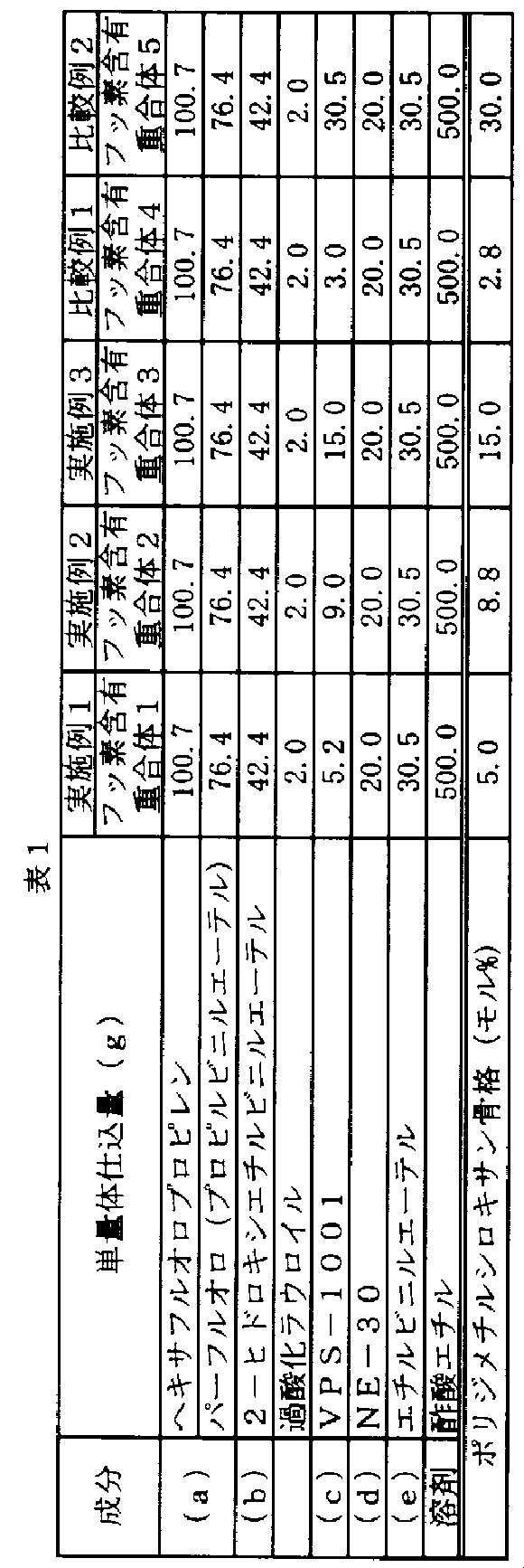
次に、(a)成分のヘキサフロロプロピレン(HFP)100.7gを仕込み、昇温を開始した。オートクレーブ内の温度が60℃に達した時点での圧力は60Paであった。その後、60℃で攪拌下に20時間反応を継続し、圧力が25Paに低下した時点で、オートクレーブを水冷して反応を停止させた。反応物が室温に達した後、未反応モノマーを放出してオートクレーブを開放し、ポリマー溶液を得た。得られたポリマー溶液をメタノールに投入し、ポリマーを析出させた後、メタノールにて洗浄し、50℃にて真空乾燥を行って、220gのフッ素含有重合体1を得た。表1に、このフッ素含有重合体1を得るための単量体の仕込み量及びポリジメチルシロキサン骨格のモル%を示す。 Next, 100.7 g of component (a) hexafluoropropylene (HFP) was charged, and the temperature was raised. The pressure when the temperature in the autoclave reached 60 ° C. was 60 Pa. Thereafter, the reaction was continued for 20 hours with stirring at 60 ° C., and when the pressure dropped to 25 Pa, the autoclave was cooled with water to stop the reaction. After the reaction product reached room temperature, unreacted monomers were released and the autoclave was opened to obtain a polymer solution. The obtained polymer solution was put into methanol to precipitate a polymer, and then washed with methanol and vacuum dried at 50 ° C. to obtain 220 g of a fluorine-containing polymer 1. Table 1 shows the amount of monomer charged to obtain the fluorine-containing polymer 1 and the mol% of the polydimethylsiloxane skeleton.
実施例2、3及び比較例1、2
各単量体の種類及び仕込み量を、表1に示したように変更したこと以外は、実施例1と同様にしてフッ素含有重合体2〜5を調製した。また、これらの重合体を構成する各単量体成分の割合は、表2のとおりである。
Examples 2 and 3 and Comparative Examples 1 and 2
Fluorine-containing polymers 2 to 5 were prepared in the same manner as in Example 1 except that the type and amount of each monomer were changed as shown in Table 1. Moreover, the ratio of each monomer component which comprises these polymers is as Table 2.
表1中の商品名は次のものを示している。
VPS−1001:前記一般式(2)で表され、y=120〜150、z=7〜10、数平均分子量が70000〜90000、ポリシロキサン骨格の分子量が約5000のアゾ基含有ポリジメチルシロキサン(和光純薬工業社製)
NE−30:前記一般式(3)で表され、n=9、m=1、s=30であるノニオン性反応性乳化剤「NE−30」(旭電化工業社製)
The product names in Table 1 indicate the following.
VPS-1001: azo group-containing polydimethylsiloxane represented by the above general formula (2), y = 120 to 150, z = 7 to 10, number average molecular weight is 70000 to 90000, and the molecular weight of polysiloxane skeleton is about 5000. Wako Pure Chemical Industries, Ltd.)
NE-30: Nonionic reactive emulsifier “NE-30” (manufactured by Asahi Denka Kogyo Co., Ltd.) represented by the general formula (3), wherein n = 9, m = 1, and s = 30
<硬化性樹脂組成物の製造>
実施例4
実施例1で得られたフッ素含有重合体1の100g、架橋性化合物のメトキシ化メチルメラミン「サイメル303」(三井サイテック株式会社製)20g及び硬化触媒であるp−トルエンスルホン酸2gとをメチルイソブチルケトン(MIBK)900gに添加して溶解させることにより、硬化性樹脂組成物を調製した。
<Manufacture of curable resin composition>
Example 4
100 g of the fluorine-containing polymer 1 obtained in Example 1, 20 g of the crosslinkable compound methoxylated methylmelamine “Cymel 303” (manufactured by Mitsui Cytec Co., Ltd.) and 2 g of p-toluenesulfonic acid which is a curing catalyst were mixed with methyl isobutyl. A curable resin composition was prepared by adding and dissolving 900 g of ketone (MIBK).
実施例5〜9及び比較例3〜5
フッ素含有重合体、架橋性化合物及び硬化触媒若しくは光重合開始剤の種類並びに量を表3に示すように変更した以外は、実施例4と同様にして硬化性樹脂組成物を調製した。
Examples 5-9 and Comparative Examples 3-5
A curable resin composition was prepared in the same manner as in Example 4 except that the types and amounts of the fluorine-containing polymer, the crosslinkable compound and the curing catalyst or photopolymerization initiator were changed as shown in Table 3.
<硬化膜の評価>
実施例4〜9及び比較例3〜5で得られた硬化性樹脂組成物を用いて形成した硬化膜について、耐布擦り性試験を実施した。結果を表3に示す。
評価用試料の硬化膜は、以下のようにして作製した。
<Evaluation of cured film>
A cloth rubbing resistance test was performed on the cured films formed using the curable resin compositions obtained in Examples 4 to 9 and Comparative Examples 3 to 5. The results are shown in Table 3.
The cured film of the evaluation sample was produced as follows.
(1)ジルコニア含有ハードコート層用組成物の調製
乾燥空気中、メルカプトプロピルトリメトキシシラン7.8部、ジブチルスズジラウレート0.2部からなる溶液に対し、イソフォロンジイソシアネート20.6部を攪拌しながら50℃で1時間かけて滴下後、60℃で3時間攪拌した。これにペンタエリスリトールトリアクリレート71.4部を30℃で1時間かけて滴下後、60℃で3時間加熱攪拌することで有機化合物(S1)を得た。次に合成した有機化合物(S1)8.2部、トルエンジルコニアゾル(数平均粒子径0.01μm、ジルコニア濃度30%)91.8部、メチルエチルケトン41.2部、イオン交換水0.1部の混合液を、60℃、4時間攪拌後、オルト蟻酸メチルエステル1.3部を添加し、さらに1時間同一温度で加熱攪拌することで架橋性粒子分散液(分散液a)を得た。この分散液aをアルミ皿に2g秤量後、120℃のホットプレート上で1時間乾燥、秤量して固形分含量を求めたところ、25%であった。乾燥空気気流下、紫外線を遮蔽した容器中において、製造した分散液aを312部、ジペンタエリスリト−ルヘキサアクリレ−ト12.0部、ペンタエリスリトールトリアクリレート9.0部、2−メチル−1−〔4−(メチルチオ)フェニル〕−2−モルフォリノプロパン−1−オン1.0部を50℃で2時間攪拌することで均一な溶液のハードコート層用組成物を得た。この組成物をアルミ皿に2g秤量後、120℃のホットプレート上で1時間乾燥、秤量して固形分含量を求めたところ、30%であった。
(1) Preparation of zirconia-containing hard coat layer composition In dry air, 20.6 parts of isophorone diisocyanate was stirred with respect to a solution consisting of 7.8 parts of mercaptopropyltrimethoxysilane and 0.2 parts of dibutyltin dilaurate. After dropwise addition at 50 ° C. over 1 hour, the mixture was stirred at 60 ° C. for 3 hours. 71.4 parts of pentaerythritol triacrylate was added dropwise thereto at 30 ° C. over 1 hour, and the mixture was heated and stirred at 60 ° C. for 3 hours to obtain an organic compound (S1). Next, 8.2 parts of the synthesized organic compound (S1), 91.8 parts of toluene zirconia sol (number average particle diameter 0.01 μm, zirconia concentration 30%), 41.2 parts of methyl ethyl ketone, 0.1 part of ion-exchanged water The mixture was stirred at 60 ° C. for 4 hours, 1.3 parts of orthoformate methyl ester was added, and the mixture was further heated and stirred at the same temperature for 1 hour to obtain a crosslinkable particle dispersion (dispersion a). 2 g of this dispersion a was weighed on an aluminum dish, dried on a hot plate at 120 ° C. for 1 hour, and weighed to determine the solid content, which was 25%. 312 parts of the produced dispersion a, 12.0 parts of dipentaerythritol hexaacrylate, 9.0 parts of pentaerythritol triacrylate, 2-methyl-1- A composition for a hard coat layer having a uniform solution was obtained by stirring 1.0 part of [4- (methylthio) phenyl] -2-morpholinopropan-1-one at 50 ° C. for 2 hours. 2 g of this composition was weighed in an aluminum dish, dried on a hot plate at 120 ° C. for 1 hour, and weighed to determine the solid content, which was 30%.
(2)硬化性樹脂組成物塗工用基材の作製
片面易接着ポリエチレンテレフタレート(PET)フィルムA4100(東レ(株)製)の易接着処理面に、上記(1)で調製したジルコニア含有ハードコート層用組成物をワイヤーバーコータ(#7)を用いて塗工し、オーブン中、80℃で1分間乾燥し、塗膜を形成した。次いで、空気下、高圧水銀ランプを用いて、0.9J/cm2の光照射条件で紫外線を照射し、硬化性樹脂組成物塗工用基材を作製した。この基材上のハードコート層の膜厚を触針式表面形状測定器により測定したところ、3μmであった。
(2) Preparation of base material for coating curable resin composition Single-sided easy-adhesive polyethylene terephthalate (PET) film A4100 (manufactured by Toray Industries, Inc.) on the easy-adhesion-treated surface prepared in (1) above. The layer composition was applied using a wire bar coater (# 7) and dried in an oven at 80 ° C. for 1 minute to form a coating film. Subsequently, ultraviolet rays were irradiated under the light irradiation conditions of 0.9 J / cm 2 in the air using a high-pressure mercury lamp to prepare a curable resin composition coating substrate. When the film thickness of the hard coat layer on this substrate was measured with a stylus type surface shape measuring instrument, it was 3 μm.
(3)評価用試料である硬化膜の作製
上記(2)で作製した硬化性樹脂組成物塗工用基材上に、実施例4〜9及び比較例3〜5で得られた各硬化性樹脂組成物をワイヤーバーコータ(#3)を用いて塗工し、オーブン中、80℃で3分間乾燥し、塗膜を形成した。次いで、窒素下、高圧水銀ランプを用いて、0.3J/cm2の光照射条件で紫外線を照射し、評価用試料を作製した。このようにして得た各硬化物層の膜厚を反射率測定により概算したところ、いずれも約100nmであった。
(3) Preparation of cured film as sample for evaluation Each curable property obtained in Examples 4 to 9 and Comparative Examples 3 to 5 on the curable resin composition coating substrate prepared in (2) above. The resin composition was applied using a wire bar coater (# 3) and dried in an oven at 80 ° C. for 3 minutes to form a coating film. Next, ultraviolet rays were irradiated under a light irradiation condition of 0.3 J / cm 2 using a high-pressure mercury lamp under nitrogen to prepare a sample for evaluation. When the thickness of each cured product layer obtained in this manner was estimated by reflectance measurement, all were about 100 nm.
耐布擦り性試験は、耐布(旭化成工業社製、商品名:ベンコット)を学振型摩擦堅牢度試験機(AB−301、テスター産業製)に取り付け、硬化膜の表面を荷重1kgの条件で擦過し、傷のつき始めるまでの回数を目視で確認することによって行った。 In the cloth abrasion resistance test, a cloth resistance (made by Asahi Kasei Kogyo Co., Ltd., trade name: Bencot) is attached to a Gakushin friction fastness tester (AB-301, made by Tester Sangyo), and the surface of the cured film is loaded under the condition of 1 kg. It was done by visually checking the number of times until scratching started.
表3中の商品名は、次のものを示している。
サイメル303:メトキシ化メチルメラミン(三井サイテック株式会社製)
IRUGACURE907:2−メチル−1−[4−(メチルチオ)フェニル]−2−モルホリノプロパン−1(チバガイギー社製、光重合開始剤)
The product names in Table 3 indicate the following.
Cymel 303: Methoxylated methylmelamine (Mitsui Cytec Co., Ltd.)
IRUGACURE907: 2-methyl-1- [4- (methylthio) phenyl] -2-morpholinopropane-1 (manufactured by Ciba Geigy, photopolymerization initiator)
表3の結果から、本発明で規定する割合より少ないポリジメチルシロキサン骨格を有するフッ素含有重合体4を用いた比較例1及び2の硬化性樹脂組成物を硬化させた硬化膜は、傷付きが確認された最少のベンコット摩耗試験回数(耐布擦り性)が30又は40であるのに対し、本発明で規定する割合で、ポリジメチルシロキサン骨格を含有するフッ素含有重合体1〜3を用いた実施例1〜6の硬化性樹脂組成物を硬化させた硬化膜は、耐布擦り性が100〜650であり、耐布擦り性が改善されることがわかる。なお、比較例5では、塗工時に未硬化組成物が基材面ではじかれたため塗工できず評価不能であった。 From the results of Table 3, the cured films obtained by curing the curable resin compositions of Comparative Examples 1 and 2 using the fluorine-containing polymer 4 having a polydimethylsiloxane skeleton having a proportion less than that specified in the present invention are damaged. Fluorine-containing polymers 1 to 3 containing a polydimethylsiloxane skeleton were used at the ratio specified in the present invention, while the minimum number of bencott abrasion tests (cloth rub resistance) confirmed was 30 or 40. The cured films obtained by curing the curable resin compositions of Examples 1 to 6 have a cloth rub resistance of 100 to 650, which indicates that the cloth rub resistance is improved. In Comparative Example 5, the uncured composition was repelled on the substrate surface at the time of coating, and thus the coating could not be performed and evaluation was impossible.
本発明の硬化性樹脂組成物は、良好な熱硬化性を示し、また、本発明の硬化性樹脂組成物から形成される硬化物は、低い屈折率及び耐布擦り性に優れる。従って、本発明の硬化性樹脂組成物は、特に、反射防止膜、光ファイバー鞘材等の光学材料の形成に有利に用いることができ、また、フッ素含量が高いことを利用して、耐候性が要求される基材に対する塗料用材料、耐候フィルム用材料、コーティング用材料、その他として好適に使用することができる。しかも、当該硬化膜は、基材に対する密着性に優れ、耐擦傷性が高く、良好な反射防止効果を付与することから、反射防止膜として極めて有用であり、各種の表示装置に適用することにより、その視認性を向上させることができる。 The curable resin composition of the present invention exhibits good thermosetting properties, and the cured product formed from the curable resin composition of the present invention is excellent in a low refractive index and fabric rubbing resistance. Therefore, the curable resin composition of the present invention can be advantageously used for the formation of an optical material such as an antireflection film and an optical fiber sheath material, and has high weather resistance by utilizing the high fluorine content. It can be suitably used as a coating material, a weather-resistant film material, a coating material, etc. for the required substrate. In addition, the cured film has excellent adhesion to the base material, high scratch resistance, and imparts a good antireflection effect. Therefore, the cured film is extremely useful as an antireflection film, and can be applied to various display devices. The visibility can be improved.
10 反射防止膜
12 基材
14 ハードコート層
16 高屈折率層
18 低屈折率層
DESCRIPTION OF
Claims (4)
An antireflection film comprising a low refractive index layer comprising a cured product obtained by curing the curable resin composition according to claim 2.
Priority Applications (1)
| Application Number | Priority Date | Filing Date | Title |
|---|---|---|---|
| JP2004104892A JP2005290119A (en) | 2004-03-31 | 2004-03-31 | Fluorine-containing olefin polymer and antireflective coating composition for low refractive index |
Applications Claiming Priority (1)
| Application Number | Priority Date | Filing Date | Title |
|---|---|---|---|
| JP2004104892A JP2005290119A (en) | 2004-03-31 | 2004-03-31 | Fluorine-containing olefin polymer and antireflective coating composition for low refractive index |
Publications (1)
| Publication Number | Publication Date |
|---|---|
| JP2005290119A true JP2005290119A (en) | 2005-10-20 |
Family
ID=35323428
Family Applications (1)
| Application Number | Title | Priority Date | Filing Date |
|---|---|---|---|
| JP2004104892A Pending JP2005290119A (en) | 2004-03-31 | 2004-03-31 | Fluorine-containing olefin polymer and antireflective coating composition for low refractive index |
Country Status (1)
| Country | Link |
|---|---|
| JP (1) | JP2005290119A (en) |
Cited By (1)
| Publication number | Priority date | Publication date | Assignee | Title |
|---|---|---|---|---|
| JP2007284546A (en) * | 2006-04-17 | 2007-11-01 | Jsr Corp | Thermosetting resin composition and antireflection film |
-
2004
- 2004-03-31 JP JP2004104892A patent/JP2005290119A/en active Pending
Cited By (1)
| Publication number | Priority date | Publication date | Assignee | Title |
|---|---|---|---|---|
| JP2007284546A (en) * | 2006-04-17 | 2007-11-01 | Jsr Corp | Thermosetting resin composition and antireflection film |
Similar Documents
| Publication | Publication Date | Title |
|---|---|---|
| JP3960307B2 (en) | Liquid resin composition, cured film and laminate | |
| JP4078704B2 (en) | Anti-reflection coating | |
| TWI232223B (en) | Olefin polymer, process for manufacturing the same, curable resin composition, and antireflection coating | |
| JP4378786B2 (en) | Anti-reflection coating | |
| JP2003133270A (en) | Window material and polishing pad for chemical mechanical polishing | |
| JP2005089536A (en) | Curable resin composition and antireflection film | |
| JP4419809B2 (en) | Manufacturing method of laminate | |
| JP4134859B2 (en) | Curable resin composition and antireflection film | |
| JP4164961B2 (en) | Curable resin composition and cured resin | |
| JP2004307524A (en) | Fluorine-containing olefin polymer, curable resin composition, and antireflection film | |
| JPWO2006070707A1 (en) | Anti-reflection coating | |
| JP2005288712A (en) | Laminated body having antistatic layer and antireflection film | |
| WO2006051634A1 (en) | Liquid curable resin composition and process for producing laminate using the same | |
| JP2006209050A (en) | Anti-reflection coating | |
| JP4774722B2 (en) | Liquid curable resin composition and cured film comprising the same | |
| JP4952047B2 (en) | Curable resin composition, cured film and antireflection film laminate | |
| EP1491562B1 (en) | Fluorinated olefin polymer, curable resin composition, and antireflection film | |
| JP2005239967A (en) | Liquid resin composition and cured film | |
| JP2008007680A (en) | Curable resin composition and antireflection film | |
| JP4780095B2 (en) | Method for producing curable resin composition | |
| JP2005264064A (en) | Fluoropolymer, curable resin composition and cured film | |
| JPH1025388A (en) | Curable resin composition | |
| JP2007284546A (en) | Thermosetting resin composition and antireflection film | |
| JP2006161013A (en) | Liquid curable resin composition, cured film and laminate | |
| JP2007277504A (en) | Curable resin composition and antireflection film |
Legal Events
| Date | Code | Title | Description |
|---|---|---|---|
| A621 | Written request for application examination |
Free format text: JAPANESE INTERMEDIATE CODE: A621 Effective date: 20060727 |
|
| A977 | Report on retrieval |
Free format text: JAPANESE INTERMEDIATE CODE: A971007 Effective date: 20081203 |
|
| A131 | Notification of reasons for refusal |
Free format text: JAPANESE INTERMEDIATE CODE: A131 Effective date: 20081216 |
|
| A02 | Decision of refusal |
Free format text: JAPANESE INTERMEDIATE CODE: A02 Effective date: 20090519 |