JP2005036282A - Aluminum alloy plate for bottle-shaped can bottom lid with excellent punching suitability - Google Patents
Aluminum alloy plate for bottle-shaped can bottom lid with excellent punching suitability Download PDFInfo
- Publication number
- JP2005036282A JP2005036282A JP2003274417A JP2003274417A JP2005036282A JP 2005036282 A JP2005036282 A JP 2005036282A JP 2003274417 A JP2003274417 A JP 2003274417A JP 2003274417 A JP2003274417 A JP 2003274417A JP 2005036282 A JP2005036282 A JP 2005036282A
- Authority
- JP
- Japan
- Prior art keywords
- mass
- aluminum alloy
- bottle
- alloy plate
- type
- Prior art date
- Legal status (The legal status is an assumption and is not a legal conclusion. Google has not performed a legal analysis and makes no representation as to the accuracy of the status listed.)
- Granted
Links
Landscapes
- Rigid Containers With Two Or More Constituent Elements (AREA)
Abstract
【課題】 ボトル型缶底蓋用アルミニウム合金板であって、密封性の良否及び缶内容物の変敗の有無を検査するための打検(打撃音響検査方法)を好適に実施できるようにした打検適性に優れたボトル型缶底蓋用アルミニウム合金板を提供する。
【解決手段】 ポリエステル樹脂を被覆した後に製蓋して用いられるボトル型缶底蓋用アルミニウム合金板において、Mg4.0〜6.0mass%、Cu0.1〜0.3mass%を含みさらにMn0.3〜0.6mass%、Cr0.05〜0.20mass%のいずれか1種または2種からなり残部がアルミニウムおよび不可避不純物からなるアルミニウム合金板であって、280℃×20秒加熱後、板厚減少率で30%圧延し、さらに125℃×30分加熱処理した際の0.2%耐力が350N/mm2以上であるアルミニウム板。
【選択図】 なしPROBLEM TO BE SOLVED: To suitably perform a percussion test (a percussive acoustic inspection method) for inspecting the quality of sealing and the presence or absence of deterioration of can contents in a bottle-type can bottom cover aluminum alloy plate Provided is an aluminum alloy plate for a bottle-type can bottom cover that is excellent in punching suitability.
An aluminum alloy plate for a bottle-type can bottom cover that is used by making a lid after coating with a polyester resin, and contains Mg 4.0 to 6.0 mass%, Cu 0.1 to 0.3 mass%, and Mn 0.3 An aluminum alloy plate made of any one or two of ~ 0.6 mass%, Cr 0.05 to 0.20 mass%, the balance being aluminum and unavoidable impurities, and reduced in thickness after heating at 280 ° C for 20 seconds An aluminum plate having a 0.2% yield strength of 350 N / mm 2 or more when rolled at a rate of 30% and further heat-treated at 125 ° C. for 30 minutes.
[Selection figure] None
Description
本発明は、ボトル型缶底蓋用アルミニウム合金板に関する。特に、胴部の下端が底蓋の巻締固着により閉鎖されるボトル型缶であって、密封性の良否及び缶内容物の変敗の有無を検査するための打検(打撃音響検査方法)を好適に実施できるようにした打検適性に優れたボトル型缶底蓋用アルミニウム合金板に関する。 The present invention relates to an aluminum alloy plate for a bottle-type can bottom cover. In particular, it is a bottle-type can where the lower end of the body is closed by tightly fastening the bottom lid, and is used for checking whether the sealability is good and whether or not the contents of the can have deteriorated (battering acoustic inspection method) The present invention relates to an aluminum alloy plate for a bottle-type can bottom lid that is excellent in punching suitability.
従来アルミニウム缶は、有底円筒状の胴部と開口用の溝とタブを加工、取りつけた蓋の部分からなる2ピース缶が主流であった。このような2ピース缶は一度開口すると、再度蓋はできない。これに対して、近年、特許文献1や特許文献2に開示されているように、再栓可能なボトル型アルミニウム缶が開発されている。
ところで、内容物がPH4.5以下の高酸性飲料の場合には、缶に充填する前に飲料を加熱殺菌し、85℃以上の温度で缶に充頃・密封し、飲料の熱で缶内面側を加熱殺菌する熱問充填法が採用されている。また、それよりもPHの高い低酸性飲料の場合には、飲料を缶に充填した後で加熱殺菌するレトルト殺菌法が採用されている。
それらの方法による缶詰において薄肉缶を使用する場合には、缶の密封直前に液体窒素を添加して、缶内を微陽圧にしている。このような方法で製造された缶詰は、内容物の変敗の有無及び密封性の良否を検査するために打検される。
By the way, when the content is a highly acidic beverage with a pH of 4.5 or less, the beverage is heat sterilized before filling the can, and the can is filled and sealed at a temperature of 85 ° C. or higher, and the inner surface of the can is heated by the beverage A hot filling method is used in which the side is heated and sterilized. In the case of a low acid beverage having a higher pH than that, a retort sterilization method is employed in which the beverage is filled in a can and then sterilized by heating.
When using thin-walled cans in cans produced by these methods, liquid nitrogen is added immediately before sealing the cans to make the inside of the cans slightly positive. The canned product manufactured by such a method is subjected to inspection in order to inspect the contents for deterioration and the sealing performance.
打検とは、缶の蓋面や底面を電磁パルスにより強制励振させたときに生じる、固有振動中心周波数と缶内圧とが相関関係を有することを利用して、缶内圧が正常か否かを判別する方法である。
具体的な打検方法としては、例えば、周知の自動打検装置を使用して、缶蓋や缶底の平坦部分に電磁パルスで衝撃を与えて強制励振させ、振動する底蓋の音をマイクロフオンでとらえた後増幅処理し、音響周波数パワーを複数の帯域フィルターにより捉え、フィルターを通過した信号出力を整流した後積分し、積分した値と予め設定しておいた正常内圧品の積分値と比較して、密封缶の内圧の良否を判別する。
上記のような打検により缶内圧を測定するためには、缶内圧により形成される平坦部分が、缶蓋又は缶底の総面積に対して50%以上必要である(例えば、特許文献3等参照)とされている。
Percussion refers to whether or not the internal pressure of the can is normal by utilizing the correlation between the natural vibration center frequency and the internal pressure of the can that is generated when the lid and bottom of the can are forcibly excited by electromagnetic pulses. It is a method of discrimination.
As a specific inspection method, for example, using a well-known automatic inspection device, a flat portion of the can lid or the bottom of the can is impacted with an electromagnetic pulse to forcibly excite the sound of the vibrating bottom lid. Amplification processing after capturing with Phuon, capturing the acoustic frequency power with multiple band filters, rectifying the signal output that passed through the filter and integrating, the integrated value and the integrated value of the normal internal pressure product set in advance In comparison, the quality of the internal pressure of the sealed can is determined.
In order to measure the internal pressure of the can by the above-described perforation, a flat portion formed by the internal pressure of the can needs to be 50% or more with respect to the total area of the can lid or the bottom of the can (for example, Patent Document 3) See).
一方、金属薄板製のボトル型缶では、缶の上部に形成された小径の口頸部には小径のネジ付きキャップを螺合するので、打検に適していない。この問題を解決するため、特許文献4において、中央部に平坦部分を有する底蓋を胴部の開口端に巻き締め固着するボトル型缶が開示されている。
このような構成のボトル型缶では、内容物を缶内に充填してキャップで密封した後、底蓋側を上側にした状態で、底蓋の中央部に形成された平坦部分を、周知の自動打検装置により電磁パルスで衝撃を与えて強制励振させ、その固有振動中心周波数から缶内圧が正常か否かを判別して、缶の密封性の良否及び内容物の変敗の有無を検査することができる。
On the other hand, a bottle-shaped can made of a thin metal plate is not suitable for punching because a small-diameter threaded cap is screwed into a small-diameter mouth-neck formed on the top of the can. In order to solve this problem, Patent Document 4 discloses a bottle-type can in which a bottom lid having a flat portion at the center is wound and fixed to the opening end of the trunk.
In the bottle-shaped can having such a configuration, after the contents are filled in the can and sealed with a cap, the flat portion formed at the center of the bottom lid is well-known with the bottom lid side facing up. An automatic percussion device is used to forcibly excite by applying an electromagnetic pulse, and whether the internal pressure of the can is normal or not from the center frequency of its natural vibration is checked to check whether the can has good sealing performance and whether the contents have been damaged or not. can do.
しかし、熱間充填やレトルト殺菌が必要となる用途の缶において、打検精度がばらつき、問題となる場合がある。
打検においては、缶内圧と周波数の関係から打検周波数で缶内圧を判定できるので、一定範囲内の打検周波数を発する缶のみを良品とすれば、内圧が規格外の製品を不良品として除外することが可能である。
しかしここで打検周波数の変動が大きいと打検精度がばらつき、不良品の見逃しや良品缶の無駄な排斥が発生する確率が高くなり問題となる。
このため、打検周波数の変動の少ない缶蓋が求められている。
However, in cans that require hot filling and retort sterilization, the accuracy of punching varies, which may be a problem.
In the inspection, the internal pressure of the can can be determined at the inspection frequency from the relationship between the internal pressure and the frequency of the can. It is possible to exclude.
However, if the variation in the punching frequency is large here, the punching accuracy varies, which increases the probability that a defective product will be overlooked or that a good product can be wasted.
For this reason, there is a need for a can lid with a small variation in percussion frequency.
この問題を解決するため、本発明者らは種々検討を行った。
その結果、中央部に広い平坦部分を有する底蓋は、構造的に剛性が低く、この為熱間充填やレトルト加熱時の缶内圧上昇により、底蓋形状が変化し、固有振動中心周波数が変動することが、打検精度ばらつきの原因であることが解った。
この対策として、底蓋に使用されるアルミニウム合金板について検討を行った結果、本発明の方法により打検精度のばらつきを改善できることが明らかになった。
すなわち、底蓋材として使用されるAl−Mg−Mn系合金の成分組成および製造条件を適切に調整して、最終圧延後の製品板における特定条件下での強度を適切に管理することで、前述の課題を解決し得ることを見出した。
In order to solve this problem, the present inventors have made various studies.
As a result, the bottom lid, which has a wide flat part at the center, is structurally low in rigidity, so that the shape of the bottom lid changes and the natural vibration center frequency fluctuates due to increased internal pressure during hot filling and retort heating. It was found that this was the cause of variations in percussion accuracy.
As a measure against this, as a result of studying an aluminum alloy plate used for the bottom lid, it was found that variation in punching accuracy can be improved by the method of the present invention.
That is, by appropriately adjusting the component composition and production conditions of the Al-Mg-Mn alloy used as the bottom cover material, and appropriately managing the strength under specific conditions in the product plate after final rolling, It has been found that the above-mentioned problems can be solved.
具体的には、請求項1の発明はポリエステル樹脂を被覆した後に製蓋して用いられるボトル型缶底蓋用アルミニウム合金板において、Mg4.0〜6.0mass%、Cu0.1〜0.3mass%を含みさらにMn0.3〜0.6mass%、Cr0.05〜0.20mass%のいずれか1種または2種からなり残部がアルミニウムおよび不可避不純物からなるアルミニウム合金板であって、280℃×20秒加熱後、板厚減少率で30%圧延し、さらに125℃×30分加熱処理した際の0.2%耐力が350N/mm2以上であることを特徴とする、打検適性に優れたボトル型缶底蓋用アルミニウム合金板である。
さらに、請求項2の発明はポリエステル樹脂を被覆した後に製蓋して用いられるボトル型缶底蓋用アルミニウム合金板において、Mg4.0〜6.0mass%、Cu0.1〜0.3mass%を含みさらにMn0.3〜0.6mass%、Cr0.05〜0.20mass%のいずれか1種または2種からなり残部がアルミニウムおよび不可避不純物からなるアルミニウム合金鋳塊を、400〜550℃の範囲内の温度で1〜10時間保持する加熱処理後、熱間圧延、1次冷間圧延、到達温度が500〜560℃の連続焼鈍、圧延率50〜70%の2次冷間圧延を順次行った最終圧延板であって、その最終圧延板を280℃×20秒加熱後、板厚減少率で30%圧延し、さらに125℃×30分加熱処理した際の0.2%耐力が350N/mm2以上であることを特徴とする、打検適性に優れたボトル型缶底蓋用アルミニウム合金板の製造方法である。
Specifically, the invention of claim 1 is an aluminum alloy plate for a bottle-type can bottom cover that is used after being coated with a polyester resin, and is Mg 4.0 to 6.0 mass%, Cu 0.1 to 0.3 mass. Is an aluminum alloy plate made of any one or two of Mn 0.3 to 0.6 mass%, Cr 0.05 to 0.20 mass%, with the balance being aluminum and inevitable impurities, 280 ° C. × 20 After 2 seconds of heating, the sheet thickness is reduced by 30%, and further 0.2% proof stress when heated at 125 ° C. for 30 minutes is 350 N / mm 2 or more. This is an aluminum alloy plate for a bottle-type can bottom lid.
Furthermore, the invention of claim 2 is an aluminum alloy plate for a bottle-type can bottom cover that is used after being coated with a polyester resin, and includes Mg 4.0 to 6.0 mass%, Cu 0.1 to 0.3 mass%. Further, an aluminum alloy ingot consisting of any one or two of Mn 0.3 to 0.6 mass%, Cr 0.05 to 0.20 mass%, the balance being aluminum and unavoidable impurities, within a range of 400 to 550 ° C. After heat treatment held at temperature for 1 to 10 hours, hot rolling, primary cold rolling, continuous annealing at an ultimate temperature of 500 to 560 ° C., and secondary cold rolling at a rolling rate of 50 to 70% were sequentially performed. A 0.2% proof stress is 350 N / m when the final rolled plate is heated at 280 ° C. for 20 seconds, rolled at 30% with a reduction rate of the plate thickness, and further heated at 125 ° C. for 30 minutes. characterized in that m 2 or more, an excellent bottle-shaped can bottom manufacturing process of the lid for the aluminum alloy plate punch biopsy suitability.
本発明のアルミニウム合金板を底蓋として使用することにより、ボトル缶蓋に面積率50%以上の大きな平坦部を設けても、底蓋形状の変形を小さく押さえることができ、その結果、固有振動中心周波数が変動することを抑制し、打検精度のばらつきを少なくするが可能となる。すなわち、打検適性に優れたボトル型缶底蓋を提供することができる。
これにより、打検時の不良品の見逃しや良品缶の無駄な排斥が発生する確率を減少させることができ、飲料缶等の最終製品の品質を向上させ、また製品歩留まりの低下の防止に寄与することができる。
By using the aluminum alloy plate of the present invention as a bottom lid, even if a large flat portion with an area ratio of 50% or more is provided on the bottle can lid, the deformation of the bottom lid shape can be suppressed to a small extent. It is possible to suppress the fluctuation of the center frequency and reduce the variation in the accuracy of the inspection. That is, it is possible to provide a bottle-type can bottom lid that is excellent in punching suitability.
This can reduce the probability of missing defective products during use and wasteful rejection of non-defective cans, improve the quality of final products such as beverage cans, and contribute to the prevention of product yield reduction. can do.
本発明で使用されるアルミニウム合金の成分組成の限定理由について説明する。 The reason for limiting the component composition of the aluminum alloy used in the present invention will be described.
Mg:
Mgはこの発明で対象となる缶蓋材に必要な強度を得るために不可欠な元素である。すなわちMgはそれ自体の固溶により強度向上に寄与し、また転位との相互作用が大きいために加工硬化による強度向上に寄与する。但しMg量が4.0mass%未満では内圧の高い缶に使用するには強度不足となり、一方6.0mass%を越えれば熱間圧延時の割れを引起こし易くなり好ましくない。したがってMg量は4.0〜6.0mass%の範囲内とした。
Mg:
Mg is an indispensable element for obtaining the strength required for the can lid material to be used in the present invention. That is, Mg contributes to strength improvement by its own solid solution, and contributes to strength improvement by work hardening because of its large interaction with dislocations. However, if the amount of Mg is less than 4.0 mass%, the strength is insufficient for use in a can having a high internal pressure. On the other hand, if it exceeds 6.0 mass%, cracking during hot rolling tends to occur, which is not preferable. Therefore, the amount of Mg is set within the range of 4.0 to 6.0 mass%.
Cu:
Cuは強度向上に寄与する元素であり、また熱間充填やレトルト加熱時の軟化抑制に大きな効果が有る。Cu量が0.1mass%未満ではその効果が得られず、一方Cu量が0.3mass%を越えると、蓋材として重要な特性である耐食性の低下を招いたり、加工硬化特性が大きくなって加工性の低下を引き起こす懸念が有る。したがってCu量は、0.1〜0.3mass%の範囲内とした。
Cu:
Cu is an element that contributes to strength improvement and has a great effect on softening suppression during hot filling and retort heating. If the amount of Cu is less than 0.1 mass%, the effect cannot be obtained. On the other hand, if the amount of Cu exceeds 0.3 mass%, the corrosion resistance, which is an important characteristic as a lid, is reduced, and the work hardening property is increased. There is a concern of causing a decrease in workability. Therefore, the amount of Cu is set within a range of 0.1 to 0.3 mass%.
Mn:
MnはMgと同様に強度向上に寄与するだけでなく、ポリエステル樹脂を被覆する時に必要な加熱時の軟化防止や熱間充填やレトルト加熱時の軟化抑制に大きな効果が有る。但しMn量が0.3mass%未満ではこれらの効果を充分に得ることができず、また製品板の強度不足を招くおそれがある。一方Mn量が0.6mass%を越えると、晶出物が粗大化し加工性が低下するので好ましくない。したがってMnの添加量は、0.3〜0.6mass%の範囲内とした。
Cr:
Crの添加は強度向上に寄与する。添加量が0.05mass%未満ではその効果が少なく、0.2mass%を超えて過多に添加すると、粗大な晶出物を生成して加工性を低下させる恐れがあり好ましくない。したがってCrの添加量は0.05〜0.20mass%とした。
Mn:
Similar to Mg, Mn not only contributes to strength improvement, but also has a great effect in preventing softening during heating and suppressing softening during hot filling and retort heating, which are necessary when coating a polyester resin. However, if the amount of Mn is less than 0.3 mass%, these effects cannot be sufficiently obtained, and the strength of the product plate may be insufficient. On the other hand, if the amount of Mn exceeds 0.6 mass%, the crystallized product becomes coarse and the workability is lowered, which is not preferable. Therefore, the amount of Mn added is in the range of 0.3 to 0.6 mass%.
Cr:
Addition of Cr contributes to strength improvement. If the addition amount is less than 0.05 mass%, the effect is small, and if it exceeds 0.2 mass%, an excessive addition is not preferable because a coarse crystallized product may be generated and the workability may be lowered. Therefore, the addition amount of Cr is set to 0.05 to 0.20 mass%.
その他の合金成分として、Fe0.50mass%以下、Si0.4mass%以下、Zn0.25mass%以下、Ti0.10mass%以下および不可避的不純物を含有しても本発明の効果を損なうことはない。 Even if Fe 0.50 mass% or less, Si 0.4 mass% or less, Zn 0.25 mass% or less, Ti 0.10 mass% or less and inevitable impurities are contained as other alloy components, the effect of the present invention is not impaired.
本発明においては上記の合金成分であると同時に、このアルミニウム板が樹脂被覆され、ボトル缶の蓋として成形され、内容物が充填されて密封された時の打検適性を評価するため、その加工工程を想定して、280℃×20秒加熱後、30%の圧延を施し、さらに125℃×30分加熱した後の0.2%耐力が350N/mm2以上でなければならない。
ここで、280℃×20秒の加熱はポリエステル樹脂を被覆するときに必要な加熱を想定したものである。またこの加熱処理後の板厚減少率で30%の圧延は被覆アルミニウム板を底蓋に成形するときの加工を想定したものである。次の125℃×30分の加熱は内容物充填後のレトルト殺菌処理を想定した加熱条件である。
ボトル缶においては前述のようにボトル形状に成形し、内容物を充填し、キャップで密封した後に、底蓋部の中央に形成された平坦部に電磁パルスで衝撃をあたえて強制励振させて、その固有振動中心周波数から内圧が正常か否かを判別している。
しかし、缶蓋の0.2%耐力が350N/mm2未満では、熱間充填やレトルト加熱時の缶内圧上昇により、底蓋形状の変形が大きくなり、固有振動中心周波数が変動するとともに、底蓋部中央の平坦度が損なわれて自動打検装置との接触が不完全になる。これが、打検精度のばらつきの原因となる。
従って、0.2%耐力が350N/mm2以上でなければならない。なお、0.2%耐力の上限は特に規定しないが、底蓋成形や巻き締めが可能な範囲であれば良く、通常は420N/mm2以下であることが望ましい。
In the present invention, at the same time as the above alloy components, this aluminum plate is coated with a resin, formed as a lid of a bottle can, filled with the contents and sealed to evaluate the punching suitability. Assuming the process, the 0.2% proof stress after heating at 280 ° C. × 20 seconds, rolling 30%, and further heating at 125 ° C. × 30 minutes should be 350 N / mm 2 or more.
Here, the heating at 280 ° C. × 20 seconds assumes the heating necessary for coating the polyester resin. Further, the rolling with a thickness reduction rate of 30% after the heat treatment is assumed to be a process for forming a coated aluminum plate on a bottom lid. The next heating at 125 ° C. for 30 minutes is a heating condition assuming retort sterilization after filling the contents.
In the bottle can, as described above, it is molded into a bottle shape, filled with contents, sealed with a cap, and then subjected to a forced excitation by applying an electromagnetic pulse to the flat part formed at the center of the bottom cover part. Whether or not the internal pressure is normal is determined from the natural vibration center frequency.
However, if the 0.2% proof stress of the can lid is less than 350 N / mm 2 , the deformation of the bottom lid shape increases due to an increase in the can internal pressure during hot filling or retort heating, the natural vibration center frequency fluctuates, and the bottom The flatness at the center of the lid is impaired, and the contact with the automatic inspection device becomes incomplete. This causes variations in the accuracy of percussion inspection.
Therefore, the 0.2% proof stress must be 350 N / mm 2 or more. The upper limit of the 0.2% proof stress is not particularly specified, but may be in a range where bottom cover molding or winding can be performed, and is generally preferably 420 N / mm 2 or less.
次に本発明の底蓋用アルミニウム合金板の製造方法について説明する。
先ず前述の成分組成のアルミニウム合金を常法に従って溶製し、DC鋳造法などの常法に従って鋳造する。
Next, the manufacturing method of the aluminum alloy plate for bottom covers of this invention is demonstrated.
First, an aluminum alloy having the above-described composition is melted according to a conventional method, and cast according to a conventional method such as a DC casting method.
得られた鋳塊に対しては、均質化処理を行なってから熱間圧延のための加熱を行なうか、または均質化処理を兼ねて熱間圧延のための加熱を行なう。この熱間圧延のための加熱は、400〜550℃の範囲内の温度で1〜10時間の保持とする必要がある。この際の加熱温度が400℃未満では熱間加工性の低下を招き、550℃を越えれば高温割れが発生するおそれがある。また、保持時間が1時間未満では、組織の均質化効果が得られず、10時間を越えれば生産性の低下を引き起こす。そのため、加熱温度は400〜550℃の温度範囲とし、保持1〜10時間とした。 The obtained ingot is subjected to a homogenization process and then heated for hot rolling, or is also heated for hot rolling in combination with the homogenization process. The heating for the hot rolling needs to be held for 1 to 10 hours at a temperature in the range of 400 to 550 ° C. If the heating temperature at this time is less than 400 ° C., the hot workability is lowered, and if it exceeds 550 ° C., hot cracking may occur. If the holding time is less than 1 hour, the effect of homogenizing the tissue cannot be obtained, and if it exceeds 10 hours, the productivity is lowered. Therefore, the heating temperature was set to a temperature range of 400 to 550 ° C. and the holding time was set to 1 to 10 hours.
続いて常法に従って熱間圧延を施した後、40%以上の圧延率で1次冷間圧延を行なう。1次冷間圧延率が40%未満では、1次冷間圧延後に行なう連続焼鈍の際に再結晶粒の粗大化を招く懸念が有る。 Subsequently, hot rolling is performed according to a conventional method, and then primary cold rolling is performed at a rolling rate of 40% or more. If the primary cold rolling rate is less than 40%, there is a concern that the recrystallized grains become coarse during the continuous annealing performed after the primary cold rolling.
続く中間焼鈍は、到達温度が500〜560℃の連続焼鈍とする。連続中間焼鈍の目的は、Mg、Cuを十分に溶体化することである。溶体化が不充分であると、十分な強度が得られず、またポリエステル樹脂を被覆する時に必要な加熱による軟化の防止や、熱間充填やレトルト加熱時の軟化を抑制する十分な効果が得られない。到達温度が500℃未満では十分な溶体化が困難であり、560℃を超える加熱は、再結晶粒が粗大化する懸念が有る。このことから中間焼鈍は、到達温度が500〜560℃の連続焼鈍とした。なお、到達温度に到達した後の保持温度は、到達後直ちに冷却を開始してもよいし、10分以下の保持を行っても良い。 The subsequent intermediate annealing is continuous annealing with an ultimate temperature of 500 to 560 ° C. The purpose of continuous intermediate annealing is to fully solutionize Mg and Cu. If the solution is insufficient, sufficient strength cannot be obtained, and sufficient effects can be obtained to prevent softening due to heating required when coating the polyester resin, and to suppress softening during hot filling and retort heating. I can't. If the ultimate temperature is less than 500 ° C, it is difficult to form a sufficient solution, and heating exceeding 560 ° C may cause the recrystallized grains to become coarse. From this, the intermediate annealing was performed continuously at an ultimate temperature of 500 to 560 ° C. The holding temperature after reaching the ultimate temperature may start cooling immediately after reaching the ultimate temperature, or may be held for 10 minutes or less.
次に50〜70%の2次冷間圧延を施して所望の板厚とする。圧延率が50%未満では十分な強度が得られない。一方圧延率を高くすれば、圧延後の強度は高くなるが、加熱されたときの軟化の度合いが大きくなり、加熱後の強度向上効果は少ない。また加工性が低下することから、圧延率を必要以上に高くすることは好ましくない。さらに、圧延率を高くすると打検精度のばらつきが大きくなる傾向があり好ましくない。従って2次冷間圧延は50〜70%が適当である。 Next, secondary cold rolling of 50 to 70% is performed to obtain a desired plate thickness. If the rolling rate is less than 50%, sufficient strength cannot be obtained. On the other hand, if the rolling rate is increased, the strength after rolling increases, but the degree of softening when heated increases, and the effect of improving strength after heating is small. Moreover, since workability falls, it is not preferable to raise a rolling rate more than necessary. Furthermore, when the rolling rate is increased, variation in punching accuracy tends to increase, which is not preferable. Therefore, the secondary cold rolling is suitably 50 to 70%.
このアルミニウム板にはポリエステル樹脂を被覆して缶蓋材とする。缶材用の被覆樹脂としては加工性、耐熱性、保香性、環境保全性等を考慮してポリエステル樹脂が適切である。
被覆方法としてはポリエステルフィルムをラミネートする方法、溶融状態のポリエステル樹脂を押出しラミネートする方法、またはポリエステル樹脂を塗装する方法がある。
ラミネートの場合、貼り合わせ前のアルミニウム板の加熱は180〜300℃の温度範囲とすることが望ましい。
また塗装による場合は、塗装後の焼付け温度は180〜280℃の温度範囲とすることが望ましい。
This aluminum plate is coated with a polyester resin to form a can lid material. As the coating resin for the can material, a polyester resin is appropriate in consideration of processability, heat resistance, fragrance retention, environmental conservation and the like.
Examples of the coating method include a method of laminating a polyester film, a method of extruding and laminating a polyester resin in a molten state, and a method of coating a polyester resin.
In the case of laminating, it is desirable that heating of the aluminum plate before bonding is performed in a temperature range of 180 to 300 ° C.
In the case of painting, it is desirable that the baking temperature after painting is in a temperature range of 180 to 280 ° C.
表1に示す成分組成のアルミニウム合金鋳塊を510℃×4時間の加熱処理後、熱間圧延を行い板厚3.2mmとした。その後1次冷間圧延、連続中間焼鈍、2次冷間圧延を行い板厚0.305mmの圧延板とした。1次冷間圧延後の板厚は2次冷間圧延の圧延率に応じた板厚とし、その板厚で中間焼鈍として、保持0秒の連続焼鈍を行った。 The aluminum alloy ingot having the composition shown in Table 1 was heat-treated at 510 ° C. for 4 hours, and then hot-rolled to a thickness of 3.2 mm. Thereafter, primary cold rolling, continuous intermediate annealing, and secondary cold rolling were performed to obtain a rolled plate having a plate thickness of 0.305 mm. The plate thickness after the primary cold rolling was set to a plate thickness corresponding to the rolling ratio of the secondary cold rolling, and continuous annealing was performed for 0 second as the intermediate annealing with the plate thickness.
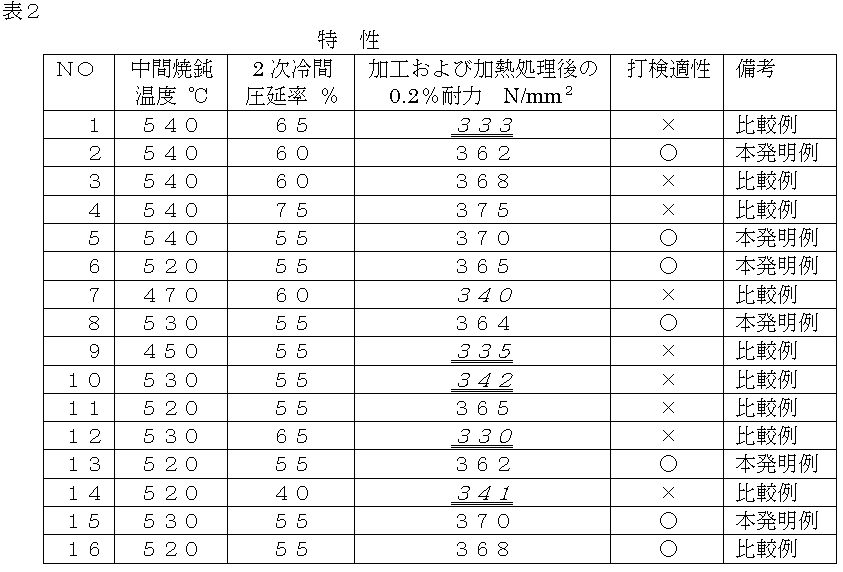
この板厚0.305mmの最終圧延板に280℃×20秒の加熱処理を施した後、板厚減少率で30%の圧延を行い、さらに125℃×30分のレトルト処理を行い試験サンプルとした。
このサンプルの引張り試験を行い、0.2%耐力を測定した。また同サンプルにて打検適性の評価を実施し、固有振動中心周波数の変動の少ないものは○、変動が大きく、打検精度にばらつきが生じやすいものは×と評価した。
This final rolled plate having a thickness of 0.305 mm was subjected to heat treatment at 280 ° C. for 20 seconds, then rolled at 30% at a reduction rate of the plate thickness, and further subjected to retort treatment at 125 ° C. for 30 minutes. did.
The sample was subjected to a tensile test and a 0.2% yield strength was measured. In addition, the sample was evaluated for punching suitability. The sample having a small variation in the natural vibration center frequency was evaluated as “◯”, and the sample having a large variation and the punching accuracy was likely to vary was evaluated as “X”.
NO.2、5、6、8、13、15は本発明の方法による実施例であり、いずれも良好な打検適性を示した。
一方、NO.1はCu添加量および0.2%耐力が本発明の範囲外であり、打検適性に欠ける結果であった。
NO.3はCr添加量が多いため、蓋加工時に割れが発生した。
NO.4は2次冷間圧延率が本発明の範囲より大きく、打検精度がばらつく結果であった。
NO.7およびNO.9は中間焼鈍の温度が低く、十分な強度が得られなかったため、打検精度がばらつく結果であった。
NO.10はMn添加量および0.2%耐力が本発明の範囲外であり、打検適性に欠ける結果であった。
NO.11はMn添加量が多いため、蓋加工時に割れが発生した。
NO.12はMg添加量および0.2%耐力が本発明の範囲外であり、打検適性に欠ける結果であった。
NO.14は2次冷間圧延率および0.2%耐力が本発明の範囲外であり、打検適性に欠ける結果であった。
NO.16は打検適性としては適切であるが、Mg添加量が多いため熱間圧延時耳割れが発生し、好ましくない結果であった。
Nos. 2, 5, 6, 8, 13, and 15 are examples according to the method of the present invention, and all showed good testability.
On the other hand, No. 1 had a Cu addition amount and a 0.2% proof stress that were outside the scope of the present invention, resulting in lack of punching suitability.
Since No. 3 had a large amount of Cr added, cracking occurred during lid processing.
No. 4 was the result that the secondary cold rolling rate was larger than the range of the present invention and the punching accuracy varied.
No. 7 and No. 9 were the results of variations in punching accuracy because the intermediate annealing temperature was low and sufficient strength could not be obtained.
No. 10 was a result of lack of suitability for punching because the added amount of Mn and the 0.2% proof stress were outside the scope of the present invention.
Since NO.11 had a large amount of Mn added, cracking occurred during lid processing.
No. 12 was a result of lack of suitability for punching because the added amount of Mg and the 0.2% proof stress were outside the scope of the present invention.
No. 14 was the result that the secondary cold rolling rate and the 0.2% proof stress were out of the scope of the present invention, and the punching suitability was lacking.
No. 16 was suitable as the punching suitability, but since the amount of Mg added was large, ear cracking occurred during hot rolling, which was an undesirable result.
Claims (2)
Priority Applications (1)
| Application Number | Priority Date | Filing Date | Title |
|---|---|---|---|
| JP2003274417A JP4472952B2 (en) | 2003-07-15 | 2003-07-15 | Manufacturing method of aluminum alloy plate for bottle-type can bottom lid with excellent punching suitability |
Applications Claiming Priority (1)
| Application Number | Priority Date | Filing Date | Title |
|---|---|---|---|
| JP2003274417A JP4472952B2 (en) | 2003-07-15 | 2003-07-15 | Manufacturing method of aluminum alloy plate for bottle-type can bottom lid with excellent punching suitability |
Publications (2)
| Publication Number | Publication Date |
|---|---|
| JP2005036282A true JP2005036282A (en) | 2005-02-10 |
| JP4472952B2 JP4472952B2 (en) | 2010-06-02 |
Family
ID=34211374
Family Applications (1)
| Application Number | Title | Priority Date | Filing Date |
|---|---|---|---|
| JP2003274417A Expired - Fee Related JP4472952B2 (en) | 2003-07-15 | 2003-07-15 | Manufacturing method of aluminum alloy plate for bottle-type can bottom lid with excellent punching suitability |
Country Status (1)
| Country | Link |
|---|---|
| JP (1) | JP4472952B2 (en) |
Cited By (1)
| Publication number | Priority date | Publication date | Assignee | Title |
|---|---|---|---|---|
| WO2011010474A1 (en) * | 2009-07-22 | 2011-01-27 | 大和製罐株式会社 | Canned food product heating apparatus |
-
2003
- 2003-07-15 JP JP2003274417A patent/JP4472952B2/en not_active Expired - Fee Related
Cited By (3)
| Publication number | Priority date | Publication date | Assignee | Title |
|---|---|---|---|---|
| WO2011010474A1 (en) * | 2009-07-22 | 2011-01-27 | 大和製罐株式会社 | Canned food product heating apparatus |
| JP2011028397A (en) * | 2009-07-22 | 2011-02-10 | Daiwa Can Co Ltd | Canned food product heating apparatus |
| CN102484901A (en) * | 2009-07-22 | 2012-05-30 | 大和制罐株式会社 | Canned food heating device |
Also Published As
| Publication number | Publication date |
|---|---|
| JP4472952B2 (en) | 2010-06-02 |
Similar Documents
| Publication | Publication Date | Title |
|---|---|---|
| TWI351780B (en) | Aluminum alloy sheet for battery lid | |
| JP6210896B2 (en) | Aluminum alloy plate for can lid and manufacturing method thereof | |
| JP3523692B2 (en) | Can lid material excellent in bending workability and its manufacturing method | |
| JP5710675B2 (en) | Aluminum alloy plate for packaging container and method for producing the same | |
| JP5113411B2 (en) | Aluminum alloy plate for packaging container and method for producing the same | |
| JP4472952B2 (en) | Manufacturing method of aluminum alloy plate for bottle-type can bottom lid with excellent punching suitability | |
| KR0179419B1 (en) | Can steel sheet resistant to stress corrosion cracking and manufacturing method thereof | |
| JPH0931584A (en) | Aluminum alloy plate for can lid having excellent corrosion resistance and aging softening resistance, and method for producing the same | |
| JP2011202240A (en) | Aluminum alloy sheet for pp cap and method of producing the same | |
| JP5699192B2 (en) | Aluminum alloy plate for negative pressure can lid | |
| JP2001262261A (en) | Aluminum alloy plate for can body excellent in can bottom formability and method for producing the same | |
| JP2005048288A (en) | Aluminum alloy plate for bottle cans with excellent bottom shape stability and strength | |
| JP5976023B2 (en) | Aluminum alloy plate for resin-coated can body | |
| JP5491933B2 (en) | Method for producing aluminum alloy sheet for resin-coated can body | |
| JP2006097076A (en) | Aluminum-alloy sheet for bottle can, and its manufacturing method | |
| JP2003242937A (en) | Aluminum alloy plate for battery case and battery case made of aluminum alloy | |
| JP2007169767A (en) | Packing container and its production method | |
| EP0269773B1 (en) | Production of aluminum alloy sheet and articles fabricated therefrom | |
| JPH09279281A (en) | Aluminum alloy baking coated plate for can lid material having excellent corrosion resistance and method for producing the same | |
| JP3719678B2 (en) | Aluminum alloy composite plate for packaging container lid and manufacturing method thereof | |
| JP2006070344A (en) | Aluminum alloy sheet for resin-coated packing container and its production method | |
| EP1347071B1 (en) | Cold worked aluminium killed steel sheet and process for manufacturing packaging from this metal sheet | |
| JPH04107237A (en) | Al alloy sheet for can end excellent in corrosion resistance and its manufacture | |
| JP6033192B2 (en) | Aluminum alloy plate for negative pressure can lid | |
| JP2017166030A (en) | Aluminum alloy coating sheet for can top |
Legal Events
| Date | Code | Title | Description |
|---|---|---|---|
| A621 | Written request for application examination |
Free format text: JAPANESE INTERMEDIATE CODE: A621 Effective date: 20060704 |
|
| A977 | Report on retrieval |
Free format text: JAPANESE INTERMEDIATE CODE: A971007 Effective date: 20090115 |
|
| A131 | Notification of reasons for refusal |
Free format text: JAPANESE INTERMEDIATE CODE: A131 Effective date: 20090203 |
|
| A521 | Request for written amendment filed |
Free format text: JAPANESE INTERMEDIATE CODE: A523 Effective date: 20090217 |
|
| A131 | Notification of reasons for refusal |
Free format text: JAPANESE INTERMEDIATE CODE: A131 Effective date: 20091027 |
|
| A521 | Request for written amendment filed |
Free format text: JAPANESE INTERMEDIATE CODE: A523 Effective date: 20091208 |
|
| A131 | Notification of reasons for refusal |
Free format text: JAPANESE INTERMEDIATE CODE: A131 Effective date: 20100112 |
|
| A521 | Request for written amendment filed |
Free format text: JAPANESE INTERMEDIATE CODE: A523 Effective date: 20100120 |
|
| TRDD | Decision of grant or rejection written | ||
| A01 | Written decision to grant a patent or to grant a registration (utility model) |
Free format text: JAPANESE INTERMEDIATE CODE: A01 Effective date: 20100302 |
|
| A01 | Written decision to grant a patent or to grant a registration (utility model) |
Free format text: JAPANESE INTERMEDIATE CODE: A01 |
|
| A61 | First payment of annual fees (during grant procedure) |
Free format text: JAPANESE INTERMEDIATE CODE: A61 Effective date: 20100304 |
|
| FPAY | Renewal fee payment (event date is renewal date of database) |
Free format text: PAYMENT UNTIL: 20130312 Year of fee payment: 3 |
|
| R150 | Certificate of patent or registration of utility model |
Ref document number: 4472952 Country of ref document: JP Free format text: JAPANESE INTERMEDIATE CODE: R150 Free format text: JAPANESE INTERMEDIATE CODE: R150 |
|
| FPAY | Renewal fee payment (event date is renewal date of database) |
Free format text: PAYMENT UNTIL: 20160312 Year of fee payment: 6 |
|
| R250 | Receipt of annual fees |
Free format text: JAPANESE INTERMEDIATE CODE: R250 |
|
| S531 | Written request for registration of change of domicile |
Free format text: JAPANESE INTERMEDIATE CODE: R313531 |
|
| S533 | Written request for registration of change of name |
Free format text: JAPANESE INTERMEDIATE CODE: R313533 |
|
| R350 | Written notification of registration of transfer |
Free format text: JAPANESE INTERMEDIATE CODE: R350 |
|
| R250 | Receipt of annual fees |
Free format text: JAPANESE INTERMEDIATE CODE: R250 |
|
| LAPS | Cancellation because of no payment of annual fees |