EP4583199A1 - Lithiumreiches metalloxid und herstellungsverfahren dafür, positivelektrodenfolie, batteriezelle und batterie - Google Patents
Lithiumreiches metalloxid und herstellungsverfahren dafür, positivelektrodenfolie, batteriezelle und batterie Download PDFInfo
- Publication number
- EP4583199A1 EP4583199A1 EP23915237.4A EP23915237A EP4583199A1 EP 4583199 A1 EP4583199 A1 EP 4583199A1 EP 23915237 A EP23915237 A EP 23915237A EP 4583199 A1 EP4583199 A1 EP 4583199A1
- Authority
- EP
- European Patent Office
- Prior art keywords
- lithium
- metal oxide
- rich metal
- optionally
- rich
- Prior art date
- Legal status (The legal status is an assumption and is not a legal conclusion. Google has not performed a legal analysis and makes no representation as to the accuracy of the status listed.)
- Pending
Links
Images


Classifications
-
- H—ELECTRICITY
- H01—ELECTRIC ELEMENTS
- H01M—PROCESSES OR MEANS, e.g. BATTERIES, FOR THE DIRECT CONVERSION OF CHEMICAL ENERGY INTO ELECTRICAL ENERGY
- H01M10/00—Secondary cells; Manufacture thereof
- H01M10/05—Accumulators with non-aqueous electrolyte
- H01M10/052—Li-accumulators
- H01M10/0525—Rocking-chair batteries, i.e. batteries with lithium insertion or intercalation in both electrodes; Lithium-ion batteries
-
- H—ELECTRICITY
- H01—ELECTRIC ELEMENTS
- H01M—PROCESSES OR MEANS, e.g. BATTERIES, FOR THE DIRECT CONVERSION OF CHEMICAL ENERGY INTO ELECTRICAL ENERGY
- H01M4/00—Electrodes
- H01M4/02—Electrodes composed of, or comprising, active material
- H01M4/36—Selection of substances as active materials, active masses, active liquids
- H01M4/362—Composites
- H01M4/366—Composites as layered products
-
- H—ELECTRICITY
- H01—ELECTRIC ELEMENTS
- H01M—PROCESSES OR MEANS, e.g. BATTERIES, FOR THE DIRECT CONVERSION OF CHEMICAL ENERGY INTO ELECTRICAL ENERGY
- H01M4/00—Electrodes
- H01M4/02—Electrodes composed of, or comprising, active material
- H01M4/36—Selection of substances as active materials, active masses, active liquids
- H01M4/48—Selection of substances as active materials, active masses, active liquids of inorganic oxides or hydroxides
-
- H—ELECTRICITY
- H01—ELECTRIC ELEMENTS
- H01M—PROCESSES OR MEANS, e.g. BATTERIES, FOR THE DIRECT CONVERSION OF CHEMICAL ENERGY INTO ELECTRICAL ENERGY
- H01M4/00—Electrodes
- H01M4/02—Electrodes composed of, or comprising, active material
- H01M4/36—Selection of substances as active materials, active masses, active liquids
- H01M4/58—Selection of substances as active materials, active masses, active liquids of inorganic compounds other than oxides or hydroxides, e.g. sulfides, selenides, tellurides, halogenides or LiCoFy; of polyanionic structures, e.g. phosphates, silicates or borates
- H01M4/583—Carbonaceous material, e.g. graphite-intercalation compounds or CFx
-
- Y—GENERAL TAGGING OF NEW TECHNOLOGICAL DEVELOPMENTS; GENERAL TAGGING OF CROSS-SECTIONAL TECHNOLOGIES SPANNING OVER SEVERAL SECTIONS OF THE IPC; TECHNICAL SUBJECTS COVERED BY FORMER USPC CROSS-REFERENCE ART COLLECTIONS [XRACs] AND DIGESTS
- Y02—TECHNOLOGIES OR APPLICATIONS FOR MITIGATION OR ADAPTATION AGAINST CLIMATE CHANGE
- Y02E—REDUCTION OF GREENHOUSE GAS [GHG] EMISSIONS, RELATED TO ENERGY GENERATION, TRANSMISSION OR DISTRIBUTION
- Y02E60/00—Enabling technologies; Technologies with a potential or indirect contribution to GHG emissions mitigation
- Y02E60/10—Energy storage using batteries
Definitions
- the present application relates to the technical field of batteries, and in particular, to a lithium-rich metal oxide and a preparation method thereof, a positive electrode plate, a battery cell, and a battery.
- a lithium-rich metal oxide as a material for preparing a positive electrode plate of a battery cell, is critical to the performance of the battery cell. Therefore, how to provide a lithium-rich metal oxide that can achieve both stability and conductivity of the lithium-rich metal oxide to improve the performance of the battery cell is an urgent technical problem to be solved.
- the present application aims to provide a lithium-rich metal oxide that achieves both stability and conductivity to improve the performance of a battery cell.
- the present application provides a lithium-rich metal oxide and a preparation method thereof, a positive electrode plate, a battery cell, and a battery.
- the present application provides a lithium-rich metal oxide including a lithium-rich metal oxide core; and a cladding layer, where the cladding layer includes an organic layer and a carbonaceous material, the organic layer clads the lithium-rich metal oxide core, and at least a portion of the carbonaceous material is embedded in the organic layer.
- the present application provides a lithium-rich metal oxide including a lithium-rich metal oxide core and a cladding layer, where the cladding layer includes an organic layer and a carbonaceous material, the organic layer clads the lithium-rich metal oxide core, and the carbonaceous material is embedded in the organic layer.
- a content of lithium ions in the lithium-rich metal oxide core is higher than that in a general lithium-containing metal oxide, so preparation of a positive electrode material by selecting the lithium-rich metal oxide core is conducive to improving the charging capacity of the battery cell.
- Cladding the lithium-rich metal oxide core with the organic layer can reduce the risk of the lithium-rich metal oxide core reacting with water, carbon dioxide, and the like in air, thereby reducing the effect of by-products generated on the surface of the lithium-rich metal oxide core on the processing of a positive electrode plate, and reducing the effect of the by-products on the deintercalation of lithium ions from the lithium-rich metal oxide core, which further reduces the effect on the charging capacity of the battery cell.
- embedding the carbonaceous material in the organic layer is conducive to improving the conductivity of the lithium-rich metal oxide. Therefore, the lithium-rich metal oxide according to the present application has high stability and conductivity, which is conducive to improving the performance of the battery cell when applied to the battery cell.
- the carbonaceous material penetrates through the organic layer.
- the carbonaceous material can act as a channel for transporting ions, which is conducive to improving a diffusion coefficient of ions, e.g., lithium ions.
- the carbonaceous material includes a monolithic carbon material.
- the monolithic carbon material includes a one-dimensional carbon material.
- the one-dimensional carbon material includes a carbon nanotube.
- the carbonaceous material includes a monolithic carbon material. In this way, it can reduce the effect of the decomposition of the carbonaceous material in the process of cladding the lithium-rich metal oxide on the conductivity of the lithium-rich metal oxide.
- the monolithic carbon material includes a one-dimensional carbon material, which is conducive to achieving embedding or penetration of the carbonaceous material in the organic layer.
- the carbon nanotube includes one or more of single-walled carbon nanotubes and multi-walled carbon nanotubes. This facilitates the flexible selection of different types of carbon nanotubes according to an actual situation.
- the mass ratio of the carbon nanotube to the lithium-rich metal oxide is 0.2% to 2%, and optionally 0.5% to 1.5%.
- the content of the carbon nanotube is too high, agglomeration occurs in the process of mixing, which is not conducive to achieving the cladding uniformity and affects the stability of the lithium-rich metal oxide.
- the conductivity of the lithium-rich metal oxide decreases, and at the same time the transmission path and the diffusion path of lithium ions decrease, which affects the charging capacity of a battery cell prepared from the lithium-rich metal oxide.
- By reasonably setting the proportion of the carbon nanotube in the lithium-rich metal oxide it is conducive to achieving the stability and conductivity of the lithium-rich metal oxide and the charging capacity of the battery cell.
- the organic layer has a softening temperature not greater than 450°C, and optionally, not greater than 300°C.
- the organic matter becomes a flow state after being softened, so as to extensively and uniformly clad the lithium-rich metal oxide core.
- the median particle diameter Dv 50 of the lithium-rich metal oxide is 2 ⁇ m to 10 ⁇ m, and optionally 4 ⁇ m to 8 ⁇ m.
- the median particle diameter of the lithium-rich metal oxide is too large, the path for lithium ions to be deintercalated from the lithium-rich metal oxide core is too long, which is not conducive to the deintercalation of lithium ions and affects the charging capacity of the battery cell prepared from the lithium-rich metal oxide.
- the median particle diameter of the lithium-rich metal oxide When the median particle diameter of the lithium-rich metal oxide is too small, the surface activity of the lithium-rich metal oxide is strong, and lithium-rich metal oxide particles or lithium-rich metal oxide core particles are likely to agglomerate among each other, and the particles are poorly dispersed, which is not conducive to achieving cladding uniformity.
- the cladding uniformity of the lithium-rich metal oxide and the charging capacity of the battery cell can both be achieved.
- the mass ratio of the cladding layer to the lithium-rich metal oxide is 1% to 10%, and optionally 3% to 7%.
- An excessively high content of the cladding layer inhibits the deintercalation of lithium ions and affects the charging capacity of the battery cell; an excessively low content of the cladding layer is not conducive to the formation of a uniform and complete cladding on the surface of the lithium-rich metal oxide core, resulting in a poorer cladding effect, poorer stability of the lithium-rich metal oxide, and at the same time affecting the charging capacity of the battery cell.
- a material of the lithium-rich metal oxide core includes Li a M n O y , and 2 ⁇ a ⁇ 8, where the Li a M n O y includes one or more of Li 2 M 1 O 2 , Li 2 M 2 O 3 , Li 3 M 3 O 4 , Li 5 M 4 O 4 , Li 6 M 5 O 4 , and Li 8 M 6 O 6 ;
- M 1 includes one or more of Ni, Co, Fe, Mn, Zn, Mg, Ca, Cu, and Mo;
- M 2 includes one or more of Mn, Sn, Mo, Ru, and Ir;
- M 3 includes one or more of V, Nb, Cr, and Mo;
- M 4 includes one or more of Fe, Cr, V, and Mo;
- M 5 includes one or more of Co, V, Cr, and Mo; and M 6 includes Sn.
- the Li a M n O y includes one or more of Li 2 NiO 2 , Li 2 CuO 2 , Li 2 MnO 3 , Li 3 VO 4 , Li 3 NbO 4 , Li 5 FeO 4 , Li 6 CoO 4 , and Li 8 SnO 6 .
- a material of the organic layer includes one or more of rubber, pitch, polypropylene, polyethylene, polystyrene, polycarbonate, polymethyl methacrylate, polyethylene terephthalate, polyvinylidene difluoride, and polytetrafluoroethylene.
- the material of the organic layer includes one or more of rubber, pitch and polyvinylidene difluoride. This facilitates the flexible selection of the material of the organic layer according to an actual need.
- the present application provides a method for preparing a lithium-rich metal oxide, including: providing a lithium-rich metal oxide core, a carbonaceous material and an organic matter; and mixing the lithium-rich metal oxide core, the carbonaceous material and the organic matter, and conducting treatment to obtain the lithium-rich metal oxide.
- the lithium-rich metal oxide prepared by the method has high conductivity and stability, which is conducive to improving the performance of the battery cell when applied to the battery cell.
- the treatment includes: sintering in an inert atmosphere for 2 h to 6 h.
- the inert atmosphere includes one or more of nitrogen gas, argon gas and helium gas. This facilitates the selection of suitable inert gas according to an actual need.
- the temperature of the treatment is not higher than 500°C, and optionally, the temperature of the sintering is not higher than 300°C. In this way, a lithium-rich metal oxide with a uniform, dense cladding layer can be achieved at a lower temperature.
- the method further includes: sieving a product obtained after the treatment to obtain the lithium-rich metal oxide. This facilitates obtaining the lithium-rich metal oxide having a suitable particle diameter.
- the carbonaceous material includes a monolithic carbon material; optionally, the monolithic carbon material includes a one-dimensional carbon material; and optionally, the one-dimensional carbon material includes a carbon nanotube. In this way, it can reduce the effect of decomposition of the carbonaceous material in the process of preparing the lithium-rich metal oxide on the conductivity of the lithium-rich metal oxide.
- the monolithic carbon material includes a one-dimensional carbon material, which is conducive to achieving embedding or penetration of the carbonaceous material in the organic layer.
- the one-dimensional carbon material includes a carbon nanotube, which is conducive to improving the electronic conductivity of the lithium-rich metal oxide by virtue of the high conductivity of the carbon nanotube; furthermore, a hollow tube inside the carbon nanotube can accommodate an electrolyte solution, the electrolyte solution can be in contact with the lithium-rich metal oxide core through the hollow tube, and the hollow tube can also be used as an ion channel for transporting lithium ions. Therefore, by selecting the carbon nanotube as the carbonaceous material, it is conducive to further improving the conductivity of the lithium-rich metal oxide.
- the carbon nanotube includes one or more of single-walled carbon nanotubes and multi-walled carbon nanotubes. This facilitates the flexible selection of different types of carbon nanotubes according to an actual situation.
- the carbon nanotube has a length-to-diameter ratio of 100:1 to 1000:1, and optionally 200:1 to 400: 1. In this way, the cladding effect on the lithium-rich metal oxide core and the conductivity of the lithium-rich metal oxide both can be achieved.
- a softening temperature of the organic matter is less than a temperature of the treatment.
- the softening temperature of the organic matter is not higher than 450°C, and optionally not higher than 300°C. In this way, the organic matter is softened at the sintering temperature to be in a flow state, which is conducive to achieving a uniform, dense cladding on the lithium-rich metal oxide core.
- the organic matter includes one or more of rubber, pitch, polypropylene, polyethylene, polystyrene, polycarbonate, polymethyl methacrylate, polyethylene terephthalate, polyvinylidene difluoride, and polytetrafluoroethylene.
- the organic matter includes one or more of rubber, pitch and polyvinylidene difluoride. This facilitates the flexible selection of materials of organic matters according to an actual need.
- the providing a lithium-rich metal oxide core includes: mixing a Li source and a Mn source evenly according to a molar ratio of (a+0.05):1 to a:1, and then conducting single heating-up sintering in an inert atmosphere at a sintering temperature of 400°C to 600°C for 4 h to 8 h; where the Li source includes one or more of lithium oxide, lithium carbonate, lithium oxalate, lithium acetate, and lithium hydroxide, the Mn source includes one or more of oxides, hydroxides, halides, sulfates, carbonates, nitrates, oxalates, acetates, sulfides, and nitrides of M n ; optionally, the sintering temperature is 450°C to 550°C; and optionally, the inert atmosphere includes one or more of nitrogen gas, argon gas, and helium gas; and subjecting a product obtained through single heating-up sintering
- a positive electrode plate including a lithium-rich metal oxide according to the first aspect and any one of the possible embodiments.
- a battery cell including a positive electrode plate according to the third aspect.
- a battery including the battery cell according to the fourth aspect.
- an electrical device including the battery according to the fifth aspect.
- Cladding the lithium-rich metal oxide core with the organic layer can reduce the risk of the lithium-rich metal oxide core reacting with water, carbon dioxide, and the like in air, thereby reducing the effect of by-products generated on the surface of the lithium-rich metal oxide core on the processing of a positive electrode plate, and reducing the effect of the by-products on the deintercalation of lithium ions from the lithium-rich metal oxide core, which further reduces the effect on the charging capacity of the battery cell.
- embedding the carbonaceous material in the organic layer is conducive to improving the conductivity of the lithium-rich metal oxide. Therefore, the lithium-rich metal oxide according to the present application has high stability and conductivity, which is conducive to improving the performance of the battery cell when applied to the battery cell.
- a “range” disclosed herein is defined in the form of a lower limit and an upper limit.
- a given range is defined by selecting a lower limit and an upper limit that define the boundaries of a particular range.
- a range so defined may be inclusive or exclusive of the end values, and a lower limit of one range may be arbitrarily combined with an upper limit of another range to form a range.
- the ranges 60 to 120 and 80 to 110 are listed for a particular parameter, it is expectable that such ranges may be understood as 60 to 110 and 80 to 120.
- lower-limit values 1 and 2 are listed, and if upper-limit values 3, 4, and 5 are listed, the following ranges are all expectable: 1 to 3, 1 to 4, 1 to 5, 2 to 3, 2 to 4, and 2 to 5.
- the numerical range "a-b” denotes an abbreviated representation of any combination of real numbers between a and b, where both a and b are real numbers.
- the numerical range "0-5" means that all the real numbers between "0-5" have been listed herein, and "0-5" is only an abbreviated representation of these numerical combinations.
- a statement that a parameter is an integer greater than or equal to 2 is equivalent to a disclosure that the parameter is an integer such as 2, 3, 4, 5, 6, 7, 8, 9, 10, 11, and 12.
- any embodiments and optional embodiments hereof may be combined with each other to form a new technical solution.
- any technical features and optional technical features hereof may be combined with each other to form a new technical solution.
- steps described herein may be performed sequentially or randomly, and preferably, performed sequentially.
- the method includes steps (a) and (b), indicating that the method may include steps (a) and (b) performed sequentially, and may also include steps (b) and (a) performed sequentially.
- that the method may further include step (c) indicates that step (c) may be added into the method in any order.
- the method may include steps (a), (b), and (c), or may include steps (a), (c), and (b), or may include steps (c), (a), and (b), and so on.
- the lithium-rich metal oxide has a high content of lithium ions and is widely used in the preparation of lithium-ion batteries.
- the stability of the lithium-rich metal oxide is poor.
- the lithium-rich metal oxide in order to improve the performance of the lithium-rich metal oxide, the lithium-rich metal oxide is usually cladded with carbon or polymer, so as to improve the conductivity or stability of the lithium-rich metal oxide.
- the applicant has found that it is often difficult to achieve both the stability and conductivity of the lithium-rich metal oxide when the lithium-rich metal oxide is cladded with only a single carbon source, which is not conducive to improving the comprehensive performance of the lithium-rich metal oxide, and is not conducive to improving the performance of the lithium-ion battery.
- a cladding layer in the lithium-rich metal oxide includes an organic matter and a carbonaceous material, which can achieve both the stability and conductivity of the lithium-rich metal oxide, and is conducive to improving the performance of the battery cell.
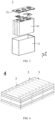
- FIG. 1 is a schematic diagram of a lithium-rich metal oxide according to an embodiment of the present application. As shown in FIG. 1 , the lithium-rich metal oxide 1 includes a lithium-rich metal oxide core 11 and a cladding layer 12.
- the content of lithium ions in the lithium-rich metal oxide core 11 is higher than that of a general lithium-containing metal oxide, so preparation of the battery cell by selecting the lithium-rich metal oxide core 11 is conducive to improving the charging capacity of the battery cell.
- the lithium-rich metal oxide core 11 is likely to react with water, carbon dioxide, and the like in air, thereby generating by-products on the surface of the lithium-rich metal oxide core 11, such as Li 2 CO 3 , LiOH, and other lithium-containing inert compounds. These by-products or lithium-containing inert compounds are dissociated on the surface of the lithium-rich metal oxide core 11, which affects deintercalation of lithium ions from the lithium-rich metal oxide core 11, resulting in a reduction in the performance of the lithium-rich metal oxide and the charging capacity of the battery cell.
- the lithium-containing inert compounds are highly alkaline, and when the lithium-rich metal oxide core 11 is mixed with a binder to form a slurry for preparing a positive electrode plate, these inert compounds affect the performance of the binder, causing the binder, for example, polyvinylidene fluoride (PVDF) to be denatured, and affecting the performance of the slurry and the coating of the slurry, thereby affecting the processing of the positive electrode plate.
- PVDF polyvinylidene fluoride
- the risk of a side reaction of the lithium-rich metal oxide core 11 can be reduced, which is conducive to improving the stability of the lithium-rich metal oxide 1; and it can reduce the effect of the lithium-containing inert compound on the processing of the positive electrode plates, and also lower the effect of the by-products on the charging capacity of the battery cell, and the performance of the lithium-rich metal oxide, which is conducive to improving the performance of the lithium-rich metal oxide and the charging capacity of the battery cell.
- the charging capacity of the battery cell may include a first turn charging capacity of the battery cell, where lithium ions are deintercalated from the positive electrode plate during charging of the battery cell.
- the charging capacity of the battery cell may be a ratio of the capacity of the battery cell to the mass of the active material in the battery cell after the charging of the battery cell is completed.
- the carbonaceous material 122 including a carbon-containing, electrically conductive material, may include a monolithic carbon material.
- the carbonaceous material 122 in the cladding layer 12 is embedded in the organic layer 121.
- the cladding layer 12 includes a plurality of carbonaceous material particles, and at least one carbonaceous material particle is embedded in the organic layer 121.
- Embedding may include: a portion of the carbonaceous material particles are embedded in the organic layer 121, the carbonaceous material particles are adsorbed onto the organic layer 121, or all of the carbonaceous material particles are embedded in the organic layer 121.
- the carbonaceous material 122 By making the carbonaceous material 122 be embedded in the organic layer 121, it is conducive to improving the conductivity of the organic layer 121, i.e., it is conducive to reducing the resistivity of the lithium-rich metal oxide 1 and improving the conductivity of the lithium-rich metal oxide 1.
- the lithium-rich metal oxide 1 of the present application can be used as a lithium replenishing agent.
- the lithium-rich metal oxide of the present application can also be used as an active agent, which is mixed with a binder and a conductive agent to prepare a positive electrode plate.
- the present application provides a lithium-rich metal oxide 1 including a lithium-rich metal oxide core 11 and a cladding layer 12, where the cladding layer 12 includes an organic layer 121 and a carbonaceous material 122, the organic layer 121 clads the lithium-rich metal oxide core 11, and the carbonaceous material 122 is embedded in the organic layer 121.
- the content of lithium ions in the lithium-rich metal oxide core 11 is higher than that in a general lithium-containing metal oxide, so preparation of a positive electrode material by selecting the lithium-rich metal oxide core 11 is conducive to improving the charging capacity of the battery cell.
- Cladding the lithium-rich metal oxide core 11 with the organic layer 121 can reduce the risk of the lithium-rich metal oxide core 11 reacting with water, carbon dioxide, and the like in air, thereby reducing the effect of by-products generated on the surface of the lithium-rich metal oxide core 11 on the processing of the positive electrode plate, and reducing the effect of the by-products on the deintercalation of lithium ions from the lithium-rich metal oxide core 11, and thus reducing the effect on the charging capacity of the battery cell.
- the carbonaceous material 122 is embedded in the organic layer 121, which is conducive to improving the conductivity of the lithium-rich metal oxide 1. Therefore, the lithium-rich metal oxide 1 according to the present application has high stability and conductivity, which is conducive to improving the performance of the battery cell when applied to the battery cell.
- the carbonaceous material 122 penetrates through the organic layer 121. That is, the carbonaceous material 122 is embedded in the organic layer 121 and extends from a surface of the organic layer 121 proximate the lithium-rich metal oxide core 11 to a surface of the organic layer 121 away from the lithium-rich metal oxide core 11. In this way, the carbonaceous material 122 is in contact with both the lithium-rich metal oxide core 11 and the exterior of the lithium-rich metal oxide 1, such as with an electrolyte solution or an electrolyte.
- the carbonaceous material 122 penetrates through the organic layer 121 and extends to a surface of the organic layer 121 away from the lithium-rich metal oxide core 11. In this way, the carbonaceous material 122 can be in contact with the external environment, such as an electrolyte solution, and can be used to transport lithium ions.
- the carbonaceous material 122 penetrates through the organic layer 121. In this way, on the one hand, it is conducive to further improving the conductivity of the lithium-rich metal oxide 1; on the other hand, the carbonaceous material 122 can serve as a channel for transporting ions, which is conducive to improving the diffusion coefficient of ions, e.g., lithium ions.
- the carbonaceous material 122 includes a monolithic carbon material. In this way, it can reduce the effect of the decomposition of the carbonaceous material 122 in the process of cladding the lithium-rich metal oxide 1 on the conductivity of the lithium-rich metal oxide 1.
- the monolithic carbon material can include a zero-dimensional carbon material, a one-dimensional carbon material, and a two-dimensional carbon material.
- the zero-dimensional carbon material can include carbon black, fullerene C60, etc.;
- the one-dimensional carbon material can include a carbon nanotube with an internal hollow structure, a carbon nanofiber without an obvious internal hollow structure, etc.;
- the two-dimensional carbon material can include graphene, etc.
- the monolithic carbon material 122 includes a one-dimensional carbon material. This is conducive to the embedding or penetration of the carbonaceous material in the organic layer 121.
- the one-dimensional carbon material includes a carbon nanotube.
- the carbon nanotube has high conductivity, and providing the carbon nanotube inside the cladding layer 12 is conducive to improving the electronic conductivity of the lithium-rich metal oxide 1.
- the hollow tube inside the carbon nanotube can accommodate the electrolyte solution, the electrolyte solution can be in contact with the lithium-rich metal oxide core 11 through the hollow tube, and the hollow tube can also be used as an ion channel for transporting lithium ions. Therefore, by selecting the carbon nanotube as the carbonaceous material 122, it is conducive to further improving the conductivity of the lithium-rich metal oxide 1.
- the carbon nanotube includes one or more of single-walled carbon nanotubes and multi-walled carbon nanotubes. This facilitates the flexible selection of different types of carbon nanotubes according to an actual situation.
- the carbon nanotube has a length-to-diameter ratio of 100:1 to 1000:1, and optionally 200:1 to 400:1.
- the length-to-diameter ratio of the carbon nanotube is a ratio of the length to the outer diameter of the carbon nanotube.
- the carbon nanotube In a case where the length-to-diameter ratio of the carbon nanotube is greater than 1000:1, the carbon nanotube has a greater length and is likely to agglomerate. This results in poor dispersion of the carbon nanotube in the process of cladding the lithium-rich metal oxide core 11, which is not conducive to uniformly cladding the lithium-rich metal oxide core 11 with the carbon nanotube.
- the length-to-diameter ratio of the carbon nanotube is less than 100:1
- the length of the carbon nanotube is smaller and the hollow tube of the carbon nanotube is shorter, which affects the effect of the carbon nanotube on the transport of electrons and ions.
- the length-to-diameter ratio of the carbon nanotube to be 100:1 to 1000:1, the cladding effect on the lithium-rich metal oxide core 11 and the conductivity of the lithium-rich metal oxide 1 both can be achieved.
- the length-to-diameter ratio of the carbon nanotube is 200:1 to 400:1, it is conducive to further improving the cladding effect on the lithium-rich metal oxide core 11 and the conductivity of the lithium-rich metal oxide 1.
- the mass ratio of the carbon nanotube to the lithium-rich metal oxide 1 is 0.2% to 2%, and optionally 0.5% to 1.5%.
- the mass ratio of the carbon nanotube to the lithium-rich metal oxide 1 is greater than 2%, in the process of mixing the carbon nanotube, or mixing the carbon nanotube with the organic matter and the lithium-rich metal oxide core 11, the carbon nanotube agglomerates, which is not conducive to achieving cladding uniformity, and affects the cladding effect and the stability of the lithium-rich metal oxide 1.
- the mass ratio of the carbon nanotube to the lithium-rich metal oxide is less than 0.2%, the content of carbon nanotube is too small, and the conductivity of the lithium-rich metal oxide 1 decreases, while the lithium ion transport path and diffusion path are reduced, which affects the performance of the lithium-rich metal oxide 1 and the charging capacity of a prepared battery cell.
- the mass ratio of the carbon nanotube to the lithium-rich metal oxide 1 is 0.2% to 2%, it is conducive to achieving both the stability and conductivity of the lithium-rich metal oxide 1, as well as the charging capacity of the battery cell.
- the mass ratio of the carbon nanotube to the lithium-rich metal oxide 1 is 0.5% to 1.5%, which is conducive to further improving the stability and conductivity of the lithium-rich metal oxide 1 and the charging capacity of the battery cell.
- the softening temperature of the organic layer 121 is not higher than 450°C, and optionally, not higher than 300°C.
- the softening temperature can be the temperature at which the organic matter changes from a solid state to a flow state, or the temperature at which the organic matter changes from a solid state to a molten state. After reaching the softening temperature of the organic matter, the organic matter is in a flow state or a molten state.
- the organic matter is molten into a flow state after being softened, so as to extensively and uniformly clad the lithium-rich metal oxide core 11, thereby forming the organic layer 121.
- a uniform, dense cladding on the lithium-rich metal oxide core 11 can be achieved at a lower temperature.
- the lithium-rich metal oxide 1 has a median particle diameter Dv 50 of 2 ⁇ m to 10 ⁇ m, and optionally 4 ⁇ m to 8 ⁇ m.
- the Li a M n O y includes one or more of Li 2 NiO 2 , Li 2 CuO 2 , Li 2 MnO 3 , Li 3 VO 4 , Li 3 NbO 4 , Li 5 FeO 4 , Li 6 CoO 4 , and Li 8 SnO 6 .
- the method further includes: sieving a product obtained after the above treatment to obtain the lithium-rich metal oxide 1. This facilitates obtaining the lithium-rich metal oxide 1 having a suitable particle diameter.
- the carbonaceous material includes a monolithic carbon material; optionally, the monolithic carbon material includes a one-dimensional carbon material; and optionally, the one-dimensional carbon material includes a carbon nanotube. In this way, it can reduce the effect of decomposition of the carbonaceous material in the process of preparing the lithium-rich metal oxide on the conductivity of the lithium-rich metal oxide.
- the monolithic carbon material includes a one-dimensional carbon material, which is conducive to achieving embedding or penetration of the carbonaceous material in the organic layer.
- the carbon nanotube includes one or more of single-walled carbon nanotubes, and multi-walled carbon nanotubes. This facilitates the flexible selection of different types of carbon nanotubes according to an actual situation.
- the softening temperature of the organic matter is less than the temperature of sintering.
- the softening temperature of the organic matter is not higher than 450°C, and optionally, not higher than 300°C. In this way, the organic matter is softened at the sintering temperature to be in a flow state, which is conducive to achieving a uniform, dense cladding on the lithium-rich metal oxide core.
- the organic matter includes one or more of rubber, pitch, polypropylene, polyethylene, polystyrene, polycarbonate, polymethyl methacrylate, polyethylene terephthalate, polyvinylidene difluoride, and polytetrafluoroethylene.
- the organic matter includes one or more of rubber, pitch and polyvinylidene difluoride. This facilitates flexible selection of the material of the organic matter according to an actual need.
- the providing a lithium-rich metal oxide core includes: mix a Li source and a M n source evenly according to a molar ratio of (a+0.05):1 to a:1 and then conduct single heating-up sintering in an inert atmosphere at a sintering temperature of 400°C to 600°C for 4 h to 8 h; where the Li source includes one or more of lithium oxide, lithium carbonate, lithium oxalate, lithium acetate, and lithium hydroxide, and the M n source includes one or more of oxides, hydroxides, halides, sulfates, carbonates, nitrates, oxalates, acetates, sulfides, and nitrides of M n ; optionally, the sintering temperature is 450°C to 550°C; and optionally, the inert atmosphere includes one or more of nitrogen gas, argon gas, and helium gas; and subject a product obtained after single heating-up sinter
- a suitable lithium-rich metal oxide core is prepared, which is conducive to subsequent preparation of the lithium-rich metal oxide.
- the lithium-rich metal oxide core is prepared at a lower sintering temperature according to the method, which is conducive to lowering the cost, while reducing the volatilization of lithium.
- the present application provides a positive electrode plate including the lithium-rich metal oxide according to any embodiment.
- the present application provides a battery cell including the positive electrode plate according to the above embodiment.
- the shape of the battery cell is not particularly limited in the present application, and may be cylindrical, prismatic or in any other shape.
- FIG. 3 is a schematic diagram of a battery cell according to an embodiment of the present application.
- the battery cell 3 includes a housing 31, a cover plate 32 and an electrode assembly 33 disposed in the housing 31.
- the electrode assembly 33 may be made from the positive electrode plate, the negative electrode plate, and the separator of the present application by a winding process or a stacking process.
- the battery cell 3 further includes an electrolyte.
- the electrolyte may be in a solid state, semi-solid state, or liquid state, without being particularly limited herein.
- the battery cell may be assembled into a battery module.
- the battery module may include one or a plurality of battery cells, and the specific number of battery cells in a battery module may be selected by a person skilled in the art depending on practical applications and capacity of the battery module.
- FIG. 4 is a schematic diagram of a battery module according to an embodiment of the present application.
- the plurality of battery cells 3 may be arranged sequentially in a length direction of the battery module 4.
- the plurality of battery cells 3 may also be arranged in any other manner. Further, the plurality of battery cells 3 may be secured by fasteners.
- the battery module 4 may further include a shell provided with an accommodation space.
- the plurality of battery cells 3 are accommodated in the accommodation space.
- the present application provides a battery including the battery cell according to the above embodiment.
- FIG. 5 is a schematic diagram of a battery according to an embodiment of the present application. As shown in FIG. 5 , the present application provides a battery 5 including the battery cell 3 according to any of the above embodiments.
- the battery cell 3 may directly form the battery 5, or may first form a plurality of battery modules that are then used to form the battery 5.
- the present application provides an electrical device including the battery according to the above embodiment.
- FIG. 6 is a schematic diagram of an electrical device according to an embodiment of the present application. As shown in FIG. 6 , the present application provides an electrical device 6 including the battery 5 according to the above embodiment.
- Embodiments of the present application are described hereinafter.
- the embodiments described below are illustrative, and are merely intended to construe the present application but not to limit the present application.
- Unless techniques or conditions are otherwise expressly specified in an embodiment hereof, the techniques or conditions described in the literature in this field or in an instruction manual of the product are applicable to the embodiment.
- the reagents or instruments used without specifying the manufacturer are conventional products available commercially.
- Embodiment 1 The difference between Embodiment 1 and Embodiments 2-9 lies in the ratio of the mass of the cladding layer to the mass of the lithium-rich metal oxide, that is, the total content of the cladding layer is different.
- Embodiment 1 The difference between Embodiment 1 and Embodiments 10-15 lies in the ratio of the mass of the carbon nanotube to the mass of the lithium-rich metal oxide, that is, the content of the carbon nanotube is different.
- Embodiment 1 The difference between Embodiment 1 and Embodiments 16-21 lies in the median particle diameter of the lithium-rich metal oxide.
- Embodiment 1 The difference between Embodiment 1 and Embodiments 22-28 lies in the length-to-diameter ratio of the carbon nanotube.
- Embodiment 1 The difference between Embodiment 1 and Embodiments 29-35 lies in the temperature T1, that is, the sintering temperature at which the lithium-rich metal oxide core is prepared is different.
- Embodiment 1 The difference between Embodiment 1 and Embodiments 36-41 lies in the temperature T2, that is, the temperature at which the lithium-rich metal oxide is prepared using the lithium-rich metal oxide core, the organic matter, and the carbonaceous material is different.
- Embodiment 1 The difference between Embodiment 1 and Embodiments 42-45 lies in the type of the lithium-rich metal oxide core.
- Embodiment 1 The difference between Embodiment 1 and Embodiments 46-48 lies in the type of the carbonaceous material.
- Embodiment 1 The difference between Embodiment 1 and Embodiments 49-50 lies in the type of the organic matter.
- the lithium-rich metal oxide core is cladded using only the carbon nanotube, and in Comparative Embodiment 3, the lithium-rich metal oxide core is cladded using only the pitch.
- the Li source and the M n source were mixed evenly according to the molar ratio of (a+0.05):1 to a:1 (where M n includes any one of M 1 to M 6 ) and then subjected to single heating-up sintering in a nitrogen inert atmosphere, where the sintering temperature was referenced to the sintering temperatures T1 of the different embodiments in Table 1, and the sintering time was 4 h to 8 h.
- the Li source includes lithium hydroxide, and the M n source includes ferric oxide; in Embodiment 43, the Li source includes lithium hydroxide, and the M n source includes cobalt hydroxide; in Embodiment 44, the Li source includes lithium hydroxide, and the M n source includes copper oxide; in Embodiment 45, the Li source includes lithium hydroxide, and the M n source includes nickel hydroxide; and in Embodiment 46, the Li source includes lithium hydroxide, and the M n source includes niobium oxide.
- the product obtained through the above single heating-up sintering was subjected to airflow crushing to obtain the lithium-rich metal oxide core.
- the lithium-rich metal oxide core and the carbonaceous material and organic matter were mixed evenly before a low temperature sintering.
- the specific sintering temperature T2 and other parameters are referenced to in Table 1.
- the lithium-rich metal oxide was obtained by sieving after sintering.
- the total content W of the cladding layer in the lithium-rich metal oxide can be measured using the high-frequency infrared carbon and sulfur analyzer carbon content analyzer (C content analyzer, model: HCS-140, manufactured by Shanghai Dekai Instruments Co., Ltd.), according to GBT20123-2006 "Determination of total carbon and sulfur content in steel using an infrared absorption method after combustion in a high-frequency induction furnace (conventional method)".
- C content analyzer model: HCS-140, manufactured by Shanghai Dekai Instruments Co., Ltd.
- the content Wo of the organic layer in the cladding layer can be measured using a thermal analyzer (model: NETZSCH STA449F3): 20 mg of the lithium-rich metal oxide was weighed and added into a corundum crucible, and a thermal weight loss rate of the lithium-rich metal oxide from 25°C to 800°C under an inert gas atmosphere was tested, where the heating rate can be 10°C/min.
- a thermal analyzer model: NETZSCH STA449F3
- the lithium-rich metal oxide was weighed and added to a corundum crucible, and the TG curve of the lithium-rich metal oxide was measured by the thermal analyzer in a nitrogen atmosphere to obtain its thermal weight loss rate (percentage of weight lost in thermal decomposition to the weight of the original sample), W L1 %, and its softening temperature T.
- the type of the organic matter was determined by the softening temperature.
- the content Wc of the carbon nanotube is equal to the total content W of the cladding layer minus the content Wo of the organic matter.
- the length-to-diameter ratio of the carbon nanotube can be measured by a transmission electron microscopy. Twenty well-dispersed carbon nanotubes were taken normally, and were measured for their outer diameters and lengths separately, and then an average value was taken as the length-to-diameter ratio of the carbon nanotube.
- the median particle diameter Dv 50 in the lithium-rich metal oxide can be measured using a laser particle diameter analyzer with reference to GB/T 19077-2016 particle diameter distribution laser diffraction method.
- Powder of the lithium-rich metal oxide was dried and an appropriate amount of the powder was weighed. Then the powder resistivity of the sample was measured by a powder resistivity tester (ST2722 digital four-probe instrument, manufactured by Suzhou Jingge Electronic Co., Ltd.) according to GB/T 30835-2014, "Carbon Composite Lithium Iron Phosphate Lithium-rich Metal Oxides for Lithium-ion Batteries". The test pressure was 20 MPa.
- a lithium-rich metal oxide, a binder polyvinylidene fluoride (PVDF), and a conductive agent acetylene black were dissolved in a solvent N-methyl-pyrrolidone (NMP) according to the mass ratio of 97: 2: 1, and full stirring and mixing was conducted to obtain a positive electrode slurry; and the positive electrode slurry was evenly coated on a positive current collector aluminum foil, and drying, cold pressing, and slitting were performed to obtain a positive electrode plate.
- NMP N-methyl-pyrrolidone
- the lithium-rich metal oxide was used as an active material, and no other active materials were added.
- a negative electrode plate Preparation of a negative electrode plate: a negative active material artificial graphite, a conductive agent acetylene black, a binder styrene-butadiene rubber (SBR), and a thickening agent sodium carboxymethyl cellulose (CMC-Na) were dissolved in deionized water according to the mass ratio of 96: 1.5: 1.5: 1.0, and full stirring and mixing was conducted to obtain a negative electrode slurry; and the negative electrode slurry was evenly coated on a negative current collector copper foil, and drying, cold pressing, and slitting were performed obtain a negative electrode plate.
- SBR binder styrene-butadiene rubber
- CMC-Na thickening agent sodium carboxymethyl cellulose
- ethylene carbonate (EC), ethyl methyl carbonate (EMC), and diethyl carbonate (DEC) were mixed according to a volume ratio of 1:1:1, and LiPF6 was evenly dissolved in the forgoing solution to obtain an electrolyte solution.
- the concentration of LiPF 6 was 1 mol/L.
- Preparation of a lithium-ion battery the positive electrode plate, the separator, and the negative electrode plate were stacked in sequence, and the stacked structure was wound to obtain an electrode assembly; the electrode assembly was placed into an outer package, the electrolyte solution prepared above was injected, and steps such as packaging, standing, chemical formation, and aging were performed to obtain a lithium-ion battery.
- the assembled lithium-ion battery was charged to 4.25 V at a constant current rate of 0.1 C, and left to stand for 5 min, and at this moment, the first turn charging capacity of the lithium-ion battery was recorded; and the first turn charging capacity of the battery was divided by the mass of the lithium-rich metal oxide to obtain the first turn charging gram capacity of the lithium-ion battery.
- the diffusion coefficient of lithium ions can be measured using conventional methods in the field such as Cyclic Voltammetry (CV), Electrochemical Impedance Spectroscopy (EIS), Galvanostatic Intermittent Titration Technique (GITT), and Potentiostatic Intermittent Titration Technique (PITT), and can be calculated based on Fick's first and second laws.
- CV Cyclic Voltammetry
- EIS Electrochemical Impedance Spectroscopy
- GITT Galvanostatic Intermittent Titration Technique
- PITT Potentiostatic Intermittent Titration Technique
- the diffusion coefficient of lithium ions of the lithium-rich metal oxide serving as the positive active material was measured according to the following steps: grinding the lithium-rich metal oxide into a powder microelectrode; and connecting the powder microelectrode to an electrochemical workstation for coulometric titration.
- a pulse current of 20 ⁇ A was used, and the titration time was 1 h with an interval of 4 h.
- D Li 4 ⁇ V m AFn 2 I 0 dE dx / dE d t 2 t ⁇ L 2 / D
- D Li the diffusion coefficient of lithium ions
- I0 is the applied current of 20 ⁇ A
- V m is the molar volume of the lithium-rich metal oxide of the active substance
- F is a Faraday's constant
- A is the surface area of the electrode
- n is the number of electrons participating in the reaction, which is also interpreted as the number of charges of the lithium ions, i.e., n may be 1
- dE/dx is the slope of a coulometric titration curve, i.e., the slope of a curve of an open-circuit potential vs a concentration value of lithium ions in the electrode at
- the lithium-rich metal oxide core is the type of the lithium-rich metal oxide core selected in the lithium-rich metal oxide
- the organic matter is the material of the organic layer in the cladding layer cladding the lithium-rich metal oxide core
- the carbonaceous material is the type of the carbonaceous material in the cladding layer
- the total content of the cladding layer is the ratio of the weight of the cladding layer to the weight of the lithium-rich metal oxide
- the content of the carbon nanotube is the ratio of the weight of the carbon nanotube to the weight of the lithium-rich metal oxide
- Dv 50 is the median particle diameter of the lithium-rich metal oxide
- the length-to-diameter ratio of the carbon nanotube is the ratio of the length to the outer diameter of the carbon nanotube in the cladding layer
- the temperature T1 is the sintering temperature at which the lithium-rich metal oxide core is prepared
- the temperature T2 is the sintering temperature at which the lithium-rich metal oxide is prepared using the lithium-rich metal oxide core
- CNTs represents that the carbonaceous material is the carbon nanotube
- P represents that the organic matter is pitch
- RB represents that the organic matter is rubber
- PVDF represents that the organic matter is polyvinylidene difluoride.
- Table 1 Specific parameters of embodiments and comparative embodiments Serial number Lithium-rich metals Oxides Carbonaceous material in cladding layer Organic matter in cladding layer Cladding layer Total content (wt%) Content of carbon nanotube (wt%) Dv 50 ( ⁇ m) Length-to-diameter ratio of carbon nanotube T1 (°C) T2 (°C) Embodiment 1 Li 5 FeO 4 CNTs P 6 1 6 300:1 600 300 Embodiment 2 Li 5 FeO 4 CNTs P 1.1 1 6 300:1 600 300 Embodiment 3 Li 5 FeO 4 CNTs P 2 1 6 300:1 600 300 Embodiment 4 Li 5 FeO 4 CNTs P 3 1 6 300:1 600 300 Embodiment 5 Li 5 FeO 4 CNTs P 4
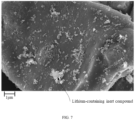
- FIG. 7 is a schematic diagram of a scanning electron microscope of a lithium-rich metal oxide core lithium-rich metal oxide not cladded with a cladding layer
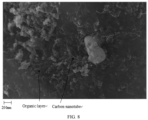
- FIG. 8 is a schematic diagram of a scanning electron microscope of a lithium-rich metal oxide core lithium-rich metal oxide cladded with a cladding layer according to the present application.
- the resistivity of the lithium-rich metal oxide not cladded with a cladding layer is much greater than that of the lithium-rich metal oxide cladded with a cladding layer, and the first turn charging capacity and the diffusion coefficient of lithium ions of a battery made of the lithium-rich metal oxide not cladded with a cladding layer are much lower than those of a battery made of the lithium-rich metal oxide cladded with a cladding layer.
- an inert lithium-containing inert compound is present on the surface of the lithium-rich metal oxide, and the lithium-containing inert compound affects the diffusion coefficient of lithium ions, the conductivity of the lithium-rich metal oxide, the charging capacity of the lithium-ion battery, and other performances.
- the surface of the lithium-rich metal oxide core is cladded with a cladding layer, and the cladding layer is embedded with a carbon nanotube. Combined with Embodiment 1 and test data thereof, the performance of the lithium-rich metal oxide set with the cladding layer is significantly improved.
- Embodiments 1-9 by reasonably setting the content of the cladding layer, the capacity of the battery and the diffusion coefficient of the lithium ion both can be achieved; when the content of the cladding layer is lower, the cladding effect is weakened, and the charging capacity of the battery is reduced; and when the content of the cladding layer is higher, the deintercalation of lithium ions is affected, and the charging capacity of the battery is reduced.
- Embodiments 10-13 by reasonably setting the content of the carbon nanotube, the conductivity of the lithium-rich metal oxide, the capacity of the battery, and the diffusion coefficient of lithium ions all can be achieved; combined with Embodiment 14, when the content of the carbon nanotube is lower, the conductivity of powder of the lithium-rich metal oxide is reduced; and combined with Embodiment 15, when the content of the carbon nanotube is higher, the charging capacity of the battery is reduced.
- Embodiments 16-19 by reasonably setting the median particle diameter of the lithium-rich metal oxide, the cladding uniformity and the capacity of the lithium-rich metal oxide both can be achieved, which is conducive to ensuring the capacity of the battery; combined with Embodiment 20, when the median particle diameter of the lithium-rich metal oxide is smaller, the charging capacity of the battery is reduced; and combined with Embodiment 21, when the median particle diameter of the lithium-rich metal oxide is greater, the charging capacity of the battery is reduced.
- Embodiments 22-26 by reasonably setting the length-to-diameter ratio of the carbon nanotube, the capacity of the battery and the conductivity of the lithium-rich metal oxide both can be achieved; combined with Embodiment 27, when the length-to-diameter ratio of the carbon nanotube is smaller, the diffusion coefficient of lithium ions is lower; and combined with Embodiment 28, when the length-to-diameter ratio of the carbon nanotube is greater, the charging capacity of the battery is reduced.
- Embodiments 36-41 by reasonably setting the temperature T2, the conductivity and stability of the lithium-rich metal oxide, the capacity of the battery, and the diffusion coefficient of lithium ions all can be achieved.
- surfaces of a plurality of lithium-rich metal oxide cores can be cladded with the cladding layer of the present application, so as to improve the performance of the battery.
- a plurality of different carbonaceous materials can be adopted for cladding the lithium-rich metal oxide core, which can improve the conductivity of the lithium-rich metal oxide.
- Embodiments 49-50 a plurality of different organic matters can be applied for cladding the lithium-rich metal oxide core.
Landscapes
- Chemical & Material Sciences (AREA)
- Chemical Kinetics & Catalysis (AREA)
- Electrochemistry (AREA)
- General Chemical & Material Sciences (AREA)
- Inorganic Chemistry (AREA)
- Composite Materials (AREA)
- Engineering & Computer Science (AREA)
- Materials Engineering (AREA)
- Manufacturing & Machinery (AREA)
- Battery Electrode And Active Subsutance (AREA)
Applications Claiming Priority (1)
| Application Number | Priority Date | Filing Date | Title |
|---|---|---|---|
| PCT/CN2023/071227 WO2024148453A1 (zh) | 2023-01-09 | 2023-01-09 | 富锂金属氧化物及其制备方法、正极片、电池单体和电池 |
Publications (2)
| Publication Number | Publication Date |
|---|---|
| EP4583199A1 true EP4583199A1 (de) | 2025-07-09 |
| EP4583199A4 EP4583199A4 (de) | 2026-01-14 |
Family
ID=91897489
Family Applications (1)
| Application Number | Title | Priority Date | Filing Date |
|---|---|---|---|
| EP23915237.4A Pending EP4583199A4 (de) | 2023-01-09 | 2023-01-09 | Lithiumreiches metalloxid und herstellungsverfahren dafür, positivelektrodenfolie, batteriezelle und batterie |
Country Status (3)
| Country | Link |
|---|---|
| EP (1) | EP4583199A4 (de) |
| CN (1) | CN119256399B (de) |
| WO (1) | WO2024148453A1 (de) |
Family Cites Families (8)
| Publication number | Priority date | Publication date | Assignee | Title |
|---|---|---|---|---|
| CN106898737A (zh) * | 2015-12-21 | 2017-06-27 | 比亚迪股份有限公司 | 一种锂离子电池正极材料添加剂及其制备方法、含有该添加剂的正极材料和锂离子电池 |
| CN107785578B (zh) * | 2016-08-25 | 2019-06-11 | 宁德时代新能源科技股份有限公司 | 正极添加剂及其制备方法、正极片及锂离子二次电池 |
| JP6922672B2 (ja) * | 2017-11-09 | 2021-08-18 | 株式会社豊田自動織機 | 炭素被覆Li5FeO4 |
| CN108461719B (zh) * | 2018-01-23 | 2020-06-05 | 广州大学 | 一种富锂材料/导电有机聚合物复合正极材料及电极的制备方法 |
| CN109286013A (zh) * | 2018-11-16 | 2019-01-29 | 华南师范大学 | 一种包覆聚酰胺有机物层的锂离子电池高压富锂锰基正极材料及其包覆改性方法和应用 |
| CN112803002B (zh) * | 2021-01-25 | 2022-06-21 | 中南大学 | 一种表面构筑离子导体-电子导体混合包覆的富锂锰基正极材料及其制备方法和应用 |
| CN114725539B (zh) * | 2021-02-10 | 2025-04-18 | 深圳市德方创域新能源科技有限公司 | 一种补锂添加剂及其制备方法 |
| KR102784439B1 (ko) * | 2021-09-27 | 2025-03-21 | 주식회사 엘지화학 | 리튬 이차전지용 양극 첨가제, 이의 제조 방법, 이를 포함하는 양극 및 리튬 이차전지 |
-
2023
- 2023-01-09 EP EP23915237.4A patent/EP4583199A4/de active Pending
- 2023-01-09 WO PCT/CN2023/071227 patent/WO2024148453A1/zh not_active Ceased
- 2023-01-09 CN CN202380043208.9A patent/CN119256399B/zh active Active
Also Published As
| Publication number | Publication date |
|---|---|
| EP4583199A4 (de) | 2026-01-14 |
| CN119256399A (zh) | 2025-01-03 |
| WO2024148453A1 (zh) | 2024-07-18 |
| CN119256399B (zh) | 2026-01-13 |
Similar Documents
| Publication | Publication Date | Title |
|---|---|---|
| EP3429000B1 (de) | Modifiziertes positives aktivmaterial und herstellungsverfahren dafür sowie elektrochemische energiespeichervorrichtung | |
| EP4170755A1 (de) | Positivelektrodenmaterial, positivelektrodenpolteil, lithiumsekundärbatterie, batteriemodul, batteriepack und vorrichtung | |
| Delpuech et al. | Mechanism of Silicon Electrode Aging upon Cycling in Full Lithium‐Ion Batteries | |
| Scaravonati et al. | Combined capacitive and electrochemical charge storage mechanism in high-performance graphene-based lithium-ion batteries | |
| CN118136801A (zh) | 含锂磷酸盐类正极材料及其制备方法和应用 | |
| Zhang et al. | Controllable synthesis of spinel nano-CoMn2O4 via a solvothermal carbon templating method and its application in lithium ion batteries | |
| US9391319B2 (en) | Hollow nanoparticle cathode materials for sodium electrochemical cells and batteries | |
| EP4322259A1 (de) | Positivelektrodenmaterial, herstellungsverfahren dafür und sekundärbatterie damit | |
| EP4645448A1 (de) | Lithium-supplementierendes material, positivelektrode, elektrochemische vorrichtung und elektrische vorrichtung | |
| US20250349850A1 (en) | Positive electrode active material and preparation method therefor, positive electrode plate, secondary battery, and power consuming apparatus | |
| Zhang et al. | New insights for the abuse tolerance behavior of LiMn2O4 under high cut‐off potential conditions | |
| CN115954460A (zh) | 一种磷酸锰铁锂正极材料及其制备方法和应用 | |
| US20230088432A1 (en) | Negative electrode active material, method for preparing the same and lithium secondary battery including the same | |
| EP4583199A1 (de) | Lithiumreiches metalloxid und herstellungsverfahren dafür, positivelektrodenfolie, batteriezelle und batterie | |
| EP4579795A1 (de) | Zusammengesetztes positivelektrodenmaterial und herstellungsverfahren dafür, positivelektrodenplatte, batterie und elektrische vorrichtung | |
| EP4297124A1 (de) | Negatives aktivmaterial, sekundärbatterie und elektronische vorrichtung | |
| Kocak et al. | Effect of doping amount on capacity retention and electrolyte decomposition of LiNi0. 5Mn1. 5O4-based cathode at high temperature | |
| EP4607640A1 (de) | Lithiumsekundärbatterie und elektrische vorrichtung | |
| EP4583209A1 (de) | Stromkollektor und seine anwendung, sekundärbatterie, batteriemodul, batteriepack und elektrische vorrichtung | |
| CN114914410B (zh) | 界面相互作用构建内建电场用于高性能锂离子存储 | |
| KR20240129002A (ko) | 양극 활물질 및 이의 제조 방법, 양극판, 이차배터리, 배터리모듈, 배터리팩 및 전기기기 | |
| Shi et al. | Remarkable anodic performance of lead titanate 1D nanostructures via in-situ irreversible formation of abundant Ti3+ as conduction pathways | |
| Zhang et al. | Electrochemical reactions between perovskite-type LaCoO3 and lithium | |
| EP4579811A1 (de) | Lithiumreiches metalloxid und herstellungsverfahren dafür, positivelektrodenfolie, batteriezelle und batterie | |
| Zhu et al. | The Effect of Different Carbon Materials on Manganese Oxide‐Based Lithium–Air Batteries in Ambient Environment |
Legal Events
| Date | Code | Title | Description |
|---|---|---|---|
| STAA | Information on the status of an ep patent application or granted ep patent |
Free format text: STATUS: THE INTERNATIONAL PUBLICATION HAS BEEN MADE |
|
| PUAI | Public reference made under article 153(3) epc to a published international application that has entered the european phase |
Free format text: ORIGINAL CODE: 0009012 |
|
| STAA | Information on the status of an ep patent application or granted ep patent |
Free format text: STATUS: REQUEST FOR EXAMINATION WAS MADE |
|
| 17P | Request for examination filed |
Effective date: 20250331 |
|
| AK | Designated contracting states |
Kind code of ref document: A1 Designated state(s): AL AT BE BG CH CY CZ DE DK EE ES FI FR GB GR HR HU IE IS IT LI LT LU LV MC ME MK MT NL NO PL PT RO RS SE SI SK SM TR |
|
| A4 | Supplementary search report drawn up and despatched |
Effective date: 20251215 |
|
| RIC1 | Information provided on ipc code assigned before grant |
Ipc: H01M 4/36 20060101AFI20251209BHEP Ipc: H01M 4/48 20100101ALI20251209BHEP Ipc: H01M 4/583 20100101ALI20251209BHEP Ipc: H01M 10/0525 20100101ALI20251209BHEP |