EP4578965A1 - Carbonaceous material to be used for production of sintered ore - Google Patents
Carbonaceous material to be used for production of sintered ore Download PDFInfo
- Publication number
- EP4578965A1 EP4578965A1 EP23865051.9A EP23865051A EP4578965A1 EP 4578965 A1 EP4578965 A1 EP 4578965A1 EP 23865051 A EP23865051 A EP 23865051A EP 4578965 A1 EP4578965 A1 EP 4578965A1
- Authority
- EP
- European Patent Office
- Prior art keywords
- carbonaceous material
- sintered ore
- carbonaceous
- production
- electric conductivity
- Prior art date
- Legal status (The legal status is an assumption and is not a legal conclusion. Google has not performed a legal analysis and makes no representation as to the accuracy of the status listed.)
- Pending
Links
Images
Classifications
-
- C—CHEMISTRY; METALLURGY
- C10—PETROLEUM, GAS OR COKE INDUSTRIES; TECHNICAL GASES CONTAINING CARBON MONOXIDE; FUELS; LUBRICANTS; PEAT
- C10L—FUELS NOT OTHERWISE PROVIDED FOR; NATURAL GAS; SYNTHETIC NATURAL GAS OBTAINED BY PROCESSES NOT COVERED BY SUBCLASSES C10G OR C10K; LIQUIFIED PETROLEUM GAS; USE OF ADDITIVES TO FUELS OR FIRES; FIRE-LIGHTERS
- C10L5/00—Solid fuels
- C10L5/02—Solid fuels such as briquettes consisting mainly of carbonaceous materials of mineral or non-mineral origin
- C10L5/04—Raw material of mineral origin to be used; Pretreatment thereof
-
- C—CHEMISTRY; METALLURGY
- C10—PETROLEUM, GAS OR COKE INDUSTRIES; TECHNICAL GASES CONTAINING CARBON MONOXIDE; FUELS; LUBRICANTS; PEAT
- C10L—FUELS NOT OTHERWISE PROVIDED FOR; NATURAL GAS; SYNTHETIC NATURAL GAS OBTAINED BY PROCESSES NOT COVERED BY SUBCLASSES C10G OR C10K; LIQUIFIED PETROLEUM GAS; USE OF ADDITIVES TO FUELS OR FIRES; FIRE-LIGHTERS
- C10L5/00—Solid fuels
-
- C—CHEMISTRY; METALLURGY
- C10—PETROLEUM, GAS OR COKE INDUSTRIES; TECHNICAL GASES CONTAINING CARBON MONOXIDE; FUELS; LUBRICANTS; PEAT
- C10L—FUELS NOT OTHERWISE PROVIDED FOR; NATURAL GAS; SYNTHETIC NATURAL GAS OBTAINED BY PROCESSES NOT COVERED BY SUBCLASSES C10G OR C10K; LIQUIFIED PETROLEUM GAS; USE OF ADDITIVES TO FUELS OR FIRES; FIRE-LIGHTERS
- C10L5/00—Solid fuels
- C10L5/02—Solid fuels such as briquettes consisting mainly of carbonaceous materials of mineral or non-mineral origin
- C10L5/34—Other details of the shaped fuels, e.g. briquettes
- C10L5/36—Shape
- C10L5/363—Pellets or granulates
-
- C—CHEMISTRY; METALLURGY
- C10—PETROLEUM, GAS OR COKE INDUSTRIES; TECHNICAL GASES CONTAINING CARBON MONOXIDE; FUELS; LUBRICANTS; PEAT
- C10L—FUELS NOT OTHERWISE PROVIDED FOR; NATURAL GAS; SYNTHETIC NATURAL GAS OBTAINED BY PROCESSES NOT COVERED BY SUBCLASSES C10G OR C10K; LIQUIFIED PETROLEUM GAS; USE OF ADDITIVES TO FUELS OR FIRES; FIRE-LIGHTERS
- C10L5/00—Solid fuels
- C10L5/40—Solid fuels essentially based on materials of non-mineral origin
-
- C—CHEMISTRY; METALLURGY
- C22—METALLURGY; FERROUS OR NON-FERROUS ALLOYS; TREATMENT OF ALLOYS OR NON-FERROUS METALS
- C22B—PRODUCTION AND REFINING OF METALS; PRETREATMENT OF RAW MATERIALS
- C22B1/00—Preliminary treatment of ores or scrap
- C22B1/14—Agglomerating; Briquetting; Binding; Granulating
- C22B1/16—Sintering; Agglomerating
-
- C—CHEMISTRY; METALLURGY
- C22—METALLURGY; FERROUS OR NON-FERROUS ALLOYS; TREATMENT OF ALLOYS OR NON-FERROUS METALS
- C22B—PRODUCTION AND REFINING OF METALS; PRETREATMENT OF RAW MATERIALS
- C22B1/00—Preliminary treatment of ores or scrap
- C22B1/14—Agglomerating; Briquetting; Binding; Granulating
- C22B1/16—Sintering; Agglomerating
- C22B1/20—Sintering; Agglomerating in sintering machines with movable grates
- C22B1/205—Sintering; Agglomerating in sintering machines with movable grates regulation of the sintering process
-
- C—CHEMISTRY; METALLURGY
- C22—METALLURGY; FERROUS OR NON-FERROUS ALLOYS; TREATMENT OF ALLOYS OR NON-FERROUS METALS
- C22B—PRODUCTION AND REFINING OF METALS; PRETREATMENT OF RAW MATERIALS
- C22B1/00—Preliminary treatment of ores or scrap
- C22B1/14—Agglomerating; Briquetting; Binding; Granulating
- C22B1/24—Binding; Briquetting ; Granulating
- C22B1/242—Binding; Briquetting ; Granulating with binders
- C22B1/244—Binding; Briquetting ; Granulating with binders organic
- C22B1/245—Binding; Briquetting ; Granulating with binders organic with carbonaceous material for the production of coked agglomerates
-
- C—CHEMISTRY; METALLURGY
- C10—PETROLEUM, GAS OR COKE INDUSTRIES; TECHNICAL GASES CONTAINING CARBON MONOXIDE; FUELS; LUBRICANTS; PEAT
- C10L—FUELS NOT OTHERWISE PROVIDED FOR; NATURAL GAS; SYNTHETIC NATURAL GAS OBTAINED BY PROCESSES NOT COVERED BY SUBCLASSES C10G OR C10K; LIQUIFIED PETROLEUM GAS; USE OF ADDITIVES TO FUELS OR FIRES; FIRE-LIGHTERS
- C10L2290/00—Fuel preparation or upgrading, processes or apparatus therefore, comprising specific process steps or apparatus units
- C10L2290/06—Heat exchange, direct or indirect
-
- C—CHEMISTRY; METALLURGY
- C10—PETROLEUM, GAS OR COKE INDUSTRIES; TECHNICAL GASES CONTAINING CARBON MONOXIDE; FUELS; LUBRICANTS; PEAT
- C10L—FUELS NOT OTHERWISE PROVIDED FOR; NATURAL GAS; SYNTHETIC NATURAL GAS OBTAINED BY PROCESSES NOT COVERED BY SUBCLASSES C10G OR C10K; LIQUIFIED PETROLEUM GAS; USE OF ADDITIVES TO FUELS OR FIRES; FIRE-LIGHTERS
- C10L2290/00—Fuel preparation or upgrading, processes or apparatus therefore, comprising specific process steps or apparatus units
- C10L2290/14—Injection, e.g. in a reactor or a fuel stream during fuel production
- C10L2290/146—Injection, e.g. in a reactor or a fuel stream during fuel production of water
-
- C—CHEMISTRY; METALLURGY
- C10—PETROLEUM, GAS OR COKE INDUSTRIES; TECHNICAL GASES CONTAINING CARBON MONOXIDE; FUELS; LUBRICANTS; PEAT
- C10L—FUELS NOT OTHERWISE PROVIDED FOR; NATURAL GAS; SYNTHETIC NATURAL GAS OBTAINED BY PROCESSES NOT COVERED BY SUBCLASSES C10G OR C10K; LIQUIFIED PETROLEUM GAS; USE OF ADDITIVES TO FUELS OR FIRES; FIRE-LIGHTERS
- C10L2290/00—Fuel preparation or upgrading, processes or apparatus therefore, comprising specific process steps or apparatus units
- C10L2290/24—Mixing, stirring of fuel components
-
- C—CHEMISTRY; METALLURGY
- C10—PETROLEUM, GAS OR COKE INDUSTRIES; TECHNICAL GASES CONTAINING CARBON MONOXIDE; FUELS; LUBRICANTS; PEAT
- C10L—FUELS NOT OTHERWISE PROVIDED FOR; NATURAL GAS; SYNTHETIC NATURAL GAS OBTAINED BY PROCESSES NOT COVERED BY SUBCLASSES C10G OR C10K; LIQUIFIED PETROLEUM GAS; USE OF ADDITIVES TO FUELS OR FIRES; FIRE-LIGHTERS
- C10L2290/00—Fuel preparation or upgrading, processes or apparatus therefore, comprising specific process steps or apparatus units
- C10L2290/28—Cutting, disintegrating, shredding or grinding
-
- C—CHEMISTRY; METALLURGY
- C10—PETROLEUM, GAS OR COKE INDUSTRIES; TECHNICAL GASES CONTAINING CARBON MONOXIDE; FUELS; LUBRICANTS; PEAT
- C10L—FUELS NOT OTHERWISE PROVIDED FOR; NATURAL GAS; SYNTHETIC NATURAL GAS OBTAINED BY PROCESSES NOT COVERED BY SUBCLASSES C10G OR C10K; LIQUIFIED PETROLEUM GAS; USE OF ADDITIVES TO FUELS OR FIRES; FIRE-LIGHTERS
- C10L2290/00—Fuel preparation or upgrading, processes or apparatus therefore, comprising specific process steps or apparatus units
- C10L2290/30—Pressing, compressing or compacting
-
- C—CHEMISTRY; METALLURGY
- C10—PETROLEUM, GAS OR COKE INDUSTRIES; TECHNICAL GASES CONTAINING CARBON MONOXIDE; FUELS; LUBRICANTS; PEAT
- C10L—FUELS NOT OTHERWISE PROVIDED FOR; NATURAL GAS; SYNTHETIC NATURAL GAS OBTAINED BY PROCESSES NOT COVERED BY SUBCLASSES C10G OR C10K; LIQUIFIED PETROLEUM GAS; USE OF ADDITIVES TO FUELS OR FIRES; FIRE-LIGHTERS
- C10L2290/00—Fuel preparation or upgrading, processes or apparatus therefore, comprising specific process steps or apparatus units
- C10L2290/54—Specific separation steps for separating fractions, components or impurities during preparation or upgrading of a fuel
- C10L2290/546—Sieving for separating fractions, components or impurities during preparation or upgrading of a fuel
-
- Y—GENERAL TAGGING OF NEW TECHNOLOGICAL DEVELOPMENTS; GENERAL TAGGING OF CROSS-SECTIONAL TECHNOLOGIES SPANNING OVER SEVERAL SECTIONS OF THE IPC; TECHNICAL SUBJECTS COVERED BY FORMER USPC CROSS-REFERENCE ART COLLECTIONS [XRACs] AND DIGESTS
- Y02—TECHNOLOGIES OR APPLICATIONS FOR MITIGATION OR ADAPTATION AGAINST CLIMATE CHANGE
- Y02E—REDUCTION OF GREENHOUSE GAS [GHG] EMISSIONS, RELATED TO ENERGY GENERATION, TRANSMISSION OR DISTRIBUTION
- Y02E50/00—Technologies for the production of fuel of non-fossil origin
- Y02E50/30—Fuel from waste, e.g. synthetic alcohol or diesel
Definitions
- the present invention relates to a carbonaceous material as a solid fuel used to produce a sintered ore.
- Patent Literature 1 provides a carbonaceous material to be used for the production of a sintered ore, assuming the use of subbituminous coal and brown coal.
- the properties of this carbonaceous material are such that a reaction start temperature is 550°C or lower; a volatile matter (VM) is 1.0% or more; an atomic number ratio between hydrogen and carbon (H/C) is 0.040 or more, and a pore quantity of pores with pore sizes of 0.1 to 10 ⁇ m is 50 mm 3 /g or larger when measured by the mercury intrusion technique.
- Patent Literature 2 proposed is the use of a raw material for sintering containing 10% by mass or more of a solid fuel with a combustion start temperature of lower than 450°C, when using 30% or more of a high crystal water iron ore that contains 4.0% by mass or more of crystal water.
- the carbonaceous material of the present invention to be used for the production of a sintered ore, by using a carbonaceous material satisfying the range of conditions limited by the present invention, pyrolysates generated at the time of combustion and substances generated by a gas phase reaction thereafter can be prevented from adhering to pipes and equipment in an exhaust gas system, whereby these pipes and equipment in the exhaust gas system can be prevented from breaking down. Further, there can be prevented white smoke generation; and the lowering of a dust collecting efficiency when using an electric dust collector to collect the dust in the exhaust gas generated at the time of using the carbonaceous material of the invention.
- VM was smaller, and electric conductivity was also at a higher level, as compared to the Example 1; even in the Example 2, the test was able to be performed 100 times, and the removal of the dust via hammering was also possible. Meanwhile, while there was not much difference in VM between the Comparative Example 2 and the Example 2, there was a significant difference in electric conductivity between the two examples; in the Comparative Example 2, while the test was able to be performed 100 times, the removal of the dust via hammering was difficult. Further, in a Comparative Example 3 in which there was only used biomass with a VM of 77.0%, although an unusable state was reached after performing the 17th test, dust removal via hammering was possible.
- the carbonaceous material of the present invention can serve as a material capable of preventing troubles in an exhaust gas system that are attributed to an exhaust gas treatment, such as tar generation in a pipe and white smoke generation in an electric dust collector, thereby making the carbonaceous material of the present invention industrially useful.
Landscapes
- Chemical & Material Sciences (AREA)
- Organic Chemistry (AREA)
- Environmental & Geological Engineering (AREA)
- General Life Sciences & Earth Sciences (AREA)
- Geochemistry & Mineralogy (AREA)
- Geology (AREA)
- Life Sciences & Earth Sciences (AREA)
- Engineering & Computer Science (AREA)
- Oil, Petroleum & Natural Gas (AREA)
- Mechanical Engineering (AREA)
- Metallurgy (AREA)
- Materials Engineering (AREA)
- Manufacturing & Machinery (AREA)
- Manufacture And Refinement Of Metals (AREA)
- Carbon And Carbon Compounds (AREA)
- Ceramic Products (AREA)
Abstract
Description
- The present invention relates to a carbonaceous material as a solid fuel used to produce a sintered ore.
- In the production process of a sintered ore, a mixture of an iron ore, flux, and a carbonaceous material as a solid fuel is sintered in a sintering machine via the combustion heat of such carbonaceous material, thereby obtaining a sintered ore. Usually, coke breeze is used as a carbonaceous material; there may also be used anthracite or the like other than coke breeze in terms of risk diversification for, for example, price fluctuations of raw material coal, and troubles in a coke production equipment.
- Meanwhile, in response to the growing awareness of environmental conservation in recent years, carbonaceous materials have progressively diversified with the intention of reducing the burden on the environment, aside from the idea of risk diversification or the like. As one example thereof,
Patent Literature 1 provides a carbonaceous material to be used for the production of a sintered ore, assuming the use of subbituminous coal and brown coal. The properties of this carbonaceous material are such that a reaction start temperature is 550°C or lower; a volatile matter (VM) is 1.0% or more; an atomic number ratio between hydrogen and carbon (H/C) is 0.040 or more, and a pore quantity of pores with pore sizes of 0.1 to 10 µm is 50 mm3/g or larger when measured by the mercury intrusion technique. Further, inPatent Literature 2, proposed is the use of a raw material for sintering containing 10% by mass or more of a solid fuel with a combustion start temperature of lower than 450°C, when using 30% or more of a high crystal water iron ore that contains 4.0% by mass or more of crystal water. -
- Patent Literature 1:
Japanese Patent No.4681688 - Patent Literature 2:
Japanese Patent No.4837799 - However, the use of the carbonaceous material that is described in
Patent Literature 1 and the use of the solid fuel that is described inPatent Literature 2 are focused on the productivity of a sintered ore and NOx; the impact of exhaust gas treatment is not taken into consideration inPatent Literature 1 andPatent Literature 2. For this reason, using the carbonaceous material described inPatent Literature 1 and the solid fuel described inPatent Literature 2 was not able to prevent troubles in an exhaust gas system that are attributed to an exhaust gas treatment, such as tar generation in a pipe and white smoke generation in an electric dust collector. - It is an object of the present invention to solve the above problems by providing a carbonaceous material capable of preventing, if used for the production of a sintered ore, troubles in an exhaust gas system that are attributed to an exhaust gas treatment, such as tar generation in a pipe and white smoke generation in an electric dust collector.
- The carbonaceous material of the present invention is a carbonaceous material to be used for the production of a sintered ore. This carbonaceous material is a carbonaceous material as a solid fuel used to produce a sintered ore, and has an electric conductivity of 1.0×10⁻⁹ S/m or more and a volatile matter (VM) of 15% or less.
- Here, in the case of the carbonaceous material of the present invention that is to be used for the production of a sintered ore and is configured in the above manner, it is considered that more preferable resolutions can be brought if:
- (1) when the carbonaceous material is comprised of multiple types of carbonaceous materials, carbonaceous materials each having an electric conductivity of 1.0×10⁻⁹ S/m or more are contained at a ratio of 80% or more, and a weighted average value of the volatile matters (VM) of the multiple types of carbonaceous materials is 15% or less;
- (2) the carbonaceous material includes a carbonaceous material having a combustion start temperature of 550°C or lower; and
- (3) the carbonaceous material having a combustion start temperature of 550°C or lower is coke whose raw material includes biomass charcoal, anthracite, waste plastic charcoal, brown coal, and subbituminous coal.
- According to the carbonaceous material of the present invention to be used for the production of a sintered ore, by using a carbonaceous material satisfying the range of conditions limited by the present invention, pyrolysates generated at the time of combustion and substances generated by a gas phase reaction thereafter can be prevented from adhering to pipes and equipment in an exhaust gas system, whereby these pipes and equipment in the exhaust gas system can be prevented from breaking down. Further, there can be prevented white smoke generation; and the lowering of a dust collecting efficiency when using an electric dust collector to collect the dust in the exhaust gas generated at the time of using the carbonaceous material of the invention.
- [
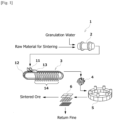
Fig. 1 ] is a schematic diagram showing one example of a sintered ore production equipment employing a carbonaceous material of the present embodiment. - An embodiment of the present invention is described in detail hereunder. Here, the following embodiment is a set of examples of a device and/or method embodying the technical concept of the present invention and is not to limit the configuration of the present invention to those shown below. That is, various modifications can be made to the technical concept of the present invention within the technical scope described in the claims.
-
Fig.1 is a schematic diagram showing an example of a sinteredore production equipment 1 that employs the carbonaceous material of the present embodiment. The sinteredore production equipment 1 has adrum mixer 2 as a granulator, asintering machine 3, a crushingmachine 4, acooler 5, and asieving device 6. A raw material for sintering containing an iron-containing raw material, an auxiliary raw material, and a coagulating material such as a carbon material and a coke powder is subjected to granulation in thedrum mixer 2 with a granulation water being added thereto. The granulated raw material for sintering is then transferred to thesintering machine 3. - The
sintering machine 3 is, for example, a Dwight-Lloyd type sintering machine. Thesintering machine 3 has a raw material for sinteringfeeding device 11, a continuous-type pallet carriage 12, anignition furnace 13, and awind box 14. The granulated raw material for sintering is charged into thepallet carriage 12 from the raw material for sinteringfeeding device 11 to form a charged layer of the raw material for sintering. The coagulating material contained in the surface layer of the charged layer is ignited by theignition furnace 13, and the air in the charged layer is sucked downward through thewind box 14, thereby causing the combustion molten zone in the charged layer to be moved to the lower region of the charged layer. Due to such movement of the combustion molten zone, the charged layer is sintered to form a sintered cake. - When sucking the air in the charged layer downward through the
wind box 14, a gas fuel and/or an oxygen-enriched air enriched with oxygen may be supplied from the upper region of the charged layer. The gas fuel is any combustible gas selected from a blast furnace gas, a coke oven gas, a converter gas, a city gas, a natural gas, a methane gas, an ethane gas, a propane gas, and a mixed gas of these gases. - The sintered cake is crushed by the crushing
machine 4 and is cooled by the cooler 5. Thesieving device 6 is then used to sieve the crushed product of the sintered cake into a sintered ore having a particle size of 5 mm or larger and a return fine having a particle size of smaller than 5 mm. The return fine is again used as the raw material for sintering. The sintered ore is produced in such manner. - Biomass-derived carbonaceous materials (referred to as biomass charcoal hereunder) are gathering attention in terms of carbonaceous material diversification intended to reduce environmental load. Biomass charcoal absorbs carbon dioxide gas until a plant as its raw material has grown; thus, from the perspective of carbon neutrality, in the case of a fuel using such biomass carbon, the discharge amount of carbon dioxide gas outside the system can be counted as none. Therefore, the use of biomass charcoal is under consideration even in an iron ore sintering process employing a normal coke breeze. One feature of biomass charcoal is that it has a combustion start temperature of roughly 550°C or lower, which is lower than that of coke (600 to 800°C). Further, it is known that the thermal decomposition reaction of biomass or the like is largely affected by a plant as its raw material; the properties of biomass charcoals vary significantly even though they may be roughly categorized as heat-treated biomass charcoals, which makes it impossible to sort them out simply based on combustion start temperature.
- In a sintering step performed by the
sintering machine 3, flux and the carbonaceous material are added to an iron ore, followed by continuously charging them onto the sinteringmachine 3 to form a sintering bed composed of the charged layer of the raw material for sintering. By sucking an exhaust gas from the lower end of the sintering bed after igniting the upper end thereof, the combustion of the carbonaceous material will propagate from the upper end of the bed to the lower end thereof, thereby causing the iron ore and flux to react and agglomerate with each other via such heat. The exhaust gas suction from the lower layer is carried out with a blower, whereby the exhaust gas sucked is then ejected from a chimney after passing through the inner side of a duct, a dust collector, and a desulfurization and denitration equipment. - Hydrocarbons having as many as or more benzene rings than naphthalene are called tars; the tar generation of biomass is enormously large when heated. The large amount of tar(s) generated adhere to, for example, the inner side of a pipe, a dust removal filter, and the impeller of a blower, which may cause troubles. Thus, when selecting a biomass charcoal, it is necessary to keep the amount of tar(s) generated, i.e., the volatile matter (VM) generated by thermal decomposition low. Here, VM is in accordance with a measurement method described in JIS M8812.
- Further, a large amount of used carbonaceous material is contained in the dust in the exhaust gas and is collected by an electric dust collector. If using an electric dust collector to capture dust with a low electric conductivity, the surface of a dust collection pole will be covered by the low-electric conductivity dust, which makes removal via hammering or the like difficult. Moreover, sparks will occur in the dust layer covering the dust collection pole due to insulation breakdown, thereby inducing white smoke troubles or the like in the electric dust collector. Thus, a biomass charcoal used needs to further meet a condition of having an electric conductivity of a certain level or more. Here, as electric conductivity, there was used an inverse of an electric resistivity measured in accordance with JIS B9915.
- Based on the above premises, in the present invention, an electric conductivity at 80 to 200°C is set to 1.0×10⁻⁹ S/m or more, and the volatile matter (VM) is set to 15% or less, for the purposes of suppressing the generation of tars at the time of producing a sintered ore, and suppressing the white smoke troubles of the electric dust collector that are caused by the exhaust gas generated at the time of producing a sintered ore.
- In the case of the carbonaceous material of the present invention to be used for the production of a sintered ore, as a specific method(s) for adjusting electric conductivity and the volatile matter, there can be considered, for example, selecting a carbonaceous material satisfying the above volatile matter (VM) and electric conductivity, or a method of reducing the volatile matter (VM) via a dry distillation treatment or the like. Further, if using multiple types of carbonaceous materials, there can be employed, for example, adjusting the composition so that there are contained 80% or more of those whose weighted average of their volatile matters (VM) satisfies the above condition, and whose electric conductivities satisfy the above condition as well. Described in greater detail hereunder are methods for measuring the electric conductivity and volatile matter in the present invention.
- For electric conductivity measurement, there is used an electric resistivity obtained in accordance with a parallel-plate electrode method (JIS B9915). An inverse of the electric resistivity obtained in accordance with the parallel-plate electrode method (JIS B9915) is obtained as electric conductivity.
- The volatile matter (VM) is measured in accordance with JIS M8812. Specifically, a sample is put into a crucible with a lid and heated at 900°C for 7 min with contact with air being blocked, followed by calculating the mass fraction (%) of a loss on heating thereof with respect to the sample, and subtracting a simultaneously quantified water content therefrom to obtain the volatile matter (VM).
- A batch-wise sintering test was performed using several carbonaceous materials. Table 1 shows the properties of the carbonaceous materials used. Here, the volatile matter (VM) was measured by JIS M8812, and as electric conductivity, there was used an inverse of an electrical resistivity measured in accordance with JIS B9915.
[Table 1] Carbonaceous Material type Volatile Matter (VM) Electrical Resistivity Coke breeze 0.7% 7.8×10⁻⁴ S/m Anthracite A 14.7% 2.3×10⁻⁹ S/m Anthracite B 15.6% 8.9×10⁻¹⁰ S/m Anthracite C 9.0% 1.4×10⁻⁵ S/m Anthracite D 9.5% 2.5×10⁻¹¹ S/m Biomass 77.1% 3.4×10⁻⁷S/m - A batch-wise sintering test was performed on a material containing a single or multiple carbonaceous materials shown in Table 1 to conduct two kinds of evaluations. One evaluation was to perform a continuous test up to 100 times and check the number of times at which the current value of a blower whose rated current (normal use) was 60A exceeded 75A which was set as the upper limit. Another evaluation was to treat the exhaust gas in the batch-wise sintering test by using a small dust collector adjusted to an electric field intensity of 3.4 kV/cm which was of a level of an actual equipment, and determine whether or not it was possible to remove the adhering dust by hammering. As test conditions, Table 2 shows the blending ratios of the carbonaceous materials, the weighted average values of VM, and the results of the two evaluations. Here, in each example, there was used the same ore raw material as the sintering target.
[Table 2] Reference Example Example 1 Example 2 Example 3 Example 4 Example 5 Comparative Example 1 Comparative Example 2 Comparative Example3 Comparative Example 4 Comparative Example 5 Carbonaceous Material Type (%) Coke Breeze 100 80 90 60 70 60 Anthracite A 100 20 5 Anthracite B 20 10 100 30 30 Anthracite C 100 Anthracite D 100 Biomass 10 10 100 5 Weighted Average of VM 0.7% 14.7% 9.0% 3.7% 8.3% 12.6% 15.6% 9.5% 77.0% 5.2% 9.7% Number of Pot Test 100 100 100 100 100 100 33 100 17 100 100 Removal via Hammering Removed Removed Removed Removed Removed Removed Not removed Not removed Removed Not removed Not removed Evaluation Good Good Good Good Good Good Poor Poor Poor Poor Poor - As shown in Table 2, coke breeze which is normally used in sintering was used in a reference example where when VM was 0.7%, the current value did not exceed the upper limit current value even when the test was performed 100 times, and hammering on the dust was also possible. Examples 1 and 2, and Comparative Examples 1 and 2 each used an anthracite which fell under the same category. However, the test was able to be performed 100 times when using an anthracite A with a VM of 14.7% as was the case with the Example 1; in contrast, the current value exceeded the upper limit current value after performing the 33rd test, and the removal of the dust via hammering was also difficult, when using an anthracite B with a VM of 15.6% as was the case with the Comparative Example 1. In the Example 2, VM was smaller, and electric conductivity was also at a higher level, as compared to the Example 1; even in the Example 2, the test was able to be performed 100 times, and the removal of the dust via hammering was also possible. Meanwhile, while there was not much difference in VM between the Comparative Example 2 and the Example 2, there was a significant difference in electric conductivity between the two examples; in the Comparative Example 2, while the test was able to be performed 100 times, the removal of the dust via hammering was difficult. Further, in a Comparative Example 3 in which there was only used biomass with a VM of 77.0%, although an unusable state was reached after performing the 17th test, dust removal via hammering was possible. In a Example 3 and Comparative Example 4, there were combined coke breeze; and the anthracite B with which, when used alone, it was unable to perform sintering 100 times and difficult to remove the dust via hammering. In the Example 3 where coke breeze was used at a ratio of 80%, and the weighted average of VM was 3.7%, the test was able to be performed 100 times, and removal via hammering was also possible. In contrast, in the Comparative Example 4 where coke breeze was used at a ratio of 70%, and the weighted average of VM was 5.2%, while the number of times of the test reached 100, the removal of the dust via hammering was difficult. In a Example 5 and Comparative Example 5, all the carbonaceous materials used this time were combined together. In the Example 5 where the weighted average of VM was 12.6%, the test was able to be performed 100 times, and the removal of the dust via hammering was also possible. In contrast, in the Comparative Example 5 where the weighted average of VM was 9.7%, while the test was able to be performed 100 times, the removal of the dust via hammering was difficult.
- As for the carbonaceous material of the present invention to be used for the production of a sintered ore, by using the same when producing a sintered ore, the carbonaceous material can serve as a material capable of preventing troubles in an exhaust gas system that are attributed to an exhaust gas treatment, such as tar generation in a pipe and white smoke generation in an electric dust collector, thereby making the carbonaceous material of the present invention industrially useful.
-
- 1 Sintered ore production equipment
- 2 Drum mixer
- 3 Sintering machine
- 4 Crushing machine
- 5 Cooler
- 6 Sieving device
- 11 Raw material for sintering feeding device
- 12 Pallet carriage
- 13 Ignition furnace
- 14 Wind box
Claims (4)
- A carbonaceous material to be used for the production of a sintered ore, being a carbonaceous material as a solid fuel used to produce a sintered ore, having an electric conductivity of 1.0×10⁻⁹ S/m or more and a volatile matter (VM) of 15% or less.
- The carbonaceous material to be used for the production of a sintered ore according to claim 1, wherein when the carbonaceous material is comprised of multiple types of carbonaceous materials, carbonaceous materials each having an electric conductivity of 1.0×10⁻⁹ S/m or more are contained at a ratio of 80% or more, and a weighted average value of the volatile matters (VM) of the multiple types of carbonaceous materials is 15% or less.
- The carbonaceous material to be used for the production of a sintered ore according to claim 1 or 2, wherein the carbonaceous material includes a carbonaceous material having a combustion start temperature of 550°C or lower.
- The carbonaceous material to be used for the production of a sintered ore according to claim 3, wherein the carbonaceous material having a combustion start temperature of 550°C or lower is coke whose raw material includes biomass charcoal, anthracite, waste plastic charcoal, brown coal, and subbituminous coal.
Applications Claiming Priority (2)
| Application Number | Priority Date | Filing Date | Title |
|---|---|---|---|
| JP2022144445 | 2022-09-12 | ||
| PCT/JP2023/025433 WO2024057689A1 (en) | 2022-09-12 | 2023-07-10 | Carbonaceous material to be used for production of sintered ore |
Publications (2)
| Publication Number | Publication Date |
|---|---|
| EP4578965A1 true EP4578965A1 (en) | 2025-07-02 |
| EP4578965A4 EP4578965A4 (en) | 2025-12-17 |
Family
ID=90274594
Family Applications (1)
| Application Number | Title | Priority Date | Filing Date |
|---|---|---|---|
| EP23865051.9A Pending EP4578965A4 (en) | 2022-09-12 | 2023-07-10 | CARBON-CONTAINING MATERIAL FOR THE PRODUCTION OF SINTERED ORE |
Country Status (6)
| Country | Link |
|---|---|
| EP (1) | EP4578965A4 (en) |
| JP (1) | JPWO2024057689A1 (en) |
| KR (1) | KR20250040699A (en) |
| CN (1) | CN119731352A (en) |
| TW (1) | TWI890134B (en) |
| WO (1) | WO2024057689A1 (en) |
Family Cites Families (15)
| Publication number | Priority date | Publication date | Assignee | Title |
|---|---|---|---|---|
| JPS4837799B1 (en) | 1969-12-13 | 1973-11-13 | ||
| US4322254A (en) * | 1980-09-22 | 1982-03-30 | Uop Inc. | Regeneration of electrical conductivity of metallic surfaces |
| JP2548647B2 (en) * | 1991-10-24 | 1996-10-30 | 新日本製鐵株式会社 | Manufacturing method of sintered ore for iron making from high goethite iron ore |
| JP2541411B2 (en) * | 1991-10-28 | 1996-10-09 | 日本軽金属株式会社 | Aluminum alloy for brazing sheet |
| TW377393B (en) * | 1998-03-30 | 1999-12-21 | Sanyo Electric Co | Air coondition |
| JP3646125B2 (en) * | 2000-08-08 | 2005-05-11 | 日本電工株式会社 | High-temperature property testing equipment for electric furnace raw materials for alloy iron production |
| JP2003328044A (en) * | 2002-05-09 | 2003-11-19 | Nippon Steel Corp | Sinter ore manufacturing method using biomass carbide and downward suction type sinter ore manufacturing apparatus |
| KR101296887B1 (en) * | 2009-02-02 | 2013-08-14 | 신닛테츠스미킨 카부시키카이샤 | Carbonaceous material for sintering iron ore |
| KR101409516B1 (en) | 2009-03-16 | 2014-06-19 | 신닛테츠스미킨 카부시키카이샤 | Process for producing sintered ore |
| CN102352273B (en) * | 2011-06-30 | 2014-07-23 | 中南大学 | Biomass carbon for iron ore sintering, preparation thereof and application thereof |
| JP5786795B2 (en) * | 2012-05-11 | 2015-09-30 | 新日鐵住金株式会社 | Sinter ore production method using oil palm core shell coal |
| JP6102484B2 (en) * | 2013-05-09 | 2017-03-29 | 新日鐵住金株式会社 | Method for producing sintered ore |
| KR101545985B1 (en) * | 2014-03-11 | 2015-08-21 | 현대제철 주식회사 | Method for manufacturing sintered ore by using biomass |
| JP7207147B2 (en) * | 2019-05-14 | 2023-01-18 | 日本製鉄株式会社 | Method for producing sintered ore |
| JP7583245B2 (en) * | 2020-08-17 | 2024-11-14 | 日本製鉄株式会社 | Sinter manufacturing method |
-
2023
- 2023-07-10 JP JP2024502138A patent/JPWO2024057689A1/ja active Pending
- 2023-07-10 EP EP23865051.9A patent/EP4578965A4/en active Pending
- 2023-07-10 KR KR1020257005450A patent/KR20250040699A/en active Pending
- 2023-07-10 WO PCT/JP2023/025433 patent/WO2024057689A1/en not_active Ceased
- 2023-07-10 CN CN202380060003.1A patent/CN119731352A/en active Pending
- 2023-09-06 TW TW112133754A patent/TWI890134B/en active
Also Published As
| Publication number | Publication date |
|---|---|
| JPWO2024057689A1 (en) | 2024-03-21 |
| WO2024057689A1 (en) | 2024-03-21 |
| CN119731352A (en) | 2025-03-28 |
| TW202411413A (en) | 2024-03-16 |
| TWI890134B (en) | 2025-07-11 |
| KR20250040699A (en) | 2025-03-24 |
| EP4578965A4 (en) | 2025-12-17 |
Similar Documents
| Publication | Publication Date | Title |
|---|---|---|
| KR101409516B1 (en) | Process for producing sintered ore | |
| JP4893136B2 (en) | Blast furnace operation method using woody biomass | |
| WO1999046410A1 (en) | Method and apparatus for rapid reduction of iron oxide in a rotary hearth furnace | |
| CN110470141A (en) | A device and method for harmlessly treating garbage fly ash using semi-coke | |
| CN102300965B (en) | Carbonaceous material for sintering iron ore | |
| JP5846289B2 (en) | Heat converter for converter | |
| JP2010037420A (en) | Method for manufacturing coke for waste melting furnace, apparatus for manufacturing the same and waste melting treatment method utilizing the coke for waste melting furnace | |
| JP2011057750A (en) | Solid fuel and method for producing the same | |
| JPH11279611A (en) | Method for rapidly reducing iron oxide in rotary hearth heating furnace and apparatus therefor | |
| JP4191636B2 (en) | Waste melting treatment method using bulk biomass | |
| JP2012143676A (en) | Method of using woody biomass | |
| TWI890134B (en) | Carbon materials used in sintering | |
| JP5412940B2 (en) | Method for producing a coagulation material for sinter production | |
| JP3760069B2 (en) | Waste melting furnace operation method | |
| JPH05230558A (en) | Production of sintered ore | |
| CN113736501B (en) | Coke production method based on coking area dust removal ash and coal co-coking | |
| EP4589033A1 (en) | Method for producing sintered ore | |
| JPH0952079A (en) | Shredder-A device for processing and recycling dust | |
| JP2016138218A (en) | Formed coal and production method thereof, and method of use of formed coal | |
| WO2011115262A1 (en) | Process for production of solid fuel for use in sintering, solid fuel for use in sintering, and process for manufacturing sintered ore using same | |
| JP2017075380A (en) | Carbon fiber processing method and molten steel manufacturing method | |
| JPH0778251B2 (en) | Direct iron making method using vertical furnace | |
| JP2004263256A (en) | Method for charging raw material into blast furnace | |
| GB815748A (en) | A process of winning elemental phosphorus | |
| Suresh et al. | Reduction of carbon rate in blast furnace by using catalyst doped nut coke |
Legal Events
| Date | Code | Title | Description |
|---|---|---|---|
| STAA | Information on the status of an ep patent application or granted ep patent |
Free format text: STATUS: THE INTERNATIONAL PUBLICATION HAS BEEN MADE |
|
| PUAI | Public reference made under article 153(3) epc to a published international application that has entered the european phase |
Free format text: ORIGINAL CODE: 0009012 |
|
| STAA | Information on the status of an ep patent application or granted ep patent |
Free format text: STATUS: REQUEST FOR EXAMINATION WAS MADE |
|
| 17P | Request for examination filed |
Effective date: 20250324 |
|
| AK | Designated contracting states |
Kind code of ref document: A1 Designated state(s): AL AT BE BG CH CY CZ DE DK EE ES FI FR GB GR HR HU IE IS IT LI LT LU LV MC ME MK MT NL NO PL PT RO RS SE SI SK SM TR |
|
| A4 | Supplementary search report drawn up and despatched |
Effective date: 20251118 |
|
| DAV | Request for validation of the european patent (deleted) | ||
| DAX | Request for extension of the european patent (deleted) | ||
| RIC1 | Information provided on ipc code assigned before grant |
Ipc: C22B 1/16 20060101AFI20251112BHEP Ipc: C10L 5/00 20060101ALI20251112BHEP Ipc: C10L 5/04 20060101ALI20251112BHEP Ipc: C10L 5/36 20060101ALI20251112BHEP Ipc: C10L 5/40 20060101ALI20251112BHEP Ipc: C22B 1/20 20060101ALI20251112BHEP Ipc: C22B 1/245 20060101ALI20251112BHEP |