EP4576375A1 - Batteriepack und energiespeichersystem damit - Google Patents
Batteriepack und energiespeichersystem damit Download PDFInfo
- Publication number
- EP4576375A1 EP4576375A1 EP23868537.4A EP23868537A EP4576375A1 EP 4576375 A1 EP4576375 A1 EP 4576375A1 EP 23868537 A EP23868537 A EP 23868537A EP 4576375 A1 EP4576375 A1 EP 4576375A1
- Authority
- EP
- European Patent Office
- Prior art keywords
- pack frame
- pack
- venting
- frame
- cell assembly
- Prior art date
- Legal status (The legal status is an assumption and is not a legal conclusion. Google has not performed a legal analysis and makes no representation as to the accuracy of the status listed.)
- Pending
Links
Images






Classifications
-
- H—ELECTRICITY
- H01—ELECTRIC ELEMENTS
- H01M—PROCESSES OR MEANS, e.g. BATTERIES, FOR THE DIRECT CONVERSION OF CHEMICAL ENERGY INTO ELECTRICAL ENERGY
- H01M50/00—Constructional details or processes of manufacture of the non-active parts of electrochemical cells other than fuel cells, e.g. hybrid cells
- H01M50/20—Mountings; Secondary casings or frames; Racks, modules or packs; Suspension devices; Shock absorbers; Transport or carrying devices; Holders
- H01M50/204—Racks, modules or packs for multiple batteries or multiple cells
- H01M50/207—Racks, modules or packs for multiple batteries or multiple cells characterised by their shape
- H01M50/209—Racks, modules or packs for multiple batteries or multiple cells characterised by their shape adapted for prismatic or rectangular cells
-
- H—ELECTRICITY
- H01—ELECTRIC ELEMENTS
- H01M—PROCESSES OR MEANS, e.g. BATTERIES, FOR THE DIRECT CONVERSION OF CHEMICAL ENERGY INTO ELECTRICAL ENERGY
- H01M50/00—Constructional details or processes of manufacture of the non-active parts of electrochemical cells other than fuel cells, e.g. hybrid cells
- H01M50/20—Mountings; Secondary casings or frames; Racks, modules or packs; Suspension devices; Shock absorbers; Transport or carrying devices; Holders
- H01M50/233—Mountings; Secondary casings or frames; Racks, modules or packs; Suspension devices; Shock absorbers; Transport or carrying devices; Holders characterised by physical properties of casings or racks, e.g. dimensions
-
- H—ELECTRICITY
- H01—ELECTRIC ELEMENTS
- H01M—PROCESSES OR MEANS, e.g. BATTERIES, FOR THE DIRECT CONVERSION OF CHEMICAL ENERGY INTO ELECTRICAL ENERGY
- H01M50/00—Constructional details or processes of manufacture of the non-active parts of electrochemical cells other than fuel cells, e.g. hybrid cells
- H01M50/20—Mountings; Secondary casings or frames; Racks, modules or packs; Suspension devices; Shock absorbers; Transport or carrying devices; Holders
- H01M50/233—Mountings; Secondary casings or frames; Racks, modules or packs; Suspension devices; Shock absorbers; Transport or carrying devices; Holders characterised by physical properties of casings or racks, e.g. dimensions
- H01M50/24—Mountings; Secondary casings or frames; Racks, modules or packs; Suspension devices; Shock absorbers; Transport or carrying devices; Holders characterised by physical properties of casings or racks, e.g. dimensions adapted for protecting batteries from their environment, e.g. from corrosion
-
- H—ELECTRICITY
- H01—ELECTRIC ELEMENTS
- H01M—PROCESSES OR MEANS, e.g. BATTERIES, FOR THE DIRECT CONVERSION OF CHEMICAL ENERGY INTO ELECTRICAL ENERGY
- H01M50/00—Constructional details or processes of manufacture of the non-active parts of electrochemical cells other than fuel cells, e.g. hybrid cells
- H01M50/30—Arrangements for facilitating escape of gases
-
- H—ELECTRICITY
- H01—ELECTRIC ELEMENTS
- H01M—PROCESSES OR MEANS, e.g. BATTERIES, FOR THE DIRECT CONVERSION OF CHEMICAL ENERGY INTO ELECTRICAL ENERGY
- H01M50/00—Constructional details or processes of manufacture of the non-active parts of electrochemical cells other than fuel cells, e.g. hybrid cells
- H01M50/30—Arrangements for facilitating escape of gases
- H01M50/342—Non-re-sealable arrangements
-
- H—ELECTRICITY
- H01—ELECTRIC ELEMENTS
- H01M—PROCESSES OR MEANS, e.g. BATTERIES, FOR THE DIRECT CONVERSION OF CHEMICAL ENERGY INTO ELECTRICAL ENERGY
- H01M50/00—Constructional details or processes of manufacture of the non-active parts of electrochemical cells other than fuel cells, e.g. hybrid cells
- H01M50/30—Arrangements for facilitating escape of gases
- H01M50/342—Non-re-sealable arrangements
- H01M50/3425—Non-re-sealable arrangements in the form of rupturable membranes or weakened parts, e.g. pierced with the aid of a sharp member
-
- H—ELECTRICITY
- H01—ELECTRIC ELEMENTS
- H01M—PROCESSES OR MEANS, e.g. BATTERIES, FOR THE DIRECT CONVERSION OF CHEMICAL ENERGY INTO ELECTRICAL ENERGY
- H01M50/00—Constructional details or processes of manufacture of the non-active parts of electrochemical cells other than fuel cells, e.g. hybrid cells
- H01M50/30—Arrangements for facilitating escape of gases
- H01M50/35—Gas exhaust passages comprising elongated, tortuous or labyrinth-shaped exhaust passages
- H01M50/367—Internal gas exhaust passages forming part of the battery cover or case; Double cover vent systems
-
- H—ELECTRICITY
- H01—ELECTRIC ELEMENTS
- H01M—PROCESSES OR MEANS, e.g. BATTERIES, FOR THE DIRECT CONVERSION OF CHEMICAL ENERGY INTO ELECTRICAL ENERGY
- H01M2200/00—Safety devices for primary or secondary batteries
- H01M2200/20—Pressure-sensitive devices
-
- H—ELECTRICITY
- H01—ELECTRIC ELEMENTS
- H01M—PROCESSES OR MEANS, e.g. BATTERIES, FOR THE DIRECT CONVERSION OF CHEMICAL ENERGY INTO ELECTRICAL ENERGY
- H01M2220/00—Batteries for particular applications
- H01M2220/10—Batteries in stationary systems, e.g. emergency power source in plant
-
- H—ELECTRICITY
- H01—ELECTRIC ELEMENTS
- H01M—PROCESSES OR MEANS, e.g. BATTERIES, FOR THE DIRECT CONVERSION OF CHEMICAL ENERGY INTO ELECTRICAL ENERGY
- H01M2220/00—Batteries for particular applications
- H01M2220/20—Batteries in motive systems, e.g. vehicle, ship, plane
-
- Y—GENERAL TAGGING OF NEW TECHNOLOGICAL DEVELOPMENTS; GENERAL TAGGING OF CROSS-SECTIONAL TECHNOLOGIES SPANNING OVER SEVERAL SECTIONS OF THE IPC; TECHNICAL SUBJECTS COVERED BY FORMER USPC CROSS-REFERENCE ART COLLECTIONS [XRACs] AND DIGESTS
- Y02—TECHNOLOGIES OR APPLICATIONS FOR MITIGATION OR ADAPTATION AGAINST CLIMATE CHANGE
- Y02E—REDUCTION OF GREENHOUSE GAS [GHG] EMISSIONS, RELATED TO ENERGY GENERATION, TRANSMISSION OR DISTRIBUTION
- Y02E60/00—Enabling technologies; Technologies with a potential or indirect contribution to GHG emissions mitigation
- Y02E60/10—Energy storage using batteries
Definitions
- the present disclosure relates to a battery pack and an energy storage system including the same, and more specifically, it relates to a battery pack with enhanced stability and an energy storage system including the same.
- lithium secondary batteries are in the spotlight for their advantages of free charging and discharging, a very low self-discharge rate, and high energy density as they have almost no memory effect, compared to nickel-based secondary batteries.
- lithium secondary batteries mainly use lithium-based oxides and carbon materials as positive and negative electrode active materials, respectively.
- the lithium secondary batteries include positive and negative electrode plates coated with the positive and negative electrode active materials, respectively, an electrode assembly in which the positive and negative electrode plates are disposed with a separator therebetween, and an exterior case that seals and stores the electrode assembly with an electrolyte.
- lithium secondary batteries may be classified, depending on the shape of a battery case, into can-type secondary batteries in which the electrode assembly is accommodated in a metal can and pouch-type secondary batteries in which the electrode assembly is accommodated in a pouch of an aluminum laminate sheet.
- can-type secondary batteries may be further classified into cylindrical batteries and prismatic batteries depending on the shape of the metal can.
- the pouch of the pouch-type secondary battery may be roughly divided into a lower sheet and an upper sheet covering the same.
- the pouch accommodates an electrode assembly obtained by laminating and winding a positive electrode, a negative electrode, and a separator. Then, after storing the electrode assembly, the edges of the upper and lower sheets are sealed by heat fusion or the like. Additionally, an electrode tab extending from each electrode may be coupled to an electrode lead, and an insulating film may be added to the portion where the electrode lead is in contact with the sealing portion.
- the pouch-type secondary battery may have the flexibility to be configured in various forms.
- the pouch-type secondary battery has the advantage of implementing a secondary battery of the same capacity with a smaller volume and mass.
- lithium secondary batteries are increasingly applied to various fields, such as energy storage systems (ESSs) and the like.
- the lithium secondary batteries are used as a cell module or battery pack obtained by overlapping or stacking multiple battery cells on each other or in a cartridge into a dense structure to provide high voltage and high current and then electrically connecting the same.
- the present disclosure has been designed to solve the problems of the related art, and therefore the present disclosure is directed to providing a battery pack that is configured to guide venting gas to be discharged in a desired direction when a thermal event occurs, and an energy storage system including the same.
- the venting guidance portion may be configured to cause the pack frame to open outwards as the internal pressure of the pack frame increases.
- the venting guidance portion may be configured to be located on at least one of both sides of the cell assembly between the pack frame and the cell assembly.
- the bonding force between one side of the venting guidance portion and the pack frame may be configured to be less than the bonding force between the other side of the venting guidance portion and the pack frame, and the venting guidance portion may be configured to cause the outlet to be formed between one side of the venting guidance portion and the pack frame as the internal pressure of the pack frame increases.
- the pack frame may further include a support configured to support one side of the venting guidance portion on the opposite side of the inner surface of the pack frame facing the cell assembly.
- the venting guidance portion may include a body coupled to the support and a flange extending from both sides of the body and coupled to the inner surface of the pack frame, and the flange may include a first portion extending from one side of the body and a second portion extending from the other side of the body, and the flange on one side of the venting guidance portion may be configured such that the first portion is coupled to the inner surface of the pack frame and such that the second portion is not coupled to the inner surface of the pack frame.
- the second portion may be configured to be located closer to the cell assembly than the first portion.
- the battery pack may further include a sealing member configured to seal the gap between the top and the side of the pack frame and the gap between the bottom and the side of the pack frame, and the sealing member may be disposed to be spaced apart from the venting guidance portion in the vertical direction in the pack frame.
- a portion of the pack frame facing the cell assembly may be thinner than other portions.
- an energy storage system includes at least one battery pack according to one aspect of the present disclosure.
- venting gas from being randomly discharged to the outside of the pack frame by configuring a structurally vulnerable portion in a portion where the pack frame and the venting guidance portion are coupled. Accordingly, it is possible to prevent oxygen from entering the pack frame, as well as to guide the venting gas to be discharged in a specific direction.
- a venting passage is configured to be inclined toward one side when the internal pressure of the pack frame increases, the venting gas may be more easily guided to be discharged in a specific direction.
- the discharge of venting gas toward the sealing member may be minimized in the event of thermal runaway of the cell assembly. Accordingly, it is possible to minimize damage to the sealing member due to the venting gas and minimize oxygen inflow through the gap between pack frames.
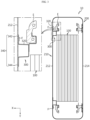
- FIG. 1 is a diagram illustrating a battery pack 10 according to an embodiment of the present disclosure
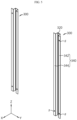
- FIG. 2 is a partially exploded perspective view of the battery pack 10 in FIG. 1
- FIG. 3 is a cross-sectional view taken along line A-A' in FIG. 1 (specifically, FIG. 3 is a cross-sectional view of the battery pack 10 taken along line A-A' on the XY plane in FIG. 1 ).
- FIG. 4 is a cross-sectional view taken along line B-B' in FIG. 1 (specifically, FIG. 4 is a cross-sectional view of the battery pack 10 taken along line B-B' on the XZ plane in FIG. 1 )
- FIG. 5 is a diagram illustrating a venting guidance portion 300 provided in the battery pack 10 in FIG. 1
- FIG. 6 is a diagram illustrating the states before and after thermal runaway of a cell assembly 100 in the battery pack 10 in FIG. 1 .
- FIG. 6(a) is a diagram illustrating the state of the battery pack 10 before thermal runaway of the cell assembly 100
- FIG. 6(b) is a diagram illustrating the state of the battery pack 10 after thermal runaway of the cell assembly 100.
- the battery pack 10 may include a cell assembly 100, a pack frame 200, and a venting guidance portion 300.
- the cell assembly 100 may include at least one battery cell.
- the battery cell may indicate a secondary battery.
- This battery cell may be provided as a pouch-type battery cell, a cylindrical battery cell, or a prismatic battery cell.
- the pack frame 200 may accommodate the cell assembly 100 therein. That is, the pack frame 200 may include an accommodation space for accommodating the cell assembly 100 therein.
- the pack frame 200 may include a material with high heat resistance and rigidity.
- the venting guidance portion 300 may be coupled to the pack frame 200 and configured to cause an outlet S, through which venting gas from the cell assembly 100 is discharged to the outside of the pack frame 200, to be formed.
- an event such as thermal runaway may occur in at least some of the battery cells.
- high-temperature and high-pressure venting gas may be generated inside the battery cell where the thermal event occurred. If the venting gas is randomly discharged from the pack frame accommodating the battery cells, oxygen may flow into the pack frame through a portion of the pack frame where the internal pressure is lowered by the discharge of the venting gas. In this case, fire may be more likely to break out inside the battery pack.
- the venting guidance portion 300 of the present disclosure may be configured such that a coupling portion thereof with the pack frame 200 is at least partially weakened as the internal pressure of the pack frame 200 increases due to the venting gas discharged from the cell assembly 100. Accordingly, if the internal pressure of the pack frame 200 increases due to venting gas, the venting guidance portion 300 may be configured to cause an outlet S, through which the venting gas is discharged to the outside of the pack frame 200, to be formed.
- the venting guidance portion 300 may configure a structurally vulnerable portion at the joint where it is coupled to the pack frame 200, thereby inducing the flow of venting gas to be concentrated on the vulnerable portion if the internal pressure of the pack frame 200 increases due to the venting gas.
- the aforementioned outlet S may be formed in the structurally vulnerable portion when the internal pressure of the pack frame 200 increases due to venting gas. Meanwhile, if high-pressure venting gas is discharged to the outside of the pack frame 200 through the outlet S, oxygen may be prevented from flowing into the pack frame 200 through the outlet S by the discharge pressure of venting gas.
- venting gas it is possible to prevent venting gas from being randomly discharged to the outside of the pack frame 200 by providing a structurally vulnerable portion at the joint where the pack frame 200 and the venting guidance portion 300 are coupled. Accordingly, it is possible to prevent the inflow of oxygen into the pack frame 200, as well as to guide the venting gas to be discharged in a specific direction.
- FIG. 7 is a diagram illustrating a state in which venting gas is discharged from the battery pack 10 in FIG. 1 .
- venting gas is indicated by the reference symbol "V" in FIG. 7 .
- venting guidance portion 300 may be configured to cause the pack frame 200 to open outwards as the internal pressure of the pack frame 200 increases.
- venting guidance portion 300 may configure the vulnerable portion described above to cause an outlet S, through which venting gas is discharged, to be formed in the vulnerable portion when the internal pressure of the pack frame 200 increases due to venting gas.
- the pack frame 200 may open outwards in the vulnerable portion to facilitate the formation of the outlet S for discharging venting gas.
- the pack frame 200 may open outwards to form an outlet S for discharging venting gas, thereby quickly discharging the venting gas through a larger area than a hole-shaped outlet.
- venting guidance portion 300 may be configured such that when the pack frame 200 opens outwards as the internal pressure of the pack frame 200 increases, the space between the cell assembly 100 and the pack frame 200 gradually increases as it is closer to one side.
- the structurally vulnerable portion at the joint where the venting guidance portion 300 is coupled to the pack frame 200 may be located on one side of the pack frame 200 (e.g., the upper side of the pack frame 200).
- the gap between the venting guidance portion 300 and the pack frame 200 may widen on one side of the pack frame 200, so that the outlet S described above may be formed on one side of the pack frame 200.
- the venting guidance portion 300 and the pack frame 200 may remain coupled to each other on the other side of the pack frame 200 (e.g., the lower side of the pack frame 200) where the vulnerable portion is not provided.
- a venting passage P through which venting gas is discharged when the internal pressure of the pack frame 200 increases, may be configured to become wider toward one side of the pack frame 200.
- the venting passage P may be formed to be inclined toward one side thereof, thereby more easily guiding the venting gas to be discharged in a specific direction.
- venting guidance portion 300 may be disposed between the pack frame 200 and the cell assembly 100.
- the stress applied to the pack frame 200 by the discharge pressure of venting gas may be concentrated on the area facing the cell assembly 100.
- the stress is applied to the pack frame 200 due to the discharge pressure of venting gas applied to the pack frame 200, so that the gap between the venting guidance portion 300 and the pack frame 200 may more easily widen in the aforementioned vulnerable portion.
- the outlet S may be easily formed in the pack frame 200 by the discharge pressure of venting gas generated due to thermal runaway of the cell assembly 100.
- the pack frame 200 described above may include side plates 210, an upper plate 220, and a lower plate 230.
- the side plates 210 may constitute the side surfaces of the pack frame 200.
- the venting guidance portion 300 may be coupled to the side plate 210 so as to be disposed between the side plate 210 and the cell assembly 100.
- the stress due to the discharge pressure of venting gas may be concentrated on the side plate 210.
- the side plates 210 may include a front plate 212 and a rear plate 214.
- the rear plate 214 may constitute the rear surface of the pack frame 200.
- the above-described venting guidance portion 300 may be configured to be coupled to the front inner surface of the pack frame 200.
- the venting guidance portion 300 may be coupled to the inner surface of the front plate 212, and the rear plate 214 may be in close contact with the wall of the installation space.
- venting guidance portion 300 may be coupled to the inner surface of the rear plate 214.
- the front plate 212 may be in close contact with the wall of the installation space.
- the upper plate 220 may be configured to cover the top of the cell assembly 100.
- the upper plate 220 may be connected to the upper end of the side plate 210.
- the lower plate 230 may be configured to cover the bottom of the cell assembly 100.
- the lower plate 230 may be connected to the lower end of the side plate 210.
- venting guidance portion 300 may be configured to be located on at least one of both sides of the cell assembly 100 between the pack frame 200 and the cell assembly 100.
- the stress applied to the pack frame 200 by the discharge pressure of venting gas may be concentrated on approximately the entire area of the pack frame 200 facing the cell assembly 100.
- the gap between the venting guidance portion 300 and the pack frame 200 may open in the vulnerable portion of the venting guidance portion 300 located on at least one side of the cell assembly 100 by the discharge pressure of venting gas applied to the pack frame 200.
- the outlet S for discharging venting gas may be configured wider, thereby more quickly discharging the venting gas to the outside.
- the bonding force between one side of the venting guidance portion 300 (e.g., the upper area of the venting guidance portion 300) and the pack frame 200 may be configured to be less than the bonding force between the other side of the venting guidance portion 300 (e.g., the lower area of the venting guidance portion 300) and the pack frame 200.
- the venting guidance portion 300 may be configured to cause an outlet S to be formed between one side of the venting guidance portion 300 and the pack frame 200 as the internal pressure of the pack frame 200 increases.
- the structurally vulnerable portion at the joint where the venting guidance portion 300 is coupled to the pack frame 200 may be located on one side of the venting guidance portion 300.
- the gap between one side of the venting guidance portion 300 and the pack frame 200 may open to form the above-described outlet S on one side of the pack frame 200.
- the coupling between the other side of the venting guidance portion 300 and the pack frame 200 may be maintained.
- the space between the cell assembly 100 and the pack frame 200 may become wider toward one side of the pack frame 200.
- the venting passage P through which venting gas is discharged when the internal pressure of the pack frame 200 increases, may be configured to become wider toward one side of the pack frame 200.
- the venting passage P is configured to be inclined toward one side thereof when the internal pressure of the pack frame 200 increases, the venting gas may be more easily guided to be discharged in a specific direction.
- the venting guidance portion 300 may include a body 320 and a flange 340.
- the body 320 may be coupled to the support E.
- the portion where the body 320 is coupled to the support E may be on the opposite side of the portion where the venting guidance portion 300 is coupled to the inner surface of the pack frame 200. Additionally, the body 320 may be formed to extend long in the vertical direction.
- the flange 340 may extend from both sides of the body 320 and may be coupled to the inner surface of the pack frame 200. In addition, the flange 340 may be formed to extend long in the vertical direction.
- the flange 340 may include a first portion 342 and a second portion 344.
- the second portion 344 may extend from the other side of the body 320.
- the flange 340 may be configured on one side of the venting guidance portion 300 (e.g., the upper area of the venting guidance portion 300) such that the first portion 342 is coupled to the inner surface of the pack frame 200 and such that the second portion 344 is not coupled to the inner surface of the pack frame 200.
- the first portion 342 of the flange 340 may be coupled to the inner surface of the pack frame 200 by a fastening member F (e.g., bolts) on one side of the venting guidance portion 300.
- a fastening member F e.g., bolts
- the flange 340 may be configured on the other side of the venting guidance portion 300 (e.g., the lower area of the venting guidance portion 300) such that both the first portion 342 and the second portion 344 are coupled to the inner surface of the pack frame 200.
- the first portion 342 and the second portion 344 of the flange 340 may be coupled to the inner surface of the pack frame 200 by a fastening member F on the other side of the venting guidance portion 300.
- the structurally vulnerable portion at the joint where the venting guidance portion 300 is coupled to the pack frame 200 may be formed on one side of the venting guidance portion 300 as described above.
- a portion (second portion 344) of the flange 340 is not coupled to the inner surface of the pack frame 200 on one side of the venting guidance portion 300, the gap between one side of the venting guidance portion 300 and the pack frame 200 may open by the discharge pressure of venting gas when the internal pressure of the pack frame 200 increases, thereby forming the outlet S described above on one side of the pack frame 200. Meanwhile, even when the internal pressure of the pack frame 200 increases, the coupling between the other side of the venting guidance portion 300 and the pack frame 200 may be maintained.
- the venting passage P is more easily configured to be inclined toward one side thereof when the internal pressure of the pack frame 200 increases, the venting gas may be more easily guided to be discharged in a specific direction.
- the second portion 344 may be configured to be located closer to the cell assembly 100 than the first portion 342.
- the second portion 344 may be located between the cell assembly 100, which emits venting gas during thermal runaway, and the inner surface of the pack frame 200.
- the discharge pressure of venting gas may be applied to a portion (second portion 344) of the flange 340 that is not coupled to the pack frame 200 on one side of the venting guidance portion 300.
- a portion (first portion 342) of the flange 340 coupled to the inner surface of the pack frame 200 may be disposed farther from the cell assembly 100 than the portion of the flange 340 that is not coupled to the pack frame 200.
- the outlet S may be formed in a portion (second portion 344) where the venting guidance portion 300 and the pack frame 200 are not coupled in the portion where the pack frame 200 faces the cell assembly 100. Accordingly, it is possible to easily form the outlet S for discharging venting gas while preventing the inner surface of the pack frame 200 from being completely separated from the battery pack 10 on one side of the venting guidance portion 300.
- FIG. 8 is an enlarged view of area C in FIG. 2
- FIG. 9 is an enlarged view of area D in FIG. 2 .
- the battery pack 10 may further include a sealing member 400.
- the sealing member 400 may be configured to seal the gap between the top and the side of the pack frame 200 and the gap between the bottom and the side of the pack frame 200.
- the sealing member 400 may be disposed to be spaced apart from the venting guidance portion 300 in the vertical direction in the pack frame 200.
- the sealing member 400 may include a first sealing portion 410 and a second sealing portion 420.
- the first sealing portion 410 may be configured to seal the gap between the side plate 210 and the upper plate 220.
- the first sealing portion 410 may be disposed to be spaced apart from one side of the venting guidance portion 300 (e.g., the upper area of the venting guidance portion 300) in the vertical direction.
- the second sealing portion 420 may be configured to seal the gap between the side plate 210 and the lower plate 230.
- the second sealing portion 420 may be disposed to be spaced apart from the other side of the venting guidance portion 300 (e.g., the lower area of the venting guidance portion 300) in the vertical direction.
- venting gas may be discharged to the outside through the outlet S formed between one side of the venting guidance portion 300 and the pack frame 200.
- the sealing member 400 is disposed to be spaced apart from one side of the venting guidance portion 300 in the vertical direction, the gas may be discharged while being spaced vertically from the outlet S in the case of thermal runaway of the cell assembly 100.
- the pack frame 200 may open outwards, thereby minimizing the discharge of venting gas toward the sealing member 400.
- the discharge of venting gas toward the sealing member 400 may be minimized in the event of thermal runaway of the cell assembly 100. Accordingly, it is possible to minimize damage to the sealing member 400 due to venting gas and minimize the inflow of oxygen through the gap of the pack frame 200.
- FIG. 10 is a diagram illustrating a battery pack 12 according to another embodiment of the present disclosure.
- the battery pack 12 according to the present embodiment is similar to the battery pack 10 in the previous embodiment, redundant descriptions of elements that are substantially the same as or similar to those in the previous embodiment will be omitted, and hereinafter, a description will be made based on the differences from the previous embodiment.
- the pack frame 200 may be configured such that a portion thereof facing the cell assembly 100 is thinner than other portions.
- the portion of the pack frame 200 facing the cell assembly 100 may be configured to be vulnerable. Accordingly, in the event of thermal runaway of the cell assembly 100, the stress due to the discharge pressure of venting gas may act stronger on the thinner portion of the pack frame 200 than on other portions of the pack frame 200.
- the gap between one side of the venting guidance portion 300 and the pack frame 200 may widen more quickly.
- the outlet S may be formed more easily in the pack frame 200 when the internal pressure of the pack frame 200 increases.
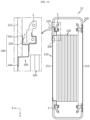
- FIG. 11 is a diagram illustrating a battery pack 14 according to another embodiment of the present disclosure.
- the battery pack 14 according to the present embodiment is similar to the battery pack 10 in the previous embodiment, redundant descriptions of elements that are substantially the same as or similar to those in the previous embodiment will be omitted, and hereinafter, a description will be made based on the differences from the previous embodiment.
- the venting guidance portion 300 may be configured to be coupled to the front inner surface and the rear inner surface of the pack frame 200.
- the battery pack 14 of this embodiment may be configured not to come into close contact with the wall of the installation space.
- the venting guidance portion 300 may be coupled to both the inner surface of the front plate 212 and the inner surface of the rear plate 214 of the side plate 210 as shown in FIG. 11 .
- the outlet S for discharging venting gas may be formed on both the front and rear sides of the battery pack 14 when the internal pressure of the pack frame 200 increases, so the venting gas may be more quickly discharged to the outside of the battery pack 14 in the event of thermal runaway of the cell assembly 100.
- the battery pack 10, 12, or 14 may further include, in addition to the cell assembly 100, various devices for controlling charging and discharging of the cell assembly 100, such as a BMS (Battery Management System), current sensors, fuses, and the like.
- BMS Battery Management System
- current sensors current sensors
- fuses current sensors
- At least one battery pack 10, 12, or 14 according to the present disclosure may be provided as an energy source to form an energy storage system (ESS).
- ESS energy storage system
Landscapes
- Chemical & Material Sciences (AREA)
- Chemical Kinetics & Catalysis (AREA)
- Electrochemistry (AREA)
- General Chemical & Material Sciences (AREA)
- Battery Mounting, Suspending (AREA)
- Gas Exhaust Devices For Batteries (AREA)
Applications Claiming Priority (2)
| Application Number | Priority Date | Filing Date | Title |
|---|---|---|---|
| KR1020220118128A KR20240039485A (ko) | 2022-09-19 | 2022-09-19 | 배터리 팩 및 이를 포함하는 전력 저장 장치 |
| PCT/KR2023/014092 WO2024063485A1 (ko) | 2022-09-19 | 2023-09-18 | 배터리 팩 및 이를 포함하는 전력 저장 장치 |
Publications (1)
| Publication Number | Publication Date |
|---|---|
| EP4576375A1 true EP4576375A1 (de) | 2025-06-25 |
Family
ID=90454956
Family Applications (1)
| Application Number | Title | Priority Date | Filing Date |
|---|---|---|---|
| EP23868537.4A Pending EP4576375A1 (de) | 2022-09-19 | 2023-09-18 | Batteriepack und energiespeichersystem damit |
Country Status (6)
| Country | Link |
|---|---|
| US (1) | US20250062483A1 (de) |
| EP (1) | EP4576375A1 (de) |
| JP (1) | JP2025502137A (de) |
| KR (1) | KR20240039485A (de) |
| CN (1) | CN118355554A (de) |
| WO (1) | WO2024063485A1 (de) |
Family Cites Families (12)
| Publication number | Priority date | Publication date | Assignee | Title |
|---|---|---|---|---|
| JP5440790B2 (ja) * | 2010-03-18 | 2014-03-12 | 三菱自動車工業株式会社 | バッテリケース及び電池パック |
| JP6089267B2 (ja) * | 2012-03-16 | 2017-03-08 | パナソニックIpマネジメント株式会社 | 蓄電装置 |
| JP5850039B2 (ja) * | 2013-12-26 | 2016-02-03 | 株式会社豊田自動織機 | 電池パック |
| JP6606907B2 (ja) * | 2015-07-30 | 2019-11-20 | 株式会社Gsユアサ | 蓄電装置 |
| JP6690451B2 (ja) * | 2016-07-20 | 2020-04-28 | 株式会社豊田自動織機 | 電池パック |
| JP2018067481A (ja) * | 2016-10-20 | 2018-04-26 | 株式会社豊田自動織機 | 電池パック |
| JP6996272B2 (ja) * | 2017-12-13 | 2022-01-17 | 日産自動車株式会社 | バッテリパック |
| DE102019200156A1 (de) * | 2019-01-09 | 2020-07-09 | Robert Bosch Gmbh | Batteriesystem |
| CN111192989A (zh) * | 2020-01-08 | 2020-05-22 | 深圳市欣旺达综合能源服务有限公司 | 电池舱泄压装置及电池舱 |
| WO2021199594A1 (ja) * | 2020-03-31 | 2021-10-07 | 三洋電機株式会社 | 電源装置及びこれを備える車両並びに蓄電装置 |
| KR102503250B1 (ko) | 2021-02-18 | 2023-02-23 | 신성민 | 반경화 코팅막 젤층을 포함하는 젤네일 스티커 및 그 제조방법 |
| CN217158332U (zh) * | 2022-03-21 | 2022-08-09 | 湖北亿纬动力有限公司 | 电池箱 |
-
2022
- 2022-09-19 KR KR1020220118128A patent/KR20240039485A/ko active Pending
-
2023
- 2023-09-18 EP EP23868537.4A patent/EP4576375A1/de active Pending
- 2023-09-18 JP JP2024541241A patent/JP2025502137A/ja active Pending
- 2023-09-18 US US18/724,912 patent/US20250062483A1/en active Pending
- 2023-09-18 CN CN202380015145.6A patent/CN118355554A/zh active Pending
- 2023-09-18 WO PCT/KR2023/014092 patent/WO2024063485A1/ko not_active Ceased
Also Published As
| Publication number | Publication date |
|---|---|
| JP2025502137A (ja) | 2025-01-24 |
| WO2024063485A1 (ko) | 2024-03-28 |
| US20250062483A1 (en) | 2025-02-20 |
| CN118355554A (zh) | 2024-07-16 |
| KR20240039485A (ko) | 2024-03-26 |
Similar Documents
| Publication | Publication Date | Title |
|---|---|---|
| EP4057434B1 (de) | Batteriemodul, batteriepack damit und automobil | |
| KR20230091784A (ko) | 안전성이 향상된 배터리 모듈 | |
| EP4358265A1 (de) | Batteriemodul, batteriepack und fahrzeug damit | |
| US20230207956A1 (en) | Battery Cell, And Battery Module, Battery Pack And Vehicle Including The Same | |
| KR20240005245A (ko) | 배터리 모듈, 배터리 팩 및 이를 포함하는 자동차 | |
| KR20230097968A (ko) | 배터리 셀, 배터리 모듈, 배터리 팩 및 이를 포함하는 자동차 | |
| EP4404361A1 (de) | Batteriepack und vorrichtung damit | |
| EP4216354B1 (de) | Batteriemodul, batteriepack und fahrzeug damit | |
| EP4576375A1 (de) | Batteriepack und energiespeichersystem damit | |
| EP4539227A1 (de) | Batteriepack und vorrichtung damit | |
| EP4456288A1 (de) | Batteriepack und energiespeichersystem damit | |
| EP4345994A1 (de) | Batteriemodul, batteriepack und fahrzeug damit | |
| KR20240051647A (ko) | 배터리 팩 및 이를 포함하는 자동차 | |
| EP4539233A1 (de) | Batteriepack und fahrzeug damit | |
| EP4425677A1 (de) | Batteriepack und vorrichtung damit | |
| EP4579939A1 (de) | Batteriemodul | |
| EP4629423A1 (de) | Batteriepack | |
| EP4386960A1 (de) | Batteriepack und fahrzeug damit | |
| US20240186641A1 (en) | Battery module with reinforced safety | |
| EP4318792A1 (de) | Batteriezelle, batteriemodul, batteriepack und fahrzeug damit | |
| CN117355984A (zh) | 电池电芯、包括该电池电芯的电池模块、电池组和车辆 |
Legal Events
| Date | Code | Title | Description |
|---|---|---|---|
| STAA | Information on the status of an ep patent application or granted ep patent |
Free format text: STATUS: THE INTERNATIONAL PUBLICATION HAS BEEN MADE |
|
| PUAI | Public reference made under article 153(3) epc to a published international application that has entered the european phase |
Free format text: ORIGINAL CODE: 0009012 |
|
| STAA | Information on the status of an ep patent application or granted ep patent |
Free format text: STATUS: REQUEST FOR EXAMINATION WAS MADE |
|
| 17P | Request for examination filed |
Effective date: 20250320 |
|
| AK | Designated contracting states |
Kind code of ref document: A1 Designated state(s): AL AT BE BG CH CY CZ DE DK EE ES FI FR GB GR HR HU IE IS IT LI LT LU LV MC ME MK MT NL NO PL PT RO RS SE SI SK SM TR |
|
| DAV | Request for validation of the european patent (deleted) | ||
| DAX | Request for extension of the european patent (deleted) |