EP4576237A1 - Kathode für lithiumsekundärbatterie, herstellungsverfahren dafür und lithiumsekundärbatterie damit - Google Patents
Kathode für lithiumsekundärbatterie, herstellungsverfahren dafür und lithiumsekundärbatterie damit Download PDFInfo
- Publication number
- EP4576237A1 EP4576237A1 EP24221781.8A EP24221781A EP4576237A1 EP 4576237 A1 EP4576237 A1 EP 4576237A1 EP 24221781 A EP24221781 A EP 24221781A EP 4576237 A1 EP4576237 A1 EP 4576237A1
- Authority
- EP
- European Patent Office
- Prior art keywords
- cathode
- secondary battery
- raman
- active material
- conductive material
- Prior art date
- Legal status (The legal status is an assumption and is not a legal conclusion. Google has not performed a legal analysis and makes no representation as to the accuracy of the status listed.)
- Pending
Links
Images



Classifications
-
- H—ELECTRICITY
- H01—ELECTRIC ELEMENTS
- H01M—PROCESSES OR MEANS, e.g. BATTERIES, FOR THE DIRECT CONVERSION OF CHEMICAL ENERGY INTO ELECTRICAL ENERGY
- H01M4/00—Electrodes
- H01M4/02—Electrodes composed of, or comprising, active material
- H01M4/13—Electrodes for accumulators with non-aqueous electrolyte, e.g. for lithium-accumulators; Processes of manufacture thereof
-
- H—ELECTRICITY
- H01—ELECTRIC ELEMENTS
- H01M—PROCESSES OR MEANS, e.g. BATTERIES, FOR THE DIRECT CONVERSION OF CHEMICAL ENERGY INTO ELECTRICAL ENERGY
- H01M10/00—Secondary cells; Manufacture thereof
- H01M10/05—Accumulators with non-aqueous electrolyte
- H01M10/052—Li-accumulators
-
- H—ELECTRICITY
- H01—ELECTRIC ELEMENTS
- H01M—PROCESSES OR MEANS, e.g. BATTERIES, FOR THE DIRECT CONVERSION OF CHEMICAL ENERGY INTO ELECTRICAL ENERGY
- H01M10/00—Secondary cells; Manufacture thereof
- H01M10/05—Accumulators with non-aqueous electrolyte
- H01M10/052—Li-accumulators
- H01M10/0525—Rocking-chair batteries, i.e. batteries with lithium insertion or intercalation in both electrodes; Lithium-ion batteries
-
- H—ELECTRICITY
- H01—ELECTRIC ELEMENTS
- H01M—PROCESSES OR MEANS, e.g. BATTERIES, FOR THE DIRECT CONVERSION OF CHEMICAL ENERGY INTO ELECTRICAL ENERGY
- H01M4/00—Electrodes
- H01M4/02—Electrodes composed of, or comprising, active material
- H01M4/04—Processes of manufacture in general
- H01M4/0402—Methods of deposition of the material
- H01M4/0404—Methods of deposition of the material by coating on electrode collectors
-
- H—ELECTRICITY
- H01—ELECTRIC ELEMENTS
- H01M—PROCESSES OR MEANS, e.g. BATTERIES, FOR THE DIRECT CONVERSION OF CHEMICAL ENERGY INTO ELECTRICAL ENERGY
- H01M4/00—Electrodes
- H01M4/02—Electrodes composed of, or comprising, active material
- H01M4/13—Electrodes for accumulators with non-aqueous electrolyte, e.g. for lithium-accumulators; Processes of manufacture thereof
- H01M4/131—Electrodes based on mixed oxides or hydroxides, or on mixtures of oxides or hydroxides, e.g. LiCoOx
-
- H—ELECTRICITY
- H01—ELECTRIC ELEMENTS
- H01M—PROCESSES OR MEANS, e.g. BATTERIES, FOR THE DIRECT CONVERSION OF CHEMICAL ENERGY INTO ELECTRICAL ENERGY
- H01M4/00—Electrodes
- H01M4/02—Electrodes composed of, or comprising, active material
- H01M4/13—Electrodes for accumulators with non-aqueous electrolyte, e.g. for lithium-accumulators; Processes of manufacture thereof
- H01M4/139—Processes of manufacture
-
- H—ELECTRICITY
- H01—ELECTRIC ELEMENTS
- H01M—PROCESSES OR MEANS, e.g. BATTERIES, FOR THE DIRECT CONVERSION OF CHEMICAL ENERGY INTO ELECTRICAL ENERGY
- H01M4/00—Electrodes
- H01M4/02—Electrodes composed of, or comprising, active material
- H01M4/13—Electrodes for accumulators with non-aqueous electrolyte, e.g. for lithium-accumulators; Processes of manufacture thereof
- H01M4/139—Processes of manufacture
- H01M4/1391—Processes of manufacture of electrodes based on mixed oxides or hydroxides, or on mixtures of oxides or hydroxides, e.g. LiCoOx
-
- H—ELECTRICITY
- H01—ELECTRIC ELEMENTS
- H01M—PROCESSES OR MEANS, e.g. BATTERIES, FOR THE DIRECT CONVERSION OF CHEMICAL ENERGY INTO ELECTRICAL ENERGY
- H01M4/00—Electrodes
- H01M4/02—Electrodes composed of, or comprising, active material
- H01M4/36—Selection of substances as active materials, active masses, active liquids
- H01M4/48—Selection of substances as active materials, active masses, active liquids of inorganic oxides or hydroxides
- H01M4/52—Selection of substances as active materials, active masses, active liquids of inorganic oxides or hydroxides of nickel, cobalt or iron
- H01M4/525—Selection of substances as active materials, active masses, active liquids of inorganic oxides or hydroxides of nickel, cobalt or iron of mixed oxides or hydroxides containing iron, cobalt or nickel for inserting or intercalating light metals, e.g. LiNiO2, LiCoO2 or LiCoOxFy
-
- H—ELECTRICITY
- H01—ELECTRIC ELEMENTS
- H01M—PROCESSES OR MEANS, e.g. BATTERIES, FOR THE DIRECT CONVERSION OF CHEMICAL ENERGY INTO ELECTRICAL ENERGY
- H01M4/00—Electrodes
- H01M4/02—Electrodes composed of, or comprising, active material
- H01M4/62—Selection of inactive substances as ingredients for active masses, e.g. binders, fillers
- H01M4/624—Electric conductive fillers
- H01M4/625—Carbon or graphite
-
- H—ELECTRICITY
- H01—ELECTRIC ELEMENTS
- H01M—PROCESSES OR MEANS, e.g. BATTERIES, FOR THE DIRECT CONVERSION OF CHEMICAL ENERGY INTO ELECTRICAL ENERGY
- H01M4/00—Electrodes
- H01M4/02—Electrodes composed of, or comprising, active material
- H01M2004/021—Physical characteristics, e.g. porosity, surface area
-
- H—ELECTRICITY
- H01—ELECTRIC ELEMENTS
- H01M—PROCESSES OR MEANS, e.g. BATTERIES, FOR THE DIRECT CONVERSION OF CHEMICAL ENERGY INTO ELECTRICAL ENERGY
- H01M4/00—Electrodes
- H01M4/02—Electrodes composed of, or comprising, active material
- H01M2004/026—Electrodes composed of, or comprising, active material characterised by the polarity
- H01M2004/028—Positive electrodes
-
- Y—GENERAL TAGGING OF NEW TECHNOLOGICAL DEVELOPMENTS; GENERAL TAGGING OF CROSS-SECTIONAL TECHNOLOGIES SPANNING OVER SEVERAL SECTIONS OF THE IPC; TECHNICAL SUBJECTS COVERED BY FORMER USPC CROSS-REFERENCE ART COLLECTIONS [XRACs] AND DIGESTS
- Y02—TECHNOLOGIES OR APPLICATIONS FOR MITIGATION OR ADAPTATION AGAINST CLIMATE CHANGE
- Y02E—REDUCTION OF GREENHOUSE GAS [GHG] EMISSIONS, RELATED TO ENERGY GENERATION, TRANSMISSION OR DISTRIBUTION
- Y02E60/00—Enabling technologies; Technologies with a potential or indirect contribution to GHG emissions mitigation
- Y02E60/10—Energy storage using batteries
Definitions
- the embodiments of the present disclosure relate generally to a cathode for a lithium secondary battery, a method of fabricating the same and a lithium secondary battery including the same. More particularly, the embodiments relate to a cathode for a lithium secondary battery including a carbon-based material, a method of fabricating the same and a lithium secondary battery including the same.
- a secondary battery which can be charged and discharged repeatedly has been widely employed as a power source of a mobile electronic device such as a camcorder, a mobile phone, a laptop computer, etc., according to developments of information and display technologies. Recently, a battery pack including the secondary battery is being developed and applied as an eco-friendly power source of an electric automobile, a hybrid vehicle, etc.
- Examples of a secondary battery include a lithium secondary battery, a nickel-cadmium battery, a nickel-hydrogen battery, etc.
- the lithium secondary battery among the secondary batteries is being actively developed due to its high operational voltage, energy density per unit weight, high charging rate, and compact dimension.
- the lithium secondary battery may include an electrode assembly including repeatedly stacked cathodes and anodes, an electrolyte solution impregnating the electrode assembly, and a case enclosing the electrode assembly.
- the case of the lithium secondary battery may have a pouch shape for accommodating the electrode assembly and the electrolyte solution.
- a carbon-based conductive material has been proposed to be applied to the cathode for improving the electrical conductivity of the cathode.
- uniform electrochemical properties may not be provided throughout the cathode/cell depending on distribution properties and crystal properties of the conductive material or of the cathode active material.
- a cathode for a lithium secondary battery having improved capacity property and stability.
- a method of fabricating a cathode for a lithium secondary battery having improved capacity property and stability.
- a lithium secondary battery having improved capacity properties and stability.
- a cathode for a lithium secondary battery includes a cathode current collector and a cathode active material layer formed on a surface of the cathode current collector.
- the cathode active material layer includes a cathode active material and a conductive material.
- a Raman R1 value represented by Equation 1 and measured on a surface of the cathode active material layer is in a range from 1.5 to 4.0.
- Raman R 1 A 1 D /A 1 G
- a solid content of the cathode slurry may be in a range from 60 wt% to 80 wt%.
- the cathode and the lithium secondary battery according to the present disclosure may be widely applied in green technology fields such as an electric vehicle, a battery charging station, a solar power generation, a wind power generation, etc., using a battery, etc.
- the cathode and the lithium secondary battery according to the present disclosure may be used for eco-friendly electric vehicles and hybrid vehicles to prevent climate change by suppressing air pollution and greenhouse gas emissions. etc.
- a cathode for a lithium secondary battery having a Raman area ratio in a predetermined range is provided.
- a lithium secondary battery including the cathode is also provided.
- FIG. 1 is a schematic cross-sectional view illustrating a cathode for a lithium secondary battery in accordance with embodiments of the present disclosure.
- a cathode 100 for a lithium secondary battery (hereinafter, abbreviated a cathode) includes a cathode current collector 105 and a cathode active material layer 110.
- a cathode slurry may be prepared by mixing a cathode active material in a solvent.
- the cathode slurry may be coated on the cathode current collector 105, and then dried and pressed to prepare the cathode active material layer 110.
- the coating process may include any suitable method including, for example, a gravure coating, a slot die coating, a multi-layer simultaneous die coating, an imprinting, a doctor blade coating, a dip coating, a bar coating, a casting, and the like.
- the cathode slurry further includes a binder and a conductive material.
- the cathode active material may include a lithium-nickel metal oxide.
- the lithium-nickel metal oxide may further include at least one of cobalt (Co), manganese (Mn) and aluminum (Al).
- M may include Co, Mn and/or Al.
- an auxiliary element for enhancing chemical stability of the cathode active material or the layered structure/crystal structure in addition to the main active element may be further included.
- the auxiliary element may be incorporated into the layered structure/crystal structure to form a bond, and this case is to be understood as being included within the range of the chemical structure represented by Chemical Formula 1.
- the auxiliary element may include at least one of, e.g., Na, Mg, Ca, Y, Ti, Hf, V, Nb, Ta, Cr, Mo, W, Fe, Cu, Ag, Zn, B, Al, Ga, C, Si, Sn, Sr, Ba, Ra, P and Zr.
- the auxiliary element may act as an auxiliary active element such as Al that contributes to capacity/power activity of the cathode active material together with Co or Mn.
- the cathode active material or the lithium-nickel metal oxide particle may include a layered structure or a crystal structure represented by Chemical Formula 1-1.
- Chemical Formula 1-1 Li x Ni a M1 b1 M2 b2 O 2+z
- the cathode active material may include a Mn-rich active material, a Li-rich layered oxide (LLO)/OLO (Over-Lithiated Oxide)-based active material, a Co-free active material, etc., which may have a chemical structure or a crystal structure represented by Chemical Formula 2 below.
- Chemical Formula 2 p[Li 2 MnO 3 ] ⁇ (1-p)[Li q JO 2 ]
- A1 D is a peak area for an absorption area (D band) from 1,252 cm -1 to 1,445 cm -1 in a Raman spectrum
- A1 G is a peak area for an absorption area (G band) from 1,577 cm -1 to 1,620 cm -1 in the Raman spectrum.
- the Raman spectrum is measured under a 100% laser focus level condition using In Via Raman Microscope from Renishaw as a Raman spectrometer.
- the analysis by the Raman spectrometer may be performed under conditions of a laser wavelength of 532 nm, a magnification x50, a laser power of 10%, 0.7 mV, and a laser exposure time of 10 seconds.
- a laser wavelength of 532 nm e.g., 532 nm
- a magnification x50 e.g., a laser power of 10%, 0.7 mV
- a laser exposure time e.g., 10 or more
- an averaged value may be used as the Raman R1 value of the corresponding cathode active material layer 110.
- the cathode active material layer has the above-described Raman R1 value, so that a conductivity of the cathode active material layer 110 may be sufficiently obtained, and power properties of the secondary battery may be improved. Additionally, the amorphous properties can be controlled in the conductive material and an increase in resistance may be prevented.
- the increase in resistance may be suppressed in the above-described Raman R1 value range, and uniform conductivity may be effectively implemented in an entire region of the cathode active material layer 110.
- dispersion of the conductive material may be promoted to suppress decrease in pore properties in the cathode active material layer due to an over-dispersion of excessively small conductive material particles by having the above-described Raman R1 value.
- electrical conductivity and mobility of lithium ions may be balanced.
- a carbon black having a Raman R2 value defined Equation 2 in a range from 2.5 to 3.5 may be used.
- the Raman R2 value of Equation 2 may represent an intrinsic Raman R value of the conductive material.
- Raman R2 A2 D / A2 G
- A2 D is a peak area for the absorption area (D band) of 1,252 cm -1 to 1,445 cm -1 in the Raman spectrum
- A2 G is a peak area for the absorption area (G band) of 1,577 cm -1 to 1,620 cm -1 in the Raman spectrum.
- the Raman spectrum is measured at a laser focus level of 0% using In Via Raman Microscope from Renishaw as a Raman spectrometer.
- the measurement conditions except for the focus level may be substantially the same as those for the Raman R1 value measurement.
- the laser focus level 100% refers to a level at which a measurement area of a single shot or a single scan of the Raman spectrometer is set to a maximum value.
- a laser focus level 0% refers to a level at which a measurement area of a single shot or a single scan of the Raman spectrometer is set to a minimum value.
- the carbon black having the Raman R2 value in a range from 2.5 to 3.3, from 2.5 to 3.0, or from 2.6 to 2.9 may be used.
- the carbon nanotube having the Raman R2 value defined as Equation 2 in a range from 1.8 to 2.8 may be used.
- the carbon nanotube having the Raman R2 value from 1.8 to 2.5, from 1.8 to 2.2, or from 1.8 to 2.0 may be used.
- the conductive material in the above-described Raman R2 value range may be used, so that the Raman R1 value may be more efficiently controlled in the above-described range, and the electrical conductivity may be effectively controlled through the conductive material.
- a minimum area MA1 capable of being measured on the surface of the cathode active material layer 110 is set.
- a signal intensity obtained in the minimum area MA1 increases, and properties in a local area may be measured more precisely with high reliability.
- a signal from the active material may be fluctuated or disturbed by components of the conductive material and the binder.
- a maximum area (MA2) capable of being measured on the surface of the cathode active material layer 110 is set.
- MA2 maximum area
- the above-described Raman R1 value may reflect uniformity of amorphous/crystalline properties, distribution of the conductive material and conductivity over the entire area of the cathode active material layer 110.
- the Raman R1 value may be adjusted within the above-described range, so that capacity enhancement through the introduction of the high-Ni active material and conductivity enhancement through the conductive material may be achieved and confirmed uniformly over the entire area of the cathode active material layer 110.
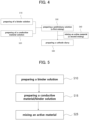
- FIGS. 4 and 5 are flow diagrams for describing a method of fabricating a cathode for a lithium secondary battery in accordance with embodiments of the present disclosure.
- the above-described cathode for a lithium secondary battery is not limited to a cathode manufactured by a method described below.
- the method described below is provided to describe embodiments for more efficiently obtaining the Raman R1 value.
- a binder solution and a conductive material solution may be prepared respectively.
- the binder solution and the conductive material solution may be prepared independently.
- an organic binder such as PVDF may be mixed and stirred in an organic solvent such as NMP to prepare the binder solution.
- a rotation speed of a stirrer when forming the binder solution may be in a range from 500 rpm to 2,000 rpm, and a stirring time may be in a range from 1 hour to 5 hours. In an embodiment, the rotation speed may be adjusted in a range from 700 rpm to 1,500 rpm, and the stirring time may be adjusted in a range from 2 hours to 4 hours.
- a solid content of the binder solution may be in a range from 5 wt% to 20 wt%. In an embodiment, the solid content of the binder solution may be in a range from 7 wt% to 15 wt%, or from 8 wt% to 12 wt%.
- the conductive material such as carbon black and/or the carbon nanotube may be mixed in an organic solvent such as NMP to prepare the conductive material solution.
- the conductive material solution may be formed by mixing using a mill device such as a spike mill.
- a linear speed of the spike mill may be adjusted in a range from 5m/s to 15m/s, and a flow rate may be adjusted in a range from 1 L/min to 5 L/min.
- the linear speed of the spike mill may be adjusted in a range from 5m/s to 12m/s, and the flow rate may be adjusted in a range from 1 L/min to 2 L/min.
- a solid content of the conductive material solution may be in a range from 4 wt% to 15 wt%. In an embodiment, the solid content of the conductive material solution may be in a range from 5 wt% to 15 wt%, from 5 wt% to 12 wt%, or from 5 wt% to 10 wt%.
- the solid content of the conductive material solution may be less than the solid content of the binder solution. Controlling the solid content of the conductive material solution to be less than the solid content of the binder solution promotes an improved, more uniform dispersion of the conductive material between binder particles.
- the Raman R1 value in the above-described range may be easily achieved while obtaining sufficient dispersibility of the conductive material in the stirring conditions and the solid content range.
- a preliminary solution may be prepared by mixing (a first mixing) the conductive material solution and the binder solution.
- a solvent e.g., NMP
- NMP may be additionally added to prepare the preliminary solution.
- a rotation speed of the stirrer used in the first mixing may be in a range from 1,000 rpm to 2,000 rpm, and a stirring time may be in a range from 20 minutes to 1 hour.
- the rotation speed may be adjusted in a range from 1,200 rpm to 1,700 rpm, and the stirring time may be adjusted in a range from 20 minutes to 40 minutes.
- a second mixing may be performed after adding a cathode active material to the preliminary solution to prepare a cathode slurry.
- a rotation speed of a stirrer used in the second mixing may be in a range from 1,000 rpm to 2,000 rpm, and a stirring time may be in a range from 1 hour to 5 hours.
- the rotation speed may be adjusted in a range from 1,200 rpm to 1,700 rpm, and the stirring time may be adjusted in a range from 1.5 hours to 4 hours.
- the stirring time of the second mixing may be greater than the stirring time of the first mixing. Controlling the stirring time of the second mixing to be greater than the stirring time of the first mixing promotes improved dispersibility of the cathode active material, and improved, more uniform dispersion of the conductive material between the cathode active materials.
- a solid content of the cathode slurry may be in a range from 60 wt% to 80 wt%. In an embodiment, the solid content of the cathode slurry may be in a range from 60 wt% to 75 wt%, or from 60 wt% to 70 wt%. In the above range, viscosity and flow properties of the cathode slurry may be adjusted to an appropriate range to prevent a local distribution deviation of the conductive material and to suppress a change in the Raman R1 value during drying and pressing processes.
- the cathode slurry may be coated on a cathode current collector, and then dried and pressed to obtain a cathode.
- a binder solution may be prepared. Thereafter, e.g., in operation S15, a conductive material may be added to the binder solution, and then mixed to prepare a conductive material/binder solution.
- a solvent NMP may be additionally added.
- the conductive material/binder solution may be prepared using stirring conditions substantially the same as or similar to those for preparing the conductive material solution in operation S20 of FIG. 4 .
- an active material may be added to the conductive material/binder solution, and mixed to prepare a cathode slurry.
- the mixing may be performed under conditions substantially the same as or similar to those of the second mixing in operation S40 of FIG. 4 .
- a solid content of the cathode slurry may be adjusted in a range substantially the same as or similar to that described with reference to FIG. 4 .
- the cathode active material may be mixed. Additionally, the overall Raman properties and uniformity of conductive properties in the cathode active material layer may be obtained by utilizing the mixing conditions as described above.
- the properties (e.g., Raman properties) of the cathode or the cathode active material layer according to embodiments of the present disclosure do not necessarily depend on the above-described preparation method and conditions.
- the above-described Raman R1 value may be changed by other factors including types and individual physical properties of the cathode active material, the conductive material and the binder, coating conditions of the cathode active material layer, and the like.
- FIG. 6 and FIG. 7 are a schematic plan view and a schematic cross-sectional view, respectively, illustrating a lithium secondary battery in accordance with embodiments of the present disclosure.
- FIG. 7 is a cross-sectional view taken along a line I-I' of FIG. 6 in a thickness direction.
- a lithium secondary battery includes the cathode 100 including the cathode active material layer 110 and the cathode current collector 105 according to embodiments of the present disclosure as described above, and an anode 130.
- the lithium secondary battery may further include a separator 140 interposed between the cathode 100 and the anode 130.
- the anode 130 may include an anode current collector 125, and an anode active material layer 120 formed by coating an anode active material on at least one surface of the anode current collector 125.
- Non-limiting examples of the anode current collector 125 may include a copper foil, a nickel foil, a stainless steel foil, a titanium foil, a nickel foam, a copper foam, a polymer substrate coated with a conductive metal, and the like.
- a thickness of the anode current collector 125 may be, for example, in a range from 5 ⁇ m to 50 ⁇ m.
- the anode active material may include a material widely known in the art capable of intercalating and de-intercalating lithium ions without a particular limitation.
- a carbon-based material such as a crystalline carbon, an amorphous carbon, a carbon composite, a carbon fiber, a lithium metal, a lithium alloy, a silicon-containing material, or a tin-containing material may be used.
- amorphous carbon examples include hard carbon, soft carbon, coke, a mesocarbon microbead (MCMB), a mesophase pitch-based carbon fiber (MPCF), and the like.
- MCMB mesocarbon microbead
- MPCF mesophase pitch-based carbon fiber
- the lithium metal may include pure lithium metal or a lithium metal having a protective layer formed for suppressing dendrite growth.
- a lithium metal-containing layer deposited or coated on the anode current collector may be used as the anode active material layer.
- a lithium thin layer may be used as the anode active material layer.
- Elements included in the lithium alloy may include, for example, aluminum, zinc, bismuth, cadmium, antimony, silicon, lead, tin, gallium, indium.
- the silicon-containing material may provide more increased capacity properties.
- the silicon-containing material may include Si, SiOx (0 ⁇ x ⁇ 2), a SiOx (0 ⁇ x ⁇ 2) doped with a metal, a silicon-carbon composite, etc.
- the metal may include lithium and/or magnesium, and the metal-doped SiOx (0 ⁇ x ⁇ 2) may include a metal silicate.
- a styrene-butadiene rubber (SBR)-based binder, carboxymethyl cellulose (CMC), a polyacrylic acid-based binder, a poly(3,4-ethylenedioxythiophene) (PEDOT)-based binder, etc. may be used as the anode binder.
- the separator 140 may include a porous polymer film or a porous non-woven fabric.
- the porous polymer film may include a polyolefin-based polymer such as an ethylene polymer, a propylene polymer, an ethylene/butene copolymer, an ethylene/hexene copolymer, an ethylene/methacrylate copolymer, etc.
- the porous non-woven fabric may include, for example, a high melting point glass fiber, a polyethylene terephthalate fiber.
- the separator 140 may include a ceramic-based material.
- inorganic particles may be coated on the polymer film or dispersed in the polymer film to improve a heat resistance.
- an electrode cell may be defined by the cathode 100, the anode 130 and the separator 140, and a plurality of the electrode cells may be stacked to form an electrode assembly 150 having, e.g., a jelly roll shape.
- the electrode assembly 150 may be formed by winding, stacking, z-folding, or stack-folding of the cathode 100, the anode 130 and the separator 140.
- the electrode assembly 150 may be accommodated together with an electrolyte solution in a case 160 to define the lithium secondary battery.
- a non-aqueous electrolyte solution may be used as the electrolyte solution.
- the non-aqueous electrolyte solution may include a lithium salt serving as an electrolyte and an organic solvent.
- the lithium salt may be represented by, e.g., Li + X - , and examples of an anion X - may include F - , Cl - , Br - , I - , NO 3 - , N(CN) 2 - , BF 4 - , ClO 4 - , PF 6 - , (CF 3 ) 2 PF 4 - , (CF 3 ) 3 PF 3 - , (CF 3 ) 4 PF 2 - , (CF 3 ) 5 PF - , (CF 3 ) 6 P - , CF 3 SO 3 - , CF 3 CF 2 SO 3 - , (CF 3 SO 2 ) 2 N - , (FSO 2 ) 2 N - , CF 3 CF 2 (CF 3 ) 2 CO - , (CF 3 SO 2 ) 2
- the organic solvent may include propylene carbonate (PC), ethylene carbonate (EC), diethyl carbonate (DEC), dimethyl carbonate (DMC), ethyl methyl carbonate (EMC), methylpropyl carbonate, dipropyl carbonate, dimethyl sulfoxide, acetonitrile, dimethoxyethane, diethoxyethane, vinylene carbonate, sulfolane, gamma-butyrolactone, propylene sulfite, tetrahydrofuran, etc.
- PC propylene carbonate
- EC ethylene carbonate
- DEC diethyl carbonate
- DMC dimethyl carbonate
- EMC ethyl methyl carbonate
- methylpropyl carbonate dipropyl carbonate
- dimethyl sulfoxide acetonitrile
- dimethoxyethane diethoxyethane
- vinylene carbonate vinylene carbonate
- sulfolane
- a solid electrolyte may be used instead of the non-aqueous electrolyte solution described above.
- the lithium secondary battery may be fabricated in the form of an all-solid-state battery.
- a solid electrolyte layer may be disposed between the cathode 100 and the anode 130 instead of the above-described separator 140.
- the solid electrolyte may include a sulfide-based electrolyte.
- Non-limiting examples of the sulfide-based electrolyte may include Li 2 S-P 2 S 5 , Li 2 S-P 2 S 5 -LiCl, Li 2 S-P 2 S 5 -LiBr, Li 2 S-P 2 S 5 -LiCl-LiBr, Li 2 S-P 2 S 5 -Li 2 O, Li 2 S-P 2 S 5 -Li 2 O-LiI, Li 2 S-SiS 2 , Li 2 S-SiS 2 -LiI, Li 2 S-SiS 2 -LiBr, Li 2 S-SiS 2 -LiCl, Li 2 S-SiS 2 -B 2 S 3 -LiI, Li 2 S-SiS 2 -P 2 S 5 -LiI, Li 2 S-B 2 S 3 , Li 2 S-P 2 S 5 -Z m
- the solid electrolyte may include, e.g., an oxide-based amorphous solid electrolyte such as Li 2 O-B 2 O 3 -P 2 O 5 , Li 2 O-SiO 2 , Li 2 O-B 2 O 3 , Li 2 O-B 2 O 3 -ZnO, etc.
- an oxide-based amorphous solid electrolyte such as Li 2 O-B 2 O 3 -P 2 O 5 , Li 2 O-SiO 2 , Li 2 O-B 2 O 3 , Li 2 O-B 2 O 3 -ZnO, etc.
- electrode tabs may protrude from the cathode current collector 105 and the anode current collector 125 included in each electrode cell to one side of the case 160.
- the electrode tabs may be welded together with the one side of the case 160 to be connected to an electrode lead (a cathode lead 107 and an anode lead 127) that may be extended or exposed to an outside of the case 160.
- the cathode lead 107 and the anode lead 127 are illustrated as protruding from an upper side of the case 160 in a plan view, but the positions of the electrode leads are not limited as illustrated in FIG. 6 .
- the electrode leads may protrude from at least one of both lateral sides of the case 160, and may also protrude from a lower side of the case 160.
- the cathode lead 107 and the anode lead 127 may be formed to protrude from different sides of the case 160.
- the lithium secondary battery may be manufactured in, e.g., a cylindrical shape using a can, a prismatic shape, a pouch shape or a coin shape.
- a PVDF powder was mixed with an NMP solvent and stirred at a speed of 1,000 rpm for 3 hours to prepare a binder solution having a solid content of 10 wt%.
- a carbon black powder having a Raman R2 value of 2.8 was mixed in an NMP solvent using a spike mill at a linear speed of 8m/s and a flow rate of 2L/min to form a conductive material solution having a solid content of 6 wt%.
- LiNi 0.8 Mn 0.1 Co 0.1 O 2 particles as a cathode active material were mixed with the binder solution and the conductive material solution to prepare a cathode slurry having a solid content of 65 wt%.
- a weight ratio of the cathode active material, the conductive material (carbon black) and the binder (PVDF) was adjusted to 96.5:2:1.5.
- the conductive material solution and the binder solution were stirred (a first mixing) in an additional NMP solvent for 30 minutes at a speed of 1,500 rpm to obtain a preliminary solution (also referred to as a first solution).
- the cathode active material was added to the first solution and stirred (a second mixing) at a speed of 1,500 rpm for 2 hours to prepare the cathode slurry.
- the cathode slurry was coated on an aluminum foil, dried and pressed to obtain a cathode.
- An anode slurry including 93 wt% of natural graphite as an anode active material, 5 wt% of KS6 as a flake-type conductive material, 1 wt% of styrene-butadiene rubber (SBR) as a binder, and 1 wt% of carboxymethyl cellulose (CMC) as a thickener was prepared.
- KS6 is a conductive synthetic graphite available by TIMCAL a subsidiary of Imerys Graphite & Carbon Canada Inc.
- the anode slurry was coated, dried and pressed on a copper substrate to prepare an anode.
- the cathode and the anode prepared as described above were notched in a predetermined size, stacked with a separator (polyethylene, thickness: 15 ⁇ m) interposed therebetween to form an electrode cell, and then the tab portions of the cathode and the anode were welded.
- the welded cathode/separator/anode assembly was put into a pouch, and three sides were sealed except for an electrolyte injection side. A region including the electrode tab was included in the sealing portion.
- An electrolyte solution was injected through the electrolyte injection side, the electrolyte injection side was also sealed, and then impregnated for 12 hours or more. Thereafter, formation charging and discharging were performed (charging conditions: CC-CV, 0.25C, 4.2V, 0.05C, CUT-OFF; discharging conditions: CC, 0.25C, 2.5V, CUT-OFF).
- the term impregnated as used here refers to the process by which the electrolyte solution is absorbed and thoroughly saturates the cathode/separator/anode assembly.
- CC-CV constant current-constant voltage
- 4.2V constant voltage
- 0.05C the cut-off current below which the charging process is terminated.
- the battery is discharged at a constant current of 0.25 C and 2.5 V is the cut-off voltage below which the discharging is terminated.
- the charging and discharging may be repeated as needed.
- a 1M LiPF 6 solution was prepared by using a mixed solvent of EC/EMC (30/70; volume ratio), and 1 wt% of vinylene carbonate (VC), 0.5 wt% of 1,3-propensultone (PRS) and 0.5 wt% of lithium bis(oxalato)borate (LiBOB) were added as an electrolyte.
- VC vinylene carbonate
- PRS 1,3-propensultone
- LiBOB lithium bis(oxalato)borate
- a cathode and a secondary battery were manufactured by the same method as that in Example 1, except that carbon nanotube (CNT) (MWCNT, i.e., multi-walled carbon nanotube having a Raman R2 of 1.9) was used as a conductive material instead of carbon black and a weight ratio of the cathode active material, the conductive material and the binder in the cathode slurry was changed to 98:0.5:1.5.
- CNT carbon nanotube
- a cathode and a secondary battery were manufactured by the same method as that in Example 1, except that a mixture of carbon black and CNT (the same CNT as in Example 2) in a weight ratio of 1:1 was used as a conductive material, and the weight ratio of the cathode active material, CNT, carbon black and PVDF was adjusted to 97.5:0.5:0.5:1.5.
- a cathode and a secondary battery were manufactured by the same method as that in Example 1, except that a linear speed of the spike mill was changed to 10 m/s when preparing the conductive material solution.
- a cathode and a secondary battery were manufactured by the same method as that in Example 1, except that a linear speed of the spike mill was changed to 6 m/s when preparing the conductive material solution.
- a cathode and a secondary battery were manufactured by the same method as that in Example 1, except that a linear speed of the spike mill was changed to 10 m/s when preparing the conductive material solution, and stirring speeds of the first mixing and the second mixing were each changed to 2,000 rpm when preparing the cathode slurry.
- a binder solution was prepared by the same method as that in Example 1.
- a conductive material/binder solution having a solid content of 6 wt% was prepared by mixing the binder solution, the same carbon black as that in Example 1 and NMP under the same spike mill condition as those in Example 1.
- Example 2 The same cathode active material as that in Example 1 was mixed with additional NMP in the conductive material/binder solution and stirred at a speed of 1500 rpm for 2 hours to prepare a cathode slurry having the same solid content and weight ratio of the active material, the conductive material and the binder as those in Example 1.
- a secondary battery was manufactured by the same method as that in Example 1 using the cathode slurry.
- a cathode active material and carbon black were added to the conductive material solution prepared in Example 1, and then stirred at a speed of 1500 rpm for 2 hours to prepare a cathode slurry having the same solid content and weight ratio of the active material, the conductive material and the binder as those in Example 1.
- a secondary battery was manufactured by the same method as that in Example 1 using the cathode slurry.
- a conductive material solution and a binder solution were prepared by the same method as that in Example 1.
- the conductive material solution and the binder solution were mixed with the same cathode active material as that in Example 1, and then stirred at a speed of 1500 rpm for 2 hours to prepare a cathode slurry having the same solid content and weight ratio of the active material, the conductive material and the binder as those in Example 1.
- a secondary battery was manufactured by the same method as that in Example 1 using the cathode slurry.
- a cathode and a secondary battery were manufactured by the same method as that in Example 1, except that the solid content of the conductive material solution was changed to 3 wt%.
- a cathode and a secondary battery were manufactured by the same method as that in Example 1, except that the solid content of the conductive material solution was changed to 18 wt%.
- a cathode and a secondary battery were manufactured by the same method as that in Example 1, except that the solid content of the cathode slurry was changed to 50 wt%.
- a Raman R1 value defined by Equation 1 was measured from a surface of the cathode active material layer of the lithium secondary battery prepared as described above after the formation charge/discharge under the following conditions. Specifically, three regions on the surface of the cathode active material layer were selected, and the Raman R1 value was obtained as an average of the corresponding values.
- a lithium secondary battery of each of Examples and Comparative Examples was discharged at a C-rate of 1 C at 50% of a state of charge (SOC) for 10 seconds.
- a slope was adopted as a DCIR by constructing an initial voltage and an end point of a voltage as an equation of a straight line.
Landscapes
- Chemical & Material Sciences (AREA)
- Chemical Kinetics & Catalysis (AREA)
- Electrochemistry (AREA)
- General Chemical & Material Sciences (AREA)
- Engineering & Computer Science (AREA)
- Manufacturing & Machinery (AREA)
- Materials Engineering (AREA)
- Inorganic Chemistry (AREA)
- Battery Electrode And Active Subsutance (AREA)
Applications Claiming Priority (1)
| Application Number | Priority Date | Filing Date | Title |
|---|---|---|---|
| KR1020230188664A KR20250097409A (ko) | 2023-12-21 | 2023-12-21 | 리튬 이차 전지용 양극, 이의 제조 방법 및 이를 포함하는 리튬 이차 전지 |
Publications (1)
| Publication Number | Publication Date |
|---|---|
| EP4576237A1 true EP4576237A1 (de) | 2025-06-25 |
Family
ID=93925218
Family Applications (1)
| Application Number | Title | Priority Date | Filing Date |
|---|---|---|---|
| EP24221781.8A Pending EP4576237A1 (de) | 2023-12-21 | 2024-12-19 | Kathode für lithiumsekundärbatterie, herstellungsverfahren dafür und lithiumsekundärbatterie damit |
Country Status (4)
| Country | Link |
|---|---|
| US (1) | US20250210667A1 (de) |
| EP (1) | EP4576237A1 (de) |
| KR (1) | KR20250097409A (de) |
| CN (1) | CN120199766A (de) |
Citations (3)
| Publication number | Priority date | Publication date | Assignee | Title |
|---|---|---|---|---|
| US10243215B2 (en) * | 2015-03-27 | 2019-03-26 | Tdk Corporation | Positive electrode active material including lithium transition metal particles with graphene coating layer positive electrode and lithium ion secondary battery including the same |
| US20210408544A1 (en) * | 2018-11-21 | 2021-12-30 | Sekisui Chemical Co., Ltd. | Active material for all-solid-state battery, electrode for all-solid-state battery, and all-solid-state battery |
| WO2022248968A1 (ja) * | 2021-05-28 | 2022-12-01 | 株式会社半導体エネルギー研究所 | 電池、電子機器、蓄電システムおよび移動体 |
-
2023
- 2023-12-21 KR KR1020230188664A patent/KR20250097409A/ko active Pending
-
2024
- 2024-12-19 EP EP24221781.8A patent/EP4576237A1/de active Pending
- 2024-12-19 CN CN202411878541.4A patent/CN120199766A/zh active Pending
- 2024-12-20 US US18/988,896 patent/US20250210667A1/en active Pending
Patent Citations (4)
| Publication number | Priority date | Publication date | Assignee | Title |
|---|---|---|---|---|
| US10243215B2 (en) * | 2015-03-27 | 2019-03-26 | Tdk Corporation | Positive electrode active material including lithium transition metal particles with graphene coating layer positive electrode and lithium ion secondary battery including the same |
| US20210408544A1 (en) * | 2018-11-21 | 2021-12-30 | Sekisui Chemical Co., Ltd. | Active material for all-solid-state battery, electrode for all-solid-state battery, and all-solid-state battery |
| WO2022248968A1 (ja) * | 2021-05-28 | 2022-12-01 | 株式会社半導体エネルギー研究所 | 電池、電子機器、蓄電システムおよび移動体 |
| US20240258497A1 (en) * | 2021-05-28 | 2024-08-01 | Semiconductor Energy Laboratory Co., Ltd. | Battery, electronic device, power storage system, and moving vehicle |
Also Published As
| Publication number | Publication date |
|---|---|
| KR20250097409A (ko) | 2025-06-30 |
| CN120199766A (zh) | 2025-06-24 |
| US20250210667A1 (en) | 2025-06-26 |
Similar Documents
| Publication | Publication Date | Title |
|---|---|---|
| KR20230109122A (ko) | 이차 전지용 음극 및 이를 포함하는 이차 전지 | |
| KR20190143088A (ko) | 리튬 이차 전지 및 이의 제조 방법 | |
| KR102539669B1 (ko) | 리튬 이차 전지 | |
| EP4517857A1 (de) | Kathodenaktivmaterial für lithiumsekundärbatterie und lithiumsekundärbatterie damit | |
| KR102725452B1 (ko) | 리튬 이차 전지 | |
| US20230084565A1 (en) | Anode active material and lithium secondary battery including the same | |
| KR20200122636A (ko) | 리튬 이차전지용 비수전해액 첨가제, 이를 포함하는 리튬 이차전지용 비수전해액 및 리튬 이차전지 | |
| EP4576237A1 (de) | Kathode für lithiumsekundärbatterie, herstellungsverfahren dafür und lithiumsekundärbatterie damit | |
| KR20190059483A (ko) | 리튬 이차 전지 | |
| KR102446269B1 (ko) | 리튬 이차 전지 | |
| EP4553913A1 (de) | Anode für lithiumsekundärbatterie und lithiumsekundärbatterie damit | |
| EP4376126B1 (de) | Elektrode für lithiumsekundärbatterie und lithiumsekundärbatterie damit | |
| KR102480473B1 (ko) | 리튬 이차 전지 및 이의 제조 방법 | |
| EP4636867A2 (de) | Kathode für lithiumsekundärbatterie und lithiumsekundärbatterie damit | |
| EP4517856A1 (de) | Kathode für lithiumsekundärbatterie und lithiumsekundärbatterie damit | |
| EP4674816A1 (de) | Kathodenaktivmaterial für lithiumsekundärbatterie und lithiumsekundärbatterie damit | |
| EP4586333A1 (de) | Kathode für lithiumsekundärbatterie und lithiumsekundärbatterie damit | |
| US20220246917A1 (en) | Anode active material for lithium secondary battery and method of manufacturing the same | |
| KR102513949B1 (ko) | 리튬 이차 전지 | |
| KR20260004095A (ko) | 리튬 이차 전지 | |
| KR20250108520A (ko) | 이차 전지용 음극 조성물의 제조 방법 | |
| KR20240081991A (ko) | 리튬 이차 전지용 양극 활물질 및 이를 포함하는 이차 전지 | |
| KR20240114808A (ko) | 리튬 이차 전지용 양극 활물질 및 이의 제조방법 | |
| KR20250106956A (ko) | 리튬 이차 전지용 양극 및 이를 포함하는 리튬 이차 전지 | |
| KR20240114807A (ko) | 리튬 이차 전지용 양극 활물질 및 이의 제조방법 |
Legal Events
| Date | Code | Title | Description |
|---|---|---|---|
| PUAI | Public reference made under article 153(3) epc to a published international application that has entered the european phase |
Free format text: ORIGINAL CODE: 0009012 |
|
| STAA | Information on the status of an ep patent application or granted ep patent |
Free format text: STATUS: REQUEST FOR EXAMINATION WAS MADE |
|
| 17P | Request for examination filed |
Effective date: 20241219 |
|
| AK | Designated contracting states |
Kind code of ref document: A1 Designated state(s): AL AT BE BG CH CY CZ DE DK EE ES FI FR GB GR HR HU IE IS IT LI LT LU LV MC ME MK MT NL NO PL PT RO RS SE SI SK SM TR |