EP4576232A1 - Herstellungsverfahren und arbeitsprinzip zur vorexpansion von elektroden auf chalcogenidbasis vor deren reaktion mit alkali-/erdalkalimetallen - Google Patents
Herstellungsverfahren und arbeitsprinzip zur vorexpansion von elektroden auf chalcogenidbasis vor deren reaktion mit alkali-/erdalkalimetallen Download PDFInfo
- Publication number
- EP4576232A1 EP4576232A1 EP23219761.6A EP23219761A EP4576232A1 EP 4576232 A1 EP4576232 A1 EP 4576232A1 EP 23219761 A EP23219761 A EP 23219761A EP 4576232 A1 EP4576232 A1 EP 4576232A1
- Authority
- EP
- European Patent Office
- Prior art keywords
- sulfur
- expansion
- chalcogenide
- chalcogenide material
- wafer
- Prior art date
- Legal status (The legal status is an assumption and is not a legal conclusion. Google has not performed a legal analysis and makes no representation as to the accuracy of the status listed.)
- Pending
Links
Images




Classifications
-
- H—ELECTRICITY
- H01—ELECTRIC ELEMENTS
- H01M—PROCESSES OR MEANS, e.g. BATTERIES, FOR THE DIRECT CONVERSION OF CHEMICAL ENERGY INTO ELECTRICAL ENERGY
- H01M4/00—Electrodes
- H01M4/02—Electrodes composed of, or comprising, active material
- H01M4/36—Selection of substances as active materials, active masses, active liquids
- H01M4/38—Selection of substances as active materials, active masses, active liquids of elements or alloys
-
- C—CHEMISTRY; METALLURGY
- C01—INORGANIC CHEMISTRY
- C01B—NON-METALLIC ELEMENTS; COMPOUNDS THEREOF; METALLOIDS OR COMPOUNDS THEREOF NOT COVERED BY SUBCLASS C01C
- C01B17/00—Sulfur; Compounds thereof
- C01B17/22—Alkali metal sulfides or polysulfides
-
- H—ELECTRICITY
- H01—ELECTRIC ELEMENTS
- H01M—PROCESSES OR MEANS, e.g. BATTERIES, FOR THE DIRECT CONVERSION OF CHEMICAL ENERGY INTO ELECTRICAL ENERGY
- H01M4/00—Electrodes
- H01M4/02—Electrodes composed of, or comprising, active material
- H01M4/04—Processes of manufacture in general
-
- H—ELECTRICITY
- H01—ELECTRIC ELEMENTS
- H01M—PROCESSES OR MEANS, e.g. BATTERIES, FOR THE DIRECT CONVERSION OF CHEMICAL ENERGY INTO ELECTRICAL ENERGY
- H01M4/00—Electrodes
- H01M4/02—Electrodes composed of, or comprising, active material
- H01M4/13—Electrodes for accumulators with non-aqueous electrolyte, e.g. for lithium-accumulators; Processes of manufacture thereof
- H01M4/139—Processes of manufacture
- H01M4/1397—Processes of manufacture of electrodes based on inorganic compounds other than oxides or hydroxides, e.g. sulfides, selenides, tellurides, halogenides or LiCoFy
-
- C—CHEMISTRY; METALLURGY
- C01—INORGANIC CHEMISTRY
- C01B—NON-METALLIC ELEMENTS; COMPOUNDS THEREOF; METALLOIDS OR COMPOUNDS THEREOF NOT COVERED BY SUBCLASS C01C
- C01B17/00—Sulfur; Compounds thereof
- C01B17/20—Methods for preparing sulfides or polysulfides, in general
-
- C—CHEMISTRY; METALLURGY
- C01—INORGANIC CHEMISTRY
- C01B—NON-METALLIC ELEMENTS; COMPOUNDS THEREOF; METALLOIDS OR COMPOUNDS THEREOF NOT COVERED BY SUBCLASS C01C
- C01B19/00—Selenium; Tellurium; Compounds thereof
-
- H—ELECTRICITY
- H01—ELECTRIC ELEMENTS
- H01M—PROCESSES OR MEANS, e.g. BATTERIES, FOR THE DIRECT CONVERSION OF CHEMICAL ENERGY INTO ELECTRICAL ENERGY
- H01M10/00—Secondary cells; Manufacture thereof
- H01M10/05—Accumulators with non-aqueous electrolyte
- H01M10/052—Li-accumulators
-
- H—ELECTRICITY
- H01—ELECTRIC ELEMENTS
- H01M—PROCESSES OR MEANS, e.g. BATTERIES, FOR THE DIRECT CONVERSION OF CHEMICAL ENERGY INTO ELECTRICAL ENERGY
- H01M10/00—Secondary cells; Manufacture thereof
- H01M10/05—Accumulators with non-aqueous electrolyte
- H01M10/054—Accumulators with insertion or intercalation of metals other than lithium, e.g. with magnesium or aluminium
-
- H—ELECTRICITY
- H01—ELECTRIC ELEMENTS
- H01M—PROCESSES OR MEANS, e.g. BATTERIES, FOR THE DIRECT CONVERSION OF CHEMICAL ENERGY INTO ELECTRICAL ENERGY
- H01M4/00—Electrodes
- H01M4/02—Electrodes composed of, or comprising, active material
- H01M4/13—Electrodes for accumulators with non-aqueous electrolyte, e.g. for lithium-accumulators; Processes of manufacture thereof
-
- H—ELECTRICITY
- H01—ELECTRIC ELEMENTS
- H01M—PROCESSES OR MEANS, e.g. BATTERIES, FOR THE DIRECT CONVERSION OF CHEMICAL ENERGY INTO ELECTRICAL ENERGY
- H01M4/00—Electrodes
- H01M4/02—Electrodes composed of, or comprising, active material
- H01M4/13—Electrodes for accumulators with non-aqueous electrolyte, e.g. for lithium-accumulators; Processes of manufacture thereof
- H01M4/136—Electrodes based on inorganic compounds other than oxides or hydroxides, e.g. sulfides, selenides, tellurides, halogenides or LiCoFy
-
- H—ELECTRICITY
- H01—ELECTRIC ELEMENTS
- H01M—PROCESSES OR MEANS, e.g. BATTERIES, FOR THE DIRECT CONVERSION OF CHEMICAL ENERGY INTO ELECTRICAL ENERGY
- H01M4/00—Electrodes
- H01M4/02—Electrodes composed of, or comprising, active material
- H01M4/13—Electrodes for accumulators with non-aqueous electrolyte, e.g. for lithium-accumulators; Processes of manufacture thereof
- H01M4/139—Processes of manufacture
-
- H—ELECTRICITY
- H01—ELECTRIC ELEMENTS
- H01M—PROCESSES OR MEANS, e.g. BATTERIES, FOR THE DIRECT CONVERSION OF CHEMICAL ENERGY INTO ELECTRICAL ENERGY
- H01M4/00—Electrodes
- H01M4/02—Electrodes composed of, or comprising, active material
- H01M4/36—Selection of substances as active materials, active masses, active liquids
- H01M4/58—Selection of substances as active materials, active masses, active liquids of inorganic compounds other than oxides or hydroxides, e.g. sulfides, selenides, tellurides, halogenides or LiCoFy; of polyanionic structures, e.g. phosphates, silicates or borates
- H01M4/581—Chalcogenides or intercalation compounds thereof
-
- H—ELECTRICITY
- H01—ELECTRIC ELEMENTS
- H01M—PROCESSES OR MEANS, e.g. BATTERIES, FOR THE DIRECT CONVERSION OF CHEMICAL ENERGY INTO ELECTRICAL ENERGY
- H01M4/00—Electrodes
- H01M4/02—Electrodes composed of, or comprising, active material
- H01M4/36—Selection of substances as active materials, active masses, active liquids
- H01M4/58—Selection of substances as active materials, active masses, active liquids of inorganic compounds other than oxides or hydroxides, e.g. sulfides, selenides, tellurides, halogenides or LiCoFy; of polyanionic structures, e.g. phosphates, silicates or borates
- H01M4/581—Chalcogenides or intercalation compounds thereof
- H01M4/5815—Sulfides
-
- C—CHEMISTRY; METALLURGY
- C01—INORGANIC CHEMISTRY
- C01P—INDEXING SCHEME RELATING TO STRUCTURAL AND PHYSICAL ASPECTS OF SOLID INORGANIC COMPOUNDS
- C01P2006/00—Physical properties of inorganic compounds
- C01P2006/10—Solid density
-
- C—CHEMISTRY; METALLURGY
- C01—INORGANIC CHEMISTRY
- C01P—INDEXING SCHEME RELATING TO STRUCTURAL AND PHYSICAL ASPECTS OF SOLID INORGANIC COMPOUNDS
- C01P2006/00—Physical properties of inorganic compounds
- C01P2006/32—Thermal properties
-
- C—CHEMISTRY; METALLURGY
- C01—INORGANIC CHEMISTRY
- C01P—INDEXING SCHEME RELATING TO STRUCTURAL AND PHYSICAL ASPECTS OF SOLID INORGANIC COMPOUNDS
- C01P2006/00—Physical properties of inorganic compounds
- C01P2006/40—Electric properties
-
- H—ELECTRICITY
- H01—ELECTRIC ELEMENTS
- H01M—PROCESSES OR MEANS, e.g. BATTERIES, FOR THE DIRECT CONVERSION OF CHEMICAL ENERGY INTO ELECTRICAL ENERGY
- H01M4/00—Electrodes
- H01M4/02—Electrodes composed of, or comprising, active material
- H01M2004/026—Electrodes composed of, or comprising, active material characterised by the polarity
- H01M2004/028—Positive electrodes
-
- Y—GENERAL TAGGING OF NEW TECHNOLOGICAL DEVELOPMENTS; GENERAL TAGGING OF CROSS-SECTIONAL TECHNOLOGIES SPANNING OVER SEVERAL SECTIONS OF THE IPC; TECHNICAL SUBJECTS COVERED BY FORMER USPC CROSS-REFERENCE ART COLLECTIONS [XRACs] AND DIGESTS
- Y02—TECHNOLOGIES OR APPLICATIONS FOR MITIGATION OR ADAPTATION AGAINST CLIMATE CHANGE
- Y02E—REDUCTION OF GREENHOUSE GAS [GHG] EMISSIONS, RELATED TO ENERGY GENERATION, TRANSMISSION OR DISTRIBUTION
- Y02E60/00—Enabling technologies; Technologies with a potential or indirect contribution to GHG emissions mitigation
- Y02E60/10—Energy storage using batteries
Definitions
- the present disclosure relates in general to the working principle and the production methods for the volumetric pre-expansion of pure and/or doped chalcogenides (S, Se, Te, but not limited to) and/or a mixture of any two or more chalcogenides.
- the present disclosure further relates to an electrode/cathode comprising of volumetrically pre-expanded chalcogenide or more specifically sulfur (but not limited to), for example, crystalline and/or glassy and/or amorphous and/or polymeric (e.g., ⁇ - and/or ⁇ - and/or ⁇ - phasic) and/or photo-sulfur allotrope having tadpole structure and/or crystalline allotrope having cyclic ring structure and/or a mixture of any two or more allotropes, wherein sulfur is photonically/electronically/thermally pre-expanded or partially pre-expanded to the state where it has the density is comparable to that of a metal sulfide, such as 1.66 g cm -3 for Li 2 S corresponding to 100% depth of discharge within LiS battery.
- a metal sulfide such as 1.66 g cm -3 for Li 2 S corresponding to 100% depth of discharge within LiS battery.
- the present disclosure further relates to a method and apparatus to carry out the pre-expansion of chalcogenides, more preferably sulfur and/or a mixture of sulfur allotropes with other chalcogenides i.e., selenium, tellurium, etc, to generate internal cavities in addition to already present open porosity, such that the internal cavities have limited access to the electrolyte and mainly act as a buffer space for volume expansion for discharged products for such an electrode/cathode during the battery operation.
- chalcogenides more preferably sulfur and/or a mixture of sulfur allotropes with other chalcogenides i.e., selenium, tellurium, etc
- the present disclosure further relates to an electrode/cathode comprising of pre-expanded chalcogenide, more preferably sulfur, and a method of fabricating the same to realize an electrochemical energy storage device and/or alkali/alkali earth metal/ion battery, such as LiS batteries, Na-S batteries, Al-S batteries, Mg-S batteries, etc with the E/S ratio of less than 1.5 ml g -1 .
- LiS batteries Due to the severe energy and environmental crisis, and rapid depletion of natural resources (i.e., fossil fuels) the search for highly efficient, environmental-friendly renewable energy sources has been under intense investigation. Lithium-sulfur (LiS) batteries have been intensively studied, as one of the most potential candidates for next-generation energy storage owing to their unprecedented theoretical capacity (1675 mAhg -1 ), high energy density (2600 Whkg -1 ), natural abundance, cost-effectiveness, and environmental sustainability.
- LiS Lithium-sulfur
- LiS batteries are limited to niche applications whereas the broader and industrial implementation of LiS technology is severely limited by the insulating nature of sulfur (electronic conductivity ⁇ 5 ⁇ 10 -30 Scm -1 at room temperature), complex electrochemical reaction (solid-liquid-solid reaction) between S and Li resulting in lithium polysulfides formation (LPSs species: Li 2 S n , 4 ⁇ n ⁇ 8), LPS shuttling, parasitic growth of lithium dendrites, unstable solid electrolyte interface (SEI), poor cycle stability, and safety hazards leading to severe capacity fade or battery failure during cycling.
- sulfur electrochemical conductivity ⁇ 5 ⁇ 10 -30 Scm -1 at room temperature
- complex electrochemical reaction solid-liquid-solid reaction
- SEI unstable solid electrolyte interface
- volume fluctuations take place within the positive and negative electrodes of the electrochemical cell.
- the sulfur in the electrode/cathode expands because of the conversion reaction producing the solid product (mostly lithium disulfide: Li 2 S or Li 2 S/Li 2 S 2 ), whereas the metallic Li anode contracts due to Li oxidation/stripping.
- the opposite processes occur during charging, where the Li metal anode expands due to lithium plating.
- the antagonistic effects i.e., expansion and shrinkage
- the state-of-the-art slurry-based process is widely used in industry for the fabrication of electrodes, regardless of the battery chemistry. This process is also used to prepare sulfur-containing cathodes for LiS batteries.
- the slurry-based process has limitations, including the inability to produce complex electrode structures with tailored and ordered porosity that is necessary for efficient accommodation of sulfur or metal sulfides, such as Li 2 S, during charging and discharging, while also providing space within the open porosity to buffer against variations in electrode thickness as a result of volume fluctuations between the charged and discharged products.
- the state-of-the-art slurry-based process has a maximum porosity of around 45%.
- Calendering is an important process/step in the production of efficient current conduction paths (networking) within the cathode of a battery. This is achieved through the interaction of the various particles (sulfur, binder, additives) in the slurry.
- the porosity of the cathode is also crucial for achieving a high-energy cathode.
- a state-of-the-art cathode may have a porosity of around 45%, which can also allow for compensation of volumetric fluctuations (such as the 79% expansion and contraction of a sulfur-based cathode during charge and discharge cycles) and space for the electrolyte to occupy the internal voids of the cathode.
- volumetric fluctuations such as the 79% expansion and contraction of a sulfur-based cathode during charge and discharge cycles
- For the LiS battery charging (contraction) and discharging (expansion), also help to move the electrolyte in and out of the electrode/cathode.
- An approximately 79% volumetric fluctuation is necessary for achieving maximum (-100% theoretically) utilization of sulfur, then delivering a capacity of about 1675 mAh g -1 ,i.e. the theoretical specific capacity of sulfur, in sulfur-based cathodes.
- the presence of electrolyte in the voids of the sulfur electrode/cathode is necessary for efficient electrode kinetics and high sulfur utilization to obtain high-capacity electrode/cathode.
- the density of sulfur changes from 2.07 g/cm 3 to 1.66 g/cm 3 upon lithiation, i.e. discharge, resulting in solid Li 2 S formation in the fully discharged state.
- This equivalent density of sulfur can be achieved through pre-expansion and enables compensation of the negative volumetric fluctuations within the LiS battery during cell operation.
- metal-chalcogenide batteries such as LiS batteries, the cathode, which contains sulfur, undergoes a constant cycle of expansion and contraction.
- Li + /e - percolation the movement of lithium ions and electrons, known as Li + /e - percolation, is simultaneously established and restored, while the components of the cell are fragmented and then reconstructed. In the longer run, this process has a negative impact on all aspects of alkali-ion/sulfur batteries or LiS batteries.
- sulfur is impregnated/encapsulated into the porous conductive matrix, for example, porous carbon, graphene, carbon nanotubes, metal-organic frameworks, or a mixture of different conductive host structures, etc., to expedite electron transport, buffer the volume expansion, mitigate the polysulfide dissolution and most importantly to stabilize sulfur in enclosed micro-meso-macro porous voids.
- the porous conductive matrix for example, porous carbon, graphene, carbon nanotubes, metal-organic frameworks, or a mixture of different conductive host structures, etc.
- conventional host structures such as carbon-based e.g., carbide-derived carbon or CO 2 etched carbon nanofibers as described in US 10,991,944 B2 and porous 3D graphene scaffold structures described in US 11,335,911 B2 , where sulfur is infiltrated into the suitable host at a single particle level, wherein it becomes a part of the aggregates and finally clusters.
- sulfur is infiltrated into the suitable host at a single particle level, wherein it becomes a part of the aggregates and finally clusters.
- sulfur is present as a crystalline phase with the most stable crystal phase, i.e. orthorhombic sulfur.
- An alternative aspect can also be visualized or implemented, wherein structural stabilization of sulfur is carried out, for example, monoclinic sulfur such as gamma sulfur ( ⁇ -sulfur) is stabilized within the cathodes.
- the present disclosure further relates to a method for the expansion of a chalcogenide material comprising the following steps a to e:
- the present disclosure further relates to an electrode (e.g., a cathode) comprising a chalcogenide material:
- the surface of the chalcogenide material is covered and/or coated and/or stabilized with a 2D material, preferentially a graphene-based material like graphene oxide, that cross-links to the chalcogenide during the expansion process.
- a 2D material preferentially a graphene-based material like graphene oxide, that cross-links to the chalcogenide during the expansion process.
- the chalcogenide material is selected from sulfur (S), selenium (Se) and tellurium (Te); especially, wherein the chalcogenide material is sulfur; further preferably, wherein the chalcogenide material is a sulfur wafer (especially a self-standing wafer).
- the present disclosure further relates to a laser-based apparatus for expanding and quenching a chalcogenide material to the state where it has the density equivalent to a metal chalcogenide.
- the wavelength of the photons is between the range of 430 nm to 254 nm, more preferably 390 nm.
- the present disclosure further relates to a FLA/IPL-based apparatus for expanding and quenching a chalcogenide material to the state where it has the density equivalent to a metal chalcogenide.
- the wavelength of the photons is between the range of 800 nm to 170 nm, more preferably within the range of 450 nm to 250 nm.
- the FLA/IPL source generates a high-intensity photons flux with a fluence of 25 J/cm2 or more, preferably above 120 J/cm2.
- the laser source generates a high-intensity photons flux with a fluence within the range of 100 J/cm2 and 400 J/cm2 or more preferably above 250 J/cm2.
- the present disclosure further relates to an electrode (especially a cathode) comprising the expanded chalcogenide material which is prepared according to the method of example 3 or 4.
- the present disclosure further relates to a battery comprising the electrode (especially the cathode) as described above.
- the battery has an electrolyte to sulfur (E/S) ratio of less than 1.99 ml/g.
- the present disclosure further relates to an apparatus for carrying out the method as described above, said apparatus comprising:
- the apparatus may, further comprise:
- the expanded chalcogenide material (especially the expanded sulfur) has a density of below 1.70 g/cm 3 (such as 1.66 g/cm 3 ).
- photon irradiation is carried out with a laser; especially with a FLA laser source, an UV laser source, or an IPL laser source.
- the FLA laser source, the UV laser source, or the IPL laser source generate a high-intensity photons flux with a fluence of 25 J/cm 2 or more, preferably above 120 J/cm 2 .
- steps d and e are carried out simultaneously.
- the liquid is selected from water, fluorinert, ethanol, CO 2 and isopropyl alcohol, or any mixtures thereof.
- chalcogenide material relates to a material comprising one chalcogenide or a mixture of two or more chalcogenides.
- the term “chalcogenide material” furthermore refers to pure and/or doped chalcogenides.
- chalcogenide material relates to chalcogenide allotropes, for example, crystalline and/or glassy and/or amorphous and/or polymeric (e.g., ⁇ - and/or ⁇ - and/or ⁇ - phasic) and/or photo-sulfur allotrope having tadpole structure and/or crystalline allotrope having cyclic ring structure and/or a mixture of any two or more allotropes.
- the chalcogenide is selected from sulfur (S), selenium (Se) and tellurium (Te); especially preferably the chalcogenide material is sulfur.
- the chalcogenide material is a chalcogenide wafer; especially a sulfur wafer. Further preferably, the wafer is a self-standing wafer.
- expansion relates to a situation under which the actual dimension of a material changes.
- the expansion is thermal expansion.
- the chalcogenide material especially the sulfur
- the chalcogenide material is expanded to a state where it will not expand further or only will expand partially or negligibly because of chemical/electrochemical and/or redox reactions, for example, lithiation and or sodiation, etc. with mono, di, or trivalent metal ions such as Li + , Na + , K + , Ca 2+ , Mg 2+ , Al 3+ , Zn 2+ , etc.
- expansion to this state is called “pre-expansion” or "pre-expanded”.
- the process liquid is preferably selected from water, fluorinert, ethanol, CO 2 and isopropyl alcohol, or any mixtures thereof.
- the process liquid may or may not be gas saturated.
- the photon irradiation or photonic irradiation is preferably carried out with a laser; especially with a FLA laser source, an UV laser source, or an IPL laser source.
- a further exemplary aspect of the present disclosure relates to an electrode/cathode comprising chalcogenide-based active material, more preferably sulfur, that has been photonically pre-expanded to the density equivalent to a metal sulfide for example Li 2 S.
- the pre-expansion is carried out before its use in the electrode/cathode fabrication for the realization of an alkali or alkali earth metal/ion battery, such as a LiS battery.
- the pre-expansion of the sulfur is achieved by benefitting from the high coefficient of thermal volumetric expansion of sulfur to tailor the expansion process.
- This pre-expansion ensures that the sulfur will not expand further or will expand negligibly during the chemical/electrochemical and/or redox reactions, such as lithiation and/or sodiation, that occur during the charging and discharging of the battery.
- an electrode/cathode comprising a mixture of chalcogenide allotropes, more preferably sulfur allotropes, including crystalline, glassy, amorphous, and polymeric phases (such as ⁇ -, ⁇ -, and ⁇ -phasic sulfur).
- the sulfur has been photonically/electronically/thermally pre-expanded to the density equivalent to a metal sulfide such as Li 2 S before its use in the electrode/cathode fabrication for the realization of an alkali or alkali earth metal/ion battery, such as a LiS battery.
- the electrode/cathode comprises a mixture of chalcogenides, including sulfur, selenium, and tellurium, that have been photonically/electronically/thermally pre-expanded to the density equivalent to a metal sulfide.
- the pre-expansion is carried out before its use in the electrode/cathode fabrication for the realization of an alkali or alkali earth metal/ion battery, such as a LiS battery.
- the pre-expansion of the chalcogenide mixture is achieved by using the anomalously high coefficient of thermal volumetric expansion of the chalcogenides to tailor the expansion process.
- This pre-expansion ensures that the chalcogenide mixture will not expand further or will expand negligibly during the chemical/electrochemical and/or redox reactions, such as lithiation and/or sodiation, that occur during the charging and discharging of the battery.
- the pre-expansion ensures that the sulfur and/or chalcogenides will not expand further or will expand negligibly during the chemical/electrochemical and/or redox reactions, such as lithiation and/or sodiation, that occur during the charging.
- Another exemplary aspect of the present disclosure relates to an electrode/cathode made of sulfur and/or a mixture of sulfur allotropes, such as crystalline, glassy, amorphous, or polymeric sulfur, that has been photonically/electronically/thermally pre-expanded to the density equivalent to a metal sulfide, such as Li 2 S.
- This pre-expanded sulfur and/or a mixture of sulfur allotropes can then be used to fabricate an electrode/cathode for use in an alkali or alkali earth metal/ion battery, such as a LiS battery.
- Another exemplary aspect of the present disclosure is an apparatus for pre-expanding sulfur and/or other chalcogenides using photon or thermal energy.
- the apparatus comprises a chamber for containing the sulfur and/or chalcogenides, and a source of photon or thermal energy to expand the sulfur and/or chalcogenides to the desired density.
- the pre-expanded sulfur and/or mixture of chalcogenides can then be used to fabricate an electrode/cathode for use in an alkali or alkali earth metal/ion battery, such as a LiS battery.
- the present disclosure relates in a further example to an electrode/cathode composed of sulfur and/or a combination of different sulfur allotropes, including crystalline, glassy, amorphous, and polymeric forms, such as ⁇ -, ⁇ -, and ⁇ -phasic sulfur.
- This electrode/cathode is designed for use in alkali and/or alkali earth metal/ion batteries, specifically LiS batteries.
- the sulfur and/or mixture of sulfur allotropes is photonically/thermally pre-expanded to a density equivalent to that of a metal sulfide, such as Li 2 S, which is the final product of a fully discharged LiS battery.
- the pre-expansion of the sulfur is achieved through the use of the anomalously high coefficient of thermal volumetric expansion of sulfur. This allows for the tailored pre-expansion of sulfur and other chalcogenides, such as selenium and tellurium, as well as combinations of these materials.
- the pre-expansion ensures that the sulfur will not expand further or will only expand negligibly as a result of chemical/electrochemical and/or redox reactions with metal ions such as Li, Na, K, Ca, Mg, Al, and Zn.
- the present disclosure also relates to the method and apparatus used for the pre-expansion of sulfur and other chalcogenides. This allows for the efficient and consistent production of the electrode/cathode for use in LiS batteries and other metal/ion batteries.
- the present disclosure also relates in a further example to an electrode/cathode comprising sulfur and/or a mixture of sulfur allotropes, such as crystalline, glassy, amorphous, or polymeric sulfur, as well as mixtures of any two or more of these allotropes.
- This electrode/cathode is designed for use in alkali and/or alkali earth metal/ion batteries, specifically LiS batteries.
- the sulfur is subjected to a pre-expansion process in which it is photonically or thermally expanded to a density equivalent to that of a metal sulfide, such as Li 2 S. This pre-expansion is made possible by the anomalously high coefficient of thermal volumetric expansion of sulfur.
- the present disclosure also includes the method and apparatus used for the pre-expansion of sulfur and other chalcogenides, such as selenium and tellurium, as well as mixtures of any two or more of these elements.
- This pre-expanded sulfur and/or a mixture of sulfur allotropes can then be used to fabricate the electrode/cathode for use in alkali and/or alkali earth metal/ion batteries.
- the present disclosure further relates in a further example to a new type of electrode/cathode for use in lithium-sulfur batteries, as well as other types of alkali or alkali earth metal/ion batteries.
- the electrode/cathode is made of sulfur and/or a mixture of different sulfur allotropes, such as crystalline, glassy, amorphous, or polymeric sulfur. These materials are pre-expanded through a process of photonically or thermally heating them, so that they have a density equivalent to a metal sulfide, like Li 2 S. This pre-expansion process occurs before the sulfur and/or sulfur allotropes are used in the fabrication of an electrode/cathode.
- One of the unique features of this disclosure is the use of the anomalously high coefficient of thermal volumetric expansion of sulfur to tailor the pre-expansion process.
- the present disclosure also relates to the method and apparatus used for the pre-expansion of sulfur and/or other chalcogenides. This includes the use of photonically or thermally heating the materials to the desired density, as well as the design and construction of the apparatus used in this process.
- the present disclosure relates in a further example to an electrode/cathode comprising sulfur and/or a mixture of sulfur allotropes, such as crystalline, glassy, amorphous, or polymeric sulfur, for use in alkali and/or alkali earth metal/ion batteries, such as LiS batteries.
- the pre-expansion is carried out before the sulfur is used in the electrode/cathode, and the resulting pre-expanded sulfur has the advantage of not expanding further or expanding negligibly as a result of chemical/electrochemical reactions, such as lithiation or sodiation, with mono, di, or trivalent metal ions.
- the sulfur may be mixed with one or more other chalcogenides, such as selenium or tellurium, in order to further improve the performance of the electrode/cathode.
- the present disclosure also relates to the method and apparatus used for the pre-expansion of sulfur and/or other chalcogenides.
- the present disclosure has the following advantages:
- the uses of pre-expanded sulfur in the electrode/cathode can significantly improve the performance of alkali and/or alkali earth metal/ion batteries, such as LiS batteries, by increasing material utilization, reducing capacity fading and increasing cycle life.
- sulfur cathode (prior to its use in alkali-ion/sulfur battery) is photonically/electronically/thermally expanded to the state where it has a similar density to Li 2 S (which is the product of a fully discharged LiS battery) and cross-linked to a 2D material like GO, which after sulfur expansion, reacts to sulfur due to the deoxygenation of GO to form reduced graphene oxide (rGO) and simultaneously cross-link to the sulfur radicals at the interface between the GO and sulfur.
- Sulfur has an anomalously high coefficient of linear and volumetric thermal expansion (presented in Figure 1 ) which is used in a favorable way to tailor the expansion of sulfur.
- the rGO Upon expansion and cross-linking, the rGO acts as a shell and also mechanical support, inducing sulfur contraction upon cooling from within the centre of the sulfur core towards the shell.
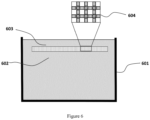
- Figure 6 to show the contraction for visualization, core towards shell and also the sulfur chains.
- Figure 2 represents the correlation between the density and the temperature of sulfur.
- pre-expansion means that the sulfur will not expand further or will expand partially or negligibly because of chemical/electrochemical and/or redox reactions, for example, lithiation and or sodiation, etc. with mono, di, or trivalent metal ions such as Li + , Na + , K + , Ca 2+ , Mg 2+ , Al 3+ , Zn 2+ , etc.
- Another aspect of a successful lithium-sulfur battery is a specific ratio of electrolyte to sulfur, measured in milliliters per gram (ml g -1 ).
- the state-of-the-art LiS batteries typically use an E/S ratio of around 5 ml g -1 . This ratio is a key factor in determining the commercial viability of the battery, as shown in Figure 3 . It is important to carefully consider the E/S ratio when designing and evaluating LiS batteries.
- the present disclosure relates to the apparatus and method for the pre-expansion of chalcogenides (S, Se, Te) and/or a mixture of any two or more (but not limited to), or more specifically pure and/or doped sulfur or more specifically a sulfur wafer ( EP 3913705 A1 ) (but not limited to).
- the pre-expansion can be carried out in multiple ways. For the present application, we are preferably proposing two unique methods namely: 1. Flash Expansion and 2. Sequential Expansion for the very first time.
- the present disclosure further relates to an electrode/cathode comprising pre-expanded chalcogenides or more specifically sulfur and/or a mixture of sulfur allotropes, wherein sulfur is photonically/thermally pre-expanded to the state where it has the density equivalent to a metal sulfide.
- the incident photons/electrons and/or thermal treatment leads to expansion of the sulfur due to an increase in the local temperature within sulfur, which results in the enhancement of the volume owing to the high coefficient of volumetric expansion of sulfur, wherein the density of sulphur reduces from 2.08 g/cm 3 to 1.66 g/cm 3 , this is followed by ROP of sulfur and its subsequent cross-linking with a 2D material like GO, which forms an external robust shell.
- the robustness of the cross-linked GO layer at the GO/sulfur interface prevents the shrinkage of the resulting coated sulfur from shell to core, but favours the inwards, i.e. core to shell shrinkage of sulfur, which in turn generates the internal cavity as shown in Figure 6 .
- a thin layer/layers of 2D material and/or materials which is/are transparent enough to the UV spectra, capable of bonding to the chalcogenide-based material, more preferably sulfur, while as the same time offering high electronic conductivity and permeability towards the charge carrier ions, such as graphene oxide etc. for redox operation.
- This thin layer/layers is/are coated over electrode/cathode comprising crystalline, glassy, amorphous, and/or polymeric (e.g., ⁇ -, ⁇ -, and/or ⁇ -phasic) sulfur and/or a mixture of any two or more sulfur allotropes, for example the porous sulfur wafer ( EP 3913705 A1 ), by dip coating/vacuum filtering/spray coating/spin-coating/bar coating/slot-die coating/roll-to-roll printing/screenprinting/flexographic printing/lithographic printing/ ink-jet printing/film stretching, or more preferably electrostatically driven layer by layer (LbL) assembly or more preferably immersing the wafer into the liquid dispersion of 2D materials, followed by IR/Air drying.
- electrode/cathode comprising crystalline, glassy, amorphous, and/or polymeric (e.g., ⁇ -, ⁇ -, and/or ⁇ -phasic) sulfur and/or a
- the nanosheets of the 2D materials or more preferably GO are electrostatically attached to the surface of the chalcogenide-based wafer, more preferably sulfur wafer.
- the process of LbL coating (i.e., dipping/emerging) and drying are repeated a few times until the desired thickness (thickness ranging between 5-50 nm, or more preferably 20 nm or more preferably 10 nm) of 2D materials over the porous wafer is achieved.
- the resulting sulfur electrode comprises of two types of porosity, i) the open porosity that originates from the wafer growth of the chalcogenide-based cathode as described in EP 3913705 A1 and is accessible to the charge carriers within the electrolyte and ii) internal cavities, originating from the photon/electron beam and/or thermally induced expansion of sulfur and its subsequent cross-linking with the 2D material shell, which enforces the structural stability to the sulfur wafer in the pre-expanded state, resulting in the formation of the internal cavity as a result of inward volumetric contraction of sulfur, i.e. core towards the shell, upon cooling to room temperature or even lower.
- the newly formed internal cavity enhances the redox active surface area between the active material and the charge carriers in the electrolyte, in addition to providing a volumetric buffering space for the discharge product, i.e metal disulfide more preferably lithium disulfide, Li 2 S.
- metal disulfide more preferably lithium disulfide, Li 2 S.
- chalcogenides or more specifically sulfur can be used as an electrode/cathode fabrication for the realization of alkali and/or alkali earth (Li, Na, K, Ca, Mg, Al, Zn, etc.) metal/ion or more specifically LiS battery.
- pre-expansion means that the sulfur will not expand further or will expand negligibly or expand partially, wherein the upper limit of volumetric fluctuation compensation provided by the present method is limited by the boiling point of sulfur at 1 atmospheric pressure ( ⁇ 444°C), wherein extensions beyond this operation window can be provided by applying higher than 1 atmospheric pressure to alter the boiling point of sulfur to the higher temperature.
- the disclosure benefits from the anomalous high coefficient of thermal linear/volumetric expansion of sulfur ( figure 1 ), which is used to tailor the pre-expansion, similarly for other pure and doped chalcogenides such as Se, Te, etc., and or a mixture of any two or more.
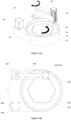
- the apparatus for the sequential expansion is presented in figure 5 (a-b).
- the apparatus comprises a metallic/glass body containing an adjustable/moveable FLA/UV/IPL laser source with a concentering coolant liquid/water stream, attached at the top of the apparatus as shown in figure 4 (a) .
- the moveable FLA/UV/IPL laser source acts as writing head, capable of writing a defined/programmable pattern on the wafer.
- the FLA/UV/IPL laser source is capable of generating high-intensity photon flux with a fluence of 25 J/cm 2 , preferably above 120 J/cm 2 which is sufficient to expand the chalcogenide and or a mixture of any two or more chalcogenides, or more specifically pure and/or doped sulfur (but not limited to).
- the apparatus is further equipped with a sample/wafer holder with a rotary function as presented in figure 4 (b) .
- the sample holder can rotate with a desired speed (preferably 15-20 rotations per minute) in a clockwise and or counterclockwise direction.
- a stream of chilled liquid flows centering the FLA/UV/IPL laser beam to quench the heated/melted sulfur and to minimize the risks of collapsing the wafer.
- a suitable processing liquid for example, water or ethanol or CO 2 or IPA, or a mixture of any two or more, capable of exchanging the heat instantaneously can be used in the stream.
- the temperature of the processing liquid is kept between -110°C to +4 °C and is controlled with the help of heat exchangers.
- the apparatus further may/may not include secondary channels spraying processing/coolant liquid to cool down the sample/wafer from the opposite side of the sample/wafer holder during the pre-expansion process whilst safeguarding the structure from collapsing.
- the pre-expansion of pure and/or doped chalcogenides and or a mixture of any two or more can be carried out with the sequential expansion method.
- the pre-expansion of a self-standing hierarchically porous monolithic sulfur wafer (EP 3913705 A1 ) can be carried out with the flash expansion method. Different from the flash expansion method where the whole wafer is exposed to the light at the same time, sequential expansion method works on the principle of spot heating and quenching.
- a self-standing porous monolithic sulfur wafer ( EP 3913705 A1 ) is placed in the sample/wafer holder as described in figure 4 (b) .
- the FLA/UV/IPL laser/radiation source shoots a high-intensity photons flux (between 25 J/cm 2 - 120 J/cm 2 ) to the sulfur wafer.
- the incident photons from FLA/UV/IPL source are absorbed by the sulfur wafer resulting in localized heating, expansion, and ring-opening polymerization (ROP).
- the stream of processing liquid immediately quenches the polymeric sulfur and helps restrain the wafer structure. During the process, the temperature of the processing liquid is maintained between -110°C to +4°C to avoid overheating, structural collapse, and vaporization of sulfur.
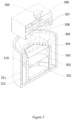
- the apparatus for the nanobubbles supported pre-expansion is presented in figure 5 .
- the apparatus comprises of a closed system of metallic/glass vessels equipped with an FLA/UV/IPL laser source at the top.
- the FLA/UV/IPL laser source is suitable to generate high-intensity photons flux with a fluence of 25 J/cm 2 , preferably above 120 J/cm 2 appropriate to expand the chalcogenide and/or a mixture of any two or more chalcogenides, or more specifically pure and/or doped sulfur (but not limited to) or more preferably a sulfur wafer ( EP 3913705 A1 ) .
- the laser source further comprises of a focusing lens, which transfers the incident photons from the FLA/UV/IPL laser source directly on to the sulfur wafer and may/or may not be partially immersed in the processing liquid in order to enhance the intensity of the photons incident on to the wafer by moderating the principle of refraction/reflection of photons.
- the metallic/glass vessel is a jacketed vessel with vacuum between inner and outer vessel, such that the inner wall of the outer vessel can be coated with a reflecting coating for photons, like barium sulphate, allowing for total reflection and focusing of the photons towards the sulfur wafer.
- the heat/mass transport with the external system is inhibited.
- the FLA/UV/IPL laser source is suitable to generate high-intensity photons flux with a fluence of 25 J/cm 2 , preferably above 120 J/cm 2 appropriate to expand the chalcogenide and/or a mixture of any two or more chalcogenides, or more specifically pure and/or doped sulfur (but not limited to) or more preferably a sulfur wafer ( EP 3913705 A1 ).
- the device further comprises of a wafer holder, which can be immersed into the processing liquid (water or fluorinert or ethanol or CO 2 or IPA, and or a mixture of any two or more), capable of heat dissipation from the sulfur wafer upon irradiation.
- the device further comprises of an aerator disc, fixed at the bottom of the vessel, through which the gas of suitable mixture is passed, for example CO 2 but not limited to.
- the gas introduced through the aerator can further be cooled before its introduction into the metallic/glass vessel by passing the gas through an externally connected auxiliary heat exchanger maintained between -110°C to +4°C.
- anodic alumina membrane (AAO) is placed between the aerator and the wafer holder.
- AAO anodic alumina membrane
- the nano pores within the AAO membrane assist and enable the formation of nano bubbles, which then move towards the irradiated wafer due to their low density as compared to the surrounding processing liquid.
- the distances/height between the aerator, AAO membrane and the wafer holder can be adjusted depending on the desired parameters.
- the nanobubbles due to the principle of buoyancy also acts as localized support towards the sulfur wafer subjected to photons/electrons and/or thermal treatment.
- a thin conductive layer coated over sulfur wafer comprising 2D materials such as carbon, graphene/graphene oxide, and/or their derivatives (but not limited to) immediately reacts/crosslinks with melted/polymeric sulfur.
- the sulfur radicals with unpaired electrons at both ends of chains violently react with graphene oxide (GO) and reduce it to r-GO aka de-oxygenating GO, and turn it into a cross-linked/covalently/chemically bonded protective layer referred to as "fish-scale" on its surface.
- This layer structurally reinforces the sulfur wafer during/after the pre-expansion and guarantees superior electronic and ionic conductivity.
- Pre-expansion of sulfur represents the most advanced way to unlock to volumetric potential of sulfur as summarised in table 1.
- the first row represents, a unitary body or monolithic 3D object formed from ordered nanocrystals of 1D/2D monoclinic sulfur allotropes, which together form a poly-crystalline, quasi-crystalline, or glassy-crystalline sulfur wafer with hierarchical porosity.
- the main difference between the unitary wafer presented herein and the state-of-the-art slurry-based sulfur cathode or cathodes with a suitable 3D host such as a graphene scaffold is the presence or absence of particles-aggregates-clusters (PAC) network, which is commonly found in both traditional lithium-ion batteries and the latest generation of post-lithium batteries.
- PAC particles-aggregates-clusters
- a thus fabricated coated electrode/cathode comprising pre-expanded sulfur possesses a unique combination of internal (closed, not accessible) and external (opened, accessible) porosity which further can be occupied by electrolyte or more preferably catholyte.
- a pre-expanded sulfur cathode promises better conductivity, higher active material utilization, E/S ratio below 1.5 ml/g and the capability to internally buffer the volumetric fluctuation during cycling without the necessity to provide or generate additional open volume/porosity.
- a pre-expanded, pure, and/or doped chalcogenide or a mixture of any two or more preferably sulfur-based electrodes can be used in electrochemical energy storage devices, i.e., secondary rechargeable batteries containing Li, Na, K, Ca, Mg, Al metal/ion as a counter electrode or more specifically, high-energy LiS batteries, Na-S batteries, Al-S batteries, Mg-S batteries, etc.
Landscapes
- Chemical & Material Sciences (AREA)
- Chemical Kinetics & Catalysis (AREA)
- Electrochemistry (AREA)
- General Chemical & Material Sciences (AREA)
- Engineering & Computer Science (AREA)
- Inorganic Chemistry (AREA)
- Manufacturing & Machinery (AREA)
- Materials Engineering (AREA)
- Organic Chemistry (AREA)
- Battery Electrode And Active Subsutance (AREA)
- Secondary Cells (AREA)
Priority Applications (6)
| Application Number | Priority Date | Filing Date | Title |
|---|---|---|---|
| EP23219761.6A EP4576232A1 (de) | 2023-12-22 | 2023-12-22 | Herstellungsverfahren und arbeitsprinzip zur vorexpansion von elektroden auf chalcogenidbasis vor deren reaktion mit alkali-/erdalkalimetallen |
| AU2024278310A AU2024278310A1 (en) | 2023-12-22 | 2024-12-11 | Production methods and working principle for the pre-expansion of chalcogenide-based electrodes prior to their reaction with alkali/alkaline earth metals |
| US18/985,478 US20250206610A1 (en) | 2023-12-22 | 2024-12-18 | Production methods and working principle for the pre-expansion of chalcogenide-based electrodes prior to their reaction with alkali/alkaline earth metals |
| JP2024225057A JP2025118516A (ja) | 2023-12-22 | 2024-12-20 | アルカリ/アルカリ土類金属との反応前のカルコゲニド系電極の予備膨張のための製造方法及び作用原理 |
| CN202411893797.2A CN120191893A (zh) | 2023-12-22 | 2024-12-20 | 用于使基于硫族化物的电极预膨胀的生产方法及工作原理 |
| KR1020240192745A KR20250099018A (ko) | 2023-12-22 | 2024-12-20 | 알칼리/알칼리 토금속과의 반응 전에 칼코게나이드-기반 전극의 사전-팽창을 위한 작동 원리 및 제조 방법 |
Applications Claiming Priority (1)
| Application Number | Priority Date | Filing Date | Title |
|---|---|---|---|
| EP23219761.6A EP4576232A1 (de) | 2023-12-22 | 2023-12-22 | Herstellungsverfahren und arbeitsprinzip zur vorexpansion von elektroden auf chalcogenidbasis vor deren reaktion mit alkali-/erdalkalimetallen |
Publications (1)
| Publication Number | Publication Date |
|---|---|
| EP4576232A1 true EP4576232A1 (de) | 2025-06-25 |
Family
ID=89322273
Family Applications (1)
| Application Number | Title | Priority Date | Filing Date |
|---|---|---|---|
| EP23219761.6A Pending EP4576232A1 (de) | 2023-12-22 | 2023-12-22 | Herstellungsverfahren und arbeitsprinzip zur vorexpansion von elektroden auf chalcogenidbasis vor deren reaktion mit alkali-/erdalkalimetallen |
Country Status (6)
| Country | Link |
|---|---|
| US (1) | US20250206610A1 (de) |
| EP (1) | EP4576232A1 (de) |
| JP (1) | JP2025118516A (de) |
| KR (1) | KR20250099018A (de) |
| CN (1) | CN120191893A (de) |
| AU (1) | AU2024278310A1 (de) |
Citations (4)
| Publication number | Priority date | Publication date | Assignee | Title |
|---|---|---|---|---|
| US20140263217A1 (en) * | 2013-03-13 | 2014-09-18 | Abbott Cardiovascular Systems Inc. | Short pulse laser machining of polymers enhanced with light absorbers for fabricating medical devices |
| US10991944B2 (en) | 2019-01-14 | 2021-04-27 | Drexel University | Synthesis of gamma monoclinic sulfur and sulfur batteries containing monoclinic sulfur |
| EP3913705A1 (de) | 2020-05-19 | 2021-11-24 | Theion GmbH | Fortgeschrittene monolithische schwefel-wafer-ähnliche kathode auf basis von hyperverzweigten superstrukturen und verfahren zur herstellung davon |
| US11335911B2 (en) | 2019-08-23 | 2022-05-17 | Lyten, Inc. | Expansion-tolerant three-dimensional (3D) carbon-based structures incorporated into lithium sulfur (Li S) battery electrodes |
-
2023
- 2023-12-22 EP EP23219761.6A patent/EP4576232A1/de active Pending
-
2024
- 2024-12-11 AU AU2024278310A patent/AU2024278310A1/en active Pending
- 2024-12-18 US US18/985,478 patent/US20250206610A1/en active Pending
- 2024-12-20 KR KR1020240192745A patent/KR20250099018A/ko active Pending
- 2024-12-20 CN CN202411893797.2A patent/CN120191893A/zh active Pending
- 2024-12-20 JP JP2024225057A patent/JP2025118516A/ja active Pending
Patent Citations (4)
| Publication number | Priority date | Publication date | Assignee | Title |
|---|---|---|---|---|
| US20140263217A1 (en) * | 2013-03-13 | 2014-09-18 | Abbott Cardiovascular Systems Inc. | Short pulse laser machining of polymers enhanced with light absorbers for fabricating medical devices |
| US10991944B2 (en) | 2019-01-14 | 2021-04-27 | Drexel University | Synthesis of gamma monoclinic sulfur and sulfur batteries containing monoclinic sulfur |
| US11335911B2 (en) | 2019-08-23 | 2022-05-17 | Lyten, Inc. | Expansion-tolerant three-dimensional (3D) carbon-based structures incorporated into lithium sulfur (Li S) battery electrodes |
| EP3913705A1 (de) | 2020-05-19 | 2021-11-24 | Theion GmbH | Fortgeschrittene monolithische schwefel-wafer-ähnliche kathode auf basis von hyperverzweigten superstrukturen und verfahren zur herstellung davon |
Non-Patent Citations (1)
| Title |
|---|
| CHEN KENA ET AL: "Sulfur nanoparticles encapsulated in reduced graphene oxide nanotubes for flexible lithium-sulfur batteries", NANO RESEARCH, TSINGHUA UNIVERSITY PRESS, CN, vol. 11, no. 3, 2 February 2018 (2018-02-02), pages 1345 - 1357, XP036413040, ISSN: 1998-0124, [retrieved on 20180202], DOI: 10.1007/S12274-017-1749-2 * |
Also Published As
| Publication number | Publication date |
|---|---|
| JP2025118516A (ja) | 2025-08-13 |
| CN120191893A (zh) | 2025-06-24 |
| AU2024278310A1 (en) | 2025-07-10 |
| US20250206610A1 (en) | 2025-06-26 |
| KR20250099018A (ko) | 2025-07-01 |
Similar Documents
| Publication | Publication Date | Title |
|---|---|---|
| Shang et al. | Boosting Zn|| I2 battery’s performance by coating a zeolite-based cation-exchange protecting layer | |
| Wang et al. | An anionic‐MOF‐based bifunctional separator for regulating lithium deposition and suppressing polysulfides shuttle in Li–S batteries | |
| Yan et al. | Confining ZnS/SnS2 Ultrathin Heterostructured Nanosheets in Hollow N‐Doped Carbon Nanocubes as Novel Sulfur Host for Advanced Li‐S Batteries | |
| Eftekhari | The rise of lithium–selenium batteries | |
| CN108140801B (zh) | 涂覆有活性氧化物材料的金属泡沫阳极 | |
| Kong et al. | Porous carbon paper as interlayer to stabilize the lithium anode for lithium–sulfur battery | |
| CN102906925B (zh) | 电化学氢催化剂动力系统 | |
| CN113148987B (zh) | 一种多维制备石墨烯基上MXene纳米花的方法 | |
| Zhang et al. | A Tellurium‐Boosted High‐Areal‐Capacity Zinc‐Sulfur Battery | |
| KR20170110583A (ko) | 전극 및 전기화학 디바이스와 전극 및 전기화학 디바이스를 제조하는 방법 | |
| CN114068970B (zh) | 一种光辅助锂二氧化碳电池及其制备方法 | |
| Cao et al. | Ultrafast synthesis of porous Fe 3 C/carbon hybrid materials via a carbothermal shock reactor for advanced energy storage applications | |
| EP4576232A1 (de) | Herstellungsverfahren und arbeitsprinzip zur vorexpansion von elektroden auf chalcogenidbasis vor deren reaktion mit alkali-/erdalkalimetallen | |
| Huang et al. | Perspectives on ultrafast, precise synthesis and regeneration of advanced battery materials | |
| CA3260480A1 (en) | Production methods and working principle for the pre-expansion of chalcogenide-based electrodes prior to their reaction with alkali/alkaline earth metals | |
| KR102683186B1 (ko) | 유기계 활물질을 포함하는 정렬된 3차원 다공성 나노네트워크 전극, 이의 제조 방법 및 이를 포함하는 이차 전지 | |
| CN115347174A (zh) | 一种多孔Cu-MOF、硒化铜衍生物及其制备方法与应用 | |
| KR20160028748A (ko) | 나트륨 이차전지 | |
| Fredj et al. | Utility of MXenes and its hybrid materials for batteries | |
| EP4525075A1 (de) | Durch bestrahlung von chalkogenidbasierten materialien induzierte mischionen-elektronenleitende übergangsschicht | |
| EP4597616A1 (de) | Monolithische waferartige kathode, die aus polykristallinen und amorphen glasartigen domänen synergisch gewachsen ist, und herstellungsverfahren dafür | |
| CN117902561B (zh) | 一种用于超高倍率性能钠离子电池硬碳负极材料制备方法 | |
| KR102717474B1 (ko) | 메탈 콜로이드 입자를 이용한 고체 전해질의 롤투롤 형성 방법 | |
| Gibson et al. | Applications of Pulsed Laser Ablation in Li-Ion Battery Research | |
| CA3262923A1 (en) | Monolithic wafer-like cathode synergically grown from poly-crystalline and amorphous glass-like domains and method of producing thereof |
Legal Events
| Date | Code | Title | Description |
|---|---|---|---|
| PUAI | Public reference made under article 153(3) epc to a published international application that has entered the european phase |
Free format text: ORIGINAL CODE: 0009012 |
|
| STAA | Information on the status of an ep patent application or granted ep patent |
Free format text: STATUS: THE APPLICATION HAS BEEN PUBLISHED |
|
| AK | Designated contracting states |
Kind code of ref document: A1 Designated state(s): AL AT BE BG CH CY CZ DE DK EE ES FI FR GB GR HR HU IE IS IT LI LT LU LV MC ME MK MT NL NO PL PT RO RS SE SI SK SM TR |
|
| STAA | Information on the status of an ep patent application or granted ep patent |
Free format text: STATUS: REQUEST FOR EXAMINATION WAS MADE |
|
| 17P | Request for examination filed |
Effective date: 20251216 |