EP4576136A1 - Mehrschichtiges elektronisches bauteil - Google Patents
Mehrschichtiges elektronisches bauteil Download PDFInfo
- Publication number
- EP4576136A1 EP4576136A1 EP24216141.2A EP24216141A EP4576136A1 EP 4576136 A1 EP4576136 A1 EP 4576136A1 EP 24216141 A EP24216141 A EP 24216141A EP 4576136 A1 EP4576136 A1 EP 4576136A1
- Authority
- EP
- European Patent Office
- Prior art keywords
- electrode layer
- electronic component
- multilayer electronic
- disposed
- upper electrode
- Prior art date
- Legal status (The legal status is an assumption and is not a legal conclusion. Google has not performed a legal analysis and makes no representation as to the accuracy of the status listed.)
- Pending
Links
Images


Classifications
-
- H—ELECTRICITY
- H01—ELECTRIC ELEMENTS
- H01G—CAPACITORS; CAPACITORS, RECTIFIERS, DETECTORS, SWITCHING DEVICES, LIGHT-SENSITIVE OR TEMPERATURE-SENSITIVE DEVICES OF THE ELECTROLYTIC TYPE
- H01G4/00—Fixed capacitors; Processes of their manufacture
- H01G4/002—Details
- H01G4/228—Terminals
- H01G4/232—Terminals electrically connecting two or more layers of a stacked or rolled capacitor
-
- H—ELECTRICITY
- H01—ELECTRIC ELEMENTS
- H01G—CAPACITORS; CAPACITORS, RECTIFIERS, DETECTORS, SWITCHING DEVICES, LIGHT-SENSITIVE OR TEMPERATURE-SENSITIVE DEVICES OF THE ELECTROLYTIC TYPE
- H01G4/00—Fixed capacitors; Processes of their manufacture
- H01G4/002—Details
- H01G4/228—Terminals
- H01G4/248—Terminals the terminals embracing or surrounding the capacitive element, e.g. caps
-
- H—ELECTRICITY
- H01—ELECTRIC ELEMENTS
- H01G—CAPACITORS; CAPACITORS, RECTIFIERS, DETECTORS, SWITCHING DEVICES, LIGHT-SENSITIVE OR TEMPERATURE-SENSITIVE DEVICES OF THE ELECTROLYTIC TYPE
- H01G2/00—Details of capacitors not covered by a single one of groups H01G4/00-H01G11/00
- H01G2/02—Mountings
- H01G2/06—Mountings specially adapted for mounting on a printed-circuit support
-
- H—ELECTRICITY
- H01—ELECTRIC ELEMENTS
- H01G—CAPACITORS; CAPACITORS, RECTIFIERS, DETECTORS, SWITCHING DEVICES, LIGHT-SENSITIVE OR TEMPERATURE-SENSITIVE DEVICES OF THE ELECTROLYTIC TYPE
- H01G4/00—Fixed capacitors; Processes of their manufacture
- H01G4/002—Details
- H01G4/005—Electrodes
- H01G4/012—Form of non-self-supporting electrodes
-
- H—ELECTRICITY
- H01—ELECTRIC ELEMENTS
- H01G—CAPACITORS; CAPACITORS, RECTIFIERS, DETECTORS, SWITCHING DEVICES, LIGHT-SENSITIVE OR TEMPERATURE-SENSITIVE DEVICES OF THE ELECTROLYTIC TYPE
- H01G4/00—Fixed capacitors; Processes of their manufacture
- H01G4/002—Details
- H01G4/018—Dielectrics
- H01G4/06—Solid dielectrics
- H01G4/08—Inorganic dielectrics
- H01G4/12—Ceramic dielectrics
- H01G4/1209—Ceramic dielectrics characterised by the ceramic dielectric material
-
- H—ELECTRICITY
- H01—ELECTRIC ELEMENTS
- H01G—CAPACITORS; CAPACITORS, RECTIFIERS, DETECTORS, SWITCHING DEVICES, LIGHT-SENSITIVE OR TEMPERATURE-SENSITIVE DEVICES OF THE ELECTROLYTIC TYPE
- H01G4/00—Fixed capacitors; Processes of their manufacture
- H01G4/002—Details
- H01G4/228—Terminals
- H01G4/232—Terminals electrically connecting two or more layers of a stacked or rolled capacitor
- H01G4/2325—Terminals electrically connecting two or more layers of a stacked or rolled capacitor characterised by the material of the terminals
-
- H—ELECTRICITY
- H01—ELECTRIC ELEMENTS
- H01G—CAPACITORS; CAPACITORS, RECTIFIERS, DETECTORS, SWITCHING DEVICES, LIGHT-SENSITIVE OR TEMPERATURE-SENSITIVE DEVICES OF THE ELECTROLYTIC TYPE
- H01G4/00—Fixed capacitors; Processes of their manufacture
- H01G4/30—Stacked capacitors
-
- H—ELECTRICITY
- H05—ELECTRIC TECHNIQUES NOT OTHERWISE PROVIDED FOR
- H05K—PRINTED CIRCUITS; CASINGS OR CONSTRUCTIONAL DETAILS OF ELECTRIC APPARATUS; MANUFACTURE OF ASSEMBLAGES OF ELECTRICAL COMPONENTS
- H05K1/00—Printed circuits
- H05K1/02—Details
- H05K1/11—Printed elements for providing electric connections to or between printed circuits
- H05K1/111—Pads for surface mounting, e.g. lay-out
-
- H—ELECTRICITY
- H05—ELECTRIC TECHNIQUES NOT OTHERWISE PROVIDED FOR
- H05K—PRINTED CIRCUITS; CASINGS OR CONSTRUCTIONAL DETAILS OF ELECTRIC APPARATUS; MANUFACTURE OF ASSEMBLAGES OF ELECTRICAL COMPONENTS
- H05K1/00—Printed circuits
- H05K1/18—Printed circuits structurally associated with non-printed electric components
- H05K1/181—Printed circuits structurally associated with non-printed electric components associated with surface mounted components
-
- H—ELECTRICITY
- H01—ELECTRIC ELEMENTS
- H01G—CAPACITORS; CAPACITORS, RECTIFIERS, DETECTORS, SWITCHING DEVICES, LIGHT-SENSITIVE OR TEMPERATURE-SENSITIVE DEVICES OF THE ELECTROLYTIC TYPE
- H01G4/00—Fixed capacitors; Processes of their manufacture
- H01G4/002—Details
- H01G4/018—Dielectrics
- H01G4/06—Solid dielectrics
- H01G4/08—Inorganic dielectrics
- H01G4/12—Ceramic dielectrics
-
- H—ELECTRICITY
- H05—ELECTRIC TECHNIQUES NOT OTHERWISE PROVIDED FOR
- H05K—PRINTED CIRCUITS; CASINGS OR CONSTRUCTIONAL DETAILS OF ELECTRIC APPARATUS; MANUFACTURE OF ASSEMBLAGES OF ELECTRICAL COMPONENTS
- H05K2201/00—Indexing scheme relating to printed circuits covered by H05K1/00
- H05K2201/10—Details of components or other objects attached to or integrated in a printed circuit board
- H05K2201/10007—Types of components
- H05K2201/10015—Non-printed capacitor
-
- H—ELECTRICITY
- H05—ELECTRIC TECHNIQUES NOT OTHERWISE PROVIDED FOR
- H05K—PRINTED CIRCUITS; CASINGS OR CONSTRUCTIONAL DETAILS OF ELECTRIC APPARATUS; MANUFACTURE OF ASSEMBLAGES OF ELECTRICAL COMPONENTS
- H05K2201/00—Indexing scheme relating to printed circuits covered by H05K1/00
- H05K2201/10—Details of components or other objects attached to or integrated in a printed circuit board
- H05K2201/10613—Details of electrical connections of non-printed components, e.g. special leads
- H05K2201/10954—Other details of electrical connections
- H05K2201/10984—Component carrying a connection agent, e.g. solder, adhesive
-
- Y—GENERAL TAGGING OF NEW TECHNOLOGICAL DEVELOPMENTS; GENERAL TAGGING OF CROSS-SECTIONAL TECHNOLOGIES SPANNING OVER SEVERAL SECTIONS OF THE IPC; TECHNICAL SUBJECTS COVERED BY FORMER USPC CROSS-REFERENCE ART COLLECTIONS [XRACs] AND DIGESTS
- Y02—TECHNOLOGIES OR APPLICATIONS FOR MITIGATION OR ADAPTATION AGAINST CLIMATE CHANGE
- Y02E—REDUCTION OF GREENHOUSE GAS [GHG] EMISSIONS, RELATED TO ENERGY GENERATION, TRANSMISSION OR DISTRIBUTION
- Y02E60/00—Enabling technologies; Technologies with a potential or indirect contribution to GHG emissions mitigation
- Y02E60/13—Energy storage using capacitors
Definitions
- the present disclosure relates to a multilayer electronic component.
- a multilayer ceramic component may be a chip condenser mounted on the printed circuit boards of various electronic products including image display devices such as a liquid crystal display (LCD) and a plasma display panel (PDP), a computer, a smartphone, a mobile phone, or the like, and charging or discharging electricity therein or therefrom.
- image display devices such as a liquid crystal display (LCD) and a plasma display panel (PDP), a computer, a smartphone, a mobile phone, or the like, and charging or discharging electricity therein or therefrom.
- Such a multilayer ceramic capacitor may be used as a component of various electronic devices, since a multilayer ceramic capacitor may have a small size and high capacitance and may be easily mounted.
- An embodiment of the present disclosure is to provide a multilayer electronic component having excellent mounting stability.
- a multilayer electronic component includes a body including a dielectric layer and internal electrodes alternately disposed with the dielectric layer, and including a first surface and a second surface opposing each other in a first direction, a third surface and a fourth surface connected to the first and second surfaces and opposing each other in a second direction, and a fifth surface and a sixth surface connected to the first to fourth surfaces and opposing each other in a third direction; and external electrodes including central portions disposed in centers of the third and fourth surfaces and outer portions connected to the central portions and disposed in outer regions of the third and fourth surfaces, wherein the external electrode includes a lower electrode layer disposed on the central portion and the outer portion and in contact with the internal electrode, and an upper electrode layer disposed on the outer portion and disposed on the lower electrode layer, and wherein, when a maximum size in the second direction of the central portion is defined as Le1 and a maximum size in the second direction of the outer portion is defined as Le2, Le2>Le1 is satisfied.
- the first direction may be defined as a thickness (T) direction
- the second direction may be defined as a length (L) direction
- the third direction may be defined as a width (W) direction.
- the terms “substantially,” “about,” and “approximately” may provide an industry-accepted tolerance for their corresponding terms and/or relativity between items, such as a tolerance of ⁇ 1%, ⁇ 5% , or ⁇ 10% of the actual value stated, and other suitable tolerances.
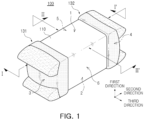
- FIG. 1 is a perspective diagram illustrating a multilayer electronic component according to an embodiment.
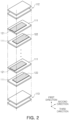
- FIG. 2 is an exploded perspective diagram illustrating a body in FIG. 1 according to an embodiment.
- FIG. 3 is a cross-sectional diagram taken along line I-I' in FIG. 1 .
- FIG. 4 is a diagram taken in direction A in FIG. 3 , viewed from side. is a cross-sectional diagram taken along line II-II' in FIG. 1 .
- FIG. 8 is a cross-sectional diagram illustrating a state in which a multilayer electronic component is mounted on a printed circuit board according to an embodiment.
- a multilayer ceramic capacitor will be described as an example of a multilayer electronic component, but an embodiment thereof is not limited thereto, and the multilayer ceramic capacitor may be applied to various multilayer electronic components, such as an inductor, a piezoelectric element, a varistor, or a thermistor.
- the multilayer electronic component 100 may include a body 110 including a dielectric layer 111 and internal electrodes 121 and 122, and external electrodes 131 and 132.
- the shape of the body 110 may not be limited to any particular shape, but as illustrated, the body 110 may have a hexahedral shape or a shape similar to a hexahedral shape. Due to shrinkage of ceramic powder included in the body 110 during a sintering process or polishing of corners, the body 110 may not have an exactly hexahedral shape formed by linear lines but may have a substantially hexahedral shape.
- the body 110 may have first and second surfaces 1 and 2 opposing each other in the first direction, third and fourth surfaces 3 and 4 connected to the first and second surfaces 1 and 2 and opposing in the second direction, and fifth and sixth surfaces 5 and 6 connected to the first and second surfaces 1 and 2 and the third and fourth surfaces 3 and 4 and opposing each other in the third direction.
- the body 110 may include the dielectric layer 111 and the first and second internal electrodes 121 and 122 disposed alternately in the first direction with the dielectric layer 111 interposed therebetween.
- the plurality of dielectric layers 111 forming the body 110 may be in a sintered state, and boundaries between adjacent dielectric layers 111 may be integrated with each other such that boundaries therebetween may not be distinct without using a scanning electron microscope (SEM).
- SEM scanning electron microscope
- the average thickness of the dielectric layer 111 is not limited to any particular example.
- the average thickness of the dielectric layer 111 may be, for example, 0.1 um to 10 um, 0.1 um to 5 um, 0.1 um to 2 um, or 0.1 um to 0.4 ⁇ m.
- the dielectric layer 111 may be formed by preparing a ceramic slurry including ceramic powder, an organic solvent, an additive, and a binder, preparing a ceramic green sheet by coating the slurry on a carrier film and drying the slurry, and sintering the ceramic green sheet.
- the ceramic powder is not limited to any particular example as long as sufficient electrostatic capacitance may be obtained therewith.
- a barium titanate material, lead composite perovskite material, or strontium titanate materials may be used.
- the ceramic powder may include BaTiO 3 , (Ba 1-x Ca x )TiO 3 (0 ⁇ x ⁇ 1), Ba(Ti x-y Ca y )O 3 (0 ⁇ y ⁇ 1), (Ba 1-x Ca x )(Ti 1-y Zr y )O 3 (0 ⁇ x ⁇ 1, 0 ⁇ y ⁇ 1) or Ba(Ti 1-y Zr y )O 3 (0 ⁇ y ⁇ 1) in which Ca (calcium) and Zr (zirconium) are partially dissolved.
- the organic solvent may be ethanol
- the binder may be polyvinyl butyral
- the organic solvent and binder may be a generally used material used in the art.
- the internal electrodes 121 and 122 may include, for example, a first internal electrodes 121 and a second internal electrode 122 disposed alternately with the dielectric layer 111 interposed therebetween. That is, the first internal electrodes 121 and the second internal electrode 122, a pair of electrodes having different polarities, may be disposed to oppose each other with the dielectric layer 111 interposed therebetween. The first internal electrodes 121 and the second internal electrode 122 may be electrically separated from each other by the dielectric layer 111 interposed therebetween.
- the first internal electrode 121 may be spaced apart from the fourth surface 4 and may be connected to the first external electrode 131 on the third surface 3.
- the second internal electrode 122 may be spaced apart from the third surface 3 and may be connected to the second external electrode 132 on the fourth surface 4.
- the conductive metal included in the internal electrodes 121 and 122 may be one or more of Ni, Cu, Pd, Ag, Au, Pt, Sn, W, Ti and alloys thereof, and may include Ni more preferably, but an embodiment thereof is not limited thereto.
- the average thickness of the internal electrodes 121 and 122 may not be limited to any particular example.
- the average thickness of the internal electrodes 121 and 122 may be, for example, 0.1 um to 5.0 um, 0.1 um to 3.0 um, 0.1 um to 1.0 um, or 0.1 um to 0.4 ⁇ m.
- the internal electrodes 121 and 122 may be formed by applying a conductive paste for an internal electrode including a conductive metal to a predetermined thickness on the ceramic green sheet and firing.
- a printing method for the conductive paste for internal electrodes a screen-printing method or a gravure printing method may be used, but an embodiment thereof is not limited thereto.
- An average thickness of the dielectric layer 111 and an average thickness of the internal electrodes 121 and 122 may indicate sizes of the dielectric layer 111 and the internal electrodes 121 and 122 in the first direction, respectively.
- the average thickness of the dielectric layer 111 and the average thickness of the internal electrodes 121 and 122 may be measured by scanning a cross-section in the first and second directions of the body 110 using a scanning electron microscope (SEM) with a magnification of 10,000. More specifically, the average thickness of the dielectric layer 111 may be measured from the thicknesses of the dielectric layer 111 at 30 points at an equal distance in the second direction.
- SEM scanning electron microscope
- the average thickness of internal electrodes 121 and 122 may be measured by measuring the thickness at multiple points of one internal electrode 121 and 122, for example, 30 points at an equal distance in the second direction. The 30 points at an equal distance may be designated in the capacitance formation portion Ac.
- the average thickness of the dielectric layer 111 and the average thickness of the internal electrodes 121 and 122 may be further generalized.
- the body 110 may include a capacitance formation portion Ac disposed in the body 110 and including the first and second internal electrodes 121 and 122 disposed alternately with the dielectric layer 111 interposed therebetween, and a first cover portion 112 and a second cover portion 113 disposed on both surfaces of the capacitance formation portion Ac opposing each other in the first direction.
- the cover portions 112 and 113 may prevent damages to the internal electrode due to physical or chemical stress.
- the cover portions 112 and 113 may be configured similarly to the dielectric layer 111, other than the configuration in which the cover portions 112 and 113 do not include an internal electrode.
- An average thickness of the cover portions 112 and 113 may not be limited to any particular example.
- the average thickness of the cover portions 112 and 113 may be, for example, 300 um or less, 100 um or less, 50 um or less, or 20 um or less, but an embodiment thereof is not limited thereto.
- the average thickness of the cover portions 112 and 113 may indicate the average thickness of each of the first cover portion 112 and the second cover portion 113.
- the average thickness of the cover portions 112 and 113 may indicate the average size in the first direction of the cover portions 112 and 113, and may be an average value of the first direction size measured at five points at an equal distance in the second direction in a cross-section in the first direction and second direction passing through a center of the body 110 in the third direction.
- the average thickness of the margin portions 114 and 115 may refer to an average size in the third direction of the margin portions 114 and 115, and may be an average value of sizes in the third direction, measured at five points at an equal distance in the first direction in a cross-section in the first and third directions of the body 110.
- the margin portions 114 and 115 may be formed by applying and sintering a conductive paste for an internal electrode other than a position in which the margin portion is formed on the ceramic green sheet.
- the internal electrodes 121 and 122 may be cut to be exposed to the fifth and sixth surfaces 5 and 6 of the body, and a single dielectric layer or two or more dielectric layers may be laminated on both surfaces in the third direction of the capacitance formation portion Ac opposing each other, thereby forming the margin portions 114 and 115.
- the external electrodes 131 and 132 may be disposed on the third and fourth surfaces 3 and 4 of the body 110, and may extend to a portion of the first surface, second, fifth and sixth surfaces 1, 2, 5, and 6.
- the external electrodes 131 and 132 may include a first external electrode 131 connected to the first internal electrodes 121 and a second external electrode 132 connected to the second internal electrode 122.
- the multilayer electronic component 100 may have two external electrodes 131 and 132, but an embodiment thereof is not limited thereto, and the number or the shape of the external electrodes 131 and 132 may be varied depending on the shape of the internal electrodes 121, 122 or other purposes.
- the external electrodes 131 and 132 may include central portion C1 and C2 disposed on centers of third and fourth surfaces 3 and 4, and outer portion P1 and P2 connected to the central portion C1 and C2 and disposed on an outer region of third and fourth surfaces 3 and 4.
- the external electrodes 131 and 132 may include band portions B1 and B2 extending from the outer portions P1 and P2 to a portions of the first and second surfaces 1 and 2.
- the band portions B1 and B2 may also extend from the outer portions P1 and P2 to a portion of the fifth and sixth surfaces 5 and 6.
- the first external electrode 131 may include a first central portion C1 disposed on a center of the third surface 3, a first outer portion P1 disposed on an outer region of the third surface 3 and connected to the first central portion C1, and a first band portion B1 extending from the first outer portion P1 to a portion of the first and second surfaces 1, 2.
- the second external electrode 132 may include a second central portion C2 disposed on the center of the fourth surface 4, a second outer portion P2 disposed on the outer region of the fourth surface 4 and connected to the second central portion C2, and a second band portion B2 extending from the second outer portion P2 to a portion of the first and second surfaces 1, 2.
- the external electrodes 131 and 132 may include lower electrode layers 131a and 132a disposed in the central portion C1 and C2 and the outer portion P1 and P2 and in contact with the internal electrodes 121 and 122, and upper electrode layers 131b and 132b disposed in the outer portion P1 and P2 and disposed on the lower electrode layers 131a and 132a, respectively.
- the upper electrode layers 131b and 132b may not be disposed in the central portion C1 and C2.
- the first external electrode 131 may include a first lower electrode layer 131a disposed in the first central portion C1 and the first outer portion P1 and in contact with the first internal electrode 121, and a first upper electrode layer 131b disposed in the first outer portion P1 and disposed on the first lower electrode layer 131a.
- the first upper electrode layer 131b may not be disposed in the first central portion C1.
- the second external electrode 132 may include a second lower electrode layer 132a disposed in the second central portion C2 and the second outer portion P2 and in contact with the second internal electrode 122, and a second upper electrode layer 132b disposed in the second outer portion P2 and disposed on the second lower electrode layer 132a.
- the second upper electrode layer 132b may not be disposed in the second central portion C2.
- the boundary between the central portions C1 and C2 and the outer portions P1 and P2 may correspond to, for example, ends of the upper electrode layers 131b and 132b adjacent to the central portions C1 and C2.
- the boundary between the outer portions P1 and P2 and the band portions B1 and B2 may correspond to ends of the upper electrode layers 131b and 132b adjacent to the band portions B1 and B2. For example, referring to FIG.
- the boundary between the central portions C1 and C2 and the outer portions P1 and P2 may correspond to one end in the first direction of the upper electrode layers 131b and 132b adjacent to the central portions C1 and C2, and the boundary between the outer portions P1 and P2 and the band portions B1 and B2 may correspond to the other end in the first direction of the upper electrode layers 131b and 132b adjacent to the band portions B1 and B2.
- the maximum size Le2 in the second direction of the outer portion may be greater than the maximum size Le1 in the second direction of the central portion. That is, Le2>Le1 may be satisfied.
- the maximum size in the second direction of the first outer portion P1 may be greater than the maximum size in the second direction of the first central portion C1
- the maximum size in the second direction of the second outer portion P2 may be greater than the maximum size in the second direction of the second central portion C2.
- the multilayer electronic component 100 by including the upper electrode layers 131b and 132b disposed in the outer portions P1 and P2, Le2>Le1 may be satisfied, and accordingly, by increasing the size in the second direction of the outer portion P1 and P2, which may be regions in contact with pads or solder of the printed circuit board, mounting stability of the multilayer electronic component 100 may improve.
- a printed circuit board 200 on which a multilayer electronic component 100 is mounted may include a plurality of pads 210 and 220 disposed on one surface.
- the solder 230 and 240 may connect the plurality of pads 210 and 220 to the multilayer electronic component 100.
- the multilayer electronic component 100 may be mounted on the printed circuit board 200 through band portions B1 and B2 of the external electrodes 131 and 132 in contact with the solder 230 and 240.
- the solder 230 and 240 may be in contact with the band portions B1 and B2 and also the outer portions P1 and P2. Accordingly, by increasing a contact area between the multilayer electronic component 100 and the solder 230 and 240, mounting stability of the multilayer electronic component 100 may improve.
- the solder 230 and 240 may flow upwardly along the outer portions P1 and P2, and the solder 230 and 240 may be in contact with the surface adjacent to the central portion C1 and C2 among outer surfaces of the outer portions P1 and P2, or may be in contact with the central portion C1 and C2. In this case, the solder 230 and 240 may generate a force pressing the outer portions P1 and P2 in the direction in which the printed circuit board 200 is disposed. Accordingly, the effect of improving mounting stability of the multilayer electronic component 100 may be more prominent.
- the shape of the outer portions P1 and P2 may not be limited to any particular example. However, in an embodiment, at least a portion of the outer portions P1 and P2 may have a shape convexly protruding more outwardly than the central portions C1 and C2.
- the maximum size in the second direction of the multilayer electronic component 100 measured at the central portion C1 and C2 is defined as Lm1
- the maximum size in the second direction of the multilayer electronic component 100 measured at the outer portion P1 and P2 is defined as Lm2
- 0.01 ⁇ (Lm2-Lm1)/Lm1 ⁇ 0.05 may be satisfied.
- (Lm2-Lm1)/Lm1 is less than 0.01, the effect of improving mounting stability of the embodiment may be insignificant.
- (Lm2-Lm1)/Lm1 exceeds 0.05, capacitance per unit volume of the multilayer electronic component 100 may be reduced.
- a ratio of to (Tc/Tm) may be greater than 0. More preferably, the ratio of to (Tc/Tm) may be 0.5 or greater.
- Tc/Tm is less than 0.5, it may be difficult for solder to flow upwardly along the outer portion and to be contact with the central portion.
- An upper limit of Tc/Tm may not be specifically limited and may be less than 1.
- the lower electrode layers 131a and 132a may extend from the outer portions P1 and P2 to the band portions B1 and B2. In an embodiment, ends of the lower electrode layers 131a and 132a may be disposed in the band portions B1 and B2.
- the first lower electrode layer 131a may extend from the first outer portion P1 to the first band portion B1 such that the end of the first lower electrode layer 131a may be disposed in the first band portion B1.
- the second lower electrode layer 132a may extend from the second outer portion P2 to the second band portion B2 such that the end of the second lower electrode layer 132a may be disposed in the second band portion B2.
- the lower electrode layers 131a and 132a may have a maximum thickness in the central portions C1 and C2 and a minimum thickness in the outer portions P1 and P2.
- the lower electrode layers 131a and 132a may have a maximum thickness in the center of the first direction of the central portions C1 and C2, for example.
- the lower electrode layers 131a and 132a may have a minimum thickness in a corner of the round shape of the body 110, for example.
- Each of the central portions C1 and C2 of the external electrodes 131 and 132 may be convex outwardly by the lower electrode layers 131a and 132a.
- the lower electrode layers 131a and 132a may be formed by, for example, dipping the third and fourth surfaces 3 and 4 of the body 110 into a conductive paste including metal powder, glass, a binder, and an organic solvent, and sintering. That is, the lower electrode layers 131a and 132a may be sintered electrodes including, for example, metal and glass.
- the metal included in the lower electrode layers 131a and 132a may include one or more of Cu, Ni, Pd, Pt, Au, Ag, Pb, and alloys thereof, but an embodiment thereof is not limited thereto.
- the type of the upper electrode layers 131b and 132b may not be limited to any particular example.
- the upper electrode layers 131b and 132b may include metal and glass. That is, the upper electrode layers 131b and 132b may be sintered electrodes including metal and glass.
- the metal included in the upper electrode layers 131b and 132b may include one or more of Cu, Ni, Pd, Pt, Au, Ag, Pb, and alloys thereof, but an embodiment thereof is not limited thereto.
- the upper electrode layers 131b and 132b may include metal and resin. That is, the upper electrode layers 131b and 132b may be resin electrodes including metal and resin. When the upper electrode layers 131b and 132b are resin electrodes, the metal included in the upper electrode layers 131b and 132b may include one or more of Cu, Ni, Ag, Pd, Sn and alloys thereof, but an embodiment thereof is not limited thereto.
- the resin included in the upper electrode layers 131b and 132b may be an epoxy resin and/or an acrylic resin, but an embodiment thereof is not limited thereto.
- the shape of the upper electrode layers 131b and 132b may not be limited to any particular example.
- the upper electrode layers 131b and 132b may not cover ends of the lower electrode layers 131a and 132a disposed in the band portions B1 and B2.
- the upper electrode layers 131b and 132b may not be disposed in, for example, the band portions B1 and B2.
- the upper electrode layers 131b and 132b may be desirable for the upper electrode layers 131b and 132b not to cover the ends of the lower electrode layers 131a and 132a.
- the upper electrode layers 131b and 132b may include first electrode layers 131b1 and 132b1 disposed on one ends in the first direction of the third and fourth surfaces 3 and 4, and second electrode layers 131b2 and 132b2 disposed on the other ends in the first direction of the third and fourth surfaces 3 and 4.
- the first upper electrode layer 131b may include a 1-1-th electrode layer 131b1 disposed on one end in the first direction of the third surface 3 and a 2-1-th electrode layer 131b1 disposed on the other end in the first direction of the third surface 3, and the second upper electrode layer 132b may include a 1-2-th electrode layer 132b1 disposed on one end in the first direction of the fourth surface 4 and a 2-2-th electrode layer 132b2 disposed on the other end in the first direction of the fourth surface 4.
- the first electrode layer 131b1 and 132b1 and the second electrode layer 131b2 and 132b2 may be spaced apart from each other and may extend in the third direction.
- the 1-1-th electrode layer 131b1 and 2-1-th electrode layer 131b2 may be spaced apart from each other and may extend in the third direction, and the 1-2-th electrode layer 132b1 and 2-2-th electrode layer 132b2 may be spaced apart from each other and may extend in the third direction.
- FIG. 9 is a plan diagram illustrating a state in which a pattern for an upper electrode layer for forming an upper electrode layer of a multilayer electronic component is printed on a surface plate according to an embodiment.
- FIG. 10 is a diagram illustrating a process of forming an upper electrode layer of a multilayer electronic component according to an embodiment.
- a plurality of patterns 30 for the upper electrode layers may be printed on the surface plate 40.
- the pattern 30 for the upper electrode layer may be formed by printing a conductive paste including metal powder, glass, a binder, and an organic solvent, for example, using a screen-printing method.
- the pattern 30 for the upper electrode layer may be formed by printing a conductive resin composition including metal powder, resin, a binder, and an organic solvent, for example, using a screen-printing method.
- the first lower electrode layer 131a having the pattern 30 for the upper electrode layer attached thereto, the opposite side of the second lower electrode layer 132a, may be bonded to the second stainless steel plate (not illustrated) through the UV tape, and the UV tape 20 attached to the second lower electrode layer 132a may be removed by a UV transfer machine. Thereafter, the pattern for the upper electrode layer may be attached to the second lower electrode layer 132a in the same manner and may be dried, and the UV tape attached to the first lower electrode layer 131a side may be removed by a UV transfer machine.
- FIG. 6 is a diagram illustrating a modified example in FIG. 5 , illustrating the first external electrode side viewed from side, but since the first external electrode and the second external electrode may be symmetrical in the second direction and the configurations thereof may be substantially the same, the description as below may include both the descriptions of the first external electrode and the second external electrode.
- the upper electrode layer may include first to fourth corner electrode layers disposed on corners of the third and fourth surfaces 3 and 4 and spaced apart from each other.
- the upper electrode layer may include first to fourth corner electrode layers disposed on corners of the outer portion and spaced apart from each other.
- the first upper electrode layer 131b' may include first to fourth corner electrode layers 131b1', 131b2', 131b3', and 131b4' disposed on the corners of the third surface and spaced apart from each other.
- the first upper electrode layer 131b' may include first to fourth corner electrode layers 131b1', 131b2', 131b3', and 131b4' disposed on the corner of the first outer portion P1 and spaced apart from each other.
- the second upper electrode layer may include first to fourth corner electrode layers disposed on corners of the fourth surface and spaced apart from each other.
- the second upper electrode layer may include first to fourth corner electrode layers disposed on corners of the second outer portion and spaced apart from each other.
- the ratio of We to Wm may be 0.8 or lower.
- We/Wm the ratio of We to Wm
- the lower limit of the We/Wm may need not be specifically limited and may exceed 0.
- the first upper electrode layer 131b' may be formed by attaching the pattern 30' for the upper electrode layer printed on the surface plate 40 illustrated in FIG. 9 to the lower electrode layer 131a, and drying and firing the layer.
- FIG. 7 is a diagram illustrating a modified example in FIG. 5 , illustrating the first external electrode side viewed from side, but since the first external electrode and the second external electrode are symmetrical in the second direction and configurations thereof may be substantially the same, the description as below may include both the descriptions of the first external electrode and the second external electrode.
- the upper electrode layer may be disposed to surround the central portion.
- the first upper electrode layer 131b" may be disposed to surround the first central portion C1.
- the first upper electrode layer 131b" may be disposed to cover the outer portion P1.
- the first upper electrode layer 131b" may be formed by attaching the pattern 30" for the upper electrode layer printed on the surface plate 40 illustrated in FIG. 9 to the lower electrode layer 131a, and drying and firing the layer.
- BaTiO 3 powder, organic solvent such as ethanol, and binder such as polyvinyl butyral were mixed to prepare ceramic slurry, and the ceramic slurry was applied on a carrier film and dried, thereby preparing a ceramic green sheet. Thereafter, conductive paste for an internal electrode including Ni powder, an organic solvent, and a binder was applied on the ceramic green sheet to a predetermined thickness and an internal electrode pattern is formed.
- the ceramic green sheet on which the internal electrode pattern was formed was laminated in tens to hundreds of layers, pressed and cut, a firing process was performed at a temperature of 1100°C or higher to 1200°C or lower, and a body was formed.
- the third and fourth surfaces of the body were dipped in a conductive paste for a lower electrode layer including Cu powder, glass, a binder, and an organic solvent, fired at a temperature of 700°C to 900°C and a lower electrode layer was formed.
- the body on which the lower electrode layer was formed was attached to a stainless steel plate using UV tape, and the stainless steel plate was pressed against the surface plate on which the pattern for the upper electrode layer was printed.
- the pattern for the upper electrode layer was formed by printing a conductive paste including Cu powder, glass, binder, and organic solvent on the surface plate. Thereafter, the pattern for the upper electrode layer attached to the lower electrode layer was dried, formed at a temperature of 700°C to 900°C, and the upper electrode layer was formed.
- a Ni plating layer and a Sn plating layer were formed on the lower electrode layer and the upper electrode layer and a sample chip was formed.
- the size of the sample chip was manufactured to the 0603 standard (size in the second direction: approximately 0.6 mm, and size in the third direction: approximately 0.3 mm).
- sample chips for each sample No. were mounted on a printed circuit board.
- the sample chip was mounted on a pad of the printed circuit board using solder, and the solder was artificially applied by shifting 0.2 mm from the pad of the printed circuit board in the second direction, thereby determining a mounting defect of the sample chip.
- sample chips of sample Nos. 2 to 5 below were manufactured using the same method, and only the difference between the maximum size in the second direction Lm1 of the sample chip measured at the central portion and the maximum size in the second direction Lm2 of the sample chip measured at the outer portion was different.
- sample No. 1 the maximum size in the second direction Lm1 of the sample chip measured at the central portion and the maximum size in the second direction Lm2 of the sample chip measured at the outer portion were the same.
- sample Nos. 2 to 5 may have better mounting stability than sample No. 1, which may be because a contact area between the sample chip and the solder increased as Lm2 increased compared to Lm1.
- (Lm2-Lm1)/Lm1 is 0.01 or higher, the mounting defect decreased rapidly.
- sample chips of sample Nos. 7 to 11 below were manufactured using the same method, and the upper electrode layer had the form illustrated in FIG. 6 .
- Sample Nos. 7 to 11 had different ratios of the minimum distance We in the third direction between the first corner electrode layer and the second corner electrode layer to the maximum size in the third direction Wm of the sample chip (We/Wm).
- the upper electrode layer of sample No. 6 had the form illustrated in FIG. 5 , differently from sample Nos. 7 to 11. Accordingly, the We was indicated as 0. Sample No. 12, differently from sample Nos. 6 to 11, the process of forming the upper electrode layer on the outer portion was not performed. Accordingly, the We is denoted as 1. [Table 2] Classification We/Wm Mounting defect (%) Sample No. 6 0 5 Sample No. 7 0.2 5 Sample No. 8 0.4 6 Sample No. 9 0.6 8 Sample No. 10 0.8 9 Sample No. 11 0.9 16 Sample No. 12 1 19
- sample Nos. 6 to 11 had better mounting stability compared to sample No. 12, which may be because the external electrode included the upper electrode layer, such that the maximum size Le2 in the second direction of the outer portion increased further than the maximum size Le1 in the second direction of the central portion, and accordingly, the contact area between the sample chip and the solder increased.
- the We/Wm is 0.8 or lower, the mounting defect was drastically reduced.
- a multilayer electronic component having excellent mounting stability may be provided.
- the term "embodiment” may not refer to one same embodiment, and may be provided to describe and emphasize different unique features of each embodiment.
- the suggested embodiments may be implemented do not exclude the possibilities of combination with features of other embodiments. For example, even though the features described in an embodiment are not described in the other embodiment, the description may be understood as relevant to the other embodiment unless otherwise indicated.
- first may be referred to as a second element, and similarly, a second element may be referred to as a first element without departing from the scope of right of the example embodiments.
Landscapes
- Engineering & Computer Science (AREA)
- Power Engineering (AREA)
- Microelectronics & Electronic Packaging (AREA)
- Manufacturing & Machinery (AREA)
- Ceramic Engineering (AREA)
- Chemical & Material Sciences (AREA)
- Inorganic Chemistry (AREA)
- Fixed Capacitors And Capacitor Manufacturing Machines (AREA)
- Ceramic Capacitors (AREA)
Applications Claiming Priority (1)
| Application Number | Priority Date | Filing Date | Title |
|---|---|---|---|
| KR1020230189549A KR20250098351A (ko) | 2023-12-22 | 2023-12-22 | 적층형 전자 부품 |
Publications (1)
| Publication Number | Publication Date |
|---|---|
| EP4576136A1 true EP4576136A1 (de) | 2025-06-25 |
Family
ID=93741864
Family Applications (1)
| Application Number | Title | Priority Date | Filing Date |
|---|---|---|---|
| EP24216141.2A Pending EP4576136A1 (de) | 2023-12-22 | 2024-11-28 | Mehrschichtiges elektronisches bauteil |
Country Status (5)
| Country | Link |
|---|---|
| US (1) | US20250210272A1 (de) |
| EP (1) | EP4576136A1 (de) |
| JP (1) | JP2025100406A (de) |
| KR (1) | KR20250098351A (de) |
| CN (1) | CN120199615A (de) |
Citations (4)
| Publication number | Priority date | Publication date | Assignee | Title |
|---|---|---|---|---|
| US20190066923A1 (en) * | 2017-08-23 | 2019-02-28 | Samsung Electro-Mechanics Co., Ltd. | Capacitor component and method of manufacturing the same |
| US20210065980A1 (en) * | 2019-09-02 | 2021-03-04 | Samsung Electro-Mechanics Co., Ltd. | Multi-layer ceramic electronic component |
| US20210335542A1 (en) * | 2020-04-24 | 2021-10-28 | Taiyo Yuden Co., Ltd. | Multi-layer ceramic electronic component, circuit board, and method of producing a multi-layer ceramic electronic component |
| US20230077511A1 (en) * | 2021-09-13 | 2023-03-16 | Taiyo Yuden Co., Ltd. | Multi-layer ceramic electronic component and circuit board |
-
2023
- 2023-12-22 KR KR1020230189549A patent/KR20250098351A/ko active Pending
-
2024
- 2024-11-28 EP EP24216141.2A patent/EP4576136A1/de active Pending
- 2024-12-02 US US18/965,292 patent/US20250210272A1/en active Pending
- 2024-12-06 JP JP2024214052A patent/JP2025100406A/ja active Pending
- 2024-12-20 CN CN202411889105.7A patent/CN120199615A/zh active Pending
Patent Citations (4)
| Publication number | Priority date | Publication date | Assignee | Title |
|---|---|---|---|---|
| US20190066923A1 (en) * | 2017-08-23 | 2019-02-28 | Samsung Electro-Mechanics Co., Ltd. | Capacitor component and method of manufacturing the same |
| US20210065980A1 (en) * | 2019-09-02 | 2021-03-04 | Samsung Electro-Mechanics Co., Ltd. | Multi-layer ceramic electronic component |
| US20210335542A1 (en) * | 2020-04-24 | 2021-10-28 | Taiyo Yuden Co., Ltd. | Multi-layer ceramic electronic component, circuit board, and method of producing a multi-layer ceramic electronic component |
| US20230077511A1 (en) * | 2021-09-13 | 2023-03-16 | Taiyo Yuden Co., Ltd. | Multi-layer ceramic electronic component and circuit board |
Also Published As
| Publication number | Publication date |
|---|---|
| US20250210272A1 (en) | 2025-06-26 |
| CN120199615A (zh) | 2025-06-24 |
| JP2025100406A (ja) | 2025-07-03 |
| KR20250098351A (ko) | 2025-07-01 |
Similar Documents
| Publication | Publication Date | Title |
|---|---|---|
| TWI552180B (zh) | 多層式陶瓷電容器及製造該多層式陶瓷電容器的方法 | |
| KR101565651B1 (ko) | 적층 세라믹 커패시터 및 그 실장 기판 | |
| KR102762879B1 (ko) | 적층형 전자 부품 | |
| KR102029529B1 (ko) | 적층 세라믹 커패시터 | |
| KR20140124298A (ko) | 적층 세라믹 전자부품 및 그 실장 기판 | |
| KR101514559B1 (ko) | 적층 세라믹 커패시터 및 그 실장 기판 | |
| KR102767792B1 (ko) | 적층 세라믹 전자부품 | |
| KR20190121180A (ko) | 세라믹 전자 부품 | |
| CN105308697A (zh) | 层叠陶瓷电容器 | |
| KR20190121182A (ko) | 세라믹 전자 부품 | |
| US20150041194A1 (en) | Multilayer ceramic electronic component, manufacturing method thereof and board for mounting the same | |
| KR102762875B1 (ko) | 적층형 전자 부품 | |
| JP2025105529A (ja) | 積層型電子部品 | |
| EP4576136A1 (de) | Mehrschichtiges elektronisches bauteil | |
| US12374497B2 (en) | Multilayer electronic component with improved reliability | |
| KR20250162214A (ko) | 적층형 전자 부품 | |
| US12374496B2 (en) | Multilayer electronic component | |
| JP2024094234A (ja) | 積層型電子部品 | |
| JP2024132785A (ja) | 積層型電子部品 | |
| KR20240147249A (ko) | 적층형 전자 부품 | |
| EP4579700A1 (de) | Mehrschichtiges elektronisches bauteil | |
| US20250118492A1 (en) | Multilayer electronic component | |
| KR102906499B1 (ko) | 적층형 전자 부품 | |
| US20250218687A1 (en) | Multilayer electronic component | |
| EP4560666A1 (de) | Mehrschichtiges elektronisches bauteil |
Legal Events
| Date | Code | Title | Description |
|---|---|---|---|
| PUAI | Public reference made under article 153(3) epc to a published international application that has entered the european phase |
Free format text: ORIGINAL CODE: 0009012 |
|
| STAA | Information on the status of an ep patent application or granted ep patent |
Free format text: STATUS: THE APPLICATION HAS BEEN PUBLISHED |
|
| AK | Designated contracting states |
Kind code of ref document: A1 Designated state(s): AL AT BE BG CH CY CZ DE DK EE ES FI FR GB GR HR HU IE IS IT LI LT LU LV MC ME MK MT NL NO PL PT RO RS SE SI SK SM TR |
|
| STAA | Information on the status of an ep patent application or granted ep patent |
Free format text: STATUS: REQUEST FOR EXAMINATION WAS MADE |
|
| 17P | Request for examination filed |
Effective date: 20251114 |