EP4575021A1 - Method for producing iron ore pellet - Google Patents
Method for producing iron ore pellet Download PDFInfo
- Publication number
- EP4575021A1 EP4575021A1 EP23865055.0A EP23865055A EP4575021A1 EP 4575021 A1 EP4575021 A1 EP 4575021A1 EP 23865055 A EP23865055 A EP 23865055A EP 4575021 A1 EP4575021 A1 EP 4575021A1
- Authority
- EP
- European Patent Office
- Prior art keywords
- ore
- iron ore
- core
- pellets
- mass
- Prior art date
- Legal status (The legal status is an assumption and is not a legal conclusion. Google has not performed a legal analysis and makes no representation as to the accuracy of the status listed.)
- Pending
Links
Images

Classifications
-
- C—CHEMISTRY; METALLURGY
- C22—METALLURGY; FERROUS OR NON-FERROUS ALLOYS; TREATMENT OF ALLOYS OR NON-FERROUS METALS
- C22B—PRODUCTION AND REFINING OF METALS; PRETREATMENT OF RAW MATERIALS
- C22B1/00—Preliminary treatment of ores or scrap
- C22B1/14—Agglomerating; Briquetting; Binding; Granulating
- C22B1/24—Binding; Briquetting ; Granulating
-
- C—CHEMISTRY; METALLURGY
- C22—METALLURGY; FERROUS OR NON-FERROUS ALLOYS; TREATMENT OF ALLOYS OR NON-FERROUS METALS
- C22B—PRODUCTION AND REFINING OF METALS; PRETREATMENT OF RAW MATERIALS
- C22B1/00—Preliminary treatment of ores or scrap
- C22B1/14—Agglomerating; Briquetting; Binding; Granulating
-
- C—CHEMISTRY; METALLURGY
- C22—METALLURGY; FERROUS OR NON-FERROUS ALLOYS; TREATMENT OF ALLOYS OR NON-FERROUS METALS
- C22B—PRODUCTION AND REFINING OF METALS; PRETREATMENT OF RAW MATERIALS
- C22B1/00—Preliminary treatment of ores or scrap
- C22B1/14—Agglomerating; Briquetting; Binding; Granulating
- C22B1/16—Sintering; Agglomerating
-
- C—CHEMISTRY; METALLURGY
- C22—METALLURGY; FERROUS OR NON-FERROUS ALLOYS; TREATMENT OF ALLOYS OR NON-FERROUS METALS
- C22B—PRODUCTION AND REFINING OF METALS; PRETREATMENT OF RAW MATERIALS
- C22B1/00—Preliminary treatment of ores or scrap
- C22B1/14—Agglomerating; Briquetting; Binding; Granulating
- C22B1/24—Binding; Briquetting ; Granulating
- C22B1/2406—Binding; Briquetting ; Granulating pelletizing
-
- C—CHEMISTRY; METALLURGY
- C22—METALLURGY; FERROUS OR NON-FERROUS ALLOYS; TREATMENT OF ALLOYS OR NON-FERROUS METALS
- C22B—PRODUCTION AND REFINING OF METALS; PRETREATMENT OF RAW MATERIALS
- C22B1/00—Preliminary treatment of ores or scrap
- C22B1/14—Agglomerating; Briquetting; Binding; Granulating
- C22B1/24—Binding; Briquetting ; Granulating
- C22B1/2413—Binding; Briquetting ; Granulating enduration of pellets
-
- C—CHEMISTRY; METALLURGY
- C22—METALLURGY; FERROUS OR NON-FERROUS ALLOYS; TREATMENT OF ALLOYS OR NON-FERROUS METALS
- C22B—PRODUCTION AND REFINING OF METALS; PRETREATMENT OF RAW MATERIALS
- C22B1/00—Preliminary treatment of ores or scrap
- C22B1/14—Agglomerating; Briquetting; Binding; Granulating
- C22B1/24—Binding; Briquetting ; Granulating
- C22B1/242—Binding; Briquetting ; Granulating with binders
-
- C—CHEMISTRY; METALLURGY
- C22—METALLURGY; FERROUS OR NON-FERROUS ALLOYS; TREATMENT OF ALLOYS OR NON-FERROUS METALS
- C22B—PRODUCTION AND REFINING OF METALS; PRETREATMENT OF RAW MATERIALS
- C22B1/00—Preliminary treatment of ores or scrap
- C22B1/14—Agglomerating; Briquetting; Binding; Granulating
- C22B1/24—Binding; Briquetting ; Granulating
- C22B1/242—Binding; Briquetting ; Granulating with binders
- C22B1/243—Binding; Briquetting ; Granulating with binders inorganic
Definitions
- the present disclosure relates to a method of producing iron ore pellets.
- Iron ore pellets are made from iron ore powder granulated to have properties (such as size, strength, and reducibility) suitable for feeding into a blast furnace or solid reduction furnace.
- properties such as size, strength, and reducibility
- iron ore pellets are typically produced by the processes of grinding iron ore material to obtain fine ore, mixing the fine ore with a binder and optional auxiliary material to obtain a mixture, granulating the mixture to obtain green pellets, and firing the green pellets to obtain iron ore pellets.
- green pellets pellets before firing in granulated form are referred to as "green pellets”.
- securing the strength of green pellets is important in order to suppress pulverization of the green pellets during handling before being put into the kiln and to suppress adherence of resulting powder to the kiln. Further, suppressing bursting of the green pellets is important to secure the strength of the iron ore pellets after firing. Bursting is a phenomenon in which green pellets burst due to the pressure of vapor generated from inside the green pellets during drying and when water of crystallization is removed. Bursting causes cracks in the green pellets, which significantly decreases the strength of the iron ore pellets after firing.
- the green pellets become denser and are more prone to bursting. That is, it has been difficult to both secure the strength of the green pellets and suppress bursting.
- the inventors have conducted extensive studies and have discovered that by using iron ore having a particle size of 1 mm or less, obtained by grinding iron ore material, as well as iron ore having a particle size of more than 1 mm, obtained without grinding iron ore material, and by mixing and granulating the iron ore to produce green pellets, it is possible to secure drop strength of green pellets and suppress bursting.
- green pellets are obtainable that have high strength and can suppress bursting.
- the method of producing iron ore pellets includes: a process of mixing iron ore having a total Fe content of 63 mass% or less and a binder to obtain a mixture; a process of granulating the mixture to obtain green pellets; and a process of firing the green pellets to obtain iron ore pellets.
- the iron ore for obtaining the mixture includes core ore having a particle size of more than 1 mm and fine ore having a particle size of 1 mm or less.
- core ore iron ore particles obtained without grinding the iron ore material and having a particle size of more than 1 mm
- fine ore iron ore particles obtained by grinding the iron ore material and having a particle size of 1 mm or less
- core ore is used in addition to fine ore as the iron ore of green pellets.
- the green pellets contain high-strength core ore, thereby securing strength of the green pellets.
- the green pellets according to the present embodiment contain core ore having a large particle size, which decreases the rate of drying and water of crystallization removal.
- the inclusion of core ore decreases the porosity of the green pellets, and denser green pellets are less likely to carry moisture. Further, fewer gas paths means vapor is less likely to be generated from inside the green pellets. As a result, bursting can be sufficiently suppressed.
- iron ore "particle size” corresponds to the nominal mesh size of a sieve mesh in accordance with Japanese Industrial Standard JIS Z 8801:2019. That is, iron ore having a particle size greater than X mm is iron ore that remains above when sieved through a sieve having a nominal mesh size of X mm. Iron ore having a particle size of Y mm or less is iron ore that passes through and falls under a sieve when sieved through the sieve having a nominal mesh size of Y mm.
- the type and properties of the core ore are not particularly limited as long as the core ore is an iron ore having a total Fe content of 63 mass% or less and a particle size greater than 1 mm. Further, the core ore preferably has a particle size of 9.5 mm or less. When the particle size is 9.5 mm or less, the completed iron ore pellets are of a suitable size, and subsequent reduction processing and the like may be performed uniformly.
- the mass fraction of the core ore is preferably 15 mass% or more of the total iron ore. This is because the more core ore, which has a larger volume than ordinary ground iron ore powder, the more effective even a small amount of binder such as bentonite can be, and strength enhancement and bursting suppression effects can be suitably obtained.
- the mass fraction of particles having a particle size of more than 2.8 mm in the core ore is 15 mass% or more of the total iron ore. Even more preferably, the mass fraction of particles having a particle size of more than 2.8 mm in the core ore is 30 mass% or more of the total iron ore. In such a case, the mass fraction of the core ore having a particle size of more than 1 mm and 2.8 mm or less is not particularly restricted and may be 0 mass%.
- the mass fraction of particles having a particle size of more than 4.8 mm in the core ore is 10 mass% or more of the total iron ore. More preferably, the mass fraction of particles having a particle size of more than 4.8 mm in the core ore is 25 mass% or more of the total iron ore. In such a case, the mass fraction of the core ore having a particle size of more than 1 mm and 4.8 mm or less is not particularly restricted and may be 0 mass%.
- the mass fraction of the core ore is preferably 99 mass% or less of the total iron ore.
- the mass fraction of the core ore is more preferably 75 mass% or less of the total iron ore.
- the mass fraction of particles having a particle size greater than 1 mm is about 75 mass% at most.
- Fine ore is obtained by grinding iron ore using a typical ball mill or the like.
- the average particle size of the fine ore is preferably some tens of micrometers.
- the Blaine number of the fine ore is preferably about 2000 cm 2 /g to 4000 cm 2 /g.
- the Blaine number of the fire ore is more preferably about 2500 cm 2 /g to 3500 cm 2 /g. When the Blaine number is 2000 cm 2 /g or more, efficiency of milling is more favorable. When the Blaine number is 4000 cm 2 /g or less, shrinkage caused by sintering during firing is suppressed and strength is more suitable.
- the Blaine number is measured by a Blaine air permeability apparatus as specified in JIS R 5201:2015 and represents the specific surface area of powder. In the pellet production process, the Blaine number is used as a control index for ore particle size, with higher values indicating finer powders.
- the iron ore mesh size is preferably sieved through a sieve having a 1 mm mesh size, the iron ore material that does not pass through the sieve being used as the core ore, and the iron ore material that passes through the sieve being ground and used as the fine ore.
- each may be prepared separately from iron ore material.
- each of the iron ore pellets obtained according to the present embodiment preferably includes one core ore 10, with fine ore 12 adhering to the surface of the core ore 10. The same is preferably true at the green pellet stage. Suitable strength is obtainable when the green pellets and the iron ore pellets each contain one core ore particle.
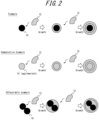
- FIG. 2 illustrates a schematic diagram (cross-section diagram) of growth processes in the granulation processes of green pellets.
- layering granulation may occur, in which the fine ore 12 and binder and the like adhere to the surface of the core ore 10 in layers.
- a powder agglomerate core 14 may be formed by the fine ore instead of the core ore, which is then covered by the fine ore so that granulation proceeds, but the binder is dispersed within the green pellet, resulting in a decrease in strength.
- a green pellet contains more than one core ore particle, a layer of the fine ore needs to encapsulate several core ore particles at once during the growth process, and the particles grow so rapidly that the layer to be covered does not have enough time to become dense, resulting in lower strength than when there is only one core ore particle.
- the particle size and mass fraction of the core ore are preferably set so that the number of particles of the core ore contained per iron ore pellet is on average 0.9 to 1.0.
- the weight fraction G of the core ore may be calculated as follows The weight fraction G of the core ore in the green pellets is considered to be equivalent to the effective volume fraction (the volume ratio excluding the pore portion in the agglomerate of the fine ore) of the core ore in the green pellets.
- the weight fraction G can be expressed as in Expression (1) below.
- G T / 1 ⁇ T * 1 ⁇ K + T
- (1 - T) * (1 - K) is the volume ratio of the agglomerate of the fine ore in the green pellets, excluding the pore portion.
- the green pellets can be made to contain one core ore particle on average.
- the porosity K of the green pellets is typically determined by ground particle size of the fine ore and, for example, 0.33 may be adopted.
- Bentonite is a preferred binder for use in granulation, but any known or optional binder may be used, including organic and inorganic binders that provide similar effects.
- limestone, dolomite, and the like may be mixed in as an auxiliary material in the mixing process.
- various reductants and additives may be added as auxiliary materials, depending on the type of furnace used for reduction processing after firing. Specifically, carbon materials such as coal or coke may be used as reductants.
- the amount of binder in the mixture preferably satisfies the following expression, when W1 is the mass of the fine ore and W2 is the mass of the binder. W 2 / W 1 ⁇ 100 ⁇ 1.0
- the amount of binder is suitable relative to the amount of the fine ore, the effect of the binder can be suitably obtained, and strength can be secured.
- the above range is more preferably 1.4 or more.
- the above range is even more preferably 1.6 or more. The greater the amount of binder, the more easily pellet strength is secured, but the purity of the reduced iron is decreased, and therefore a range of 3.0 or less is preferred.
- Iron ore pellets are produced by typical grinding, mixing, granulation, and firing processes.
- the grinding process may be carried out using a typical ball mill or other grinding machine, and is only carried out on iron ore to be used as the fine ore.
- the mixing process may be carried out using a typical concrete mixer or the like.
- the granulation process may be carried out using a typical pelletizer, drum mixer, or the like.
- the firing process may be carried out using a typical shaft furnace, rotary kiln, or the like.
- a granulated green pellet preferably has a size of about 9.5 mm to 12 mm.
- the size of the green pellets is less than 9.5 mm, the gas permeability degrades when filled into a blast furnace as fired pellets.
- the size of the green pellets exceeds 12 mm, reducibility decreases.
- the fine ore was iron ore that passed entirely through the sieve having a mesh size of 1.0 mm, that is, iron ore having a particle size of 1 mm or less.
- the Blaine number of the fine ore was 2560 cm 2 /g. [Table 1] Table 1 (mass%) T.Fe SiO 2 Al 2 O 3 CaO MgO LOI 61.5 3.7 2.2 0.07 0.09 5.4
- the core ore and the fine ore were prepared in the mass fractions listed in Table 2 for a total of 5000 g, and mixed together with bentonite in a defined ratio for 3 min at 20 rpm using a concrete mixer.
- the amount (mass%) of bentonite added to the total iron ore (sum of the core ore and the fine ore) is listed in Table 2 in the "Bentonite fraction" column.
- the mixed materials were placed in a 1.2 m diameter pelletizer and granulation was carried out while adding water. Pellet particles of 9.5 mm to 12 mm were collected and rolled in a pelletizer for another 10 min to obtain green pellets.
- the mix proportion of the core ore and the fine ore was adjusted so that the number of core ore particles in one green pellet averaged 1.0.
- the volume fraction of the core ore to the green pellets and the number of core ore particles per green pellet are listed in Table 2. Porosity was 33 %.
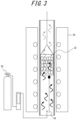
- FIG. 3 is a schematic illustration of the electric furnace used for these examples.
- a green pellet filling basket 32 filled with 200 g of green pellets was placed in an electric furnace 30, and hot blast (air) at 200 °C (measured by a thermocouple 34) at a flow rate of 1.2 m/s was flowed from a heating gas supply 36 and held for 10 min. After the holding, samples were removed and checked for bursting. When no bursting was observed, the hot blast temperature was increased by a 40 °C increment, a new sample was placed in the furnace, and the same test was repeated. The temperature at which a sample was observed to burst was taken as the bursting temperature, and the results are listed in Table 2.
- the present disclosure provides a method of producing iron ore pellets that produces green pellets that have high strength and can suppress bursting.
Landscapes
- Chemical & Material Sciences (AREA)
- Engineering & Computer Science (AREA)
- Manufacturing & Machinery (AREA)
- Geochemistry & Mineralogy (AREA)
- Geology (AREA)
- General Life Sciences & Earth Sciences (AREA)
- Life Sciences & Earth Sciences (AREA)
- Environmental & Geological Engineering (AREA)
- Materials Engineering (AREA)
- Mechanical Engineering (AREA)
- Metallurgy (AREA)
- Organic Chemistry (AREA)
- Inorganic Chemistry (AREA)
- Manufacture And Refinement Of Metals (AREA)
Abstract
Description
- The present disclosure relates to a method of producing iron ore pellets.
- Iron ore pellets are made from iron ore powder granulated to have properties (such as size, strength, and reducibility) suitable for feeding into a blast furnace or solid reduction furnace. For example, as described in Patent Literature (PTL) 1, iron ore pellets are typically produced by the processes of grinding iron ore material to obtain fine ore, mixing the fine ore with a binder and optional auxiliary material to obtain a mixture, granulating the mixture to obtain green pellets, and firing the green pellets to obtain iron ore pellets. Hereinafter, pellets before firing in granulated form are referred to as "green pellets".
- In the production of iron ore pellets, securing the strength of green pellets is important in order to suppress pulverization of the green pellets during handling before being put into the kiln and to suppress adherence of resulting powder to the kiln. Further, suppressing bursting of the green pellets is important to secure the strength of the iron ore pellets after firing. Bursting is a phenomenon in which green pellets burst due to the pressure of vapor generated from inside the green pellets during drying and when water of crystallization is removed. Bursting causes cracks in the green pellets, which significantly decreases the strength of the iron ore pellets after firing. In particular, when the particle size of the ground fine ore is decreased to secure the strength of the green pellets, the green pellets become denser and are more prone to bursting. That is, it has been difficult to both secure the strength of the green pellets and suppress bursting.
- PTL 1:
JP 2022-034210 A - In order to secure the strength of green pellets or to suppress bursting of green pellets, bentonite or various organic or inorganic binders have been added as a binder. However, there was room for improvement in terms of securing the strength of green pellets and suppressing bursting.
- In view of the technical problems described above, it would be helpful to provide a method of producing iron ore pellets that can obtain green pellets having high strength that can suppress bursting.
- The inventors have conducted extensive studies and have discovered that by using iron ore having a particle size of 1 mm or less, obtained by grinding iron ore material, as well as iron ore having a particle size of more than 1 mm, obtained without grinding iron ore material, and by mixing and granulating the iron ore to produce green pellets, it is possible to secure drop strength of green pellets and suppress bursting.
- The present disclosure was completed based on these discoveries, and primary features of the present disclosure are described below.
- [1] A method of producing iron ore pellets, the method comprising:
- a process of mixing iron ore having a total Fe content of 63 mass% or less and a binder to obtain a mixture;
- a process of granulating the mixture to obtain green pellets; and
- a process of firing the green pellets to obtain iron ore pellets, wherein,
- the iron ore comprises core ore having a particle size of more than 1 mm and fine ore having a particle size of 1 mm or less.
- [2] The method of producing iron ore pellets according to [1], above, wherein the mass fraction of the core ore is 15 mass% or more of the iron ore.
- [3] The method of producing iron ore pellets according to [2], above, wherein the mass fraction of particles having a particle size of more than 2.8 mm in the core ore is 15 mass% or more of the iron ore.
- [4] The method of producing iron ore pellets according to [2], above, wherein the mass fraction of particles having a particle size of more than 2.8 mm in the core ore is 30 mass% or more of the iron ore.
- [5] The method of producing iron ore pellets according to [1], above, wherein the mass fraction of particles having a particle size of more than 4.8 mm in the core ore is 10 mass% or more of the iron ore.
- [6] The method of producing iron ore pellets according to [5], above, wherein the mass fraction of particles having a particle size of more than 4.8 mm in the core ore is 25 mass% or more of the iron ore.
- [7] The method of producing iron ore pellets according to any one of [1] to [6], above, wherein the particle size and mass fraction of the core ore are set so that the number of particles of the core ore contained per iron ore pellet is on average 0.9 to 1.0.
- [8] The method of producing iron ore pellets according to any one of [1] to [7], above, wherein the iron ore material is sieved through a sieve having a 1 mm mesh size, the iron ore material that does not pass through the sieve is used as the core ore, and the iron ore material that passes through the sieve is ground and used as the fine ore.
- [9] The method of producing iron ore pellets according to any one of [1] to [8], above, wherein, in the mixture, when W1 is the mass of the fine ore and W2 is the mass of the binder, W2/W1 × 100 is 1.0 or more.
- [10] The method of producing iron ore pellets according to any one of [1] to [9], above, wherein the binder is bentonite.
- According to the method of producing iron ore pellets, green pellets are obtainable that have high strength and can suppress bursting.
- In the accompanying drawings:
-
FIG. 1 is a diagram schematically illustrating a cross-section of iron ore pellets obtained according to an embodiment of the present disclosure; -
FIG. 2 is a diagram schematically illustrating growth processes of green pellets in granulation processes according to an embodiment of the present disclosure and comparative examples; and -
FIG. 3 is a diagram schematically illustrating an electric furnace used for bursting temperature measurement. - The following describes an embodiment of the method of producing iron ore pellets. The embodiment described below is an example embodiment of the present disclosure, and does not limit configuration to the specific example described.
- The method of producing iron ore pellets according to an embodiment of the present disclosure includes: a process of mixing iron ore having a total Fe content of 63 mass% or less and a binder to obtain a mixture; a process of granulating the mixture to obtain green pellets; and a process of firing the green pellets to obtain iron ore pellets. The iron ore for obtaining the mixture includes core ore having a particle size of more than 1 mm and fine ore having a particle size of 1 mm or less.
- Hereinafter, iron ore particles obtained without grinding the iron ore material and having a particle size of more than 1 mm are referred to as "core ore" and iron ore particles obtained by grinding the iron ore material and having a particle size of 1 mm or less are referred to as "fine ore".
- According to the present embodiment, core ore is used in addition to fine ore as the iron ore of green pellets. The green pellets contain high-strength core ore, thereby securing strength of the green pellets. Further, compared to conventional technology, where the iron ore of the green pellets consists only of fine ore, the green pellets according to the present embodiment contain core ore having a large particle size, which decreases the rate of drying and water of crystallization removal. The inclusion of core ore decreases the porosity of the green pellets, and denser green pellets are less likely to carry moisture. Further, fewer gas paths means vapor is less likely to be generated from inside the green pellets. As a result, bursting can be sufficiently suppressed.
- In the present disclosure, iron ore "particle size" corresponds to the nominal mesh size of a sieve mesh in accordance with Japanese Industrial Standard JIS Z 8801:2019. That is, iron ore having a particle size greater than X mm is iron ore that remains above when sieved through a sieve having a nominal mesh size of X mm. Iron ore having a particle size of Y mm or less is iron ore that passes through and falls under a sieve when sieved through the sieve having a nominal mesh size of Y mm.
- The type and properties of the core ore are not particularly limited as long as the core ore is an iron ore having a total Fe content of 63 mass% or less and a particle size greater than 1 mm. Further, the core ore preferably has a particle size of 9.5 mm or less. When the particle size is 9.5 mm or less, the completed iron ore pellets are of a suitable size, and subsequent reduction processing and the like may be performed uniformly.
- The mass fraction of the core ore is preferably 15 mass% or more of the total iron ore. This is because the more core ore, which has a larger volume than ordinary ground iron ore powder, the more effective even a small amount of binder such as bentonite can be, and strength enhancement and bursting suppression effects can be suitably obtained.
- Similarly, from the viewpoint of more fully obtaining the effects of the present disclosure, more preferably, the mass fraction of particles having a particle size of more than 2.8 mm in the core ore is 15 mass% or more of the total iron ore. Even more preferably, the mass fraction of particles having a particle size of more than 2.8 mm in the core ore is 30 mass% or more of the total iron ore. In such a case, the mass fraction of the core ore having a particle size of more than 1 mm and 2.8 mm or less is not particularly restricted and may be 0 mass%.
- Similarly, from the viewpoint of more fully obtaining the effects of the present disclosure, preferably, the mass fraction of particles having a particle size of more than 4.8 mm in the core ore is 10 mass% or more of the total iron ore. More preferably, the mass fraction of particles having a particle size of more than 4.8 mm in the core ore is 25 mass% or more of the total iron ore. In such a case, the mass fraction of the core ore having a particle size of more than 1 mm and 4.8 mm or less is not particularly restricted and may be 0 mass%.
- Further, the mass fraction of the core ore is preferably 99 mass% or less of the total iron ore. The mass fraction of the core ore is more preferably 75 mass% or less of the total iron ore. In typical iron ore material, the mass fraction of particles having a particle size greater than 1 mm is about 75 mass% at most.
- Fine ore is obtained by grinding iron ore using a typical ball mill or the like. The average particle size of the fine ore is preferably some tens of micrometers. The Blaine number of the fine ore is preferably about 2000 cm2/g to 4000 cm2/g. The Blaine number of the fire ore is more preferably about 2500 cm2/g to 3500 cm2/g. When the Blaine number is 2000 cm2/g or more, efficiency of milling is more favorable. When the Blaine number is 4000 cm2/g or less, shrinkage caused by sintering during firing is suppressed and strength is more suitable. The Blaine number is measured by a Blaine air permeability apparatus as specified in JIS R 5201:2015 and represents the specific surface area of powder. In the pellet production process, the Blaine number is used as a control index for ore particle size, with higher values indicating finer powders.
- There is no particular method specified for the production of the core ore and the fine ore. The iron ore mesh size is preferably sieved through a sieve having a 1 mm mesh size, the iron ore material that does not pass through the sieve being used as the core ore, and the iron ore material that passes through the sieve being ground and used as the fine ore. Alternatively, each may be prepared separately from iron ore material.
- As illustrated in
FIG. 1 , each of the iron ore pellets obtained according to the present embodiment preferably includes onecore ore 10, withfine ore 12 adhering to the surface of thecore ore 10. The same is preferably true at the green pellet stage. Suitable strength is obtainable when the green pellets and the iron ore pellets each contain one core ore particle. - The inventors think that a reason for the high strength of the green pellets and the iron ore pellets each including a single core ore particle may be as follows.
FIG. 2 illustrates a schematic diagram (cross-section diagram) of growth processes in the granulation processes of green pellets. When the number of core ore particles in one pellet is one, as in the present disclosure, layering granulation may occur, in which thefine ore 12 and binder and the like adhere to the surface of thecore ore 10 in layers. When a green pellets does not contain a core ore particle, apowder agglomerate core 14 may be formed by the fine ore instead of the core ore, which is then covered by the fine ore so that granulation proceeds, but the binder is dispersed within the green pellet, resulting in a decrease in strength. When a green pellet contains more than one core ore particle, a layer of the fine ore needs to encapsulate several core ore particles at once during the growth process, and the particles grow so rapidly that the layer to be covered does not have enough time to become dense, resulting in lower strength than when there is only one core ore particle. - Therefore, according to the present embodiment, the particle size and mass fraction of the core ore are preferably set so that the number of particles of the core ore contained per iron ore pellet is on average 0.9 to 1.0. From the size of the core ore and the green pellets, the weight fraction G of the core ore may be calculated as follows The weight fraction G of the core ore in the green pellets is considered to be equivalent to the effective volume fraction (the volume ratio excluding the pore portion in the agglomerate of the fine ore) of the core ore in the green pellets. When T is the volume ratio of the core ore to the volume of the green pellets (the "bulk volume" of the pellets, including the pores of the agglomerate portion of the fine ore) and K is the porosity of the agglomerate of the fine ore, the weight fraction G can be expressed as in Expression (1) below.

- Here, "(1 - T) * (1 - K)" is the volume ratio of the agglomerate of the fine ore in the green pellets, excluding the pore portion. By adjusting the weight fraction of the core ore and the particle size of the core ore to satisfy Expression (1), the green pellets can be made to contain one core ore particle on average. The porosity K of the green pellets is typically determined by ground particle size of the fine ore and, for example, 0.33 may be adopted.
- Bentonite is a preferred binder for use in granulation, but any known or optional binder may be used, including organic and inorganic binders that provide similar effects. Further, in addition to the iron ore and the binder, limestone, dolomite, and the like may be mixed in as an auxiliary material in the mixing process. Further, various reductants and additives may be added as auxiliary materials, depending on the type of furnace used for reduction processing after firing. Specifically, carbon materials such as coal or coke may be used as reductants.
- The amount of binder in the mixture preferably satisfies the following expression, when W1 is the mass of the fine ore and W2 is the mass of the binder.

- Within the above range, the amount of binder is suitable relative to the amount of the fine ore, the effect of the binder can be suitably obtained, and strength can be secured. The above range is more preferably 1.4 or more. The above range is even more preferably 1.6 or more. The greater the amount of binder, the more easily pellet strength is secured, but the purity of the reduced iron is decreased, and therefore a range of 3.0 or less is preferred.
- Iron ore pellets are produced by typical grinding, mixing, granulation, and firing processes. The grinding process may be carried out using a typical ball mill or other grinding machine, and is only carried out on iron ore to be used as the fine ore. The mixing process may be carried out using a typical concrete mixer or the like. The granulation process may be carried out using a typical pelletizer, drum mixer, or the like. The firing process may be carried out using a typical shaft furnace, rotary kiln, or the like.
- A granulated green pellet preferably has a size of about 9.5 mm to 12 mm. When the size of the green pellets is less than 9.5 mm, the gas permeability degrades when filled into a blast furnace as fired pellets. When the size of the green pellets exceeds 12 mm, reducibility decreases.
- After drying iron ore at 105 °C for 24 h, sieving was carried out using a rotating oscillation and tapping sieve shaker having mesh sizes of 1.0 mm, 2.8 mm, 4.8 mm, 6.7 mm, 8.0 mm, and 9.5 mm, and the iron ore that did not pass through these sieves was used as the core ore. Table 1 lists the composition of the iron ore used as raw material. T.Fe is the total iron content in the iron ore, and LOI (loss on ignition) is the ignition loss at the time of measurement. Iron ore having the same composition as described above was also dried at 105 °C for 24 h then ground in a ball mill to obtain iron ore powder that was used as the fine ore. The fine ore was iron ore that passed entirely through the sieve having a mesh size of 1.0 mm, that is, iron ore having a particle size of 1 mm or less. The Blaine number of the fine ore was 2560 cm2/g.
[Table 1] Table 1 (mass%) T.Fe SiO2 Al2O3 CaO MgO LOI 61.5 3.7 2.2 0.07 0.09 5.4 - The core ore and the fine ore were prepared in the mass fractions listed in Table 2 for a total of 5000 g, and mixed together with bentonite in a defined ratio for 3 min at 20 rpm using a concrete mixer. The amount (mass%) of bentonite added to the total iron ore (sum of the core ore and the fine ore) is listed in Table 2 in the "Bentonite fraction" column. Next, the mixed materials were placed in a 1.2 m diameter pelletizer and granulation was carried out while adding water. Pellet particles of 9.5 mm to 12 mm were collected and rolled in a pelletizer for another 10 min to obtain green pellets. According to the Examples within the scope of the present disclosure, the mix proportion of the core ore and the fine ore was adjusted so that the number of core ore particles in one green pellet averaged 1.0. The volume fraction of the core ore to the green pellets and the number of core ore particles per green pellet are listed in Table 2. Porosity was 33 %.
-
Table 2 No. Particle size fraction of iron ore (mass%) Fine ore fraction >1 mm fraction >2.8 mm fraction >4.8 mm fraction Core ore size Pellet size Core ore no. Bentonite fraction W2 / W1 × 100 Drop strength Bursting temp. Remarks 1 mm or less (fine ore) 1 mm to 2.8 mm 2.8 mm to 4.8 mm 4.8 mm to 8.0 mm 6.7 mm to 8.0 mm 8.0 mm to 9.5 mm mass% mass% mass% mass% mm mm Particles mass% % Times °C 1 100.0 0.0 0.0 0.0 0.0 0.0 100.0 0.0 0.0 0.0 0.0 10.8 0.0 1.0 1.0 5.1 280 Comparative Example 2 99.2 0.8 0.0 0.0 0.0 0.0 99.2 0.8 0.0 0.0 1.9 10.8 1.0 1.0 1.0 5.4 280 Example 3 93.5 0.0 6.5 0.0 0.0 0.0 93.5 6.5 6.5 0.0 3.8 10.8 1.0 1.0 1.1 5.8 280 Example 4 71.5 0.0 0.0 28.5 - 0.0 71.5 28.5 28.5 28.5 6.4 10.8 1.0 1.0 1.4 6.4 280 Example 5 58.8 0.0 0.0 0.0 41.2 0.0 58.8 41.2 41.2 41.2 7.4 10.8 1.0 1.0 1.7 7.8 320 Example 6 36.4 0.0 0.0 0.0 0.0 63.6 36.4 63.6 63.6 63.6 8.8 10.8 1.0 1.0 2.7 9.6 320 Example 7 100.0 0.0 0.0 0.0 0.0 0.0 100.0 0.0 0.0 0.0 0.0 10.8 0.0 0.8 0.8 4.0 240 Comparative Example 8 99.2 0.8 0.0 0.0 0.0 0.0 99.2 0.8 0.0 0.0 1.9 10.8 1.0 0.8 0.8 5.4 240 Example 9 93.5 0.0 6.5 0.0 0.0 0.0 93.5 6.5 6.5 0.0 3.8 10.8 1.0 0.8 0.9 4.7 240 Example 10 71.5 0.0 0.0 28.5 - 0.0 71.5 28.5 28.5 28.5 6.4 10.8 1.0 0.8 1.1 6.4 280 Example 11 58.8 0.0 0.0 0.0 41.2 0.0 58.8 41.2 41.2 41.2 7.4 10.8 1.0 0.8 1.4 7.7 280 Example 12 36.4 0.0 0.0 0.0 0.0 63.6 36.4 63.6 63.6 63.6 8.8 10.8 1.0 0.8 2.2 9.0 320 Example 13 100.0 0.0 0.0 0.0 0.0 0.0 100.0 0.0 0.0 0.0 0.0 10.8 0.0 0.6 0.6 2.5 200 Comparative Example 14 99.2 0.8 0.0 0.0 0.0 0.0 99.2 0.8 0.0 0.0 1.9 10.8 1.0 0.6 0.6 3.8 200 Example 15 93.5 0.0 6.5 0.0 0.0 0.0 93.5 6.5 6.5 0.0 3.8 10.8 1.0 0.6 0.6 3.5 200 Example 16 71.5 0.0 0.0 28.5 - 0.0 71.5 28.5 28.5 28.5 6.4 10.8 1.0 0.6 0.8 4.9 240 Example 17 58.8 0.0 0.0 0.0 41.2 0.0 58.8 41.2 41.2 41.2 7.4 10.8 1.0 0.6 1.0 5.7 280 Example 18 36.4 0.0 0.0 0.0 0.0 63.6 36.4 63.6 63.6 63.6 8.8 10.8 1.0 0.6 1.6 7.7 280 Example 19 82.5 0.0 3.2 14.3 - 0.0 82.5 17.5 17.5 14.3 3.8 6.4 10.8 1.0 0.6 0.7 5.2 240 Example 20 53.9 0.0 0.0 14.3 - 31.8 53.9 46.1 46.1 46.1 6.4 8.8 10.8 1.0 0.6 1.1 6.7 280 Example - For each of the Examples and Comparative Examples, drop strength measurements were carried out on ten green pellets, simulating conveyance, charging, and the like in actual operations. The process of dropping each of the green pellets from a height of 50 cm was repeated, and the process was terminated when a crack or fracture was observed in the green pellet. The number of times before termination (that is, the time when cracking or fracture was observed) was used as the drop strength, and the average drop strength of the ten particles is listed in Table 2.
- For each of the Examples and Comparative Examples, the temperature at which the green pellets burst in a furnace (hereinafter also referred to as bursting temperature) was measured.
FIG. 3 is a schematic illustration of the electric furnace used for these examples. A greenpellet filling basket 32 filled with 200 g of green pellets was placed in anelectric furnace 30, and hot blast (air) at 200 °C (measured by a thermocouple 34) at a flow rate of 1.2 m/s was flowed from aheating gas supply 36 and held for 10 min. After the holding, samples were removed and checked for bursting. When no bursting was observed, the hot blast temperature was increased by a 40 °C increment, a new sample was placed in the furnace, and the same test was repeated. The temperature at which a sample was observed to burst was taken as the bursting temperature, and the results are listed in Table 2. - Referring to Table 2, comparing the Examples with the Comparative Examples having the same bentonite fraction, it can be confirmed that the Examples including the core ore have higher drop strength and higher bursting temperature, which clearly demonstrates the effects of the present disclosure. Further, it can be observed that an increased ratio of large particle size core ore and an increased bentonite fraction improved the strength and bursting temperature, and are therefore more suitable production conditions.
- The present disclosure provides a method of producing iron ore pellets that produces green pellets that have high strength and can suppress bursting.
-
- 10
- core ore having particle size exceeding 1 mm
- 12
- fine ore having
particle size 1 mm or less - 14
- core of agglomerates of fine ore having
particle size 1 mm or less - 30
- electric furnace
- 32
- green pellet filling basket
- 34
- thermocouple
- 36
- heating gas supply
Claims (10)
- A method of producing iron ore pellets, the method comprising:a process of mixing iron ore having a total Fe content of 63 mass% or less and a binder to obtain a mixture;a process of granulating the mixture to obtain green pellets; anda process of firing the green pellets to obtain iron ore pellets,wherein,the iron ore comprises core ore having a particle size of more than 1 mm and fine ore having a particle size of 1 mm or less.
- The method of producing iron ore pellets according to claim 1, wherein the mass fraction of the core ore is 15 mass% or more of the iron ore.
- The method of producing iron ore pellets according to claim 2, wherein the mass fraction of particles having a particle size of more than 2.8 mm in the core ore is 15 mass% or more of the iron ore.
- The method of producing iron ore pellets according to claim 2, wherein the mass fraction of particles having a particle size of more than 2.8 mm in the core ore is 30 mass% or more of the iron ore.
- The method of producing iron ore pellets according to claim 1, wherein the mass fraction of particles having a particle size of more than 4.8 mm in the core ore is 10 mass% or more of the iron ore.
- The method of producing iron ore pellets according to claim 5, wherein the mass fraction of particles having a particle size of more than 4.8 mm in the core ore is 25 mass% or more of the iron ore.
- The method of producing iron ore pellets according to any one of claims 1 to 6, wherein the particle size and mass fraction of the core ore are set so that the number of particles of the core ore contained per iron ore pellet is on average 0.9 to 1.0.
- The method of producing iron ore pellets according to any one of claims 1 to 7, wherein the iron ore material is sieved through a sieve having a 1 mm mesh size, the iron ore material that does not pass through the sieve is used as the core ore, and the iron ore material that passes through the sieve is ground and used as the fine ore.
- The method of producing iron ore pellets according to any one of claims 1 to 8, wherein, in the mixture, when W1 is the mass of the fine ore and W2 is the mass of the binder, W2/W1 × 100 is 1.0 or more.
- The method of producing iron ore pellets according to any one of claims 1 to 9, wherein the binder is bentonite.
Applications Claiming Priority (2)
| Application Number | Priority Date | Filing Date | Title |
|---|---|---|---|
| JP2022148507 | 2022-09-16 | ||
| PCT/JP2023/025629 WO2024057693A1 (en) | 2022-09-16 | 2023-07-11 | Method for producing iron ore pellet |
Publications (2)
| Publication Number | Publication Date |
|---|---|
| EP4575021A1 true EP4575021A1 (en) | 2025-06-25 |
| EP4575021A4 EP4575021A4 (en) | 2025-07-02 |
Family
ID=90274602
Family Applications (1)
| Application Number | Title | Priority Date | Filing Date |
|---|---|---|---|
| EP23865055.0A Pending EP4575021A4 (en) | 2022-09-16 | 2023-07-11 | PROCESS FOR PRODUCING IRON ORE PELLETS |
Country Status (7)
| Country | Link |
|---|---|
| US (1) | US20260085376A1 (en) |
| EP (1) | EP4575021A4 (en) |
| JP (1) | JP7831577B2 (en) |
| CN (1) | CN119855926A (en) |
| AU (1) | AU2023341034A1 (en) |
| CA (1) | CA3262919A1 (en) |
| WO (1) | WO2024057693A1 (en) |
Family Cites Families (13)
| Publication number | Priority date | Publication date | Assignee | Title |
|---|---|---|---|---|
| JPS54117301A (en) * | 1978-03-03 | 1979-09-12 | Kobe Steel Ltd | Coarse particles-containing self-fluxing ore pellets |
| JPS57200529A (en) * | 1981-06-02 | 1982-12-08 | Nippon Steel Corp | Preparation of sintered ore having iron ore fine powder highly compounded therein |
| JPS6237325A (en) * | 1985-06-27 | 1987-02-18 | Nippon Kokan Kk <Nkk> | Calcined lump ore and its production |
| JPS63149336A (en) * | 1986-12-15 | 1988-06-22 | Nkk Corp | Production of burnt agglomerated ore |
| JPS63219534A (en) * | 1987-03-09 | 1988-09-13 | Kobe Steel Ltd | Manufacture of self-fluxing pellet |
| JP2001181745A (en) * | 1999-12-27 | 2001-07-03 | Kobe Steel Ltd | METHOD FOR PRODUCING IRON ORE AGGLOMERATE USING WASTE SOLUTION AFTER WATER IMMERSING TREATMENT OF Na- CONTAINING SLAG |
| JP4154914B2 (en) * | 2002-04-04 | 2008-09-24 | Jfeスチール株式会社 | Method for producing sintered ore for blast furnace |
| TWI280985B (en) * | 2002-08-21 | 2007-05-11 | Nippon Steel Corp | Method of granulating sintering material for iron manufacturing |
| JP4518895B2 (en) * | 2004-09-29 | 2010-08-04 | 新日本製鐵株式会社 | Raw material evaluation method and blending design method |
| JP5098248B2 (en) * | 2006-08-03 | 2012-12-12 | 新日鐵住金株式会社 | Granulation method of iron-containing dust collection dusts for iron making |
| JP5000366B2 (en) * | 2007-04-12 | 2012-08-15 | 新日本製鐵株式会社 | Method for producing sintered ore |
| JP2016176130A (en) * | 2015-03-20 | 2016-10-06 | 株式会社神戸製鋼所 | Raw pellet for manufacturing iron ore calcinated pellet and method for manufacturing iron ore calcinated pellet |
| JP7440768B2 (en) * | 2020-08-18 | 2024-02-29 | 日本製鉄株式会社 | Blast furnace fired pellets and method for producing blast furnace fired pellets |
-
2023
- 2023-07-11 EP EP23865055.0A patent/EP4575021A4/en active Pending
- 2023-07-11 US US19/106,634 patent/US20260085376A1/en active Pending
- 2023-07-11 CN CN202380065660.5A patent/CN119855926A/en active Pending
- 2023-07-11 WO PCT/JP2023/025629 patent/WO2024057693A1/en not_active Ceased
- 2023-07-11 CA CA3262919A patent/CA3262919A1/en active Pending
- 2023-07-11 AU AU2023341034A patent/AU2023341034A1/en active Pending
- 2023-07-11 JP JP2024504887A patent/JP7831577B2/en active Active
Also Published As
| Publication number | Publication date |
|---|---|
| WO2024057693A1 (en) | 2024-03-21 |
| JPWO2024057693A1 (en) | 2024-03-21 |
| EP4575021A4 (en) | 2025-07-02 |
| AU2023341034A1 (en) | 2025-02-13 |
| JP7831577B2 (en) | 2026-03-17 |
| CA3262919A1 (en) | 2025-06-09 |
| US20260085376A1 (en) | 2026-03-26 |
| CN119855926A (en) | 2025-04-18 |
Similar Documents
| Publication | Publication Date | Title |
|---|---|---|
| JP5375742B2 (en) | Granulation method of sintering raw material | |
| US9175363B2 (en) | Method for producing an agglomerate made of fine material containing metal oxide for use as a blast furnace feed material | |
| CA1149617A (en) | Porous iron ore pellets and process for manufacturing same | |
| CN110462070B (en) | Method for producing granulated sintering material and method for producing sintered ore | |
| JP2003129139A (en) | Pretreatment method for sintering raw materials | |
| US20260085376A1 (en) | Method of producing iron ore pellets | |
| CN110527826B (en) | A sintering method for inhibiting the formation of perovskite during sintering | |
| JP2004137575A (en) | Production method for sintered ore | |
| JP2000256756A (en) | Method for granulating sintering raw material | |
| JP2008189994A (en) | Method for producing granulated and sintered raw materials | |
| JP7188126B2 (en) | Method for manufacturing carbon-containing non-fired pellets for blast furnace | |
| JP2004204332A (en) | Method for manufacturing raw materials for sintering | |
| JP7110830B2 (en) | Granulation method of mixed raw materials | |
| JP3888981B2 (en) | Method for producing sintered ore | |
| JPH05339652A (en) | Pre-granulation method and its pseudo-grain structure for the production of sinter using pisolite ore as the main raw material | |
| EP4549601A1 (en) | Non-fired pellets for reduction, and method for manufacturing same | |
| CN114836616B (en) | Iron ore powder pellets and preparation method thereof | |
| JP2003306723A (en) | Method for producing sintered ore for blast furnace | |
| EP4556584A1 (en) | Non-fired pellets for reduction, and method for manufacturing same | |
| JP4356929B2 (en) | Method for producing sintered ore | |
| EP4575020A1 (en) | Iron ore pellet production method | |
| JPH05339653A (en) | Pretreatment of sintered ore raw material and sintered ore raw material for iron making | |
| JPH05339654A (en) | Pretreatment of sintered ore raw material and sintered ore raw material for iron making | |
| JP6885386B2 (en) | Manufacturing method of carbon material interior particles and manufacturing method of carbon material interior sintered ore | |
| EP4575004A1 (en) | Reduced iron production method |
Legal Events
| Date | Code | Title | Description |
|---|---|---|---|
| STAA | Information on the status of an ep patent application or granted ep patent |
Free format text: STATUS: THE INTERNATIONAL PUBLICATION HAS BEEN MADE |
|
| PUAI | Public reference made under article 153(3) epc to a published international application that has entered the european phase |
Free format text: ORIGINAL CODE: 0009012 |
|
| STAA | Information on the status of an ep patent application or granted ep patent |
Free format text: STATUS: REQUEST FOR EXAMINATION WAS MADE |
|
| 17P | Request for examination filed |
Effective date: 20250318 |
|
| AK | Designated contracting states |
Kind code of ref document: A1 Designated state(s): AL AT BE BG CH CY CZ DE DK EE ES FI FR GB GR HR HU IE IS IT LI LT LU LV MC ME MK MT NL NO PL PT RO RS SE SI SK SM TR |
|
| A4 | Supplementary search report drawn up and despatched |
Effective date: 20250602 |
|
| RIC1 | Information provided on ipc code assigned before grant |
Ipc: C22B 1/24 20060101ALI20250526BHEP Ipc: C22B 1/14 20060101ALI20250526BHEP Ipc: C22B 1/16 20060101ALI20250526BHEP Ipc: C22B 1/242 20060101AFI20250526BHEP |
|
| DAV | Request for validation of the european patent (deleted) | ||
| DAX | Request for extension of the european patent (deleted) |