EP4574299A1 - Wickelmaschine und herstellungsverfahren für schraubenfedern - Google Patents
Wickelmaschine und herstellungsverfahren für schraubenfedern Download PDFInfo
- Publication number
- EP4574299A1 EP4574299A1 EP23854707.9A EP23854707A EP4574299A1 EP 4574299 A1 EP4574299 A1 EP 4574299A1 EP 23854707 A EP23854707 A EP 23854707A EP 4574299 A1 EP4574299 A1 EP 4574299A1
- Authority
- EP
- European Patent Office
- Prior art keywords
- wire
- laser light
- equal
- irradiation
- coil spring
- Prior art date
- Legal status (The legal status is an assumption and is not a legal conclusion. Google has not performed a legal analysis and makes no representation as to the accuracy of the status listed.)
- Pending
Links
Images





Classifications
-
- B—PERFORMING OPERATIONS; TRANSPORTING
- B21—MECHANICAL METAL-WORKING WITHOUT ESSENTIALLY REMOVING MATERIAL; PUNCHING METAL
- B21F—WORKING OR PROCESSING OF METAL WIRE
- B21F3/00—Coiling wire into particular forms
- B21F3/02—Coiling wire into particular forms helically
-
- B—PERFORMING OPERATIONS; TRANSPORTING
- B21—MECHANICAL METAL-WORKING WITHOUT ESSENTIALLY REMOVING MATERIAL; PUNCHING METAL
- B21F—WORKING OR PROCESSING OF METAL WIRE
- B21F35/00—Making springs from wire
-
- B—PERFORMING OPERATIONS; TRANSPORTING
- B21—MECHANICAL METAL-WORKING WITHOUT ESSENTIALLY REMOVING MATERIAL; PUNCHING METAL
- B21F—WORKING OR PROCESSING OF METAL WIRE
- B21F11/00—Cutting wire
- B21F11/005—Cutting wire springs
-
- B—PERFORMING OPERATIONS; TRANSPORTING
- B21—MECHANICAL METAL-WORKING WITHOUT ESSENTIALLY REMOVING MATERIAL; PUNCHING METAL
- B21F—WORKING OR PROCESSING OF METAL WIRE
- B21F3/00—Coiling wire into particular forms
- B21F3/02—Coiling wire into particular forms helically
- B21F3/04—Coiling wire into particular forms helically externally on a mandrel or the like
-
- B—PERFORMING OPERATIONS; TRANSPORTING
- B23—MACHINE TOOLS; METAL-WORKING NOT OTHERWISE PROVIDED FOR
- B23K—SOLDERING OR UNSOLDERING; WELDING; CLADDING OR PLATING BY SOLDERING OR WELDING; CUTTING BY APPLYING HEAT LOCALLY, e.g. FLAME CUTTING; WORKING BY LASER BEAM
- B23K26/00—Working by laser beam, e.g. welding, cutting or boring
- B23K26/352—Working by laser beam, e.g. welding, cutting or boring for surface treatment
-
- B—PERFORMING OPERATIONS; TRANSPORTING
- B23—MACHINE TOOLS; METAL-WORKING NOT OTHERWISE PROVIDED FOR
- B23K—SOLDERING OR UNSOLDERING; WELDING; CLADDING OR PLATING BY SOLDERING OR WELDING; CUTTING BY APPLYING HEAT LOCALLY, e.g. FLAME CUTTING; WORKING BY LASER BEAM
- B23K2101/00—Articles made by soldering, welding or cutting
- B23K2101/32—Wires
Definitions
- the present invention relates to a coiling machine for manufacturing a coil spring and a coil spring manufacturing method.
- the coil spring forming machine described in patent literature 1 As a device for manufacturing a coil spring, for example, the coil spring forming machine described in patent literature 1 is known. This coil spring forming machine calculates the position of the cut site based on the length of a wire formed into a helical shape in advance and cuts the wire in a state where the cut site is softened by high-frequency heating.
- the responsiveness of the heating of the cut site is not good.
- the members used for cutting may be affected by high-frequency heating.
- the responsiveness of high-frequency heating is not satisfactory, and the wire is coiled up in a state where the wire is partly heated. Therefore, it may be difficult to stabilize the formation accuracy of the spring.
- the spring manufacturing device of patent literature 2 requires high-power laser light which can cut a wire.
- sputter may occur because of irradiation with laser light, and further, laser light may be applied to each unit of the spring manufacturing device as well as the wire. Therefore, measures for these problems need to be taken.
- the applicant of the present application suggests the method of cutting a site of a wire heated by laser light by a cutting member such as a cutter as described in patent literature 3.
- a cutting member such as a cutter
- the wire can be easily cut, and further, a coil spring having a good cutting surface can be obtained.
- the method of cutting a site of a wire heated by laser light by a cutting member as described above has room for improvement in various ways.
- the irradiation conditions of laser light for the wire need to be appropriately determined such that the wire is heated to a temperature which is suitable for cutting and further the section of the cut wire has a good shape.
- One of the objects of the present invention is to provide a coiling machine and a coil sprig manufacturing method for enabling the improvement of the manufacturing efficiency of a coil spring and the manufacturing of a coil spring having a good shape.
- the coiling machine of the present invention comprises a laser heater configured to emit laser light to a wire formed into a helical shape, thereby heating a portion of the wire, and a cutting unit configured to cut a site of the wire heated by irradiation with the laser light.
- An output density of the laser light is greater than or equal to 10 W/mm 2 and less than or equal to 100 mm 2 .
- the coil spring manufacturing method of the present invention includes emitting laser light to a wire formed into a helical shape, thereby heating a portion of the wire, and cutting a site of the wire heated by irradiation with the laser light.
- An output density of the laser light is greater than or equal to 10 W/mm 2 and less than or equal to 100 W/mm 2 .
- the output density should be desirably greater than or equal to 31 W/mm 2 and less than or equal to 74 W/mm 2 .
- the output density is a value obtained by dividing an output of the laser light by an area of an irradiation area irradiated with the laser light on a surface of the wire when viewed in an irradiation direction of the laser light.
- the irradiation area is an area defined by a half width of an output distribution of the laser light on the surface of the wire.
- the irradiation area may have a shape which is elongated in a width direction of the wire.
- FIG. 1 is a schematic perspective view showing the main portions of a coiling machine 100 according to an embodiment.
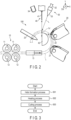
- FIG. 2 is a schematic front view of the coiling machine 100 shown in FIG. 1 .
- a feed direction X, a perpendicular direction Y, a formation direction Z and a circumferential direction D ⁇ are defined as shown in FIG. 1 and FIG. 2 .
- the feed direction X, the perpendicular direction Y and the formation direction Z are orthogonal to each other.
- the feed direction X is a direction in which a linear wire 1 before formation into a helical shape is fed.
- the formation direction Z is a direction in which a coil spring consisting of the wire 1 which is bent into a helical shape extends (a direction in which the spring develops).
- the circumferential direction D ⁇ is a direction in which the wire 1 constituting the coil spring is wound.
- the coiling machine 100 comprises a feed unit 10, a helix formation unit 20, a heating unit (laser heater 30), a cutting unit 40 and a control unit 50.
- the driving rollers 11 face the driven rollers 12, respectively, via the wire 1.
- a corresponding driven roller 12 rotates via the wire 1.
- the wire 1 interposed between the driving rollers 11 and the driven rollers 12 is fed in the feed direction X.
- the wire 1 is inserted into the wire guide 13.
- the wire guide 13 guides the wire 1 such that the wire 1 goes straight in the feed direction X, and guides the wire 1 to the helix formation unit 20.
- the first formation roller 21, the second formation roller 22 and the pitch tool 23 are provided in order in the circumferential direction D ⁇ .
- the positions of the first formation roller 21, the second formation roller 22 and the pitch tool 23 in the formation direction Z are different from each other.
- the first formation roller 21 and the second formation roller 22 bend, in the perpendicular direction Y, the wire 1 fed in the feed direction X in series.
- the wire 1 which is bent in series in this manner draws an arc along the circumferential direction D ⁇ .
- the bent wire 1 is guided by the pitch tool 23 at a position deviating in the formation direction Z relative to the second formation roller 22.
- the laser heater 30 emits laser light L to a portion of the wire 1 formed into a helical shape as shown in FIG. 2 .
- a heated site 1V in which the temperature is higher than the other portion is formed in the wire 1.
- the laser heater 30 comprises a laser oscillator 31, an optical fiber 32 and a laser head 33.
- the laser head 33 includes, for example, a beam spot adjustment device.
- a semiconductor laser which generates laser light L can be used.
- the optical fiber 32 transmits laser light L generated in the laser oscillator 31 to the laser head 33.
- the laser head 33 adjusts the beam shape of laser light L so as to be a rectangle or a circle by the beam spot adjustment device described above.
- an optical element such as a beam homogenizer can be used.
- the laser heater 30 may further comprise a measurement device 34 which measures the temperature of the heated site 1V.
- the measurement device 34 has, for example, a sensor which detects the temperature of the heated site 1V of the wire 1.
- the measurement device 34 may be provided on a lateral side of the cutting unit 40 to avoid interference with the cutting unit 40.
- the measurement device 34 may be configured to move away from a cutter 41 in cooperation with the operation of the cutter 41 to avoid interference with the cutter 41 described later.
- the measurement result by the measurement device 34 can be used to, for example, control the cut timing of the wire 1 by the cutting unit 40.
- the measurement device 34 is not an essential configuration. In other words, without using the measurement device 34, various conditions related to the cutting of the wire 1 may be set in advance, and the cutting unit 40 may cut the heated site 1V based on the conditions.
- the laser heater 30 may further comprise a movement stage which causes the laser head 33 to approach or move away from the heated site 1V of the wire 1.
- the movement stage may consist of, for example, a linear-motion stage or a robot hand.
- the cutting unit 40 cuts the heated site 1V of the wire 1 having a temperature higher than that before the irradiation with the laser light.
- the cutting unit 40 comprises the cutter 41 and a mandrel 42.
- the cutter 41 is provided between the second formation roller 22 and the pitch tool 23 in the circumferential direction D ⁇ .
- the cutter 41 has, at the distal end, for example, a sharp cutting blade in which the blade edge is parallel to the formation direction Z.
- the cutter 41 is configured such that it can be moved in the perpendicular direction Y by a drive mechanism (not shown).
- the mandrel 42 is provided on the inner side of the first formation roller 21, the second formation roller 22 and the pitch tool 23.
- the mandrel 42 has a semicircular shape along an X-Y plane, and extends so as to be elongated in the formation direction Z.
- the mandrel 42 supports the inner circumferential surface of the wire 1 formed into a helical shape mainly in the end portion of the arc surface in the perpendicular direction Y.
- the control unit 50 controls the feed unit 10, the helix formation unit 20, the laser heater 30 and the cutting unit 40.
- This control unit 50 comprises a controller 51.
- the controller 51 includes a read only memory (ROM), a central processing unit (CPU) and a random access memory (RAM).
- the ROM stores a computer program for controlling the feed unit 10, the helix formation unit 20, the laser heater 30 and the cutting unit 40.
- the CPU runs the computer program stored in the ROM.
- the RAM temporarily stores various types of data generated in association with the run of the computer program while the computer program is run by the CPU.
- FIG. 3 is a flowchart showing the operation of the coiling machine 100.
- the operation shown in this flowchart is realized mainly as the controller 51 runs a computer program.
- the manufacturing process of the coil spring 2 by the coiling machine 100 includes a helix formation process S01, a heating process S02 and a cutting process S03.
- the wire 1 is formed into a helical shape.
- laser light L is emitted to a portion of the wire 1, thereby forming the heated site V1 in the wire 1.
- the heated site 1V includes a portion which is softened relative to the other portion (base material) of the wire 1.
- the cutting process S03 subsequent to the completion of the heating process S02 the heated site 1V of the wire 1 is cut.
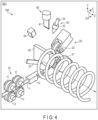
- FIG. 4 is a schematic perspective view of the coiling machine 100 and shows a specific example of the helix formation process S01.
- the feed unit 10 guides the wire 1 to the wire guide 13 by causing the wire 1 to go straight in the feed direction X using the driving rollers 11 and the driven rollers 12.
- the wire 1 drawn from the wire guide 13 is bent in the perpendicular direction Y by the first formation roller 21 and the second formation roller 22 and is formed into an arc shape.
- the wire 1 formed into an arc shape is guided by the pitch tool 23 so as to be formed into a helical shape having a predetermined pitch. By this operation, the wire 1 having a helical shape gradually stretches in the formation direction Z.
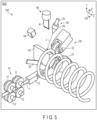
- FIG. 5 is a schematic perspective view of the coiling machine 100 and shows a specific example of the heating process S02.
- the laser heater 30 directly emits laser light L to, for example, the portion located near the end portion of the mandrel 42 (under the cutter 41) in the perpendicular direction Y in the wire 1 formed into a helical shape.
- the base material of the wire 1 is heated by the energy of laser light L, and the softened heated site 1V is formed.
- the laser heater 30 is provided at, for example, a predetermined position in a fixed manner, and emits laser light L to a portion of the suspended wire 1 from that position.
- the laser heater 30 may move the laser head 33 closer to the wire 1 and then emit laser light L.
- the laser heater 30 may emit laser light L to the site of the wire 1 delivered in the circumferential direction D ⁇ without stopping the feeding of the wire 1 by the feed unit 10.
- the movement of the laser heater 30 may be controlled such that the irradiation position of laser light L is moved so as to follow the movement of the cut position by coiling.
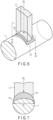
- FIG. 6 is a perspective view of the wire 1 and shows the first example of the method of heating and softening a portion of the wire 1.
- the laser heater 30 emits laser light L1 to the surface of the wire 1 in an irradiation direction DL.
- Laser light L1 has, for example, a rectangular beam profile which is elongated in the width direction of the wire 1.
- the heated site 1V is formed in the irradiation area 1a of the wire 1 irradiated with laser light L1 and its vicinity.
- FIG. 7 is the cross-sectional view of the wire 1 along the VII-VII line of FIG. 6 .
- the heated site 1V extends to the inside of the wire 1 as well as the surrounding area of the irradiation area 1a on the surface of the wire 1.
- the width of laser light L1 is less than diameter R of the wire 1. Therefore, laser light L1 is mostly applied to the wire 1.
- FIG. 8 is a perspective view of the wire 1 and shows the second example of the method of heating and softening a portion of the wire 1.
- the laser heater 30 emits laser light L2 to the surface of the wire 1 in the irradiation direction DL.
- Laser light L2 has, for example, a circular beam profile.
- the heated site 1V is formed in a manner similar to that of the first example.
- FIG. 9 is the cross-sectional view of the wire 1 along the IX-IX line of FIG. 8 .
- the heated site 1V extends to the inside of the wire 1 as well as the surrounding area of the irradiation area 1a on the surface of the wire 1.
- the diameter of laser light L2 is less than diameter R of the wire 1. Therefore, laser light L2 is mostly applied to the wire 1.
- the heated site 1V may extend to the inside of the wire 1 more deeply than the examples shown in FIG. 7 and FIG. 9 .
- the shape of laser light L emitted by the laser heater 30 is not limited to the first example and the second example.
- the heated site 1V may include a melt pool in which the base material of the wire 1 is melted by the energy of laser light L.
- the melt pool may extend to the surrounding area of the irradiation area 1a as well as the irradiation area 1a.
- FIG. 10 is a schematic perspective view of the coiling machine 100 and shows a specific example of the cutting process S03.
- the cutting process S03 is performed after the irradiation with laser light L is stopped.
- the cutting process S03 may be performed during the irradiation with laser light L.
- the heated site 1V of the wire 1 in which the temperature is higher than that before the irradiation with laser light L is cut by the cutting unit 40.
- the coil spring 2 is manufactured.
- the cutter 41 descends toward the vicinity of the portion of the wire 1 supported by the mandrel 42 in the cutting process S03. At this time, the wire 1 is cut by the impact applied by the cutter 41.
- the melt pool may solidify during the period from the suspension of irradiation with laser light L until the start of the operation of the cutter 41.
- the melt pool may be solidified as the heat of the heated site 1V is taken by the cutter 41 when the cutter 41 comes into contact with the surface of the wire 1 after the operation of the cutter 41.
- the cutter 41 may be operated based on the measurement result of the temperature of the heated site 1V by the measurement device 34. Specifically, the cutter 41 may operate when the temperature of the heated site 1V is decreased to the predetermined target temperature after the irradiation with laser light L.
- the target temperature may be, for example, a temperature at which the melted base material solidifies.
- the heated site 1V may be cut without using the measurement device 34 by determining in advance the delay time from the suspension of irradiation with laser light L until the start of the operation of the cutter 41.
- the cut coil spring 2 has a first terminal 61 including a first end face 61a, and a second terminal 62 including a second end face 62a. After one coil spring 2 is manufactured, the helix formation process S01, heating process S02 and cutting process S03 described above are performed again, and thus, the next coil spring 2 is manufactured. Thus, each of the first terminal 61 and the second terminal 62 is cut through the processes descried above.
- a shear force necessary for cutting the wire 1 decreases as the temperature of the wire 1 is increased by heating. Even if the wire 1 has not reached the melting point, the shear force can be decreased. Further, this tendency does not depend on the diameter of the wire 1.
- the temperature of at least a portion of the heated site 1V should be desirably greater than or equal to 500°C.
- FIG. 11 is a schematic cross-sectional view of the wire 1 irradiated with laser light L.
- this specification assumes a case where laser light L2 having the shape shown in FIG. 8 is emitted to the surface of the wire 1, and a melt pool is formed.
- "O" indicates the center of the irradiation area 1a (see FIG. 6 and FIG. 8 ) irradiated with laser light L on the outer circumferential surface of the wire 1.
- this irradiation center O corresponds to the position at which the peak portion having the highest intensity is irradiated in the beam profile of laser light L.
- the irradiation center O may be considered as the center of the melt pool.
- the heated site 1V is formed.
- a melt pool is formed around the irradiation center O.
- the melt pool is solidified, thereby forming a quench hardened portion 1C.
- a heat affected portion (heat affected zone [HAZ]) 1H is formed.
- the heat affected portion 1H has not been melted, but the property has been changed from the base material of the wire 1 by the heat applied at the time of the irradiation with laser light L.
- the heated site 1V includes the quench hardened portion 1C and the heat affected portion 1H.
- FIG. 11 shows the result obtained by measuring the Vickers hardness [HV] of the quench hardened portion 1C, the heat affected portion 1H and the base material of the wire 1.
- the quench hardened portion 1C has a hardness which is greater than that of the base material as a whole.
- the heat affected potion 1H has a hardness which is less than that of the base material as a whole.
- the hardness of the heat affected portion 1H gradually increases from the vicinity of the quench hardened portion 1C to the base material.
- FIG. 12 is a cross-sectional view showing an example of the preferable positional relationships of the cutter 41, the mandrel 42 and the irradiation area irradiated with laser light L.
- the wire 1 formed into a helical shape is delivered to the portion located between the cutter 41 and the mandrel 42.
- a clearance G is provided between an end portion 41a of the cutter 41 and an end portion 42a of the mandrel 42.
- the center of the clearance G in the circumferential direction D ⁇ is referred to as a clearance center C.
- the clearance center C and the irradiation center O are out of alignment in the circumferential direction D ⁇ .
- the irradiation center O is located on the cutter 41 side (the downstream side of the circumferential direction D ⁇ ) relative to the clearance center C.
- the heated site 1V includes a melt pool 1P which becomes the quench hardened portion 1C described above after solidification.
- the melt pool 1P overlaps the clearance center C.
- the melt pool 1P overlaps the end portion 41a of the cutter 41 in the perpendicular direction Y.
- the melt pool 1P does not overlap the end portion 42a of the mandrel 42 in the perpendicular direction Y.
- the end portion 42a of the mandrel 42 overlaps, of the heat affected portion 1H, the portion located on the upstream side of the circumferential direction D ⁇ relative to the melt pool 1P, in the perpendicular direction Y.
- FIG. 13 is a cross-sectional view showing a state in which the cutter 41 is moved downward from the state shown in FIG. 12 parallel to the perpendicular direction Y and the wire 1 is cut.
- the melt pool 1P has already solidified, or the melt pool 1P is solidified as the heat is taken by contact with the cutter 41.
- the quench hardened portion 1C is formed during cutting.
- the melt pool 1P may partly remain inside the heated site 1V.
- the distal end portion of the cutter 41 applies an impact to the outer circumferential surface of the wire 1 which protrudes from the end portion 42a of the mandrel 42, a shear force is applied to the heated site 1V and its vicinity, and thus, the wire 1 is broken and cut.
- the cutter 41 descends to the vicinity of the axis of the wire 1 at the maximum.
- the cut wire 1 in other words, the coil spring 2, a dent (recess portion) B by the cutter 41 is formed.
- the quench hardened portion 1C and the heat affected portion 1H overlap the dent B. However, they may be misaligned with each other.
- the heat affected portion 1H is softer than the quench hardened portion 1C and the base material of the wire 1. Therefore, when the cutter 41 applies an impact to the wire 1, the heat affected portion 1H is easily broken and cut in the heated site 1V.
- the irradiation center O is displaced on the cutter 41 side relative to the clearance center C as shown in FIG. 12 , a load can be effectively applied to, of the heat affected portion 1H, the portion located on the upstream side of the circumferential direction D ⁇ relative to the melt pool 1P, and thus, the wire 1 can be broken and cut along this portion.
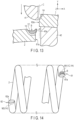
- FIG. 14 is a schematic side view of the coil spring 2 cut from the wire 1 by the method shown in FIG. 12 and FIG. 13 .
- the coil spring 2 has the first terminal 61 including the first end face 61a, and the second terminal 62 including the second end face 62a.
- the first end face 61a corresponds to the fracture surface of the coil spring 2 which is separated from the wire 1 in FIG. 13 .
- the first terminal 61 has the first irradiation trace M1 of laser light L, and the dent B of the cutter 41.
- the first irradiation trace M1 includes the quench hardened portion 1C and the heat affected portion (first heat affected portion) 1H.
- the second end face 62a corresponds to the fracture surface of the wire 1 which remains above the mandrel 42 when the coil spring 2 manufactured before the above coil spring 2 is separated.
- the second terminal 62 has the second irradiation trace M2 of laser light L.
- the second irradiation trace M2 includes the heat affected portion (second heat affected portion) 1H.
- the second irradiation trace M2 does not include the quench hardened portion 1C.
- the second irradiation trace M2 may include, for example, a less amount of quench hardened portion 1C than the first irradiation trace M1.
- FIG. 15 is a schematic plan view in which the surface of the wire 1 irradiated with laser light L1 having a rectangular beam profile as shown in FIG. 6 is viewed in the irradiation direction DL.
- a direction parallel to the axis of the wire 1 is referred to as an axial direction DA
- a direction orthogonal to the axial direction DA and the irradiation direction DL is referred to as the width direction DW of the wire 1.
- the dotted area in FIG. 15 corresponds to the irradiation area 1a irradiated with laser light L1 on the surface of the wire 1.
- the irradiation area 1a When viewed in the irradiation direction DL, the irradiation area 1a has a rectangular shape having width W1 in the axial direction DA and having width W2 in the width direction DW. Width W1 is less than width W2.
- the irradiation area 1a has a shape which is elongated in the width direction DW.
- FIG. 16 is a diagram for explaining the definition of the irradiation area 1a shown in FIG. 15.
- FIG. 16 shows center line CL1 which passes through the irradiation center O of the irradiation area 1a and is parallel to the axial direction DA, and center line CL2 which passes through the irradiation center O and is parallel to the width direction DW.
- laser light L1 On the surface of the wire 1, laser light L1 has output distribution PW1 along center line CL1, and output distribution PW2 along center line CL2.
- output distribution PW1 is a Gaussian output distribution
- output distribution PW2 is a top-hat output distribution
- the Gaussian output distribution PW1 has a mountain shape in which the output value reaches its peak in the center.
- the top-hat output distribution PW2 has a trapezoidal shape in which the peak of the output value covers a wide range.
- FIG. 17 is a schematic plan view in which the surface of the wire 1 irradiated with laser light L2 having a circular beam profile as shown in FIG. 8 is viewed in the irradiation direction DL.
- the irradiation area 1a is a circle having diameter Ra.
- FIG. 18 is a diagram for explaining the definition of the irradiation area 1a shown in FIG. 17 .
- laser light L2 has a Gaussian output distribution PW on the line segments which pass through the irradiation center O like center lines CL1 and CL2 on the surface of the wire 1.
- Diameter Ra corresponds to the half width of output distribution PW, in other words, the width of output distribution PW at the position where the output value becomes half of the peak PK.
- the irradiation area 1a irradiated with laser light L2 may be defined as a rectangular shape shown by width W1 in the axial direction DA and width W2 in the width direction DW in a manner similar to that of the example of FIG. 15 and FIG. 16 .
- both output distribution PW1 and output distribution PW2 may be a top-hat output distribution, or both output distribution PW1 and output distribution PW2 may be a Gaussian output distribution.
- output distribution PW may be a top-hat output distribution.
- the irradiation area 1a should be at least defined as an area irradiated with laser light L by an output which is greater than or equal to half of the peak.
- the shape of the irradiation area 1a is not limited to a rectangle or a circle. As another example, the irradiation area 1a may have an oval shape. In this case, the long axis and short axis of the irradiation area 1a may be defined by the half width of the output distribution.
- FIG. 19 is a chart showing irradiation conditions which may be applied to laser light L and implementation examples 1, 2 and 3.
- the cutting method using both heating by laser light L and the cutting unit 40 like the present embodiment is suitable for cutting a thick wire 1 whose diameter R is, for example, greater than or equal to 8 mm.
- the wire 1 is too thick, there is a possibility that a good cut surface cannot be obtained.
- the present embodiment assumes a case where diameter R of the wire 1 is greater than or equal to 8 mm and less than or equal to 18 mm as shown in the irradiation conditions of FIG. 19 .
- laser light L should be preferably emitted so as not to run off the wire 1. Further, if the irradiation area 1a irradiated with laser light L is too small, there is a possibility that a heat affected portion 1H having a shape suitable for cutting cannot be formed in the wire 1. In consideration of this matter, for example, when the irradiation area 1a has the rectangular shape shown in FIG. 15 and FIG.
- width W1 of the irradiation area 1a should be desirably greater than or equal to 2 mm and less than or equal to 6 mm
- width W2 should be desirably greater than or equal to 8 mm and less than or equal to 18 mm.
- the irradiation area is greater than or equal to 16 mm 2 and is less than or equal to 108 mm 2 .
- the output of laser light L needs to be determined such that a satisfactory heat affected portion 1H is formed in the wire 1, and further, the wire 1 is not cut by only irradiation with laser light L. If the output of laser light L is less, the irradiation time needs to be elongated to form a heat affected portion 1H which is sufficient for cutting. However, if the irradiation time is too long, the manufacturing efficiency of the coil spring 2 is decreased. If the output of laser light L is great, the size of the laser heater 30 is increased, and the degree of freedom of the layout of each unit of the coiling machine 100 is decreased. Further, there is a possibility that the size of the quench hardened portion 1C is increased as the wire 1 is overheated, and sputter occurs.
- the output of laser light L should be desirably greater than or equal to 500 W and less than or equal to 8000 W.
- the output density corresponding to the output of laser light L per unit area should be desirably greater than or equal to 10 W/mm 2 and less than or equal to 100 W/mm 2 .
- the output density should be more desirably greater than or equal to 31 W/mm 2 and less than or equal to 74 W/mm 2 .
- the output density is a value obtained by dividing the output of laser light L by the area of the irradiation area 1a on the surface of the wire 1 when viewed in the irradiation direction DL.
- the irradiation area 1a is an area defined by the half width of the output distribution of laser light L on the surface of the wire 1 as explained using, for example, FIG. 16 .
- the output of laser light L is 3000 W.
- the irradiation size and the irradiation area differ.
- the irradiation size is 4 mm ⁇ 14 mm in implementation example 1, 3.9 mm ⁇ 12.1 mm in implementation example 2, and 3.8 mm ⁇ 15.4 mm in implementation example 3.
- the irradiation area is 56 mm 2 in implementation example 1, 47.19 mm 2 in implementation example 2, and 58.52 mm 2 in implementation example 3.
- the output density is 53.57 W/mm 2 in implementation example 1, 63.57 W/mm 2 in implementation example 2, and 51.26 W/mm 2 in implementation example 3. All of these output densities are greater than or equal to 10 W/mm 2 and less than or equal to 100 W/mm 2 , and further, greater than or equal to 31 W/mm 2 and less than or equal to 74 W/mm 2 as shown in the irradiation conditions of FIG. 19 .
- FIG. 19 assumes a case where the irradiation size is defined by width W1 and width W2.
- the irradiation size may be defined by the radius.
- the irradiation size may be appropriately determined based on the shape of the irradiation area 1a. Even if the irradiation size is determined in any manner, similar effects can be obtained as long as the output density is in the range shown in FIG. 19 .
- the site (the heated site 1V) in which the temperature is increased by irradiation with laser light L is cut by the cutting unit 40 (the cutter 41 and the mandrel 42). Therefore, the shear force required for cutting becomes less. In this manner, the wire 1 can be easily cut.
- the manufacturing efficiency of the coil spring 2 can be improved, and further, the high-quality coil spring 2 having a good terminal can be obtained.
- the present invention can be implemented by modifying modes such as the configuration and layout of the elements provided in the coiling machine 100 in various ways depending on the need.
- Each embodiment exemplarily shows the configuration in which the coiling machine 100 cuts the heated site 1V of the wire 1 using the cutter 41.
- the coiling machine 100 is not limited to this configuration.
- the heated site 1V of the wire 1 may be cut by cutting using a rotary cutting blade.
- the coil spring 2 manufactured by the coiling machine 100 may be a coil spring in various forms, such as a cylindrical coil spring, a barrel-shaped coil spring, a hourglass coil spring, a tapered coil spring, a variable pitch coil spring and a coil spring having a portion with a minus pitch.
- Second terminal 100 ... Coiling machine, L, L1, L2 ... Laser light, S01 ... Helix formation process, S02 ... Heating process, S03 ... Cutting process, M1 ... First irradiation trace, M2 ... Second irradiation trace, B ... Dent, X ... Feed direction, Y ... Perpendicular direction, Z ... Formation direction, D ⁇ ... Circumferential direction, DL ... Irradiation direction
Landscapes
- Engineering & Computer Science (AREA)
- Mechanical Engineering (AREA)
- Physics & Mathematics (AREA)
- Optics & Photonics (AREA)
- Plasma & Fusion (AREA)
- Wire Processing (AREA)
Applications Claiming Priority (2)
| Application Number | Priority Date | Filing Date | Title |
|---|---|---|---|
| JP2022129256A JP7840815B2 (ja) | 2022-08-15 | 2022-08-15 | コイリングマシンおよびコイルばねの製造方法 |
| PCT/JP2023/022577 WO2024038669A1 (ja) | 2022-08-15 | 2023-06-19 | コイリングマシンおよびコイルばねの製造方法 |
Publications (2)
| Publication Number | Publication Date |
|---|---|
| EP4574299A1 true EP4574299A1 (de) | 2025-06-25 |
| EP4574299A4 EP4574299A4 (de) | 2025-12-17 |
Family
ID=89941432
Family Applications (1)
| Application Number | Title | Priority Date | Filing Date |
|---|---|---|---|
| EP23854707.9A Pending EP4574299A4 (de) | 2022-08-15 | 2023-06-19 | Wickelmaschine und herstellungsverfahren für schraubenfedern |
Country Status (6)
| Country | Link |
|---|---|
| US (1) | US20250178069A1 (de) |
| EP (1) | EP4574299A4 (de) |
| JP (1) | JP7840815B2 (de) |
| CN (1) | CN119677602A (de) |
| MX (1) | MX2025001806A (de) |
| WO (1) | WO2024038669A1 (de) |
Families Citing this family (2)
| Publication number | Priority date | Publication date | Assignee | Title |
|---|---|---|---|---|
| JP7203910B1 (ja) * | 2021-07-01 | 2023-01-13 | 日本発條株式会社 | コイルばね、懸架装置およびコイルばねの製造方法 |
| JP7749872B1 (ja) * | 2025-04-10 | 2025-10-06 | 日本発條株式会社 | コイリングマシンおよびコイルばねの製造方法 |
Family Cites Families (7)
| Publication number | Priority date | Publication date | Assignee | Title |
|---|---|---|---|---|
| JPS59187414A (ja) * | 1983-04-08 | 1984-10-24 | Mitsubishi Electric Corp | レ−ザ併用せん断機 |
| JPS6250028A (ja) * | 1985-08-27 | 1987-03-04 | High Frequency Heattreat Co Ltd | 高強度太径線材使用冷間成形コイルばね成形時の切断方法 |
| JPS63260716A (ja) * | 1987-04-20 | 1988-10-27 | Nippon Steel Corp | 鋼板の剪断加工時に発生するかえりを減少する方法 |
| JPH0729164B2 (ja) * | 1993-01-27 | 1995-04-05 | 株式会社板屋製作所 | バネ製造装置 |
| DE102013214161B4 (de) * | 2013-07-18 | 2015-05-07 | Wafios Ag | Verfahren und Vorrichtung zur Herstellung von Schraubenfedern durch Federwinden |
| JP7258545B2 (ja) * | 2018-12-28 | 2023-04-17 | 日本発條株式会社 | コイリングマシンと、コイルばねの製造方法 |
| WO2020161998A1 (ja) | 2019-02-06 | 2020-08-13 | 日本発條株式会社 | コイリングマシン、コイルばねの製造方法およびコイルばね |
-
2022
- 2022-08-15 JP JP2022129256A patent/JP7840815B2/ja active Active
-
2023
- 2023-06-19 WO PCT/JP2023/022577 patent/WO2024038669A1/ja not_active Ceased
- 2023-06-19 EP EP23854707.9A patent/EP4574299A4/de active Pending
- 2023-06-19 CN CN202380058832.6A patent/CN119677602A/zh active Pending
-
2025
- 2025-02-10 US US19/049,752 patent/US20250178069A1/en active Pending
- 2025-02-12 MX MX2025001806A patent/MX2025001806A/es unknown
Also Published As
| Publication number | Publication date |
|---|---|
| EP4574299A4 (de) | 2025-12-17 |
| WO2024038669A1 (ja) | 2024-02-22 |
| JP2024025901A (ja) | 2024-02-28 |
| MX2025001806A (es) | 2025-03-07 |
| JP7840815B2 (ja) | 2026-04-06 |
| US20250178069A1 (en) | 2025-06-05 |
| CN119677602A (zh) | 2025-03-21 |
Similar Documents
| Publication | Publication Date | Title |
|---|---|---|
| US20250178069A1 (en) | Coiling machine and production method for coil springs | |
| EP3922377B1 (de) | Wickelmaschine, verfahren zur herstellung einer schraubenfeder und schraubenfeder | |
| US20250178068A1 (en) | Coiling machine and coil spring manufacturing method | |
| CN105377466B (zh) | 用于通过绕簧制造螺旋弹簧的方法和装置 | |
| EP3542452B1 (de) | Verfahren und vorrichtung zur herstellung eines stators einer dynamo-elektrischen maschine | |
| CN111790989A (zh) | 用于激光切割的方法以及对应的激光加工机和计算机程序产品 | |
| US11953875B2 (en) | Cutting processing machine and cutting processing method | |
| EP3766630B1 (de) | Laserbearbeitungsmaschine und laserbearbeitungsverfahren | |
| US20180290240A1 (en) | Wire-based additive manufacturing system and method | |
| US6365870B1 (en) | Method and device for treating work pieces with laser radiation | |
| EP3871825B1 (de) | Laserstrahlmaschine, laserstrahlbearbeitungsverfahren | |
| US12533730B2 (en) | Additive manufacturing apparatus and additive manufacturing method | |
| US20220032401A1 (en) | Laser processing method, laser processing device, and method for producing laser processed product | |
| JP7749872B1 (ja) | コイリングマシンおよびコイルばねの製造方法 | |
| US20250187118A1 (en) | Dynamically controlled laser drilling system and method for producing holes | |
| US20230105729A1 (en) | Press-Forming Device for Depositing Solder and Producing Individual Solder Bodies | |
| KR20170124101A (ko) | 금속으로 튜브를 제조하는 방법 | |
| WO1999036200A1 (en) | A welding method, a heat exchanger tube, and an apparatus for the manufacturing of a heat exchanger tube | |
| EP4501526A1 (de) | Laserdurchstechverfahren und lasermaschine |
Legal Events
| Date | Code | Title | Description |
|---|---|---|---|
| STAA | Information on the status of an ep patent application or granted ep patent |
Free format text: STATUS: THE INTERNATIONAL PUBLICATION HAS BEEN MADE |
|
| PUAI | Public reference made under article 153(3) epc to a published international application that has entered the european phase |
Free format text: ORIGINAL CODE: 0009012 |
|
| STAA | Information on the status of an ep patent application or granted ep patent |
Free format text: STATUS: REQUEST FOR EXAMINATION WAS MADE |
|
| 17P | Request for examination filed |
Effective date: 20250210 |
|
| AK | Designated contracting states |
Kind code of ref document: A1 Designated state(s): AL AT BE BG CH CY CZ DE DK EE ES FI FR GB GR HR HU IE IS IT LI LT LU LV MC ME MK MT NL NO PL PT RO RS SE SI SK SM TR |
|
| DAV | Request for validation of the european patent (deleted) | ||
| DAX | Request for extension of the european patent (deleted) | ||
| A4 | Supplementary search report drawn up and despatched |
Effective date: 20251118 |
|
| RIC1 | Information provided on ipc code assigned before grant |
Ipc: B21F 35/00 20060101AFI20251112BHEP Ipc: B21F 11/00 20060101ALI20251112BHEP |