EP4574091A2 - Hornhautimplantat - Google Patents
Hornhautimplantat Download PDFInfo
- Publication number
- EP4574091A2 EP4574091A2 EP25174419.9A EP25174419A EP4574091A2 EP 4574091 A2 EP4574091 A2 EP 4574091A2 EP 25174419 A EP25174419 A EP 25174419A EP 4574091 A2 EP4574091 A2 EP 4574091A2
- Authority
- EP
- European Patent Office
- Prior art keywords
- corneal
- implant
- peripheral ring
- beams
- reticular structure
- Prior art date
- Legal status (The legal status is an assumption and is not a legal conclusion. Google has not performed a legal analysis and makes no representation as to the accuracy of the status listed.)
- Pending
Links
Images


Classifications
-
- A—HUMAN NECESSITIES
- A61—MEDICAL OR VETERINARY SCIENCE; HYGIENE
- A61F—FILTERS IMPLANTABLE INTO BLOOD VESSELS; PROSTHESES; DEVICES PROVIDING PATENCY TO, OR PREVENTING COLLAPSING OF, TUBULAR STRUCTURES OF THE BODY, e.g. STENTS; ORTHOPAEDIC, NURSING OR CONTRACEPTIVE DEVICES; FOMENTATION; TREATMENT OR PROTECTION OF EYES OR EARS; BANDAGES, DRESSINGS OR ABSORBENT PADS; FIRST-AID KITS
- A61F2/00—Filters implantable into blood vessels; Prostheses, i.e. artificial substitutes or replacements for parts of the body; Appliances for connecting them with the body; Devices providing patency to, or preventing collapsing of, tubular structures of the body, e.g. stents
- A61F2/02—Prostheses implantable into the body
- A61F2/14—Eye parts, e.g. lenses or corneal implants; Artificial eyes
-
- A—HUMAN NECESSITIES
- A61—MEDICAL OR VETERINARY SCIENCE; HYGIENE
- A61F—FILTERS IMPLANTABLE INTO BLOOD VESSELS; PROSTHESES; DEVICES PROVIDING PATENCY TO, OR PREVENTING COLLAPSING OF, TUBULAR STRUCTURES OF THE BODY, e.g. STENTS; ORTHOPAEDIC, NURSING OR CONTRACEPTIVE DEVICES; FOMENTATION; TREATMENT OR PROTECTION OF EYES OR EARS; BANDAGES, DRESSINGS OR ABSORBENT PADS; FIRST-AID KITS
- A61F2/00—Filters implantable into blood vessels; Prostheses, i.e. artificial substitutes or replacements for parts of the body; Appliances for connecting them with the body; Devices providing patency to, or preventing collapsing of, tubular structures of the body, e.g. stents
- A61F2/02—Prostheses implantable into the body
-
- A—HUMAN NECESSITIES
- A61—MEDICAL OR VETERINARY SCIENCE; HYGIENE
- A61F—FILTERS IMPLANTABLE INTO BLOOD VESSELS; PROSTHESES; DEVICES PROVIDING PATENCY TO, OR PREVENTING COLLAPSING OF, TUBULAR STRUCTURES OF THE BODY, e.g. STENTS; ORTHOPAEDIC, NURSING OR CONTRACEPTIVE DEVICES; FOMENTATION; TREATMENT OR PROTECTION OF EYES OR EARS; BANDAGES, DRESSINGS OR ABSORBENT PADS; FIRST-AID KITS
- A61F2/00—Filters implantable into blood vessels; Prostheses, i.e. artificial substitutes or replacements for parts of the body; Appliances for connecting them with the body; Devices providing patency to, or preventing collapsing of, tubular structures of the body, e.g. stents
- A61F2/02—Prostheses implantable into the body
- A61F2/14—Eye parts, e.g. lenses or corneal implants; Artificial eyes
- A61F2/142—Cornea, e.g. artificial corneae, keratoprostheses or corneal implants for repair of defective corneal tissue
-
- A—HUMAN NECESSITIES
- A61—MEDICAL OR VETERINARY SCIENCE; HYGIENE
- A61F—FILTERS IMPLANTABLE INTO BLOOD VESSELS; PROSTHESES; DEVICES PROVIDING PATENCY TO, OR PREVENTING COLLAPSING OF, TUBULAR STRUCTURES OF THE BODY, e.g. STENTS; ORTHOPAEDIC, NURSING OR CONTRACEPTIVE DEVICES; FOMENTATION; TREATMENT OR PROTECTION OF EYES OR EARS; BANDAGES, DRESSINGS OR ABSORBENT PADS; FIRST-AID KITS
- A61F2/00—Filters implantable into blood vessels; Prostheses, i.e. artificial substitutes or replacements for parts of the body; Appliances for connecting them with the body; Devices providing patency to, or preventing collapsing of, tubular structures of the body, e.g. stents
- A61F2/02—Prostheses implantable into the body
- A61F2/14—Eye parts, e.g. lenses or corneal implants; Artificial eyes
- A61F2/145—Corneal inlays, onlays, or lenses for refractive correction
- A61F2/1451—Inlays or onlays
-
- A—HUMAN NECESSITIES
- A61—MEDICAL OR VETERINARY SCIENCE; HYGIENE
- A61F—FILTERS IMPLANTABLE INTO BLOOD VESSELS; PROSTHESES; DEVICES PROVIDING PATENCY TO, OR PREVENTING COLLAPSING OF, TUBULAR STRUCTURES OF THE BODY, e.g. STENTS; ORTHOPAEDIC, NURSING OR CONTRACEPTIVE DEVICES; FOMENTATION; TREATMENT OR PROTECTION OF EYES OR EARS; BANDAGES, DRESSINGS OR ABSORBENT PADS; FIRST-AID KITS
- A61F2/00—Filters implantable into blood vessels; Prostheses, i.e. artificial substitutes or replacements for parts of the body; Appliances for connecting them with the body; Devices providing patency to, or preventing collapsing of, tubular structures of the body, e.g. stents
- A61F2/02—Prostheses implantable into the body
- A61F2/14—Eye parts, e.g. lenses or corneal implants; Artificial eyes
- A61F2/147—Implants to be inserted in the stroma for refractive correction, e.g. ring-like implants
-
- A—HUMAN NECESSITIES
- A61—MEDICAL OR VETERINARY SCIENCE; HYGIENE
- A61F—FILTERS IMPLANTABLE INTO BLOOD VESSELS; PROSTHESES; DEVICES PROVIDING PATENCY TO, OR PREVENTING COLLAPSING OF, TUBULAR STRUCTURES OF THE BODY, e.g. STENTS; ORTHOPAEDIC, NURSING OR CONTRACEPTIVE DEVICES; FOMENTATION; TREATMENT OR PROTECTION OF EYES OR EARS; BANDAGES, DRESSINGS OR ABSORBENT PADS; FIRST-AID KITS
- A61F2/00—Filters implantable into blood vessels; Prostheses, i.e. artificial substitutes or replacements for parts of the body; Appliances for connecting them with the body; Devices providing patency to, or preventing collapsing of, tubular structures of the body, e.g. stents
- A61F2/02—Prostheses implantable into the body
- A61F2/14—Eye parts, e.g. lenses or corneal implants; Artificial eyes
- A61F2/15—Implant having one or more holes, e.g. for nutrient transport, for facilitating handling
Definitions
- the present description relates to a corneal implant intended to correct irregularities in the curvature of a subject's cornea.
- a corneal implant is an implantable device intended to impose a substantially regular curvature to the cornea, so as to restore an optimal optical situation intended to reduce or eliminate optical aberrations that compromise, for example, visual acuity or contrast sensitivity.
- Treatments known and used - to date - for treating corneal aberrations induced by curvature irregularities are the following:
- These corneal implant devices although better than ICRS, still have the main disadvantage of a reduced ability to impose a pre-defined curvature on the cornea, as they are characterized by a reduced size in radial cross-section: this means that their main role is that of flattening the corneal portions in which they are implanted if they are highly curved.
- the reduced width of these ring structures prevents them from defining a precise shape for the cornea, as they exert their action on a very small surface along a radial direction.
- the corneal implant subject of the present description is intended for treating patients suffering from an irregular conformation of the cornea.
- the corneal implant described here is, in fact, able to impose its curvature on the cornea in order to correct the pathological deformations of the cornea itself thanks to the rigidity of its structure and the presence of a continuous outer peripheral ring capable of stabilizing the three-dimensional conformation of the implant itself.
- an outer peripheral ring in the corneal implant described here allows the implant to slide into the corneal stroma during the implantation process, making the surgical implant method substantially atraumatic; a margin formed of free ends would constitute an irregular surface, posing a disadvantage in the implant as it would not be suitable for sliding between the corneal layers.
- the corneal implant has a dome-shaped structural body configured to impose a regular curvature on the corneal portions intended to be in contact with the implant.
- the structural body comprises an outer peripheral ring and an inner reticular structure, which, in turn, comprises at least one first and one second series of beams intersecting each other, where the beams of the first series are connected to the outer peripheral ring through a respective first end, in which the overall area of the void portions within the meshes of the reticular structure is between 50 and 99.9% of the surface area of the reticular structure.
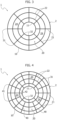
- the corneal implant identified with the numerical reference 1 has a generally dome-shaped structural body 2 comprising an outer peripheral ring 10 and an inner reticular structure 20.
- the outer peripheral ring has a continuous surface. This characteristic allows rendering the insertion of the implant atraumatic, as highlighted above.
- the inner reticular structure 20 comprises at least one first and one second series of beams 21, 22 intersecting each other, where the beams 21, 22 of both the first and second series have both ends 31, 32, 33, 34 connected to the outer peripheral ring 10.
- the first and second series of intersecting beams 21, 22 extend in a radial direction with respect to the outer peripheral ring 10.
- the outer peripheral ring 10 can preferably assume a circular or elliptical configuration.
- the overall area of the void portions 24 within the meshes of the reticular structure 20 is between 50 and 99.9%, preferably between 75 and 98%, of the total surface area of the reticular structure 20.
- an outer peripheral ring 10 and an inner peripheral ring 11 gives the implant greater conformational stability, which results in an effective treatment of corneas with particularly irregular surfaces.
- the outer peripheral ring 10, the innermost peripheral ring 11 and the beams 21, 22, 40 have a dimension of this cross-section in a direction perpendicular to the width or plane of the peripheral rings 10, 11, or rather a thickness, in a range from 5 to 250 ⁇ m, more preferably above 10 ⁇ m and less than 1000 ⁇ m.
- the reticular structure 20 can have coplanar beams 21, 22, 40 or on several superposed planes.
- the rigidity of the human cornea results in values from 0.01 to 10 MPa, preferably from 0.1 to 1 MPa.
- the rigidity of the corneal implant subject of the present description is preferably greater than 1 MPa, more preferably greater than 10 MPa, still more preferably included in a range from 10 MPa to 300 GPa.
- the device also allows, due to its rigidity, reduction of optical aberrations generated both by the anterior corneal surface and by the posterior corneal surface in the case in which the implant is inserted inside the corneal stroma (where anterior and posterior are to be understood with reference to the corneal implant 1 insertion position inside the cornea), correction not obtainable with ablation by excimer or femtosecond laser or ring-shaped corneal implants or even implants made of non-rigid materials, such as tissue.
- the implant is positioned below the corneal epithelium, when the corneal epithelium regrows it will cover and incorporate the implant, assuming its shape.
- the corneal tissue presenting a lower structural resistance than the precut corneal tissue will better adapt to the new geometry imposed by the corneal implant with quantitatively higher optical results.
- the cornea within which the corneal implant 1 has been inserted will have a structural rigidity suitable for the correct maintenance over time of the optical correction imposed by the corneal implant 1.
- the implant is able to maintain its dome-shaped configuration also following stresses made during implantation (for example, due to manipulation of the implant by the surgeon) or daily use (for example, due to rubbing of the eye by the patient).
- the device is indicated in all the pathologies that involve an irregularity of curvature of the cornea, preferably with useful stroma transparency, which cause optical aberrations that cannot be corrected, for example, with temple lenses or contact lenses, or in subjects that do not tolerate contact lenses.
- the device subject of the present description can be implanted in order to vary the corneal curvature in healthy subjects to correct a refractive error.
- the main categories of patients targeted by the device include subjects suffering from non-inflammatory corneal ectasia (such as, for example, keratoconus and marginal pellucid degeneration or ectasia following corneal refractive surgical procedures) and subjects undergoing perforating keratoplasty or deep anterior lamellar with irregular or elevated astigmatism.
- non-inflammatory corneal ectasia such as, for example, keratoconus and marginal pellucid degeneration or ectasia following corneal refractive surgical procedures
- corneal implant 1 subject of the present description allows the following benefits to be obtained.
- the corneal implant 1 allows the cornea to be modeled by imposing and obtaining a curvature defined a priori, contrary to what occurs with the use of ICRS (Intra corneal ring segments), and without tissue ablation, as happens in the case of ablative treatments with excimer or femtosecond laser, in which the final conformation of the cornea is not exactly predictable and the treatment is irreversible.
- ICRS Intra corneal ring segments
- the corneal implant subject of the present description i) does not interfere (or at most to a very negligible extent) with the passage of oxygen and other molecules through the corneal tissue anterior and posterior to the implant and ii) involves a reduction of the incoming light by 5-10% and of diffractive phenomena which are by far negligible when compared to the benefits gained by the implant 1 in terms of reduction of low-order (astigmatism) and high-order aberrations (such as coma and trefoil).
- this implant is not substantially perceived by the patient.
- the corneal implant 1 subject of the present description is implantable preferably in the corneal stroma or fixable to the anterior surface of the corneal stroma, below the corneal epithelium.
- the implant is also easily grafted and removable without (or with minimal) damage to the corneal tissue, greatly reducing pain in the postoperative period, speeding up visual recovery and thus improving the patient's quality of life.
- the dimensions of the corneal implant 1, intended as the diameter of the outer peripheral ring 10, the diameter of the innermost peripheral ring 11 (if present), the radius of curvature of the dome-shaped structural body 2, as well as the thickness of the peripheral rings 10, 11 and/or of the beams 21, 22 and 40 are selected in such a way as to adapt to the specific needs of the patient and to the morphology of the cornea.
- the implant which is the subject of the present description can be grafted into the cornea of a patient by means of a conservative-additive refractive surgery that does not involve the removal of corneal tissue.
- the device is preferably implantable in the corneal stroma, but can also be attached to the anterior surface of the corneal stroma, below the corneal epithelium or Bowman's membrane.
- the free edge of the flap or of the anterior layer to the pocket is attached to the adjacent tissue with stitches, or metal clips, or fibrin glue.
- the corneal implant 1 can be made using: metals and relative alloys (by way of example titanium (such as grade 1 or grade 2 titanium), nickel, cobalt, chromium, tantalum, gold, silver, iron and their alloys, such as steel, Nitinol, Ti 6 Al 4 V, AISI 301 ® , etc.), since the metals are preferably non-magnetic; carbon and its compounds, preferably inorganic; polymers; ceramic materials, and relative combinations.
- titanium such as grade 1 or grade 2 titanium
- nickel, cobalt chromium, tantalum, gold, silver, iron and their alloys, such as steel, Nitinol, Ti 6 Al 4 V, AISI 301 ® , etc.
- the metals are preferably non-magnetic
- carbon and its compounds preferably inorganic
- polymers preferably ceramic materials, and relative combinations.
- the corneal implant 1 can also be made by using the aforesaid materials further mixed with other compounds such as hydroxyapatite, polylactic acid, polycaprolactone, fibroin, chitin, cellulose, chitosan, gelatin, carboxylmethyl cellulose, collagen (human or animal), hydrocolloid, hydrogel, Crabyon ® , silver.
- other compounds such as hydroxyapatite, polylactic acid, polycaprolactone, fibroin, chitin, cellulose, chitosan, gelatin, carboxylmethyl cellulose, collagen (human or animal), hydrocolloid, hydrogel, Crabyon ® , silver.
- the corneal implant 1 can also be provided with an outer biocompatible and/or biodegradable coating optionally comprising a pharmacologically active principle, preferably anti-inflammatory, antibacterial and/or intended to inhibit or control the fibrotic reaction around the implant.
- an outer biocompatible and/or biodegradable coating optionally comprising a pharmacologically active principle, preferably anti-inflammatory, antibacterial and/or intended to inhibit or control the fibrotic reaction around the implant.
- the outer coating can be made using compounds and/or compositions known in the field of implantable prostheses in an animal body for releasing active principles by implantable devices/prostheses.
- Particularly preferred materials for making a biocompatible and/or biodegradable coating of the corneal implant 1 are selected from: hydroxyapatite, polylactic acid, polycaprolactone, fibroin, chitin, cellulose, chitosan, gelatin, carboxylmethyl cellulose, collagen (human or animal), hydrocolloid, hydrogel, Crabyon ® , silver and relative combinations.
- Laser processing can also be carried out using a StarFiber 180FC fiber source (Rofin Baasel Lasertech GmbH & Co. KG).
- StarFiber 180FC fiber source Rosin Baasel Lasertech GmbH & Co. KG.
- the result in terms of cutting precision is as good as the solution obtained with the StarFemto FX laser, but given the heat input, there is a deformation and a lower quality of the cut wall compared to that obtained with the StarFemto FX laser which mounts a source with ultrashort pulses.
- a chemical electro-polishing treatment is carried out according to techniques widely known in the art in order to clean the surface and remove unwanted contaminants from the surface.
- the pieces after electro-polishing can be subjected to a passivation/anodization treatment if the introduction of a color change of the piece is required.
- the anodizing treatment of the individual titanium pieces is carried out according to the following procedure: the pieces are inserted into a basic aqueous solution of 10% ammonium sulfate, at room temperature for 10 s.
- the potential that is applied varies according to the desired color and, by way of non-exhaustive example, we report the following indications of the potentials to be applied and the colors obtainable:
- the piece is subjected to a drawing operation and subsequent coining with a mold formed by a die and a punch.
- Die and punch are made of tempered material (K100).
- the drawing and coining process is preferably carried out using a mechanical press with a precise mechanical laboratory toggle (GECHTER, 5HKPU), punching precision of +/- 10 ⁇ m, pressure value 9 Kg.
- GECHTER precise mechanical laboratory toggle
- the drawing and coining process is preferably carried out using a press with electro-actuated descent of the puncher (ALFAMATIC, COLOMBO), punching precision of +/- 10 ⁇ m, pressure value 9 Kg.
- a subsequent final cleaning (for example, in an ultrasonic bath) can be provided to remove any further residues still present on the surface of the corneal implant at the end of the production process.
- the corneal implant can also be subjected to one or more mechanical, laser, chemical or other processes that have the purpose of modifying the surface morphology of the implant itself.
- Some possible processes are shot peening, corundum sandblasting and passivation treatment (which gives the maximum resistance to corrosion to the passive layer of oxide film, promoting its formation).
- the production method can envisage carrying out all or only some of the steps already described previously with reference to the use of a starting material in the form of a sheet, such as electro-polishing, anodizing, drawing and any additional treatments intended to modify the implant surface morphology.
- the corneal implant can also be produced by 3D printing of the final implant or in wax from which the implant subject of the present description is then obtained by lost-wax casting.
- the wax model is used according to the usual lost-wax casting techniques for producing the final component of the required material.
- Young's modulus of the device subject of the present invention it is possible to perform tests of different types known to the expert, such as, for example, tensile tests 1) on the plate of the material with which the device is subsequently made, 2) on a single beam of which the device is constituted, or 3) on the final device.
- case 3 it is possible to use the same methods of case 1), while bearing in mind that the load applied in the first part of the tensile test will be used to flatten the dome-shaped device to make it planar, and will not be indicative for determining Young's modulus.
Landscapes
- Health & Medical Sciences (AREA)
- Biomedical Technology (AREA)
- Transplantation (AREA)
- Engineering & Computer Science (AREA)
- Ophthalmology & Optometry (AREA)
- Life Sciences & Earth Sciences (AREA)
- Heart & Thoracic Surgery (AREA)
- Vascular Medicine (AREA)
- Oral & Maxillofacial Surgery (AREA)
- Animal Behavior & Ethology (AREA)
- General Health & Medical Sciences (AREA)
- Public Health (AREA)
- Veterinary Medicine (AREA)
- Cardiology (AREA)
- Prostheses (AREA)
- Medicines Containing Plant Substances (AREA)
- Cosmetics (AREA)
- Agricultural Chemicals And Associated Chemicals (AREA)
Applications Claiming Priority (3)
| Application Number | Priority Date | Filing Date | Title |
|---|---|---|---|
| IT102018000006146A IT201800006146A1 (it) | 2018-06-08 | 2018-06-08 | Impianto corneale |
| EP19740646.5A EP3801386B1 (de) | 2018-06-08 | 2019-05-31 | Hornhautimplantat |
| PCT/IB2019/054540 WO2019234571A1 (en) | 2018-06-08 | 2019-05-31 | Corneal implant |
Related Parent Applications (2)
| Application Number | Title | Priority Date | Filing Date |
|---|---|---|---|
| EP19740646.5A Division EP3801386B1 (de) | 2018-06-08 | 2019-05-31 | Hornhautimplantat |
| EP19740646.5A Division-Into EP3801386B1 (de) | 2018-06-08 | 2019-05-31 | Hornhautimplantat |
Publications (2)
| Publication Number | Publication Date |
|---|---|
| EP4574091A2 true EP4574091A2 (de) | 2025-06-25 |
| EP4574091A3 EP4574091A3 (de) | 2025-08-13 |
Family
ID=63449592
Family Applications (3)
| Application Number | Title | Priority Date | Filing Date |
|---|---|---|---|
| EP19740646.5A Active EP3801386B1 (de) | 2018-06-08 | 2019-05-31 | Hornhautimplantat |
| EP25174468.6A Pending EP4574092A3 (de) | 2018-06-08 | 2019-05-31 | Hornhautimplantat |
| EP25174419.9A Pending EP4574091A3 (de) | 2018-06-08 | 2019-05-31 | Hornhautimplantat |
Family Applications Before (2)
| Application Number | Title | Priority Date | Filing Date |
|---|---|---|---|
| EP19740646.5A Active EP3801386B1 (de) | 2018-06-08 | 2019-05-31 | Hornhautimplantat |
| EP25174468.6A Pending EP4574092A3 (de) | 2018-06-08 | 2019-05-31 | Hornhautimplantat |
Country Status (9)
| Country | Link |
|---|---|
| US (3) | US11510775B2 (de) |
| EP (3) | EP3801386B1 (de) |
| JP (3) | JP7294575B2 (de) |
| CN (3) | CN112236105B (de) |
| CA (1) | CA3101591A1 (de) |
| ES (1) | ES3040568T3 (de) |
| IL (3) | IL279164B2 (de) |
| IT (1) | IT201800006146A1 (de) |
| WO (1) | WO2019234571A1 (de) |
Families Citing this family (1)
| Publication number | Priority date | Publication date | Assignee | Title |
|---|---|---|---|---|
| EP4665271A1 (de) * | 2023-02-13 | 2025-12-24 | Recornea S.r.l. | Hornhautimplantat |
Citations (8)
| Publication number | Priority date | Publication date | Assignee | Title |
|---|---|---|---|---|
| US4671276A (en) | 1982-01-04 | 1987-06-09 | Kera Associates | Apparatus for corneal curvature adjustment |
| WO1993012735A1 (en) | 1992-01-02 | 1993-07-08 | Chiron Intraoptics, Inc. | Corneal ring inlay and methods of use |
| US5645582A (en) | 1992-09-21 | 1997-07-08 | Keravision, Inc. | Overlapping ring device for corneal curvature adjustment |
| US20020013622A1 (en) | 1995-06-27 | 2002-01-31 | Jurgen Hennig | Corneal insert, instrument for insertion of the same and method of correcting the refractive power of an eye |
| WO2006113634A2 (en) | 2005-04-18 | 2006-10-26 | Price Francis W Jr | Corneal implants and methods of use |
| US20060271185A1 (en) | 2004-12-01 | 2006-11-30 | Silvestrini Thomas A | Method of making an ocular implant |
| WO2011069059A1 (en) | 2009-12-04 | 2011-06-09 | Acufocus, Inc. | Corneal implant for refractive correction |
| US20140074232A1 (en) | 2012-09-07 | 2014-03-13 | Marcelo Francisco Pessoa SOARES | Implantable device for molding the curvature of the cornea |
Family Cites Families (17)
| Publication number | Priority date | Publication date | Assignee | Title |
|---|---|---|---|---|
| GB772569A (en) * | 1955-05-10 | 1957-04-17 | Stone Jr William | Artificial corneal implant |
| SU1160623A1 (ru) * | 1984-01-09 | 1987-10-07 | Mo Nii Microchirurg | Кератопротез |
| BR9708285A (pt) * | 1996-02-09 | 1999-08-03 | Keravision Inc | Inserção corneal intra-estromal segmentada para alterar as propriedades refrativas corneais e métodos da mesma |
| US7645299B2 (en) * | 2001-05-11 | 2010-01-12 | Koziol Jeffrey E | Intracorneal lens system having connected lenses |
| US7628810B2 (en) * | 2003-05-28 | 2009-12-08 | Acufocus, Inc. | Mask configured to maintain nutrient transport without producing visible diffraction patterns |
| GB2403908B (en) * | 2003-07-17 | 2007-03-28 | I O Internat Ltd | Artificial cornea |
| EP1790316A4 (de) * | 2004-06-17 | 2012-05-16 | Zakrytoe Akcionernoe Obschestvo N Proizv Complex Ecoflon | Implantat zur verstärkung der hornhaut und keratoprothese mit einer platte aus porösem polytetrafluorethylen |
| US8029515B2 (en) | 2005-01-31 | 2011-10-04 | Yichieh Shiuey | Corneal implants and methods and systems for placement |
| US9999497B2 (en) * | 2005-01-31 | 2018-06-19 | Yichieh Shiuey | Corneal implants and methods and systems for placement |
| EP1933751A4 (de) * | 2005-10-13 | 2009-12-02 | Shui T Lai | Intrastromale refraktive chirurgie durch induktion von formveränderungen in der hornhaut |
| US20070168025A1 (en) * | 2006-01-13 | 2007-07-19 | Sohrab Darougar | Artificial cornea |
| MX2008011680A (es) * | 2006-03-16 | 2008-12-10 | Daxer Albert | Implante de cornea. |
| EP2271964A4 (de) * | 2008-03-18 | 2017-09-20 | Mitsui Chemicals, Inc. | Fortschrittliche elektroaktive optische anordnung |
| US9943402B2 (en) * | 2008-11-20 | 2018-04-17 | Insight Innovations, Llc | Micropatterned intraocular implant |
| US20120232649A1 (en) * | 2008-11-20 | 2012-09-13 | Insight Innovations, Llc | Intraocular Lens Cell Migration Inhibition System |
| EP3730093B1 (de) * | 2010-09-30 | 2022-12-21 | KeraMed, Inc. | Reversibel verformbare künstliche hornhaut |
| US10548768B2 (en) * | 2016-09-16 | 2020-02-04 | Cretech B.V. | System for correcting an irregular surface of a cornea and uses thereof |
-
2018
- 2018-06-08 IT IT102018000006146A patent/IT201800006146A1/it unknown
-
2019
- 2019-05-31 ES ES19740646T patent/ES3040568T3/es active Active
- 2019-05-31 EP EP19740646.5A patent/EP3801386B1/de active Active
- 2019-05-31 EP EP25174468.6A patent/EP4574092A3/de active Pending
- 2019-05-31 CN CN201980037355.9A patent/CN112236105B/zh active Active
- 2019-05-31 CN CN202410960184.XA patent/CN118986586A/zh active Pending
- 2019-05-31 IL IL279164A patent/IL279164B2/en unknown
- 2019-05-31 CA CA3101591A patent/CA3101591A1/en active Pending
- 2019-05-31 CN CN202410960181.6A patent/CN118986585A/zh active Pending
- 2019-05-31 US US16/972,924 patent/US11510775B2/en active Active
- 2019-05-31 IL IL309090A patent/IL309090B2/en unknown
- 2019-05-31 JP JP2020565920A patent/JP7294575B2/ja active Active
- 2019-05-31 WO PCT/IB2019/054540 patent/WO2019234571A1/en not_active Ceased
- 2019-05-31 EP EP25174419.9A patent/EP4574091A3/de active Pending
-
2022
- 2022-10-28 US US17/975,872 patent/US11957568B2/en active Active
- 2022-10-28 US US17/975,851 patent/US12144722B2/en active Active
-
2023
- 2023-02-02 JP JP2023014492A patent/JP7540623B2/ja active Active
- 2023-02-02 JP JP2023014491A patent/JP7396571B2/ja active Active
- 2023-12-04 IL IL309089A patent/IL309089B2/en unknown
Patent Citations (8)
| Publication number | Priority date | Publication date | Assignee | Title |
|---|---|---|---|---|
| US4671276A (en) | 1982-01-04 | 1987-06-09 | Kera Associates | Apparatus for corneal curvature adjustment |
| WO1993012735A1 (en) | 1992-01-02 | 1993-07-08 | Chiron Intraoptics, Inc. | Corneal ring inlay and methods of use |
| US5645582A (en) | 1992-09-21 | 1997-07-08 | Keravision, Inc. | Overlapping ring device for corneal curvature adjustment |
| US20020013622A1 (en) | 1995-06-27 | 2002-01-31 | Jurgen Hennig | Corneal insert, instrument for insertion of the same and method of correcting the refractive power of an eye |
| US20060271185A1 (en) | 2004-12-01 | 2006-11-30 | Silvestrini Thomas A | Method of making an ocular implant |
| WO2006113634A2 (en) | 2005-04-18 | 2006-10-26 | Price Francis W Jr | Corneal implants and methods of use |
| WO2011069059A1 (en) | 2009-12-04 | 2011-06-09 | Acufocus, Inc. | Corneal implant for refractive correction |
| US20140074232A1 (en) | 2012-09-07 | 2014-03-13 | Marcelo Francisco Pessoa SOARES | Implantable device for molding the curvature of the cornea |
Also Published As
Similar Documents
| Publication | Publication Date | Title |
|---|---|---|
| AU667342B2 (en) | Corneal ring inlay and methods of use | |
| CA2709426C (en) | Method for intrastromal refractive surgery | |
| EP3125020A1 (de) | Einlagen mit kleinem durchmesser | |
| US20110313344A1 (en) | Method for treating refractive errors and vision disorders of an eye | |
| CN101431965A (zh) | 用于角膜异常或缺陷的预成型角膜基质插入物 | |
| US11957568B2 (en) | Corneal implant | |
| BR122023014422B1 (pt) | Implante corneano | |
| BR122023014425B1 (pt) | Implante corneano | |
| BR112020024953B1 (pt) | Implante corneano | |
| IL322351A (en) | Corneal implant | |
| IT202000011524A1 (it) | Impianto corneale | |
| IT202000011536A1 (it) | Impianto corneale | |
| EP4218670A1 (de) | Doppelsegment-intrastromale vorrichtung zur korrektur schwerer ametropie | |
| GB2629464A (en) | Corneal graft retainer ring |
Legal Events
| Date | Code | Title | Description |
|---|---|---|---|
| PUAI | Public reference made under article 153(3) epc to a published international application that has entered the european phase |
Free format text: ORIGINAL CODE: 0009012 |
|
| STAA | Information on the status of an ep patent application or granted ep patent |
Free format text: STATUS: THE APPLICATION HAS BEEN PUBLISHED |
|
| AC | Divisional application: reference to earlier application |
Ref document number: 3801386 Country of ref document: EP Kind code of ref document: P |
|
| AK | Designated contracting states |
Kind code of ref document: A2 Designated state(s): AL AT BE BG CH CY CZ DE DK EE ES FI FR GB GR HR HU IE IS IT LI LT LU LV MC MK MT NL NO PL PT RO RS SE SI SK SM TR |
|
| PUAL | Search report despatched |
Free format text: ORIGINAL CODE: 0009013 |
|
| AK | Designated contracting states |
Kind code of ref document: A3 Designated state(s): AL AT BE BG CH CY CZ DE DK EE ES FI FR GB GR HR HU IE IS IT LI LT LU LV MC MK MT NL NO PL PT RO RS SE SI SK SM TR |
|
| RIC1 | Information provided on ipc code assigned before grant |
Ipc: A61F 2/14 20060101AFI20250709BHEP |
|
| STAA | Information on the status of an ep patent application or granted ep patent |
Free format text: STATUS: REQUEST FOR EXAMINATION WAS MADE |
|
| 17P | Request for examination filed |
Effective date: 20251021 |