EP4571401A1 - Eyeglass lens determination method, and eyeglass lens determination assistance system - Google Patents
Eyeglass lens determination method, and eyeglass lens determination assistance system Download PDFInfo
- Publication number
- EP4571401A1 EP4571401A1 EP23852349.2A EP23852349A EP4571401A1 EP 4571401 A1 EP4571401 A1 EP 4571401A1 EP 23852349 A EP23852349 A EP 23852349A EP 4571401 A1 EP4571401 A1 EP 4571401A1
- Authority
- EP
- European Patent Office
- Prior art keywords
- subject
- aberration
- blurred images
- sensitivity
- spectacle lens
- Prior art date
- Legal status (The legal status is an assumption and is not a legal conclusion. Google has not performed a legal analysis and makes no representation as to the accuracy of the status listed.)
- Pending
Links
Images




Classifications
-
- A—HUMAN NECESSITIES
- A61—MEDICAL OR VETERINARY SCIENCE; HYGIENE
- A61B—DIAGNOSIS; SURGERY; IDENTIFICATION
- A61B3/00—Apparatus for testing the eyes; Instruments for examining the eyes
- A61B3/02—Subjective types, i.e. testing apparatus requiring the active assistance of the patient
- A61B3/028—Subjective types, i.e. testing apparatus requiring the active assistance of the patient for testing visual acuity; for determination of refraction, e.g. phoropters
-
- A—HUMAN NECESSITIES
- A61—MEDICAL OR VETERINARY SCIENCE; HYGIENE
- A61B—DIAGNOSIS; SURGERY; IDENTIFICATION
- A61B3/00—Apparatus for testing the eyes; Instruments for examining the eyes
- A61B3/02—Subjective types, i.e. testing apparatus requiring the active assistance of the patient
- A61B3/028—Subjective types, i.e. testing apparatus requiring the active assistance of the patient for testing visual acuity; for determination of refraction, e.g. phoropters
- A61B3/0285—Phoropters
-
- A—HUMAN NECESSITIES
- A61—MEDICAL OR VETERINARY SCIENCE; HYGIENE
- A61B—DIAGNOSIS; SURGERY; IDENTIFICATION
- A61B3/00—Apparatus for testing the eyes; Instruments for examining the eyes
- A61B3/02—Subjective types, i.e. testing apparatus requiring the active assistance of the patient
- A61B3/028—Subjective types, i.e. testing apparatus requiring the active assistance of the patient for testing visual acuity; for determination of refraction, e.g. phoropters
- A61B3/036—Subjective types, i.e. testing apparatus requiring the active assistance of the patient for testing visual acuity; for determination of refraction, e.g. phoropters for testing astigmatism
-
- A—HUMAN NECESSITIES
- A61—MEDICAL OR VETERINARY SCIENCE; HYGIENE
- A61B—DIAGNOSIS; SURGERY; IDENTIFICATION
- A61B3/00—Apparatus for testing the eyes; Instruments for examining the eyes
- A61B3/02—Subjective types, i.e. testing apparatus requiring the active assistance of the patient
- A61B3/028—Subjective types, i.e. testing apparatus requiring the active assistance of the patient for testing visual acuity; for determination of refraction, e.g. phoropters
- A61B3/04—Trial frames; Sets of lenses for use therewith
-
- G—PHYSICS
- G02—OPTICS
- G02C—SPECTACLES; SUNGLASSES OR GOGGLES INSOFAR AS THEY HAVE THE SAME FEATURES AS SPECTACLES; CONTACT LENSES
- G02C7/00—Optical parts
- G02C7/02—Lenses; Lens systems ; Methods of designing lenses
- G02C7/024—Methods of designing ophthalmic lenses
- G02C7/027—Methods of designing ophthalmic lenses considering wearer's parameters
-
- G—PHYSICS
- G02—OPTICS
- G02C—SPECTACLES; SUNGLASSES OR GOGGLES INSOFAR AS THEY HAVE THE SAME FEATURES AS SPECTACLES; CONTACT LENSES
- G02C7/00—Optical parts
- G02C7/02—Lenses; Lens systems ; Methods of designing lenses
- G02C7/06—Lenses; Lens systems ; Methods of designing lenses bifocal; multifocal ; progressive
- G02C7/061—Spectacle lenses with progressively varying focal power
Definitions
- the present invention relates to a method for determining a spectacle lens and a system for supporting determination of a spectacle lens.
- a method for designing a spectacle lens including: presenting multiple blurred images created by applying different degrees of blurring (blurring level) to an original image, allowing a wearer to view them, acquiring information regarding a wearer's sensitivity to blur, and designing a spectacle lens based on the information regarding the wearer's sensitivity to blur.
- a method for designing a spectacle lens including: displaying an image on a display device while maintaining a positional relationship between a subject's face and the display device, obtaining information evaluating a subject's visual sensitivity based on a subject's impression of viewing the image, and designing a spectacle lens based on the information obtained from evaluating the sensitivity.
- An object of one embodiment of the present invention is to provide a technique for determining a spectacle lens suitable for a subject, in consideration of a subject's sensitivity to aberration.
- the method for determining a spectacle lens of the first aspect wherein in the preparation of the multiple blurred images, the original image is selected according to a characteristic direction of a decrease in spatial frequency characteristics due to the added aberration.
- a progressive power lens is determined.
- the method for determining a spectacle lens of the first aspect wherein in the measurement of the subject's sensitivity to aberration, the multiple blurred images are presented with a size such that a spatial frequency of main parts of the multiple blurred images is 3 CPD or more and 9 CPD or less.
- a seventh aspect of the present invention there is provided the method for determining a spectacle lens of the first aspect, wherein in the measurement of the subject's sensitivity to aberration, a subject's head is not fixed, and the multiple blurred images are presented at a distance of 0.3 m or more and 2 m or less from subject's eyes.
- a system for supporting determination of a spectacle lens including: a storage unit that stores multiple blurred images in which amounts of added aberrations are varied, with respect to a predetermined original image;
- a spectacle lens suitable for a subject can be determined, in consideration of a subject's sensitivity to aberration.
- the present inventor has conducted extensive research into the above-described problems. As a result, it is found that by simultaneously presenting multiple blurred images to a subject to compare the appearances of them, the sensitivity to blur can be measured without being affected by a subjects' memory, fatigue, adaptability, etc. It is also found that the measurement time can be shortened. Further, since multiple blurred images are compared, a relative evaluation can be made, which has an advantage of making it easier for the subject to evaluate. Accordingly, it becomes easier to determine a spectacle lens that is suitable for the subject, in consideration of the subject's sensitivity to blur.
- FIG. 1 is a flowchart showing an example of the method for determining a spectacle lens according to this embodiment.
- the method for determining a spectacle lens according to this embodiment includes, for example, a blurred image preparation step S101, a blur sensitivity measurement step S102, and a spectacle lens determination step S103.
- This embodiment shows a case of determining a progressive power lens suitable for a subject.
- the blurred image preparation step S101 is, for example, a step of preparing multiple blurred images (in this embodiment, two blurred images) in which the amount of added aberration (preferably the amount only) is varied with respect to a predetermined original image.
- the added aberration includes astigmatism, coma, trefoil aberration, etc.
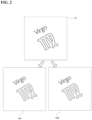
- FIG. 2 illustrates an example of an original image and multiple blurred images.
- FIG. 2 illustrates a blurred image 10A in which predetermined amount of aberration is added, and a blurred image 10B in which larger amount of aberration than the blurred image 10A is added, with respect to an original image 10.
- FIG. 3 illustrates an example of a spot image created by the aberration added to the blurred image. Also, FIG. 3 illustrates a spot image in an appearance of a trailing tail at the bottom left of the page.
- the blurred image added with aberration that creates such a spot image appears blurred in a lower left direction.
- the added aberration results in a noticeable (characteristic) decrease in spatial frequency characteristics in the lower left direction.
- Such a characteristic direction of the decrease in the spatial frequency characteristics due to the added aberration is referred to as a direction of aberration in this specification.
- the directions of the aberrations added to the multiple blurred images are substantially the same. This makes it easier for the subject to compare the appearances of the multiple blurred images.
- the term "the directions of aberrations are substantially the same” includes a case where the directions are completely the same, as well as a case where there is a slight difference of ⁇ 15 degrees or less in the direction of aberration.
- the direction of aberration refers to a direction of a component with a largest absolute value among all coefficients of all the blurred images when the aberrations added to the blurred images displayed simultaneously are expanded into Zernike polynomials.
- the blurred image preparation step S101 when selecting the added aberration to the original image, for example, it may be arbitrarily selected from among the aberrations caused by a standard progressive power lens.
- the blur sensitivity measurement step S102 is a step of measuring the subject's sensitivity to aberration, for example, by simultaneously presenting multiple blurred images to the subject to compare the appearances of them and obtaining a subjective response of the subject. Specifically, for example, the blurred image 10A and the blurred image 10B as illustrated in FIG. 2 are simultaneously presented to a subject to compare the appearances of them and select which one appears clearer.
- the sensitivity to blur is high, and in the case of selecting the blurred image 10B in which the amount of added aberration is large (hereinafter, also referred to as an incorrect selection), it may be determined that the sensitivity to blur is low.
- “simultaneously presenting multiple blurred images” means presenting multiple blurred images so that the multiple blurred images are present within the field of view of the subject and are visible to the subject, and the timing of starting or ending the presentation of each blurred image is not limited (for example, the timing of starting or ending the presentation of the blurred image 10A and the timing of starting or ending the presentation of the blurred image 10B may be different from each other).
- the sensitivity to blur is judged based on a single subjective response, for example, this may include the case where a blurred image in which the amount of aberration is small, happens to be selected even when a difference in appearance is not actually known. Therefore, it is preferable that in the blurred image preparation step S101 of this embodiment, multiple similar blurred images similar to the multiple blurred images are further prepared, and in the blur sensitivity measurement step S102, the multiple similar blurred images in which the amount of added aberration (preferably the amount only) is varied, are simultaneously presented to the subject, then, the subject is allowed to compare the appearances of the images, and the subjective response of the subject is obtained multiple times, to thereby measure the consistency of the subjective response of the subject.
- the similar blurred image will be described in detail below.
- FIG. 4 illustrates an example of the similar blurred images similar to the blurred image 10A and the blurred image 10B.
- the similar blurred image means, for example, an image obtained by rotating the blurred image at an arbitrary angle, or an image obtained by enlarging or reducing the blurred image at an arbitrary magnification.
- FIG. 4 illustrates similar blurred images 20A and 20B which are obtained by rotating the blurred images 10A and 10B by 90 degrees respectively, similar blurred images 21A and 21B which are obtained by rotating the blurred images 10A and 10B by 180 degrees respectively, and similar blurred images 22A and 22B which are obtained by rotating the blurred images 10A and 10B by 270 degrees respectively.
- two (similar) blurred images having the same rotation angle e.g., similar blurred image 20A and similar blurred image 20B
- the subject is given selections four times as to which one is more clearly visible, and subjective responses of the subject can be obtained four times.
- the blurred image and the similar blurred image have a common original image, they are not exactly the same images.
- the influence of the subject's adaptability will be strong, and it may be impossible to accurately measure the sensitivity to blur.
- the influence of the subject's adaptability can be reduced and the sensitivity to blur can be measured more accurately.
- the display positions of the image in which the amount of added aberration is small and the image in which the amount of added aberration is large may be switched and presented.
- the blurred image preparation step S101 of this embodiment multiple difficulty level-varied blurred images are prepared, in which the difference in appearance is easier or harder to distinguish than the multiple blurred images; and in the blur sensitivity measurement step S102, multiple difficulty level-varied blurred images are simultaneously presented to the subject to compare the appearances of them, and the subjective response of the subject is obtained multiple times, to thereby measure the subject's sensitivity to aberration.
- the difficulty level-varied blurred images will be described in detail below.
- VSOTF may be calculated for each of the multiple blurred images, and the difficulty level may be determined based on the difference between the VSOTFs, or the difficulty level may be determined based on the percentage of correct answers given by allowing a large number of subjects to compare the appearances of the images.
- the VSOTF is described in the following document: Thibos LN, Hong X, Bradley A, Applegate RA. Accuracy and precision of objective refraction from wavefront aberrations. J Vis. 2004 Apr 23;4(4):329-51 . Description thereof will be omitted here.
- the subject's sensitivity to blur can be measured in stages. This makes it easier to determine a spectacle lens suitable for the subject.
- the multiple types of difficulty level-varied blurred images each has a different original image.
- the blurred image presented first (difficulty level-varied blurred images) in the blur sensitivity measurement step S102 is the blurred image with a low difficulty level.
- FIG. 5 is a view for explaining characteristic directions of the spatial frequency characteristics of an original image.
- the characteristic direction of the spatial frequency characteristics is the left-right direction.
- the characteristic direction of the spatial frequency characteristics is the left-right direction.
- aberration in the left-right direction is added to the original image 11, this may result in a blurred image that looks significantly different from the original image 11.
- the blurred image preparation step S101 of this embodiment it is preferable to select the original image according to the characteristic direction (direction of aberration) of the decrease in the spatial frequency characteristics due to the added aberration.
- This allows the difficulty level of the blurred image to be appropriately controlled. Specifically, for example, by selecting the original image so that the direction of the added aberration approximately coincides with the characteristic direction of the spatial frequency characteristics of the original image, the blurred image with extremely high difficulty level that is so blurry that no one can tell the difference in appearance, can be avoided.
- the direction of the added aberration substantially coincides with the characteristic direction of the spatial frequency characteristics of the original image, which may mean, for example, that the absolute value of the inner product of the unit direction vectors of both directions is 0.7 or more.
- the direction of aberration (0° to 180°) is the direction in which blurring increases, which is obtained from the direction in which the dispersion of the point spread function is greatest, for example.
- a further code may be added based on the direction from the peak point of the point spread function to the center of gravity (that is, the direction of the aberration is -180° to 180°).
- the blur sensitivity measurement step S102 it is preferable to present multiple blurred images with a size such that the spatial frequency of the main parts of the multiple blurred images is 3 CPD or more and 9 CPD or less (equivalent to visual acuity of 0.1 to 0.3).
- the spatial frequency of the main parts of the multiple blurred images is 3 CPD or more and 9 CPD or less (equivalent to visual acuity of 0.1 to 0.3).
- the main part of a blurred image means a characteristic part in the blurred image where the difference in appearance is easily distinguishable. Further, it is preferable to present multiple blurred images of the same size, but for example, even when there is a slight difference in the magnification percentage of the multiple blurred images (for example, the magnification rate of less than 5%), it is acceptable as long as the subject can distinguish the difference in appearance.
- the size at which the spatial frequency of the main part of the blurred image is 3 CPD to 9 CPD means, for example, that in the case of an original image composed of line drawings and text, the width of the main lines that forms the drawings and text is between 1/6 degree and 1/18 degree of a visual angle.
- the subject's head is not fixed and that the multiple blurred images are presented at a distance of 0.3 m to 2 m from the subject's eyes.
- tension occurs and the subject is put under a lot of strain.
- the strain on the subject can be reduced.
- the sensitivity to blur can be measured more accurately by presenting multiple blurred images at a distance where the effect of slight changes in head position (for example, about 3 cm) is negligible.
- the answer options for the subjective response in the blur sensitivity measurement step S102 may include an option such as "I can't tell the difference" in addition to "which image is clearly visible".
- the subject who answered "I can't tell the difference” at a frequent rate tends to be aware of having low sensitivity to blur. Further, when there are a plurality of subjects who selected the correct answer at roughly the same rate, the subject who answered "I can't tell the difference" at a frequent rate tends to be more tolerant of spectacle aberration than the subject who answered "I can't tell the difference” at not a frequent rate. In this way, by taking into consideration the response rate of "I can't tell the difference," it becomes easier to determine a spectacle lens that is more suitable for the subject in the spectacle lens determination step S103.
- the sensitivity to blur can be divided into, for example, sensitivity to the size of the blur and the strength of a bias caused by the direction of the blur.
- the sensitivity to blur described above is mainly the sensitivity to the size of the blur, but in the blur sensitivity measurement step S102, it is preferable to measure not only the sensitivity to the size of the blur but also the strength of the bias caused by the direction of blur.
- the direction of blur refers to a direction in a range of -180° to 180°, which corresponds to the direction of the spot image in the appearance of trailing illustrated in FIG. 3 . That is, for example, the left-right direction is distinguished into the right direction and the left direction.
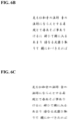
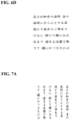
- FIG. 6A to 6D and 7A to 7D are views illustrating examples of the blurred images for explaining the bias caused by the direction of blur.
- FIG. 6A is an image with aberration added downward
- FIG. 6B is an image with aberration added upward
- FIG. 6C is an image with aberration added rightward
- FIG. 6D is an image with aberration added leftward, with respect to an image (original image) of the text to be read rightward on the paper.
- FIG. 7A is an image with aberration added downward
- FIG. 7B is an image with aberration added upward
- FIG. 7C is an image with aberration added rightward
- FIG. 7D is an image with aberration added leftward, with respect to an image (original image) of the text to be read downward on the page.
- FIGS. 6A to 6D many subjects selected FIG. 6C in which rightward aberration is added, as being clearly visible, and among FIGS. 7A to 7D , many subjects selected FIG. 7A in which downward aberration is added, as being clearly visible. That is, in the blurred image containing text, the blur tends to be less noticeable when the direction of reading the text matches the direction of the added aberration. Since the strength of such a bias varies from person to person, it is preferable to measure to what extent the subject has a bias caused by the direction of blur. It is also preferable to perform measurement while taking into consideration the difference due to the language that the subject normally uses.
- the sensitivity to the size of blur can be measured, for example, by presenting multiple blurred images in which different amounts of aberrations are added, to a subject and judging whether the subject can distinguish the difference.
- the extent of the bias caused by the direction of blur can be estimated, for example, from the extent of matching and mismatching in the answers when the direction of the added aberration is varied by 180°.
- the inner product of the unit direction vector in the direction of the added aberration and in the characteristic direction of the spatial frequency characteristics of the original image it is preferable to present the subject with a blurred image with the inner product of 0.7 or more and a blurred image with the inner product of -0.7 or less and obtain a subjective response multiple times, from the viewpoint of reducing the influence of the bias caused by the direction of blur and more accurately measuring the sensitivity to the size of the blur.
- a blurred image with the inner product of 0.7 or more and a blurred image with the inner product of -0.7 or less and obtain a subjective response multiple times, from the viewpoint of reducing the influence of the bias caused by the direction of blur and more accurately measuring the sensitivity to the size of the blur.
- the spectacle lens determination step S103 is, for example, a step of determining a spectacle lens suitable for the subject based on the subject's sensitivity to aberration measured in the blur sensitivity measurement step S102.
- the blur sensitivity measurement step S102 for the subjects who select correct answers many times, it may be determined that they have a high sensitivity to blur, and a progressive power lens that retains as little aberration on a principal meridian as possible may be selected. Further for example, for the subjects who select incorrect answers many times, it may be determined that they have a high sensitivity to blur but prefer a state of large aberration, and a progressive power lens having the aberration preferred by the subject may be selected.
- a progressive power lens of a balanced design in which other improvement is achieved instead of a low aberration for example, a design that prioritizes dioptric power
- a progressive power lens of a balanced design in which other improvement is achieved instead of retaining aberration on the principal meridian may be selected.
- the progressive power lens may be determined as follows, taking into consideration the bias caused by the direction of blur. For example, for the subjects who have high sensitivity to the size of blur and have a small bias caused by the direction of blur, it may be determined that the subjects are susceptible to blur (or have high sensitivity to blur) (or have high sensitivity to blur) on the principal meridian, and a progressive power lens of a design in which as little aberration as possible is retained on the principal meridian may selected.
- a progressive power lens of a design in which the peripheral aberration is improved instead of retaining aberration on the principal meridian may be selected.
- a progressive power lens of a design in which the peripheral aberration is improved instead of retaining aberration on the principal meridian may be selected.
- a progressive power lens of a design in which other aspect (depth of focus, etc.) is improved instead of retaining aberration on the principal meridian, may be selected.
- the spectacle lens may be determined taking into consideration the subject's residual refractive error. Specifically, for example, for the subjects having severe refractive errors such as astigmatism, the spectacle lens may be selected on the assumption that they actually have a slightly higher sensitivity than the sensitivity measured in the blur sensitivity measurement step S102, taking into consideration the possibility that the difference in the appearance of the blurred images may be difficult to distinguish.
- the present invention can also be applied as a determination support system for a spectacle lens.
- the spectacle lens determination support system of this embodiment includes, for example: a storage unit for storing multiple blurred images in which the amount of the added aberration is varied with respect to a predetermined original image; a display unit that simultaneously presents the multiple blurred images to a subject to compare appearances of the images; an input unit into which a subjective response of the subject is inputted; a judgement unit that judges the subject's sensitivity to aberration from the subjective response of the subject; and an output unit from which information for determining a spectacle lens suitable for the subject is outputted based on the subject's sensitivity to aberration.
- the spectacle lens determination support system of this embodiment can be realized, for example, by a tablet terminal equipped with a predetermined program, and has an advantage of low implementation costs. Further, the spectacle lens determination support system of this embodiment may further include, for example, a creation unit that adds a predetermined aberration to the original image and creates a blurred image.
- the above-described embodiment shows a case where two blurred images are prepared, in which the amount of added aberration is varied with respect to a predetermined original image, and the two blurred images are simultaneously presented to the subject to compare the appearances of them.
- three or more blurred images may be prepared and presented simultaneously to compare the appearances of them.
- difference due to a position within a visual field will become dominant. This may make it difficult for the subject to make judgment. Therefore, from the viewpoint of reducing the difference due to the position in the visual field and presenting the blurred images that are easy for the subject to judge, it is preferable to present two blurred images simultaneously to compare the appearances of them as in the above-described embodiment.
- the above-described embodiment shows a case where the directions of the added aberrations in the multiple blurred images presented simultaneously are substantially the same.
- the directions of the added aberrations in the multiple blurred images presented simultaneously do not necessarily have to be substantially the same.
- no astigmatism may be added to one blurred image (with no directional aberration) and astigmatism may be added to the other blurred image (with a directional aberration).
- the subject can easily compare the appearances of the multiple blurred images.
- two blurred images were presented simultaneously.
- six different original images were prepared, and six types of blurred image pairs with different difficulty levels (difficulty level-varied blurred images) were prepared. Further, for each of the six types of blurred image pairs, a rotation angle was changed, and three types of similar blurred images (four types including the original blurred image) were prepared, and a total of 24 types of blurred image pairs were prepared.
- blurred image pairs were displayed on the tablet terminal 24 times in random order, and the subject was allowed to compare the appearances of them, and subjective response as to which image appeared clearer were obtained 24 times.
- the blurred image was enlarged to a size such that the spatial frequency of the main parts was about 6 CPD (equivalent to visual acuity of 0.2), and was presented at a distance of 1 m in front of the subject.
- the subjects who selected blurred images in which the amount of added optical aberration is small were classified as group A having high sensitivity to aberration, and the subjects who selected blurred images in which the amount of added optical aberration is small (or blurred images with good evaluation indexes) at a moderate frequent rate (for example, 7 to 17 times out of 24 times) were classified as group B having low sensitivity to aberration, and the subjects who selected blurred images in which the amount of added optical aberration is small (or blurred images with a good evaluation index) at a not frequent rate (for example, 6 times or less out of 24 times) were classified as group C who evaluated the images from a perspective different from a designer.
- the evaluation index is an index indicating the visibility of a blurred image, calculated from the VSOTF of the blurred image or from the past selection results of the subjects.
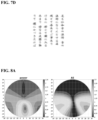
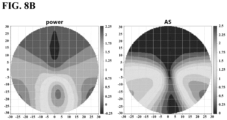
- a progressive power lens suitable for the subject was determined based on the subject's sensitivity to aberration measured in the blur sensitivity measurement step S102 described above. Specifically, for example, for the group A, a progressive power lens having a power distribution (power) and an astigmatism distribution (AS) as illustrated in FIG. 8A was determined, and for the group B, a progressive power lens having a power distribution (power) and an astigmatism distribution (AS) as illustrated in FIG. 8B was determined. This is because as illustrated in FIG. 8A , a lens that is free of astigmatism on and near the principal meridian is suitable for the subject having high sensitivity to aberration, and as illustrated in FIG.
- a lens with astigmatism on the principal meridian but with a wide range of near addition power on both sides are suitable for the subject having low sensitivity to aberration.
- the present inventor so far, no subjects that fell into the group C were found, but since it is difficult to apply objective optical indexes to the group C, it is advisable to perform additional investigations, such as counseling, before determining a spectacle lens.
- the spectacle lens suitable for a subject can be determined by taking into consideration the subject's sensitivity to aberration.
Landscapes
- Health & Medical Sciences (AREA)
- Life Sciences & Earth Sciences (AREA)
- Ophthalmology & Optometry (AREA)
- Physics & Mathematics (AREA)
- General Health & Medical Sciences (AREA)
- Animal Behavior & Ethology (AREA)
- Biomedical Technology (AREA)
- Heart & Thoracic Surgery (AREA)
- Medical Informatics (AREA)
- Molecular Biology (AREA)
- Surgery (AREA)
- Engineering & Computer Science (AREA)
- Biophysics (AREA)
- Public Health (AREA)
- Veterinary Medicine (AREA)
- General Physics & Mathematics (AREA)
- Optics & Photonics (AREA)
- Eyeglasses (AREA)
Applications Claiming Priority (2)
| Application Number | Priority Date | Filing Date | Title |
|---|---|---|---|
| JP2022128803 | 2022-08-12 | ||
| PCT/JP2023/026965 WO2024034373A1 (ja) | 2022-08-12 | 2023-07-24 | 眼鏡レンズの決定方法、および、眼鏡レンズの決定支援システム |
Publications (1)
| Publication Number | Publication Date |
|---|---|
| EP4571401A1 true EP4571401A1 (en) | 2025-06-18 |
Family
ID=89851516
Family Applications (1)
| Application Number | Title | Priority Date | Filing Date |
|---|---|---|---|
| EP23852349.2A Pending EP4571401A1 (en) | 2022-08-12 | 2023-07-24 | Eyeglass lens determination method, and eyeglass lens determination assistance system |
Country Status (5)
| Country | Link |
|---|---|
| US (1) | US20250375107A1 (https=) |
| EP (1) | EP4571401A1 (https=) |
| JP (1) | JPWO2024034373A1 (https=) |
| CN (1) | CN119698571A (https=) |
| WO (1) | WO2024034373A1 (https=) |
Families Citing this family (1)
| Publication number | Priority date | Publication date | Assignee | Title |
|---|---|---|---|---|
| TW202603445A (zh) * | 2024-03-29 | 2026-01-16 | 日商尼康依視路股份有限公司 | 眼鏡鏡片的評估方法、設計方法、選擇方法和製造方法 |
Family Cites Families (4)
| Publication number | Priority date | Publication date | Assignee | Title |
|---|---|---|---|---|
| EP3550356A4 (en) * | 2016-11-30 | 2020-08-12 | Nikon-Essilor Co., Ltd. | GLASS GLASS DESIGN PROCESS, GLASS GLASS MANUFACTURING PROCESS, GLASS CONTROL DEVICE, GLASS GLASS CONTROL AND RECEPTION DEVICE, A SYSTEM FOR ORDERING AND RECEIVING THE GLASS ORDER OF GLASS OF GLASSES, PROGRESSIVE LENS, AND MONOFOCAL LENS |
| JP6894621B2 (ja) * | 2017-03-01 | 2021-06-30 | 東海光学株式会社 | 眼鏡用レンズの設計方法、製造方法及び供給システム |
| EP3398501B1 (en) * | 2017-05-02 | 2025-07-02 | Essilor International | Device for determining astigmatism of an eye of a person |
| CA3168630A1 (en) * | 2020-02-06 | 2021-08-12 | Nikon-Essilor Co., Ltd. | Sensitivity evaluation method for ophthalmic lenses and the design, manufacture, and ordering thereof |
-
2023
- 2023-07-24 US US19/099,201 patent/US20250375107A1/en active Pending
- 2023-07-24 JP JP2024540351A patent/JPWO2024034373A1/ja active Pending
- 2023-07-24 EP EP23852349.2A patent/EP4571401A1/en active Pending
- 2023-07-24 CN CN202380058048.5A patent/CN119698571A/zh active Pending
- 2023-07-24 WO PCT/JP2023/026965 patent/WO2024034373A1/ja not_active Ceased
Also Published As
| Publication number | Publication date |
|---|---|
| JPWO2024034373A1 (https=) | 2024-02-15 |
| US20250375107A1 (en) | 2025-12-11 |
| WO2024034373A1 (ja) | 2024-02-15 |
| CN119698571A (zh) | 2025-03-25 |
Similar Documents
| Publication | Publication Date | Title |
|---|---|---|
| US20190125179A1 (en) | Smart Phone Based Virtual Visual Charts for Measuring Visual Acuity | |
| US20150131056A1 (en) | Method For Providing A Personalized Spectacle Lens Optical System For A Wearer | |
| Kohnen et al. | Defocus curves: focusing on factors influencing assessment | |
| JP6049750B2 (ja) | 眼鏡レンズの輝度依存調整 | |
| KR102848125B1 (ko) | 대상의 전체적 감도 파라미터의 값을 결정하기 위한 방법, 이러한 값을 사용하는 방법들, 및 상기 값을 결정하기 위한 시스템 | |
| EP1158338A2 (en) | Method for simulating an ocular optical system and apparatus therefor | |
| JP2017037330A (ja) | 視線情報補正装置、視線情報検出装置、眼鏡レンズの設計方法、眼鏡レンズの製造方法、眼鏡レンズ選択装置、眼鏡レンズ選択方法、および眼鏡レンズ | |
| WO2011061267A1 (en) | Method for determining binocular performance of a pair of spectacle lenses | |
| KR20170085557A (ko) | 부가적 난시를 갖는 광학 시각 보조기구 | |
| Pope | Progressive addition lenses: history, design, wearer satisfaction and trends | |
| EP4571401A1 (en) | Eyeglass lens determination method, and eyeglass lens determination assistance system | |
| KR102745547B1 (ko) | 감수성 평가 방법, 안경 렌즈의 설계 방법, 안경 렌즈의 제조 방법, 안경 렌즈, 안경 렌즈 발주 장치, 안경 렌즈 수주 장치 및 안경 렌즈 수발주 시스템 | |
| IL305328A (en) | Method, device and computer program product for determining the sensitivity of at least one eye of a subject | |
| CN110062598B (zh) | 用于眼睛中期评估的方法和装置 | |
| EP3109692B1 (en) | Spectacle lens supply system, program therefor, prism amount determination device, prism amount determination method, and method for producing spectacle lens | |
| US20220022742A1 (en) | Method for assessing the suitability between an optical device and a user of the optical device | |
| EP3109694A1 (en) | Spectacle lens supply system, spectacle lens supply method, spectacle lens supply program, spectacle lens recommended type presentation device, and spectacle lens production method | |
| US12366502B2 (en) | System and method for determining a rounded value of an optical feature of an ophthalmic lens adapted to provide a dioptric correction for improving the vision of a subject | |
| US11982879B2 (en) | Method for determining to which extent a lens design is adapted to a user | |
| TWI921636B (zh) | 折射度數決定方法 | |
| JP2025122909A (ja) | 眼鏡レンズの決定方法 | |
| EP4685548A1 (en) | Method for determining progressive refractive power lens | |
| Xu et al. | Method for evaluating 3D display systems based on perceived retinal image | |
| EP4685549A1 (en) | Method for determining progressive refractive power lens | |
| TW202339661A (zh) | 折射度數決定方法 |
Legal Events
| Date | Code | Title | Description |
|---|---|---|---|
| STAA | Information on the status of an ep patent application or granted ep patent |
Free format text: STATUS: THE INTERNATIONAL PUBLICATION HAS BEEN MADE |
|
| PUAI | Public reference made under article 153(3) epc to a published international application that has entered the european phase |
Free format text: ORIGINAL CODE: 0009012 |
|
| STAA | Information on the status of an ep patent application or granted ep patent |
Free format text: STATUS: REQUEST FOR EXAMINATION WAS MADE |
|
| 17P | Request for examination filed |
Effective date: 20250225 |
|
| AK | Designated contracting states |
Kind code of ref document: A1 Designated state(s): AL AT BE BG CH CY CZ DE DK EE ES FI FR GB GR HR HU IE IS IT LI LT LU LV MC ME MK MT NL NO PL PT RO RS SE SI SK SM TR |
|
| DAV | Request for validation of the european patent (deleted) | ||
| DAX | Request for extension of the european patent (deleted) | ||
| RAP3 | Party data changed (applicant data changed or rights of an application transferred) |
Owner name: HOYA LENS THAILAND LTD. |