EP4570871A1 - Plasmonische tinte mit kern-schale-metallnanopartikeln - Google Patents
Plasmonische tinte mit kern-schale-metallnanopartikeln Download PDFInfo
- Publication number
- EP4570871A1 EP4570871A1 EP23307189.3A EP23307189A EP4570871A1 EP 4570871 A1 EP4570871 A1 EP 4570871A1 EP 23307189 A EP23307189 A EP 23307189A EP 4570871 A1 EP4570871 A1 EP 4570871A1
- Authority
- EP
- European Patent Office
- Prior art keywords
- weight
- specifically
- copper
- silver
- core
- Prior art date
- Legal status (The legal status is an assumption and is not a legal conclusion. Google has not performed a legal analysis and makes no representation as to the accuracy of the status listed.)
- Pending
Links
Images


Classifications
-
- C—CHEMISTRY; METALLURGY
- C09—DYES; PAINTS; POLISHES; NATURAL RESINS; ADHESIVES; COMPOSITIONS NOT OTHERWISE PROVIDED FOR; APPLICATIONS OF MATERIALS NOT OTHERWISE PROVIDED FOR
- C09D—COATING COMPOSITIONS, e.g. PAINTS, VARNISHES OR LACQUERS; FILLING PASTES; CHEMICAL PAINT OR INK REMOVERS; INKS; CORRECTING FLUIDS; WOODSTAINS; PASTES OR SOLIDS FOR COLOURING OR PRINTING; USE OF MATERIALS THEREFOR
- C09D11/00—Inks
- C09D11/16—Writing inks
- C09D11/17—Writing inks characterised by colouring agents
-
- C—CHEMISTRY; METALLURGY
- C09—DYES; PAINTS; POLISHES; NATURAL RESINS; ADHESIVES; COMPOSITIONS NOT OTHERWISE PROVIDED FOR; APPLICATIONS OF MATERIALS NOT OTHERWISE PROVIDED FOR
- C09D—COATING COMPOSITIONS, e.g. PAINTS, VARNISHES OR LACQUERS; FILLING PASTES; CHEMICAL PAINT OR INK REMOVERS; INKS; CORRECTING FLUIDS; WOODSTAINS; PASTES OR SOLIDS FOR COLOURING OR PRINTING; USE OF MATERIALS THEREFOR
- C09D11/00—Inks
- C09D11/16—Writing inks
- C09D11/18—Writing inks specially adapted for ball-point writing instruments
-
- B—PERFORMING OPERATIONS; TRANSPORTING
- B82—NANOTECHNOLOGY
- B82Y—SPECIFIC USES OR APPLICATIONS OF NANOSTRUCTURES; MEASUREMENT OR ANALYSIS OF NANOSTRUCTURES; MANUFACTURE OR TREATMENT OF NANOSTRUCTURES
- B82Y40/00—Manufacture or treatment of nanostructures
Definitions
- the present disclosure relates to a process for preparing an aqueous suspension and an aqueous gel ink comprising core-shell metal nanoparticles.
- the present disclosure relates to an aqueous suspension and an aqueous gel ink comprising core-shell metal nanoparticles.
- Writing instruments such as ballpoint pens comprise inks to produce images, texts or designs.
- the inks typically comprise pigments or dyes as colorants.
- the production of pigments and dyes, as well as the inadequate disposal of dyes and pigments may be harmful to the environment.
- Very recently plasmonic nanoparticles have emerged as an alternative colorant for writing instrument inks.
- Inks comprising plasmonic nanoparticles may be referred to as plasmonic ink compositions.
- the color and intensity (vividness) of aqueous plasmonic ink compositions may be controlled by adjusting the particle size of the plasmonic nanoparticles.
- the "vividness” should be understood as the intensity when applied on a support, in particular on a porous support, i.e. an absorbing support or a synthetic paper.
- a first ink comprising gold nanoparticles of smaller particle size may show a color closer to blue compared to a second ink comprising gold nanoparticles of a greater particle size, which may show a color closer to red.
- the color and intensity (vividness) of the aqueous plasmonic ink compositions may be controlled by adjusting the structure of the metal nanoparticles.
- plasmonic ink compositions may be formulated with metal nanoparticles consisting of a single metal.
- metal nanoparticles consisting of a single metal for example only silver, gold or copper
- metal nanoparticles consisting of a single metal may have a plasmonic spectrum with well-defined peaks, but their absorption efficiency is limited and they tend to scatter light. This may have a negative impact on the vividness/intensity of the color of the ink composition.
- the weight ratio of metallic copper to metallic silver is from 6 to 20, more specifically from 6 to 15, and in particular from 6 to 12.
- the core of the metal nanoparticles comprises silver and the shell of the metal nanoparticles comprises copper.
- the core of the metal nanoparticles essentially consists or consists of silver and the shell of the metal nanoparticles essentially consists or consists of copper.
- the silver salt is chosen from AgNO 3 , AgClO 4 , Ag 2 SO 4 , AgCl, AgBr, AgOH, Ag 2 O, AgBF 4 , AglO 3 , AgPF 6 and mixtures thereof, more specifically the silver salt is silver nitrate AgNO 3 .
- the copper salt is a copper (II) salt.
- the copper (II) salt is chosen from CuSO 4 , CuCl 2 , CuO, Cu(NO 3 ) 2 , CuF 2 , CuBr 2 , CuCO 3 , Cu(OAc) 2 , Cu(ClO 3 ) 2 , Cu(N 3 ) 2 , Cu 2 (CO 3 ) 2 (OH) 2 , Cu(OH) 2 , and mixtures thereof, even more specifically the copper salt is copper sulfate CuSO 4 .
- the silver salt (more specifically the silver nitrate) is added at an amount from 0.01 to 2 weight%, more specifically from 0.05 to 1.5 weight%, more specifically from 0.05 to 1 weight%, and in particular from 0.05 to 0.5 weight%, based on the total weight of the aqueous suspension.
- the copper salt (more specifically the copper sulfate) is added at an amount from 0.5 to 15 weight%, more specifically from 1 to 10 weight%, more specifically from 1 to 5 weight%, and in particular from 1 to 4 weight%, based on the total weight of the aqueous suspension.
- the dispersing agent is present at an amount from 0.1 to 1.1 weight%, more specifically from 0.15 to 1.0 weight%, more specifically from 0.2 to 0.8 weight%, and in particular from 0.25 to 0.4 weight%, based on the total weight of the aqueous suspension.
- the dispersing agent comprises homopolymers or copolymers of vinylpyrrolidone, more specifically polyvinylpyrrolidone.
- the ascorbic acid is present at an amount from 1 to 10 weight%, more specifically from 2 to 8 weight%, and in particular from 3 to 7 weight%, based on the total weight of the aqueous suspension.
- the alkali base is chosen from metallic oxides and/or metallic hydroxides, more specifically chosen from Na 2 O, K 2 O, CS 2 O, CaO, BaO, NaOH, KOH, CsOH, Ca(OH) 2 , Ba(OH) 2 , and mixtures thereof, and in particular the alkali base is sodium hydroxide NaOH.
- the alkali base is added at an amount from 0.5 to 30 weight%, more specifically from 1 to 20 weight%, and in particular from 2 to 10 weight%, based on the total weight of the aqueous suspension.
- the process is carried out at a temperature from 0 to 100°C, more specifically from 5 to 80°C, more specifically from 20 to 80°C, more specifically from 50 to 68°C, more specifically from 53 to 65 °C, and even more specifically from 55 to 63°C.
- the process comprises a step of preparing a first mixture comprising water, the silver salt and the copper salt, and then adding to that first mixture a second mixture comprising the ascorbic acid, more specifically wherein the first mixture has a pH of from 5 to 9 and more specifically from 6 to 8.
- the process comprises a step of:
- the first mixture has a pH from 5 to 9, and more specifically from 6 to 8.
- the second mixture has a pH from 5 to 9, and more specifically from 6 to 8.
- the step of mixing the first mixture with the second mixture is carried out by adding the second mixture to the first mixture, in particular under stirring, the step of mixing the first mixture with the second mixture is carried out more specifically for a duration of at least 10 min, and more specifically for a duration of at least 1 hour.
- the step of mixing the first mixture with the second mixture is carried out at a temperature from 0 to 100°C, more specifically from 5 to 80°C, more specifically from 20 to 80°C, more specifically from 50 to 68°C, more specifically from 53 and 65 °C, and even more specifically from 55 to 63°C.
- the pH of the aqueous suspension is from 4 to 8, more specifically from 4.5 to 7, and in particular from 5 to 7.
- the process is not carried out under inert atmosphere.
- the process does not comprise the addition of sodium borohydride NaBH 4 , more specifically the process does not comprise the addition of sodium borohydride, and/or hydrazine, and/or lithium tetrahydruroalum inate.
- the process does not comprise a step of adding an additional coloring agent.
- the process further comprises a step of adding a homopolymer or copolymer of vinyl alcohol.
- the core-shell metal nanoparticles have an average particle size from 10 to 250 nm, specifically from 20 to 200 nm, and even more specifically from 40 to 170 nm.
- the aqueous gel ink has a fixed color.
- the aqueous suspension is concentrated by nanofiltration, in particular wherein the aqueous suspension is retained by a porous polysulfone membrane.
- the gel-based matrix comprises one or more of a co-solvent, an antimicrobial agent, a corrosion inhibitor, an antifoam agent, and/or a rheology modifier.
- the core of the metal nanoparticles consists or essentially consists of silver and the shell of the metal nanoparticles consists or essentially consists of copper.
- the aqueous suspension exhibits a plasmonic effect.
- the metal nanoparticles are the only coloring agent.
- the nanoparticles are present at an amount of 0.11 to 2.0 weight%, more specifically from 0.22 to 1.1 weight%, and in particular from 0.23 to 0.88 weight%, based on the total weight of the aqueous suspension.
- the aqueous suspension comprises from 0.1 to 1.5 weight%, more specifically from 0.2 to 1 weight%, and in particular from 0.2 to 0.8 weight% of copper based on the total weight of the aqueous suspension.
- the aqueous suspension comprises from 0.01 to 0.5 weight%, more specifically from 0.02 to 0.1 weight%, and in particular from 0.03 to 0.08 weight% of silver based on the total weight of the aqueous suspension.
- the dispersing agent is present at an amount of 0.1 to 1.1 weight%, based on the total weight of the aqueous suspension.
- the dispersing agent comprises homopolymers or copolymers of vinylpyrrolidone, more specifically polyvinylpyrrolidone.
- the ascorbic acid and/or its residuals is present at an amount of 0.00000002 to 0.2 weight%, based on the total weight of the aqueous suspension.
- the alkali metal salt is chosen from a sodium salt, a potassium salt, a calcium salt, a barium salt, a cesium salt, and mixtures thereof, and in particular the alkali metal salt is a sodium salt.
- the alkali metal salt is present at an amount of 0.00000002 to 0.2 weight%, in particular from 0.00000002 to 0.1 weight%, based on the total weight of the aqueous suspension.
- the aqueous suspension comprises water at an amount of 50 to 95 weight%, more specifically from 70 to 90 weight%, and in particular from 75 to 90 weight%, based on the total weight of the aqueous gel ink.
- the pH of the aqueous suspension is from 4 and 8, more specifically from 4.5 to 7, and in particular from 5 to 7.
- the core-shell metal nanoparticles have an average particle size from 10 to 250 nm, specifically from 20 to 200 nm, and even more specifically from 40 to 170 nm.
- the aqueous suspension further comprises a homopolymer or copolymer of vinyl alcohol.
- the aqueous suspension is obtained by the process disclosed above.
- It is a fourth object of the present disclosure to provide an aqueous gel ink comprising core-shell metal nanoparticles which essentially consist of metal, a dispersing agent, ascorbic acid and/or its residuals and an alkali metal salt, wherein the core of the metal nanoparticles comprises silver and the shell of said nanoparticles comprises copper and wherein the weight ratio of metallic copper to metallic silver is equal to or higher than 4
- the aqueous gel ink exhibits a plasmonic effect.
- the metal nanoparticles are the only coloring agent.
- the aqueous gel ink has a fixed color.
- the core of the metal nanoparticles consists or essentially consists of silver and the shell of the metal nanoparticles consists or essentially consists of copper.
- the core-shell metal nanoparticles are present at an amount of 0.11 to 11 weight%, more specifically from 0.55 to 8.5 weight%, and in particular from 1.1 to 5.5 weight%, based on the total weight of the aqueous gel ink.
- the aqueous gel ink comprises from 0.01 to 1 weight%, more specifically from 0.05 to 0.5 weight%, and in particular from 0.1 to 0.5 weight% of silver, based on the total weight of the aqueous gel ink.
- the aqueous gel ink comprises from 0.1 to 10 weight%, more specifically from 0.5 to 8 weight%, and in particular from 1 to 5 weight% of copper, based on the total weight of the gel ink.
- the dispersing agent is present at an amount of 0.01 to 1.5 weight%, more specifically from 0.01 to 1.5 weight%, more specifically from 0.2 to 1.5 weight%, and in particular from 0.5 to 1.5 weight%, based on the total weight of the aqueous gel ink.
- the dispersing agent comprises homopolymers or copolymers of vinylpyrrolidone, more specifically polyvinylpyrrolidone.
- the ascorbic acid and/or its residuals is present at an amount of 0.0000001 to 0.5 weight%, based on the total weight of the aqueous gel ink.
- the alkali metal salt is present at an amount of 0.0000001 to 0.5 weight%, in particular from 0.0000002 to 0.1 weight%, based on the total weight of the aqueous gel ink.
- the alkali metal salt is chosen from a sodium salt, a potassium salt, a calcium salt, a barium salt, a cesium salt, and mixtures thereof, and in particular the alkali metal salt is a sodium salt.
- the aqueous gel ink comprises water at an amount of 25 to 80 weight%, more specifically from 30 to 70 weight%, and in particular from 30 to 60 weight%, based on the total weight of the aqueous gel ink.
- the core-shell metal nanoparticles have an average particle size from 10 to 250 nm, specifically from 20 to 200 nm, and even more specifically from 40 to 170 nm.
- the aqueous gel ink further comprises a homopolymer or copolymer of vinyl alcohol.
- the aqueous gel ink further comprises one or more of a co-solvent, an antimicrobial agent, a corrosion inhibitor, an antifoam agent, and/or a rheology modifier.
- the aqueous gel ink further comprises:
- the aqueous gel ink is obtained by the process disclosed above.
- the writing instrument is configured to dispense from 150 to 800 mg/100m, specifically from 200 to 700 mg/100m, more specifically from 250 to 600 mg/100m and in particular from 250 to 500 mg/100m.
- It is a sixth object of the present disclosure to provide a method of writing with an aqueous gel ink comprising the step of writing on an absorbing support, specifically paper, notably cellulosic paper, cardboard or textile, more specifically paper, with an aqueous gel ink disclosed above.
- It is a seventh object of the present disclosure to provide a method of writing with an aqueous gel ink comprising the step of writing on a synthetic paper, specifically a synthetic polymer, more specifically wherein the synthetic polymer is selected from polyolefins, polyesters, polyethers, polyketones, polyamides, polyvinyls and polystyrenes, with an aqueous gel ink disclosed above.
- the present disclosure makes it possible to address the need mentioned above.
- the present disclosure provides a plasmonic ink composition presenting an improved writing performance in terms of vividness and safety, that is produced in a simple and cost-effective manner.
- the process according to the present disclosure allows to obtain an aqueous gel ink that has an improved vividness when applied on a support, more specifically on a porous support, and increased safety, with regards to already existing plasmonic inks comprising metal nanoparticles comprising or consisting of a single metal.
- the process according to the present disclosure allows to obtain core-shell metal nanoparticles which essentially consist of metal, wherein the core of said nanoparticles comprises at least one of silver or copper and wherein the shell of said nanoparticles comprises at least one of the other of silver or copper.
- the weight ratio of metallic copper to metallic silver should be equal to or higher than 4.
- the desired core-shell nanoparticles cannot be formed, as only nanoparticles comprising silver (and no copper) and nanoparticles comprising copper (and no silver) are formed.
- the alkali base allows to avoid precipitation of the copper salts and promotes the formation of the core-shell nanoparticles (notably by avoiding an acidic pH in the reaction mixture). It shall be noted that in the absence of an alkali base, the formation of core-shell nanoparticles is prevented as only nanoparticles comprising silver (and no copper) and nanoparticles comprising copper (and no silver) are formed and then aggregate to form precipitates.
- the dispersing agent allows to disperse the formed nanoparticles and reduce or even avoid agglomeration and/or aggregation and/or sedimentation of the nanoparticles so as to stabilize them
- the presence of ascorbic acid which is considered as a weak reducing agent, allows to slowly reduce the metal salts so as to form the core-shell nanoparticles.
- a strong reducing agent is used instead of ascorbic acid, such as sodium borohydride for example, the reduction reaction is carried out very quickly and the formation of core-shell nanoparticles is prevented.
- the aqueous gel ink comprising core-shell metal nanoparticles according to the present disclosure presents an improved vividness when applied on a support, in particular on a porous support, compared to an aqueous gel ink comprising nanoparticles comprising or consisting of a single metal.
- core-shell metal nanoparticles allow to produce a synergistic effect due to the presence of more than one metals in the nanoparticles. This means that the properties of such nanoparticles are improved and can be more easily adjustable.
- core-shell metal nanoparticles may have an improved chemical stability, an improved light absorption efficiency, an increased electrical conductivity, and tunable magnetic properties.
- the plasmon effect of the core-shell metal nanoparticles may be amplified compared to an aqueous gel ink comprising nanoparticles comprising or consisting of a single metal.
- the above benefits provided with the core-shell metal nanoparticles are not provided in the case of nanoparticles comprising alloys of different metals within each nanoparticle, that are not organized in the form of core-shell nanoparticles but are randomly distributed in the nanoparticle. More specifically, in case of core-shell nanoparticles, the surface of contact between the core that comprises one metal and the shell that comprises a different metal contributes to enhance the plasmonic effect whereas such effect cannot be obtained in case of nanoparticles comprising alloys of metals, as the interactions between the different metals of the alloy cannot be predicted (i.e. the "location" of each of the constituent metals in the nanoparticle is random) and thus the control of the properties of the nanoparticles becomes very difficult. For example, for such alloy metal nanoparticles, the light scattering may be reduced compared to pure metal nanoparticles, which means that the intensity/vividness of the color is lower.
- the amount of silver is reduced (compared to metal nanoparticles consisting (or essentially consisting) of silver) in the ink, which renders such ink more safe and compliant to any future safety regulations.
- the present disclosure relates to a process for preparing an aqueous suspension of core-shell metal nanoparticles.
- core-shell nanoparticles is meant a type of biphasic material that have an inner core structure and an outer shell made of different components.
- the core-shell metal nanoparticles of the present disclosure essentially consist of metal.
- core-shell metal nanoparticles essentially consisting of metal is meant that the main component of the nanoparticles is metal and in particular that other ingredients in the metal nanoparticles such as impurities, such as metal oxides are only present in trace amounts. More specifically, the content of metal is of at least 95 weight%, even more specifically of at least 98 weight%, relative to the total weight of nanoparticles.
- the core-shell metal nanoparticles may be identified for example by Energy Dispersive X-ray (EDX) microanalysis.
- EDX analysis is an analytical technic used to characterize the element composition and chemical analysis of a sample with atomic number (Z) superior to 3.
- Z atomic number
- the EDX is configured to collect X-ray signals from the silver metal (Ag) and copper metal (Cu) and allows to obtain the spatial visualization of the distribution of silver and copper metals.
- Energy Dispersive X-Ray (EDX) is usually used in combination with Transmission Electron Microscope (TEM) of 2D images (microscope: JEOL ARM 200) according to the standard ISO9001:2015.
- TEM Transmission Electron Microscope
- the core-shell metal nanoparticles consist of metal.
- the core-shell metal nanoparticles are formed in an aqueous suspension prepared by the process according to the present disclosure.
- Such process comprises mixing:
- the silver salt mentioned above can be chosen from silver nitrate (AgNO 3 ), silver perchlorate (AgClO 4 ), silver sulfate (Ag 2 SO 4 ), silver chloride (AgCl), silver bromide (AgBr), silver hydroxide (AgOH), silver oxide (Ag 2 O), silver tetrafluoroborate (AgBF 4 ), silver iodate (AglO 3 ), silver hexafluorophosphate (AgPF 6 ) and mixtures thereof.
- the silver salt may be silver nitrate (AgNO 3 ).
- the silver salt can be added/used at an amount from 0.01 to 2 weight%, more specifically from 0.05 to 1.5 weight%, in particular from 0.05 to 1 weight%, and in particular from 0.05 to 0.5 weight%, based on the total weight of the aqueous suspension.
- the copper salt mentioned above can be a copper (II) salt.
- such salt can be chosen from copper sulfate (CuSO 4 ), copper chloride (CuCl 2 ), copper oxide (CuO), copper nitrate (Cu(NO 3 ) 2 ), copper fluoride (CuF 2 ), copper bromide (CuBr 2 ), copper carbonate (CuCO 3 ), copper acetate (Cu(OAc) 2 ), copper chlorate Cu(ClO 3 ) 2 ), copper azide (Cu(N 3 ) 2 ), copper hydroxide carbonate or malachite Cu 2 (CO 3 ) 2 (OH) 2 ), copper hydroxide (Cu(OH) 2 ), and mixtures thereof.
- the copper salt may be copper sulfate (CuSO 4 ).
- the copper salt can be added/used at an amount from 0.5 to 15 weight%, more specifically from 1 to 10 weight%, in particular from 1 to 5 weight%, and in particular from 1 to 4 weight%, based on the total weight of the aqueous suspension.
- the weight ratio of (metallic) copper to (metallic) silver is equal to or higher than 4, more specifically equal to or higher than 6. It shall be noted that the inventors have surprisingly discovered that when the weight ratio is lower than 4, the desired core-shell nanoparticles cannot be formed and only nanoparticles comprising silver (and no copper) and nanoparticles comprising copper (and no silver) are formed.
- the content of metallic copper and metallic silver in the aqueous suspension and in the aqueous gel ink may be measured by elemental analysis using an Inductively Coupled Plasma Mass Spectrometry (ICP-MS) apparatus (apparatus: ICP OES Varian 725-ES Radial).
- ICP-MS Inductively Coupled Plasma Mass Spectrometry
- the weight ratio of (metallic) copper to (metallic) silver is from 4 to 20, more specifically from 6 to 20, even more specifically from 6 to 15 and in particular from 6 to 22.
- a dispersing agent is also added and used to form the desired core-shell nanoparticles.
- the dispersing agent can be chosen among homopolymers or copolymers of vinylpyrrolidone.
- the homopolymer or copolymer of vinylpyrrolidone may be polyvinylpyrrolidone.
- such component offers excellent steric stability and/or helps prevent metal nanoparticles from directly contacting and/or aggregating and/or sedimenting in a water-based ink, which allows to obtain a stronger and/or a more stable plasmon effect (such effect will be explained below).
- such agglomeration and/or aggregation and/or sedimentation may prevent obtaining a plasmonic effect.
- the dispersing agent may be used at an amount from 0.1 to 1.1 weight% based on the total weight of the aqueous suspension. More specifically, said amount may be from 0.15 to 1.0 weight%, more specifically from 0.2 to 0.8 weight%, and in particular from 0.25 to 0.4 weight%, based on the total weight of the aqueous suspension.
- the above-mentioned ranges are advantageous for the formation of the core-shell metal nanoparticles.
- the process further comprises a step of adding an additional dispersing agent (other than the above (first) dispersing agent).
- Said additional dispersing agent may be a homopolymer or copolymer of vinyl alcohol such as polyvinyl alcohol.
- Said additional dispersing agent may be added at an amount from 0.01 to 1 weight% relative to the total weight of the aqueous suspension.
- the total amount of dispersing agent i.e. total amount of homopolymer or copolymer of vinylpyrrolidone and of further dispersing agent
- the total amount of dispersing agent is lower than or equal to 1.1 weight%, based on the total weight of the aqueous suspension.
- ascorbic acid is added in the mixture so as to form the core-shell metal nanoparticles. More particularly, the presence of ascorbic acid, which is considered as a weak reducing agent, is necessary so as to slowly reduce the metal salts and form the core-shell metal nanoparticles. It shall be noted that the same result (formation of core-shell metal nanoparticles) cannot be achieved with a strong reducing agent (such as sodium borohydride, hydrazine or lithium tetrahydroaluminate). In fact, in this case, the reduction reaction is carried out very quickly and the formation of core-shell nanoparticles is prevented.
- a strong reducing agent such as sodium borohydride, hydrazine or lithium tetrahydroaluminate.
- the process according to the present disclosure does not comprise a step of adding one or more further reducing agents, in particular such as of sodium borohydride, and/or hydrazine, and/or lithium tetrahydruroaluminate.
- the process according to the present disclosure does not comprise adding sodium borohydride, hydrazine, and lithium tetrahydruroaluminate.
- the ascorbic acid may be added/used at an amount from 1 to 10 weight%, more specifically from 2 to 8 weight%, and in particular from 3 to 7 weight%, based on the total weight of the aqueous suspension.
- ascorbic acid is a weak reducing agent
- the disclosed amounts of ascorbic acid allow to successfully reduce the silver salt and copper salt in metallic silver and metallic copper respectively, in particular when ascorbic acid is the sole reducing agent (when no further reducing agent is added).
- an alkali base is added in the mixture of the process according to the present disclosure.
- the alkali base allows to avoid precipitation of the copper salts and further promotes the formation of the core-shell nanoparticles, notably by adjusting the pH of the mixture and by avoiding an acidic pH in the reaction mixture.
- the pH of the mixture is acidic (i.e. below 7). It shall be noted that in the absence of an alkali base, the formation of core-shell nanoparticles is prevented as only nanoparticles comprising silver (and no copper) and nanoparticles comprising copper (and no silver) are formed and then aggregate to form precipitates.
- the alkali base may be chosen from metallic oxides and/or metallic hydroxides. More specifically the alkali base may be chosen from sodium oxide (Na 2 O), potassium oxide (K 2 O), cesium oxide (Cs2O), calcium oxide (CaO), barium oxide (BaO), sodium hydroxide (NaOH), potassium hydroxide (KOH), cesium hydroxide (CsOH), calcium hydroxide (Ca(OH) 2 ), barium hydroxide (Ba(OH) 2 ), and mixtures thereof.
- the alkali base may be a metallic hydroxide, and in particular sodium hydroxide (NaOH).
- the alkali base may be added/used at an amount from 0.5 to 30 weight%, more specifically from 1 to 20 weight%, and in particular from 2 to 10 weight%, based on the total weight of the aqueous suspension.
- the process according to the present disclosure may be carried out at a temperature from 0 to 100°C, more specifically from 5 to 80°C, more specifically from 20 to 80°C, more specifically from 50 to 68°C, more specifically from 53 to 65 °C, and even more specifically from 55 to 63°C.
- the above temperature range may be advantageous for the formation of the core-shell metal nanoparticles. According to preferred embodiments, this temperature may be from 53 to 65 °C. According to more preferred embodiments, this temperature may be from 55 to 63°C.
- the process according to the present disclosure may be carried out in ambient atmosphere (ambient atmospheric pressure).
- this process is not carried out under inert atmosphere (for example the process is not carried out under argon or nitrogen atmosphere).
- the process according to the present disclosure may comprise a step of preparing a first mixture comprising water, the silver salt and the copper salt, and then adding to that first mixture a second mixture comprising the ascorbic acid.
- the pH of the first mixture may be from 5 to 9, and more specifically from 6 to 8.
- the pH of the second mixture may be from 5 to 9, and more specifically from 6 to 8.
- the alkali base may be added in the first mixture and/or the second mixture, and more specifically the alkali base may be added in the first mixture and the second mixture.
- a pH from 5 to 9, and more particularly from 6 to 8 allows to promote the formation of the core-shell nanoparticles.
- the process according to the present disclosure may comprise a first step (i) of preparing a first mixture comprising the silver salt, the copper salt, the dispersing agent, alkali base and water, and a second step (ii) of preparing a second mixture comprising the ascorbic acid, alkali base and water.
- Said embodiment further comprises a third step (iii) of mixing the first mixture with the second mixture to form the aqueous suspension.
- the first mixture may have a pH from 5 to 9, and more specifically from 6 to 8.
- said pH may be from 5 to 6, or from 6 to 7 or from 7 to 8 or from 8 to 9.
- This specific pH is achieved by adding the alkali base in the mixture comprising the ascorbic acid and the water.
- the second mixture may have a pH from 5 to 9, and more specifically from 6 to 8.
- said pH may be from 5 to 6, or from 6 to 7 or from 7 to 8 or from 8 to 9.
- This specific pH is achieved by adding the alkali base in the mixture comprising the silver salt, the copper salt, the dispersing agent and the water.
- the alkali base is added to the first mixture and/or the second mixture and more specifically the alkali base is added both to the first mixture and the second mixture.
- the pH of the first mixture may be the same as the pH of the second mixture.
- the first mixture and/or (preferably and) the second mixture may be at a temperature from 5 to 40°C, more specifically from 10 to 30°C and in particular from 15 to 25°C.
- the first mixture and/or (preferably and) the second mixture may be at ambient atmospheric pressure (around 1 bar).
- the step of mixing the first mixture with the second mixture may be carried out by adding the first mixture to the second mixture.
- the step of mixing the first mixture with the second mixture may be carried out by adding the second mixture to the first mixture.
- the step of mixing the first mixture with the second mixture may be done under stirring, more specifically for a duration of at least 10 minutes, and more specifically for a duration of at least 1 hour.
- the step of mixing the first mixture with the second mixture may be carried out at a temperature from 0 to 100°C, more specifically from 5 to 80°C, more specifically from 20 to 80°C, more specifically from 50 to 68°C, more specifically from 53 to 65 °C, and even more specifically from 55 to 63°C.
- the above temperature range may be advantageous for the formation of the core-shell metal nanoparticles. According to preferred embodiments, this temperature may be from 53 to 65°C. According to more preferred embodiments, this temperature may be from 55 to 63°C.
- the pH of the aqueous suspension obtained after the third step (iii) of mixing the first mixture with the second mixture is from 4 and 8, more specifically from 4.5 to 7, and in particular from 5 to 7.
- such pH may be from 4 to 5, or from 5 to 6, or from 6 to 7, or from 7 to 8.
- the pH of the aqueous suspension is lower than the pH of the first mixture and lower than the pH of the second mixture.
- the present disclosure thus, further relates to an aqueous suspension comprising core-shell metal nanoparticles.
- the core-shell nanoparticles may have an essentially spherical shape. More specifically, the external surface of the core-shell nanoparticles (i.e. the external surface of the (outer) shell of the core-shell metal nanoparticles) may present diverse roughness, i.e. may have one or more protrusions. In other words, the external surface of the core-shell nanoparticles (i.e. the external surface of the (outer) shell of the core-shell metal nanoparticles) is not smooth.
- the core of said nanoparticles comprises at least one of silver or copper and the shell of said nanoparticles comprises at least one of the other of silver or copper.
- the silver salt and the copper salt are reduced to metallic silver and metallic copper respectively, so as to form the core-shell metal nanoparticles.
- the core of the metal nanoparticles comprises, essentially consists, or consists of copper and the shell of the metal nanoparticles comprises, essentially consists, or consists of silver.
- the core of the metal nanoparticles comprises, essentially consists, or consists of silver and the shell of the metal nanoparticles comprises, essentially consists, or consists of copper.
- the metallic silver is found in the core of the metal nanoparticles, while the metallic copper is found in the shell of the metal nanoparticles.
- the process according to the present disclosure allows to form core-shell nanoparticles having a weight ratio of (metallic) copper to (metallic) silver equal to or higher than 4, more preferably equal to or higher than 6.
- Such embodiment is advantageous as it is of interest to reduce the amount of silver without affecting the intensity/vividness of the final color.
- the core-shell metal nanoparticles according to the present disclosure play the role of a coloring agent.
- the aqueous suspension is devoid of any other additional coloring agent (therefore the above-described process does not comprise a step of adding an additional coloring agent).
- the core-shell metal nanoparticles are the only coloring agent.
- the core-shell metal nanoparticles have an average particle size from 10 to 250 nm, more specifically from 20 to 200 nm, and even more specifically from 40 to 170 nm. More specifically, the longest dimension of the core-shell metal nanoparticles is from 10 to 250 nm, more specifically from 20 to 200 nm, and even more specifically from 40 to 170 nm. Even more specifically, all dimensions of the core-shell metal nanoparticles range from 10 to 250 nm, more specifically from 20 to 200 nm, and even more specifically from 40 to 170 nm. This average particle size and the dimension of the particles may be determined by Transmission Electron Microscopy analysis of 2D images (microscope: JEOL ARM 200), according to the standard ISO9001:2015.
- DLS Dynamic Light Scattering
- DLS Dynamic Light scattering
- DLS is a particle sizing technique that relies on the interaction of coherent light with the Brownian motion of particles in a small volume. This leads to a requirement of dilute solutions, in particular dilution of at least 10.
- DLS analysis can be carried out with a DLS Zetasizer Ultra apparatus from Malvern.
- the aqueous suspension may comprise core-shell metal nanoparticles at an amount from 0.11 to 2 weight%, more specifically from 0.22 to 1.1 weight%, and in particular from 0.23 to 0.88 weight%, based on the total weight of the aqueous suspension.
- the aqueous suspension may comprise copper at an amount from 0.1 to 1.5 weight%, more specifically from 0.2 to 1 weight%, and in particular from 0.2 to 0.8 weight%, based on the total weight of the aqueous suspension.
- the aqueous suspension may comprise silver at an amount from 0.01 to 0.5 weight%, more specifically from 0.02 to 0.1 weight%, and in particular from 0.03 to 0.08 weight%, based on the total weight of the aqueous suspension.
- the aqueous suspension aside from the core-shell metal nanoparticles, comprises a dispersing agent.
- the dispersing agent may be present in the aqueous suspension at an amount from 0.1 to 1.1 weight% based on the total weight of the aqueous suspension.
- the process further comprises a step of adding an additional dispersing agent (other than the above first dispersing agent).
- Said additional dispersing agent may be a homopolymer or copolymer of vinyl alcohol such as polyvinyl alcohol.
- Said additional dispersing agent may be added in the aqueous suspension at an amount from 0.01 to 1 weight%, relative to the total weight of the aqueous suspension.
- the total amount of dispersing agent i.e. total amount of homopolymer or copolymer of vinylpyrrolidone and of further dispersing agent
- the total amount of dispersing agent is lower than or equal to 1.1 weight%, based on the total weight of the aqueous suspension.
- the aqueous suspension comprises ascorbic acid and/or its residuals.
- residuals is meant any oxidized form or any product of decomposition of the ascorbic acid. This term is used because as the ascorbic acid is used to reduce the silver salt and the copper salt in metallic silver and metallic copper to form the core-shell metal nanoparticles, in some embodiments, the ascorbic acid may already be (largely) consumed in the process of preparing the core-shell metal nanoparticles and that (mostly) residuals of the ascorbic acid, e.g. their oxidized forms or a products of further decomposition, are present. Therefore, according to some embodiments, the ascorbic acid and/or its residuals may be present at an amount of 0.00000002 to 0.2 weight%, based on the total weight of the aqueous suspension.
- the aqueous suspension further comprises an alkali metal salt.
- alkali metal salt is meant any salt formed during the above process for the preparation of the nanoparticles that comprises the alkali cation of the alkali base detailed above. Therefore, the alkali metal salt may be chosen from a sodium salt, a potassium salt, a calcium salt, a barium salt, a cesium salt, and mixtures thereof. In preferred embodiments, the alkali metal salt may be a sodium salt. Said alkali metal salt may be present in the aqueous suspension at an amount from 0.00000002 to 0.2 weight%, in particular from 0.00000002 to 0.1 weight%, based on the total weight of the aqueous suspension.
- the aqueous suspension may further comprise water.
- Water can be present at an amount from 50 to 95 weight%, more specifically from 70 to 90 weight%, and in particular from 75 to 90 weight%, based on the total weight of the aqueous suspension.
- the pH of the aqueous suspension may be from 4 and 8, more specifically from 4.5 to 7, and in particular from 5 to 7.
- the aqueous suspension described above may exhibit a plasmonic effect (also called plasmon effect).
- the core-shell metal nanoparticles may be plasmonic metal nanoparticles.
- different plasmonic colors can be obtained depending on the content of the components used.
- the plasmonic color is due to both the light absorption by metal nanoparticles and/or the spacing between them in the aqueous suspension (and in the gel ink that will be described below). Depending on their size, shape and distance, the color of the aqueous suspension (and that of the aqueous gel ink) may change, as well as its properties.
- plasmonic (metal) nanoparticles is well-known in the art and i.a. attributed its common meaning in the art. Additionally or alternatively, the term “plasmonic (metal) nanoparticles” may refer to particles, whose electron density can couple with electromagnetic radiation of wavelengths greater than the particle due to a dielectric-metal interface between the particles and the medium the particles are dispersed within. The coupling with electromagnetic radiation may be referred to as plasmonic effect. Additionally or alternatively, the term “plasmonic (metal) nanoparticles” may refer to particles configured to form plasmonic clusters with adjacent plasmonic nanoparticle(s). The coupling with adjacent plasmonic nanoparticles may result in plasmonic coupling.
- the plasmonic clusters may form a type of bonding or antibonding character between the plasmonic nanoparticles similar to molecules, in particular by the surface electrons of each particle collectively oscillating.
- Two (metal) nanoparticles may in particular form a plasmonic cluster if the distance between the (metal) nanoparticles is less than the diameter of a particle.
- Both the plasmonic effect, as well as the plasmonic coupling may influence the color of a plasmonic composition, in particular by changing the light absorption and light scattering characteristics. Further, both the plasmonic effect and plasmonic coupling depend on the particle size and shape of the (metal) nanoparticles as well as on distance between the metal nanoparticles.
- the above-mentioned plasmonic effect can be characterized by UV (ultraviolet)-visible-NIR (near infra-red) absorption spectroscopy.
- the aqueous suspension of core-shell metal nanoparticles may be obtained by the process described above.
- the present disclosure further relates to an aqueous gel ink of core-shell metal nanoparticles and to a process for preparing said aqueous gel ink.
- the term "ink' is intended to mean a "writing ink' which is intended to be used in a writing instrument, and in particular in a pen.
- a writing ink should not be confused with a “printing ink' which is used in printing machines, and which does not have the same technical constraints and thus the same specifications.
- a writing ink must not contain solid particles of which the size is greater than the channels of the writing instrument, in order to avoid blocking them, which would inevitably lead to writing being irreversibly stopped.
- it must allow an ink flow rate suitable for the writing instrument used. It must also dry sufficiently rapidly to avoid smudging the writing medium. It must also avoid the problems of migration (bleeding) over time.
- the ink according to the present disclosure will be suitable for the writing instrument for which it is intended, in particular for a pen.
- a "writing ink' must not be too fluid, so as to avoid leaks during writing. However, it must be sufficiently fluid to facilitate the flow of the writing action.
- the writing ink is more specifically a "gelink' (which corresponds therefore to a thixotropic ink), in particular the viscosity measured at rest (at a shear rate of 0.01 s -1 ) at 20°C is different and in particular higher than the viscosity measured with a shear rate of 100 s -1 at 20°C using the same rheometer such as a cone-and-plate rheometer for example Malvern KINEXUS with a cone of 60 mm and an angle of 1°.
- the viscosity of the aqueous gel ink according to the present disclosure measured under these conditions ranges from 1,000 to 7,000 mPa.s, specifically from 2,000 to 5,000 mPa.s, and more specifically from 2,500 to 3,500 mPa.s, at rest (i.e. with a shear rate of 1 s -1 ), and specifically from 5 to 50 mPa.s, more specifically from 7 to 40 mPa.s, and still more specifically from 10 to 20 mPa.s with a shear rate of 5,000 s -1 .
- said viscosity is stable during storage for at least three months at 40°C and 20% relative humidity, in particular the viscosity will not have a more than 50% decrease in said time period. More specifically, the return to viscosity at rest after shear may additionally be very quick, specifically at most a few (e.g. 1, 2, 3, 4 or 5) minutes, in order to avoid static leakage in the minutes after writing.
- the aqueous gel ink according to the present disclosure may provide a plasmonic effect, i.e. be a plasmonic ink.
- plasmonic ink' is well-known in the art and i.a. attributed its common meaning in the art. Additionally or alternatively, the term “plasmonic ink' may refer to an ink comprising plasmonic structures. Additionally, or alternatively, the term “plasmonic ink' may refer to an ink comprising plasmonic nanoparticles, in particular plasmonic metal nanoparticles (such metal nanoparticles being defined above).
- the process for preparing the aqueous gel ink comprises the steps of:
- the process for preparing the aqueous gel ink allows to prepare the core-shell metal nanoparticles ex-situ (first the aqueous suspension is prepared which will then be added to the rest of the ingredients).
- the aqueous suspension may be concentrated by nanofiltration.
- the process of nanofiltration is not particularly limited and includes, in particular filtration (with or without assistance of pressure) through a membrane which retains at least a portion of the metal nanoparticles in the aqueous suspension.
- filtration in the presence of the aforementioned dispersing agent(s) is beneficial for preventing/reducing agglomeration during the concentration step.
- the nanoparticles are retained by a porous polysulfone membrane.
- the aqueous suspension may be concentrated by centrifugation.
- centrifugation can be performed at 8,000 to 50,000 rpm, more specifically at 9,000 to 25,000 rpm and in particular at 10,000 to 15,000 rpm, for at least 10 minutes, more specifically at least 20 minutes and in particular at least 30 minutes.
- the concentrated aqueous suspension of nanoparticles obtained in step (ii) may have a volume which is from 1/10 to 1/3000 of the volume of aqueous suspension of nanoparticles (prior to concentration), more specifically from 1/50 to 1/1500, and in particular from 1/200 to 1/800.
- the aqueous suspension in step (ii), may be concentrated by filtration, followed by centrifugation.
- gel-based matrix is a placeholder for summarizing the remainder of components of the aqueous gel ink. It can be a single composition or be present as a plurality of physically distinct compositions. Such gel-based matrix may comprise one or more of a co-solvent, an antimicrobial agent, a corrosion inhibitor, an antifoam agent, and/or a rheology modifier. These components will be described further below.
- the aqueous gel ink according to the present disclosure comprises core-shell metal nanoparticles. Said core-shell metal nanoparticles are described above.
- the aqueous gel ink may have a fixed color.
- the aqueous suspension of nanoparticles has a fixed color under agitation.
- the term "fixed color" is intended to mean that the color of the aqueous writing ink, as perceived by visual observation, is the same before and after application on an absorbing support, specifically paper, carboard or textiles, within 7 calendar days (one week).
- the aqueous gel ink may comprise core-shell metal nanoparticles at an amount from 0.11 to 11 weight%, more specifically from 0.55 to 8.5 weight%, and in particular from 1.1 to 5.5 weight%, based on the total weight of the aqueous gel ink.
- the aqueous gel ink may comprise (metallic) copper at an amount from 0.1 to 10 weight%, more specifically from 0.5 to 8 weight%, and in particular from 1 to 5 weight%, based on the total weight of the aqueous gel ink.
- the aqueous gel ink according to the present disclosure comprises core-shell nanoparticles having a weight ratio of (metallic) copper to (metallic) silver equal to or higher than 4, more preferably equal to or higher than 6.
- the aqueous gel ink may comprise (metallic) silver at an amount from 0.01 to 1 weight%, more specifically from 0.05 to 0.5 weight%, and in particular from 0.1 to 0.5 weight%, based on the total weight of the aqueous gel ink.
- the aqueous gel ink aside from the core-shell metal nanoparticles, comprises a dispersing agent.
- the dispersing agent may be a homopolymer or copolymer of vinylpyrrolidone.
- said dispersing agent may be polyvinyl pyrrolidone.
- the dispersing agent may be present in the gel ink at an amount of 0.01 to 2 weight%, more specifically from 0.2 to 1.5 weight%, and in particular from 0.5 to 1.5 weight%, based on the total weight of the aqueous gel ink. The nature and utility of such component are described above.
- the aqueous gel ink may further comprise a step of adding an additional dispersing agent (other than the above (first) dispersing agent).
- Said additional dispersing agent may be a homopolymer or copolymer of vinyl alcohol such as polyvinyl alcohol. Said additional dispersing agent may be added at an amount from 0.01 to 1 weight %,relative to the total weight of the aqueous gel ink.
- the aqueous gel ink comprises ascorbic acid and/or its residuals (said residuals being explained above). Therefore, according to some embodiments, the ascorbic acid and/or its residuals may be present at an amount of 0.0000001 to 0.5 weight%, based on the total weight of the aqueous gel ink.
- the aqueous gel ink further comprises an alkali metal salt.
- This alkali metal salt has been described above.
- Said alkali metal salt may be present in the aqueous gel ink at an amount from 0.0000001 to 0.5 weight%, in particular from 0.0000002 to 0.1 weight%, based on the total weight of the aqueous gel ink.
- the aqueous gel ink may further comprise water.
- Water can be present at an amount from 25 to 80 weight%, more specifically from 30 to 70 weight%, and in particular from 30 to 60 weight%, based on the total weight of the aqueous gel ink.
- the aqueous gel ink does not comprise any other (additional) coloring agent (other than the core-shell metal nanoparticles).
- the core-shell metal nanoparticles are the only coloring agent in the aqueous gel ink. Therefore, in this case, the aqueous gel ink does not contain any dyes or pigments.
- the aqueous gel ink may contain a further coloring agent, other than the core-shell metal nanoparticles to further adjust the color impression or to render the ink a color changing ink.
- the term "color changing ink' is intended to mean any ink the color of which (first or initial color) can be changed after writing to another color (second color), which is advantageously different from the first color, by the use of the eradicator fluid such as the eradicator fluid disclosed in applicant's copending PCT application PCT/EP2022/054728 which is incorporated herein in its entirety by reference thereto.
- the color of the written mark obtained, in particular on a porous support, by this ink can thus be changed to another color any time after writing by the use of such an eradicator fluid.
- the ink may be an irreversible color changing aqueous writing ink. Once the color has changed, it is not possible to change it again, and in particular it is not possible to go back to the initial color (first color).
- the further coloring agent can be a dye, a pigment or mixtures thereof, in particular a dye.
- the dye or pigment can be any dye or pigment known by the one skilled in the art and which can be used in aqueous writing inks, specifically in aqueous writing gel ink.
- the total amount of the further coloring agent in the aqueous gel ink may range from 0.01 to 30 weight%, more specifically from 0.05 to 25 weight%, based on the total weight of the aqueous gel ink.
- the coloring agent may be one or more dyes.
- dyes should be understood as meaning colored, mineral or organic particles of any form, which are soluble in the medium in which they are solubilized, i.e. the aqueous medium of the aqueous gel ink.
- the dye is not a thermochromic dye or a photochromic dye or a pressure sensitive dye.
- the dye may be chosen for example in the group consisting of direct dyes (for example C.I direct black 17, 19, 22, 32, 38, 51, 71; C.I direct yellow 4, 26, 44, 50; C.I direct red 1, 4, 23, 31, 37, 39, 75, 80, 81, 83, 225, 226, 227; C.I direct blue 1, 15, 41, 71, 86, 87, 106, 108, 199, and the like), acid dyes (for example C.I acid black 1, 2, 24, 26, 31, 52, 107, 109, 110, 119, 154; C.I acid yellow 1, 7, 17, 19, 23, 25, 29, 38, 42, 49, 61, 72, 78, 110, 127, 135, 141, 142; C.I acid red 8, 9, 14, 18, 26, 27, 33, 35, 37, 51, 52, 57, 82, 83, 87, 92, 94, 111, 129, 131, 138, 186, 249, 254, 265, 276; C.I acid violet 15, 17, 49; C
- pigment should be understood as meaning white or colored, mineral or organic particles of any form with the exception of metal nanoparticle, which are insoluble in the medium in which they are solubilized, i.e. the aqueous medium of the aqueous gel ink.
- the pigment is chosen in the group consisting of pigment black 7 (such as Flexiverse III black 7 by SunChemical ® ), pigment blue 15:3 (such as APE FRE BL 15:3 DISP by SunChemical ® ), and mixtures thereof.
- pigment black 7 such as Flexiverse III black 7 by SunChemical ®
- pigment blue 15:3 such as APE FRE BL 15:3 DISP by SunChemical ®
- the diameter of the pigment in the pigment dispersion is less than 1 ⁇ m, and preferably less than 0.7 ⁇ m.
- the total amount of the pigment dispersion in the aqueous gel ink may range from 0.1 to 30 weight%, more specifically from 0.05 to 25 weight%, still more specifically from 0.3 to 10 weight%, relative to the total weight of the aqueous gel ink.
- the co-solvent is chosen in the group consisting of glycol ethers, and more specifically is chosen in the group consisting of triethylene glycol, polyethylene glycol, diethylene glycol monoethyl ether, diethylene-glycol-mono butyl ether, dipropyleneglycol monobutyl ether, tripropylene glycol monomethyl ether, phenoxyethanol, phenoxypropanol, and mixtures thereof.
- the co-solvent is chosen in the group consisting of triethylene glycol, polyethylene glycol and mixtures thereof.
- the total amount of the co-solvent in the aqueous gel ink ranges from 5 to 35 weight%, more specifically from 9 to 30 weight%, even more specifically from 11 to 25 weight%, relative to the total weight of the aqueous gel ink.
- the aqueous gel ink may comprise an antimicrobial agent such as isothiazolinone (ACTICIDE ® from Thor), specifically chosen in the group consisting of 1,2-benzisothiazolin-3-one, 2-methyl-4-isothiazolin-3-one, and mixtures thereof.
- an antimicrobial agent such as isothiazolinone (ACTICIDE ® from Thor)
- ACTICIDE ® isothiazolinone
- the total amount of the antimicrobial agent in the aqueous gel ink may range from 0.01 to 0.5 weight%, more specifically from 0.1 to 0.2 weight%, relative to the total weight of the aqueous gel ink.
- the aqueous gel ink may comprise a corrosion inhibitor, specifically chosen in the group consisting of tolytriazole, benzotriazole, and mixtures thereof.
- the total amount of the corrosion inhibitor in the aqueous gel ink may range from 0.05 to 1 weight%, more specifically from 0.07 to 0.6 weight%, even more specifically from 0.08 to 0.4 weight%, relative to the total weight of the aqueous gel ink.
- the aqueous gel ink may comprise an antifoam agent, specifically a polysiloxane-based antifoam agent, and more specifically an aqueous emulsion of modified polysiloxane (such as MOUSSEX ® from Synthron, TEGO ® Foamex from Evonik).
- an antifoam agent specifically a polysiloxane-based antifoam agent
- an aqueous emulsion of modified polysiloxane such as MOUSSEX ® from Synthron, TEGO ® Foamex from Evonik.
- the total amount of the antifoam agent in the aqueous gel ink may range from 0.05 to 1 weight%, more specifically from 0.1 to 0.5 weight%, even more specifically from 0.2 to 0.4 weight%, relative to the total weight of the aqueous gel ink.
- the aqueous gel ink may comprise a rheology modifier capable of generating a gelling effect, in particular capable of generating a thixotropic phenomenon wherein the viscosity depends on the time of shear rate, for example chosen in the group consisting of polysaccharides such as xanthan gum, gum arabic, and mixtures thereof.
- the total amount of the rheology modifier in the aqueous gel ink may range from 0.08 to 2 weight%, more specifically from 0.2 to 0.8 weight%, even more specifically from 0.3 to 0.6 weight%, relative to the total weight of the aqueous gel ink.
- the aqueous gel ink may also comprise still other additives such as:
- the aqueous gel ink has a color selected from red, orange, yellow, green, cyan, blue, magenta, purple, black, gray, pink, maroon, brown, beige, tan, peach, lime, olive, turquoise, teal, navy blue, indigo, and violet; more specifically a color selected from red, green, black or blue and in particular black or blue.
- the aqueous gel ink comprising the core-shell metal nanoparticles may be obtained by the process described above.
- the present disclosure further relates to a writing instrument.
- Said writing instrument comprises:
- the writing instrument may be chosen from a gel pen, and a felt pen. More specifically, the writing instrument is a gel pen.
- the pen body comprises a writing tip.
- the writing tip of the writing instrument may comprise a ball point having a ball size of between about 0.6 mm and about 2 mm, in particular between about 0.7 mm and about 1.5 mm.
- the writing tip may comprise a ball point comprising a ball rotably located within a writing orifice, wherein a gap between the writing orifice and the ball has a width of between about 5 ⁇ m to about 30 ⁇ m, more specifically between about 5 ⁇ m to about 25 ⁇ m and in particular between about 10 ⁇ m to about 25 ⁇ m.
- a gap between the writing orifice and the ball of these sizes may be beneficial for providing the required high laydown but without causing undue static or dynamic leakage during storage or after writing.
- the writing instrument may be configured to dispense from 150 to 800 mg/100m, specifically from 200 to 700 mg/100m, more specifically from 250 to 600 mg/100m and in particular from 250 to 500 mg/100m.
- the determination of the laydown is not particularly limited and can be done as indicated in the below experimental section.
- the present disclosure further relates to a method of writing by using the aqueous gel ink described above.
- said method comprises a step of writing on an absorbent (or absorbing) support.
- the absorbing support is a porous substrate, specifically paper, notably cellulosic paper, cardboard, or a textile. More specifically, the absorbent support is paper.
- porous substrate is meant a substrate that contains pores. The porous substrates have empty spaces or pores that allow external matter, like ink, to penetrate into the substrate.
- the method of writing by using the aqueous gel comprises a step of writing on a synthetic paper.
- synthetic paper is well known in the art and i.a. (inter alia) attributed its common meaning in the art. Additionally or alternatively, the term “synthetic paper” may relate to a writing substrate comprising a synthetic polymer, in particular a polymer selected from polyolefins, polyesters, polyethers, polyketones, polyamides, polyvinyls and polystyrenes.
- the synthetic paper may be waterproof and/or water-resistant.
- waterproof' is well-known and i.a. attributed its common meaning in the art.
- waterproof' may refer to a material being impervious or substantially impervious to water. Determining whether the synthetic paper is waterproof in the above sense is not particularly limited and can be done by e.g. the following procedure: A piece of synthetic paper is folded to a cup-like shape and filled with water such that at least the bottom of the cup is covered with a layer of 10 mm of water. The synthetic paper is considered waterproof if the paper face opposite to the paper face forming the bottom of the cup remains dry for a time period of at least 3 minutes.
- water-resistant is well-known and i.a. attributed its common meaning in the art.
- waterproof' may refer to a material not being significantly damaged or damaged by contact with water.
- the synthetic paper may comprise for example a water-resistant polymer, e.g. a polymer that is insoluble in water and/or does not significantly swell in water. Further, the polymer may be substantially impervious to water.
- the synthetic paper may be a synthetic polymer, more specifically a synthetic polymer selected from polyolefins, polyesters, polyethers, polyketones, polyamides, polyvinyls and polystyrenes.
- Example 1 (according to the invention):
- a first mixture was prepared by mixing at ambient temperature (around 21°C), under stirring until dissolution of all raw materials, a total amount of 2686.4 g of distilled water, 4.6 g of silver nitrate (S7276 from Sigma Aldrich), 86 g of copper sulfate, pentahydrated (209198 from Sigma Aldrich), 13.4 g of polyvinyl pyrrolidone (PVP K30 from Sigma Aldrich), and 62.9 g of sodium hydroxide (from Alfa Aesar) so as to obtain a pH of 7.
- a second mixture was prepared by mixing at ambient temperature (around 21°C), under stirring until dissolution of all raw materials, a total amount of 1074.5 g of distilled water, 189.1 g of ascorbic acid (A92902 from Sigma Aldrich) and 161.2 g of sodium hydroxide (from Alfa Aesar) so as to obtain a pH of 7.
- the second mixture was added to the first mixture under stirring for a duration of 10 min at ambient temperature (around 21°C).
- the resulting mixture was then heated at 60°C and stirring was continued for 4 hours (after the temperature was stabilized at 60°C).
- the color of the solution was dark green.
- the pH of the aqueous suspension of the core-shell metal nanoparticles was measured at 5.
- the weight ratio of metallic copper to metallic silver is 7.5.
- the aqueous suspension of core-shell nanoparticles was subjected to nanofiltration using the filtration system VariMemTM Nano, obtainable from Pall Corporation.
- the nanoparticles were retained by a polysulfone membrane (SLP-1053: Polysulfone - 10 kDa).
- SLP-1053 Polysulfone - 10 kDa
- the concentration was carried out continuously, the pressure was fixed at 0.7 bar for a flow rate of 12 L/min.
- the nanoparticles were fast and very efficiently concentrated to approximately 7 of the initial volume of the aqueous suspension without agglomeration.
- the concentrated aqueous suspension was dark green-black.
- the resulting ink had an overall composition as follows: Component Quantity Aqueous suspension (preparation described before) 814.6 g Glycerin 80 g Polyethylen glycol 200 100 g Acticide MBS 1.9 g Xanthan Gum 3.5 g TOTAL 1000 g
- the obtained aqueous gel ink was black.
- the aqueous gel comprises about 2.48 weight% of core-shell metal nanoparticles.
- core-shell nanoparticles were formed.
- EDX analysis also confirmed that in the obtained core-shell nanoparticles, the silver is located in the core of the core-shell nanoparticles while copper is located in the shell of the core-shell metal nanoparticles.
- a spectrum of the core-shell nanoparticles of Example 1 exhibited a first peak at about 583 nm corresponding to metallic copper and a second peak at 463 nm corresponding to metallic silver.
- the metallic silver peak seemed less intense than the metallic copper peak. It is believed that this is because the silver is located in the core of the core-shell nanoparticles while copper is located in the shell of the metal nanoparticles.
- the ink was filled into a Gelocity Illusion ink cartridge, sold by the company BIC S.A., France.
- the writing instrument had a gap between the writing ball and the writing orifice with a width of 20 ⁇ m.
- a written mark was made with the above writing instrument on a porous substrate (printed paper: Clairefontaine, clairalfa 80 g/m 2 ).
- the obtained written mark exhibits a good intensity (or vividness) of the color.
- a first mixture was prepared by mixing at ambient temperature (around 21°C), under stirring until dissolution of all raw materials, a total amount of 2686.4 g of distilled water, 2.18 g of silver nitrate (S7276 from Sigma Aldrich), 8.55 g of copper sulfate, pentahydrated (209198 from Sigma Aldrich), 13.4 g of polyvinyl pyrrolidone (PVP K30 from Sigma Aldrich), and 62.9 g of sodium hydroxide (from Alfa Aesar) so as to obtain a pH of 7.
- a second mixture was prepared by mixing at ambient temperature (around 21°C), under stirring until dissolution of all raw materials, a total amount of 1074.5 g of distilled water, 189.1 g of ascorbic acid (A92902 from Sigma Aldrich) and 161.2 g of sodium hydroxide (from Alfa Aesar) so as to obtain a pH of 7.
- the second mixture was added to the first mixture under stirring for a duration of 10 min at ambient temperature (around 21 °C).
- the resulting mixture was then heated at 60°C and stirring was continued for 4 hours (after the temperature was stabilized at 60°C).
- the color of the solution was dark green.
- the pH of the aqueous suspension of the metal nanoparticles was measured at 5.
- the weight ratio of metallic copper to metallic silver is 3.9.
- the aqueous suspension of nanoparticles was subjected to nanofiltration using the filtration system VariMemTM Nano, obtainable from Pall Corporation.
- the nanoparticles were retained by a polysulfone membrane (SLP-1053: Polysulfone - 10 kDa).
- SLP-1053 Polysulfone - 10 kDa
- the concentration was carried out continuously, the pressure was fixed at 0.7 bar for a flow rate of 12 L/min.
- the nanoparticles were fast and very efficiently concentrated to about approximately 7 of the initial volume of the aqueous suspension.
- the concentrated aqueous suspension was dark green-black.
- the resulting ink had an overall composition as follows: Component Quantity Aqueous suspension (preparation described before) 814.6 g Glycerin 80 g Polyethylen glycol 200 100 g Acticide MBS 1.9 g Xanthan Gum 3.5 g TOTAL 1000 g
- the obtained aqueous gel ink was black.
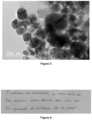
- core-shell nanoparticles were not formed when the weight ratio of metallic copper to metallic silver is lower than 4. This has been further confirmed by EDX analysis. In fact, in this case, as shown in Figure 3 , a mixture of copper nanoparticles and silver nanoparticles was formed.
- the ink was filled into a Gelocity Illusion ink cartridge, sold by the company BIC S.A., France.
- the writing instrument had a gap between the writing ball and the writing orifice with a width of 20 ⁇ m.
- a written mark was made with the above writing instrument on a porous substrate (printed paper: Clairefontaine, clairalfa 80 g/m 2 ). As seen in Figure 4 , the obtained written mark exhibits a lower color intensity and saturation compared to the written mark obtained with the ink according to the invention obtained in example 1.
- a first mixture was prepared by mixing at ambient temperature (around 21°C), under stirring until dissolution of all raw materials, a total amount of 2846.6 g of distilled water, 4.6 g of silver nitrate (S7276 from Sigma Aldrich), 86 g of copper sulfate, pentahydrated (209198 from Sigma Aldrich), 13.4 g of polyvinyl pyrrolidone (PVP K30 from Sigma Aldrich).
- a second mixture was prepared by mixing at ambient temperature (around 21°C), under stirring until dissolution of all raw materials, a total amount of 1138.5 g of distilled water, and 189.1 g of ascorbic acid (A92902 from Sigma Aldrich).
- the second mixture was added to the first mixture under stirring for a duration of 10 min at ambient temperature (around 21°C).
- the resulting mixture was then heated at 60°C and stirring was continued for 4 hours (after the temperature was stabilized at 60°C).
- the color of the solution was dark green.
- the pH of the aqueous suspension of the metal nanoparticles was measured at 1.25.
Landscapes
- Chemical & Material Sciences (AREA)
- Life Sciences & Earth Sciences (AREA)
- Engineering & Computer Science (AREA)
- Materials Engineering (AREA)
- Wood Science & Technology (AREA)
- Organic Chemistry (AREA)
- Inks, Pencil-Leads, Or Crayons (AREA)
Priority Applications (2)
| Application Number | Priority Date | Filing Date | Title |
|---|---|---|---|
| EP23307189.3A EP4570871A1 (de) | 2023-12-13 | 2023-12-13 | Plasmonische tinte mit kern-schale-metallnanopartikeln |
| PCT/EP2024/083472 WO2025124877A1 (en) | 2023-12-13 | 2024-11-25 | Plasmonic ink with core-shell metal nanoparticles |
Applications Claiming Priority (1)
| Application Number | Priority Date | Filing Date | Title |
|---|---|---|---|
| EP23307189.3A EP4570871A1 (de) | 2023-12-13 | 2023-12-13 | Plasmonische tinte mit kern-schale-metallnanopartikeln |
Publications (1)
| Publication Number | Publication Date |
|---|---|
| EP4570871A1 true EP4570871A1 (de) | 2025-06-18 |
Family
ID=89430511
Family Applications (1)
| Application Number | Title | Priority Date | Filing Date |
|---|---|---|---|
| EP23307189.3A Pending EP4570871A1 (de) | 2023-12-13 | 2023-12-13 | Plasmonische tinte mit kern-schale-metallnanopartikeln |
Country Status (2)
| Country | Link |
|---|---|
| EP (1) | EP4570871A1 (de) |
| WO (1) | WO2025124877A1 (de) |
Citations (5)
| Publication number | Priority date | Publication date | Assignee | Title |
|---|---|---|---|---|
| CN105855538A (zh) * | 2016-04-08 | 2016-08-17 | 广东工业大学 | 一种纳米银包铜粉、其制备方法及应用 |
| WO2021038087A1 (en) * | 2019-08-29 | 2021-03-04 | Societe Bic | Process of preparation of an aqueous gel ink with fixed color comprising silver nanoparticles |
| CN113523649A (zh) * | 2021-07-21 | 2021-10-22 | 北京工业大学 | 一种复合焊膏的制备方法 |
| CN113618080A (zh) * | 2021-08-13 | 2021-11-09 | 中国海洋大学 | 一种pH响应型核壳结构的壳聚糖包覆氧化亚铜负载银纳米球的制备方法 |
| EP4050074A1 (de) * | 2021-02-25 | 2022-08-31 | Société BIC | Fluid zum löschen von tinte und kit damit |
-
2023
- 2023-12-13 EP EP23307189.3A patent/EP4570871A1/de active Pending
-
2024
- 2024-11-25 WO PCT/EP2024/083472 patent/WO2025124877A1/en active Pending
Patent Citations (5)
| Publication number | Priority date | Publication date | Assignee | Title |
|---|---|---|---|---|
| CN105855538A (zh) * | 2016-04-08 | 2016-08-17 | 广东工业大学 | 一种纳米银包铜粉、其制备方法及应用 |
| WO2021038087A1 (en) * | 2019-08-29 | 2021-03-04 | Societe Bic | Process of preparation of an aqueous gel ink with fixed color comprising silver nanoparticles |
| EP4050074A1 (de) * | 2021-02-25 | 2022-08-31 | Société BIC | Fluid zum löschen von tinte und kit damit |
| CN113523649A (zh) * | 2021-07-21 | 2021-10-22 | 北京工业大学 | 一种复合焊膏的制备方法 |
| CN113618080A (zh) * | 2021-08-13 | 2021-11-09 | 中国海洋大学 | 一种pH响应型核壳结构的壳聚糖包覆氧化亚铜负载银纳米球的制备方法 |
Non-Patent Citations (1)
| Title |
|---|
| MALLIKARJUNA N. NADAGOUDA ET AL: "A Greener Synthesis of Core (Fe, Cu)-Shell (Au, Pt, Pd, and Ag) Nanocrystals Using Aqueous Vitamin C", CRYSTAL GROWTH & DESIGN, vol. 7, no. 12, 1 December 2007 (2007-12-01), US, pages 2582 - 2587, XP055622736, ISSN: 1528-7483, DOI: 10.1021/cg070554e * |
Also Published As
| Publication number | Publication date |
|---|---|
| WO2025124877A1 (en) | 2025-06-19 |
Similar Documents
| Publication | Publication Date | Title |
|---|---|---|
| EP4050074B1 (de) | Fluid zum löschen von tinte und kit damit | |
| JP6780064B2 (ja) | 顔料組成物及びインクジェット用水性インク組成物 | |
| CN105524524A (zh) | 一种用自分散型颜料色浆制备的中性墨水及其制备方法 | |
| US12486413B2 (en) | Process of preparation of an aqueous gel ink with fixed color comprising silver nanoparticles | |
| EP4570871A1 (de) | Plasmonische tinte mit kern-schale-metallnanopartikeln | |
| EP4570870A1 (de) | Plasmonische tinte mit kern-schale-metallnanopartikeln | |
| CN113874451B (zh) | 用于制备具有可变颜色的水性凝胶油墨的方法和其水性凝胶油墨 | |
| JPH07145339A (ja) | ボールペン用水性金属光沢色インキ | |
| WO2014175086A1 (ja) | 油性顔料インキ組成物及び油性顔料インキ筆記具 | |
| US12247131B2 (en) | Process of preparation of an aqueous gel ink with fixed color comprising silver nanoparticles | |
| JP3312214B2 (ja) | 水性金属光沢色インキ | |
| EP4328277A1 (de) | Plasmonische tinten mit bunten farben | |
| JP2015134935A (ja) | 水系インク組成物およびこれを用いた記録物 | |
| CN114207056B (zh) | 用于制备包含银或金纳米颗粒的具有固定颜色的水性凝胶墨水的方法 | |
| JP7430105B2 (ja) | ボールペン用インキ組成物およびそれを用いたボールペン | |
| EP4332182A1 (de) | Verwendung einer plasmonischen tintenzusammensetzung auf synthetischem papier | |
| EP3932999A1 (de) | Nachfüllbares schreibgerät für eine wasserbasierte tintenzusammensetzung | |
| JP3486688B2 (ja) | ボールペン用水性金属光沢色インキ | |
| JP2013032454A (ja) | 隠ぺい性インク組成物 | |
| JP2025181039A (ja) | 水性インキ組成物、ボールペン、及び筆記性向上方法 | |
| CN114450357A (zh) | 制备包括银纳米颗粒的具有可变颜色的水性凝胶油墨的方法 | |
| EP3932998A1 (de) | Handschreibgerät mit verbesserter offenlagerfähigkeit |
Legal Events
| Date | Code | Title | Description |
|---|---|---|---|
| PUAI | Public reference made under article 153(3) epc to a published international application that has entered the european phase |
Free format text: ORIGINAL CODE: 0009012 |
|
| STAA | Information on the status of an ep patent application or granted ep patent |
Free format text: STATUS: THE APPLICATION HAS BEEN PUBLISHED |
|
| AK | Designated contracting states |
Kind code of ref document: A1 Designated state(s): AL AT BE BG CH CY CZ DE DK EE ES FI FR GB GR HR HU IE IS IT LI LT LU LV MC ME MK MT NL NO PL PT RO RS SE SI SK SM TR |
|
| STAA | Information on the status of an ep patent application or granted ep patent |
Free format text: STATUS: REQUEST FOR EXAMINATION WAS MADE |
|
| 17P | Request for examination filed |
Effective date: 20251001 |