EP4567012A2 - Herstellung einer rohstoffzusammensetzung - Google Patents
Herstellung einer rohstoffzusammensetzung Download PDFInfo
- Publication number
- EP4567012A2 EP4567012A2 EP25153748.6A EP25153748A EP4567012A2 EP 4567012 A2 EP4567012 A2 EP 4567012A2 EP 25153748 A EP25153748 A EP 25153748A EP 4567012 A2 EP4567012 A2 EP 4567012A2
- Authority
- EP
- European Patent Office
- Prior art keywords
- glass
- equal
- composition
- raw materials
- mass
- Prior art date
- Legal status (The legal status is an assumption and is not a legal conclusion. Google has not performed a legal analysis and makes no representation as to the accuracy of the status listed.)
- Pending
Links
Images
Classifications
-
- C—CHEMISTRY; METALLURGY
- C03—GLASS; MINERAL OR SLAG WOOL
- C03B—MANUFACTURE, SHAPING, OR SUPPLEMENTARY PROCESSES
- C03B1/00—Preparing the batches
- C03B1/02—Compacting the glass batches, e.g. pelletising
-
- C—CHEMISTRY; METALLURGY
- C03—GLASS; MINERAL OR SLAG WOOL
- C03B—MANUFACTURE, SHAPING, OR SUPPLEMENTARY PROCESSES
- C03B1/00—Preparing the batches
-
- C—CHEMISTRY; METALLURGY
- C03—GLASS; MINERAL OR SLAG WOOL
- C03B—MANUFACTURE, SHAPING, OR SUPPLEMENTARY PROCESSES
- C03B3/00—Charging the melting furnaces
- C03B3/005—Charging the melting furnaces using screw feeders
-
- C—CHEMISTRY; METALLURGY
- C03—GLASS; MINERAL OR SLAG WOOL
- C03C—CHEMICAL COMPOSITION OF GLASSES, GLAZES OR VITREOUS ENAMELS; SURFACE TREATMENT OF GLASS; SURFACE TREATMENT OF FIBRES OR FILAMENTS MADE FROM GLASS, MINERALS OR SLAGS; JOINING GLASS TO GLASS OR OTHER MATERIALS
- C03C1/00—Ingredients generally applicable to manufacture of glasses, glazes, or vitreous enamels
- C03C1/002—Use of waste materials, e.g. slags
-
- C—CHEMISTRY; METALLURGY
- C03—GLASS; MINERAL OR SLAG WOOL
- C03C—CHEMICAL COMPOSITION OF GLASSES, GLAZES OR VITREOUS ENAMELS; SURFACE TREATMENT OF GLASS; SURFACE TREATMENT OF FIBRES OR FILAMENTS MADE FROM GLASS, MINERALS OR SLAGS; JOINING GLASS TO GLASS OR OTHER MATERIALS
- C03C1/00—Ingredients generally applicable to manufacture of glasses, glazes, or vitreous enamels
- C03C1/02—Pretreated ingredients
- C03C1/026—Pelletisation or prereacting of powdered raw materials
-
- C—CHEMISTRY; METALLURGY
- C03—GLASS; MINERAL OR SLAG WOOL
- C03C—CHEMICAL COMPOSITION OF GLASSES, GLAZES OR VITREOUS ENAMELS; SURFACE TREATMENT OF GLASS; SURFACE TREATMENT OF FIBRES OR FILAMENTS MADE FROM GLASS, MINERALS OR SLAGS; JOINING GLASS TO GLASS OR OTHER MATERIALS
- C03C13/00—Fibre or filament compositions
- C03C13/06—Mineral fibres, e.g. slag wool, mineral wool, rock wool
-
- Y—GENERAL TAGGING OF NEW TECHNOLOGICAL DEVELOPMENTS; GENERAL TAGGING OF CROSS-SECTIONAL TECHNOLOGIES SPANNING OVER SEVERAL SECTIONS OF THE IPC; TECHNICAL SUBJECTS COVERED BY FORMER USPC CROSS-REFERENCE ART COLLECTIONS [XRACs] AND DIGESTS
- Y02—TECHNOLOGIES OR APPLICATIONS FOR MITIGATION OR ADAPTATION AGAINST CLIMATE CHANGE
- Y02P—CLIMATE CHANGE MITIGATION TECHNOLOGIES IN THE PRODUCTION OR PROCESSING OF GOODS
- Y02P40/00—Technologies relating to the processing of minerals
- Y02P40/50—Glass production, e.g. reusing waste heat during processing or shaping
-
- Y—GENERAL TAGGING OF NEW TECHNOLOGICAL DEVELOPMENTS; GENERAL TAGGING OF CROSS-SECTIONAL TECHNOLOGIES SPANNING OVER SEVERAL SECTIONS OF THE IPC; TECHNICAL SUBJECTS COVERED BY FORMER USPC CROSS-REFERENCE ART COLLECTIONS [XRACs] AND DIGESTS
- Y02—TECHNOLOGIES OR APPLICATIONS FOR MITIGATION OR ADAPTATION AGAINST CLIMATE CHANGE
- Y02P—CLIMATE CHANGE MITIGATION TECHNOLOGIES IN THE PRODUCTION OR PROCESSING OF GOODS
- Y02P40/00—Technologies relating to the processing of minerals
- Y02P40/50—Glass production, e.g. reusing waste heat during processing or shaping
- Y02P40/57—Improving the yield, e-g- reduction of reject rates
Definitions
- the present invention relates to a method for preparing a composition of raw materials suitable for being placed in a glass furnace.
- the invention also relates to the composition of raw materials thus obtained, as well as to a method for melting this composition.
- the invention relates to a method for manufacturing cullet, glass wool and/or rock wool, textile glass yarns and/or flat glass, or hollow glass (bottles, flasks, etc.) or following said melting method.
- a composition of raw materials according to the invention is obtained from a mixture of mineral wool.
- a mixture of mineral wool comprises one or more types of mineral fibers originating from the production of said fibers (factory waste), from construction sites (construction site waste or waste from deconstruction sites) and/or from recycling channels making it possible to recover such fibers in final products, whether or not they are used.
- the different stages of the production of mineral wool generate a certain quantity of waste entering into the composition of said mixture of mineral wool.
- This waste may originate, for example, from the cutting of products (and/or discarded products), and then contain significant quantities of organic materials such as resins called "binders" and intended to ensure the mechanical cohesion of the fibrous mats.
- mineral fibers for example paper, aluminum-based or bituminous films, or wooden pallet elements.
- mineral fibers can in particular be made of glass and/or rock. These are then referred to as glass wool and rock wool respectively.
- These mineral fibers are generally combined with organic binders and other metallic and/or organic materials.
- such a mineral wool mixture occupies a significant volume at the time of its introduction into the furnace, for example via a charging screw.
- the use of a raw material composition consisting of such a mineral wool mixture tends to significantly reduce the mass of raw materials introduced into the furnace per unit of time.
- the use of such a mineral wool mixture as a raw material reduces the mass flow rate of charging, and therefore the efficiency of the furnace, which, in an industrial context, can prove to be a prohibitive disadvantage.
- a natural solution to this technical problem is to increase the capacity of the raw material loading means, for example by implementing a larger screw loading machine.
- This solution is not without drawbacks, however, since it involves a structural modification of the loading machine and, more generally, makes its dimensioning dependent on the nature of the composition being loaded.
- the proposed technique aims to provide a technical solution to the drawbacks described above. More particularly, in at least one embodiment, the proposed technique relates to a method for preparing a composition of raw materials suitable for being placed in the furnace in the melting chamber of an installation suitable for obtaining cullet, glass and/or rock wool, textile glass yarns, flat glass and/or hollow glass, said method being characterized in that it comprises at least one step of grinding of a mineral wool mixture suitable for inclusion in the composition of raw materials, so that the granular mixture obtained after grinding has an apparent density greater than or equal to 30 kg/m3.
- the expression "bulk density”, synonymous with “bulk density without compaction”, often improperly called apparent density, designates the mass of the ground mixture per unit of total volume, including the interstitial spaces separating the aggregates (grains) which compose this mixture.
- this apparent density is measured according to an operating protocol detailed in the description, or by any operating protocol allowing equivalent results to be obtained.
- the mineral wool mixture being ground includes one or more types of mineral fibers from the production of said fibers, from construction sites (construction or deconstruction) and/or from recycling channels allowing the recovery of such fibers in final products, whether or not they are used.
- Such mineral fibers may in particular be made of glass and/or rock. These are then referred to as glass wool and rock wool respectively.
- a preparation method according to the invention makes it possible to increase the apparent density of the mineral wool mixture by grinding, and thus to obtain a granular mixture which can be charged into a so-called "traditional" glass furnace at a satisfactory charging mass flow rate.
- the use of such a granular mixture makes it possible in particular, under standard charging conditions below the level of the glass bath, to achieve charging mass flow rates greater than or equal to 5 tonnes per day.
- the choice of such a minimum apparent density value takes into account in particular the empirically observed difference between the theoretical charging mass flow rate value and the actual value of such a flow rate measured under standard operating conditions.
- the granular mixture obtained has an apparent density greater than or equal to 50 kg/m3, preferably greater than or equal to 70 kg/m3, preferably greater than or equal to 90 kg/m3, preferably greater than or equal to 100 kg/m3.
- the granular mixture obtained after grinding has an apparent density less than or equal to 500 kg/m3.
- the implementation of a fusion test campaign on a submerged burner furnace revealed that above a certain apparent density value, part of the introduced raw material composition tends, due to its high volatility, to be expelled with the exhaust fumes, which complicates the work of treating the fumes, reduces the productivity of the furnace, and consequently represents a major industrial disadvantage.
- the implementation of a granular mixture with an apparent density less than or equal to 500 kg/m3 makes it possible to maintain an acceptable percentage of flight of the granular mixture, since it is less than 3%.
- the granular mixture obtained has an apparent density less than or equal to 400 kg/m3, preferably less than or equal to 300 kg/m3, preferably less than or equal to 220 kg/m3.
- Limiting the apparent density of the granular mixture makes it possible to reduce the percentage of raw materials being blown away, and therefore to facilitate the treatment of fumes.
- the mass proportion of said granular mixture to the total mass of said composition of raw materials is greater than or equal to 5%, preferably greater than or equal to 20%, preferably greater than or equal to 40%, preferably greater than or equal to 60%, preferably greater than or equal to 70%, preferably greater than or equal to 80%, preferably greater than or equal to equal to 90%, preferably greater than or equal to 95%, preferably greater than or equal to 99%.
- the preparation method comprises a step of adding cullet to said granular mixture, the mass of cullet being greater than or equal to 1% of the total mass of the granular mixture.
- the introduction of cullet has the additional advantage of allowing its processing for further use, for example by removal in a submerged burner kiln of certain undesirable chemical compounds.
- the mass of cullet is less than or equal to 20% of the total mass of the granular mixture.
- said added cullet has a granularity of between 1 and 5 mm.
- granularity means the size of the aggregates as determined by screening on a sieve. Choosing a cullet granularity range of 1 to 10 mm optimizes the fluidification of the granular mixture by the cullet.
- the preparation method comprises a prior step of determining a desired value of apparent density of the ground granular mixture, as a function of the dimensional characteristics of a charging unit to be implemented, and/or a desired value of charging mass flow rate.
- the preliminary determination and subsequent consideration of a desired density value makes it possible to adjust the preparation process of the raw material composition, so as to obtain a targeted mass flow rate for charging, by using a charging machine whose dimensional characteristics are known.
- said mineral wool mixture has a humidity level greater than 1% of the total mass of said mixture.
- the water is supplied upstream of the grinding and/or during the grinding, for example by spraying.
- said mineral wool mixture has a humidity level greater than 2%, preferably greater than 3%.
- an upper limit of 25% corresponds to the threshold from which the granular mixture tends to remain stuck to the conveyor belt and thus block and/or damage it.
- the preparation method uses at least one grinder equipped with a grid whose mesh size is less than 20 mm.
- the mesh size of said grid is less than 20 mm, preferably less than 15 mm, preferably less than 10 mm.
- the grinder is adapted to rotate at a speed greater than 150 revolutions per minute, preferably greater than 175 revolutions per minute, preferably greater than 200 revolutions per minute.
- the efficiency of the crusher tends to increase with the rotation speed of its drum.
- the invention also relates to a composition of raw materials suitable for being placed in the melting chamber of an installation suitable for obtaining cullet, glass and/or rock wool, textile glass yarns, flat glass and/or hollow glass, preferably obtained via such a preparation process, characterized in that it comprises a granular mixture whose apparent density is greater than or equal to 30 kg/m3.
- the granular mixture has an apparent density greater than or equal to 50 kg/m3, preferably greater than or equal to 70 kg/m3, preferably greater than or equal to 90 kg/m3, preferably greater than or equal to 110 kg/m3.
- the granular mixture has an apparent density less than or equal to 500 kg/m3, preferably less than or equal to 400 kg/m3, preferably less than or equal to 300 kg/m3, preferably less than or equal to 200 kg/m3, preferably less than or equal to 160 kg/m3, preferably less than or equal to 140 kg/m3.
- the composition of raw materials comprises at least 30% by mass of granular mixture, preferably at least 60% by mass, more preferably at least 80% by mass, more preferably at least 90% by mass, more preferably at least 95% by mass, more preferably at least 98% by mass of granular mixture.
- the composition of raw materials comprises a mass of cullet of at least 1% of the total mass of the granular mixture.
- the mass of cullet is less than or equal to 20% of the total mass of the granular mixture.
- the invention also relates to a process for melting such a composition of raw materials, to obtain cullet, glass and/or rock wool, textile glass yarns and/or flat glass/hollow glass.
- said composition of raw materials is fed into the oven by means of a feeding screw, preferably fed by a buffer silo containing said composition of raw materials.
- a worm screw allows for continuous charging, which is particularly useful when charging is carried out below the level of the glass bath.
- said composition of raw materials is fed into the oven at a mass flow rate greater than or equal to 5 tonnes per day.
- said composition of raw materials is fed into the oven at a mass flow rate greater than or equal to 7 tonnes per day, preferably greater than or equal to 9 tonnes per day, preferably greater than or equal to 10 tonnes per day.
- the apparent density of the granular mixture is measured periodically, manually and/or automatically.
- the apparent density of the granular mixture is adjusted manually and/or automatically, depending on the desired charging flow rates.
- said composition of raw materials is placed in the furnace below the level of the glass bath, and preferably in which said melting process uses a melting chamber equipped with submerged burners.
- liquid glass and glass bath designate the product of the melting of these vitrifiable materials introduced into the glass furnace.
- submerged burners are understood to mean burners configured so that the flames they generate and/or the combustion gases produced develop within the glass bath itself. Generally, they are arranged so as to be flush with the floor so that the flame develops within the mass of vitrifiable materials during liquefaction (melting). They can thus be made to pass through its side walls, the floor (lower wall) and/or suspended from above, by attaching them to the roof or any suitable superstructure. These burners can be such that their gas supply conduits are flush with the wall they pass through.
- conduits may be "enter" at least partly into the mass of vitrifiable materials, so as to prevent the flames from are too close to the walls and cause premature wear of the refractory materials. It is also possible to choose to inject only the combustion gases, with the combustion taking place outside the actual melting chamber.
- said composition of raw materials is placed in the furnace above the level of the glass bath, and preferably in which said melting process uses a melting chamber equipped with flame burners arranged above the level of the glass bath.
- the charging of said composition of raw materials above the level of the glass bath has the advantage of allowing the organics present in said composition to be burned before their introduction into the glass bath, which makes it possible to take advantage of the additional energy source that these organics constitute while limiting the pollution of the glass bath.
- composition according to the invention is therefore particularly suitable since it is of reduced volume and therefore thickness, for an equivalent mass.
- the invention also relates to a method for manufacturing cullet, glass and/or rock wool, textile glass yarns, flat glass and/or hollow glass, comprising such a melting method.
- the invention also relates to cullet, glass and/or rock wool, textile glass yarns, flat glass and/or hollow glass obtained according to such a manufacturing method.
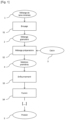
- FIG. 1 is a flow diagram illustrating a method for manufacturing cullet, glass and/or rock wool, textile glass yarns, flat glass and/or hollow glass, according to a particular embodiment of the invention.
- FIG. 1 is a flow diagram illustrating a method for manufacturing a glass product (5), according to a particular embodiment of the invention.
- raw materials (4) obtained at least in part from a mixture of mineral wool (1) are placed (step S3) in a glass furnace to be melted (step S4) and subsequently transformed into a glass product (5).
- the molten mixture can alternatively be cooled and fragmented to obtain cullet, fiberized to obtain glass wool or rock wool, spun into textile glass yarns and/or poured onto a tin bath (float in English) to obtain flat glass, each of these industrial applications being designated by the expression “glass product (5)” throughout the description.
- such a manufacturing method comprises the melting of a composition of raw materials (4) obtained at least in part from a granular mixture (2) whose apparent density is greater than or equal to 30 kg/m3.
- the latter is first poured into a container, for example a bucket, of known mass and volume.
- the container must be at least 20 liters to have sufficient precision and respect an aspect ratio allowing to limit the compaction of the mixture, by checking the formula: L max ⁇ 2 V 3 Where L max is the maximum extent of the container in a given direction, by analogy with the Feret diameter of a particle, and V is the volume of said container.
- the filled bucket is then weighed to determine the mass of the poured mixture.
- the apparent density is the ratio between the measured mass of the mixture and the volume of the bucket.
- any mixture of mineral wool (1) can be seen as an agglomerate of mineral fibers, of extensible or compressible volume, which can itself be divided into a plurality of agglomerates of fibers of smaller size and/or lower density.
- the size of an agglomerate of mineral fibers is therefore not usable data for characterizing a product and/or comparing two products with each other.
- the inventors carried out a campaign of conveying tests on two batches of glass wool waste having apparent densities of 20 kg/m3 and 110 kg/m3 respectively.
- the feeding screw has a diameter and a screw pitch of 30 cm.
- the filling rate is 100%, the loading hopper of the screw being filled to ensure its constant feeding.
- Table 1 [Tables 1] below shows the results obtained for four glass wool samples with different apparent densities. These four samples are introduced into the furnace via the auger, for different screw rotation speeds. Table 1 - Variation of the mass flow rate of the furnace as a function of different operational parameters of a furnace and the apparent density of the composition being fed Sample number Apparent density in kg/m3 Screw speed in rpm Mass flow rate in kg/hour Hot/Theory Ratio in % Theory Cold tests Hot tests 1 20 10 232 216 150 65 2 110 2 248 254 147 59 3 110 3 372 360 283 76 4 110 4 495 492 383 77
- the inventors implemented a standard industrial grinder and carried out a test campaign during which three batches of glass wool waste were ground before the apparent density of the granular mixtures obtained was measured for each of these batches.
- the objective of this campaign was in particular to evaluate the influence of the different parameters of the grinder and the humidification rate on the apparent density of the ground mineral wool mixture.
- a first batch is composed only of standard glass wool plates.
- a second batch corresponds to this first batch to which 8.8 kg of moistened glass wool waste is added.
- a third batch corresponds to this second batch to which 6.4 kg of moistened glass wool waste are added.
- Tests number 1 to 3 are carried out with the first batch, by varying the settings of the crusher.
- Test number 4 is implemented with the second batch, and test number 5 is implemented with the third batch.
- Table 2 [Tables 2] below presents the results obtained for each of these tests. Unless otherwise specified, all parameters not specified in this table remain identical between each of these tests. Table 2 - Variation in the apparent density of crushed glass wool waste as a function of the operational parameters of the crusher and the humidification rate of the crushed mixture. Test number Mesh size in mm Speed in rpm Capacity in kg/h Apparent density in kg/m3 1 10 150 288 110 2 15 150 414 64 3 15 210 454 68 4 10 210 554 142 5 10 210 776 223
Landscapes
- Chemical & Material Sciences (AREA)
- Engineering & Computer Science (AREA)
- Materials Engineering (AREA)
- Organic Chemistry (AREA)
- Life Sciences & Earth Sciences (AREA)
- Chemical Kinetics & Catalysis (AREA)
- General Chemical & Material Sciences (AREA)
- Geochemistry & Mineralogy (AREA)
- General Life Sciences & Earth Sciences (AREA)
- Glass Compositions (AREA)
- Glass Melting And Manufacturing (AREA)
- Manufacture, Treatment Of Glass Fibers (AREA)
- Pharmaceuticals Containing Other Organic And Inorganic Compounds (AREA)
Applications Claiming Priority (3)
| Application Number | Priority Date | Filing Date | Title |
|---|---|---|---|
| FR2009691A FR3114314B1 (fr) | 2020-09-24 | 2020-09-24 | Preparation d’une composition de matieres premieres |
| PCT/FR2021/051638 WO2022064150A1 (fr) | 2020-09-24 | 2021-09-23 | Preparation d'une composition de matieres premieres |
| EP21798411.1A EP4185557B1 (de) | 2020-09-24 | 2021-09-23 | Herstellung einer rohstoffzusammensetzung |
Related Parent Applications (1)
| Application Number | Title | Priority Date | Filing Date |
|---|---|---|---|
| EP21798411.1A Division EP4185557B1 (de) | 2020-09-24 | 2021-09-23 | Herstellung einer rohstoffzusammensetzung |
Publications (2)
| Publication Number | Publication Date |
|---|---|
| EP4567012A2 true EP4567012A2 (de) | 2025-06-11 |
| EP4567012A3 EP4567012A3 (de) | 2025-08-06 |
Family
ID=73793387
Family Applications (2)
| Application Number | Title | Priority Date | Filing Date |
|---|---|---|---|
| EP25153748.6A Pending EP4567012A3 (de) | 2020-09-24 | 2021-09-23 | Herstellung einer rohstoffzusammensetzung |
| EP21798411.1A Active EP4185557B1 (de) | 2020-09-24 | 2021-09-23 | Herstellung einer rohstoffzusammensetzung |
Family Applications After (1)
| Application Number | Title | Priority Date | Filing Date |
|---|---|---|---|
| EP21798411.1A Active EP4185557B1 (de) | 2020-09-24 | 2021-09-23 | Herstellung einer rohstoffzusammensetzung |
Country Status (19)
| Country | Link |
|---|---|
| US (1) | US20230391653A1 (de) |
| EP (2) | EP4567012A3 (de) |
| JP (1) | JP7778137B2 (de) |
| CN (1) | CN116194414A (de) |
| AR (1) | AR123586A1 (de) |
| AU (1) | AU2021349337B2 (de) |
| CA (1) | CA3191117A1 (de) |
| CL (1) | CL2023000715A1 (de) |
| CO (1) | CO2023003585A2 (de) |
| DK (1) | DK4185557T3 (de) |
| ES (1) | ES3018010T3 (de) |
| FI (1) | FI4185557T3 (de) |
| FR (1) | FR3114314B1 (de) |
| HR (1) | HRP20250237T1 (de) |
| LT (1) | LT4185557T (de) |
| MX (1) | MX2023003077A (de) |
| PL (1) | PL4185557T3 (de) |
| SI (1) | SI4185557T1 (de) |
| WO (1) | WO2022064150A1 (de) |
Citations (1)
| Publication number | Priority date | Publication date | Assignee | Title |
|---|---|---|---|---|
| EP1771391B1 (de) | 2004-07-29 | 2012-02-29 | Saint-Gobain Isover | Verfahren und vorrichtung zur behandlung von faserabfallstoffen zur wiederverwertung |
Family Cites Families (9)
| Publication number | Priority date | Publication date | Assignee | Title |
|---|---|---|---|---|
| GB8331031D0 (en) * | 1983-11-21 | 1983-12-29 | Roberts D | Vitrification of asbestos waste |
| CZ297579B6 (cs) | 1998-01-09 | 2007-02-07 | Saint-Gobain Vitrage | Zpusob a zarízení pro tavení a cerení zeskelnovatelných materiálu |
| JP2003278066A (ja) * | 2002-03-22 | 2003-10-02 | Jfe Steel Kk | 粒状無機繊維綿およびその製造方法 |
| DE10337087B4 (de) | 2003-08-12 | 2006-12-14 | Saint-Gobain Isover G+H Ag | Verfahren zur Erzeugung eines Granulates aus Altglas und Verwendung |
| WO2006040135A1 (en) * | 2004-10-13 | 2006-04-20 | Rockwool International A/S | Treatment of sludge |
| EP2105415A1 (de) | 2008-03-27 | 2009-09-30 | Rockwool International A/S | Verfahren und Vorrichtung zur Herstellung einer mineralischen Schmelze |
| WO2014052213A1 (en) * | 2012-09-25 | 2014-04-03 | Dow Global Technologies Llc | Process for producing cellulose derivatives of high bulk density, good flowability and/or dispersibility in cold water as well as low solution color |
| FR3019816B1 (fr) | 2014-04-10 | 2021-04-02 | Saint Gobain Isover | Composite comprenant une laine minerale comprenant un sucre |
| GB201501314D0 (en) * | 2015-01-27 | 2015-03-11 | Knauf Insulation And Knauf Insulation Llc And Knauf Insulation Gmbh And Knauf Insulation Doo Skofja | Glass melting |
-
2020
- 2020-09-24 FR FR2009691A patent/FR3114314B1/fr active Active
-
2021
- 2021-09-23 PL PL21798411.1T patent/PL4185557T3/pl unknown
- 2021-09-23 HR HRP20250237TT patent/HRP20250237T1/hr unknown
- 2021-09-23 MX MX2023003077A patent/MX2023003077A/es unknown
- 2021-09-23 US US18/246,374 patent/US20230391653A1/en active Pending
- 2021-09-23 FI FIEP21798411.1T patent/FI4185557T3/en active
- 2021-09-23 DK DK21798411.1T patent/DK4185557T3/da active
- 2021-09-23 ES ES21798411T patent/ES3018010T3/es active Active
- 2021-09-23 AU AU2021349337A patent/AU2021349337B2/en active Active
- 2021-09-23 EP EP25153748.6A patent/EP4567012A3/de active Pending
- 2021-09-23 EP EP21798411.1A patent/EP4185557B1/de active Active
- 2021-09-23 JP JP2023516573A patent/JP7778137B2/ja active Active
- 2021-09-23 SI SI202130282T patent/SI4185557T1/sl unknown
- 2021-09-23 CA CA3191117A patent/CA3191117A1/fr active Pending
- 2021-09-23 LT LTEPPCT/FR2021/051638T patent/LT4185557T/lt unknown
- 2021-09-23 WO PCT/FR2021/051638 patent/WO2022064150A1/fr not_active Ceased
- 2021-09-23 CN CN202180064874.1A patent/CN116194414A/zh active Pending
- 2021-09-23 AR ARP210102646A patent/AR123586A1/es active IP Right Grant
-
2023
- 2023-03-13 CL CL2023000715A patent/CL2023000715A1/es unknown
- 2023-03-22 CO CONC2023/0003585A patent/CO2023003585A2/es unknown
Patent Citations (1)
| Publication number | Priority date | Publication date | Assignee | Title |
|---|---|---|---|---|
| EP1771391B1 (de) | 2004-07-29 | 2012-02-29 | Saint-Gobain Isover | Verfahren und vorrichtung zur behandlung von faserabfallstoffen zur wiederverwertung |
Also Published As
| Publication number | Publication date |
|---|---|
| CN116194414A (zh) | 2023-05-30 |
| US20230391653A1 (en) | 2023-12-07 |
| DK4185557T3 (da) | 2025-03-03 |
| PL4185557T3 (pl) | 2025-04-14 |
| MX2023003077A (es) | 2023-04-13 |
| EP4567012A3 (de) | 2025-08-06 |
| FR3114314A1 (fr) | 2022-03-25 |
| LT4185557T (lt) | 2025-03-10 |
| AU2021349337B2 (en) | 2025-10-02 |
| WO2022064150A1 (fr) | 2022-03-31 |
| AU2021349337A1 (en) | 2023-04-06 |
| FI4185557T3 (en) | 2025-03-08 |
| EP4185557A1 (de) | 2023-05-31 |
| ES3018010T3 (en) | 2025-05-14 |
| JP2023542653A (ja) | 2023-10-11 |
| CA3191117A1 (fr) | 2022-03-31 |
| CO2023003585A2 (es) | 2023-07-21 |
| CL2023000715A1 (es) | 2023-11-24 |
| AR123586A1 (es) | 2022-12-21 |
| SI4185557T1 (sl) | 2025-04-30 |
| JP7778137B2 (ja) | 2025-12-01 |
| EP4185557B1 (de) | 2025-01-29 |
| HRP20250237T1 (hr) | 2025-04-11 |
| FR3114314B1 (fr) | 2023-05-19 |
| KR20230074175A (ko) | 2023-05-26 |
Similar Documents
| Publication | Publication Date | Title |
|---|---|---|
| EP3818019B1 (de) | Herstellung von ausgangsstoffen für glasschmelzofen | |
| EP3831513A1 (de) | Verfahren zur additiven fertigung von werkstücken durch schmelzen oder sintern von pulverpartikeln mithilfe eines hochenergiestrahls mit auf das jeweilge verfahren und material abgestimmten pulvern | |
| FR2585037A1 (fr) | Procede de raffinage d'un minerai d'oxyde de nickel ou similaire | |
| EP1451116A1 (de) | Vorrichtung und verfahren zum schmelzen von glasartigen materialien | |
| CA2992025C (fr) | Procede de fabrication d'aluminates de calcium | |
| EP0410889A1 (de) | Verfahren und Vorrichtung zur Behandlung von Abfallglas oder Mineralfasern für ihre Rückgewinnung | |
| EP1242332B1 (de) | Verfahren zur herstellung eines russblockes mit hoher resistenz gegenüber thermischen schocks | |
| EP4185557B1 (de) | Herstellung einer rohstoffzusammensetzung | |
| EP4298065A1 (de) | Ofensteuerung | |
| EP2437876B1 (de) | Verfahren zur herstellung von granulat aus pulvermaterialen | |
| EP1713977B1 (de) | Verfahren und vorrichtung zur erwärmung von verschlissenen strassenbeschichtungsmaterialien | |
| CN113402262A (zh) | 一种镁质热补料及其制备工艺 | |
| EP4452880B1 (de) | Schmelzen und zerfaserung von recycelter glaswolle | |
| BE1020903A3 (fr) | Procede de recyclage de dechets de verre. | |
| EP0019338B1 (de) | Verfahren zur Herstellung synthetischer Schlacken, so erhaltene synthetische Schlacken und ihre Verwendung | |
| KR102959300B1 (ko) | 원료 조성물의 제조 | |
| CN114481749A (zh) | 旧沥青物料厂拌热再生预拌分步拌和控制方法 | |
| FR2670481A1 (fr) | Composition pour la reparation par soudage sur site de produits refractaires. | |
| TWI842462B (zh) | 燒結礦之製造方法 | |
| FR2791586A1 (fr) | Conditionnement de poussieres de filtres et vitrification de ces poussieres ainsi conditionnees | |
| EP4667429A1 (de) | Schmelzen und ziehen von zigariten mit metallresten | |
| FR2662689A1 (fr) | Nouveau produit pour l'alimentation des fours de verrerie et procede pour son obtention. | |
| BE1020574A3 (fr) | Procede de fabrication d'agglomerats a partir de matieres pulverulentes. | |
| EP0611212A1 (de) | Einbringen von pulverartigen Zusatzstoffen in einen Ofen |
Legal Events
| Date | Code | Title | Description |
|---|---|---|---|
| PUAI | Public reference made under article 153(3) epc to a published international application that has entered the european phase |
Free format text: ORIGINAL CODE: 0009012 |
|
| STAA | Information on the status of an ep patent application or granted ep patent |
Free format text: STATUS: THE APPLICATION HAS BEEN PUBLISHED |
|
| AC | Divisional application: reference to earlier application |
Ref document number: 4185557 Country of ref document: EP Kind code of ref document: P |
|
| AK | Designated contracting states |
Kind code of ref document: A2 Designated state(s): AL AT BE BG CH CY CZ DE DK EE ES FI FR GB GR HR HU IE IS IT LI LT LU LV MC MK MT NL NO PL PT RO RS SE SI SK SM TR |
|
| REG | Reference to a national code |
Ref country code: DE Ref legal event code: R079 Free format text: PREVIOUS MAIN CLASS: C03C0013060000 Ipc: C03B0001000000 |
|
| PUAL | Search report despatched |
Free format text: ORIGINAL CODE: 0009013 |
|
| AK | Designated contracting states |
Kind code of ref document: A3 Designated state(s): AL AT BE BG CH CY CZ DE DK EE ES FI FR GB GR HR HU IE IS IT LI LT LU LV MC MK MT NL NO PL PT RO RS SE SI SK SM TR |
|
| RIC1 | Information provided on ipc code assigned before grant |
Ipc: C03B 1/00 20060101AFI20250702BHEP Ipc: C03C 1/00 20060101ALI20250702BHEP Ipc: C03C 1/02 20060101ALI20250702BHEP Ipc: C03C 6/02 20060101ALI20250702BHEP Ipc: C03B 3/00 20060101ALI20250702BHEP Ipc: C03C 13/06 20060101ALI20250702BHEP |