EP4564609A1 - Frequenzselektive oberfläche und räumliches filterverfahren - Google Patents
Frequenzselektive oberfläche und räumliches filterverfahren Download PDFInfo
- Publication number
- EP4564609A1 EP4564609A1 EP23856370.4A EP23856370A EP4564609A1 EP 4564609 A1 EP4564609 A1 EP 4564609A1 EP 23856370 A EP23856370 A EP 23856370A EP 4564609 A1 EP4564609 A1 EP 4564609A1
- Authority
- EP
- European Patent Office
- Prior art keywords
- frequency selective
- metal strips
- selective surface
- strip
- metal
- Prior art date
- Legal status (The legal status is an assumption and is not a legal conclusion. Google has not performed a legal analysis and makes no representation as to the accuracy of the status listed.)
- Pending
Links
Images




Classifications
-
- H—ELECTRICITY
- H01—ELECTRIC ELEMENTS
- H01Q—ANTENNAS, i.e. RADIO AERIALS
- H01Q15/00—Devices for reflection, refraction, diffraction or polarisation of waves radiated from an antenna, e.g. quasi-optical devices
- H01Q15/0006—Devices acting selectively as reflecting surface, as diffracting or as refracting device, e.g. frequency filtering or angular spatial filtering devices
- H01Q15/0013—Devices acting selectively as reflecting surface, as diffracting or as refracting device, e.g. frequency filtering or angular spatial filtering devices said selective devices working as frequency-selective reflecting surfaces, e.g. FSS, dichroic plates, surfaces being partly transmissive and reflective
- H01Q15/0026—Devices acting selectively as reflecting surface, as diffracting or as refracting device, e.g. frequency filtering or angular spatial filtering devices said selective devices working as frequency-selective reflecting surfaces, e.g. FSS, dichroic plates, surfaces being partly transmissive and reflective said selective devices having a stacked geometry or having multiple layers
-
- H—ELECTRICITY
- H01—ELECTRIC ELEMENTS
- H01Q—ANTENNAS, i.e. RADIO AERIALS
- H01Q15/00—Devices for reflection, refraction, diffraction or polarisation of waves radiated from an antenna, e.g. quasi-optical devices
- H01Q15/0006—Devices acting selectively as reflecting surface, as diffracting or as refracting device, e.g. frequency filtering or angular spatial filtering devices
- H01Q15/0013—Devices acting selectively as reflecting surface, as diffracting or as refracting device, e.g. frequency filtering or angular spatial filtering devices said selective devices working as frequency-selective reflecting surfaces, e.g. FSS, dichroic plates, surfaces being partly transmissive and reflective
-
- H—ELECTRICITY
- H01—ELECTRIC ELEMENTS
- H01Q—ANTENNAS, i.e. RADIO AERIALS
- H01Q1/00—Details of, or arrangements associated with, antennas
- H01Q1/12—Supports; Mounting means
- H01Q1/22—Supports; Mounting means by structural association with other equipment or articles
- H01Q1/24—Supports; Mounting means by structural association with other equipment or articles with receiving set
- H01Q1/241—Supports; Mounting means by structural association with other equipment or articles with receiving set used in mobile communications, e.g. GSM
- H01Q1/246—Supports; Mounting means by structural association with other equipment or articles with receiving set used in mobile communications, e.g. GSM specially adapted for base stations
Definitions
- Embodiments of the present disclosure relate to the field of communications, and in particular, to a frequency selective surface and a spatial filtering method.
- a 5G active antenna surface faces three major challenges: 1. a new site cannot be added; 2. a 5G active antenna surface cannot be additionally deployed at an existing site deployed with a 4G passive antenna surface; and 3. a 5G active antenna surface can be additionally deployed at an existing site, but the limited height constraints optimal signal coverage.
- a 4G passive antenna surface and 5G active antenna surface integration scheme i.e. an A+P (Active plus Passive, A+P) antenna.
- the A+P antenna is a multi-frequency shared-aperture antenna that uses an integrated interleaving scheme to embed the 5G active antenna surface into the back of the 4G passive antenna surface, so as to achieve integrated deployment.
- the A+P antenna may be aligned with existing networks in performance, and supports separate maintenance and independent deployment of an active antenna surface and a passive antenna surface, thereby greatly reducing operation costs and satisfying the requirements of smooth device upgrade.
- a frequency selective surface In order to meet the A+P antenna performance, a frequency selective surface (FSS) needs to be designed to implement perfect integration of a passive antenna surface and an active antenna surface.
- FSS frequency selective surface
- Embodiments of the present disclosure provide a frequency selective surface and a spatial filtering method, so as to at least solve the problem in the related art that a 4G passive antenna surface cannot be perfectly integrated with a 5G active antenna surface.
- a frequency selective surface unit comprising: a first surface, composed of a plurality of first metal strips interleaved with one another; a second surface, composed of a plurality of second metal strips, wherein each of the second metal strips is provided with a second inter-strip gap, and metal strips at two sides of the second inter-strip gap are connected by means of a metal strip line, so as to form a parallel resonant LC circuit in an H frequency band; and a support plate, the first surface and the second surface being fixed on the same surface or front and back surfaces of the support plate.
- a frequency selective surface is further provided, which is formed by periodic extension of the described frequency selective surface unit.
- a spatial filtering method is further provided.
- the spatial filtering method is implemented using the described frequency selective surface, and comprises: L values or C values of a series resonant LC circuit and a parallel resonant LC circuit are adjusted, so as to control a transmission frequency band and a reflection frequency band of the frequency selective surface unit.
- An A+P antenna is a multi-frequency shared-aperture antenna that uses an integrated interleaving scheme to embed a 5G active antenna surface into the back of a 4G passive antenna surface, so as to achieve integrated deployment.
- the A+P antenna may be aligned with existing networks in performance, and supports separate maintenance and independent deployment of an active antenna surface and a passive antenna surface, thereby greatly reducing operation costs and satisfying the requirements of smooth device upgrade.
- a frequency selective surface is a periodic artificial electromagnetic material, and can regulate and control electromagnetic waves with specific frequencies or polarized electromagnetic waves.
- FSS frequency selective surface
- Fig. 1 is a schematic diagram of the principle of an FSS-based A+P antenna scheme.
- a passive antenna surface working in an L frequency band an FSS and an active antenna surface working in an H frequency band are respectively provided.
- the FSS has the characteristics of low-impedance and high-pass for spatial electromagnetic waves, and can be used as a reflector for the passive antenna surface and a radome for the active antenna surface.
- the spatial filtering function of the FSS can reduce inter-frequency coupling between an L-band antenna and an H-band antenna, thereby improving the antenna performance.
- the FSS-based A+P antenna can ensure the independence of a 4G passive antenna surface and a 5G active antenna surface, i.e. support independent design, independent deployment, and independent maintenance of the active and passive antenna surfaces.
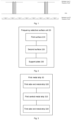
- Fig. 2 is a structural block diagram of a frequency selective surface unit according to embodiments of the present disclosure.
- the frequency selective surface unit 20 comprises: a first surface 210, composed of a plurality of first metal strips interleaved with one another; a second surface 220, composed of a plurality of second metal strips, wherein each of the second metal strips is provided with a second inter-strip gap, and metal strips at two sides of the second inter-strip gap are connected by means of a metal strip line, so as to form a parallel resonant LC circuit in an H frequency band; and a support plate 230, wherein the first surface 210 and the second surface 220 may be fixed on the same surface or front and back surfaces of the support plate 230.
- the first surface is composed of a plurality of first metal strips interleaved with one another;
- the second surface is composed of a plurality of second metal strips, wherein each of the second metal strips is provided with a second inter-strip gap, and metal strips at two sides of the second inter-strip gap are connected by means of a metal strip line, so as to form a parallel resonant LC circuit in an H frequency band; and the first surface and the second surface are fixed on the same surface or front and back surfaces of the support plate, thereby solving the problem in the related art that a 4G passive antenna surface cannot be perfectly integrated with a 5G active antenna surface.
- first inter-strip gaps are distributed at two ends of each first metal strip, and in cases where the first surface and the second surface are fixed on the front and back surfaces of the support plate, the second inter-strip gaps are located in a preset area above or below the first inter-strip gaps, so as to form a series resonant LC circuit in an L frequency band.
- the first inter-trip gaps may be symmetrically distributed at two ends of the first metal strip, and the second inter-trip gaps may be located right below the first inter-trip gaps.
- the positional relationship between the second inter-trip gaps and the first inter-trip gaps is not specifically limited, that is, the positional relationship between the first surface and the second surface is not limited.
- the second surface may be located right below the first surface, and may also be located right above the first surface; and the second surface may also be in the same layer as the first surface and distributed on the left side, the right side or the left and right sides of the first surface.
- Fig. 3 is a structural block diagram of a first metal strip of a first surface according to embodiments of the present disclosure.
- the first metal strip 30 further comprises: a first central metal strip 310 and two first side end metal strips 320, wherein the first central metal strip 310 is located in the middle of the first metal strip 30, and the two first side end metal strips 320 are respectively distributed at two ends of the first metal strip 30 and each forms a first inter-strip gap with the first central metal strip 310.
- the first metal strips 30 and/or the second metal strips 40 are at least one of the following: elongated metal strip lines; bent metal strip lines; metal coils; and metal via holes.
- the elongated metal strip line refers to a metal strip line of which the length is greater than or equal to five times the width.
- connection mode of the first metal strips 30 and the second metal strips 40 is one of the following: coplanar coupled line connection; non-coplanar coupled line connection; and interleaved line connection.
- the support plate is one of the following: a dielectric substrate; a ceramic; a sheet metal strip line; and a metal body.
- a frequency selective surface is provided, which is formed by periodic extension of the described frequency selective surface unit.
- the frequency selective surface is one of the following: single-layer periodic extension of the frequency selective surface unit; double-layer periodic extension of the frequency selective surface unit; and multi-layer periodic extension of the frequency selective surface unit.
- a spatial filtering method is provided, which is implemented using the described frequency selective surface.
- Fig. 5 is a flowchart of a spatial filtering method according to embodiments of the present disclosure. As shown in Fig. 5 , the flow comprises the following step: step S502: L values or C values of a series resonant LC circuit and a parallel resonant LC circuit are adjusted, so as to control a transmission frequency band and a reflection frequency band of a frequency selective surface unit.
- Fig. 6 is a flowchart of a spatial filtering method according to embodiments of the present disclosure. As shown in Fig. 6 , the flow comprises the following steps:
- the upper surface is the first surface
- the lower surface is the second surface
- the present scenario embodiment provides a low-impedance and high-pass FSS.
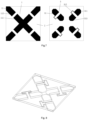
- Fig. 7 is a schematic structural diagram of an upper surface and a lower surface of an FSS unit according to scenario embodiments of the present disclosure.
- the FSS unit comprises an upper surface 1, a dielectric substrate 2 and a lower surface 3, and the dielectric substrate 2 supports the upper surface 1 and the lower surface 3.
- the upper surface 1 is composed of two first metal strips 11 interleaved with one another; and from the center to the outer side, each first metal strip 11 sequentially comprises a first central metal strip 111 and first side end metal strips 112.
- the lower surface 3 is formed by rotation of four second metal strips 31, and each second metal strip 31 comprises second side end metal strips 311, 313 and a second central metal strip 312.
- the second metal strips 31 are located right below the gaps between the first central metal strips 111 and the first side end metal strips 112. That is, as shown in Fig. 7 , the gaps between the second side end metal strips 311, 313 are exactly aligned with the gaps between the first central metal strips 111 and the first side end metal strips 112.
- Fig. 8 is a side view of a perspective structure of an FSS unit according to scenario embodiments of the present disclosure.
- the second metal strips 31 are located right below the gaps between the first central metal strips 111 and the first side end metal strips 112, which is used to implement the positional relationship that the lower surface is located right below the upper surface; however, the upper surface and the lower surface are not limited to this positional relationship.
- Each second central metal strip 312 has a width far less than the length, and may be equivalent to an inductor, for example, in the present embodiment, the range of "far less than” may be that the length of the metal strip is greater than or equal to five times the width; and the second side end metal strips 311, 313 are coupled to each other, and may be equivalent to a capacitor.
- the second central metal strip 312 and the second side end metal strips 311, 313 are connected in parallel, and may form a parallel resonant LC circuit in an H frequency band.
- Fig. 9 is a schematic structural diagram of an upper surface of an FSS according to scenario embodiments of the present disclosure
- Fig. 10 is a schematic structural diagram of a lower surface of the FSS according to scenario embodiments of the present disclosure.
- the FSS is formed by periodic extension of the FSS unit shown in Fig. 7 .
- the parallel resonant LC circuit In the H frequency band, the parallel resonant LC circuit is open to generate a reflection zero, so as to realize transmission of electromagnetic waves; and in the L frequency band, the series LC circuit is short-circuited to generate a transmission zero, so as to realize reflection of electromagnetic waves.
- Fig. 11 is a construction principle diagram of a four-order series-parallel resonant circuit according to scenario embodiments of the present disclosure. As shown in Fig. 11 , one-order, two-order or multi-order series-parallel resonant circuits can be constructed by increasing the number of metal strips 11.
- Fig. 12 is a schematic diagram of the shape of an FSS unit according to scenario embodiments of the present disclosure. As shown in Fig. 12 , the FSS unit is a rectangular FSS unit. A person skilled in the art should know that the shape of the FSS unit provided in some embodiments of the present disclosure may be a square, a rectangle, a triangle, or a polygon, which is not limited herein.
- Fig. 13 is a schematic structural diagram of a multi-layer FSS according to scenario embodiments of the present disclosure. As shown in Fig. 13 , the FSS may have a single-layer structure, a two-layer structure and a multi-layer structure.
- the FSS provided in some embodiments of the present disclosure realizes spatial filtering with low-impedance and high-pass characteristics by designing series LC circuits in an L frequency band and parallel LC circuits in an H frequency band.
- the series/parallel LC circuits and the equivalent capacitor and inductor elements are not limited to the forms described in scenario embodiment I, for example, the inductors may be designed as elongated straight lines, bent lines, coils, metal via holes, etc.; and the capacitors may be designed as coplanar coupled lines, non-coplanar coupled lines, interleaved lines, etc.
- the structures of series-parallel LC circuits are provided, but they are only described as examples, and are not specifically limited thereto.
- Fig. 14 is a schematic structural diagram of a distributed LC circuit according to scenario embodiments of the present disclosure.
- the distributed LC circuit comprises upper-layer and lower-layer metal strip lines, wherein a coupling region of the upper-layer metal strip line and the lower-layer metal strip line is equivalent to a capacitor, and the upper metal strip line is equivalent to an inductor.
- the structure can be regarded as a series LC circuit, and can provide a transmission zero in the L frequency band.
- Fig. 15 is a schematic structural diagram of a distributed LC circuit according to scenario embodiments of the present disclosure.
- the distributed LC circuit comprises a single-layer metal strip line, wherein the bent thin line in the middle is equivalent to an inductor, and wide lines on two sides are equivalent to a capacitor (it should be noted that the capacitor may be very small, and the corresponding line width is very narrow).
- the structure can be regarded as a parallel LC circuit, and can provide a reflection zero in the H frequency band.
- Fig. 16 is a schematic structural diagram of a distributed LC circuit according to scenario embodiments of the present disclosure.
- the distributed LC circuit comprises upper-layer and lower-layer metal strip lines, wherein the bent thin line in the middle of the lower-layer metal strip line is equivalent to an inductor, and metal strip lines on two sides of a thin seam are equivalent to a capacitor, and the two form a parallel LC circuit; and a coupling region of the upper-layer metal strip line and the lower-layer metal strip line is equivalent to a capacitor, and the upper metal strip line is equivalent to an inductor.
- the structure can be regarded as a parallel LC circuit and a series LC circuit, and can provide a transmission zero in the L frequency band and a reflection zero in the H frequency band.
- Fig. 17 is a schematic structural diagram of a distributed LC circuit according to scenario embodiments of the present disclosure.
- the distributed LC circuit comprises upper-layer and lower-layer metal strip lines, wherein the bent thin line at one side of the lower-layer metal strip line is equivalent to an inductor, and metal strip lines on two sides of a wide seam are equivalent to a capacitor, and the two form a parallel LC circuit; and a coupling region of the upper-layer metal strip line and the lower-layer metal strip line is equivalent to a capacitor, and the upper-layer metal strip line is equivalent to an inductor.
- the structure can be regarded as a parallel LC circuit and a series LC circuit, and can provide a transmission zero in the L frequency band and a reflection zero in the H frequency band.
- Fig. 18 is a schematic structural diagram of a distributed LC circuit according to scenario embodiments of the present disclosure.
- the distributed LC circuit comprises a single-layer metal strip line, wherein 1/4 wavelength open stub lines on two sides respectively form an equivalent inductor, and two stub lines are coupled with a metal strip line in the middle to form equivalent capacitors.
- the structure can be regarded as a parallel LC circuit, and can provide a reflection zero in the H frequency band.
- the present scenario embodiment provides a spatial filtering method.
- the resonant frequency of a parallel LC resonant circuit and a series LC resonant circuit can be changed by adjusting L values or C values, so as to control a transmission frequency band and a reflection frequency band; and N series resonant circuits and M parallel resonant circuits are constructed (N and M being greater than or equal to 1), and a transmission bandwidth and a reflection bandwidth can be respectively increased by increasing the value of N or M.
- Fig. 19 is a schematic structural diagram of an FSS unit according to scenario embodiments of the present disclosure. As shown in Fig. 19 , each of the two orthogonal metal strips of the FSS unit has four parallel LC circuits and two series LC circuits, and can provide four reflection zeros in the H frequency band and two transmission zeros in the L frequency band.
- Fig. 20 is a schematic structural diagram of an FSS unit according to scenario embodiments of the present disclosure.
- each of the two orthogonal metal strips of the FSS unit has four parallel LC circuits and two series LC circuits, and can provide four reflection zeros in the H frequency band and two transmission zeros in the L frequency band.
- the parallel LC circuit is formed by a bent inductive line and thin wires at two ends. As the thin lines at two ends have a narrow width, the capacitance thereof is small.
- the parallel LC circuit is approximately a pure inductor, it still relates to a parallel LC circuit in a strict sense.
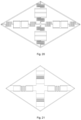
- Fig. 21 is a schematic structural diagram of an FSS unit according to scenario embodiments of the present disclosure
- Fig. 22 is a schematic structural diagram of an FSS unit according to scenario embodiments of the present disclosure.
- the FSS unit provided in the scenario embodiments above, a person skilled in the art should know that the FSS provided in some embodiments of the present disclosure has a plurality of structure implementation forms.
- a transmission zero and a reflection zero are respectively created in the L frequency band and the H frequency band, thereby achieving the functions of electromagnetic wave reflection in the L frequency band and electromagnetic wave transmission in the H frequency band.
- the FSS provided in some embodiments of the present disclosure has the following features: 1). the FSS can be applied to different carrier materials such as a dielectric substrate, a ceramic, a sheet metal strip line and a metal body; 2) the FSS may have a planar structure or a three-dimensional structure; 3) the FSS may have a single-layer structure or a multi-layer structure; 4) the shape of a unit may be a square, a rectangle, a triangle or a polygon; 5) a plurality of series or parallel resonant circuits may be constructed to obtain one or more transmission zeros or reflection zeros, thereby expanding the stopband and passband bandwidths; 6) only a parallel resonant circuit may be constructed to obtain an optimal reflection zero; and 7) dual-polarized, single-polarized and circularly-polarized electromagnetic waves may be supported.
- carrier materials such as a dielectric substrate, a ceramic, a sheet metal strip line and a metal body
- the FSS may have a planar structure or a three-dimensional
- the FSS designed according to some embodiments of the present disclosure can realize reflection with a relative bandwidth greater than 35% in the L frequency band, the reflection coefficient being greater than -0.2 dB, and can realize transmission with a relative bandwidth greater than 45% in the H frequency band, the transmission coefficient being greater than -0.3 dB.
- the frequency ratio of the L frequency band to the H frequency band can reach a minimum of 1.5:1 and a maximum of 5:1.
- the gain of a passive antenna surface in the L frequency band is only reduced by 0.2 dB, and the average gain of the active antennas in the H frequency band is not reduced.
- the FSS provided in the embodiments of the present disclosure is applicable to various specifications and models of active and passive integrated base stations and antenna products, and may be specifically used in the following scenarios: 1. a new site cannot be added; 2. a 5G antenna surface site cannot be added due to factors such as limited wind load; and 3. due to the effect of an early 4G antenna surface, the height of a 5G active antenna surface is relatively low or there are sites with line-of-sight obstructions.
- a transmission zero and a reflection zero are respectively obtained by constructing a low-frequency series LC circuit and a high-frequency parallel LC circuit in a metal strip, so as to achieve a low-impedance and high-pass filtering effect for spatial electromagnetic waves; and at the same time, on the basis of the FSS design method, a plurality of FSS unit embodiments are provided.
- the optimal embodiment uses a double-layer structure, which has extremely low transmission/reflection losses and good spatial dispersion characteristics, and can effectively suppress secondary radiation of an induced current in a wave-transmitting frequency band, thereby ensuring antenna surface air interface radiation characteristics.
- the frequency selective surface has the functions of reflecting low-frequency electromagnetic waves and transmitting high-frequency electromagnetic waves, can suppress inter-frequency coupling while implementing aperture sharing of multi-frequency antennas, and ensure independent deployment and separate maintenance of the multi-frequency antennas.
Landscapes
- Aerials With Secondary Devices (AREA)
Applications Claiming Priority (2)
| Application Number | Priority Date | Filing Date | Title |
|---|---|---|---|
| CN202211021650.5A CN117673762A (zh) | 2022-08-24 | 2022-08-24 | 频率选择表面与空间滤波方法 |
| PCT/CN2023/108731 WO2024041280A1 (zh) | 2022-08-24 | 2023-07-21 | 频率选择表面与空间滤波方法 |
Publications (2)
| Publication Number | Publication Date |
|---|---|
| EP4564609A1 true EP4564609A1 (de) | 2025-06-04 |
| EP4564609A4 EP4564609A4 (de) | 2025-11-19 |
Family
ID=90012386
Family Applications (1)
| Application Number | Title | Priority Date | Filing Date |
|---|---|---|---|
| EP23856370.4A Pending EP4564609A4 (de) | 2022-08-24 | 2023-07-21 | Frequenzselektive oberfläche und räumliches filterverfahren |
Country Status (3)
| Country | Link |
|---|---|
| EP (1) | EP4564609A4 (de) |
| CN (1) | CN117673762A (de) |
| WO (1) | WO2024041280A1 (de) |
Families Citing this family (2)
| Publication number | Priority date | Publication date | Assignee | Title |
|---|---|---|---|---|
| CN118137168B (zh) * | 2024-03-25 | 2024-08-16 | 南京林业大学 | 一种宽频透射、宽频吸波的二维三维混合结构频率选择吸收体 |
| CN119764849A (zh) * | 2024-03-27 | 2025-04-04 | 中兴通讯股份有限公司 | 频率选择单元、频率选择表面及基站天线 |
Family Cites Families (6)
| Publication number | Priority date | Publication date | Assignee | Title |
|---|---|---|---|---|
| US20030142036A1 (en) * | 2001-02-08 | 2003-07-31 | Wilhelm Michael John | Multiband or broadband frequency selective surface |
| US7071889B2 (en) * | 2001-08-06 | 2006-07-04 | Actiontec Electronics, Inc. | Low frequency enhanced frequency selective surface technology and applications |
| CN103490175B (zh) * | 2013-09-23 | 2016-01-06 | 摩比天线技术(深圳)有限公司 | 一种一体化基站天线 |
| CN110416735A (zh) * | 2018-07-16 | 2019-11-05 | 西安电子科技大学 | 具有传输零点的柔性多层频率选择表面 |
| CN111786122A (zh) * | 2020-07-26 | 2020-10-16 | 中国人民解放军国防科技大学 | 一种具有高透过率的可重构吸波与透波一体化fss |
| CN215680980U (zh) * | 2021-09-29 | 2022-01-28 | 京信通信技术(广州)有限公司 | 无源天线与多频融合基站天线 |
-
2022
- 2022-08-24 CN CN202211021650.5A patent/CN117673762A/zh active Pending
-
2023
- 2023-07-21 EP EP23856370.4A patent/EP4564609A4/de active Pending
- 2023-07-21 WO PCT/CN2023/108731 patent/WO2024041280A1/zh not_active Ceased
Also Published As
| Publication number | Publication date |
|---|---|
| CN117673762A (zh) | 2024-03-08 |
| WO2024041280A1 (zh) | 2024-02-29 |
| EP4564609A4 (de) | 2025-11-19 |
Similar Documents
| Publication | Publication Date | Title |
|---|---|---|
| JP7734838B2 (ja) | 制御可能な電磁アレイ素子、及びインテリジェンスサーフェス | |
| CN111864368B (zh) | 面向于5g通信的低剖面宽带圆极化天线及其设计方法 | |
| EP4564609A1 (de) | Frequenzselektive oberfläche und räumliches filterverfahren | |
| CN113285226B (zh) | 一种低频辐射单元及天线 | |
| US12176632B2 (en) | Dual-polarized filtering antenna units and dual-polarized filtering antenna arrays | |
| CN115864003B (zh) | 一种具有透波窗口宽频段可重构特性的频率选择表面 | |
| CN106299628B (zh) | 一种天线和无线路由器 | |
| CN118040336B (zh) | 宽频透波滤波低频辐射单元、共口径天线阵列及通信设备 | |
| CN113346250A (zh) | 一种基于多层耦合结构的毫米波三频频率选择表面 | |
| CN112563724A (zh) | 具有高频率选择性的低剖面半模基片集成波导滤波天线 | |
| CN116742356A (zh) | 基于多层超表面的5g毫米波双频天线 | |
| CN111834752A (zh) | 一种单层微带双极化透射阵天线及制造方法 | |
| CN113036432A (zh) | 一种异频滤波天线、异频滤波天线的制作方法、应用 | |
| CN113497357B (zh) | 一种宽带双极化滤波天线 | |
| CN112134005A (zh) | 一种偶极子天线及无线设备 | |
| CN215497086U (zh) | 一种低频辐射单元及天线 | |
| CN111952722A (zh) | 一种反射阵列天线单元、反射阵列天线和制作方法 | |
| CN117458157A (zh) | 一种具有滤波功能的智能超表面及设计方法 | |
| CN117394008A (zh) | 一种具有陷波结构的超宽带天线及其设计方法 | |
| CN118763413B (zh) | 一种双极化滤波天线 | |
| CN116565545A (zh) | 天线及网络设备 | |
| CN120498409B (zh) | 一种空间非谐振节点谐振器、滤波器及射频通信设备 | |
| CN113745822A (zh) | 一种低交叉极化非对称毫米波振子天线的设计方法 | |
| CN223871692U (zh) | 辐射单元、天线和基站 | |
| CN116722355B (zh) | 一种双极化滤波天线、阵列天线及无线通信设备 |
Legal Events
| Date | Code | Title | Description |
|---|---|---|---|
| STAA | Information on the status of an ep patent application or granted ep patent |
Free format text: STATUS: THE INTERNATIONAL PUBLICATION HAS BEEN MADE |
|
| PUAI | Public reference made under article 153(3) epc to a published international application that has entered the european phase |
Free format text: ORIGINAL CODE: 0009012 |
|
| STAA | Information on the status of an ep patent application or granted ep patent |
Free format text: STATUS: REQUEST FOR EXAMINATION WAS MADE |
|
| 17P | Request for examination filed |
Effective date: 20250226 |
|
| AK | Designated contracting states |
Kind code of ref document: A1 Designated state(s): AL AT BE BG CH CY CZ DE DK EE ES FI FR GB GR HR HU IE IS IT LI LT LU LV MC ME MK MT NL NO PL PT RO RS SE SI SK SM TR |
|
| A4 | Supplementary search report drawn up and despatched |
Effective date: 20251022 |
|
| RIC1 | Information provided on ipc code assigned before grant |
Ipc: H01Q 15/00 20060101AFI20251016BHEP Ipc: H01Q 1/24 20060101ALN20251016BHEP |
|
| DAV | Request for validation of the european patent (deleted) | ||
| DAX | Request for extension of the european patent (deleted) |