EP4559657A1 - Verfahren zur herstellung eines aktuators und aktuatorgehäuse dafür sowie kern zur herstellung - Google Patents
Verfahren zur herstellung eines aktuators und aktuatorgehäuse dafür sowie kern zur herstellung Download PDFInfo
- Publication number
- EP4559657A1 EP4559657A1 EP23842704.1A EP23842704A EP4559657A1 EP 4559657 A1 EP4559657 A1 EP 4559657A1 EP 23842704 A EP23842704 A EP 23842704A EP 4559657 A1 EP4559657 A1 EP 4559657A1
- Authority
- EP
- European Patent Office
- Prior art keywords
- output hole
- protruding walls
- protruding
- actuator
- output
- Prior art date
- Legal status (The legal status is an assumption and is not a legal conclusion. Google has not performed a legal analysis and makes no representation as to the accuracy of the status listed.)
- Pending
Links
Images




Classifications
-
- F—MECHANICAL ENGINEERING; LIGHTING; HEATING; WEAPONS; BLASTING
- F16—ENGINEERING ELEMENTS AND UNITS; GENERAL MEASURES FOR PRODUCING AND MAINTAINING EFFECTIVE FUNCTIONING OF MACHINES OR INSTALLATIONS; THERMAL INSULATION IN GENERAL
- F16J—PISTONS; CYLINDERS; SEALINGS
- F16J3/00—Diaphragms; Bellows; Bellows pistons
- F16J3/04—Bellows
- F16J3/041—Non-metallic bellows
- F16J3/042—Fastening details
-
- F—MECHANICAL ENGINEERING; LIGHTING; HEATING; WEAPONS; BLASTING
- F16—ENGINEERING ELEMENTS AND UNITS; GENERAL MEASURES FOR PRODUCING AND MAINTAINING EFFECTIVE FUNCTIONING OF MACHINES OR INSTALLATIONS; THERMAL INSULATION IN GENERAL
- F16D—COUPLINGS FOR TRANSMITTING ROTATION; CLUTCHES; BRAKES
- F16D65/00—Parts or details
- F16D65/14—Actuating mechanisms for brakes; Means for initiating operation at a predetermined position
- F16D65/28—Actuating mechanisms for brakes; Means for initiating operation at a predetermined position arranged apart from the brake
-
- B—PERFORMING OPERATIONS; TRANSPORTING
- B29—WORKING OF PLASTICS; WORKING OF SUBSTANCES IN A PLASTIC STATE IN GENERAL
- B29C—SHAPING OR JOINING OF PLASTICS; SHAPING OF MATERIAL IN A PLASTIC STATE, NOT OTHERWISE PROVIDED FOR; AFTER-TREATMENT OF THE SHAPED PRODUCTS, e.g. REPAIRING
- B29C33/00—Moulds or cores; Details thereof or accessories therefor
- B29C33/42—Moulds or cores; Details thereof or accessories therefor characterised by the shape of the moulding surface, e.g. ribs or grooves
-
- B—PERFORMING OPERATIONS; TRANSPORTING
- B29—WORKING OF PLASTICS; WORKING OF SUBSTANCES IN A PLASTIC STATE IN GENERAL
- B29C—SHAPING OR JOINING OF PLASTICS; SHAPING OF MATERIAL IN A PLASTIC STATE, NOT OTHERWISE PROVIDED FOR; AFTER-TREATMENT OF THE SHAPED PRODUCTS, e.g. REPAIRING
- B29C45/00—Injection moulding, i.e. forcing the required volume of moulding material through a nozzle into a closed mould; Apparatus therefor
- B29C45/17—Component parts, details or accessories; Auxiliary operations
- B29C45/26—Moulds
-
- B—PERFORMING OPERATIONS; TRANSPORTING
- B29—WORKING OF PLASTICS; WORKING OF SUBSTANCES IN A PLASTIC STATE IN GENERAL
- B29C—SHAPING OR JOINING OF PLASTICS; SHAPING OF MATERIAL IN A PLASTIC STATE, NOT OTHERWISE PROVIDED FOR; AFTER-TREATMENT OF THE SHAPED PRODUCTS, e.g. REPAIRING
- B29C45/00—Injection moulding, i.e. forcing the required volume of moulding material through a nozzle into a closed mould; Apparatus therefor
- B29C45/17—Component parts, details or accessories; Auxiliary operations
- B29C45/26—Moulds
- B29C45/261—Moulds having tubular mould cavities
- B29C45/2612—Moulds having tubular mould cavities for manufacturing tubular articles with an annular groove
-
- B—PERFORMING OPERATIONS; TRANSPORTING
- B60—VEHICLES IN GENERAL
- B60T—VEHICLE BRAKE CONTROL SYSTEMS OR PARTS THEREOF; BRAKE CONTROL SYSTEMS OR PARTS THEREOF, IN GENERAL; ARRANGEMENT OF BRAKING ELEMENTS ON VEHICLES IN GENERAL; PORTABLE DEVICES FOR PREVENTING UNWANTED MOVEMENT OF VEHICLES; VEHICLE MODIFICATIONS TO FACILITATE COOLING OF BRAKES
- B60T13/00—Transmitting braking action from initiating means to ultimate brake actuator with power assistance or drive; Brake systems incorporating such transmitting means, e.g. air-pressure brake systems
- B60T13/74—Transmitting braking action from initiating means to ultimate brake actuator with power assistance or drive; Brake systems incorporating such transmitting means, e.g. air-pressure brake systems with electrical assistance or drive
-
- B—PERFORMING OPERATIONS; TRANSPORTING
- B60—VEHICLES IN GENERAL
- B60T—VEHICLE BRAKE CONTROL SYSTEMS OR PARTS THEREOF; BRAKE CONTROL SYSTEMS OR PARTS THEREOF, IN GENERAL; ARRANGEMENT OF BRAKING ELEMENTS ON VEHICLES IN GENERAL; PORTABLE DEVICES FOR PREVENTING UNWANTED MOVEMENT OF VEHICLES; VEHICLE MODIFICATIONS TO FACILITATE COOLING OF BRAKES
- B60T13/00—Transmitting braking action from initiating means to ultimate brake actuator with power assistance or drive; Brake systems incorporating such transmitting means, e.g. air-pressure brake systems
- B60T13/74—Transmitting braking action from initiating means to ultimate brake actuator with power assistance or drive; Brake systems incorporating such transmitting means, e.g. air-pressure brake systems with electrical assistance or drive
- B60T13/746—Transmitting braking action from initiating means to ultimate brake actuator with power assistance or drive; Brake systems incorporating such transmitting means, e.g. air-pressure brake systems with electrical assistance or drive and mechanical transmission of the braking action
-
- F—MECHANICAL ENGINEERING; LIGHTING; HEATING; WEAPONS; BLASTING
- F16—ENGINEERING ELEMENTS AND UNITS; GENERAL MEASURES FOR PRODUCING AND MAINTAINING EFFECTIVE FUNCTIONING OF MACHINES OR INSTALLATIONS; THERMAL INSULATION IN GENERAL
- F16J—PISTONS; CYLINDERS; SEALINGS
- F16J15/00—Sealings
- F16J15/50—Sealings between relatively-movable members, by means of a sealing without relatively-moving surfaces, e.g. fluid-tight sealings for transmitting motion through a wall
- F16J15/52—Sealings between relatively-movable members, by means of a sealing without relatively-moving surfaces, e.g. fluid-tight sealings for transmitting motion through a wall by means of sealing bellows or diaphragms
-
- F—MECHANICAL ENGINEERING; LIGHTING; HEATING; WEAPONS; BLASTING
- F16—ENGINEERING ELEMENTS AND UNITS; GENERAL MEASURES FOR PRODUCING AND MAINTAINING EFFECTIVE FUNCTIONING OF MACHINES OR INSTALLATIONS; THERMAL INSULATION IN GENERAL
- F16J—PISTONS; CYLINDERS; SEALINGS
- F16J3/00—Diaphragms; Bellows; Bellows pistons
- F16J3/04—Bellows
-
- F—MECHANICAL ENGINEERING; LIGHTING; HEATING; WEAPONS; BLASTING
- F16—ENGINEERING ELEMENTS AND UNITS; GENERAL MEASURES FOR PRODUCING AND MAINTAINING EFFECTIVE FUNCTIONING OF MACHINES OR INSTALLATIONS; THERMAL INSULATION IN GENERAL
- F16D—COUPLINGS FOR TRANSMITTING ROTATION; CLUTCHES; BRAKES
- F16D2121/00—Type of actuator operation force
- F16D2121/18—Electric or magnetic
- F16D2121/24—Electric or magnetic using motors
-
- F—MECHANICAL ENGINEERING; LIGHTING; HEATING; WEAPONS; BLASTING
- F16—ENGINEERING ELEMENTS AND UNITS; GENERAL MEASURES FOR PRODUCING AND MAINTAINING EFFECTIVE FUNCTIONING OF MACHINES OR INSTALLATIONS; THERMAL INSULATION IN GENERAL
- F16D—COUPLINGS FOR TRANSMITTING ROTATION; CLUTCHES; BRAKES
- F16D2125/00—Components of actuators
- F16D2125/18—Mechanical mechanisms
- F16D2125/20—Mechanical mechanisms converting rotation to linear movement or vice versa
- F16D2125/34—Mechanical mechanisms converting rotation to linear movement or vice versa acting in the direction of the axis of rotation
- F16D2125/40—Screw-and-nut
-
- F—MECHANICAL ENGINEERING; LIGHTING; HEATING; WEAPONS; BLASTING
- F16—ENGINEERING ELEMENTS AND UNITS; GENERAL MEASURES FOR PRODUCING AND MAINTAINING EFFECTIVE FUNCTIONING OF MACHINES OR INSTALLATIONS; THERMAL INSULATION IN GENERAL
- F16D—COUPLINGS FOR TRANSMITTING ROTATION; CLUTCHES; BRAKES
- F16D2125/00—Components of actuators
- F16D2125/18—Mechanical mechanisms
- F16D2125/44—Mechanical mechanisms transmitting rotation
- F16D2125/46—Rotating members in mutual engagement
- F16D2125/48—Rotating members in mutual engagement with parallel stationary axes, e.g. spur gears
-
- F—MECHANICAL ENGINEERING; LIGHTING; HEATING; WEAPONS; BLASTING
- F16—ENGINEERING ELEMENTS AND UNITS; GENERAL MEASURES FOR PRODUCING AND MAINTAINING EFFECTIVE FUNCTIONING OF MACHINES OR INSTALLATIONS; THERMAL INSULATION IN GENERAL
- F16D—COUPLINGS FOR TRANSMITTING ROTATION; CLUTCHES; BRAKES
- F16D2125/00—Components of actuators
- F16D2125/18—Mechanical mechanisms
- F16D2125/58—Mechanical mechanisms transmitting linear movement
- F16D2125/582—Flexible element, e.g. spring, other than the main force generating element
-
- F—MECHANICAL ENGINEERING; LIGHTING; HEATING; WEAPONS; BLASTING
- F16—ENGINEERING ELEMENTS AND UNITS; GENERAL MEASURES FOR PRODUCING AND MAINTAINING EFFECTIVE FUNCTIONING OF MACHINES OR INSTALLATIONS; THERMAL INSULATION IN GENERAL
- F16D—COUPLINGS FOR TRANSMITTING ROTATION; CLUTCHES; BRAKES
- F16D2125/00—Components of actuators
- F16D2125/18—Mechanical mechanisms
- F16D2125/58—Mechanical mechanisms transmitting linear movement
- F16D2125/60—Cables or chains, e.g. Bowden cables
-
- F—MECHANICAL ENGINEERING; LIGHTING; HEATING; WEAPONS; BLASTING
- F16—ENGINEERING ELEMENTS AND UNITS; GENERAL MEASURES FOR PRODUCING AND MAINTAINING EFFECTIVE FUNCTIONING OF MACHINES OR INSTALLATIONS; THERMAL INSULATION IN GENERAL
- F16D—COUPLINGS FOR TRANSMITTING ROTATION; CLUTCHES; BRAKES
- F16D2131/00—Overall arrangement of the actuators or their elements, e.g. modular construction
-
- F—MECHANICAL ENGINEERING; LIGHTING; HEATING; WEAPONS; BLASTING
- F16—ENGINEERING ELEMENTS AND UNITS; GENERAL MEASURES FOR PRODUCING AND MAINTAINING EFFECTIVE FUNCTIONING OF MACHINES OR INSTALLATIONS; THERMAL INSULATION IN GENERAL
- F16D—COUPLINGS FOR TRANSMITTING ROTATION; CLUTCHES; BRAKES
- F16D2200/00—Materials; Production methods therefor
- F16D2200/0034—Materials; Production methods therefor non-metallic
- F16D2200/0056—Elastomers
-
- F—MECHANICAL ENGINEERING; LIGHTING; HEATING; WEAPONS; BLASTING
- F16—ENGINEERING ELEMENTS AND UNITS; GENERAL MEASURES FOR PRODUCING AND MAINTAINING EFFECTIVE FUNCTIONING OF MACHINES OR INSTALLATIONS; THERMAL INSULATION IN GENERAL
- F16D—COUPLINGS FOR TRANSMITTING ROTATION; CLUTCHES; BRAKES
- F16D2200/00—Materials; Production methods therefor
- F16D2200/0082—Production methods therefor
Definitions
- the present invention relates to: an actuator in which an actuator mechanism is housed in an actuator case made of a resin, an output member of the actuator mechanism is disposed so as to pass through an output hole of the actuator case, and a boot for covering an outer portion, which protrudes to an outside of the output hole, of the output member is mounted to the actuator case; a method of manufacturing the actuator case; and a core to be used for the manufacturing method.
- the present invention has been made in view of the circumstances described above, and has an object to provide: an actuator in which a fitting groove into which a mounting portion of a boot is to be mounted is formed in an inner peripheral surface of an output hole of an actuator case so as to enable protection of the mounting portion from external shock and formation of the fitting groove is enabled simultaneously with molding of the actuator case of a resin; a method of manufacturing the actuator case; and a core for manufacturing.
- an actuator including;
- the output member corresponds to an output bolt 19 in an embodiment of the present invention, which is described later.
- a width of each of the first gaps between the first protruding walls is set larger than a length of each of the second protruding walls in the circumferential direction of the output hole.
- a protruding height of the second protruding walls is set larger than a protruding height of the first protruding walls, and the second protruding walls are configured to bear the mounting portion in a process of mounting the mounting portion into the fitting groove.
- a length of each of the first protruding walls in the circumferential direction of the output hole is set smaller than a length of each of the second protruding walls in the circumferential direction of the output hole.
- a reinforcing member is embedded in the mounting portion.
- an actuator case including:
- a core to be used in the method of manufacturing an actuator which has the six feature,
- the plurality of first protruding walls, each protruding radially inward are formed on the outer end portion of the output hole so as to alternate with the gaps in the circumferential direction of the output hole.
- the plurality of second protruding walls, each protruding radially inward are formed on the inner end portion of the output hole so as to alternate with the gaps in the circumferential direction of the output hole.
- the first protruding walls and the second protruding walls are arranged so as to avoid overlapping with each other when the output hole is seen in plan view, and the fitting groove into which the mounting portion of the boot is to be mounted is defined between the first protruding walls and the second protruding walls.
- the first protruding walls and the second protruding walls are formed using the core that is divided in the axial direction inside the output hole, and the fitting groove can be defined by the first protruding walls and the second protruding walls.
- an additional process for forming the fitting groove is not required after the molding of the actuator case, and this can contribute to a reduction in manufacturing costs.
- the mounting portion of the boot which is mounted in the fitting groove on the inner side of the output hole, can be protected from external shock so as to be prevented from being disengaged from the fitting groove.
- the width of each of the first gaps between the first protruding walls is set larger than the length of each of the second protruding walls in the circumferential direction of the output hole.
- the protruding height of the second protruding walls is set larger than the protruding height of the first protruding walls so that the mounting portion is borne by the second protruding walls in the process of mounting the mounting portion into the fitting groove.
- the mounting portion can easily be press-fitted and mounted into the fitting groove, and can also be prevented by the second protruding walls from being moved too far.
- the mounting portion when the length of each of the first protruding walls in the circumferential direction of the output hole is set smaller than the length of each of the second protruding walls in the circumferential direction of the output hole, the mounting portion can further easily be press-fitted and mounted into the fitting groove. Further, after the mounting of the mounting portion, the mounting portion can be prevented by the first protruding walls from being disengaged from the fitting groove.
- a force for press-fitting and mounting the mounting portion into the fitting groove is effectively increased to thereby be able to stabilize a mounted state of the mounting portion into the fitting groove.
- the output hole having the fitting groove can be formed by using the first core and the second core.
- the output hole having the fitting groove can be reliably formed by using the first core and the second core.
- An actuator “A” includes an actuator case 10 and an actuator mechanism 11 housed in the actuator “A.” With respect to the actuator "A,” an extending direction of an output bolt 19, which is described later, from the actuator case 10 is referred to as “forward (front),” and a direction opposite thereto is referred to as “rearward (rear).”
- the actuator case 10 includes a motor case part 10a having a cylindrical shape, an output case part 10b having a cylindrical shape, and a gear case part 10c.
- the output case part 10b is arranged adjacent to and in parallel to the motor case part 10a.
- the gear case part 10c connects a rear end portion of the motor case part 10a to an intermediate portion of the output case part.
- An output hole 15 is formed in a front end portion of the output case part 10b.
- this actuator case 10 is divided into a case main body 10A corresponding to a front half part and a case cover 10B corresponding to a rear half part so as to enable assembly and disassembly of the actuator mechanism 11.
- the case main body 10A and the case cover 10B are formed by injection molding of a resin.
- the actuator mechanism 11 includes a motor 12, the output bolt 19, a speed-reduction gear train 13, and a motion conversion mechanism 16.
- the motor 12 is housed in the motor case part 10a.
- the output bolt 19 is disposed so as to protrude from the output case part 10b to an outside through the output hole 15.
- the speed-reduction gear train 13 is housed in the gear case part 10c and extends toward the output case part 10b.
- the speed-reduction rear train 13 reduces a speed of rotation of a rotor shaft 10a of the motor 12 and then transmits the rotation to a final gear 14.
- the motion conversion mechanism 16 is housed in the output case part 10b, and converts a rotational motion of the final gear 14 into an axial motion and then transmits the axial motion to the output bolt 19.
- the motion conversion mechanism 16 includes a rotating nut 18 and a male thread 19a of the output bolt 19.
- the rotating nut 18 is rotatably and axially unmovably supported by the output case part 10b through intermediation of a bearing 17.
- the male thread 19a is threadably engaged with a female thread 18a of the rotating nut 18.
- a large-diameter cylindrical portion 20 is provided integrally and continuously with a rear end of the rotating nut 18 and is coupled to the final gear 14. Thus, the large-diameter cylindrical portion 20 can be rotated together with the final gear 14 but cannot be moved in an axial direction.
- keys 21 protruding in a diametrical direction of the output bolt 19 are formed on a rear end portion of the output bolt 19.
- Key grooves 22 with which the keys 21 are to be slidably engaged are formed on the output case part 10b.
- the output bolt 19 is movable in its axial direction but is nonrotatable.
- a distal end portion of the output bolt 19, which protrudes to the outside of the output hole 15, is connected to a parking brake mechanism (not shown) of a drum brake through intermediation of a cable 23.
- a plurality of belleville springs 24, which are compressed by advancement of the keys 21, are housed in the large-diameter cylindrical portion 20 of the rotating nut 18.
- a bellows-type boot 25 made of an elastic material is mounted to the output case part 10b so as to cover an outer part of the output bolt 19.
- the boot 25 is mounted in order to close the output hole 15 of the output case part 10b for the purpose of preventing dust and water.
- the boot 25 has a first mounting portion 26 with a larger diameter at one end part and a second mounting portion 27 with a smaller diameter at another end part.
- a reinforcing member 28 made of metal is embedded in the first mounting portion 26 having a larger diameter.
- This first mounting portion 26 is press-fitted and mounted into a fitting groove 30 formed on an inner peripheral surface of the output hole 15.
- the second mounting portion 27 having a smaller diameter is mounted into an outer peripheral groove 31 of a distal end portion of the output bolt 19.
- the first mounting portion 26 is one example of a mounting portion of the present invention.
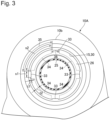
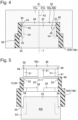
- a structure of the fitting groove 30 is described with reference to Fig. 2 , Fig. 3 , Fig. 5 , and Fig. 8 .
- first protruding walls 33 are formed on an outer end side of an inner peripheral surface of the output hole 15 so as to alternate with first gaps 35 in a circumferential direction of the output hole 15.
- the same number of second protruding walls 34 as the number of the first protruding walls 33, which protrude radially inward from the inner peripheral surface of the output hole 15, are formed on an inner end side of the inner peripheral surface of the output hole 15 so as to alternate with second gaps 26 in the circumferential direction of the output hole 15.
- the first protruding walls 33 and the second protruding walls 33 are arranged so as to avoid overlapping with each other when the output hole 15 is seen in plan view (see Fig. 3 ). In this manner, the first protruding walls 33 and the second protruding walls 34 define the fitting groove 30 on the inner peripheral surface of the output hole 15.
- a width of the first gap 35 between the first protruding walls 33 is set larger than a length s2 of the second protruding wall 34 in the circumferential direction of the output hole 15. This is equivalent to setting a width of the second gap 36 between the second protruding walls 34 larger than a length s1 of the first protruding wall 33 in the circumferential direction of the output hole 15.
- a protruding height t2 of the second protruding walls 34 from the inner peripheral surface of the output hole 15 is set larger than a protruding height t1 of the first protruding walls 33 from the inner peripheral surface of the output hole 15. This is equivalent to setting a diameter of an imaginary circle being in contact with distal end surfaces of all the second protruding walls 34 larger than a diameter of an imaginary circle being in contact with distal end surfaces of all the first protruding walls 33.
- an inner diameter D2 of the fitting groove 30 is set slightly smaller than an outer diameter D1 of the first mounting portion 26.
- the first mounting portion 26 of the boot 25 In order to mount the first mounting portion 26 of the boot 25 into the fitting groove 30 of the output case part 10b, the first mounting portion 26 is press-fitted toward the tapered press-fit guide surface 40 of the output case part 10b. Then, the first mounting portion 26 is moved into the fitting groove 30 while being compressed in a radially contracting direction by the first protruding walls 33, and is borne by the second protruding walls 34 so as to be restrained from being moved too far. Further, the first mounting portion 26 is prevented by the first protruding walls 33 from being disengaged from the fitting groove 30. Besides, an initial load is applied to the first mounting portion 26 in the radially contracting direction by the bottom surface of the fitting groove 30 in the fitting groove 30.
- the reinforcing member 28 is embedded in the first mounting portion 26.
- a reaction force to the press-fitting of the first mounting portion 26 into the fitting groove 30 can be effectively increased so as to be able to further stabilize the mounted state of the first mounting portion 26 in the fitting groove 30.
- an outer die 41 for forming an outer surface of the case main body 10A and a core 42 (see Fig. 5 , Fig. 7 , and Fig. 8 ) for forming an inner peripheral surface of the output hole 15 are prepared.
- the outer die 41 includes a first outer-die half body 41a and a second outer-die half body 41b, which are aligned in abutment relation with each other (or joined together) at a partition plane 43 passing through a center axis Y of the output hole 15 so as to be separable from each other.
- the core 42 is formed by fitting a first core half body 42a and a second core half body 42b together so that the first half body 42a and the second core half body 42b are separable from each other in the axial direction.
- the first core half body 42a is positioned on the outer end side of the output hole 15, and the second core half body 42b is positioned on the inner end side of the output hole 15.
- First recessed portions 45 and second recessed portions 46 for forming the first protruding walls 33 and the second protruding walls 34, respectively, are defined between the first core half body 42a and the second core half body 42b in the following manner.
- the second core half body 42b includes: a first columnar portion 52 to be fitted along an inner peripheral surface of the hollow cylindrical portion 47 so as to be removable therefrom; and a second columnar portion 53 continuous with the first columnar portion 52, which has a diameter larger than that of the first columnar portion 52.
- Ridges 54 (see Fig. 8 ) that define the first recessed portions 45 in cooperation with the groove portions 49 while being engaged with the cutouts 51 are formed on the first columnar portion 52.
- the second recessed portions 46 are defined by a distal end surface of the hollow cylindrical portion 47, the ridges 54, and a step portion 55 between the first columnar portion 52 and the second columnar portion 53.
- first outer-die half body 41a and the second outer-die half body 41b are aligned in abutment relation with each other (or joined together) at the partition plane 43, and are clamped together.
- first core half body 42a and the second core half body 42b are fitted together inside the first outer-die half body 41a and the second outer-die half body 41b, a cavity 56 including the first recessed portions 45 and the second recessed portions 46 is defined between the first outer-die half body 41a and the second outer-die half body 41b and the first core half body 42a and the second core half body 42b.
- a resin is injected into the cavity 56 to thereby form the case main body 10A by molding.
- the plurality of first protruding walls 33 and the plurality of second protruding walls 34, which define the fitting groove 30, and the press-fit guide surface 40 can be formed.
- an additional process for forming the fitting groove 30 is not required.
- a reduction in manufacturing costs can be achieved.
Landscapes
- Engineering & Computer Science (AREA)
- Mechanical Engineering (AREA)
- General Engineering & Computer Science (AREA)
- Transportation (AREA)
- Manufacturing & Machinery (AREA)
- Moulds For Moulding Plastics Or The Like (AREA)
- Motor Or Generator Frames (AREA)
Applications Claiming Priority (2)
| Application Number | Priority Date | Filing Date | Title |
|---|---|---|---|
| JP2022114949 | 2022-07-19 | ||
| PCT/JP2023/021132 WO2024018772A1 (ja) | 2022-07-19 | 2023-06-07 | アクチュエータ,並びにそのアクチュエータケースの製造方法及び製造用中子 |
Publications (2)
| Publication Number | Publication Date |
|---|---|
| EP4559657A1 true EP4559657A1 (de) | 2025-05-28 |
| EP4559657A4 EP4559657A4 (de) | 2025-11-12 |
Family
ID=89617471
Family Applications (1)
| Application Number | Title | Priority Date | Filing Date |
|---|---|---|---|
| EP23842704.1A Pending EP4559657A4 (de) | 2022-07-19 | 2023-06-07 | Verfahren zur herstellung eines aktuators und aktuatorgehäuse dafür sowie kern zur herstellung |
Country Status (5)
| Country | Link |
|---|---|
| EP (1) | EP4559657A4 (de) |
| JP (1) | JP7728466B2 (de) |
| KR (1) | KR20250023556A (de) |
| CN (1) | CN119452196A (de) |
| WO (1) | WO2024018772A1 (de) |
Family Cites Families (11)
| Publication number | Priority date | Publication date | Assignee | Title |
|---|---|---|---|---|
| DE102009060201A1 (de) * | 2009-12-23 | 2011-06-30 | Lucas Automotive GmbH, 56070 | Unterbaugruppe für einen elektromechanischen Bremsaktor |
| JP6029373B2 (ja) * | 2012-07-31 | 2016-11-24 | 日立オートモティブシステムズ株式会社 | ディスクブレーキ |
| JP2015110967A (ja) * | 2013-12-06 | 2015-06-18 | 曙ブレーキ工業株式会社 | ドラム式電動駐車ブレーキ装置用アクチュエータユニット |
| JP6397726B2 (ja) * | 2014-11-04 | 2018-09-26 | Kyb株式会社 | シリンダ装置及びカバー部材 |
| WO2016129511A1 (ja) * | 2015-02-12 | 2016-08-18 | 株式会社ミツバ | アクチュエータおよびその製造方法 |
| JP6474271B2 (ja) * | 2015-02-12 | 2019-02-27 | 株式会社ミツバ | アクチュエータ |
| JP6739287B2 (ja) * | 2016-08-24 | 2020-08-12 | Ntn株式会社 | 電動ブレーキ装置 |
| JP6581152B2 (ja) * | 2017-06-23 | 2019-09-25 | 日信工業株式会社 | 電動アクチュエータおよび電動パーキングブレーキ装置 |
| JP2019152268A (ja) | 2018-03-02 | 2019-09-12 | Ntn株式会社 | 運動変換機構及びその組立方法 |
| US11400908B2 (en) | 2018-03-30 | 2022-08-02 | Hitachi Astemo, Ltd. | Electric parking brake device |
| JP7144700B2 (ja) | 2021-01-27 | 2022-09-30 | 正 大平 | 自転車 |
-
2023
- 2023-06-07 EP EP23842704.1A patent/EP4559657A4/de active Pending
- 2023-06-07 JP JP2024534960A patent/JP7728466B2/ja active Active
- 2023-06-07 WO PCT/JP2023/021132 patent/WO2024018772A1/ja not_active Ceased
- 2023-06-07 KR KR1020257001671A patent/KR20250023556A/ko active Pending
- 2023-06-07 CN CN202380052692.1A patent/CN119452196A/zh active Pending
Also Published As
| Publication number | Publication date |
|---|---|
| CN119452196A (zh) | 2025-02-14 |
| JP7728466B2 (ja) | 2025-08-22 |
| WO2024018772A1 (ja) | 2024-01-25 |
| EP4559657A4 (de) | 2025-11-12 |
| JPWO2024018772A1 (de) | 2024-01-25 |
| KR20250023556A (ko) | 2025-02-18 |
Similar Documents
| Publication | Publication Date | Title |
|---|---|---|
| US9346484B2 (en) | Apparatus for releasing a securing screw for a unit in a housing | |
| JP3227610B2 (ja) | 自動車のクラッチ制御機構 | |
| WO2017170040A1 (ja) | 電動アクチュエータ | |
| CN110719999B (zh) | 用于机动车辆的转向轴 | |
| KR101429841B1 (ko) | 링 기어와 차동 케이스의 체결 구조 및 그것을 사용한 차동 장치 | |
| US10232872B2 (en) | Steering apparatus | |
| JP2009108892A (ja) | トルク伝達用継手及び電動パワ−ステアリング装置 | |
| EP4559657A1 (de) | Verfahren zur herstellung eines aktuators und aktuatorgehäuse dafür sowie kern zur herstellung | |
| EP3748197A1 (de) | Wendeeinheit | |
| EP2530343A1 (de) | Kopplungsstruktur und Lenkvorrichtung | |
| US11384827B2 (en) | Electric power steering polymer drive pulley | |
| JP6257804B2 (ja) | ディスクブレーキ | |
| CN117469348A (zh) | 用于制动执行器的传动机构的多部件齿轮、制动执行器及生产该多部件齿轮的方法 | |
| US7681471B2 (en) | Motor vehicle gear arrangement for a power assist gearing in a motor vehicle | |
| CN109973610B (zh) | 一种线性致动器 | |
| EP3214340B1 (de) | Schneckenreduktionsgetriebe und elektrisch angetriebene hilfsvorrichtung | |
| US10323740B2 (en) | Differential for automobile | |
| EP3534508A1 (de) | Elektrischer aktuator | |
| US20210088113A1 (en) | Gearbox assembly and worm shaft assesmbly therefore steering column assembly | |
| JP2017133584A (ja) | ディスクブレーキ | |
| JP2016125547A (ja) | ディスクブレーキ | |
| WO2004057207A1 (en) | An electro-mechanical screw actuator assembly | |
| JP6994916B2 (ja) | ディスクブレーキ | |
| EP2634013B1 (de) | Radstützvorrichtung | |
| WO2016147829A1 (ja) | 固定式等速自在継手および固定式等速自在継手の組立方法 |
Legal Events
| Date | Code | Title | Description |
|---|---|---|---|
| STAA | Information on the status of an ep patent application or granted ep patent |
Free format text: STATUS: THE INTERNATIONAL PUBLICATION HAS BEEN MADE |
|
| PUAI | Public reference made under article 153(3) epc to a published international application that has entered the european phase |
Free format text: ORIGINAL CODE: 0009012 |
|
| STAA | Information on the status of an ep patent application or granted ep patent |
Free format text: STATUS: REQUEST FOR EXAMINATION WAS MADE |
|
| 17P | Request for examination filed |
Effective date: 20250113 |
|
| AK | Designated contracting states |
Kind code of ref document: A1 Designated state(s): AL AT BE BG CH CY CZ DE DK EE ES FI FR GB GR HR HU IE IS IT LI LT LU LV MC ME MK MT NL NO PL PT RO RS SE SI SK SM TR |
|
| RAP3 | Party data changed (applicant data changed or rights of an application transferred) |
Owner name: ASTEMO, LTD. |
|
| DAV | Request for validation of the european patent (deleted) | ||
| DAX | Request for extension of the european patent (deleted) | ||
| A4 | Supplementary search report drawn up and despatched |
Effective date: 20251013 |
|
| RIC1 | Information provided on ipc code assigned before grant |
Ipc: B29C 45/26 20060101AFI20251007BHEP Ipc: F16J 3/04 20060101ALI20251007BHEP Ipc: F16D 65/28 20060101ALI20251007BHEP Ipc: F16D 125/06 20120101ALI20251007BHEP Ipc: F16D 125/40 20120101ALI20251007BHEP Ipc: F16D 125/70 20120101ALI20251007BHEP Ipc: B60T 13/74 20060101ALI20251007BHEP Ipc: F16J 15/52 20060101ALI20251007BHEP Ipc: B29C 33/42 20060101ALI20251007BHEP |