EP4556583A1 - Sintered ore and method for producing same, and sintered ore for hydrogen reduction and method for producing same - Google Patents
Sintered ore and method for producing same, and sintered ore for hydrogen reduction and method for producing same Download PDFInfo
- Publication number
- EP4556583A1 EP4556583A1 EP22953914.3A EP22953914A EP4556583A1 EP 4556583 A1 EP4556583 A1 EP 4556583A1 EP 22953914 A EP22953914 A EP 22953914A EP 4556583 A1 EP4556583 A1 EP 4556583A1
- Authority
- EP
- European Patent Office
- Prior art keywords
- sintered ore
- porosity
- gas
- reduction
- producing
- Prior art date
- Legal status (The legal status is an assumption and is not a legal conclusion. Google has not performed a legal analysis and makes no representation as to the accuracy of the status listed.)
- Pending
Links
Images



Classifications
-
- C—CHEMISTRY; METALLURGY
- C22—METALLURGY; FERROUS OR NON-FERROUS ALLOYS; TREATMENT OF ALLOYS OR NON-FERROUS METALS
- C22B—PRODUCTION AND REFINING OF METALS; PRETREATMENT OF RAW MATERIALS
- C22B1/00—Preliminary treatment of ores or scrap
- C22B1/14—Agglomerating; Briquetting; Binding; Granulating
- C22B1/16—Sintering; Agglomerating
-
- C—CHEMISTRY; METALLURGY
- C21—METALLURGY OF IRON
- C21B—MANUFACTURE OF IRON OR STEEL
- C21B13/00—Making spongy iron or liquid steel, by direct processes
- C21B13/0086—Conditioning, transformation of reduced iron ores
-
- C—CHEMISTRY; METALLURGY
- C21—METALLURGY OF IRON
- C21B—MANUFACTURE OF IRON OR STEEL
- C21B13/00—Making spongy iron or liquid steel, by direct processes
- C21B13/02—Making spongy iron or liquid steel, by direct processes in shaft furnaces
-
- C—CHEMISTRY; METALLURGY
- C21—METALLURGY OF IRON
- C21B—MANUFACTURE OF IRON OR STEEL
- C21B5/00—Making pig-iron in the blast furnace
- C21B5/008—Composition or distribution of the charge
-
- G—PHYSICS
- G01—MEASURING; TESTING
- G01N—INVESTIGATING OR ANALYSING MATERIALS BY DETERMINING THEIR CHEMICAL OR PHYSICAL PROPERTIES
- G01N15/00—Investigating characteristics of particles; Investigating permeability, pore-volume or surface-area of porous materials
- G01N15/08—Investigating permeability, pore-volume, or surface area of porous materials
- G01N15/088—Investigating volume, surface area, size or distribution of pores; Porosimetry
- G01N15/0886—Mercury porosimetry
-
- G—PHYSICS
- G01—MEASURING; TESTING
- G01N—INVESTIGATING OR ANALYSING MATERIALS BY DETERMINING THEIR CHEMICAL OR PHYSICAL PROPERTIES
- G01N15/00—Investigating characteristics of particles; Investigating permeability, pore-volume or surface-area of porous materials
- G01N15/08—Investigating permeability, pore-volume, or surface area of porous materials
- G01N15/088—Investigating volume, surface area, size or distribution of pores; Porosimetry
- G01N15/0893—Investigating volume, surface area, size or distribution of pores; Porosimetry by measuring weight or volume of sorbed fluid, e.g. B.E.T. method
-
- C—CHEMISTRY; METALLURGY
- C21—METALLURGY OF IRON
- C21B—MANUFACTURE OF IRON OR STEEL
- C21B13/00—Making spongy iron or liquid steel, by direct processes
- C21B13/0073—Selection or treatment of the reducing gases
-
- G—PHYSICS
- G01—MEASURING; TESTING
- G01N—INVESTIGATING OR ANALYSING MATERIALS BY DETERMINING THEIR CHEMICAL OR PHYSICAL PROPERTIES
- G01N9/00—Investigating density or specific gravity of materials; Analysing materials by determining density or specific gravity
- G01N9/36—Analysing materials by measuring the density or specific gravity, e.g. determining quantity of moisture
Definitions
- the object of the present invention is to provide a sintered ore for use in a blast furnace method or for direct reduction, particularly to provide a sintered ore or a sintered ore for hydrogen reduction, each of which achieves high reducibility and a low reduction-degradation property and to propose a method for producing the sintered ore or the sintered ore for hydrogen reduction.
- the inventors have grasped a pore structure that contributes to achieving both high reducibility and a low reduction-degradation property, and attempted to construct a new concept on pores that can achieve both high reducibility and a low reduction-degradation property.
- a sintered ore according to the present invention that advantageously solves the above problems has a ratio P A /P B of 0.23 or more, where P A represents a porosity (volume%), measured by mercury porosimetry, of particles of the sintered ore that have a size of 5 mm or more and are ground to an average particle size of 1 to 2 mm, and P B represents the porosity (volume%) of the particles of the sintered ore determined using an apparent density measured by an in-liquid weighing method using water, and using a real density, measured by a boiling method or a vacuum suction method, of the particles of the sintered ore that are ground and sieved into a particle size of less than 250 ⁇ m.
- the sintered ore according to the present invention may include the following feature, for example, as a solution means that is considered to be more preferable.
- a sintered ore for hydrogen reduction according to the present invention that advantageously solves the above problems is characterized in that the porosity ratio P A /P B in any one of the above sintered ores is 0.25 or more.
- a method for producing a sintered ore according to the present invention that advantageously solves the above problems is a method for producing any one of the above sintered ores, including using a raw material containing an ore having a crystal water content of 4 mass% or more.
- the method for producing the sintered ore according to the present invention may include the following feature as a solution means that is considered to be more preferable: blowing in gaseous fuel as sintering fuel, and the gaseous fuel is any combustible gas selected from among hydrogen gas, blast furnace gas, coke oven gas, blast furnace-coke oven mixed gas, town gas, natural gas, methane gas, ethane gas, propane gas, butane gas, and a mixed gas thereof.
- a method for producing the sintered ore for hydrogen reduction according to the present invention that advantageously solves the above problems is characterized by setting the porosity ratio P A /P B of the sintered ore to 0.25 or more in the method for producing any one of the above sintered ore.
- the sintered ore and the sintered ore for hydrogen reduction according to the present invention it is possible to control the pore structure to obtain a sintered ore and a sintered ore for hydrogen reduction each having both high reducibility and a low reduction-degradation property.
- sintered ores are suitable as a raw material for the blast furnace method or for the direct-reduction ironmaking method performed with, for example, a shaft furnace.
- the method for producing the sintered ore and the method for producing the sintered ore for hydrogen reduction according to the present invention it is possible to appropriately control the pore structure of the sintered ore.
- Fig. 1 shows the flow of the evaluation method.
- a sintered ore product having a particle size of +5 mm is used as sintered ore S0 to be used for a porosity measurement target.
- “having a particle size of +5 mm” represents remaining on a 5mm-mesh sieve after sieving. Meanwhile, for example, “having a particle size of -5 mm” represents under the 5-mm mesh sieve after sieving.
- the sintered ore S0 is sieved as appropriate to obtain a uniform particle size in the range of about 19 to 21 mm, for example (S1).
- any finished sintered ore with a particle size of +5 mm may be used, regardless of its particle size or regardless of whether the ore has been sieved. Achieving a uniform particle size in a certain range can reduce the load on the subsequent grinding process.
- micropore porosity P A and its pore size d A of the obtained sintered ore S1 with a uniform particle size are measured as follows.
- the sintered ore S1 is ground and is then sieved into a particle size of 1 mm or more but less than 2 mm.
- the grinding method herein is preferably performed with a grinding machine that does not cause particles, which have been ground into a predetermined particle size or less, to be further ground into a smaller particle size, such as a disk mill or a jaw crusher.
- the pore size distribution of the obtained sintered ore having a particle size of 1 mm or more but less than 2 mm is measured by mercury porosimetry according to JIS R1655:2003, so that the porosity P A (S13) and the mean pore size d A (S14) are determined from the cumulative pore volume of micropores having a pore size of 3.6 nm to 200 ⁇ m.
- the pore size is determined by assuming that an open pore has a cylindrical shape and calculating the diameter of the cylinder using the Washburn equation of Expression (1) below.
- the mean pore size d A is the value corresponding to 50% of the cumulative volume criterion.
- d ⁇ 4 ⁇ cos ⁇ / P
- d represents the pore size (m)
- ⁇ represents the surface tension (N/m) of mercury
- ⁇ represents the contact angle (°) between the measured sample and the mercury
- P represents the pressure (Pa) applied to the mercury.
- the macropore porosity P B of the obtained sintered ore S1 with a uniform particle size is measured as follows.
- the sintered ore S1 is ground and then sieved to have a particle size of -250 ⁇ m. Then, the real density of the obtained sintered ore S1 is measured based on the boiling method or the vacuum suction method according to JIS R1634:1998.
- Sintered ores were produced by mixing various raw materials shown in Table 1 within the range of the component composition specified therein under various operating conditions and collected from samplers of the actual sintering machine.
- the reduction index JIS-RI (mass%) was measured according to JIS M8713:2009.
- the reduction-degradation index JIS-RDI was measured according to JIS M8720:2017.
- Fig. 2 is a graph showing the relationship between the reducibility and the reduction-degradation property of the sintered ores produced with the various mixing ratios of the compositions and under the various operating conditions.
- the abscissa axis indicates the reduction index JIS-RI as the reducibility
- the ordinate axis indicates the reduction-degradation index JIS-RDI as the reduction-degradation property.
- a sintered ore produced with a typical mixing ratio of the compositions and under a typical operating condition exhibits a positive correlation as plotted in hollow circles (O).
- the lower the reduction-degradation index JIS-RDI the better. This means that there is usually a contradictory relationship between the reducibility and the reduction-degradation property and that it is therefore difficult to satisfy both properties at the same time.
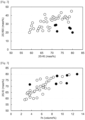
- Figs. 3 and 4 are graphs showing the relationship between the micropore porosity P A and the reduction index JIS-RI and the relationship between the micropore porosity P A and the reduction-degradation index JIS-RDI, respectively.
- the relationship between the micropore porosity P A and the reduction index JIS-RI shows a positive correlation as with the conventional findings.
- the relationship between the micropore porosity P A and the reduction-degradation index JIS-RDI shows no clear correlation. It is therefore difficult to obtain a sintered ore that is superior in both reducibility and reduction-degradation property only by controlling the micropore porosity.
- the ratio (JIS-RI/JIS-RDI) between the reduction index and the reduction-degradation index was analyzed to examine, as an appropriate operating condition, the condition in which the sintered ore with a reduction index JIS-RI of 70 mass% or more was obtained.
- Fig. 5 is a graph illustrating the influence of the ratio P A /P B between the micropore porosity and the macropore porosity on the ratio JIS-RI/JIS-RDI between the JIS reduction index and the JIS reduction-degradation index. It is found that setting the porosity ratio P A /P B to 0.23 or more can obtain a sintered ore that has a ratio JIS-RI/JIS-RDI of 2.0 or more and thus is superior in both the reducibility and the reduction-degradation property.
- setting the porosity ratio P A /P B to 0.25 or more can achieve a ratio JIS-RI/JIS-RDI of 2.5 or more, which is preferable for a sintered ore for hydrogen reduction.
- the upper limit of the porosity ratio P A /P B is not specified, but is preferably determined based on the preferable ranges of the micropore porosity P A and the macropore porosity P B described below.
- the micropore porosity P A is preferably in the range of 3 to 13 volume%.
- a sintered ore having a macropore porosity P B of less than 10 volume% it is difficult, in principle, to produce a sintered ore having a macropore porosity P B of less than 10 volume%.
- a sintered ore having P B of more than 42 mass% has a reduction index JIS-RI that is too low or a reduction-degradation index JIS-RDI that is too high, and thus has a poor balance.
- the macropore porosity P B is preferably in the range of 10 to 42 volume%.
- Fig. 6 shows the relationship between the mean pore size d A of micropores and the ratio JIS-RI/JIS-RDI between the JIS reduction index and the reduction-degradation index of a sintered ore having a good balance of reducibility and reduction-degradation property.
- Setting the mean pore size d A to 0.7 ⁇ m or less can increase the strength of a sintered ore, and can achieve the more superior balance of reducibility and reduction-degradation property of the sintered ore.
- the lower limit of the mean pore size d A is not limited to a particular value, but is preferably about 0.1 ⁇ m, considering the foregoing preferable range of the micropore porosity.
- a common method can be applied to the production of a sintered ore.
- using ore with a crystal water content of 4 mass% or more, and evaporating the crystal water in the sintering process can produce fine pores in the resulting sintered ore, and thus can increase the micropore porosity P A , which is preferable.
- gaseous fuel as a sintering fuel can increase the amount of melt in the sintering process, thereby reducing the macropore porosity P B and also reliably producing fine pores, which is preferable.
- the gaseous fuel is preferably any combustible gas selected from a group consisting of hydrogen gas, blast furnace gas, coke oven gas, blast furnace-coke oven mixed gas, town gas, natural gas, methane gas, ethane gas, propane gas, and butane gas; and a mixed gas thereof.
- the sintered ore and the method for producing the same and the sintered ore for hydrogen reduction and the method for producing the same according to the present invention, it is possible to improve the reducibility and reduction-degradation property in a well-balanced manner by appropriately controlling the proportions of micropores and macropores.
- a stable operation can be performed, while when the obtained sintered ore is used for hydrogen reduction, in particular, an iron source with reduced carbon dioxide emissions can be obtained.
- such sintered ore is industrially advantageous from the perspective of reducing environmental burdens.
Landscapes
- Chemical & Material Sciences (AREA)
- Engineering & Computer Science (AREA)
- Organic Chemistry (AREA)
- Metallurgy (AREA)
- Materials Engineering (AREA)
- Life Sciences & Earth Sciences (AREA)
- Manufacturing & Machinery (AREA)
- Analytical Chemistry (AREA)
- Geology (AREA)
- Immunology (AREA)
- Pathology (AREA)
- Environmental & Geological Engineering (AREA)
- General Life Sciences & Earth Sciences (AREA)
- Geochemistry & Mineralogy (AREA)
- General Physics & Mathematics (AREA)
- General Health & Medical Sciences (AREA)
- Biochemistry (AREA)
- Health & Medical Sciences (AREA)
- Physics & Mathematics (AREA)
- Dispersion Chemistry (AREA)
- Mechanical Engineering (AREA)
- Manufacture And Refinement Of Metals (AREA)
Abstract
Description
- The present invention relates to a sintered ore having a good balance of reducibility and a reduction-degradation property, and a method for producing the same, and a sintered ore for hydrogen reduction and a method for producing the same.
- The direct-reduction ironmaking method is known as an ironmaking method for reducing iron from a raw material containing iron oxide. The direct-reduction ironmaking method has been developed because of its advantages, such as low construction costs for plants for performing the method, easy operation of the method, and the feasibility of the method in a small-scale plant. In particular, various improvements have been made to direct-reduction shaft furnaces to effectively use a reducing gas in the furnaces.
- For a stable operation of a direct-reduction shaft furnace, it is an important technical challenge to achieve both high reducibility and a low reduction-degradation property by securing a stable flow of a reducing gas and also securing the logistics of an iron oxide raw material. When an iron oxide raw material is reduced and powdered in the high-temperature zone in the lower part of the shaft furnace, ventilation resistance increases, the productivity of the vertical shaft furnace decreases, and the iron oxide raw material does not descend properly, which hinders production. The decrease in productivity resulting from the increase in ventilation resistance due to the reduction-degradation of an iron oxide raw material also occurs in the blast furnace method. However, unlike in the blast furnace method, in the direct-reduction ironmaking method in which an iron oxide raw material is reduced in a solid state and discharged, if a reduction-degradation phenomenon occurs during the process of reducing the iron oxide raw material in a solid particle state, the particles will be fused (referred to as clustering), which hinders the discharge of the material from the reduction furnace. Therefore, it is necessary to suppress the reduction and degradation of an iron oxide raw material more when using the direct-reduction ironmaking method than when using the blast furnace method.
- To improve reducibility, for example,
Patent Literature 1 discloses that, among pores remaining in a sintered ore, based on a pore size in the range of 2 to 5 mm, a pore having a larger pore size is determined as an open pore and a pore having a shorter pore size is determined as a closed pore. In particular,Patent Literature 1 discloses that closed pores having a pore size of 0.5 mm or less dominates reducibility. - In addition,
Non Patent Literature 1 reports that the proportion and the structure of macropores through which a reducing gas is supplied to each texture play important roles in determining the overall reducibility of the sintered ore. InNon Patent Literature 1, pores with a shape close to a spherical shape having a pore size larger than about 50 µm are defined as macropores. - For such reasons, there have been an increasing number of reports about the analysis of pore structures. For example, a model for predicting porosity and a model for predicting the reduction index have been reported as in
Non Patent Literatures -
Patent Literature 2 discloses a highly reducible sintered ore having, as a production index of a sintered ore for a blast furnace, a texture in which the proportion of fine pores having a pore size of 100 µm or less is 0.42 or more, the sintered ore being formed by adding an organic binder containing 3 mass% or more H and granulating the mixture. -
Patent Literature 3 discloses that when a raw material for direct reduction such as pellets is reduced in a shaft furnace in terms of the quality during hydrogen reduction, reduction-degradation can be suppressed by providing the raw material and a coating layer covering the periphery of the raw material and having a porous structure with a porosity of 20 volume% or more. -
- Patent Literature 1:
JP-H10-324929A - Patent Literature 2:
JP-2017-75348A - Patent Literature 3: International Publication No.
WO 2015/016145 Non Patent Literature - Non Patent Literature 1: Takayuki MAEDA and Yoichi ONO: Tetsu-to-Hagane, 72(1986)7, pp. 775-782
- Non Patent Literature 2: Takazo KAWAGUCHI, Shun SATO, and Kozo TAKADA: Tetsu-to-Hagane, 73(1987)15, pp. 1940-1947
- Non Patent Literature 3: Shun SATO, Takazo KAWAGUCHI, Minoru ICHIDATE, and Mayumi YOSHINAGA: Tetsu-to-Hagane, 73(1987)7, pp. 804-811
- From the conventional technologies, it is found that a pore structure affects the reducibility and reduction-degradation property and thus controlling the pore structure is important.
- However, it is commonly known that there is a contradictory relationship between improving reducibility and achieving a low reduction-degradation property and that if reduction-degradation is suppressed, reducibility would decrease.
- That is, to achieve both high reducibility and a low reduction-degradation property, it is necessary to control the porosity ranging from macropore porosity to micropore porosity as well as the pore structure. However, each of the conventional technologies focuses only on the porosity in a certain range, and no attempt has been made to perform such control. Thus, it has been a task to propose a pore structure that can achieve both high reducibility and a low reduction-degradation property.
- The object of the present invention is to provide a sintered ore for use in a blast furnace method or for direct reduction, particularly to provide a sintered ore or a sintered ore for hydrogen reduction, each of which achieves high reducibility and a low reduction-degradation property and to propose a method for producing the sintered ore or the sintered ore for hydrogen reduction.
- The inventors have grasped a pore structure that contributes to achieving both high reducibility and a low reduction-degradation property, and attempted to construct a new concept on pores that can achieve both high reducibility and a low reduction-degradation property.
- A sintered ore according to the present invention that advantageously solves the above problems has a ratio PA/PB of 0.23 or more, where PA represents a porosity (volume%), measured by mercury porosimetry, of particles of the sintered ore that have a size of 5 mm or more and are ground to an average particle size of 1 to 2 mm, and PB represents the porosity (volume%) of the particles of the sintered ore determined using an apparent density measured by an in-liquid weighing method using water, and using a real density, measured by a boiling method or a vacuum suction method, of the particles of the sintered ore that are ground and sieved into a particle size of less than 250 µm.
- In addition, the sintered ore according to the present invention may include the following feature, for example, as a solution means that is considered to be more preferable.
- (a) The porosity PA is in the range of 3 to 13 volume%.
- (b) The porosity PB is in the range of 10 to 42 volume%.
- (c) A mean pore size dA, as measured by the mercury porosimetry, is 0.7 µm or less.
- A sintered ore for hydrogen reduction according to the present invention that advantageously solves the above problems is characterized in that the porosity ratio PA/PB in any one of the above sintered ores is 0.25 or more.
- A method for producing a sintered ore according to the present invention that advantageously solves the above problems is a method for producing any one of the above sintered ores, including using a raw material containing an ore having a crystal water content of 4 mass% or more. The method for producing the sintered ore according to the present invention may include the following feature as a solution means that is considered to be more preferable: blowing in gaseous fuel as sintering fuel, and the gaseous fuel is any combustible gas selected from among hydrogen gas, blast furnace gas, coke oven gas, blast furnace-coke oven mixed gas, town gas, natural gas, methane gas, ethane gas, propane gas, butane gas, and a mixed gas thereof.
- A method for producing the sintered ore for hydrogen reduction according to the present invention that advantageously solves the above problems is characterized by setting the porosity ratio PA/PB of the sintered ore to 0.25 or more in the method for producing any one of the above sintered ore.
- With the sintered ore and the sintered ore for hydrogen reduction according to the present invention, it is possible to control the pore structure to obtain a sintered ore and a sintered ore for hydrogen reduction each having both high reducibility and a low reduction-degradation property. Thus, such sintered ores are suitable as a raw material for the blast furnace method or for the direct-reduction ironmaking method performed with, for example, a shaft furnace. In addition, with the method for producing the sintered ore and the method for producing the sintered ore for hydrogen reduction according to the present invention, it is possible to appropriately control the pore structure of the sintered ore.
-
- [
Fig. 1] Fig. 1 is a flowchart of a method for measuring the porosity of a sintered ore according to an embodiment of the present invention. - [
Fig. 2] Fig. 2 is a graph illustrating the relationship between the JIS reduction index (JIS-RI) and the reduction-degradation index (JIS-RDI) of a sintered ore. - [
Fig. 3] Fig. 3 is a graph illustrating the relationship between the micropore porosity PA and the JIS reduction index (JIS-RI). - [
Fig. 4] Fig. 4 is a graph illustrating the relationship between the micropore porosity PA and the reduction-degradation index (JIS-RDI). - [
Fig. 5] Fig. 5 is a graph illustrating the influence of the ratio PA/PB between the micropore porosity and the macropore porosity on the ratio JIS-RI/JIS-RDI between the JIS reduction index and the reduction-degradation index. - [
Fig. 6] Fig. 6 is a graph illustrating the influence of the mean pore size, as measured by mercury porosimetry, of a sintered ore in which the ratio PA/PB between the micropore porosity and the macropore porosity is 0.25 or more on the ratio JIS-RI/JIS-RDI between the JIS reduction index and the reduction-degradation index. - Hereinafter, an embodiment of the present invention will be specifically described with reference to the drawings. The following embodiment only illustrates examples of a method and so on for embodying the technical idea of the present invention. Thus, the configuration of the present invention is not limited thereto. That is, the technical idea of the present invention may be changed in various ways within the technical scope recited in the claims.
- The inventors have measured and quantified micropores having a pore size of 200 µm or less which affect the reducibility of a sintered ore, and macropores which affect influence on the strength of a sintered ore. Then, the inventors have studied preferable properties for a sintered ore, in particular, a sintered ore for hydrogen reduction.
Fig. 1 shows the flow of the evaluation method. - A sintered ore product having a particle size of +5 mm is used as sintered ore S0 to be used for a porosity measurement target. Herein, "having a particle size of +5 mm" represents remaining on a 5mm-mesh sieve after sieving. Meanwhile, for example, "having a particle size of -5 mm" represents under the 5-mm mesh sieve after sieving. First, the sintered ore S0 is sieved as appropriate to obtain a uniform particle size in the range of about 19 to 21 mm, for example (S1). Herein, any finished sintered ore with a particle size of +5 mm may be used, regardless of its particle size or regardless of whether the ore has been sieved. Achieving a uniform particle size in a certain range can reduce the load on the subsequent grinding process.
- The micropore porosity PA and its pore size dA of the obtained sintered ore S1 with a uniform particle size are measured as follows.
- (S11) The sintered ore S1 is ground and is then sieved into a particle size of 1 mm or more but less than 2 mm. The grinding method herein is preferably performed with a grinding machine that does not cause particles, which have been ground into a predetermined particle size or less, to be further ground into a smaller particle size, such as a disk mill or a jaw crusher.
- (S12) The pore size distribution of the obtained sintered ore having a particle size of 1 mm or more but less than 2 mm is measured by mercury porosimetry according to JIS R1655:2003, so that the porosity PA (S13) and the mean pore size dA (S14) are determined from the cumulative pore volume of micropores having a pore size of 3.6 nm to 200 µm. Herein, the pore size is determined by assuming that an open pore has a cylindrical shape and calculating the diameter of the cylinder using the Washburn equation of Expression (1) below. In addition, the mean pore size dA is the value corresponding to 50% of the cumulative volume criterion.

- The macropore porosity PB of the obtained sintered ore S1 with a uniform particle size is measured as follows.
- (S21) The apparent density of the sintered ore S1 is measured by the in-liquid weighing method based on Archimedes' principle according to JIS Z8807:2012. First, the sintered ore S1 is weighed in a dry state.
- (S22) Next, the same sintered ore S1 is weighed in water. The apparent density of the sintered ore S1 is determined using the in-liquid weighing method based on the density at the measured temperature of water as a reference material.
- (S23) The sintered ore S1 is ground and then sieved to have a particle size of -250 µm. Then, the real density of the obtained sintered ore S1 is measured based on the boiling method or the vacuum suction method according to JIS R1634:1998.
- (S24) The apparent density of the sintered ore S1 and the real density of the ground sintered ore S1 are compared to calculate the macropore porosity PB.
- Sintered ores were produced by mixing various raw materials shown in Table 1 within the range of the component composition specified therein under various operating conditions and collected from samplers of the actual sintering machine. For the reducibility of each sintered ore, the reduction index JIS-RI (mass%) was measured according to JIS M8713:2009. Meanwhile, for the reduction-degradation property of each sintered ore, the reduction-degradation index JIS-RDI (mass%) was measured according to JIS M8720:2017.
Fig. 2 is a graph showing the relationship between the reducibility and the reduction-degradation property of the sintered ores produced with the various mixing ratios of the compositions and under the various operating conditions. The abscissa axis indicates the reduction index JIS-RI as the reducibility, and the ordinate axis indicates the reduction-degradation index JIS-RDI as the reduction-degradation property. A sintered ore produced with a typical mixing ratio of the compositions and under a typical operating condition exhibits a positive correlation as plotted in hollow circles (O). The higher the reduction index JIS-RI, the better. Conversely, the lower the reduction-degradation index JIS-RDI, the better. This means that there is usually a contradictory relationship between the reducibility and the reduction-degradation property and that it is therefore difficult to satisfy both properties at the same time. Meanwhile, some sintered ores showed both superior reducibility and a superior reduction-degradation property as plotted in solid circles (•). Therefore, the relationship between such properties and the porosity was examined.[Table 1] Component composition [mass%] T. Fe FeO SiO2 CaO Al2O3 MgO Maximum value 59 10 6 12 2.5 1.8 Minimum value 56 4 4 9 1.2 0.2 -
Figs. 3 and4 are graphs showing the relationship between the micropore porosity PA and the reduction index JIS-RI and the relationship between the micropore porosity PA and the reduction-degradation index JIS-RDI, respectively. The relationship between the micropore porosity PA and the reduction index JIS-RI shows a positive correlation as with the conventional findings. Meanwhile, the relationship between the micropore porosity PA and the reduction-degradation index JIS-RDI shows no clear correlation. It is therefore difficult to obtain a sintered ore that is superior in both reducibility and reduction-degradation property only by controlling the micropore porosity. - The ratio (JIS-RI/JIS-RDI) between the reduction index and the reduction-degradation index was analyzed to examine, as an appropriate operating condition, the condition in which the sintered ore with a reduction index JIS-RI of 70 mass% or more was obtained. The larger the value, the more it is possible to obtain a condition that can achieve both reducibility and reduction-degradation property.
- As a result of organizing with the ratio (PA/PB) between the micropore porosity and the macropore porosity, it was found possible to obtain a condition that can achieve both appropriate reducibility and appropriate reduction-degradation property.
Fig. 5 is a graph illustrating the influence of the ratio PA/PB between the micropore porosity and the macropore porosity on the ratio JIS-RI/JIS-RDI between the JIS reduction index and the JIS reduction-degradation index. It is found that setting the porosity ratio PA/PB to 0.23 or more can obtain a sintered ore that has a ratio JIS-RI/JIS-RDI of 2.0 or more and thus is superior in both the reducibility and the reduction-degradation property. Further, setting the porosity ratio PA/PB to 0.25 or more can achieve a ratio JIS-RI/JIS-RDI of 2.5 or more, which is preferable for a sintered ore for hydrogen reduction. Note that the upper limit of the porosity ratio PA/PB is not specified, but is preferably determined based on the preferable ranges of the micropore porosity PA and the macropore porosity PB described below. - As shown in
Fig. 3 , when the micropore porosity PA is less than 3 volume%, it is difficult to achieve a reduction index JIS-RI of 70 mass% or more. Meanwhile, when PA is more than 13 volume%, adjacent micropores become close to each other, which may reduce the strength of the sintered ore. Therefore, the micropore porosity PA is preferably in the range of 3 to 13 volume%. - In addition, it is difficult, in principle, to produce a sintered ore having a macropore porosity PB of less than 10 volume%. Meanwhile, a sintered ore having PB of more than 42 mass% has a reduction index JIS-RI that is too low or a reduction-degradation index JIS-RDI that is too high, and thus has a poor balance. Thus, the macropore porosity PB is preferably in the range of 10 to 42 volume%.
-
Fig. 6 shows the relationship between the mean pore size dA of micropores and the ratio JIS-RI/JIS-RDI between the JIS reduction index and the reduction-degradation index of a sintered ore having a good balance of reducibility and reduction-degradation property. Setting the mean pore size dA to 0.7 µm or less can increase the strength of a sintered ore, and can achieve the more superior balance of reducibility and reduction-degradation property of the sintered ore. The lower limit of the mean pore size dA is not limited to a particular value, but is preferably about 0.1 µm, considering the foregoing preferable range of the micropore porosity. - A common method can be applied to the production of a sintered ore. Among all, using ore with a crystal water content of 4 mass% or more, and evaporating the crystal water in the sintering process can produce fine pores in the resulting sintered ore, and thus can increase the micropore porosity PA, which is preferable.
- Further, blowing in gaseous fuel as a sintering fuel can increase the amount of melt in the sintering process, thereby reducing the macropore porosity PB and also reliably producing fine pores, which is preferable. Herein, the gaseous fuel is preferably any combustible gas selected from a group consisting of hydrogen gas, blast furnace gas, coke oven gas, blast furnace-coke oven mixed gas, town gas, natural gas, methane gas, ethane gas, propane gas, and butane gas; and a mixed gas thereof.
- According to the sintered ore and the method for producing the same, and the sintered ore for hydrogen reduction and the method for producing the same according to the present invention, it is possible to improve the reducibility and reduction-degradation property in a well-balanced manner by appropriately controlling the proportions of micropores and macropores. When the obtained sintered ore is used for a blast furnace, a stable operation can be performed, while when the obtained sintered ore is used for hydrogen reduction, in particular, an iron source with reduced carbon dioxide emissions can be obtained. Thus, such sintered ore is industrially advantageous from the perspective of reducing environmental burdens.
Claims (9)
- A sintered ore having a ratio PA/PB of 0.23 or more, where PA represents a porosity (volume%), measured by mercury porosimetry, of particles of the sintered ore that have a size of 5 mm or more and are ground to an average particle size of 1 to 2 mm, and PB represents the porosity (volume%) of the particles of the sintered ore determined using an apparent density measured by an in-liquid weighing method using water, and using a real density, measured by a boiling method or a vacuum suction method, of the particles of the sintered ore that are ground and sieved into a particle size of less than 250 µm.
- The sintered ore according to claim 1, wherein
the porosity PA is in a range of 3 to 13 volume%. - The sintered ore according to claim 1 or 2, wherein
the porosity PB is in a range of 10 to 42 volume%. - The sintered ore according to any one of claims 1 to 3, wherein
a mean pore size dA, as measured by the mercury porosimetry, is 0.7 µm or less. - A sintered ore for hydrogen reduction, characterized in that
the porosity ratio PA/PB in the sintered ore according to any one of claims 1 to 4 is 0.25 or more. - A method for producing the sintered ore according to any one of claims 1 to 4, wherein
a raw material including an ore with a crystal water content of 4 mass% or more is used. - The method for producing the sintered ore according to claim 6, comprising blowing in gaseous fuel as sintering fuel.
- The method for producing the sintered ore according to claim 7, wherein
the gaseous fuel is any combustible gas selected from a group consisting of hydrogen gas, blast furnace gas, coke oven gas, blast furnace-coke oven mixed gas, town gas, natural gas, methane gas, ethane gas, propane gas, and butane gas; and a mixed gas thereof. - A method for producing the sintered ore for hydrogen reduction, wherein
the porosity ratio PA/PB of the sintered ore is set to 0.25 or more in the method for producing the sintered ore according to any one of claims 6 to 8.
Applications Claiming Priority (1)
| Application Number | Priority Date | Filing Date | Title |
|---|---|---|---|
| PCT/JP2022/029424 WO2024028923A1 (en) | 2022-08-01 | 2022-08-01 | Sintered ore and method for producing same, and sintered ore for hydrogen reduction and method for producing same |
Publications (2)
| Publication Number | Publication Date |
|---|---|
| EP4556583A1 true EP4556583A1 (en) | 2025-05-21 |
| EP4556583A4 EP4556583A4 (en) | 2025-12-10 |
Family
ID=89848635
Family Applications (1)
| Application Number | Title | Priority Date | Filing Date |
|---|---|---|---|
| EP22953914.3A Pending EP4556583A4 (en) | 2022-08-01 | 2022-08-01 | Sintered ore and process for its production, as well as sintered ore for hydrogen reduction and process for its production |
Country Status (5)
| Country | Link |
|---|---|
| EP (1) | EP4556583A4 (en) |
| CN (1) | CN119421961A (en) |
| AU (1) | AU2022472682A1 (en) |
| CA (1) | CA3262606A1 (en) |
| WO (1) | WO2024028923A1 (en) |
Family Cites Families (17)
| Publication number | Priority date | Publication date | Assignee | Title |
|---|---|---|---|---|
| JPS61204344A (en) * | 1985-03-08 | 1986-09-10 | Sumitomo Metal Ind Ltd | Predicting method for reducibility of sintered ore |
| JPS61217534A (en) * | 1985-03-22 | 1986-09-27 | Sumitomo Metal Ind Ltd | Method for estimating and controlling reducibility of sintered ore |
| JPH04168233A (en) * | 1990-11-01 | 1992-06-16 | Nippon Steel Corp | Production of sintered ore |
| JPH10324929A (en) | 1997-05-26 | 1998-12-08 | Nippon Steel Corp | Sinter production method |
| JP3900721B2 (en) * | 1998-12-11 | 2007-04-04 | Jfeスチール株式会社 | Manufacturing method of high quality low SiO2 sintered ore |
| JP3840891B2 (en) * | 2000-10-26 | 2006-11-01 | Jfeスチール株式会社 | High-grade fired agglomerate for iron making and method for producing the same |
| JP2003277838A (en) * | 2002-03-22 | 2003-10-02 | Jfe Steel Kk | High crystal water ore used as sintering raw material for blast furnace, sintering raw material for blast furnace, and method for producing the same |
| JP2005140526A (en) * | 2003-11-04 | 2005-06-02 | Nippon Steel Corp | Method for measuring porosity, method for producing sintered ore, and method for predicting air permeability of sintered bed |
| JP2007100150A (en) * | 2005-10-03 | 2007-04-19 | Jfe Steel Kk | Method for producing sintered ore |
| JP5124969B2 (en) * | 2006-04-03 | 2013-01-23 | Jfeスチール株式会社 | Sinter ore manufacturing method |
| JP2007327096A (en) * | 2006-06-07 | 2007-12-20 | Nippon Steel Corp | Method for producing sintered ore using brucite |
| JP4418836B2 (en) * | 2007-12-20 | 2010-02-24 | 株式会社神戸製鋼所 | Self-fluxing pellets for blast furnace and manufacturing method thereof |
| JP5703616B2 (en) * | 2010-07-16 | 2015-04-22 | 新日鐵住金株式会社 | Method for producing sintered ore |
| WO2015016145A1 (en) | 2013-07-29 | 2015-02-05 | 新日鐵住金株式会社 | Raw material for direct reduction applications, method for producing raw material for direct reduction applications, and method for producing reduced iron |
| KR102022947B1 (en) * | 2015-01-14 | 2019-11-04 | 제이에프이 스틸 가부시키가이샤 | Method for preparing reduced iron powder and method for producing bearing |
| JP2017075348A (en) | 2015-10-13 | 2017-04-20 | 日新製鋼株式会社 | Production method of sinter and sinter |
| JP6627469B2 (en) * | 2015-12-08 | 2020-01-08 | 日本製鉄株式会社 | Reduction method of iron oxide raw material using shaft furnace |
-
2022
- 2022-08-01 AU AU2022472682A patent/AU2022472682A1/en active Pending
- 2022-08-01 CN CN202280097451.4A patent/CN119421961A/en active Pending
- 2022-08-01 EP EP22953914.3A patent/EP4556583A4/en active Pending
- 2022-08-01 WO PCT/JP2022/029424 patent/WO2024028923A1/en not_active Ceased
- 2022-08-01 CA CA3262606A patent/CA3262606A1/en active Pending
Also Published As
| Publication number | Publication date |
|---|---|
| AU2022472682A1 (en) | 2025-02-13 |
| CA3262606A1 (en) | 2025-06-12 |
| CN119421961A (en) | 2025-02-11 |
| EP4556583A4 (en) | 2025-12-10 |
| WO2024028923A1 (en) | 2024-02-08 |
Similar Documents
| Publication | Publication Date | Title |
|---|---|---|
| CN104226979B (en) | The production of molybdenum metal powder | |
| CN117265315B (en) | Binding phase-free hard alloy and preparation method thereof | |
| CN111175449A (en) | Method for evaluating mixing uniformity of strong mixing reinforced iron ore sintering raw materials | |
| CN107208166B (en) | Method of loading raw materials into blast furnace | |
| RU2455371C2 (en) | Self-fluxing pellets for blast furnaces and method for their manufacture | |
| US11834341B2 (en) | Process for producing lithiated transition metal oxides | |
| CN113042730A (en) | WC-based hard alloy powder, quantitative characterization method thereof and hard alloy | |
| JP7447871B2 (en) | Sintered ore and its manufacturing method, and sintered ore for hydrogen reduction and its manufacturing method | |
| AU2022472682A1 (en) | Sintered ore and method for producing same, and sintered ore for hydrogen reduction and method for producing same | |
| Umadevi et al. | Influence of coke breeze particle size on quality of sinter | |
| US11396451B2 (en) | Tungsten carbide powder and production method therefor | |
| CN119706844A (en) | A medium-coarse tungsten carbide and preparation method thereof | |
| JP4935133B2 (en) | Ferro-coke and method for producing sintered ore | |
| CN105461336B (en) | The preparation method of refractory brick | |
| EP4317464A1 (en) | Raw material particles for production of agglomerate, method for producing raw material particles for production of agglomerate, agglomerate, method for producing agglomerate, and method for producing reduced iron | |
| JP3643929B2 (en) | Manganese-containing sintered ore for electric furnace smelting and method for producing the same | |
| CN108455976B (en) | Sintered tabular corundum with low zirconium content and preparation method thereof | |
| CN115704076B (en) | Hard granular powder for sintered bodies | |
| EP4575004A1 (en) | Reduced iron production method | |
| JPH10265857A (en) | High quality sinter | |
| JP7497700B2 (en) | Method for producing reduced iron | |
| EP4553175A1 (en) | Production method for reduced iron | |
| KR100226935B1 (en) | Method for producing sintered ore using lime-fired sludge | |
| CN119614771A (en) | High-magnesium high-carbon mixed powder and preparation method and application thereof | |
| CN118418266A (en) | A method for improving carbonization performance of low-carbon clinker |
Legal Events
| Date | Code | Title | Description |
|---|---|---|---|
| STAA | Information on the status of an ep patent application or granted ep patent |
Free format text: STATUS: THE INTERNATIONAL PUBLICATION HAS BEEN MADE |
|
| PUAI | Public reference made under article 153(3) epc to a published international application that has entered the european phase |
Free format text: ORIGINAL CODE: 0009012 |
|
| STAA | Information on the status of an ep patent application or granted ep patent |
Free format text: STATUS: REQUEST FOR EXAMINATION WAS MADE |
|
| 17P | Request for examination filed |
Effective date: 20250205 |
|
| AK | Designated contracting states |
Kind code of ref document: A1 Designated state(s): AL AT BE BG CH CY CZ DE DK EE ES FI FR GB GR HR HU IE IS IT LI LT LU LV MC MK MT NL NO PL PT RO RS SE SI SK SM TR |
|
| DAV | Request for validation of the european patent (deleted) | ||
| DAX | Request for extension of the european patent (deleted) | ||
| A4 | Supplementary search report drawn up and despatched |
Effective date: 20251107 |
|
| RIC1 | Information provided on ipc code assigned before grant |
Ipc: C22B 1/16 20060101AFI20251103BHEP Ipc: C21B 13/02 20060101ALI20251103BHEP Ipc: G01N 9/36 20060101ALI20251103BHEP Ipc: G01N 15/08 20060101ALI20251103BHEP Ipc: C21B 5/00 20060101ALI20251103BHEP Ipc: C21B 13/00 20060101ALI20251103BHEP |