EP4550652A1 - Spannungswandlerschaltung, steuerungsverfahren für spannungswandlerschaltung und energiespeichervorrichtung - Google Patents
Spannungswandlerschaltung, steuerungsverfahren für spannungswandlerschaltung und energiespeichervorrichtung Download PDFInfo
- Publication number
- EP4550652A1 EP4550652A1 EP22948330.0A EP22948330A EP4550652A1 EP 4550652 A1 EP4550652 A1 EP 4550652A1 EP 22948330 A EP22948330 A EP 22948330A EP 4550652 A1 EP4550652 A1 EP 4550652A1
- Authority
- EP
- European Patent Office
- Prior art keywords
- control unit
- voltage
- bus
- unit
- control
- Prior art date
- Legal status (The legal status is an assumption and is not a legal conclusion. Google has not performed a legal analysis and makes no representation as to the accuracy of the status listed.)
- Pending
Links
Images


Classifications
-
- H—ELECTRICITY
- H02—GENERATION; CONVERSION OR DISTRIBUTION OF ELECTRIC POWER
- H02M—APPARATUS FOR CONVERSION BETWEEN AC AND AC, BETWEEN AC AND DC, OR BETWEEN DC AND DC, AND FOR USE WITH MAINS OR SIMILAR POWER SUPPLY SYSTEMS; CONVERSION OF DC OR AC INPUT POWER INTO SURGE OUTPUT POWER; CONTROL OR REGULATION THEREOF
- H02M1/00—Details of apparatus for conversion
- H02M1/0003—Details of control, feedback or regulation circuits
- H02M1/0025—Arrangements for modifying reference values, feedback values or error values in the control loop of a converter
-
- H—ELECTRICITY
- H02—GENERATION; CONVERSION OR DISTRIBUTION OF ELECTRIC POWER
- H02M—APPARATUS FOR CONVERSION BETWEEN AC AND AC, BETWEEN AC AND DC, OR BETWEEN DC AND DC, AND FOR USE WITH MAINS OR SIMILAR POWER SUPPLY SYSTEMS; CONVERSION OF DC OR AC INPUT POWER INTO SURGE OUTPUT POWER; CONTROL OR REGULATION THEREOF
- H02M1/00—Details of apparatus for conversion
- H02M1/08—Circuits specially adapted for the generation of control voltages for semiconductor devices incorporated in static converters
- H02M1/088—Circuits specially adapted for the generation of control voltages for semiconductor devices incorporated in static converters for the simultaneous control of series or parallel connected semiconductor devices
-
- H—ELECTRICITY
- H02—GENERATION; CONVERSION OR DISTRIBUTION OF ELECTRIC POWER
- H02J—ELECTRIC POWER NETWORKS; CIRCUIT ARRANGEMENTS OR SYSTEMS FOR SUPPLYING OR DISTRIBUTING ELECTRIC POWER; SYSTEMS FOR STORING ELECTRIC ENERGY
- H02J7/00—Circuit arrangements for charging or discharging batteries or for supplying loads from batteries
- H02J7/02—Circuit arrangements for charging or discharging batteries or for supplying loads from batteries for charging batteries from AC mains by converters
-
- H—ELECTRICITY
- H02—GENERATION; CONVERSION OR DISTRIBUTION OF ELECTRIC POWER
- H02M—APPARATUS FOR CONVERSION BETWEEN AC AND AC, BETWEEN AC AND DC, OR BETWEEN DC AND DC, AND FOR USE WITH MAINS OR SIMILAR POWER SUPPLY SYSTEMS; CONVERSION OF DC OR AC INPUT POWER INTO SURGE OUTPUT POWER; CONTROL OR REGULATION THEREOF
- H02M1/00—Details of apparatus for conversion
- H02M1/0003—Details of control, feedback or regulation circuits
- H02M1/0032—Control circuits allowing low power mode operation, e.g. in standby mode
-
- H—ELECTRICITY
- H02—GENERATION; CONVERSION OR DISTRIBUTION OF ELECTRIC POWER
- H02M—APPARATUS FOR CONVERSION BETWEEN AC AND AC, BETWEEN AC AND DC, OR BETWEEN DC AND DC, AND FOR USE WITH MAINS OR SIMILAR POWER SUPPLY SYSTEMS; CONVERSION OF DC OR AC INPUT POWER INTO SURGE OUTPUT POWER; CONTROL OR REGULATION THEREOF
- H02M1/00—Details of apparatus for conversion
- H02M1/0048—Circuits or arrangements for reducing losses
- H02M1/0054—Transistor switching losses
-
- H—ELECTRICITY
- H02—GENERATION; CONVERSION OR DISTRIBUTION OF ELECTRIC POWER
- H02M—APPARATUS FOR CONVERSION BETWEEN AC AND AC, BETWEEN AC AND DC, OR BETWEEN DC AND DC, AND FOR USE WITH MAINS OR SIMILAR POWER SUPPLY SYSTEMS; CONVERSION OF DC OR AC INPUT POWER INTO SURGE OUTPUT POWER; CONTROL OR REGULATION THEREOF
- H02M1/00—Details of apparatus for conversion
- H02M1/0067—Converter structures employing plural converter units, other than for parallel operation of the units on a single load
- H02M1/007—Plural converter units in cascade
-
- H—ELECTRICITY
- H02—GENERATION; CONVERSION OR DISTRIBUTION OF ELECTRIC POWER
- H02M—APPARATUS FOR CONVERSION BETWEEN AC AND AC, BETWEEN AC AND DC, OR BETWEEN DC AND DC, AND FOR USE WITH MAINS OR SIMILAR POWER SUPPLY SYSTEMS; CONVERSION OF DC OR AC INPUT POWER INTO SURGE OUTPUT POWER; CONTROL OR REGULATION THEREOF
- H02M1/00—Details of apparatus for conversion
- H02M1/36—Means for starting or stopping converters
-
- H—ELECTRICITY
- H02—GENERATION; CONVERSION OR DISTRIBUTION OF ELECTRIC POWER
- H02M—APPARATUS FOR CONVERSION BETWEEN AC AND AC, BETWEEN AC AND DC, OR BETWEEN DC AND DC, AND FOR USE WITH MAINS OR SIMILAR POWER SUPPLY SYSTEMS; CONVERSION OF DC OR AC INPUT POWER INTO SURGE OUTPUT POWER; CONTROL OR REGULATION THEREOF
- H02M1/00—Details of apparatus for conversion
- H02M1/42—Circuits or arrangements for compensating for or adjusting power factor in converters or inverters
- H02M1/4208—Arrangements for improving power factor of AC input
- H02M1/4225—Arrangements for improving power factor of AC input using a non-isolated boost converter
-
- H—ELECTRICITY
- H02—GENERATION; CONVERSION OR DISTRIBUTION OF ELECTRIC POWER
- H02M—APPARATUS FOR CONVERSION BETWEEN AC AND AC, BETWEEN AC AND DC, OR BETWEEN DC AND DC, AND FOR USE WITH MAINS OR SIMILAR POWER SUPPLY SYSTEMS; CONVERSION OF DC OR AC INPUT POWER INTO SURGE OUTPUT POWER; CONTROL OR REGULATION THEREOF
- H02M3/00—Conversion of DC power input into DC power output
- H02M3/02—Conversion of DC power input into DC power output without intermediate conversion into AC
- H02M3/04—Conversion of DC power input into DC power output without intermediate conversion into AC by static converters
- H02M3/10—Conversion of DC power input into DC power output without intermediate conversion into AC by static converters using discharge tubes with control electrode or semiconductor devices with control electrode
- H02M3/145—Conversion of DC power input into DC power output without intermediate conversion into AC by static converters using discharge tubes with control electrode or semiconductor devices with control electrode using devices of a triode or transistor type requiring continuous application of a control signal
- H02M3/155—Conversion of DC power input into DC power output without intermediate conversion into AC by static converters using discharge tubes with control electrode or semiconductor devices with control electrode using devices of a triode or transistor type requiring continuous application of a control signal using semiconductor devices only
- H02M3/156—Conversion of DC power input into DC power output without intermediate conversion into AC by static converters using discharge tubes with control electrode or semiconductor devices with control electrode using devices of a triode or transistor type requiring continuous application of a control signal using semiconductor devices only with automatic control of output voltage or current, e.g. switching regulators
-
- H—ELECTRICITY
- H02—GENERATION; CONVERSION OR DISTRIBUTION OF ELECTRIC POWER
- H02M—APPARATUS FOR CONVERSION BETWEEN AC AND AC, BETWEEN AC AND DC, OR BETWEEN DC AND DC, AND FOR USE WITH MAINS OR SIMILAR POWER SUPPLY SYSTEMS; CONVERSION OF DC OR AC INPUT POWER INTO SURGE OUTPUT POWER; CONTROL OR REGULATION THEREOF
- H02M3/00—Conversion of DC power input into DC power output
- H02M3/02—Conversion of DC power input into DC power output without intermediate conversion into AC
- H02M3/04—Conversion of DC power input into DC power output without intermediate conversion into AC by static converters
- H02M3/10—Conversion of DC power input into DC power output without intermediate conversion into AC by static converters using discharge tubes with control electrode or semiconductor devices with control electrode
- H02M3/145—Conversion of DC power input into DC power output without intermediate conversion into AC by static converters using discharge tubes with control electrode or semiconductor devices with control electrode using devices of a triode or transistor type requiring continuous application of a control signal
- H02M3/155—Conversion of DC power input into DC power output without intermediate conversion into AC by static converters using discharge tubes with control electrode or semiconductor devices with control electrode using devices of a triode or transistor type requiring continuous application of a control signal using semiconductor devices only
- H02M3/156—Conversion of DC power input into DC power output without intermediate conversion into AC by static converters using discharge tubes with control electrode or semiconductor devices with control electrode using devices of a triode or transistor type requiring continuous application of a control signal using semiconductor devices only with automatic control of output voltage or current, e.g. switching regulators
- H02M3/158—Conversion of DC power input into DC power output without intermediate conversion into AC by static converters using discharge tubes with control electrode or semiconductor devices with control electrode using devices of a triode or transistor type requiring continuous application of a control signal using semiconductor devices only with automatic control of output voltage or current, e.g. switching regulators including plural semiconductor devices as final control devices for a single load
-
- H—ELECTRICITY
- H02—GENERATION; CONVERSION OR DISTRIBUTION OF ELECTRIC POWER
- H02M—APPARATUS FOR CONVERSION BETWEEN AC AND AC, BETWEEN AC AND DC, OR BETWEEN DC AND DC, AND FOR USE WITH MAINS OR SIMILAR POWER SUPPLY SYSTEMS; CONVERSION OF DC OR AC INPUT POWER INTO SURGE OUTPUT POWER; CONTROL OR REGULATION THEREOF
- H02M3/00—Conversion of DC power input into DC power output
- H02M3/22—Conversion of DC power input into DC power output with intermediate conversion into AC
- H02M3/24—Conversion of DC power input into DC power output with intermediate conversion into AC by static converters
- H02M3/28—Conversion of DC power input into DC power output with intermediate conversion into AC by static converters using discharge tubes with control electrode or semiconductor devices with control electrode to produce the intermediate AC
- H02M3/325—Conversion of DC power input into DC power output with intermediate conversion into AC by static converters using discharge tubes with control electrode or semiconductor devices with control electrode to produce the intermediate AC using devices of a triode or a transistor type requiring continuous application of a control signal
- H02M3/335—Conversion of DC power input into DC power output with intermediate conversion into AC by static converters using discharge tubes with control electrode or semiconductor devices with control electrode to produce the intermediate AC using devices of a triode or a transistor type requiring continuous application of a control signal using semiconductor devices only
- H02M3/33507—Conversion of DC power input into DC power output with intermediate conversion into AC by static converters using discharge tubes with control electrode or semiconductor devices with control electrode to produce the intermediate AC using devices of a triode or a transistor type requiring continuous application of a control signal using semiconductor devices only with automatic control of the output voltage or current, e.g. flyback converters
-
- H—ELECTRICITY
- H02—GENERATION; CONVERSION OR DISTRIBUTION OF ELECTRIC POWER
- H02M—APPARATUS FOR CONVERSION BETWEEN AC AND AC, BETWEEN AC AND DC, OR BETWEEN DC AND DC, AND FOR USE WITH MAINS OR SIMILAR POWER SUPPLY SYSTEMS; CONVERSION OF DC OR AC INPUT POWER INTO SURGE OUTPUT POWER; CONTROL OR REGULATION THEREOF
- H02M3/00—Conversion of DC power input into DC power output
- H02M3/22—Conversion of DC power input into DC power output with intermediate conversion into AC
- H02M3/24—Conversion of DC power input into DC power output with intermediate conversion into AC by static converters
- H02M3/28—Conversion of DC power input into DC power output with intermediate conversion into AC by static converters using discharge tubes with control electrode or semiconductor devices with control electrode to produce the intermediate AC
- H02M3/325—Conversion of DC power input into DC power output with intermediate conversion into AC by static converters using discharge tubes with control electrode or semiconductor devices with control electrode to produce the intermediate AC using devices of a triode or a transistor type requiring continuous application of a control signal
- H02M3/335—Conversion of DC power input into DC power output with intermediate conversion into AC by static converters using discharge tubes with control electrode or semiconductor devices with control electrode to produce the intermediate AC using devices of a triode or a transistor type requiring continuous application of a control signal using semiconductor devices only
- H02M3/33538—Conversion of DC power input into DC power output with intermediate conversion into AC by static converters using discharge tubes with control electrode or semiconductor devices with control electrode to produce the intermediate AC using devices of a triode or a transistor type requiring continuous application of a control signal using semiconductor devices only of the forward type
- H02M3/33546—Conversion of DC power input into DC power output with intermediate conversion into AC by static converters using discharge tubes with control electrode or semiconductor devices with control electrode to produce the intermediate AC using devices of a triode or a transistor type requiring continuous application of a control signal using semiconductor devices only of the forward type with automatic control of the output voltage or current
- H02M3/33553—Conversion of DC power input into DC power output with intermediate conversion into AC by static converters using discharge tubes with control electrode or semiconductor devices with control electrode to produce the intermediate AC using devices of a triode or a transistor type requiring continuous application of a control signal using semiconductor devices only of the forward type with automatic control of the output voltage or current with galvanic isolation between input and output of both the power stage and the feedback loop
-
- H—ELECTRICITY
- H02—GENERATION; CONVERSION OR DISTRIBUTION OF ELECTRIC POWER
- H02M—APPARATUS FOR CONVERSION BETWEEN AC AND AC, BETWEEN AC AND DC, OR BETWEEN DC AND DC, AND FOR USE WITH MAINS OR SIMILAR POWER SUPPLY SYSTEMS; CONVERSION OF DC OR AC INPUT POWER INTO SURGE OUTPUT POWER; CONTROL OR REGULATION THEREOF
- H02M5/00—Conversion of AC power input into AC power output, e.g. for change of voltage, for change of frequency, for change of number of phases
- H02M5/40—Conversion of AC power input into AC power output, e.g. for change of voltage, for change of frequency, for change of number of phases with intermediate conversion into DC
- H02M5/42—Conversion of AC power input into AC power output, e.g. for change of voltage, for change of frequency, for change of number of phases with intermediate conversion into DC by static converters
- H02M5/44—Conversion of AC power input into AC power output, e.g. for change of voltage, for change of frequency, for change of number of phases with intermediate conversion into DC by static converters using discharge tubes or semiconductor devices to convert the intermediate DC into AC
- H02M5/453—Conversion of AC power input into AC power output, e.g. for change of voltage, for change of frequency, for change of number of phases with intermediate conversion into DC by static converters using discharge tubes or semiconductor devices to convert the intermediate DC into AC using devices of a triode or transistor type requiring continuous application of a control signal
- H02M5/458—Conversion of AC power input into AC power output, e.g. for change of voltage, for change of frequency, for change of number of phases with intermediate conversion into DC by static converters using discharge tubes or semiconductor devices to convert the intermediate DC into AC using devices of a triode or transistor type requiring continuous application of a control signal using semiconductor devices only
- H02M5/4585—Conversion of AC power input into AC power output, e.g. for change of voltage, for change of frequency, for change of number of phases with intermediate conversion into DC by static converters using discharge tubes or semiconductor devices to convert the intermediate DC into AC using devices of a triode or transistor type requiring continuous application of a control signal using semiconductor devices only having a rectifier with controlled elements
-
- H—ELECTRICITY
- H02—GENERATION; CONVERSION OR DISTRIBUTION OF ELECTRIC POWER
- H02M—APPARATUS FOR CONVERSION BETWEEN AC AND AC, BETWEEN AC AND DC, OR BETWEEN DC AND DC, AND FOR USE WITH MAINS OR SIMILAR POWER SUPPLY SYSTEMS; CONVERSION OF DC OR AC INPUT POWER INTO SURGE OUTPUT POWER; CONTROL OR REGULATION THEREOF
- H02M7/00—Conversion of AC power input into DC power output; Conversion of DC power input into AC power output
- H02M7/02—Conversion of AC power input into DC power output without possibility of reversal
- H02M7/04—Conversion of AC power input into DC power output without possibility of reversal by static converters
- H02M7/12—Conversion of AC power input into DC power output without possibility of reversal by static converters using discharge tubes with control electrode or semiconductor devices with control electrode
- H02M7/21—Conversion of AC power input into DC power output without possibility of reversal by static converters using discharge tubes with control electrode or semiconductor devices with control electrode using devices of a triode or transistor type requiring continuous application of a control signal
- H02M7/217—Conversion of AC power input into DC power output without possibility of reversal by static converters using discharge tubes with control electrode or semiconductor devices with control electrode using devices of a triode or transistor type requiring continuous application of a control signal using semiconductor devices only
-
- H—ELECTRICITY
- H02—GENERATION; CONVERSION OR DISTRIBUTION OF ELECTRIC POWER
- H02M—APPARATUS FOR CONVERSION BETWEEN AC AND AC, BETWEEN AC AND DC, OR BETWEEN DC AND DC, AND FOR USE WITH MAINS OR SIMILAR POWER SUPPLY SYSTEMS; CONVERSION OF DC OR AC INPUT POWER INTO SURGE OUTPUT POWER; CONTROL OR REGULATION THEREOF
- H02M7/00—Conversion of AC power input into DC power output; Conversion of DC power input into AC power output
- H02M7/02—Conversion of AC power input into DC power output without possibility of reversal
- H02M7/04—Conversion of AC power input into DC power output without possibility of reversal by static converters
- H02M7/12—Conversion of AC power input into DC power output without possibility of reversal by static converters using discharge tubes with control electrode or semiconductor devices with control electrode
- H02M7/21—Conversion of AC power input into DC power output without possibility of reversal by static converters using discharge tubes with control electrode or semiconductor devices with control electrode using devices of a triode or transistor type requiring continuous application of a control signal
- H02M7/217—Conversion of AC power input into DC power output without possibility of reversal by static converters using discharge tubes with control electrode or semiconductor devices with control electrode using devices of a triode or transistor type requiring continuous application of a control signal using semiconductor devices only
- H02M7/219—Conversion of AC power input into DC power output without possibility of reversal by static converters using discharge tubes with control electrode or semiconductor devices with control electrode using devices of a triode or transistor type requiring continuous application of a control signal using semiconductor devices only in a bridge configuration
-
- H—ELECTRICITY
- H02—GENERATION; CONVERSION OR DISTRIBUTION OF ELECTRIC POWER
- H02J—ELECTRIC POWER NETWORKS; CIRCUIT ARRANGEMENTS OR SYSTEMS FOR SUPPLYING OR DISTRIBUTING ELECTRIC POWER; SYSTEMS FOR STORING ELECTRIC ENERGY
- H02J2207/00—Details of circuit arrangements for charging or discharging batteries or supplying loads from batteries
- H02J2207/20—Charging or discharging characterised by the power electronics converter
-
- H—ELECTRICITY
- H02—GENERATION; CONVERSION OR DISTRIBUTION OF ELECTRIC POWER
- H02M—APPARATUS FOR CONVERSION BETWEEN AC AND AC, BETWEEN AC AND DC, OR BETWEEN DC AND DC, AND FOR USE WITH MAINS OR SIMILAR POWER SUPPLY SYSTEMS; CONVERSION OF DC OR AC INPUT POWER INTO SURGE OUTPUT POWER; CONTROL OR REGULATION THEREOF
- H02M3/00—Conversion of DC power input into DC power output
- H02M3/01—Resonant DC/DC converters
Definitions
- This application relates to the field of power supply technologies, and in particular, to a voltage conversion circuit, a method for controlling a voltage conversion circuit, and an energy storage device.
- voltage conversion circuits connected to the battery modules are configured to implement charging and discharging of the battery modules.
- electric energy of the battery module is converted by the voltage conversion circuit, to provide operating electricity for a load, namely, an electricity consuming device.
- a voltage conversion circuit a method for controlling a voltage conversion circuit, and an energy storage device are provided.
- this application provides a voltage conversion circuit, including: an AC/DC conversion unit, a DC/DC conversion unit, a first control unit, and a second control unit, where the AC/DC conversion unit is connected to the DC/DC conversion unit through a direct current bus; the first control unit is communicatively connected to the second control unit;
- a voltage conversion circuit includes an AC/DC conversion unit, a DC/DC conversion unit, a first control unit, and a second control unit, where the AC/DC conversion unit is connected to the DC/DC conversion unit through a direct current bus; and the first control unit is communicatively connected to the second control unit.
- the control method is applied to a first control unit, and the control method includes:
- this application provides an energy storage device, including a battery module and a voltage conversion circuit, where the voltage conversion circuit is the voltage conversion circuit provided in the first aspect.
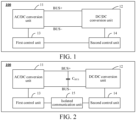
- FIG. 1 is a schematic block diagram of a voltage conversion circuit according to an embodiment of this application.
- a voltage conversion circuit 100 includes an AC/DC conversion unit 11, a DC/DC conversion unit 12, a first control unit 13, and a second control unit 14.
- the AC/DC conversion unit 11 is connected to the DC/DC conversion unit 12 through a direct current bus (BUS+ and BUS-).
- the first control unit 13 is communicatively connected to the second control unit 14.
- the first control unit 13 is configured to obtain a bus voltage on the direct current bus (BUS+ and BUS-), and generate a first control signal and output the first control signal to the second control unit 14 when the bus voltage is less than a first voltage threshold.
- the second control unit 14 is configured to enter a heavy load mode when the first control signal is received, and output a first drive signal to the DC/DC conversion unit 12, to drive the DC/DC conversion unit 12 to operate.
- a duty cycle of the first drive signal is greater than a duty cycle of another drive signal output by the second control unit 14 in a non-heavy load mode.
- the voltage conversion circuit 100 provided in this embodiment can implement bidirectional voltage conversion and bidirectional electric energy transmission.
- the voltage conversion circuit 100 is configured in an energy storage device including a battery module.
- the AC/DC conversion unit 11 in the voltage conversion circuit 100 converts, under control of the first control unit 13, an alternating current provided by the alternating current source into a first direct current, and the DC/DC conversion unit 12 performs, under control of the second control unit 14, voltage conversion on the direct current to obtain a second direct current used for charging the battery module.
- the DC/DC conversion unit 12 in the voltage conversion circuit 100 performs, under control of the second control unit 14, voltage conversion on a direct current provided by the battery module, and then the first control unit 13 controls the AC/DC conversion unit 11 to convert the direct current after the voltage conversion, to obtain alternating current operating electricity available for electricity consumption of the load.
- the second control unit 14 may alternatively control, after the load is connected, the DC/DC conversion unit 12 to perform voltage conversion on the direct current provided by the battery module, and then output direct current operating electricity.
- electric energy may be transmitted between the AC/DC conversion unit 11 and the DC/DC conversion unit 12 through the direct current bus (BUS+ and BUS-).
- the direct current bus BUS+ and BUS-
- an energy storage unit C BUS may be configured between a positive direct current bus BUS+ and a negative direct current bus BUS- of the direct current bus, to store remaining electric energy when an output of the DC/DC conversion unit 12 can meet a requirement of the load and there is the remaining electric energy, so that a voltage on the energy storage unit C BUS continuously rises with the charging.
- the energy storage unit C BUS may be a circuit independent of the AC/DC conversion unit 11 and the DC/DC conversion unit 12.
- the energy storage unit C BUS and the AC/DC conversion unit 11 may be used as a circuit module, or the energy storage unit C BUS and the DC/DC conversion unit 12 may be used as a circuit module.
- the energy storage unit C BUS When required power of the load is large, electric energy output by the DC/DC conversion unit 12 can only meet electricity consumed by the load, and the energy storage unit C BUS also synchronously supplies electricity to the load, so that the voltage on the energy storage unit C BUS gradually drops, and tends to be stable. Because the energy storage unit C BUS is connected in parallel between the positive direct current bus BUS+ and the negative direct current bus BUS-, the voltage on the energy storage unit C BUS is equal to the voltage on the direct current bus, and a load situation of the voltage conversion circuit 100 may also be reflected according to a change of the voltage on the direct current bus.
- the bus voltage on the direct current bus may be sampled by configuring a corresponding voltage sampling circuit.
- the voltage sampling circuit may send the sampled bus voltage to a controller of a battery management system, and the first control unit 13 obtains the bus voltage from the controller of the battery management system.
- the voltage sampling circuit may be directly connected to the first control unit 13, and the first control unit 13 may directly obtain the bus voltage through the voltage sampling circuit.
- the first control unit 13 may further output another control signal adapted to a non-heavy load situation according to the bus voltage on the direct current bus (BUS+ and BUS-), so that the second control unit 14 may enter another control mode according to the another control signal.
- a limitation on a light load and a heavy load may be further predefined according to rated output power of the voltage conversion circuit 100. For example, when a ratio of required power to the rated output power of the voltage conversion circuit is less than a preset percentage, the load is defined as a light load. Otherwise, the load is defined as a heavy load.
- the preset percentage may be set according to an actual need, for example, set to 30%, 50%, or 60%.
- rated required power of an electricity consuming device is 1200 W
- the rated output power of the voltage conversion circuit 100 is 1500 W.
- the rated required power of the electricity consuming device accounts for 80% of the rated output power of the voltage conversion circuit 100, and is greater than 60% of the preset percentage, and it is determined that the load situation of the voltage conversion circuit 100 is a heavy load.
- rated required power of an electricity consuming device is 300 W
- the rated output power of the voltage conversion circuit 100 is 1500 W.
- the rated power of the electricity consuming device accounts for 20% of the rated output power of the voltage conversion circuit 100, and is less than the preset percentage, and it is determined that the load situation of the voltage conversion circuit 100 is a light load.
- the first control unit 13 can adjust an output control signal according to the bus voltage on the direct current bus (BUS+ and BUS-), to adjust a control mode of the second control unit 14, thereby adjusting an electricity supply status of the DC/DC conversion unit 12 to the energy storage unit C BUS .
- the energy storage unit C BUS may be a capacitor or another energy storage component. This is not limited in this application.
- a current value of the first charging electrical signal is greater than a current value of a charging electrical signal output by the DC/DC conversion unit 12 in the non-heavy load mode.
- a voltage value of the first charging electrical signal is greater than a voltage value of a charging electrical signal output by the DC/DC conversion unit 12 under action of another drive signal.
- a duty cycle is a ratio of high-level duration to low-level duration in a drive signal.
- a larger duty cycle of a drive signal indicates a higher proportion of a high level in a unit period of the drive signal.
- the duty cycle of the first drive signal is greater than the duty cycle of the drive signal output by the second control unit 14 in the non-heavy load mode. Therefore, the DC/DC conversion unit 12 supplies, under the action of the first drive signal, electricity to the external energy storage unit C BUS and the load at a larger charging current or charging voltage. In this case, the voltage on the energy storage unit C BUS gradually rises, and tends to be stable.
- the voltage conversion circuit 100 charges the energy storage unit C BUS at a charging current or charging voltage smaller than that in the heavy load mode, thereby reducing power consumption in the non-heavy load mode, and improving overall energy utilization.
- a switching frequency of the first drive signal is greater than a switching frequency of a drive signal output be the second control unit 14 in the non-heavy load mode.
- a switching frequency is a quantity of times that a drive signal drives a switch tube in the DC/DC conversion unit 12 to periodically change in unit time.
- a larger switching frequency of a drive signal indicates that the DC/DC conversion unit 12 supplies, under action of the drive signal, electricity to the external energy storage unit C BUS and the load at a larger charging current or charging voltage.
- the voltage conversion circuit 100 is configured in an energy storage device including a battery module.
- the voltage conversion circuit 100 is used as a transformer in the energy storage device, and the DC/DC conversion unit 12 in the voltage conversion circuit 100 is connected to the battery module.
- a voltage of the battery module is less than that of the alternating current source or the alternating current load connected to the AC/DC conversion unit 11, and belongs to a low-voltage side.
- the AC/DC conversion unit 11 and the energy storage unit C BUS belong to a high-voltage side.
- the second control unit 14 does not need to sample a bus voltage on the high-voltage side. Therefore, an overall voltage resistance requirement is low, so that costs of a circuit on the low-voltage side can be reduced.
- the second control unit 14 can perform mode switching according to a control signal output by the first control unit 13, and does not need to rely on sampling data such as the bus voltage transmitted by the AC/DC conversion unit 11 to perform mode switching control.
- sampling data such as the bus voltage transmitted by the AC/DC conversion unit 11 to perform mode switching control.
- a delay during transmission of the control signal between the first control unit 13 and the second control unit 14 is shorter than that of the sampling data, which can ensure that the second control unit 14 performs mode switching according to the load in time, thereby improving reliability of the circuit.
- the first control unit 13 is further configured to generate a second control signal and output the second control signal to the second control unit when the bus voltage is greater than a second voltage threshold; and the second control unit 14 is further configured to stop outputting a drive signal to the DC/DC conversion unit 12 when the second control signal is received, to control the DC/DC conversion unit 12 to stop operating.
- the second voltage threshold is greater than the first voltage threshold.
- the DC/DC conversion unit 12 stops operating, that is, stops charging the energy storage unit C BUS , to ensure that the bus voltage can be kept below the second voltage threshold, thereby avoiding over-voltage damage to the energy storage unit C BUS caused when the energy storage unit C BUS is continuously charged. In this case, electric energy on the energy storage unit C BUS supplies electricity to the load and an electricity consuming part of the energy storage unit C BUS . Therefore, the voltage on the energy storage unit C BUS gradually drops.
- the first control unit 13 is further configured to generate a third control signal and output the third control signal to the second control unit 14 when the bus voltage is less than a third voltage threshold; and the second control unit 14 is further configured to keep outputting the first drive signal to the DC/DC conversion unit 12 when the third control signal is received and the second control unit is in the heavy load mode.
- the third voltage threshold is greater than the first voltage threshold and less than the second voltage threshold.
- the DC/DC conversion unit 12 After the DC/DC conversion unit 12 stops operating, the DC/DC conversion unit 12 also stops charging the energy storage unit C BUS . In this case, the voltage on the energy storage unit C BUS gradually drops. Therefore, when it is detected that the bus voltage is less than the third voltage threshold, the first control unit 13 outputs the third control signal to the second control unit 14. After the third control signal is received, the second control unit 14 determines, according to a status of the second control unit 14, whether to perform mode switching.
- the second control unit 14 when the second control unit 14 is in the heavy load mode, the second control unit 14 outputs the first drive signal to the DC/DC conversion unit 12, to drive the DC/DC conversion unit 12 to charge the energy storage unit C BUS and the load at a charging current or charging voltage larger than that in the non-heavy load mode.
- the voltage on the energy storage unit C BUS gradually rises, and in a time period, the bus voltage on the direct current bus still ranges from the third voltage threshold to the first voltage threshold. Therefore, in this case, the second control unit 14 keeps the heavy load mode until a region of the voltage on the energy storage unit C BUS is stable.
- the stable voltage on the energy storage unit C BUS ranges from the second voltage threshold to the third voltage threshold.
- the second control unit 14 When the second control unit 14 is in the non-heavy load mode, after the third control signal is received, the second control unit 14 outputs a second drive signal to the DC/DC conversion unit 12.
- a duty cycle of the second drive signal is less than the duty cycle of the first drive signal. Therefore, under action of the second drive signal, the DC/DC conversion unit 12 charges the energy storage unit C BUS at a charging current or charging voltage smaller than that under the action of the first drive signal, and supplies electricity to the outside when there is a load, to ensure that in the non-heavy load situation, the voltage on the energy storage unit C BUS can always range from the second voltage threshold to the third voltage threshold, thereby avoiding a low response speed when a heavy load is switched to due to an excessively low voltage on the energy storage unit C BUS .
- the second control unit 14 outputs the second drive signal, because the load is a non-heavy load, namely, a light load or no load, overall electric energy consumption power is less than external output power of the second control unit 14. Therefore, the energy storage unit C BUS does not need to supply electricity to the outside, and the second control unit 14 continuously charges the energy storage unit C BUS while supplying electricity to the outside, so that voltages on the two ends of the energy storage unit C BUS rise, that is, the bus voltage rises.
- the first control unit 13 When the bus voltage rises to be greater than the second voltage threshold, the first control unit 13 outputs the second control signal to the second control unit 14.
- the second control unit 14 stops outputting a drive signal to the DC/DC conversion unit 12. Therefore, the DC/DC conversion unit 12 stops operating, that is, stops charging the energy storage unit C BUS .
- the second control unit 14 when the second control unit 14 is in the heavy load mode, a corresponding load is a heavy load.
- the second control unit 14 outputs the first drive signal to the DC/DC conversion unit 12, and a charging parameter for the DC/DC conversion unit 12 to charge the energy storage unit C BUS under driving of the first drive signal needs to be greater than a charging parameter in another mode. Therefore, electric energy output by the DC/DC conversion unit 12 can cause the voltage on the energy storage unit C BUS to slowly rise and be finally in a stable state while supplying electricity to the load.
- the stable voltage on the energy storage unit C BUS ranges from the second voltage threshold to the third voltage threshold.
- the second control unit 14 when the second control unit 14 is in the heavy load mode, even if the third control signal output by the first control unit 13 is received, the second control unit 14 does not perform control mode switching, and keeps the heavy load mode.
- the second control unit 14 performs control mode switching and exits the heavy load mode only when the second control signal output by the first control unit 13 is received.
- the second control signal is output to the second control unit 14, so that the DC/DC conversion unit 12 stops operating, thereby avoiding an over-voltage of the energy storage unit C BUS .
- the second control unit 14 when the first control signal is received and the second control unit 14 is in the heavy load mode, the second control unit 14 keeps the heavy load mode, and does not perform control mode switching. Therefore, when load switching is frequently performed in the circuit, as long as the circuit is still in the heavy load mode, the second control unit 14 does not perform frequent switching between different modes, that is, the DC/DC conversion unit 12 is still driven by the second drive signal, thereby improving stability and reliability of the circuit.
- the second control unit 14 outputs the second drive signal to the DC/DC conversion unit 12.
- the second control unit 14 outputs the second drive signal to the DC/DC conversion unit 12.
- the second control unit 14 is further configured to output the second drive signal to the DC/DC conversion unit 12 when the third control signal is received and the second control signal is in the non-heavy load mode, where a switching frequency of the second drive signal is less than the switching frequency of the first drive signal.
- the second control unit 14 is further configured to output the second drive signal to the DC/DC conversion unit 12 when the third control signal is received and the second control signal is in the non-heavy load mode, where a duty cycle of the second drive signal is less than the duty cycle of the first drive signal.
- the DC/DC conversion unit 12 outputs a first charging electrical signal under the action of the first drive signal
- the DC/DC conversion unit 12 outputs a second charging electrical signal under the action of the second drive signal.
- a current value of the second charging electrical signal is less than a current value of the first charging electrical signal, or a voltage value of the second charging electrical signal is less than a voltage value of the first charging electrical signal.
- FIG. 2 is a schematic block diagram of a voltage conversion circuit according to another embodiment of this application. As shown in FIG. 2 , a difference from the embodiment corresponding to FIG. 1 lies in that, a voltage conversion circuit 100 provided in this embodiment further includes an isolated communication unit 15. A first control unit 13 transmits a first control signal, a second control signal, or a third control signal to a second control unit 14 through the isolated communication unit 15.
- the isolated communication unit 15 may include an isolated optical coupler, to transmit a control signal through the isolated optical coupler.
- the isolated optical coupler may be arranged between the first control unit 13 and the second control unit 14, so that a control signal output by the first control unit 13 can be transmitted to the second control unit 14 through the isolated optical coupler, to implement the foregoing embodiments.
- the isolated optical coupler is arranged, so that electrical isolation between the first control unit 13 and the second control unit 14 can be implemented, that is, isolation between the high-voltage side and the low-voltage side can be implemented, thereby improving the stability and reliability of the circuit.
- a DC/DC conversion unit 12 may include a full-bridge or half-bridge voltage conversion circuit, and the second control unit 14 may control a drive signal for a switch tube on a bridge arm, to ensure that the switch tube outputs different charging currents or charging voltages.
- the DC/DC conversion unit 12 can control the switch tube on the bridge arm by using PWM signals with different duty cycles and frequencies, so that the switch tube outputs different charging currents. It may be understood that, a duty cycle and a frequency of a PWM signal of the DC/DC conversion unit 12 in a first control mode are greater than a duty cycle and a frequency of a PWM signal in another mode.
- the DC/DC conversion unit 12 when the DC/DC conversion unit 12 is in different control modes, the DC/DC conversion unit 12 can provide different electrical signals for an energy storage unit C BUS for charging, so that an electricity consumption requirement of a load can be met.
- FIG. 3 is a specific circuit diagram of a voltage conversion circuit according to another embodiment of this application.
- an AC/DC conversion unit 11 may be a conversion circuit including four transistors (Q1 to Q4), and a DC/DC conversion unit 12 may be a resonant network formed by a conversion circuit including eight transistors (Q5 to Q12), a transformer Tr, an inductor L2, and a capacitor C2.
- the DC/DC conversion unit 12 is a resonant conversion circuit.
- the DC/DC conversion unit 12 may alternatively be implemented by using another circuit structure.
- the transformer Tr may implement isolation between a high-voltage side and a low-voltage side.
- a first control unit 13 may be a first chip U1
- a second control unit 14 may be a second chip U2.
- the first chip U1 may determine a load situation by obtaining a change of a bus voltage, to output different control signals to the second chip U2.
- the second chip U2 adjusts duty cycles and switching frequencies of drive signals according to the control signals, so that the DC/DC conversion unit 12 outputs different charging currents or charging voltages under action of different drive signals, to meet different electricity consumption requirements.
- the second chip U2 is configured to enter, when a first control signal is received, a heavy load mode according to the first control signal, and generate a first drive signal to the DC/DC conversion unit 12.
- the second chip U2 is configured to keep outputting the first drive signal to the DC/DC conversion unit 12 when a third control signal is received and the second chip U2 is in the heavy load mode.
- the DC/DC conversion unit 12 operates at a first duty cycle and/or a first switching frequency under action of the first drive signal.
- the second chip U2 is further configured to generate, when the third control signal is received and the second chip U2 is in a non-heavy load mode, a second drive signal to the DC/DC conversion circuit 12 according to the third control signal.
- the DC/DC conversion unit 12 operates at a second duty cycle and a second switching frequency under action of the second drive signal.
- the first duty cycle is greater than the second duty cycle, and the first switching frequency is greater than the second switching frequency.
- the first switching frequency may be 110 KHz
- the first duty cycle may be 50%
- the second switching frequency may be 90 KHz
- the second duty cycle may be 20%.
- the second chip U2 is further configured to stop outputting a drive signal to the DC/DC conversion unit 12 when a second control signal is received, to control the DC/DC conversion unit 12 to stop operating, thereby avoiding circuit damage caused by an over-voltage on a direct current bus.
- the first chip U1 outputs the second control signal when the bus voltage is greater than a second voltage threshold.
- the DC/DC conversion unit 12 is controlled to stop operating, so that the circuit damage caused by the over-voltage on the direct current bus can be avoided, and an energy storage device can be in a discontinuous operating state.
- the first control signal, the second control signal, and the third control signal may all be corresponding level signals.
- a delay is short, and the second control unit 14 can be controlled in time to perform state switching control, to ensure safety and accuracy of circuit control.
- the first control unit 13 needs to send acquired sampling data such as the bus voltage to the second control unit 14, and in this case, there is a long delay when the sampling data passes through an optical coupler isolation circuit. In this way, the sampling data cannot be used as control data of the second control unit 14.
- the first control unit 13 needs to send only the first control signal, the second control signal, and the third control signal that are level signals, to control the second control unit 14, so that a circuit structure is simple and stability and reliability are high.
- FIG. 4 is a first schematic diagram of a change of a bus voltage on a direct current bus according to an embodiment of this application.
- a dashed waveform describes a change process of a bus voltage on a direct current bus obtained by using a conventional manner of controlling a voltage conversion circuit
- a solid waveform describes a change process of the bus voltage on the direct current bus in a voltage conversion circuit provided in this embodiment.
- the bus voltage on the direct current bus always ranges from a second voltage threshold to a third voltage threshold, and is not less than a first voltage threshold. Therefore, a load corresponding to the entire voltage conversion circuit is not a heavy load but a light load or no load.
- a load situation is no load or a light load.
- the bus voltage is greater than the second voltage threshold.
- a first control unit 13 in a voltage conversion circuit 100 outputs a second control signal to a second control unit 14.
- the second control unit 14 stops outputting a drive signal to a DC/DC conversion unit 12, to control the DC/DC conversion unit 12 to stop operating.
- electric energy stored on an energy storage unit C BUS is consumed due to power consumption of the circuit and power consumption caused by the light load, so that the voltage on the direct current bus drops accordingly.
- the first control unit 13 outputs a third control signal to the second control unit 14 when the bus voltage is less than the third voltage threshold.
- the second control unit 14 outputs a second drive signal to the DC/DC conversion unit 12, so that the DC/DC conversion unit 12 supplies electricity at a duty cycle and a switching frequency less than those in a heavy load mode.
- an output of the DC/DC conversion unit can charge the energy storage unit C BUS while meeting power consumption of the DC/DC conversion unit and the power consumption of the load, so that the bus voltage is kept ranging from the second voltage threshold to the third voltage threshold.
- the bus voltage on the direct current bus slowly rises, and it may be determined that the load changes, to be specific, the voltage conversion circuit switches from no load to the light load, or required power corresponding to the light load increases (for example, a new light load is added). As a result, overall required power of electricity consumption increases, and a capability of charging the energy storage unit C BUS is reduced, so that a voltage on the energy storage unit C BUS slowly rises. Because the bus voltage ranges from the second voltage threshold to the third voltage threshold in this case, although the load situation changes, the first control unit 13 does not output a new control signal to the second control unit 14, and the second control unit 14 does not change the drive signal output to the DC/DC conversion unit 12.
- the DC/DC conversion unit 12 does not change a policy of charging the energy storage unit C BUS , and still keeps charging the energy storage unit C BUS in a third control mode.
- the conventional voltage conversion circuit uses a same control mode regardless of a light load or a heavy load, that is, supplies electricity at a same charging current or charging voltage. After a load changes, the bus voltage on the conventional voltage conversion circuit decelerates relative to that before the moment t 1 . However, it can be seen by comparing lines in FIG. 4 that, compared with this embodiment, a deceleration rate in the conventional solution is not obvious.
- a dropping slope of the bus voltage on the direct current bus becomes steeper than that before the time t 1 because required power of the load increases.
- the dropping slope is the same as that in the conventional control manner because required power of loads are the same.
- the first control unit 13 outputs the third control signal to the second control unit 14.
- the second control unit 14 drives, according to the second drive signal, the DC/DC conversion unit 12 to operate, and a duty cycle and/or a switching frequency of the second drive signal is less than a duty cycle and/or a switching frequency of a first drive signal.
- the DC/DC conversion unit 12 is controlled to operate at a smaller duty cycle and/or switching frequency.
- the change of the bus voltage is a periodic change.
- the second control unit 14 when the second control unit 14 is in the non-heavy load mode, the second control unit 14 periodically outputs the second drive signal to the DC/DC conversion unit 12, to drive the DC/DC conversion unit 12 to periodically charge the energy storage unit C BUS .
- the DC/DC conversion unit 12 is in a periodically operating state.
- the DC/DC conversion unit 12 charges the energy storage unit C BUS for a period of time, when the bus voltage is greater than or equal to the second voltage threshold, the charging of the energy storage unit C BUS is stopped.
- the bus voltage drops.
- the second control unit 14 outputs the second drive signal to the DC/DC conversion unit 12, to drive the DC/DC conversion unit 12 to operate, so that the DC/DC conversion unit 12 performs switching between the non-heavy load mode and stop operating.
- FIG. 5 is a second schematic diagram of a change of a bus voltage on a direct current bus according to an embodiment of this application.
- FIG. 6 is a third schematic diagram of a change of a bus voltage on a direct current bus according to an embodiment of this application. A difference between FIG. 5 and FIG. 6 lies in that, a second control unit 14 is in a different control mode when a load is switched to.
- the bus voltage ranges from a second voltage threshold to a third voltage threshold, and it may be determined that a load situation of an energy storage device is no load or a light load.
- the second control unit 14 performs switching between outputting a second drive signal and stopping outputting a drive signal, so that a DC/DC conversion unit 12 in a voltage conversion circuit 100 is in a discontinuous operating state.
- the second control unit 14 is in a non-heavy load mode.
- the second control unit 14 outputs the second drive signal to the DC/DC conversion unit 12, to drive the DC/DC conversion unit 12 to charge the energy storage unit C BUS at a smaller charging current or charging voltage.
- a rising rate of the bus voltage decelerates, and it may be determined that the load situation changes. In this case, because the bus voltage does not drop to be less than the third voltage threshold or does not rise to be greater than the second voltage threshold, a first control unit 13 keeps outputting a third control signal.
- the first control unit 13 outputs a second control signal to the second control unit 14.
- the second control unit 14 stops outputting a second drive signal to the DC/DC conversion unit 12 according to the second control signal, so that the DC/DC conversion unit 12 stops charging the energy storage unit C BUS .
- the DC/DC conversion unit 12 stops charging the energy storage unit C BUS .
- the bus voltage drops due to electricity consumption of the load and the energy storage device. However, at the moment t 3 , a dropping rate of the bus voltage increases, and it may be considered that the load increases, resulting in an increase in required power of the load. Because the bus voltage is still greater than the third voltage threshold, the first control unit 13 keeps outputting the second control signal, until the bus voltage is less than the third voltage threshold at a moment t 4 and the first control unit 13 outputs the third control signal.
- the second control unit 14 When the third control signal is received, the second control unit 14 outputs the second drive signal to the DC/DC conversion unit 12, to drive the DC/DC conversion unit 12 to charge the energy storage unit C BUS , that is, supply electricity at a smaller charging current or charging voltage.
- the bus voltage continuously drops, and drops to be less than a first voltage threshold at a moment t 5 .
- the first control unit 13 outputs a first control signal to the second control unit 14 when the bus voltage is less than the first voltage threshold.
- the second control unit 14 When the first control signal is received, the second control unit 14 enters a heavy load mode, and outputs a first drive signal to the DC/DC conversion unit 12, to drive the DC/DC conversion unit 12 to increase a current value or a voltage value for charging the energy storage unit C BUS . In this way, while electricity is supplied to the load, a voltage on the energy storage unit C BUS also slowly rises until stable.
- a control process before a moment t 3 in FIG. 6 is similar to a control process in FIG. 4 .
- a load is connected, but is still in a non-heavy load range.
- the bus voltage is in a rising phase, and the bus voltage ranges from a second voltage threshold to a third voltage threshold.
- a second control unit 14 outputs a second drive signal to a DC/DC conversion unit 12, so that the DC/DC conversion unit 12 charges an energy storage unit C BUS by outputting a smaller charging current or charging voltage.
- the bus voltage sharply drops, and first drops to the third voltage threshold.
- a first control unit 13 when it is detected that the bus voltage is less than the third voltage threshold, a first control unit 13 outputs a third control signal.
- the second control unit 14 is already in a non-heavy load mode, and therefore does not perform operating mode switching.
- the second control unit 14 still drives, according to the second drive signal, the DC/DC conversion unit 12 to charge the energy storage unit C BUS at a smaller charging current or charging voltage.
- the energy storage unit C BUS continuously supplies electricity to the load, and the voltage continuously drops to a first voltage threshold.
- the first control unit 13 may determine that the load is switched to a heavy load.
- the first control unit 13 outputs a first control signal to the second control unit 14.
- the second control unit 14 When the first control signal is received, the second control unit 14 enters a heavy load mode, and generates a first drive signal, to drive the DC/DC conversion unit 12 according to the first drive signal, to increase a current value or a voltage value for charging the energy storage unit C BUS . In this way, while electricity is supplied to the load, a voltage on the energy storage unit C BUS also slowly rises until stable.
- the first control signal, the second control signal, and the third control signal may be different level states, so that the second control unit 14 can switch to corresponding control modes according to different control signals.
- FIG. 7 is a schematic diagram of steps of a method for controlling a voltage conversion circuit according to an embodiment of this application.
- a voltage conversion circuit includes an AC/DC conversion unit, a DC/DC conversion unit, a first control unit, and a second control unit, where the AC/DC conversion unit is connected to the DC/DC conversion unit through a direct current bus; and the first control unit is communicatively connected to the second control unit.
- the control method is applied to a first control unit, and the control method includes the following steps:
- the bus voltage on the direct current bus (BUS+ and BUS-) is obtained, a corresponding control signal is determined according to the bus voltage, and the second control unit is controlled to switch to a corresponding load mode by using the control signal, to drive the DC/DC conversion unit to operate, thereby meeting electricity supply requirements of different load situations.
- the method further includes: generating a second control signal when the bus voltage is greater than a second voltage threshold, where the second voltage threshold is greater than the first voltage threshold; and the second control signal is used for controlling the second control unit to stop outputting a drive signal to the DC/DC conversion unit, to control the DC/DC conversion unit to stop operating.
- the first control unit when the bus voltage is greater than the second voltage threshold, the first control unit generates the second control signal, and controls, by using the second control signal, the second control unit to stop driving the DC/DC conversion unit, so that the DC/DC conversion unit stops charging an energy storage unit, to avoid overcharging of the energy storage unit.
- the method for controlling a voltage conversion circuit may be applied to the embodiments of the voltage conversion circuit 100 described above, and details are not described herein again.
- the first control unit 13 in the voltage conversion circuit 100 may output different control signals to the second control unit 14 according to the bus voltage on the direct current bus (BUS+ and BUS-), and the second control unit 14 adjusts corresponding control modes when the control signals are received, to adjust a current value and/or a voltage value for charging the energy storage unit.
- the control method may be as described in the embodiments of the voltage conversion circuit 100, and details are not described herein again.
- FIG. 8 is a structural block diagram of an energy storage device according to an embodiment of this application.
- the energy storage device includes a voltage conversion circuit 100 and a battery module 200.
- a DC/DC conversion unit in the voltage conversion circuit 100 is connected to the battery module 200.
- the voltage conversion circuit 100 is the voltage conversion circuit 100 as described above.
- the energy storage device includes a removable energy storage device.
- the battery module 200 may be an existing battery module.
- connection may be a fixed connection, a detachable connection, or an integral connection; or the connection may be a mechanical connection or an electrical connection; or the connection may be a direct connection, an indirect connection through an intermediate medium, internal communication between two elements, or an interaction relationship between two elements.
Landscapes
- Engineering & Computer Science (AREA)
- Power Engineering (AREA)
- Charge And Discharge Circuits For Batteries Or The Like (AREA)
- Dc-Dc Converters (AREA)
- Rectifiers (AREA)
Applications Claiming Priority (1)
| Application Number | Priority Date | Filing Date | Title |
|---|---|---|---|
| PCT/CN2022/102108 WO2024000210A1 (zh) | 2022-06-29 | 2022-06-29 | 电压变换电路、电压变换电路的控制方法及储能设备 |
Publications (2)
| Publication Number | Publication Date |
|---|---|
| EP4550652A1 true EP4550652A1 (de) | 2025-05-07 |
| EP4550652A4 EP4550652A4 (de) | 2025-07-23 |
Family
ID=85577741
Family Applications (1)
| Application Number | Title | Priority Date | Filing Date |
|---|---|---|---|
| EP22948330.0A Pending EP4550652A4 (de) | 2022-06-29 | 2022-06-29 | Spannungswandlerschaltung, steuerungsverfahren für spannungswandlerschaltung und energiespeichervorrichtung |
Country Status (4)
| Country | Link |
|---|---|
| US (1) | US20250125714A1 (de) |
| EP (1) | EP4550652A4 (de) |
| CN (1) | CN115843413A (de) |
| WO (1) | WO2024000210A1 (de) |
Family Cites Families (14)
| Publication number | Priority date | Publication date | Assignee | Title |
|---|---|---|---|---|
| JP2006067730A (ja) * | 2004-08-27 | 2006-03-09 | Sanken Electric Co Ltd | 力率改善回路 |
| US20070139984A1 (en) * | 2005-12-20 | 2007-06-21 | Yu-Kang Lo | Resonant conversion control method and device with a very low standby power consumption |
| CN101728957B (zh) * | 2009-11-24 | 2011-09-28 | 华东交通大学 | 一种两级结构逆变器降低空载损耗的方法 |
| CN102468763B (zh) * | 2010-11-17 | 2014-07-16 | 光宝电子(广州)有限公司 | 不对称直流对直流变换器的控制方法及控制模块 |
| JP2014239620A (ja) * | 2013-06-10 | 2014-12-18 | ソニー株式会社 | スイッチング電源装置、スイッチング電源制御方法および電子機器 |
| JP6153491B2 (ja) * | 2014-03-28 | 2017-06-28 | オムロンオートモーティブエレクトロニクス株式会社 | 電力供給装置 |
| CN104935063B (zh) * | 2015-06-18 | 2017-01-25 | 电子科技大学 | 一种蓄电池正负脉冲充电变换器 |
| US10250116B2 (en) * | 2017-09-01 | 2019-04-02 | Meanwell (Guangzhou) Electronics Co., Ltd. | Control circuit for reducing power loss of LLC resonant converter during light-load or no-load operation |
| US10250126B1 (en) * | 2018-02-12 | 2019-04-02 | Meanwell (Guangzhou) Electronics Co., Ltd. | Method for controlling resonant converter |
| WO2020237810A1 (zh) * | 2019-05-31 | 2020-12-03 | 广东美的制冷设备有限公司 | 驱动控制方法、装置、家电设备和计算机可读存储介质 |
| CN112994469B (zh) * | 2021-03-22 | 2022-09-13 | 阳光电源股份有限公司 | 一种全桥llc变换器控制方法、装置及存储介质 |
| CN215009653U (zh) * | 2021-03-31 | 2021-12-03 | 浙江大学绍兴微电子研究中心 | 电池模组端电压调节电路及装置 |
| CN216016710U (zh) * | 2021-08-13 | 2022-03-11 | 深圳市正浩创新科技股份有限公司 | 电压变换电路的驱动电路及电压变换电路 |
| CN114499115B (zh) * | 2022-01-04 | 2025-11-04 | 珠海拓芯科技有限公司 | Pfc电路控制方法、装置、pfc电路及空调器 |
-
2022
- 2022-06-29 CN CN202280004178.6A patent/CN115843413A/zh active Pending
- 2022-06-29 EP EP22948330.0A patent/EP4550652A4/de active Pending
- 2022-06-29 WO PCT/CN2022/102108 patent/WO2024000210A1/zh not_active Ceased
-
2024
- 2024-12-23 US US18/999,680 patent/US20250125714A1/en active Pending
Also Published As
| Publication number | Publication date |
|---|---|
| WO2024000210A1 (zh) | 2024-01-04 |
| CN115843413A (zh) | 2023-03-24 |
| US20250125714A1 (en) | 2025-04-17 |
| EP4550652A4 (de) | 2025-07-23 |
Similar Documents
| Publication | Publication Date | Title |
|---|---|---|
| CN101572499B (zh) | 具间歇省电模式管理电路的切换式控制器 | |
| US20260025000A1 (en) | Control method of power supply circuit, power supply circuit, and energy storage device | |
| JP2004503198A (ja) | スイッチング・レギュレータの軽負荷時の効率を改善するための方法および装置 | |
| CN102969874A (zh) | 功率转换器的具有深度间歇省电模式的控制电路 | |
| CN103429454A (zh) | 电动车辆的电池充电器 | |
| EP4047805B1 (de) | Steuerung und steuerungssystem für einen gleichspannungswandler | |
| CN110149044A (zh) | 两级式变换器及其启动方法、llc变换器和应用系统 | |
| US20240405689A1 (en) | Bridge converter and method of controlling the same | |
| EP4142102A2 (de) | Stromversorgungssystem | |
| CN111231730A (zh) | 一种充电桩充放电控制方法及系统 | |
| CN1256022A (zh) | 具有有限输出功率的逆向变换器 | |
| CN112438008A (zh) | 不间断电源装置 | |
| EP4550652A1 (de) | Spannungswandlerschaltung, steuerungsverfahren für spannungswandlerschaltung und energiespeichervorrichtung | |
| JPH11113191A (ja) | 無停電電源装置及びその充電制御方法 | |
| JP2007209056A (ja) | 蓄電装置 | |
| JPH10248256A (ja) | 節電機能付きスイッチング電源装置 | |
| CN116365653B (zh) | 供电电路、功率转换设备及储能设备 | |
| CN111106660A (zh) | 高集成控制芯片及具有它的电源电路 | |
| JP2008035573A (ja) | 電気二重層コンデンサを用いた蓄電装置 | |
| CN111009697A (zh) | 一种汽车能量储存再使用系统 | |
| US20120086393A1 (en) | Device and Method for an Intermittent Load | |
| US11613444B2 (en) | Decentralized power management in an elevator system | |
| CN110445404B (zh) | 改善动态性能的开关电源控制电路及方法和开关电源系统 | |
| CN116169384B (zh) | 一种铅酸蓄电池的修复电路及方法 | |
| CN116345634B (zh) | 供电电路、储能设备以及电子设备 |
Legal Events
| Date | Code | Title | Description |
|---|---|---|---|
| STAA | Information on the status of an ep patent application or granted ep patent |
Free format text: STATUS: THE INTERNATIONAL PUBLICATION HAS BEEN MADE |
|
| PUAI | Public reference made under article 153(3) epc to a published international application that has entered the european phase |
Free format text: ORIGINAL CODE: 0009012 |
|
| STAA | Information on the status of an ep patent application or granted ep patent |
Free format text: STATUS: REQUEST FOR EXAMINATION WAS MADE |
|
| 17P | Request for examination filed |
Effective date: 20250128 |
|
| AK | Designated contracting states |
Kind code of ref document: A1 Designated state(s): AL AT BE BG CH CY CZ DE DK EE ES FI FR GB GR HR HU IE IS IT LI LT LU LV MC MK MT NL NO PL PT RO RS SE SI SK SM TR |
|
| REG | Reference to a national code |
Ref country code: DE Ref legal event code: R079 Free format text: PREVIOUS MAIN CLASS: H02M0007219000 Ipc: H02M0003335000 |
|
| A4 | Supplementary search report drawn up and despatched |
Effective date: 20250625 |
|
| RIC1 | Information provided on ipc code assigned before grant |
Ipc: H02M 3/335 20060101AFI20250618BHEP Ipc: H02M 3/156 20060101ALI20250618BHEP Ipc: H02M 1/42 20070101ALI20250618BHEP Ipc: H02M 7/219 20060101ALI20250618BHEP Ipc: H02M 5/458 20060101ALI20250618BHEP Ipc: H02M 1/00 20060101ALI20250618BHEP |
|
| DAV | Request for validation of the european patent (deleted) | ||
| DAX | Request for extension of the european patent (deleted) |