EP4550461A1 - Positive electrode active material for non-aqueous electrolyte secondary battery, method of producing positive electrode active material for non-aqueous electrolyte secondary battery, and non-aqueous electrolyte secondary battery - Google Patents
Positive electrode active material for non-aqueous electrolyte secondary battery, method of producing positive electrode active material for non-aqueous electrolyte secondary battery, and non-aqueous electrolyte secondary battery Download PDFInfo
- Publication number
- EP4550461A1 EP4550461A1 EP23831074.2A EP23831074A EP4550461A1 EP 4550461 A1 EP4550461 A1 EP 4550461A1 EP 23831074 A EP23831074 A EP 23831074A EP 4550461 A1 EP4550461 A1 EP 4550461A1
- Authority
- EP
- European Patent Office
- Prior art keywords
- positive electrode
- lithium
- mol
- composite oxide
- active material
- Prior art date
- Legal status (The legal status is an assumption and is not a legal conclusion. Google has not performed a legal analysis and makes no representation as to the accuracy of the status listed.)
- Pending
Links
Images
Classifications
-
- H—ELECTRICITY
- H01—ELECTRIC ELEMENTS
- H01M—PROCESSES OR MEANS, e.g. BATTERIES, FOR THE DIRECT CONVERSION OF CHEMICAL ENERGY INTO ELECTRICAL ENERGY
- H01M4/00—Electrodes
- H01M4/02—Electrodes composed of, or comprising, active material
- H01M4/36—Selection of substances as active materials, active masses, active liquids
- H01M4/362—Composites
- H01M4/366—Composites as layered products
-
- C—CHEMISTRY; METALLURGY
- C01—INORGANIC CHEMISTRY
- C01G—COMPOUNDS CONTAINING METALS NOT COVERED BY SUBCLASSES C01D OR C01F
- C01G53/00—Compounds of nickel
- C01G53/40—Complex oxides containing nickel and at least one other metal element
- C01G53/42—Complex oxides containing nickel and at least one other metal element containing alkali metals, e.g. LiNiO2
-
- C—CHEMISTRY; METALLURGY
- C01—INORGANIC CHEMISTRY
- C01G—COMPOUNDS CONTAINING METALS NOT COVERED BY SUBCLASSES C01D OR C01F
- C01G53/00—Compounds of nickel
- C01G53/40—Complex oxides containing nickel and at least one other metal element
- C01G53/42—Complex oxides containing nickel and at least one other metal element containing alkali metals, e.g. LiNiO2
- C01G53/44—Complex oxides containing nickel and at least one other metal element containing alkali metals, e.g. LiNiO2 containing manganese
- C01G53/50—Complex oxides containing nickel and at least one other metal element containing alkali metals, e.g. LiNiO2 containing manganese of the type (MnO2)n-, e.g. Li(NixMn1-x)O2 or Li(MyNixMn1-x-y)O2
-
- C—CHEMISTRY; METALLURGY
- C01—INORGANIC CHEMISTRY
- C01G—COMPOUNDS CONTAINING METALS NOT COVERED BY SUBCLASSES C01D OR C01F
- C01G53/00—Compounds of nickel
- C01G53/40—Complex oxides containing nickel and at least one other metal element
- C01G53/42—Complex oxides containing nickel and at least one other metal element containing alkali metals, e.g. LiNiO2
- C01G53/44—Complex oxides containing nickel and at least one other metal element containing alkali metals, e.g. LiNiO2 containing manganese
- C01G53/50—Complex oxides containing nickel and at least one other metal element containing alkali metals, e.g. LiNiO2 containing manganese of the type (MnO2)n-, e.g. Li(NixMn1-x)O2 or Li(MyNixMn1-x-y)O2
- C01G53/502—Complex oxides containing nickel and at least one other metal element containing alkali metals, e.g. LiNiO2 containing manganese of the type (MnO2)n-, e.g. Li(NixMn1-x)O2 or Li(MyNixMn1-x-y)O2 containing lithium and cobalt
- C01G53/504—Complex oxides containing nickel and at least one other metal element containing alkali metals, e.g. LiNiO2 containing manganese of the type (MnO2)n-, e.g. Li(NixMn1-x)O2 or Li(MyNixMn1-x-y)O2 containing lithium and cobalt with the molar ratio of nickel with respect to all the metals other than alkali metals higher than or equal to 0.5, e.g. Li(MzNixCoyMn1-x-y-z)O2 with x ≥ 0.5
- C01G53/506—Complex oxides containing nickel and at least one other metal element containing alkali metals, e.g. LiNiO2 containing manganese of the type (MnO2)n-, e.g. Li(NixMn1-x)O2 or Li(MyNixMn1-x-y)O2 containing lithium and cobalt with the molar ratio of nickel with respect to all the metals other than alkali metals higher than or equal to 0.5, e.g. Li(MzNixCoyMn1-x-y-z)O2 with x ≥ 0.5 with the molar ratio of nickel with respect to all the metals other than alkali metals higher than or equal to 0.8, e.g. Li(MzNixCoyMn1-x-y-z)O2 with x ≥ 0.8
-
- H—ELECTRICITY
- H01—ELECTRIC ELEMENTS
- H01M—PROCESSES OR MEANS, e.g. BATTERIES, FOR THE DIRECT CONVERSION OF CHEMICAL ENERGY INTO ELECTRICAL ENERGY
- H01M10/00—Secondary cells; Manufacture thereof
- H01M10/05—Accumulators with non-aqueous electrolyte
- H01M10/052—Li-accumulators
- H01M10/0525—Rocking-chair batteries, i.e. batteries with lithium insertion or intercalation in both electrodes; Lithium-ion batteries
-
- H—ELECTRICITY
- H01—ELECTRIC ELEMENTS
- H01M—PROCESSES OR MEANS, e.g. BATTERIES, FOR THE DIRECT CONVERSION OF CHEMICAL ENERGY INTO ELECTRICAL ENERGY
- H01M4/00—Electrodes
- H01M4/02—Electrodes composed of, or comprising, active material
- H01M4/13—Electrodes for accumulators with non-aqueous electrolyte, e.g. for lithium-accumulators; Processes of manufacture thereof
- H01M4/131—Electrodes based on mixed oxides or hydroxides, or on mixtures of oxides or hydroxides, e.g. LiCoOx
-
- H—ELECTRICITY
- H01—ELECTRIC ELEMENTS
- H01M—PROCESSES OR MEANS, e.g. BATTERIES, FOR THE DIRECT CONVERSION OF CHEMICAL ENERGY INTO ELECTRICAL ENERGY
- H01M4/00—Electrodes
- H01M4/02—Electrodes composed of, or comprising, active material
- H01M4/36—Selection of substances as active materials, active masses, active liquids
- H01M4/48—Selection of substances as active materials, active masses, active liquids of inorganic oxides or hydroxides
- H01M4/50—Selection of substances as active materials, active masses, active liquids of inorganic oxides or hydroxides of manganese
- H01M4/505—Selection of substances as active materials, active masses, active liquids of inorganic oxides or hydroxides of manganese of mixed oxides or hydroxides containing manganese for inserting or intercalating light metals, e.g. LiMn2O4 or LiMn2OxFy
-
- H—ELECTRICITY
- H01—ELECTRIC ELEMENTS
- H01M—PROCESSES OR MEANS, e.g. BATTERIES, FOR THE DIRECT CONVERSION OF CHEMICAL ENERGY INTO ELECTRICAL ENERGY
- H01M4/00—Electrodes
- H01M4/02—Electrodes composed of, or comprising, active material
- H01M4/36—Selection of substances as active materials, active masses, active liquids
- H01M4/48—Selection of substances as active materials, active masses, active liquids of inorganic oxides or hydroxides
- H01M4/52—Selection of substances as active materials, active masses, active liquids of inorganic oxides or hydroxides of nickel, cobalt or iron
- H01M4/525—Selection of substances as active materials, active masses, active liquids of inorganic oxides or hydroxides of nickel, cobalt or iron of mixed oxides or hydroxides containing iron, cobalt or nickel for inserting or intercalating light metals, e.g. LiNiO2, LiCoO2 or LiCoOxFy
-
- C—CHEMISTRY; METALLURGY
- C01—INORGANIC CHEMISTRY
- C01P—INDEXING SCHEME RELATING TO STRUCTURAL AND PHYSICAL ASPECTS OF SOLID INORGANIC COMPOUNDS
- C01P2002/00—Crystal-structural characteristics
- C01P2002/60—Compounds characterised by their crystallite size
-
- H—ELECTRICITY
- H01—ELECTRIC ELEMENTS
- H01M—PROCESSES OR MEANS, e.g. BATTERIES, FOR THE DIRECT CONVERSION OF CHEMICAL ENERGY INTO ELECTRICAL ENERGY
- H01M4/00—Electrodes
- H01M4/02—Electrodes composed of, or comprising, active material
- H01M2004/026—Electrodes composed of, or comprising, active material characterised by the polarity
- H01M2004/028—Positive electrodes
-
- Y—GENERAL TAGGING OF NEW TECHNOLOGICAL DEVELOPMENTS; GENERAL TAGGING OF CROSS-SECTIONAL TECHNOLOGIES SPANNING OVER SEVERAL SECTIONS OF THE IPC; TECHNICAL SUBJECTS COVERED BY FORMER USPC CROSS-REFERENCE ART COLLECTIONS [XRACs] AND DIGESTS
- Y02—TECHNOLOGIES OR APPLICATIONS FOR MITIGATION OR ADAPTATION AGAINST CLIMATE CHANGE
- Y02E—REDUCTION OF GREENHOUSE GAS [GHG] EMISSIONS, RELATED TO ENERGY GENERATION, TRANSMISSION OR DISTRIBUTION
- Y02E60/00—Enabling technologies; Technologies with a potential or indirect contribution to GHG emissions mitigation
- Y02E60/10—Energy storage using batteries
Definitions
- the present disclosure relates to a positive electrode active material for a non-aqueous electrolyte secondary battery, a method for manufacturing a positive electrode active material for a non-aqueous electrolyte secondary battery, and a non-aqueous electrolyte secondary battery.
- Lithium nickelate (LiNiO 2 ) has been conventionally known to have a high energy density, and substitution of a part of Ni with Co, Al, Mn, or the like can improve battery characteristics such as reliability.
- Patent Literature 1 discloses a positive electrode active material having an oxide coating layer including Li 3 PO 4 formed on a surface of a lithium-transition metal composite oxide containing Ni, Mn, Co, and Sr. Patent Literature 1 describes that use of this positive electrode active material improves charge-discharge cycle characteristics of a secondary battery.
- PATENT LITERATURE 1 Japanese Patent No. 6749973
- Patent Literature 1 A lithium-transition metal composite oxide with a high content rate of Ni tends to undergo side reactions with a non-aqueous electrolyte, which may increase reaction resistance of the secondary battery.
- the art described in Patent Literature 1 does not investigate inhibition of the reaction resistance of the battery, and still has room for improvement.
- a positive electrode active material for a non-aqueous electrolyte secondary battery of an aspect of the present disclosure includes a lithium-transition metal composite oxide, wherein the lithium-transition metal composite oxide contains Ni, Ca, P, and Me, wherein Me represents at least one element selected from the group consisting of B, Al, Si, Ti, Mn, Fe, Co, Sr, Zr, Nb, Mo, Sn, W, and Bi, a proportion of Ni in the lithium-transition metal composite oxide is greater than or equal to 75 mol% and less than or equal to 95 mol% relative to a total number of moles of metal elements excluding Li, a proportion of Ca in the lithium-transition metal composite oxide is greater than 0 mol% and less than or equal to 2 mol% relative to the total number of moles of metal elements excluding Li, a proportion of P in the lithium-transition metal composite oxide is greater than 0 mol% and less than or equal to 2 mol% relative to the total number of moles of metal elements excluding Li, a proportion of
- a method for manufacturing a positive electrode active material for a non-aqueous electrolyte secondary battery of an aspect of the present disclosure includes: a step of mixing a metal oxide containing at least Ni, a Li raw material, a Ca raw material, and a P raw material to obtain a mixture; and a step of calcining the mixture.
- a non-aqueous electrolyte secondary battery of an aspect of the present disclosure comprises: a positive electrode including the above positive electrode active material for a non-aqueous electrolyte secondary battery; a negative electrode; and a non-aqueous electrolyte.
- the reaction resistance of the battery can be reduced, and therefore, a high-output non-aqueous electrolyte secondary battery can be obtained.
- this positive electrode active material for a non-aqueous electrolyte secondary battery can be produced.
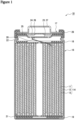
- FIG. 1 is a vertical sectional view of a non-aqueous electrolyte secondary battery of an example of an embodiment.
- a layered structure of a lithium-transition metal composite oxide includes a layer of transition metal such as Ni and a Li layer, and by the Li layer reversibly intercalating and deintercalating Li ions present therein, charge-discharge reactions of a battery proceed.
- a lithium-transition metal composite oxide containing Ni as a main component is a positive electrode active material having a high capacity.
- the secondary battery using such a lithium-transition metal composite oxide tends to undergo side reactions with the non-aqueous electrolyte, which may increase reaction resistance of the battery.
- Patent Literature 1 discloses, from the viewpoint of improvement of charge-discharge cycle characteristics, a positive electrode active material having an oxide-coating layer including Li 3 PO 4 formed on a surface of a lithium-transition metal composite oxide containing Ni, Mn, Co, and Sr. Patent Literature 1, however, does not investigate inhibition of the reaction resistance of the battery.
- the present inventors have made intensive investigation to solve the above problem, and consequently found that the reaction resistance of the battery can be reduced by forming a surface-modifying layer containing Ca and P on surfaces of primary particles constituting a lithium-transition metal composite oxide. It is presumed that a synergistic effect of Ca and P contained in the surface-modifying layer protects the lithium-transition metal composite oxide from a non-aqueous electrolyte and changes a surface state of the lithium-transition metal composite oxide by electronic interaction to reduce the reaction resistance of the battery.
- a cylindrical battery in which a wound electrode assembly is housed in a cylindrical exterior will be exemplified, but the electrode assembly is not limited to the wound electrode assembly, and may be a stacked electrode assembly in which a plurality of positive electrodes and a plurality of negative electrodes are alternately stacked one by one via a separator.
- the exterior is not limited to the cylindrical exterior, and may be, for example, a rectangular exterior, a coin-shaped exterior, or a battery case composed of a laminated sheet including a metal layer and a resin layer.
- FIG. 1 is an axial sectional view of a cylindrical secondary battery 10 of an example of an embodiment.
- the secondary battery 10 comprises a wound electrode assembly 14, an electrolyte liquid, and an exterior 16 housing the electrode assembly 14 and the electrolyte.
- the electrode assembly 14 includes a positive electrode 11, a negative electrode 12, and a separator 13, and has a wound structure in which the positive electrode 11 and the negative electrode 12 are spirally wound via the separator 13.
- the exterior 16 is a bottomed cylindrical metallic container having an opening on one side in an axial direction, and the opening of the exterior 16 is capped with a sealing assembly 17.
- the sealing assembly 17 side of the battery will be described as the upper side
- the bottom side of the exterior 16 will be described as the lower side.
- All of the positive electrode 11, the negative electrode 12, and the separator 13 that constitute the electrode assembly 14 have an elongated rectangular shape, and are spirally wound in a longitudinal direction to be alternately stacked in a radial direction of the electrode assembly 14.
- the separator 13 separates the positive electrode 11 and the negative electrode 12 each other.
- the negative electrode 12 is formed to be one size larger than the positive electrode 11. That is, the negative electrode 12 is formed to be longer than the positive electrode 11 in the longitudinal direction and the short direction.
- the two separators 13 are formed to be one size larger than at least the positive electrode 11, and disposed to, for example, sandwich the positive electrode 11.
- the electrode assembly 14 comprises: a positive electrode lead 20 connected to the positive electrode 11 by welding or the like; and a negative electrode lead 21 connected to the negative electrode 12 by welding or the like.
- the longitudinal direction of the positive electrode 11 and the negative electrode 12 becomes a winding direction
- the short direction of the positive electrode 11 and the negative electrode 12 becomes the axial direction. That is, an end surface in the short direction of the positive electrode 11 and the negative electrode 12 forms an end surface of the axial direction of the electrode assembly 14.
- Insulating plates 18 and 19 are respectively disposed on the upper and lower sides of the electrode assembly 14.
- the positive electrode lead 20 extends through a through hole of the insulating plate 18 toward the sealing assembly 17 side
- the negative electrode lead 21 extends through an outside of the insulating plate 19 toward the bottom side of the exterior 16.
- the positive electrode lead 20 is connected to a lower surface of an internal terminal plate 23 of the sealing assembly 17 by welding or the like, and a cap 27, which is a top plate of the sealing assembly 17 electrically connected to the internal terminal plate 23, becomes a positive electrode terminal.
- the negative electrode lead 21 is connected to a bottom inner surface of the exterior 16 by welding or the like, and the exterior 16 becomes a negative electrode terminal.
- a gasket 28 is provided between the exterior 16 and the sealing assembly 17 to achieve sealability inside the battery.
- a grooved portion 22 in which a part of a side wall thereof projects inward to support the sealing assembly 17 is formed.
- the grooved portion 22 is preferably formed in a circular shape along a circumferential direction of the exterior 16, and supports the sealing assembly 17 with the upper face thereof.
- the sealing assembly 17 is fixed on the upper part of the exterior 16 with the grooved portion 22 and with an end of the opening of the exterior 16 caulked to the sealing assembly 17.
- the sealing assembly 17 has a structure having the internal terminal plate 23, a lower vent member 24, an insulating member 25, an upper vent member 26, and the cap 27, which are stacked in this order from the electrode assembly 14 side.
- Each member constituting the sealing assembly 17 has, for example, a disk shape or a ring shape, and each member except for the insulating member 25 is electrically connected to each other.
- the lower vent member 24 and the upper vent member 26 are connected at respective central parts thereof, and the insulating member 25 is interposed between the respective circumferential parts thereof.
- the lower vent member 24 is deformed so as to push the upper vent member 26 up toward the cap 27 side and breaks, and thereby a current pathway between the lower vent member 24 and the upper vent member 26 is cut off. If the internal pressure further increases, the upper vent member 26 breaks, and gas is discharged through the opening of the cap 27.
- the positive electrode 11, the negative electrode 12, the separator 13, and the non-aqueous electrolyte, which constitute the secondary battery 10, specifically the positive electrode 11, will be described in detail.
- the positive electrode 11 has, for example, a positive electrode current collector and a positive electrode mixture layer formed on a surface of the positive electrode current collector.
- the positive electrode mixture layer is preferably formed on both surfaces of the positive electrode current collector.
- a foil of a metal stable within a potential range of the positive electrode 11, such as aluminum and an aluminum alloy, a film in which such a metal is disposed on a surface layer thereof, and the like may be used.
- a thickness of the positive electrode current collector is, for example, greater than or equal to 10 ⁇ m and less than or equal to 30 ⁇ m.
- the positive electrode mixture layer includes, for example, the positive electrode active material, a conductive agent, and a binder.
- a thickness of the positive electrode mixture layer is, for example, greater than or equal to 10 ⁇ m and less than or equal to 150 ⁇ m on one side of the positive electrode current collector.
- the positive electrode 11 may be produced by, for example, applying a positive electrode mixture slurry including the positive electrode active material, the conductive agent, and the like on the surface of the positive electrode current collector, and drying and subsequently rolling the coating film to form the positive electrode mixture layer on both surfaces of the positive electrode current collector.
- Examples of the conductive agent included in the positive electrode mixture layer include carbon-based particles such as carbon black (CB), acetylene black (AB), Ketjenblack, carbon nanotube (CNT), graphene, and graphite. These may be used singly, or may be used in combination of two or more thereof.
- binder included in the positive electrode mixture layer examples include a fluororesin such as polytetrafluoroethylene (PTFE) and polyvinylidene fluoride (PVDF), a polyimide resin, an acrylic resin, a polyolefin resin, and polyacrylonitrile (PAN). These may be used singly, or may be used in combination of two or more thereof.
- a fluororesin such as polytetrafluoroethylene (PTFE) and polyvinylidene fluoride (PVDF)
- PVDF polyvinylidene fluoride
- PAN polyacrylonitrile
- the positive electrode active material included in the positive electrode mixture layer includes a lithium-transition metal composite oxide.
- the lithium-transition metal composite oxide contains Ni, Ca, P, and Me, wherein Me represents at least one element selected from the group consisting of B, Al, Si, Ti, Mn, Fe, Co, Sr, Zr, Nb, Mo, Sn, W, and Bi.
- a proportion of Ni in the lithium-transition metal composite oxide is greater than or equal to 75 mol% and less than or equal to 95 mol% relative to a total number of moles of metal elements excluding Li.
- the proportion of Ni is preferably within this range from the viewpoint of achievement of both the increase in capacity and stabilization of the structure.
- the proportion of Ni is preferably greater than or equal to 80 mol%, and more preferably greater than or equal to 85 mol%.
- a proportion of Ca in the lithium-transition metal composite oxide is greater than 0 mol% and less than or equal to 2 mol% relative to the total number of moles of metal elements excluding Li.
- the presence of Ca at this proportion with P can exhibit the effect of the surface-modifying layer.
- the proportion of Ca is preferably greater than or equal to 0.01 mol%, more preferably greater than or equal to 0.05 mol%, and further preferably greater than or equal to 0.2 mol%.
- the lithium-transition metal composite oxide containing Ca can inhibit deterioration of the battery capacity due to repetition of charge and discharge of the secondary battery 10.
- a proportion of P in the lithium-transition metal composite oxide is greater than 0 mol% and less than or equal to 2 mol% relative to the total number of moles of metal elements excluding Li.
- the presence of P at this proportion with Ca can exhibit the effect of the surface-modifying layer.
- the proportion of Ca is preferably greater than or equal to 0.01 mol%, more preferably greater than or equal to 0.05 mol%, and further preferably greater than or equal to 0.2 mol%.
- the lithium-transition metal composite oxide containing P can improve stability of the secondary battery 10.
- a proportion of Me in the lithium-transition metal composite oxide is greater than or equal to 2 mol% and less than 25 mol% relative to the total number of moles of metal elements excluding Li.
- the proportion of Me is preferably within this range from the viewpoint of achievement of both the increase in capacity and stabilization of the structure.
- the proportion of Me is preferably greater than or equal to 2 mol% and less than or equal to 24 mol%, and more preferably greater than or equal to 5 mol% and less than or equal to 20 mol%.
- a proportion of the metal elements contained in the lithium-transition metal composite oxide may be measured with an inductively coupled plasma atomic emission spectrometer (ICP-AES), for example.
- ICP-AES inductively coupled plasma atomic emission spectrometer
- a ratio z/y of the proportion "z" of P relative to the proportion "y" of Ca preferably satisfies 0.1 ⁇ z/y ⁇ 5, more preferably satisfies 0.25 ⁇ z/y ⁇ 4, and further preferably satisfies 0.5 ⁇ z/y ⁇ 2. This allows the effect of the surface-modifying layer to be more remarkable.
- the lithium-transition metal composite oxide includes secondary particles each formed by aggregation of primary particles.
- a particle diameter of the primary particles is, for example, greater than or equal to 0.02 ⁇ m and less than or equal to 2 ⁇ m.
- the particle diameter of the primary particles is measured as a diameter of a circumscribed circle in a particle image observed with a scanning electron microscope (SEM).
- An average particle diameter of the secondary particles of the lithium-containing composite oxide is, for example, greater than or equal to 2 ⁇ m and less than or equal to 30 ⁇ m.
- the average particle diameter means a median diameter (D50) on a volumetric basis.
- the D50 means a particle diameter at which a cumulative frequency is 50% from a smaller particle diameter side in a particle size distribution on a volumetric basis.
- the particle size distribution of the secondary particles can be measured by using a laser diffraction-type particle size distribution measuring device (for example, MT3000II, manufactured by MicrotracBEL Corp.) with water as a dispersion medium
- a surface-modifying layer containing Ca and P is present on surfaces of the primary particles including surfaces of the secondary particles. This can inhibit side reactions between the primary particles and the non-aqueous electrolyte, thereby reducing the reaction resistance of the battery.
- the presence of Ca and P in the surface-modifying layer can be confirmed by energy dispersive X-ray spectrometry (TEM-EDX), for example.
- the surface-modifying layer may include a compound containing Ca and a compound containing P, or may include a compound containing Ca and P.
- the surface-modifying layer may contain a compound containing Ca, a compound containing P, and a compound containing Ca and P. These compounds may be uniformly dispersed on the entire surfaces of the primary particles including the surfaces of the secondary particles of the lithium-transition metal composite oxide, or may be present on a part thereof. These compounds are, for example, oxides.
- Ca and P may be present in the surface-modifying layer and within 30 nm near the surfaces of the primary particles. This allows the effect of reducing reaction resistance of the battery to be more remarkable.
- a crystallite size "s" of the lithium-transition metal composite oxide preferably satisfies 300 ⁇ ⁇ s ⁇ 700 ⁇ from the viewpoint of the increase in capacity of the battery and improvement of output characteristics of the battery.
- the crystallite size "s" is calculated with Scherrer equation from a half-value width of a diffraction peak of a (104) face of the X-ray diffraction pattern by X-ray diffraction.
- the X-ray diffraction pattern is obtained by a powder X-ray diffraction method using a powder X-ray diffraction apparatus (manufactured by Rigaku Corporation, product name "RINT-TTR", radiation source Cu-K ⁇ ) under the following conditions.
- the Scherrer equation is represented by the following equation.
- "s" represents the crystallite size
- " ⁇ ” represents a wavelength of the X-ray
- B represents the half-value width of the diffraction peak of the (104) face
- " ⁇ ” represents a diffraction angle (rad)
- K represents a Scherrer constant.
- K is 0.9.
- s K ⁇ / Bcos ⁇
- the lithium-transition metal composite oxide may have a layered structure.
- Example of the layered structure of the lithium-transition metal composite oxide include a layered structure belonging to the space group R-3m and a layered structure belonging to the space group C2/m.
- the lithium-transition metal composite oxide preferably has the layered structure belonging to the space group R-3m from the viewpoints of increase in capacity and the stability of the crystal structure.
- the layered structure of the lithium-transition metal composite oxide may include a transition metal layer and a Li layer.
- a porous sheet having an ion permeation property and an insulation property is used, for example.
- the porous sheet include a fine porous thin film, a woven fabric, and a nonwoven fabric.
- a polyolefin such as polyethylene or polypropylene, cellulose, or the like is preferable.
- the separator 13 may have a single-layer structure or a multi-layer structure.
- a resin layer having high heat resistance, such as an aramid resin, and a filler layer including a filler of an inorganic compound may be provided.
- a test cell was produced and evaluated in the same manner as in Example 1-1 except that, in the production of the positive electrode active material: the composition of the metal oxide was changed to Ni 0.94 Mn 0.02 Al 0.04 O 2 ; the Ca raw material and the P raw material were not mixed in producing the mixture; Ca(OH) 2 and Li 3 PO 4 were mixed in producing the positive electrode so that each of the mole ratios of Ca and P relative to the total amount of Ni, Mn, and Al was 1 mol%.
- a test cell was produced and evaluated in the same manner as in Example 1-1 except that, in the production of the positive electrode active material: the composition of the metal oxide was changed to Ni 0.94 Mn 0.02 Al 0.04 O 2 ; the Ca raw material and the P raw material were not mixed in producing the mixture; Sr(OH) 2 was mixed so that the mole ratio of Sr relative to the total amount of Ni, Mn, and Al was 1 mol%; and Li 3 PO 4 was mixed in producing the positive electrode so that the mole ratio of P relative to the total amount of Ni, Mn, and Al was 1 mol%.
- a test cell was produced and evaluated in the same manner as in Example 1-1 except that the positive electrode active material was produced as follows.
- a test cell was produced and evaluated in the same manner as in Example 2-1 except that, in the production of the positive electrode active material; the composition of the metal oxide was changed to Ni 0.93 Co 0.02 Al 0.05 O 2 ; the metal oxide, CaHPO 4 , and TiO 2 were mixed so that each of the mole ratios of Ca and P relative to the total amount of Ni, Co, and Al was 1.5 mol%, and the mole ratio of Ti was 1 mol%; lithium hydroxide monohydrate (LiOH ⁇ H 2 O) was mixed so that a mole ratio of Li relative to a total amount of Ni, Co, Al, Ca, P, and Ti was 102 mol%; and the mixture was heated at a heating rate of 0.5°C/min from 680°C to 720°C, and then retained for 3 hours.
- the composition of the metal oxide was changed to Ni 0.93 Co 0.02 Al 0.05 O 2 ; the metal oxide, CaHPO 4 , and TiO 2 were mixed so that each of the mole ratios of Ca and P relative to the
- a test cell was produced and evaluated in the same manner as in Example 2-1 except that, in the production of the positive electrode active material; the composition of the metal oxide was changed to Ni 0.90 Co 0.05 Mn 0.05 O 2 ; the metal oxide, CaHPO 4 , and ZrO 2 were mixed so that each of the mole ratios of Ca and P relative to the total amount of Ni, Co, and Mn was 0.25 mol%, and the mole ratio of Zr was 0.5 mol%; this mixture was calcined under an oxygen flow with an oxygen concentration of 95% at a flow rate of 6 L/min per kilogram of the mixture.
- a test cell was produced and evaluated in the same manner as in Example 2-1 except that, in the production of the positive electrode active material: the Ca raw material and the P raw material were not mixed in producing the mixture; and ZrO 2 was mixed so that the mole ratio of Zr relative to the total amount of Ni, Co, and Mn was 1 mol%.
- a test cell was produced and evaluated in the same manner as in Example 1-1 except that the positive electrode active material was produced as follows.
- a test cell was produced and evaluated in the same manner as in Example 3-1 except that, in the production of the positive electrode active material; the metal oxide, Ca 3 (PO 4 ) 2 , and Li 2 MoO 4 were mixed so that the mole ratio of Ca relative to the total amount of Ni, Co, and Mn was 1.5 mol%, the mole ratio of P was 1 mol%, and the mole ratio of Mo was 0.5 mol%; H 3 BO 4 was mixed with the lithium-transition metal composite oxide so that the mole ratio of B relative to the total amount of Ni, Co, and Mn was 1 mol%; and the mixture was thermally treated under an oxygen flow at 400°C to obtain a positive electrode active material.
- a test cell was produced and evaluated in the same manner as in Example 3-1 except that, in the production of the positive electrode active material, the metal oxide, CaHPO 4 , Sr(OH) 2 , and WO 3 were mixed so that the mole ratio of Ca relative to the total amount of Ni, Co, and Mn was 0.5 mol%, the mole ratio of P was 0.25 mol%, the mole ratio of Sr was 0.25 mol%, and the mole ratio of W was 0.5 mol%.
- a test cell was produced and evaluated in the same manner as in Example 3-1 except that, in the production of the positive electrode active material; the composition of the metal oxide was changed to Ni 0.84 Co 0.08 Mn 0.08 O 2 ; the metal oxide, Ca(OH) 2 , and Li 3 PO 4 were mixed so that each of the mole ratios of Ca and P relative to the total amount of Ni, Co, and Mn was 1.75 mol%; and this mixture was calcined under an oxygen flow with an oxygen concentration of 95% at a flow rate of 0.8 L/min per kilogram of the mixture, heated at a heating rate of 1°C/min from 650°C to 780°C, and then retained for 8 hours.
- a test cell was produced and evaluated in the same manner as in Example 3-1 except that, in the production of the positive electrode active material, the Ca raw material and the P raw material were not mixed in producing the mixture.
- Tables 1 to 3 show the composition of the positive electrode active material, the presence or absence of Ca and P on the primary particle surfaces, the proportion of the metal elements other than Li in the Li layer, the crystallite size "s", and the ratio m/n of the half-value widths.
- the reaction resistance of the test cells other than Comparative Example 1-1 is shown relative to the reaction resistance of the test cell of Comparative Example 1-1 being 100.
- the reaction resistance of Examples is shown relative to the reaction resistance of the test cell of Comparative Example being 100.
Landscapes
- Chemical & Material Sciences (AREA)
- Organic Chemistry (AREA)
- Inorganic Chemistry (AREA)
- Chemical Kinetics & Catalysis (AREA)
- Electrochemistry (AREA)
- General Chemical & Material Sciences (AREA)
- Engineering & Computer Science (AREA)
- Materials Engineering (AREA)
- Composite Materials (AREA)
- Manufacturing & Machinery (AREA)
- Battery Electrode And Active Subsutance (AREA)
Applications Claiming Priority (2)
| Application Number | Priority Date | Filing Date | Title |
|---|---|---|---|
| JP2022104645 | 2022-06-29 | ||
| PCT/JP2023/021859 WO2024004626A1 (ja) | 2022-06-29 | 2023-06-13 | 非水電解質二次電池用正極活物質、非水電解質二次電池用正極活物質の製造方法、及び非水電解質二次電池 |
Publications (2)
| Publication Number | Publication Date |
|---|---|
| EP4550461A4 EP4550461A4 (en) | 2025-05-07 |
| EP4550461A1 true EP4550461A1 (en) | 2025-05-07 |
Family
ID=89382041
Family Applications (1)
| Application Number | Title | Priority Date | Filing Date |
|---|---|---|---|
| EP23831074.2A Pending EP4550461A1 (en) | 2022-06-29 | 2023-06-13 | Positive electrode active material for non-aqueous electrolyte secondary battery, method of producing positive electrode active material for non-aqueous electrolyte secondary battery, and non-aqueous electrolyte secondary battery |
Country Status (4)
| Country | Link |
|---|---|
| EP (1) | EP4550461A1 (https=) |
| JP (1) | JPWO2024004626A1 (https=) |
| CN (1) | CN119384734A (https=) |
| WO (1) | WO2024004626A1 (https=) |
Families Citing this family (1)
| Publication number | Priority date | Publication date | Assignee | Title |
|---|---|---|---|---|
| WO2026070880A1 (ja) * | 2024-09-30 | 2026-04-02 | パナソニックIpマネジメント株式会社 | 非水電解質二次電池用正極活物質、非水電解質二次電池、及び非水電解質二次電池用正極活物質の製造方法 |
Family Cites Families (5)
| Publication number | Priority date | Publication date | Assignee | Title |
|---|---|---|---|---|
| JP2012253009A (ja) * | 2011-05-10 | 2012-12-20 | Nippon Chem Ind Co Ltd | リチウム二次電池用正極活物質粉体、その製造方法及びリチウム二次電池 |
| KR101644684B1 (ko) | 2014-02-28 | 2016-08-01 | 주식회사 엘지화학 | 리튬-니켈계 양극 활물질, 이의 제조방법 및 이를 포함하는 리튬 이차전지 |
| JP7599094B2 (ja) * | 2019-11-29 | 2024-12-13 | パナソニックIpマネジメント株式会社 | 非水電解質二次電池用正極活物質、非水電解質二次電池用正極活物質の製造方法、及び非水電解質二次電池 |
| US20240038970A1 (en) * | 2020-12-18 | 2024-02-01 | Panasonic Intellectual Property Management Co., Ltd. | Non-aqueous electrolyte secondary battery positive electrode and non-aqueous electrolyte secondary battery |
| CN114551835B (zh) * | 2022-02-24 | 2024-01-30 | 蜂巢能源科技股份有限公司 | 一种超高镍四元正极材料及其制备方法和应用 |
-
2023
- 2023-06-13 JP JP2024530661A patent/JPWO2024004626A1/ja active Pending
- 2023-06-13 CN CN202380046582.4A patent/CN119384734A/zh active Pending
- 2023-06-13 WO PCT/JP2023/021859 patent/WO2024004626A1/ja not_active Ceased
- 2023-06-13 EP EP23831074.2A patent/EP4550461A1/en active Pending
Also Published As
| Publication number | Publication date |
|---|---|
| JPWO2024004626A1 (https=) | 2024-01-04 |
| WO2024004626A1 (ja) | 2024-01-04 |
| CN119384734A (zh) | 2025-01-28 |
Similar Documents
| Publication | Publication Date | Title |
|---|---|---|
| EP4067310A1 (en) | Positive-electrode active material for nonaqueous-electrolyte secondary battery, method for producing positive-electrode active material for nonaqueous-electrolyte secondary battery, and nonaqueous-electrolyte secondary battery | |
| EP4159685A1 (en) | Positive electrode active material for nonaqueous electrolyte secondary batteries, and nonaqueous electrolyte secondary battery | |
| EP4167322A1 (en) | Positive electrode active material for non-aqueous electrolyte secondary battery, and non-aqueous electrolyte secondary battery | |
| EP4265570A1 (en) | Non-aqueous electrolyte secondary battery positive electrode and non-aqueous electrolyte secondary battery | |
| EP4023606A1 (en) | Positive electrode active material for nonaqueous electrolyte secondary batteries, and nonaqueous electrolyte secondary battery | |
| EP4224572A1 (en) | Positive electrode active material for nonaqueous electrolyte secondary batteries, and nonaqueous electrolyte secondary battery | |
| EP4485558A1 (en) | Positive electrode for nonaqueous electrolyte secondary batteries, and nonaqueous electrolyte secondary battery | |
| EP4209461A1 (en) | Positive electrode active material for nonaqueous electrolyte secondary batteries, and nonaqueous electrolyte secondary battery | |
| EP4160723A1 (en) | Positive electrode for nonaqueous electrolyte secondary batteries, and nonaqueous electrolyte secondary battery | |
| EP4160724A1 (en) | Positive electrode for non-aqueous electrolyte secondary battery, and non-aqueous electrolyte secondary battery | |
| EP4579808A1 (en) | Positive electrode active material for nonaqueous electrolyte secondary batteries, and nonaqueous electrolyte secondary battery | |
| EP4064387B1 (en) | Non-aqueous electrolyte secondary battery | |
| EP4485574A1 (en) | Positive electrode active material for nonaqueous electrolyte secondary batteries, and nonaqueous electrolyte secondary battery | |
| EP4060769A1 (en) | Positive electrode active material for non-aqueous electrolyte secondary battery, and non-aqueous electrolyte secondary battery | |
| EP4443560A1 (en) | Positive electrode active material for nonaqueous electrolyte secondary batteries, positive electrode for nonaqueous electrolyte secondary batteries, nonaqueous electrolyte secondary battery, and method for producing positive electrode active material for nonaqueous electrolyte secondary batteries | |
| EP4270528A1 (en) | Positive electrode for non-aqueous electrolyte secondary battery and non-aqueous electrolyte secondary battery | |
| EP4207370A1 (en) | Positive-electrode active material for nonaqueous-electrolyte secondary cell, and nonaqueous-electrolyte secondary cell | |
| EP4550461A1 (en) | Positive electrode active material for non-aqueous electrolyte secondary battery, method of producing positive electrode active material for non-aqueous electrolyte secondary battery, and non-aqueous electrolyte secondary battery | |
| EP4099441B1 (en) | Positive electrode active material for nonaqueous electrolyte secondary batteries, and nonaqueous electrolyte secondary battery | |
| EP4550467A1 (en) | Positive electrode active material for nonaqueous electrolyte secondary batteries, method for producing positive electrode active material for nonaqueous electrolyte secondary batteries, and nonaqueous electrolyte secondary battery | |
| EP4567932A1 (en) | Positive electrode active material for nonaqueous electrolyte secondary battery, and nonaqueous electrolyte secondary battery | |
| EP4138157A1 (en) | Positive electrode active material for nonaqueous electrolyte secondary batteries, and nonaqueous electrolyte secondary battery | |
| EP4550468A1 (en) | Positive electrode active material for non-aqueous electrolyte secondary cell, and non-aqueous electrolyte secondary cell | |
| EP4550466A1 (en) | Positive electrode active material for non-aqueous electrolyte secondary cell, and non-aqueous electrolyte secondary cell | |
| EP4550464A1 (en) | Positive electrode active material for non-aqueous electrolyte secondary battery, and non-aqueous electrolyte secondary battery |
Legal Events
| Date | Code | Title | Description |
|---|---|---|---|
| STAA | Information on the status of an ep patent application or granted ep patent |
Free format text: STATUS: THE INTERNATIONAL PUBLICATION HAS BEEN MADE |
|
| PUAI | Public reference made under article 153(3) epc to a published international application that has entered the european phase |
Free format text: ORIGINAL CODE: 0009012 |
|
| STAA | Information on the status of an ep patent application or granted ep patent |
Free format text: STATUS: REQUEST FOR EXAMINATION WAS MADE |
|
| 17P | Request for examination filed |
Effective date: 20241209 |
|
| A4 | Supplementary search report drawn up and despatched |
Effective date: 20250328 |
|
| AK | Designated contracting states |
Kind code of ref document: A1 Designated state(s): AL AT BE BG CH CY CZ DE DK EE ES FI FR GB GR HR HU IE IS IT LI LT LU LV MC ME MK MT NL NO PL PT RO RS SE SI SK SM TR |
|
| DAV | Request for validation of the european patent (deleted) | ||
| DAX | Request for extension of the european patent (deleted) | ||
| STAA | Information on the status of an ep patent application or granted ep patent |
Free format text: STATUS: EXAMINATION IS IN PROGRESS |