EP4545579A1 - Verfahren zur herstellung eines polyisocyanats auf basis von 1,5-pentamethylendiisocyanat - Google Patents
Verfahren zur herstellung eines polyisocyanats auf basis von 1,5-pentamethylendiisocyanat Download PDFInfo
- Publication number
- EP4545579A1 EP4545579A1 EP23205409.8A EP23205409A EP4545579A1 EP 4545579 A1 EP4545579 A1 EP 4545579A1 EP 23205409 A EP23205409 A EP 23205409A EP 4545579 A1 EP4545579 A1 EP 4545579A1
- Authority
- EP
- European Patent Office
- Prior art keywords
- polyisocyanate
- particularly preferably
- pentamethylene diisocyanate
- groups
- carbon atoms
- Prior art date
- Legal status (The legal status is an assumption and is not a legal conclusion. Google has not performed a legal analysis and makes no representation as to the accuracy of the status listed.)
- Withdrawn
Links
Classifications
-
- C—CHEMISTRY; METALLURGY
- C08—ORGANIC MACROMOLECULAR COMPOUNDS; THEIR PREPARATION OR CHEMICAL WORKING-UP; COMPOSITIONS BASED THEREON
- C08G—MACROMOLECULAR COMPOUNDS OBTAINED OTHERWISE THAN BY REACTIONS ONLY INVOLVING UNSATURATED CARBON-TO-CARBON BONDS
- C08G18/00—Polymeric products of isocyanates or isothiocyanates
- C08G18/06—Polymeric products of isocyanates or isothiocyanates with compounds having active hydrogen
- C08G18/70—Polymeric products of isocyanates or isothiocyanates with compounds having active hydrogen characterised by the isocyanates or isothiocyanates used
- C08G18/72—Polyisocyanates or polyisothiocyanates
- C08G18/73—Polyisocyanates or polyisothiocyanates acyclic
-
- C—CHEMISTRY; METALLURGY
- C08—ORGANIC MACROMOLECULAR COMPOUNDS; THEIR PREPARATION OR CHEMICAL WORKING-UP; COMPOSITIONS BASED THEREON
- C08G—MACROMOLECULAR COMPOUNDS OBTAINED OTHERWISE THAN BY REACTIONS ONLY INVOLVING UNSATURATED CARBON-TO-CARBON BONDS
- C08G18/00—Polymeric products of isocyanates or isothiocyanates
- C08G18/02—Polymeric products of isocyanates or isothiocyanates of isocyanates or isothiocyanates only
- C08G18/022—Polymeric products of isocyanates or isothiocyanates of isocyanates or isothiocyanates only the polymeric products containing isocyanurate groups
-
- C—CHEMISTRY; METALLURGY
- C08—ORGANIC MACROMOLECULAR COMPOUNDS; THEIR PREPARATION OR CHEMICAL WORKING-UP; COMPOSITIONS BASED THEREON
- C08G—MACROMOLECULAR COMPOUNDS OBTAINED OTHERWISE THAN BY REACTIONS ONLY INVOLVING UNSATURATED CARBON-TO-CARBON BONDS
- C08G18/00—Polymeric products of isocyanates or isothiocyanates
- C08G18/06—Polymeric products of isocyanates or isothiocyanates with compounds having active hydrogen
- C08G18/28—Polymeric products of isocyanates or isothiocyanates with compounds having active hydrogen characterised by the compounds used containing active hydrogen
- C08G18/2805—Compounds having only one group containing active hydrogen
- C08G18/2815—Monohydroxy compounds
- C08G18/282—Alkanols, cycloalkanols or arylalkanols including terpenealcohols
- C08G18/2825—Alkanols, cycloalkanols or arylalkanols including terpenealcohols having at least 6 carbon atoms
-
- C—CHEMISTRY; METALLURGY
- C08—ORGANIC MACROMOLECULAR COMPOUNDS; THEIR PREPARATION OR CHEMICAL WORKING-UP; COMPOSITIONS BASED THEREON
- C08G—MACROMOLECULAR COMPOUNDS OBTAINED OTHERWISE THAN BY REACTIONS ONLY INVOLVING UNSATURATED CARBON-TO-CARBON BONDS
- C08G18/00—Polymeric products of isocyanates or isothiocyanates
- C08G18/06—Polymeric products of isocyanates or isothiocyanates with compounds having active hydrogen
- C08G18/70—Polymeric products of isocyanates or isothiocyanates with compounds having active hydrogen characterised by the isocyanates or isothiocyanates used
- C08G18/72—Polyisocyanates or polyisothiocyanates
- C08G18/77—Polyisocyanates or polyisothiocyanates having heteroatoms in addition to the isocyanate or isothiocyanate nitrogen and oxygen or sulfur
- C08G18/78—Nitrogen
- C08G18/79—Nitrogen characterised by the polyisocyanates used, these having groups formed by oligomerisation of isocyanates or isothiocyanates
- C08G18/791—Nitrogen characterised by the polyisocyanates used, these having groups formed by oligomerisation of isocyanates or isothiocyanates containing isocyanurate groups
- C08G18/792—Nitrogen characterised by the polyisocyanates used, these having groups formed by oligomerisation of isocyanates or isothiocyanates containing isocyanurate groups formed by oligomerisation of aliphatic and/or cycloaliphatic isocyanates or isothiocyanates
Definitions
- the invention relates to a process for producing a polyisocyanate based on 1,5-pentamethylene diisocyanate, as well as to the polyisocyanate obtained.
- the invention further relates to a two-component system containing the polyisocyanate.
- the invention relates to its use for producing a coating on a substrate, for producing a molded article, or as an adhesive, as well as to the composite of the coating or adhesive and the substrate, as well as the molded article.
- Two-component polyurethane coatings have been around for a long time.
- coatings made from aliphatic polyisocyanates and polyols such as polyacrylate polyols, polyester polyols, or polycarbonate polyols, are particularly popular.
- the polyisocyanates used for these high-quality coatings are particularly low-monomer derivatives made from 1,6-hexamethylene diisocyanate (hereinafter abbreviated as HDI).
- isocyanurate polyisocyanates of HDI or polyisocyanates of HDI containing iminooxadiazinedione and isocyanurate structures such as those used in HJ Laas, R. Halpaap, J. Pedain, J. prakt. Chem. 1994, 336, 185-200 or in EP 0330966 B1 or EP 0798299 B1
- polyisocyanates generally have isocyanate functionalities (F NCO ) of 3 or more, where isocyanate functionality is understood to be the average number of NCO groups per molecule.
- 1,5-pentamethylene diisocyanate (hereinafter also referred to as 1,5-pentane diisocyanate or pentamethylene diisocyanate or abbreviated as PDI) has long been known as a monomer, for example by W. Siefken, Liebigs Ann. Chem. 1949, 562, page 122 or in the DE 1493360 B1 and the DE 1900514 A1 described.
- WO2016146574A1 describes a polyisocyanate based on PDI that demonstrates improved compatibility with high-OH polyols. Preferred distillation temperatures of 120 to 180°C are described, with a temperature of 140°C being used in the specific examples, without addressing the storage stability of the resulting products.
- EP2806026A1 describes a polyisocyanate based on PDI, wherein the PDI polyisocyanate crude solution in Example 12 is distilled via a thin film evaporator at 150 °C and a pressure of 0.093 KPa.
- EP2543736A1 describes a polyisocyanate based on PDI, wherein the PDI polyisocyanate crude solution in Example 23 is distilled via a thin film evaporator at 150 °C and a pressure of 0.093 KPa.
- US2018142123 describes a polyisocyanate based on PDI, wherein the reaction mixture in Examples 1 to 12 is distilled via a thin-film evaporator at 120 °C and a pressure of 0.093 KPa and wherein o-toluenesulfonamide is added.
- the object of the present invention was to provide a process for the preparation of a polyisocyanate based on 1,5-pentamethylene diisocyanate, whereby products can be obtained which do not increase in viscosity or become cloudy during storage, or at least increase to a significantly lesser extent.
- This object was achieved by a process for producing a polyisocyanate based on 1,5-pentamethylene diisocyanate, comprising reacting an isocyanate component containing at least 1,5-pentamethylene diisocyanate in the presence of at least one catalyst and optionally in the presence of one or more co-reagents comprising alcohols, amines, water and carbon dioxide to form a crude polyisocyanate, characterized in that the crude polyisocyanate is distilled in a further step in a temperature range from 155 °C to 175 °C and in a further step the polyisocyanate based on 1,5-pentamethylene diisocyanate is obtained.
- the term "distilled” in the sentence "that the crude polyisocyanate is distilled in a further step in a temperature range of 155 °C to 175 °C” is to be understood as meaning that essentially the excess 1,5-pentamethylene diisocyanate is evaporated from the crude polyisocyanate, while the polyisocyanate based on 1,5-pentamethylene diisocyanate remains largely in the liquid phase.
- the terms “comprising” or “containing” preferably mean “consisting essentially of,” and particularly preferably “consisting of.”
- the further embodiments mentioned in the patent claims and in the description can be combined in any desired way, unless the context clearly indicates otherwise.
- At least one refers to 1 or more, for example, 2, 3, 4, 5, 6, 7, 8, 9, or more. In the context of components of the compounds described herein, this statement does not refer to the absolute amount of molecules, but rather to the type of component. "At least one catalyst” therefore means, for example, that only one type of catalyst or several different types of catalysts may be present, without specifying the amount of the individual compounds.
- Numerical ranges specified in the format "in/from x to y" include the specified values. If multiple preferred numerical ranges are specified in this format, it goes without saying that all ranges resulting from the combination of the different endpoints will also be included.
- substituents are -F, -Cl, -Br, -I, -OCH3, OCH2CH3, -O-isopropyl or -on-propyl, -OCF3, -CF3, -S-C1-6-alkyl, and/or (optionally via an attached heteroatom) a linear or branched, aliphatic and/or alicyclic structural unit having 1 to 12 carbon atoms, each acting as a replacement for a carbon-bonded hydrogen atom of the molecule in question.
- Preferred substituents are halogen (especially -F, -Cl), C1 - C6- alkoxy (especially methoxy and ethoxy), trifluoromethyl, and trifluoromethoxy, each acting as a replacement for a carbon-bonded hydrogen atom of the molecule in question.
- the isocyanate component contains at least 1,5-pentamethylene diisocyanate, which is mixed in the presence of a catalyst and preferably with at least one linear, branched, and optionally substituted monoalcohol whose side chain is inert toward isocyanate groups, and is reacted to form the polyisocyanate based on 1,5-pentamethylene diisocyanate.
- at least one linear, branched, and optionally substituted monoalcohol whose side chain is inert toward isocyanate groups is added beforehand, simultaneously, and/or subsequently.
- diisocyanates with aliphatically, cycloaliphatically, araliphatically, and/or aromatically bound isocyanate groups can be used in addition to 1,5-pentamethylene diisocyanate in the production of the polyisocyanate. These are particularly those in the molecular weight range of 140 to 400, such as 1,5-pentamethylene diisocyanate.
- diisocyanates which may be used in the preparation of the polyisocyanate, are also obtainable, for example, by phosgenation in the liquid or gas phase and are used, if at all, in amounts of up to 80 wt.%, preferably up to 50 wt.%, particularly preferably up to 20 wt.%, and particularly preferably from 0 to 4 wt.%, based on the total amount of diisocyanates used.
- the isocyanate component contains only PDI as the diisocyanate.
- the isocyanate component for carrying out the process according to the invention can be introduced, optionally under an inert gas, such as nitrogen, and optionally in the presence of a solvent, at a temperature between 0 and 180 °C, preferably 20 to 140 °C, particularly preferably 40 to 100 °C.
- the catalyst or a mixture of the catalyst with a suitable catalyst solvent can be added in the amount specified below.
- the catalyst can be added in one or more portions or continuously, e.g., using a suitable metering pump, over the entire reaction duration.
- the one or more co-reagents optionally present in the process according to the invention comprise alcohols, amines, water and carbon dioxide and are preferably linear, branched and optionally substituted monoalcohols which are inert in the side chain towards isocyanate groups, particularly preferred are monoalcohols which have 1 to 18 carbon atoms, preferably 1 to 12 carbon atoms and particularly preferably 1 to 8 carbon atoms.
- the alcohols are primary or secondary monoalcohols, most preferably primary monoalcohols.
- monoalcohols having 1 to 18 carbon atoms, preferably 1 to 12 carbon atoms, and particularly preferably 1 to 8 carbon atoms.
- Suitable monoalcohols for the process according to the invention are, for example, methanol, ethanol, n-propanol, isopropanol, n-butanol, sec-butanol, iso-butanol, n-hexanol, 2-ethyl-1-hexanol, ether alcohols such as, for example, 1-methoxy-2-propanol, 3-ethyl-3-hydroxymethyloxetane, tetrahydrofurfuryl alcohol, ethylene glycol monomethyl ether, ethylene glycol monoethyl ether, ethylene glycol monobutyl ether, diethylene glycol monomethyl ether, diethylene glycol monoethyl ether, diethylene glycol monobutyl ether or else liquid higher molecular weight polyethylene glycol monoalkyl ethers, polypropylene glycol monoalkyl ethers, mixed polyethylene/polypropylene glycol monoalkyl ethers; ester alcohol
- the temperatures for carrying out the process according to the invention can be selected depending on the compounds used. However, it is preferred if the reaction is carried out at temperatures between ⁇ 0 and ⁇ 180 °C, preferably ⁇ 20 to ⁇ 140 °C, particularly preferably ⁇ 40 to ⁇ 100 °C.
- the 1,5-pentamethylene diisocyanate used at least in the process according to the invention can be generated by any known prior art process for the preparation of aliphatic diisocyanates, for example, with or without the use of phosgene and starting from 1,5-diaminopentane, preferably obtained biotechnologically by decarboxylation of the naturally occurring amino acid lysine.
- phosgene When phosgene is used, the phosgenation of 1,5-diaminopentane can be carried out in the liquid or gas phase.
- 1,5-diisocyanatopentane is obtained by phosgenation of 1,5-diaminopentane in the gas phase.
- the phosgenation of amines in the gas phase is known per se and can be carried out, for example, as described in EP 0 289 840 B1 , EP 1 319 655 A2 , EP 1 555 258 A1 , EP 1 275 639 A1 , EP 1 275 640 A1 , EP 1 449 826 A1 , EP 1 754 698 B1 , DE 10 359 627 A1 or in the German patent application DE 10 2005 042392 A1 described.
- the 1,5-diaminopentane originates from a bio-based source and is preferably obtained biotechnologically, e.g., by fermentation of suitable biomass.
- trimerization catalyst plays a role in the implementation of the process according to the invention in that it can influence the product selectivity with regard to the formation of products containing predominantly allophanate and isocyanurate groups.
- Suitable catalysts are, for example, quaternary ammonium carboxylates, such as N-(2-hydroxypropyl)-N,N,N-trimethylammonium 2-ethylhexanoate, N-(2-hydroxypropyl)-N,N,N-trimethylammonium 2-formate, N,N,N-tetramethylammonium octoate, quaternary ammonium hydroxides, such as. B.
- catalysts in this group are N,N,N-trimethyl-N-(2-hydroxyethyl)ammonium hydroxide, N,N,N-trimethyl-N-(2-hydroxypropyl)ammonium hydroxide, N,N,N-trimethyl-N-(2-hydroxybutyl)ammonium hydroxide, and especially N,N,N-trimethyl-N-benzylammonium hydroxide.
- Suitable catalysts include, for example, hexamethyldisilazane, heptamethyldisilazane, diethyl-1,3-tetramethyl-1,1,3,3-disilazane, divinyl-1,3-tetramethyl-1,1,3,3-disilazane, hexaethyldisilazane, and diphenyl-1,3-tetramethyl-1,1,3,3-disilazane.
- Hexamethyldisilazane is preferred from this group.
- Suitable amounts of the catalyst may be, for example, up to 0.25 wt.%, preferably up to 0.1 wt.% and particularly preferably up to 0.05 wt.%.
- catalyst solvents are preferably used which carry groups reactive towards isocyanates and can be incorporated into the polyisocyanate.
- solvents are simple alcohols such as methanol, ethanol, n-propanol, isopropanol, n-butanol, sec-butanol, iso-butanol, n-hexanol, 2-ethyl-1-hexanol; ether alcohols such as 1-methoxy-2-propanol, 3-ethyl-3-hydroxymethyloxetane, tetrahydrofurfuryl alcohol, ethylene glycol monomethyl ether, ethylene glycol monoethyl ether, ethylene glycol monobutyl ether, diethylene glycol monomethyl ether, diethylene glycol monothyl ether, diethylene glycol monobutyl ether or liquid higher molecular weight polyethylene glycol monoalkyl ethers, polypropylene glycol monoalkyl ethers,
- the catalyst is used dissolved in the corresponding monoalcohol or monoalcohol mixture desired for the formation of the allophanate groups.
- the catalyst solvent corresponds to the above-mentioned monoalcohols.
- the order of addition of the components to be reacted can be chosen arbitrarily.
- the amount of solvent can be selected to establish a specific equivalent ratio of allophanate groups to isocyanurate groups.
- Allophanate groups are more soluble in polyisocyanate than the corresponding urethanes, which are composed of the same building blocks, and—at least in the case of products based on monofunctional alcohols—have a significantly lower viscosity than the trimers.
- the fundamental disadvantage is that the allophanate groups composed of monofunctional alcohols and diisocyanates are only NCOdifunctional and thus reduce the (average) NCO functionality of the polyisocyanates.
- reaction mixture is understood to mean a mixture of 1,5-pentamethylene diisocyanate, the catalyst, the monoalcohol(s) and, if appropriate, other starting materials and the polyisocyanates formed.
- the course of the reaction in the process according to the invention is monitored via the decrease in the NCO content in the reaction mixture.
- the content of isocyanate groups in the reaction mixture, as well as the content of isocyanate groups in the polyisocyanate composition obtained by the process according to the invention, can be determined, for example, titrimetrically according to DIN EN ISO 11 909.
- the reaction is continued until the reaction mixture has a degree of oligomerization of 10 to 40%, preferably 15 to 30%.
- degree of oligomerization is understood to mean the percentage of the isocyanate groups originally present in the starting mixture that are consumed during the reaction according to the invention.
- the reaction can be terminated, for example, after the desired degree of oligomerization has been reached.
- This degree of oligomerization is generally achieved after a reaction time of 30 minutes to 8 hours, preferably 1 to 6 hours.
- the reaction can be terminated, for example, by cooling the reaction mixture to room temperature. However, the reaction is generally terminated by adding a catalyst poison and, if necessary, briefly heating the reaction mixture, for example, to a temperature above 80 °C.
- Suitable catalyst poisons are, for example, inorganic acids such as hydrochloric acid, phosphorous acid or phosphoric acid, acid chlorides such as acetyl chloride, benzoyl chloride or isophthaloyl dichloride, sulfonic acids and sulfonic acid esters such as methanesulfonic acid, p-toluenesulfonic acid, trifluoromethanesulfonic acid, perfluorobutanesulfonic acid, dodecylbenzenesulfonic acid, p-toluenesulfonic acid methyl ester and ethyl ester, mono- and dialkyl phosphates such as monotridecyl phosphate, dibutyl phosphate and dioctyl phosphate but also silylated acids such as methanesulfonic acid trimethylsilyl ester, trifluoromethanesulfonic acid trimethylsilyl ester, phosphoric acid tri
- the amount of catalyst poison required to complete the reaction depends on the amount of catalyst used; generally, an equivalent amount of catalyst poison is used, based on the amount of catalyst initially used. However, taking into account any catalyst losses that may occur during the reaction, as little as 20 to 80 equivalent percent of catalyst poison, based on the amount of catalyst originally used, may be sufficient to complete the reaction.
- the catalyst poisons mentioned can be used either in their pure form or dissolved in a suitable solvent. If a solvent is used to dissolve the catalyst poison, 1,5-pentane diisocyanate is preferred.
- the degree of dilution can be freely selected within a very wide range; for example, solutions with a concentration of ⁇ 25 wt.%, preferably ⁇ 10 wt.%, are suitable.
- the reaction mixture obtained after the reaction is referred to herein as crude polyisocyanate.
- Crude polyisocyanate Essential to the present process is that the crude polyisocyanate based on 1,5-pentamethylene diisocyanate is distilled in a further step in a temperature range of 155°C to 175°C, preferably 160°C to 175°C, and particularly preferably 162°C to 173°C, and the polyisocyanate based on 1,5-pentamethylene diisocyanate is obtained in a further step.
- Distillation primarily serves to free the crude polyisocyanate from volatile constituents (excess monomeric isocyanate components and any solvents used). Distillation is preferably carried out using a falling-film evaporator or thin-film distillation, and more preferably using a falling-film evaporator, preferably under vacuum, with a pressure of preferably less than 1.0 mbar, preferably less than 0.25 mbar, and more preferably less than 0.1 mbar in the final evaporator stage.
- distillation is preferably carried out in several stages, with pressures of less than 30 mbar in the first stages, preferably less than 20 mbar, more preferably less than 10 mbar, and a pressure of less than 1 mbar, preferably less than 0.25 mbar, and more preferably less than 0.1 mbar in the final evaporator stage.
- temperatures of 155°C to 175°C, preferably 160°C to 175°C and particularly preferably 162°C to 173°C prevail, it being possible to vary the further distillation conditions.
- the distillation conditions, including the distillation temperatures can be varied as desired. It is possible to use different or multiple times the same distillation method, such as thin-film distillation, falling-film evaporation or short-path distillation.
- the distillation step essential to the invention is preferably carried out at temperatures of 155°C to 175°C, preferably 160°C to 175°C and particularly preferably 162°C to 173°C and in a falling-film evaporator or thin-film distillation and particularly preferably by means of a falling-film evaporator.
- the design of the evaporator stages, evaporation units, and distillation apparatus for the possible distillation methods can be chosen arbitrarily. It may be advantageous to heat them with direct steam and/or a pressurized water circuit.
- the evaporation units preferably contain several condensers and vacuum pumps.
- the distillation setup comprises or consists of three evaporator stages and particularly preferably comprises or consists of a falling-film evaporator. as the first evaporation stage, a thin film evaporator or falling film evaporator as the second evaporation stage and a short path evaporator as the third evaporation stage.
- the polyisocyanate based on 1,5-pentamethylene diisocyanate is obtained.
- This step can, for example, be the mere obtaining of the polyisocyanate based on 1,5-pentamethylene diisocyanate or, for example, comprise or consist of product packaging, product bottling, or even further distillation steps.
- the step can follow directly on from the step essential to the invention, or one or more steps can be interposed, such as one or more of the aforementioned further distillation steps at different temperatures. It is also possible for other steps, such as further distillation steps, to follow before the distillation step according to the invention.
- the polyisocyanate based on 1,5-pentamethylene diisocyanate obtainable or produced using the process according to the invention differs structurally and in its composition from previous polyisocyanates based on 1,5-pentamethylene diisocyanate and represents a further subject of the present invention.
- the process according to the invention also reduces the alpha-nylon content in the obtainable and produced process products and reduces the tendency to form alpha-nylon during production and also during subsequent storage.
- long storage period refers to a period of 8 weeks at 50 °C or 6 months at room temperature (20-30 °C).
- the polyisocyanate based on 1,5 comprises at least one compound containing isocyanate groups and having at least one 1,5-bridging pentamethylene unit and one isocyanurate group, some of the compounds preferably additionally containing at least one allophanate group, characterized in that the polyisocyanate composition has an isocyanurate trimer content of ⁇ 59 wt.% based on the total weight of the polyisocyanate composition, the allophanate groups carry an organic radical which is inert towards isocyanate groups and the allophanate groups are present to the isocyanurate groups in an equivalent ratio of > 0 and ⁇ 0.19.
- 1,5-bridging pentamethylene units are understood to mean structural units consisting of linear pentamethylene units (-CH 2 CH 2 CH 2 CH 2 CH 2 -) which are bonded at position 1 to the nitrogen atom of an isocyanate group, the nitrogen atom of an isocyanurate group or the The nitrogen atom of an allophanate group bearing an organic radical inert toward isocyanate groups is bonded at position 5 to the nitrogen atom of an isocyanurate group or the nitrogen atom of an allophanate group bearing an organic radical inert toward isocyanate groups.
- positions 1 and 5 can also be interchanged.
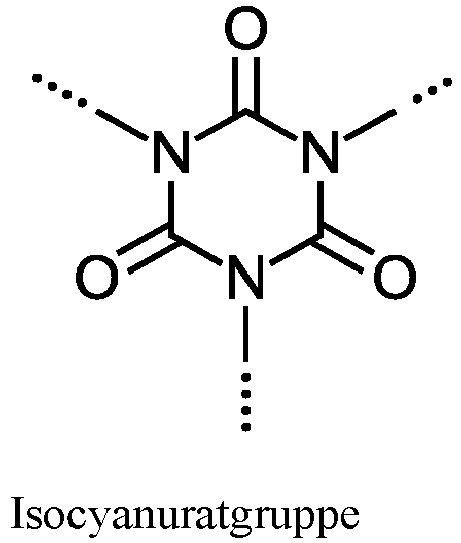
- trimer structures are understood to mean the following isocyanurate structural units which are statistically linked to one another via the pentamethylene units described above according to the oligomeric distribution:
- the indication of the content of isocyanurate trimer as a proportion by weight based on the total weight of the polyisocyanate composition refers to the compounds in the polyisocyanate composition which contain exactly one isocyanurate group and three isocyanate groups.
- the mentioned allophanate groups are preferably incorporated statistically into the oligomer distribution of the isocyanurates during the trimerization process.
- the content of isocyanurate trimer is ⁇ 56 wt.%, preferably ⁇ 51 wt.% and particularly preferably ⁇ 47 wt.% based on the total weight of the polyisocyanate composition according to the invention.
- the content of isocyanurate trimer can be determined, for example, by gel permeation chromatography according to DIN 13885-1.
- the equivalent ratio of allophanate groups to isocyanurate groups is between ⁇ 0.02 and ⁇ 0.18, preferably between ⁇ 0.05 and ⁇ 0.16, and particularly preferably between ⁇ 0.10 and ⁇ 0.15.
- the equivalent ratio of allophanate groups to isocyanurate groups can be determined, for example, by NMR spectroscopy. 13 C NMR spectroscopy, preferably proton-decoupled, is preferred, since the allophanate, isocyanurate, and/or uretdione groups yield characteristic signals.
- 13 C NMR spectroscopy preferably proton-decoupled, is preferred, since the allophanate, isocyanurate, and/or uretdione groups yield characteristic signals.
- the chemical shift of the above-mentioned compounds in the NMR spectrum is known in the literature (cf. D. Wendisch, H. Reiff and D. Dieterich, Angew. Makromol. Chem. 1986, 141, 173-183 and literature cited therein).
- a combination of the two embodiments mentioned above can be particularly advantageous if binders with an OH content ⁇ 7.0 wt.% are used as NCO-functional crosslinking agents, since in this case a particularly high compatibility is present.
- the organic radical inert towards isocyanate groups is selected from the group of linear, branched and optionally substituted radicals having 1 to 18 carbon atoms, preferably having 1 to 12 carbon atoms and particularly preferably having 1 to 8 carbon atoms.
- the organic radical is linked to the allophanate group via a primary or secondary, preferably via a primary, carbon atom.
- Suitable organic radicals are, for example, methyl, ethyl, 1-propyl, 2-propyl, n-butyl, isobutyl, sec-butyl, n-hexyl, 2-ethyl-1-hexyl, as well as the ether alcohols listed below which have been converted to an allophanate group, such as 1-methoxy-2-propanol, 3-ethyl-3-hydroxymethyl-oxetane, tetrahydrofurfuryl alcohol, ethylene glycol monomethyl ether, ethylene glycol monoethyl ether, ethylene glycol monobutyl ether, diethylene glycol monomethyl ether, diethylene glycol monoethyl ether, diethylene glycol monobutyl ether or also liquid higher molecular weight polyethylene glycol monoalkyl ethers, polypropylene glycol monoalkyl ethers, mixed polyethylene/polypropylene glycol monoalkyl ethers; Ester alcohols such as
- the polyisocyanate composition according to the invention has an isocyanate group content of between ⁇ 15% and ⁇ 25%, preferably between ⁇ 17% and ⁇ 24%, and particularly preferably between ⁇ 20% and ⁇ 23%, based on the total weight of the polyisocyanate composition according to the invention.
- This isocyanate group content can also be referred to as NCO content and can be determined, for example, by titration according to DIN EN ISO 11909:2007-05.
- the residual monomer content of 1,5-pentamethylene diisocyanate in the polyisocyanate according to the invention is below 0.5 wt. %, preferably below 0.3 wt. %, and particularly preferably below 0.1 wt. %.
- the residual monomer content of the total diisocyanates used in the polyisocyanate is below 0.5 wt. %, preferably below 0.3 wt. % and particularly preferably below 0.1 wt. %.
- the residual monomer contents are determined by gas chromatography using an internal standard in accordance with DIN EN ISO 10283:2007-11.
- the polyisocyanate according to DIN EN ISO 3219:1994-10 has a viscosity of ⁇ 36,000 mPa*s, preferably ⁇ 24,000 mPa*s, and particularly preferably ⁇ 12,000 mPa*s at 23°C.
- the dynamic viscosities were determined at 23°C and a shear rate of 250 s -1 according to DIN EN ISO 3219:1994-10 using a Physica MCR 51 rheometer from Anton Paar Germany GmbH.
- the polyisocyanate according to the invention obtainable or obtained by the process according to the invention is outstandingly suitable as a curing agent for two-component systems in which, as binders reactive towards isocyanate groups, for example hydroxy-functional compounds such as polyether polyols, polyester polyols, polycarbonate polyols and/or polyacrylate polyols are used as reactants for the polyisocyanate composition.
- binders reactive towards isocyanate groups for example hydroxy-functional compounds such as polyether polyols, polyester polyols, polycarbonate polyols and/or polyacrylate polyols are used as reactants for the polyisocyanate composition.
- the polyisocyanate composition according to the invention can also be reacted with polyamines, such as those from EP-B 0 403 921 known polyaspartic acid derivatives, or also those polyamines whose amino groups are in blocked form, such as polyketimines, polyaldimines, or oxazolanes. Under the influence of moisture, these blocked amino groups form free amino groups and, in the case of oxazolanes, also free hydroxyl groups, which react with the isocyanate groups of the polyisocyanate composition according to the invention by crosslinking.
- polyamines such as those from EP-B 0 403 921 known polyaspartic acid derivatives, or also those polyamines whose amino groups are in blocked form, such as polyketimines, polyaldimines, or oxazolanes. Under the influence of moisture, these blocked amino groups form free amino groups and, in the case of oxazolanes, also free hydroxyl groups, which react with the isocyanate groups of the polyisocyan
- a two-component system comprising component A) comprising at least one polyisocyanate according to the invention and component B) comprising at least one binder reactive toward isocyanate groups is a further subject of the invention.
- the two-component system is also referred to below as a coating composition.
- the isocyanate-reactive binder comprises at least one hydroxy-functional compound having a hydroxyl group content of ⁇ 5.0 wt. %, preferably ⁇ 7.0 wt. %, and particularly preferably ⁇ 9.0 wt. %, based on the solids content of the isocyanate-reactive binder.
- auxiliaries and additives commonly used in the coatings sector can be added to the formulated coating.
- Suitable auxiliaries and additives include, for example, flow control agents, color pigments, fillers, matting agents, inorganic or organic pigments, light stabilizers, coating additives such as dispersants, leveling agents, thickeners, defoamers and other auxiliaries, adhesives, fungicides, bactericides, stabilizers or inhibitors, catalysts, or emulsifiers.
- the binders reactive towards isocyanate groups are generally used in amounts which correspond to an equivalent ratio of isocyanate groups to isocyanate-reactive groups of 2:1 to 0.5:1, preferably of 1.5:1 to 0.8:1, particularly preferably of 1.1:1 to 0.9:1.
- the mixing of the polyisocyanate according to the invention with the binders reactive towards isocyanate groups can be carried out by simple stirring before processing the coating compositions by any method, by using mechanical aids known to the person skilled in the art or by using two-component spray guns.
- the above two-component systems can produce high-gloss, hard, and elastic coatings characterized by excellent solvent resistance even when dried at room temperature.
- these two-component systems can be dried under forced conditions at elevated temperatures or by baking at temperatures up to 260°C.
- the polyisocyanate according to the invention can also be used with the polymers known from polyurethane chemistry
- Blocking agents can be used in the sense of one-component systems. Blocking agents can generally be those found in H.-U. Meier-Westhues, Polyurethanes - Coatings, Adhesives and Sealants, Hannover Vincentz Network 2007, pages 36-43 or for example in the EP 713871 A1 described compounds can be used.
- the two-component systems according to the invention are excellently suited for producing a coating on a substrate. Therefore, a coating obtainable by using the two-component system according to the invention is a further subject of the present invention.
- the coating compositions based on the polyisocyanate of the invention can be applied to any substrate by known methods, such as spraying, brushing, flow coating, or by means of rollers or doctor blades.
- Suitable substrates include, for example, metal, wood, glass, stone, ceramic materials, concrete, rigid and flexible plastics, textiles, leather, or paper, which can optionally also be coated with conventional primers prior to coating.
- Another subject of the invention is a composite of a coating according to the invention and a substrate with a surface made of metal and/or plastic.
- the polyisocyanate according to the invention can also be used for the production of molded articles, adhesives, sealants, and cast elastomers.
- the NCO contents were determined by titration according to DIN EN ISO 11909:2007-05.
- the residual monomer content was determined by gas chromatography using an internal standard according to DIN EN ISO 10283:2007-11.
- the dynamic viscosities were determined at 23 °C and a shear rate of 250 s -1 according to DIN EN ISO 3219:1994-10 using a Physica MCR 51 rheometer from Anton Paar Germany GmbH.
- the platinum-cobalt color number was determined spectrophotometrically according to DIN EN ISO 6271-2:2005-03 using a Lange LICO 400 spectrophotometer.
- a sample of the product was diluted 50:50 with N,N-dimethylacetamide to reduce the viscosity.
- the measurement solution was filled into a cuvette and measured.
- the turbidity was determined according to DIN EN ISO 15715:2006-05.
- a reaction vessel equipped with a stirrer, reflux condenser, N2 flow tube, and internal thermometer was charged with 1000 parts by mass of 1,5-pentamethylene diisocyanate (PDI).
- PDI 1,5-pentamethylene diisocyanate
- the mixture was degassed three times at room temperature and vented with nitrogen.
- the mixture was then heated to 60 °C, and catalyst solution (N,N,N-trimethyl-N-benzylammonium hydroxide solution in methanol and 2-ethylhexanol) was added at a rate sufficient to maintain the exothermic trimerization at a temperature of 60-80 °C.
- 2-ethylhexanol 20 parts by mass of 2-ethylhexanol were added.
- the reaction was stopped with dibutyl phosphate (equimolar amount based on the trimethylbenzylammonium hydroxide used).
- a three-stage vacuum evaporation unit was used to evaporate the excess PDI from the crude reaction product.
- the three-stage unit consisted of a falling-film evaporator as the first evaporation stage, a thin-film evaporator as the second stage, and a short-path evaporator as the third stage. All evaporators were heated with direct steam and/or a pressurized water circuit.
- the evaporation unit also contained several condensers and vacuum pumps.
- each PDI-based polyisocyanate obtained was taken and analyzed to determine the starting values.
- Each sample of the PDI-based polyisocyanates was filled to the brim into 125 g aluminum bottles. The bottles were sealed, stored at a specific temperature for a defined storage time, and then analyzed.
- the turbidity values of at least 0.8 following the non-inventive temperature distillation are significantly worse than the turbidity values of the products obtainable at the distillation temperature according to the invention (E1 to E8), which were consistently below 0.3 under the storage conditions.
- the viscosity in the comparative examples increased by about 1000 mPas, while the viscosity of the products according to the invention increased only by about 600 mPas.
Landscapes
- Chemical & Material Sciences (AREA)
- Health & Medical Sciences (AREA)
- Chemical Kinetics & Catalysis (AREA)
- Medicinal Chemistry (AREA)
- Polymers & Plastics (AREA)
- Organic Chemistry (AREA)
- Polyurethanes Or Polyureas (AREA)
Abstract
Die vorliegende Erfindung betrifft ein Verfahren zur Herstellung eines Polyisocyanates auf Basis von 1,5-Pentamethylendiisocyanat, umfassend eine Umsetzung einer Isocyanatkomponente, enthaltend mindestens 1,5-Pentamethylendiisocyanat, in Gegenwart mindestens eines Katalysators und gegebenenfalls in Gegenwart eines oder mehrerer Co-Reagenzien, umfassend Alkohole, Amine, Wasser und Kohlenstoffdioxid, zu einem Roh-Polyisocyanat umgesetzt wird, dadurch gekennzeichnet, dass das Roh-Polyisocyanat in einem weiteren Schritt in einem Temperaturbereich von 155 °C bis 175 °C destilliert und in einem weiteren Schritt das Polyisocyanat auf Basis von 1,5-Pentamethylendiisocyanat erhalten wird. Weitere Gegenstände sind ein Polyisocyanat auf Basis von 1,5-Pentamethylendiisocyanat, ein Zwei-Komponenten-System, dessen Verwendung zur Herstellung einer Beschichtung auf einem Substrat, die Beschichtung und der Verbund aus der Beschichtung und dem Substrat.
Description
- Die Erfindung betrifft ein Verfahren zur Herstellung eines Polyisocyanates auf Basis von 1,5-Pentamethylendiisocyanat sowie das erhältliche Polyisocyanat. Ein weiterer Gegenstand der Erfindung ist ein, das Polyisocyanat enthaltendes, Zwei-Komponenten-System. Darüber hinaus sind dessen Verwendung zur Herstellung einer Beschichtung auf einem Substrat oder zur Herstellung eines Formkörpers oder als Klebstoff sowie der Verbund aus der Beschichtung oder dem Klebstoff und dem Substrat sowie der Formkörper weitere Gegenstände der Erfindung.
- Zwei-Komponenten Polyurethan-Beschichtungen sind seit langem bekannt. Für hochwertige lichtechte Decklacke kommen dabei besonders Beschichtungen aus aliphatischen Polyisocyanaten und Polyolen wie z. B. Polyacrylatpolyolen, Polyesterpolyolen oder Polycarbonatpolyolen zum Einsatz. Als Polyisocyanate kommen für diese hochwertigen Beschichtungen besonders monomerenarme Derivate hergestellt aus 1,6-Hexamethylendiisocyanat (im Folgenden als HDI abgekürzt) zum Einsatz. Besonders geeignet für elastische hochbeständige Beschichtungen sind dafür Isocyanurat-Polyisocyanate des HDI oder Iminooxadiazindion- und Isocyanurat-Strukturen aufweisende Polyisocyanate des HDI, wie sie z. B. in H. J. Laas, R. Halpaap, J. Pedain, J. prakt. Chem. 1994, 336, 185-200 oder in
EP 0330966 B1 oderEP 0798299 B1 beschrieben sind. Diese Polyisocyanate haben in der Regel Isocyanatfunktionalitäten (FNCO) von 3 oder mehr, wobei man unter Isocyanatfunktionalität die mittlere Zahl an NCO-Gruppen pro Molekül versteht. - Neben dem HDI ist auch 1,5-Pentamethylendiisocyanat (im Folgenden auch als 1,5-Pentandiisocyanat oder Pentamethylendiisocyanat bezeichnet oder als PDI abgekürzt) als Monomer bereits lange bekannt, wie beispielsweise von W. Siefken, Liebigs Ann. Chem. 1949, 562, Seite 122 oder in der
DE 1493360 B1 und derDE 1900514 A1 beschrieben. -
WO2016146574A1 beschreibt ein Polyisocyanat basierend auf PDI welches eine verbesserte Verträglichkeit mit hoch OH-haltigen Polyolen beschreibt. Es werden bevorzugte Destillationstemperaturen von 120 bis 180°C beschrieben, wobei in den konkreten Beispielen eine Temperatur von 140°C angelegt wird, ohne dabei auf Lagerstabilitäten der resultierenden Produkte einzugehen. -
EP2806026A1 beschreibt ein Polyisocyanat basierend auf PDI, wobei die PDI Polyisocyanat Rohlösung in Beispiel 12 über einen Dünnschichtverdampfer bei 150 °C und einem Druck von 0,093 KPa destilliert wird. -
EP2543736A1 beschreibt ein Polyisocyanat basierend auf PDI, wobei die PDI Polyisocyanat Rohlösung in Beispiel 23 über einen Dünnschichtverdampfer bei 150 °C und einem Druck von 0,093 KPa destilliert wird. -
US2018142123 beschreibt ein Polyisocyanat basierend auf PDI, wobei die Reaktionsmischung in Beispiel 1 bis 12 über einen Dünnschichtverdampfer bei 120 °C und einem Druck von 0,093 KPa destilliert wird und wobei o-Toluolsulfonamid zugegeben wird. - Bei einer verlängerten Lagerung hat sich jedoch gezeigt, dass PDI basierte Polyisocyanate aus dem Stand der Technik in ihrer Viskosität ansteigen, was sich nachteilig auf ihre Verwendung als Vernetzer in Zwei-Komponenten-Systemen auswirkt. Ebenfalls hat sich gezeigt, dass sich die Polyisocyanate auf Basis von PDI über die Lagerdauer eintrüben und somit in Klarlackanwendungen nicht mehr sinnvoll eingesetzt werden können.
- Daher war es weiterhin wünschenswert Polyisocyanate auf Basis von PDI bereitzustellen, die bei Lagerung nicht oder zumindest deutlich weniger stark in ihrer Viskosität ansteigen und eintrüben als die im Stand der Technik bekannten Produkte.
- Aufgabe der vorliegenden Erfindung war es, ein Verfahren zur Herstellung eines Polyisocyanates auf Basis von 1,5-Pentamethylendiisocyanat bereitzustellen, womit Produkte erhältlich sind, die bei Lagerung nicht oder zumindest deutlich weniger stark in ihrer Viskosität ansteigen und eintrüben.
- Diese Aufgabe wurde gelöst durch ein Verfahren zur Herstellung eines Polyisocyanates auf Basis von 1,5-Pentamethylendiisocyanat, umfassend eine Umsetzung einer Isocyanatkomponente, enthaltend mindestens 1,5-Pentamethylendiisocyanat, in Gegenwart mindestens eines Katalysators und gegebenenfalls in Gegenwart eines oder mehrerer Co-Reagenzien, umfassend Alkohole, Amine, Wasser und Kohlenstoffdioxid, zu einem Roh-Polyisocyanat umgesetzt wird, dadurch gekennzeichnet, dass das Roh-Polyisocyanat in einem weiteren Schritt in einem Temperaturbereich von 155 °C bis 175 °C destilliert und in einem weiteren Schritt das Polyisocyanat auf Basis von 1,5-Pentamethylendiisocyanat erhalten wird.
- Überraschenderweise wurde gefunden, dass durch Anpassung des Temperaturbereichs während der Destillation des Roh-Polyisocyanats im Wesentlichen zur Entfernung des, bei der Polymerisation notwendigen Monomer Überschusses, eine signifikant bessere Lagerstabilität bezgl. der Viskosität und Trübung erreichen lässt. Als besonders zielführend hat sich ein Temperaturfenster von mindestens 155 °C und höchstens 175°C erwiesen. Unterhalb der 155 °C ist die Lagerstabilität hinsichtlich Viskosität und Trübung signifikant schlechter während bei Temperaturen oberhalb von 175°C zum einen die Energieeffizienz des Produktionsprozesses leidet und zum anderen die Produktqualität bzw. die Prozesssicherheit aufgrund von unerwünschten Nebenreaktion nicht mehr im optimalen Bereich liegt.
- Insbesondere sind die Ergebnisse überraschend, da generell anzunehmen war, dass eine möglichst niedrige Destillationstemperatur des Roh-Polyisocyanats und die damit verbundene Vermeidung störender Zersetzungsreaktionen für möglichst trübungsfreie, farbhelle und viskositätsstabile Produkte wichtig sei.
- Vorliegend ist der Begriff "destilliert" in dem Satz "dass das Roh-Polyisocyanat in einem weiteren Schritt in einem Temperaturbereich von 155 °C bis 175 °C destilliert wird" so zu verstehen, dass im Wesentlichen das überschüssige 1,5-Pentamethylendiisocyanat aus dem Roh-Polyisocyanat verdampft wird, während das Polyisocyanat auf Basis von 1,5-Pentamethylendiisocyanat weitestgehend in der flüssigen Phase verbleibt.
- Bevorzugt bedeuten erfindungsgemäß die Ausdrücke "umfassend" oder "enthaltend", "im Wesentlichen bestehend aus" und besonders bevorzugt "bestehend aus". Die in den Patentansprüchen und in der Beschreibung genannten weiteren Ausführungsformen können beliebig kombiniert werden, sofern sich aus dem Kontext nicht eindeutig das Gegenteil ergibt.
- "Mindestens ein", wie hierin verwendet, bezieht sich auf 1 oder mehr, beispielsweise 2, 3, 4, 5, 6, 7, 8, 9 oder mehr. Im Zusammenhang mit Bestandteilen der hierin beschriebenen Verbindungen bezieht sich diese Angabe nicht auf die absolute Menge an Molekülen, sondern auf die Art des Bestandteils. "mindestens eines Katalysators" bedeutet daher beispielsweise, dass nur eine Art von Katalysatoren oder mehrere verschiedene Arten von Katalysatoren, ohne Angaben über die Menge der einzelnen Verbindungen zu machen, enthalten sein können.
- Zahlenwerte, die hierin ohne Dezimalstellen angegeben sind, beziehen sich jeweils auf den vollen angegebenen Wert mit einer Dezimalstelle. So steht beispielsweise "99 %" für "99,0 %".
- Numerische Bereiche, die in dem Format "in/von x bis y" angegeben sind, schließen die genannten Werte ein. Wenn mehrere bevorzugte numerische Bereiche in diesem Format angegeben sind, ist es selbstverständlich, dass alle Bereiche, die durch die Kombination der verschiedenen Endpunkte entstehen, ebenfalls erfasst werden.
- Für den Fall, dass die Gruppen oder Verbindungen als "gegebenenfalls substituiert" oder "substituiert" offenbart werden, sind geeignete Substituenten -F, -Cl, -Br, -I, -OCH3, OCH2CH3, - O-Isopropyl oder -O-n-Propyl, -OCF3, -CF3, -S-C1-6-Alkyl und/oder (gegebenenfalls über ein angehängtes Heteroatom) eine lineare oder verzweigte, aliphatische und/oder alicyclische Struktureinheit mit 1 bis 12 Kohlenstoffatomen, die jeweils als Ersatz für ein kohlenstoffgebundenes Wasserstoffatom des betreffenden Moleküls fungiert. Bevorzugte Substituenten sind Halogen (insbesondere -F, -Cl), C1-C6-Alkoxy (insbesondere Methoxy und Ethoxy), Trifluormethyl und Trifluormethoxy, die jeweils als Ersatz für ein an Kohlenstoff gebundenes Wasserstoffatom des betreffenden Moleküls fungieren.
- Im erfindungsgemäßen Verfahren enthält die Isocyanatkomponente wenigstens 1,5-Pentamethylendiisocyanat, welche in Anwesenheit eines Katalysators sowie vorzugsweise mit wenigstens einem linearen, verzweigten und gegebenenfalls substituierten, in der Seitenkette gegenüber Isocyanatgruppen inerten Monoalkohol vermischt wird und zu dem Polyisocyanat auf Basis von 1,5-Pentamethylendiisocyanat umgesetzt wird. Vorzugsweise wird vorher, gleichzeitig und/oder nachher mit wenigstens einem linearen, verzweigten und gegebenenfalls substituierten, in der Seitenkette gegenüber Isocyanatgruppen inerten Monoalkohol zugemischt.
- Gegebenenfalls können bei der Herstellung des Polyisocyanates neben 1,5-Pentamethylendiisocyanat weitere Diisocyanate mit aliphatisch, cycloaliphatisch, araliphatisch und/oder aromatisch gebundenen Isocyanatgruppen mitverwendet werden. Hierbei handelt es sich insbesondere um solche des Molekulargewichtsbereichs 140 bis 400, wie z. B. 1,4-Diisocyanatobutan, 1,6-Diisocyanatohexan (HDI), 2-Methyl-1,5-diisocyanatopentan, 1,5-Diisocyanato-2,2-dimethylpentan, 2,2,4- bzw. 2,4,4-Trimethyl-1,6-diisocyanatohexan, 1,10-Diisocyanatodecan, 1,3- und 1,4-Diisocyanatocyclohexan, 2,4- und 2,6-Diisocyanato-1-methylcyclohexan, 1,3- und 1,4-Bis-(isocyanatomethyl)-cyclohexan, 1-Isocyanato-3,3,5-trimethyl-5-isocyanatomethylcyclohexan (Isophorondiisocyanat, IPDI), 4,4'-Diisocyana-todicyclohexylmethan, 2,4'-Diisocyanatodicyclohexylmethan, 1-Isocyanato-1-methyl-4(3)isocyanato-methylcyclohexan, Bis-(isocyanatomethyl)-norbornan, 1,3- und 1,4-Bis(isocyanatomethyl)benzol (XDI), 1,3- und 1,4-Bis-(2-isocyanato-prop-2-yl)-benzol (TMXDI), 2,4- und 2,6-Diisocyanatotoluol (TDI), 2,4'- und 4,4'-Diisocyanatodiphenylmethan (MDI), 1,5-Diisocyanatonaphthalin oder beliebige Gemische solcher Diisocyanate.
- Diese bei der Herstellung des Polyisocyanates gegebenenfalls mitzuverwendenden Diisocyanate sind beispielsweise ebenfalls durch Phosgenierung in der Flüssig- oder Gasphase erhältlich und kommen, falls überhaupt, in Mengen von bis zu 80 Gew.-%, vorzugsweise bis zu 50 Gew.-%, besonders bevorzugt bis zu 20 Gew.-% und besonders bevorzugt von 0 bis 4 Gew.-%, bezogen auf die Gesamtmenge an eingesetzten Diisocyanaten, zum Einsatz. Besonders bevorzugt enthält die Isocyanatkomponente nur PDI als Diisocyanat.
- In einer bevorzugten Ausführungsform kann die Isocyanatkomponente zur Durchführung des erfindungsgemäßen Verfahrens, gegebenenfalls unter Inertgas, wie beispielsweise Stickstoff, und gegebenenfalls in Gegenwart eines Lösungsmittels bei einer Temperatur zwischen 0 und 180 °C, vorzugsweise 20 bis 140 °C, besonders bevorzugt 40 bis 100 °C vorgelegt werden.
- Nach dem Vorlegen der Isocyanatkomponente kann der Katalysator bzw. eine Mischung des Katalysators mit einem geeigneten Katalysatorlösungsmittel in der nachstehend angegebenen Menge zugegeben werden. Die Zugabe des Katalysators kann dabei in einer oder mehreren Portionen oder auch kontinuierlich, z. B. mit Hilfe einer geeigneten Dosierpumpe, über die gesamte Dauer der Umsetzung erfolgen.
- Die im erfindungsgemäßen Verfahren gegebenenfalls anwesenden ein oder mehrere Co-Reagenzien umfassen Alkohole, Amine, Wasser und Kohlenstoffdioxid und sind vorzugsweise lineare, verzweigte und gegebenenfalls substituierte, in der Seitenkette gegenüber Isocyanatgruppen inerte Monoalkohole, besonders bevorzugt sind Monoalkohole, die 1 bis 18 Kohlenstoffatome, bevorzugt 1 bis 12 Kohlenstoffatome und besonders bevorzugt mit 1 bis 8 Kohlenstoffatome aufweisen.
- Besonders bevorzugt ist es, dass die Alkohole primäre oder sekundäre Monoalkohole, ganz besonders bevorzugt primäre Monoalkohole sind. Alternativ und weiter bevorzugt sind Monoalkohole, die 1 bis 18 Kohlenstoffatome, bevorzugt 1 bis 12 Kohlenstoffatome und besonders bevorzugt mit 1 bis 8 Kohlenstoffatome aufweisen.
- Geeignete Monoalkohole für das erfindungsgemäße Verfahren sind beispielsweise Methanol, Ethanol, n-Propanol, Isopropanol, n-Butanol, sec-Butanol, iso-Butanol, n-Hexanol, 2-Ethyl-1-hexanol Etheralkohole, wie z. B. 1-Methoxy-2-propanol, 3-Ethyl-3-hydroxymethyloxetan, Tetrahydrofurfurylalkohol, Ethylengylkol-monomethylether, Ethylenglykolmonoethylether, Ethylenglykolmonobutylether, Diethylenglykolmonomethylether, Diethylenglykolmonoethylether, Diethylenglykolmono-butylether oder auch flüssige höhermolekulare Polyethylenglykolmonoalkylether, Polypropylenglykolmonoalkylether, gemischte Polyethylen/polypropylenglykolmonoalkylether; Esteralkohole, wie z. B. Ethylen-glykolmonoacetat, Propylen-glykolmonolaurat, Glycerindiacetat, 2,2,4-Trimethyl-1,3-pentandiol-monoisobutyrat; ungesättigte Alkohole wie z. B. Allylalkohol, 1,1-Dimethyl-allylalkohol oder Oleinalkohol; araliphatische Alkohole wie z. B. Benzylalkohol.
- Die Temperaturen zur Durchführung des erfindungsgemäßen Verfahrens können in Abhängigkeit von den eingesetzten Verbindungen ausgewählt werden. Bevorzugt ist hierbei jedoch, wenn die Umsetzung bei Temperaturen zwischen ≥ 0 und ≤ 180 °C, vorzugsweise ≥ 20 bis ≤ 140 °C, besonders bevorzugt ≥ 40 bis ≤ 100 °C durchgeführt wird.
- Das im erfindungsgemäßen Verfahren mindestens eingesetzte 1,5-Pentamethylendiisocyanat kann nach beliebigen im Stand der Technik bekannten Verfahren zur Herstellung aliphatischer Diisocyanate generiert werden, beispielsweise mit oder ohne Verwendung von Phosgen und ausgehend von, vorzugsweise biotechnologisch durch Decarboxylierung der natürlich vorkommenden Aminosäure Lysin erhaltenem, 1,5-Diaminopentan. Bei Verwendung von Phosgen kann die Phosgenierung von 1,5-Diaminopentan in der Flüssig- oder Gasphase erfolgen.
- Hierbei ist es für das erfindungsgemäße Verfahren besonders bevorzugt, wenn 1,5-Diisocyanatopentan durch Phosgenierung von 1,5-Diaminopentan in der Gasphase erhalten wird. Die Phosgenierung von Aminen in der Gasphase an sich ist bekannt und kann beispielsweise, wie in
EP 0 289 840 B1 ,EP 1 319 655 A2 ,EP 1 555 258 A1 ,EP 1 275 639 A1 ,EP 1 275 640 A1 ,EP 1 449 826 A1 ,EP 1 754 698 B1 ,DE 10 359 627 A1 oder in der deutschen PatentanmeldungDE 10 2005 042392 A1 beschrieben, erfolgen. Besonders bevorzugt stammt das 1,5-Diaminopentan aus biobasierter Quelle und wird vorzugsweise biotechnologisch, z.B. durch Fermentation von geeigneter Biomasse erhalten. - Die Art des Trimerisierungskatalysators spielt für die Durchführung des erfindungsgemäßen Verfahrens insofern eine Rolle, als sie die Produktselektivität hinsichtlich der Bildung von überwiegend Allophanat- und Isocyanurat-gruppen enthaltenden Produkten beeinflussen kann.
- Als Katalysatoren für die Modifizierung von Isocyanaten haben sich eine Reihe von Verbindungen bewährt, wie beispielsweise in H. J. Laas et al., J. Prakt. Chem. 1994, 336, 185 ff, D. Dieterich Methoden der organischen Chemie (Houben-Weyl), Band E 20 1987, 1741 ff,
EP 0649866 A1 (Seite 4, Zeile 7 bis Seite 5, Zeile 15) oder derEP 0896009 A1 (Seite 4, Zeile 17 bis 58) beschrieben. - Geeignete Katalysatoren sind beispielsweise quaternäre Ammoniumcarboxylate, wie z. B. N-(2-Hydroxypropyl)-N,N,N-trimethylammonium-2-ethylhexanoat, N-(2-Hydroxypropyl)-N,N,N-trimethylammonium-2-formiat, N,N,N-Tetramethylammoniumoctoat, quaternäre Ammoniumhydroxide, wie z. B. Tetramethyl-, Tetraethyl-, Trimethylstearyl- und Dimethylethylcyclohexylammoniumhydroxid, N,N,N-Trimethyl-N-(2-hydroxyethyl)-ammoniumhydroxid, N,N,N-Trimethyl-N-(2-hydroxypropyl)-ammoniumhydroxid, N,N,N-Trimethyl-(2-hydroxybutyl)-ammoniumhydroxid, N,N-Dimethyl-n-dodecyl-N-(2-hydroxyethyl)-ammoniumhydroxid, N-(2-Hydroxyethyl)-N,N-dimethyl-N-(2,2'-dihydroxymethylbutyl)-ammoniumhydroxid, N-Methyl-2-hydroxyethyl-morpholiniumhydroxid, N-Methyl-N-(2-hydroxypropyl)-pyrrolidiniumhydroxid, N-Dodecyl-tris-N-(2-hydroxyethyl)-ammoniumhydroxid, Tetra-(2-hydroxyethyl)-ammoniumhydroxid, N,N,N-Trimethyl-N-benzylammoniumhydroxid, oder quaternäre Ammonium- und Phosphoniumhydrogenpolyfluoride, wie z. B. Tetrabutylphosphoniumhydrogendifluorid. Ganz besonders bevorzugte Katalysatoren dieser Gruppe sind N,N,N-Trimethyl-N-(2-hydroxyethyl)-ammoniumhydroxid, N,N,N-Trimethyl-N-(2-hydroxypropyl)-ammoniumhydroxid, N,N,N-Trimethyl-N-(2-hydroxybutyl)-ammoniumhydroxid und insbesondere N,N,N-Trimethyl-N-benzylammoniumhydroxid.
- Ebenfalls geeignete Katalysatoren sind beispielsweise Hexamethyldisilazan, Heptamethyldisilazan, Diethyl-1,3-tetramethyl-1,1,3,3-disilazan, Divinyl-1,3-tetramethyl-1,1,3,3-disilazan, Hexaethyldisilazan und Diphenyl-1,3-tetramethyl-1,1,3,3-disilazan. Aus dieser Gruppe ist Hexamethyldisilazan bevorzugt.
- Geeignete Mengen des Katalysators können beispielsweise bis zu 0,25 Gew.-%, bevorzugt bis zu 0,1 Gew.-% und besonders bevorzugt bis 0,05 Gew.-% sein.
- Bevorzugt kommen beim erfindungsgemäßen Verfahren Katalysatorlösungsmittel zum Einsatz, die gegenüber Isocyanaten reaktive Gruppen tragen und in das Polyisocyanat eingebaut werden können. Beispiele für solche Lösungsmittel sind einfache Alkohole, wie z. B. Methanol, Ethanol, n-Propanol, Isopropanol, n-Butanol, sec-Butanol, iso-Butanol, n-Hexanol, 2-Ethyl-1-hexanol; Etheralkohole, wie z. B. 1-Methoxy-2-propanol, 3-Ethyl-3-hydroxymethyloxetan, Tetrahydrofurfurylalkohol, Ethylengylkol-monomethylether, Ethylenglykolmonoethylether, Ethylenglykolmonobutylether, Diethylenglykolmonomethylether, Diethylenglykolmonothylether, Diethylenglykolmono-butylether oder auch flüssige höhermolekulare Polyethylenglykolmonoalkylether, Polypropylenglykolmonoalkylether, gemischte Polyethylen/polypropylenglykolmonoalkylether; Esteralkohole, wie z. B. Ethylen-glykolmonoacetat, Propylen-glykolmonolaurat, Glycerindiacetat, 2,2,4-Trimethyl-1,3-pentandiol-monoisobutyrat, ungesättigte Alkohole wie z. B. Allylalkohol, 1,1-Dimethyl-allylalkohol oder Oleinalkohol; araliphatische Alkohole wie z. B. Benzylalkohol; N-monosubstituierte Amide, wie z. B. N-Methylformamid, N-Methylacetamid, Cyanacetamid oder 2-Pyrrolidinon oder beliebige Gemische derartiger Lösungsmittel.
- Ganz besonders bevorzugt ist hierbei, wenn der Katalysator in dem entsprechenden Monoalkohol oder Monoalkoholgemisch gelöst eingesetzt wird, der für die Bildung der Allophanatgruppen gewünscht ist. In solchen Fällen entspricht das Katalysatorlösungsmittel dann den oben genannten Monoalkoholen. Die Reihenfolge der Zugabe der umzusetzenden Komponenten beliebig wählbar. Für den Fall, dass ein gelöster Katalysator eingesetzt wird, kann die Menge des Lösungsmittels so gewählt werden, um ein bestimmtes Äquivalentverhältnis der Allophanatgruppen zu den Isocyanuratgruppen einstellen zu können.
- Verwendet man stark verdünnte Katalysatorlösungen in gegenüber Isocyanaten reaktiven Katalysatorlösungsmitteln kommt ein Problem hinzu: die bestimmungsgemäße (Haupt-)Reaktion, die Isocyanatmodifizierung, kann zwar durch frühzeitigeren Abbruch der Reaktion bei niedrigeren Umsatzstufen terminiert werden, die Reaktion des Katalysatorlösungsmittels mit den freien Isocyanatgruppen aller im Reaktionsgemisch vorliegender Spezies hingegen nicht, sie läuft immer mindestens bis zur Stufe des Urethans (Carbamates) ab, wobei aber in der Regel erwünscht ist, den Umsatz des Alkohols bis zur Stufe des Allophanates zu führen, was die Gegenwart des aktiven Trimerisierungskatalysators, der im beanspruchten Fall auch für die Allophanatbildung geeignet und erforderlich ist, bedingt. Allophanatgruppen sind gegenüber den aus gleichen Bausteinen aufgebauten Urethanen besser im Polyisocyanat löslich als die entsprechenden Urethane und weisen - zumindest im Fall der Produkte auf Basis monofunktioneller Alkohole - eine gegenüber den Trimeren deutlich niedrigere Viskosität auf. Prinzipiell nachteilig ist hingegen, dass die aus monofunktionellen Alkoholen und Diisocyanaten aufgebauten Allophanatgruppen nur NCOdifunktionell sind und somit die (mittlere) NCO-Funktionalität der Polyisocyanate erniedrigen.
- Unter einem Reaktionsgemisch wird im Folgenden eine Mischung von 1,5-Pentamethylendiisocyanat, des Katalysators, des Monoalkohols oder der Monoalkohole sowie gegebenenfalls weiterer Einsatzstoffe und der gebildeten Polyisocyanate verstanden.
- In einer weiteren bevorzugten Ausführungsform wird der Verlauf der Umsetzung beim erfindungsgemäßen Verfahren über die Abnahme des NCO-Gehaltes in der Reaktionsmischung verfolgt. Der Gehalt an Isocyanatgruppen in der Reaktionsmischung kann, ebenso wie der Gehalt an Isocyanatgruppen der nach dem erfindungsgemäßen Verfahren erhaltenen Polyisocyanatzusammensetzung, z. B. titrimetrisch gemäß DIN EN ISO 11 909 bestimmt werden.
- Gemäß einer weiteren bevorzugten Ausführungsform wird die Umsetzung so weit geführt, dass das Reaktionsgemisch einen Oligomerisierungsgrad von 10 bis 40%, vorzugsweise von 15 bis 30% aufweist. Vorliegend ist unter "Oligomerisierungsgrad" der Prozentsatz, der in der Ausgangsmischung ursprünglich vorhandenen Isocyanatgruppen zu verstehen, der während der erfindungsgemäßen Umsetzung verbraucht wird. Der Oligomerisierungsgrad in Prozent kann nach folgender Formel berechnet werden:

- Die Umsetzung kann z. B. nach Erreichen des angestrebten Oligomerisierungsgrades abgebrochen werden. Dieser Oligomerisierungsgrad wird im allgemeinen nach einer Reaktionszeit von 30 Minuten bis 8 Stunden, vorzugsweise von 1 bis 6 Stunden erreicht.
- Ein Abbruch der Umsetzung kann beispielsweise durch Abkühlen des Reaktionsgemisches auf Raumtemperatur erfolgen. Im Allgemeinen wird die Umsetzung aber durch Zugabe eines Katalysatorgiftes und gegebenenfalls nachfolgendes kurzzeitiges Erhitzen der Reaktionsmischung beispielsweise auf eine oberhalb 80 °C liegende Temperatur beendet.
- Geeignete Katalysatorgifte sind beispielsweise anorganische Säuren wie Salzsäure, phosphorige Säure oder Phosphorsäure, Säurechloride wie Acetylchlorid, Benzoylchlorid oder Isophthaloyldichlorid, Sulfonsäuren und Sulfonsäureester, wie Methansulfonsäure, p-Toluol-sulfonsäure, Trifluormethansulfonsäure, Perfluorbutansulfonsäure, Dodecylbenzolsulfon-säure, p-Toluolsulfonsäuremethylester und -ethylester, Mono- und Dialkylphosphate wie Monotridecylphosphat, Dibutylphosphat und Dioctylphosphat aber auch silylierte Säuren, wie Methansulfonsäuretrimethylsilylester, Trifluormethansulfonsäuretrimethylsilylester, Phosphorsäure-tris-(trimethylsilylester) und Phosphorsäurediethylester-trimethylsilylester.
- Die zur Beendigung der Umsetzung benötigte Menge des Katalysatorgiftes richtet sich dabei nach der Menge des verwendeten Katalysators; im Allgemeinen wird eine äquivalente Menge des Katalysatorgiftes, bezogen auf den zu Beginn eingesetzten Katalysator, eingesetzt. Berücksichtigt man allerdings eventuell während der Umsetzung auftretende Verluste an Katalysator, so können zur Beendigung der Umsetzung auch schon 20 bis 80 Äquivalent-% des Katalysatorgiftes, bezogen auf die Menge des ursprünglich eingesetzten Katalysators, ausreichen.
- Die genannten Katalysatorgifte können sowohl in Substanz als auch in einem geeigneten Lösungsmittel gelöst eingesetzt werden. Falls ein Lösungsmittel zur Lösung des Katalysatorgiftes zum Einsatz kommt, wird bevorzugt 1,5-Pentandiisocyanat eingesetzt. Der Verdünnungsgrad kann innerhalb eines sehr breiten Bereichs frei gewählt werden, geeignet sind beispielsweise Lösungen ab einer Konzentration von ≥ 25 Gew.-%, bevorzugt ≥ 10 Gew.-%.
- Das nach der Reaktion erhaltene Reaktionsgemisch wird vorliegend als Roh-Polyisocyanat bezeichnet. Erfindungswesentlich für das vorliegende Verfahren ist es, dass das Roh-Polyisocyanat auf Basis von 1,5-Pentamethylendiisocyanat in einem weiteren Schritt in einem Temperaturbereich von 155 °C bis 175 °C, bevorzugt 160 °C bis 175 °C und besonders bevorzugt 162 °C bis 173 °C, destilliert und in einem weiteren Schritt das Polyisocyanat auf Basis von 1,5-Pentamethylendiisocyanat erhalten wird.
- Die Destillation dient in erster Linie dazu, das Roh-Polyisocyanat von flüchtigen Bestandteilen (überschüssigen monomeren Isocyanatkomponenten und gegebenenfalls mitverwendeten Lösungsmitteln) zu befreien. Vorzugsweise erfolgt die Destillation mittels Fallfilmverdampfer oder Dünnschichtdestillation und besonders bevorzugt mittels Fallfilmverdampfer, bevorzugt im Vakuum, wobei in der letzten Verdampferstufe bevorzugt ein Druck von unter 1,0 mbar, vorzugsweise unter 0,25 mbar, besonders bevorzugt unter 0,1 mbar herrscht. Im Produktionsmaßstab erfolgt die Destillation vorzugsweise mehrstufig, mit Drücken von unter 30 mbar in den ersten Stufen, bevorzugt unter 20 mbar, besonders bevorzugt unter 10 mbar und einem Druck von unter 1mbar, vorzugsweise unter 0,25 mbar, besonders bevorzugt unter 0,1 mbar in der letzten Verdampferstufe.
- Im erfindungswesentlichen Schritt herrschen dabei Temperaturen von 155 °C bis 175 °C, bevorzugt 160 °C bis 175 °C und besonders bevorzugt 162 °C bis 173 °C, wobei die weiteren Destillationsbedingungen variiert werden können. In den optionalen oder bevorzugten mehreren Verdampferstufen und/oder weiteren optionalen Destillationsschritten können die Destillationsbedingungen, auch die Destillationstemperaturen, beliebig variiert werden. Es ist möglich verschiedene oder mehrfach dieselbe Destillationsmethode wie Dünnschichtdestillation, Fallfilmverdampfer oder Kurzwegdestillation zu verwenden. Bevorzugt wird der erfindungswesentliche Destillationsschritt bei Temperaturen von 155 °C bis 175 °C, bevorzugt 160 °C bis 175 °C und besonders bevorzugt 162 °C bis 173 °C und in einem Fallfilmverdampfer oder Dünnschichtdestillation und besonders bevorzugt mittels Fallfilmverdampfer durchgeführt.
- Die Ausgestaltung der Verdampferstufen, Verdampfungseinheiten und Destillationsapparate für die möglichen Destillationsmethoden kann beliebig gewählt werden. Es kann von Vorteil sein, diese mit Direktdampf und/oder einem Druckwasserkreislauf zu beheizen. Zudem enthalten die Verdampfungseinheiten vorzugsweise mehrere Kondensatoren und Vakuumpumpen. In einer bevorzugten Ausführungsform umfasst oder besteht das Destillationssetup aus drei Verdampferstufen und besonders bevorzugt umfasst oder besteht es aus einem Fallfilmverdampfer als erste Verdampfungsstufe, einem Dünnschichtverdampfer oder Fallfilmverdampfer als zweite Verdampferstufe und einem Kurzwegverdampfer als dritte Verdampferstufe.
- In einem weiteren Schritt des erfindungsgemäßen Verfahrens wird das Polyisocyanat auf Basis von 1,5-Pentamethylendiisocyanat erhalten. Dieser Schritt kann beispielsweise der bloße Erhalt des Polyisocyanates auf Basis von 1,5-Pentamethylendiisocyanat sein oder z.B. eine Konfektionierung des Produkts, eine Abfüllung des Produkts oder auch weitere Destillationsschritte umfassen oder daraus bestehen. Der Schritt kann sich unmittelbar an den erfindungswesentlichen Schritt anschließen oder es können ein oder mehrere Schritte dazwischen liegen, wie z.B. eine oder mehrere der vorstehend genannte weiteren Destillationsschritte bei anderen Temperaturen. Ebenso ist es möglich, dass vor dem erfindungsgemäßen Destillationsschritt andere Schritte wie beispielsweise weitere Destillationsschritte folgen.
- Durch die überraschenderweise gefundenen vorteilhaften Auswirkungen der speziellen Temperaturbereiche bei der Destillation des Roh-Produkts ergibt sich eine besonders gute Viskositätsstabilität und Trübungsfreiheit über einen langen Lagerungszeitraum. Daher unterscheidet sich das mit dem erfindungsgemäßen Verfahren erhältliche oder hergestellte Polyisocyanat auf Basis von 1,5-Pentamethylendiisocyanat strukturell und in seiner Zusammensetzung von den bisherigen Polyisocyanaten auf Basis von 1,5-Pentamethylendiisocyanat und stellt einen weiteren Gegenstand der vorliegenden Erfindung dar. Ohne an wissenschaftliche Theorien gebunden zu sein vermuten die Erfinderinnen und Erfinder, dass sich mit dem erfindungsgemäßen Verfahren auch die alpha-Nylon Gehalte in den erhältlichen und hergestellten Verfahrensprodukten verringern bzw. die Neigung zur Bildung von alpha-Nylon während der Herstellung aber auch in der anschließenden Lagerung reduziert wird.
- Vorliegend ist unter dem Begriff "langem Lagerungszeitraum" eine Dauer von 8 Wochen bei 50 °C oder von 6 Monaten bei Raumtemperatur (20-30 °C) zu verstehen.
- Besonders bevorzugt umfasst das Polyisocyanat auf Basis von 1.5, wenigstens eine Isocyanatgruppen aufweisende Verbindung mit wenigstens einer 1,5- verbrückenden Pentamethyleneinheit und einer Isocyanuratgruppe, wobei ein Teil der Verbindungen bevorzugt zusätzlich noch wenigstens eine Allophanatgruppe aufweist, dadurch gekennzeichnet, dass die Polyisocyanatzusammensetzung einen Gehalt an Isocyanurattrimer von ≤ 59 Gew.-% bezogen auf das Gesamtgewicht der Polyisocyanatzusammensetzung aufweist, die Allophanatgruppen einen gegenüber Isocyanatgruppen inerten, organischen Rest tragen und die Allophanatgruppen zu den Isocyanuratgruppen in einem Äquivalentverhältnis von > 0 und ≤ 0,19 vorliegen.
- Vorliegend werden unter 1,5- verbrückenden Pentamethyleneinheiten Struktureinheiten verstanden, die aus linearen Pentamethyleneinheiten (-CH2CH2CH2CH2CH2-) bestehen, die an Position 1 mit dem Stickstoffatom einer Isocyanatgruppe, dem Stickstoffatom einer Isocyanuratgruppe oder dem Stickstoffatom einer Allophanatgruppe, die einen gegenüber Isocyanatgruppen inerten, organischen Rest trägt, und an Position 5 mit dem Stickstoffatom einer Isocyanuratgruppe oder dem Stickstoffatom einer Allophanatgruppe, die einen gegenüber Isocyanatgruppen inerten, organischen Rest trägt, verbunden sind. Hierbei kann die Bezeichnung der Positionen 1 und 5 auch getauscht werden.
- Im Rahmen der vorliegenden Erfindung werden unter Trimerstrukturen folgende Isocyanuratstruktureinheiten verstanden, die über die oben beschriebenen Pentamethyleneinheiten gemäß der oligomeren Verteilung statistisch miteinander verknüpft sind:
- Die Angabe des Gehalts an Isocyanurattrimer als Gewichtsanteil bezogen auf das Gesamtgewicht der Polyisocyanatzusammensetzung bezieht sich erfindungsgemäß auf die Verbindungen in der Polyisocyanatzusammensetzung, die genau eine Isocyanuratgruppe und drei Isocyanatgruppen enthalten.
- Vorliegend werden unter Allophanatgruppen folgende Struktureinheiten verstanden:

- Die genannten Allophanatgruppen werden vorzugsweise während des Trimerisierungsprozesses statistisch mit in die Oligomerenverteilung der Isocyanurate eingebaut.
- In einer weiteren bevorzugten Ausführungsform ist der Gehalt an Isocyanurattrimer ≤ 56 Gew.-%, bevorzugt ≤ 51 Gew.-% und besonders bevorzugt ≤ 47 Gew.-% bezogen auf das Gesamtgewicht der erfindungsgemäßen Polyisocyanatzusammensetzung.
- Der Gehalt an Isocyanurattrimer lässt sich beispielsweise durch Gelpermeations-Chormatographie nach der DIN 13885-1- bestimmen.
- Gemäß einer weiteren bevorzugten Ausführungsform liegt das Äquivalentverhältnis der Allophanatgruppen zu den Isocyanuratgruppen zwischen ≥ 0,02 und ≤ 0,18, bevorzugt zwischen ≥ 0,05 und ≤ 0,16 und besonders bevorzugt zwischen ≥ 0,10 und ≤ 0,15. Hieraus ergibt sich unter anderem der Vorteil, dass die Ressourcen-Effizienz gegenüber einem reinen Allophanat weiter gesteigert werden kann, was das grundsätzliche Bestreben nach einer ökonomisch und ökologisch optimierten Formulierung unterstützt. Im Vergleich zu reinen Polyisocyanuraten sinkt mit steigendem Allophanatgruppenanteil der Gehalt an reaktiven NCO-Gruppen, wodurch sich die Menge an einzusetzendem Härter gegenüber dem Bindemittel erhöht, was wiederum eine Erhöhung der Lösungsmittelmenge erfordert.
- Das Äquivalentverhältnis von Allophanatgruppen zu den Isocyanuratgruppen kann z. B. durch eine NMR-spektroskopische Untersuchung bestimmt werden. Bevorzugt lässt sich hierbei die 13C-NMR-Spektroskopie, vorzugsweise protonenentkoppelt, einsetzen, da die Allophanat-, Isocyanurat- und/oder Uretdiongruppen charakteristische Signale liefern. Die chemische Verschiebung der oben genannten Verbindungen im NMR-Spektrum ist in der Literatur bekannt (vgl. D. Wendisch, H. Reiff und D. Dieterich, Angew. Makromol. Chem. 1986, 141, 173-183 und darin zitierte Literatur).
- Eine Kombination der beiden vorstehend genannten Ausführungsformen kann besonders vorteilhaft sein, wenn Bindemittel mit einem OH-Gehalt ≥ 7,0 Gew.-% als NCO-funktionelle Vernetzungsmittel zum Einsatz kommen, da hier eine besonders hohe Verträglichkeit vorliegt.
- In einer weiteren bevorzugten Ausführungsform wird der gegenüber Isocyanatgruppen inerte organische Rest aus der Gruppe linearer, verzweigter und gegebenenfalls substituierter Reste mit 1 bis 18 Kohlenstoffatomen, bevorzugt mit 1 bis 12 Kohlenstoffatomen und besonders bevorzugt mit 1 bis 8 Kohlenstoffatomen ausgewählt.
- In Bezug auf die erfindungsgemäße Polyisocyanatzusammensetzung ist es ebenfalls bevorzugt, wenn der organische Rest über ein primäres oder sekundäres, bevorzugt über ein primäres Kohlenstoffatom mit der Allophanatgruppe verbunden ist.
- Geeignete organische Reste sind beispielsweise Methyl-, Ethyl-, 1-Propyl-, 2-Propyl-, n-Butyl-, isoButyl-, sec-Butyl-, n-Hexyl-, 2-Ethyl-1-hexyl-, sowie die zu einer Allophanatgruppe umgesetzten nachstehend genannten Etheralkohole, wie z. B. 1-Methoxy-2-propanol, 3-Ethyl-3-hydroxymethyl-oxetan, Tetrahydrofurfurylalkohol, Ethylengylkol-monomethylether, Ethylenglykolmonoethylether, Ethylenglykolmonobutylether, Diethylenglykolmonomethylether, Diethylenglykolmonoethylether, Diethylenglykolmonobutylether oder auch flüssige höhermolekulare Polyethylenglykolmonoalkylether, Polypropylenglykolmonoalkylether, gemischte Polyethylen/polypropylenglykolmonoalkylether; Esteralkohole, wie z. B. Ethylen-glykolmonoacetat, Propylen-glykolmonolaurat, Glycerindiacetat, 2,2,4-Trimethyl-1,3-pentandiol-monoisobutyrat, ungesättigte Alkohole wie z. B. Allylalkohol, 1,1-Dimethyl-allylalkohol oder Oleinalkohol; araliphatische Alkohole wie z. B. Benzylalkohol.
- Gemäß einer weiteren bevorzugten Ausführungsform weist die erfindungsgemäße Polyisocyanatzusammensetzung einen Gehalt an Isocyanatgruppen zwischen ≥ 15% und ≤ 25%, bevorzugt zwischen ≥ 17% und ≤ 24% und besonders bevorzugt zwischen ≥ 20% und ≤ 23%, bezogen auf das Gesamtgewicht der erfindungsgemäßen Polyisocyanatzusammensetzung auf. Dieser Gehalt an Isocyanatgruppen kann auch als NCO-Gehalt bezeichnet werden und lässt sich beispielsweise durch Titration gemäß DIN EN ISO 11909:2007-05 bestimmen.
- Es ist weiterhin besonders bevorzugt, wenn der Restmonomerengehalt an 1,5-Pentamethylendiisocyanat im erfindungsgemäßen Polyisocyanat unter 0,5 Gew.-%, bevorzugt unter 0,3 Gew.-% und besonders bevorzugt unter 0,1 Gew.-% liegt. Bei der optionalen Mitverwendung oben genannter Diisocyanate ist es weiterhin bevorzugt, wenn der Restmonomerengehalt an insgesamt eingesetzten Diisocyanate in dem Polyisocyanat unter 0,5 Gew.-%, bevorzugt unter 0,3 Gew.-% und besonders bevorzugt unter 0,1 Gew.-% liegt. Die Bestimmung der Restmonomergehalte erfolgt gaschromatographisch mit internem Standard gemäß DIN EN ISO 10283:2007-11.
- In einer weiteren bevorzugten Ausführungsform weist das erfindungsgemäße Polyisocyanat nach DIN EN ISO 3219: 1994-10 bei 23 °C eine Viskosität von ≤ 36.000 mPa*s, bevorzugt von ≤ 24.000 mPa*s und besonders bevorzugt von ≤ 12.000 mPa*s auf. Die dynamischen Viskositäten wurden bei 23 °C und einer Scherrate von 250 s-1 nach DIN EN ISO 3219:1994-10 mit einem Physica MCR 51 Rheometer von Anton Paar Germany GmbH bestimmt.
- Das mit dem erfindungsgemäßen Verfahren erhältliche oder erhaltene erfindungsgemäße Polyisocyanat eignet sich in hervorragender Weise als Härter für Zwei-Komponenten-Systeme, in denen als gegenüber Isocyanatgruppen reaktive Bindemittel beispielsweise hydroxyfunktionelle Verbindungen wie z. B. Polyetherpolyole, Polyesterpolyole, Polycarbonatpolyole und/oder Polyacrylatpolyole als Reaktionspartner für die Polyisocyanatzusammensetzung zum Einsatz kommen.
- Alternativ zu den oben genannten hydroxyfunktionellen Verbindungen kann die erfindungsgemäße Polyisocyanatzusammensetzung aber auch mit Polyaminen, wie z. B. den aus
EP-B 0 403 921 bekannten Polyasparaginsäurederivaten, oder auch solchen Polyaminen, deren Aminogruppen in blockierter Form vorliegen, wie z. B. Polyketiminen, Polyaldiminen oder Oxazolanen, kombiniert werden. Aus diesen blockierten Aminogruppen entstehen unter Feuchtigkeitseinfluss freie Aminogruppen und im Falle der Oxazolane auch freie Hydroxylgruppen, die unter Vernetzung mit den Isocyanatgruppen der erfindungsgemäßen Polyisocyanatzusammensetzung abreagieren. Daher ist ein Zwei-Komponenten-System enthaltend eine Komponente A), umfassend wenigstens ein erfindungsgemäßes Polyisocyanat und eine Komponente B), umfassend wenigstens ein gegenüber Isocyanatgruppen reaktives Bindemittel ein weiterer Gegenstand der Erfindung. Im Folgenden wird das Zwei-Komponenten-System auch als Beschichtungsmittel bezeichnet. - Gemäß einer weiteren bevorzugten Ausführungsform umfasst das gegenüber Isocyanatgruppen reaktive Bindemittel wenigstens eine hydroxyfunktionelle Verbindung mit einem Gehalt an Hydroxylgruppen von ≥ 5,0 Gew.-%, bevorzugt von ≥ 7,0 Gew.-% und besonders bevorzugt von ≥ 9,0 Gew.-%, bezogen auf den Feststoffgehalt des gegenüber Isocyanatgruppen reaktiven Bindemittels. Hiermit ist der vorteilhafte Effekt verbunden, dass ein solches Zwei-Komponenten-System eine ausgezeichnete Verträglichkeit aufweist und zu Beschichtungen mit weiter verbesserten physikalischen Eigenschaften führt.
- Gegebenenfalls können dem formulierten Beschichtungsmittel weitere auf dem Lacksektor üblichen Hilfs- und Zusatzmittel zugesetzt werden. Als Hilfs- und Zusatzmittel eignen sich hierbei beispielsweise Verlaufshilfsmittel, Farbpigmente, Füllstoffe, Mattierungsmittel, anorganische oder organische Pigmente, Lichtschutzmittel, Lackadditive, wie Dispergiermittel, Verlaufsmittel, Verdicker, Entschäumer und andere Hilfsmittel, Haftmittel, Fungizide, Bakterizide, Stabilisatoren oder Inhibitoren und Katalysatoren oder Emulgatoren.
- Bei der Herstellung der Beschichtungsmittel aus der erfindungsgemäßen Polyisocyanatzusammensetzung werden die genannten gegenüber Isocyanatgruppen reaktiven Bindemittel im allgemeinen in solchen Mengen eingesetzt, die einem Äquivalentverhältnis von Isocyanatgruppen gegenüber Isocyanatgruppen reaktiven Gruppen von 2: 1 bis 0,5:1, bevorzugt von 1,5:1 bis 0,8:1, besonders bevorzugt von 1,1:1 bis 0,9:1 entsprechen.
- Das Vermischen des erfindungsgemäßen Polyisocyanats mit den gegenüber Isocyanatgruppen reaktiven Bindemitteln kann durch einfaches Verrühren vor der Verarbeitung der Beschichtungsmittel nach beliebigen Methoden, durch Verwendung von dem Fachmann bekannten mechanischen Hilfsmitteln oder auch unter Verwendung von Zwei-Komponenten-Spritzpistolen erfolgen.
- In einer weiteren bevorzugten Ausführungsform können obige Zwei-Komponenten-Systeme bereits bei Raumtemperaturtrocknung hochglänzende, harte und elastische Beschichtungen ergeben, die sich durch hervorragende Lösungsmittelbeständigkeiten auszeichnen. Es ist jedoch ebenso möglich, dass diese Zwei-Komponenten-Systeme unter forcierten Bedingungen bei erhöhter Temperatur bzw. durch Einbrennen bei Temperaturen bis 260°C getrocknet werden.
- Neben dem vorstehend beschriebenen bevorzugten Einsatz in unblockierter Form kann das erfindungsgemäße Polyisocyanat aber auch mit den, aus der Polyurethanchemie bekannten Blockierungsmitteln blockiert, im Sinne von Ein-Komponenten-Systemen, eingesetzt werden. Als Blockierungsmittel können hierbei allgemein die in H.-U. Meier-Westhues, Polyurethane - Lacke, Kleb- und Dichtstoffe, Hannover Vincentz Network 2007 auf den Seiten 36-43 oder beispielsweise in der
EP 713871 A1 - Im Allgemeinen lassen sich die erfindungsgemäßen Zwei-Komponenten-Systeme hervorragend zur Herstellung einer Beschichtung auf einem Substrat verwenden. Daher ist eine Beschichtung, erhältlich durch Verwendung des erfindungsgemäßen Zwei-Komponenten-Systems ein weiterer Gegenstand der vorliegenden Erfindung.
- Die Beschichtungsmittel basierend auf dem erfindungsgemäßen Polyisocyanat können nach bekannten Methoden wie beispielsweise durch Spritzen, Streichen, Fluten oder mit Hilfe von Walzen oder Rakeln auf beliebige Substrate aufgetragen werden. Als Substrate eignen sich beispielsweise Metall, Holz, Glas, Stein, keramische Materialien, Beton, harte und flexible Kunststoffe, Textilien, Leder oder Papier, die vor der Beschichtung gegebenenfalls auch mit üblichen Grundierungen versehen werden können.
- Ein weiterer Gegenstand der Erfindung ist ein Verbund aus einer erfindungsgemäßen Beschichtung und einem Substrat mit einer Oberfläche aus Metall und/oder Kunststoff.
- Neben den beschriebenen erfindungsgemäßen Beschichtungen kann das erfindungsgemäße Polyisocyanat auch zur Herstellung von Formkörpern, Klebstoffen, Dichtstoffen, Gießelastomeren eingesetzt werden.
- Im Nachfolgenden wird die Erfindung an Beispielen näher erläutert.
- Alle Mengenangaben beziehen sich, soweit nicht anders vermerkt, auf die Masse.
- Die Ermittlung der NCO-Gehalte erfolgte durch Titration gemäß DIN EN ISO 11909:2007-05.
- Die Bestimmung der Restmonomergehalte erfolgte gaschromatographisch mit internem Standard gemäß DIN EN ISO 10283:2007-11.
- Die dynamischen Viskositäten wurden bei 23 °C und einer Scherrate von 250 s-1 nach DIN EN ISO 3219:1994-10 mit einem Physica MCR 51 Rheometer von Anton Paar Germany GmbH bestimmt.
- Die Platin-Cobalt Farbzahl wurde spektrofotometrisch nach DIN EN ISO 6271-2:2005-03 mittels eines LICO 400 Spektrophotometers von Lange bestimmt. Für die Messung wurde eine Probe des Produkts mit N,N-Dimethylacetamid im Verhältnis (50:50) verdünnt, um die Viskosität zu verringern. Die Messlösung wurde in eine Küvette gefüllt und vermessen.
- Die Trübung wurde bestimmt nach DIN EN ISO 15715:2006-05.
-
- 1,5-Pentamethylendiisocyanat (Covestro Deutschland AG)
- Dibutylphosphat (Sigma Aldrich)
- 2-Ethyl-hexan-1-ol (Sigma Aldrich)
- N,N,N-Trimethyl-N-benzylammoniumhydroxid (40%ige Lösung in Methanol) (Sigma Aldrich)
- In einen Reaktionsgefäß ausgestattet mit Rührer, Rückflusskühler, N2-Durchleitungsrohr und Innenthermometer wurden 1000 Massenteile 1,5-Pentamethylendiisocyanat (PDI) vorgelegt und drei Mal bei Raumtemperatur entgast und mit Stickstoff belüftet. Anschließend wurde der Ansatz auf 60 °C erwärmt und Katalysatorlösung (N,N,N-Trimethyl-N-benzylammoniumhydroxid Lösung in Methanol und 2-Ethylhexanol) so zudosiert, dass die exotherme Trimerisierung bei einer Temperatur von 60-80 °C gehalten wurde und nach Beendigung der Trimerisierung 20 Massenteile 2-Ethylhexanol zugegeben wurden. Bei Erreichen eines NCO-Gehalts von 36,7 Gew.-% wurde die Reaktion mit Dibutylphosphat (equimolare Menge bezogen auf eingesetztes Trimethylbenzylammoniumhydroxid) gestoppt.
- Das überschüssige PDI wurde mit Hilfe des im Folgenden beschrieben Destillationssetup abgetrennt.
- Eine dreistufige Vakuumverdampfungseinheit wurde verwendet, um das überschüssige PDI aus dem rohen Reaktionsprodukt zu verdampfen. Die dreistufige Einheit bestand aus einem Fallfilmverdampfer als erste Verdampfungsstufe, einem Dünnschichtverdampfer als zweite Stufe und einem Kurzwegverdampfer als dritte Stufe. Alle Verdampfer wurden mit Direktdampf und/oder einem Druckwasserkreislauf beheizt. Die Verdampfungseinheit enthielt ebenfalls mehrere Kondensatoren und Vakuumpumpen.
- Mehrere verschiedene nach obiger Synthese hergestellte Roh-Polyisocyanate wurden bei niedrigen und hohen Temperaturen in der Destillation bei konstanter Zuführung des Rohprodukts in der Verdampfungseinheit durchgeführt. Das Vakuumniveau in den drei Verdampfern liegt zwischen ≤ 10 mbar in der ersten Stufe und < 0,1 mbar in der dritten Stufe. Der Druck (Vakuumniveaus) in den drei Verdampfern wurde während der Versuche so geregelt, dass am Ausgang des Verdampfungsstrangs die gleiche freie PDI-Konzentration (ca. 0,05 %) erreicht wurde.
Tabelle 1: Vergleich der Destillationstemperaturen Nummer Temperatur 1. Stufe (Fallfilmverdampfer) Temperatur 2. Stufe (Dünnschichtverdampfer) Temperatur 3. Stufe (Kurzwegverdampfer) Vergleichsbeispiele V1, V2, V3, V4 127°C 132°C 135°C V5 127°C 140°C 140°C Erfindungsgemäß E1, E2, E3, E4, E5, E6, E7, E8 145°C 165°C 145°C - Von jedem erhaltenen Polyisocyanat auf Basis von PDI wurde eine Probe entnommen und analytisch untersucht, um die Startwerte zu bestimmen. Jede Probe der Polyisocyanate auf Basis von PDI wurde bis zum Rand der Flasche in 125 g Aluminiumflaschen gefüllt. Die Flaschen wurden verschlossen, dann bei einer bestimmten Temperatur für eine definierte Lagerzeit gelagert und danach analysiert.
- Diese Proben wurden 8 Wochen lang bei 50 °C im Ofen gelagert und dann analysiert. Die Lagerung bei 50 °C ist ein weithin akzeptierter Test zur beschleunigten Lagerung. Es wird angenommen, dass 50 °C für 8 Wochen in den meisten Fällen einer Lagerung für 6 Monate bei 20-30 °C ähnelt.
- Die Proben wurden wie in der Tabelle dargestellt 6, 7 oder 12 Monate bei 20-30 °C gelagert und danach analysiert.
Tabelle 2: Ergebnisse der Vergleichsbeispiele nach Lagerung bei 50 °C Nummer V2 V3 V5 Start 8 Wochen Start 8 Wochen Start 8 Wochen PDI Monomer (%) 0.05 0.08 0.05 0.09 0.04 0.07 Farbe 10 14 14 12 10 10 Viskosität 23 °C mPas 8940 10800 9645 11500 9190 10100 NCO Gehalt (%) 21.8 21.4 21.9 21.6 22 21.4 Trübung 0.65 1.4 0.25 1.0 0.28 1.2 Tabelle 3: Ergebnisse der erfindungsgemäßen Beispiele nach Lagerung bei 50 °C E1 E2 E3 E4 Start 8 Wochen Start 8 Wochen Start 8 Wochen Start 8 Wochen PDI Monomer (%) 0.05 0.06 0.05 0.05 0.05 0.06 0.05 0.07 Farbe 15 23 15 22 26 32 30 35 Viskosität 23 °C mPas 10032 10500 9762 9970 10028 10400 9111 9540 NCO Gehalt (%) 21.9 21.7 21.9 21.8 21.9 21.7 22 21.8 Trübung 0.24 0.4 0.15 0.2 0.15 0.3 0.21 0.2 Tabelle 4: Ergebnisse der Vergleichsbeispiele nach Lagerung bei 20-30 °C V1 V4 Start 12 Monate Start 7 Monate PDI Monomer (%) 0.06 0.16 0.06 0.08 Farbe 18 49 15 17 Viskosität 23 °C mPas 9233 10288 10125 11065 NCO Gehalt (%) 22.08 21.84 21.85 21.81 Trübung 0.6 2.2 0.45 0.8 Tabelle 5: Ergebnisse der erfindungsgemäßen Beispiele nach Lagerung bei 20-30 °C E5 E6 E7 E8 Start 6 Monate Start 6 Monate Start 6 Monate Start 6 Monate PDI Monomer (%) 0.05 0.07 0.05 0.06 0.05 0.06 0.05 0.08 Farbe 19 21 29 27 25 26 12 13 Viskosität 23 °C mPas 9292 9920 10240 10700 10269 10900 8459 9140 NCO Gehalt (%) 21.8 21.9 21.8 21.7 21.8 21.7 22.0 21.8 Trübung 0.54 0.3 0.16 0.2 0.21 0.2 0.41 0.2 - Die Lagerung der PDI-Polyisocyanate bei 50 °C nach den niedrigen Destillationstemperaturen aus dem Stand der Technik (V1 bis V5) führte in allen Proben zu Trübungswerten nach 8 Wochen über 1,0. Auch die Viskosität der Proben erhöhte sich in allen Proben um mindestens 900 mPas (Tabelle 2). Im Vergleich dazu zeigt Tabelle 3 die Analyseergebnisse nach Lagerung von Proben, die bei erfindungsgemäßer Temperatur destilliert wurden (E1 bis E8). Die Trübung war in diesen Proben nie höher als 0,4. Zudem stieg die Viskosität mit Anstiegen von 200-470 mPas nur geringfügig an. Derselbe Trend ist bei den Proben bei 20-30 °C zu beobachten. Die Trübungswerte von mindestens 0,8 nach der nicht-erfindungsgemäßen Temperaturdestillation sind deutlich schlechter als die Trübungswerde der mit erfindungsgemäßer Destillationstemperatur erhältlichen Produkte (E1 bis E8), die nach den Lagerbedingungen konstant unter 0,3 lagen. Die Viskosität in den Vergleichsbespielen stieg um etwa 1000 mPas an, während die Viskosität der erfindungsgemäßen Produkte nur um etwa 600 mPas zunahm.
- Diese Ergebnisse bestätigen, dass die erfindungsgemäße Temperaturdestillation zu niedrigeren Trübungs- und Viskositätswerten von Polyisocyanaten auf Basis von 1,5-Pentamethylendiisocyanat nach 20-30°C und 50 °C Lagerung führt.
Claims (15)
- Verfahren zur Herstellung eines Polyisocyanates auf Basis von 1,5-Pentamethylendiisocyanat, umfassend eine Umsetzung einer Isocyanatkomponente, enthaltend mindestens 1,5-Pentamethylendiisocyanat, in Gegenwart mindestens eines Katalysators und gegebenenfalls in Gegenwart eines oder mehrerer Co-Reagenzien, umfassend Alkohole, Amine, Wasser und Kohlenstoffdioxid, zu einem Roh-Polyisocyanat umgesetzt wird, dadurch gekennzeichnet, dass das Roh-Polyisocyanat in einem weiteren Schritt in einem Temperaturbereich von 155 °C bis 175 °C destilliert und in einem weiteren Schritt das Polyisocyanat auf Basis von 1,5-Pentamethylendiisocyanat erhalten wird.
- Verfahren gemäß Anspruch 1, dadurch gekennzeichnet, dass die Destillation in einem Temperaturbereich von 160 °C bis 175 °C und besonders bevorzugt von 162 °C bis 173 °C erfolgt.
- Verfahren nach Anspruch 1 oder 2, dadurch gekennzeichnet, dass die Umsetzung in Gegenwart mindestens eines linearen und/oder verzweigten und/oder gegebenenfalls substituierten Monoalkohols, bevorzugt mit 1 bis 18 Kohlenstoffatomen, besonders bevorzugt mit 1 bis 12 Kohlenstoffatomen und besonders bevorzugt mit 1 bis 8 Kohlenstoffatomen durchgeführt wird.
- Polyisocyanat auf Basis von 1,5-Pentamethylendiisocyanat, erhältlich oder direkt hergestellt durch ein Verfahren nach einem der Ansprüche 1 bis 3.
- Polyisocyanat nach Anspruch 4 enthaltend Isocyanatgruppen aufweisende Verbindungen mit wenigstens einer 1,5- verbrückenden Pentamethyleneinheit und einer Isocyanuratgruppe, wobei ein Teil der Verbindungen zusätzlich noch wenigstens eine Allophanatgruppe aufweist, dadurch gekennzeichnet, dass die Polyisocyanatzusammensetzung einen Gehalt an Isocyanurattrimer von ≤ 59 Gew.-% bezogen auf das Gesamtgewicht der Polyisocyanatzusammensetzung aufweist, die Allophanatgruppen einen gegenüber Isocyanatgruppen inerten, organischen Rest tragen und die Allophanatgruppen zu den Isocyanuratgruppen in einem Äquivalentverhältnis von > 0 und ≤ 0,19 vorliegen.
- Polyisocyanat nach Anspruch 4 oder 5, dadurch gekennzeichnet, dass der Gehalt an Isocyanurattrimer ≤ 56 Gew.-%, bevorzugt ≤ 51 Gew.-% und besonders bevorzugt ≤ 47 Gew.-%, bezogen auf das Gesamtgewicht des Polyisocyanates ist.
- Polyisocyanat nach einem der Ansprüche 4 bis 6, dadurch gekennzeichnet, dass das Äquivalentverhältnis zwischen ≥ 0,02 und ≤ 0,18, bevorzugt zwischen ≥ 0,05 und ≤ 0,16 und besonders bevorzugt zwischen ≥ 0,10 und ≤ 0,15 liegt.
- Polyisocyanat nach einem der Ansprüche 4 bis 7, dadurch gekennzeichnet, dass der organische Rest ausgewählt wird aus der Gruppe linearer, verzweigter und gegebenenfalls substituierter Reste mit 1 bis 18 Kohlenstoffatomen, bevorzugt mit 1 bis 12 Kohlenstoffatomen und besonders bevorzugt mit 1 bis 8 Kohlenstoffatomen.
- Polyisocyanat nach einem der Ansprüche 4 bis 8, dadurch gekennzeichnet, dass der organische Rest über ein primäres oder sekundäres, bevorzugt über ein primäres Kohlenstoffatom mit der Allophanatgruppe verbunden ist.
- Polyisocyanat nach einem der Ansprüche 4 bis 9, dadurch gekennzeichnet, dass es einen Gehalt an Isocyanatgruppen zwischen ≥ 15% und ≤ 25%, bevorzugt zwischen ≥ 17% und ≤ 24% und besonders bevorzugt zwischen ≥ 20% und ≤ 23% bezogen auf das Gesamtgewicht des Polyisocyanates aufweist.
- Polyisocyanat nach einem der Ansprüche 4 bis 10, dadurch gekennzeichnet, dass es nach DIN EN ISO 3219 bei 23 °C eine Viskosität von ≤ 36.000 mPa*s, bevorzugt von ≤ 24.000 mPa*s und besonders bevorzugt von ≤ 12.000 mPa*s aufweist.
- Zwei-Komponenten-System enthaltend eine Komponente A), umfassend wenigstens ein Polyisocyanat gemäß einem der Ansprüche 4 bis 11 und eine Komponente B), umfassend wenigstens ein gegenüber Isocyanatgruppen reaktives Bindemittel.
- Verwendung des Zwei-Komponenten-Systems nach einem der Ansprüche 11 oder 12 zur Herstellung einer Beschichtung auf einem Substrat.
- Beschichtung, erhältlich durch Verwendung des Zwei-Komponenten-Systems nach Anspruch 13.
- Verbund aus einer Beschichtung nach Anspruch 14 und einem Substrat mit einer Oberfläche aus Metall und/oder Kunststoff.
Priority Applications (2)
| Application Number | Priority Date | Filing Date | Title |
|---|---|---|---|
| EP23205409.8A EP4545579A1 (de) | 2023-10-24 | 2023-10-24 | Verfahren zur herstellung eines polyisocyanats auf basis von 1,5-pentamethylendiisocyanat |
| PCT/EP2024/078988 WO2025087730A1 (de) | 2023-10-24 | 2024-10-15 | Verfahren zur herstellung eines polyisocyanats auf basis von 1,5-pentamethylendiisocyanat |
Applications Claiming Priority (1)
| Application Number | Priority Date | Filing Date | Title |
|---|---|---|---|
| EP23205409.8A EP4545579A1 (de) | 2023-10-24 | 2023-10-24 | Verfahren zur herstellung eines polyisocyanats auf basis von 1,5-pentamethylendiisocyanat |
Publications (1)
| Publication Number | Publication Date |
|---|---|
| EP4545579A1 true EP4545579A1 (de) | 2025-04-30 |
Family
ID=88511254
Family Applications (1)
| Application Number | Title | Priority Date | Filing Date |
|---|---|---|---|
| EP23205409.8A Withdrawn EP4545579A1 (de) | 2023-10-24 | 2023-10-24 | Verfahren zur herstellung eines polyisocyanats auf basis von 1,5-pentamethylendiisocyanat |
Country Status (2)
| Country | Link |
|---|---|
| EP (1) | EP4545579A1 (de) |
| WO (1) | WO2025087730A1 (de) |
Citations (23)
| Publication number | Priority date | Publication date | Assignee | Title |
|---|---|---|---|---|
| DE1493360B1 (de) | 1965-03-09 | 1970-01-15 | Upjohn Co | Verfahren zur Herstellung von an chlorhaltigen Verunreinigungen armen aliphatischen,cycloaliphatischen oder araliphatischen Polyisocyanaten |
| DE1900514A1 (de) | 1969-01-07 | 1970-08-20 | Bayer Ag | Verfahren zur Herstellung von Diisocyanaten |
| EP0289840B1 (de) | 1987-04-30 | 1990-10-17 | Bayer Ag | Verfahren zur Herstellung von (cyclo) aliphatischen Diisocyanaten |
| EP0330966B1 (de) | 1988-02-27 | 1994-03-30 | Bayer Ag | Verfahren zur Herstellung von Isocyanuratgruppen aufweisenden Polyisocyanaten |
| EP0403921B1 (de) | 1989-06-23 | 1994-11-02 | Bayer Ag | Verfahren zur Herstellung von Überzügen |
| EP0649866A1 (de) | 1993-10-20 | 1995-04-26 | Bayer Ag | Lackpolyisocyanate und ihre Verwendung |
| EP0713871A1 (de) | 1994-11-22 | 1996-05-29 | Bayer Ag | Verfahren zur Herstellung von 3,5-Dimethylpyrazol-blockierten Polyisocyanaten |
| EP0896009A1 (de) | 1997-08-06 | 1999-02-10 | Bayer Ag | Verfahren zur Herstellung von Polyisocyanaten, damit hergestellte Polyisocyanate und deren Verwendung |
| EP1275640A1 (de) | 2001-07-11 | 2003-01-15 | Bayer Ag | Verfahren zur Herstellung von (cyclo)aliphatischen Isocyanaten |
| EP1275639A1 (de) | 2001-07-11 | 2003-01-15 | Bayer Aktiengesellschaft | Verfahren zur Herstellung von (cyclo)aliphatischen Isocyanaten |
| EP1319655A2 (de) | 2001-12-14 | 2003-06-18 | Bayer Ag | Verbessertes Verfahren für die Herstellung von (Poly-)isocyanaten in der Gasphase |
| EP0798299B1 (de) | 1996-03-26 | 2003-08-27 | Bayer Ag | Isocyanattrimerisate und Isocyanattrimerisatmischungen, deren Herstellung und Verwendung |
| EP1449826A1 (de) | 2003-02-20 | 2004-08-25 | Bayer Aktiengesellschaft | Verfahren zur Herstellung von (Poly-)isocyanaten in der Gasphase |
| EP1555258A1 (de) | 2003-12-18 | 2005-07-20 | Bayer MaterialScience AG | Verfahren zur Herstellung von Diisocyanaten und/oder Triisocyanaten |
| DE102005042392A1 (de) | 2005-09-06 | 2007-03-08 | Basf Ag | Verfahren zur Herstellung von Isocyanaten |
| EP1754698B1 (de) | 2005-08-02 | 2008-12-17 | Bayer MaterialScience AG | Verfahren zur Gasphasenphosgenierung |
| EP2543736A1 (de) | 2010-03-01 | 2013-01-09 | Mitsui Chemicals, Inc. | Verfahren zur herstellung von 1,5-pentamethylen-diamin, 1,5-pentamethylen-diamin, 1,5-pentamethylen-diisocyanat, verfahren zur herstellung von 1,5-pentamethylen-diisocyanat, polyisocyanat-zusammensetzung und polyurethanharz |
| EP2806026A1 (de) | 2012-01-18 | 2014-11-26 | Mitsui Chemicals, Inc. | Verfahren zur herstellung von 1,5-pentamethylendiamin, verfahren zur herstellung von mutierter lysindecarboxylase und 1,5-pentamethylen-diisocyanat sowie verfahren zur herstellung einer polyisocyanatzusammensetzung |
| WO2016146574A1 (de) | 2015-03-16 | 2016-09-22 | Covestro Deutschland Ag | Polyisocyanatzusammensetzung auf basis von 1,5-pentamethylendiisocyanat |
| US20180086938A1 (en) * | 2015-04-20 | 2018-03-29 | Basf Se | Two-component coating compounds |
| US20180142123A1 (en) | 2015-05-08 | 2018-05-24 | Mitsui Chemicals, Inc. | Polyisocyanate composition, polyurethane resin, and coating |
| CN110183390A (zh) * | 2019-06-04 | 2019-08-30 | 中海油常州涂料化工研究院有限公司 | 一种生物基五亚甲基二异氰酸酯三聚体的制备方法 |
| US20190292306A1 (en) * | 2016-11-16 | 2019-09-26 | Mitsui Chemicals, Inc. | Polyurethane foam, apparel material, brassiere pad, brassiere cup, and method for producing polyurethane foam |
-
2023
- 2023-10-24 EP EP23205409.8A patent/EP4545579A1/de not_active Withdrawn
-
2024
- 2024-10-15 WO PCT/EP2024/078988 patent/WO2025087730A1/de active Pending
Patent Citations (24)
| Publication number | Priority date | Publication date | Assignee | Title |
|---|---|---|---|---|
| DE1493360B1 (de) | 1965-03-09 | 1970-01-15 | Upjohn Co | Verfahren zur Herstellung von an chlorhaltigen Verunreinigungen armen aliphatischen,cycloaliphatischen oder araliphatischen Polyisocyanaten |
| DE1900514A1 (de) | 1969-01-07 | 1970-08-20 | Bayer Ag | Verfahren zur Herstellung von Diisocyanaten |
| EP0289840B1 (de) | 1987-04-30 | 1990-10-17 | Bayer Ag | Verfahren zur Herstellung von (cyclo) aliphatischen Diisocyanaten |
| EP0330966B1 (de) | 1988-02-27 | 1994-03-30 | Bayer Ag | Verfahren zur Herstellung von Isocyanuratgruppen aufweisenden Polyisocyanaten |
| EP0403921B1 (de) | 1989-06-23 | 1994-11-02 | Bayer Ag | Verfahren zur Herstellung von Überzügen |
| EP0649866A1 (de) | 1993-10-20 | 1995-04-26 | Bayer Ag | Lackpolyisocyanate und ihre Verwendung |
| EP0713871A1 (de) | 1994-11-22 | 1996-05-29 | Bayer Ag | Verfahren zur Herstellung von 3,5-Dimethylpyrazol-blockierten Polyisocyanaten |
| EP0798299B1 (de) | 1996-03-26 | 2003-08-27 | Bayer Ag | Isocyanattrimerisate und Isocyanattrimerisatmischungen, deren Herstellung und Verwendung |
| EP0896009A1 (de) | 1997-08-06 | 1999-02-10 | Bayer Ag | Verfahren zur Herstellung von Polyisocyanaten, damit hergestellte Polyisocyanate und deren Verwendung |
| EP1275640A1 (de) | 2001-07-11 | 2003-01-15 | Bayer Ag | Verfahren zur Herstellung von (cyclo)aliphatischen Isocyanaten |
| EP1275639A1 (de) | 2001-07-11 | 2003-01-15 | Bayer Aktiengesellschaft | Verfahren zur Herstellung von (cyclo)aliphatischen Isocyanaten |
| EP1319655A2 (de) | 2001-12-14 | 2003-06-18 | Bayer Ag | Verbessertes Verfahren für die Herstellung von (Poly-)isocyanaten in der Gasphase |
| EP1449826A1 (de) | 2003-02-20 | 2004-08-25 | Bayer Aktiengesellschaft | Verfahren zur Herstellung von (Poly-)isocyanaten in der Gasphase |
| EP1555258A1 (de) | 2003-12-18 | 2005-07-20 | Bayer MaterialScience AG | Verfahren zur Herstellung von Diisocyanaten und/oder Triisocyanaten |
| DE10359627A1 (de) | 2003-12-18 | 2005-07-21 | Bayer Materialscience Ag | Verfahren zur Herstellung von Diisocyanaten |
| EP1754698B1 (de) | 2005-08-02 | 2008-12-17 | Bayer MaterialScience AG | Verfahren zur Gasphasenphosgenierung |
| DE102005042392A1 (de) | 2005-09-06 | 2007-03-08 | Basf Ag | Verfahren zur Herstellung von Isocyanaten |
| EP2543736A1 (de) | 2010-03-01 | 2013-01-09 | Mitsui Chemicals, Inc. | Verfahren zur herstellung von 1,5-pentamethylen-diamin, 1,5-pentamethylen-diamin, 1,5-pentamethylen-diisocyanat, verfahren zur herstellung von 1,5-pentamethylen-diisocyanat, polyisocyanat-zusammensetzung und polyurethanharz |
| EP2806026A1 (de) | 2012-01-18 | 2014-11-26 | Mitsui Chemicals, Inc. | Verfahren zur herstellung von 1,5-pentamethylendiamin, verfahren zur herstellung von mutierter lysindecarboxylase und 1,5-pentamethylen-diisocyanat sowie verfahren zur herstellung einer polyisocyanatzusammensetzung |
| WO2016146574A1 (de) | 2015-03-16 | 2016-09-22 | Covestro Deutschland Ag | Polyisocyanatzusammensetzung auf basis von 1,5-pentamethylendiisocyanat |
| US20180086938A1 (en) * | 2015-04-20 | 2018-03-29 | Basf Se | Two-component coating compounds |
| US20180142123A1 (en) | 2015-05-08 | 2018-05-24 | Mitsui Chemicals, Inc. | Polyisocyanate composition, polyurethane resin, and coating |
| US20190292306A1 (en) * | 2016-11-16 | 2019-09-26 | Mitsui Chemicals, Inc. | Polyurethane foam, apparel material, brassiere pad, brassiere cup, and method for producing polyurethane foam |
| CN110183390A (zh) * | 2019-06-04 | 2019-08-30 | 中海油常州涂料化工研究院有限公司 | 一种生物基五亚甲基二异氰酸酯三聚体的制备方法 |
Non-Patent Citations (5)
| Title |
|---|
| D. DIETERICH, METHODEN DER ORGANISCHEN CHEMIE (HOUBEN-WEYL, vol. 20, 1987 |
| D. WENDISCHH. REIFFD. DIETERICH, ANGEW. MAKROMOL. CHEM., vol. 141, 1986, pages 173 - 183 |
| H. J. LAAS ET AL., J. PRAKT. CHEM, vol. 336, 1994 |
| H. J. LAASR. HALPAAPJ. PEDAIN, J. PRAKT. CHEM., vol. 336, 1994, pages 185 - 200 |
| W. SIEFKEN, LIEBIGS ANN. CHEM, vol. 562, 1949, pages 122 |
Also Published As
| Publication number | Publication date |
|---|---|
| WO2025087730A1 (de) | 2025-05-01 |
Similar Documents
| Publication | Publication Date | Title |
|---|---|---|
| EP3271432B1 (de) | Polyisocyanatzusammensetzung auf basis von 1,5-pentamethylendiisocyanat | |
| DE69626734T2 (de) | Niedrige Oberflächenenergie aufweisende Polyisocyanate sowie ihre Verwendung in Ein- oder Zweikomponentenbeschichtungszusammensetzungen | |
| DE69520342T2 (de) | Polyisocyanate mit niedriger Oberflächenenergie und ihre Verwendung in Ein- oder Zweikomponentenbeschichtungszusammensetzungen | |
| EP0649866A1 (de) | Lackpolyisocyanate und ihre Verwendung | |
| EP3538586A1 (de) | Beschichtungszusammensetzungen mit dualer härtung | |
| EP3085719A1 (de) | Hydrophob modifizierter polyisocyanuratkunststoff und verfahren zu dessen herstellung | |
| EP2883895A1 (de) | Iminooxadiazindion-Polyisocyanate | |
| EP0752433A2 (de) | Einkomponenten- und Zweikomponenten-Polyurethanbeschichtungsmassen | |
| EP2992027A1 (de) | Wasseremulgierbare isocyanate für beschichtungen mit verbessertem glanz | |
| EP3851472B1 (de) | Ionisch hydrophilierte polyisocyanate, wassergehalt | |
| EP0868463B1 (de) | Verbindungen mit isocyanatgruppen und verkappten gegenüber isocyanaten reaktiven gruppen | |
| EP2890725B1 (de) | Isocyanatfunktionelle cyclische carbonate | |
| EP0896973B1 (de) | Verfahren zur Herstellung farbheller Uretdionpolyisocyanate | |
| EP3794049B1 (de) | Verfahren zur herstellung eines polyisocyanatpolymers und eines polyisocyanuratkunststoffs | |
| EP3286238B1 (de) | Polyisocyanatmischung auf basis von 1,5-diisocyanatopentan | |
| WO2020174009A1 (de) | Polyisocyanuratwerkstoffe als elektrovergussmassen | |
| EP3649113A1 (de) | Kontinuierliche verdünnung von polyisocyanaten | |
| WO2025087730A1 (de) | Verfahren zur herstellung eines polyisocyanats auf basis von 1,5-pentamethylendiisocyanat | |
| EP4015546A1 (de) | Nichtionisch hydrophilierte polyisocyanate mit sehr niedrigem monomergehalt | |
| EP2804883B1 (de) | Kompakte, lichtechte polyurethanformteile | |
| WO2023227540A1 (de) | Blockierte polyisocyanate | |
| EP4733339A1 (de) | Hydrophile polyisocyanate auf basis von 1,5-diisocyanatopentan mit verringerter viskosität | |
| EP4559946A1 (de) | Blockierte polyisocyanate | |
| WO2025224257A1 (de) | Ein-komponenten-beschichtungsmittel für nahrungsmittelbehälter | |
| EP4532582A1 (de) | Einkomponenten- einbrennsystem |
Legal Events
| Date | Code | Title | Description |
|---|---|---|---|
| PUAI | Public reference made under article 153(3) epc to a published international application that has entered the european phase |
Free format text: ORIGINAL CODE: 0009012 |
|
| STAA | Information on the status of an ep patent application or granted ep patent |
Free format text: STATUS: THE APPLICATION HAS BEEN PUBLISHED |
|
| AK | Designated contracting states |
Kind code of ref document: A1 Designated state(s): AL AT BE BG CH CY CZ DE DK EE ES FI FR GB GR HR HU IE IS IT LI LT LU LV MC ME MK MT NL NO PL PT RO RS SE SI SK SM TR |
|
| STAA | Information on the status of an ep patent application or granted ep patent |
Free format text: STATUS: THE APPLICATION IS DEEMED TO BE WITHDRAWN |
|
| 18D | Application deemed to be withdrawn |
Effective date: 20251031 |