EP4545534A1 - Heterocyclic compound as taar1 ligand agonist - Google Patents
Heterocyclic compound as taar1 ligand agonist Download PDFInfo
- Publication number
- EP4545534A1 EP4545534A1 EP23826517.7A EP23826517A EP4545534A1 EP 4545534 A1 EP4545534 A1 EP 4545534A1 EP 23826517 A EP23826517 A EP 23826517A EP 4545534 A1 EP4545534 A1 EP 4545534A1
- Authority
- EP
- European Patent Office
- Prior art keywords
- group
- alkyl
- compound
- independently selected
- methyl
- Prior art date
- Legal status (The legal status is an assumption and is not a legal conclusion. Google has not performed a legal analysis and makes no representation as to the accuracy of the status listed.)
- Pending
Links
Images
Classifications
-
- C—CHEMISTRY; METALLURGY
- C07—ORGANIC CHEMISTRY
- C07D—HETEROCYCLIC COMPOUNDS
- C07D495/00—Heterocyclic compounds containing in the condensed system at least one hetero ring having sulfur atoms as the only ring hetero atoms
- C07D495/12—Heterocyclic compounds containing in the condensed system at least one hetero ring having sulfur atoms as the only ring hetero atoms in which the condensed system contains three hetero rings
- C07D495/14—Ortho-condensed systems
-
- A—HUMAN NECESSITIES
- A61—MEDICAL OR VETERINARY SCIENCE; HYGIENE
- A61K—PREPARATIONS FOR MEDICAL, DENTAL OR TOILETRY PURPOSES
- A61K31/00—Medicinal preparations containing organic active ingredients
- A61K31/33—Heterocyclic compounds
- A61K31/335—Heterocyclic compounds having oxygen as the only ring hetero atom, e.g. fungichromin
- A61K31/35—Heterocyclic compounds having oxygen as the only ring hetero atom, e.g. fungichromin having six-membered rings with one oxygen as the only ring hetero atom
-
- A—HUMAN NECESSITIES
- A61—MEDICAL OR VETERINARY SCIENCE; HYGIENE
- A61K—PREPARATIONS FOR MEDICAL, DENTAL OR TOILETRY PURPOSES
- A61K31/00—Medicinal preparations containing organic active ingredients
- A61K31/33—Heterocyclic compounds
- A61K31/38—Heterocyclic compounds having sulfur as a ring hetero atom
- A61K31/381—Heterocyclic compounds having sulfur as a ring hetero atom having five-membered rings
-
- A—HUMAN NECESSITIES
- A61—MEDICAL OR VETERINARY SCIENCE; HYGIENE
- A61K—PREPARATIONS FOR MEDICAL, DENTAL OR TOILETRY PURPOSES
- A61K31/00—Medicinal preparations containing organic active ingredients
- A61K31/33—Heterocyclic compounds
- A61K31/38—Heterocyclic compounds having sulfur as a ring hetero atom
- A61K31/382—Heterocyclic compounds having sulfur as a ring hetero atom having six-membered rings, e.g. thioxanthenes
-
- A—HUMAN NECESSITIES
- A61—MEDICAL OR VETERINARY SCIENCE; HYGIENE
- A61K—PREPARATIONS FOR MEDICAL, DENTAL OR TOILETRY PURPOSES
- A61K31/00—Medicinal preparations containing organic active ingredients
- A61K31/33—Heterocyclic compounds
- A61K31/395—Heterocyclic compounds having nitrogen as a ring hetero atom, e.g. guanethidine or rifamycins
- A61K31/435—Heterocyclic compounds having nitrogen as a ring hetero atom, e.g. guanethidine or rifamycins having six-membered rings with one nitrogen as the only ring hetero atom
- A61K31/4353—Heterocyclic compounds having nitrogen as a ring hetero atom, e.g. guanethidine or rifamycins having six-membered rings with one nitrogen as the only ring hetero atom ortho- or peri-condensed with heterocyclic ring systems
- A61K31/4365—Heterocyclic compounds having nitrogen as a ring hetero atom, e.g. guanethidine or rifamycins having six-membered rings with one nitrogen as the only ring hetero atom ortho- or peri-condensed with heterocyclic ring systems the heterocyclic ring system having sulfur as a ring hetero atom, e.g. ticlopidine
-
- A—HUMAN NECESSITIES
- A61—MEDICAL OR VETERINARY SCIENCE; HYGIENE
- A61K—PREPARATIONS FOR MEDICAL, DENTAL OR TOILETRY PURPOSES
- A61K31/00—Medicinal preparations containing organic active ingredients
- A61K31/33—Heterocyclic compounds
- A61K31/395—Heterocyclic compounds having nitrogen as a ring hetero atom, e.g. guanethidine or rifamycins
- A61K31/435—Heterocyclic compounds having nitrogen as a ring hetero atom, e.g. guanethidine or rifamycins having six-membered rings with one nitrogen as the only ring hetero atom
- A61K31/44—Non condensed pyridines; Hydrogenated derivatives thereof
- A61K31/445—Non condensed piperidines, e.g. piperocaine
- A61K31/4523—Non condensed piperidines, e.g. piperocaine containing further heterocyclic ring systems
- A61K31/4535—Non condensed piperidines, e.g. piperocaine containing further heterocyclic ring systems containing a heterocyclic ring having sulfur as a ring hetero atom, e.g. pizotifen
-
- A—HUMAN NECESSITIES
- A61—MEDICAL OR VETERINARY SCIENCE; HYGIENE
- A61K—PREPARATIONS FOR MEDICAL, DENTAL OR TOILETRY PURPOSES
- A61K31/00—Medicinal preparations containing organic active ingredients
- A61K31/33—Heterocyclic compounds
- A61K31/395—Heterocyclic compounds having nitrogen as a ring hetero atom, e.g. guanethidine or rifamycins
- A61K31/435—Heterocyclic compounds having nitrogen as a ring hetero atom, e.g. guanethidine or rifamycins having six-membered rings with one nitrogen as the only ring hetero atom
- A61K31/47—Quinolines; Isoquinolines
- A61K31/4738—Quinolines; Isoquinolines ortho- or peri-condensed with heterocyclic ring systems
- A61K31/4743—Quinolines; Isoquinolines ortho- or peri-condensed with heterocyclic ring systems condensed with ring systems having sulfur as a ring hetero atom
-
- A—HUMAN NECESSITIES
- A61—MEDICAL OR VETERINARY SCIENCE; HYGIENE
- A61K—PREPARATIONS FOR MEDICAL, DENTAL OR TOILETRY PURPOSES
- A61K31/00—Medicinal preparations containing organic active ingredients
- A61K31/33—Heterocyclic compounds
- A61K31/395—Heterocyclic compounds having nitrogen as a ring hetero atom, e.g. guanethidine or rifamycins
- A61K31/495—Heterocyclic compounds having nitrogen as a ring hetero atom, e.g. guanethidine or rifamycins having six-membered rings with two or more nitrogen atoms as the only ring heteroatoms, e.g. piperazine or tetrazines
- A61K31/496—Non-condensed piperazines containing further heterocyclic rings, e.g. rifampin, thiothixene or sparfloxacin
-
- A—HUMAN NECESSITIES
- A61—MEDICAL OR VETERINARY SCIENCE; HYGIENE
- A61K—PREPARATIONS FOR MEDICAL, DENTAL OR TOILETRY PURPOSES
- A61K31/00—Medicinal preparations containing organic active ingredients
- A61K31/33—Heterocyclic compounds
- A61K31/395—Heterocyclic compounds having nitrogen as a ring hetero atom, e.g. guanethidine or rifamycins
- A61K31/495—Heterocyclic compounds having nitrogen as a ring hetero atom, e.g. guanethidine or rifamycins having six-membered rings with two or more nitrogen atoms as the only ring heteroatoms, e.g. piperazine or tetrazines
- A61K31/4985—Pyrazines or piperazines ortho- or peri-condensed with heterocyclic ring systems
-
- A—HUMAN NECESSITIES
- A61—MEDICAL OR VETERINARY SCIENCE; HYGIENE
- A61K—PREPARATIONS FOR MEDICAL, DENTAL OR TOILETRY PURPOSES
- A61K31/00—Medicinal preparations containing organic active ingredients
- A61K31/33—Heterocyclic compounds
- A61K31/395—Heterocyclic compounds having nitrogen as a ring hetero atom, e.g. guanethidine or rifamycins
- A61K31/535—Heterocyclic compounds having nitrogen as a ring hetero atom, e.g. guanethidine or rifamycins having six-membered rings with at least one nitrogen and one oxygen as the ring hetero atoms, e.g. 1,2-oxazines
- A61K31/5365—Heterocyclic compounds having nitrogen as a ring hetero atom, e.g. guanethidine or rifamycins having six-membered rings with at least one nitrogen and one oxygen as the ring hetero atoms, e.g. 1,2-oxazines ortho- or peri-condensed with heterocyclic ring systems
-
- A—HUMAN NECESSITIES
- A61—MEDICAL OR VETERINARY SCIENCE; HYGIENE
- A61K—PREPARATIONS FOR MEDICAL, DENTAL OR TOILETRY PURPOSES
- A61K31/00—Medicinal preparations containing organic active ingredients
- A61K31/33—Heterocyclic compounds
- A61K31/395—Heterocyclic compounds having nitrogen as a ring hetero atom, e.g. guanethidine or rifamycins
- A61K31/535—Heterocyclic compounds having nitrogen as a ring hetero atom, e.g. guanethidine or rifamycins having six-membered rings with at least one nitrogen and one oxygen as the ring hetero atoms, e.g. 1,2-oxazines
- A61K31/5375—1,4-Oxazines, e.g. morpholine
- A61K31/5377—1,4-Oxazines, e.g. morpholine not condensed and containing further heterocyclic rings, e.g. timolol
-
- A—HUMAN NECESSITIES
- A61—MEDICAL OR VETERINARY SCIENCE; HYGIENE
- A61K—PREPARATIONS FOR MEDICAL, DENTAL OR TOILETRY PURPOSES
- A61K31/00—Medicinal preparations containing organic active ingredients
- A61K31/66—Phosphorus compounds
- A61K31/675—Phosphorus compounds having nitrogen as a ring hetero atom, e.g. pyridoxal phosphate
-
- A—HUMAN NECESSITIES
- A61—MEDICAL OR VETERINARY SCIENCE; HYGIENE
- A61P—SPECIFIC THERAPEUTIC ACTIVITY OF CHEMICAL COMPOUNDS OR MEDICINAL PREPARATIONS
- A61P25/00—Drugs for disorders of the nervous system
-
- A—HUMAN NECESSITIES
- A61—MEDICAL OR VETERINARY SCIENCE; HYGIENE
- A61P—SPECIFIC THERAPEUTIC ACTIVITY OF CHEMICAL COMPOUNDS OR MEDICINAL PREPARATIONS
- A61P25/00—Drugs for disorders of the nervous system
- A61P25/18—Antipsychotics, i.e. neuroleptics; Drugs for mania or schizophrenia
-
- A—HUMAN NECESSITIES
- A61—MEDICAL OR VETERINARY SCIENCE; HYGIENE
- A61P—SPECIFIC THERAPEUTIC ACTIVITY OF CHEMICAL COMPOUNDS OR MEDICINAL PREPARATIONS
- A61P25/00—Drugs for disorders of the nervous system
- A61P25/22—Anxiolytics
-
- A—HUMAN NECESSITIES
- A61—MEDICAL OR VETERINARY SCIENCE; HYGIENE
- A61P—SPECIFIC THERAPEUTIC ACTIVITY OF CHEMICAL COMPOUNDS OR MEDICINAL PREPARATIONS
- A61P25/00—Drugs for disorders of the nervous system
- A61P25/28—Drugs for disorders of the nervous system for treating neurodegenerative disorders of the central nervous system, e.g. nootropic agents, cognition enhancers, drugs for treating Alzheimer's disease or other forms of dementia
-
- A—HUMAN NECESSITIES
- A61—MEDICAL OR VETERINARY SCIENCE; HYGIENE
- A61P—SPECIFIC THERAPEUTIC ACTIVITY OF CHEMICAL COMPOUNDS OR MEDICINAL PREPARATIONS
- A61P3/00—Drugs for disorders of the metabolism
- A61P3/04—Anorexiants; Antiobesity agents
-
- A—HUMAN NECESSITIES
- A61—MEDICAL OR VETERINARY SCIENCE; HYGIENE
- A61P—SPECIFIC THERAPEUTIC ACTIVITY OF CHEMICAL COMPOUNDS OR MEDICINAL PREPARATIONS
- A61P3/00—Drugs for disorders of the metabolism
- A61P3/06—Antihyperlipidemics
-
- A—HUMAN NECESSITIES
- A61—MEDICAL OR VETERINARY SCIENCE; HYGIENE
- A61P—SPECIFIC THERAPEUTIC ACTIVITY OF CHEMICAL COMPOUNDS OR MEDICINAL PREPARATIONS
- A61P3/00—Drugs for disorders of the metabolism
- A61P3/08—Drugs for disorders of the metabolism for glucose homeostasis
- A61P3/10—Drugs for disorders of the metabolism for glucose homeostasis for hyperglycaemia, e.g. antidiabetics
-
- A—HUMAN NECESSITIES
- A61—MEDICAL OR VETERINARY SCIENCE; HYGIENE
- A61P—SPECIFIC THERAPEUTIC ACTIVITY OF CHEMICAL COMPOUNDS OR MEDICINAL PREPARATIONS
- A61P9/00—Drugs for disorders of the cardiovascular system
- A61P9/12—Antihypertensives
-
- C—CHEMISTRY; METALLURGY
- C07—ORGANIC CHEMISTRY
- C07D—HETEROCYCLIC COMPOUNDS
- C07D409/00—Heterocyclic compounds containing two or more hetero rings, at least one ring having sulfur atoms as the only ring hetero atoms
- C07D409/02—Heterocyclic compounds containing two or more hetero rings, at least one ring having sulfur atoms as the only ring hetero atoms containing two hetero rings
- C07D409/04—Heterocyclic compounds containing two or more hetero rings, at least one ring having sulfur atoms as the only ring hetero atoms containing two hetero rings directly linked by a ring-member-to-ring-member bond
-
- C—CHEMISTRY; METALLURGY
- C07—ORGANIC CHEMISTRY
- C07D—HETEROCYCLIC COMPOUNDS
- C07D413/00—Heterocyclic compounds containing two or more hetero rings, at least one ring having nitrogen and oxygen atoms as the only ring hetero atoms
- C07D413/02—Heterocyclic compounds containing two or more hetero rings, at least one ring having nitrogen and oxygen atoms as the only ring hetero atoms containing two hetero rings
- C07D413/04—Heterocyclic compounds containing two or more hetero rings, at least one ring having nitrogen and oxygen atoms as the only ring hetero atoms containing two hetero rings directly linked by a ring-member-to-ring-member bond
-
- C—CHEMISTRY; METALLURGY
- C07—ORGANIC CHEMISTRY
- C07D—HETEROCYCLIC COMPOUNDS
- C07D417/00—Heterocyclic compounds containing two or more hetero rings, at least one ring having nitrogen and sulfur atoms as the only ring hetero atoms, not provided for by group C07D415/00
- C07D417/02—Heterocyclic compounds containing two or more hetero rings, at least one ring having nitrogen and sulfur atoms as the only ring hetero atoms, not provided for by group C07D415/00 containing two hetero rings
- C07D417/04—Heterocyclic compounds containing two or more hetero rings, at least one ring having nitrogen and sulfur atoms as the only ring hetero atoms, not provided for by group C07D415/00 containing two hetero rings directly linked by a ring-member-to-ring-member bond
-
- C—CHEMISTRY; METALLURGY
- C07—ORGANIC CHEMISTRY
- C07D—HETEROCYCLIC COMPOUNDS
- C07D493/00—Heterocyclic compounds containing oxygen atoms as the only ring hetero atoms in the condensed system
- C07D493/02—Heterocyclic compounds containing oxygen atoms as the only ring hetero atoms in the condensed system in which the condensed system contains two hetero rings
- C07D493/04—Ortho-condensed systems
-
- C—CHEMISTRY; METALLURGY
- C07—ORGANIC CHEMISTRY
- C07D—HETEROCYCLIC COMPOUNDS
- C07D495/00—Heterocyclic compounds containing in the condensed system at least one hetero ring having sulfur atoms as the only ring hetero atoms
- C07D495/02—Heterocyclic compounds containing in the condensed system at least one hetero ring having sulfur atoms as the only ring hetero atoms in which the condensed system contains two hetero rings
- C07D495/04—Ortho-condensed systems
-
- C—CHEMISTRY; METALLURGY
- C07—ORGANIC CHEMISTRY
- C07D—HETEROCYCLIC COMPOUNDS
- C07D498/00—Heterocyclic compounds containing in the condensed system at least one hetero ring having nitrogen and oxygen atoms as the only ring hetero atoms
- C07D498/12—Heterocyclic compounds containing in the condensed system at least one hetero ring having nitrogen and oxygen atoms as the only ring hetero atoms in which the condensed system contains three hetero rings
- C07D498/14—Ortho-condensed systems
-
- C—CHEMISTRY; METALLURGY
- C07—ORGANIC CHEMISTRY
- C07F—ACYCLIC, CARBOCYCLIC OR HETEROCYCLIC COMPOUNDS CONTAINING ELEMENTS OTHER THAN CARBON, HYDROGEN, HALOGEN, OXYGEN, NITROGEN, SULFUR, SELENIUM OR TELLURIUM
- C07F9/00—Compounds containing elements of Groups 5 or 15 of the Periodic Table
- C07F9/02—Phosphorus compounds
- C07F9/547—Heterocyclic compounds, e.g. containing phosphorus as a ring hetero atom
- C07F9/6561—Heterocyclic compounds, e.g. containing phosphorus as a ring hetero atom containing systems of two or more relevant hetero rings condensed among themselves or condensed with a common carbocyclic ring or ring system, with or without other non-condensed hetero rings
Definitions
- the present disclosure relates to a heterocyclic compound and a preparation method therefor, as well as use thereof as a TAAR1 agonist for the treatment of related diseases.
- the trace amine-associated receptors are a family of endogenous biogenic amine-activated G protein-coupled receptors, and 6 TAARs and 3 pseudogenes have been identified in humans. Of all TAARs, TAAR1 is most studied, and is widely expressed in the mammalian brain, particularly in the limbic and monoaminergic regions. TAAR1 can modulate presynaptic dopaminergic neurotransmission function, and can also induce the activation of G protein-coupled inwardly rectifying potassium ion channel and reduce the discharge frequency of neuron. TAAR1 may be a potential therapeutic target for treating psychiatric diseases such as schizophrenia, depression, Parkinson's disease psychosis, behavioral and psychological symptoms of dementia, anxiety, migraine and attention deficit and hyperactivity disorder (ADHD).
- ADHD attention deficit and hyperactivity disorder
- Amphetamine was approved by the FDA for the treatment of attention deficit and hyperactivity disorder (adhd) in 2016, but this compound has strong excitability to the central nervous system. Administering it in the short term may cause fast heart beat, increased blood pressure, mood swings, and reduced fatigue, while in the long term, may cause adverse reactions such as insomnia, restlessness, delusion and hallucination, violent and assaultive actions, thus being classified as a controlled drug.
- RG-7906, RO-5263397, and SEP-363856 under development are all TAAR1 selective agonists, where RG-7906 is in phase II clinical trials, RO-5263397 is in phase I pause, and the most rapidly progressing SEP-363856 is in phase III clinical trials. Therefore, there is a need to develop a new TAAR1 agonist that meet patient needs with better safety and efficacy.
- the compound of formula (IA-3) or (IA-4), the pharmaceutically acceptable salt thereof or the stereoisomer thereof is a prodrug of the compound of formula (IA-1) or (IA-2), the pharmaceutically acceptable salt thereof or the stereoisomer thereof.
- X 1 is selected from the group consisting of S or O
- X 2 is selected from the group consisting of CH; the other variables are as defined in the present disclosure.
- X 2 is selected from the group consisting of S or O
- X 1 is selected from the group consisting of CH; the other variables are as defined in the present disclosure.
- X 1 is selected from the group consisting of S or O
- X 2 is selected from the group consisting of CH; the other variables are as defined in the present disclosure.
- X 2 is selected from the group consisting of S or O
- X 1 is selected from the group consisting of CH; the other variables are as defined in the present disclosure.
- the present disclosure also provides a pharmaceutical composition comprising any one of the compounds or pharmaceutically acceptable salts thereof described above and a pharmaceutically acceptable carrier.
- the pharmaceutical composition can be prepared into various pharmaceutically acceptable dosage forms, such as tablets, capsules, oral liquid, granules, and injections.
- the pharmaceutical composition can be administered orally or parenterally (e.g., intravenously, subcutaneously, topically, etc.).
- the administration dose may be suitably adjusted depending on the age, sex, and type of disease of the patient, and is generally about 1-200 mg per day.
- the present disclosure also provides use of the compounds, the pharmaceutically acceptable salts thereof, the stereoisomers thereof, or the pharmaceutical composition described above in the preparation of a TAAR, particularly TAAR1 agonist medicament.
- the present disclosure also provides use of the compounds, the pharmaceutically acceptable salts thereof, the stereoisomers thereof, or the pharmaceutical composition described above in the preparation of a medicament for treating TAAR, particularly TAAR1-mediated related diseases.
- the present disclosure also provides use of the compounds, the pharmaceutically acceptable salts thereof, the stereoisomers thereof, or the pharmaceutical composition described above for preventing and/or treating TAAR, particularly TAAR1-mediated related diseases.
- the present disclosure provides a method for treating, preventing and/or controlling various central nervous system (CNS)-related diseases or symptoms using the compounds, the pharmaceutically acceptable salts, the stereoisomers, or the compositions thereof provided by the present disclosure.
- the present disclosure also provides use of the compounds, the pharmaceutically acceptable salts, the stereoisomers, or the compositions thereof provided by the present disclosure in the preparation of a medicament for treating, preventing and/or controlling various central nervous system (CNS)-related diseases or symptoms.
- the central nervous system (CNS) diseases or symptoms include, but are not limited to: schizophrenia, schizophrenia spectrum disorder, acute schizophrenia, chronic schizophrenia, NOS schizophrenia, psychotic disorder, schizoid personality disorder, schizotypal personality disorder, delusional disorder, psychosis, mental disorder, brief psychotic disorder, shared psychotic disorder, psychotic disorder due to a physical disease, drug (e.g., cocaine, alcohol, and amphetamine)-induced psychosis, psychoaffective disorder, aggressive delirium, Parkinson psychosis, excitative psychosis, Tourette syndrome, organic or NOS psychosis, epilepsy, epileptic seizures, agitation, post-traumatic stress disorder, behavioral disorder, neurodegenerative disease, Alzheimer disease, Parkinson's disease, dyskinesias, Huntington disease, dementia, affective disorder, anxiety, affective psychosis (e.g., depression, e.g., major depressive disorder and dysthymia; bipolar disorder, e.g., bipolar depression; manic disorder; seasonal affective psychosis
- the present disclosure provides a method for treating, preventing and/or controlling cardiovascular or metabolic diseases using the compounds, the pharmaceutically acceptable salts, the stereoisomers, or the compositions thereof provided by the present disclosure.
- the present disclosure also provides use of the compounds, the pharmaceutically acceptable salts, the stereoisomers, or the compositions thereof provided by the present disclosure in the preparation of a medicament for treating, preventing and/or controlling cardiovascular or metabolic diseases.
- the cardiovascular or metabolic diseases include, but are not limited to: diabetes, diabetic complications, obesity, dyslipidemia, and hypertension.
- pharmaceutically acceptable is described herein in terms of the compounds, compositions, and/or dosage forms, which are suitable for use in contact with human and animal tissues within the scope of reliable medical judgment, with no excessive toxicity, irritation, allergic response, or other problems or complications, and commensurate with a reasonable benefit/risk ratio.
- pharmaceutically acceptable salt refers to a salt of the compound of the present disclosure, which is prepared by reacting the compound having a specific substituent described herein with a relatively nontoxic acid or base.
- an acid addition salt can be obtained by contacting the neutral form of such a compound with a sufficient amount of an acid in a pure solution or a suitable inert solvent.
- the pharmaceutically acceptable acid addition salts include inorganic acid salts and organic acid salts, and also include salts of amino acids such as arginine, and salts of organic acids such as glucuronic acid.
- Certain specific compounds of the present disclosure contain basic functional group that allow the compounds to be converted into any acid addition salt.
- Certain compounds of the present disclosure may have asymmetric carbon atoms (optical centers) or double bonds. Racemates, diastereoisomers, geometric isomers, and individual isomers are all included within the scope of the present disclosure.
- the compounds disclosed herein may be present in a specific geometric isomer or stereoisomer form. All such compounds are contemplated herein, including cis and trans isomers, (-)- and (+)-enantiomers, (R)- and (S)-enantiomers, diastereoisomers, ( D )-isomers, ( L )-isomers, and racemic mixtures and other mixtures thereof, such as a mixture enriched in enantiomer or diastereoisomer, all of which are encompassed within the scope of the present disclosure. Substituents such as alkyl may have an additional asymmetric carbon atom. All such isomers and mixtures thereof are included within the scope of the present disclosure.
- the pharmaceutically acceptable salt of the present disclosure can be synthesized from the parent compound containing an acid or a basic moiety by conventional chemical methods.
- the salt is prepared by reacting the free acid or base form of the compound with a stoichiometric amount of an appropriate base or acid in water or an organic solvent or a mixture thereof.
- pharmaceutically acceptable carrier refers to any preparation or carrier medium representative of a carrier that is capable of delivering an effective amount of an active substance of the present disclosure, does not interfere with the biological activity of the active substance, and has no toxic side effects on the host or patient, including, but not limited to: binders, fillers, lubricants, disintegrants, wetting agents, dispersing agents, solubilizers, suspending agents, and the like.
- the present disclosure is intended to include all isotopes of atoms present in the compounds of the present disclosure.
- Isotopes include those atoms having the same number of atoms but different mass numbers.
- isotopes of hydrogen include deuterium and tritium.
- Isotopes of carbon include 13 C and 14 C.
- Isotopically-labeled compounds of the present disclosure can generally be prepared by conventional techniques known to those skilled in the art or by processes analogous to those described herein using an appropriate isotopically-labeled reagent in place of the non-labeled reagent otherwise used.
- alkyl is used to refer to linear or branched saturated hydrocarbyl, which may be monosubstituted (e.g., -CH 2 F) or polysubstituted (e.g., -CF 3 ), and may be monovalent (e.g., methyl), divalent (e.g., methylene), or multivalent (e.g., methine).
- C 1 -C 12 represents 1-12 carbons, and C 1-12 is selected from the group consisting of C 1 , C 2 , C 3 , C 4 , C 5 , C 6 , C 7 , C 8 , C 9 , C 10 , C 11 , and C 12 .
- alkyl examples include methyl (Me), ethyl (Et), propyl (e.g., n-propyl and isopropyl), butyl (e.g., n-butyl, isobutyl, s-butyl, and t-butyl), pentyl (e.g., n-pentyl, isopentyl, neopentyl, and 1-ethylpropyl), hexyl (e.g., n-hexyl, isohexyl, 1,1-dimethylbutyl, 2,2-dimethylbutyl, 3,3-dimethylbutyl, and 2-ethylbutyl), n-heptyl, n-octyl, n-nonyl, n-decyl, n-undecyl, n-dodecyl, and the like.
- halo or halogen by itself or as part of another substituent refers to a fluorine, chlorine, bromine, or iodine atom.
- haloalkyl is used to refer to monohalogenated/polyhalogenated linear or branched alkyl.
- Typical haloalkyl groups include C 1-6 haloalkyl, such as haloalkyl of C 1 , C 2 , C 3 , C 4 , C 5 , and C 6 .
- examples of C 1 -C 6 haloalkyl include, but are not limited to: fluoromethyl, chloromethyl, difluoromethyl, dichloromethyl, trifluoromethyl, trichloromethyl, 2,2-difluoroethyl, 2,2-dichloroethyl, 2,2,2-trifluoroethyl, 2,2,2-trichloroethyl, pentafluoroethyl, and pentachloroethyl.
- alkoxy represents the above alkyl groups (including cycloalkyl or haloalkyl) having the specified number of carbon atoms connected through an oxygen bridge.
- Typical alkoxy groups include C 1-6 alkoxy, e.g., alkoxy of C 1 , C 2 , C 3 , C 4 , C 5 , and C 6 , cycloalkoxy of C 3 , C 4 , C 5 , and C 6 , and haloalkoxy of C 1 , C 2 , C 3 , C 4 , C 5 , and C 6 .
- alkoxy examples include, but are not limited to: methoxy, ethoxy, n-propoxy, isopropoxy, n-butoxy, s-butoxy, t-butoxy, n-pentyloxy, S-pentyloxy, hexyloxy, and 2-ethylbutoxy.
- cycloalkoxy examples include, but are not limited to: cyclopropoxy, cyclobutoxy, cyclopentyloxy, and cyclohexyloxy.
- haloalkoxy examples include, but are not limited to: fluoromethoxy, chloromethoxy, difluoromethoxy, dichloromethoxy, trifluoromethoxy, trichloromethoxy, 2-fluoroethoxy, 2,2-difluoroethoxy, 2,2-dichloroethoxy, 2,2,2-trifluoroethoxy, 2,2,2-trichloroethoxy, pentafluoroethoxy, and pentachloroethoxy.
- cycloalkyl refers to a saturated or partially unsaturated monocyclic or polycyclic hydrocarbon substituent, which may be monosubstituted or polysubstituted and may be monovalent, divalent, or polyvalent. Examples of these cycloalkyl groups include, but are not limited to, cyclopropyl, cyclobutyl, cyclopentyl, cyclohexyl, and the like.
- aryl refers to a 6- to 10-membered carbon monocyclic or fused polycyclic (rings sharing a pair of adjacent carbon atoms) group having a conjugated ⁇ -electron system such as phenyl and naphthyl, preferably phenyl.
- bond/single bond refers to a chemical bond between atoms for interconnection or interaction, such as an ionic bond, a covalent bond, and a coordination bond; the "bond/single bond" in the molecular structure of an organic compound is usually a covalent bond.
- bonds/single bond it is generally meant that the two atoms/groups are directly connected in a “bond/single bond”.
- Prodrug refers to a compound form that can be metabolized in vivo to become biologically active.
- this absolute configuration may be confirmed by means of conventional techniques in the art.
- SXRD single crystal X-ray diffraction
- intensity data of diffraction of the single crystal grown are collected with a Bruker D8 venture diffractometer, with the light source being Cu-K ⁇ radiation and the scanning mode being ⁇ / ⁇ scanning; after related data are collected, a direct method (Shelxs97) is further employed to analyze the crystal structure, and thus the absolute configuration can be confirmed.
- the instrument used for nuclear magnetic hydrogen spectrum detection of the compounds of the present disclosure is Bruker/AVANCE NEO 400MHz.
- t-Butyl-2-oxopyran-4-carboxylate (1.59 g, 7.88 mmol, 0.90 eq) was weighed out, dissolved in anhydrous THF (4.00 mL), and added dropwise to the reaction mixture within 10 min with the temperature controlled at -65 °C to -60 °C. After the dropwise addition was completed, the reaction mixture was naturally warmed to 20 °C and stirred for 2 h. The reaction of compound 10-1 was completely as detected by LCMS. The reaction was quenched by dropwise adding an aqueous NH 4 Cl solution (5.0 mL) under nitrogen atmosphere, diluted with water (20.0 mL), and extracted three times with EtOAc (30.0 mL).
- Trimethylsulfoxonium iodide (1.15 g, 5.23 mmol, 1.00 eq) was dissolved in dry DMSO (16.0 mL) and cooled to 0-5 °C.
- NaH 210 mg, 5.23 mmol, 60.0% purity, 1.00 eq
- Compound 13-1 (1.00 g, 5.23 mmol, 1.00 eq) was dissolved in anhydrous THF (8.00 mL) and added dropwise to the reaction mixture with the temperature controlled at 0 to 5 °C. The reaction mixture was naturally warmed to 20 °C and stirred for 2 h.
- reaction of compound 13-1 was completed as detected by LCMS.
- the reaction mixture was slowly poured into ice water and extracted twice with petroleum ether (50 mL). The organic phases were combined, washed once with brine (30 mL), and dried over anhydrous Na 2 SO 4 to give a solution of compound 13-2 in petroleum ether (100 mL).
- Ethanolamine (1.60 g, 26.2 mmol, 5.00 eq) was added to the solution of compound 13-2 in petroleum ether, and the reaction mixture was heated to 50 °C and stirred for 3 h.
- the reaction of compound 13-2 was completed as detected by LCMS.
- the reaction mixture was cooled to 20 °C, and Boc 2 O (5.71 g, 26.2 mmol, 6.01 mL, 5.00 eq) was added in portions. The reaction mixture was stirred at 20 °C for 2 h. The reaction of compound 13-3 was completed as detected by LCMS.
- the reaction mixture was diluted with EtOAc (50.0 mL), washed once with water (50.0 mL), washed once with brine (30.0 mL), dried over anhydrous Na 2 SO 4 , and concentrated under reduced pressure to give a crude product.
- the crude product was purified by silica gel column chromatography to give compound 13-4 (300 mg, 819 ⁇ mol, yield: 15.7%) as a brown liquid.
- 3-Bromothiophene (10.0 g, 61.3 mmol, 5.75 mL, 1 eq) was dissolved in tetrahydrofuran (150 mL). The solution was cooled to -78 °C, and n-butyllithium (4.32 g, 67.5 mmol, 27.0 mL, 1.10 eq) was then slowly added dropwise.
- reaction mixture was quenched by slowly adding a saturated potassium hydroxide solution until pH > 7, and extracted with methyl t-butyl ether.
- the organic phase was washed with saturated brine, dried over anhydrous sodium sulfate, filtered, and concentrated under reduced pressure to give a crude product.
- the crude product was purified by high performance liquid chromatography to give compound 28, and resolved and purified by SFC (column: DAICEL CHIRALPAK AY-H (250 mm ⁇ 30 mm, 10 ⁇ m); mobile phase: A: CO 2 , B: (0.1% NH 3 H 2 O MeOH); B%: 20%-20%, 4 min) to give 28-a (retention time: 0.812 min, 65.8 mg, 333 ⁇ mol, yield: 61.5%) as a yellow oily compound, and 28-b (0.954 min, 66.1 mg, 334 ⁇ mol, yield: 61.8%) as a yellow oily compound.
- reaction mixture was cooled to 0 °C, quenched by dropwise adding H 2 O (1.11 mL), 15% NaOH (1.11 mL) and H 2 O (3.33 mL) sequentially, supplemented with H 2 O (10.0 mL), and extracted 3 times with ethyl acetate (18.0 mL).
- 3-Aminoethylthiophene (1.10 g, 6.72 mmol, 1 eq, HCl), 2-(1,3-dioxoisoindolin-2-yl)acetaldehyde (1.27 g, 6.72 mmol, 1.00 eq) and trifluoroacetic acid (66.0 mg, 579 ⁇ mol, 42.9 ⁇ L, 2 eq) were dissolved in 1,2-dichloroethane (10 mL) under nitrogen atmosphere and purged with nitrogen three times, after which the mixture was warmed to 45 °C and stirred for 12 h.
- 2-(Thien-3-yl)ethanol (7.00 g, 54.6 mmol, 6.03 mL, 1 eq) was dissolved in dichloromethane (100 mL), and 4-methylbenzenesulfonyl chloride (12.5 g, 65.5 mmol, 1.2 eq) and triethylamine (6.63 g, 65.5 mmol, 9.12 mL, 1.2 eq) were added. The resulting mixture was then stirred at 15 °C for 12 h. The reaction was completed as monitored by TLC. The reaction mixture was quenched by adding 150 mL of water at 0 °C, and extracted with dichloromethane.
- the organic phase was collected, dried over Na 2 SO 4 , and concentrated to dryness by rotary evaporation to give a crude product.
- the reaction mixture was filtered to collect the solid, and the solid was concentrated to dryness by rotary evaporation to give the hydrochloride of compound L15 (150 mg, 582 ⁇ mol, yield: 22.6%) as a yellow solid.
- the SD rats were dosed intravenously (IV) and intragastrically (IG), 3 SD rats in each group.
- Compounds 1-b, 2-a and L27 were separately administered, and the vehicles were DMSO and Tween 80.
- Administration dose 2 mg/kg (compound 1-b) or 1 mg/kg (compound 2-a) for intravenous administration, and 5 mg/kg (compound 1-b and compound 2-a) or 9 mg/kg (compound L27) for intragastric administration.
- Whole blood samples were separately collected at 0, 5 min (intravenous), 15 min, 30 min, 1 h, 2 h, 4 h, 6 h, 8 h, 12 h, and 24 h.
- the whole blood was placed in a heparinized EP tube and centrifuged at 13,500 rpm for 10 min to separate the plasma. After pretreatment, the plasma was analyzed by LC-MS/MS to determine the concentration of the test compound in the plasma. The results are shown in Table 2 and Table 3: Table 2.
- L15 hydrochloride was administered intragastrically at a dose of 2 mg/kg (calculated based on free base), 2 Beagle dogs in each group.
- the vehicles were DMSO and Tween 80.
- Whole blood samples were separately collected at 0, 5 min, 15 min, 30 min, 1 h, 2 h, 3 h, 4 h, 6 h, 8 h, 12 h, and 24 h.
- the whole blood was placed in a heparinized EP tube and centrifuged at 13,500 rpm for 10 min to separate the plasma. After pretreatment, the plasma was analyzed by LC-MS/MS to determine the concentration of the test compound in the plasma. The results are shown in Table 4: Table 4.
- Instrument electronic balance, METTLER TOLEDO; TopScan monitoring system.
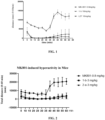
- model preparation MK-801 induces overactivity in mice and is commonly used for preclinical evaluation of antipsychotics.
- the modeling method in this test was: The mice were injected with MK-801 intraperitoneally in at single dose of 0.8 mg/kg.
- mice were randomly divided into model group, 1-b group, and L27 group, 10 animals in each group, as shown in Table 5.
- Table 5. Animal grouping and dosing Group Type of drug Administration dose (mg/kg) Drug concentration (mg/mL) Administration route Administration volume (mL/kg) Animal Number Model group -- -- -- -- -- 10 1-b group 1-b 10 1 Intragastric 10 10 L27 group L27 hydrochloride 16 1.6 Intragastric 10 10 Note: The L27 group was the equimolar dose as 1-b.
- mice were randomly divided into groups.
- the test samples were administered intragastrically at an single dose according to the doses shown in Table 5, and the mice were placed in an activity chamber.
- each mouse was injected intraperitoneally with 0.8 mg/kg of MK-801 for modeling, and placed in the activity chamber again.
- the movement distance (mm) of the mice after modeling was recorded and analyzed using a TopScan monitoring system.
- mice after modeling (within 30-60 min after administration) was recorded and analyzed using a TopScan monitoring system. The total movement distance of the mice after modeling (30-60 min after administration) was recorded.
- the test results show that the total movement distance of the animals in the groups 1-b and L27 after modeling was 6493.12 ⁇ 6228.87 mm and 8100.56 ⁇ 7787.37 mm, respectively, which was significantly reduced ( p ⁇ 0.05) compared with the total movement distance of the animals in the model group after modeling (63052.14 ⁇ 21618.80 mm).
- mice were randomly divided into model group, 1-b group, and 2-a group, 5 animals in each group, as shown in Table 6.
- the model preparation, test method, observation of indexes and statistical method were the same as those in Test Example 4. Table 6.
- Animal grouping and dosing Group Type of drug Administration dose (mg/kg)
- Drug concentration (mg/mL)
- Administration route Administration volume (mL/kg)
- Animal Number Model group -- -- -- -- -- 5 1-b group 1-b 3 0.75 Intragastric 4 5 2-a group 2-a 3 0.75 Intragastric 4 5
- the test results show that the total movement distance of the animals in the groups 1-b and 2-a after modeling was 13644.54 ⁇ 10814.85 mm and 9161.61 ⁇ 4711.10 mm, respectively, which was significantly reduced ( p ⁇ 0.05) compared with the total movement distance of the animals in the model group after modeling (101535.71 ⁇ 26076.11 mm).
Landscapes
- Chemical & Material Sciences (AREA)
- Health & Medical Sciences (AREA)
- Organic Chemistry (AREA)
- Life Sciences & Earth Sciences (AREA)
- General Health & Medical Sciences (AREA)
- Pharmacology & Pharmacy (AREA)
- Medicinal Chemistry (AREA)
- Animal Behavior & Ethology (AREA)
- Public Health (AREA)
- Veterinary Medicine (AREA)
- Epidemiology (AREA)
- Engineering & Computer Science (AREA)
- Bioinformatics & Cheminformatics (AREA)
- General Chemical & Material Sciences (AREA)
- Chemical Kinetics & Catalysis (AREA)
- Nuclear Medicine, Radiotherapy & Molecular Imaging (AREA)
- Diabetes (AREA)
- Biomedical Technology (AREA)
- Neurosurgery (AREA)
- Neurology (AREA)
- Hematology (AREA)
- Obesity (AREA)
- Psychiatry (AREA)
- Heart & Thoracic Surgery (AREA)
- Cardiology (AREA)
- Child & Adolescent Psychology (AREA)
- Molecular Biology (AREA)
- Biochemistry (AREA)
- Emergency Medicine (AREA)
- Endocrinology (AREA)
- Hospice & Palliative Care (AREA)
- Pharmaceuticals Containing Other Organic And Inorganic Compounds (AREA)
- Heterocyclic Carbon Compounds Containing A Hetero Ring Having Nitrogen And Oxygen As The Only Ring Hetero Atoms (AREA)
Applications Claiming Priority (3)
| Application Number | Priority Date | Filing Date | Title |
|---|---|---|---|
| CN202210723387 | 2022-06-24 | ||
| CN202310089008 | 2023-02-09 | ||
| PCT/CN2023/101737 WO2023246872A1 (zh) | 2022-06-24 | 2023-06-21 | 作为taar1配体激动剂的杂环化合物 |
Publications (1)
| Publication Number | Publication Date |
|---|---|
| EP4545534A1 true EP4545534A1 (en) | 2025-04-30 |
Family
ID=89379183
Family Applications (1)
| Application Number | Title | Priority Date | Filing Date |
|---|---|---|---|
| EP23826517.7A Pending EP4545534A1 (en) | 2022-06-24 | 2023-06-21 | Heterocyclic compound as taar1 ligand agonist |
Country Status (8)
| Country | Link |
|---|---|
| US (1) | US20250382306A1 (https=) |
| EP (1) | EP4545534A1 (https=) |
| JP (1) | JP2025525370A (https=) |
| KR (1) | KR20250028295A (https=) |
| CN (1) | CN119403809A (https=) |
| AU (1) | AU2023287274A1 (https=) |
| CA (1) | CA3260200A1 (https=) |
| WO (1) | WO2023246872A1 (https=) |
Families Citing this family (1)
| Publication number | Priority date | Publication date | Assignee | Title |
|---|---|---|---|---|
| WO2025131045A1 (zh) * | 2023-12-22 | 2025-06-26 | 山东绿叶制药有限公司 | 一种taar1配体激动剂的盐型、晶型及其制备方法和应用 |
Family Cites Families (3)
| Publication number | Priority date | Publication date | Assignee | Title |
|---|---|---|---|---|
| SG10201510665WA (en) * | 2009-12-04 | 2016-01-28 | Sunovion Pharmaceuticals Inc | Multicycle Compounds And Pharmaceutical Compositions Useful For The Treatment Of Neurological Disorders |
| WO2022204150A1 (en) * | 2021-03-22 | 2022-09-29 | Blue Oak Pharmaceuticals, Inc. | Compounds and compositions for treating cns disorders |
| CN115433205A (zh) * | 2021-06-03 | 2022-12-06 | 上海翰森生物医药科技有限公司 | 多环类衍生物受体激动剂、其制备方法和应用 |
-
2023
- 2023-06-21 US US18/878,000 patent/US20250382306A1/en active Pending
- 2023-06-21 JP JP2024574809A patent/JP2025525370A/ja active Pending
- 2023-06-21 KR KR1020247043024A patent/KR20250028295A/ko active Pending
- 2023-06-21 EP EP23826517.7A patent/EP4545534A1/en active Pending
- 2023-06-21 CA CA3260200A patent/CA3260200A1/en active Pending
- 2023-06-21 AU AU2023287274A patent/AU2023287274A1/en active Pending
- 2023-06-21 CN CN202380048535.3A patent/CN119403809A/zh active Pending
- 2023-06-21 WO PCT/CN2023/101737 patent/WO2023246872A1/zh not_active Ceased
Also Published As
| Publication number | Publication date |
|---|---|
| WO2023246872A1 (zh) | 2023-12-28 |
| KR20250028295A (ko) | 2025-02-28 |
| CA3260200A1 (en) | 2025-03-31 |
| CN119403809A (zh) | 2025-02-07 |
| AU2023287274A1 (en) | 2025-01-09 |
| JP2025525370A (ja) | 2025-08-05 |
| US20250382306A1 (en) | 2025-12-18 |
Similar Documents
| Publication | Publication Date | Title |
|---|---|---|
| AU2017263361B2 (en) | Cyclopropyl-amide compounds as dual LSD1/HDAC inhibitors | |
| DE60009915T2 (de) | Verbindungen | |
| DE60225162T2 (de) | Phenylpiperazinderivate als serotonin wiederaufnahmehemmer | |
| KR20230051252A (ko) | 통증의 치료를 위한 nav 1.7의 비수화 케톤 억제제 | |
| WO2018183781A1 (en) | 11,13-modified saxitoxins for the treatment of pain | |
| JPH06172178A (ja) | モルホリン及びチオモルホリンタチキニンレセプタ ーアンタゴニスト | |
| ZA200700325B (en) | Indole-2-carboxamidine derivatives as NMDA receptor antagonists | |
| JP2021535909A (ja) | 高活性stingタンパク質アゴニスト化合物 | |
| KR102150739B1 (ko) | 카르바메이트/우레아 유도체 | |
| CA3113463A1 (en) | Nitroxoline prodrug and use thereof | |
| EP4545534A1 (en) | Heterocyclic compound as taar1 ligand agonist | |
| EP3747881B1 (en) | Nitrogen-containing benzoheterocycle compound comprising carboxylic acid group, preparation method and use thereof | |
| EP3722286B1 (en) | Salt of a phenylpropionamide derivative and preparation method therefor | |
| CA3238026A1 (en) | Multicyclic compounds | |
| EP3484880B1 (en) | Heteroaromatic modulators of the retinoid-related orphan receptor gamma | |
| KR20240050372A (ko) | 수용성 알로프레그나놀론 유도체 및 이의 제조 방법과 용도 | |
| EP4082616B1 (en) | Aliphatic acid amide derivative | |
| HRP980104A2 (en) | Quinoxalinediones | |
| KR20180050408A (ko) | 국부 약물 전달용의 비스테로이드성 글루코코르티코이드 수용체 조절제 | |
| EP3805219A1 (en) | Pyrazolopyrimidine derivative, use thereof and pharmaceutical composition | |
| WO2024124050A1 (en) | Multicyclic compounds | |
| EP4512807A1 (en) | Bicycloamine carboxamide derivative | |
| EP4700019A1 (en) | Crystal form of 1,5-dihydro-2,4-benzodiazepine-3-one derivative citrate, preparation method, and use thereof | |
| HK40079616B (en) | Aliphatic acid amide derivative | |
| HK40079616A (en) | Aliphatic acid amide derivative |
Legal Events
| Date | Code | Title | Description |
|---|---|---|---|
| STAA | Information on the status of an ep patent application or granted ep patent |
Free format text: STATUS: THE INTERNATIONAL PUBLICATION HAS BEEN MADE |
|
| PUAI | Public reference made under article 153(3) epc to a published international application that has entered the european phase |
Free format text: ORIGINAL CODE: 0009012 |
|
| STAA | Information on the status of an ep patent application or granted ep patent |
Free format text: STATUS: REQUEST FOR EXAMINATION WAS MADE |
|
| 17P | Request for examination filed |
Effective date: 20250109 |
|
| AK | Designated contracting states |
Kind code of ref document: A1 Designated state(s): AL AT BE BG CH CY CZ DE DK EE ES FI FR GB GR HR HU IE IS IT LI LT LU LV MC ME MK MT NL NO PL PT RO RS SE SI SK SM TR |
|
| DAV | Request for validation of the european patent (deleted) | ||
| DAX | Request for extension of the european patent (deleted) |