EP4545409A1 - Verfahren und system zur überwachung einer passagierkabine eines flugzeugs - Google Patents
Verfahren und system zur überwachung einer passagierkabine eines flugzeugs Download PDFInfo
- Publication number
- EP4545409A1 EP4545409A1 EP23205960.0A EP23205960A EP4545409A1 EP 4545409 A1 EP4545409 A1 EP 4545409A1 EP 23205960 A EP23205960 A EP 23205960A EP 4545409 A1 EP4545409 A1 EP 4545409A1
- Authority
- EP
- European Patent Office
- Prior art keywords
- cabin
- passenger
- status
- portable
- seat belt
- Prior art date
- Legal status (The legal status is an assumption and is not a legal conclusion. Google has not performed a legal analysis and makes no representation as to the accuracy of the status listed.)
- Pending
Links
Images
Classifications
-
- B—PERFORMING OPERATIONS; TRANSPORTING
- B64—AIRCRAFT; AVIATION; COSMONAUTICS
- B64D—EQUIPMENT FOR FITTING IN OR TO AIRCRAFT; FLIGHT SUITS; PARACHUTES; ARRANGEMENT OR MOUNTING OF POWER PLANTS OR PROPULSION TRANSMISSIONS IN AIRCRAFT
- B64D11/00—Passenger or crew accommodation; Flight-deck installations not otherwise provided for
- B64D11/0015—Arrangements for entertainment or communications, e.g. radio, television
-
- B—PERFORMING OPERATIONS; TRANSPORTING
- B64—AIRCRAFT; AVIATION; COSMONAUTICS
- B64D—EQUIPMENT FOR FITTING IN OR TO AIRCRAFT; FLIGHT SUITS; PARACHUTES; ARRANGEMENT OR MOUNTING OF POWER PLANTS OR PROPULSION TRANSMISSIONS IN AIRCRAFT
- B64D11/00—Passenger or crew accommodation; Flight-deck installations not otherwise provided for
- B64D11/06—Arrangements of seats, or adaptations or details specially adapted for aircraft seats
- B64D11/062—Belts or other passenger restraint means for passenger seats
-
- B—PERFORMING OPERATIONS; TRANSPORTING
- B64—AIRCRAFT; AVIATION; COSMONAUTICS
- B64D—EQUIPMENT FOR FITTING IN OR TO AIRCRAFT; FLIGHT SUITS; PARACHUTES; ARRANGEMENT OR MOUNTING OF POWER PLANTS OR PROPULSION TRANSMISSIONS IN AIRCRAFT
- B64D45/00—Aircraft indicators or protectors not otherwise provided for
- B64D45/0015—Devices specially adapted for the protection against criminal attack, e.g. anti-hijacking systems
- B64D45/0051—Devices specially adapted for the protection against criminal attack, e.g. anti-hijacking systems by monitoring passengers or crew on aircraft
-
- G—PHYSICS
- G06—COMPUTING OR CALCULATING; COUNTING
- G06V—IMAGE OR VIDEO RECOGNITION OR UNDERSTANDING
- G06V20/00—Scenes; Scene-specific elements
- G06V20/20—Scenes; Scene-specific elements in augmented reality scenes
-
- G—PHYSICS
- G06—COMPUTING OR CALCULATING; COUNTING
- G06V—IMAGE OR VIDEO RECOGNITION OR UNDERSTANDING
- G06V20/00—Scenes; Scene-specific elements
- G06V20/40—Scenes; Scene-specific elements in video content
- G06V20/41—Higher-level, semantic clustering, classification or understanding of video scenes, e.g. detection, labelling or Markovian modelling of sport events or news items
-
- G—PHYSICS
- G06—COMPUTING OR CALCULATING; COUNTING
- G06V—IMAGE OR VIDEO RECOGNITION OR UNDERSTANDING
- G06V20/00—Scenes; Scene-specific elements
- G06V20/50—Context or environment of the image
- G06V20/59—Context or environment of the image inside of a vehicle, e.g. relating to seat occupancy, driver state or inner lighting conditions
- G06V20/593—Recognising seat occupancy
-
- H—ELECTRICITY
- H04—ELECTRIC COMMUNICATION TECHNIQUE
- H04N—PICTORIAL COMMUNICATION, e.g. TELEVISION
- H04N7/00—Television systems
- H04N7/18—Closed-circuit television [CCTV] systems, i.e. systems in which the video signal is not broadcast
- H04N7/181—Closed-circuit television [CCTV] systems, i.e. systems in which the video signal is not broadcast for receiving images from a plurality of remote sources
-
- G—PHYSICS
- G06—COMPUTING OR CALCULATING; COUNTING
- G06V—IMAGE OR VIDEO RECOGNITION OR UNDERSTANDING
- G06V10/00—Arrangements for image or video recognition or understanding
- G06V10/70—Arrangements for image or video recognition or understanding using pattern recognition or machine learning
Definitions
- the present invention pertains to a method and system for surveillance of a passenger cabin of an aircraft.
- a cabin attendant may have visual sight of the aisle of an aircraft and also sight of at least 50% of the passengers. This may in particular apply to critical phases of a flight, including take-off and landing. During these critical phases, the cabin attendants usually have to remain at respective flight attendant seats while being capable of monitoring the passenger seats in accordance with the above-cited regulation requirements. Due to these requirements the crew attendant seats may have to be located appropriately within the cabin and to be oriented toward certain cabin areas that are to be monitored.
- a monitoring system using a camera for passenger and aisle surveillance may be used.
- the camera view may then displayed on a monitor at the galley end of the cabin opposite to the flight attendant. See, for example, document EP 3 606 818 B1 for an example of such a cabin monitoring system.
- Document EP 2 939 924 A1 describes the use of a wearable device as digital crew assist that is connectable with one or more aircraft related systems such as a cabin management system as well as sensors, actuators and so on.
- Document EP 2 819 100 A1 describes the use of augmented reality images in an aircraft during flight to enhance the well-being of passengers and to display technical aspects of the aircraft on a portable device of the passengers.
- a method for surveillance of a passenger cabin of an aircraft comprises capturing a live video feed of the passenger cabin with a video surveillance system; collecting seat belt condition data of passenger seats within the passenger cabin with a seat belt sensor system; assessing with a computer-based evaluation system a current seat occupation status of the passenger seats based on the captured live video feed and a current seat belt status of the passenger seats based on the collected seat belt condition data; wirelessly transmitting the seat occupation status and the seat belt status to a portable crew device, the portable crew device being a pair of smart glasses; and projecting visual cabin information representing the seat occupation status and the seat belt status on the portable crew device.
- an aircraft has a passenger cabin comprising a plurality of passenger seats and a cabin surveillance system, wherein the cabin surveillance system comprises a video surveillance system configured to capture a live video feed of the passenger cabin; a seat belt sensor system configured to collect seat belt condition data of passenger seats within the passenger cabin; a computer-based evaluation system configured to assess a current seat occupation status of the passenger seats based on the captured live video feed and a current seat belt status of the passenger seats based on the collected seat belt condition data and to wirelessly transmit the seat occupation status and the seat belt status; and a portable crew device, the portable crew device being a pair of smart glasses and being configured to receive the seat occupation status and the seat belt status from the computer-based evaluation system and to project visual cabin information representing the seat occupation status and the seat belt status on the portable crew device.
- the cabin surveillance system comprises a video surveillance system configured to capture a live video feed of the passenger cabin; a seat belt sensor system configured to collect seat belt condition data of passenger seats within the passenger cabin; a computer-based evaluation system configured to assess a current seat occupation
- one idea of the present invention is to digitalize the cabin environment and automatize surveillance of it by providing the cabin crew with information on seat occupation and seatbelt statuses continuously and automatically on their smart glasses.
- the use of wireless information transfer technology facilitates oversight of the relevant situation without restricting the cabin attendants to a specific location in the aircraft, as they have all information in sight at any position and viewing direction.
- cabin operations such a checking for fastened seatbelts and fulfilling certification requirements such as visual coverage of the passengers and/or the aisle can be done much more flexible and efficient.
- movement of the cabin crew can be reduced, which in turn enhances safety, especially during turbulences and other difficult situations, as the crew can remain seated while still having full overview of the situation due to the projected information on their glasses.
- With the use of smart glasses weight can be reduced, as heavy monitors and the necessary electrical and mechanical installations are no longer required.
- Such a digitalized cabin may comprise cameras and other detection devices as part of the video surveillance system.
- the computer-based evaluation system may then recognize whether seats are empty or occupied based on object/pattern recognition algorithms, which may, for example, utilize advanced machine learning and/or artificial intelligence based evaluation.
- object/pattern recognition algorithms which may, for example, utilize advanced machine learning and/or artificial intelligence based evaluation.
- Such systems may also be used to assess various others aspects and/or data on the current cabin situation, e.g. whether passengers are seated or standing, or indications of an emergency or other situation requiring the immediate attention of the cabin crew.
- the evaluation system may be provided as a dedicated computer system (cabin monitoring computer) or may be part of such a system, which may be integrated or communicatively coupled to a cabin management system of the respective aircraft.
- seatbelts may be provided with suitable sensors to assess whether they are (properly) closed and/or open.
- sensor may comprise, for example, wired contact switches on the seat belts.
- the seat belts may be equipped with near field communication (NFC) technology that can determine their closing status.
- NFC near field communication
- the evaluation of both information allows for a detailed assessment of each seat inside the cabin as to its status.
- the system can thus automatically analyze whether seats are occupied or not and whether the respective seatbelts are fastened or not.
- Sharing of this information via a wireless data network to the crew's smart glasses provides them with the ability to check the current status of the cabin in real-time, in principle even without having direct sight of it.
- a full or partial view of the cabin may be projected on their glasses and additional information about the cabin may be overlayed. For example, dedicated indicators, icons, scales or other graphical elements may be projected and/or overlayed. Additional coloring and/or shading may further help to visualize certain data. These may be accompanied by other visual signals like flashing and/or additional auditory information, e.g. to inform the crew about an emergency or similar.
- a current view of the passenger cabin may be captured with the video surveillance system, wirelessly transmitted to the portable crew device and overlayed there and projected together with the visual cabin information.
- a real live view of the present situation within the passenger cabin may be projected, e.g. a static view from one or several fixed positions and/or directions.
- the current view of the passenger cabin may be a static view being independent of a current viewing direction and a current position associated with the portable crew device.
- a static sight of the cabin is provided on the smart glasses from a fixed perspective, e.g. as delivered by one or several cameras.
- the crew can then access this view of the cabin from anywhere inside the aircraft, e.g. from within the flight crew compartment even when sitting on a flight attendant seat with the back to the passenger cabin.
- the visual cabin information may be projected on the portable crew device as augmented reality images.
- the projected image on the smart glasses may be adapted according to the current viewing direction of the respective cabin attendant, e.g. while walking along the aisle of the passenger cabin.
- information can be displayed onto the glasses while looking through the glasses to project the information to a specific location within the passenger cabin with certain data overlayed over the current image of the cabin, in particular the seat occupation status and the seat belt status.
- the computer-based evaluation system may assess a passenger status within the passenger cabin based on the captured live video feed, the passenger status including information on whether passengers are seated or standing.
- a corresponding passenger status may be projected on the portable crew device as part of the visual cabin information.
- additional information may be taken into account besides the seat occupation status and the seat belt status.
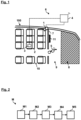
- Figure 1 schematically depicts a top view of a passenger cabin 10 of an aircraft 100 according to an embodiment of the invention that is provided with a cabin surveillance system 6.
- Fig. 2 schematically depicts a flow diagram of a method M for surveillance of the passenger cabin 10 of Fig. 1 according to an embodiment of the invention.
- the aircraft 100 may be, for example, a single aisle passenger aircraft.
- Fig. 1 depicts a rear end of the respective aircraft 100.
- the aircraft 100 comprises a passenger cabin 10 with a plurality of passenger seats 2 and a flight crew compartment 9 with a flight attendant seat 11. Both cabin sections 10, 9 are separated by several partition walls 7, whereby a passageway is formed along the aisle that connects the flight crew compartment 9 with the passenger cabin 10 in the usual manner.
- the flight crew compartment 9 may include a galley 8 for example. It is to be understood that the depicted arrangement is merely an example. It will be clear to the person of skill that the invention can be used in various other cabin configurations. It is also clear that more than one flight attendant seat 3 could be provided within the flight crew compartment 9.
- regulations usually require that at least a certain percentage of the passenger seats 2 must be visible by cabin attendants, in particular under critical phases of a flight like take-off and landing phases.
- the cabin attendants have to remain at respective flight attendant seats 3 (as the one exemplary shown in the figures) while being capable of monitoring the passenger seats 2 in accordance with the above-cited regulation requirements.
- the cabin attendants are conventionally seated against flight direction for better space usage in the rear end of the aircraft 100, as the galley 8 is arranged at the opposite end.
- a monitoring system is typically installed within a cabin including a monitor mounted at the galley, which displays a live view of the passenger seats 2.
- These systems are typically rather complex and expensive, as the electrical installation needs to be provided between one or several cameras in the passenger cabin 10 and the monitor in the galley 8.
- the necessary mechanical provisions further increase the costs and weight of such conventional installations.
- the present solution offers a simple alternative to such complex arrangements by relying on a digitized cabin environment with wireless access to sensor data and computer based systems that can be used to feed a live view of the cabin along with all relevant information to portable devices of the cabin attendants.
- the present cabin surveillance system 6 comprises a video surveillance system 1 configured to capture a live video feed of the passenger cabin 10, which may comprise one or several cameras installed within the passenger cabin 10, e.g. on the partition walls 7 between the passenger cabin 10 and the flight crew compartment 9. It is to be understood that this merely an example, as it will be clear to the person of skill that also other sensor technologies may be employed in addition for the present purpose.
- the cabin surveillance system 6 further comprises a seat belt sensor system 3 configured to collect seat belt condition data of passenger seats 2 within the passenger cabin 10.
- the seat belt sensor system 3 may comprise, for example, wired contact switches within each individual seat belt as well as near field communication technology.
- the cabin surveillance system 6 further comprises a computer-based evaluation system 4, which may be integrated in or communicatively coupled to a cabin management system of the aircraft (e.g. via a wireless data network).
- the computer-based evaluation system 4 is configured to assess a current seat occupation status of the passenger seats 2 based on the captured live video feed and a current seat belt status of the passenger seats 2 based on the collected seat belt condition data.
- the system 4 may distinguish between empty and occupied seats based on machine learning and/or artificial intelligence tools.
- the system 4 may be able to detect whether passengers are seated or standing.
- the computer-based evaluation system 4 may additionally assess a passenger status within the passenger cabin 10 based on the captured live video feed, wherein the passenger status includes information on whether passengers are seated or standing. The system 4 may even be used to automatically identify the passengers based on booking and identification information provided for each flight.
- the system 4 is able to assess the current seat occupation as well as the seat belt situation, that is, whether the seat belts of occupied seats are fastened or not, as well as whether passenger are standing, e.g. in the aisle or are using the lavatory etc.
- the respective data are then wirelessly transmitted by the computer system 4 to portable crew devices 5 of the aircraft crew, in particular to smart glasses of each crew member (one of which is exemplarily shown in Fig. 1 ).
- each pair of smart glasses 5 projects visual cabin information representing the seat occupation status and the seat belt status on the portable crew device 5.
- the visual cabin information may be overlayed over a current view of the passenger cabin 10 as captured with the cabin surveillance system 1 and projected together with it on the portable crew device 5.
- the visual cabin information may be particularly projected on the portable crew device 5 as augmented reality images.
- the corresponding method M as schematically shown in Fig. 2 comprises under M1 capturing the live video feed of the passenger cabin 10 with the video surveillance system 1, under M2 collecting the seat belt condition data of the passenger seats 2 with the seat belt sensor system 3, under M3 assessing with the computer-based evaluation system 4 the current seat occupation status of the passenger seats 2 and the passenger status based on the captured live video feed and the current seat belt status of the passenger seats 2 based on the collected seat belt condition data.
- the method M further comprises under M4 wirelessly transmitting the seat occupation status, the passenger status and the seat belt status to the smart glasses used as portable crew device 5.
- the method M comprises projecting visual cabin information representing the seat occupation status and the seat belt status on the portable crew device 5, which may be projected together with a current view of the passenger cabin 10 as captured with the video surveillance system 1.
- a static view can be displayed on the smart glasses 5, which is independent of a current viewing direction and a current position associated with the respective smart glasses 5.
- a video feed of the full cabin 10 or of some segments/portions of it may be projected on the smart glasses.
- the cabin information may then be overlayed over this video feed in the form of visual indicators like icons, highlighted and/or colored elements, numbers etc. that may indicated whether passengers are standing or are sitting but have not fastened their seatbelts.
- a sight along the aisle may be possible via the glasses 5 (independent of the attendant's current position).
- the current view of the passenger cabin 10 may be a dynamic view being adapted according to the current viewing direction of the cabin attendant wearing the respective smart glasses 5.
- the smart glasses 5 may be configured to display the visual cabin information together with the view of the passenger cabin 10 as augmented reality images. In principle, these information can also be displayed onto the glasses while looking through the glasses standing at a certain position within the cabin 10 and looking in a certain direction. In this case, (un-) occupied seats and/or (un-) fastened seatbelts may be highlighted within the view based on the ML/AI-supported evaluation and thus point the cabin attendants directly to the respective seats 2.
- the present solution thus makes use of a digitized cabin environment to provide the cabin attendants with improved means to monitor the passenger cabin 10, thereby enhancing not only flexibility and efficiency but also safety, as they are able to access and evaluate a current situation within the cabin from basically anywhere in the aircraft.
Landscapes
- Engineering & Computer Science (AREA)
- Multimedia (AREA)
- Physics & Mathematics (AREA)
- General Physics & Mathematics (AREA)
- Theoretical Computer Science (AREA)
- Aviation & Aerospace Engineering (AREA)
- Computational Linguistics (AREA)
- Software Systems (AREA)
- Signal Processing (AREA)
- Closed-Circuit Television Systems (AREA)
Priority Applications (2)
| Application Number | Priority Date | Filing Date | Title |
|---|---|---|---|
| EP23205960.0A EP4545409A1 (de) | 2023-10-26 | 2023-10-26 | Verfahren und system zur überwachung einer passagierkabine eines flugzeugs |
| US18/924,648 US20250136278A1 (en) | 2023-10-26 | 2024-10-23 | Method and system for surveillance of a passenger cabin of an aircraft |
Applications Claiming Priority (1)
| Application Number | Priority Date | Filing Date | Title |
|---|---|---|---|
| EP23205960.0A EP4545409A1 (de) | 2023-10-26 | 2023-10-26 | Verfahren und system zur überwachung einer passagierkabine eines flugzeugs |
Publications (1)
| Publication Number | Publication Date |
|---|---|
| EP4545409A1 true EP4545409A1 (de) | 2025-04-30 |
Family
ID=88558307
Family Applications (1)
| Application Number | Title | Priority Date | Filing Date |
|---|---|---|---|
| EP23205960.0A Pending EP4545409A1 (de) | 2023-10-26 | 2023-10-26 | Verfahren und system zur überwachung einer passagierkabine eines flugzeugs |
Country Status (2)
| Country | Link |
|---|---|
| US (1) | US20250136278A1 (de) |
| EP (1) | EP4545409A1 (de) |
Citations (9)
| Publication number | Priority date | Publication date | Assignee | Title |
|---|---|---|---|---|
| JPH08315258A (ja) * | 1995-05-19 | 1996-11-29 | Fujitsu General Ltd | インテリジェント機内モニタ |
| EP2819100A1 (de) | 2013-06-26 | 2014-12-31 | Airbus Operations GmbH | Anzeigen von Bildern mit erweiterter Realität in einem Flugzeug während des Fluges |
| EP2939924A1 (de) | 2014-04-30 | 2015-11-04 | Airbus Operations GmbH | Digitale Besatzungsunterstützung |
| US20190177004A1 (en) * | 2017-12-08 | 2019-06-13 | Rockwell Collins, Inc. | Integrated Imaging System for a Connected Aircraft |
| US20200028687A1 (en) * | 2018-07-20 | 2020-01-23 | Thales | Continuity of access to avionic data outside of the cockpit of an aircraft |
| US10752130B2 (en) * | 2016-10-29 | 2020-08-25 | Diehl Aerospace Gmbh | Monitoring module for a seat of a passenger aircraft, monitoring device and passenger aircraft |
| EP3606818B1 (de) | 2017-04-03 | 2021-09-15 | Lufthansa Technik AG | Flugzeug mit einem monument für die flugzeugkabine |
| US20230120829A1 (en) * | 2020-03-31 | 2023-04-20 | B/E Aerospace, Inc. | Person activity recognition |
| US11729432B2 (en) * | 2019-11-19 | 2023-08-15 | Thales Avionics, Inc. | Inflight entertainment system using video object recognition to monitor seat areas and generate flight crew notifications |
-
2023
- 2023-10-26 EP EP23205960.0A patent/EP4545409A1/de active Pending
-
2024
- 2024-10-23 US US18/924,648 patent/US20250136278A1/en active Pending
Patent Citations (10)
| Publication number | Priority date | Publication date | Assignee | Title |
|---|---|---|---|---|
| JPH08315258A (ja) * | 1995-05-19 | 1996-11-29 | Fujitsu General Ltd | インテリジェント機内モニタ |
| EP2819100A1 (de) | 2013-06-26 | 2014-12-31 | Airbus Operations GmbH | Anzeigen von Bildern mit erweiterter Realität in einem Flugzeug während des Fluges |
| EP2939924A1 (de) | 2014-04-30 | 2015-11-04 | Airbus Operations GmbH | Digitale Besatzungsunterstützung |
| US9889934B2 (en) * | 2014-04-30 | 2018-02-13 | Airbus Operations Gmbh | Digital crew assist |
| US10752130B2 (en) * | 2016-10-29 | 2020-08-25 | Diehl Aerospace Gmbh | Monitoring module for a seat of a passenger aircraft, monitoring device and passenger aircraft |
| EP3606818B1 (de) | 2017-04-03 | 2021-09-15 | Lufthansa Technik AG | Flugzeug mit einem monument für die flugzeugkabine |
| US20190177004A1 (en) * | 2017-12-08 | 2019-06-13 | Rockwell Collins, Inc. | Integrated Imaging System for a Connected Aircraft |
| US20200028687A1 (en) * | 2018-07-20 | 2020-01-23 | Thales | Continuity of access to avionic data outside of the cockpit of an aircraft |
| US11729432B2 (en) * | 2019-11-19 | 2023-08-15 | Thales Avionics, Inc. | Inflight entertainment system using video object recognition to monitor seat areas and generate flight crew notifications |
| US20230120829A1 (en) * | 2020-03-31 | 2023-04-20 | B/E Aerospace, Inc. | Person activity recognition |
Also Published As
| Publication number | Publication date |
|---|---|
| US20250136278A1 (en) | 2025-05-01 |
Similar Documents
| Publication | Publication Date | Title |
|---|---|---|
| US20170113801A1 (en) | Cabin monitoring system and cabin of aircraft or spacecraft | |
| EP3495275B1 (de) | Integriertes bildgebungssystem für ein verbundenes flugzeug | |
| US6864805B1 (en) | Surveillance system for aircraft interior | |
| US7932837B2 (en) | Conditional aircraft cabin warning and signalling system for determining the cabin status | |
| US10723481B2 (en) | Method and system for monitoring and securing an enclosure of a vehicle, in particular of an aircraft | |
| US10733858B2 (en) | Method and system for monitoring and securing an enclosure of a vehicle, in particular of an aircraft | |
| KR101358401B1 (ko) | 선박내의 위험감시 통합모니터링 시스템 및 방법 | |
| JP5988472B2 (ja) | 監視システム、および、混雑率算出方法 | |
| EP2924663B1 (de) | Automatische Personenzählung an Bord eines Flugzeugs | |
| JP2020036211A (ja) | 照合システム | |
| US20180208318A1 (en) | Safety belt, notably for aircraft seat | |
| US20090273487A1 (en) | Apparatus for interconnecting a pilot station to at least one other aircraft zone, cockpit and aircraft equipped with such an apparatus | |
| US20140176668A1 (en) | Aircraft provided with a surveillance system | |
| EP4545409A1 (de) | Verfahren und system zur überwachung einer passagierkabine eines flugzeugs | |
| US10836507B2 (en) | Aircraft communication network | |
| CN110461712A (zh) | 包括座舱监控系统的飞机的立体空间总装 | |
| KR20180055016A (ko) | 선박 손상 및 화재시 실시간 사고대응시스템 | |
| EP3747726A1 (de) | Autoinformationsteuerungsvorrichtung | |
| CN118675115B (zh) | 一种机场空管集中监控方法及管理系统 | |
| CN107954003B (zh) | 具有多个飞行器门的飞行器 | |
| EP4101771B1 (de) | Fahrzeugführer-überwachungssystem mit intelligenter aktiver ein- und auskupplung | |
| KR20180088962A (ko) | 열차의 탑승 안내 시스템 | |
| US11136127B2 (en) | Supervision system for an aircraft for monitoring the safe charging of portable electrical devices | |
| EP4545408A1 (de) | Flugzeug mit spiegel zur kabinenüberwachung | |
| EP4484300A1 (de) | System, flugzeugkabine und verfahren zur überwachung einer flugzeugkabine |
Legal Events
| Date | Code | Title | Description |
|---|---|---|---|
| PUAI | Public reference made under article 153(3) epc to a published international application that has entered the european phase |
Free format text: ORIGINAL CODE: 0009012 |
|
| STAA | Information on the status of an ep patent application or granted ep patent |
Free format text: STATUS: THE APPLICATION HAS BEEN PUBLISHED |
|
| AK | Designated contracting states |
Kind code of ref document: A1 Designated state(s): AL AT BE BG CH CY CZ DE DK EE ES FI FR GB GR HR HU IE IS IT LI LT LU LV MC ME MK MT NL NO PL PT RO RS SE SI SK SM TR |
|
| STAA | Information on the status of an ep patent application or granted ep patent |
Free format text: STATUS: REQUEST FOR EXAMINATION WAS MADE |
|
| 17P | Request for examination filed |
Effective date: 20251030 |