EP4539435A2 - Optimierung der datenzwischenspeicherung einer benutzerschnittstelle für zukünftige aktionen - Google Patents
Optimierung der datenzwischenspeicherung einer benutzerschnittstelle für zukünftige aktionen Download PDFInfo
- Publication number
- EP4539435A2 EP4539435A2 EP25159763.9A EP25159763A EP4539435A2 EP 4539435 A2 EP4539435 A2 EP 4539435A2 EP 25159763 A EP25159763 A EP 25159763A EP 4539435 A2 EP4539435 A2 EP 4539435A2
- Authority
- EP
- European Patent Office
- Prior art keywords
- data
- user interface
- next action
- application
- user
- Prior art date
- Legal status (The legal status is an assumption and is not a legal conclusion. Google has not performed a legal analysis and makes no representation as to the accuracy of the status listed.)
- Pending
Links
Images
Classifications
-
- G—PHYSICS
- G06—COMPUTING OR CALCULATING; COUNTING
- G06F—ELECTRIC DIGITAL DATA PROCESSING
- G06F16/00—Information retrieval; Database structures therefor; File system structures therefor
- G06F16/90—Details of database functions independent of the retrieved data types
- G06F16/95—Retrieval from the web
- G06F16/957—Browsing optimisation, e.g. caching or content distillation
- G06F16/9574—Browsing optimisation, e.g. caching or content distillation of access to content, e.g. by caching
-
- G—PHYSICS
- G06—COMPUTING OR CALCULATING; COUNTING
- G06F—ELECTRIC DIGITAL DATA PROCESSING
- G06F12/00—Accessing, addressing or allocating within memory systems or architectures
- G06F12/02—Addressing or allocation; Relocation
- G06F12/08—Addressing or allocation; Relocation in hierarchically structured memory systems, e.g. virtual memory systems
- G06F12/0802—Addressing of a memory level in which the access to the desired data or data block requires associative addressing means, e.g. caches
- G06F12/0806—Multiuser, multiprocessor or multiprocessing cache systems
- G06F12/0813—Multiuser, multiprocessor or multiprocessing cache systems with a network or matrix configuration
-
- G—PHYSICS
- G06—COMPUTING OR CALCULATING; COUNTING
- G06F—ELECTRIC DIGITAL DATA PROCESSING
- G06F16/00—Information retrieval; Database structures therefor; File system structures therefor
- G06F16/90—Details of database functions independent of the retrieved data types
- G06F16/95—Retrieval from the web
- G06F16/954—Navigation, e.g. using categorised browsing
-
- G—PHYSICS
- G06—COMPUTING OR CALCULATING; COUNTING
- G06F—ELECTRIC DIGITAL DATA PROCESSING
- G06F3/00—Input arrangements for transferring data to be processed into a form capable of being handled by the computer; Output arrangements for transferring data from processing unit to output unit, e.g. interface arrangements
- G06F3/01—Input arrangements or combined input and output arrangements for interaction between user and computer
- G06F3/048—Interaction techniques based on graphical user interfaces [GUI]
- G06F3/0484—Interaction techniques based on graphical user interfaces [GUI] for the control of specific functions or operations, e.g. selecting or manipulating an object, an image or a displayed text element, setting a parameter value or selecting a range
-
- H—ELECTRICITY
- H04—ELECTRIC COMMUNICATION TECHNIQUE
- H04L—TRANSMISSION OF DIGITAL INFORMATION, e.g. TELEGRAPHIC COMMUNICATION
- H04L67/00—Network arrangements or protocols for supporting network services or applications
- H04L67/01—Protocols
- H04L67/04—Protocols specially adapted for terminals or networks with limited capabilities; specially adapted for terminal portability
-
- H—ELECTRICITY
- H04—ELECTRIC COMMUNICATION TECHNIQUE
- H04L—TRANSMISSION OF DIGITAL INFORMATION, e.g. TELEGRAPHIC COMMUNICATION
- H04L67/00—Network arrangements or protocols for supporting network services or applications
- H04L67/01—Protocols
- H04L67/12—Protocols specially adapted for proprietary or special-purpose networking environments, e.g. medical networks, sensor networks, networks in vehicles or remote metering networks
- H04L67/125—Protocols specially adapted for proprietary or special-purpose networking environments, e.g. medical networks, sensor networks, networks in vehicles or remote metering networks involving control of end-device applications over a network
-
- H—ELECTRICITY
- H04—ELECTRIC COMMUNICATION TECHNIQUE
- H04L—TRANSMISSION OF DIGITAL INFORMATION, e.g. TELEGRAPHIC COMMUNICATION
- H04L67/00—Network arrangements or protocols for supporting network services or applications
- H04L67/2866—Architectures; Arrangements
- H04L67/30—Profiles
- H04L67/306—User profiles
-
- H—ELECTRICITY
- H04—ELECTRIC COMMUNICATION TECHNIQUE
- H04L—TRANSMISSION OF DIGITAL INFORMATION, e.g. TELEGRAPHIC COMMUNICATION
- H04L67/00—Network arrangements or protocols for supporting network services or applications
- H04L67/50—Network services
- H04L67/56—Provisioning of proxy services
- H04L67/568—Storing data temporarily at an intermediate stage, e.g. caching
- H04L67/5681—Pre-fetching or pre-delivering data based on network characteristics
-
- H—ELECTRICITY
- H04—ELECTRIC COMMUNICATION TECHNIQUE
- H04W—WIRELESS COMMUNICATION NETWORKS
- H04W4/00—Services specially adapted for wireless communication networks; Facilities therefor
- H04W4/60—Subscription-based services using application servers or record carriers, e.g. SIM application toolkits
-
- G—PHYSICS
- G06—COMPUTING OR CALCULATING; COUNTING
- G06F—ELECTRIC DIGITAL DATA PROCESSING
- G06F2212/00—Indexing scheme relating to accessing, addressing or allocation within memory systems or architectures
- G06F2212/15—Use in a specific computing environment
- G06F2212/154—Networked environment
-
- G—PHYSICS
- G06—COMPUTING OR CALCULATING; COUNTING
- G06F—ELECTRIC DIGITAL DATA PROCESSING
- G06F2212/00—Indexing scheme relating to accessing, addressing or allocation within memory systems or architectures
- G06F2212/60—Details of cache memory
-
- G—PHYSICS
- G06—COMPUTING OR CALCULATING; COUNTING
- G06F—ELECTRIC DIGITAL DATA PROCESSING
- G06F2212/00—Indexing scheme relating to accessing, addressing or allocation within memory systems or architectures
- G06F2212/62—Details of cache specific to multiprocessor cache arrangements
Definitions
- This specification describes systems, methods, devices, and other techniques for pre-caching data at a client device based on a next action that the user is determined, e.g., predicted, to perform.
- the user interface context specifies a rollup level of the data that is being presented in the given user interface.
- the rollup level can specify a hierarchical level at which the data is aggregated.
- the data processing apparatus of the client device can detect a trigger event for determining the predicted next action.
- the predicted next action can be determined in response to detecting the trigger event.
- the latency in obtaining and presenting data to a user can be reduced by pre-caching data that is likely to be requested in response to the user's next action, e.g., the user's next user interaction with an application.
- the latency in loading a web application can be reduced by identifying a web application that will be used to present data requested in response to the user's next action and obtaining the code, e.g., scripts, used to load the web application.
- the techniques described in this document enable client side evaluation of user interaction with an application to predict an upcoming action that will be performed within the application (or another different application). That prediction enables the client device to request data required to support the upcoming action from a server before it is needed, such that when the data is needed, it will already be stored on the client device.
- the techniques enable real-time transitions from a first user interface to a different user interface even though the transition to the different user interface may require an amount of data that otherwise would not be able to be downloaded fast enough to support the real-time transition.
- the evaluation of the data is also performed in the background of the client device (e.g., without interrupting use of the first user interface), such that the user experience with the first application is not degraded.
- the techniques described in this document utilize real-time data (e.g., user interactions with the mobile device) that would not be available absent the use of computing devices.
- the techniques described in this document also make effective and efficient use of a mobile device's limited cache to improve transitions between user interfaces that are updated (e.g., with new, filtered, or modified data) in response to user interaction.
- Using next action models described in this document improves the likelihood that the data stored in the cache will actually be requested. This reduced the likelihood that the mobile device will have to download data to support the user's interaction with the user interface at the time that the user requests the next user interface.
- setup and teardown activity involved in performing mobile data downloads including obtaining access to the mobile device's processor, wi-fi or mobile network transceiver, and other components, receiving the data, and storing the data in a proper location, performing the data download in advance saves time and reduces the demand placed on the mobile device at a time that the mobile device is transitioning to a different user interface.
- the techniques described herein allow the mobile device to download future data at the same time as other data to reduce the number of times data is downloaded and therefore reduce the demand placed on the mobile device that would occur if the mobile device had to perform the setup and teardown activity multiple times.
- a system can determine one or more predicted next actions (e.g., future actions) that a user is likely to perform at a user interface of an application, e.g., at a mobile application that executes on a mobile device or at a web application that executes in a web browser.
- the system can identify data that will be presented in the user interface (or in another user interface that to which the application transitions to present the data) if the user actually performs the predicted next action and pre-cache the data at the user's client device prior to the user performing the action.
- the system can determine the predicted next action based on the context of the user interface. For example, a user may be more likely to perform a particular action when a particular type of data is being presented in the user interface.
- the user interface context data used to determine the predicted next action can include, for example, the type of data that is being presented, a group to which the data belongs, a rollup level of the data, a tab of the application that is currently presented, a status of the user interface, and/or other appropriate context data.
- the system can determine the predicted next action based on actions that the user viewing the user interface and/or other users performed in the past. For example, the system can maintain, for a set of actions (e.g., user interactions) that can be performed at a given user interface, a number of times the action has been performed by the user(s). The system can also maintain, for one or more user interface contexts, a number of times each action was performed when the user interface had a context that matches the user interface context. For example, one user interface context may be defined by the presentation of a particular group of data having a particular data type. For this user interface context, the system can maintain a count of the number of times each action was performed when the user interface was presenting the particular group of data having the particular data type. In some implementations, the system may select, as the predicted next action(s), one or more of the actions that have been performed the most in the past when the user interface was presenting the particular group of data having the particular data type.
- actions e.g., user interactions
- the system can also maintain
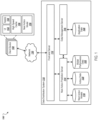
- the high speed cache 156 can store data for the applications 154, including data that has not yet been requested by a user of the client device 150.
- the applications 154 (or another dedicated application) can determine one or more predicted next actions that the user is likely to perform.
- the predicted next action(s) may be actions that have at least a threshold probability of being performed by the user.
- the application 154 can also request, from the data distribution system 110, data that will be presented if the user performs the predicted next action.
- the application 154 can transmit this request prior to the user performing the predicted next action and without human intervention.
- the application 154 can automatically determine the predicted next action in response to a trigger event (e.g., selection of a data and time range selector) and request the data in response to determining the predicted next action.
- the application 154 can store the received data in the high speed cache 156 so that the data can be presented quickly if the user subsequently performs the predicted next action.
- An application 154 can use a next action model 158 to determine a predicted next action for a user.
- the next action model 158 is application-specific.
- an application 154 may have a corresponding next action model 158 that determines a predicted next action for a user to which a user interface 152 of the application 154 is being presented.
- an application 154 may have a respective next action model 158 for each user interface 152 or for a set of user interfaces 152 generated and presented by the application 154.
- a next action model 154 may be used to determine a predicted next action for users to which the next action model's respective user interface(s) are presented.
- a next action model 158 for an application 154 can specify, for each action in a set of actions that can be performed at a user interface 152 of the application 154, the probability that the action will be performed.
- the next action model 158 may specify that a first action has a 50% probability of being performed at the user interface 152 while a second action has a 45% probability of being performed at the user interface 152.
- the application 154 may select one or more of the next actions having the highest probabilities as the predicted next action(s).
- the probabilities specified by a next action model 158 for an application 154 may be based on previous actions performed at user interfaces of the application 154.
- the rollup level of data can specify a hierarchical level at which the data is aggregated. For example, performance data can be obtained for each iteration of an event. This performance data can be aggregated for daily totals, weekly totals, monthly totals, etc. In this example, the monthly total would be at a higher rollup level than the weekly totals and the weekly totals would be at a higher rollup level than the daily totals.
- statistics can be aggregated at multiple different hierarchical levels. For example, a football player's statistics can be aggregated at a game level, a season level, and a career level. In this example, the career level would be at a higher rollup level than the season level and the season level would be at a higher level than the game level.
- the next action model(s) 158 for an application 154 can specify, for each user interface context (e.g., each set of one or more attributes of a user interface), the probability that each of a set of actions will be performed.
- the application 154 uses the next action model(s) to determine a predicted next action, the application 154 can compare the attributes of the user interface currently being presented to the user to the attributes of the user interface contexts of the appropriate next action model 158 (e.g., the next action model for the user and/or user interface or a general next action model for multiple users and/or the user interface).
- the application 154 may select a user interface context that is most similar to the current user interface. For example, the application 154 may select a user interface context that has the highest number of matching attributes between the current user interface and the user interface contexts.
- a predictive model may be converted to mappings between predicted next actions and probabilities at the client device 150.
- Each mapping can be a mapping between a respective predicted next action and a probability of the respective predicted next action occurring for a given user interface context. In this way, the application 154 can more quickly look up the probabilities in the mapping than if the application 154 had to apply the attributes of the user interface to the predictive model.
- the application 154 may use multiple next action models to determine multiple predicted next actions and obtain and store data for each of the multiple predicted next actions in the high speed cache 156 before the user performs the actions. For example, the application 154 may use a place change next action model to determine a predicted next place change action and a scope change next action model to determine a predicted next scope change action. The application 154 can then obtain and store the data for both predicted next actions in the high speed cache 156.
- the front-end server 112 can provide the requests to a data management server 116.
- the data management server 116 can obtain the appropriate data from an application data storage device 124 (e.g., hard drive(s), flash memory, etc.) and provide the data to the front-end server 112.
- the front-end server 112 can transmit the data to the client device 150 from which the request was received over the data communication network 130.
- the data management server 116 can manage the data for applications, such as the applications 154 of the client devices 150.
- the data management server 116 may receive the data from application developers, from servers that aggregate data that is displayed by the applications, or other sources and stores the data in the application data storage device 124.
- the data distribution system 110 also includes a next action prediction server 114.
- the next action prediction server 114 can generate next action models 158, update next action models 158, monitor the performance of next action models 158, and/or determine predicted next actions for applications 154.
- the application 154 can also send to the front-end server 112 action data specifying, for example, the date and time range, attributes of the particular set of data (e.g., the group to which the data belongs, type of data, account to which the data belongs, etc.), attributes of the user interface 152 at which the action was performed, the time at which the action was performed, and a unique identifier for the user or user device 150.
- the front-end server 112 can send the action data to the next action prediction server 114 and the next action prediction server 114 can store the action data in the action data storage device 120.
- the applications 154 can send the action data for each action after the action is performed and/or periodically.
- the next action prediction server 114 can generate the next action model(s) 158 for an application 154 based on the action data for the application 154 stored in the action data storage device 120.
- a next action model 158 can specify probabilities of an action being performed based on the user interface context of a user interface.
- the next action prediction server 114 can determine the probabilities for the actions based on the number of times each action occurred for each user interface context. For example, if a particular action occurred ten times when the user interface for the application 154 has a particular user interface context and a total of one hundred actions were performed at the user interface when the user interface had the particular user interface context, the probability of the particular action may be 10% (10/100).
- the next action prediction server 114 can also train predictive models using machine learning techniques using the action data stored in the action data storage device 120. For example, the next action prediction server 114 may generate Markov chains to predict next user actions based on a current user interface context.
- a Markov chain is a model that uses a sequence of possible actions in which the probability of each action depends on the state (e.g., context) of the current user interface.
- the cache hit rate for a next action model can be based on a ratio between the number of times the data required to respond to a user action for which the next action model was used to determine a predicted next action is found in the high speed cache 158 and a total number of times data is requested in response to a user action for which the next action model was used to determine a predicted next action.
- the user action latency can indicate a latency of an action as perceived by a user.
- the user action latency can indicate the latency from a time at which the user performs an action (e.g., selects a tab or submits filtering criteria) to a time at which the new or uprated data is rendered at the client device 150. This time and can be measured and aggregated (e.g., averaged) for multiple uses of a next action model to determine an aggregate user action latency for the next action model.
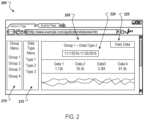
- the user interface 200 also include a date and time range selector 220 that allows a user to select a date and time range for the data that is presented in the display area 205.
- the selected date and time range is 11/1/2017-11/30/2016.
- the data presented in the display area 205 may be filtered so that only data related to the selected date and time range is presented.
- the user interface 200 can include other filtering elements such as those for filtering based on values of the data or other filtering criteria.
- the selection of a particular (or relative) date and time range may be a next action that is determined by a next action model. For example, users may often view the previous month's data when viewing data of a particular type.
- the particular type of data is an attribute of the user interface context that allows the next action model to predict that the next action will be a selection of the previous month for the data.
- the application can pre-cache the previous month's data of the particular data type, e.g., for the selected group.
- the selection of the date and time range selector 220 may be a trigger event that causes the application to determine a predicted next action.
- the system updates the user interface to present the next action data (316). For example, if the predicted next action is to navigate to a different tab and the user selected the different tab, the system may navigate the user interface to the different tab and present the next action data in the different tab. In another example, if the predicted next action is to filter data to a particular date and time range, the system may present the filtered data in the user interface.
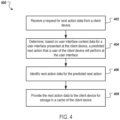
- Figure 4 is a flow chart of example process 400 for determining a predicted next action and pre-caching next action data for the predicted next action.
- Operations of the process 400 can be implemented, for example, by a system that includes one or more data processing apparatus, such as the data distribution system 110 of Figure 1 .
- the process 400 can also be implemented by instructions stored on computer storage medium, where execution of the instructions by a system that includes a data processing apparatus cause the data processing apparatus to perform the operations of the process 400.
- the system provides the next action data to the client device for storage in a cache of the client device (408).
- the client device can store the next action data in the cache. If the client device detects that the predicted next action was performed, the client device can obtain the data from the cache and present the data to the user.
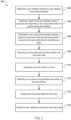
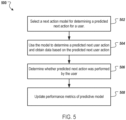
- the system selects a predicted model for determining a predicted next action for a user (502).
- the system selects the next action model based on a number of actions performed by a user at user interfaces generated and presented by an application. For example, if the user has performed less than a threshold number of actions, the system may select a general next action model generated based on actions performed by multiple users as the system may not have enough data for the user to generate a user-specific next action model for the application.
- the system uses the selected next action model to determine a predicted next user action and obtain data based on the predicted next user action (504). For example, the system may obtain data for the predicted next action from a server and store the data in a cache of a client device.
- the term "data processing apparatus” encompasses all kinds of apparatus, devices, and machines for processing data, including by way of example a programmable processor, a computer, a system on a chip, or multiple ones, or combinations, of the foregoing.
- the apparatus can include special purpose logic circuitry, e.g., an FPGA (field programmable gate array) or an ASIC (application specific integrated circuit).
- the apparatus can also include, in addition to hardware, code that creates an execution environment for the computer program in question, e.g., code that constitutes processor firmware, a protocol stack, a database management system, an operating system, a cross-platform runtime environment, a virtual machine, or a combination of one or more of them.
- the apparatus and execution environment can realize various different computing model infrastructures, such as web services, distributed computing and grid computing infrastructures.
Landscapes
- Engineering & Computer Science (AREA)
- Computer Networks & Wireless Communication (AREA)
- Signal Processing (AREA)
- Theoretical Computer Science (AREA)
- General Engineering & Computer Science (AREA)
- Physics & Mathematics (AREA)
- General Physics & Mathematics (AREA)
- Databases & Information Systems (AREA)
- Medical Informatics (AREA)
- Health & Medical Sciences (AREA)
- General Health & Medical Sciences (AREA)
- Computing Systems (AREA)
- Data Mining & Analysis (AREA)
- Human Computer Interaction (AREA)
- Mathematical Physics (AREA)
- Remote Sensing (AREA)
- Radar, Positioning & Navigation (AREA)
- Information Transfer Between Computers (AREA)
- User Interface Of Digital Computer (AREA)
Applications Claiming Priority (4)
| Application Number | Priority Date | Filing Date | Title |
|---|---|---|---|
| US15/392,894 US10356200B2 (en) | 2016-12-28 | 2016-12-28 | Optimizing user interface data caching for future actions |
| EP17731389.7A EP3482553B1 (de) | 2016-12-28 | 2017-06-07 | Optimierung der datenzwischenspeicherung einer benutzerschnittstelle d für spätere aktionen |
| EP20180328.5A EP3731499B1 (de) | 2016-12-28 | 2017-06-07 | Optimierung der datenzwischenspeicherung einer benutzerschnittstelle für spätere aktionen |
| PCT/US2017/036294 WO2018125276A1 (en) | 2016-12-28 | 2017-06-07 | Optimizing user interface data caching for future actions |
Related Parent Applications (2)
| Application Number | Title | Priority Date | Filing Date |
|---|---|---|---|
| EP20180328.5A Division EP3731499B1 (de) | 2016-12-28 | 2017-06-07 | Optimierung der datenzwischenspeicherung einer benutzerschnittstelle für spätere aktionen |
| EP17731389.7A Division EP3482553B1 (de) | 2016-12-28 | 2017-06-07 | Optimierung der datenzwischenspeicherung einer benutzerschnittstelle d für spätere aktionen |
Publications (2)
| Publication Number | Publication Date |
|---|---|
| EP4539435A2 true EP4539435A2 (de) | 2025-04-16 |
| EP4539435A3 EP4539435A3 (de) | 2025-07-16 |
Family
ID=59078214
Family Applications (3)
| Application Number | Title | Priority Date | Filing Date |
|---|---|---|---|
| EP17731389.7A Active EP3482553B1 (de) | 2016-12-28 | 2017-06-07 | Optimierung der datenzwischenspeicherung einer benutzerschnittstelle d für spätere aktionen |
| EP20180328.5A Active EP3731499B1 (de) | 2016-12-28 | 2017-06-07 | Optimierung der datenzwischenspeicherung einer benutzerschnittstelle für spätere aktionen |
| EP25159763.9A Pending EP4539435A3 (de) | 2016-12-28 | 2017-06-07 | Optimierung der datenzwischenspeicherung einer benutzerschnittstelle für zukünftige aktionen |
Family Applications Before (2)
| Application Number | Title | Priority Date | Filing Date |
|---|---|---|---|
| EP17731389.7A Active EP3482553B1 (de) | 2016-12-28 | 2017-06-07 | Optimierung der datenzwischenspeicherung einer benutzerschnittstelle d für spätere aktionen |
| EP20180328.5A Active EP3731499B1 (de) | 2016-12-28 | 2017-06-07 | Optimierung der datenzwischenspeicherung einer benutzerschnittstelle für spätere aktionen |
Country Status (7)
| Country | Link |
|---|---|
| US (3) | US10356200B2 (de) |
| EP (3) | EP3482553B1 (de) |
| JP (2) | JP6648292B2 (de) |
| KR (2) | KR102300077B1 (de) |
| CN (2) | CN108605053B (de) |
| ES (1) | ES3017065T3 (de) |
| WO (1) | WO2018125276A1 (de) |
Families Citing this family (33)
| Publication number | Priority date | Publication date | Assignee | Title |
|---|---|---|---|---|
| US10841425B1 (en) | 2014-09-16 | 2020-11-17 | United Services Automobile Association | Systems and methods for electronically predicting future customer interactions |
| US10623514B2 (en) | 2015-10-13 | 2020-04-14 | Home Box Office, Inc. | Resource response expansion |
| US10656935B2 (en) | 2015-10-13 | 2020-05-19 | Home Box Office, Inc. | Maintaining and updating software versions via hierarchy |
| US10356200B2 (en) | 2016-12-28 | 2019-07-16 | Google Llc | Optimizing user interface data caching for future actions |
| US10706433B2 (en) * | 2017-01-25 | 2020-07-07 | Mastercard International Incorporated | Individual level learning mechanism |
| US10698740B2 (en) | 2017-05-02 | 2020-06-30 | Home Box Office, Inc. | Virtual graph nodes |
| US11366872B1 (en) * | 2017-07-19 | 2022-06-21 | Amazon Technologies, Inc. | Digital navigation menus with dynamic content placement |
| US10346304B2 (en) * | 2017-07-25 | 2019-07-09 | Microsoft Technology Licensing, Llc | Cache management for multi-node databases |
| US20240070488A1 (en) * | 2019-01-10 | 2024-02-29 | Jagadeshwar Nomula | System and Method for Recommending Actions on a Device |
| US10511681B2 (en) * | 2018-03-02 | 2019-12-17 | Adobe Inc. | Establishing and utilizing behavioral data thresholds for deep learning and other models to identify users across digital space |
| US11640429B2 (en) * | 2018-10-11 | 2023-05-02 | Home Box Office, Inc. | Graph views to improve user interface responsiveness |
| US11301780B2 (en) | 2019-02-15 | 2022-04-12 | Samsung Electronics Co., Ltd. | Method and electronic device for machine learning based prediction of subsequent user interface layouts |
| KR102859994B1 (ko) | 2019-02-19 | 2025-09-15 | 삼성전자주식회사 | 어플리케이션을 프리페치하는 전자 장치 및 방법 |
| US11144179B2 (en) | 2019-04-12 | 2021-10-12 | Sap Se | Next user interaction prediction |
| GB2583718A (en) * | 2019-05-01 | 2020-11-11 | Samsung Electronics Co Ltd | Method, apparatus and computer program for updating a cluster probability model |
| WO2020226667A1 (en) * | 2019-05-06 | 2020-11-12 | Google Llc | Performing subtask(s) for a predicted action in response to a separate user interaction with an automated assistant prior to performance of the predicted action |
| EP4246507B1 (de) * | 2019-05-06 | 2025-09-10 | Google LLC | Proaktive zwischenspeicherung eines aktionsinhalts eines assistenten an einer client-vorrichtung zur ermöglichung der auflösung auf der vorrichtung von gesprochenen oder getippten äusserungen |
| CN113906501A (zh) * | 2019-05-06 | 2022-01-07 | 谷歌有限责任公司 | 在进行预测动作之前响应于与自动化助理的单独用户交互而进行预测动作的(多个)子任务 |
| KR102283779B1 (ko) * | 2019-07-18 | 2021-07-29 | 건국대학교 산학협력단 | 질의 응답 방법 및 이를 수행하는 장치들 |
| US11146656B2 (en) * | 2019-12-20 | 2021-10-12 | Tealium Inc. | Feature activation control and data prefetching with network-connected mobile devices |
| WO2021141399A1 (en) * | 2020-01-10 | 2021-07-15 | Samsung Electronics Co., Ltd. | Method and electronic device for accelerating asset execution |
| US11481111B2 (en) | 2020-04-24 | 2022-10-25 | Microsoft Technology Licensing, Llc | Utilization of predictive gesture analysis for preloading and executing application components |
| US11681466B2 (en) * | 2020-06-30 | 2023-06-20 | Western Digital Technologies, Inc. | Proactive storage operation management |
| US11915047B2 (en) | 2020-06-30 | 2024-02-27 | Western Digital Technologies, Inc. | Managing storage device compute operations |
| CN111563106A (zh) * | 2020-07-14 | 2020-08-21 | 成都市映潮科技股份有限公司 | 一种数据缓存方法、装置、系统及可读存储介质 |
| CN114402317B (zh) * | 2020-08-21 | 2025-12-16 | 谷歌有限责任公司 | 数据完整性优化 |
| WO2022108019A1 (en) | 2020-11-23 | 2022-05-27 | Samsung Electronics Co., Ltd. | Electronic device and method for optimizing user interface of application |
| CN113268201B (zh) | 2021-05-13 | 2024-10-25 | 三星(中国)半导体有限公司 | 基于文件属性的缓存管理方法和装置 |
| DE112022002891T5 (de) * | 2021-05-31 | 2024-03-28 | Sony Group Corporation | Informationsverarbeitungsvorrichtung, fernbedienungssystem und informationsverarbeitungsverfahren |
| US11886891B2 (en) * | 2021-09-10 | 2024-01-30 | Sap Se | Context-based multiexperience element dynamically generated using natural language processing |
| CN113849532A (zh) * | 2021-09-24 | 2021-12-28 | 中国第一汽车股份有限公司 | 缓存预热方法、装置、计算机设备和存储介质 |
| US12481416B2 (en) * | 2022-02-01 | 2025-11-25 | Servicenow, Inc. | Progressive refresh of user interface screens |
| US12393943B2 (en) * | 2023-10-03 | 2025-08-19 | Bank Of America Corporation | Intelligent method for real time cache updates leveraging distributed ledger technology with non-fungible token (NFT) tied system of record (SOR) update indicators |
Family Cites Families (56)
| Publication number | Priority date | Publication date | Assignee | Title |
|---|---|---|---|---|
| US5305389A (en) * | 1991-08-30 | 1994-04-19 | Digital Equipment Corporation | Predictive cache system |
| US6850252B1 (en) * | 1999-10-05 | 2005-02-01 | Steven M. Hoffberg | Intelligent electronic appliance system and method |
| US6182122B1 (en) * | 1997-03-26 | 2001-01-30 | International Business Machines Corporation | Precaching data at an intermediate server based on historical data requests by users of the intermediate server |
| US6154767A (en) * | 1998-01-15 | 2000-11-28 | Microsoft Corporation | Methods and apparatus for using attribute transition probability models for pre-fetching resources |
| US6055569A (en) | 1998-01-27 | 2000-04-25 | Go Ahead Software Inc. | Accelerating web access by predicting user action |
| US6463509B1 (en) * | 1999-01-26 | 2002-10-08 | Motive Power, Inc. | Preloading data in a cache memory according to user-specified preload criteria |
| US7966078B2 (en) * | 1999-02-01 | 2011-06-21 | Steven Hoffberg | Network media appliance system and method |
| US20050055426A1 (en) | 2000-06-12 | 2005-03-10 | Kim Smith | System, method and computer program product that pre-caches content to provide timely information to a user |
| US8516114B2 (en) * | 2002-03-29 | 2013-08-20 | International Business Machines Corporation | Method and apparatus for content pre-fetching and preparation |
| JP4497944B2 (ja) * | 2003-02-05 | 2010-07-07 | キヤノン株式会社 | 受信装置及び受信装置の制御方法 |
| JP4248529B2 (ja) * | 2003-02-25 | 2009-04-02 | パナソニック株式会社 | 移動体端末 |
| FI116168B (fi) * | 2003-03-03 | 2005-09-30 | Flextronics Odm Luxembourg Sa | Datan syöttö |
| US8112605B2 (en) * | 2005-05-02 | 2012-02-07 | Commvault Systems, Inc. | System and method for allocation of organizational resources |
| US20080301300A1 (en) | 2007-06-01 | 2008-12-04 | Microsoft Corporation | Predictive asynchronous web pre-fetch |
| WO2009057585A1 (ja) * | 2007-11-02 | 2009-05-07 | Nec Corporation | 情報端末装置及び機能利用方法 |
| US8271413B2 (en) | 2008-11-25 | 2012-09-18 | Google Inc. | Providing digital content based on expected user behavior |
| IL197196A0 (en) | 2009-02-23 | 2009-12-24 | Univ Ben Gurion | Intention prediction using hidden markov models and user profile |
| US20110029670A1 (en) | 2009-07-31 | 2011-02-03 | Microsoft Corporation | Adapting pushed content delivery based on predictiveness |
| US8364611B2 (en) * | 2009-08-13 | 2013-01-29 | Yahoo! Inc. | System and method for precaching information on a mobile device |
| KR101453743B1 (ko) * | 2010-08-16 | 2014-10-21 | 에스케이플래닛 주식회사 | 웹 어플리케이션을 위한 사전 캐싱 방법 및 이를 적용한 단말 장치 |
| US8561208B2 (en) * | 2011-05-20 | 2013-10-15 | Adobe Systems Incorporated | Secure user interface content |
| JP5805867B2 (ja) * | 2011-06-30 | 2015-11-10 | アマゾン・テクノロジーズ、インコーポレイテッド | 遠隔ブラウジングセッション管理 |
| US20130187753A1 (en) * | 2012-01-20 | 2013-07-25 | Research In Motion Limited | Predictive Context-Aware Dynamic Lock Screen |
| US9582603B1 (en) * | 2012-02-27 | 2017-02-28 | Amazon Technologies, Inc. | Managing preloading of data on client systems |
| US20130222329A1 (en) | 2012-02-29 | 2013-08-29 | Lars-Johan Olof LARSBY | Graphical user interface interaction on a touch-sensitive device |
| US9756108B2 (en) | 2012-05-29 | 2017-09-05 | Google Inc. | Preloading resources of a web page |
| US9239794B1 (en) * | 2012-06-11 | 2016-01-19 | Google Inc. | Managing a prefetch buffer with probabilistic access predictions |
| US8990143B2 (en) * | 2012-06-29 | 2015-03-24 | Intel Corporation | Application-provided context for potential action prediction |
| US9836213B2 (en) * | 2012-07-27 | 2017-12-05 | Symbol Technologies, Llc | Enhanced user interface for pressure sensitive touch screen |
| US20140053056A1 (en) * | 2012-08-16 | 2014-02-20 | Qualcomm Incorporated | Pre-processing of scripts in web browsers |
| US9058324B2 (en) * | 2012-09-28 | 2015-06-16 | Intel Corporation | Predictive precaching of data based on context |
| CN103049163B (zh) * | 2012-12-28 | 2016-12-28 | 华为技术有限公司 | 用户界面智能显示控制方法和装置 |
| US9542423B2 (en) * | 2012-12-31 | 2017-01-10 | Apple Inc. | Backup user interface |
| US9117179B2 (en) | 2013-03-11 | 2015-08-25 | International Business Machines Corporation | Predicting user activity in social media applications |
| US10949894B1 (en) * | 2013-06-07 | 2021-03-16 | Groupon, Inc. | Method, apparatus, and computer program product for facilitating dynamic pricing |
| US20140373032A1 (en) * | 2013-06-12 | 2014-12-18 | Microsoft Corporation | Prefetching content for service-connected applications |
| JP6183099B2 (ja) | 2013-09-25 | 2017-08-23 | 日本電気株式会社 | 入力支援装置、入力支援方法及び入力支援プログラム |
| US20150163258A1 (en) * | 2013-12-05 | 2015-06-11 | Facebook, Inc. | Indicating User Availability for Communication |
| US20150188981A1 (en) * | 2013-12-31 | 2015-07-02 | Huawei Technologies Co., Ltd. | Page processing method, apparatus, and system |
| US9519408B2 (en) * | 2013-12-31 | 2016-12-13 | Google Inc. | Systems and methods for guided user actions |
| US9032321B1 (en) * | 2014-06-16 | 2015-05-12 | Google Inc. | Context-based presentation of a user interface |
| US10452992B2 (en) * | 2014-06-30 | 2019-10-22 | Amazon Technologies, Inc. | Interactive interfaces for machine learning model evaluations |
| US10963810B2 (en) * | 2014-06-30 | 2021-03-30 | Amazon Technologies, Inc. | Efficient duplicate detection for machine learning data sets |
| US9621650B2 (en) * | 2014-09-30 | 2017-04-11 | Google Inc | Mobile application state identifier framework |
| CN105577707B (zh) * | 2014-10-08 | 2019-01-11 | 阿里巴巴集团控股有限公司 | 一种远程调用方法与设备 |
| US10547711B2 (en) * | 2015-03-25 | 2020-01-28 | Vmware, Inc. | Using off-screen user interface data during remote sessions |
| JP2016212595A (ja) | 2015-05-07 | 2016-12-15 | Mist Technologies株式会社 | サーバ装置、プログラム及び情報処理システム |
| US10097973B2 (en) * | 2015-05-27 | 2018-10-09 | Apple Inc. | Systems and methods for proactively identifying and surfacing relevant content on a touch-sensitive device |
| US10200824B2 (en) * | 2015-05-27 | 2019-02-05 | Apple Inc. | Systems and methods for proactively identifying and surfacing relevant content on a touch-sensitive device |
| US20160357774A1 (en) * | 2015-06-05 | 2016-12-08 | Apple Inc. | Segmentation techniques for learning user patterns to suggest applications responsive to an event on a device |
| US10264319B2 (en) * | 2015-06-07 | 2019-04-16 | Apple Inc. | Priming media applications and presenting primed media application data |
| EP3106973A1 (de) * | 2015-06-16 | 2016-12-21 | Huawei Technologies Co., Ltd. | Auf zufallsindexprädiktor für mobile vorrichtungen basierende, kontextgesteuerte, adaptive anwendungsstarter-netzbenutzer-schnittstelle |
| US10949822B2 (en) * | 2016-03-25 | 2021-03-16 | Stripe Inc. | Methods and systems for providing payment interface services using a payment platform |
| CN105955650A (zh) * | 2016-04-29 | 2016-09-21 | 努比亚技术有限公司 | 一种人机交互操作的方法和装置 |
| US10540739B2 (en) * | 2016-11-23 | 2020-01-21 | Roku, Inc. | Predictive application caching |
| US10356200B2 (en) | 2016-12-28 | 2019-07-16 | Google Llc | Optimizing user interface data caching for future actions |
-
2016
- 2016-12-28 US US15/392,894 patent/US10356200B2/en active Active
-
2017
- 2017-06-07 CN CN201780000575.5A patent/CN108605053B/zh active Active
- 2017-06-07 KR KR1020207032736A patent/KR102300077B1/ko active Active
- 2017-06-07 EP EP17731389.7A patent/EP3482553B1/de active Active
- 2017-06-07 EP EP20180328.5A patent/EP3731499B1/de active Active
- 2017-06-07 ES ES20180328T patent/ES3017065T3/es active Active
- 2017-06-07 JP JP2018542767A patent/JP6648292B2/ja active Active
- 2017-06-07 KR KR1020187023036A patent/KR102180995B1/ko active Active
- 2017-06-07 CN CN202110521354.0A patent/CN113259433B/zh active Active
- 2017-06-07 EP EP25159763.9A patent/EP4539435A3/de active Pending
- 2017-06-07 WO PCT/US2017/036294 patent/WO2018125276A1/en not_active Ceased
-
2019
- 2019-05-30 US US16/426,672 patent/US10560546B2/en active Active
- 2019-12-18 US US16/719,951 patent/US11310331B2/en active Active
-
2020
- 2020-01-14 JP JP2020003688A patent/JP6989628B2/ja active Active
Also Published As
| Publication number | Publication date |
|---|---|
| EP4539435A3 (de) | 2025-07-16 |
| EP3731499B1 (de) | 2025-03-26 |
| US20190281128A1 (en) | 2019-09-12 |
| JP2019514091A (ja) | 2019-05-30 |
| KR102180995B1 (ko) | 2020-11-19 |
| US10560546B2 (en) | 2020-02-11 |
| KR20200130523A (ko) | 2020-11-18 |
| ES3017065T3 (en) | 2025-05-12 |
| US10356200B2 (en) | 2019-07-16 |
| CN113259433A (zh) | 2021-08-13 |
| US11310331B2 (en) | 2022-04-19 |
| JP6989628B2 (ja) | 2022-01-05 |
| JP6648292B2 (ja) | 2020-02-14 |
| WO2018125276A1 (en) | 2018-07-05 |
| US20200128097A1 (en) | 2020-04-23 |
| KR102300077B1 (ko) | 2021-09-08 |
| EP3731499A1 (de) | 2020-10-28 |
| CN108605053B (zh) | 2021-05-25 |
| EP3482553A1 (de) | 2019-05-15 |
| JP2020074154A (ja) | 2020-05-14 |
| KR20180102625A (ko) | 2018-09-17 |
| CN108605053A (zh) | 2018-09-28 |
| EP3731499C0 (de) | 2025-03-26 |
| CN113259433B (zh) | 2024-01-09 |
| US20180183891A1 (en) | 2018-06-28 |
| EP3482553B1 (de) | 2020-12-23 |
Similar Documents
| Publication | Publication Date | Title |
|---|---|---|
| US11310331B2 (en) | Optimizing user interface data caching for future actions | |
| US12314273B2 (en) | Prefetching using dynamic user model to reduce latency | |
| EP3566424A1 (de) | System und verfahren zur aktualisierung von anwendungsclients unter verwendung einer vielzahl von inhaltsbereitstellungsnetzwerken | |
| KR102087330B1 (ko) | 콘텐트 획득시 사용자의 관심 레벨에 기초하는 콘텐트 아이템 디스플레이 | |
| US20170185599A1 (en) | Ranking of Search Results | |
| CN112836117B (zh) | 从内容项集合中选择内容项的方法和系统,以及介质 | |
| EP4275151B1 (de) | Transfermaschinenlernen zur attributvorhersage | |
| US20190378434A1 (en) | Change data driven tactile response | |
| US20080144653A1 (en) | Self learning performance optimized data transfer via one or several communication channels between systems | |
| JP7223164B2 (ja) | データインテグリティの最適化 |
Legal Events
| Date | Code | Title | Description |
|---|---|---|---|
| PUAI | Public reference made under article 153(3) epc to a published international application that has entered the european phase |
Free format text: ORIGINAL CODE: 0009012 |
|
| STAA | Information on the status of an ep patent application or granted ep patent |
Free format text: STATUS: THE APPLICATION HAS BEEN PUBLISHED |
|
| AC | Divisional application: reference to earlier application |
Ref document number: 3482553 Country of ref document: EP Kind code of ref document: P Ref document number: 3731499 Country of ref document: EP Kind code of ref document: P |
|
| AK | Designated contracting states |
Kind code of ref document: A2 Designated state(s): AL AT BE BG CH CY CZ DE DK EE ES FI FR GB GR HR HU IE IS IT LI LT LU LV MC MK MT NL NO PL PT RO RS SE SI SK SM TR |
|
| REG | Reference to a national code |
Ref country code: DE Ref legal event code: R079 Free format text: PREVIOUS MAIN CLASS: H04L0067568100 Ipc: H04L0067040000 |
|
| PUAL | Search report despatched |
Free format text: ORIGINAL CODE: 0009013 |
|
| AK | Designated contracting states |
Kind code of ref document: A3 Designated state(s): AL AT BE BG CH CY CZ DE DK EE ES FI FR GB GR HR HU IE IS IT LI LT LU LV MC MK MT NL NO PL PT RO RS SE SI SK SM TR |
|
| RIC1 | Information provided on ipc code assigned before grant |
Ipc: H04L 67/04 20220101AFI20250610BHEP Ipc: H04L 67/125 20220101ALI20250610BHEP Ipc: H04L 67/306 20220101ALI20250610BHEP Ipc: H04L 67/5681 20220101ALI20250610BHEP |
|
| STAA | Information on the status of an ep patent application or granted ep patent |
Free format text: STATUS: REQUEST FOR EXAMINATION WAS MADE |
|
| 17P | Request for examination filed |
Effective date: 20251107 |
|
| GRAP | Despatch of communication of intention to grant a patent |
Free format text: ORIGINAL CODE: EPIDOSNIGR1 |
|
| STAA | Information on the status of an ep patent application or granted ep patent |
Free format text: STATUS: GRANT OF PATENT IS INTENDED |
|
| INTG | Intention to grant announced |
Effective date: 20251223 |