EP4539291A1 - Steuerungssystem, hybridleistungssystem und steuerungsverfahren - Google Patents
Steuerungssystem, hybridleistungssystem und steuerungsverfahren Download PDFInfo
- Publication number
- EP4539291A1 EP4539291A1 EP23867880.9A EP23867880A EP4539291A1 EP 4539291 A1 EP4539291 A1 EP 4539291A1 EP 23867880 A EP23867880 A EP 23867880A EP 4539291 A1 EP4539291 A1 EP 4539291A1
- Authority
- EP
- European Patent Office
- Prior art keywords
- power
- value
- charging
- generator
- bus
- Prior art date
- Legal status (The legal status is an assumption and is not a legal conclusion. Google has not performed a legal analysis and makes no representation as to the accuracy of the status listed.)
- Pending
Links
Images



Classifications
-
- H—ELECTRICITY
- H02—GENERATION; CONVERSION OR DISTRIBUTION OF ELECTRIC POWER
- H02J—ELECTRIC POWER NETWORKS; CIRCUIT ARRANGEMENTS OR SYSTEMS FOR SUPPLYING OR DISTRIBUTING ELECTRIC POWER; SYSTEMS FOR STORING ELECTRIC ENERGY
- H02J3/00—Circuit arrangements for AC mains or AC distribution networks
- H02J3/28—Arrangements for balancing of the load in networks by storage of energy
- H02J3/32—Arrangements for balancing of the load in networks by storage of energy using batteries or super capacitors with converting means
-
- H—ELECTRICITY
- H02—GENERATION; CONVERSION OR DISTRIBUTION OF ELECTRIC POWER
- H02J—ELECTRIC POWER NETWORKS; CIRCUIT ARRANGEMENTS OR SYSTEMS FOR SUPPLYING OR DISTRIBUTING ELECTRIC POWER; SYSTEMS FOR STORING ELECTRIC ENERGY
- H02J2101/00—Supply or distribution of decentralised, dispersed or local electric power generation
- H02J2101/10—Dispersed power generation using fossil fuels, e.g. diesel generators
-
- H—ELECTRICITY
- H02—GENERATION; CONVERSION OR DISTRIBUTION OF ELECTRIC POWER
- H02J—ELECTRIC POWER NETWORKS; CIRCUIT ARRANGEMENTS OR SYSTEMS FOR SUPPLYING OR DISTRIBUTING ELECTRIC POWER; SYSTEMS FOR STORING ELECTRIC ENERGY
- H02J2101/00—Supply or distribution of decentralised, dispersed or local electric power generation
- H02J2101/20—Dispersed power generation using renewable energy sources
- H02J2101/22—Solar energy
- H02J2101/24—Photovoltaics
-
- H—ELECTRICITY
- H02—GENERATION; CONVERSION OR DISTRIBUTION OF ELECTRIC POWER
- H02J—ELECTRIC POWER NETWORKS; CIRCUIT ARRANGEMENTS OR SYSTEMS FOR SUPPLYING OR DISTRIBUTING ELECTRIC POWER; SYSTEMS FOR STORING ELECTRIC ENERGY
- H02J2105/00—Networks for supplying or distributing electric power characterised by their spatial reach or by the load
- H02J2105/10—Local stationary networks having a local or delimited stationary reach
-
- H—ELECTRICITY
- H02—GENERATION; CONVERSION OR DISTRIBUTION OF ELECTRIC POWER
- H02J—ELECTRIC POWER NETWORKS; CIRCUIT ARRANGEMENTS OR SYSTEMS FOR SUPPLYING OR DISTRIBUTING ELECTRIC POWER; SYSTEMS FOR STORING ELECTRIC ENERGY
- H02J3/00—Circuit arrangements for AC mains or AC distribution networks
- H02J3/38—Arrangements for feeding a single network from two or more generators or sources in parallel; Arrangements for feeding already energised networks from additional generators or sources in parallel
- H02J3/381—Dispersed generators
Definitions
- the present disclosure relates to a control system, a hybrid power system, and a control method for a micro grid system.
- the present disclosure claims priority based on Japanese Patent Application No. 2022-151162 filed in Japan on September 22, 2022 , the contents of which are incorporated herein by reference.
- a so-called microgrid system or off-grid system is disclosed in which an inverter of renewable energy or a secondary battery is connected to a bus created by an alternating current generator driven by an engine or the like, and power is supplied according to a load of the bus (for example, PTL 1).
- a technique for stably controlling the inverter connected to the bus by controlling charging/discharging of the secondary battery in accordance with variation in a frequency and power of the bus while controlling the inverter of the secondary battery as a virtual synchronous generator is disclosed.
- variation in the frequency and a voltage of the bus may be larger than that of a general large-scale system.
- the present disclosure provides a control system, a hybrid power system, and a control method capable of solving the above problems.
- a control system of the present disclosure is a control system of a power conversion device that converts direct current power output by a secondary battery into alternating current power and supplies the alternating current power to a bus and that converts alternating current power of the bus into direct current power and supplies the direct current power to the secondary battery, in a power supply system including a generator, which has unintended output variability, and the secondary battery, the control system including: a charging/discharging command unit that generates a charging/discharging command value for the secondary battery that compensates for a difference between generated power of the generator and total generated power of the power supply system; a virtual power generation calculation unit that calculates an effective voltage value and a phase of a virtual synchronous generator based on a rotor model that simulates driving of the virtual synchronous generator and that calculates a rotational speed of the virtual synchronous generator; a bus calculation unit that calculates a voltage and a phase at a connection point between the power conversion device and the bus; a phase difference angle calculation unit
- a hybrid power system of the present disclosure includes a generator having unintended output variability, a secondary battery, a power conversion device that converts direct current power output by the secondary battery into alternating current power and supplies the alternating current power to a bus, and converts alternating current power of the bus into direct current power and supplies the direct current power to the secondary battery, and the above-described control system.
- a control method of the present disclosure is a control method of a power conversion device that converts direct current power output by a secondary battery into alternating current power and supplies the alternating current power to a bus and that converts alternating current power of the bus into direct current power and supplies the direct current power to the secondary battery, in a power supply system including a generator, which has unintended output variability, and the secondary battery, the control method including: a step of generating a charging/discharging command value for the secondary battery that compensates for a difference between power generated by the generator and total generated power of the power supply system; a step of calculating an effective voltage value and a phase of a virtual synchronous generator based on a rotor model that simulates driving of the virtual synchronous generator and that calculates a rotational speed of the virtual synchronous generator; a step of calculating a voltage and a phase at a connection point between the power conversion device and the bus; a step of calculating a phase difference angle between the phase of the virtual synchronous
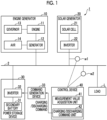
- a power supply system 1 is a hybrid power system that includes an engine generator 10, a solar generator 20, a power storage device 30, a command generation device 33, and a control device 40.
- the power supply system 1 supplies power to a load L through an autonomous operation. That is, the power supply system 1 is a so-called microgrid system or an off-grid system.
- the engine generator 10, the solar generator 20, and the power storage device 30 are connected to a bus 2, and supply power to the load L via the bus 2.
- the engine generator 10 includes an engine 11, a generator 12, a governor 13, and an automatic voltage regulator (AVR) 14.
- the engine generator 10 is an alternating current generator that generates alternating current power by driving the generator 12 with rotation of the engine 11.
- the governor 13 controls a rotational speed of the engine 11 through an Hz-kW droop characteristic.
- a governor characteristic of the engine generator 10 is represented by, for example, a slope of a linear function connecting a plot related to a rated output and a rated frequency and a plot related to a settling frequency which is settled in a no-load state where the load is cut off from a zero output and a rated output. That is, the Hz-kW droop characteristic is a characteristic in which an output decreases as a frequency increases.
- the governor characteristic may be realized by a proportional integral differential (PID) control.
- PID proportional integral differential
- the AVR 14 regulates a terminal voltage of the generator 12 by controlling a current supplied to a field magnet winding of the generator 12 through a V-kbar droop characteristic.
- the V-kbar droop characteristic is a characteristic in which ineffective power decreases as a voltage increases.
- another alternating current generator may be used instead of the engine generator 10.
- the solar generator 20 includes a solar cell 21 and an inverter 22.
- the solar cell 21 is a direct current power supply device that converts sunlight into direct current power.
- the inverter 22 converts the direct current power generated by the solar cell 21 into alternating current power.
- the inverter 22 and the solar cell 21 do not necessarily have to be provided one-to-one.
- a plurality of the solar cells 21 may be connected to one inverter 22.
- another renewable energy generator such as a wind power generator may be used.
- various generators of which output varies unintentionally may be used, not limited to renewable energy.
- a generator that is operated independently of the power supply system 1 and that generates power regardless of the intention of the power supply system 1 may be used.
- the power storage device 30 includes a secondary battery 31 and an inverter 32.
- a control command for the inverter 32 includes a target value of effective power and a target value of ineffective power.
- the inverter 32 converts the direct current power which is output (discharged) by the secondary battery 31 into alternating current power based on a command from the command generation device 33, and supplies the alternating current power to the bus 2, the alternating current power being synchronized with a voltage frequency of the bus 2.
- the inverter 32 synchronizes output power with the voltage frequency of the bus 2 via a phase lock loop (PLL) control.
- PLL phase lock loop
- the inverter 32 converts a part of the alternating current power flowing through the bus 2 into direct current power based on a control command generated by the command generation device 33 according to a command from the control device 40, and charges the secondary battery 31 using the direct current power.
- the secondary battery 31 for example, a lithium ion secondary battery may be used.
- the inverter 32 is a general-purpose current control type inverter that operates according to a control command related to an effective-ineffective power (P-Q) control.
- the inverter 32 according to another embodiment may operate according to a control command related to a target value of apparent power, a target value of a power factor angle, and a target value of a voltage frequency.
- the inverter 32 and the secondary battery 31 do not necessarily have to be provided one-to-one.
- a plurality of the secondary batteries 31 may be connected to one inverter 32.
- the command generation device 33 generates the control command for controlling the inverter 32 of the power storage device 30 based on a charging/discharging command from the control device 40, and outputs the control command to the power storage device 30.
- the command generation device 33 is a device provided separately from the power storage device 30.
- the command generation device 33 has a VSG function for causing the inverter 32 to behave like a synchronous generator.
- the power storage device 30 is controlled by using the VSG function, whereby it is possible to stabilize the system.
- Fig. 2 shows an example of a schematic configuration of the command generation device 33.
- the command generation device 33 includes a voltmeter 331 and a computer 332.
- the voltmeter 331 measures a voltage of a connection point between the inverter 32 and the bus 2.
- the computer 332 generates a control command based on a measurement value of the voltmeter 331.
- the computer 332 includes a command reception unit 3321, a measurement value acquisition unit 3322, a model storage unit 3323, a drive torque calculation unit 3324, a virtual power generation calculation unit 3325, a bus calculation unit 3326, a phase difference angle calculation unit 3327, a target power determination unit 3328, and a command generation unit 3329.
- the command reception unit 3321 receives the charging/discharging command from the control device 40.
- the charging/discharging command includes a command value of the effective power and a command value of the ineffective power.
- the measurement value acquisition unit 3322 acquires the measurement value of the voltmeter 331. That is, the measurement value acquisition unit 3322 acquires an instantaneous voltage value of the connection point.
- the model storage unit 3323 stores a mathematical model for simulating a behavior of a virtual synchronous generator. Specifically, the model storage unit 3323 stores a governor model M1 for simulating a behavior of a governor of a virtual synchronous generator and a rotor model M2 for simulating a behavior of a rotor of the virtual synchronous generator. In a case where an angular velocity of the rotor of the virtual synchronous generator and an angular velocity command value are input to the governor model M1, the governor model M1 outputs a drive torque value of the virtual synchronous generator.
- the rotor model M2 In a case where an electric torque value and the drive torque value of the virtual synchronous generator are input to the rotor model M2, the rotor model M2 outputs the angular velocity and a phase angle of the rotor of the virtual synchronous generator.
- the governor model M1 and the rotor model M2 models disclosed in PTL 1 can be applied.
- the drive torque calculation unit 3324 calculates the drive torque value of the virtual synchronous generator by inputting, to the governor model M1, a target value of the effective power determined by the target power determination unit 3328 and the angular velocity of the rotor of the virtual synchronous generator calculated by the virtual power generation calculation unit 3325 in a previous control.
- the virtual power generation calculation unit 3325 calculates the angular velocity and the phase angle of the rotor of the virtual synchronous generator by inputting, to the rotor model M2, the drive torque value calculated by the drive torque calculation unit 3324.
- the virtual power generation calculation unit 3325 calculates an effective voltage value of the virtual synchronous generator based on the phase of the rotor and on the measurement value of the voltmeter 331 acquired by the measurement value acquisition unit 3322.
- the measurement value acquisition unit 3322 calculates an effective voltage value of a frequency component of the rotor by sampling the instantaneous voltage value of the bus 2 at a frequency of the rotor with a PLL circuit and performing frequency conversion on the sampled data.
- the bus calculation unit 3326 calculates an effective voltage value and a phase of the connection point based on the measurement value of the voltmeter 331 acquired by the measurement value acquisition unit 3322. For example, the bus calculation unit 3326 calculates an effective voltage value of a fundamental wave component by sampling the instantaneous voltage value of the bus 2 at the connection point in synchronization with a fundamental wave frequency with the PLL circuit and performing frequency conversion on the sampled data. For example, the bus calculation unit 3326 calculates the phase of the connection point based on the sampling performed in synchronization with the fundamental wave frequency.
- the phase difference angle calculation unit 3327 calculates a phase difference angle as a difference between the phase of the bus 2 calculated by the bus calculation unit 3326 and the phase of the rotor of the virtual synchronous generator calculated by the virtual power generation calculation unit 3325.
- the target power determination unit 3328 determines the target value of the effective power based on the effective voltage value of the virtual synchronous generator calculated by the virtual power generation calculation unit 3325, the effective voltage value of the bus 2 calculated by the bus calculation unit 3326, and the phase difference angle calculated by the phase difference angle calculation unit 3327. Specifically, the target power determination unit 3328 determines the target value of the effective power based on the following Equation (1).
- Pvsg Vgrid ⁇ Vvsg ⁇ X ⁇ sin ⁇
- Pvsg indicates the target value of the effective power.
- Vgrid indicates the effective voltage value of the bus 2.
- Vvsg indicates the effective voltage value of the virtual synchronous generator.
- X indicates a series reactance between the virtual synchronous generator and the bus 2.
- the series reactance X is a value which is at least larger than the reactance of the virtual synchronous generator.
- ⁇ indicates the phase difference angle between the bus 2 and the virtual synchronous generator. Equation (1) is based on an equivalent circuit in which the series reactance X and the virtual synchronous generator are connected in series with respect to the bus 2.
- the target power determination unit 3328 may determine the target value of the effective power by solving a Y parameter of a two-terminal-pair circuit in which the bus 2 and the virtual synchronous generator are connected. Equation (1) is equivalent to a case where an admittance of a ⁇ -type circuit which is an equivalent circuit of the two-terminal-pair circuit is set to 0.
- the command generation unit 3329 generates the control command for the inverter 32 that includes the target value of the effective power determined by the target power determination unit 3328 and the charging/discharging command received from the control device 40 by the command reception unit 3321.
- the command generation unit 3329 outputs the generated control command to the inverter 32.
- the control device 40 monitors a power value of the bus 2 and a power value generated by the solar generator 20, and outputs the charging/discharging command to the engine generator 10 and to the power storage device 30.
- the power value of the bus 2 is the total generated power (power required by the load L) by the power supply system 1. For example, in a case where the generated power by the solar generator 20 is equal to or larger than a predetermined threshold value, such as in a daytime, the control device 40 outputs a power command to decrease the generated power by the engine generator 10 or stop power generation by the engine generator 10.
- the control device 40 In a case where the generated power by the solar generator 20 is smaller than a predetermined threshold value, such as in a night-time or in bad weather, the control device 40 outputs a power command to increase the generated power by the engine generator 10.
- the control device 40 compares the power value of the bus 2 with a demand power value according to the load L, and outputs the charging/discharging command to the power storage device 30 based on a difference in power.
- the control device 40 outputs the charging/discharging command for leveling variation in the generated power by the solar generator 20 that is unintentionally varied, to the power storage device 30.
- the control device 40 includes a measurement value acquisition unit 41 and a charging/discharging command unit 42.
- the measurement value acquisition unit 41 acquires a measurement value of the generated power (may be referred to as photovoltaic (PV) generated power) of the solar generator 20 and a measurement value of the total generated power by the power supply system 1.
- a power meter w1 that measures the generated power of the solar generator 20 is provided between the inverter 22 and the bus 2, and the measurement value acquisition unit 41 acquires the power value measured by the power meter w1.
- a power meter w2 that measures the total generated power of the power supply system 1 is provided on the bus 2, and the measurement value acquisition unit 41 acquires the power value measured by the power meter w2.
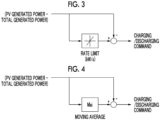
- the charging/discharging command unit 42 generates a charging/discharging command value for leveling the difference between the generated power of the solar generator 20 and the total generated power. Next, a generation method of the charging/discharging command value for the leveling (leveling processes A and B) will be described with reference to Figs. 3 and 4 .
- Fig. 3 is a first diagram showing an example of a calculation method of a charging/discharging command value according to the embodiment.
- the charging/discharging command unit 42 subtracts the measurement value of the total generated power acquired by the measurement value acquisition unit 41 at time T from the measurement value of the PV generated power acquired by the measurement value acquisition unit 41 at the time T, and calculates a difference ⁇ W(T) therebetween.
- the charging/discharging command unit 42 subtracts the measurement value of the total generated power acquired by the measurement value acquisition unit 41 at time T+ ⁇ T from the measurement value of the PV generated power acquired by the measurement value acquisition unit 41 at the time T+ ⁇ T, and calculates a difference ⁇ W(T+ ⁇ T) therebetween.
- the charging/discharging command unit 42 repeatedly calculates such a difference ⁇ W at a predetermined cycle ⁇ T, sets a limit (rate limit) on a variation amount per unit time of the calculated difference ⁇ W, and generates the charging/discharging command value for compensating for the variation amount per unit time that exceeds the rate limit.
- the rate limit is set to 1 kW/s or less. In a case where the difference ⁇ W(T) calculated at a certain time T is -10 kW, ⁇ T is 1 second, and the difference calculated after 1 second is -10 kW, the variation per second of the difference is 0 kW/s, and the variation amount per unit time of the difference ⁇ W is 1 kW/s or less.
- Fig. 4 is a second diagram showing an example of the calculation method of a charging/discharging command value according to the embodiment.
- the charging/discharging command unit 42 subtracts the measurement value of the total generated power acquired by the measurement value acquisition unit 41 at time T from the measurement value of the PV generated power acquired by the measurement value acquisition unit 41 at the time T, and calculates a difference ⁇ W(T) therebetween.
- the charging/discharging command unit 42 subtracts the measurement value of the total generated power acquired by the measurement value acquisition unit 41 at time T+ ⁇ T from the measurement value of the PV generated power acquired by the measurement value acquisition unit 41 at the time T+ ⁇ T, and calculates a difference ⁇ W(T+ ⁇ T) therebetween.
- the charging/discharging command unit 42 calculates the difference ⁇ W at the predetermined cycle ⁇ T and calculates the average (moving average) of the difference ⁇ W at the predetermined time (for example, 3 minutes). The charging/discharging command unit 42 repeats the calculation of the moving average of the difference ⁇ W and updates the value thereof. Meanwhile, the charging/discharging command unit 42 generates the charging/discharging command value based on the value obtained by subtracting the measurement value of the total generated power from the measurement value of the PV generated power and on the moving average calculated immediately before.
- the variation of the difference between the PV generated power and the total generated power is compensated.
- the charging/discharging command unit 42 may generate the charging/discharging command in consideration of a state of charge (SOC) of the secondary battery 31. For example, upper and lower limit values are set for the SOC of the secondary battery 31.
- the charging/discharging command unit 42 acquires the SOC of the secondary battery 31 at a predetermined control cycle.
- the charging/discharging command unit 42 corrects the charging/discharging command value such that charging/discharging is performed within a range of the set upper and lower limit values while calculating the charging/discharging command value with the leveling process A or the leveling process B described above, and outputs the corrected charging/discharging command value to the command generation device 33.
- the control device 40 outputs the charging/discharging command value generated by the leveling process A or by the leveling process B to the command generation device 33.
- the command reception unit 3321 receives the charging/discharging command value.
- the command generation device 33 obtains the phase and the angular velocity of the virtual synchronous generator, from the effective power command value and the angular velocity command value, based on the governor model M1 and the rotor model M2.
- the command generation device 33 obtains the effective voltage value and the phase of the bus 2 and the effective voltage value of the virtual synchronous generator, from the measurement value of the voltmeter 331.
- the command generation device 33 obtains a phase difference angle as a difference between the phase of the virtual synchronous generator and the phase of the bus 2.
- the command generation device 33 determines the target value of the effective power based on the effective voltage value of the bus 2, the effective voltage value of the virtual synchronous generator, and the phase difference angle, and generates the control command for the inverter 32 that includes the charging/discharging command value and the target value of the effective power.
- the inverter 32 is operated according to the control command generated by the command generation device 33. With this, compensation for unintended output variation of the solar generator 20 and load variation and characteristics corresponding to the virtual synchronous generator are realized.
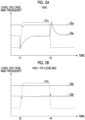
- Fig. 5A shows a transition of the voltage and the frequency of the bus 2 in a case where the output of the power supply system 1 follows the load variation by applying only the VSG function of the command generation device 33 without applying the leveling control via the charging/discharging command unit 42.
- the vertical axis of Fig. 5A indicates the magnitudes of the load, the voltage, and the frequency, and the horizontal axis indicates time.
- a graph 51a shows a transition of the load
- a graph 52a shows a transition of the voltage
- a graph 53a shows a transition of the frequency.
- Fig. 5B shows a transition of the voltage and the frequency of the bus 2 in a case where the output of the power supply system 1 follows the load variation by applying both the leveling control via the charging/discharging command unit 42 and the VSG function of the command generation device 33.
- the vertical axis of Fig. 5B indicates the magnitudes of the load, the voltage, and the frequency, and the horizontal axis indicates time.
- a graph 51b shows a transition of the load
- a graph 52b shows a transition of the voltage
- a graph 53b shows a transition of the frequency.
- the start was made from the same load as in the case of Fig. 5A , the load was increased at time t3 in the same manner as in the case of Fig.
- the effect in a case where the load is greatly varied has been described with reference to the example, but it has been confirmed that the variation in the voltage and the frequency of the bus 2 can be suppressed as in the example shown in Fig. 5B even in a case where the load is constant and the generated power of the solar generator 20 is greatly varied.
- the VSG function of the command generation device 33 adds a virtual synchronization characteristic to the inverter 32 to cope with the variation in the voltage of the bus 2 and to stabilize the system, and is not intended to cancel the load variation or the like.
- the control cycle is about 0.1 milliseconds.
- the leveling control via the charging/discharging command unit 42 is intended to level the difference between the PV generated power and the total generated power (cancel the difference), and thus can also cope with relatively large variation over a few seconds or more.
- the variation width of the bus 2 can be halved by combining the leveling control via the charging/discharging command unit 42 and the VSG function of the command generation device 33.
- the engine output cannot be raised to the rated output in view of the output variation of the engine 11 in accordance with the load variation, but the output of engine 11 can be raised to the vicinity of the rated output by reducing the load variation with the leveling control via the charging/discharging command unit 42.
- the inverter 32 is controlled by combining the process of generating the charging/discharging command value for leveling the difference between the renewable energy generated power and the total generated power via the charging/discharging command unit 42 and the process of obtaining the effective voltage value and the phase of the bus 2 from the measurement value of the instantaneous voltage value at the connection point via the command generation device 33 and determining the target value of the effective power of the inverter 32 based on the effective voltage value of the virtual synchronous generator, the voltage at the connection point, and the phase difference angle.
- the inverter 32 is controlled by combining the process of generating the charging/discharging command value for leveling the difference between the renewable energy generated power and the total generated power via the charging/discharging command unit 42 and the process of obtaining the effective voltage value and the phase of the bus 2 from the measurement value of the instantaneous voltage value at the connection point via the command generation device 33 and determining the target value of the effective power of the inverter 32 based on the effective voltage value of the virtual synchronous generator, the voltage at
- the command generation device 33 can have the configuration shown in Figs. 6 and 7 .
- the frequency of the virtual synchronous generator and the frequency of the bus 2 can be synchronized with each other.
- the inverter 32 is controlled while maintaining the phase difference angle at a synchronization timing. That is, the phase difference angle is in an offset state. Meanwhile, as the phase difference angle is closer to 0, a synchronization stability is higher, and as an absolute value of the phase difference angle is closer to ⁇ (180 degrees), a synchronization stability is lower.
- the absolute value of the phase difference angle is within ⁇ /2 (90 degrees).
- the command generation device 33 shown in Fig. 6 synchronizes the frequency of the virtual synchronous generator and the frequency of the bus 2 while making the phase difference angle close to 0.
- the command generation device 33 shown in Fig. 6 further includes a phase difference angle decreasing unit 3330 in addition to the configuration in Fig. 2 .
- the phase difference angle decreasing unit 3330 uses a proportional integral (PI) control with the phase difference angle calculated by the phase difference angle calculation unit 3327 as input to calculate a correction rotational speed for canceling the phase difference angle, and corrects the angular velocity command value by adding the correction rotational speed to the angular velocity command value received by the command reception unit 3321.
- the drive torque calculation unit 3324 calculates a drive torque based on the corrected angular velocity command value.
- the command generation device 33 in Fig. 6 corrects the target value of the rotational speed such that the phase difference angle approaches 0, and calculates the effective voltage value and the phase of the virtual synchronous generator based on the rotor model M2 and on the corrected target value of the rotational speed. Thereby, the command generation device 33 can synchronize the frequency of the virtual synchronous generator and the frequency of the bus 2 while making the phase difference angle close to 0. Therefore, the command generation device 33 can reduce a possibility that the absolute value of the phase difference angle exceeds ⁇ /2 and the system is in an unstable state due to instantaneous variation of the frequency of the bus 2.
- the command generation device 33 shown in Fig. 7 controls the inverter 32 such that the phase difference angle always remains in a stable region.
- the command generation device 33 shown in Fig. 7 further includes a limiter 3331 in addition to the configuration in Fig. 6 .
- the limiter 3331 limits the phase difference angle calculated by the phase difference angle calculation unit 3327 to a value within a range of - ⁇ /2 to + ⁇ /2.
- the target power determination unit 3328 determines the target value of the effective power of the inverter 32 based on the phase difference angle limited by the limiter 3331. Thereby, the command generation device 33 can always make the phase difference angle remain in the stable region.
- the inverter 32 can be stably controlled, and in combination with the leveling control via the charging/discharging command unit 42, the variation width of the voltage and the frequency of the bus 2 can be suppressed.
- the command generation device 33 and/or the control device 40 may be configured by a single computer, respectively.
- the configuration of the command generation device 33 and/or the control device 40 may be implemented in a plurality of computers. In this case, the plurality of computers may cooperate with each other, and thus may function as the command generation device 33.
- the configurations of the command generation device 33 and the control device 40 may be implemented in one computer.
- the solar generator 20 has been described as an example of the renewable energy power generation, but the leveling control via the charging/discharging command unit 42 of the present embodiment can also be applied to a power supply system including wind power generation, hydraulic power generation, geothermal power generation, or the like and a secondary battery without being limited to the solar power generation (or the power supply system including the solar generator 20, another renewable energy power generation, and a secondary battery).
- the leveling control via the charging/discharging command unit 42 of the present embodiment can also be applied to a power supply system including various generators having unintended output variability instead of/in addition to the solar generator 20 without being limited to the renewable energy power generation.
- Fig. 8 is a schematic block diagram showing a configuration of a computer according to the embodiment.
- a computer 90 includes a processor 91, a main memory 92, a storage 93, and an interface 94.
- Each of the command generation device 33 and the control device 40 described above is implemented in the computer 90.
- the operation of each processing unit described above is stored in the storage 93 in a form of a program.
- the processor 91 reads the program from the storage 93, loads the program into the main memory 92, and performs the above-described processes in accordance with the program.
- the processor 91 secures a storage area corresponding to each storage unit described above in the main memory 92 in accordance with the program. Examples of the processor 91 include a central processing unit (CPU), a graphic processing unit (GPU), and a microprocessor.
- CPU central processing unit
- GPU graphic processing unit
- microprocessor microprocessor
- the program may realize some of functions fulfilled by the computer 90.
- the program may fulfill the functions in combination with another program already stored in the storage or in combination with another program installed on another device.
- the computer 90 may include a custom large scale integrated circuit (LSI) such as a programmable logic device (PLD).
- LSI large scale integrated circuit
- PLDs include a programmable array logic (PAL), a generic array logic (GAL), a complex programmable logic device (CPLD), and a field-programmable gate array (FPGA).
- PAL programmable array logic
- GAL generic array logic
- CPLD complex programmable logic device
- FPGA field-programmable gate array
- some or all of the functions realized by the processor 91 may be realized by the integrated circuit.
- Such an integrated circuit is also included in an example of the processor.
- Examples of the storage 93 include a hard disk drive (HDD), a solid state drive (SSD), a magnetic disc, a magneto-optical disc, a compact disc read only memory (CD-ROM), a digital versatile disc read only memory (DVD-ROM), and a semiconductor memory.
- the storage 93 may be an internal medium directly connected to a bus of the computer 90, or may be an external medium connected to the computer 90 via the interface 94 or a communication line. When this program is distributed to the computer 90 by using the communication line, the computer 90, in which the program is distributed, may load the program in the main memory 92 and execute the above process.
- the storage 93 is a non-temporary tangible storage medium.
- the program may realize some of the foregoing functions. Further, the program may be a program that realizes the functions described above in combination with other programs already stored in the storage 93, that is, a so-called difference file (difference program).
- control system The control system, the hybrid power system, and the control method described in each embodiment are ascertained as follows, for example.
Landscapes
- Engineering & Computer Science (AREA)
- Power Engineering (AREA)
- Supply And Distribution Of Alternating Current (AREA)
Applications Claiming Priority (2)
| Application Number | Priority Date | Filing Date | Title |
|---|---|---|---|
| JP2022151162A JP2024046024A (ja) | 2022-09-22 | 2022-09-22 | 制御システム、複合発電システム及び制御方法 |
| PCT/JP2023/026388 WO2024062754A1 (ja) | 2022-09-22 | 2023-07-19 | 制御システム、複合発電システム及び制御方法 |
Publications (2)
| Publication Number | Publication Date |
|---|---|
| EP4539291A1 true EP4539291A1 (de) | 2025-04-16 |
| EP4539291A4 EP4539291A4 (de) | 2025-10-15 |
Family
ID=90454373
Family Applications (1)
| Application Number | Title | Priority Date | Filing Date |
|---|---|---|---|
| EP23867880.9A Pending EP4539291A4 (de) | 2022-09-22 | 2023-07-19 | Steuerungssystem, hybridleistungssystem und steuerungsverfahren |
Country Status (3)
| Country | Link |
|---|---|
| EP (1) | EP4539291A4 (de) |
| JP (1) | JP2024046024A (de) |
| WO (1) | WO2024062754A1 (de) |
Family Cites Families (5)
| Publication number | Priority date | Publication date | Assignee | Title |
|---|---|---|---|---|
| JP2011205824A (ja) * | 2010-03-26 | 2011-10-13 | Tokyo Electric Power Co Inc:The | 蓄電システム |
| JP6190185B2 (ja) * | 2013-07-03 | 2017-08-30 | 川崎重工業株式会社 | マイクログリッドの制御装置及びその制御方法 |
| JP7112973B2 (ja) * | 2019-02-01 | 2022-08-04 | 三菱重工エンジン&ターボチャージャ株式会社 | 指令生成装置および指令生成方法 |
| JP7324653B2 (ja) * | 2019-08-09 | 2023-08-10 | 三菱重工エンジン&ターボチャージャ株式会社 | 指令生成装置および指令生成方法 |
| JP7128927B1 (ja) | 2021-03-26 | 2022-08-31 | アンリツ株式会社 | 信号解析装置及び信号解析方法 |
-
2022
- 2022-09-22 JP JP2022151162A patent/JP2024046024A/ja active Pending
-
2023
- 2023-07-19 EP EP23867880.9A patent/EP4539291A4/de active Pending
- 2023-07-19 WO PCT/JP2023/026388 patent/WO2024062754A1/ja not_active Ceased
Also Published As
| Publication number | Publication date |
|---|---|
| EP4539291A4 (de) | 2025-10-15 |
| JP2024046024A (ja) | 2024-04-03 |
| WO2024062754A1 (ja) | 2024-03-28 |
Similar Documents
| Publication | Publication Date | Title |
|---|---|---|
| US20150092462A1 (en) | Control circuit and control method for inverter circuit, and control circuit and control method for power conversion circuit | |
| US12107426B2 (en) | Power conversion device | |
| US12224658B2 (en) | Power conversion device | |
| US12407166B2 (en) | Distributed power supply management device | |
| US12166427B2 (en) | Power conversion device including an inverter control circuit that controls a phase of an AC voltage target value | |
| US12149082B2 (en) | Command generation device and command generation method | |
| Karaki et al. | Frequency and voltage restoration for droop controlled AC microgrids | |
| EP4038712A1 (de) | Verfahren und systeme zur leistungsverwaltung in einem mikronetz | |
| US11735925B2 (en) | Command generation device and command generation method | |
| EP3907842B1 (de) | Kombistromversorgungssystem im autonomen betrieb | |
| US12266943B2 (en) | Command generation device and command generation method in multiple power generation power supply system | |
| JP7708480B2 (ja) | 系統形成型電力変換装置、系統形成型電力システム、系統形成型電力変換方法、及びプログラム | |
| EP4539291A1 (de) | Steuerungssystem, hybridleistungssystem und steuerungsverfahren | |
| US20250125745A1 (en) | Power conversion device and power conversion system | |
| TWI870907B (zh) | 電力轉換裝置、電力轉換方法及記錄媒體 | |
| WO2025079180A9 (ja) | 分散電源管理装置および配電系統 |
Legal Events
| Date | Code | Title | Description |
|---|---|---|---|
| STAA | Information on the status of an ep patent application or granted ep patent |
Free format text: STATUS: THE INTERNATIONAL PUBLICATION HAS BEEN MADE |
|
| PUAI | Public reference made under article 153(3) epc to a published international application that has entered the european phase |
Free format text: ORIGINAL CODE: 0009012 |
|
| STAA | Information on the status of an ep patent application or granted ep patent |
Free format text: STATUS: REQUEST FOR EXAMINATION WAS MADE |
|
| 17P | Request for examination filed |
Effective date: 20250108 |
|
| AK | Designated contracting states |
Kind code of ref document: A1 Designated state(s): AL AT BE BG CH CY CZ DE DK EE ES FI FR GB GR HR HU IE IS IT LI LT LU LV MC ME MK MT NL NO PL PT RO RS SE SI SK SM TR |
|
| REG | Reference to a national code |
Ref country code: DE Ref legal event code: R079 Free format text: PREVIOUS MAIN CLASS: H02J0003380000 Ipc: H02J0003320000 |
|
| A4 | Supplementary search report drawn up and despatched |
Effective date: 20250912 |
|
| RIC1 | Information provided on ipc code assigned before grant |
Ipc: H02J 3/32 20060101AFI20250908BHEP Ipc: H02J 3/38 20060101ALI20250908BHEP |
|
| DAV | Request for validation of the european patent (deleted) | ||
| DAX | Request for extension of the european patent (deleted) |