EP4539155A1 - Herstellungsverfahren für natriumionenbatterie-positivelektrodenmaterial und verwendung des natriumionenbatterie-positivelektrodenmaterials - Google Patents
Herstellungsverfahren für natriumionenbatterie-positivelektrodenmaterial und verwendung des natriumionenbatterie-positivelektrodenmaterials Download PDFInfo
- Publication number
- EP4539155A1 EP4539155A1 EP23833294.4A EP23833294A EP4539155A1 EP 4539155 A1 EP4539155 A1 EP 4539155A1 EP 23833294 A EP23833294 A EP 23833294A EP 4539155 A1 EP4539155 A1 EP 4539155A1
- Authority
- EP
- European Patent Office
- Prior art keywords
- ion battery
- sodium
- cathode material
- sodium ion
- preparation
- Prior art date
- Legal status (The legal status is an assumption and is not a legal conclusion. Google has not performed a legal analysis and makes no representation as to the accuracy of the status listed.)
- Pending
Links
Images


Classifications
-
- H—ELECTRICITY
- H01—ELECTRIC ELEMENTS
- H01M—PROCESSES OR MEANS, e.g. BATTERIES, FOR THE DIRECT CONVERSION OF CHEMICAL ENERGY INTO ELECTRICAL ENERGY
- H01M4/00—Electrodes
- H01M4/02—Electrodes composed of, or comprising, active material
- H01M4/36—Selection of substances as active materials, active masses, active liquids
- H01M4/362—Composites
- H01M4/364—Composites as mixtures
-
- C—CHEMISTRY; METALLURGY
- C01—INORGANIC CHEMISTRY
- C01B—NON-METALLIC ELEMENTS; COMPOUNDS THEREOF; METALLOIDS OR COMPOUNDS THEREOF NOT COVERED BY SUBCLASS C01C
- C01B25/00—Phosphorus; Compounds thereof
- C01B25/16—Oxyacids of phosphorus; Salts thereof
- C01B25/26—Phosphates
- C01B25/45—Phosphates containing plural metal, or metal and ammonium
-
- H—ELECTRICITY
- H01—ELECTRIC ELEMENTS
- H01M—PROCESSES OR MEANS, e.g. BATTERIES, FOR THE DIRECT CONVERSION OF CHEMICAL ENERGY INTO ELECTRICAL ENERGY
- H01M10/00—Secondary cells; Manufacture thereof
- H01M10/05—Accumulators with non-aqueous electrolyte
- H01M10/054—Accumulators with insertion or intercalation of metals other than lithium, e.g. with magnesium or aluminium
-
- H—ELECTRICITY
- H01—ELECTRIC ELEMENTS
- H01M—PROCESSES OR MEANS, e.g. BATTERIES, FOR THE DIRECT CONVERSION OF CHEMICAL ENERGY INTO ELECTRICAL ENERGY
- H01M4/00—Electrodes
- H01M4/02—Electrodes composed of, or comprising, active material
- H01M4/36—Selection of substances as active materials, active masses, active liquids
- H01M4/58—Selection of substances as active materials, active masses, active liquids of inorganic compounds other than oxides or hydroxides, e.g. sulfides, selenides, tellurides, halogenides or LiCoFy; of polyanionic structures, e.g. phosphates, silicates or borates
- H01M4/5825—Oxygenated metallic salts or polyanionic structures, e.g. borates, phosphates, silicates, olivines
-
- H—ELECTRICITY
- H01—ELECTRIC ELEMENTS
- H01M—PROCESSES OR MEANS, e.g. BATTERIES, FOR THE DIRECT CONVERSION OF CHEMICAL ENERGY INTO ELECTRICAL ENERGY
- H01M4/00—Electrodes
- H01M4/02—Electrodes composed of, or comprising, active material
- H01M4/62—Selection of inactive substances as ingredients for active masses, e.g. binders, fillers
- H01M4/624—Electric conductive fillers
- H01M4/625—Carbon or graphite
-
- C—CHEMISTRY; METALLURGY
- C01—INORGANIC CHEMISTRY
- C01P—INDEXING SCHEME RELATING TO STRUCTURAL AND PHYSICAL ASPECTS OF SOLID INORGANIC COMPOUNDS
- C01P2002/00—Crystal-structural characteristics
- C01P2002/70—Crystal-structural characteristics defined by measured X-ray, neutron or electron diffraction data
- C01P2002/72—Crystal-structural characteristics defined by measured X-ray, neutron or electron diffraction data by d-values or two theta-values, e.g. as X-ray diagram
-
- C—CHEMISTRY; METALLURGY
- C01—INORGANIC CHEMISTRY
- C01P—INDEXING SCHEME RELATING TO STRUCTURAL AND PHYSICAL ASPECTS OF SOLID INORGANIC COMPOUNDS
- C01P2004/00—Particle morphology
- C01P2004/01—Particle morphology depicted by an image
- C01P2004/03—Particle morphology depicted by an image obtained by SEM
-
- H—ELECTRICITY
- H01—ELECTRIC ELEMENTS
- H01M—PROCESSES OR MEANS, e.g. BATTERIES, FOR THE DIRECT CONVERSION OF CHEMICAL ENERGY INTO ELECTRICAL ENERGY
- H01M4/00—Electrodes
- H01M4/02—Electrodes composed of, or comprising, active material
- H01M2004/026—Electrodes composed of, or comprising, active material characterised by the polarity
- H01M2004/028—Positive electrodes
-
- Y—GENERAL TAGGING OF NEW TECHNOLOGICAL DEVELOPMENTS; GENERAL TAGGING OF CROSS-SECTIONAL TECHNOLOGIES SPANNING OVER SEVERAL SECTIONS OF THE IPC; TECHNICAL SUBJECTS COVERED BY FORMER USPC CROSS-REFERENCE ART COLLECTIONS [XRACs] AND DIGESTS
- Y02—TECHNOLOGIES OR APPLICATIONS FOR MITIGATION OR ADAPTATION AGAINST CLIMATE CHANGE
- Y02E—REDUCTION OF GREENHOUSE GAS [GHG] EMISSIONS, RELATED TO ENERGY GENERATION, TRANSMISSION OR DISTRIBUTION
- Y02E60/00—Enabling technologies; Technologies with a potential or indirect contribution to GHG emissions mitigation
- Y02E60/10—Energy storage using batteries
Definitions
- the present disclosure relates to the technical field of sodium ion batteries, and in particular to a preparation method for a sodium ion battery cathode material, and application of the sodium ion battery cathode material.
- Lithium-ion batteries As the representative of second-generation batteries with the best comprehensive performance at present, the commercialization of lithium-ion batteries can be traced back to the 1990s. Lithium-ion batteries, after years of research, have developed into a mature battery technology route. However, limited by the crustal abundance of lithium, it is difficult for lithium-ion batteries to support the increasing energy storage market. Sodium ion battery has the similar operating principle to the lithium-ion battery, and sodium salt is rich in reserves and simple to mine, so the sodium ion battery has more advantages in large-scale application in the field of subsequent energy storage.
- the sodium ion battery is mainly composed of a cathode, an anode, electrolyte, a diaphragm, and accessory components.
- Cathode and anode materials are the key to affect the performance of a sodium ion battery system, and the cathode material is particularly prominent.
- Sodium ion battery cathode materials are divided into three categories: transition metal oxide, Prussian white/blue, and polyanion type.
- the polyanionic sodium ion battery cathode material has the advantages of stable structure and small volume change during charging and discharging.
- an iron-based sodium battery has the advantages of the lowest cost and non-toxicity, sodium iron pyrophosphate phosphate (Na 4 Fe 3 (PO 4 ) 2 P 2 O 7 ) is the most potential cathode material in the iron-based sodium battery, which has the advantages of low cost, environmental friendliness, high theoretical capacity (129 mAh/g), excellent cycle performance, and low volume expansion (about 4%).
- a high-temperature solid-state method using grinding-spraying-sintering process route is the most effective production method for preparing a second-generation battery cathode material.
- the sodium iron pyrophosphate phosphate is prepared using this process route, the raw materials used are mixed unevenly at the microscopic level, leading to the generation of impurities such as sodium iron phosphate and sodium iron pyrophosphate, which makes the crystal phase purity of the prepared cathode material lower.
- the above shortcomings seriously limit the subsequent application of the sodium iron pyrophosphate phosphate cathode material.
- the present disclosure is intended to at least solve one of the technical problems in the prior art.
- a preparation method for a sodium ion battery cathode material and application of the sodium ion battery cathode material are provided.
- the sodium ion battery cathode material prepared by the preparation method has high crystal phase purity, higher compaction density, and higher energy density. Meanwhile, the technical process of the preparation method is simple, and suitable for large-scale industrial production.
- a preparation method for a sodium ion battery cathode material including the following steps: dispersing a sodium source compound, iron hydrogen phosphate hydrate and a carbon source compound in water according to a certain proportion, and stirring and mixing to obtain a dispersion solution; sand-grinding the dispersion solution in a sand mill for a certain period of time to obtain slurry; drying the sanded slurry to obtain a powdery precursor; and sintering and pulverizing the powdery precursor to obtain a sodium ion battery cathode material.
- the sodium source compound is one or more of sodium formate, sodium acetate, sodium citrate, sodium oxalate, sodium chloride, sodium nitrate, and sodium sulfate.
- the carbon source compound is one or more of vaseline, stearic acid, sucrose, ascorbic acid, formaldehyde, acetaldehyde, n-butyraldehyde, lactic acid, citric acid, malic acid, oxalic acid, adipic acid, soluble starch, glucose, polyethylene glycol, maltose, cyclodextrin, carbon nanotubes, acetylene black, and graphene.
- a sand-grinding mode of the sand mill includes one of a disc type, a rod pin type, and a turbine type.
- a particle size of the sanded slurry is controlled at 0.1 ⁇ m ⁇ DN50 ⁇ 5 ⁇ m.
- a preparation method for a sodium ion battery cathode material and application of the sodium ion battery cathode material are provided by the embodiments of the present disclosure.
- the preparation method is used for preparing the sodium ion battery cathode material with high crystal phase purity, higher compaction density, and high energy density.
- the sodium ion battery cathode material is a sodium iron pyrophosphate phosphate cathode material, a chemical formula of which is Na 4 Fe 3 (PO 4 ) 2 P 2 O 7 .
- a sodium ion battery prepared based on the sodium ion battery cathode material has good battery cycle performance and stability.
- the sodium source compound may be one or more of sodium formate, sodium acetate, sodium citrate, sodium oxalate, sodium chloride, sodium nitrate, and sodium sulfate.
- the obtained powdery precursor is placed in a nitrogen atmosphere, the temperature is increased to 500°C at 2 °C/min, and then is kept for 18 h. After the material is cooled and pulverized, the Na 4 Fe 3 (PO 4 ) 2 P 2 O 7 sodium ion battery cathode material 7 is obtained.
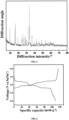
- FIG. 3 is an XRD pattern of Na 4 Fe 3 (PO 4 ) 2 P 2 O 7 cathode material prepared according to this embodiment.
- a button-type half cell is assembled in a glove box with water oxygen content less than 0.01 ppm.
- a test result is shown in FIG. 4 , when a current density is 0.1 C, and a voltage ranges from 2.0 V to 4.0 V, the discharge capacity reaches 109.7 mAh/g.
- the sodium ion battery cathode material prepared in this embodiment is a Na 4 Fe 3 (PO 4 ) 2 P 2 O 7 cathode material
- the method includes the following steps: 1 mol of iron hydrogen phosphate hydrate and 4 mol of sodium chloride are weighed and dispersed in deionized water, glucose with the mass accounting for 30% of the addition mass of the iron hydrogen phosphate hydrate is weighed and added into the deionized water, then a dispersion solution is obtained after stirring and mixing.
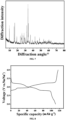
- FIG. 5 is an XRD pattern of a Na 4 Fe 3 (PO 4 ) 2 P 2 O 7 cathode material prepared according to this embodiment.
- the Na 4 Fe 3 (PO 4 ) 2 P 2 O 7 cathode material prepared by this embodiment, acetylene black and PVDF are mixed and homogenized by adding an appropriate amount of NMP according to a mass ratio of 70: 20: 10, black slurry is coated on an aluminum foil using a 150 ⁇ m four-sided preparation machine, and then the film is vacuum-dried in a vacuum drying oven at 110°C for 6 h. The dried electrode film is punched into a disc with the same radius by a punching machine, which is a positive electrode plate.
- the Na 4 Fe 3 (PO 4 ) 2 P 2 O 7 cathode material prepared by this embodiment, acetylene black and PVDF are mixed and homogenized by adding an appropriate amount of NMP according to a mass ratio of 70: 20: 10, black slurry is coated on an aluminum foil using a 150 ⁇ m four-sided preparation machine, and then the film is vacuum-dried in a vacuum drying oven at 110°C for 6 h. The dried electrode film is punched into a disc with the same radius by a punching machine, which is a positive electrode plate.
- a button-type half cell is assembled in a glove box with water oxygen content less than 0.01 ppm.
- a test result is shown in FIG. 8 , when a current density is 0.1 C, and a voltage ranges from 2.0 V to 4.0 V, the discharge capacity reaches 110.5 mAh/g.
Landscapes
- Chemical & Material Sciences (AREA)
- Electrochemistry (AREA)
- General Chemical & Material Sciences (AREA)
- Chemical Kinetics & Catalysis (AREA)
- Engineering & Computer Science (AREA)
- Inorganic Chemistry (AREA)
- Organic Chemistry (AREA)
- Crystallography & Structural Chemistry (AREA)
- Materials Engineering (AREA)
- Manufacturing & Machinery (AREA)
- Composite Materials (AREA)
- Secondary Cells (AREA)
- Battery Electrode And Active Subsutance (AREA)
Applications Claiming Priority (2)
| Application Number | Priority Date | Filing Date | Title |
|---|---|---|---|
| CN202311113969.5A CN117012937A (zh) | 2023-08-29 | 2023-08-29 | 一种钠离子电池正极材料的制备方法和应用 |
| PCT/CN2023/134736 WO2025043913A1 (zh) | 2023-08-29 | 2023-11-28 | 一种钠离子电池正极材料的制备方法和应用 |
Publications (2)
| Publication Number | Publication Date |
|---|---|
| EP4539155A1 true EP4539155A1 (de) | 2025-04-16 |
| EP4539155A4 EP4539155A4 (de) | 2026-04-22 |
Family
ID=88576220
Family Applications (1)
| Application Number | Title | Priority Date | Filing Date |
|---|---|---|---|
| EP23833294.4A Pending EP4539155A4 (de) | 2023-08-29 | 2023-11-28 | Herstellungsverfahren für natriumionenbatterie-positivelektrodenmaterial und verwendung des natriumionenbatterie-positivelektrodenmaterials |
Country Status (5)
| Country | Link |
|---|---|
| EP (1) | EP4539155A4 (de) |
| JP (1) | JP7850514B2 (de) |
| KR (1) | KR102919005B1 (de) |
| CN (1) | CN117012937A (de) |
| WO (1) | WO2025043913A1 (de) |
Families Citing this family (4)
| Publication number | Priority date | Publication date | Assignee | Title |
|---|---|---|---|---|
| CN117012937A (zh) * | 2023-08-29 | 2023-11-07 | 湖北融通高科先进材料集团股份有限公司 | 一种钠离子电池正极材料的制备方法和应用 |
| CN117550577A (zh) * | 2023-11-14 | 2024-02-13 | 欧赛新能源科技股份有限公司 | 一种含钠正极材料及其制备方法和应用 |
| CN120518050B (zh) * | 2025-07-25 | 2025-10-03 | 四川大学 | 复合磷酸铁钠正极材料、前驱体及其制备方法、钠离子电池 |
| CN120749152B (zh) * | 2025-08-15 | 2026-01-02 | 湖南丰日电源电气股份有限公司 | 长循环聚阴离子正极材料及其制备方法与钠离子电池 |
Family Cites Families (13)
| Publication number | Priority date | Publication date | Assignee | Title |
|---|---|---|---|---|
| CN101327921B (zh) * | 2007-06-20 | 2010-05-26 | 中南大学 | 磷酸铁锂系复合材料的制备方法 |
| WO2014098937A1 (en) * | 2012-12-21 | 2014-06-26 | Dow Global Technologies Llc | Lmfp cathode materials with improved electrochemical performance |
| JP2016533629A (ja) * | 2013-09-30 | 2016-10-27 | ダウ グローバル テクノロジーズ エルエルシー | 改善された電気化学性能を有するlmfpカソード材料 |
| CN112768673B (zh) * | 2021-02-04 | 2022-06-03 | 武汉大学 | 一种Na4Fe3-x(PO4)2P2O7/C钠离子电池正极材料及其制备方法和应用 |
| CN113060714B (zh) * | 2021-02-25 | 2022-03-18 | 湖北万润新能源科技股份有限公司 | 一种从FePO4液相制备Na4Fe3(PO4)2(P2O7)的方法 |
| CN113871565B (zh) | 2021-09-22 | 2023-05-26 | 雅迪科技集团有限公司 | 钠离子电池 |
| CN114620702A (zh) * | 2022-03-14 | 2022-06-14 | 湖北万润新能源科技股份有限公司 | 正极材料的制备方法、正极材料、正极片和钠离子电池 |
| CN114914413B (zh) * | 2022-04-25 | 2024-03-26 | 湖南钠邦新能源有限公司 | 一种碳包覆氟磷酸亚铁钠材料及其制备和在钠离子电池中的应用 |
| CN114944478B (zh) | 2022-05-26 | 2024-06-07 | 蜂巢能源科技股份有限公司 | 钠离子电池正极材料及其制备方法和应用 |
| CN115133023B (zh) * | 2022-07-26 | 2026-03-17 | 乐普钠电(上海)技术有限公司 | 一种掺杂改性焦磷酸铁钠正极材料的制备方法 |
| CN115611258B (zh) * | 2022-12-20 | 2023-04-07 | 四川易纳能新能源科技有限公司 | 一种钠离子电池正极材料Na3Fe2(PO4)P2O7的制备方法 |
| CN116621148A (zh) * | 2023-05-26 | 2023-08-22 | 深圳珈钠能源科技有限公司 | 钠离子电池金属基磷酸盐类正极材料的制备方法 |
| CN117012937A (zh) * | 2023-08-29 | 2023-11-07 | 湖北融通高科先进材料集团股份有限公司 | 一种钠离子电池正极材料的制备方法和应用 |
-
2023
- 2023-08-29 CN CN202311113969.5A patent/CN117012937A/zh active Pending
- 2023-11-28 EP EP23833294.4A patent/EP4539155A4/de active Pending
- 2023-11-28 WO PCT/CN2023/134736 patent/WO2025043913A1/zh active Pending
- 2023-11-28 KR KR1020247000129A patent/KR102919005B1/ko active Active
- 2023-11-28 JP JP2023576019A patent/JP7850514B2/ja active Active
Also Published As
| Publication number | Publication date |
|---|---|
| JP7850514B2 (ja) | 2026-04-23 |
| WO2025043913A1 (zh) | 2025-03-06 |
| EP4539155A4 (de) | 2026-04-22 |
| KR102919005B1 (ko) | 2026-01-28 |
| CN117012937A (zh) | 2023-11-07 |
| JP2025531961A (ja) | 2025-09-29 |
| KR20250034001A (ko) | 2025-03-10 |
Similar Documents
| Publication | Publication Date | Title |
|---|---|---|
| KR102746786B1 (ko) | 다중 탄소 코팅 인산망간철리튬의 제조 방법 | |
| EP4506306A1 (de) | Herstellungsverfahren für lithiumeisenmanganphosphat, anodenelektrodenmaterial und lithium-ionen-batterie | |
| EP4539155A1 (de) | Herstellungsverfahren für natriumionenbatterie-positivelektrodenmaterial und verwendung des natriumionenbatterie-positivelektrodenmaterials | |
| EP4057390A1 (de) | Kohlenstoffbeschichtetes lithiumreiches oxid-verbundmaterial und herstellungsverfahren dafür | |
| CN115312768B (zh) | 正极补锂复合添加剂及其制备方法和应用 | |
| CN115911610B (zh) | 一种正极补锂材料、制备方法及其应用 | |
| US20240336493A1 (en) | Prelithiation reagent for lithium-ion battery (lib), and preparation method therefor and use thereof | |
| US20250132349A1 (en) | Cathode lithium-supplementing additive and preparation method and application thereof | |
| CN116470021A (zh) | 一种磷酸盐正极材料、制备方法及锂电池应用 | |
| CN116314795B (zh) | 一种聚阴离子型钠离子电池正极材料的制备方法 | |
| US20260008691A1 (en) | Pure-phase polyanionic sulfate sodium ion battery positive electrode material and preparation method therefor | |
| CN116936770A (zh) | 一种钠离子电池正极材料的制备方法和应用 | |
| CN116666626A (zh) | 一种钠离子正极材料及其制备方法和应用 | |
| CN114171729A (zh) | 一种石墨烯基磷酸铁锂正极材料的制备方法 | |
| CN116598483A (zh) | 一种正极材料、极片及其锂离子电池的制备与应用 | |
| CN117199350A (zh) | 一种磷酸锰铁锂正极材料及其制备方法和应用 | |
| CN119943945A (zh) | 正极活性材料及制备方法、正极极片、钠离子电池和装置 | |
| CN119008934A (zh) | 钠电正极材料及其制备方法与应用 | |
| CN116093291B (zh) | 正极材料及其制备方法、锂离子电池 | |
| CN106025182A (zh) | 一种钛铬掺杂氟化铁-碳纳米复合正极材料及其制备方法和应用 | |
| CN117525352A (zh) | 一种非化学计量比的聚阴离子正极材料、制备方法及应用 | |
| CN110085854B (zh) | 一种磷酸钒锂正极材料及其制备方法 | |
| CN114843477A (zh) | 一种多晶结构的超高镍正极材料及其制备方法和应用 | |
| CN119108537A (zh) | 一种聚阴离子型钠离子电池正极材料 | |
| CN118943360A (zh) | 普鲁士蓝类正极材料及其制备方法、正极极片、二次电池和用电装置 |
Legal Events
| Date | Code | Title | Description |
|---|---|---|---|
| STAA | Information on the status of an ep patent application or granted ep patent |
Free format text: STATUS: UNKNOWN |
|
| STAA | Information on the status of an ep patent application or granted ep patent |
Free format text: STATUS: THE INTERNATIONAL PUBLICATION HAS BEEN MADE |
|
| PUAI | Public reference made under article 153(3) epc to a published international application that has entered the european phase |
Free format text: ORIGINAL CODE: 0009012 |
|
| STAA | Information on the status of an ep patent application or granted ep patent |
Free format text: STATUS: REQUEST FOR EXAMINATION WAS MADE |
|
| 17P | Request for examination filed |
Effective date: 20240110 |
|
| AK | Designated contracting states |
Kind code of ref document: A1 Designated state(s): AL AT BE BG CH CY CZ DE DK EE ES FI FR GB GR HR HU IE IS IT LI LT LU LV MC ME MK MT NL NO PL PT RO RS SE SI SK SM TR |
|
| A4 | Supplementary search report drawn up and despatched |
Effective date: 20260320 |
|
| RIC1 | Information provided on ipc code assigned before grant |
Ipc: H01M 4/36 20060101AFI20260316BHEP Ipc: H01M 4/58 20100101ALI20260316BHEP Ipc: C01B 25/45 20060101ALI20260316BHEP Ipc: H01M 10/054 20100101ALI20260316BHEP |