EP4538255A2 - Verfahren zur herstellung von essigsäure - Google Patents
Verfahren zur herstellung von essigsäure Download PDFInfo
- Publication number
- EP4538255A2 EP4538255A2 EP25158821.6A EP25158821A EP4538255A2 EP 4538255 A2 EP4538255 A2 EP 4538255A2 EP 25158821 A EP25158821 A EP 25158821A EP 4538255 A2 EP4538255 A2 EP 4538255A2
- Authority
- EP
- European Patent Office
- Prior art keywords
- stream
- acetic acid
- equal
- iodide
- column
- Prior art date
- Legal status (The legal status is an assumption and is not a legal conclusion. Google has not performed a legal analysis and makes no representation as to the accuracy of the status listed.)
- Pending
Links
Images
Classifications
-
- B—PERFORMING OPERATIONS; TRANSPORTING
- B01—PHYSICAL OR CHEMICAL PROCESSES OR APPARATUS IN GENERAL
- B01D—SEPARATION
- B01D3/00—Distillation or related exchange processes in which liquids are contacted with gaseous media, e.g. stripping
- B01D3/14—Fractional distillation or use of a fractionation or rectification column
- B01D3/143—Fractional distillation or use of a fractionation or rectification column by two or more of a fractionation, separation or rectification step
-
- B—PERFORMING OPERATIONS; TRANSPORTING
- B01—PHYSICAL OR CHEMICAL PROCESSES OR APPARATUS IN GENERAL
- B01D—SEPARATION
- B01D3/00—Distillation or related exchange processes in which liquids are contacted with gaseous media, e.g. stripping
- B01D3/14—Fractional distillation or use of a fractionation or rectification column
- B01D3/32—Other features of fractionating columns ; Constructional details of fractionating columns not provided for in groups B01D3/16 - B01D3/30
-
- B—PERFORMING OPERATIONS; TRANSPORTING
- B01—PHYSICAL OR CHEMICAL PROCESSES OR APPARATUS IN GENERAL
- B01D—SEPARATION
- B01D3/00—Distillation or related exchange processes in which liquids are contacted with gaseous media, e.g. stripping
- B01D3/42—Regulation; Control
- B01D3/4205—Reflux ratio control splitter
-
- C—CHEMISTRY; METALLURGY
- C07—ORGANIC CHEMISTRY
- C07C—ACYCLIC OR CARBOCYCLIC COMPOUNDS
- C07C51/00—Preparation of carboxylic acids or their salts, halides or anhydrides
- C07C51/09—Preparation of carboxylic acids or their salts, halides or anhydrides from carboxylic acid esters or lactones
-
- C—CHEMISTRY; METALLURGY
- C07—ORGANIC CHEMISTRY
- C07C—ACYCLIC OR CARBOCYCLIC COMPOUNDS
- C07C51/00—Preparation of carboxylic acids or their salts, halides or anhydrides
- C07C51/10—Preparation of carboxylic acids or their salts, halides or anhydrides by reaction with carbon monoxide
- C07C51/12—Preparation of carboxylic acids or their salts, halides or anhydrides by reaction with carbon monoxide on an oxygen-containing group in organic compounds, e.g. alcohols
-
- C—CHEMISTRY; METALLURGY
- C07—ORGANIC CHEMISTRY
- C07C—ACYCLIC OR CARBOCYCLIC COMPOUNDS
- C07C51/00—Preparation of carboxylic acids or their salts, halides or anhydrides
- C07C51/42—Separation; Purification; Stabilisation; Use of additives
- C07C51/43—Separation; Purification; Stabilisation; Use of additives by change of the physical state, e.g. crystallisation
- C07C51/44—Separation; Purification; Stabilisation; Use of additives by change of the physical state, e.g. crystallisation by distillation
-
- C—CHEMISTRY; METALLURGY
- C07—ORGANIC CHEMISTRY
- C07C—ACYCLIC OR CARBOCYCLIC COMPOUNDS
- C07C53/00—Saturated compounds having only one carboxyl group bound to an acyclic carbon atom or hydrogen
- C07C53/08—Acetic acid
Definitions
- This invention relates to processes for producing acetic acid and, in particular, to improved processes for controlling the water concentration and the hydrogen iodide concentration fed to the drying column.
- the carbonylation catalyst contains a metal catalyst, such as rhodium, which is either dissolved or otherwise dispersed in a liquid reaction medium or supported on an inert solid, along with a halogen-containing catalyst promoter as exemplified by methyl iodide.
- the reaction is conducted by continuously bubbling carbon monoxide gas through a liquid reaction medium in which the catalyst is dissolved.
- Methanol and carbon monoxide are fed to a reactor as feedstocks.
- a portion of the reaction medium is continuously withdrawn and provided to a flash vessel where the product is flashed and sent as a vapor to a purification train.
- the purification train includes a light ends column which removes "light" or low boiling components as an overhead and provides a side stream for further purification.
- the purification train may further include columns to dehydrate the side stream or for removing "heavy" or high boiling components, such as propionic acid, from the side stream. It is desirable in a carbonylation process for making acetic acid to minimize the number of distillation operations to minimize energy usage in the process.
- U.S. Pat. No. 5,416,237 discloses a process for the production of acetic acid by carbonylation of methanol in the presence of a rhodium catalyst, methyl iodide, and an iodide salt stabilizer.
- the improvement according to the '237 patent resides in maintaining a finite concentration of water up to about 10 wt.% and a methyl acetate concentration of at least 2 wt.% in the liquid reaction composition and recovering the acetic acid product by passing the liquid reaction composition through a flash zone to produce a vapor fraction which is passed to a single distillation column from which the acetic acid product is removed.
- the drawback of eliminating distillation stages is that the level of purity of the product suffers. In particular, the distillation columns tend to remove high boiling iodides as well as aldehyde contamination products. Both of these impurities impact the commercial desirability of the final product.
- US Pat. No. 9,006,483 discloses a production process of acetic acid that seeks to inhibit concentration of hydrogen iodide and improves a liquid-liquid separation of an overhead from a distillation column.
- Acetic acid is produced by distilling a mixture containing hydrogen iodide, water, acetic acid and methyl acetate in a first distillation column to form an overhead and a side cut stream or bottom stream containing acetic acid, cooling and condensing the overhead in a condenser to form separated upper and lower phases in a decanter.
- a zone having a high water concentration is formed in the distillation column above the feed position of the mixture by feeding a mixture having a water concentration of not less than an effective amount to not more than 5% by weight (e.g., 0.5 to 4.5% by weight) and a methyl acetate concentration of 0.5 to 9% by weight (e.g., 0.5 to 8% by weight) as the mixture to the distillation column and distilling the mixture.
- a mixture having a water concentration of not less than an effective amount to not more than 5% by weight e.g., 0.5 to 4.5% by weight
- a methyl acetate concentration 0.5 to 9% by weight
- US Pat. No. 7,884,241 discloses a mixture containing hydrogen iodide and water and having a water content of not more than 5% by weight (particularly not more than 3% by weight) in a distillation system that is distilled to prevent condensation of hydrogen iodide in the distillation system.
- the mixture may comprise hydrogen iodide, water, methanol, methyl iodide, acetic acid, and methyl acetate.
- an acetic acid product having a concentration of hydrogen iodide of not more than 50 ppm can be obtained by withdrawing a fraction containing hydrogen iodide from the top of the column and withdrawing acetic acid as a side-cut stream or a stream from the bottom of the column.
- Such a process effectively inhibits condensation of hydrogen iodide in the distillation system and corrosion in the distillation system. To keep water concentrations low, this process requires a large reflux of 2.35, which is energy intensive.
- US Pat. No. 6,657,078 discloses a low energy process for producing acetic acid by the carbonylation of methanol.
- the process involves a rhodium-catalyzed system operated at less than about 14 wt.% water utilizing up to 2 distillation columns.
- US Pat. No. 4,008,131 discloses a method for removal of excess water which tends to build up in recycle streams and reduces the rate of pure acid production during operation of a distillation system for purification of crude acetic acid containing water and methyl iodide.
- the crude acid is introduced into the upper half of a distillation zone.
- the methyl iodide, a major proportion of water and an equivalent amount of acid are removed overhead from the zone.
- a minor proportion of the water containing a small amount of acetic acid is removed as a liquid sidedraw at a point near the top of the distillation zone.
- a product acid stream essentially dry and substantially free of methyl iodide is removed from the bottom of the distillation zone.
- the overhead stream can be stored, disposed of or preferably recycled to the acid-producing step.
- the liquid water sidedraw may either be discarded or subjected to rectification for recovery of acid values.
- US Pat. No. 3,791,935 discloses a process by introducing a monocarboxylic acid stream containing water and the halogen contaminant into the upper half of a distillation column, removing an overhead fraction consisting primarily of the water and alkyl halide charged to said column, removing a stream from the middle portion of said column containing a major proportion of hydrogen halide present in said column, and removing a product acid stream from at or near the bottom of said column, the product acid stream being essentially dry and substantially free of the halogen contaminants charged to said column.
- the method is particularly applicable to the removal of water and iodine-containing compounds from acetic and propionic acids.
- the bottoms product that contains acetic acid is reported to contain from 83 to 132 wppm water and 0.083 wppm to 0.3 wppm hydrogen iodide.
- the side stream may further comprise one or more C 1 -C 14 alkyl iodides in an concentration from 0.1 to 6 wt.%, and the side stream further comprises methyl acetate in an concentration from 0.1 to 6 wt.%.
- the side stream comprises each of the one or more C 1 -C 14 alkyl iodides and the methyl acetate in an amount ⁇ 0.9 wt.% of the water concentration in the side stream.
- the reaction medium may further comprise methyl acetate, a metal catalyst, an iodide salt and methyl iodide.
- the reaction medium comprises methyl acetate in an amount from 0.5 to 30 wt.%, a metal catalyst in an amount from 200 to 3000 wppm, iodide salt in an amount from 1 to 25 wt.%, and methyl iodide in an amount from 1 to 25 wt.%.
- a portion of the heavy liquid phase is treated to remove at least one permanganate reducing compound selected from the group consisting of acetaldehyde, acetone, methyl ethyl ketone, butylaldehyde, crotonaldehyde, 2-ethyl crotonaldehyde, 2-ethyl butyraldehyde, and the aldol condensation products thereof.
- the process may involve refluxing the heavy liquid phase, the light liquid phase, or a mixture thereof to the first column.
- the first column is operated with a reflux ratio from 0.05 to 0.4.
- the process may further comprise recycling the aqueous overhead, or a condensed portion thereof, to the reactor, wherein the recycle ratio of the mass flow of the light liquid phase recycled to the reactor to the mass flow of the aqueous overhead to the reactor is less than or equal to 2.
- water, methyl acetate, or a combination thereof is not introduced to the vapor stream or to the first column.
- the process may further comprise contacting the purified acetic acid product with a guard bed when total iodide concentration of the purified acetic acid product is less than or equal to 5 wppm.
- the recycle of light liquid phase is from 0 to 20%, of the total light phase condensed from the low boiling overhead vapor stream.
- the present invention provides methods for controlling the water concentration in the side stream between two columns in acetic acid recovery process.
- the side stream primarily comprises acetic acid produced by carbonylation.
- the hydrogen iodide concentration may also be regulated to reduce the amount of hydrogen iodide that is forwarded from a light ends column or first column to a drying column or second column for subsequent acetic acid recovery.
- the water concentration may be controlled by the recycle rate of the light liquid phase recovered from the first column to the reactor. In one embodiment, 0 to 20% of the total light liquid phase condensed from the low boiling overhead vapor stream is recycled and the remainder may be used as a reflux on the light ends column or fed to an acetaldehyde reduction system.
- a change in the reflux ratio may also affect the recycle rate. Reducing the hydrogen iodide fed to the second column helps to reduce the total iodide concentration in the second column and ultimately the purified acetic acid product.
- a low total iodide concentration, e.g., less than or equal to 5 wppm, or less than or equal to 1 wppm, in the purified acetic acid product allows for removal of iodide by using a guard bed. This greatly improves the quality of the purified acetic acid product.
- a process for producing acetic acid comprising separating a reaction medium formed in a reactor in a flash vessel to form a liquid recycle and a vapor product stream, distilling the vapor product stream in a first column to obtain a side stream and a low boiling overhead vapor stream comprising water in an amount of greater than or equal to 5 wt.%, condensing the low boiling overhead vapor stream and biphasically separating the condensed stream to form a heavy liquid phase and a light liquid phase, maintaining a water concentration in the side stream from 1 to 3 wt.%, e.g., preferably from 1.1 to 2.5 wt.%, and a hydrogen iodide concentration in the side stream in an amount of less than or equal to 50 wppm, e.g., preferably from 0.1 to 50 wppm, by controlling a recycle rate of the light liquid phase to the reactor, and distilling the side stream in a second column to obtain a purified acetic acid product.
- a process for producing acetic acid comprising separating a reaction medium formed in a reactor in a flash vessel to form a liquid recycle and a vapor product stream, wherein the reaction medium comprises water in an amount from 0.1 to 4.1 wt.%, distilling a portion of the vapor product stream in a first column to obtain a side stream, a low boiling overhead vapor stream comprising water in an amount of greater than or equal to 5 wt.%, and a residuum stream comprising acetic acid in an amount greater than or equal to 95 wt.% and water in an amount less than or equal to 5 wt.%, condensing the low boiling overhead vapor stream and biphasically separating the condensed stream to form a heavy liquid phase and a light liquid phase, maintaining a water concentration in the side stream from 1 to 3 wt.% and a hydrogen iodide concentration in the side stream of less than or equal to 50 wppm, e.g.
- the hydrogen iodide concentration in the side stream may be measured to control the recycle rate of the light liquid phase.
- a process for producing acetic acid comprising separating a reaction medium formed in a reactor in a flash vessel to form a liquid recycle and a vapor product stream, distilling the vapor product stream in a first column to obtain a side stream and a low boiling overhead vapor stream, condensing the low boiling overhead vapor stream and biphasically separating the condensed stream to form a heavy liquid phase and a light liquid phase, measuring hydrogen iodide concentration in the side stream, controlling recycle rate of the light liquid phase to the reactor in response to the measured hydrogen iodide to maintain hydrogen iodide concentration in the side stream of less than or equal to 50 wppm, and distilling the side stream in a second column to obtain a purified acetic acid product.
- a process for producing acetic acid comprising separating a reaction medium formed in a reactor in a flash vessel to form a liquid recycle and a vapor product stream, distilling the vapor product stream in a first column to obtain a low boiling overhead vapor stream and a side stream comprising water in an amount from 1 to 3 wt.%, one or more C 1 -C 14 alkyl iodides in an amount from 0.1 to 6 wt.%, and hydrogen iodide in an amount of less than or equal to 50 wppm, distilling the side stream in a second column to obtain a purified acetic acid product, and contacting the purified acetic acid product with a guard bed when total iodide concentration of the purified acetic acid product is less than or equal to 5 wppm, e.g., less than or equal to 1 wppm.
- the present invention may also maintain stable amount of C 1 -C 14 alkyl iodides and methyl acetate relative to the water concentration.
- the concentration of the one or more C 1 -C 14 alkyl iodides and the concentration of methyl acetate is within the range of ⁇ 0.9% of the water concentration in the side stream, e.g., ⁇ 0.7%, ⁇ 0.6%, ⁇ 0.5%, ⁇ 0.4%, ⁇ 0.3%, ⁇ 0.2%, or ⁇ 0.1%.
- the concentration of C 1 -C 14 alkyl iodides is from 1.6 to 3.4 wt.%
- the concentration of methyl acetate is from 1.6 to 3.4 wt.%. This may be achieved by controlling a recycle rate of a portion of the light liquid phase to the reactor.
- controlling the recycle rate of a portion of the light liquid phase to the reactor may achieve a stable concentration of methyl iodide in the side stream within the range of ⁇ 0.6% of the water concentration in the side stream, e.g., ⁇ 0.5%, ⁇ 0.4%, ⁇ 0.3%, ⁇ 0.2%, or ⁇ 0.1%.
- a process for producing acetic acid comprising separating a reaction medium formed in a reactor in a flash vessel to form a liquid recycle and a vapor product stream, wherein the reaction medium comprises water in an amount from 0.1 to 4.1 wt.% and methyl acetate in an amount of less than or equal to 9 wt.%, distilling a portion of the vapor product stream in a first column to obtain a side stream comprising acetic acid, water, hydrogen iodide, one or more C 1 -C 14 alkyl iodides, and methyl acetate, a low boiling overhead vapor stream comprising water in an amount of greater than or equal to 5 wt.%, and a residuum stream comprising acetic acid in an amount greater than or equal to 95 wt.% and water in an amount less than or equal to 5 wt.%, condensing the low boiling overhead vapor stream and biphasically separating the condensed stream to form a
- the concentration of the components, in particular water and hydrogen iodide, in the side stream between two columns may be maintained within certain concentration limits.
- the recycle of the light liquid phase results in a side stream comprising water in an amount from 1 to 3 wt.%, e.g., from 1 to 2.5 wt.% and more preferably from 1.1 to 2.1 wt.%.
- the concentration of water in the side stream is maintained at greater than or equal to 1 wt.%, or greater than or equal to 1.1 wt.%, or greater than or equal to 1.3 wt.%, or greater than or equal to 1.5 wt.%, or greater than or equal to 2 wt.%, and/or in embodiments, the concentration of water in the side stream is maintained at less than or equal to 3 wt.%, or less than or equal to 2.8 wt.%, or less than or equal to 2.5 wt.%, or less than or equal to 2.1 wt.%.
- a water concentration within this range maintains a certain amount of hydrogen iodide of less than or equal to 50 wppm in the side stream, e.g., from 0.1 to 50 wppm hydrogen iodide, or from 5 to 30 wppm hydrogen iodide.
- the concentration of hydrogen iodide in the side stream is maintained at less than or equal to 50 wppm, or less than or equal to 45 wppm, or less than or equal to 40 wppm, or less than or equal to 35 wppm, or less than or equal to 30 wppm, and/or in embodiments, the concentration of hydrogen iodide in the side stream is maintained at greater than or equal to 0.1 wppm, or greater than or equal to 1 wppm, or greater than or equal to 5 wppm, or greater than or equal to 10 wppm.
- Controlling the recycle rate of the liquid light phase to maintain the water concentration in the side stream as described above also maintains certain water concentrations in the overhead and bottoms in the first column.
- the concentration of water in the overhead is maintained at greater than or equal to 5 wt.%, or greater than or equal to 10 wt.%, or greater than or equal to 15 wt.%, or greater than or equal to 20 wt.%, or greater than or equal to 25 wt.%, and/or in embodiments, the concentration of water in the overhead is maintained at less than or equal to 80 wt.%, or less than or equal to 75 wt.%, or less than or equal to 70 wt.%, or less than or equal to 60 wt.%.
- the concentration of water in the bottoms is maintained at less than or equal to 5 wt.%, or less than or equal to 4.5 wt.%, or less than or equal to 4 wt.%, or less than or equal to 3.5 wt.%, or greater than or equal to 3 wt.%, and/or in embodiments, the concentration of water in the bottoms is maintained at greater than or equal to 0 wt.%, or greater than or equal to 0.5 wt.%, or greater than or equal to 1 wt.%, or greater than or equal to 1.5 wt.%.
- Hydrogen iodide is soluble in acetic acid-water mixtures containing water in an amount from 3 to 8 wt.% and the solubility of hydrogen iodide decreases as the water concentration decreases. This makes hydrogen iodide more volatile and thus, in some embodiments, hydrogen iodide may be collected in the overhead of the column. Although hydrogen iodide has been indicated by others to be corrosive, a certain amount of hydrogen iodide under some conditions may be beneficial to act as a catalyst, such as a catalyst for forming dimethyl ether as described in US Pat. No. 7,223,883 , the entire contents and disclosures of which are incorporated by reference.
- the control of the recycle of the liquid light phase is an improvement over other processes that maintain concentrations of the vapor product feeding the first column, such as those described in US Pat. No. 9,006,483 .
- the present invention advantageously improves control for any type of feed without having to introduce additional components into the first column or maintain concentrations in a vapor product feed.
- the present invention does not feed water or methyl acetate into the first column or the feed source, i.e. vapor stream, into the first column.
- US Pat. No. 9,006,483 fails to control the light liquid phase recycle to the reactor and thus cannot independently control the water and hydrogen iodide concentration in the side stream.
- the side stream comprises acetic acid in amount of greater than or equal to 90 wt.%, e.g., greater than or equal to 94 wt.% or greater than or equal to 96 wt.%.
- the acetic acid concentration may be in an amount from 90 to 99 wt.%, e.g., from 91 to 98 wt.%. This allows a majority of the acetic acid fed to the first column to be withdrawn in the side stream for further purification.
- acetic acid is not recovered as a product in the overhead or bottoms of the first column.
- the side stream may also comprise one or more C 1 -C 14 alkyl iodides in an amount from 0.1 to 6 wt.%, e.g., from 0.5 to 5 wt.%, from 0.6 to 4 wt.%, from 0.7 to 3.7 wt.%, or from 0.8 to 3.6 wt.%.
- the one or more C 1 -C 14 alkyl iodides at least comprise methyl iodide.
- Other alkyl iodides such as hexyl iodide may also be formed from carbonyl impurities such as acetaldehyde.
- the side stream comprises one or more C 1 -C 14 alkyl iodides in an amount from 0.5 to 3 wt.%. Due to the presence of water, the side stream may also contain methyl acetate in an amount from 0.1 to 6 wt.%, e.g., from 0.5 to 5 wt.%, from 0.6 to 4 wt.%, from 0.7 to 3.7 wt.%, or from 0.8 to 3.6 wt.%.
- impurities such as C 1 -C 14 alkyl iodides, namely methyl iodide, and methyl acetate in the side stream based on the water concentration.
- iodide ion concentration may be calculated by subtracting the iodide ion concentration derived from the iodide salt form (including iodides derived from co-catalysts and metal iodide) from the total concentration of iodide ion (I - ).
- Such indirect calculation techniques are typically inaccurate, resulting in a poor indication of actual hydrogen iodide concentration owing largely to the inaccuracies of the underlying ion measurement methods.
- this indirect calculation technique fails to account for other iodide forms because metal cations are measured and incorrectly assumed to be completely associated only with iodide anions while, in fact, the metal cations may be associated with other anions, such as acetate and catalyst anions.
- the direct measurement of hydrogen iodide concentration according to the present invention advantageously reflects the actual hydrogen iodide concentration in the system, and can result in accuracy as low as 0.01%.
- the hydrogen iodide concentration in the side stream may be determined by potentiometric titration using lithium acetate as the titrant.
- the recycle rate of the light liquid phase may be controlled. For example, when the hydrogen iodide concentration exceeds a determined threshold of 50 wppm, the recycle rate of the light liquid phase may be increased. Once the hydrogen iodide concentration is below the determined threshold of 50 wppm, the recycle rate of the light liquid phase may be maintained and/or decreased as desired to also maintain water concentrations in an amount from 1 to 3 wt.%. As described herein, the recycle rate of the light liquid phase is the amount being recycled as compared to the amount of light liquid phase being refluxed.
- the light liquid phase may be recycled directly to the carbonylation reactor or indirectly by first removing an impurity, such as a carbonyl compound, prior to recycling to the reactor.
- Carbonylation reactor 105 is preferably either a mechanically stirred vessel, a vessel with an educted or pump-around mixing, or bubble-column type vessel, with or without an agitator, within which the reacting liquid or slurry contents are maintained, preferably automatically, at a predetermined level, which preferably remains substantially constant during normal operation.
- a mechanically stirred vessel a vessel with an educted or pump-around mixing, or bubble-column type vessel, with or without an agitator, within which the reacting liquid or slurry contents are maintained, preferably automatically, at a predetermined level, which preferably remains substantially constant during normal operation.
- fresh methanol, carbon monoxide, and sufficient water are continuously introduced as needed to maintain suitable concentrations in the reaction medium.
- the metal catalyst may comprise a Group VIII metal.
- Suitable Group VIII catalysts include rhodium and/or iridium catalysts.
- the rhodium catalyst may be added in any suitable form such that rhodium is in the catalyst solution as an equilibrium mixture including [Rh(CO) 2 I 2 ]-anion, as is well known in the art.
- Iodide salts optionally maintained in the reaction mixtures of the processes described herein may be in the form of a soluble salt of an alkali metal or alkaline earth metal, quaternary ammonium, phosphonium salt or mixtures thereof.
- the catalyst co-promoter is lithium iodide, lithium acetate, or mixtures thereof.
- the components of the reaction medium are maintained within defined limits to ensure sufficient production of acetic acid.
- the reaction medium contains a concentration of the metal catalyst, e.g., rhodium catalyst, in an amount from 200 to 3000 wppm, e.g., from 800 to 3000 wppm, or from 900 to 1500 wppm.
- the concentration of water in the reaction medium is maintained to be less than or equal to 14 wt.%, e.g., from 0.1 wt.% to 14 wt.%, from 0.2 wt.% to 10 wt.% or from 0.25 wt.% to 5 wt.%.
- the reaction is conducted under low water conditions and the reaction medium contains water in an amount from 0.1 to 4.1 wt.%, e.g., from 0.1 to 3.1 wt.% or from 0.5 to 2.8 wt.%.
- the concentration of methyl iodide in the reaction medium is maintained to be from 1 to 25 wt.%, e.g., from 5 to 20 wt.%, from 4 to 13.9 wt.%.
- the concentration of iodide salt, e.g., lithium iodide, in the reaction medium is maintained to be from 1 to 25 wt.%, e.g., from 2 to 20 wt.%, from 3 to 20 wt.%.
- the concentration of methyl acetate in the reaction medium is maintained to be from 0.5 to 30 wt.%, e.g., from 0.3 to 20 wt.%, from 0.6 to 9 wt.%, or from 0.6 to 4.1 wt.%.
- the following amounts are based on the total weight of the reaction medium.
- the concentration of acetic acid in the reaction medium is generally greater than or equal to 30 wt.%, e.g., greater than or equal to 40 wt.% or greater than or equal to 50 wt.%.
- the process for producing acetic acid further includes introducing a lithium compound into the reactor to maintain the concentration of lithium acetate in an amount from 0.3 to 0.7 wt.% in the reaction medium.
- an amount of the lithium compound is introduced into the reactor to maintain the concentration of hydrogen iodide in an amount from 0.1 to 1.3 wt.% in the reaction medium.
- the lithium compound introduced into the reactor is selected from the group consisting of lithium acetate, lithium carboxylates, lithium carbonates, lithium hydroxide, other organic lithium salts, and mixtures thereof.
- the lithium compound is soluble in the reaction medium.
- lithium acetate dihydrate may be used as the source of the lithium compound.
- Lithium acetate reacts with hydrogen iodide according to the following equilibrium reaction (I) to form lithium iodide and acetic acid: LiOAc + HI ⁇ LiI + HOAc (I)
- Lithium acetate is thought to provide improved control of hydrogen iodide concentration relative to other acetates, such as methyl acetate, present in the reaction medium.
- lithium acetate is a conjugate base of acetic acid and thus reactive toward hydrogen iodide via an acid - base reaction. This property is thought to result in an equilibrium of the reaction (I) which favors reaction products over and above that produced by the corresponding equilibrium of methyl acetate and hydrogen iodide. This improved equilibrium is favored by water concentrations of less than or equal to 4.1 wt.% in the reaction medium.
- the concentration of lithium acetate in the reaction medium is maintained at greater than or equal to 0.3 wt.%, or greater than or equal to 0.35 wt.%, or greater than or equal to 0.4 wt.%, or greater than or equal to 0.45 wt.%, or greater than or equal to 0.5 wt.%, and/or in embodiments, the concentration of lithium acetate in the reaction medium is maintained at less than or equal to 0.7 wt.%, or less than or equal to 0.65 wt.%, or less than or equal to 0.6 wt.%, or less than or equal to 0.55 wt.%.
- the lithium compound may be introduced continuously or intermittently into the reaction medium. In embodiments, the lithium compound is introduced during reactor start up. In embodiments, the lithium compound is introduced intermittently to replace entrainment losses.
- the desired reaction rates are obtained even at low water concentrations by maintaining in the reaction medium an ester of the desired carboxylic acid and an alcohol, desirably the alcohol used in the carbonylation, and an additional iodide ion that is over and above the iodide ion that is present as hydrogen iodide.
- a desired ester is methyl acetate.
- the additional iodide ion is desirably an iodide salt, with lithium iodide (LiI) being preferred. It has been found, as described in U.S. Pat. No. 5,001,259 , that under low water concentrations, methyl acetate and lithium iodide act as rate promoters only when relatively high concentrations of each of these components are present and that the promotion is higher when both of these components are present simultaneously.
- the reaction medium may also contain impurities that should be controlled to avoid byproduct formation.
- One impurity in the reaction medium may be ethyl iodide, which is carbonylated to propionic acid.
- ethyl iodide which is carbonylated to propionic acid.
- the formation of ethyl iodide may be affected by numerous variables, including the concentration of acetaldehyde, ethyl acetate, methyl acetate and methyl iodide in the reaction medium.
- ethanol content in the methanol source, hydrogen partial pressure and hydrogen content in the carbon monoxide source have been discovered to affect ethyl iodide concentration in the reaction medium and, consequently, propionic acid concentration in the final acetic acid product.
- the ethyl iodide concentration in the reaction medium and propionic acid in the acetic acid product may be present in a weight ratio from 3:1 to 1:2.
- the acetaldehyde:ethyl iodide concentration in the reaction medium is maintained at a weight ratio from 2:1 to 20:1.
- the concentration of ethyl iodide in the reaction medium is maintained/controlled to be less than or equal to 750 wppm, or e.g., less than or equal to 650 wppm, or less than or equal to 550 wppm, or less than or equal to 450 wppm, or less than or equal to 350 wppm.
- the concentration of ethyl iodide in the reaction medium is maintained/controlled at greater than or equal to 1 wppm, or e.g., 5 wppm, or 10 wppm, or 20 wppm, or 25 wppm, and less than or equal to 650 wppm, or e.g., 550 wppm, or 450 wppm, or 350 wppm.
- the weight ratio of acetaldehyde to ethyl iodide in the reaction medium may range from 20:1 to 2:1, or e.g., from 15:1 to 2:1 or from 9:1 to 2:1.
- vapor product stream 112 comprises acetic acid, methyl iodide, methyl acetate, water, acetaldehyde, and hydrogen iodide. In one embodiment, vapor product stream 112 comprises acetic acid in an amount from 45 to 75 wt.%, methyl iodide in an amount from 20 to 50 wt.%, methyl acetate in an amount of less than or equal to 9 wt.%, and water in an amount of less than or equal to 15 wt.%, based on the total weight of the vapor product stream.
- vapor product stream 112 comprises acetic acid in an amount from 45 to 75 wt.%, methyl iodide in an amount from 24 to less than or equal to 36 wt.%, methyl acetate in an amount of less than or equal to 9 wt.%, and water in an amount of less than or equal to 15 wt.%, based on the total weight of the vapor product stream. More preferably, vapor product stream 112 comprises acetic acid in an amount from 55 to 75 wt.%, methyl iodide in an amount from 24 to 35 wt.%, methyl acetate in an amount from 0.5 to 8 wt.%, and water in an amount from 0.5 to 14 wt.%.
- vapor product stream 112 comprises acetic acid in an amount from 60 to 70 wt.%, methyl iodide in an amount from 25 to 35 wt.%, methyl acetate in an amount from 0.5 to 6.5 wt.%, and water in an amount from 1 to 8 wt.%.
- the acetaldehyde concentration in the vapor product stream may be in an amount from 0.005 to 1 wt.%, based on the total weight of the vapor product stream, e.g., from 0.01 to 0.8 wt.%, or from 0.01 to 0.7 wt.%.
- Vapor product stream 112 may comprise hydrogen iodide in an amount less than or equal to 1 wt.%, based on the total weight of the vapor product stream, e.g., less than or equal to 0.5 wt.%, or less than or equal to 0.1 wt.%. Vapor product stream 112 is preferably substantially free of, i.e., contains less than or equal to 0.0001 wt.%, propionic acid, based on the total weight of the vapor product stream.
- Liquid recycle stream 111 comprises acetic acid, the metal catalyst, corrosion metals, as well as other various compounds.
- liquid recycle stream comprises acetic acid in an amount from 60 to 90 wt.%, metal catalyst in an amount from 0.01 to 0.5 wt.%, corrosion metals (e.g., nickel, iron and chromium) in a total amount from 10 to 2500 wppm, lithium iodide in an amount from 5 to 20 wt.%, methyl iodide in an amount from 0.5 to 5 wt.%, methyl acetate in an amount from 0.1 to 5 wt.%, water in an amount from 0.1 to 8 wt.%, acetaldehyde in an amount of less than or equal to 1 wt.% (e.g., from 0.0001 to 1 wt.% acetaldehyde), and hydrogen iodide in an amount of less than or equal to 0.5 wt.% (e.g., from 0.000
- vapor product stream 112 also comprises methyl iodide, methyl acetate, water, and PRC's, e.g., acetaldehyde and crotonaldehyde.
- Dissolved gases exiting reactor 105 and entering flash vessel 110 comprise a portion of the carbon monoxide and may also contain gaseous by-products such as methane, hydrogen, and carbon dioxide. Such dissolved gases exit flash vessel 110 as part of the vapor product stream 112.
- carbon monoxide in gaseous purge stream 106 may be fed to the base of flash vessel 110 to enhance rhodium stability.
- distillation and recovery of acetic acid is not particularly limited for the purposes of the present invention.
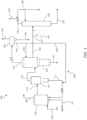
- vapor product stream 112 is directed to a first column 120, also referred to as a light ends column.
- vapor product stream 112 may comprise acetic acid, methyl acetate, water, methyl iodide, and acetaldehyde, along with other impurities such as hydrogen iodide and crotonaldehyde, and byproducts such as propionic acid. Distillation yields a low-boiling overhead vapor stream 122, a purified acetic acid product that preferably is removed via a side stream 123, and a high boiling residue stream 121.
- low-boiling overhead vapor stream 122 may also comprise methyl acetate, methyl iodide, and carbonyl impurities, which are preferably concentrated in the overhead to be removed from acetic acid in side stream 123. These carbonyl impurities may also be referred to herein as PRC's.
- the density of the heavy liquid phase 134 may be from 1.3 to 2, e.g., from 1.5 to 1.8, from 1.5 to 1.75 or from 1.55 to 1.7. As described in U.S. Pat. No. 6,677,480 , the measured density in the heavy liquid phase 134 may correlate to the methyl acetate concentration in the reaction medium. As density decreases, the methyl acetate concentration in the reaction medium increases. In one embodiment of the present invention, heavy liquid phase 134 is recycled to the reactor and the light liquid phase 133 is controlled to be recycled through the same pump.
- a portion of the heavy liquid phase 134 may be treated to remove impurities such as acetaldehyde.
- the water concentration in the light liquid phase 133 is larger than the heavy liquid phase 134 and thus the present invention can control the side stream water concentration through the recycle of the light liquid phase.
- the concentration of water and hydrogen iodide is controlled in side stream 123 by the recycle rate of light liquid phase 133 to reactor 105 via line 136.
- the reflux ratio (meaning herein as the mass flow rate of the reflux divided by the total mass flow exiting the top of the column 120, including both heavy phase 134 which may be fully recycled and light phase 133) to the first column of the light liquid phase 133 via line 135 preferably is from 0.05 to 0.4, e.g., from 0.1 to 0.35 or from 0.15 to 0.3.
- the number of theoretical trays above the side stream and top of first column may be greater than or equal to 5, e.g., preferably greater than or equal to 10.
- the recycle of light liquid phase in line 136 back to reactor 105 is up to or equal to 20%, e.g., up to or equal to 10%, of the total light liquid phase 133 condensed from the column overhead (reflux plus recycle).
- the recycle of light liquid phase in line 136 may be from 0 to 20% e.g., from 0.1 to 20%, from 0.5 to 20%, from 1 to 15%, or from 1 to 10%, of the total light liquid phase 133 condensed from the low boiling overhead vapor stream (reflux plus recycle).
- a flow valve (not shown) and/or flow monitor (not shown) may be used to control the reflux in line 135 and recycle in line 136.
- hydrogen iodide concentration in side stream 123 may be determined by feeding a sample stream 141 to an on-line analyzer 142.
- the controls for the reflux in line 135 and recycle in line 136 may be in communication with on-line analyzer 142 that may provide feedback information to control the respective reflux ratio and recycle to reactor. Changing the reflux ratio may impact the amount of water that is recycled to the reactor. In some embodiments, the amount may be changed so that there is no recycle of the light liquid phase 133 to the reactor.
- the acetic acid withdrawn from the drying column may contain a total iodide concentration that is too high for efficient handling by guard beds.
- light liquid phase 133 and/or heavy liquid phase 134 may be separated and directed to acetaldehyde or PRC removal system to recover methyl iodide and methyl acetate during the acetaldehyde removal process.
- light liquid phase 133 and/or heavy liquid phase 134 each contain PRC's and the process may include removing carbonyl impurities, such as acetaldehyde, that deteriorate the quality of the acetic acid product and may be removed in suitable impurity removal columns and absorbers as described in US Pat. Nos.
- Carbonyl impurities such as acetaldehyde, may react with iodide catalyst promoters to form alkyl iodides, e.g., ethyl iodide, propyl iodide, butyl iodide, pentyl iodide, hexyl iodide, etc.
- alkyl iodides e.g., ethyl iodide, propyl iodide, butyl iodide, pentyl iodide, hexyl iodide, etc.
- the portion of light liquid phase 133 and/or heavy liquid phase 134 fed to the acetaldehyde or PRC removal system may vary from 1% to 99% of the mass flow of either the light liquid phase 133 and/or heavy liquid phase 134, e.g., from 1 to 50%, from 2 to 45%, from 5 to 40%, 5 to 30% or 5 to 20%. Also in some embodiments, a portion of both the light liquid phase 133 and heavy liquid phase 134 may be fed to the acetaldehyde or PRC removal system. The portion of the light liquid phase 133 not fed to the acetaldehyde or PRC removal system may be refluxed to the first column or recycled to the reactor, as described herein.
- the portion of the heavy liquid phase 134 not fed to the acetaldehyde or PRC removal system may be recycled to the reactor. Although a portion of heavy liquid phase 134 may be refluxed to the first column, it is more desirable to return the methyl iodide enriched heavy liquid phase 134 to the reactor.
- a portion of light liquid phase 133 and/or heavy liquid phase 134 is fed to a distillation column which enriches the overhead thereof to have acetaldehyde and methyl iodide.
- a distillation column which enriches the overhead thereof to have acetaldehyde and methyl iodide.
- the overhead of the second column may be enriched in acetaldehyde and methyl iodide.
- Dimethyl ether which may be formed in-situ, may also be present in the overhead.
- the overhead may be subject to one or more extraction stages to remove a raffinate enriched in methyl iodide and an extractant. A portion of the raffinate may be returned to the distillation column, first column, overhead decanter and/or reactor.
- a process for producing acetic acid comprising separating a reaction medium formed in a reactor in a flash vessel to form a liquid recycle and a vapor product stream, distilling the vapor product stream in a first column to obtain a side stream and a low boiling overhead vapor stream comprising water in an amount of greater than or equal to 5 wt.%, condensing the low boiling overhead vapor stream and biphasically separating the condensed stream to form a heavy liquid phase and a light liquid phase, separating a portion of the heavy liquid phase to remove acetaldehyde or other PRC's, maintaining a water concentration in the side stream from 1 to 3 wt.%, e.g., preferably from 1.1 to 2.5 wt.%, and a hydrogen iodide concentration in the side stream in an amount of less than or equal to 50 wppm, e.g., preferably from 0.1 to 50 wppm, by controlling a recycle rate of the light liquid phase to the
- a process for producing acetic acid comprising separating a reaction medium formed in a reactor in a flash vessel to form a liquid recycle and a vapor product stream, wherein the reaction medium comprises water in an amount from 0.1 to 4.1 wt.%, distilling a portion of the vapor product stream in a first column to obtain a side stream, a low boiling overhead vapor stream comprising water in an amount of greater than or equal to 5 wt.%, and a residuum stream comprising acetic acid in an amount greater than or equal to 95 wt.% and water in an amount less than or equal to 5 wt.%, condensing the low boiling overhead vapor stream and biphasically separating the condensed stream to form a heavy liquid phase and a light liquid phase, separating a portion of the heavy liquid phase to remove acetaldehyde or other PRC's, maintaining a water concentration in the side stream from 1 to 3 wt.%, e
- Acetic acid removed via side stream 123 preferably is subjected to further purification, such as in a second column 125, also referred to as a drying column, and separates side stream 123 to form aqueous overhead stream 126 comprised primarily of water and product stream 127 comprised primarily of acetic acid.
- Water from the side stream is concentrated in the aqueous overhead stream and the aqueous overhead comprises greater than or equal to 90% of the water in the side stream fed to the second column, e.g., greater than or equal to 95%, greater than or equal to 97%, greater than or equal to 99%.
- Aqueous overhead stream 126 may comprise water in an amount from 50 to 75 wt.%.
- aqueous overhead stream may comprise water in an amount of less than or equal to 75 wt.%, e.g., less than or equal to 70 wt.%, less than or equal to 65 wt.%.
- Methyl acetate and methyl iodide are also removed from the side stream and concentrated in the overhead stream.
- Product stream 127 preferably comprises or consists essentially of acetic acid and may be withdrawn in the bottom of second column 125 or a side stream near the bottom. When withdrawn as a side stream near the bottom, the side stream may be a liquid or a vapor stream.
- aqueous overhead stream 126 from second column 125 contains a reaction component, such as methyl iodide, methyl acetate, and water, and it is preferable to retain these reaction components within the process.
- Aqueous overhead stream 126 is condensed by a heat exchanger into stream 138, which is recycled to reactor 105 and/or refluxed second column 125.
- An offgas component may be vented via line 137 from condensed low-boiling overhead vapor stream 126.
- condensed overhead stream 138 may also be separated to form an aqueous phase and an organic phase, and these phases may be recycled or refluxed as needed to maintain the concentrations in the reaction medium.
- each member or unit associated with the distillation system including the columns, valves, condensers, receivers, pumps, reboilers, and internals, and various lines, each communicating to the distillation system may be made of suitable materials such as glass, metal, ceramic, or combinations thereof, and is not particularly limited to a specific one.
- the material of the foregoing distillation system and various lines are a transition metal or a transition-metal-based alloy such as iron alloy, e.g., a stainless steel, nickel or nickel alloy, zirconium or zirconium alloy thereof, titanium or titanium alloy thereof, or aluminum alloy.
- Suitable iron-based alloys include those containing iron as a main component, e.g., a stainless steel that also comprises chromium, nickel, molybdenum and others.
- Suitable alloys include those containing nickel as a main component and one or more of chromium, iron, cobalt, molybdenum, tungsten, manganese, and others, e.g., HASTELLOY TM and INCONEL TM .
- Corrosion-resistant metals may be particularly suitable as materials for the distillation system and various lines.
- Carboxylic acid streams e.g., acetic acid streams, that are contaminated with a halides and/or corrosion metals may be contacted with an ion exchange resin composition under a wide range of operating conditions.
- the ion exchange resin composition is provided in a guard bed.
- the use of guard beds to purify contaminated carboxylic acid streams is well documented in the art, for example, US Pat. Nos. 4,615,806 ; 5,653,853 ; 5,731,252 ; and 6,225,498 , which are hereby incorporated by reference in their entireties.
- a contaminated liquid carboxylic acid stream is contacted with an ion exchange resin composition, which is preferably disposed in the guard bed.
- halide contaminants e.g., iodide contaminants
- hydrocarbon moieties e.g., methyl groups
- methyl acetate would be produced as a byproduct of the iodide removal.
- the formation of this esterification product typically does not have a deleterious effect on the treated carboxylic acid stream.
- the ion exchange resin is a metal-exchanged ion exchange resin and may comprise at least one metal selected from the group consisting of silver, mercury, palladium and rhodium. In one embodiment, at least 1% of the strong acid exchange sites of said metal-exchanged resin are occupied by silver. In another embodiment, at least 1% of the strong acid exchange sites of said metal-exchanged resin are occupied by mercury.
- the process may further comprise treating the purified acetic acid product with a cationic exchange resin to recover any silver, mercury, palladium or rhodium.
- the pressure during the contacting step is limited only by the physical strength of the resin.
- the contacting is conducted at pressures ranging from 0.1 MPa to 1 MPa, e.g., from 0.1 MPa to 0.8 MPa or from 0.1 MPa to 0.5 MPa.
- both pressure and temperature preferably may be established so that the contaminated carboxylic acid stream is processed as a liquid.
- the temperature may range from 17°C (the freezing point of acetic acid) to 118°C (the boiling point of acetic acid). It is within the purview of those skilled in the art to determine analogous ranges for product streams comprising other carboxylic acid compounds.
- the temperature of the contacting step preferably is kept relatively low to minimize resin degradation.
- the contacting is conducted at a temperature ranging from 25°C to 120°C, e.g., from 25°C to 100°C or from 50°C to 100°C.
- Some cationic macroreticular resins typically begin degrading (via the mechanism of acid-catalyzed aromatic desulfonation) at temperatures of 150°C.
- Carboxylic acids having up to 5 carbon atoms, e.g., up to 3 carbon atoms remain liquid at these temperatures.
- the temperature during the contacting should be maintained below the degradation temperature of the resin utilized.
- the operating temperature is kept below temperature limit of the resin, consistent with liquid phase operation and the desired kinetics for halide removal.
- the configuration of the guard bed within an acetic acid purification train may vary widely.
- the guard bed may be configured after a drying column.
- the guard be may be configured after a heavy ends removal column or finishing column.
- the guard bed is configured in a position wherein the temperature acetic acid product stream is low, e.g., less than or equal to 120°C or less than or equal to 100°C.
- lower temperature operation provides for less corrosion as compared to higher temperature operation.
- Lower temperature operation provides for less formation of corrosion metal contaminants, which, as discussed above, may decrease overall resin life.
- vessels advantageously need not be made from expensive corrosion-resistant metals, and lower grade metals, e.g., standard stainless steel, may be used.
- the flow rate through the guard bed ranges from 0.1 bed volumes per hour ("BV/hr") to 50 BV/hr, e.g., 1 BV/hr to 20 BV/hr or from 6 BV/hr to 10 BV/hr.
- a bed volume of organic medium is a volume of the medium equal to the volume occupied by the resin bed.
- a flow rate of 1 BV/hr means that a quantity of organic liquid equal to the volume occupied by the resin bed passes through the resin bed in a one hour time period.
- the purified acetic acid product in bottoms stream 127 is contacted with a guard bed when total iodide concentration of the purified acetic acid product is less than or equal to 5 wppm, e.g., preferably less than or equal to 1 wppm.
- Total iodide concentration includes iodide from both organic, C 1 to C 14 alkyl iodides, and inorganic sources, such as hydrogen iodide.
- a purified acetic acid composition is obtained as a result of the guard bed treatment.
- the purified acetic acid composition in one embodiment, comprises less than or equal to 100 wppb iodides, e.g., less than or equal to 90 wppb, less than or equal to 50 wppb, or less than or equal to 25 wppb. In one embodiment, the purified acetic acid composition comprises less than or equal to 1000 wppb corrosion metals, e.g., less than or equal to 750 wppb, less than or equal to 500 wppb, or less than or equal to 250 wppb.
- corrosion metals include metals selected from the group consisting of nickel, iron, chromium, molybdenum and combinations thereof.
- the purified acetic acid composition may comprise from 0 to 100 wppb iodides, e.g., from 1 to 50 wppb, and/or from 0 to 1000 wppb corrosion metals, e.g., from 1 to 500 wppb.
- the guard bed removes at least 25 wt.% of the iodides from the crude acetic acid product, e.g., at least 50 wt.% or at least 75 wt.%. In one embodiment, the guard bed removes at least 25 wt.% of the corrosion metals from the crude acetic acid product, e.g., at least 50 wt.% or at least 75 wt.%.
- the product stream may be contacted with cationic exchanger to remove lithium compounds.
- the cationic exchanger in the acid form comprises a resin of acid-form strong acid cation exchange macroreticular, macroporous or mesoporous resins.
- feeding a product stream to an ion-exchange comprises lithium compounds in an amount of greater than or equal to 10 wppm results in displacement of metals in the treated product.
- this may be overcome by using an cationic exchanger upstream of the ion-exchange resin.
- the product stream may have a lithium ion concentration of less than or equal to 50 weight part per billion (wppb), e.g., less than or equal to 10 wppb, or less than or equal to 5 wppb.
- wppb weight part per billion
- the product stream may be contacted with an ion-exchange resin to remove iodides, it is preferred not to flash the product stream or contact with product stream with an adsorption system that contains activated carbon. Flashing the product stream is not efficient because there is not a sufficient pressure drop to recover greater than 50% of the acetic acid from the product stream. Thus, in one embodiment, a non-flashed portion of the product stream is fed to the ion-exchange bed to remove iodides.
Landscapes
- Chemical & Material Sciences (AREA)
- Organic Chemistry (AREA)
- Chemical Kinetics & Catalysis (AREA)
- Engineering & Computer Science (AREA)
- Oil, Petroleum & Natural Gas (AREA)
- Crystallography & Structural Chemistry (AREA)
- Organic Low-Molecular-Weight Compounds And Preparation Thereof (AREA)
Applications Claiming Priority (4)
| Application Number | Priority Date | Filing Date | Title |
|---|---|---|---|
| US14/788,928 US9302974B1 (en) | 2015-07-01 | 2015-07-01 | Process for producing acetic acid |
| EP15781521.8A EP3317244B1 (de) | 2015-07-01 | 2015-10-02 | Verfahren zur herstellung von essigsäure |
| EP21194488.9A EP3950656B1 (de) | 2015-07-01 | 2015-10-02 | Verfahren zur herstellung von essigsäure |
| PCT/US2015/053728 WO2017003497A1 (en) | 2015-07-01 | 2015-10-02 | Process for producing acetic acid |
Related Parent Applications (2)
| Application Number | Title | Priority Date | Filing Date |
|---|---|---|---|
| EP21194488.9A Division EP3950656B1 (de) | 2015-07-01 | 2015-10-02 | Verfahren zur herstellung von essigsäure |
| EP15781521.8A Division EP3317244B1 (de) | 2015-07-01 | 2015-10-02 | Verfahren zur herstellung von essigsäure |
Publications (2)
| Publication Number | Publication Date |
|---|---|
| EP4538255A2 true EP4538255A2 (de) | 2025-04-16 |
| EP4538255A3 EP4538255A3 (de) | 2025-06-25 |
Family
ID=54330062
Family Applications (3)
| Application Number | Title | Priority Date | Filing Date |
|---|---|---|---|
| EP25158821.6A Pending EP4538255A3 (de) | 2015-07-01 | 2015-10-02 | Verfahren zur herstellung von essigsäure |
| EP15781521.8A Active EP3317244B1 (de) | 2015-07-01 | 2015-10-02 | Verfahren zur herstellung von essigsäure |
| EP21194488.9A Active EP3950656B1 (de) | 2015-07-01 | 2015-10-02 | Verfahren zur herstellung von essigsäure |
Family Applications After (2)
| Application Number | Title | Priority Date | Filing Date |
|---|---|---|---|
| EP15781521.8A Active EP3317244B1 (de) | 2015-07-01 | 2015-10-02 | Verfahren zur herstellung von essigsäure |
| EP21194488.9A Active EP3950656B1 (de) | 2015-07-01 | 2015-10-02 | Verfahren zur herstellung von essigsäure |
Country Status (11)
| Country | Link |
|---|---|
| US (2) | US9302974B1 (de) |
| EP (3) | EP4538255A3 (de) |
| JP (1) | JP6738356B2 (de) |
| KR (1) | KR102437425B1 (de) |
| CN (1) | CN107912038B (de) |
| ES (2) | ES3023520T3 (de) |
| MX (2) | MX2017016689A (de) |
| MY (1) | MY195744A (de) |
| RS (1) | RS62896B1 (de) |
| SA (1) | SA517390626B1 (de) |
| WO (1) | WO2017003497A1 (de) |
Families Citing this family (4)
| Publication number | Priority date | Publication date | Assignee | Title |
|---|---|---|---|---|
| US9302974B1 (en) * | 2015-07-01 | 2016-04-05 | Celanese International Corporation | Process for producing acetic acid |
| KR102438920B1 (ko) * | 2015-10-02 | 2022-08-31 | 셀라니즈 인터내셔날 코포레이션 | 물의 재순환과 함께 아세트산을 생산하는 방법 |
| KR102328843B1 (ko) * | 2017-03-28 | 2021-11-19 | 주식회사 다이셀 | 아세트산의 제조 방법 |
| US12404482B2 (en) * | 2019-12-19 | 2025-09-02 | Abv Technology, Inc. | Process for separating a fermented malt beverage |
Citations (33)
| Publication number | Priority date | Publication date | Assignee | Title |
|---|---|---|---|---|
| US3769329A (en) | 1970-03-12 | 1973-10-30 | Monsanto Co | Production of carboxylic acids and esters |
| US3791935A (en) | 1971-11-10 | 1974-02-12 | Monsanto Co | Purification of carboxylic acids |
| US4008131A (en) | 1975-12-11 | 1977-02-15 | Monsanto Company | Purification of acetic acid |
| US4615806A (en) | 1985-03-07 | 1986-10-07 | Celanese Corporation | Removal of iodide compounds from non-aqueous organic media |
| US5001259A (en) | 1984-05-03 | 1991-03-19 | Hoechst Celanese Corporation | Methanol carbonylation process |
| US5026908A (en) | 1984-05-03 | 1991-06-25 | Hoechst Celanese Corporation | Methanol carbonylation process |
| US5144068A (en) | 1984-05-03 | 1992-09-01 | Hoechst Celanese Corporation | Methanol carbonylation process |
| US5416237A (en) | 1992-06-02 | 1995-05-16 | Bp Chemicals Limited | Process for the production of acetic acid |
| US5653853A (en) | 1993-05-31 | 1997-08-05 | Daicel Chemical Industries, Ltd. | Method of removing iodine compounds from crude acetic anhydride |
| US5696284A (en) | 1995-06-21 | 1997-12-09 | Bp Chemicals Limited | Process for the carbonylation of alkyl alcohols and/or reactive derivatives thereof |
| US5731252A (en) | 1995-10-27 | 1998-03-24 | Hoechst Celanese Corporation | Process for improving productivity of a carbonylation catalyst solution by removing corrosion metals |
| US5877348A (en) | 1996-12-19 | 1999-03-02 | Bp Chemicals Limited | Iridium-catalyzed carbonylation process for the production of acetic acid |
| US5877347A (en) | 1996-12-19 | 1999-03-02 | Bp Chemicals Limited | Iridium catalyzed carbonylation process for the production of acetic acid |
| US5883295A (en) | 1996-12-19 | 1999-03-16 | Bp Chemicals Limited | Iridium catalyzed carbonylation process for the production of acetic acid |
| US5932764A (en) | 1996-12-05 | 1999-08-03 | Bp Chemicals Limited | Iridium-catalyzed carbonylation process for the production of a carboxylic acid |
| US5942460A (en) | 1993-09-10 | 1999-08-24 | Bp Chemicals Limited | Catalyst system |
| US6143930A (en) | 1996-10-18 | 2000-11-07 | Celanese International Corp | Removal of permanganate reducing compounds and alkyl iodides from a carbonylation process stream |
| US6225498B1 (en) | 2000-03-24 | 2001-05-01 | Celanese International Corporation | Method of removing organic iodides from organic media |
| US6339171B1 (en) | 1996-10-18 | 2002-01-15 | Celanese International Corporation | Removal or reduction of permanganate reducing compounds and alkyl iodides from a carbonylation process stream |
| US6657078B2 (en) | 2001-02-07 | 2003-12-02 | Celanese International Corporation | Low energy carbonylation process |
| US6677480B2 (en) | 2002-01-28 | 2004-01-13 | Celanese International Corporation | Process control in production of acetic acid via use of heavy phase density measurement |
| US20060011462A1 (en) | 2002-10-08 | 2006-01-19 | Akira Horiguchi | Process for producing carboxylic acid and system for producing the same |
| US7005541B2 (en) | 2002-12-23 | 2006-02-28 | Celanese International Corporation | Low water methanol carbonylation process for high acetic acid production and for water balance control |
| US7223886B2 (en) | 2004-03-02 | 2007-05-29 | Celanese International Corporation | Removal of permanganate reducing compounds from methanol carbonylation process stream |
| US7223883B2 (en) | 2004-03-02 | 2007-05-29 | Celanese International Corporation | Removal of permanganate reducing compounds from methanol carbonylation process stream |
| US7855306B2 (en) | 2005-04-28 | 2010-12-21 | Celanese International Corporation | Process for the production of acetic acid |
| US7884237B2 (en) | 2008-11-07 | 2011-02-08 | Celanese International Corp. | Methanol carbonylation with improved aldehyde removal |
| US7884241B2 (en) | 2004-12-06 | 2011-02-08 | Daicel Chemical Industries, Ltd. | Distillation process |
| US8318977B2 (en) | 2008-04-29 | 2012-11-27 | Celanese International Corporation | Methanol carbonylation system having absorber with multiple solvent options |
| US20130310603A1 (en) | 2010-12-15 | 2013-11-21 | Daicel Corporation | Process for producing acetic acid |
| US8697908B2 (en) | 2011-05-05 | 2014-04-15 | Celanese International Corporation | Removal of amine compounds from carbonylation process stream containing corrosion metal contaminants |
| US8889904B2 (en) | 2010-05-18 | 2014-11-18 | Celanese International Corporation | Processes for producing acetic acid |
| US9006483B2 (en) | 2012-03-14 | 2015-04-14 | Daicel Corporation | Process for producing acetic acid |
Family Cites Families (21)
| Publication number | Priority date | Publication date | Assignee | Title |
|---|---|---|---|---|
| JP3306227B2 (ja) * | 1994-07-06 | 2002-07-24 | ダイセル化学工業株式会社 | 酢酸および/または無水酢酸の製造法 |
| US5880311A (en) * | 1994-07-22 | 1999-03-09 | Tonen Corporation | Method of contacting catalyst particles with gas and liquid |
| JPH10231267A (ja) * | 1997-02-19 | 1998-09-02 | Chiyoda Corp | 有機カルボン酸の製造方法 |
| GB9816385D0 (en) | 1998-07-29 | 1998-09-23 | Bp Chem Int Ltd | Process |
| US6552221B1 (en) * | 1998-12-18 | 2003-04-22 | Millenium Petrochemicals, Inc. | Process control for acetic acid manufacture |
| JP4489487B2 (ja) | 2004-04-02 | 2010-06-23 | ダイセル化学工業株式会社 | ヨウ化水素の分離方法 |
| JP4526381B2 (ja) * | 2004-12-27 | 2010-08-18 | ダイセル化学工業株式会社 | 酢酸の製造方法 |
| US7053241B1 (en) * | 2005-02-24 | 2006-05-30 | Celanese International Corporation | Acetic acid production methods incorporating at least one metal salt as a catalyst stabilizer |
| US7820855B2 (en) | 2008-04-29 | 2010-10-26 | Celanese International Corporation | Method and apparatus for carbonylating methanol with acetic acid enriched flash stream |
| ES2645007T3 (es) | 2010-07-26 | 2017-12-01 | Daicel Corporation | Procedimiento para la producción de ácido acético |
| JP5872477B2 (ja) | 2010-10-06 | 2016-03-01 | 株式会社ダイセル | 酢酸の製造方法 |
| EP2627625B1 (de) | 2010-10-13 | 2018-12-05 | Celanese International Corporation | Verfahren zur rückgewinnung von halogenpromotern und beseitigung von permanganatreduzierenden verbindungen |
| USRE47569E1 (en) | 2010-12-15 | 2019-08-13 | Daicel Corporation | Process for producing acetic acid |
| US9073843B2 (en) | 2010-12-15 | 2015-07-07 | Daicel Corporation | Process for producing acetic acid |
| EP2657220B1 (de) | 2010-12-24 | 2016-08-31 | Daicel Corporation | Verfahren zur herstellung von essigsäure |
| US8629298B2 (en) * | 2011-02-28 | 2014-01-14 | Lyondell Chemical Technology, L.P. | Acetic acid production process |
| WO2013101015A1 (en) * | 2011-12-28 | 2013-07-04 | Eastman Chemical Company | Catalyst recovery using aqueous hydrogen iodide and acetic acid |
| AR094541A1 (es) | 2013-01-25 | 2015-08-12 | Daicel Corp | Procedimiento para producir ácido carboxílico |
| US9382186B1 (en) * | 2015-07-01 | 2016-07-05 | Celanese International Corporation | Process for producing acetic acid |
| US9302974B1 (en) * | 2015-07-01 | 2016-04-05 | Celanese International Corporation | Process for producing acetic acid |
| US9416088B1 (en) * | 2015-10-02 | 2016-08-16 | Celanese International Corporation | Process to produce acetic acid with recycle of water |
-
2015
- 2015-07-01 US US14/788,928 patent/US9302974B1/en active Active
- 2015-10-02 EP EP25158821.6A patent/EP4538255A3/de active Pending
- 2015-10-02 MY MYPI2017705052A patent/MY195744A/en unknown
- 2015-10-02 EP EP15781521.8A patent/EP3317244B1/de active Active
- 2015-10-02 EP EP21194488.9A patent/EP3950656B1/de active Active
- 2015-10-02 JP JP2017566862A patent/JP6738356B2/ja active Active
- 2015-10-02 MX MX2017016689A patent/MX2017016689A/es unknown
- 2015-10-02 WO PCT/US2015/053728 patent/WO2017003497A1/en not_active Ceased
- 2015-10-02 KR KR1020187003291A patent/KR102437425B1/ko active Active
- 2015-10-02 ES ES21194488T patent/ES3023520T3/es active Active
- 2015-10-02 CN CN201580081306.7A patent/CN107912038B/zh active Active
- 2015-10-02 RS RS20220125A patent/RS62896B1/sr unknown
- 2015-10-02 ES ES15781521T patent/ES2906720T3/es active Active
-
2016
- 2016-03-17 US US15/073,111 patent/US9676694B2/en active Active
-
2017
- 2017-12-18 MX MX2023003730A patent/MX2023003730A/es unknown
- 2017-12-27 SA SA517390626A patent/SA517390626B1/ar unknown
Patent Citations (34)
| Publication number | Priority date | Publication date | Assignee | Title |
|---|---|---|---|---|
| US3769329A (en) | 1970-03-12 | 1973-10-30 | Monsanto Co | Production of carboxylic acids and esters |
| US3791935A (en) | 1971-11-10 | 1974-02-12 | Monsanto Co | Purification of carboxylic acids |
| US4008131A (en) | 1975-12-11 | 1977-02-15 | Monsanto Company | Purification of acetic acid |
| US5001259A (en) | 1984-05-03 | 1991-03-19 | Hoechst Celanese Corporation | Methanol carbonylation process |
| US5026908A (en) | 1984-05-03 | 1991-06-25 | Hoechst Celanese Corporation | Methanol carbonylation process |
| US5144068A (en) | 1984-05-03 | 1992-09-01 | Hoechst Celanese Corporation | Methanol carbonylation process |
| US4615806A (en) | 1985-03-07 | 1986-10-07 | Celanese Corporation | Removal of iodide compounds from non-aqueous organic media |
| US4615806B1 (en) | 1985-03-07 | 1994-05-03 | Hoechst Co American | Removal of iodide compounds from non-aqueous organic media |
| US5416237A (en) | 1992-06-02 | 1995-05-16 | Bp Chemicals Limited | Process for the production of acetic acid |
| US5653853A (en) | 1993-05-31 | 1997-08-05 | Daicel Chemical Industries, Ltd. | Method of removing iodine compounds from crude acetic anhydride |
| US5942460A (en) | 1993-09-10 | 1999-08-24 | Bp Chemicals Limited | Catalyst system |
| US5696284A (en) | 1995-06-21 | 1997-12-09 | Bp Chemicals Limited | Process for the carbonylation of alkyl alcohols and/or reactive derivatives thereof |
| US5731252A (en) | 1995-10-27 | 1998-03-24 | Hoechst Celanese Corporation | Process for improving productivity of a carbonylation catalyst solution by removing corrosion metals |
| US6143930A (en) | 1996-10-18 | 2000-11-07 | Celanese International Corp | Removal of permanganate reducing compounds and alkyl iodides from a carbonylation process stream |
| US6339171B1 (en) | 1996-10-18 | 2002-01-15 | Celanese International Corporation | Removal or reduction of permanganate reducing compounds and alkyl iodides from a carbonylation process stream |
| US5932764A (en) | 1996-12-05 | 1999-08-03 | Bp Chemicals Limited | Iridium-catalyzed carbonylation process for the production of a carboxylic acid |
| US5877348A (en) | 1996-12-19 | 1999-03-02 | Bp Chemicals Limited | Iridium-catalyzed carbonylation process for the production of acetic acid |
| US5877347A (en) | 1996-12-19 | 1999-03-02 | Bp Chemicals Limited | Iridium catalyzed carbonylation process for the production of acetic acid |
| US5883295A (en) | 1996-12-19 | 1999-03-16 | Bp Chemicals Limited | Iridium catalyzed carbonylation process for the production of acetic acid |
| US6225498B1 (en) | 2000-03-24 | 2001-05-01 | Celanese International Corporation | Method of removing organic iodides from organic media |
| US6657078B2 (en) | 2001-02-07 | 2003-12-02 | Celanese International Corporation | Low energy carbonylation process |
| US6677480B2 (en) | 2002-01-28 | 2004-01-13 | Celanese International Corporation | Process control in production of acetic acid via use of heavy phase density measurement |
| US20060011462A1 (en) | 2002-10-08 | 2006-01-19 | Akira Horiguchi | Process for producing carboxylic acid and system for producing the same |
| US7005541B2 (en) | 2002-12-23 | 2006-02-28 | Celanese International Corporation | Low water methanol carbonylation process for high acetic acid production and for water balance control |
| US7223886B2 (en) | 2004-03-02 | 2007-05-29 | Celanese International Corporation | Removal of permanganate reducing compounds from methanol carbonylation process stream |
| US7223883B2 (en) | 2004-03-02 | 2007-05-29 | Celanese International Corporation | Removal of permanganate reducing compounds from methanol carbonylation process stream |
| US7884241B2 (en) | 2004-12-06 | 2011-02-08 | Daicel Chemical Industries, Ltd. | Distillation process |
| US7855306B2 (en) | 2005-04-28 | 2010-12-21 | Celanese International Corporation | Process for the production of acetic acid |
| US8318977B2 (en) | 2008-04-29 | 2012-11-27 | Celanese International Corporation | Methanol carbonylation system having absorber with multiple solvent options |
| US7884237B2 (en) | 2008-11-07 | 2011-02-08 | Celanese International Corp. | Methanol carbonylation with improved aldehyde removal |
| US8889904B2 (en) | 2010-05-18 | 2014-11-18 | Celanese International Corporation | Processes for producing acetic acid |
| US20130310603A1 (en) | 2010-12-15 | 2013-11-21 | Daicel Corporation | Process for producing acetic acid |
| US8697908B2 (en) | 2011-05-05 | 2014-04-15 | Celanese International Corporation | Removal of amine compounds from carbonylation process stream containing corrosion metal contaminants |
| US9006483B2 (en) | 2012-03-14 | 2015-04-14 | Daicel Corporation | Process for producing acetic acid |
Non-Patent Citations (1)
| Title |
|---|
| "Handbook of Chemistry and Physics", March 2002, CRC PRESS |
Also Published As
| Publication number | Publication date |
|---|---|
| EP3950656B1 (de) | 2025-03-12 |
| EP3317244A1 (de) | 2018-05-09 |
| US20170001937A1 (en) | 2017-01-05 |
| ES3023520T3 (en) | 2025-06-02 |
| MX2023003730A (es) | 2023-04-24 |
| EP3950656A1 (de) | 2022-02-09 |
| ES2906720T3 (es) | 2022-04-20 |
| US9302974B1 (en) | 2016-04-05 |
| US9676694B2 (en) | 2017-06-13 |
| MX2017016689A (es) | 2018-03-26 |
| JP6738356B2 (ja) | 2020-08-12 |
| EP3950656C0 (de) | 2025-03-12 |
| JP2018524332A (ja) | 2018-08-30 |
| CN107912038A (zh) | 2018-04-13 |
| RS62896B1 (sr) | 2022-03-31 |
| KR20180022991A (ko) | 2018-03-06 |
| MY195744A (en) | 2023-02-08 |
| EP3317244B1 (de) | 2021-12-01 |
| SA517390626B1 (ar) | 2021-05-18 |
| KR102437425B1 (ko) | 2022-08-26 |
| EP4538255A3 (de) | 2025-06-25 |
| WO2017003497A1 (en) | 2017-01-05 |
| CN107912038B (zh) | 2021-05-04 |
Similar Documents
| Publication | Publication Date | Title |
|---|---|---|
| KR20170083617A (ko) | 낮은 아세트산부틸 함량을 갖는 아세트산 생성물을 제조하기 위한 방법 | |
| US9458078B2 (en) | Processes for producing acetic acid from a reaction medium having low ethyl iodide content | |
| US9580377B2 (en) | Process for producing acetic acid by introducing a lithium compound | |
| US9505691B2 (en) | Process for producing acetic acid | |
| EP3950656B1 (de) | Verfahren zur herstellung von essigsäure | |
| EP3317245B1 (de) | Verfahren zum flashing eines reaktionsmediums | |
| EP3374341B1 (de) | Verfahren zur reinigung von essigsäure und hydratisierung von anhydrid | |
| US9382186B1 (en) | Process for producing acetic acid | |
| US9416088B1 (en) | Process to produce acetic acid with recycle of water | |
| US9340481B1 (en) | Process for flashing a reaction medium comprising lithium acetate | |
| EP3374342B1 (de) | Verfahren zur herstellung von essigsäure | |
| US9382183B1 (en) | Process for flashing a reaction medium | |
| EP3218346B1 (de) | Verfahren zum abbrennen eines reaktionsmediums mit lithiumacetat | |
| JP5952951B1 (ja) | 酢酸の製造方法 | |
| US10526270B2 (en) | Process to produce acetic acid with recycle of water |
Legal Events
| Date | Code | Title | Description |
|---|---|---|---|
| PUAI | Public reference made under article 153(3) epc to a published international application that has entered the european phase |
Free format text: ORIGINAL CODE: 0009012 |
|
| STAA | Information on the status of an ep patent application or granted ep patent |
Free format text: STATUS: THE APPLICATION HAS BEEN PUBLISHED |
|
| AC | Divisional application: reference to earlier application |
Ref document number: 3317244 Country of ref document: EP Kind code of ref document: P Ref document number: 3950656 Country of ref document: EP Kind code of ref document: P |
|
| AK | Designated contracting states |
Kind code of ref document: A2 Designated state(s): AL AT BE BG CH CY CZ DE DK EE ES FI FR GB GR HR HU IE IS IT LI LT LU LV MC MK MT NL NO PL PT RO RS SE SI SK SM TR |
|
| REG | Reference to a national code |
Ref country code: DE Ref legal event code: R079 Free format text: PREVIOUS MAIN CLASS: C07C0053080000 Ipc: C07C0051120000 |
|
| PUAL | Search report despatched |
Free format text: ORIGINAL CODE: 0009013 |
|
| AK | Designated contracting states |
Kind code of ref document: A3 Designated state(s): AL AT BE BG CH CY CZ DE DK EE ES FI FR GB GR HR HU IE IS IT LI LT LU LV MC MK MT NL NO PL PT RO RS SE SI SK SM TR |
|
| RIC1 | Information provided on ipc code assigned before grant |
Ipc: C07C 53/08 20060101ALI20250522BHEP Ipc: C07C 51/44 20060101ALI20250522BHEP Ipc: C07C 51/12 20060101AFI20250522BHEP |
|
| STAA | Information on the status of an ep patent application or granted ep patent |
Free format text: STATUS: REQUEST FOR EXAMINATION WAS MADE |
|
| 17P | Request for examination filed |
Effective date: 20251216 |