EP4537705A1 - Gleitschienenanordnung - Google Patents
Gleitschienenanordnung Download PDFInfo
- Publication number
- EP4537705A1 EP4537705A1 EP24170777.7A EP24170777A EP4537705A1 EP 4537705 A1 EP4537705 A1 EP 4537705A1 EP 24170777 A EP24170777 A EP 24170777A EP 4537705 A1 EP4537705 A1 EP 4537705A1
- Authority
- EP
- European Patent Office
- Prior art keywords
- rail
- slide rail
- operating member
- locking member
- operating
- Prior art date
- Legal status (The legal status is an assumption and is not a legal conclusion. Google has not performed a legal analysis and makes no representation as to the accuracy of the status listed.)
- Granted
Links
Images






Classifications
-
- A—HUMAN NECESSITIES
- A47—FURNITURE; DOMESTIC ARTICLES OR APPLIANCES; COFFEE MILLS; SPICE MILLS; SUCTION CLEANERS IN GENERAL
- A47B—TABLES; DESKS; OFFICE FURNITURE; CABINETS; DRAWERS; GENERAL DETAILS OF FURNITURE
- A47B88/00—Drawers for tables, cabinets or like furniture; Guides for drawers
- A47B88/50—Safety devices or the like for drawers
-
- A—HUMAN NECESSITIES
- A47—FURNITURE; DOMESTIC ARTICLES OR APPLIANCES; COFFEE MILLS; SPICE MILLS; SUCTION CLEANERS IN GENERAL
- A47B—TABLES; DESKS; OFFICE FURNITURE; CABINETS; DRAWERS; GENERAL DETAILS OF FURNITURE
- A47B88/00—Drawers for tables, cabinets or like furniture; Guides for drawers
- A47B88/40—Sliding drawers; Slides or guides therefor
- A47B88/473—Braking devices, e.g. linear or rotational dampers or friction brakes; Buffers; End stops
- A47B88/477—Buffers; End stops
-
- E—FIXED CONSTRUCTIONS
- E05—LOCKS; KEYS; WINDOW OR DOOR FITTINGS; SAFES
- E05B—LOCKS; ACCESSORIES THEREFOR; HANDCUFFS
- E05B65/00—Locks or fastenings for special use
- E05B65/46—Locks or fastenings for special use for drawers
-
- H—ELECTRICITY
- H05—ELECTRIC TECHNIQUES NOT OTHERWISE PROVIDED FOR
- H05K—PRINTED CIRCUITS; CASINGS OR CONSTRUCTIONAL DETAILS OF ELECTRIC APPARATUS; MANUFACTURE OF ASSEMBLAGES OF ELECTRICAL COMPONENTS
- H05K7/00—Constructional details common to different types of electric apparatus
- H05K7/14—Mounting supporting structure in casing or on frame or rack
- H05K7/1485—Servers; Data center rooms, e.g. 19-inch computer racks
- H05K7/1488—Cabinets therefor, e.g. chassis or racks or mechanical interfaces between blades and support structures
- H05K7/1489—Cabinets therefor, e.g. chassis or racks or mechanical interfaces between blades and support structures characterized by the mounting of blades therein, e.g. brackets, rails, trays
-
- A—HUMAN NECESSITIES
- A47—FURNITURE; DOMESTIC ARTICLES OR APPLIANCES; COFFEE MILLS; SPICE MILLS; SUCTION CLEANERS IN GENERAL
- A47B—TABLES; DESKS; OFFICE FURNITURE; CABINETS; DRAWERS; GENERAL DETAILS OF FURNITURE
- A47B88/00—Drawers for tables, cabinets or like furniture; Guides for drawers
- A47B88/40—Sliding drawers; Slides or guides therefor
- A47B88/423—Fastening devices for slides or guides
- A47B2088/4235—Fastening devices for slides or guides having a latch mechanism coupling or disconnecting a drawer with drawer side slide from the rest of the slide members
Definitions
- the present invention is related to a slide rail assembly.
- US patent number US 6,883,884 B2 discloses a latch assembly for a slide rail device.
- the slide rail device comprises a first rail and a second rail movable relative to each other.
- the first rail is arranged with a latch assembly
- the second rail is arranged with a latch base.
- the present invention aims at providing a slide rail assembly.
- the claimed slide rail assembly comprises a first rail, a second rail, two operating members and a locking member.
- the second rail is movable relative to the first rail.
- the blocking feature is arranged on the first rail.
- the two operating members are movably mounted on the second rail.
- the locking member is movably mounted on the second rail.
- a slide rail assembly 20 comprises a first rail 22 and a second rail 24 longitudinally movable relative to each other according to an embodiment of the present invention.
- the slide rail assembly 20 further comprises a third rail 26 movably arranged between the first rail 22 and the second rail 24.
- the third rail 26 is formed with a passage 27 configured to movably mount the second rail 24.
- the X-axis is a longitudinal direction (or a length direction of the slide rail)
- the Y-axis is a transverse direction (or a lateral direction of the slide rail)
- the Z-axis is a vertical direction (or a height direction of the slide rail).
- the slide rail assembly 20 further comprises a blocking feature 28, a locking member 30 and two operating members (such as a first operating member 31 and a second operating member 32) .
- the locking member 30 is configured to work with the blocking feature 28.
- the blocking feature 28 is arranged on one of the first rail 22 and the second rail 24. In the present embodiment, the blocking feature 28 is arranged on the first rail 22, but the present invention is not limited thereto.
- the blocking feature 28 can be directly or indirectly arranged on the first rail 22.
- the blocking feature 28 is a protrusion; or in an alternative embodiment, the blocking feature 28 is a wall around a hole or a groove, but the present invention is not limited thereto.
- the first rail 22 has a first end part 22a and a second end part 22b opposite to each other, such as a front end part and a rear end part.
- the blocking feature 28 is arranged on the first rail 22 and adjacent to the first end part 22a of the first rail 22.
- the locking member 30, the first operating member 31 and the second operating member 32 are movably mounted on the other one of the first rail 22 and the second rail 24.
- the locking member 30, the first operating member 31 and the second operating member 32 are movably mounted on the second rail 24.
- the second rail 24 has a first end part 24a and a second end part 24b opposite to each other, such as a front end part and a rear end part.
- the locking member 30, the first operating member 31 and the second operating member 32 are movably mounted on the second rail 24 and adjacent to the first end part 24a of the second rail 24.
- the second rail 24 is arranged with a housing 34 (as shown in FIG. 1 ) .
- the housing 34 is connected (such as fixed) to the second rail 24 and adjacent to the first end part 24a of the second rail 24, such that the housing 34 can be seen as a part of the second rail 24.
- the housing 34 comprises a first housing part 34a and a second housing part 34b that can be connected to each other (as shown in FIG. 2 ).
- the first housing part 34a and the second housing part 34b are detachably mounted to each other, and an accommodating space is defined between the first housing part 34a and the second housing part 34b.
- the locking member 30, the first operating member 31 and the second operating member 32 are movably arranged on the first housing part 34a on the first end part 24a of the second rail 24. Furthermore, the first housing part 34a and the second housing part 34b are configured to accommodate and/or cover most of the locking member 30, the first operating member 31 and the second operating member 32 for protection. Or, in other alternative embodiments, the locking member 30, the first operating member 31 and the second operating member 32 can be directly arranged on the second rail 24 and adjacent to the first end part 24a of the second rail 24 without being arranged on the housing 34.
- the first operating member 31 and the second operating member 32 are pivotally connected to the first housing part 34a on the second rail 24 through a first shaft 36 and a second shaft 38 respectively.
- At least one of the first shaft 36 and the second shaft 38 is arranged in a direction substantially identical to the transverse direction of the second rail 24.
- both the first shaft 36 and the second shaft 38 are arranged in a direction substantially identical to the transverse direction of the second rail 24 (or the lateral direction of the second rail 24, or the Y-axis direction).
- the first operating member 31 and the second operating member 32 respectively have a first gear structure 40 and a second gear structure 42 configured to mesh with each other.
- the first gear structure 40 and the second gear structure 42 have a plurality of teeth that mesh with each other.
- one of the first operating member 31 and the second operating member 32 comprises a driving part 44.
- the first operating member 31 comprises the driving part 44
- the driving part 44 is configured to drive the locking member 30 to move.
- the slide rail assembly 20 further comprises a return elastic member 46 configured to provide a return elastic force to at least one of the first operating member 31 and the second operating member 32.
- the return elastic member 46 comprises a first elastic section 48a and a second elastic section 48b configured to provide the return elastic force to the first operating member 31 and the second operating member 32 respectively.
- the first operating member 31 and the second operating member 32 are configured to be held in a first state S1 in response to the return elastic force of the return elastic member 46.
- the first operating member 31 and the second operating member 32 respectively comprise a first operating part 50 and a second operating part 52 configured to be operated by a user in a pressing manner.
- the first operating part 50 and the second operating part 52 are located at corresponding positions. Specifically, the first operating part 50 is located at a first height position (such as a lower position) on the second rail 24, and the second operating part 52 is located at a second height position (such as an upper position) on the second rail 24.
- the locking member 30 is pivotally connected to the first housing part 34a on the second rail 24 through a pivot member 53.
- the pivot member 53 is pivotally connected to at least one lug 51 of the first housing part 34a.
- the pivot member 53 is arranged in a direction substantially identical to the height direction of the second rail 24 (such as the Z-axis direction).
- the slide rail assembly 20 further comprises an auxiliary elastic member 54.
- the auxiliary elastic member 54 can be an elastic piece or a component with elasticity configured to provide an auxiliary elastic force, but the present invention is not limited thereto.
- the locking member 30 is configured to be held in a locking state K1 in response to the auxiliary elastic force of the auxiliary elastic member 54.
- the first shaft 36 is located between the first operating part 50 and the driving part 44.
- the first operating member 31 further comprises a first working part 56 located adjacent to the first shaft 36, and the first working part 56 is arranged with the first gear structure 40.
- the second operating member 32 further comprises a second working part 58 located adjacent to the second shaft 38, and the second working part 58 is arranged with the second gear structure 42 configured to mesh with the first gear structure 40.
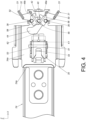
- a locking part 60 of the locking member 30 and the blocking feature 28 are configured to block each other in order to prevent the second rail 24 from being moved away from the predetermined position P along a predetermined direction D1 (such as an opening direction). More particularly, when the locking member 30 is in the locking state K1, the blocking feature 28 is located on a moving path of the locking part 60 along the longitudinal direction, such that the locking part 60 and the blocking feature 28 are configured to block each other.
- one of the locking member 30 and the first operating member 31 is arranged with a guiding feature 62, such as an inclined surface or an arc surface, but the present invention is not limited thereto.
- the locking member 30 is arranged with at least one guiding feature 62, and the guiding feature 62 is configured to work with the driving part 44 of the first operating member 31.
- the locking member 30 when one of the first operating member 31 and the second operating member 32 is operated (for example, the first operating member 31 is operated), the locking member 30 is configured to be driven to switch from the locking state K1 (as shown in FIG. 5 ) to an unlocking state K2 (as shown in FIG. 7 and FIG. 8 ) in order to allow the second rail 24 to be moved away from the predetermined position P.
- the second rail 24 is able to be moved away from the predetermined position P along the predetermined direction D1.
- the user can apply a first force F1 to one of the first operating member 31 (the first operating part 50 of the first operating member 31) and the second operating member 32 (the second operating part 52 of the second operating member 32) .
- the user applies the first force F1 to the first operating member 31 (the first operating part 50 of the first operating member 31) to drive the first operating member 31 to switch from the first state S1 to a second state S2.
- the driving part 44 of the first operating member 31 is configured to contact the guiding feature 62 of the locking member 30 to easily drive the locking member 30 to switch from the locking state K1 (as shown in FIG. 5 ) to the unlocking state K2 (as shown in FIG. 7 and FIG.
- the blocking feature 28 is no longer located on the moving path of the locking part 60 along the longitudinal direction (for example, the locking part 60 and the blocking feature 28 are not aligned with each other along the longitudinal direction), such that the locking part 60 and the blocking feature 28 no longer block each other (as shown in FIG. 8 ), in order to allow the second rail 24 to be moved from the predetermined position P along the predetermined direction D1.
- the first operating member 31 and the second operating member 32 are configured to interact with each other through the first gear structure 40 and the second gear structure 42 meshing with each other, such that the second operating member 32 is configured to be moved to switch from the first state S1 (as shown in FIG. 5 ) to the second state S2 (as shown in FIG. 7 ) in response to the movement of the first operating member 31.
- the first operating member 31 is moved along a first rotating direction r1 to switch from the first state S1 (as shown in FIG.
- the auxiliary elastic member 54 is in a state of accumulating the auxiliary elastic force.
- the return elastic member 46 is in a state of accumulating the return elastic force.
- the second rail 24 is able to be moved from the predetermined position P along the predetermined direction D1 to another predetermined position (such as an open position) .
- the first operating member 31 and the second operating member 32 is configured to return to the first state S1 (as shown in FIG. 5 ) from the second state S2 (as shown in FIG. 7 ) in response to the return elastic force released by the return elastic member 46, and the locking member 30 is configured to return to the locking state K1 (as shown in FIG. 5 and 6 ) from the unlocking state K2 (as shown in FIG. 7 and 8 ) in response to the auxiliary elastic force released by the auxiliary elastic member 54.
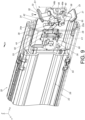
- the locking member 30 when the second operating member 32 is operated, the locking member 30 is also configured to be moved to switch from the locking state K1 (as shown in FIG. 9 ) to the unlocking state K2 (as shown in FIG. 7 and FIG. 8 ) in order to allow the second rail 24 to be moved away from the predetermined position P.
- the second rail 24 is able to be moved from the predetermined position P along the predetermined direction D1.
- the user can apply a second force F2 opposite to the first force F1 to the second operating member 32 (the second operating part 52 of the second operating member 32) as shown in FIG. 9 , in order to press the second operating member 32 to switch from the first state S1 (as shown in FIG. 9 ) to the second state S2 (as shown in FIG. 7 ).
- the first operating member 31 and the second operating member 32 are configured to interact with each other through the first gear structure 40 and the second gear structure 42 meshing with each other, such that the first operating member 31 is configured to be moved to switch from the first state S1 (as shown in FIG. 9 ) to the second state S2 (as shown in FIG. 7 ) in response to the movement of the second operating member 32.
- the driving part 44 of the first operating member 31 is configured to contact the guiding feature 62 of the locking member 30 to easily drive the locking member 30 to switch from the locking state K1 (as shown in FIG. 9 ) to the unlocking state K2 (as shown in FIG. 7 and FIG. 8 ), in order to allow the second rail 24 to be moved from the predetermined position P along the predetermined direction D1.
- the blocking feature 28 is no longer located on the moving path of the locking part 60 along the longitudinal direction (for example, the locking part 60 and the blocking feature 28 are not aligned with each other along the longitudinal direction), such that the locking part 60 and the blocking feature 28 no longer block each other (as shown in FIG. 8 ), in order to allow the second rail 24 to be moved from the predetermined position P along the predetermined direction D1.
- the user can operate the first operating member 31 or the second operating member 32 to unlock the second rail 24 relative to the first rail 22 at the predetermined position P, in order to allow the second rail 24 to be moved away from the predetermined position P.
- a plurality of slide rail assemblies 20 are mounted on a rack 64 (or a cabinet) along the height direction (such as the Z-axis direction), and the slide rail assemblies 20 have substantially the same structural configuration. Furthermore, when the user is going to operate the slide rail assembly 20 mounted at the highest position of the rack 64 with the second rail 24 being locked at the predetermined position P relative to the first rail 22, it is difficult for the user's hand H to reach and operate the second operating member 32 (the second operating part 52 of the second operating member 32) of the slide rail assembly 20 at the highest position. Therefore, the user can operate the first operating member 31 (the first operating part 50 of the first operating member 31) to drive the locking member 30 to switch from the locking state K1 (please also refer to FIG.
- the slide rail assembly 20 according to the embodiments of the present invention has the following technical features:
Landscapes
- Engineering & Computer Science (AREA)
- Computer Hardware Design (AREA)
- General Engineering & Computer Science (AREA)
- Microelectronics & Electronic Packaging (AREA)
- Seats For Vehicles (AREA)
- Drawers Of Furniture (AREA)
Applications Claiming Priority (1)
| Application Number | Priority Date | Filing Date | Title |
|---|---|---|---|
| TW112139307A TWI842640B (zh) | 2023-10-12 | 2023-10-12 | 滑軌總成 |
Publications (2)
| Publication Number | Publication Date |
|---|---|
| EP4537705A1 true EP4537705A1 (de) | 2025-04-16 |
| EP4537705B1 EP4537705B1 (de) | 2026-02-18 |
Family
ID=90789182
Family Applications (1)
| Application Number | Title | Priority Date | Filing Date |
|---|---|---|---|
| EP24170777.7A Active EP4537705B1 (de) | 2023-10-12 | 2024-04-17 | Gleitschienenanordnung |
Country Status (4)
| Country | Link |
|---|---|
| US (1) | US12490831B2 (de) |
| EP (1) | EP4537705B1 (de) |
| JP (1) | JP7707503B2 (de) |
| TW (1) | TWI842640B (de) |
Families Citing this family (2)
| Publication number | Priority date | Publication date | Assignee | Title |
|---|---|---|---|---|
| TWI847902B (zh) * | 2023-10-30 | 2024-07-01 | 川湖科技股份有限公司 | 滑軌總成 |
| TWI865407B (zh) * | 2024-06-07 | 2024-12-01 | 川湖科技股份有限公司 | 滑軌總成 |
Citations (2)
| Publication number | Priority date | Publication date | Assignee | Title |
|---|---|---|---|---|
| US6883884B2 (en) | 2002-09-25 | 2005-04-26 | King Slide Works Co., Ltd. | Latch assembly for a track device |
| US20080122333A1 (en) * | 2006-11-24 | 2008-05-29 | I-Ming Tseng | Latch and release device of a slide assembly |
Family Cites Families (28)
| Publication number | Priority date | Publication date | Assignee | Title |
|---|---|---|---|---|
| US1455297A (en) * | 1921-11-21 | 1923-05-15 | Heller Tool Company | Cutting tool |
| US5570510A (en) * | 1992-11-30 | 1996-11-05 | Fiskars Oy Ab | Lopper |
| US5689888A (en) * | 1996-08-20 | 1997-11-25 | Fiskars Consumer Oy Ab | Variable force tool |
| GB2344783A (en) * | 1998-12-16 | 2000-06-21 | Lin Yu Tang | Gardening shears |
| US6789324B2 (en) * | 2000-05-12 | 2004-09-14 | Fiskars Consumer Oy Ob | Double gear hedge shears |
| GB0112003D0 (en) * | 2001-05-17 | 2001-07-11 | Neil Holdings Ltd James | Garden tool |
| DE102005007001A1 (de) * | 2005-02-16 | 2006-08-17 | Lautenschläger, Horst | Einrichtung zur Aufnahme einer Schublade |
| FI121534B (fi) * | 2006-05-09 | 2010-12-31 | Fiskars Brands Finland Oy Ab | Leikkuutyökalu |
| US7798581B2 (en) * | 2007-02-22 | 2010-09-21 | King Slide Works Co., Ltd. | Fast detachable slide bracket |
| TWI354528B (en) * | 2008-09-01 | 2011-12-11 | King Slide Works Co Ltd | Bracket assembly |
| US20100277047A1 (en) * | 2009-04-27 | 2010-11-04 | Henry Chen Sung | Hand free releasing lock for drawer structure |
| US20110279973A1 (en) * | 2010-05-11 | 2011-11-17 | Dell Products L.P. | Bezel lock for an information handling system |
| US8317278B2 (en) * | 2010-08-18 | 2012-11-27 | Knape & Vogt Manufacturing Company | Releasably locking slide assemblies |
| TWI448264B (zh) * | 2010-09-03 | 2014-08-11 | King Slide Works Co Ltd | 用於滑軌總成之鎖掣及釋放裝置 |
| CN102783830B (zh) * | 2011-05-19 | 2014-03-05 | 川湖科技股份有限公司 | 滑轨总成的收合卡掣构造 |
| CN204181228U (zh) * | 2014-11-10 | 2015-03-04 | 广东泰明金属制品有限公司 | 抽屉滑轨的锁紧调节装置 |
| US9723745B2 (en) * | 2015-02-16 | 2017-08-01 | Cisco Technology, Inc. | Line card ejector with line card removal indication |
| US9609778B1 (en) * | 2015-10-05 | 2017-03-28 | Hewlett Packard Enterprise Development Lp | Server having a latch |
| US10524378B2 (en) * | 2015-12-08 | 2019-12-31 | Hewlett Packard Enterprise Development Lp | Latch rotation to secure blade server to enclosure |
| TWI594711B (zh) * | 2016-05-31 | 2017-08-11 | 川湖科技股份有限公司 | 滑軌裝置 |
| TWI665983B (zh) * | 2017-04-12 | 2019-07-21 | 川湖科技股份有限公司 | 滑軌總成 |
| CN109413923B (zh) * | 2017-08-18 | 2021-07-09 | 联想企业解决方案(新加坡)有限公司 | 轨道装配 |
| TWI642385B (zh) * | 2017-08-31 | 2018-12-01 | 川湖科技股份有限公司 | 滑軌總成及其滑軌機構 |
| TWI672109B (zh) * | 2018-10-04 | 2019-09-21 | 川湖科技股份有限公司 | 滑軌總成 |
| US10827641B1 (en) * | 2019-10-30 | 2020-11-03 | Super Micro Computer Inc. | Server apparatus with horizontal push-pull operating structure |
| TWI733625B (zh) * | 2020-11-24 | 2021-07-11 | 川湖科技股份有限公司 | 滑軌總成 |
| USD1015092S1 (en) * | 2021-08-13 | 2024-02-20 | Woodland Tools Inc. | Garden lopper |
| TWI806513B (zh) * | 2022-03-23 | 2023-06-21 | 緯創資通股份有限公司 | 殼體組件與包括其之電子裝置 |
-
2023
- 2023-10-12 TW TW112139307A patent/TWI842640B/zh active
-
2024
- 2024-02-27 US US18/588,543 patent/US12490831B2/en active Active
- 2024-04-17 EP EP24170777.7A patent/EP4537705B1/de active Active
- 2024-05-28 JP JP2024085924A patent/JP7707503B2/ja active Active
Patent Citations (2)
| Publication number | Priority date | Publication date | Assignee | Title |
|---|---|---|---|---|
| US6883884B2 (en) | 2002-09-25 | 2005-04-26 | King Slide Works Co., Ltd. | Latch assembly for a track device |
| US20080122333A1 (en) * | 2006-11-24 | 2008-05-29 | I-Ming Tseng | Latch and release device of a slide assembly |
Also Published As
| Publication number | Publication date |
|---|---|
| TWI842640B (zh) | 2024-05-11 |
| JP7707503B2 (ja) | 2025-07-15 |
| JP2025067778A (ja) | 2025-04-24 |
| US20250120506A1 (en) | 2025-04-17 |
| US12490831B2 (en) | 2025-12-09 |
| TW202515465A (zh) | 2025-04-16 |
| EP4537705B1 (de) | 2026-02-18 |
Similar Documents
| Publication | Publication Date | Title |
|---|---|---|
| EP4537705A1 (de) | Gleitschienenanordnung | |
| EP4548808B1 (de) | Gleitschienenanordnung | |
| EP0977227B1 (de) | Schlüssel-Schaltanordnung | |
| US7187554B2 (en) | Movable console device | |
| EP3886546B1 (de) | Gleitschienenanordnung | |
| TW202116224A (zh) | 滑軌總成 | |
| EP3505008B1 (de) | Gleitschienenanordnung | |
| EP3505007B1 (de) | Gleitschienenanordnung | |
| JP6920406B2 (ja) | スライドレールアセンブリ | |
| EP3735859A1 (de) | Gleitschienenanordnung | |
| EP3225132B1 (de) | Antriebsmechanismus und antriebsverfahren für möbelteile | |
| EP3440961B1 (de) | Schiebebügel-montage und schienen-set davon | |
| EP3744215A1 (de) | Synchronisierungssystem, gleitschienenanordnung und antriebsverfahren für gleitschienenanordnung | |
| US20240240669A1 (en) | Slide Rail Assembly | |
| EP3387951B1 (de) | Kupplungssystem für möbelteile | |
| EP3865003B1 (de) | Gleitschienenanordnung | |
| US20250176716A1 (en) | Slide rail assembly | |
| US20250176714A1 (en) | Slide rail assembly | |
| EP3321039A1 (de) | Akkubetriebene elektrowerkzeugmaschine | |
| EP4616761B1 (de) | Gleitschienenmechanismus | |
| CN119856841A (zh) | 滑轨总成 | |
| EP4546960A1 (de) | Gleitschienenbausatz | |
| EP4629760A1 (de) | Gleitschienenanordnung | |
| CN119947025A (zh) | 滑轨总成 | |
| JP2025084049A (ja) | 取り付けアセンブリ及びその取り付け装置 |
Legal Events
| Date | Code | Title | Description |
|---|---|---|---|
| PUAI | Public reference made under article 153(3) epc to a published international application that has entered the european phase |
Free format text: ORIGINAL CODE: 0009012 |
|
| STAA | Information on the status of an ep patent application or granted ep patent |
Free format text: STATUS: REQUEST FOR EXAMINATION WAS MADE |
|
| 17P | Request for examination filed |
Effective date: 20241119 |
|
| AK | Designated contracting states |
Kind code of ref document: A1 Designated state(s): AL AT BE BG CH CY CZ DE DK EE ES FI FR GB GR HR HU IE IS IT LI LT LU LV MC ME MK MT NL NO PL PT RO RS SE SI SK SM TR |
|
| STAA | Information on the status of an ep patent application or granted ep patent |
Free format text: STATUS: EXAMINATION IS IN PROGRESS |
|
| 17Q | First examination report despatched |
Effective date: 20250428 |
|
| GRAP | Despatch of communication of intention to grant a patent |
Free format text: ORIGINAL CODE: EPIDOSNIGR1 |
|
| STAA | Information on the status of an ep patent application or granted ep patent |
Free format text: STATUS: GRANT OF PATENT IS INTENDED |
|
| RIC1 | Information provided on ipc code assigned before grant |
Ipc: A47B 88/50 20170101AFI20251021BHEP Ipc: E05B 65/46 20170101ALI20251021BHEP Ipc: H05K 7/14 20060101ALI20251021BHEP Ipc: A47B 88/423 20170101ALN20251021BHEP |
|
| INTG | Intention to grant announced |
Effective date: 20251112 |
|
| GRAS | Grant fee paid |
Free format text: ORIGINAL CODE: EPIDOSNIGR3 |
|
| GRAA | (expected) grant |
Free format text: ORIGINAL CODE: 0009210 |
|
| STAA | Information on the status of an ep patent application or granted ep patent |
Free format text: STATUS: THE PATENT HAS BEEN GRANTED |