EP4534505A1 - Sintered zirconia composite object and production method therefor - Google Patents
Sintered zirconia composite object and production method therefor Download PDFInfo
- Publication number
- EP4534505A1 EP4534505A1 EP23816154.1A EP23816154A EP4534505A1 EP 4534505 A1 EP4534505 A1 EP 4534505A1 EP 23816154 A EP23816154 A EP 23816154A EP 4534505 A1 EP4534505 A1 EP 4534505A1
- Authority
- EP
- European Patent Office
- Prior art keywords
- sintered body
- mol
- zro
- zirconia
- composite sintered
- Prior art date
- Legal status (The legal status is an assumption and is not a legal conclusion. Google has not performed a legal analysis and makes no representation as to the accuracy of the status listed.)
- Pending
Links
Images
Classifications
-
- C—CHEMISTRY; METALLURGY
- C04—CEMENTS; CONCRETE; ARTIFICIAL STONE; CERAMICS; REFRACTORIES
- C04B—LIME, MAGNESIA; SLAG; CEMENTS; COMPOSITIONS THEREOF, e.g. MORTARS, CONCRETE OR LIKE BUILDING MATERIALS; ARTIFICIAL STONE; CERAMICS; REFRACTORIES; TREATMENT OF NATURAL STONE
- C04B35/00—Shaped ceramic products characterised by their composition; Ceramics compositions; Processing powders of inorganic compounds preparatory to the manufacturing of ceramic products
- C04B35/01—Shaped ceramic products characterised by their composition; Ceramics compositions; Processing powders of inorganic compounds preparatory to the manufacturing of ceramic products based on oxide ceramics
- C04B35/48—Shaped ceramic products characterised by their composition; Ceramics compositions; Processing powders of inorganic compounds preparatory to the manufacturing of ceramic products based on oxide ceramics based on zirconium or hafnium oxides, zirconates, zircon or hafnates
-
- C—CHEMISTRY; METALLURGY
- C04—CEMENTS; CONCRETE; ARTIFICIAL STONE; CERAMICS; REFRACTORIES
- C04B—LIME, MAGNESIA; SLAG; CEMENTS; COMPOSITIONS THEREOF, e.g. MORTARS, CONCRETE OR LIKE BUILDING MATERIALS; ARTIFICIAL STONE; CERAMICS; REFRACTORIES; TREATMENT OF NATURAL STONE
- C04B35/00—Shaped ceramic products characterised by their composition; Ceramics compositions; Processing powders of inorganic compounds preparatory to the manufacturing of ceramic products
- C04B35/01—Shaped ceramic products characterised by their composition; Ceramics compositions; Processing powders of inorganic compounds preparatory to the manufacturing of ceramic products based on oxide ceramics
- C04B35/48—Shaped ceramic products characterised by their composition; Ceramics compositions; Processing powders of inorganic compounds preparatory to the manufacturing of ceramic products based on oxide ceramics based on zirconium or hafnium oxides, zirconates, zircon or hafnates
- C04B35/486—Fine ceramics
- C04B35/488—Composites
-
- A—HUMAN NECESSITIES
- A61—MEDICAL OR VETERINARY SCIENCE; HYGIENE
- A61C—DENTISTRY; APPARATUS OR METHODS FOR ORAL OR DENTAL HYGIENE
- A61C13/00—Dental prostheses; Making same
- A61C13/08—Artificial teeth; Making same
- A61C13/083—Porcelain or ceramic teeth
-
- A—HUMAN NECESSITIES
- A61—MEDICAL OR VETERINARY SCIENCE; HYGIENE
- A61C—DENTISTRY; APPARATUS OR METHODS FOR ORAL OR DENTAL HYGIENE
- A61C5/00—Filling or capping teeth
- A61C5/70—Tooth crowns; Making thereof
-
- C—CHEMISTRY; METALLURGY
- C04—CEMENTS; CONCRETE; ARTIFICIAL STONE; CERAMICS; REFRACTORIES
- C04B—LIME, MAGNESIA; SLAG; CEMENTS; COMPOSITIONS THEREOF, e.g. MORTARS, CONCRETE OR LIKE BUILDING MATERIALS; ARTIFICIAL STONE; CERAMICS; REFRACTORIES; TREATMENT OF NATURAL STONE
- C04B35/00—Shaped ceramic products characterised by their composition; Ceramics compositions; Processing powders of inorganic compounds preparatory to the manufacturing of ceramic products
- C04B35/622—Forming processes; Processing powders of inorganic compounds preparatory to the manufacturing of ceramic products
- C04B35/626—Preparing or treating the powders individually or as batches ; preparing or treating macroscopic reinforcing agents for ceramic products, e.g. fibres; mechanical aspects section B
- C04B35/62605—Treating the starting powders individually or as mixtures
- C04B35/62625—Wet mixtures
-
- C—CHEMISTRY; METALLURGY
- C04—CEMENTS; CONCRETE; ARTIFICIAL STONE; CERAMICS; REFRACTORIES
- C04B—LIME, MAGNESIA; SLAG; CEMENTS; COMPOSITIONS THEREOF, e.g. MORTARS, CONCRETE OR LIKE BUILDING MATERIALS; ARTIFICIAL STONE; CERAMICS; REFRACTORIES; TREATMENT OF NATURAL STONE
- C04B2235/00—Aspects relating to ceramic starting mixtures or sintered ceramic products
- C04B2235/02—Composition of constituents of the starting material or of secondary phases of the final product
- C04B2235/30—Constituents and secondary phases not being of a fibrous nature
- C04B2235/32—Metal oxides, mixed metal oxides, or oxide-forming salts thereof, e.g. carbonates, nitrates, (oxy)hydroxides, chlorides
- C04B2235/3201—Alkali metal oxides or oxide-forming salts thereof
-
- C—CHEMISTRY; METALLURGY
- C04—CEMENTS; CONCRETE; ARTIFICIAL STONE; CERAMICS; REFRACTORIES
- C04B—LIME, MAGNESIA; SLAG; CEMENTS; COMPOSITIONS THEREOF, e.g. MORTARS, CONCRETE OR LIKE BUILDING MATERIALS; ARTIFICIAL STONE; CERAMICS; REFRACTORIES; TREATMENT OF NATURAL STONE
- C04B2235/00—Aspects relating to ceramic starting mixtures or sintered ceramic products
- C04B2235/02—Composition of constituents of the starting material or of secondary phases of the final product
- C04B2235/30—Constituents and secondary phases not being of a fibrous nature
- C04B2235/32—Metal oxides, mixed metal oxides, or oxide-forming salts thereof, e.g. carbonates, nitrates, (oxy)hydroxides, chlorides
- C04B2235/3201—Alkali metal oxides or oxide-forming salts thereof
- C04B2235/3203—Lithium oxide or oxide-forming salts thereof
-
- C—CHEMISTRY; METALLURGY
- C04—CEMENTS; CONCRETE; ARTIFICIAL STONE; CERAMICS; REFRACTORIES
- C04B—LIME, MAGNESIA; SLAG; CEMENTS; COMPOSITIONS THEREOF, e.g. MORTARS, CONCRETE OR LIKE BUILDING MATERIALS; ARTIFICIAL STONE; CERAMICS; REFRACTORIES; TREATMENT OF NATURAL STONE
- C04B2235/00—Aspects relating to ceramic starting mixtures or sintered ceramic products
- C04B2235/02—Composition of constituents of the starting material or of secondary phases of the final product
- C04B2235/30—Constituents and secondary phases not being of a fibrous nature
- C04B2235/32—Metal oxides, mixed metal oxides, or oxide-forming salts thereof, e.g. carbonates, nitrates, (oxy)hydroxides, chlorides
- C04B2235/3217—Aluminum oxide or oxide forming salts thereof, e.g. bauxite, alpha-alumina
-
- C—CHEMISTRY; METALLURGY
- C04—CEMENTS; CONCRETE; ARTIFICIAL STONE; CERAMICS; REFRACTORIES
- C04B—LIME, MAGNESIA; SLAG; CEMENTS; COMPOSITIONS THEREOF, e.g. MORTARS, CONCRETE OR LIKE BUILDING MATERIALS; ARTIFICIAL STONE; CERAMICS; REFRACTORIES; TREATMENT OF NATURAL STONE
- C04B2235/00—Aspects relating to ceramic starting mixtures or sintered ceramic products
- C04B2235/02—Composition of constituents of the starting material or of secondary phases of the final product
- C04B2235/30—Constituents and secondary phases not being of a fibrous nature
- C04B2235/32—Metal oxides, mixed metal oxides, or oxide-forming salts thereof, e.g. carbonates, nitrates, (oxy)hydroxides, chlorides
- C04B2235/3224—Rare earth oxide or oxide forming salts thereof, e.g. scandium oxide
- C04B2235/3225—Yttrium oxide or oxide-forming salts thereof
-
- C—CHEMISTRY; METALLURGY
- C04—CEMENTS; CONCRETE; ARTIFICIAL STONE; CERAMICS; REFRACTORIES
- C04B—LIME, MAGNESIA; SLAG; CEMENTS; COMPOSITIONS THEREOF, e.g. MORTARS, CONCRETE OR LIKE BUILDING MATERIALS; ARTIFICIAL STONE; CERAMICS; REFRACTORIES; TREATMENT OF NATURAL STONE
- C04B2235/00—Aspects relating to ceramic starting mixtures or sintered ceramic products
- C04B2235/02—Composition of constituents of the starting material or of secondary phases of the final product
- C04B2235/30—Constituents and secondary phases not being of a fibrous nature
- C04B2235/32—Metal oxides, mixed metal oxides, or oxide-forming salts thereof, e.g. carbonates, nitrates, (oxy)hydroxides, chlorides
- C04B2235/3224—Rare earth oxide or oxide forming salts thereof, e.g. scandium oxide
- C04B2235/3229—Cerium oxides or oxide-forming salts thereof
-
- C—CHEMISTRY; METALLURGY
- C04—CEMENTS; CONCRETE; ARTIFICIAL STONE; CERAMICS; REFRACTORIES
- C04B—LIME, MAGNESIA; SLAG; CEMENTS; COMPOSITIONS THEREOF, e.g. MORTARS, CONCRETE OR LIKE BUILDING MATERIALS; ARTIFICIAL STONE; CERAMICS; REFRACTORIES; TREATMENT OF NATURAL STONE
- C04B2235/00—Aspects relating to ceramic starting mixtures or sintered ceramic products
- C04B2235/02—Composition of constituents of the starting material or of secondary phases of the final product
- C04B2235/30—Constituents and secondary phases not being of a fibrous nature
- C04B2235/32—Metal oxides, mixed metal oxides, or oxide-forming salts thereof, e.g. carbonates, nitrates, (oxy)hydroxides, chlorides
- C04B2235/3231—Refractory metal oxides, their mixed metal oxides, or oxide-forming salts thereof
- C04B2235/3232—Titanium oxides or titanates, e.g. rutile or anatase
-
- C—CHEMISTRY; METALLURGY
- C04—CEMENTS; CONCRETE; ARTIFICIAL STONE; CERAMICS; REFRACTORIES
- C04B—LIME, MAGNESIA; SLAG; CEMENTS; COMPOSITIONS THEREOF, e.g. MORTARS, CONCRETE OR LIKE BUILDING MATERIALS; ARTIFICIAL STONE; CERAMICS; REFRACTORIES; TREATMENT OF NATURAL STONE
- C04B2235/00—Aspects relating to ceramic starting mixtures or sintered ceramic products
- C04B2235/02—Composition of constituents of the starting material or of secondary phases of the final product
- C04B2235/30—Constituents and secondary phases not being of a fibrous nature
- C04B2235/32—Metal oxides, mixed metal oxides, or oxide-forming salts thereof, e.g. carbonates, nitrates, (oxy)hydroxides, chlorides
- C04B2235/3231—Refractory metal oxides, their mixed metal oxides, or oxide-forming salts thereof
- C04B2235/3239—Vanadium oxides, vanadates or oxide forming salts thereof, e.g. magnesium vanadate
-
- C—CHEMISTRY; METALLURGY
- C04—CEMENTS; CONCRETE; ARTIFICIAL STONE; CERAMICS; REFRACTORIES
- C04B—LIME, MAGNESIA; SLAG; CEMENTS; COMPOSITIONS THEREOF, e.g. MORTARS, CONCRETE OR LIKE BUILDING MATERIALS; ARTIFICIAL STONE; CERAMICS; REFRACTORIES; TREATMENT OF NATURAL STONE
- C04B2235/00—Aspects relating to ceramic starting mixtures or sintered ceramic products
- C04B2235/02—Composition of constituents of the starting material or of secondary phases of the final product
- C04B2235/30—Constituents and secondary phases not being of a fibrous nature
- C04B2235/32—Metal oxides, mixed metal oxides, or oxide-forming salts thereof, e.g. carbonates, nitrates, (oxy)hydroxides, chlorides
- C04B2235/3231—Refractory metal oxides, their mixed metal oxides, or oxide-forming salts thereof
- C04B2235/3244—Zirconium oxides, zirconates, hafnium oxides, hafnates, or oxide-forming salts thereof
-
- C—CHEMISTRY; METALLURGY
- C04—CEMENTS; CONCRETE; ARTIFICIAL STONE; CERAMICS; REFRACTORIES
- C04B—LIME, MAGNESIA; SLAG; CEMENTS; COMPOSITIONS THEREOF, e.g. MORTARS, CONCRETE OR LIKE BUILDING MATERIALS; ARTIFICIAL STONE; CERAMICS; REFRACTORIES; TREATMENT OF NATURAL STONE
- C04B2235/00—Aspects relating to ceramic starting mixtures or sintered ceramic products
- C04B2235/02—Composition of constituents of the starting material or of secondary phases of the final product
- C04B2235/30—Constituents and secondary phases not being of a fibrous nature
- C04B2235/32—Metal oxides, mixed metal oxides, or oxide-forming salts thereof, e.g. carbonates, nitrates, (oxy)hydroxides, chlorides
- C04B2235/3231—Refractory metal oxides, their mixed metal oxides, or oxide-forming salts thereof
- C04B2235/3244—Zirconium oxides, zirconates, hafnium oxides, hafnates, or oxide-forming salts thereof
- C04B2235/3246—Stabilised zirconias, e.g. YSZ or cerium stabilised zirconia
-
- C—CHEMISTRY; METALLURGY
- C04—CEMENTS; CONCRETE; ARTIFICIAL STONE; CERAMICS; REFRACTORIES
- C04B—LIME, MAGNESIA; SLAG; CEMENTS; COMPOSITIONS THEREOF, e.g. MORTARS, CONCRETE OR LIKE BUILDING MATERIALS; ARTIFICIAL STONE; CERAMICS; REFRACTORIES; TREATMENT OF NATURAL STONE
- C04B2235/00—Aspects relating to ceramic starting mixtures or sintered ceramic products
- C04B2235/02—Composition of constituents of the starting material or of secondary phases of the final product
- C04B2235/30—Constituents and secondary phases not being of a fibrous nature
- C04B2235/32—Metal oxides, mixed metal oxides, or oxide-forming salts thereof, e.g. carbonates, nitrates, (oxy)hydroxides, chlorides
- C04B2235/3231—Refractory metal oxides, their mixed metal oxides, or oxide-forming salts thereof
- C04B2235/3251—Niobium oxides, niobates, tantalum oxides, tantalates, or oxide-forming salts thereof
-
- C—CHEMISTRY; METALLURGY
- C04—CEMENTS; CONCRETE; ARTIFICIAL STONE; CERAMICS; REFRACTORIES
- C04B—LIME, MAGNESIA; SLAG; CEMENTS; COMPOSITIONS THEREOF, e.g. MORTARS, CONCRETE OR LIKE BUILDING MATERIALS; ARTIFICIAL STONE; CERAMICS; REFRACTORIES; TREATMENT OF NATURAL STONE
- C04B2235/00—Aspects relating to ceramic starting mixtures or sintered ceramic products
- C04B2235/02—Composition of constituents of the starting material or of secondary phases of the final product
- C04B2235/30—Constituents and secondary phases not being of a fibrous nature
- C04B2235/32—Metal oxides, mixed metal oxides, or oxide-forming salts thereof, e.g. carbonates, nitrates, (oxy)hydroxides, chlorides
- C04B2235/3231—Refractory metal oxides, their mixed metal oxides, or oxide-forming salts thereof
- C04B2235/3251—Niobium oxides, niobates, tantalum oxides, tantalates, or oxide-forming salts thereof
- C04B2235/3253—Substoichiometric niobium or tantalum oxides, e.g. NbO
-
- C—CHEMISTRY; METALLURGY
- C04—CEMENTS; CONCRETE; ARTIFICIAL STONE; CERAMICS; REFRACTORIES
- C04B—LIME, MAGNESIA; SLAG; CEMENTS; COMPOSITIONS THEREOF, e.g. MORTARS, CONCRETE OR LIKE BUILDING MATERIALS; ARTIFICIAL STONE; CERAMICS; REFRACTORIES; TREATMENT OF NATURAL STONE
- C04B2235/00—Aspects relating to ceramic starting mixtures or sintered ceramic products
- C04B2235/02—Composition of constituents of the starting material or of secondary phases of the final product
- C04B2235/30—Constituents and secondary phases not being of a fibrous nature
- C04B2235/32—Metal oxides, mixed metal oxides, or oxide-forming salts thereof, e.g. carbonates, nitrates, (oxy)hydroxides, chlorides
- C04B2235/327—Iron group oxides, their mixed metal oxides, or oxide-forming salts thereof
- C04B2235/3279—Nickel oxides, nickalates, or oxide-forming salts thereof
-
- C—CHEMISTRY; METALLURGY
- C04—CEMENTS; CONCRETE; ARTIFICIAL STONE; CERAMICS; REFRACTORIES
- C04B—LIME, MAGNESIA; SLAG; CEMENTS; COMPOSITIONS THEREOF, e.g. MORTARS, CONCRETE OR LIKE BUILDING MATERIALS; ARTIFICIAL STONE; CERAMICS; REFRACTORIES; TREATMENT OF NATURAL STONE
- C04B2235/00—Aspects relating to ceramic starting mixtures or sintered ceramic products
- C04B2235/02—Composition of constituents of the starting material or of secondary phases of the final product
- C04B2235/30—Constituents and secondary phases not being of a fibrous nature
- C04B2235/32—Metal oxides, mixed metal oxides, or oxide-forming salts thereof, e.g. carbonates, nitrates, (oxy)hydroxides, chlorides
- C04B2235/3281—Copper oxides, cuprates or oxide-forming salts thereof, e.g. CuO or Cu2O
-
- C—CHEMISTRY; METALLURGY
- C04—CEMENTS; CONCRETE; ARTIFICIAL STONE; CERAMICS; REFRACTORIES
- C04B—LIME, MAGNESIA; SLAG; CEMENTS; COMPOSITIONS THEREOF, e.g. MORTARS, CONCRETE OR LIKE BUILDING MATERIALS; ARTIFICIAL STONE; CERAMICS; REFRACTORIES; TREATMENT OF NATURAL STONE
- C04B2235/00—Aspects relating to ceramic starting mixtures or sintered ceramic products
- C04B2235/02—Composition of constituents of the starting material or of secondary phases of the final product
- C04B2235/30—Constituents and secondary phases not being of a fibrous nature
- C04B2235/32—Metal oxides, mixed metal oxides, or oxide-forming salts thereof, e.g. carbonates, nitrates, (oxy)hydroxides, chlorides
- C04B2235/3289—Noble metal oxides
- C04B2235/3291—Silver oxides
-
- C—CHEMISTRY; METALLURGY
- C04—CEMENTS; CONCRETE; ARTIFICIAL STONE; CERAMICS; REFRACTORIES
- C04B—LIME, MAGNESIA; SLAG; CEMENTS; COMPOSITIONS THEREOF, e.g. MORTARS, CONCRETE OR LIKE BUILDING MATERIALS; ARTIFICIAL STONE; CERAMICS; REFRACTORIES; TREATMENT OF NATURAL STONE
- C04B2235/00—Aspects relating to ceramic starting mixtures or sintered ceramic products
- C04B2235/02—Composition of constituents of the starting material or of secondary phases of the final product
- C04B2235/30—Constituents and secondary phases not being of a fibrous nature
- C04B2235/44—Metal salt constituents or additives chosen for the nature of the anions, e.g. hydrides or acetylacetonate
-
- C—CHEMISTRY; METALLURGY
- C04—CEMENTS; CONCRETE; ARTIFICIAL STONE; CERAMICS; REFRACTORIES
- C04B—LIME, MAGNESIA; SLAG; CEMENTS; COMPOSITIONS THEREOF, e.g. MORTARS, CONCRETE OR LIKE BUILDING MATERIALS; ARTIFICIAL STONE; CERAMICS; REFRACTORIES; TREATMENT OF NATURAL STONE
- C04B2235/00—Aspects relating to ceramic starting mixtures or sintered ceramic products
- C04B2235/02—Composition of constituents of the starting material or of secondary phases of the final product
- C04B2235/30—Constituents and secondary phases not being of a fibrous nature
- C04B2235/44—Metal salt constituents or additives chosen for the nature of the anions, e.g. hydrides or acetylacetonate
- C04B2235/442—Carbonates
-
- C—CHEMISTRY; METALLURGY
- C04—CEMENTS; CONCRETE; ARTIFICIAL STONE; CERAMICS; REFRACTORIES
- C04B—LIME, MAGNESIA; SLAG; CEMENTS; COMPOSITIONS THEREOF, e.g. MORTARS, CONCRETE OR LIKE BUILDING MATERIALS; ARTIFICIAL STONE; CERAMICS; REFRACTORIES; TREATMENT OF NATURAL STONE
- C04B2235/00—Aspects relating to ceramic starting mixtures or sintered ceramic products
- C04B2235/02—Composition of constituents of the starting material or of secondary phases of the final product
- C04B2235/30—Constituents and secondary phases not being of a fibrous nature
- C04B2235/44—Metal salt constituents or additives chosen for the nature of the anions, e.g. hydrides or acetylacetonate
- C04B2235/444—Halide containing anions, e.g. bromide, iodate, chlorite
-
- C—CHEMISTRY; METALLURGY
- C04—CEMENTS; CONCRETE; ARTIFICIAL STONE; CERAMICS; REFRACTORIES
- C04B—LIME, MAGNESIA; SLAG; CEMENTS; COMPOSITIONS THEREOF, e.g. MORTARS, CONCRETE OR LIKE BUILDING MATERIALS; ARTIFICIAL STONE; CERAMICS; REFRACTORIES; TREATMENT OF NATURAL STONE
- C04B2235/00—Aspects relating to ceramic starting mixtures or sintered ceramic products
- C04B2235/02—Composition of constituents of the starting material or of secondary phases of the final product
- C04B2235/30—Constituents and secondary phases not being of a fibrous nature
- C04B2235/44—Metal salt constituents or additives chosen for the nature of the anions, e.g. hydrides or acetylacetonate
- C04B2235/444—Halide containing anions, e.g. bromide, iodate, chlorite
- C04B2235/445—Fluoride containing anions, e.g. fluosilicate
-
- C—CHEMISTRY; METALLURGY
- C04—CEMENTS; CONCRETE; ARTIFICIAL STONE; CERAMICS; REFRACTORIES
- C04B—LIME, MAGNESIA; SLAG; CEMENTS; COMPOSITIONS THEREOF, e.g. MORTARS, CONCRETE OR LIKE BUILDING MATERIALS; ARTIFICIAL STONE; CERAMICS; REFRACTORIES; TREATMENT OF NATURAL STONE
- C04B2235/00—Aspects relating to ceramic starting mixtures or sintered ceramic products
- C04B2235/02—Composition of constituents of the starting material or of secondary phases of the final product
- C04B2235/50—Constituents or additives of the starting mixture chosen for their shape or used because of their shape or their physical appearance
- C04B2235/54—Particle size related information
- C04B2235/5418—Particle size related information expressed by the size of the particles or aggregates thereof
- C04B2235/5445—Particle size related information expressed by the size of the particles or aggregates thereof submicron sized, i.e. from 0,1 to 1 micron
-
- C—CHEMISTRY; METALLURGY
- C04—CEMENTS; CONCRETE; ARTIFICIAL STONE; CERAMICS; REFRACTORIES
- C04B—LIME, MAGNESIA; SLAG; CEMENTS; COMPOSITIONS THEREOF, e.g. MORTARS, CONCRETE OR LIKE BUILDING MATERIALS; ARTIFICIAL STONE; CERAMICS; REFRACTORIES; TREATMENT OF NATURAL STONE
- C04B2235/00—Aspects relating to ceramic starting mixtures or sintered ceramic products
- C04B2235/65—Aspects relating to heat treatments of ceramic bodies such as green ceramics or pre-sintered ceramics, e.g. burning, sintering or melting processes
- C04B2235/658—Atmosphere during thermal treatment
- C04B2235/6583—Oxygen containing atmosphere, e.g. with changing oxygen pressures
- C04B2235/6585—Oxygen containing atmosphere, e.g. with changing oxygen pressures at an oxygen percentage above that of air
-
- C—CHEMISTRY; METALLURGY
- C04—CEMENTS; CONCRETE; ARTIFICIAL STONE; CERAMICS; REFRACTORIES
- C04B—LIME, MAGNESIA; SLAG; CEMENTS; COMPOSITIONS THEREOF, e.g. MORTARS, CONCRETE OR LIKE BUILDING MATERIALS; ARTIFICIAL STONE; CERAMICS; REFRACTORIES; TREATMENT OF NATURAL STONE
- C04B2235/00—Aspects relating to ceramic starting mixtures or sintered ceramic products
- C04B2235/65—Aspects relating to heat treatments of ceramic bodies such as green ceramics or pre-sintered ceramics, e.g. burning, sintering or melting processes
- C04B2235/66—Specific sintering techniques, e.g. centrifugal sintering
- C04B2235/661—Multi-step sintering
-
- C—CHEMISTRY; METALLURGY
- C04—CEMENTS; CONCRETE; ARTIFICIAL STONE; CERAMICS; REFRACTORIES
- C04B—LIME, MAGNESIA; SLAG; CEMENTS; COMPOSITIONS THEREOF, e.g. MORTARS, CONCRETE OR LIKE BUILDING MATERIALS; ARTIFICIAL STONE; CERAMICS; REFRACTORIES; TREATMENT OF NATURAL STONE
- C04B2235/00—Aspects relating to ceramic starting mixtures or sintered ceramic products
- C04B2235/65—Aspects relating to heat treatments of ceramic bodies such as green ceramics or pre-sintered ceramics, e.g. burning, sintering or melting processes
- C04B2235/66—Specific sintering techniques, e.g. centrifugal sintering
- C04B2235/661—Multi-step sintering
- C04B2235/662—Annealing after sintering
- C04B2235/663—Oxidative annealing
-
- C—CHEMISTRY; METALLURGY
- C04—CEMENTS; CONCRETE; ARTIFICIAL STONE; CERAMICS; REFRACTORIES
- C04B—LIME, MAGNESIA; SLAG; CEMENTS; COMPOSITIONS THEREOF, e.g. MORTARS, CONCRETE OR LIKE BUILDING MATERIALS; ARTIFICIAL STONE; CERAMICS; REFRACTORIES; TREATMENT OF NATURAL STONE
- C04B2235/00—Aspects relating to ceramic starting mixtures or sintered ceramic products
- C04B2235/70—Aspects relating to sintered or melt-casted ceramic products
- C04B2235/74—Physical characteristics
- C04B2235/78—Grain sizes and shapes, product microstructures, e.g. acicular grains, equiaxed grains, platelet-structures
- C04B2235/785—Submicron sized grains, i.e. from 0,1 to 1 micron
-
- C—CHEMISTRY; METALLURGY
- C04—CEMENTS; CONCRETE; ARTIFICIAL STONE; CERAMICS; REFRACTORIES
- C04B—LIME, MAGNESIA; SLAG; CEMENTS; COMPOSITIONS THEREOF, e.g. MORTARS, CONCRETE OR LIKE BUILDING MATERIALS; ARTIFICIAL STONE; CERAMICS; REFRACTORIES; TREATMENT OF NATURAL STONE
- C04B2235/00—Aspects relating to ceramic starting mixtures or sintered ceramic products
- C04B2235/70—Aspects relating to sintered or melt-casted ceramic products
- C04B2235/74—Physical characteristics
- C04B2235/78—Grain sizes and shapes, product microstructures, e.g. acicular grains, equiaxed grains, platelet-structures
- C04B2235/786—Micrometer sized grains, i.e. from 1 to 100 micron
-
- C—CHEMISTRY; METALLURGY
- C04—CEMENTS; CONCRETE; ARTIFICIAL STONE; CERAMICS; REFRACTORIES
- C04B—LIME, MAGNESIA; SLAG; CEMENTS; COMPOSITIONS THEREOF, e.g. MORTARS, CONCRETE OR LIKE BUILDING MATERIALS; ARTIFICIAL STONE; CERAMICS; REFRACTORIES; TREATMENT OF NATURAL STONE
- C04B2235/00—Aspects relating to ceramic starting mixtures or sintered ceramic products
- C04B2235/70—Aspects relating to sintered or melt-casted ceramic products
- C04B2235/95—Products characterised by their size, e.g. microceramics
-
- C—CHEMISTRY; METALLURGY
- C04—CEMENTS; CONCRETE; ARTIFICIAL STONE; CERAMICS; REFRACTORIES
- C04B—LIME, MAGNESIA; SLAG; CEMENTS; COMPOSITIONS THEREOF, e.g. MORTARS, CONCRETE OR LIKE BUILDING MATERIALS; ARTIFICIAL STONE; CERAMICS; REFRACTORIES; TREATMENT OF NATURAL STONE
- C04B2235/00—Aspects relating to ceramic starting mixtures or sintered ceramic products
- C04B2235/70—Aspects relating to sintered or melt-casted ceramic products
- C04B2235/96—Properties of ceramic products, e.g. mechanical properties such as strength, toughness, wear resistance
-
- C—CHEMISTRY; METALLURGY
- C04—CEMENTS; CONCRETE; ARTIFICIAL STONE; CERAMICS; REFRACTORIES
- C04B—LIME, MAGNESIA; SLAG; CEMENTS; COMPOSITIONS THEREOF, e.g. MORTARS, CONCRETE OR LIKE BUILDING MATERIALS; ARTIFICIAL STONE; CERAMICS; REFRACTORIES; TREATMENT OF NATURAL STONE
- C04B2235/00—Aspects relating to ceramic starting mixtures or sintered ceramic products
- C04B2235/70—Aspects relating to sintered or melt-casted ceramic products
- C04B2235/96—Properties of ceramic products, e.g. mechanical properties such as strength, toughness, wear resistance
- C04B2235/9646—Optical properties
- C04B2235/9653—Translucent or transparent ceramics other than alumina
-
- C—CHEMISTRY; METALLURGY
- C04—CEMENTS; CONCRETE; ARTIFICIAL STONE; CERAMICS; REFRACTORIES
- C04B—LIME, MAGNESIA; SLAG; CEMENTS; COMPOSITIONS THEREOF, e.g. MORTARS, CONCRETE OR LIKE BUILDING MATERIALS; ARTIFICIAL STONE; CERAMICS; REFRACTORIES; TREATMENT OF NATURAL STONE
- C04B2235/00—Aspects relating to ceramic starting mixtures or sintered ceramic products
- C04B2235/70—Aspects relating to sintered or melt-casted ceramic products
- C04B2235/96—Properties of ceramic products, e.g. mechanical properties such as strength, toughness, wear resistance
- C04B2235/9646—Optical properties
- C04B2235/9661—Colour
-
- C—CHEMISTRY; METALLURGY
- C04—CEMENTS; CONCRETE; ARTIFICIAL STONE; CERAMICS; REFRACTORIES
- C04B—LIME, MAGNESIA; SLAG; CEMENTS; COMPOSITIONS THEREOF, e.g. MORTARS, CONCRETE OR LIKE BUILDING MATERIALS; ARTIFICIAL STONE; CERAMICS; REFRACTORIES; TREATMENT OF NATURAL STONE
- C04B35/00—Shaped ceramic products characterised by their composition; Ceramics compositions; Processing powders of inorganic compounds preparatory to the manufacturing of ceramic products
- C04B35/622—Forming processes; Processing powders of inorganic compounds preparatory to the manufacturing of ceramic products
- C04B35/64—Burning or sintering processes
- C04B35/645—Pressure sintering
- C04B35/6455—Hot isostatic pressing
Definitions
- Patent Literature 1 discloses a processable zirconia as a sintered body formed by incorporating a tetragonal zirconia composite powder and a TiO 2 nanopowder, where the tetragonal zirconia composite powder contains 79.8 to 92 mol% ZrO 2 and 4.5 to 10.2 mol% Y 2 O 3 along with 3.5 to 7.5 mol% Nb 2 O 5 or 5.5 to 10.0 mol% Ta 2 O 5 , and the TiO 2 nanopowder is incorporated in a mass ratio of more than 0 mass% and 2.5 mass% or less relative to the zirconia composite powder. A method of production of this zirconia sintered body is also disclosed.
- a zirconia composite sintered body of the present invention refers to a state where ZrO 2 particles (powder) are fully sintered (sintered state).
- the upper limits and lower limits of numeric ranges can be appropriately combined.
- machining encompasses both cutting and grinding. Machining may be a wet or dry process, without specific restrictions.
- elements or ions derived from a capping agent refer to elements or ions that weaken the strength of the crystal interface, or grain boundary as it is also called hereinbelow, by capping the terminals of the bonding sites of zirconia-based composite oxides within a zirconia composite sintered body constituted of zirconia-based composite oxides (hereinafter, the strength of grain boundaries is also referred to as “grain boundary strength").
- the capping agent can partially cap the crystal grain boundaries.
- capping refers to elements or ions (capping elements or ions) of interest existing at the crystal grain boundaries by binding to the bonding sites of zirconia-based composite oxides instead of the metal elements.
- capping elements or ions in the form of +1 cations or -1 anions causes electrostatic repulsion between these capping cations or anions, thereby reducing the grain boundary strength.
- the content of zirconia enhancer (mass%) is the proportion external to total 100 mass% of ZrO 2 , HfO 2 , the stabilizer, Nb 2 O 5 , and Ta 2 O 5 . Accordingly, the content of zirconia enhancer in the zirconia composite sintered body can be calculated from the quantity (mass) of the raw material added.
- the capping elements or ions When present at the crystal grain boundaries in the zirconia composite sintered body comprising ZrO 2 , HfO 2 , a stabilizer capable of preventing a phase transformation of zirconia, and Nb 2 O 5 and/or Ta 2 O 5 , the capping elements or ions appear to reduce the grain boundary strength in the form of +1 cations or -1 anions, facilitating particles to separate, thereby improving grindability and machinability.
- ZrO 2 , HfO 2 , and Nb 2 O 5 and/or Ta 2 O 5 are present in part within both the zirconia particles 1 and the adhesive component 3.
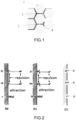
- FIG. 1 is a schematic view representing the presumed structure of the zirconia composite sintered body in an embodiment where the zirconia composite sintered body comprises a zirconia enhancer. Even though the adhesive component 3 is present in the zirconia composite sintered body containing a zirconia enhancer, it is possible to increase strength without inhibiting the effect of releasing component 2 to reduce grain boundary strength.
- the capping elements or ions bind to the bonding sites of zirconia-based composite oxides at the grain boundaries of the zirconia composite sintered body. This binding leads to electrostatic repulsion between the cations or anions, reducing the grain boundary strength while maintaining the strength and translucency properties of the particles constituting the zirconia composite sintered body, resulting in improved machinability.
- a -1 anion can bind to the cation derived from the metal element (for example, Zr, Hf, Y, Nb, or Ta) contained within the zirconia-based composite oxide and attached to other metal elements, as shown in FIG. 2(c) .
- the metal element for example, Zr, Hf, Y, Nb, or Ta
- X - represents a -1 anion.
- FIG. 2, (a) through (c) schematically represents the interactions between charged sites and adsorption sites at the grain boundaries.
- Nb 2 O 5 and/or Ta 2 O 5 serve to coarsen the microstructure and reduce hardness, and, by acting integrally with the capping elements or ions, improve machinability.
- Nb 2 O 5 and/or Ta 2 O 5 and the capping elements or ions can provide excellent free-machinability while ensuring the strength needed as artificial teeth, reducing machining time and increasing the number of dental prostheses that can be produced in continuous processing with a single processing tool while reducing wear on processing tools. It is believed that this can resolve the specific challenges associated with the continuous processing of sintered bodies.
- the content of capping elements or ions is more preferably 0.2 mol% or more and 5 mol% or less, even more preferably 0.3 mol% or more and 4 mol% or less, particularly preferably 0.4 mol% or more and 3.5 mol% or less, most preferably 0.5 mol% or more and 3.0 mol% or less in view of providing even superior machinability and increasing the number of dental prostheses that can be produced in continuous processing with a single processing tool.
- the elements with high electron affinity are preferably Group 17 elements.
- Preferred as Group 17 elements are At, I, Br, Cl, and F.
- the methods described above can be appropriately employed for the measurement of first ionization energy and electron affinity because the measurement simply involves comparing the likelihood to form +1 cations or -1 anions among different elements.
- a certain preferred embodiment is, for example, a zirconia composite sintered body in which the elements derived from the capping agent comprise at least one element selected from the group consisting of Cu, Ag, Li, Na, K, Rb, Cs, Fr, At, I, Br, Cl, and F, and ions of these elements are at least one +1 cation or -1 anion selected from the group consisting of Cu, Ag, Li, Na, K, Rb, Cs, Fr, I, Br, Cl, and F.
- the total content of ZrO 2 and HfO 2 is 78 to 97.5 mol% in total 100 mol% of ZrO 2 , HfO 2 , the stabilizer, Nb 2 O 5 , and Ta 2 O 5 .
- the total content of ZrO 2 and HfO 2 is preferably 79 mol% or more and 96 mol% or less, more preferably 80 mol% or more and 94 mol% or less, even more preferably 81 mol% or more and 93 mol% or less.
- Another certain preferred embodiment is, for example, a zirconia composite sintered body in which the stabilizer capable of preventing a phase transformation of zirconia comprises Y 2 O 3 , and the Y 2 O 3 content is 2 mol% or more and 10 mol% or less.
- the content of Y 2 O 3 and CeO 2 may be appropriately varied within the ranges specified in this specification.
- the total content of Y 2 O 3 and CeO 2 may be 2.5 mol% or more and 10 mol% or less, or 3 mol% or more and 9 mol% or less.
- the resulting zirconia composite sintered body may experience defects such as chipping, and fail to exhibit sufficient properties.
- the ratio A/B is preferably 0.9 to 3, more preferably 0.95 to 2, where A is the content of stabilizer in mol%, and B is the total content of Nb 2 O 5 and Ta 2 O 5 in mol%. Even more preferably, the ratio A/B is 1 to 1.6 in view of enhancing the effectiveness of the integrated action between the capping elements or ions and Nb 2 O 5 and/or Ta 2 O 5 , improving free-machinability, and increasing the number of dental prostheses that can be produced in continuous processing with a single processing tool while reducing wear on processing tools.
- a certain preferred embodiment is, for example, a zirconia composite sintered body in which the zirconia enhancer comprises TiO 2 , and the TiO 2 content is 0.6 to 3.7 mass%.
- a zirconia composite sintered body of the present invention has an average crystal grain size of preferably 0.5 to 5.0 ⁇ m.
- the average crystal grain size is more preferably 0.5 to 4.5 ⁇ m, even more preferably 1.0 to 4.0 ⁇ m.
- the method of measurement of average crystal grain size is as described in the EXAMPLES section below.
- the average crystal grain size can be measured by adjusting the particle count in one SEM image field to about 50 or 100 particles, according to the method described in the EXAMPLES section below.
- Another embodiment of the present invention is, for example, a method for producing a zirconia composite sintered body comprising the steps of:
- the raw material composition of the zirconia composite sintered body comprises ZrO 2 , HfO 2 , a stabilizer capable of preventing a phase transformation of zirconia, Nb 2 O 5 and/or Ta 2 O 5 , and a capping agent.
- the raw material composition of the zirconia composite sintered body may be in a dry state, or in a liquid state containing liquid or contained in liquid.
- the raw material composition may have a form of a powder, a granule or granulated material, a paste, or a slurry.
- Examples of carbonates containing capping elements or ions include lithium carbonate, sodium carbonate, potassium carbonate, rubidium carbonate, francium carbonate, and cesium carbonate.
- bromates containing capping elements or ions include neodymium bromate, lanthanum bromate, and praseodymium bromate.
- permanganates containing capping elements or ions examples include calcium(VII) permanganate, potassium(VII) permanganate, and sodium(VII) permanganate.
- chlorides containing capping elements or ions include zirconium oxychloride, lithium chloride, sodium chloride, potassium chloride, rubidium chloride, cesium chloride, francium chloride, beryllium chloride, magnesium chloride, calcium chloride, strontium chloride, barium chloride, scandium(III) chloride, yttrium(III) chloride, lanthanum(III) chloride, cerium(III) chloride, praseodymium chloride, neodymium(III) chloride, samarium chloride, europium chloride, titanium(III) chloride, titanium(IV) chloride, zirconium(IV) chloride, hafnium(IV) chloride, tantalum(V) chloride, manganese chloride, iron(II) chloride, iron(III) chloride, cobalt(II) chloride, nickel(II) chloride, copper(I) chloride, copper(II) chloride, zinc(II) chloride,
- the method of production of zirconia powder is not particularly limited, and known methods may be employed, for example, such as the breakdown process, where coarse particles are pulverized into fine powder, or the building-up process, where synthesis occurs through nucleation and growth from atoms or ions.
- the type of zirconia powder in the raw material composition is not particularly limited. It is possible to additionally incorporate stabilizer particles when the zirconia powder comprises ZrO 2 and HfO 2 but does not contain a stabilizer, or when increasing the content of stabilizer as needed.
- the stabilizer particles are not particularly limited, as long as the content of the stabilizer within the zirconia composite sintered body can be adjusted to the predetermined ranges mentioned above.
- the stabilizer particles may be commercially available products, and may be prepared by pulverizing a commercially available powder using a known pulverizing mixer (such as a ball mill).
- a known pulverizing mixer such as a ball mill.
- the stabilizer may be either a stabilizer not dissolved in ZrO 2 and HfO 2 as a solid solution, or a stabilizer dissolved in ZrO 2 and HfO 2 as a solid solution.
- a certain preferred embodiment is, for example, a method for producing a zirconia composite sintered body in which the stabilizer (preferably, Y 2 O 3 ) comprises a stabilizer not dissolved in ZrO 2 and HfO 2 as a solid solution within the raw material composition.
- the stabilizer preferably, Y 2 O 3
- the stabilizer comprises a stabilizer not dissolved in ZrO 2 and HfO 2 as a solid solution within the raw material composition.
- the presence of stabilizers not dissolved in zirconia as a solid solution can be verified, for example, through X-ray diffraction (XRD) patterns.
- the presence of peaks derived from the stabilizer in an XRD pattern of the raw material composition or molded body means the presence of a stabilizer that is not dissolved in ZrO 2 and HfO 2 in the raw material composition or molded body.
- the percentage presence f y of yttria not dissolved in ZrO 2 and HfO 2 as a solid solution (hereinafter, also referred to as "undissolved yttria”) can be calculated using the following mathematical formula (1).
- the formula can be applied to calculate the percentage presence of undissolved stabilizers other than yttria by substituting I 29 with the peaks of other stabilizers.
- the percentage presence f y of undissolved yttria falls within the following ranges when the yttria content in the raw material composition or molded body of the present invention is 3 mol% or more and 8 mol% or less.
- Nb 2 O 5 and/or Ta 2 O 5 incorporated in the raw material composition of the present invention, as long as the content of Nb 2 O 5 and/or Ta 2 O 5 within the zirconia composite sintered body can be adjusted in the predetermined ranges mentioned above.
- commercially available products may be used for Nb 2 O 5 and/or Ta 2 O 5 without any particular restrictions. These may be used after pulverizing its powder using a known pulverizing mixer (such as a ball mill).
- the binder may be added to the pulverized slurry after the slurry is formed by adding a primary powder mixture of ZrO 2 , HfO 2 , Y 2 O 3 , Nb 2 O 5 and/or Ta 2 O 5 , and a capping agent into water.
- dispersants examples include ammonium polycarboxylates (such as triammonium citrate), ammonium polyacrylate, acrylic copolymer resin, acrylic acid ester copolymer, polyacrylic acid, bentonite, carboxymethyl cellulose, anionic surfactants (for example, polyoxyethylene alkyl ether phosphoric acid esters such as polyoxyethylene lauryl ether phosphoric acid ester), non-ionic surfactants, oleic glyceride, amine salt surfactants, oligosaccharide alcohols, and stearic acid.
- ammonium polycarboxylates such as triammonium citrate
- ammonium polyacrylate acrylic copolymer resin
- acrylic acid ester copolymer acrylic acid ester copolymer
- polyacrylic acid bentonite
- carboxymethyl cellulose examples include anionic surfactants (for example, polyoxyethylene alkyl ether phosphoric acid esters such as polyoxyethylene lauryl ether phosphoric acid ester
- emulsifiers examples include alkyl ethers, phenyl ethers, and sorbitan derivatives.
- pH adjusters examples include ammonia, and ammonium salts (including ammonium hydroxides such as tetramethylammonium hydroxide).
- fluorescent agents examples include Y 2 SiO 5 :Ce, Y 2 SiO 5 :Tb, (Y,Gd,Eu)BO 3 , Y 2 O 3 :Eu, YAG:Ce, ZnGa 2 O 4 :Zn, and BaMgAl 10 O 17 :Eu.
- the molded body is sintered.
- molded body refers to a state that is neither a semi-sintered state (pre-sintered state) nor a sintered state. That is, the molded body is distinct from pre-sintered bodies and sintered bodies in that it has not been fired after molding.
- the sintering temperature (highest sintering temperature) for obtaining the zirconia composite sintered body is, for example, preferably 1,300°C or more, more preferably 1,350°C or more, even more preferably 1,400°C or more, yet more preferably 1,450°C or more, particularly preferably 1,500°C or more.
- the sintering temperature is, for example, preferably 1,680°C or less, more preferably 1,650°C or less, even more preferably 1,600°C or less.
- the method for producing a zirconia composite sintered body of the present invention involves firing the molded body at a highest sintering temperature of 1,300 to 1,680°C.
- the highest sintering temperature is preferably a temperature in the atmosphere.
- the hold time (retention time) at the highest sintering temperature is preferably 30 hours or less, more preferably 20 hours or less, even more preferably 10 hours or less, yet more preferably 5 hours or less, particularly preferably 3 hours or less, most preferably 2 hours or less, depending on the temperature.
- the hold time may be 25 minutes or less, 20 minutes or less, or 15 minutes or less.
- the hold time is preferably 1 minute or more, more preferably 5 minutes or more, even more preferably 10 minutes or more.
- a production method of the present invention enables the fabrication of a zirconia composite sintered body having superior flexural strength, translucency, and machinability in a manner that depends on the content of the stabilizer.
- the sintering time can be reduced, as long as the present invention can exhibit its effects. Shortening the sintering time can improve production efficiency and reduce energy costs.
- the sintering process for the molded body includes a hot isostatic pressing (HIP) process, aside from sintering at the highest sintering temperature.
- HIP hot isostatic pressing
- the HIP process can further improve the translucency and strength of the zirconia composite sintered body.
- primary sintered body is used to refer to sintered bodies obtained through sintering at the highest sintering temperature
- HIP sintered body is used to refer to sintered bodies after a HIP process.
- the HIP pressure in the HIP process of the primary sintered body is not particularly limited.
- the HIP pressure is preferably 100 MPa or more, more preferably 125 MPa or more, even more preferably 130 MPa or more.
- the upper limit of HIP pressure is not particularly limited, and may be, for example, 400 MPa or less, 300 MPa or less, or 200 MPa or less.
- a zirconia composite sintered body of the present invention exhibits excellent machinability despite being a sintered body. It is accordingly not necessary to machine it as a mill blank of a pre-sintered body in a semi-sintered state before sintering into a sintered body.
- the firing temperature (pre-sintering temperature) in the pre-sintering step is, for example, preferably 800°C or more, more preferably 900°C or more, even more preferably 950°C or more.
- the pre-sintering temperature is, for example, preferably 1,200°C or less, more preferably 1,150°C or less, even more preferably 1,100°C or less.
- the preferred range of pre-sintering temperatures is, for example, 800°C to 1,200°C. It is believed that, at these pre-sintering temperatures, no significant progression of the formation of the solid solution of the stabilizer occurs in the pre-sintering step.
- the flexural strength can be measured in compliance with ISO 6872:2015 except for the specimen size, using a specimen measuring 5 mm in thickness, 10 mm in width, and 50 mm in length.
- the specimen surfaces including chamfered surfaces (45° chamfers at the corners of specimen), are finished longitudinally with #600 sandpaper.
- the specimen is disposed in such an orientation that its widest face is perpendicular to the vertical direction (loading direction).
- measurements are made at a span of 30 mm with a crosshead speed of 1.0 mm/min.
- the sintering step for the zirconia pre-sintered body can be conducted using the same method and conditions (such as temperature and pressure) used to sinter the molded body. Accordingly, in embodiments of the production method using zirconia pre-sintered bodies, the term "molded body" can be read as referring to "pre-sintered body”.
- a zirconia composite sintered body of the present invention excels in strength.
- a zirconia composite sintered body of the present invention has a biaxial flexural strength of preferably 300 MPa or more, more preferably 350 MPa or more, even more preferably 400 MPa or more, yet more preferably 450 MPa or more, particularly preferably 500 MPa or more.
- a zirconia composite sintered body of the present invention with its biaxial flexural strength falling in these ranges, can reduce defects, for example, such as fracture in the oral cavity, when used as a dental prosthesis.
- the upper limit of biaxial flexural strength is not particularly limited, and may be, for example, 1,200 MPa or less, or 1,000 MPa or less.
- the biaxial flexural strength of the zirconia composite sintered body can be measured in compliance with ISO 6872:2015.
- ⁇ L* means the difference between the lightness (first L* value) against a white background and the lightness (second L* value) against a black background in the same sample.
- ⁇ L* means the difference between the L* value against a white back ground (JIS Z 8781-4:2013 Color Measurements - Part 4: CIE 1976 L*a*b* color space) and the L* value against a black background.
- the white background means the white part of the hiding-power test paper described in JIS K 5600-4-1:1999, Part 4, Section 1, and the black background means the black part of the hiding-power test paper.
- the color of dental prostheses may vary depending on patient preferences, such as a more pronounced white or a shade closer to natural teeth.
- a dental shade guide is used to produce dental prostheses in shades that satisfy the patient's requests. While natural teeth show a yellow tint, ZrO 2 sintered bodies do not usually have a yellow hue. Therefore, pigments or CeO 2 are added to impart a yellow shade. However, the addition of pigments or CeO 2 may result in reduced translucency and/or strength, depending on the amount added.
- the total content of Nb 2 O 5 and Ta 2 O 5 is 1 to 9 mol%, preferably 1.5 mol% or more and 8.5 mol% or less in total 100 mol% of ZrO 2 , HfO 2 , the stabilizer, Nb 2 O 5 , and Ta 2 O 5 .
- the total content of Nb 2 O 5 and Ta 2 O 5 is more preferably 2.5 mol% or more and 8 mol% or less, even more preferably 3 mol% or more and 7 mol% or less.
- the resulting zirconia composite sintered body may experience defects such as chipping, and fail to exhibit sufficient properties.
- the preferred elements or ions derived from a capping agent are Cu, Ag, Li, Na, K, Rb, Cs, F, and ions of these elements, more preferably Li, Na, K, and ions of these.
- a preferred embodiment is, for example, a zirconia composite sintered body in which the b* value is 5 or more, the zirconia enhancer is TiO 2 , and the TiO 2 content is 0.6 to 3.7 mass%.
- the average crystal grain size of the zirconia composite sintered body with a b* value of 5 or more may be the same as in the foregoing embodiments.
- This method does not differ from the production method of zirconia composite sintered body described above, except that it uses a raw material composition in which at least a part of the stabilizer is dissolved in ZrO 2 and HfO 2 as a solid solution.
- zirconia powder in which Y 2 O 3 is uniformly dispersed as a solid solution, as in the commercially available product TZ series (those with "TZ" in the product names).
- the present invention encompasses embodiments combining all or part of the foregoing features, provided that the present invention can exhibit its effects with such combinations made in various forms within the technical idea of the present invention.
- average particle diameter refers to average primary particle diameter, and can be determined using a laser diffraction scattering method. Specifically, the average particle diameter can be measured by volume using a laser diffraction particle size distribution analyzer (SALD-2300, manufactured by Shimadzu Corporation) with a 0.2% sodium hexametaphosphate aqueous solution used as dispersion medium.
- SALD-2300 laser diffraction particle size distribution analyzer
- a mixture was prepared by combining commercially available powders of ZrO 2 , Y 2 O 3 , Nb 2 O 5 , and Ta 2 O 5 , along with a capping agent, and, optionally, a TiO 2 powder or Al 2 O 3 powder, according to the formulations specified in Tables 1 to 3. Subsequently, water was added to prepare a slurry, and the slurry was pulverized wet with a ball mill until it had an average particle diameter of 0.13 ⁇ m or less.
- the content (mass%) of TiO 2 and Al 2 O 3 in Tables 1 to 3 refers to the proportion external to total 100 mass% of ZrO 2 , HfO 2 , the stabilizer, Nb 2 O 5 , and Ta 2 O 5 .
- the dental colorimeter Crystaleye (7-band LED illuminant) manufactured by Olympus Corporation was used as the measurement device.
- a white background (underlay) was arranged for the sample (the opposite side of the sample from the measurement device is white), and the sample was measured for L* value according to L*a*b*color system (JIS Z 8781-4:2013 Color Measurements - Part 4: CIE 1976 L*a*b* color space). This was recorded as a first L* value.
- the samples were measured for L* and b* against a white background (underlay) (the opposite side of the sample from the measurement device is white) according to L*a*b* color system (JIS Z 8781-4:2013 Color Measurements - Part 4: CIE 1976 L*a*b* color space), using the dental colorimeter Crystaleye (7-band LED illuminant) manufactured by Olympus Corporation as the measurement device.
- the pellet-shaped zirconia composite sintered body (tempered sintered body) samples of each Example and Comparative Example were directly used to measure biaxial flexural strength.
- the measurement results are presented as average values in Tables 1 to 3. A strength of 300 MPa or more was considered acceptable.
- the captured SEM image was binarized with image analysis software (Image-Pro Plus manufactured by Hakuto Co., Ltd. under this trade name), and particles were recognized from the field (region) by adjusting the brightness range to provide clear grain boundaries.
- the crystal grain size from Image-Pro Plus is the average of the measurements of the length of a line segment connecting the contour line and passing through the center of gravity determined from the contour line of the crystal grain, conducted at 2-degree intervals with the center of gravity as the central point.
- the measurement of crystal grain size was conducted for all particles not extending beyond the edges of the SEM photographic image (3 fields) of each Example and Comparative Example. The average of the measured crystal grain sizes was then determined as the average crystal grain size (number-based) of the sintered body.
- Comparative Example 8 with excessively high Y 2 O 3 content also failed to show adequate reduction in processing time.
Landscapes
- Chemical & Material Sciences (AREA)
- Engineering & Computer Science (AREA)
- Ceramic Engineering (AREA)
- Health & Medical Sciences (AREA)
- Manufacturing & Machinery (AREA)
- Materials Engineering (AREA)
- Structural Engineering (AREA)
- Organic Chemistry (AREA)
- Composite Materials (AREA)
- Dentistry (AREA)
- Oral & Maxillofacial Surgery (AREA)
- Epidemiology (AREA)
- Life Sciences & Earth Sciences (AREA)
- Animal Behavior & Ethology (AREA)
- General Health & Medical Sciences (AREA)
- Public Health (AREA)
- Veterinary Medicine (AREA)
- Inorganic Chemistry (AREA)
- Compositions Of Oxide Ceramics (AREA)
- Materials For Medical Uses (AREA)
- Dental Prosthetics (AREA)
- Inorganic Compounds Of Heavy Metals (AREA)
Applications Claiming Priority (2)
| Application Number | Priority Date | Filing Date | Title |
|---|---|---|---|
| JP2022089657 | 2022-06-01 | ||
| PCT/JP2023/020508 WO2023234397A1 (ja) | 2022-06-01 | 2023-06-01 | ジルコニア複合焼結体及びその製造方法 |
Publications (1)
| Publication Number | Publication Date |
|---|---|
| EP4534505A1 true EP4534505A1 (en) | 2025-04-09 |
Family
ID=89024998
Family Applications (1)
| Application Number | Title | Priority Date | Filing Date |
|---|---|---|---|
| EP23816154.1A Pending EP4534505A1 (en) | 2022-06-01 | 2023-06-01 | Sintered zirconia composite object and production method therefor |
Country Status (5)
| Country | Link |
|---|---|
| EP (1) | EP4534505A1 (https=) |
| JP (2) | JP7610081B2 (https=) |
| KR (1) | KR20250010666A (https=) |
| CN (1) | CN119301090A (https=) |
| WO (1) | WO2023234397A1 (https=) |
Families Citing this family (5)
| Publication number | Priority date | Publication date | Assignee | Title |
|---|---|---|---|---|
| WO2023234396A1 (ja) * | 2022-06-01 | 2023-12-07 | クラレノリタケデンタル株式会社 | 黒色ジルコニア複合焼結体及びその製造方法 |
| WO2025047657A1 (ja) * | 2023-08-31 | 2025-03-06 | 東ソー株式会社 | チタン及びイットリウム固溶ジルコニア焼結体 |
| WO2025143125A1 (ja) * | 2023-12-28 | 2025-07-03 | クラレノリタケデンタル株式会社 | 歯科用補綴物の製造方法 |
| WO2025143124A1 (ja) * | 2023-12-28 | 2025-07-03 | クラレノリタケデンタル株式会社 | ジルコニア複合焼結体 |
| JP7631611B1 (ja) * | 2024-10-17 | 2025-02-18 | 第一稀元素化学工業株式会社 | ジルコニア焼結体、及び、ジルコニア焼結体の製造方法 |
Family Cites Families (6)
| Publication number | Priority date | Publication date | Assignee | Title |
|---|---|---|---|---|
| EP2889279B1 (en) | 2013-12-27 | 2022-08-24 | Vatechacucera, Inc. | Machinable Zirconia |
| CN105565806B (zh) * | 2014-12-08 | 2017-04-05 | 比亚迪股份有限公司 | 一种陶瓷及其制备方法 |
| DE102015122857A1 (de) * | 2015-12-28 | 2017-06-29 | Degudent Gmbh | Verfahren zur Herstellung eines Formkörpers sowie Formkörper |
| EP4082991A4 (en) | 2019-12-26 | 2024-01-24 | Kuraray Noritake Dental Inc. | Production method for workable zirconia composite sintered body, raw material composition for workable zirconia composite sintered body, and workable zirconia composite calcined body |
| CN112500159B (zh) * | 2020-12-28 | 2023-05-23 | 长裕控股集团股份有限公司 | 高韧性高强度黑色氧化锆陶瓷材料的制备方法 |
| WO2023234396A1 (ja) | 2022-06-01 | 2023-12-07 | クラレノリタケデンタル株式会社 | 黒色ジルコニア複合焼結体及びその製造方法 |
-
2023
- 2023-06-01 JP JP2024524947A patent/JP7610081B2/ja active Active
- 2023-06-01 KR KR1020247041467A patent/KR20250010666A/ko active Pending
- 2023-06-01 WO PCT/JP2023/020508 patent/WO2023234397A1/ja not_active Ceased
- 2023-06-01 EP EP23816154.1A patent/EP4534505A1/en active Pending
- 2023-06-01 CN CN202380044109.2A patent/CN119301090A/zh active Pending
-
2024
- 2024-12-19 JP JP2024223659A patent/JP2025041740A/ja active Pending
Also Published As
| Publication number | Publication date |
|---|---|
| JP2025041740A (ja) | 2025-03-26 |
| WO2023234397A1 (ja) | 2023-12-07 |
| CN119301090A (zh) | 2025-01-10 |
| JP7610081B2 (ja) | 2025-01-07 |
| KR20250010666A (ko) | 2025-01-21 |
| JPWO2023234397A1 (https=) | 2023-12-07 |
Similar Documents
| Publication | Publication Date | Title |
|---|---|---|
| EP4534505A1 (en) | Sintered zirconia composite object and production method therefor | |
| US6713421B1 (en) | Blank comprised of a zirconium oxide ceramic with an oxide additive and the use thereof | |
| JP7213829B2 (ja) | 歯科用に好適なジルコニア仮焼体 | |
| EP3517518A1 (en) | Zirconia composition, calcined object and sintered compact, and method for producing same | |
| EP4534503A1 (en) | Dental workpiece and method for producing same | |
| EP4082991A1 (en) | Production method for workable zirconia composite sintered body, raw material composition for workable zirconia composite sintered body, and workable zirconia composite calcined body | |
| EP4265584A1 (en) | Zirconia sintered body containing needle-shaped metal oxide | |
| EP4534504A1 (en) | Black zirconia composite sintered body and method for manufacturing same | |
| EP4534507A1 (en) | Zirconia composite sintered body and method for producing same | |
| CN116261435A (zh) | 牙科用陶瓷着色溶液 | |
| EP4534506A1 (en) | Sintered zirconia composite object and production method therefor | |
| WO2025143124A1 (ja) | ジルコニア複合焼結体 | |
| WO2025115986A1 (ja) | ジルコニア複合焼結体 | |
| JP7820618B1 (ja) | セラミックス仮焼体の製造方法 | |
| EP4458773A1 (en) | Zirconia sintered body and method for producing same | |
| WO2025143125A1 (ja) | 歯科用補綴物の製造方法 | |
| WO2025206348A1 (ja) | セラミックス仮焼体の製造方法 | |
| JP2025156254A (ja) | セラミックス仮焼体の製造方法 | |
| JP2025156253A (ja) | セラミックス仮焼体の製造方法 |
Legal Events
| Date | Code | Title | Description |
|---|---|---|---|
| STAA | Information on the status of an ep patent application or granted ep patent |
Free format text: STATUS: THE INTERNATIONAL PUBLICATION HAS BEEN MADE |
|
| PUAI | Public reference made under article 153(3) epc to a published international application that has entered the european phase |
Free format text: ORIGINAL CODE: 0009012 |
|
| STAA | Information on the status of an ep patent application or granted ep patent |
Free format text: STATUS: REQUEST FOR EXAMINATION WAS MADE |
|
| 17P | Request for examination filed |
Effective date: 20241218 |
|
| AK | Designated contracting states |
Kind code of ref document: A1 Designated state(s): AL AT BE BG CH CY CZ DE DK EE ES FI FR GB GR HR HU IE IS IT LI LT LU LV MC ME MK MT NL NO PL PT RO RS SE SI SK SM TR |
|
| DAV | Request for validation of the european patent (deleted) | ||
| DAX | Request for extension of the european patent (deleted) |