EP4530795A1 - Sicherheitswarnung für tragbare elektronische vorrichtungen - Google Patents
Sicherheitswarnung für tragbare elektronische vorrichtungen Download PDFInfo
- Publication number
- EP4530795A1 EP4530795A1 EP24199955.6A EP24199955A EP4530795A1 EP 4530795 A1 EP4530795 A1 EP 4530795A1 EP 24199955 A EP24199955 A EP 24199955A EP 4530795 A1 EP4530795 A1 EP 4530795A1
- Authority
- EP
- European Patent Office
- Prior art keywords
- user
- tilt angle
- processing circuitry
- activity type
- condition
- Prior art date
- Legal status (The legal status is an assumption and is not a legal conclusion. Google has not performed a legal analysis and makes no representation as to the accuracy of the status listed.)
- Pending
Links
Images



Classifications
-
- G—PHYSICS
- G06—COMPUTING OR CALCULATING; COUNTING
- G06F—ELECTRIC DIGITAL DATA PROCESSING
- G06F1/00—Details not covered by groups G06F3/00 - G06F13/00 and G06F21/00
- G06F1/16—Constructional details or arrangements
- G06F1/1613—Constructional details or arrangements for portable computers
- G06F1/1633—Constructional details or arrangements of portable computers not specific to the type of enclosures covered by groups G06F1/1615 - G06F1/1626
- G06F1/1684—Constructional details or arrangements related to integrated I/O peripherals not covered by groups G06F1/1635 - G06F1/1675
- G06F1/1694—Constructional details or arrangements related to integrated I/O peripherals not covered by groups G06F1/1635 - G06F1/1675 the I/O peripheral being a single or a set of motion sensors for pointer control or gesture input obtained by sensing movements of the portable computer
-
- G—PHYSICS
- G08—SIGNALLING
- G08B—SIGNALLING SYSTEMS, e.g. PERSONAL CALLING SYSTEMS; ORDER TELEGRAPHS; ALARM SYSTEMS
- G08B21/00—Alarms responsive to a single specified undesired or abnormal condition and not otherwise provided for
- G08B21/18—Status alarms
-
- G—PHYSICS
- G06—COMPUTING OR CALCULATING; COUNTING
- G06F—ELECTRIC DIGITAL DATA PROCESSING
- G06F1/00—Details not covered by groups G06F3/00 - G06F13/00 and G06F21/00
- G06F1/26—Power supply means, e.g. regulation thereof
- G06F1/32—Means for saving power
- G06F1/3203—Power management, i.e. event-based initiation of a power-saving mode
- G06F1/3206—Monitoring of events, devices or parameters that trigger a change in power modality
- G06F1/3231—Monitoring the presence, absence or movement of users
-
- G—PHYSICS
- G06—COMPUTING OR CALCULATING; COUNTING
- G06N—COMPUTING ARRANGEMENTS BASED ON SPECIFIC COMPUTATIONAL MODELS
- G06N20/00—Machine learning
- G06N20/20—Ensemble learning
-
- G—PHYSICS
- G06—COMPUTING OR CALCULATING; COUNTING
- G06N—COMPUTING ARRANGEMENTS BASED ON SPECIFIC COMPUTATIONAL MODELS
- G06N3/00—Computing arrangements based on biological models
- G06N3/02—Neural networks
- G06N3/04—Architecture, e.g. interconnection topology
- G06N3/0464—Convolutional networks [CNN, ConvNet]
-
- G—PHYSICS
- G08—SIGNALLING
- G08B—SIGNALLING SYSTEMS, e.g. PERSONAL CALLING SYSTEMS; ORDER TELEGRAPHS; ALARM SYSTEMS
- G08B21/00—Alarms responsive to a single specified undesired or abnormal condition and not otherwise provided for
- G08B21/02—Alarms for ensuring the safety of persons
-
- H—ELECTRICITY
- H04—ELECTRIC COMMUNICATION TECHNIQUE
- H04M—TELEPHONIC COMMUNICATION
- H04M1/00—Substation equipment, e.g. for use by subscribers
- H04M1/72—Mobile telephones; Cordless telephones, i.e. devices for establishing wireless links to base stations without route selection
- H04M1/724—User interfaces specially adapted for cordless or mobile telephones
- H04M1/72448—User interfaces specially adapted for cordless or mobile telephones with means for adapting the functionality of the device according to specific conditions
- H04M1/72454—User interfaces specially adapted for cordless or mobile telephones with means for adapting the functionality of the device according to specific conditions according to context-related or environment-related conditions
-
- H—ELECTRICITY
- H04—ELECTRIC COMMUNICATION TECHNIQUE
- H04W—WIRELESS COMMUNICATION NETWORKS
- H04W4/00—Services specially adapted for wireless communication networks; Facilities therefor
- H04W4/02—Services making use of location information
- H04W4/025—Services making use of location information using location based information parameters
-
- G—PHYSICS
- G06—COMPUTING OR CALCULATING; COUNTING
- G06F—ELECTRIC DIGITAL DATA PROCESSING
- G06F2200/00—Indexing scheme relating to G06F1/04 - G06F1/32
- G06F2200/16—Indexing scheme relating to G06F1/16 - G06F1/18
- G06F2200/163—Indexing scheme relating to constructional details of the computer
- G06F2200/1637—Sensing arrangement for detection of housing movement or orientation, e.g. for controlling scrolling or cursor movement on the display of an handheld computer
Definitions
- the present invention generally relates to activity recognition, for example in portable electronic devices.
- Electronic devices such as smartphones, laptops, smart bands, smart watches, smart pens, etc., often use position, orientation, gesture, motion, location and other information to facilitate the control and operation of the devices.
- the electronic devices may typically include multiple sensors, such as GPS systems, accelerometers, gyroscopes, pressure sensors, etc., to sense such position, gesture, motion, location and other information.
- An aim of the present invention is to devise a solution that addresses the potential issues of unsafe conditions related to the use of such electronic devices while moving.
- a device in an embodiment, includes one or more motion sensors and processing circuitry coupled to the one or more motion sensors.
- the one or more motion sensors in operation, generate motion sensor signals.
- the processing circuitry in operation, classifies a user-activity type based on the motion sensor signals, the user-activity type being selected from a plurality of user-activity types including one or more moving activity types, detects a tilt angle of the device based on the motion sensor signals, and classifies a use-condition of the device as used or not used based on the detected tilt angle.
- the processing circuitry generates a use-warning signal based on whether the classification of the user-activity type is a moving activity type and on whether the classification of the use-condition is used.
- the device may include an integrated circuit including the motion sensors and the processing circuitry, and the integrated circuit may be embedded in a display.
- a system comprises a display screen, one or more inertial or motion sensors, and processing circuitry.
- the one or more inertial sensors in operation, generate inertial sensor signals.
- the processing circuitry is coupled to the one or more inertial sensors.
- the processing circuitry in operation, classifies a user-activity type based on the inertial sensor signals, the user-activity type being selected from a plurality of user-activity types including one or more moving activity types, detects a tilt angle of the display screen based on the inertial sensor signals, and classifies a use-condition of the system as used or not used based on the detected tilt angle.
- the processing circuitry generates a use-warning signal based on whether the classification of the user-activity type is a moving activity type and on whether the classification of the use-condition is used.
- a method comprises generating, using one or more inertial sensors of an electronic device, inertial sensor signals.
- a user-activity type of the electronic device is classified based on the inertial sensor signals, the user-activity type being selected from a plurality of user-activity types including one or more moving activity types.
- a tilt angle of the electronic device is detected based on the inertial sensor signals.
- a use-condition of the electronic device as used or not used is classified based on the detected tilt angle.
- a use-warning signal is generated based on whether the classification of the user-activity type is a moving activity type and on whether the classification of the use-condition is used. The generation of the use-warning signal may also be conditioned on a display of the electronic device being on.
- a non-transitory computer-readable medium's contents configure processing circuitry of an electronic device to perform a method.
- the method comprises classifying a user-activity type of the electronic device based on inertial sensor signals generated by one or more inertial sensors of the electronic device, the user-activity type being selected from a plurality of user-activity types including one or more moving activity types, detecting a tilt angle of the electronic device based on the inertial sensor signals, and classifying a use-condition of the electronic device as used or not used based on the detected tilt angle.
- a use-warning signal is generated based on whether the classification of the user-activity type is a moving activity type and on whether the classification of the use-condition is used.
- the contents may comprise instructions executed by the processing circuitry.
- FIG. 1 is a functional block diagram of an embodiment of an electronic device or system 100.
- the system 100 comprises one or more processing cores or circuits 102.
- the processing cores 102 may comprise, for example, one or more processors, a state machine, a microprocessor, a programmable logic circuit, discrete circuitry, logic gates, registers, etc., and various combinations thereof.
- the processing cores may control overall operation of the system 100, execution of application programs by the system 100 (e.g., programs which may use position, orientation, gesture, motion, gravity vectors, tilt angles, location and other information, and various combinations thereof, to perform various functions), etc.
- the system 100 includes one or more memories 104, such as one or more volatile and/or non-volatile memories which may store, for example, all or part of instructions and data related to control of the system 100, applications and operations performed by the system 100, etc.
- One or more of the memories 104 may include a memory array, which, in operation, may be shared by one or more processes executed by the system 100.
- the system 100 also includes one or more displays 106, which may display information to a user, receive user-input, etc.
- the system 100 may include one or more sensors or a sensor array 160, as illustrated, one or more gyroscopes 162, one or more accelerometers 164, one or more image sensors 166, one or more audio sensors 168, one or more pressure sensors 170, one or more temperature sensors 172, etc., one or more global position systems 174, one or more interfaces 180 ( e.g., wireless communication interfaces, wired communication interfaces, user-input devices, etc., and various combinations thereof), and other functional circuits 185, which may include antennas, power supplies, one or more built-in self-test (BIST) circuits, etc., and a main bus system 190.
- the main bus system 190 may include one or more data, address, power and/or control buses coupled to the various components of the system 100.
- the one or more gyroscopes 162 in operation, generate rotational data, and may typically provide an output in the form of motion sensor signals indicating a rotational velocity measurements vector indicating a rotational velocity with respect to, for example, three axes of movement.
- the one or more gyroscopes 162 may typically comprise a micro-electro-mechanical system (MEMS) device that measures the rate of rotation of an object around one or more axis.
- MEMS micro-electro-mechanical system
- the one or more accelerometers 164 in operation, generate acceleration data, and may typically provide an output in the form of motion sensor signals indicating an acceleration measurements vector indicating acceleration along, for example, three axes of movement.
- the one or more accelerometers 164 may typically comprise a MEMS device that measures the acceleration of an object along one or more axes.
- the one or more image sensors 166 in operation, generate digital or analog signals based on optical images.
- the image sensors 166 may typically include a photosensitive element which generates a signal in response to light waves, and may typically provide digital signal in the form of pixel values.
- the one or more audio sensors 168 in operation, generate digital or analog signals based on sound waves.
- the audio sensors 168 may typically comprise a MEMS device which converts sound waves into electrical signals.
- the one or more pressure sensors 170 in operation, generate digital or analog signals based on an ambient pressure.
- the pressure sensors 170 may typically comprise a MEMS device, such as a capacitive sensor, a piezoresistive sensor, etc., which converts an indication of pressure or a pressure change into electrical signals.
- the one or more temperature sensors 172 in operation, generate digital or analog signals based on an ambient temperature, temperature differences, etc.
- the temperature sensors 172 may typically comprise a resistance temperature detector, a semiconductor detector, a junction detector, etc., which converts an indication of a temperature or a temperature change into electrical signals.
- the system 100 as illustrated also includes one or more global positioning systems (GPS) 174.
- GPS global positioning systems
- the GPS system 174 may, in operation, generate position and movement information based on GPS signals received from other systems, such as one or more satellite systems.
- use-warning signals may be generated based on determinations of whether a device is in use while the device is moving.
- the use-warning signals may be used to control the device (e.g., by responding to the use-warning signal by generating signals to cause a warning message to be displayed or signaled to a user, by inhibiting use of the device, etc., and various combinations thereof).
- use-warning signals are generated based on signals received from a GPS system, such as the GPS system 174, which indicate position or movement information. GPS signals, however, are not always available. For example, reception of the GPS signals may not be available indoors or in certain outdoor conditions.
- using a GPS system may add significant costs to a device in terms of hardware, power and control requirements, as well as other operational costs such as subscription fees.
- the system 100 includes a use-warning detector or use-warning detection and generation circuitry 110 which, in operation, generates a warning signal associated with the device being used while moving based on inertial sensor or motion sensor data, such as motion sensor data generated by a gyroscope 162, an accelerometer 164, or a gyroscope 162 and an accelerometer 164 of the one or more sensors 160 of the system 100.
- the use-warning detection and generation circuitry 110 may be employed in addition to conventional use of a GPS system, or instead of convention use of a GPS system, to detect use of a device while moving.
- the use-warning detector 110 facilities generating a use-warning signal when GPS signals are unavailable.
- processing circuitry of the system e.g., the processing core 102, processing circuitry 202 of a sensor array 260 (see Figure 2 ), etc.
- processing circuitry of the system classifies a user-activity type based on the motion sensor signals, such as signals from a gyroscope 162, an accelerometer 164, or both.
- the user-activity type is selected from a plurality of user-activity types including one or more moving activity types.
- the processing circuitry 102, 202 detects a tilt angle of the device or system based on the motion sensor signals. A use-condition of the device is classified as used or not used based on the detected tilt angle.
- the processing circuitry 102, 202 generates a use-warning signal based on whether the classification of the user-activity type is a moving activity type and based on whether the classification of the use-condition is used.
- the use-warning signal may also be based on other system information, such as whether a display is on.
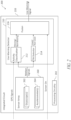
- FIG. 2 is functional block diagram of an embodiment of a device 200 that may be employed, for example, in the system 100 of Figure 1 , to provide all or part of the functionality of the use-warning detector 110 and the sensor array 160 of the system 100.
- the device 200 includes an integrated circuit 220.
- a sensor array 260 is embedded in the integrated circuit 220, and includes one or more inertial sensors, as illustrated one or more gyroscopes 262 and one or more accelerometers 264.
- the device 200 also includes a use-warning detector 210 embedded in the integrated circuit 220.
- the use-warning detector 210 includes an activity classification block or circuit 212, a tilt detection block or circuit 214, and a fusion block or circuit 216.
- the integrated circuit 220 also includes embedded processing circuitry 202, which may be employed to implement the functionality of the blocks of the use-warning detector 210.
- the processing circuitry may comprise signal preprocessing circuitry to compute features, applies filters, etc., and output stabilization circuitry (e.g., meta classifiers).
- the activity classification block 212 determines whether the device 200 is moving or non-moving using motion sensor data. This may be done, for example by classifying a user activity (e.g., walking, fast walking, running, driving, riding, biking, still, stationary) based on the motion sensor data, and determining whether the classified activity is considered or classified as a moving or non-moving activity for purposes of generating a use-warning signal. For example, in some embodiments walking, fast walking, running, driving, riding, and biking activity classifications may be considered moving activities, and still and stationary classifications may be considered as non-moving activities.
- the activity classification block 212 may be implemented, for example, using a decision tree.
- the classification of the user-activity type as a moving or non-moving activity type may also be based on GPS signals. This is illustrated in Figure 2 as an optional providing of GPS signals to the activity classification block 212 of the use-warning detector 210.
- the tilt detection block 214 in operation, detects a tilt angle of the device based on the motion sensor signals, and classifies a use-condition of the device as used or not used based on the detected tilt angle.
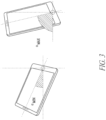
- Figure 3 is a conceptual diagram illustrating detecting a tilt angle and using the detected tilt angle to classify a use-condition of a device, such as the system 100 of Figure 1 or the device 200 of Figure 2 .
- the device is a tablet, having one or more inertial sensors embedded therein (see, e.g., sensors 262, 264 of Figure 2 ).
- the tilt angle may be detected based on inertial sensor data or motion signals generated by embedded sensors.
- the tilt angle may be detected based on an accelerometer z-axis signal, which may be averaged or low-pass filtered.
- the detected tilt angle may be compared to one or more threshold tilt angles to determine a use-condition of the device. For example, a detected tilt angle may be compared to a minimum tilt angle ⁇ MIN and a maximum tilt angle ⁇ MAX . If the detected tilt angle is between the minimum tilt angle ⁇ MIN and the maximum tilt angle ⁇ MAX , the use-condition may be classified as used. If the detected tilt angle is outside a range defined by the minimum tilt angle ⁇ MIN and the maximum tilt angle ⁇ MAX , the use-condition may be classified as not-used. For example, the minimum tilt angle ⁇ MIN may be approximately 20 degrees and the maximum tilt angle ⁇ MAX may be approximately 65 degrees in an embodiment.
- the tilt detection block 214 may be implemented, for example, using a finite state machine.
- the fusion block 216 in operation, generates a use-warning signal based on whether the classification of the user-activity type is a moving activity type and on whether the classification of the use-condition is used.
- the fusion block 216 may be implemented, for example, using a finite state machine.
- Figure 4 is a conceptual diagram illustrating how the moving/non-moving activity classification and the used/not-used use-condition classification may be fused by the fusion block 216 to generate a use-warning signal.
- Example 1 of Figure 4 the activity classification based on the motion data is a moving activity classification, and the used / not-used condition classification based on the tilt angle (which is detected based on the motion data) is used.
- the use-warning signal is generated.
- Example 2 of Figure 4 the activity classification based on the motion data is a not moving activity classification, and the used / not-used condition classification based on the tilt angle is used. In Example 2, the use-warning signal is not generated.
- Example 3 of Figure 4 the activity classification based on the motion data is a moving activity classification, and the used / not-used condition classification based on the tilt angle is not-used. In Example 3, the use-warning signal is not generated.
- Example 4 of Figure 4 the activity classification based on the motion data is a not moving activity classification, and the used / not-used condition classification based on the tilt angle is not-used. In Example 4, the use-warning signal is not generated.
- the use-warning signal may also be based on other system information in some embodiments, such as whether a display is on. This may reduce the generation of false positive use-warning signals.
- This is illustrated in Figure 2 as an optional providing of signal indicating whether a screen is on to the fusion block 216 of the use-warning detector 210. For example, if a display is not turned on, generation of the use-warning signal may be inhibited.
- Embodiments of the system 100 of Figure 1 and of the device 200 of Figure 2 may include more components than illustrated, may include fewer components than illustrated, may combine components, may separate components into sub-components, and various combination thereof.
- the GPS system 174 may be omitted from some embodiments of the system 100 of Figure 1 .
- a sensor array 160, 260 may comprise a combined gyroscope and accelerometer
- an inertial measurement unit or device (IMU) package may include an accelerometer, a gyroscope and embedded processing circuitry, which, in operation, implements a use-warning detector, etc., and various combinations thereof.
- Figure 5 illustrates an embodiment of a method 500 of generating a use-warning signal, that may be employed by various devices and systems, such as, for example, the system 100 of Figure 1 , the device 200 of Figure 2 , etc. For convenience, Figure 5 will be described with reference to the system 100 of Figure 1 and the device 200 of Figure 2 .
- the method 500 starts at 502, and proceeds from 502 to 504.
- the process 500 may typically be executed in a loop processing, for example, sample by sample the sensor data, classification by classification the classification results, etc., generating a continuous or periodic indication of whether a use-warning signal is active.
- various actions indicated as occurring in sequence in the loop may be performed in parallel or in various sequences.
- the method 500 generates inertial sensor signals indicative of movement or motion of the system 100 or of the device 200. This may be done, for example, using the gyroscope 162 and accelerometer 164 of Figure 1 , using the sensor array 260 of Figure 2 , etc. The method 500 proceeds from 504 to 506.
- the method 500 classifies a user-activity type based on the motion sensor signals generated at 504.
- the user-activity type is selected from a plurality of user-activity types including one or more moving activity types.
- the classification of the user-activity type may be performed, for example, as discussed above with reference to the activity classification block 212 of Figure 2 , and may include classifying a user-activity type, and determining whether the classified user-activity type is a moving or non-moving activity type.
- the method 500 proceeds from 506 to 508.
- the method 500 detects a tilt angle of a device, such as the system 100 of Figure 1 or the device 200 of Figure 2 . This may be done, for example, as discussed above with reference to the tilt detection block 214 of Figure 2 and to the conceptual diagram of Figure 3 .
- the method 500 proceeds from 508 to 510.
- the method 500 classifies a use-condition as used or not used based on the detected tilt angle. This may be done, for example, as discussed above with reference to the tilt detection block 214 of Figure 2 and to the conceptual diagram of Figure 3 .
- the method 500 proceeds from 510 to 512.
- the method 500 generates a use-warning signal based on whether the classification of the user-activity type is a moving activity type and on whether the classification of the use-condition is used. This may be done, for example, as discussed above with reference to the fusion block 216 of Figure 2 and to the conceptual diagram of Figure 4 .
- the method 500 proceeds from 512 to 514.
- the method 500 generates one or more control signals to control operation of the device in response to the use-warning signal. For example, when the use-warning signal indicates the device is in use while moving, the device may generate control signals in response to cause a warning message to be conveyed to a user (e.g., to display or sound a warning), may generate control signals to inhibit operation of the device, etc., and various combinations thereof.
- the method 500 proceeds from 514 to 516.
- Embodiments of the foregoing processes and methods may contain additional acts not shown in Figure 5 , may not contain all of the acts shown in Figure 5 , may perform acts shown in Figure 5 in various orders, may combine acts, may split acts into separate acts, and may be otherwise modified in various respects.
- Figure 5 may be modified to combine acts 508 and 510, to perform acts 506, 508 and 510 in parallel, to include an explicit determination of whether to return to 504 after 516, etc., and various combinations thereof.
- a device in an embodiment, includes one or more motion sensors and processing circuitry coupled to the one or more motion sensors.
- the one or more sensors in operation, generate motion sensor signals.
- the processing circuitry in operation, classifies a user-activity type based on the motion sensor signals, the user-activity type being selected from a plurality of user-activity types including one or more moving activity types, detects a tilt angle of the device based on the motion sensor signals, and classifies a use-condition of the device as used or not used based on the detected tilt angle.
- the processing circuitry generates a use-warning signal based on whether the classification of the user-activity type is a moving activity type and on whether the classification of the use-condition is used.
- the device may include an integrated circuit including the motion sensors and the processing circuitry, and the integrated circuit may be embedded in a display.
- the classifying the use-condition of the device as used or not used based on the detected tilt angle comprises comparing the detected tilt angle to a threshold range of tilt angles.
- the processing circuitry in operation, responds to the comparing indicating the detected tilt angle is within the threshold range by classifying the use-condition as used; responds to the comparing indicating the detected tilt angle is outside the threshold range by classifying the use-condition as not used.
- the device comprises a display.
- the processing circuitry initiates the generating the use-warning signal based on an indication of whether the display is on.
- the processing circuitry in operation, responds to the use-warning signal indicating the device is being used while moving by generating a signal to cause the display to display a warning message.
- the processing circuitry uses a trained classifier to classify the user-activity type based on the motion sensor signals.
- the trained classifier is implemented by a decision tree.
- the trained classifier is implemented by a convolutional neural network (CNN).
- the device comprises an integrated circuit having the one or more motion sensors and the processing circuitry embedded therein. In an embodiment, the device comprises a display including the integrated circuit.
- the one or more motion sensors include: one or more gyroscopes; one or more accelerometers; or one or more gyroscopes and one or more accelerometers.
- a system comprises a display screen, one or more inertial or motion sensors, and processing circuitry.
- the one or more inertial sensors in operation, generate inertial sensor signals.
- the processing circuitry is coupled to the one or more inertial sensors.
- the processing circuitry in operation, classifies a user-activity type based on the inertial sensor signals, the user-activity type being selected from a plurality of user-activity types including one or more moving activity types, detects a tilt angle of the display screen based on the inertial sensor signals, and classifies a use-condition of the system as used or not used based on the detected tilt angle.
- the processing circuitry generates a use-warning signal based on whether the classification of the user-activity type is a moving activity type and on whether the classification of the use-condition is used.
- the classifying the use-condition of the system as used or not used based on the detected tilt angle comprises comparing the detected tilt angle to a threshold range of tilt angles.
- the processing circuitry initiates the generating the use-warning signal based on an indication of whether the display screen is on.
- the processing circuitry uses a trained classifier to classify the user-activity type based on the motion sensor signals.
- the system comprises an integrated circuit having the one or more inertial sensors and the processing circuitry embedded therein.
- the one or more inertial sensors include: one or more gyroscopes; one or more accelerometers; or one or more gyroscopes and one or more accelerometers.
- a method comprises generating, using one or more inertial sensors of an electronic device, inertial sensor signals.
- a user-activity type of the electronic device is classified based on the inertial sensor signals, the user-activity type being selected from a plurality of user-activity types including one or more moving activity types.
- a tilt angle of the electronic device is detected based on the inertial sensor signals.
- a use-condition of the electronic device as used or not used is classified based on the detected tilt angle.
- a use-warning signal is generated based on whether the classification of the user-activity type is a moving activity type and on whether the classification of the use-condition is used. The generation of the use-warning signal may also be conditioned on a display of the electronic device being on.
- the classifying the use-condition of the electronic device as used or not used based on the detected tilt angle comprises comparing the detected tilt angle to a threshold range of tilt angles.
- a non-transitory computer-readable medium's contents configure processing circuitry of an electronic device to perform a method.
- the method comprises classifying a user-activity type of the electronic device based on inertial sensor signals generated by one or more inertial sensors of the electronic device, the user-activity type being selected from a plurality of user-activity types including one or more moving activity types, detecting a tilt angle of the electronic device based on the inertial sensor signals, and classifying a use-condition of the electronic device as used or not used based on the detected tilt angle.
- a use-warning signal is generated based on whether the classification of the user-activity type is a moving activity type and on whether the classification of the use-condition is used.
- the contents may comprise instructions executed by the processing circuitry.
- a computer readable medium comprising a computer program adapted to perform one or more of the methods or functions described above.
- the medium may be a physical storage medium, such as for example a Read Only Memory (ROM) chip, or a disk such as a Digital Versatile Disk (DVD-ROM), Compact Disk (CD-ROM), a hard disk, a memory, a network, or a portable media article to be read by an appropriate drive or via an appropriate connection, including as encoded in one or more barcodes or other related codes stored on one or more such computer-readable mediums and being readable by an appropriate reader device.
- ROM Read Only Memory
- DVD-ROM Digital Versatile Disk
- CD-ROM Compact Disk
- some or all of the methods and/or functionality may be implemented or provided in other manners, such as at least partially in firmware and/or hardware, including, but not limited to, one or more application-specific integrated circuits (ASICs), digital signal processors, discrete circuitry, logic gates, standard integrated circuits, controllers (e.g., by executing appropriate instructions, and including microcontrollers and/or embedded controllers), field-programmable gate arrays (FPGAs), complex programmable logic devices (CPLDs), etc., as well as devices that employ RFID technology, and various combinations thereof.
- ASICs application-specific integrated circuits
- DSPs digital signal processors
- discrete circuitry discrete circuitry
- logic gates e.g., logic gates, standard integrated circuits
- controllers e.g., by executing appropriate instructions, and including microcontrollers and/or embedded controllers
- FPGAs field-programmable gate arrays
- CPLDs complex programmable logic devices
Landscapes
- Engineering & Computer Science (AREA)
- Theoretical Computer Science (AREA)
- Physics & Mathematics (AREA)
- General Physics & Mathematics (AREA)
- General Engineering & Computer Science (AREA)
- Software Systems (AREA)
- Computer Hardware Design (AREA)
- Artificial Intelligence (AREA)
- Data Mining & Analysis (AREA)
- Evolutionary Computation (AREA)
- Mathematical Physics (AREA)
- Computing Systems (AREA)
- Business, Economics & Management (AREA)
- Emergency Management (AREA)
- Signal Processing (AREA)
- Computer Networks & Wireless Communication (AREA)
- Human Computer Interaction (AREA)
- Biomedical Technology (AREA)
- Molecular Biology (AREA)
- General Health & Medical Sciences (AREA)
- Computer Vision & Pattern Recognition (AREA)
- Medical Informatics (AREA)
- Computational Linguistics (AREA)
- Biophysics (AREA)
- Life Sciences & Earth Sciences (AREA)
- Health & Medical Sciences (AREA)
- Environmental & Geological Engineering (AREA)
- User Interface Of Digital Computer (AREA)
- Telephone Function (AREA)
- Measurement Of The Respiration, Hearing Ability, Form, And Blood Characteristics Of Living Organisms (AREA)
Applications Claiming Priority (1)
| Application Number | Priority Date | Filing Date | Title |
|---|---|---|---|
| US18/475,961 US12505729B2 (en) | 2023-09-27 | 2023-09-27 | Safety warning for portable electronic devices |
Publications (1)
| Publication Number | Publication Date |
|---|---|
| EP4530795A1 true EP4530795A1 (de) | 2025-04-02 |
Family
ID=92792320
Family Applications (1)
| Application Number | Title | Priority Date | Filing Date |
|---|---|---|---|
| EP24199955.6A Pending EP4530795A1 (de) | 2023-09-27 | 2024-09-12 | Sicherheitswarnung für tragbare elektronische vorrichtungen |
Country Status (3)
| Country | Link |
|---|---|
| US (1) | US12505729B2 (de) |
| EP (1) | EP4530795A1 (de) |
| CN (1) | CN119728825A (de) |
Citations (6)
| Publication number | Priority date | Publication date | Assignee | Title |
|---|---|---|---|---|
| US20140184502A1 (en) * | 2012-12-27 | 2014-07-03 | Min Liu | Portable device with display management based on user intent intelligence |
| US20140317429A1 (en) * | 2013-04-23 | 2014-10-23 | Getac Technology Corporation | Electronic device and method for resuming from hibernation for the same |
| US20170329949A1 (en) * | 2011-09-09 | 2017-11-16 | Google Inc. | Preventing computing device from timing out |
| EP3416358A1 (de) * | 2017-06-14 | 2018-12-19 | Wipro Limited | System und verfahren zum warnen eines benutzers vor risiken |
| US20200090488A1 (en) * | 2018-09-17 | 2020-03-19 | Truemotion, Inc. | Systems and methods detecting use of mounted phones in motor vehicles |
| US20230123815A1 (en) * | 2021-10-19 | 2023-04-20 | Proyectos Ingeniería SAS | Stability scoring of individuals utilizing inertial sensor device |
Family Cites Families (12)
| Publication number | Priority date | Publication date | Assignee | Title |
|---|---|---|---|---|
| US9501495B2 (en) * | 2010-04-22 | 2016-11-22 | Apple Inc. | Location metadata in a media file |
| US8762101B2 (en) | 2010-09-30 | 2014-06-24 | Fitbit, Inc. | Methods and systems for identification of event data having combined activity and location information of portable monitoring devices |
| US8892391B2 (en) | 2011-06-03 | 2014-11-18 | Apple Inc. | Activity detection |
| US8731530B1 (en) | 2012-04-26 | 2014-05-20 | Intelligent Technologies International, Inc. | In-vehicle driver cell phone detector |
| US10120431B2 (en) | 2014-07-18 | 2018-11-06 | Apple Inc. | Raise gesture detection in a device with preheating of a processor |
| KR102390876B1 (ko) | 2015-03-27 | 2022-04-26 | 삼성전자주식회사 | 가속도 센서를 이용하여 사용자의 활동을 인식하는 방법 및 장치 |
| US10726281B2 (en) * | 2015-07-29 | 2020-07-28 | Invensense, Inc. | Method and apparatus for user and moving vehicle detection |
| US11429883B2 (en) * | 2015-11-13 | 2022-08-30 | Microsoft Technology Licensing, Llc | Enhanced computer experience from activity prediction |
| US9854086B1 (en) * | 2016-12-23 | 2017-12-26 | Echostar Technologies L.L.C. | In-vehicle mobile device distracted driver control |
| KR102280545B1 (ko) * | 2017-03-09 | 2021-07-22 | 삼성전자 주식회사 | 이동 경로를 제공하는 방법 및 장치 |
| US11599178B2 (en) | 2020-02-17 | 2023-03-07 | Stmicroelectronics S.R.L. | Method, electronic device system and computer-readable medium for managing transitions between a plurality of power states of an electronic device based on sensor data indicative of a change in an angle between a plane of base portion of the electronic device and plane of a lid portion of the electronic device |
| US11755095B2 (en) | 2021-07-19 | 2023-09-12 | Stmicroelectronics S.R.L. | Bag detection using an electrostatic charge sensor |
-
2023
- 2023-09-27 US US18/475,961 patent/US12505729B2/en active Active
-
2024
- 2024-09-12 EP EP24199955.6A patent/EP4530795A1/de active Pending
- 2024-09-25 CN CN202411343770.6A patent/CN119728825A/zh active Pending
Patent Citations (6)
| Publication number | Priority date | Publication date | Assignee | Title |
|---|---|---|---|---|
| US20170329949A1 (en) * | 2011-09-09 | 2017-11-16 | Google Inc. | Preventing computing device from timing out |
| US20140184502A1 (en) * | 2012-12-27 | 2014-07-03 | Min Liu | Portable device with display management based on user intent intelligence |
| US20140317429A1 (en) * | 2013-04-23 | 2014-10-23 | Getac Technology Corporation | Electronic device and method for resuming from hibernation for the same |
| EP3416358A1 (de) * | 2017-06-14 | 2018-12-19 | Wipro Limited | System und verfahren zum warnen eines benutzers vor risiken |
| US20200090488A1 (en) * | 2018-09-17 | 2020-03-19 | Truemotion, Inc. | Systems and methods detecting use of mounted phones in motor vehicles |
| US20230123815A1 (en) * | 2021-10-19 | 2023-04-20 | Proyectos Ingeniería SAS | Stability scoring of individuals utilizing inertial sensor device |
Also Published As
| Publication number | Publication date |
|---|---|
| US12505729B2 (en) | 2025-12-23 |
| CN119728825A (zh) | 2025-03-28 |
| US20250104548A1 (en) | 2025-03-27 |
Similar Documents
| Publication | Publication Date | Title |
|---|---|---|
| KR102306064B1 (ko) | 가속도계 데이터를 사용하는 활동 인식 | |
| CN107665330B (zh) | 在车辆中检测头部姿势的系统、方法和计算机可读介质 | |
| CN104620189B (zh) | 具有微机电系统运动传感器的移动设备硬件姿态检测实现 | |
| US8896533B2 (en) | Display directional sensing | |
| US9975483B1 (en) | Driver assist using smart mobile devices | |
| CN109866760B (zh) | 自动泊车的遥控方法、装置及可穿戴电子设备 | |
| US9865146B2 (en) | System and method for accident avoidance during mobile device usage | |
| US20140085341A1 (en) | Mobile device and method of changing screen orientation of mobile device | |
| EP3767435B1 (de) | Verfolgung mit 6 freiheitsgraden unter verwendung von visuellen hinweisen | |
| US10659279B2 (en) | Method and device for displaying video corresponding to physical object | |
| US10352958B2 (en) | Electronic device and driver determining method thereof | |
| KR20180019741A (ko) | 보행자 추측 항법 기술 | |
| CN104615236A (zh) | 活动检测和分析 | |
| US20160062472A1 (en) | Recognition device, intelligent device and information providing method | |
| US12517583B2 (en) | Information processing system and information processing method | |
| KR20150103507A (ko) | 모션 인식 잠금 해제 방법, 모션 인식 잠금 해제 시스템 및 이를 포함하는 전자 기기 | |
| US20240182129A1 (en) | System and method for driving monitoring and analyzing and generating alerts to users in real-time | |
| KR101685388B1 (ko) | 복수의 센서를 이용한 동작 인식 방법 및 장치 | |
| Ouyang et al. | Multiwave: A novel vehicle steering pattern detection method based on smartphones | |
| KR20160062521A (ko) | 목디스크 예방시스템 및 방법 | |
| US20170344123A1 (en) | Recognition of Pickup and Glance Gestures on Mobile Devices | |
| EP4530795A1 (de) | Sicherheitswarnung für tragbare elektronische vorrichtungen | |
| KR20200011209A (ko) | 위성 측위 회로를 이용하여 획득된 방위 정보에 기반하여, 센서를 통해 획득된 방위 정보 또는 센서를 보정하는 방법 및 이를 지원하는 전자 장치 | |
| US12066301B1 (en) | Device orientation calibration system | |
| US20140194147A1 (en) | Apparatus and method for reducing battery consumption of mobile terminal |
Legal Events
| Date | Code | Title | Description |
|---|---|---|---|
| PUAI | Public reference made under article 153(3) epc to a published international application that has entered the european phase |
Free format text: ORIGINAL CODE: 0009012 |
|
| STAA | Information on the status of an ep patent application or granted ep patent |
Free format text: STATUS: THE APPLICATION HAS BEEN PUBLISHED |
|
| AK | Designated contracting states |
Kind code of ref document: A1 Designated state(s): AL AT BE BG CH CY CZ DE DK EE ES FI FR GB GR HR HU IE IS IT LI LT LU LV MC ME MK MT NL NO PL PT RO RS SE SI SK SM TR |
|
| STAA | Information on the status of an ep patent application or granted ep patent |
Free format text: STATUS: REQUEST FOR EXAMINATION WAS MADE |
|
| 17P | Request for examination filed |
Effective date: 20250929 |