EP4530681A1 - Verfahren und vorrichtung zur bestimmung der energiekalibrierung für einen radioaktiven detektor, vorrichtung und medium - Google Patents
Verfahren und vorrichtung zur bestimmung der energiekalibrierung für einen radioaktiven detektor, vorrichtung und medium Download PDFInfo
- Publication number
- EP4530681A1 EP4530681A1 EP24752878.9A EP24752878A EP4530681A1 EP 4530681 A1 EP4530681 A1 EP 4530681A1 EP 24752878 A EP24752878 A EP 24752878A EP 4530681 A1 EP4530681 A1 EP 4530681A1
- Authority
- EP
- European Patent Office
- Prior art keywords
- energy
- target
- channel address
- coefficient
- initial
- Prior art date
- Legal status (The legal status is an assumption and is not a legal conclusion. Google has not performed a legal analysis and makes no representation as to the accuracy of the status listed.)
- Pending
Links
Images



Classifications
-
- G—PHYSICS
- G01—MEASURING; TESTING
- G01T—MEASUREMENT OF NUCLEAR OR X-RADIATION
- G01T7/00—Details of radiation-measuring instruments
- G01T7/005—Details of radiation-measuring instruments calibration techniques
-
- G—PHYSICS
- G01—MEASURING; TESTING
- G01T—MEASUREMENT OF NUCLEAR OR X-RADIATION
- G01T1/00—Measuring X-radiation, gamma radiation, corpuscular radiation, or cosmic radiation
- G01T1/36—Measuring spectral distribution of X-rays or of nuclear radiation spectrometry
-
- G—PHYSICS
- G01—MEASURING; TESTING
- G01T—MEASUREMENT OF NUCLEAR OR X-RADIATION
- G01T1/00—Measuring X-radiation, gamma radiation, corpuscular radiation, or cosmic radiation
- G01T1/36—Measuring spectral distribution of X-rays or of nuclear radiation spectrometry
- G01T1/40—Stabilisation of spectrometers
-
- Y—GENERAL TAGGING OF NEW TECHNOLOGICAL DEVELOPMENTS; GENERAL TAGGING OF CROSS-SECTIONAL TECHNOLOGIES SPANNING OVER SEVERAL SECTIONS OF THE IPC; TECHNICAL SUBJECTS COVERED BY FORMER USPC CROSS-REFERENCE ART COLLECTIONS [XRACs] AND DIGESTS
- Y02—TECHNOLOGIES OR APPLICATIONS FOR MITIGATION OR ADAPTATION AGAINST CLIMATE CHANGE
- Y02E—REDUCTION OF GREENHOUSE GAS [GHG] EMISSIONS, RELATED TO ENERGY GENERATION, TRANSMISSION OR DISTRIBUTION
- Y02E30/00—Energy generation of nuclear origin
- Y02E30/30—Nuclear fission reactors
Definitions
- the present disclosure relates to a field of environmental monitoring, in particular to a method and an apparatus for determining an energy calibration of a radiation detector, a device, a medium, and a program product.
- Environmental radiation monitoring is an important part of environmental monitoring, and also a basis of environmental radiation management.
- a prevention and control of environmental radioactive pollution is also one of hot spots of public concern.
- it is needed to periodically perform an energy calibration on a detector system.
- the energy calibration In a process of the energy calibration, it is generally to use a common detector device to detect and measure ⁇ radionuclides in an environmental sample to obtain ⁇ spectrum information of the sample, that is, a relationship between photon count and channel address, and then the energy calibration may be performed on the detector according to a quadratic non-linear relationship between energy and channel address.
- ⁇ spectrum information of the sample that is, a relationship between photon count and channel address
- the present disclosure provides a method and an apparatus for determining an energy calibration of a radiation detector, a device, a medium, and a program product for improving a correction speed of an energy calibration of a radiation detector.
- a method for determining an energy calibration of a radiation detector including: acquiring a background energy spectrum of a plurality of known nuclides, where the background energy spectrum is obtained by the radiation detector detecting the plurality of known nuclides; performing a differential processing on the background energy spectrum to obtain a channel address-difference diagram, where the channel address-difference diagram includes a plurality of valid peak information determined from a plurality of full-energy peak information; determining a target coefficient according to the channel address-difference diagram, where the target coefficient characterizes a calibration coefficient in an initial energy channel address function; and determining a target energy channel address function according to the channel address-difference diagram and the initial energy channel address function, where the target energy channel address function characterizes the energy calibration of the radiation detector.
- the determining a target coefficient according to the channel address-difference diagram includes: determining a plurality of target intervals of a target nuclide from the channel address-difference diagram, where the target intervals include a plurality of valid peak information of the target nuclide; and determining the target coefficient according to the plurality of target intervals.
- the determining the target coefficient according to the plurality of target intervals includes: obtaining, for each target interval, an initial weight according to a plurality of full-energy peak weighting coefficients and difference coefficients of the plurality of full-energy peak information; and determining the target coefficient according to a plurality of initial weights based on a predetermined filtering rule.
- the obtaining an initial weight according to a plurality of full-energy peak weighting coefficients and difference coefficients of the plurality of full-energy peak information includes: determining, for each valid peak information, a product value according to the full-energy peak weighting coefficient corresponding to the valid peak information and the difference coefficient at a full-energy peak energy channel address in the valid peak information; and summing a plurality of product values to obtain the initial weight of the target interval.
- the differential processing includes a second-order differential processing
- the difference coefficient includes a second-order difference coefficient
- the determining the target coefficient according to a plurality of initial weights based on a predetermined filtering rule includes: drawing a weight-coefficient relationship diagram according to the plurality of initial weights, where a horizontal ordinate in the weight-coefficient relationship diagram represents a coefficient scale, and a vertical ordinate in the weight-coefficient relationship diagram represents a weight scale; and determining the horizontal ordinate corresponding to a maximum weight value in the weight-coefficient relationship diagram as the target coefficient.
- the determining a target energy channel address function according to the channel address-difference diagram and the initial energy channel address function includes: constructing a plurality of coordinate points in a channel address-energy coordinate system according to a channel address corresponding to each full-energy peak information in each target interval and a known full-energy peak energy of the target nuclide; and solving, based on the target coefficient, the initial energy channel address function according to the plurality of coordinate points to obtain the target energy channel address function.
- the solving the initial energy channel address function according to the plurality of coordinate points to obtain the target energy channel address function includes: fitting the plurality of coordinate points in the channel address-energy coordinate system to obtain a target curve; solving the initial energy channel address function by using the target curve to obtain a constant term coefficient and a quadratic term coefficient, where the target coefficient characterizes a primary term coefficient; and obtaining, based on the initial energy channel address function, the target energy channel address function according to the constant term coefficient, the target coefficient and the quadratic term coefficient.
- the initial weight is expressed by a first equation
- the initial energy channel address function is expressed by a second equation.
- W j represents an initial weight of a j th target interval
- w i,j represents an i th full-energy peak weighting coefficient in the j th target interval
- sec i,j represents a difference coefficient at an i th full-energy peak energy channel address in the j th target interval
- E represents a full-energy peak energy of ⁇ -rays
- ch represents a channel address of a full-energy peak of the rays
- c 0 , c 1 and c 2 are a constant term coefficient, a target coefficient and a quadratic term coefficient to be calculated, respectively.
- an apparatus for determining an energy calibration of a radiation detector including: an acquisition module configured to acquire a background energy spectrum of a plurality of known nuclides, where the background energy spectrum is obtained by the radiation detector detecting the plurality of known nuclides; a differencing module configured to perform a differential processing on the background energy spectrum to obtain a channel address-difference diagram, where the channel address-difference diagram includes a plurality of valid peak information determined from a plurality of full-energy peak information; a first determination module configured to determine a target coefficient according to the channel address-difference diagram, where the target coefficient characterizes a calibration coefficient in an initial energy channel address function; and a second determination module configured to determine a target energy channel address function according to the channel address-difference diagram and the initial energy channel address function, where the target energy channel address function characterizes the energy calibration of the radiation detector.
- an electronic device including: one or more processors; a storage means for storing one or more programs, where the one or more programs are configured to, when executed by the one or more processors, cause the one or more processors to implement the method for determining the energy calibration of the radiation detector as described above.
- a computer readable storage medium having executable instructions thereon is provided, where the instructions are configured to, when executed by a processor, cause the processor to implement the method for determining the energy calibration of the radiation detector as described above.
- a computer program product containing a computer program where the computer program is configured to, when executed by a processor, cause the processor to implement the method for determining the energy calibration of the radiation detector as described above.
- a system including at least one of A, B and C should include but not be limited to a system including A alone, a system including B alone, a system including C alone, a system including A and B, a system including A and C, a system including B and C, and/or a system including A, B and C).
- the embodiments of the present disclosure provide a method and an apparatus for determining an energy calibration of a radiation detector, a device, and a medium.
- the method includes: acquiring a background energy spectrum of a plurality of known nuclides, where the background energy spectrum is obtained by the radiation detector detecting the plurality of known nuclides; performing a differential processing on the background energy spectrum to obtain a channel address-difference diagram, where the channel address-difference diagram includes a plurality of valid peak information determined from a plurality of full-energy peak information; determining a target coefficient according to the channel address-difference diagram, where the target coefficient characterizes a calibration coefficient in an initial energy channel address function; and determining a target energy channel address function according to the channel address-difference diagram and the initial energy channel address function, where the target energy channel address function characterizes the energy calibration of the radiation detector.
- FIG. 1 schematically shows a flowchart of a method for determining an energy calibration of a radiation detector according to the embodiments of the present disclosure.
- FIG. 2 schematically shows a schematic diagram of a background energy spectrum according to the embodiments of the present disclosure.
- FIG. 3 schematically shows a channel address-difference diagram according to the embodiments of the present disclosure.
- the method for determining the energy calibration of the radiation detector includes operations S110 to S140.
- a background energy spectrum of a plurality of known nuclides is acquired, where the background energy spectrum is obtained by the radiation detector detecting the plurality of known nuclides.
- a differential processing is performed on the background energy spectrum to obtain a channel address-difference diagram, where the channel address-difference diagram includes a plurality of valid peak information determined from a plurality of full-energy peak information.
- a target coefficient is determined according to the channel address-difference diagram, where the target coefficient characterizes a calibration coefficient in an initial energy channel address function.
- a target energy channel address function is determined according to the channel address-difference diagram and the initial energy channel address function, where the target energy channel address function characterizes the energy calibration of the radiation detector.
- the energy calibration refers to an experimental work for determining a correspondence relationship between an energy of incident particles in a radiation detector and a channel address of a multi-channel address analyzer.
- the radiation detector is generally installed in an outdoor environment to be detected. After the radiation detector works for a period of time, it is needed to correct the energy calibration of the radiation detector to ensure a detection accuracy of the radiation detector.
- the channel address refers to an energy interval, and a natural number label of the energy thereof is the channel address.
- the full-energy peak information refers to a spectrum peak formed by a pulse output by the detector when all the energy of incident rays is lost in a sensitive volume of the detector.
- the valid peak information refers to a full-energy peak information of a known nuclide determined from a plurality of full-energy peak information of a plurality of known nuclides.
- the known nuclides may include thorium (Th-232), radium (Ra-226), potassium (K-40), etc.
- the background energy spectrum of the plurality of known nuclides as shown in FIG. 2 by detecting the plurality of known nuclides using the radiation detector. It is possible to obtain the channel address-difference diagram as shown in FIG. 3 by performing a differential processing on the background energy spectrum, such as performing a second-order differential processing using Mariscotti method.
- the channel address-difference diagram clearly shows the valid peak information of the plurality of known nuclides.
- a target coefficient may be determined, which is a second-order coefficient of the initial energy channel address function.
- a target energy channel address function may be determined according to the target coefficient, the channel address-difference diagram and the initial energy channel address function, and an energy calibration of the radiation detector may be corrected based on the target energy channel address function.
- a channel address-difference diagram by performing a differential processing on the background energy spectrum obtained by detecting a plurality of known nuclides using the radiation detector to be corrected, determine a target coefficient in the initial energy channel address function based on the channel address-difference diagram, and determine a target energy channel address function by combining the channel address-difference diagram and the initial energy channel address function, so that the energy calibration of the radiation detector to be corrected may be corrected using the target energy channel address function, which may avoid a problem of an inaccurate detection result of the corrected radiation detector caused by manually performing an energy calibration using a radioactive source in the related art, and improve a correction efficiency and detection accuracy of the radiation detector.
- determining the target coefficient according to the channel address-difference diagram includes the following operations: determining a plurality of target intervals of a target nuclide from the channel address-difference diagram, where the target intervals include a plurality of valid peak information of the target nuclide; and determining the target coefficient according to the plurality of target intervals.
- the target interval is determined according to the valid peak information of a known nuclide, where the valid peak information is known before correction.
- the target intervals of thorium include [c 1 , c 2 ], [c 3 , c 4 ] and [c 5 , c 6 ], where c i represents a horizontal ordinate scale of the channel address-difference diagram, and a specific value is related to the specific full-energy peak information of the target nuclide.
- the target coefficient may be determined according to the channel address-difference diagram corresponding to the plurality of target intervals.
- determining the target coefficient according to the plurality of target intervals includes the following operations: obtaining, for each target interval, an initial weight according to a plurality of full-energy peak weighting coefficients and difference coefficients of the plurality of full-energy peak information; and determining the target coefficient according to a plurality of initial weights based on a predetermined filtering rule.
- an initial weight of the target interval may be obtained according to the plurality of valid peak information in the target interval, such as the full-energy peak weighting coefficient corresponding to each valid peak information and a difference coefficient at the valid peak information during the differential processing.
- the target coefficient is finally determined from a plurality of initial weights using a predetermined filtering rule.
- the full-energy peak weighting coefficient is a weighting coefficient of a full-energy peak energy, which may be specifically set by the staff according to actual needs.
- obtaining the initial weight according to the plurality of full-energy peak weighting coefficients and the difference coefficients of the plurality of full-energy peak information includes the following operations: determining, for each valid peak information, a product value according to the full-energy peak weighting coefficient corresponding to the valid peak information and the difference coefficient at a full-energy peak energy channel address in the valid peak information; and summing a plurality of product values to obtain the initial weight of the target interval.
- the full-energy peak weighting coefficient and the difference coefficient corresponding to the valid peak information may be multiplied to obtain a product value, then a plurality of product values corresponding to the plurality of valid peak information may be summed, and a summed result is determined as the initial weight of the target interval.
- the differential processing includes a second-order differential processing
- the difference coefficient includes a second-order difference coefficient
- the second-order differential processing method used in the present disclosure is Mariscotti method, but the present disclosure is not limited to using the method only.
- FIG. 4 schematically shows a weight-coefficient relationship diagram according to the embodiments of the present disclosure.
- determining the target coefficient according to the plurality of initial weights based on the predetermined filtering rule includes the following operations: drawing a weight-coefficient relationship diagram according to the plurality of initial weights, where a horizontal ordinate in the weight-coefficient relationship diagram represents a coefficient scale, and a vertical ordinate in the weight-coefficient relationship diagram represents a weight scale; and determining the horizontal ordinate corresponding to a maximum weight value in the weight-coefficient relationship diagram as the target coefficient.
- a weight-coefficient relationship diagram may be drawn based on the plurality of initial weights, as shown in FIG. 4 .
- each of the initial weights is drawn, and points are connected.
- a target energy channel address function may be determined according to the channel address-difference diagram and the initial energy channel address function.
- FIG. 5 schematically shows a schematic diagram of a channel address-energy coordinate system according to the embodiments of the present disclosure.
- determining a target energy channel address function according to the channel address-difference diagram and the initial energy channel address function includes the following operations: constructing a plurality of coordinate points in a channel address-energy coordinate system according to a channel address corresponding to each full-energy peak information in each target interval and a known full-energy peak energy of the target nuclide; and solving, based on the target coefficient, the initial energy channel address function according to the plurality of coordinate points to obtain the target energy channel address function.
- the known full-energy peak energy of the target nuclide is a value determined before the correction, it is possible to mark an energy coordinate of each full-energy peak in the channel address-energy coordinate system by combining the channel address corresponding to each full-energy peak information in the target interval, and thus a plurality of coordinate points with respect to the full-energy peak information may be obtained.
- the target coefficient since the target coefficient has been determined, other coefficients in the initial energy channel address function may be calculated according to the plurality of coordinate points drawn in the channel address-energy coordinate system as shown in FIG. 5 , and then the final target energy channel address function may be obtained, as shown in FIG. 5 .
- solving the initial energy channel address function according to the plurality of coordinate points to obtain the target energy channel address function includes the following operations: fitting the plurality of coordinate points in the channel address-energy coordinate system to obtain a target curve; solving the initial energy channel address function by using the target curve to obtain a constant term coefficient and a quadratic term coefficient, where the target coefficient characterizes a primary term coefficient; and obtaining, based on the initial energy channel address function, the target energy channel address function according to the constant term coefficient, the target coefficient and the quadratic term coefficient.
- the plurality of coordinate points are fitted in the channel address-energy coordinate system to obtain a target curve, where the purpose of fitting is to finally obtain a more accurate target energy channel address function, so as to ensure a detection accuracy of the finally-corrected radiation detector when in use.
- the target curve after obtaining the target curve, it is possible to calculate the constant term coefficient and the quadratic term coefficient in the initial energy channel address function by using the target curve, and finally construct a target energy channel address function according to the determined target coefficient, constant term coefficient and quadratic term coefficient.
- the initial weight is expressed by Equation (1) and the initial energy channel address function is expressed by Equation (2).
- W j represents an initial weight of a j th target interval
- w i , j represents an i th full-energy peak weighting coefficient in the j th target interval
- sec i , j represents a difference coefficient at an i th full-energy peak energy channel address in the j th target interval
- E represents a full-energy peak energy of ⁇ -rays
- ch represents a full-energy peak channel address of the rays
- c 0 , c 1 and c 2 are a constant term coefficient, a target coefficient and a quadratic term coefficient to be calculated, respectively.
- the constant term coefficient and the quadratic term coefficient in Equation (2) may be calculated by using the channel address-energy coordinate system, and the target energy channel address function may be obtained finally.
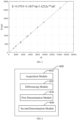
- FIG. 6 schematically shows a structure block diagram of an apparatus for determining an energy calibration of a radiation detector according to the embodiments of the present disclosure.
- an apparatus 600 for determining an energy calibration of a radiation detector includes an acquisition module 610, a differencing module 620, a first determination module 630, and a second determination module 640.
- the acquisition module 610 is used to acquire a background energy spectrum of a plurality of known nuclides, where the background energy spectrum is obtained by the radiation detector detecting the plurality of known nuclides.
- the differencing module 620 is used to perform a differential processing on the background energy spectrum to obtain a channel address-difference diagram, where the channel address-difference diagram includes a plurality of valid peak information determined from a plurality of full-energy peak information.
- the first determination module 630 is used to determine a target coefficient according to the channel address-difference diagram, where the target coefficient characterizes a calibration coefficient in an initial energy channel address function.
- the second determination module 640 is used to determine a target energy channel address function according to the channel address-difference diagram and the initial energy channel address function, where the target energy channel address function characterizes the energy calibration of the radiation detector.
- a channel address-difference diagram by performing a differential processing on the background energy spectrum obtained by detecting a plurality of known nuclides using the radiation detector to be corrected, determine a target coefficient in the initial energy channel address function based on the channel address-difference diagram, and determine the target energy channel address function by combining the channel address-difference diagram and the initial energy channel address function, so that the energy calibration of the radiation detector to be corrected may be corrected using the target energy channel address function, which may avoid a problem of an inaccurate detection result of the corrected radiation detector caused by manually performing an energy calibration using a radioactive source in the related art, and improve a correction efficiency and detection accuracy of the radiation detector.
- the first determination module 630 includes a first determination sub-module and a second determination sub-module.
- the first determination sub-module is used to determine a plurality of target intervals of a target nuclide from the channel address-difference diagram, where the target intervals include a plurality of valid peak information of the target nuclide.
- the second determination sub-module is used to determine the target coefficient according to the plurality of target intervals.
- the second determination sub-module includes a first obtaining unit and a determination unit.
- the first obtaining unit is used to obtain, for each target interval, an initial weight according to a plurality of full-energy peak weighting coefficients and difference coefficients of the plurality of full-energy peak information.
- the determination unit is used to determine the target coefficient according to a plurality of initial weights based on a predetermined filtering rule.
- the first obtaining unit includes a first determination sub-unit and an obtaining sub-unit.
- the first determination sub-unit is used to determine, for each valid peak information, a product value according to the full-energy peak weighting coefficient corresponding to the valid peak information and the difference coefficient at a full-energy peak energy channel address in the valid peak information.
- the obtaining sub-unit is used to sum a plurality of product values to obtain the initial weight of the target interval.
- the differential processing includes a second-order differential processing
- the difference coefficient includes a second-order difference coefficient
- the determination unit includes a drawing sub-unit and a second determination sub-unit.
- the drawing sub-unit is used to draw a weight-coefficient relationship diagram according to the plurality of initial weights, where a horizontal ordinate in the weight-coefficient relationship diagram represents a coefficient scale, and a vertical ordinate in the weight-coefficient relationship diagram represents a weight scale.
- the second determination sub-unit is used to determine the horizontal ordinate corresponding to a maximum weight value in the weight-coefficient relationship diagram as the target coefficient.
- the second determination module 640 includes a constructing sub-module and a solving sub-module.
- the constructing sub-module is used to construct a plurality of coordinate points in a channel address-energy coordinate system according to a channel address corresponding to each full-energy peak information in each target interval and a known full-energy peak energy of the target nuclide.
- the solving sub-module is used to solve, based on the target coefficient, the initial energy channel address function according to the plurality of coordinate points to obtain the target energy channel address function.
- the solving sub-module includes a fitting unit, a solving unit, and a second obtaining unit.
- the fitting unit is used to fit the plurality of coordinate points in the channel address-energy coordinate system to obtain a target curve.
- the solving unit is used to solve the initial energy channel address function by using the target curve to obtain a constant term coefficient and a quadratic term coefficient, where the target coefficient characterizes a primary term coefficient.
- the second obtaining unit is used to obtain, based on the initial energy channel address function, the target energy channel address function according to the constant term coefficient, the target coefficient and the quadratic term coefficient.
- any number of the acquisition module 610, the differencing module 620, the first determination module 630 and the second determination module 640 may be combined into one module for implementation, or any one of the modules may be divided into a plurality of modules. Alternatively, at least part of the functions of one or more of these modules may be combined with at least part of the functions of other modules and implemented in one module. According to the embodiments of the present disclosure, at least one of the acquisition module 610, the differencing module 620, the first determination module 630 and the second determination module 640 may be implemented at least partially as a hardware circuit, such as a field programmable gate array
- FPGA field-programmable gate array
- PLA programmable logic array
- ASIC application specific integrated circuit
- the acquisition module 610, the differencing module 620, the first determination module 630 and the second determination module 640 may be at least partially implemented as a computer program module that may perform corresponding functions when executed.
- FIG. 7 schematically shows a block diagram of an electronic device suitable for implementing the method for determining the energy calibration of the radiation detector according to the embodiments of the present disclosure.
- an electronic device 700 includes a processor 701, which may execute various appropriate actions and processes according to the program stored in a read-only memory (ROM) 702 or the program loaded into a random access memory (RAM) 703 from a storage part 708.
- the processor 701 may, for example, include a general-purpose microprocessor (for example, a CPU), an instruction set processor and/or a related chipset and/or a special-purpose microprocessor (for example, an application specific integrated circuit (ASIC)), and the like.
- the processor 701 may further include an on-board memory for caching purposes.
- the processor 701 may include a single processing unit or a plurality of processing units for executing different actions of the method flow according to the embodiments of the present disclosure.
- the processor 701, the ROM 702, and the RAM 703 are connected to each other through a bus 704.
- the processor 701 executes various operations of the method flow according to the embodiments of the present disclosure by executing the programs in the ROM 702 and/or the RAM 703. It should be noted that the program may also be stored in one or more memories other than ROM 702 and RAM 703.
- the processor 701 may also execute various operations of the method flow according to the embodiments of the present disclosure by executing programs stored in the one or more memories.
- the electronic device 700 may further include an input/output (I/O) interface 705 which is also connected to the bus 704.
- the electronic device 700 may further include one or more of the following components connected to the I/O interface 705: an input part 706 including a keyboard, mouse, etc.; an output part 707 including a cathode ray tube (CRT), a liquid crystal display (LCD), a speaker, etc.; a storage part 708 including a hard disk, etc.; and a communication part 709 including a network interface card, such as a LAN card, a modem, and the like.
- the communication part 709 performs communication processing via a network such as the Internet.
- a driver 710 is also connected to the I/O interface 705 as required.
- a removable medium 711 such as a magnetic disk, an optical disk, a magneto-optical disk, a semiconductor memory, and the like, is installed on the drive 710 as required, so that a computer program to be read therefrom is installed into the storage part 708 as required.
- the present disclosure further provides a computer-readable storage medium, which may be included in the device/apparatus/system described in the above embodiments; or exist alone without being assembled into the device/apparatus/system.
- the above-mentioned computer-readable storage medium carries one or more programs that when executed, perform the methods of the embodiments of the present disclosure.
- the computer-readable storage medium may be a non-volatile computer-readable storage medium, for example, may include but not limited to, a portable computer disk, a hard disk, a random access memory (RAM), a read-only memory (ROM), an erasable programmable read-only memory (EPROM or flash memory), a portable compact disk read-only memory (CD-ROM), an optical memory device, a magnetic memory device, or any suitable combination of the above.
- the computer-readable storage medium may be any tangible medium that contains or stores programs that may be used by or in combination with an instruction execution system, apparatus, or device.
- the computer-readable storage medium may include the above-mentioned ROM 702 and/or RAM 703 and/or one or more memories other than the ROM 702 and RAM 703.
- the embodiments of the present disclosure further include a computer program product, which contains a computer program.
- the computer program contains program code for performing the method shown in the flowchart.
- the program code causes the computer system to implement the method of the embodiments of the present disclosure.
- the computer program may rely on a tangible storage medium such as an optical storage device and a magnetic memory device.
- the computer program may also be transmitted and distributed in the form of signals on a network medium, downloaded and installed through the communication part 709, and/or installed from the removable medium 711.
- the program code contained in the computer program may be transmitted by any suitable medium, including but not limited to a wireless one, a wired one, or any suitable combination of the above.
- the computer program may be downloaded and installed from the network through the communication part 709, and/or installed from the removable medium 711.
- the computer program is executed by the processor 701
- the above-mentioned functions defined in the system of embodiments of the present disclosure are performed.
- the above-mentioned systems, devices, apparatuses, modules, units, etc. may be implemented by computer program modules.
- the program code for executing computer programs provided by the embodiments of the present disclosure may be written in any combination of one or more programming languages.
- these computing programs may be implemented using high-level procedures and/or object-oriented programming languages, and/or assembly/machine languages.
- Programming languages include, but are not limited to, Java, C + +, python, the "C" language, or similar programming languages.
- the program code may be completely executed on the user computing device, partially on the user device, partially on the remote computing device, or completely executed on the remote computing device or server.
- the remote computing device may be connected to a user computing device through any kind of network, including a local area network (LAN) or a wide area network (WAN), or may be connected to an external computing device (e.g., through the Internet using an Internet service provider).
- LAN local area network
- WAN wide area network
- each block in the flowcharts or block diagrams may represent a part of a module, a program segment, or a code, which part includes one or more executable instructions for implementing the specified logical function.
- the functions noted in the blocks may also occur in a different order from that noted in the accompanying drawings. For example, two blocks shown in succession may actually be executed substantially in parallel, or they may sometimes be executed in a reverse order, depending on the functions involved.
- each block in the block diagrams or flowcharts, and the combination of blocks in the block diagrams or flowcharts, may be implemented by a dedicated hardware-based system that performs the specified functions or operations, or may be performed by a combination of dedicated hardware and computer instructions.
Landscapes
- Physics & Mathematics (AREA)
- Spectroscopy & Molecular Physics (AREA)
- Health & Medical Sciences (AREA)
- Life Sciences & Earth Sciences (AREA)
- General Physics & Mathematics (AREA)
- High Energy & Nuclear Physics (AREA)
- Molecular Biology (AREA)
- Measurement Of Radiation (AREA)
Applications Claiming Priority (2)
| Application Number | Priority Date | Filing Date | Title |
|---|---|---|---|
| CN202310134373.7A CN118501927B (zh) | 2023-02-09 | 2023-02-09 | 放射性探测器的能量刻度确定方法、装置、设备和介质 |
| PCT/CN2024/076343 WO2024165023A1 (zh) | 2023-02-09 | 2024-02-06 | 放射性探测器的能量刻度确定方法、装置、设备和介质 |
Publications (1)
| Publication Number | Publication Date |
|---|---|
| EP4530681A1 true EP4530681A1 (de) | 2025-04-02 |
Family
ID=92227955
Family Applications (1)
| Application Number | Title | Priority Date | Filing Date |
|---|---|---|---|
| EP24752878.9A Pending EP4530681A1 (de) | 2023-02-09 | 2024-02-06 | Verfahren und vorrichtung zur bestimmung der energiekalibrierung für einen radioaktiven detektor, vorrichtung und medium |
Country Status (4)
| Country | Link |
|---|---|
| US (1) | US20250216564A1 (de) |
| EP (1) | EP4530681A1 (de) |
| CN (1) | CN118501927B (de) |
| WO (1) | WO2024165023A1 (de) |
Family Cites Families (12)
| Publication number | Priority date | Publication date | Assignee | Title |
|---|---|---|---|---|
| RU2008703C1 (ru) * | 1991-06-27 | 1994-02-28 | Всесоюзный научно-исследовательский институт разведочной геофизики | Способ стабилизации масштаба энергетической шкалы гамма-спектрометра |
| RU2034314C1 (ru) * | 1992-06-18 | 1995-04-30 | Научно-производственное объединение "Тайфун" | Способ градуировки авиационного гамма-спектрометра |
| DE102007027460B4 (de) * | 2007-06-14 | 2017-03-23 | Siemens Healthcare Gmbh | Verfahren zur Durchführung einer bildgebenden Messung mit einem energieselektiven Röntgendetektor |
| CN108457644B (zh) * | 2017-12-26 | 2020-04-10 | 中国石油天然气股份有限公司 | 一种元素俘获能谱测井的伽马能谱解谱方法及装置 |
| CN109239758B (zh) * | 2018-07-27 | 2022-08-12 | 国家海洋局南海环境监测中心(中国海监南海区检验鉴定中心) | 一种生物样品中伽马能谱核素检测分析方法 |
| CN109799541B (zh) * | 2019-01-25 | 2020-12-11 | 中国自然资源航空物探遥感中心 | 一种γ能谱测量谱漂及积分非线性校正方法 |
| RU2704564C1 (ru) * | 2019-03-11 | 2019-10-29 | Российская Федерация, от имени которой выступает Государственная корпорация по атомной энергии "Росатом" (Госкорпорация "Росатом") | СПОСОБ КАЛИБРОВКИ И СТАБИЛИЗАЦИИ ПАРАМЕТРОВ СПЕКТРОМЕТРА γ-ИЗЛУЧЕНИЯ |
| KR102224603B1 (ko) * | 2019-10-24 | 2021-03-08 | 한국원자력안전기술원 | 방사선 검출기 및 그 제어방법 |
| CN111538069A (zh) * | 2020-06-17 | 2020-08-14 | 中国原子能科学研究院 | 能谱分析系统、方法及能谱数据分析设备 |
| CN112684490B (zh) * | 2020-12-22 | 2024-05-24 | 上海工物高技术产业发展有限公司 | 能谱分区方法、装置、计算机设备和存储介质 |
| CN115128661A (zh) * | 2022-06-27 | 2022-09-30 | 中核立信(北京)科技有限公司 | 一种适用于解析计算γ能谱的方法 |
| CN115267881B (zh) * | 2022-07-26 | 2025-12-02 | 黑龙江省原子能研究院 | 一种核探测器温度补偿修正算法 |
-
2023
- 2023-02-09 CN CN202310134373.7A patent/CN118501927B/zh active Active
-
2024
- 2024-02-06 WO PCT/CN2024/076343 patent/WO2024165023A1/zh not_active Ceased
- 2024-02-06 US US18/879,236 patent/US20250216564A1/en active Pending
- 2024-02-06 EP EP24752878.9A patent/EP4530681A1/de active Pending
Also Published As
| Publication number | Publication date |
|---|---|
| CN118501927A (zh) | 2024-08-16 |
| WO2024165023A1 (zh) | 2024-08-15 |
| US20250216564A1 (en) | 2025-07-03 |
| CN118501927B (zh) | 2025-09-05 |
Similar Documents
| Publication | Publication Date | Title |
|---|---|---|
| Casanovas et al. | Implementation of gamma-ray spectrometry in two real-time water monitors using NaI (Tl) scintillation detectors | |
| CN109283568B (zh) | 一种放射性水过滤器废滤芯测量系统和方法 | |
| CN110988967B (zh) | 环境X、γ辐射探测器剂量率量程的扩展方法 | |
| JP2016033459A (ja) | 放射性物質のモニタリング装置及び放射性物質のモニタリング方法 | |
| CN116381772A (zh) | 一种用于剂量率仪的实时能量响应校正方法、系统及终端 | |
| EP3546986A1 (de) | Doppelenergiedetektionsvorrichtung und verfahren dafür | |
| JP2013210317A (ja) | 放射性物質の測定方法およびそのための測定装置 | |
| Mauring et al. | Implications for analysis of 226Ra in a low-level gamma spectrometry laboratory due to variations in radon background levels | |
| EP4530681A1 (de) | Verfahren und vorrichtung zur bestimmung der energiekalibrierung für einen radioaktiven detektor, vorrichtung und medium | |
| KR20180031984A (ko) | 방재요원 훈련 시스템, 방재요원 훈련용 단말기 및 방재요원 훈련 시스템 운용방법 | |
| EP3719541B1 (de) | Effizienzausgleichssystem einer schutzvorrichtung | |
| CN108802792B (zh) | 放射性惰性气体的测量装置及方法 | |
| Mitev et al. | Towards a radon-in-water primary standard at LNHB | |
| KR101197002B1 (ko) | 핵물질 혼재 시료에서 핵물질별 정량분석을 하기 위한 비파괴측정장치와 통합 분석시스템을 갖춘 핵물질 통합 측정 시스템 | |
| US20150177408A1 (en) | Method for measuring the activity of a photon emission source | |
| JP7121648B2 (ja) | 放射性廃棄物のレベル推定方法 | |
| US3780289A (en) | Quench correction in liquid scintillation counting | |
| JP7079426B2 (ja) | γ線検出装置 | |
| JPS62179684A (ja) | 低レベル固体廃棄物中の含有放射性核種評価測定システム | |
| Park et al. | Uncertainty estimation of minimum detectable activity through sparse spectrum using kernel-based Gaussian process regression | |
| Agboraw et al. | Revisiting Currie’s Minimum Detectable Activity for Non-Destructive Assay By Gamma Detection Using Tolerance Intervals | |
| KR102875795B1 (ko) | 베이지안 선형회귀법을 이용한 Sr-89/90 혼합선원의 체렌코프광 계측효율 결정시스템 및 그 방법 | |
| KR101308937B1 (ko) | 차량을 이용한 방사능오염 탐사장치 및 그를 이용한 탐사 방법 | |
| Hashimoto et al. | Simultaneous determination of radionuclides separable into natural decay series by use of time-interval analysis | |
| JP2019190993A (ja) | 警報設定値を自動で補正する放射線源検出設備用のソフトウェアプログラム及び放射線源検出設備の運用方法 |
Legal Events
| Date | Code | Title | Description |
|---|---|---|---|
| STAA | Information on the status of an ep patent application or granted ep patent |
Free format text: STATUS: THE INTERNATIONAL PUBLICATION HAS BEEN MADE |
|
| PUAI | Public reference made under article 153(3) epc to a published international application that has entered the european phase |
Free format text: ORIGINAL CODE: 0009012 |
|
| STAA | Information on the status of an ep patent application or granted ep patent |
Free format text: STATUS: REQUEST FOR EXAMINATION WAS MADE |
|
| 17P | Request for examination filed |
Effective date: 20241223 |
|
| AK | Designated contracting states |
Kind code of ref document: A1 Designated state(s): AL AT BE BG CH CY CZ DE DK EE ES FI FR GB GR HR HU IE IS IT LI LT LU LV MC ME MK MT NL NO PL PT RO RS SE SI SK SM TR |