EP4530606A1 - Dispositifs à semi-conducteur, capteur de gaz à système microélectromécanique, procédés - Google Patents
Dispositifs à semi-conducteur, capteur de gaz à système microélectromécanique, procédés Download PDFInfo
- Publication number
- EP4530606A1 EP4530606A1 EP23199747.9A EP23199747A EP4530606A1 EP 4530606 A1 EP4530606 A1 EP 4530606A1 EP 23199747 A EP23199747 A EP 23199747A EP 4530606 A1 EP4530606 A1 EP 4530606A1
- Authority
- EP
- European Patent Office
- Prior art keywords
- layer
- radiation
- substrate
- radiation element
- interface layer
- Prior art date
- Legal status (The legal status is an assumption and is not a legal conclusion. Google has not performed a legal analysis and makes no representation as to the accuracy of the status listed.)
- Pending
Links
Images

Classifications
-
- G—PHYSICS
- G01—MEASURING; TESTING
- G01N—INVESTIGATING OR ANALYSING MATERIALS BY DETERMINING THEIR CHEMICAL OR PHYSICAL PROPERTIES
- G01N21/00—Investigating or analysing materials by the use of optical means, i.e. using sub-millimetre waves, infrared, visible or ultraviolet light
- G01N21/17—Systems in which incident light is modified in accordance with the properties of the material investigated
- G01N21/1702—Systems in which incident light is modified in accordance with the properties of the material investigated with opto-acoustic detection, e.g. for gases or analysing solids
-
- G—PHYSICS
- G01—MEASURING; TESTING
- G01N—INVESTIGATING OR ANALYSING MATERIALS BY DETERMINING THEIR CHEMICAL OR PHYSICAL PROPERTIES
- G01N27/00—Investigating or analysing materials by the use of electric, electrochemical, or magnetic means
- G01N27/02—Investigating or analysing materials by the use of electric, electrochemical, or magnetic means by investigating impedance
- G01N27/04—Investigating or analysing materials by the use of electric, electrochemical, or magnetic means by investigating impedance by investigating resistance
- G01N27/14—Investigating or analysing materials by the use of electric, electrochemical, or magnetic means by investigating impedance by investigating resistance of an electrically-heated body in dependence upon change of temperature
- G01N27/18—Investigating or analysing materials by the use of electric, electrochemical, or magnetic means by investigating impedance by investigating resistance of an electrically-heated body in dependence upon change of temperature caused by changes in the thermal conductivity of a surrounding material to be tested
-
- B—PERFORMING OPERATIONS; TRANSPORTING
- B81—MICROSTRUCTURAL TECHNOLOGY
- B81B—MICROSTRUCTURAL DEVICES OR SYSTEMS, e.g. MICROMECHANICAL DEVICES
- B81B7/00—Microstructural systems; Auxiliary parts of microstructural devices or systems
- B81B7/0009—Structural features, others than packages, for protecting a device against environmental influences
- B81B7/0019—Protection against thermal alteration or destruction
-
- B—PERFORMING OPERATIONS; TRANSPORTING
- B81—MICROSTRUCTURAL TECHNOLOGY
- B81B—MICROSTRUCTURAL DEVICES OR SYSTEMS, e.g. MICROMECHANICAL DEVICES
- B81B7/00—Microstructural systems; Auxiliary parts of microstructural devices or systems
- B81B7/02—Microstructural systems; Auxiliary parts of microstructural devices or systems containing distinct electrical or optical devices of particular relevance for their function, e.g. microelectro-mechanical systems [MEMS]
-
- B—PERFORMING OPERATIONS; TRANSPORTING
- B81—MICROSTRUCTURAL TECHNOLOGY
- B81C—PROCESSES OR APPARATUS SPECIALLY ADAPTED FOR THE MANUFACTURE OR TREATMENT OF MICROSTRUCTURAL DEVICES OR SYSTEMS
- B81C1/00—Manufacture or treatment of devices or systems in or on a substrate
- B81C1/00015—Manufacture or treatment of devices or systems in or on a substrate for manufacturing microsystems
-
- B—PERFORMING OPERATIONS; TRANSPORTING
- B81—MICROSTRUCTURAL TECHNOLOGY
- B81C—PROCESSES OR APPARATUS SPECIALLY ADAPTED FOR THE MANUFACTURE OR TREATMENT OF MICROSTRUCTURAL DEVICES OR SYSTEMS
- B81C1/00—Manufacture or treatment of devices or systems in or on a substrate
- B81C1/00642—Manufacture or treatment of devices or systems in or on a substrate for improving the physical properties of a device
- B81C1/0069—Thermal properties, e.g. improve thermal insulation
-
- G—PHYSICS
- G01—MEASURING; TESTING
- G01L—MEASURING FORCE, STRESS, TORQUE, WORK, MECHANICAL POWER, MECHANICAL EFFICIENCY, OR FLUID PRESSURE
- G01L11/00—Measuring steady or quasi-steady pressure of a fluid or a fluent solid material by means not provided for in group G01L7/00 or G01L9/00
- G01L11/02—Measuring steady or quasi-steady pressure of a fluid or a fluent solid material by means not provided for in group G01L7/00 or G01L9/00 by optical means
-
- G—PHYSICS
- G01—MEASURING; TESTING
- G01L—MEASURING FORCE, STRESS, TORQUE, WORK, MECHANICAL POWER, MECHANICAL EFFICIENCY, OR FLUID PRESSURE
- G01L9/00—Measuring steady of quasi-steady pressure of fluid or fluent solid material by electric or magnetic pressure-sensitive elements; Transmitting or indicating the displacement of mechanical pressure-sensitive elements, used to measure the steady or quasi-steady pressure of a fluid or fluent solid material, by electric or magnetic means
- G01L9/0041—Transmitting or indicating the displacement of flexible diaphragms
- G01L9/0076—Transmitting or indicating the displacement of flexible diaphragms using photoelectric means
-
- G—PHYSICS
- G01—MEASURING; TESTING
- G01N—INVESTIGATING OR ANALYSING MATERIALS BY DETERMINING THEIR CHEMICAL OR PHYSICAL PROPERTIES
- G01N27/00—Investigating or analysing materials by the use of electric, electrochemical, or magnetic means
- G01N27/02—Investigating or analysing materials by the use of electric, electrochemical, or magnetic means by investigating impedance
- G01N27/04—Investigating or analysing materials by the use of electric, electrochemical, or magnetic means by investigating impedance by investigating resistance
- G01N27/14—Investigating or analysing materials by the use of electric, electrochemical, or magnetic means by investigating impedance by investigating resistance of an electrically-heated body in dependence upon change of temperature
- G01N27/18—Investigating or analysing materials by the use of electric, electrochemical, or magnetic means by investigating impedance by investigating resistance of an electrically-heated body in dependence upon change of temperature caused by changes in the thermal conductivity of a surrounding material to be tested
- G01N27/185—Investigating or analysing materials by the use of electric, electrochemical, or magnetic means by investigating impedance by investigating resistance of an electrically-heated body in dependence upon change of temperature caused by changes in the thermal conductivity of a surrounding material to be tested using a catharometer
-
- H—ELECTRICITY
- H10—SEMICONDUCTOR DEVICES; ELECTRIC SOLID-STATE DEVICES NOT OTHERWISE PROVIDED FOR
- H10F—INORGANIC SEMICONDUCTOR DEVICES SENSITIVE TO INFRARED RADIATION, LIGHT, ELECTROMAGNETIC RADIATION OF SHORTER WAVELENGTH OR CORPUSCULAR RADIATION
- H10F55/00—Radiation-sensitive semiconductor devices covered by groups H10F10/00, H10F19/00 or H10F30/00 being structurally associated with electric light sources and electrically or optically coupled thereto
-
- B—PERFORMING OPERATIONS; TRANSPORTING
- B81—MICROSTRUCTURAL TECHNOLOGY
- B81B—MICROSTRUCTURAL DEVICES OR SYSTEMS, e.g. MICROMECHANICAL DEVICES
- B81B2201/00—Specific applications of microelectromechanical systems
- B81B2201/02—Sensors
-
- G—PHYSICS
- G01—MEASURING; TESTING
- G01N—INVESTIGATING OR ANALYSING MATERIALS BY DETERMINING THEIR CHEMICAL OR PHYSICAL PROPERTIES
- G01N21/00—Investigating or analysing materials by the use of optical means, i.e. using sub-millimetre waves, infrared, visible or ultraviolet light
- G01N21/17—Systems in which incident light is modified in accordance with the properties of the material investigated
- G01N21/1702—Systems in which incident light is modified in accordance with the properties of the material investigated with opto-acoustic detection, e.g. for gases or analysing solids
- G01N2021/1704—Systems in which incident light is modified in accordance with the properties of the material investigated with opto-acoustic detection, e.g. for gases or analysing solids in gases
Definitions
- Examples relate to semiconductor devices, a microelectromechanical system gas sensor and methods.
- a semiconductor device comprising a radiation element and a detection element.
- the radiation element comprises a radiation layer for radiating an electromagnetic wave.
- the detection element comprises a detection layer for detecting the electromagnetic wave.
- the semiconductor device comprises a substrate and an interface layer.
- the interface layer is arranged between the radiation element and/or the detection element and the substrate. A thermal conductivity of the radiation element and/or the detection element is different from a thermal conductivity of the interface layer.
- a semiconductor device comprising a radiation element and a detection element.
- the radiation element comprises a radiation layer for radiating an electromagnetic wave.
- the detection element comprises a detection layer for detecting the electromagnetic wave.
- the semiconductor device comprises a substrate and a cap layer.
- the cap layer is arranged above the radiation element and/or the detection element. A thermal conductivity of the radiation element and/or the detection element is different from a thermal conductivity of the cap layer.
- Some aspects of the present disclosure relate to a MEMS gas sensor comprising a semiconductor device as described above.
- Some aspects of the present disclosure relate to a method comprising forming a radiation element comprising a radiation layer for radiating an electromagnetic wave and a detection element comprising a detection layer for detecting the electromagnetic wave on a substrate.
- the method further comprises forming an interface layer on the radiation element or the detection element.
- a thermal conductivity of the radiation element and/or the detection element is different from a thermal conductivity of the interface layer.
- the method comprises attaching the interface layer to a further substrate.
- Some aspects of the present disclosure relate to a method comprising forming a radiation element comprising a radiation layer for radiating an electromagnetic wave and a detection element comprising a detection layer for detecting the electromagnetic wave on a substrate.
- the method further comprises forming a cap layer on the radiation element or the detection element.
- a thermal conductivity of the radiation element and/or the detection element is different from a thermal conductivity of the cap layer.
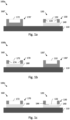
- Figs. 1a-1c show schematic views of cross sections of semiconductor devices 100a, 100b, 100c.
- the semiconductor device 100a comprises a substrate 110.
- the semiconductor device 100a comprises a radiation element 130 and detection element 170'.
- the radiation element 130 comprises a radiation layer 132 configured to radiate an electromagnetic wave.
- the detection element 170' comprises a detection layer 172 configured to detect the electromagnetic wave. That is, the radiation element 130 may radiate an electromagnetic wave to be detected by the detection element 170'.
- the radiation element 130 may be part of an emitter 120 and/or the detection element 170' may be part of a detector 160'.
- the radiation element 130 may comprise a supporting layer 134, e.g., a semiconductor substrate or a semiconductor layer.
- the radiation element 130 e.g., the radiation layer 132
- the radiation layer 132 may comprise a membrane structure or may be a membrane structure, e.g., a membrane or a diaphragm.
- the radiation element 130 may be a thermal MEMS, such as an infrared heater. That is, the radiation element 130 may be a thermally active component.
- the supporting layer 134 and the radiation layer 132 may be formed in one piece.
- the radiation layer 132 may be formed from the supporting layer 134, e.g., a semiconductor substrate, for example, by etching a portion of the supporting layer to form the radiation layer 132.
- the radiation layer 132 may be attached to the supporting layer 134.
- the supporting layer 134 may comprise multiple sub-layers (i.e., the supporting layer 134 is not formed in one piece).
- the radiation layer 132 may be formed in a sub-layer of the supporting layer 134.
- the supporting layer 134 and/or the radiation layer 132 may comprise or may be made of a semiconducting material such as silicon, silicon carbide, silicon germanium, for example.
- the supporting layer 134 and/or the radiation layer 132 may comprise or may be made of an insulating material such as silicon nitride or glass. That is, the detection element 130 may comprise or may be made of silicon nitride or glass.
- the radiation element 130 may be configured to radiate an electromagnetic wave.
- the radiation layer 132 may be configured to radiate heat or thermal radiation, e.g., infrared radiation.
- the radiation layer 132 may be configured to radiate the electromagnetic wave in an operating range, e.g., a temperature range or wavelength range, of the detection layer 172.
- the electromagnetic wave may be radiated at a first temperature range for operating the detection layer 172 for physically (i.e., according to a physical principle, e.g., the photoacoustic principle) detecting at least a first target gas between the radiation layer 132 and the detection layer 172.
- the radiation layer 132 may be configured to intermittently radiate the electromagnetic wave.
- the radiated electromagnetic wave may be absorbed, at least partially, by gas molecules which heat up accordingly. If the electromagnetic wave is no longer emitted by the radiation layer 132, no heat or thermal radiation can be absorbed anymore by the gas molecules, and they cool down again.
- This intermittent heating and cooling induces a pressure variation.
- This pressure variation may be detected by the detection layer 172 which may transduce the measured pressure variation into a corresponding measurement signal. That is, the detection layer 172 may be configured to detect the electromagnetic wave radiated by the radiation layer 132.
- the detection layer 172 may be configured to detect indirectly the electromagnetic wave radiated by the radiation layer 132.
- the detection layer 172 may be configured to detect a pressure variation induced by the electromagnetic wave.
- the detection layer 172 may be part of a thermal sensor.
- the detection layer 172 may be configured to detect directly the electromagnetic wave radiated by the radiation layer 132. That is, the detection layer 172 may be configured to determine an absorption spectrum of the electromagnetic wave, for example. In this case, the detection layer 172 may be part of a direct absorption sensor.
- the detection element 170 may comprise a supporting layer 174, e.g., a semiconductor substrate or a semiconductor layer.
- the detection element 170 e.g., the detection layer 172
- the detection layer 172 may comprise or may be a microphone structure, e.g., a MEMS microphone, a pressure sensitive transducer, a piezo transducer, a capacitive sensor, a thermal sensitive structure, a mechanical strain sensitive structure and/or a magnetic field sensitive structure.
- the detection element 170 may be a thermally sensitive component.
- the semiconductor device 100a, 100b, 100c may be used in a MEMS gas sensor, such as in a miniaturized photo acoustic spectrometer sensor or a thermally sensitive device (see Fig. 6 ).
- the supporting layer 174 and the detection layer 172 may be formed in one piece. That is, the detection layer 172 may be formed from the supporting layer 174, e.g., a semiconductor substrate, for example, by etching a portion of the supporting layer to form the detection layer 172. Alternatively, the detection layer 172 may be attached to the supporting layer 174. Optionally or alternatively, the supporting layer 174 may comprise multiple sub-layers (i.e., the supporting layer 174 is not formed in one piece). For example, the detection layer 172 may be formed in a sub-layer of the supporting layer 174.
- the supporting layer 174 and/or the detection layer 172 may comprise or may be made of a semiconducting material such as silicon, silicon carbide, silicon germanium and/or a piezoelectric material such as lithium niobate, aluminum nitride, barium titanate, for example.
- the supporting layer 174 and/or the detection layer 172 may comprise or may be made of an insulating material such as silicon nitride or glass. That is, the detection element 170 may comprise or may be made of silicon nitride or glass.
- the substrate 110 may be a printed circuit board or a lead frame, for example. Because the radiation element 130, 130' and the detection element 170, 170' may be thermally connected through the substrate 110, heat generated in the radiation element 130, 130' may affect the functionality of the detection element 170, 170'. The smaller the distance between the radiation element 130, 130'and the detection element 170, 170' become, the faster they can react to temperature changes (i.e., thermal capacity decreases and thermal modulation increases). Thermal modulation on the radiation element 130, 130' (caused by the process of radiating the electromagnetic wave) may create a modulated differential pressure.
- the modulated differential pressure may interfere with the optically generated photoacoustic signal, i.e., the induced pressure variation of the gas, and thus may negatively affect the detection element 170,170'. That is, thermal modulation on the radiation element 130, 130' (e.g., by a parasitic thermal signal) may conduct to the thermally sensitive detection element 170, 170' and may affect the sensitivity of the detection element 170, 170' due to cross-coupling. Therefore, the accuracy of the detection element 170, 170' may be decreased and/or an error of the detection element 170, 170' may be increased.
- a defined conductive thermal interface may be necessary to adjust a thermal conductivity and a thermal path in a way to demodulate parasitic thermal signals (caused by the radiation element 130, 130' radiating the electromagnetic wave) from sensor measurement signals (the electromagnetic wave measured by the detection element 170, 170').
- the conductive thermal interface may be provided by the interface layer 140, 180.
- an emitter or a detector does not comprise a separate interface layer.
- a detector 160' and an emitter 120' do not normally have an interface layer (see Figs. 1a and Figs. 1b , respectively).
- a material between the radiation element 130'/the detection element 170' and the substrate 110 is identical to a material of the radiation element 130'/the detection element 170'. Therefore, parasitic thermal signal induced by an emitter 120' can negatively affect the detector 160'.
- the conductive thermal interface i.e., the interface layer 140, 180
- the conductive thermal interface can reduce cross-coupling between radiation element 130, 130' and detection element 170, 170'.
- the interface layer 140, 180 may comprise a smaller or a larger thermal conductivity than the radiation element 130 and/or the detection element 170.
- an interface layer 140 may be only arranged between the radiation element 130 and the substrate 110.
- an interface layer 180 may be only arranged between the detection element 170 and the substrate 110 (see Fig. 1b ).
- an interface layer 140 may be arranged between the radiation element 130 and the substrate 110 and an interface layer 180 may be arranged between the detection element 170 and the substrate 110 (see Fig. 1c ).
- the interface layer 140, 180 may allow to provide a thermally isolated material stack (e.g., the emitter 120 or the detector 160) utilizing a thermally decoupling material (part of the interface layer 140, 180), e.g., an insulating material or a conductive material, with a thermal conductivity different from the thermal conductivity of the radiation element 130 and/or the detection element 170.
- the thermally decoupling material may demodulate the thermal oscillation caused by the radiation element 130 out of a frequency of the induced pressure variation to be detected by the detection element 170'. In this way, the modulated parasitic temperature oscillations of a material stack may be converted to a slow temperature drift by the thermally isolated material stack. That is, the thermally isolated material stack may be improved for a thermal path.
- the thermally isolated material stack may be combined with an arrangement as flip-chip mounting (e.g., see Figs. 1c , 3d , 4a, 4b , 5b, 5c , 6a ). In this way, cross-coupling between radiation element 130, 130' and detection 170', 170 can be reduced in a facilitated way.
- the thermally isolated material stack design may be used for the emitter 120 and/or the detector 160.
- Fig. 1c shows an example of an emitter 120 assembled using flip-chip mounting.
- the interface layer 140 may be manufactured as a "cap layer" of an intermediate semiconductor device.
- the intermediate semiconductor device may be attached to the substrate 110 using flip-chip mounting.
- the "cap layer” of the intermediate semiconductor device may become the interface layer 140.
- the radiation element 130 may be supported by the interface layer 140.
- the radiation element 130 may face the interface layer 140.
- the thermally isolated material stack comprising an interface layer 140, 180 may improve a performance of the detection element 170', 170 (due to a lower parasitic signal) and/or may allow to size-down/shrink the distance between the radiation element 130, 130' and the detection element 170', 170 due to thermal improvement possible.
- the interface layer 140, 180 may comprise or may be made of (i.e., the thermally decoupling material may comprise or may be made of) an insulating material, such as glass or silicon nitride or a conductive material such as doped silicon (if the radiation element 130'/detection element 170' comprises or is made of undoped silicon), monocrystalline silicon (if the radiation element 130'/detection element 170' comprises or is made of polycrystalline silicon) or a metal such as copper, gold, silver.
- an insulating material such as glass or silicon nitride or a conductive material such as doped silicon (if the radiation element 130'/detection element 170' comprises or is made of undoped silicon), monocrystalline silicon (if the radiation element 130'/detection element 170' comprises or is made of polycrystalline silicon) or a metal such as copper, gold, silver.
- a thickness of the interface layer 140, 180 may be at least 10 ⁇ m, or at least 30 ⁇ m, or at least 50 ⁇ m, or at least 100 ⁇ m and/or at most 1400 ⁇ m, or at most 1600 ⁇ m, or at most 1800 ⁇ m, or at most 2000 ⁇ m.
- a material of the (emitter) interface layer 140 may be different from a material of the (detector) interface layer 180, e.g., the (emitter) interface layer material may be an insulating material and the (detector) interface layer material may be a conductive material or a different insulating material.
- the (emitter) interface layer 140 may comprise a conductive material and the (detector) interface layer 180 may comprise an insulating material. In this way, parameters of the emitter 120 and the detector 160 can be adjusted independently.
- the thermal conductivity of the radiation element 130 and/or the detection element 170 may be different from the thermal conductivity of the interface layer 140, 180 by a factor of at least 5, or at least 7, or at least 9, or at least 10, or at least 12, or at least 14. In this way, the interface layer 140, 180 can thermally decouple the radiation element 130 and/or the detection element 170.
- a difference by a factor can mean that the thermal conductivity is either smaller by this factor or larger by this factor.
- the thermal conductivity of the interface layer 140, 180 may be 10 times larger or ten times smaller than the thermal conductivity of the radiation element 130 or the detection element 170.
- the radiation element 130 and/or the detection element 170 may comprise or may be made of silicon (150-170 W/(m*K)) and the interface layer 140, 180 may comprise or may be made of silicon nitride (10-50 W/(m*K)), glass (1,5 W/(m*K)) or a metal such as copper (398 W/(m*K)), gold (315 W/(m*K)), silver (429 W/(m*K)).
- the radiation element 130 and/or the detection element may comprise or may be made of glass (e.g., the supporting layer 134, 174 may comprise or may be made of glass) and the interface layer 140, 180 may be made of silicon (e.g., doped silicon, undoped silicon, monocrystalline silicon or polycrystalline silicone).
- the interface layer 140, 180 may partially thermally decouple the radiation element 130/detection element 170 from the substrate 110. In this way, a cross-coupling can be reduced and a performance of the detection element 170, 170' can be improved.
- the interface layer 140, 180 may be a conductive layer.
- the interface layer 140, 180 may have a thermal conductivity of at least 150 W/(m*K), or at least 170 W/(m*K), or at least 190 W/(m*K), or at least 200 W/(m*K) or at least 300 W/(m*K), or at least 380 W/(m*K).
- Decreasing or increasing the heat transfer between radiation element 130/detection element 170 and the substrate 110 may allow to improve a thermal decoupling of the radiation element 130 from the detection element 170, 170' and/or the detection element 170 from the radiation element 130, 130'. In this way, a cross-coupling can be reduced even further and a performance of the detection element 170, 170' can be improved.
- the interface layer 140, 180 may comprise glass or may be made of glass.
- the glass may comprise or may be made of silicon oxide such as silica quartz or phosphosilicate glass.
- the interface layer 140, 180 may act as insulating layer.
- glass may facilitate a handling of the emitter 120/detector 160, such as attachment to the substrate 110.
- an interface layer 140, 180 comprising glass may provide an improved interface between interface layer 140, 180 and substrate 110, as in comparison to an adhesive.
- the interface layer 140, 180 may comprise a surface, which could be attached to the substrate 110.
- an adhesive may not be required to attach an interface layer 140, 180, such as a glass layer or a silicon nitride layer, to a surface. In this way, an interface between the substrate 110 and the emitter 120/the detector 160 can be improved. For example, an inaccurate contact between interface layer 140 and surface due to the adhesive can be avoided.
- the interface layer 140, 180 may be directly attached to the substrate 110.
- the interface layer 140, 180 may be attached to the substrate 110 by bonding, e.g., glass to silicon anodic bonding, glass frit bonding, eutectic, transient liquid metal or metal to metal thermocompression bonding.
- bonding e.g., glass to silicon anodic bonding, glass frit bonding, eutectic, transient liquid metal or metal to metal thermocompression bonding.
- adhesive-free wafer bonding techniques such as surface-activated bonding or hydrophilic bonding, can be used to attach the interface layer 140, 180 to the substrate 110. These methods rely on surface activation or modification to create a bond without the use of adhesives. Since the interface layer 140, 180 can be attached directly to the substrate 110, an interface between the emitter 120/the detector 160 and the substrate 110 can be improved.
- the interface layer 140, 180 may be a "cap layer" of an intermediate semiconductor device.
- the radiation layer 132 may face the interface layer 140, 180. That is, the radiation layer 132 may be formed on or in a surface of the radiation element 130 facing the interface layer 140, 180.
- the interface layer 140, 180 may comprise a cavity 144. Further, the radiation layer 132 may face the cavity.
- the radiation layer 132 may be arranged above the cavity 144 to prevent a contact between interface layer 140, 180 and radiation layer 132.
- a thermally isolated material stack (comprising the interface layer 140, 180 and the radiation element 130) may be attached to the substrate 110 (e.g., using flip-chip mounting).
- the interface layer 140, 180 may be attached to the substrate 110 and the radiation element 130 may be attached to the interface layer 140, 180. That is, both the emitter 120 and the detector 160 can each be formed using flip-chip mounting or alternatively, by attaching the interface layer 140, 180 to the substrate 110 and by attaching the radiation element 130/detection element 170 to the interface layer 140, 180.
- the interface layer 140, 180 may be attached to the radiation element 130 and/or the detection element 170.
- the radiation element 130 may be an emitting layer 130.
- the emitting layer 130 may comprise the radiation layer 132. That is, the emitting layer 130 may be configured to radiate the electromagnetic wave.
- the emitting layer 130 may be formed separately from the interface layer 140.
- the emitting layer 130 may be attached to the interface layer 140.
- the emitting layer 130 may be attached to the supporting layer 134 and the supporting layer 134 may be attached to the interface layer 140.
- the emitting layer 130 may be directly attached to the interface layer 140.
- the radiation element 130 may be a thermally active component and the detection element 170 may be a thermally sensitive component.
- the radiation element 130 or the detection element 170 may be electrically connected to the substrate 110 by a coupling element.
- the radiation element 130 and the detection element 170 may be connected by multiple coupling elements to the substrate 110.
- the coupling element may be an electrical connection between the radiation element 130/the detection 170 and the substrate 110.
- the coupling element may comprise or may be a solder ball, a via, an electrically conductive adhesive and/or a wire bond.
- the semiconductor device 100a, 100b, 100c may further comprise an underfill layer arranged between the radiation element 130 or the detection element 170 and the substrate 110 (see also Figs. 4 , 5b, 5c ).
- the underfill layer may improve a stability of the emitter 120 and/or the detector 160.
- the underfill layer may increase a design flexibility of the semiconductor device 100a, 100b, 100c.
- a material of the underfill layer can be chosen depending on a thermal conductivity. That is, a thermal conductivity of the emitter 120/the detector 160 can be adjusted using the underfill layer. Thus, the thermal conductivity can be adjusted using the underfill layer during a back-end-of-line process.
- the thermal conductivity of the emitter 120/the detector 160 can be adjusted using front-end-of-line processes, e.g., bonding the interface layer 140, 170 on the substrate 110 and using back-end-of-line processes, e.g., forming the underfill layer.
- the semiconductor device 100a, 100b, 100c may further comprise a cap layer arranged above the radiation element 130 and/or the detection element 170.
- the cap layer is transparent for infrared light.
- the cap layer may cover the radiation element 130 and/or the detection element 170.
- the cap layer may not block or may not interfere with the radiated electromagnetic wave.
- the cap layer may further act to thermally decouple the radiation element 130 and/or the detection element 170.
- a thermal conductivity of the cap layer may be different from a thermal conductivity of the radiation element and/or the detection element (e.g., see Figs. 2 , 3b ).
- Fig. 1 may comprise one or more optional or additional features corresponding to one or more aspects mentioned in connection with the proposed concept or one or more examples described below (e.g., Fig. 2 - 8 ).
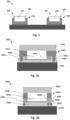
- Fig. 2 shows a schematic view of a cross section of another example of a semiconductor device 200.
- the semiconductor device 200 comprises a substrate 210. Further, the semiconductor device 200 comprises a radiation element 230 and detection element 270.
- the radiation element 230 comprises a radiation layer 232 configured to radiate an electromagnetic wave.
- the detection element 270 comprises a detection layer 272 configured to detect the electromagnetic wave. That is, the radiation element 230 may radiate an electromagnetic wave to be detected by the detection element 270.
- the radiation element 230 may be part of an emitter 220 and/or the detection element 270 may be part of a detector 260.
- arranging the radiation element 230 and the detection element 270 in a semiconductor device 200 may lead to cross-coupling.
- the cross-coupling can be reduced by an interface layer as described with reference to Fig. 1 .
- the cross-coupling can also be reduced by a cap layer 250, 290 .
- the semiconductor device 200 may comprise a cap layer 250, 290 arranged above the radiation element 230 and/or the detection element 270.
- a thermal conductivity of the radiation element 230 and/or the detection element 270 may be different from a thermal conductivity of the cap layer 250, 290.
- the cap layer 250, 290 may affect a heat generation and/or a heat distribution in the emitter 220 and/or the detector 260. Therefore, a heat transfer to the substrate 210 can be adjusted using the cap layer 250, 290.
- the cap layer 250, 290 may cause an increased heat transfer towards the substrate 210 or a decreased heat transferred towards the substrate 210. In this way, undesired heat generated in the emitter 210 and transferred into the substrate 210 can be at least partially thermally decoupled from the intended electromagnetic wave radiated of the radiation element 230.
- the cap layer 250, 290 may be a separate layer attached to the radiation element 230/the detection element 270.
- the above description ( Fig. 1 ) of the interface layer also applies to the cap layer 250, 290. That is, the cap layer 250, 290 can have the same properties and parameters as the interface layer.
- the cap layer 250, 290 can be combined with an interface layer. In this case, the adjustment of heat transfer can be facilitated.
- Fig. 2 shows only exemplary a cap layer 250 above the radiation element 230 and a cap layer 290 above the detection element 270.
- a cap layer 250 or a cap layer 290 may be disposed only over the radiation element 230 or only over the detection element 270, respectively.
- Fig. 2 may comprise one or more optional or additional features corresponding to one or more aspects mentioned in connection with the proposed concept or one or more examples described above (e.g., Fig. 1 ) and/or below (e.g., Fig. 3 -8 ).
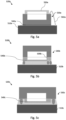
- Figs. 3a-3d show schematic views of cross sections of other examples of a part of a semiconductor device.
- Figs. 3a-3d show exemplary an emitter 320a, 320b, 320c, 320d with a three-layer stack, namely interface layer 336a, 340b, 340c, 340d, radiation element 330a, 330b, 330c, 330d comprising the supporting structure 334a, 334b, 334c, 334d and the cap layer 350a, 350b, 356c, 356d.
- the three-layer stack is an example. In other examples, the stack may comprise less layers, e.g., two layers (see Fig. 5 ) or more layers.
- the interface layer 336a, 340b, 340c, 340d and/or the radiation element 330a, 330b, 330c, 330d may comprise multiple layers.
- the substrate 310a and the interface layer 336a may comprise or may be made of silicon and may be bonded together.
- silicon to silicon bonding can be done by glass frit bonding, eutectic, transient liquid metal or metal to metal thermocompression bonding.
- Fig. 3b shows an example of an emitter 320b.
- the emitter 320b may be part of a semiconductor device according to Fig. 1 and/or Fig. 2 .
- the emitter 320b may comprise a substrate 310b, an interface layer 340b, a radiation element 330b and a cap layer 350b.
- the thermal conductivity of the interface layer 340b may be different from the thermal conductivity of the radiation element 330b.
- the thermal conductivity of the radiation element 330b may be different from the thermal conductivity of the cap layer 350b.
- the radiation element 330b may comprise a supporting layer 334b configured to support the radiation layer. Further, Fig.
- the cap layer 350b and/or the interface layer 340b may comprise or may be made of glass or a silicon nitride.
- the radiation element 330b may comprise or may be made of semiconducting material such as silicon, silicon carbide, silicon germanium and/or a piezoelectric material such as lithium niobate, aluminum nitride, barium titanate, for example.
- the interface layer 340b may be attached to the substrate 310b using bonding techniques, e.g., anodic bonding, glass frit bonding, eutectic, transient liquid metal or metal to metal thermocompression bonding.
- bonding techniques e.g., anodic bonding, glass frit bonding, eutectic, transient liquid metal or metal to metal thermocompression bonding.
- Fig. 3c shows an example of an emitter 320c.
- the emitter 320c may be part of a semiconductor device according to Fig. 1 .
- the emitter 320c may comprise a substrate 310c, an interface layer 340c, a radiation element 330c and a cap layer 356c.
- the thermal conductivity of the interface layer 340c may be different from the thermal conductivity of the radiation element 330c.
- the thermal conductivity of the radiation element 330c may be identical to the thermal conductivity of the cap layer 356c. Thus, a thermally decoupling can be achieved using the interface layer 340c.
- the radiation element 330c may comprise a supporting layer 334c configured to support the radiation layer. Further, Fig.
- the interface layer 340c may comprise or may be made of glass or a silicon nitride.
- the radiation element 330c and/or the cap layer 356c may comprise or may be made of semiconducting material such as silicon, silicon carbide, silicon germanium, for example.
- the interface layer 340c may be attached to the substrate 3 10c using an attachment layer 342c.
- the attachment layer 342c may comprise or may be made of an adhesive or an elastomer.
- Fig. 3d shows an example of an emitter 320d.
- the emitter 320d may be part of a semiconductor device according to Fig. 1 .
- the emitter 320d may comprise a substrate 310d, an interface layer 340d, a radiation element 330d and a cap layer 356d.
- the thermal conductivity of the interface layer 340d may be different from the thermal conductivity of the radiation element 330d.
- the thermal conductivity of the radiation element 330d may be identical to the thermal conductivity of the cap layer 356d. Thus, a thermally decoupling can be achieved using the interface layer 340d.
- the radiation element 330d may comprise a supporting layer 334d configured to support the radiation layer. Further, Fig.
- the 3d shows a coupling element 302d, e.g., a through substrate via such as a through glass via, configured to electrically connect the substrate 3 10d with the radiation element 330d.
- the interface layer 340d may comprise or may be made of glass or a silicon nitride.
- the radiation element 330d and/or the cap layer 356d may comprise or may be made of semiconducting material such as silicon, silicon carbide, silicon germanium, for example.
- the radiation layer 332d may face the interface layer 340d.
- the interface layer 340d may comprise a cavity 344c.
- the radiation layer 332d may face the cavity 344d. That is, a surface of the radiation element 330d on or in which the radiation element 332d is formed may face the interface layer 340d. Therefore, Fig. 3d shows an emitter 320d, which may be manufactured using flip-chip mounting.
- Figs. 3a-3d of the emitter 320a, 320b, 320c, 320d also applies to a detector.
- the emitter 320b according to Fig. 3b may comprise a through silicon via instead of a wire bond and optionally may be manufactured using flip-chip mounting or the semiconductor device 300d according to Fig. 3d may comprise a cap layer 356d comprising or made of glass or a silicon nitride.
- Fig. 1 and Fig. 2 show separated approaches for emitters and detectors for a semiconductor device, they can be combined.
- a semiconductor device may comprise an emitter according to Fig. 3d and a detector according to Fig. 3a .
- Fig. 3 may comprise one or more optional or additional features corresponding to one or more aspects mentioned in connection with the proposed concept or one or more examples described above (e.g., Fig. 1 - 2 ) and/or below (e.g., Fig. 4 - 8 ).
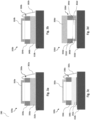
- Figs. 4a-4b show schematic views of cross sections of other examples of a part of a semiconductor device.
- Fig. 4a shows an emitter 420a.
- the emitter 420a may be part of a semiconductor device according to Fig. 1 .
- the emitter 420a may comprise a substrate 410a, an interface layer 440a, a radiation element 430a and a cap layer 456a.
- the emitter 420a may further comprise an optional underfill layer 408a.
- the underfill layer 408a may be arranged between the substrate 410a and the radiation element 430a.
- the underfill layer 408a may partially surround the interface layer 440a. That is, the interface layer 440a may be embedded in the underfill layer 408a.
- the interface layer 440a may comprise a cavity 444a.
- the radiation layer 432a of the radiation element 430a may face the cavity 444a. That is, the emitter 420a may be manufactured using flip-chip mounting.
- the emitter 420a comprises a coupling element 402a.
- the coupling element 402a may be a solder ball or a cupper pillar.
- the coupling element 402a may be partially surrounded by the underfill material 408a.
- a solder ball or a cupper pillar may be advantageously if the interface layer 440a has a smaller cross-section than the radiation element 430a.
- a thermally isolated material stack can be flip chip soldered onto the substrate 410a, e.g., a lead frame or a printed circuit board, by solder balls or cupper pillars.
- the coupling element 402b may be electrically connected with a conductive trace 409a, e.g., a solder cap arranged on top of the interface layer 440a and the underfill 408a.
- the conductive trace 409a may be electrically connected to the radiation layer 432a.
- the underfill 408a may increase a stability of the emitter 420a and/or may protect the coupling element 402a, e.g., prevent corrosion.
- the interface layer 440a may comprise or may be made of glass or silicon nitride.
- the radiation element 430a and/or the cap layer 456a may comprise or may be made of semiconducting material such as silicon, silicon carbide, silicon germanium, for example.
- Fig. 4b shows another example of an emitter 420b.
- the emitter 420b may be part of a semiconductor device according to Fig. 1 .
- the emitter 420b may comprise a substrate 410b, an interface layer 440b, a radiation element 430b and a cap layer 456b.
- the emitter 420b may further comprise an optional underfill layer 408a.
- the underfill layer 408b may be arranged between the substrate 410b and the radiation element 430b. As can be seen in Fig. 4a , the underfill layer 408b may partially surround the interface layer 440b. That is, the interface layer 440b may be embedded in the underfill layer 408b.
- the interface layer 440b may comprise a cavity 444b.
- the radiation layer 432b of the radiation element 430b may face the cavity 444b. That is, the emitter 420b may be manufactured using flip-chip mounting.
- the emitter 420a comprises a coupling element 402a.
- the cross-section of the interface layer 440b may be at least identical to the cross-section of the radiation element 430b. Therefore, the coupling element 402a may comprise a through substrate via 406b, such as a through glass via 406b, and a solder ball 404b. The solder ball 404b may be partially surrounded by the underfill material 408b.
- the through glass via 406 may have been formed, for example, through a glass "cap layer" of an intermediate semiconductor device.
- the intermediate semiconductor device can be flip chip mounted onto the substrate 410b, e.g., a lead frame or a printed circuit board, by solder balls or cupper pillars.
- the coupling element 402b may be electrically connected with a conductive trace 409b, e.g., a solder cap arranged on top of the interface layer 440b.
- the conductive trace 409b may be electrically connected to the radiation layer 432b.
- Figs. 4a-4b of the emitter 420a, 420b also applies to a detector.
- Fig. 4 may comprise one or more optional or additional features corresponding to one or more aspects mentioned in connection with the proposed concept or one or more examples described above (e.g., Fig. 1 - 3 ) and/or below (e.g., Fig. 5 - 8 ).
- Fig. 5a shows a coupling element 502a, e.g., a wire bond 502a, configured to electrically connect the substrate 510a with the radiation element 530a.
- the cap layer 550a may comprise or may be made of glass or a silicon nitride.
- the radiation element 530a may comprise or may be made of semiconducting material such as silicon, silicon carbide, silicon germanium, for example.
- Fig. 5 may comprise one or more optional or additional features corresponding to one or more aspects mentioned in connection with the proposed concept or one or more examples described above (e.g., Fig. 1 - 4 ) and/or below (e.g., Fig. 6 - 8 ).
- the photoacoustic sensor 600a may comprise a substrate 610a, e.g., a printed circuit board or a lead frame.
- a cover 694a may be arranged on the substrate 610a.
- the cover 694a may be configured to cover the emitter 620a and the detector 660a. Further, the cover 694a may form the measurement cavity 696a. That is, the cover 694a may be configured to reflect the electromagnetic wave radiated from the emitter 620a.
- the cover 694a may provide a housing for the emitter 620a and the detector 660a.
- the cover 694a may comprise an opening 692a configured to provide a fluid communication with a surrounding, for example, for allowing an environmental gas and/or a target gas to enter the measurement cavity 696a.
- the opening 692a may be arranged in a top wall (i.e., the wall facing the substrate 610a) of the cover 694a.
- the opening and/or another opening may be arranged in a side wall of the cover 694a.
- the semiconductor device 600a, 600b may provide a detector, e.g., a Si-microphone, packaged with wafer level bonding processes under a defined gas-sensing atmosphere, e.g., CO 2 or vacuum.
- the semiconductor device may provide a non-dispersive infrared sensor packaged with wafer level bonding processes. Typical photoacoustic sensors use silicon as bottom interface and top interface as connection to the sensing volume. Instead the semiconductor device 600a, 600b uses different materials to allow for adjustment of thermal conductivity to reduce cross-coupling.
- Fig. 6 may comprise one or more optional or additional features corresponding to one or more aspects mentioned in connection with the proposed concept or one or more examples described above (e.g., Fig. 1 - 5 ) and/or below (e.g., Fig. 7 - 8 ).
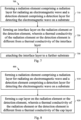
- Fig. 7 shows a block diagram of a method 700 for manufacturing a semiconductor device.
- the method 700 comprises forming 710 a radiation element comprising a radiation layer for radiating an electromagnetic wave and a detection element comprising a detection layer for detecting the electromagnetic wave on a substrate.
- the method 700 further comprises 720 forming an interface layer on the radiation element or the detection element.
- a thermal conductivity of the radiation element and/or the detection element is different from a thermal conductivity of the interface layer.
- the method 700 comprises attaching 730 the interface layer to a further substrate.
- a part of a or semiconductor device as described above, e.g., with reference to Figs. 1-6 can be formed according to method 700.
- attaching the interface layer to the further substrate may comprise a flip-chip process.
- the interface layer can be manufactured as cap layer on top of the radiation element/the detection element and can be arranged as interface layer by flip-chip mounting.
- a thermal MEMS such as an infrared heater
- a photoacoustic sensor 600a, 600b may be manufactured using wafer level bonding.
- the method 700 may further comprise forming an underfill layer with a back-end-of-line process.
- a thermal conductivity of the underfill layer is different from a thermal conductivity of the radiation element or the detection element.
- a thermal conductivity of an emitter/detector can be adjusted using a back-end-of-line process. That is, a thermal conductivity can be adjusted after front-end-of-line processing is finished, e.g., after glass to silicon bonding.
- Fig. 7 may comprise one or more optional or additional features corresponding to one or more aspects mentioned in connection with the proposed concept or one or more examples described above (e.g., Fig. 1 - 6 ) and/or below (e.g., Fig. 8 ).
- Fig. 8 shows a block diagram of a method 800 for manufacturing a semiconductor device.
- the method 800 comprises forming 810 a radiation element comprising a radiation layer for radiating an electromagnetic wave and a detection element comprising a detection layer for detecting the electromagnetic wave on a substrate.
- the method 800 further comprises forming 820 a cap layer on the radiation element or the detection element.
- a thermal conductivity of the radiation element and/or the detection element is different from a thermal conductivity of the cap layer.
- a part of a or a semiconductor device as described above, e.g., with reference to Figs. 1-6 can be formed according to method 800.
- Fig. 8 may comprise one or more optional or additional features corresponding to one or more aspects mentioned in connection with the proposed concept or one or more examples described above (e.g., Fig. 1 - 7 ).
- Examples may further be or relate to a (computer) program including a program code to execute one or more of the above methods when the program is executed on a computer, processor or other programmable hardware component.
- steps, operations or processes of different ones of the methods described above may also be executed by programmed computers, processors or other programmable hardware components.
- Examples may also cover program storage devices, such as digital data storage media, which are machine-, processor- or computer-readable and encode and/or contain machine-executable, processor-executable or computer-executable programs and instructions.
- Program storage devices may include or be digital storage devices, magnetic storage media such as magnetic disks and magnetic tapes, hard disk drives, or optically readable digital data storage media, for example.
- aspects described in relation to a device or system should also be understood as a description of the corresponding method.
- a block, device or functional aspect of the device or system may correspond to a feature, such as a method step, of the corresponding method.
- aspects described in relation to a method shall also be understood as a description of a corresponding block, a corresponding element, a property or a functional feature of a corresponding device or a corresponding system.
- An example (e.g., example 1) relates to a semiconductor device, comprising a radiation element comprising a radiation layer for radiating an electromagnetic wave and a detection element comprising a detection layer for detecting the electromagnetic wave, a substrate, and an interface layer arranged between the radiation element or the detection element and the substrate, wherein a thermal conductivity of the radiation element or the detection element is different from a thermal conductivity of the interface layer.
- Another example relates to a previous example (e.g., example 1) or to any other example, further comprising that the thermal conductivity of the radiation element or the detection element is different from the thermal conductivity of the interface layer by a factor of at least 10.
- Another example (e.g., example 4) relates to a previous example (e.g., one of the examples 1 to 3) or to any other example, further comprising that the interface layer comprises glass or is made of glass.
- Another example (e.g., example 5) relates to a previous example (e.g., one of the examples 1 to 4) or to any other example, further comprising that the interface layer is directly attached to the substrate.
- Another example (e.g., example 6) relates to a previous example (e.g., one of the examples 1 to 5) or to any other example, further comprising that the radiation element or the detection element is electrically coupled to the substrate by a coupling element.
- Another example (e.g., example 7) relates to a previous example (e.g., example 6) or to any other example, further comprising that the coupling element comprises at least one of a solder ball, a via, an electrically conductive adhesive and a wire bond.
- Another example (e.g., example 8) relates to a previous example (e.g., one of the examples 1 to 7) or to any other example, further comprising that the interface layer is directly attached to the radiation element or the detection element.
- Another example (e.g., example 9) relates to a previous example (e.g., one of the examples 1 to 8) or to any other example, further comprising an underfill layer arranged between the radiation element or the detection element and the substrate.
- Another example (e.g., example 10) relates to a previous example (e.g., example 9) or to any other example, further comprising that the underfill layer is arranged between the interface layer and the substrate.
- Another example (e.g., example 11) relates to a previous example (e.g., example 9) or to any other example, further comprising that the interface layer is at least partially embedded in the underfill layer.
- Another example relates to a previous example (e.g., example 12) or to any other example, further comprising a solder ball electrically coupling the radiation element or the detection element with the substrate, wherein the solder ball is partially embedded in the underfill layer.
- Another example relates to a previous example (e.g., example 12) or to any other example, further comprising that the solder ball extends along a lateral dimension of the interface layer.
- Another example relates to a previous example (e.g., one of the examples 1 to 13) or to any other example, further comprising that the radiation element comprises a membrane.
- Another example relates to a previous example (e.g., one of the examples 1 to 14) or to any other example, further comprising that the detection element comprises at least one of a pressure sensitive transducer, a piezo transducer, a capacitive sensor, a thermal sensitive structure, a mechanical strain sensitive structure and a magnetic field sensitive structure.
- the detection element comprises at least one of a pressure sensitive transducer, a piezo transducer, a capacitive sensor, a thermal sensitive structure, a mechanical strain sensitive structure and a magnetic field sensitive structure.
- Another example (e.g., example 16) relates to a previous example (e.g., one of the examples 1 to 15) or to any other example, further comprising a cap layer arranged above the radiation element or the detection element, the cap layer is transparent for infrared light.
- An example (e.g., example 17) relates to a semiconductor device, comprising a radiation element comprising a radiation layer for radiating an electromagnetic wave or a detection element comprising a detection layer for detecting the electromagnetic wave, a substrate, and a cap layer arranged above the radiation element or the detection element, wherein a thermal conductivity of the radiation element or the detection element is different from a thermal conductivity of the cap layer.
- An example (e.g., example 18) relates to a microelectromechanical system, MEMS, gas sensor, comprising a semiconductor device according to any one of the preceding examples.
- An example (e.g., example 19) relates to a method, comprising forming a radiation element comprising a radiation layer for radiating an electromagnetic wave and a detection element comprising a detection layer for detecting the electromagnetic wave on a substrate, forming an interface layer on the radiation element or the detection element, wherein a thermal conductivity of the radiation element or the detection element is different from a thermal conductivity of the interface layer, and attaching the interface layer to a further substrate.
- Another example relates to a previous example (e.g., example 19) or to any other example, further comprising attaching the interface layer to the further substrate comprises a flip-chip process.
- Another example (e.g., example 21) relates to a previous example (e.g., one of the examples 19 or 20) or to any other example, further comprising forming an underfill layer with a back-end-of-line process, wherein a thermal conductivity of the underfill layer is different from a thermal conductivity of the radiation element or the detection element.
- An example (e.g., example 22) relates to a method, comprising forming a radiation element comprising a radiation layer for radiating an electromagnetic wave and a detection element comprising a detection layer for detecting the electromagnetic wave on a substrate, and forming a cap layer on the radiation element or the detection element, wherein a thermal conductivity of the radiation element or the detection element is different from a thermal conductivity of the cap layer.
Landscapes
- Physics & Mathematics (AREA)
- Engineering & Computer Science (AREA)
- General Physics & Mathematics (AREA)
- Chemical & Material Sciences (AREA)
- Health & Medical Sciences (AREA)
- General Health & Medical Sciences (AREA)
- Analytical Chemistry (AREA)
- Immunology (AREA)
- Pathology (AREA)
- Biochemistry (AREA)
- Life Sciences & Earth Sciences (AREA)
- Microelectronics & Electronic Packaging (AREA)
- Manufacturing & Machinery (AREA)
- Computer Hardware Design (AREA)
- Electrochemistry (AREA)
- Chemical Kinetics & Catalysis (AREA)
- Toxicology (AREA)
- Thermal Sciences (AREA)
- Photometry And Measurement Of Optical Pulse Characteristics (AREA)
- Investigating Or Analyzing Materials By The Use Of Electric Means (AREA)
- Investigating Or Analysing Materials By Optical Means (AREA)
Priority Applications (3)
| Application Number | Priority Date | Filing Date | Title |
|---|---|---|---|
| EP23199747.9A EP4530606A1 (fr) | 2023-09-26 | 2023-09-26 | Dispositifs à semi-conducteur, capteur de gaz à système microélectromécanique, procédés |
| US18/830,121 US20250102422A1 (en) | 2023-09-26 | 2024-09-10 | Semiconductor devices, microelectromechanical system gas sensor, methods |
| CN202411331860.3A CN119706728A (zh) | 2023-09-26 | 2024-09-24 | 半导体设备、微机电系统气体传感器、方法 |
Applications Claiming Priority (1)
| Application Number | Priority Date | Filing Date | Title |
|---|---|---|---|
| EP23199747.9A EP4530606A1 (fr) | 2023-09-26 | 2023-09-26 | Dispositifs à semi-conducteur, capteur de gaz à système microélectromécanique, procédés |
Publications (1)
| Publication Number | Publication Date |
|---|---|
| EP4530606A1 true EP4530606A1 (fr) | 2025-04-02 |
Family
ID=88204277
Family Applications (1)
| Application Number | Title | Priority Date | Filing Date |
|---|---|---|---|
| EP23199747.9A Pending EP4530606A1 (fr) | 2023-09-26 | 2023-09-26 | Dispositifs à semi-conducteur, capteur de gaz à système microélectromécanique, procédés |
Country Status (3)
| Country | Link |
|---|---|
| US (1) | US20250102422A1 (fr) |
| EP (1) | EP4530606A1 (fr) |
| CN (1) | CN119706728A (fr) |
Citations (3)
| Publication number | Priority date | Publication date | Assignee | Title |
|---|---|---|---|---|
| EP3996473A1 (fr) * | 2020-11-05 | 2022-05-11 | AT & S Austria Technologie & Systemtechnik Aktiengesellschaft | Support de composant à composants électroniques et blocs thermiquement conducteurs des deux côtés |
| US20220381753A1 (en) * | 2021-06-01 | 2022-12-01 | Infineon Technologies Ag | Sensor and method for detecting guided thermal radiation |
| EP4191232A1 (fr) * | 2019-08-22 | 2023-06-07 | Infineon Technologies AG | Cellule de détection pour un capteur de gaz photoacoustique et capteur de gaz photoacoustique |
-
2023
- 2023-09-26 EP EP23199747.9A patent/EP4530606A1/fr active Pending
-
2024
- 2024-09-10 US US18/830,121 patent/US20250102422A1/en active Pending
- 2024-09-24 CN CN202411331860.3A patent/CN119706728A/zh active Pending
Patent Citations (3)
| Publication number | Priority date | Publication date | Assignee | Title |
|---|---|---|---|---|
| EP4191232A1 (fr) * | 2019-08-22 | 2023-06-07 | Infineon Technologies AG | Cellule de détection pour un capteur de gaz photoacoustique et capteur de gaz photoacoustique |
| EP3996473A1 (fr) * | 2020-11-05 | 2022-05-11 | AT & S Austria Technologie & Systemtechnik Aktiengesellschaft | Support de composant à composants électroniques et blocs thermiquement conducteurs des deux côtés |
| US20220381753A1 (en) * | 2021-06-01 | 2022-12-01 | Infineon Technologies Ag | Sensor and method for detecting guided thermal radiation |
Also Published As
| Publication number | Publication date |
|---|---|
| CN119706728A (zh) | 2025-03-28 |
| US20250102422A1 (en) | 2025-03-27 |
Similar Documents
| Publication | Publication Date | Title |
|---|---|---|
| CN101389940B (zh) | 带有硅玻璃料结合帽的压力传感器 | |
| US7997142B2 (en) | Low pressure sensor device with high accuracy and high sensitivity | |
| CN102257372B (zh) | 压力测量装置 | |
| CN102105769B (zh) | 带有帽的介质隔离的差动压力传感器 | |
| KR100372340B1 (ko) | 압력 센서 및 그 제조방법 | |
| KR101199904B1 (ko) | 적외선 센서 | |
| CN107110729B (zh) | 压力测量装置 | |
| CN107152983B (zh) | 压力传感器 | |
| US20080164413A1 (en) | Infrared Sensor | |
| JPS5855732A (ja) | 静電容量型圧力センサ | |
| US3968466A (en) | Pressure transducer | |
| KR20110066187A (ko) | 적외선 센서 | |
| JP2012225925A (ja) | 封止構造を有するセンサデバイス | |
| US11780727B2 (en) | Low-stress packaging structure for MEMS acceleration sensor chip | |
| EP4530606A1 (fr) | Dispositifs à semi-conducteur, capteur de gaz à système microélectromécanique, procédés | |
| JP2011203226A (ja) | 赤外線センサモジュール | |
| JP2004163148A (ja) | 半導体圧力センサ | |
| JP2001174324A (ja) | 赤外線検出器および赤外線検出装置 | |
| JP2008032451A (ja) | 容量変化型圧力センサ | |
| CN115541071B (zh) | 双极型晶体管式mems压力传感器及其制备方法 | |
| JP5771921B2 (ja) | 封止型デバイス及びその製造方法 | |
| JPS61272623A (ja) | 静電容量式圧力センサ | |
| JPH08184514A (ja) | 圧力センサ | |
| CN118089999B (zh) | 压力传感器、压力传感装置及电子设备 | |
| JP3882645B2 (ja) | 赤外線センサ |
Legal Events
| Date | Code | Title | Description |
|---|---|---|---|
| PUAI | Public reference made under article 153(3) epc to a published international application that has entered the european phase |
Free format text: ORIGINAL CODE: 0009012 |
|
| STAA | Information on the status of an ep patent application or granted ep patent |
Free format text: STATUS: THE APPLICATION HAS BEEN PUBLISHED |
|
| AK | Designated contracting states |
Kind code of ref document: A1 Designated state(s): AL AT BE BG CH CY CZ DE DK EE ES FI FR GB GR HR HU IE IS IT LI LT LU LV MC ME MK MT NL NO PL PT RO RS SE SI SK SM TR |
|
| STAA | Information on the status of an ep patent application or granted ep patent |
Free format text: STATUS: REQUEST FOR EXAMINATION WAS MADE |
|
| 17P | Request for examination filed |
Effective date: 20251001 |