EP4530446A1 - Variable ventilvorrichtung - Google Patents
Variable ventilvorrichtung Download PDFInfo
- Publication number
- EP4530446A1 EP4530446A1 EP24202366.1A EP24202366A EP4530446A1 EP 4530446 A1 EP4530446 A1 EP 4530446A1 EP 24202366 A EP24202366 A EP 24202366A EP 4530446 A1 EP4530446 A1 EP 4530446A1
- Authority
- EP
- European Patent Office
- Prior art keywords
- oil
- passage
- hydraulic piston
- oil passage
- valve device
- Prior art date
- Legal status (The legal status is an assumption and is not a legal conclusion. Google has not performed a legal analysis and makes no representation as to the accuracy of the status listed.)
- Granted
Links
Images





Classifications
-
- F—MECHANICAL ENGINEERING; LIGHTING; HEATING; WEAPONS; BLASTING
- F01—MACHINES OR ENGINES IN GENERAL; ENGINE PLANTS IN GENERAL; STEAM ENGINES
- F01L—CYCLICALLY OPERATING VALVES FOR MACHINES OR ENGINES
- F01L1/00—Valve-gear or valve arrangements, e.g. lift-valve gear
- F01L1/20—Adjusting or compensating clearance
- F01L1/22—Adjusting or compensating clearance automatically, e.g. mechanically
- F01L1/24—Adjusting or compensating clearance automatically, e.g. mechanically by fluid means, e.g. hydraulically
- F01L1/2416—Adjusting or compensating clearance automatically, e.g. mechanically by fluid means, e.g. hydraulically by means of a hydraulic adjusting device attached to an articulated rocker
-
- F—MECHANICAL ENGINEERING; LIGHTING; HEATING; WEAPONS; BLASTING
- F01—MACHINES OR ENGINES IN GENERAL; ENGINE PLANTS IN GENERAL; STEAM ENGINES
- F01L—CYCLICALLY OPERATING VALVES FOR MACHINES OR ENGINES
- F01L9/00—Valve-gear or valve arrangements actuated non-mechanically
- F01L9/10—Valve-gear or valve arrangements actuated non-mechanically by fluid means, e.g. hydraulic
-
- F—MECHANICAL ENGINEERING; LIGHTING; HEATING; WEAPONS; BLASTING
- F01—MACHINES OR ENGINES IN GENERAL; ENGINE PLANTS IN GENERAL; STEAM ENGINES
- F01L—CYCLICALLY OPERATING VALVES FOR MACHINES OR ENGINES
- F01L1/00—Valve-gear or valve arrangements, e.g. lift-valve gear
- F01L1/02—Valve drive
- F01L1/04—Valve drive by means of cams, camshafts, cam discs, eccentrics or the like
- F01L1/047—Camshafts
- F01L1/053—Camshafts overhead type
-
- F—MECHANICAL ENGINEERING; LIGHTING; HEATING; WEAPONS; BLASTING
- F01—MACHINES OR ENGINES IN GENERAL; ENGINE PLANTS IN GENERAL; STEAM ENGINES
- F01L—CYCLICALLY OPERATING VALVES FOR MACHINES OR ENGINES
- F01L1/00—Valve-gear or valve arrangements, e.g. lift-valve gear
- F01L1/12—Transmitting gear between valve drive and valve
- F01L1/18—Rocking arms or levers
- F01L1/181—Centre pivot rocking arms
-
- F—MECHANICAL ENGINEERING; LIGHTING; HEATING; WEAPONS; BLASTING
- F01—MACHINES OR ENGINES IN GENERAL; ENGINE PLANTS IN GENERAL; STEAM ENGINES
- F01L—CYCLICALLY OPERATING VALVES FOR MACHINES OR ENGINES
- F01L1/00—Valve-gear or valve arrangements, e.g. lift-valve gear
- F01L1/12—Transmitting gear between valve drive and valve
- F01L1/18—Rocking arms or levers
- F01L1/185—Overhead end-pivot rocking arms
-
- F—MECHANICAL ENGINEERING; LIGHTING; HEATING; WEAPONS; BLASTING
- F01—MACHINES OR ENGINES IN GENERAL; ENGINE PLANTS IN GENERAL; STEAM ENGINES
- F01L—CYCLICALLY OPERATING VALVES FOR MACHINES OR ENGINES
- F01L1/00—Valve-gear or valve arrangements, e.g. lift-valve gear
- F01L1/26—Valve-gear or valve arrangements, e.g. lift-valve gear characterised by the provision of two or more valves operated simultaneously by same transmitting-gear; peculiar to machines or engines with more than two lift-valves per cylinder
- F01L1/267—Valve-gear or valve arrangements, e.g. lift-valve gear characterised by the provision of two or more valves operated simultaneously by same transmitting-gear; peculiar to machines or engines with more than two lift-valves per cylinder with means for varying the timing or the lift of the valves
-
- F—MECHANICAL ENGINEERING; LIGHTING; HEATING; WEAPONS; BLASTING
- F01—MACHINES OR ENGINES IN GENERAL; ENGINE PLANTS IN GENERAL; STEAM ENGINES
- F01L—CYCLICALLY OPERATING VALVES FOR MACHINES OR ENGINES
- F01L13/00—Modifications of valve-gear to facilitate reversing, braking, starting, changing compression ratio, or other specific operations
-
- F—MECHANICAL ENGINEERING; LIGHTING; HEATING; WEAPONS; BLASTING
- F01—MACHINES OR ENGINES IN GENERAL; ENGINE PLANTS IN GENERAL; STEAM ENGINES
- F01L—CYCLICALLY OPERATING VALVES FOR MACHINES OR ENGINES
- F01L13/00—Modifications of valve-gear to facilitate reversing, braking, starting, changing compression ratio, or other specific operations
- F01L13/0015—Modifications of valve-gear to facilitate reversing, braking, starting, changing compression ratio, or other specific operations for optimising engine performances by modifying valve lift according to various working parameters, e.g. rotational speed, load, torque
- F01L13/0036—Modifications of valve-gear to facilitate reversing, braking, starting, changing compression ratio, or other specific operations for optimising engine performances by modifying valve lift according to various working parameters, e.g. rotational speed, load, torque the valves being driven by two or more cams with different shape, size or timing or a single cam profiled in axial and radial direction
-
- F—MECHANICAL ENGINEERING; LIGHTING; HEATING; WEAPONS; BLASTING
- F01—MACHINES OR ENGINES IN GENERAL; ENGINE PLANTS IN GENERAL; STEAM ENGINES
- F01L—CYCLICALLY OPERATING VALVES FOR MACHINES OR ENGINES
- F01L9/00—Valve-gear or valve arrangements actuated non-mechanically
- F01L9/40—Methods of operation thereof; Control of valve actuation, e.g. duration or lift
-
- F—MECHANICAL ENGINEERING; LIGHTING; HEATING; WEAPONS; BLASTING
- F16—ENGINEERING ELEMENTS AND UNITS; GENERAL MEASURES FOR PRODUCING AND MAINTAINING EFFECTIVE FUNCTIONING OF MACHINES OR INSTALLATIONS; THERMAL INSULATION IN GENERAL
- F16K—VALVES; TAPS; COCKS; ACTUATING-FLOATS; DEVICES FOR VENTING OR AERATING
- F16K1/00—Lift valves or globe valves, i.e. cut-off apparatus with closure members having at least a component of their opening and closing motion perpendicular to the closing faces
- F16K1/32—Details
- F16K1/52—Means for additional adjustment of the rate of flow
-
- F—MECHANICAL ENGINEERING; LIGHTING; HEATING; WEAPONS; BLASTING
- F16—ENGINEERING ELEMENTS AND UNITS; GENERAL MEASURES FOR PRODUCING AND MAINTAINING EFFECTIVE FUNCTIONING OF MACHINES OR INSTALLATIONS; THERMAL INSULATION IN GENERAL
- F16K—VALVES; TAPS; COCKS; ACTUATING-FLOATS; DEVICES FOR VENTING OR AERATING
- F16K31/00—Actuating devices; Operating means; Releasing devices
- F16K31/44—Mechanical actuating means
- F16K31/52—Mechanical actuating means with crank, eccentric, or cam
- F16K31/524—Mechanical actuating means with crank, eccentric, or cam with a cam
- F16K31/52408—Mechanical actuating means with crank, eccentric, or cam with a cam comprising a lift valve
-
- F—MECHANICAL ENGINEERING; LIGHTING; HEATING; WEAPONS; BLASTING
- F01—MACHINES OR ENGINES IN GENERAL; ENGINE PLANTS IN GENERAL; STEAM ENGINES
- F01L—CYCLICALLY OPERATING VALVES FOR MACHINES OR ENGINES
- F01L1/00—Valve-gear or valve arrangements, e.g. lift-valve gear
- F01L1/02—Valve drive
- F01L1/04—Valve drive by means of cams, camshafts, cam discs, eccentrics or the like
- F01L1/047—Camshafts
- F01L1/053—Camshafts overhead type
- F01L2001/0537—Double overhead camshafts [DOHC]
-
- F—MECHANICAL ENGINEERING; LIGHTING; HEATING; WEAPONS; BLASTING
- F01—MACHINES OR ENGINES IN GENERAL; ENGINE PLANTS IN GENERAL; STEAM ENGINES
- F01L—CYCLICALLY OPERATING VALVES FOR MACHINES OR ENGINES
- F01L1/00—Valve-gear or valve arrangements, e.g. lift-valve gear
- F01L1/12—Transmitting gear between valve drive and valve
- F01L1/18—Rocking arms or levers
- F01L2001/186—Split rocking arms, e.g. rocker arms having two articulated parts and means for varying the relative position of these parts or for selectively connecting the parts to move in unison
-
- F—MECHANICAL ENGINEERING; LIGHTING; HEATING; WEAPONS; BLASTING
- F01—MACHINES OR ENGINES IN GENERAL; ENGINE PLANTS IN GENERAL; STEAM ENGINES
- F01L—CYCLICALLY OPERATING VALVES FOR MACHINES OR ENGINES
- F01L1/00—Valve-gear or valve arrangements, e.g. lift-valve gear
- F01L1/20—Adjusting or compensating clearance
- F01L1/22—Adjusting or compensating clearance automatically, e.g. mechanically
- F01L1/24—Adjusting or compensating clearance automatically, e.g. mechanically by fluid means, e.g. hydraulically
- F01L2001/2444—Details relating to the hydraulic feeding circuit, e.g. lifter oil manifold assembly [LOMA]
-
- F—MECHANICAL ENGINEERING; LIGHTING; HEATING; WEAPONS; BLASTING
- F01—MACHINES OR ENGINES IN GENERAL; ENGINE PLANTS IN GENERAL; STEAM ENGINES
- F01L—CYCLICALLY OPERATING VALVES FOR MACHINES OR ENGINES
- F01L2305/00—Valve arrangements comprising rollers
Definitions
- the present disclosure relates to a variable valve device.
- variable valve device in which a plurality of rocker arms are coupled to one another to switch a valve operation (for example, see JP2009-264199A ).
- a pair of cams having different lift amounts are formed on a camshaft, and a pair of rocker arms are provided corresponding to the pair of cams.
- a switching mechanism is coupled to the pair of rocker arms, and a coupling state and a separation state of the pair of rocker arms are switched by applying oil pressure to the switching mechanism.
- a valve lift amount is changed by switching the cams that lift valves between when the pair of rocker arms are coupled and when the pair of rocker arms are separated.
- variable valve device configured to change a valve lift amount in a cylinder head.
- the variable valve device includes: a camshaft formed with a plurality of cams having different valve lift amounts; a plurality of rocker arms configured to be in contact with the plurality of cams and move a valve; a switching mechanism configured to couple and separate the plurality of rocker arms by oil pressure; and an oil control valve configured to control the oil pressure applied to the switching mechanism.
- the switching mechanism includes a hydraulic piston configured to be moved forward and backward by the oil pressure such that the plurality of rocker arms are coupled along forward movement of the hydraulic piston, and the plurality of rocker arms are separated along backward movement of the hydraulic piston.
- a first oil passage and a second oil passage extend from the oil control valve to the hydraulic piston. Apart of the first oil passage is formed by an oil groove through which oil is allowed to pass at a predetermined rotation phase of the camshaft.
- the second oil passage is opened during forward movement of the hydraulic piston and is closed during backward movement of the hydraulic piston.
- a bypass passage configured to bypass the oil groove when the second oil passage is closed is provided.
- variable valve device of JP2009-264199A the pair of rocker arms are coupled regardless of a rotation phase of the camshaft.
- a valve lift may inhibit coupling of the pair of rocker arms. Even when the pair of rocker arms are coupled while avoiding a valve lift, the pair of rocker arms may not be smoothly separated from each other.
- the present disclosure has been made in view of the above circumstances, and an object of the present disclosure is to provide a variable valve device capable of smoothly switching between a coupling state and a separation state of a plurality of rocker arms.
- a variable valve device in a cylinder head and changes a valve lift amount.
- a plurality of cams having different valve lift amounts are formed on a camshaft, and a plurality of rocker arms for moving valves are configured to be in contact with the plurality of cams.
- the plurality of rocker arms are coupled and separated by a switching mechanism by oil pressure, and the oil pressure applied to the switching mechanism is controlled by an oil control valve.
- a hydraulic piston of the switching mechanism is moved forward and backward by the oil pressure such that the plurality of rocker arms are coupled along forward movement of the hydraulic piston, and the plurality of rocker arms are separated along backward movement the hydraulic piston.
- a first oil passage and a second oil passage extend from the oil control valve to the hydraulic piston.
- a part of the first oil passage is an oil groove through which the oil is allowed to pass at a predetermined rotation phase of the camshaft, and a bypass passage bypasses the oil groove when the second oil passage is closed.
- the second oil passage is opened during forward movement of the hydraulic piston and is closed during backward movement of the hydraulic piston.
- the hydraulic piston is moved forward at a predetermined rotation phase of the camshaft by oil pressure in the first oil passage.
- the second oil passage is opened during forward movement of the hydraulic piston and the plurality of rocker arms are coupled, a coupling state is maintained by oil pressure in the second oil passage.
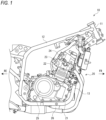
- FIG. 1 is a right side view showing an engine and a vehicle body frame according to the present embodiment.
- FIG. 2 is a right side view showing an upper portion of the engine from which a cylinder head cover is removed according to the present embodiment.
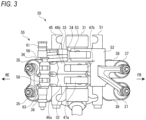
- FIG. 3 is a schematic top view showing a variable valve device according to the present embodiment.
- an arrow Fr indicates a vehicle front side
- an arrow Re indicates a vehicle rear side
- an arrow L indicates a vehicle left side
- an arrow R indicates a vehicle right side.
- the straddle-type vehicle includes various components such as an engine 20 and an electrical system which are mounted on a cradle type vehicle body frame 10.
- the vehicle body frame 10 includes a main tube 12 that extends rearward from an upper portion of a head pipe 11 and then is bent downward, and a down tube 13 that extends downward from a lower portion of the head pipe 11 and then is bent rearward.
- a rear end portion of the down tube 13 is joined to a lower end portion of the main tube 12 to form an installation space for the engine 20 inside the vehicle body frame 10.
- the main tube 12 supports a rear side of the engine 20, and the down tube 13 supports a front side and a lower side of the engine 20.
- the engine 20 is a four-valve two-cylinder engine, and includes a crankcase 21, a cylinder 22 provided on the crankcase 21, a cylinder head 23 provided on the cylinder 22, and a cylinder head cover 24 provided on the cylinder head 23.
- a clutch cover 25 that covers a clutch (not shown) from a side is attached to a right side surface of the crankcase 21.
- a magnet cover (not shown) that covers a magnet (not shown) from a side is attached to a left side surface of the crankcase 21.
- An oil pan 26 that stores oil is attached to a lower surface of the crankcase 21.
- left and right valve operating chambers are formed inside the cylinder head 23 and the cylinder head cover 24 for each cylinder.
- a variable valve device 30 is mounted in each of the left and right value operating chambers.
- the variable valve device 30 is capable of changing valve lift amounts of an intake valve 35 and an exhaust valve 37 by oil pressure.
- the variable valve device 30 includes a camshaft 31 shared by an intake side and an exhaust side.
- a pair of partition walls protrude from a bottom surface of the cylinder head 23 for each cylinder, and a pair of cam housings 41 are attached on the pair of partition walls.
- the camshaft 31 is supported in a rotatable manner by mating surfaces between the plural partition walls and the cam housings 41.
- intake valves 35 are installed on a rear side of the camshaft 31, and four (only one is shown in FIG. 2 ) exhaust valves 37 are installed on a front side of the camshaft 31.
- the intake valve 35 is pressed in a valve closing direction by a valve spring 36, and the exhaust valve 37 is pressed in a valve closing direction by a valve spring 38.
- a low-speed cam 32, a high-speed cam 33, and an exhaust cam 34 are formed on an outer circumferential surface of the camshaft 31.
- Each of the cams 32 to 34 has a plate shape in which a cam ridge protrudes from a part of a base circle, and the cam ridge of the high-speed cam 33 is higher than the cam ridge of the low-speed cam 32.
- An intake-side rocker shaft 45 and an exhaust-side rocker shaft 51 are supported on upper portions of the cam housings 41.
- the intake-side rocker shaft 45 and the exhaust-side rocker shaft 51 are located above the camshaft 31, and the intake-side rocker shaft 45 and the exhaust-side rocker shaft 51 extend parallel to the camshaft 31.
- An upper housing 42 is attached to an upper portion of the cam housing 41, and a hydraulic piston 61 and a spring pin 63 (see FIG. 6 ) are accommodated in the upper housing 42.
- An oil control valve 71 that controls oil pressure of the variable valve device 30 is installed on a rear side of an upper surface of the cylinder head cover 24.
- the intake-side rocker shaft 45 is located in the rear of the camshaft 31, and the exhaust-side rocker shaft 51 is located in front of the camshaft 31.
- Two types of rocker arms 46a and 46b are supported in a swingable manner by the intake-side rocker shaft 45, and a rocker arm 52 (only one is shown in FIG. 3 ) is supported in a swingable manner by the exhaust-side rocker shaft 51.
- the rocker arm 46a on an intake side and the rocker arm 52 on an exhaust side are formed in a seesaw shape having a point of effort and a point of load, and the rocker arm 46b on the intake side is formed to be the point of effort of the rocker arm 46a.
- a roller 47a that is in rolling contact with the low-speed cam 32 is supported in a rotatable manner at one end of the rocker arm 46a on the intake side, and a pair of the intake valves 35 are coupled to the other end of the rocker arm 46a which is bifurcated.
- a roller 47b that is in rolling contact with the high-speed cam 33 is supported in a rotatable manner at one end of the rocker arm 46b on the intake side, and the intake valves 35 are not coupled to the other end of the rocker arm 46b.
- a roller 53 that is in rolling contact with the exhaust cam 34 is supported in a rotatable manner at one end of the rocker arm 52 on the exhaust side, and a pair of the exhaust valves 37 are coupled to the other end of the rocker arm 52 which is bifurcated.
- the rocker arms 46a and 46b are formed in a manner capable of being coupled to each other.
- the variable valve device 30 includes a switching mechanism 55 that switches between a coupling state and a separation state of the rocker arms 46a and 46b by oil pressure.
- the switching mechanism 55 includes a coupling pin 56 installed in a storage hole of the rocker arm 46b and a return pin 58 installed in a storage hole of the rocker arm 46a.
- the switching mechanism 55 includes the hydraulic piston 61 that is in contact with the coupling pin 56 from one side in a left-right direction, and the spring pin 63 that is in contact with the return pin 58 from the other side in the left-right direction.
- the hydraulic piston 61 can be moved forward and backward by oil pressure, and the spring pin 63 can be moved forward and backward by expansion and contraction of a spring.
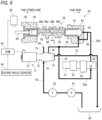
- a coupling pin 116 is moved by a hydraulic piston 117 regardless of a valve lift.
- a low-speed cam 113 is switched to a high-speed cam 114, when the coupling pin 116 protrudes out of a storage hole of a rocker arm 115b immediately before a valve lift of an intake valve 111, insertion of the coupling pin 116 into a storage hole of a rocker arm 115a is shallow.
- oil may be supplied from an actuation passage 128 to a hydraulic piston 127 in a predetermined period after a valve lift ends. Accordingly, a coupling operation of a pair of rocker arms 125a and 125b is not hindered by a valve lift. However, since only the actuation passage 128 is used, oil is intermittently supplied, so that the coupling state between the pair of rocker arms 125a and 125b is not stable. Therefore, a direct passage 129 that is opened after the oil is supplied from the actuation passage 128 is provided, and the oil is supplied from the direct passage 129 to the hydraulic piston 127, thereby stabilizing the coupling state.
- an actuation passage 81 and a direct passage 85 are coupled by a bypass passage 86, and oil is discharged from the hydraulic piston 61 in a period other than a predetermined period after a valve lift ends at the time of switching from the high-speed cam 33 to the low-speed cam 32 (see FIG. 6 ).
- the direct passage 85 is closed by the hydraulic piston 61 and only the actuation passage 81 is coupled to the hydraulic piston 61, the oil is continuously discharged from the hydraulic piston 61 through the bypass passage 86 regardless of an end timing of a valve lift. Since the pair of rocker arms 46a and 46b are smoothly separated from each other, generation of abnormal noises can be prevented, and durability of the variable valve device 30 can be improved.
- FIG. 6 is a schematic diagram showing the variable valve device according to the present embodiment.
- FIG. 7 is a schematic view showing the actuation passage and the direct passage according to the present embodiment.
- FIG. 8 is a perspective view showing the hydraulic piston according to the present embodiment.
- an oil supply path 64 extends from the oil pan 26 toward the oil control valve 71.
- Oil is pumped up from the oil pan 26 by an oil pump 91 provided in an intermediate portion of the oil supply path 64, and the oil is supplied to the oil control valve 71 through an oil filter 92.
- the oil control valve 71 includes a valve housing 72 that accommodates a valve spool (not shown), and a solenoid 73 that moves the valve spool forward and backward. The valve spool is moved forward and backward by the solenoid 73 to switch an oil passage in the oil control valve 71.
- An input port 74, a low-speed port 75, a high-speed port 76, and a drain port 77 are formed in the valve housing 72.
- the oil supply path 64 communicates with the input port 74, a dead end passage 65 communicates with the low-speed port 75, a switching passage 66 communicates with the high-speed port 76, and a drain passage 67 communicates with the drain port 77.
- a discharge destination of the dead end passage 65 is closed, and the switching passage 66 extends from the oil control valve 71 toward the switching mechanism 55.
- the drain passage 67 extends from the oil control valve 71 to a position above the oil pan 26, and oil is dropped from an outlet of the drain passage 67 to the oil pan 26.
- the input port 74 communicates with one of the low-speed port 75 and the high-speed port 76
- the drain port 77 communicates with the other one of the low-speed port 75 and the high-speed port 76.
- Oil is output from the oil control valve 71 to one of the dead end passage 65 and the switching passage 66, and remaining oil is discharged from the other one of the dead end passage 65 and the switching passage 66 to the oil control valve 71 (the drain passage 67). In this manner, oil pressure applied to the switching mechanism 55 is controlled by the oil control valve 71.
- the actuation passage 81 is divided into an upstream passage 82a and a downstream passage 82b with the oil groove 83 of the camshaft 31 interposed therebetween.
- a predetermined rotation phase of the camshaft 31 is set from an end timing of a valve lift to a timing before the start of a subsequent valve lift.
- the direct passage 85 directly extends from the oil control valve 71 to the hydraulic piston 61 without passing through the oil groove 83 of the camshaft 31. Therefore, oil is continuously supplied from the oil control valve 71 to the hydraulic piston 61 through the direct passage 85, and oil is continuously discharged from the hydraulic piston 61 to the oil control valve 71 through the direct passage 85.
- the direct passage 85 is opened and closed by the hydraulic piston 61.
- the direct passage 85 is opened during forward movement of the hydraulic piston 61, and the direct passage 85 is closed during backward movement of the hydraulic piston 61.
- the rocker arms 46a and 46b are adj acent to each other, and upper portions of the rocker arms 46a and 46b are adjacent to each other with a slight gap C therebetween.
- Storage holes 48a and 48b parallel to the camshaft 31 are formed in the upper portions of the rocker arms 46a and 46b. Hole diameters of the storage hole 48a of the rocker arm 46a and the storage hole 48b of the rocker arm 46b match with each other, and the storage holes 48a and 48b are coaxially formed such that the storage holes 48a and 48b communicate with each other in a state in which the rocker arm 46a is not lifted up.
- the coupling pin 56 is installed in the storage hole 48b of the rocker arm 46b, and the return pin 58 is installed in the storage hole 48a of the rocker arm 46a. A tip end of the return pin 58 is in contact with a tip end of the coupling pin 56.
- a sliding chamber 43 is formed in the upper housing 42 on a side closer to the one side than the rocker arm 46b.
- the hydraulic piston 61 is installed in the sliding chamber 43.
- a pressing surface of the hydraulic piston 61 is in contact with the coupling pin 56, and the coupling pin 56 is moved to the other side by the hydraulic piston 61.
- a sliding chamber 44 is formed in the upper housing 42 on a side closer to the other side than the rocker arm 46a.
- the spring pin 63 is installed in the sliding chamber 44.
- a pressing surface of the spring pin 63 is in contact with the return pin 58, and the return pin 58 is returned to the one side by the spring pin 63.
- a sensing arm 69 extends from the spring pin 63 to the other side.
- the switching mechanism 55 switches the coupling state of the rocker arms 46a and 46b by moving the coupling pin 56 by oil pressure. As described above, in the separation state of the rocker arms 46a and 46b, the pair of intake valves 35 are operated by the low-speed cam 32 via the rocker arms 46a. In the coupling state of the rocker arms 46a and 46b, the pair of intake valves 35 are operated by the high-speed cam 33 via the rocker arms 46a and 46b. In this manner, the switching mechanism 55 switches cams that move the pair of intake valves 35 by switching the coupling state of the rocker arms 46a and 46b by the coupling pin 56.
- the variable valve device 30 includes an engine control module (ECM) 93, an engine angle sensor 94, and a switching sensor 95.
- the engine angle sensor 94 detects an engine rotation speed, when the engine rotation speed is a predetermined rotation speed or more, the ECM 93 outputs a coupling command signal to the solenoid 73, and when the engine rotation speed is less than the predetermined rotation speed, the ECM 93 outputs a release command signal to the solenoid 73.
- the switching sensor 95 detects switching between the coupling state and the separation state of the rocker arms 46a and 46b based on movement of a tip end of the sensing arm 69. A failure of the variable valve device 30 such as a defective switching operation can be determined by comparing a command signal from the ECM 93 and a detection signal from the switching sensor 95.
- the upstream passage 82a of the actuation passage 81 extends from the oil control valve 71 to the camshaft 31, and the downstream passage 82b of the actuation passage 81 extends from the camshaft 31 to the hydraulic piston 61.
- a downstream end of the upstream passage 82a and an upstream end of the downstream passage 82b are positioned on the same circumference on the outer circumferential surface of the camshaft 31.
- the oil groove 83 is formed in a circumferential direction on the circumference of the outer circumferential surface of the camshaft 31.
- the direct passage 85 extends from the oil control valve 71 to the hydraulic piston 61, and the direct passage 85 is formed to be shorter than the actuation passage 81.
- the oil groove 83 is formed such that the upstream passage 82a and the downstream passage 82b communicate with each other at an end timing of a valve lift, and the upstream passage 82a and the downstream passage 82b are separated from each other before a valve lift starts. That is, the oil groove 83 is formed such that oil starts to be supplied from the oil control valve 71 to the hydraulic piston 61 at an end timing of a valve lift and the oil supply to the hydraulic piston 61 ends before a valve lift starts.
- the hydraulic piston 61 When the oil is discharged from the hydraulic piston 61, the oil is discharged through the actuation passage 81 and the direct passage 85.
- the direct passage 85 is closed by the hydraulic piston 61 during discharging of the oil, and the oil could be discharged intermittently from the actuation passage 81 only.
- the actuation passage 81 and the direct passage 85 are coupled via the bypass passage 86, and the oil is continuously discharged from the hydraulic piston 61 through the actuation passage 81, the bypass passage 86, and the direct passage 85. Therefore, the hydraulic piston 61 is quickly returned to an initial position, and a valve lift of the high-speed cam 33 is not started in a state in which the rocker arms 46a and 46b are not completely separated.
- a downstream end of the actuation passage 81 and a downstream end of the direct passage 85 are adjacent to each other, and the downstream end of the actuation passage 81 and the downstream end of the direct passage 85 communicate with each other via the bypass passage 86.
- the bypass passage 86 is short, the oil flows from the actuation passage 81 to the direct passage 85 through the bypass passage 86, and the oil is quickly discharged from the hydraulic piston 61. Oil passes through the bypass passage 86 not only when the oil is discharged from the hydraulic piston 61 but also when the oil is supplied to the hydraulic piston 61.
- a cross-sectional area of the bypass passage 86 is formed to be smaller than cross-sectional areas of the actuation passage 81 and the direct passage 85, thereby reducing an influence of the bypass passage 86.
- the bypass passage 86 is formed by communication grooves 62 provided in an outer circumferential surface of the hydraulic piston 61.
- a rear end portion of the outer circumferential surface of the hydraulic piston 61 bulges in an annular shape so as to partition the downstream end of the actuation passage 81 and the downstream end of the direct passage 85.
- the downstream end of the actuation passage 81 and the downstream end of the direct passage 85 are coupled to each other via the communication grooves 62 that are formed by reducing a part of the annular bulge portion.
- FIGS. 9A, 9B, and 9C are views showing the coupling operation of the variable valve device according to the present embodiment.
- FIGS. 10A, 10B, and 10C are views showing the separation operation of the variable valve device according to the present embodiment.
- reference numerals in FIG. 6 are used as appropriate for convenience of description.
- the hydraulic piston 61 is installed in the cylindrical sliding chamber 43 of the upper housing 42.
- the downstream end of the actuation passage 81 (the downstream passage 82b) is opened in a back surface of the sliding chamber 43, and the downstream end of the direct passage 85 is opened in an inner circumferential surface of the sliding chamber 43.
- a supply direction of the oil from the actuation passage 81 to the hydraulic piston 61 is directed to a forward and backward direction of the hydraulic piston 61, and a supply direction of the oil from the direct passage 85 to the hydraulic piston 61 is directed to a radial direction of the hydraulic piston 61.
- the hydraulic piston 61 is moved backward, and the downstream end of the direct passage 85 is closed by the outer circumferential surface of the hydraulic piston 61.
- the oil is not supplied from the oil control valve 71 to the hydraulic piston 61.
- No pressing force acts on the coupling pin 56 from the hydraulic piston 61, and a spring force of the spring pin 63 acts on the return pin 58.
- a flange of the return pin 58 abuts against the rocker arm 46a, and the return pin 58 is positioned at an initial position.
- a tip end 57 of the coupling pin 56 is in contact with a tip end 59 of the return pin 58 at a separation position P1 in the gap C between the rocker arms 46a and 46b.
- the tip end 57 of the coupling pin 56 is positioned in the gap C between the rocker arms 46a and 46b, and the rocker arms 46a and 46b are separated from each other.
- the return pin 58 is pushed out by the coupling pin 56 along the forward movement of the hydraulic piston 61, and a part of the coupling pin 56 starts to enter the storage hole 48a of the rocker arm 46a.
- the coupling pin 56 shallowly enters the storage hole 48a of the rocker arm 46a, and the rocker arms 46a and 46b are not completely coupled to each other. Since a valve lift of the intake valve 35 does not occur, the coupling pin 56 is not pulled out from the rocker arm 46a due to a valve lift during the coupling of the rocker arms 46a and 46b.
- the hydraulic piston 61 is pushed to a maximum stroke position by the oil pressure.
- the tip end 57 of the coupling pin 56 is positioned at a coupling position P2 of the rocker arm 46a.
- a part of the coupling pin 56 deeply enters the storage hole 48a of the rocker arm 46a, and the rocker arms 46a and 46b are coupled to each other via the coupling pin 56.
- the downstream end of the direct passage 85 is opened along the forward movement of the hydraulic piston 61, and the hydraulic piston 61 is held at the maximum stroke position by oil supply from the direct passage 85.
- the downstream end of the direct passage 85 is closed by the hydraulic piston 61 during backward movement of the hydraulic piston 61.
- the actuation passage 81 does not allow oil to pass therethrough at a phase other than the predetermined rotation phase of the camshaft 31
- the oil is allowed to pass from the actuation passage 81 to the direct passage 85 via the bypass passage 86.
- the oil is continuously discharged from the hydraulic piston 61 to the oil control valve 71 through the bypass passage 86 while bypassing the oil groove 83 (see FIG. 6 ) of the camshaft 31. Therefore, the hydraulic piston 61 does not stop during backward movement, and the coupling pin 56 does not stay in the storage hole 48a of the rocker arm 46a.
- the hydraulic piston 61 is pushed back to a minimum stroke position by the repulsive force of the spring pin 63.
- the tip end 57 of the coupling pin 56 is positioned at the separation position P1 of the rocker arm 46a.
- the coupling pin 56 is completely pulled out of the storage hole 48a of the rocker arm 46a, and the rocker arms 46a and 46b are separated from each other. No oil pressure acts on the hydraulic piston 61, and the hydraulic piston 61 is held at the minimum stroke position by a spring force of the spring pin 63.
- variable valve device 30 of the present embodiment when the oil is supplied from the oil control valve 71 to the hydraulic piston 61, the hydraulic piston 61 is moved forward at the predetermined rotation phase of the camshaft 31 by the oil pressure in the actuation passage 81.
- the direct passage 85 is opened during forward movement of the hydraulic piston 61 and the rocker arms 46a and 46b are coupled, the coupling state is maintained by oil pressure in the direct passage 85.
- the oil pressure in the actuation passage 81 and the direct passage 85 is released, and the hydraulic piston 61 is moved backward.
- the direct passage 85 is closed during backward movement of the hydraulic piston 61, and the oil is not allowed to pass through the oil groove 83 of the actuation passage 81 at a phase other than the predetermined rotation phase of the camshaft 31. At this time, the oil is continuously discharged from the hydraulic piston 61 through the bypass passage 86 bypassing the oil groove 83, so that the rocker arms 46a and 46b are smoothly separated from each other.
- the bypass passage is formed by the communication grooves in the outer circumferential surface of the hydraulic piston.
- the bypass passage may be formed in any manner as long as the bypass passage bypasses the oil groove of the actuation passage when the direct passage is closed.
- the bypass passage may be formed by through holes 98 provided in an outer circumferential surface of a hydraulic piston 97.
- the hydraulic piston 97 is formed in a cylindrical shape, and an actuation passage and a direct passage communicate with each other via the through holes 98.
- an oil hole 101 coupled to an oil control valve is formed in a lower surface of an upper housing 100.
- An oil groove 102a extends from the oil hole 101 to a position directly below a camshaft (not shown), and an oil groove 102b extends from a position adjacent to a downstream end of the oil groove 102a to the vicinity of a sliding chamber of a hydraulic piston (not shown).
- the downstream end of the oil groove 102a is coupled to an oil hole 106a of a cam housing 105, and an upstream end of the oil groove 102b is coupled to an oil hole 106b of the cam housing 105.
- the oil holes 106a and 106b pass through the cam housing 105 from an upper surface to a support surface 107 of a lower surface of the cam housing 105.
- an oil groove 102c extends from the oil hole 101 to the vicinity of the sliding chamber of the hydraulic piston.
- an upstream passage of an actuation passage is formed by the oil groove 102a and the oil hole 106a
- a downstream passage of the actuation passage is formed by the oil groove 102b and the oil hole 106b.
- a direct passage is formed by the oil groove 102c.
- the oil holes 106a and 106b are opened in the support surface 107 of a camshaft, and communication and separation of the oil holes 106a and 106b are repeated by an oil groove (not shown) of the camshaft.
- a bypass passage that couples an actuation passage and a direct passage may be formed in the lower surface of the upper housing 100.
- a downstream end of the oil groove 102b and a downstream end of the oil groove 102c are adjacent to each other, and downstream ends of the oil grooves 102b and 102c are coupled to each other via a narrow groove 103a indicated by a broken line.
- a bypass passage that couples an upstream passage and a downstream passage of an actuation passage may be formed in the lower surface of the upper housing 100.
- a downstream end of the oil groove 102a and an upstream end of the oil groove 102b are adjacent to each other, and the downstream end of the oil groove 102a and the upstream end of the oil groove 102b are coupled to each other via a narrow groove 103b indicated by a broken line.
- a bypass passage that couples an upstream passage and a downstream passage of the actuation passage may be formed in an upper surface of the cam housing 105.
- the oil holes 106a and 106b are adjacent to each other in the upper surface of the cam housing 105, and the oil holes 106a and 106b are coupled to each other via a narrow groove 108c indicated by a broken line.
- a bypass passage that couples an upstream passage and a downstream passage of an actuation passage may be formed in the support surface 107 of the cam housing 105.
- the oil holes 106a and 106b are adj acent to each other in the support surface 107 of the cam housing 105, and the oil holes 106a and 106b are coupled to each other via a narrow groove 108d indicated by a broken line.
- the end timing of a valve lift is not limited to a timing when the valve lift is completely ended, and may include a timing immediately before an end when a valve lift can be regarded as being ended.
- a supply timing of the oil is not limited to the end timing of a valve lift.
- the oil may start to be supplied from the oil control valve to the switching mechanism in a zero range where no valve lift occurs. With such a configuration, a switching operation of a cam can also be prevented from being hindered by a valve lift.
- rocker arms are provided on an intake side of the variable valve device in the present embodiment
- a plurality of rocker arms may be provided on the intake side of the variable valve device.
- three or more rocker arms may be provided on the intake side of the variable valve device.
- the type of the rocker arm is not particularly limited, and a finger follower type rocker arm may be used.
- the plurality of rocker arms may be separated from one another.
- variable valve device is not limited to being used in an engine of the straddle-type vehicle described above, and may be used in an engine of another type of vehicle.
- the straddle-type vehicle is not limited to a motorcycle, and may be any vehicle on which an engine is mounted.
- the straddle-type vehicle is not limited to a general vehicle in which a driver rides on a seat in a posture straddling the seat, and includes a scooter-type vehicle in which a driver rides on a seat without straddling the seat.
- variable valve device configured to change a valve lift amount in a cylinder head (23).
- the variable valve device includes: a camshaft (31) formed with a plurality of cams (the low-speed cam 32 and the high-speed cam 33) having different valve lift amounts; a plurality of rocker arms (46a and 46b) configured to be in contact with the plurality of cams and move a valve (the intake valve 35); a switching mechanism (55) configured to couple and separate the plurality of rocker arms by oil pressure; and an oil control valve (71) configured to control the oil pressure applied to the switching mechanism.
- the switching mechanism includes a hydraulic piston (61) configured to be moved forward and backward by the oil pressure such that the plurality of rocker arms are coupled along forward movement of the hydraulic piston, and the plurality of rocker arms are separated along backward movement of the hydraulic piston, a first oil passage (the actuation passage 81) and a second oil passage (the direct passage 85) extend from the oil control valve to the hydraulic piston, a part of the first oil passage is formed by an oil groove (83) through which oil is allowed to pass at a predetermined rotation phase of the camshaft, the second oil passage is opened during forward movement of the hydraulic piston and is closed during backward movement of the hydraulic piston, and a bypass passage (86) configured to bypass the oil groove when the second oil passage is closed is provided.
- a hydraulic piston (61) configured to be moved forward and backward by the oil pressure such that the plurality of rocker arms are coupled along forward movement of the hydraulic piston, and the plurality of rocker arms are separated along backward movement of the hydraulic piston
- a first oil passage (the actuation passage 81
- a cross-sectional area of the bypass passage is smaller than a cross-sectional area of the first oil passage and a cross-sectional area of the second oil passage. According to this configuration, an influence of the bypass passage on oil supply to the hydraulic piston can be reduced.
- a downstream end of the first oil passage and a downstream end of the second oil passage are positioned adjacent to each other, and the downstream end of the first oil passage and the downstream end of the second oil passage are coupled to each other via the bypass passage.
- the bypass passage can be shortened. The oil flows from the first oil passage to the second oil passage through the bypass passage, and the oil can be quickly discharged from the hydraulic piston.
- the bypass passage is formed by a communication groove (62) provided in an outer circumferential surface of the hydraulic piston. According to this configuration, by preparing several types of the hydraulic piston in which the number and a groove width of the communication groove are changed, it is possible to adjust a passing amount of the oil by changing the cross-sectional area of the bypass passage by replacing the hydraulic piston.
- the bypass passage is formed by a through hole (98) provided in an outer circumferential surface of the hydraulic piston (97).
- variable valve device further includes a cam housing (105) configured to support the camshaft in a rotatable manner, and an upper housing (100) attached to an upper surface of the cam housing.
- the first oil passage, the second oil passage, and the bypass passage configured to couple the first oil passage and the second oil passage are formed in the upper housing.
- variable valve device further includes a cam housing configured to support the camshaft in a rotatable manner, and an upper housing attached to an upper surface of the cam housing.
- the first oil passage, the second oil passage, and the bypass passage are formed in the cam housing and/or the upper housing, and an upstream side and a downstream side of the first oil passage are coupled via the bypass passage with the oil groove of the camshaft interposed between the upstream side and the downstream side. According to this configuration, the oil flows from the downstream side to the upstream side of the first oil passage through the bypass passage, and the oil can be quickly discharged from the hydraulic piston.
- the oil groove is formed such that the oil starts to be supplied from the oil control valve to the switching mechanism at an end timing of a valve lift or in a zero range where no valve lift occurs. According to this configuration, since the oil starts to be supplied from the oil control valve to the switching mechanism at the end timing of a valve lift or in the zero range, a coupling operation of the plurality of rocker arms is not hindered by a valve lift.
- the technique according to the present disclosure is not limited to the embodiment described above, and may be variously changed, replaced, or modified without departing from the gist of the technical concept. Further, the present disclosure may be implemented by other methods as long as the technical concept can be implemented by the methods through advance of the technique or other derivative techniques. Therefore, the claims cover all embodiments that may fall within the scope of the technical concept.
Landscapes
- Engineering & Computer Science (AREA)
- General Engineering & Computer Science (AREA)
- Mechanical Engineering (AREA)
- Valve Device For Special Equipments (AREA)
Applications Claiming Priority (1)
| Application Number | Priority Date | Filing Date | Title |
|---|---|---|---|
| JP2023167725A JP2025057894A (ja) | 2023-09-28 | 2023-09-28 | 可変動弁装置 |
Publications (2)
| Publication Number | Publication Date |
|---|---|
| EP4530446A1 true EP4530446A1 (de) | 2025-04-02 |
| EP4530446B1 EP4530446B1 (de) | 2026-03-11 |
Family
ID=92899843
Family Applications (1)
| Application Number | Title | Priority Date | Filing Date |
|---|---|---|---|
| EP24202366.1A Active EP4530446B1 (de) | 2023-09-28 | 2024-09-24 | Variable ventilvorrichtung |
Country Status (4)
| Country | Link |
|---|---|
| US (1) | US12584426B2 (de) |
| EP (1) | EP4530446B1 (de) |
| JP (1) | JP2025057894A (de) |
| CN (1) | CN119712281A (de) |
Citations (8)
| Publication number | Priority date | Publication date | Assignee | Title |
|---|---|---|---|---|
| US5497737A (en) * | 1993-10-14 | 1996-03-12 | Nissan Motor Co., Ltd. | Intake and exhaust valves control of internal combustion engine |
| US20080196680A1 (en) * | 2006-10-27 | 2008-08-21 | Robb Janak | Engine brake apparatus |
| JP2009185753A (ja) * | 2008-02-08 | 2009-08-20 | Otics Corp | 可変動弁機構 |
| JP2009264199A (ja) | 2008-04-23 | 2009-11-12 | Honda Motor Co Ltd | 可変動弁装置 |
| US20110271918A1 (en) * | 2009-02-25 | 2011-11-10 | Toyota Jidosha Kabushiki Kaisha | Variable valve operating apparatus for internal combustion engine |
| DE102015107511A1 (de) * | 2014-05-14 | 2015-11-19 | Toyota Jidosha Kabushiki Kaisha | Steuervorrichtung für eine Verbrennungskraftmaschine und variabler Ventilmechanismus für eine Verbrennungskraftmaschine |
| EP3203043A1 (de) * | 2014-10-03 | 2017-08-09 | Yamaha Hatsudoki Kabushiki Kaisha | Ventiltrieb für einen motor |
| EP3540185A1 (de) * | 2018-03-16 | 2019-09-18 | OTICS Corporation | Variabler ventilmechanismus eines verbrennungsmotors |
Family Cites Families (6)
| Publication number | Priority date | Publication date | Assignee | Title |
|---|---|---|---|---|
| JPH0747923B2 (ja) * | 1989-06-30 | 1995-05-24 | いすゞ自動車株式会社 | 可変バルブタイミング・リフト装置 |
| US5036810A (en) * | 1990-08-07 | 1991-08-06 | Jenara Enterprises Ltd. | Engine brake and method |
| JPH05156914A (ja) * | 1991-12-09 | 1993-06-22 | Honda Motor Co Ltd | 内燃機関の動弁装置 |
| US6718940B2 (en) * | 1998-04-03 | 2004-04-13 | Diesel Engine Retarders, Inc. | Hydraulic lash adjuster with compression release brake |
| DE60043780D1 (de) * | 1999-09-10 | 2010-03-18 | Diesel Engine Retarders Inc | Kipphebelsystem mit totgang und integrierter motorbremse |
| WO2013005070A1 (en) * | 2011-07-06 | 2013-01-10 | Renault Trucks | Valve actuation mechanism and automotive vehicle comprising such a valve actuation |
-
2023
- 2023-09-28 JP JP2023167725A patent/JP2025057894A/ja active Pending
-
2024
- 2024-09-20 US US18/891,714 patent/US12584426B2/en active Active
- 2024-09-24 EP EP24202366.1A patent/EP4530446B1/de active Active
- 2024-09-27 CN CN202411359184.0A patent/CN119712281A/zh active Pending
Patent Citations (8)
| Publication number | Priority date | Publication date | Assignee | Title |
|---|---|---|---|---|
| US5497737A (en) * | 1993-10-14 | 1996-03-12 | Nissan Motor Co., Ltd. | Intake and exhaust valves control of internal combustion engine |
| US20080196680A1 (en) * | 2006-10-27 | 2008-08-21 | Robb Janak | Engine brake apparatus |
| JP2009185753A (ja) * | 2008-02-08 | 2009-08-20 | Otics Corp | 可変動弁機構 |
| JP2009264199A (ja) | 2008-04-23 | 2009-11-12 | Honda Motor Co Ltd | 可変動弁装置 |
| US20110271918A1 (en) * | 2009-02-25 | 2011-11-10 | Toyota Jidosha Kabushiki Kaisha | Variable valve operating apparatus for internal combustion engine |
| DE102015107511A1 (de) * | 2014-05-14 | 2015-11-19 | Toyota Jidosha Kabushiki Kaisha | Steuervorrichtung für eine Verbrennungskraftmaschine und variabler Ventilmechanismus für eine Verbrennungskraftmaschine |
| EP3203043A1 (de) * | 2014-10-03 | 2017-08-09 | Yamaha Hatsudoki Kabushiki Kaisha | Ventiltrieb für einen motor |
| EP3540185A1 (de) * | 2018-03-16 | 2019-09-18 | OTICS Corporation | Variabler ventilmechanismus eines verbrennungsmotors |
Also Published As
| Publication number | Publication date |
|---|---|
| US20250109699A1 (en) | 2025-04-03 |
| EP4530446B1 (de) | 2026-03-11 |
| JP2025057894A (ja) | 2025-04-09 |
| CN119712281A (zh) | 2025-03-28 |
| US12584426B2 (en) | 2026-03-24 |
Similar Documents
| Publication | Publication Date | Title |
|---|---|---|
| JP2010084635A (ja) | 可変動弁装置を備えた内燃機関及び自動二輪車 | |
| JP5108428B2 (ja) | ブリーザ室が設けられた内燃機関 | |
| CN101153550B (zh) | 多气缸内燃机 | |
| EP0559199B1 (de) | Ventilantrieb für eine Brennkraftmaschine | |
| EP4530446B1 (de) | Variable ventilvorrichtung | |
| EP2644854B1 (de) | Variabler Ventiltrieb für einen Verbrennungsmotor | |
| EP4530448B1 (de) | Variable ventilvorrichtung | |
| EP4530447A1 (de) | Variable ventilvorrichtung | |
| US20170298784A1 (en) | Valve gear for engine | |
| JP4286235B2 (ja) | 内燃機関の可変動弁機構 | |
| US12331668B1 (en) | Variable valve device | |
| EP4269759B1 (de) | Variable ventilvorrichtung | |
| US12025035B2 (en) | Variable valve device | |
| EP4703571A1 (de) | Variable ventilvorrichtung | |
| JP3940527B2 (ja) | 内燃機関の可変動弁装置 | |
| US12221910B2 (en) | Variable valve device | |
| EP1270882B1 (de) | Viertakt-Brennkraftmaschine mit Ventildeaktivierungsmechanismus | |
| JP2703978B2 (ja) | 内燃機関の動弁機構 | |
| JP2004211686A (ja) | 内燃機関の動弁装置 | |
| KR20080054207A (ko) | 차량용 실린더 정지장치 | |
| JP2015068315A (ja) | 鞍乗り型車両用内燃機関の可変動弁制御装置 |
Legal Events
| Date | Code | Title | Description |
|---|---|---|---|
| PUAI | Public reference made under article 153(3) epc to a published international application that has entered the european phase |
Free format text: ORIGINAL CODE: 0009012 |
|
| STAA | Information on the status of an ep patent application or granted ep patent |
Free format text: STATUS: REQUEST FOR EXAMINATION WAS MADE |
|
| 17P | Request for examination filed |
Effective date: 20240924 |
|
| AK | Designated contracting states |
Kind code of ref document: A1 Designated state(s): AL AT BE BG CH CY CZ DE DK EE ES FI FR GB GR HR HU IE IS IT LI LT LU LV MC ME MK MT NL NO PL PT RO RS SE SI SK SM TR |
|
| GRAP | Despatch of communication of intention to grant a patent |
Free format text: ORIGINAL CODE: EPIDOSNIGR1 |
|
| STAA | Information on the status of an ep patent application or granted ep patent |
Free format text: STATUS: GRANT OF PATENT IS INTENDED |
|
| INTG | Intention to grant announced |
Effective date: 20251006 |
|
| GRAS | Grant fee paid |
Free format text: ORIGINAL CODE: EPIDOSNIGR3 |
|
| GRAA | (expected) grant |
Free format text: ORIGINAL CODE: 0009210 |
|
| STAA | Information on the status of an ep patent application or granted ep patent |
Free format text: STATUS: THE PATENT HAS BEEN GRANTED |
|
| AK | Designated contracting states |
Kind code of ref document: B1 Designated state(s): AL AT BE BG CH CY CZ DE DK EE ES FI FR GB GR HR HU IE IS IT LI LT LU LV MC ME MK MT NL NO PL PT RO RS SE SI SK SM TR |
|
| REG | Reference to a national code |
Ref country code: CH Ref legal event code: F10 Free format text: ST27 STATUS EVENT CODE: U-0-0-F10-F00 (AS PROVIDED BY THE NATIONAL OFFICE) Effective date: 20260311 Ref country code: GB Ref legal event code: FG4D |
|
| REG | Reference to a national code |
Ref country code: DE Ref legal event code: R096 Ref document number: 602024003132 Country of ref document: DE |
|
| REG | Reference to a national code |
Ref country code: IE Ref legal event code: FG4D |
|
| PG25 | Lapsed in a contracting state [announced via postgrant information from national office to epo] |
Ref country code: RS Free format text: LAPSE BECAUSE OF FAILURE TO SUBMIT A TRANSLATION OF THE DESCRIPTION OR TO PAY THE FEE WITHIN THE PRESCRIBED TIME-LIMIT Effective date: 20260611 |
|
| PG25 | Lapsed in a contracting state [announced via postgrant information from national office to epo] |
Ref country code: ES Free format text: LAPSE BECAUSE OF FAILURE TO SUBMIT A TRANSLATION OF THE DESCRIPTION OR TO PAY THE FEE WITHIN THE PRESCRIBED TIME-LIMIT Effective date: 20260311 |
|
| PG25 | Lapsed in a contracting state [announced via postgrant information from national office to epo] |
Ref country code: GR Free format text: LAPSE BECAUSE OF FAILURE TO SUBMIT A TRANSLATION OF THE DESCRIPTION OR TO PAY THE FEE WITHIN THE PRESCRIBED TIME-LIMIT Effective date: 20260612 |
|
| REG | Reference to a national code |
Ref country code: LT Ref legal event code: MG9D |
|
| PG25 | Lapsed in a contracting state [announced via postgrant information from national office to epo] |
Ref country code: LT Free format text: LAPSE BECAUSE OF FAILURE TO SUBMIT A TRANSLATION OF THE DESCRIPTION OR TO PAY THE FEE WITHIN THE PRESCRIBED TIME-LIMIT Effective date: 20260311 |
|
| PG25 | Lapsed in a contracting state [announced via postgrant information from national office to epo] |
Ref country code: NO Free format text: LAPSE BECAUSE OF FAILURE TO SUBMIT A TRANSLATION OF THE DESCRIPTION OR TO PAY THE FEE WITHIN THE PRESCRIBED TIME-LIMIT Effective date: 20260611 |
|
| PG25 | Lapsed in a contracting state [announced via postgrant information from national office to epo] |
Ref country code: SE Free format text: LAPSE BECAUSE OF FAILURE TO SUBMIT A TRANSLATION OF THE DESCRIPTION OR TO PAY THE FEE WITHIN THE PRESCRIBED TIME-LIMIT Effective date: 20260311 Ref country code: FI Free format text: LAPSE BECAUSE OF FAILURE TO SUBMIT A TRANSLATION OF THE DESCRIPTION OR TO PAY THE FEE WITHIN THE PRESCRIBED TIME-LIMIT Effective date: 20260311 |
|
| REG | Reference to a national code |
Ref country code: NL Ref legal event code: MP Effective date: 20260311 |
|
| PG25 | Lapsed in a contracting state [announced via postgrant information from national office to epo] |
Ref country code: HR Free format text: LAPSE BECAUSE OF FAILURE TO SUBMIT A TRANSLATION OF THE DESCRIPTION OR TO PAY THE FEE WITHIN THE PRESCRIBED TIME-LIMIT Effective date: 20260311 |
|
| PG25 | Lapsed in a contracting state [announced via postgrant information from national office to epo] |
Ref country code: LV Free format text: LAPSE BECAUSE OF FAILURE TO SUBMIT A TRANSLATION OF THE DESCRIPTION OR TO PAY THE FEE WITHIN THE PRESCRIBED TIME-LIMIT Effective date: 20260311 |
|
| PG25 | Lapsed in a contracting state [announced via postgrant information from national office to epo] |
Ref country code: BG Free format text: LAPSE BECAUSE OF FAILURE TO SUBMIT A TRANSLATION OF THE DESCRIPTION OR TO PAY THE FEE WITHIN THE PRESCRIBED TIME-LIMIT Effective date: 20260311 |