EP4530229A2 - Dispositif et procédé de mise à disposition, en fonction de la demande, de marchandises individuelles pour plusieurs demandes sur un poste d'emballage - Google Patents
Dispositif et procédé de mise à disposition, en fonction de la demande, de marchandises individuelles pour plusieurs demandes sur un poste d'emballage Download PDFInfo
- Publication number
- EP4530229A2 EP4530229A2 EP25154301.3A EP25154301A EP4530229A2 EP 4530229 A2 EP4530229 A2 EP 4530229A2 EP 25154301 A EP25154301 A EP 25154301A EP 4530229 A2 EP4530229 A2 EP 4530229A2
- Authority
- EP
- European Patent Office
- Prior art keywords
- order
- individual goods
- conveyor
- individual
- individual items
- Prior art date
- Legal status (The legal status is an assumption and is not a legal conclusion. Google has not performed a legal analysis and makes no representation as to the accuracy of the status listed.)
- Pending
Links
Images
Classifications
-
- B—PERFORMING OPERATIONS; TRANSPORTING
- B65—CONVEYING; PACKING; STORING; HANDLING THIN OR FILAMENTARY MATERIAL
- B65G—TRANSPORT OR STORAGE DEVICES, e.g. CONVEYORS FOR LOADING OR TIPPING, SHOP CONVEYOR SYSTEMS OR PNEUMATIC TUBE CONVEYORS
- B65G1/00—Storing articles, individually or in orderly arrangement, in warehouses or magazines
- B65G1/02—Storage devices
- B65G1/04—Storage devices mechanical
- B65G1/137—Storage devices mechanical with arrangements or automatic control means for selecting which articles are to be removed
- B65G1/1373—Storage devices mechanical with arrangements or automatic control means for selecting which articles are to be removed for fulfilling orders in warehouses
- B65G1/1378—Storage devices mechanical with arrangements or automatic control means for selecting which articles are to be removed for fulfilling orders in warehouses the orders being assembled on fixed commissioning areas remote from the storage areas
-
- B—PERFORMING OPERATIONS; TRANSPORTING
- B65—CONVEYING; PACKING; STORING; HANDLING THIN OR FILAMENTARY MATERIAL
- B65B—MACHINES, APPARATUS OR DEVICES FOR, OR METHODS OF, PACKAGING ARTICLES OR MATERIALS; UNPACKING
- B65B35/00—Supplying, feeding, arranging or orientating articles to be packaged
- B65B35/30—Arranging and feeding articles in groups
- B65B35/44—Arranging and feeding articles in groups by endless belts or chains
-
- B—PERFORMING OPERATIONS; TRANSPORTING
- B65—CONVEYING; PACKING; STORING; HANDLING THIN OR FILAMENTARY MATERIAL
- B65B—MACHINES, APPARATUS OR DEVICES FOR, OR METHODS OF, PACKAGING ARTICLES OR MATERIALS; UNPACKING
- B65B5/00—Packaging individual articles in containers or receptacles, e.g. bags, sacks, boxes, cartons, cans, jars
- B65B5/06—Packaging groups of articles, the groups being treated as single articles
-
- B—PERFORMING OPERATIONS; TRANSPORTING
- B65—CONVEYING; PACKING; STORING; HANDLING THIN OR FILAMENTARY MATERIAL
- B65B—MACHINES, APPARATUS OR DEVICES FOR, OR METHODS OF, PACKAGING ARTICLES OR MATERIALS; UNPACKING
- B65B65/00—Details peculiar to packaging machines and not otherwise provided for; Arrangements of such details
- B65B65/003—Packaging lines, e.g. general layout
-
- B—PERFORMING OPERATIONS; TRANSPORTING
- B65—CONVEYING; PACKING; STORING; HANDLING THIN OR FILAMENTARY MATERIAL
- B65G—TRANSPORT OR STORAGE DEVICES, e.g. CONVEYORS FOR LOADING OR TIPPING, SHOP CONVEYOR SYSTEMS OR PNEUMATIC TUBE CONVEYORS
- B65G17/00—Conveyors having an endless traction element, e.g. a chain, transmitting movement to a continuous or substantially-continuous load-carrying surface or to a series of individual load-carriers; Endless-chain conveyors in which the chains form the load-carrying surface
- B65G17/20—Conveyors having an endless traction element, e.g. a chain, transmitting movement to a continuous or substantially-continuous load-carrying surface or to a series of individual load-carriers; Endless-chain conveyors in which the chains form the load-carrying surface comprising load-carriers suspended from overhead traction chains
-
- B—PERFORMING OPERATIONS; TRANSPORTING
- B65—CONVEYING; PACKING; STORING; HANDLING THIN OR FILAMENTARY MATERIAL
- B65G—TRANSPORT OR STORAGE DEVICES, e.g. CONVEYORS FOR LOADING OR TIPPING, SHOP CONVEYOR SYSTEMS OR PNEUMATIC TUBE CONVEYORS
- B65G47/00—Article or material-handling devices associated with conveyors; Methods employing such devices
- B65G47/52—Devices for transferring articles or materials between conveyors i.e. discharging or feeding devices
- B65G47/60—Devices for transferring articles or materials between conveyors i.e. discharging or feeding devices to or from conveyors of the suspended, e.g. trolley, type
- B65G47/61—Devices for transferring articles or materials between conveyors i.e. discharging or feeding devices to or from conveyors of the suspended, e.g. trolley, type for articles
Definitions
- the invention relates to a device and a method for the order-oriented provision of individual goods of several orders at a packing station of an overhead conveyor system.
- Individual items from a goods receiving area and/or a warehouse can be transported individually in a conveyor system using transport bags.
- the transport bags loaded with individual items are transported to a packing station, where they are unloaded from the transport bags and collected for packing.
- the order can be packed and transported away.
- individual items from a subsequent order are only unloaded at the packing station once the previous order has been completely processed.
- the packing station is blocked.
- the conveyance of individual items in such a system is inflexible.
- the conveyance rate is reduced.
- the conveyance rate of the overhead conveyor system depends on the processing speed at the packing station, which is mainly manual.
- a parking area for parking individual items of an order at a packing station of a conveyor system in particular an overhead conveyor system
- Individual items that are transported to the packing station in the overhead conveyor system can be delivered to a conveyor track of a device.
- the device can also comprise multiple conveyor tracks.
- the device can be used for shipping packaging in e-commerce.
- An order in e-commerce typically comprises three to four individual items.
- the device can also process orders with multiple individual items.
- An order consisting of a large number of individual items, in particular more than 10 individual items, in particular more than 100 individual items, in particular more than 1,000 individual items and in particular more than 10,000 individual items, can be divided into multiple conveyor tracks at the device in order to efficiently provide the individual items at the packing station.
- the individual items are fed to the conveyor track via a feed opening and conveyed to a discharge opening connected to it by conveyor technology.
- the individual items are provided at the discharge opening in an order-oriented manner.
- the parking area allows for the temporary buffering of individual items from a subsequent order while the individual items from a previous order are still being processed at the packing station.
- a conveyor track can be a conveyor shaft, a conveyor chute, a spiral chute, and/or a belt conveyor.
- the feed opening of a conveyor shaft, particularly a closed one is the end of the conveyor shaft at which the individual items enter the conveyor shaft. Accordingly, the discharge opening is the opening of the closed shaft at which the individual items can be removed.
- the feed opening and discharge opening are the points at which the individual items are fed or discharged onto the respective conveyor track.
- the feed opening is the upstream end of the belt, and the discharge opening is the downstream end.
- the type of conveying from the feed opening to the discharge opening is irrelevant. Conveying can occur automatically, particularly due to gravity. Conveying can also occur using a powered conveyor.
- the conveyor track specifies a conveying direction that is oriented from the feed opening to the discharge opening.
- the device has a conveyor device with which individual items, in particular each in a transport bag, can be conveyed in a hanging manner.
- the individual items can be unloaded from the transport bags, in particular automatically.
- the transport bags are in particular opened automatically so that the individual items fall downwards out of the transport bags due to gravity.
- the individual items can automatically pass through the feed opening into the conveyor track.
- the packing station the individual items are packed according to order and then transported away. It is in particular possible for the transport bags to be unloaded at the unloading station while the transport bags are being transported along a transport direction.
- an unloading station corridor can be defined, in particular in the unloading station, within which the automatic unloading of the transport bags takes place.
- the length of the unloading corridor depends in particular on the transport speed of the transport bags and/or the size of the feed openings. It is particularly advantageous if the individual items of an order are pre-sorted, in particular order-oriented, and fed to the device, i.e. in particular pre-sorted, before being delivered to the conveyor track. It is particularly advantageous to reduce the time span between the first individual item of an order arriving at the packing station and the last individual item of this order arriving at the packing station. This reduces the time span in which the conveyor track is filled with the individual items of the order and is thus blocked for subsequent orders. The overall utilization of the device is increased.
- the device is also suitable for enabling so-called target point sorting in that the individual items that are delivered unsorted to the device are sorted by means of the device and assigned to the various delivery openings depending on the order.
- the device enables intermediate buffering of individual items at the packing station.
- the device also enables sorting of the individual items according to orders.
- a device simplifies the separate loading of individual items from different orders.
- the device comprises at least two conveyor tracks.
- the number of conveyor tracks and their allocation to the packing stations can be variable.
- the individual items of a first order are delivered to a first conveyor track and the individual items of a second order to a second conveyor track.
- the first and second conveyor tracks are physically separated from one another and are designed in particular as separate conveyor shafts, conveyor chutes, spiral chutes and/or belts. This makes it possible for individual items of the second order to be delivered to the second conveyor track while the individual items of the first order are still being delivered to the first conveyor track and/or are still being processed in the packing area. In particular, it is not necessary for the individual items to already
- the items are conveyed to the device in an order-oriented, i.e. sorted, manner.
- a so-called target location sorting can take place at the device, which represents a target location.
- a signaling element signals to an operator, in particular at the packing station, the delivery opening at which the individual items of a complete order are located.
- the operator can process this order next.
- the signaling element enables an optical, acoustic, and/or other type of signal to enable, for example, technologies such as pick-by-light, pick-by-voice, and/or pick-by-vision at the packing station.
- a retaining element can be provided to prevent the operator from unauthorized removal of individual items from an order at the dispensing opening.
- the retaining element is, for example, a mechanical separating device, which can be designed in particular in the form of a flap that cannot be opened manually, a basket, or a spacer for the operator.
- the retaining element prevents the processing of orders that should not or cannot yet be processed because, for example, they are incomplete, have a low priority, and/or are to be delivered with a delay.
- Such a design is particularly necessary when conveying individual items that require a high level of process reliability, such as in the pharmaceutical industry.
- a device enables a compact design of the conveyor track and parking area.
- the parking area can be integrated into the conveyor track using a separating element.
- the separating element is in particular a mechanical separating element, in particular in the form of a pivoting flap or a slide.
- the connection from the feed opening to the discharge opening along the conveying direction can be interrupted at least temporarily. This makes it possible to discharge individual items of a subsequent order into the conveyor track while the individual items of the previous order are still being processed at the discharge opening. Because the individual items of the subsequent order are prevented from being conveyed to the discharge opening by the separating element, mixing of the individual items of different orders is reliably prevented.
- the separating element can also be designed as a switch flap.
- the conveyor track has, in particular, one feed opening and two discharge openings, with the individual items of the first order being collected at the first discharge opening and the individual items of the second order being collected at the second discharge opening.
- Such a conveyor track is particularly uncomplicated if the individual items are already delivered to the conveyor track in an order-oriented manner, i.e. sorted according to orders. In this case, all individual items of the first order are first fed to the first discharge opening, then the switch blade is switched, and finally the individual items are fed to the second discharge opening.
- the switch blade prefferably in bidirectional signal communication via a control unit in order to change the switching position of the switch blade depending on the individual items fed to the feed opening, so that the individual items in the conveyor track are sorted according to the first and second orders.
- conveyor tracks according to claim 5 enable particularly high flexibility in handling and sorting individual items, as well as a high throughput rate in goods transport.
- the conveyor tracks serve as a buffer to compensate for fluctuations in the number of prepared and packed orders. This buffer function is particularly advantageous when the number of occupied and free conveyor tracks is monitored and made available to the system operator. Based on this information, the system operator can add or subtract operators.
- the compact arrangement of the feed and discharge openings allows for unloading of individual items from the transport bags and packing of individual items into orders in a space-saving manner.
- a stop element according to claim 6 ensures a defined provision of the individual items at the discharge opening.
- the stop element can be a pivoting flap or a slider at the discharge opening that opens when the individual items are to be packed.
- the opening of the stop element can also be automated.
- the stop element can also be a retaining strip, which prevents uncontrolled further transport of the individual items, particularly at the end of an inclined slide or an inclined shaft.
- the stop element can in particular be used in addition to or alternatively to the retaining element.
- Inclined designs of the feed opening and/or the discharge opening according to one of claims 7 and 8 simplify the automated feeding and removal of individual items into and out of the conveyor track.
- An embodiment of the conveyor track according to claim 9 enables particularly cost-effective conveying of individual items along the conveyor track.
- automatic, gravity-driven conveying is possible.
- a sensor according to claim 10 enables flexible operation of the device.
- the sensor can, in particular, detect the dropping of an individual item from a transport pocket of the overhead conveyor system into the conveyor track of the device. Additional sensors can be arranged along the overhead conveyor system and the device to detect the respective position of the transport pocket. The combination of the known identity and position of the transport pocket and the confirmation of the dropping of an individual item by the sensor is sufficient to detect the completeness of an order in a conveyor track.
- the sensor can also be used to signal to the control unit whether the assigned conveyor track is empty or already occupied with individual items from an order.
- additional sensors can be arranged along the conveyor track, particularly in the area of the discharge opening. This can, in particular, prevent an operator at the packing station from removing an incomplete batch of individual items from an order. For example, if the operator releases the conveyor track after removing the individual items and the sensor at the discharge opening still detects individual items, a corresponding error signal can be provided.
- the sensor can be designed to be particularly simple, since the clear identification of the individual item is not important. It is sufficient, when the sensor detects that at least one individual item is located at the discharge opening.
- the sensor is in particular in bidirectional signal communication with a control unit. It is possible to monitor and influence the flow of individual items in the overhead conveyor system and in the device, i.e., to deliver individual items to a specific conveyor track.
- An overhead conveyor system with such a device essentially has the advantages of the device itself, to which reference is hereby made.
- a method according to claim 12 essentially has the advantages of the device itself, to which reference is hereby made. Because individual items of a subsequent order, i.e. a second order, can be parked, i.e. temporarily stored, in a parking area while the individual items of the previous order are still being packed, the flexibility in conveying individual items is increased and the risk of individual items from different orders being mixed up at the packing station is prevented. In particular, it is possible to pack orders with a higher priority first, even though they arrived at the packing station after other orders.
- the prioritization of orders is, in particular, independent of the sequence of the individual items or the transport bags. Such an embodiment is particularly advantageous in large packing areas with many conveyor tracks.
- a method according to claim 13 enables a simplified design of the device. Since the individual items are fed in an order-oriented manner, sorting within the device is unnecessary.
- a sorting unit according to claim 14 simplifies the order-oriented feeding of the individual goods to the device.
- Targeted dispensing of individual items according to claim 15 enables so-called target point sorting.
- the functional density of the device is increased.
- the method offers increased flexibility.
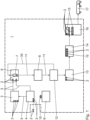
- the system designated as a whole with 1, serves to convey and/or transport individual items 2.
- the system 1 comprises a warehouse 3 in which the individual items 2 are stored.
- the warehouse 3 can be designed as a manual warehouse or as an automated warehouse.
- the system 1 further has a goods receipt 4, through which individual items 2 are fed into the system 1, particularly from external sources. Returned goods can also be fed to the goods receipt 4.
- the goods receiving area 4 is connected to the warehouse 3 by means of a conveyor system 5.
- the conveyor system 5 is, for example, a conveyor belt or a manual delivery of the individual goods 2, which may in particular also be present in containers in the goods receiving area 4, to the warehouse 3.
- the system 1 further comprises a loading station 6, where the individual items are loaded into a carrying device 7, designed as a transport bag.
- the loading station 6 is connected to both the goods receiving area 4 and the warehouse 3, each independently via a conveyor system 5.
- the individual items 2 are conveyed from the warehouse 3 and/or the goods receiving area 4 to the loading station by means of the conveyor system 5.
- system 1 without conveyor technology between the loading station 6 and the goods receipt 4 or the warehouse 3.
- the individual goods 2 are transported from the goods receipt 4 and/or the warehouse 3 manually to the loading station 6, in particular by means of spring-loaded trolleys or pallet trucks.
- the carrying devices 7 can each be individually transported using a roller adapter in a rail system.
- the carrying devices 7 are conveyed in a suspended manner.
- the system 1 is an overhead conveyor system. It is advantageous if the carrying devices 7 can each be uniquely identified using an identification device.
- the rolling adapter can each have an integrated RFID chip on which identification data is stored.
- the identification data can be captured using suitable reading devices, which are arranged in particular along the transport path of the overhead conveyor system 1, in order to track and control the conveying path of the carrying devices 7 along the overhead conveyor system 1.
- the carrying devices 7 are each positively connected to a roller adapter.
- the carrying devices 7 each have a hook that can be hooked into a corresponding recess in the roller adapter.
- a coat hanger with a garment hanging from it can also be hooked into the recess in the roller adapter.
- each carrying device 7 serves to convey exactly one individual item of goods 2.
- the rolling adapter can be designed in the shape of a hook and can be hooked into a recess in the carrying device 7.
- the overhead conveyor system 1 comprises a sorting unit 8, which serves to sort the carrying devices 7, i.e., to change the order of the individual items in the flow of goods.
- the sorting unit 8 can be designed in various ways.
- the sorting unit 8 can have several accumulation sections arranged in parallel and/or in series and/or one or more circulating carousels. Additionally or alternatively, the sorting unit 8 can be designed as a matrix sorter.
- the sorting unit 8 serves, in particular, to assemble the individual goods 2 into logical groups.
- the individual goods 2 are combined into groups of individual goods 2 that form an order 15.
- Groups of individual goods 2 that are part of an order 15 can also be formed in the sorting unit 8.
- the overhead conveyor system 1 comprises a central control unit 9, which is connected in particular to the reading devices along the overhead conveyor system 1.
- the signal connection can be wired or wireless.
- a wireless, radio-based signal connection is possible in Fig. 1 represented by a symbol 10 for radio transmission.
- the overhead conveyor system 1 comprises a rail system 11, by means of which the carrying devices 7 are conveyed from the loading station 6 to the sorting unit 8 and through the sorting unit 8.
- the rail system 11 also serves to connect the sorting unit 8 to at least one unloading station 12.
- unloading stations 12 are provided.
- the carrying devices 7 are automatically opened and unloaded, in particular by the individual goods 2 falling downward from the opened carrying device 7 due to gravity.
- An opening unit (not shown in detail) serves to automatically open the carrying devices 7 in the unloading station 12.
- the individual items 2 unloaded at the unloading station 12 are delivered to a device, designated as a whole by 13, for the order-oriented provision of the individual items 2 of multiple orders.
- the device 13 is arranged adjacent to the unloading station 12 and a packing area with at least one packing station 14. In particular, the device 13 serves to convey and provide the individual items 2 from the unloading station 12 to the packing station 14.
- At least one of the unloading stations 12 is permanently assigned to the packing area.
- the packing area has at least one packing station 14.
- several packing stations 14 are provided in the packing area.
- the number of unloading stations 12 per packing station 14 is at least one.
- Several unloading stations 12 can also be assigned to one packing station 14.
- a design without a fixed unloading station assignment is also conceivable, allowing for a flexible number of operators per packing area.
- Adaptability to the individual throughput requirements of individual operators is increased.
- Adaptability to the order profile, particularly to characteristics that change the duration of the packing process, such as order size and value-added service, is improved.
- the carrying devices 7 emptied in the unloading station 12 are returned via a return path 35 of the overhead conveyor system 1, closed by means of a closing unit (not shown), i.e. returned to their original state, and made available again, for example, at the loading station 6 as empty pockets for loading with individual goods 2.
- Packing station 14 the individual items 2 of an order 15 are combined and packaged.
- Packing station 14 is connected to a goods issue 16 by conveyor technology.
- the orders 15 containing the individual items 2 can leave system 1 via goods issue 16.
- the orders 15 processed in system 1 can contain different items and different quantities of items. It is also conceivable for an order 15 to contain only a single individual item 2. Orders 15 from goods issue 16 can be transported away using external means of transport 17, such as trucks.
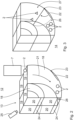
- the device 13 comprises four conveyor tracks 18.
- the conveyor tracks 18 are each designed as 90° bends in the form of a conveyor shaft and are essentially identical.
- Each conveyor track 18 has a feed opening 19 arranged at the top and a Fig. 2 each have a discharge opening 20 shown on the left.
- the respective discharge openings 20 of the conveyor tracks 18 are each connected to the associated feed opening 19.
- the individual items 2, which are fed to the device 13 at the feed opening 19, are conveyed to the discharge opening 20.
- the conveyance of the individual items 2 along the device 13 occurs automatically, i.e., due to gravity.
- a conveying direction 21 is defined along the conveyor track 18 from the feed opening 19 to the discharge opening 20.
- An actuatable separating element 22 is arranged between the feed opening 19 and the discharge opening 20 along the conveying direction 21.
- the separating element 22 for the conveyor track 18 is shown, which in Fig. 2 and 3 shown in the bottom right corner.
- the other conveyor tracks 18 of the device 13 have corresponding separating elements 22.
- the separating element 22 is a pivoting flap, which in Fig. 2 in the open position.
- the separating element 22 is pivotally connected to the conveyor track 18 about a separating element pivot axis 23. The separating element 22 can be moved between the open position in Fig. 2 and the closed position in Fig. 3 be swiveled.
- the conveyor tracks 18 are in accordance with Fig. 2 arranged in a 2x2 grid in a matrix-like manner. Accordingly, the feed openings 19 and the discharge openings 20 are each arranged in a 2x2 grid, i.e. in two rows and two columns. If several conveyor tracks 18 are provided, any arrangement of the conveyor tracks 18 is conceivable, for example in a single row or in any nxm grid.
- the feed openings 19 are oriented horizontally, i.e. in a horizontal plane, according to the embodiment shown.
- the feed openings 19 can be arranged with a feed inclination angle relative to the horizontal plane, wherein the feed inclination angle is in particular not more than 45°, in particular not more than 30°, in particular not more than 15° and in particular not more than 5°.
- the discharge openings 20 are oriented vertically, i.e., in a vertical plane.
- the discharge openings can also be arranged with a discharge angle of inclination relative to the vertical plane, wherein the discharge angle of inclination is at most 45°, in particular at most 30°, in particular at most 15°, in particular at most 5°.
- a stop element 24 in the form of a retaining strip is provided.
- the stop element 24 prevents the individual items 22 conveyed along the conveyor track 18 from inadvertently exiting the conveyor track 18.
- the stop elements 24 ensure that the individual items 2 are provided in a defined manner at the discharge opening 20.
- a pivoting flap or a sliding flap can be arranged additionally or alternatively at the discharge opening 20, which closes the discharge opening 20.
- FIG. 2 A sensor 25 is shown, which serves to detect the individual items 2 delivered to the conveyor track 18.
- a sensor 25 is assigned to each conveyor track 18.
- the sensor 25 is in particular in signal communication with the central control unit 9.
- the sensor 25 can provide a control signal when all individual items 2 of an order have been delivered to the conveyor track 18.
- the separating element 22 divides the conveyor track 18 into a discharge area 26 facing the discharge opening 20 and a parking area 27 arranged between the feed opening 19 and the separating element 22. In the discharge area 26, the individual items 2 are prepared for discharge. Individual items 2, in particular of a subsequent order 15, are parked in the parking area 27. The separating element 22 prevents the individual items 2 of different orders 15 from being mixed together in the device 13.
- the parking area 27 is integrated into the conveyor track.
- a signaling element in the form of a display element 28 serving as a signal light is provided on the stop element 24 in the area of the dispensing opening 20.
- the display element 28 serves to indicate that the individual items 2 of a complete order 15 are available at the dispensing opening 20.
- the display element 28 can additionally or alternatively be designed as an acoustic display, for example in the form of a signal tone. It is also conceivable to use a display unit in the form of a screen that indicates which of the dispensing openings 20 is to be served next.
- the carrying devices 7 with individual items 2 are conveyed along the overhead conveyor system 1 to the unloading station 12 and opened automatically there.
- the individual items 2 fall due to gravity downwards out of the carrying device 7 and are delivered into the feed opening 19 of a conveyor track 18.
- the individual items 2 are conveyed by gravity in the conveyor track 18 along the conveying direction 21 to the delivery opening 20 and stopped at the stop element 24.
- the delivery of the individual items 2 into the conveyor track 18 is monitored by means of the sensor 25.
- a control signal is transmitted from the control unit 9 to the separating element 22, so that the separating element 22 moves from the Fig. 2 shown open position to the position shown in Fig. 3 shown closed position.
- the individual items 2 of the first order 15 are arranged in the delivery area 26 and are ready for removal at the packing station 14.
- individual items 2 of a second order 15 can already be delivered to the conveyor track 18, even if the individual items 2 of the first order 15 have not yet been or have not yet been completely removed at the delivery opening 20.
- the individual items 2 of the second order 15 are parked, i.e. temporarily stored, in the parking area 27.
- the control unit 9 sends a release signal to the separating element 22, which then Fig. 2 shown open position, so that the individual items 2 of the second order 15 are conveyed to the discharge opening 20.
- the individual items 2 of the first order 15 are symbolized as circles and the individual items 2 of the second order 15 as triangles.
- the device 13 enables an order-oriented provision of the individual goods 2.
- the individual goods 2 are unloaded according to the shown embodiment at the unloading station 12 in an order-oriented manner and the Device 13. This means that first all individual items 2 of the first order 15 are delivered to device 13 before the next individual items 2 of the subsequent order 15 are delivered.
- the conveyor track 18 can also be designed as a spiral slide.
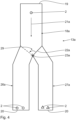
- the conveyor track 18a is essentially Y-shaped with a feed opening 19 and two discharge openings 20.
- the conveyor track 18a has a switch area 29.
- the separating element 22a is arranged in the switch area 29.
- the separating element 22a is designed as a switch tongue, which is arranged to pivot about the pivot axis 23a between two end positions.
- the individual goods 2 are conveyed into the left branch of the conveyor track 18a to the discharge opening 20 shown on the left.
- the separating element 22a which is shown in Fig.
- the individual items 2 are conveyed into the right branch of the conveyor track 18a to the discharge opening 20 shown on the right.
- Fig. 4 In the arrangement shown, the right branch of the conveyor track 18a, which is separated from the feed opening 19 by the separating element 22a, represents the parking area 27a.
- the branch of the conveyor track 18a released by the separating element 22a forms the discharge area 26a.
- the device 13a according to Fig. 4 can be arranged such that the conveying direction 21 is oriented substantially vertically, i.e. both the feed opening 19 and the discharge openings 20 are each arranged in a horizontal plane.
- the conveying direction 21a can be oriented horizontally. Accordingly, the feed opening 19 and the discharge openings 20 are oriented in a vertical plane.
- the conveyor track can be implemented, for example, by a driven belt, onto which the individual goods 2 are placed and conveyed by the belt.
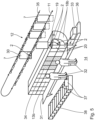
- each device 13b comprises two conveyor tracks 18b, wherein the individual items 2 of different orders 15 are delivered to the first conveyor track or the second conveyor track 18b.
- one conveyor track 18b, at which the individual items 2 are delivered forms the delivery area 28b
- the other conveyor track 18b, at which the individual items 2 are temporarily buffered, i.e. parked, for delivery at a later time forms the parking area 27b.
- a separating element is dispensable in this embodiment.
- a Overhead conveyor technology provided with a rail system 11, along which transport pockets 7 are conveyed suspended on roller adapters 30. The unloading station 12 is arranged such that the transport pockets 7 are guided above the feed openings 19 of the conveyor tracks 18b.
- the device 13b is also referred to as a packing wall.
- the packing wall is typically operated by several operators 32, each operator 32 having a permanently assigned work area 34.
- the work area 34 is defined for each operator 32 in particular by a fixed assignment of discharge openings 20.
- a typical work area 34 may, for example, comprise six discharge openings 20, which are arranged in Fig. 5 are shown in grey.
- the respective work area is defined flexibly.
- a flexible definition of the respective work area is possible, in particular, depending on the individual packing performance of the operator 32 and/or other distinguishing criteria, particularly those related to individual goods.
- Such criteria include, for example, the value of the goods, the parcel service provider, the order size, and/or the shipping container.
- the respective conveyor tracks 18b form so-called target points.
- a so-called target point sorting can be carried out.
- the individual goods 2 can, in particular, be transported to the unloading station 12 completely unsorted.
- the device 13b has a plurality of conveyor tracks 18b arranged in two rows such that two discharge openings 20 are arranged one above the other.
- a packing table 31 is provided at the packing station, which facilitates operators 32 in packing the individual goods 2 removed from the discharge opening 20 into a shipping container 33 in the form of a shipping carton.
- the unloaded, emptied transport bags 7 are returned via the return track 35.
- the fully packed shipping container 33 can be transported to the goods exit 16 by means of a transport infrastructure 36.
- a transport infrastructure 36 which is designed as an automatic belt, a manual removal to the goods exit 16 can also be provided.
- the individual items 2 are collected in the conveyor tracks 18b, which function as destination points.
- the destination point is stationary.
- slides and/or spiral tracks can be used.
- a partial order is present, this is signaled to the operator 32 by means of the display element 28.
- the division of an order can be based on the total volume of the order, i.e. the number of individual items, and/or on other criteria such as the fragility of an individual item. Distributing the individual items of an order 15 onto multiple conveyor tracks 18b, i.e., target locations, is advantageous to avoid damage to the individual parts. In particular, the back pressure within a conveyor track is reduced.
- the operator 32 can remove the individual items 2 of the order 15 via the discharge opening 20 and pack them at the packing table 31, converting them into the packed order 15.
- the conveyor tracks 18b according to the packing wall can also be additionally equipped with a separating element, as explained for the first embodiment.
- additional non-pouchable individual items 37 can be provided using an additional infrastructure 38. This expands the functionality of the overhead conveyor system 1, since the orders 15 can also include non-pouchable individual items 37.
- the essential advantages of the device according to the invention are that the complexity of the overhead conveyor technology of the overhead conveyor system 1 is reduced.
- the space requirement at the packing station 14 is reduced.
- the provision of non-pouchable individual items 37 is simplified due to the reduced space requirement. It is particularly conceivable for the non-pouchable individual items 37 to be provided in a separate, specially designed packing wall.
- the sequence of the two material flows of pocketable and non-pouchable individual items does not need to be coordinated.
- the provision of the goods at the packing station 14 can be flexible and independent.
- the height requirement at packing station 14 is reduced. Because the overhead conveyor technology in the area of packing station 14 can be designed very compactly, its connection to other transport infrastructures, in particular the transport infrastructure 36 for the removal of fully packed orders 15 and the additional infrastructure 38 for the provision of non-pouchable individual goods 37, is simplified.
- the conveying capacity of the overhead conveyor system can be optimally utilized.
- the device according to the invention is suitable for unloading more than 250 individual items 2 per hour, in particular more than 500, in particular more than 1000, in particular more than 2000, in particular more than 2500, and in particular more than 3000 carrying devices 7 per hour in the unloading area 12 and for providing the individual items 2 at the delivery openings 20, which are then packed into orders 15 by the operators 32.
- the packaging material can be provided in a more accessible manner at the packing station 14.
- the device 13b can be combined with other technologies, particularly when packing individual items, in particular pick-by-light, pick-by-voice, and pick-by-vision.
Landscapes
- Engineering & Computer Science (AREA)
- Mechanical Engineering (AREA)
- Branching, Merging, And Special Transfer Between Conveyors (AREA)
Applications Claiming Priority (2)
| Application Number | Priority Date | Filing Date | Title |
|---|---|---|---|
| DE102018209266.4A DE102018209266A1 (de) | 2018-06-11 | 2018-06-11 | Vorrichtung und Verfahren zum auftragsorientierten Bereitstellen von Einzelwaren mehrerer Aufträge an einem Packplatz |
| EP19177187.2A EP3581523B1 (fr) | 2018-06-11 | 2019-05-29 | Dispositif et procédé de mise à disposition, en fonction de la demande, de marchandises individuelles pour plusieurs demandes sur un poste d'emballage |
Related Parent Applications (2)
| Application Number | Title | Priority Date | Filing Date |
|---|---|---|---|
| EP19177187.2A Division EP3581523B1 (fr) | 2018-06-11 | 2019-05-29 | Dispositif et procédé de mise à disposition, en fonction de la demande, de marchandises individuelles pour plusieurs demandes sur un poste d'emballage |
| EP19177187.2A Division-Into EP3581523B1 (fr) | 2018-06-11 | 2019-05-29 | Dispositif et procédé de mise à disposition, en fonction de la demande, de marchandises individuelles pour plusieurs demandes sur un poste d'emballage |
Publications (2)
| Publication Number | Publication Date |
|---|---|
| EP4530229A2 true EP4530229A2 (fr) | 2025-04-02 |
| EP4530229A3 EP4530229A3 (fr) | 2025-06-25 |
Family
ID=66676319
Family Applications (2)
| Application Number | Title | Priority Date | Filing Date |
|---|---|---|---|
| EP19177187.2A Active EP3581523B1 (fr) | 2018-06-11 | 2019-05-29 | Dispositif et procédé de mise à disposition, en fonction de la demande, de marchandises individuelles pour plusieurs demandes sur un poste d'emballage |
| EP25154301.3A Pending EP4530229A3 (fr) | 2018-06-11 | 2019-05-29 | Dispositif et procédé de mise à disposition, en fonction de la demande, de marchandises individuelles pour plusieurs demandes sur un poste d'emballage |
Family Applications Before (1)
| Application Number | Title | Priority Date | Filing Date |
|---|---|---|---|
| EP19177187.2A Active EP3581523B1 (fr) | 2018-06-11 | 2019-05-29 | Dispositif et procédé de mise à disposition, en fonction de la demande, de marchandises individuelles pour plusieurs demandes sur un poste d'emballage |
Country Status (4)
| Country | Link |
|---|---|
| US (1) | US11472587B2 (fr) |
| EP (2) | EP3581523B1 (fr) |
| DE (1) | DE102018209266A1 (fr) |
| ES (1) | ES3025788T3 (fr) |
Families Citing this family (12)
| Publication number | Priority date | Publication date | Assignee | Title |
|---|---|---|---|---|
| DE102018209266A1 (de) | 2018-06-11 | 2019-12-12 | Dürkopp Fördertechnik GmbH | Vorrichtung und Verfahren zum auftragsorientierten Bereitstellen von Einzelwaren mehrerer Aufträge an einem Packplatz |
| CN111598498B (zh) * | 2020-04-08 | 2023-08-15 | 北京旷视机器人技术有限公司 | 仓库订单的分配方法、装置及系统 |
| US11383937B2 (en) * | 2020-04-20 | 2022-07-12 | Target Brands, Inc. | Systems and methods for warehouse order sortation |
| CN112644783A (zh) * | 2020-12-23 | 2021-04-13 | 芜湖福派卫生用品有限公司 | 一种棉柔巾输送通道的分段控制系统及控制方法 |
| DE102021207911A1 (de) | 2021-07-23 | 2023-01-26 | Dürkopp Fördertechnik GmbH | Vorrichtung und Verfahren zum automatischen Entladen einer hängend geförderten Transporttasche sowie Hängeförderanlage mit einer derartigen Vorrichtung |
| AT526795B1 (de) * | 2022-12-15 | 2024-11-15 | Tgw Logistics Group Gmbh | Verfahren und Umpackstation zum Umpacken von Waren aus Abgabebehältern in Warenaufnahmebehälter |
| EP4446255B1 (fr) | 2023-04-12 | 2025-09-24 | BEUMER Group GmbH & Co. KG | Convoyeur aérien pour assembler des articles en ordre de tri et procédé correspondant |
| CH720733A1 (de) | 2023-04-25 | 2024-10-31 | Ferag Ag | Kommissionieranlage |
| EP4549343A1 (fr) | 2023-11-02 | 2025-05-07 | BEUMER Group GmbH & Co. KG | Dispositif de tri avec deux plans de tri perpendiculaires l'un par rapport à l'autre |
| AT527219B1 (de) * | 2023-11-14 | 2024-12-15 | Tgw Logistics Group Gmbh | Verfahren und Umpacksystem zum Umpacken von Waren aus Abgabebehältern in Warenaufnahmebehälter mit einer Entleerstation und einer Umverteilstation |
| EP4651045A1 (fr) | 2024-05-17 | 2025-11-19 | BEUMER Group GmbH & Co. KG | Système d'utilisation optimisée d'un convoyeur de tri, en particulier d'un trieur de sacs |
| EP4647371A1 (fr) * | 2024-11-05 | 2025-11-12 | Dürkopp Fördertechnik GmbH | Installation de transport et procédé de transport et de déchargement de marchandises |
Citations (2)
| Publication number | Priority date | Publication date | Assignee | Title |
|---|---|---|---|---|
| EP1690811B1 (fr) | 2005-02-12 | 2007-05-02 | Dürkopp Adler Aktiengesellschaft | Système de transport pour des articles suspendus |
| DE102018209266A1 (de) | 2018-06-11 | 2019-12-12 | Dürkopp Fördertechnik GmbH | Vorrichtung und Verfahren zum auftragsorientierten Bereitstellen von Einzelwaren mehrerer Aufträge an einem Packplatz |
Family Cites Families (34)
| Publication number | Priority date | Publication date | Assignee | Title |
|---|---|---|---|---|
| US4133098A (en) * | 1977-05-18 | 1979-01-09 | Autosystems Limited | Apparatus for sorting successive articles moving along a path |
| US4274783A (en) * | 1977-05-26 | 1981-06-23 | Fmc Corporation | Chain measuring and conveyor control system |
| US4815582A (en) * | 1981-12-24 | 1989-03-28 | Francesco Canziani | Feeding apparatus particularly for machines for the conveyance and sorting of objects |
| DK162380C (da) * | 1989-09-01 | 1992-03-16 | Int Transport Syst Its | Bakke til brug i en sorteringsmaskine |
| DE4209558A1 (de) * | 1992-03-21 | 1993-09-23 | Otto Versand Gmbh & Co | Verfahren und vorrichtung zum zusammenstellen von warensendungen |
| AT403798B (de) * | 1996-08-13 | 1998-05-25 | Moerchen Wolfgang Dr Ing | Aufteileinrichtung |
| DE29806960U1 (de) * | 1998-04-17 | 1998-08-13 | Wolf - Montage - Automationsanlagen + Sondermaschinen - GmbH, 97264 Helmstadt | Kommissioniereinrichtung zur Bestückung von Versandbehältern |
| JP3203421B2 (ja) * | 1998-12-10 | 2001-08-27 | 有限会社 エーデック産業 | 衣類などの仕分け搬送集積装置 |
| US6208908B1 (en) * | 1999-04-27 | 2001-03-27 | Si Handling Systems, Inc. | Integrated order selection and distribution system |
| US20020087231A1 (en) * | 2001-01-04 | 2002-07-04 | Lewis Jimmy Randolph | Method and apparatus for filling stock orders |
| US7159375B2 (en) * | 2003-10-08 | 2007-01-09 | Kimberly-Clark Worldwide, Inc. | Multi-product accumulating and packing system |
| DE102004014378A1 (de) * | 2004-03-17 | 2005-10-06 | SSI Schäfer PEEM GmbH | Anlage und Verfahren zum Kommissionieren von Artikeln in Auftragsbehälter |
| WO2006029212A2 (fr) * | 2004-09-02 | 2006-03-16 | Fki Logistex Inc. | Transporteuse/trieuse et procédé |
| AT500946A1 (de) * | 2004-10-22 | 2006-05-15 | Tgw Transportgeraete Gmbh | Warenumschlaglager und verfahren zu dessen betrieb |
| DE202005002292U1 (de) * | 2005-02-14 | 2005-05-12 | Knapp Logistik Automation Ges.M.B.H. | Vertikalförderer in einem Kommissioniersystem zum Vertikalfördern von Fördergütern |
| DE102006003270A1 (de) * | 2006-01-19 | 2007-08-02 | SSI Schäfer PEEM GmbH | Vorrichtung und Verfahren zum Sortieren von ungeordneten Behältern in einem Kommissioniersystem |
| DE102007011856B4 (de) * | 2007-03-05 | 2011-01-20 | SSI Schäfer Noell GmbH Lager- und Systemtechnik | Doppelseitig zugängliches Kommissionierregal und Kommissionierverfahren |
| AT506638B1 (de) * | 2008-04-03 | 2010-05-15 | Salomon Automation Gmbh | Kommisionieranlage und verfahren zum kommissionieren |
| AT510309B1 (de) * | 2010-08-23 | 2017-12-15 | Tgw Logistics Group Gmbh | Verfahren zum kommissionieren von waren, fördereinrichtung, ladehilfsmittel und verwendung eines ladehilfsmittels |
| DE102011015138B4 (de) * | 2011-03-17 | 2014-05-08 | SSI Schäfer PEEM GmbH | Hängeförder-Transporttasche und Verfahren zum automatisierten Entladen der Transporttasche |
| DE102011083580A1 (de) * | 2011-09-28 | 2013-03-28 | Siemens Aktiengesellschaft | Sortieranlage und Sortierverfahren zum gemeinsamen Sortieren von verschiedenartigen Gegenständen |
| DE102012101198A1 (de) * | 2011-10-11 | 2013-04-11 | Rsl Logistik Gmbh & Co. Kg | Verfahren zum Kommissionieren von Aufträgen und Hängebahnanlage |
| DE102011087370A1 (de) | 2011-11-29 | 2013-05-29 | Siemens Aktiengesellschaft | Sortieranlage und Sortierverfahren mit zwei Arten von Sortierendstellen |
| DE102012018925B4 (de) * | 2012-09-18 | 2020-06-18 | Ssi Schäfer Automation Gmbh | Tasche für Hängeförderer, Beladestation, Entladestation und Taschen-Hängeförderanlage |
| DE102014203118B4 (de) * | 2014-02-20 | 2019-07-18 | Dürkopp Fördertechnik GmbH | Schaltbare Weiche zum Beeinflussen eines Flusses von Einzelwaren in einem Fördersystem, Fördersystem mit einer derartigen schaltbaren Weiche sowie Verfahren zum Schalten einer derartigen schaltbaren Weiche |
| US11059185B2 (en) * | 2014-10-03 | 2021-07-13 | Frito-Lay North America, Inc. | Apparatus and method for transferring a pattern from a universal surface to an ultimate package |
| CH711809A1 (de) * | 2015-11-25 | 2017-05-31 | Ferag Ag | Vorrichtung zum Beschicken von Transporttaschen. |
| CN109641701B (zh) * | 2016-07-20 | 2020-09-08 | 德马泰克公司 | 具有整理和分拣功能的订单履行系统及方法 |
| CA3045522C (fr) * | 2016-12-06 | 2023-10-03 | Berkshire Grey, Inc. | Systemes et procedes pour permettre le traitement d'objets dans des vehicules |
| DE202017100206U1 (de) * | 2017-01-16 | 2018-04-17 | Tgw Mechanics Gmbh | Fördergutbehälter mit Auswerfvorrichtung und zugehörige Hängefördervorrichtung |
| CH713387A1 (de) * | 2017-01-26 | 2018-07-31 | Ferag Ag | Beschickungsvorrichtung zum kontinuierlichen Beschicken von Aufnahmeeinheiten mit Transportgütern. |
| CH713551A1 (de) * | 2017-03-07 | 2018-09-14 | Ferag Ag | Verfahren zum Kommissionieren von Waren und Kommissionierungsanlage zur Durchführung des Verfahrens. |
| WO2018226773A1 (fr) * | 2017-06-06 | 2018-12-13 | Material Handling Systems, Inc. | Système et procédé d'identification et de transfert de colis d'un premier transporteur à un second transporteur |
| US10427873B1 (en) * | 2018-05-29 | 2019-10-01 | Schaefer Systems International, Inc. | Cluster-based-system and method for E-commerce-order fulfillment |
-
2018
- 2018-06-11 DE DE102018209266.4A patent/DE102018209266A1/de active Pending
-
2019
- 2019-05-29 EP EP19177187.2A patent/EP3581523B1/fr active Active
- 2019-05-29 ES ES19177187T patent/ES3025788T3/es active Active
- 2019-05-29 EP EP25154301.3A patent/EP4530229A3/fr active Pending
- 2019-06-07 US US16/434,908 patent/US11472587B2/en active Active
Patent Citations (2)
| Publication number | Priority date | Publication date | Assignee | Title |
|---|---|---|---|---|
| EP1690811B1 (fr) | 2005-02-12 | 2007-05-02 | Dürkopp Adler Aktiengesellschaft | Système de transport pour des articles suspendus |
| DE102018209266A1 (de) | 2018-06-11 | 2019-12-12 | Dürkopp Fördertechnik GmbH | Vorrichtung und Verfahren zum auftragsorientierten Bereitstellen von Einzelwaren mehrerer Aufträge an einem Packplatz |
Also Published As
| Publication number | Publication date |
|---|---|
| US20190375527A1 (en) | 2019-12-12 |
| US11472587B2 (en) | 2022-10-18 |
| ES3025788T3 (en) | 2025-06-09 |
| EP4530229A3 (fr) | 2025-06-25 |
| DE102018209266A1 (de) | 2019-12-12 |
| EP3581523B1 (fr) | 2025-04-23 |
| EP3581523A1 (fr) | 2019-12-18 |
Similar Documents
| Publication | Publication Date | Title |
|---|---|---|
| EP3581523B1 (fr) | Dispositif et procédé de mise à disposition, en fonction de la demande, de marchandises individuelles pour plusieurs demandes sur un poste d'emballage | |
| EP3666690B1 (fr) | Procédé de préparation de commandes d'articles individuels dans une installation de transport suspendue ainsi qu'une telle installation de transport suspendue | |
| EP3655351B1 (fr) | Installation de préparation de commandes pour la préparation de différentes marchandises commandées pouvant en particulier être transportées en suspension, ainsi que procédé pour faire fonctionner ladite installation de préparation de commandes | |
| EP3665104B1 (fr) | Convoyeur aérien pour le tri de produits et procédé | |
| DE102008036564B4 (de) | Skalierbarer Versandpuffer mit integrierter Sortierfunktion und Verfahren dazu | |
| DE112006001872B4 (de) | Kommissionierverfahren sowie Kommissionierfördervorrichtung für ein Lager | |
| DE102020214613A1 (de) | Vorrichtung und Verfahren zum Aufgeben von Transporttaschen in eine Fördertechnik einer Hängeförderanlage sowie derartige Hängeförderanlage | |
| EP4112504A1 (fr) | Installation de préparation de commandes suspendu avec système de pesage intégré au rail et méthode correspondante | |
| EP3581524A1 (fr) | Procédé et dispositif de création des commandes à partir de marchandises individuelles | |
| WO2013020999A1 (fr) | Dispositif et procédé de tri au moyen d'une zone d'accumulation et d'une zone de tri | |
| EP4477587A1 (fr) | Poste de déchargement pour une installation de transport, installation de transport dotée d'un tel poste de déchargement et procédé de déchargement automatisé de récipients de transport | |
| DE10332359A1 (de) | Verfahren und Vorrichtung zur Frühgepäckspeicherung | |
| EP4541733A1 (fr) | Procédé et station de transfert pour comprimer un flux de marchandises dans une installation de transport suspendu | |
| EP2095887B1 (fr) | Dispositif et procédé de tri d'objets | |
| EP3623060B1 (fr) | Procédé de tri d'objets ainsi qu'installation de tri | |
| WO2013060721A1 (fr) | Installation de tri et procédé de tri comprenant deux zones de stockage | |
| DE102021110132A1 (de) | Verfahren zum Betreiben eines Förderers für hintereinander folgende Güter und entsprechendes Fördersystem | |
| DE102009017343A1 (de) | Sortierförderer innerhalb einer Förderanlage zum automatisierten Transport von Stückgütern | |
| EP4442374A1 (fr) | Procédé de chargement et station de chargement pour récipients de transport | |
| EP4166482B1 (fr) | Technique de transport suspendu et procédé de transport des adaptateurs de suspension, ainsi qu'installation de transport suspendu dotée d'une telle technique de transport suspendu | |
| EP2088096A1 (fr) | Dispositif d'insertion automatisée pour un stock de pharmacie | |
| EP1117603B1 (fr) | Dispositif et procede pour le tri d'articles individuels | |
| EP4166480B1 (fr) | Dispositif et procédé de transport suspendu d'objets | |
| DE102022205209A1 (de) | Fördervorrichtung und Förderverfahren für Waren | |
| DE19620599A1 (de) | Verfahren zum Zuführen von Versand- und Frachtgut zu einer Sortier- oder Verteilanlage und Vorrichtung zur Durchführung des Verfahrens |
Legal Events
| Date | Code | Title | Description |
|---|---|---|---|
| PUAI | Public reference made under article 153(3) epc to a published international application that has entered the european phase |
Free format text: ORIGINAL CODE: 0009012 |
|
| STAA | Information on the status of an ep patent application or granted ep patent |
Free format text: STATUS: THE APPLICATION HAS BEEN PUBLISHED |
|
| AC | Divisional application: reference to earlier application |
Ref document number: 3581523 Country of ref document: EP Kind code of ref document: P |
|
| AK | Designated contracting states |
Kind code of ref document: A2 Designated state(s): AL AT BE BG CH CY CZ DE DK EE ES FI FR GB GR HR HU IE IS IT LI LT LU LV MC MK MT NL NO PL PT RO RS SE SI SK SM TR |
|
| PUAL | Search report despatched |
Free format text: ORIGINAL CODE: 0009013 |
|
| AK | Designated contracting states |
Kind code of ref document: A3 Designated state(s): AL AT BE BG CH CY CZ DE DK EE ES FI FR GB GR HR HU IE IS IT LI LT LU LV MC MK MT NL NO PL PT RO RS SE SI SK SM TR |
|
| RIC1 | Information provided on ipc code assigned before grant |
Ipc: B65G 47/61 20060101ALI20250520BHEP Ipc: B65G 1/137 20060101AFI20250520BHEP |
|
| STAA | Information on the status of an ep patent application or granted ep patent |
Free format text: STATUS: REQUEST FOR EXAMINATION WAS MADE |