EP4529311A1 - Funkrufverfahren und kommunikationsvorrichtung - Google Patents
Funkrufverfahren und kommunikationsvorrichtung Download PDFInfo
- Publication number
- EP4529311A1 EP4529311A1 EP23822841.5A EP23822841A EP4529311A1 EP 4529311 A1 EP4529311 A1 EP 4529311A1 EP 23822841 A EP23822841 A EP 23822841A EP 4529311 A1 EP4529311 A1 EP 4529311A1
- Authority
- EP
- European Patent Office
- Prior art keywords
- satellite
- track
- terminal
- orbit
- information
- Prior art date
- Legal status (The legal status is an assumption and is not a legal conclusion. Google has not performed a legal analysis and makes no representation as to the accuracy of the status listed.)
- Pending
Links
Images



Classifications
-
- H—ELECTRICITY
- H04—ELECTRIC COMMUNICATION TECHNIQUE
- H04W—WIRELESS COMMUNICATION NETWORKS
- H04W68/00—User notification, e.g. alerting and paging, for incoming communication, change of service or the like
-
- H—ELECTRICITY
- H04—ELECTRIC COMMUNICATION TECHNIQUE
- H04W—WIRELESS COMMUNICATION NETWORKS
- H04W64/00—Locating users or terminals or network equipment for network management purposes, e.g. mobility management
-
- H—ELECTRICITY
- H04—ELECTRIC COMMUNICATION TECHNIQUE
- H04W—WIRELESS COMMUNICATION NETWORKS
- H04W68/00—User notification, e.g. alerting and paging, for incoming communication, change of service or the like
- H04W68/02—Arrangements for increasing efficiency of notification or paging channel
-
- H—ELECTRICITY
- H04—ELECTRIC COMMUNICATION TECHNIQUE
- H04W—WIRELESS COMMUNICATION NETWORKS
- H04W84/00—Network topologies
- H04W84/02—Hierarchically pre-organised networks, e.g. paging networks, cellular networks, WLAN [Wireless Local Area Network] or WLL [Wireless Local Loop]
- H04W84/04—Large scale networks; Deep hierarchical networks
- H04W84/06—Airborne or Satellite Networks
Definitions
- Embodiments of this application relate to the field of communication technologies, and in particular, to a paging method and a communication apparatus.
- 5th generation (5th generation, 5G) new radio new radio (new radio, NR) has entered a commercial deployment phase from a standardization phase.
- An NR standard is researched and designed for a characteristic of terrestrial communication, and has characteristics of providing high-rate, high-reliability, and low-latency communication for a user terminal.
- non-terrestrial network non-terrestrial network, NTN
- NTN non-terrestrial network
- research institutes, communication organizations, companies, and the like have participated in researching NTN communication technologies and standards, aiming to build an integrated communication network for space-air-ground communication.
- a satellite can accurately obtain a location of a terminal.
- the satellite calculates, based on the stored location of the terminal and coverage of the satellite, a satellite and a beam that serve an area in which the terminal is located, and sends a paging message.
- a paging area update tilt area update, TAU
- TAU tracking area update
- the terminal When there are a large quantity of satellites for coverage, only one satellite or a batch of satellites that can cover an area in which the terminal is located need to send one or more paging messages, and not all satellites that can cover the area need to send paging. Correspondingly, the terminal only needs to listen to one or more paging messages of one satellite/a batch of satellites that satisfy a specific condition.
- a network device When the terminal is at a fixed location and is handed over to another batch of satellites that originally do not send paging due to a reason (for example, weather), a network device does not know that the batch of satellites on which the terminal camps is changed, and a paging failure occurs.
- This application provides a paging method and a communication apparatus, to reduce paging overheads and improve paging efficiency.
- this application provides a paging method.
- the method may be performed by a terminal or a network device.
- the terminal may be understood as a user equipment (user equipment, UE), a vehicle-mounted device, a chip of the terminal, or the like.
- a type of the terminal is not specifically limited herein in this application.
- the terminal may communicate with a satellite.
- the satellite may be a geostationary satellite, a non-geostationary satellite, an artificial satellite, a low earth orbit satellite, a medium earth orbit satellite, a high earth orbit satellite, or the like.
- the terminal may also communicate with a network device.
- the network device may be understood as a base station, a transmission point, or the like. This is not specifically limited herein in this application.
- the network device may also communicate with the satellite. This is not specifically limited herein in this application.
- the method includes: A network device sends satellite parameter information, where the satellite parameter information includes at least one of the following: satellite ephemeris information, satellite orbit information, and satellite projected track information.
- a terminal receives the satellite parameter information, and determines a projection location of the terminal based on satellite parameter information of a first satellite, where the projection location is determined based on a location of the terminal and orbit information of the first satellite, or is determined based on a location of the terminal and projected track information of the first satellite, where the first satellite is a satellite that communicates with the terminal.
- the terminal sends the projection location of the terminal to the network device, so that the network device determines, based on the projection location, a device configured to send a paging message, and the terminal receives the paging message.
- the projection location of the terminal is determined based on the satellite orbit information or the satellite projected track information, and the device for sending paging is determined based on the projection location of the terminal, so that paging efficiency can be improved, and paging overheads can be reduced.
- the projection location indicates an orbit point that is on an orbit of the first satellite and that is closest to the terminal or a point in a neighborhood range of the orbit point; the projection location indicates a track point that is on a projected track of the first satellite and that is closest to the terminal or a point in a neighborhood range of the track point; or the projection location indicates a track segment that is on a projected track of the first satellite and that is closest to the terminal or a track segment in a neighborhood range of the track segment, where the first satellite is a satellite belonging to a ground co-track satellite chain, and the ground co-track satellite chain includes a plurality of satellites that have a same ground projected track.
- the projection location is indicated by using the orbit point on the orbit of the first satellite, or the track point or the track segment on the ground projected track of the first satellite.
- the track point is indicated by using one of the following parameters: a distance from a reference point moving along a first projected track to the track point, a satellite motion phase difference accumulated from the reference point moving along the first projected track to the track point, and a latitude difference accumulated from the reference point moving along the first projected track to the track point, where the reference point is any point on the first projected track, and the first projected track is a ground projected track of any ground co-track satellite chain.
- the track point may be indicated by using a distance from the reference point to the track point.
- the reference point is any point on a projected track 1, and a location 10 meters away from the reference point is the track point. In this case, the track point may be indicated by using 10 meters.
- the track point may be indicated by using a satellite motion phase difference accumulated from the reference point to the track point.
- the reference point is any point on a projected track 1, a satellite ground projection is located at the reference point at a moment 1, and the satellite ground projection is located at the track point after X moments.
- the track point may be indicated by using a satellite motion phase difference accumulated from the moment 1 to a moment X+1.
- the track point may be indicated by using a latitude difference accumulated from the reference point to the track point.
- the reference point is any point on a projected track 1
- the reference point is located at latitude 1
- Y latitude needs to be passed from the reference point to the track point.
- the track point may be indicated by using the Y latitude. Based on this, the track point may be indicated by using different parameters.
- the projection location is indicated by using an opening angle between the orbit point closest to the terminal and any point on the orbit of the first satellite relative to the earth center; or when the first satellite is located on the ground co-track satellite chain, the projection location is indicated by using an offset between the track point or the track segment closest to the terminal and the reference point.
- the satellite parameter information further includes a satellite orbit index
- the satellite orbit index indicates the satellite orbit information or the satellite projected track information.
- the projection location further includes a satellite orbit index of the first satellite.
- the satellite orbit index of the first satellite is reported, so that a data reporting amount can be reduced, and signaling overheads can be reduced.
- the parameter information further includes a paging number, and the paging number corresponds to a satellite orbit interval or a satellite track interval.
- a satellite orbit interval of the first satellite is indicated by using an interval between opening angles between any two orbit points on the orbit of the first satellite and any point on the orbit of the first satellite relative to the earth center; or when the first satellite is located on the ground co-track satellite chain, a satellite track interval of the first satellite is indicated by using an interval between offsets between two points on the projected track of the first satellite and the reference point.
- the projection location further includes a paging number corresponding to the first satellite.
- the corresponding paging number on the orbit of the first satellite is reported, so that a data reporting amount can be reduced, and signaling overheads can be reduced.
- the satellite orbit information includes at least one of the following: a satellite orbit type, satellite altitude information, satellite inclination angle information, satellite ascending node angle information, and satellite perigee angle information.
- the terminal sends an update message
- the network device receives the update message, where the update message includes a projection location of the terminal on an orbit of a second satellite or a location that is of the terminal and that is on a ground projected track of the second satellite.
- an update of the paging message can be triggered in a timely manner, to ensure that the terminal device can normally receive the paging message.
- the update message is triggered based on a change of the location of the terminal and a change of the projection location.
- the change of the projection location includes at least one of the following cases: orbit information or projected track information of the satellite on which the terminal camps is changed, a change of an orbit point of the terminal on the orbit of the first satellite exceeds a preset orbit point threshold, a track point of the terminal on the projected track of the first satellite exceeds a preset track point threshold, and a track segment of the terminal on the projected track of the first satellite exceeds a preset track segment threshold.
- the update message further includes a difference parameter
- the difference parameter is changed satellite orbit information of the second satellite relative to the first satellite or changed satellite projected track information of the second satellite relative to the first satellite.
- the difference parameter is an ascending node angle or an orbit number of the second satellite
- the satellites on the ground co-track satellite chain have a same inclination angle and are located on discrete orbits.
- this application provides a paging method.
- a terminal determines a satellite orbit identifier of a device that is to listen to a message; the terminal sends the satellite orbit identifier, where the satellite orbit identifier is used to determine a device configured to send a paging message; and the terminal receives the paging message.
- the terminal when the terminal can communicate with satellites on a plurality of orbits, the terminal may negotiate with a network device, only a satellite on one or more of the satellite orbits sends a paging message, and the terminal receives only the paging message from the satellite on the one or more satellite orbits, to reduce network side overheads, reduce receiving power consumption of the terminal, and reduces data processing complexity.
- the terminal sends an update message, where the update message is triggered based on a change of a location of the terminal and a change of the satellite orbit identifier stored in the terminal.
- this application provides a paging method.
- a network device sends satellite parameter information, where the satellite parameter information includes at least one of the following: satellite ephemeris information, satellite orbit information, and satellite projected track information.
- a terminal receives the satellite parameter information.
- the terminal sends a projection location of the terminal, where the projection location is determined based on satellite parameter information of a first satellite; and the projection location is determined based on a location of the terminal and orbit information of the first satellite, or is determined based on a location of the terminal and projected track information of the first satellite, where the first satellite is a satellite that communicates with the terminal.
- the network device receives the projection location of the terminal.
- the network device determines, based on the projection location, a device configured to send a paging message.
- the terminal receives the paging message.
- this application provides a communication apparatus.
- the communication apparatus may be a terminal (for example, the terminal in the first aspect, the terminal in the second aspect, or the terminal in the third aspect) or a chip disposed in the terminal; or the communication apparatus may be a network device (for example, the network device in the first aspect, the network device in the second aspect, or the network device in the third aspect) or a chip disposed in the network device.
- the communication apparatus has a function of implementing any one of the first aspect to the third aspect.
- the communication apparatus includes a corresponding module, unit, or means (means) for performing the steps in any one of the first aspect to the third aspect.
- the function, unit, or means may be implemented by using software, implemented by using hardware, or implemented by hardware executing corresponding software.
- the communication apparatus includes a processing unit and a transceiver unit.
- the transceiver unit may be configured to send and receive a signal, to implement communication between the communication apparatus and another apparatus.
- the transceiver unit is configured to send a projection location of a terminal.
- the processing unit may be configured to perform some internal operations of the communication apparatus.
- the transceiver unit may be referred to as an input/output unit, a communication unit, or the like, and the transceiver unit may be a transceiver.
- the processing unit may be a processor.
- the transceiver unit may be an input/output interface, an input/output circuit, an input/output pin, or the like, and may also be referred to as an interface, a communication interface, an interface circuit, or the like; and the processing unit may be a processor, a processing circuit, a logic circuit, or the like.
- the communication apparatus includes a processor, and may further include a transceiver.
- the transceiver is configured to send and receive a signal, and the processor executes program instructions, to complete the method in any possible design or implementation of the first aspect to the third aspect.
- the communication apparatus may further include one or more memories.
- the memory is configured to be coupled to the processor, and the memory may store a necessary computer program or necessary instructions for implementing the function in any one of the first aspect to the third aspect.
- the processor may execute the computer program or the instructions stored in the memory. When the computer program is executed or the instructions are executed, the communication apparatus is enabled to implement the method in any possible design or implementation in the first aspect to the third aspect.
- the communication apparatus includes a processor.
- the processor may be configured to be coupled to a memory.
- the memory may store a necessary computer program or necessary instructions for implementing the function in any one of the first aspect to the third aspect.
- the processor may execute the computer program or the instructions stored in the memory. When the computer program is executed or the instructions are executed, the communication apparatus is enabled to implement the method in any possible design or implementation in the first aspect to the third aspect.
- the communication apparatus includes a processor and an interface circuit.
- the processor is configured to: communicate with another apparatus through the interface circuit, and perform the method in any possible design or implementation of the first aspect to the third aspect.
- the processor may be implemented by using hardware or may be implemented by using software.
- the processor may be a logic circuit, an integrated circuit, or the like.
- the processor may be a general-purpose processor, and is implemented by reading software code stored in the memory.
- there may be one or more processors, and one or more memories.
- the memory may be integrated with the processor, or the memory and the processor are disposed separately. In a specific implementation process, the memory and the processor may be integrated into one chip, or may be disposed on different chips. A type of the memory and a manner in which the memory and the processor are disposed are not limited in embodiments of this application.
- this application provides a communication system.
- the communication system includes the terminal, the network device, and the satellite in the first aspect to the third aspect.
- this application provides a chip system.
- the chip system includes a processor, and may further include a memory, to implement the method in any possible design of the first aspect to the third aspect.
- the chip system may include a chip, or may include a chip and another discrete component.
- this application further provides a computer-readable storage medium.
- the computer-readable storage medium stores computer-readable instructions.
- the computer-readable instructions When the computer-readable instructions are run on a computer, the computer is enabled to perform the method in any possible design of the first aspect to the third aspect.
- this application provides a computer program product including instructions.
- the computer program product runs on a computer, the computer is enabled to perform the method in various embodiments of the first aspect to the third aspect.
- An NTN system may include a satellite system. Satellite systems may be classified into a highly elliptical orbit (highly elliptical orbit, HEO) satellite, a GEO satellite, a medium earth orbit (medium earth orbit, MEO) satellite, and a LEO satellite based on satellite altitudes, namely, satellite orbital altitudes.
- the NTN system may further include an air network device, for example, a high altitude platform (high altitude platform station, HAPS) communication system.
- HAPS high altitude platform
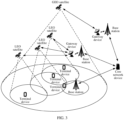
- FIG. 1 is a diagram of an architecture of an NTN network.
- the NTN network includes a first network device, a second network device, and a terminal.
- the first network device may be a satellite (or referred to as a satellite base station), for example, may be an HEO satellite, a GEO satellite, an MEO satellite, an LEO satellite, or a HAPS. This is not limited herein.
- the second network device may be a gateway (gateway) (or referred to as a ground station, an earth station, or a gateway station), and may be configured to connect the second network device to a core network.
- a communication mode of the first network device is a transparent (transparent) mode.
- the first network device serves as a base station for wireless communication
- the second network device may serve as a relay of the first network device and may transparently transmit a signal between the first network device and the terminal.
- the second network device may access the core network through a base station, and then access a data network.
- the communication mode of the first network device may alternatively be a regenerative (regenerative) mode.
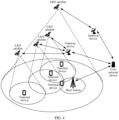
- FIG. 2 is a diagram of another architecture of an NTN network.
- a communication mode of a first network device is a regenerative mode.
- the first network device may serve as a base station for wireless communication.
- the first network device may be an artificial earth satellite, a high-altitude flight vehicle, or the like that serves as a base station for wireless communication, for example, an evolved NodeB (eNB) or a 5G base station (gNB).
- eNB evolved NodeB
- gNB 5G base station
- a second network device may transparently transmit signaling between the first network device and a core network.
- FIG. 1 and FIG. 2 show only one first network device and one second network device.
- an architecture with a plurality of first network devices and/or one second network device may be used based on a requirement.
- Each first network device may serve one or more terminals
- each second network device may correspond to one or more first network devices
- each first network device may correspond to one or more second network devices. This is not specifically limited in this application.
- An NTN communication system provides seamless coverage for a terminal device by deploying all or some functions of an access network device on an NTN device (for example, a high altitude platform or a satellite). Because a non-ground device is less affected by a natural disaster, reliability of the communication system can be improved.
- FIG. 3 shows an example of a possible network architecture.
- an architecture of an NTN device may be a transparent transmission mode.
- FIG. 4 shows an example of another possible network architecture.
- an architecture of an NTN device may be a regenerative mode.
- the NTN device and an access network device on the ground may be interconnected through a common core network.
- the NTN device and an access network device on the ground may implement assistance and interconnection with higher time validity through an interface defined between access network devices.
- An interface between access network devices may be referred to as an Xn interface
- an interface between the access network device and a core network may be referred to as an NG interface.
- the NTN device and the access network device on the ground may communicate and collaborate with each other through the Xn interface or the NG interface.
- a link between the NTN device and a terminal device may be referred to as a service link (service link), and a link between the NTN device and a gateway device may be referred to as a feeder link (feeder link).
- service link service link
- feeder link feeder link
- a network device may be an NTN device that has all or some functions of an access network device, or may also be an access network device on the ground.
- the access network device is an entity configured to transmit or receive a signal on a network side, for example, a gNB.
- the access network device may be a device configured to communicate with a mobile device.
- the access network device may be an AP in a wireless local area network (wireless local area networks, WLAN), an evolved NodeB (evolved NodeB, eNB or eNodeB) in long term evolution (long term evolution, LTE), a relay station, an access point, integrated access and backhaul (integrated access and backhaul, IAB), a vehicle-mounted device, a wearable device, an access network device in a future 5G network, an access network device in a future evolved public land mobile network (public land mobile network, PLMN), a gNodeB (gNB) in an NR system, or the like.
- WLAN wireless local area network
- eNB evolved NodeB
- eNodeB evolved NodeB
- LTE long term evolution
- IAB integrated access and backhaul
- a vehicle-mounted device a wearable device
- an access network device in a future 5G network an access network device in a future evolved public land mobile network (public land mobile network, PLMN), a g
- the access network device serves a cell, and the terminal device communicates with the access network device via a transmission resource (for example, a frequency domain resource or a spectrum resource) used for the cell.
- the access network device in embodiments of this application may be a central unit (central unit, CU) or a distributed unit (distributed unit, DU).
- the access network device may include a CU and a DU.
- the CU and the DU may be physically separated, or may be deployed together. This is not specifically limited in embodiments of this application.
- One CU may be connected to one DU, or a plurality of DUs may share one CU, so that costs can be reduced and network expansion is easy.
- the CU and the DU may be split based on a protocol stack.
- a radio resource control (radio resource control, RRC) layer, a service data adaptation protocol stack (service data adaptation protocol, SDAP) layer, and a packet data convergence protocol (packet data convergence protocol, PDCP) layer are deployed on the CU, and remaining radio link control (radio link control, RLC) layer, media access control (media access control, MAC) layer, and physical layer are deployed on the DU.
- RLC radio link control
- media access control media access control
- MAC media access control
- the foregoing protocol stack splitting manner is not completely limited in embodiments of this application, and there may be another splitting manner.
- the CU is connected to the DU through an F1 interface.
- the CU indicates that a gNB is connected to a core network through an Ng interface.
- the access network device in embodiments of this application may be a central unit control plane (CU-CP) node or a central unit user plane (CU-UP) node, or the access network device may include a CU-CP and a CU-UP.
- the CU-CP is responsible for functions of a control plane, and mainly includes RRC and PDCP-C.
- the PDCP-C is mainly responsible for data encryption and decryption, integrity protection, data transmission, and the like on the control plane.
- the CU-UP is responsible for functions of a user plane, and mainly includes SDAP and PDCP-U.
- the SDAP is mainly responsible for processing data of the core network and mapping a flow to a bearer.
- the PDCP-U is mainly responsible for encryption and decryption, integrity protection, header compression, sequence number maintenance, data transmission, and the like on a data plane.
- the CU-CP and the CU-UP are connected through an E1 interface.
- the CU-CP indicates that the gNB is connected to the core network through the Ng interface, and the CU-CP is connected to the DU through F1-C (control plane).
- the CU-UP is connected to the DU through F1-U (user plane).
- the PDCP-C is alternatively on the CU-UP.
- the access network device mentioned in embodiments of this application may be a device including a CU or a DU, a device including a CU and a DU, or a device including a control plane CU node (CU-CP node), a user plane CU node (CU-UP node), and a DU node.
- the access network device may be another apparatus that provides a wireless communication function for the terminal device.
- a specific technology and a specific device form that are used for the access network device are not limited in embodiments of this application.
- an apparatus that provides a wireless communication function for a terminal device is referred to as an access network device.
- the terminal device may be a device capable of receiving scheduling and indication information of the access network device (or the NTN device).
- the terminal device may be a device that provides users with voice and/or data connectivity, a handheld device having a wireless connection function, or another processing device connected to a wireless modem.
- the terminal device may communicate with one or more core networks or the internet through a radio access network (for example, a radio access network, RAN).
- the terminal device may be a mobile terminal device, such as a mobile telephone (or referred to as a "cellular" phone, or a mobile phone (mobile phone)), a computer, or a data card, for example, may be a portable, pocket-sized, handheld, computer built-in, or vehicle-mounted mobile apparatus, and exchange language and/or data with the radio access network.
- the terminal device is a device such as a personal communication service (personal communications service, PCS) telephone, a cordless telephone, a session initiation protocol (SIP) telephone, a wireless local loop (wireless local loop, WLL) station, a personal digital assistant (personal digital assistant, PDA), a tablet computer (Pad), and a computer having a wireless transceiver function.
- PCS personal communications service
- SIP session initiation protocol
- WLL wireless local loop
- PDA personal digital assistant
- PDA tablet computer
- Pad tablet computer having a wireless transceiver function
- the terminal device may also be referred to as a system, a subscriber unit (subscriber unit), a subscriber station (subscriber station), a mobile station (mobile station, MS), a remote station (remote station), an access point (access point, AP), a remote terminal device (remote terminal), an access terminal device (access terminal), a user terminal device (user terminal), a user agent (user agent), a subscriber station (subscriber station, SS), a customer premises equipment (customer premises equipment, CPE), a terminal (terminal), a UE, a mobile terminal (mobile terminal, MT), or the like.
- the terminal device may be a wearable device, a terminal device in a next-generation communication system, for example, a 5G network, a terminal device in a future evolved PLMN network, or a terminal device in a new radio (new radio, NR) communication system.
- the terminal device may further be a terminal that communicates with the NTN device.
- embodiments of this application may be further applied to another future-oriented communication technology, for example, a 6th generation mobile communication network (6G).
- 6G 6th generation mobile communication network
- Network architectures and service scenarios described in this application are intended to describe the technical solutions in this application more clearly, and do not constitute a limitation on the technical solutions provided in this application.
- a person of ordinary skill in the art may know that: With evolution of the network architecture and emergence of a new service scenario, the technical solutions provided in this application are also applicable to similar technical problems.
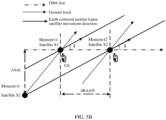
- ⁇ E is an angular velocity of the earth's rotation
- n 0 is a satellite motion angular velocity
- ⁇ is an orbital perturbation amount of right ascension of the ascending node
- ⁇ 0 is an orbital perturbation amount of a mean anomaly
- ⁇ is an orbital perturbation amount of an argument of perigee
- ⁇ RAAN is the right ascension of the ascending node difference between satellite orbits
- ⁇ AoL is the argument of latitude difference between the satellites.
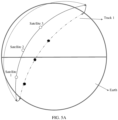
- a satellite S1 and a satellite S2 are two satellites of a ground co-track satellite chain.
- the satellite S1 and the satellite S2 are both on independent orbits, and have a same orbital inclination angle I.
- the satellite S1 passes from south to north through the equator, a ground projection of the satellite S1 is exactly located at a UE, and the satellite S2 is at south of the equator and west of the satellite S1.
- the satellite S2 also passes through a same point on the equator at a moment t2, and a ground projection of the satellite S2 is also exactly located at the UE (it is assumed that the UE is stationary relative to the earth).
- the satellite S1 and the satellite S2 run on different orbits, their moving tracks on the ground are the same.
- Ground co-track constellation It is a constellation including one or more ground co-track satellite chains.
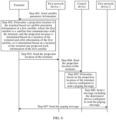
- FIG. 6 is a flowchart of a paging method according to an embodiment of this application.
- a first network device for example, the first network device in FIG. 1 and FIG. 2 , or may be referred to as a satellite base station
- a control device which may be understood as a device in a core network or another management network element device
- FIG. 1 and FIG. 2 are merely used as examples in embodiments of this application. A scenario is not limited thereto.
- the first network device 1 and the first network device 2 are first network devices that serve the terminal in different time periods. There may be a plurality of first network devices 2, and the first network device 2 may include the first network device 1. This is not specifically limited herein.
- Data may be transmitted between the first network device and the control device through a second network device. To be specific, the first network device may first transmit the data to the second network device, and then transmit the data to the control device through the second network device. Details are not described in FIG. 6 .
- Step 601 The first network device 1 sends satellite parameter information, where the satellite parameter information includes at least one of the following: satellite ephemeris information, satellite orbit information, and satellite projected track information.
- the terminal receives the satellite parameter information.
- the first network device 1 may be understood as a satellite base station, or a satellite that can currently exchange data with the terminal device.
- the satellite ephemeris information may include parameters such as time, coordinates, an orientation, and a speed of a satellite.
- the parameters such as the time, the coordinates, the orientation, and the speed of the satellite are determined based on a mathematical relationship between six orbit parameters of Kepler's law.
- the satellite ephemeris information can be used to accurately calculate, predict, describe, and track running states such as time, a location, and a speed of the satellite or a flying body, and determine the satellite orbit information.
- the satellite orbit information is information that can reflect a satellite orbit, and may include information indicating an orbit inclination angle, an orbit altitude, and the like of the satellite.
- the satellite projected track information may be understood as a ground projected track of a satellite on a ground co-track satellite chain.
- the first network device may send, to the terminal, satellite parameter information of a plurality of satellites managed by the first network device; or send, to the terminal, satellite parameter information obtained by the first network device from another first network device.
- the first network device may alternatively send parameter information of some satellites to the terminal.
- the some satellites are satellites that are determined by the first network device based on a location of the terminal and that may have information transmission with the terminal.
- Step 602 The terminal determines a projection location of the terminal based on satellite parameter information of a first satellite, where the first satellite is a satellite that communicates with the terminal, and the projection location is determined based on the location of the terminal and orbit information of the first satellite, or is determined based on the location of the terminal and projected track information of the first satellite.
- That the first satellite is a satellite that communicates with the terminal may be understood as a satellite that is exchanging data with the terminal, a satellite from which the terminal is listening to a message, or the like. This is not specifically limited herein in this application.
- the projection location of the terminal may be determined based on the orbit information of the first satellite and the location of the terminal. For example, a projection of the terminal on an orbit of the first satellite is used as the projection location of the terminal. If the first satellite is a satellite on the ground co-track satellite chain, the projection location of the terminal may be determined based on the projected track information of the first satellite and the location of the terminal. For example, a point that is on a projected track of the first satellite and that is closest to the terminal is used as the projection location.
- Example descriptions are merely provided herein, and a manner of determining the projection location of the terminal is not limited.
- the projection location may indicate an orbit point that is on the orbit of the first satellite and that is closest to the terminal or a point in a neighborhood range of the orbit point;
- the satellite projection location of the first satellite belonging to the ground co-track satellite chain may indicate a track point that is on the projected track of the first satellite and that is closest to the terminal or a point in a neighborhood range of the track point; or the projection location may indicate a track segment that is on the projected track of the first satellite and that is closest to the terminal or a track segment in a neighborhood range of the track segment.
- the projection location is indicated by using the orbit point on the orbit of the first satellite and the track point or the track segment on the ground projected track of the first satellite, so that a property that satellites on the ground co-track satellite chain have a same ground projected track can be fully used.
- the track point may be indicated by using one of the following parameters: a distance from a reference point moving along a first projected track to the track point, a satellite motion phase difference accumulated from the reference point moving along the first projected track to the track point, and a latitude difference accumulated from the reference point moving along the first projected track to the track point, where the reference point is any point on the first projected track, and the first projected track is a ground projected track of any ground co-track satellite chain.
- the track point may be indicated by using a distance from the reference point to the track point.
- the reference point is any point on a projected track 1, and a location 10 meters away from the reference point is the track point. In this case, the track point may be indicated by using 10 meters.
- the track point may be indicated by using a satellite motion phase difference accumulated from the reference point to the track point.
- the reference point is any point on a projected track 1, a satellite ground projection is located at the reference point at a moment 1, and the satellite ground projection is located at the track point after X moments.
- the track point may be indicated by using a satellite motion phase difference accumulated from the moment 1 to a moment X+1.
- the track point may be indicated by using a latitude difference accumulated from the reference point to the track point.
- the reference point is any point on a projected track 1
- the reference point is located at latitude 1
- Y latitude needs to be passed from the reference point to the track point.
- the track point may be indicated by using the Y latitude. Based on this, the track point may be indicated by using different parameters.
- a track location accumulated from the reference point to the track point may be defined as a ground projected track address (ground track address, GTA).
- GTA ground track address
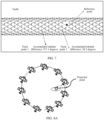
- a track point shown by a pentagram is a reference point, if an accumulated latitude difference of a satellite moving along a ground projected track is used as a location difference, a GTA of a track point 1 is a latitude difference accumulated from the reference point to the track point 1, that is, 38.3 degrees, and a GTA of a track point 2 is a latitude difference accumulated from the reference point to the track point 2, that is, 517.1 degrees.
- each satellite track may be distinguished by using a track number, and a track location may be jointly described by using the track number and a location on the track.
- a track segment of the ground track may be defined as a ground track address range (ground track address range, GTAR), and may be generally described by using GTAs at two ends of the track, for example, a track segment GTAR between the track point 1 and the track point 2 is (GTA0, GTA1).
- the following provides descriptions based on different cases of the first satellite.
- Case 1 The first satellite is not located on the ground co-track satellite chain.
- the projection location may be indicated by using an angle between the orbit point closest to the terminal and any point on the orbit of the first satellite relative to the earth center.
- orbit information may be described by using an altitude, an inclination angle, and an angle of an ascending node
- a projection location is described by using an angle offset range (for example, an opening angle between a current satellite location and an ascending node relative to the earth center) compared with an agreed reference point on the orbit.
- an orbit and a projection location may be determined based on the following parameters: RAAN: Q, an orbit altitude: h, an orbit inclination angle: ⁇ , and the projection location: an opening angle between the foregoing orbit and a reference point (an ascending node) relative to the earth center.
- RAAN Q
- an orbit altitude: h an orbit inclination angle: ⁇
- the projection location an opening angle between the foregoing orbit and a reference point (an ascending node) relative to the earth center.
- FIG. 8A an orbit point of a terminal on a satellite orbit is A, and an opening angle between the orbit point and an ascending node relative to the earth center indicates a projection location.
- Case 2 The first satellite is located on the ground co-track satellite chain.
- the projection location of the terminal may be indicated by using an offset between the track point or the track segment closest to the terminal and the reference point.
- orbit information may be described by using an orbital altitude, an orbital inclination angle, reference RAAN, and a reference AoL
- a projection location may be described by using an offset range compared with an agreed reference point (an intersection point between an orbit and the equator, or start RAAN and a start AoL) on a projected track.
- an orbit and a projection location may be determined based on the following parameters: RAAN: ⁇ 0, a reference location AoL: ph0, an orbit altitude: h, an orbit inclination angle: ⁇ , and the projection location: a phase offset between a satellite moving track and the reference location. As shown in FIG.
- a track point that is on a ground co-track satellite track and that is closest to a terminal is a track point B, and an offset between the track point B and a reference point is PH1.
- a projection location may be indicated by using PH1, or may be indicated by using a GTA of the track point B.
- Step 603 The terminal sends the projection location of the terminal to the first network device 1.
- the first network device 1 receives the projection location of the terminal.
- Step 604 The first network device 1 sends the projection location of the terminal to the control device.
- control device receives the projection location of the terminal.
- Step 605 The control device determines, based on the projection location of the terminal, a device configured to send a paging message.
- step 604 may not be performed, and step 605 may alternatively be performed by the first network device 1. This is not specifically limited herein in this application.
- the control device determines, through calculation based on the projection location that is of the terminal and that is sent by the terminal and the satellite parameter information, a satellite that can send a paging message to the terminal. Specifically, the control device infers, based on the projection location of the terminal, a potential area of the terminal on the ground, and further determines, when the paging message is sent, a set of satellites that can cover the area, where the set of satellites includes the satellite that sends the paging message. After the satellite that sends the paging message is determined, the satellite that sends the paging message may send the paging message to the terminal, or may choose, based on a current communication status of the satellite, whether to send the paging message.
- a satellite 2 that is determined by the control device and that is for sending the paging message currently performs a large quantity of services, occupies a large quantity of resources, and cannot allocate more resources to send the paging message.
- the satellite 2 that sends the paging message may not send the paging message.
- Example descriptions are merely provided herein, and the satellite that sends the paging message is not specifically limited.
- Step 606 The control device sends a message including the determined device configured to send the paging message.
- the device that is determined by the control device and that is configured to send the paging message is the first network device 2. Possibly, the first network device 2 is specifically determined based on the projection location of the terminal.
- the first network device 2 receives the message.
- Step 607 The first network device 2 sends the paging message.
- the terminal may receive the paging message.
- the projection location of the terminal is determined based on the satellite orbit information or the satellite projected track information, and the satellite that sends the paging message is determined based on the projection location of the terminal, so that paging efficiency can be improved, and paging overheads can be reduced.
- a first network device may notify a terminal of satellite parameter information via RRC signaling, broadcast signaling, or the like.
- the satellite parameter information includes a satellite orbit index, and satellite orbit information or satellite projected track information may be determined based on the satellite orbit index.
- a satellite orbit index 1 indicates that a satellite orbit type is a conventional satellite orbit, and indicates a satellite orbit parameter set 1 (an orbit altitude h1, an orbit inclination angle ⁇ 1, RAAN ⁇ 1, and the like).
- a satellite orbit index 3 indicates that a satellite orbit type is a ground co-track satellite, and indicates a satellite orbit parameter set 3 (an orbital altitude h3, an orbital inclination angle ⁇ 3, a RAAN ⁇ 3, a reference location ph3, and the like). Examples are not enumerated herein.
- the first network device delivers the satellite parameter information including the satellite orbit index to the terminal.
- the terminal reports the satellite orbit index of the first satellite, and does not need to report all orbit parameter information or projected track information of the first satellite, so that an amount of data reported by the terminal can be reduced, and signaling overheads can be further reduced.
- the satellite parameter information in step 601 further includes a paging number, and the paging number corresponds to a satellite orbit interval or a satellite track interval.
- the terminal when reporting the projection location of the terminal, the terminal may further include the paging number corresponding to the first satellite. The paging number of the first satellite is reported, so that a data reporting amount can be reduced, and signaling overheads can be reduced.
- Case 1 The first satellite is not located on the ground co-track satellite chain.
- a satellite orbit interval of the first satellite is indicated by using an interval between opening angles between any two orbit points on the orbit of the first satellite and any point on the orbit of the first satellite relative to the earth center.
- orbit information may be described by using an altitude, an inclination angle, and an angle of an ascending node, and any point on an orbit may be described by using an angle offset range (for example, an opening angle between a current satellite location and the ascending node relative to the earth center) compared with an agreed reference point on the orbit.
- an orbit and any point on the orbit may be determined based on the following parameters: RAAN: Q, an orbit altitude: h, an orbit inclination angle: ⁇ , and any point on the orbit: an opening angle between the foregoing orbit and a reference point (an ascending node) relative to the earth center.
- RAAN Q
- an orbit altitude h
- an orbit inclination angle ⁇
- any point on the orbit an opening angle between the foregoing orbit and a reference point (an ascending node) relative to the earth center.
- orbit points of a satellite orbit are A, B, and C
- opening angles between the orbit points and an ascending node relative to the earth center are respectively PH0, PH1, and PH2, where PH0 and PH1 indicate an orbit interval 1, and PH1 and PH2 indicate an orbit interval 2.
- Case 2 The first satellite is located on the ground co-track satellite chain.
- a satellite track interval of the first satellite is indicated by using an interval between offsets between two points on the projected track of the first satellite and the reference point.
- orbit information may be described by using an orbital altitude, an orbital inclination angle, reference RAAN, and a reference AoL
- any point on a projected track may be described by using an offset range compared with an agreed reference point (an intersection point between an orbit and the equator, or start RAAN and a start AoL) on the projected track.
- an orbit and a track point may be determined based on the following parameters: reference location RAAN: ⁇ 0, a reference location AoL: ph0, an orbit altitude: h, an orbit inclination angle: ⁇ , and a location of the track point: a phase offset between a satellite moving track and the reference location indicates the track point.
- offsets between track points A, B, C, and D on a ground co-track satellite track and a reference point on a projected track are respectively PH10, PH11, PH12, and PH13, where PH10 and PH11 indicate a track interval 1, and PH12 and PH13 indicate a track interval 2.
- a track segment GTAR is used for indication.
- a GTA of a track point A is GTA1
- a GTA of a track point B is GTA2
- a GTA of a track point C is a GTA3
- a network device may notify a terminal of satellite parameter information via RRC signaling, broadcast signaling, or the like.
- the satellite parameter information includes a paging number, and satellite orbit information or satellite projected track information may be determined based on the paging number.
- a paging number 1 indicates that a satellite orbit type is a conventional satellite orbit, and indicates a satellite orbit interval set 1 (an orbit altitude h1, an orbit inclination angle ⁇ 1, a paging interval [ph0 ph1], and the like).
- a paging number 3 indicates that a satellite orbit type is a ground co-track satellite, and indicates a satellite track interval parameter set 3 (an orbital altitude h3, an orbital inclination angle ⁇ 3, RAAN ⁇ 1, a reference location ph1, a paging interval [ph11 ph22], and the like). Examples are not enumerated herein and example descriptions are merely provided.
- the network device 1 delivers the satellite parameter information including the paging number to the terminal. When reporting projection location information of the terminal, the terminal reports the paging number of the first satellite, and does not need to report all orbit parameter information or projected track information of the first satellite, so that an amount of data reported by the terminal can be reduced, and signaling overheads can be further reduced.
- Table 2 Paging number Orbit type Descriptions of an orbital region 1 Conventional orbit Parameter set 1 (h1, ⁇ 1, [ph0 ph1]) 2 Conventional orbit Parameter set 2 (h2, ⁇ 2, [ph1 ph2]) 3 Ground co-track satellite Parameter set 3 ( ⁇ 1, h3, ⁇ 3, [ph11 ph12]) 4 Ground co-track satellite Parameter set 4 ( ⁇ 2, h4, ⁇ 4, [ph21 ph22]) ... ...
- the network device 1 may indicate a satellite in a range of the satellite orbit interval (or the satellite track interval) to send a paging message, or may indicate a satellite in an interval slightly larger or smaller than the satellite orbit interval (or the satellite track interval) to send a paging message. This is not specifically limited herein in this application.
- the network device may indicate a satellite in the satellite orbit interval [ph0 ph1] to send a paging message, may indicate a satellite in an interval smaller than [ph0 ph1] to send a paging message, or may indicate a satellite in an interval greater than [ph0 ph1] to send a paging message.
- Example descriptions are merely provided herein in this application, and a satellite that sends paging is not specifically limited.
- a UE may camp on a cell served by a plurality of satellites, in other words, the terminal listens to paging messages of the plurality of satellites, and the plurality of satellites send the paging messages.
- the UE may report projection locations on orbits of a plurality of satellites on which the UE intends to camp, so that the first network device, the core network, or the another management network element knows satellites that need to be selected to send paging messages.
- the terminal finds that an existing satellite is not suitable for camping on (for example, due to deterioration of channel quality)
- the terminal sends an update message to notify the network device, to request to deactivate some projection locations.
- the terminal may further initiates an update message due to discovery of an appropriate satellite, to notify the network device that a new projection location needs to be activated, and further notify the first network device that a satellite for sending a paging message may be added.
- the terminal when both the location of the terminal and the projection location of the terminal are changed, the terminal triggers an update message, where the update message includes a projection location of the terminal on an orbit of a second satellite or a location that is of the terminal and that is on a ground projected track of the second satellite.
- the change of the location of the terminal may be understood as that the location of the terminal is changed, but the location of the terminal is changed, and the projection location of the terminal may not be changed.
- the terminal may further receive the paging message of the paging satellite.
- the location of the terminal is changed, and the projection location of the terminal is also changed, it is determined that a satellite on which the terminal intends to camp is changed, so that a change message needs to be triggered.
- the network device performs calculation based on a new projection location that is of the terminal and that is reported by the terminal, to re-determine a paging satellite that needs to send a paging message.
- the network device may use satellites 4 and 5 as paging satellites to send paging messages. In this manner, the paging satellites determined by the network device based on the triggered update information are more accurate.
- the change of the projection location includes at least one of the following cases: orbit information or projected track information of the satellite on which the terminal camps is changed, a change of an orbit point of the terminal on the orbit of the first satellite exceeds a preset orbit point threshold (for example, the orbit point threshold is A, a previous orbit point of the terminal on the orbit of the first satellite is S1, but a current orbit point is changed to S2, and an absolute value difference between S2 and S1 is greater than A), a track point of the terminal on the projected track of the first satellite exceeds a preset track point threshold (for example, the track point threshold is B, a previous track point of the terminal on the projected track of the first satellite is G1, but a current track point is changed to G2, and an absolute value difference between G2 and G1 is greater than B), and a track segment of the terminal on the projected track of the first satellite exceeds a preset track segment threshold (for example, the track segment threshold is C, and a previous track segment of the terminal on the projected track of the first satellite is G1 to
- the change of the orbit information or the projected track information of the satellite on which the terminal camps includes the following cases:
- the projection location of the terminal is changed from an orbit point A on an orbit A (the orbit of the first satellite) to an orbit point B on an orbit B (the orbit of the second satellite).
- the orbit A and the orbit B are not the same.
- the projection location of the terminal is changed from a track point A (the projected track of the first satellite) to a track point B (the projected track of the second satellite).
- the projected track of the first satellite is different from the projected track of the second satellite, in other words, the first satellite and the second satellite belong to different ground co-track satellite chains; or the projected track of the first satellite is the same as the projected track of the second satellite, but the track point A and the track point B belong to different track segments.
- the projection location of the terminal is changed from an orbit point on the orbit A (the orbit of the first satellite) to the track point B (the projected track of the second satellite).
- the first satellite is a conventional orbit satellite
- the second satellite is a satellite on a ground co-track satellite chain.
- the projection location of the terminal is changed from the track point A (the projected track of the first satellite) to the orbit point B in the orbit B (the orbit of the second satellite).
- the first satellite is a satellite on a ground co-track satellite chain
- the second satellite is a conventional orbit satellite.
- the second satellite may be understood as a satellite on which the terminal currently intends to camp. This is not specifically limited herein.
- the terminal may send the new projection location of the terminal and satellite parameter information of the second satellite to the network device, or may send the new projection location of the terminal and a satellite orbit index of the second satellite or a paging number corresponding to the second satellite.
- the update message further includes a difference parameter, and the difference parameter is changed satellite orbit information of the second satellite relative to the first satellite or changed satellite projected track information of the second satellite relative to the first satellite.
- the difference parameter is changed satellite orbit information of the second satellite relative to the first satellite or changed satellite projected track information of the second satellite relative to the first satellite.
- the difference parameter is an ascending node angle (for example, when the first satellite and the second satellite are conventional orbital satellites and have a same inclination angle and a same altitude, only an orbit parameter RAAN may be reported, and a remaining part is determined by the first network device, the core network, or the another network management device based on a satellite parameter of the first satellite) or an orbit number of the second satellite;
- the difference parameter includes a location of the reference point (for example, when the first satellite and the second satellite are satellites in the same ground co-track satellite chain, only the location of the reference point may be reported, and a remaining part is determined by the first network device, the core network, or the another network management device based on a satellite parameter of the first satellite); and when the second satellite and the first satellite belong to different ground co-track satellite chains
- the first network device may notify the terminal of a smallest satellite that needs to listen to paging.
- a satellite when covering different areas, a satellite sends different paging area codes (tracking area codes, TACs).
- TACs tracking area codes
- a satellite When covering a plurality of TAC areas, a satellite sends a plurality of TACs.
- a network broadcasts a plurality of TACs and increases or decreases the TACs in real time, to prevent the UE from triggering the TAU only due to movement of the satellite.
- the TAC is one-to-one correspond to a cell served by the satellite. This is similar to a paging number.
- a satellite base station needs to send the plurality of TACs, and there is redundancy in to-be-sent information.
- this application further provides another paging method.
- the paging method may be performed through interaction between a terminal, a first network device 1, a control device, and a first network device 2.
- the following steps are performed.
- Step 1001 The terminal determines a satellite orbit identifier of a device that is to listen to a message.
- one satellite orbit identifier may correspond to a plurality of satellites, namely, a set of satellites.
- the satellite orbit identifier corresponds to the satellite orbit identifier in this application.
- the correspondence may be agreed upon in advance by the first network device and the terminal, or may be sent to the terminal in advance after being determined by the first network device. The correspondence is prestored in the terminal, the first network device, the control device, and the like.
- Step 1002 The terminal sends the satellite orbit identifier determined by the terminal to the first network device 1.
- the first network device 1 receives the satellite orbit identifier determined by the terminal.
- Step 1003 The first network device 1 sends, to the control device, the satellite orbit identifier determined by the terminal.
- control device receives the satellite orbit identifier determined by the terminal.
- Step 1004 The control device determines, based on the satellite orbit identifier determined by the terminal, a device (namely, the first network device 2) configured to send a paging message.
- step 1003 may not be performed, and step 1004 may alternatively be performed by the first network device 1. This is not specifically limited herein in this application.
- Step 1005 The control device sends a message including the determined device configured to send the paging message.
- Step 1006 The first network device 2 sends the paging message.
- the terminal receives the paging message from the first network device 2.
- the terminal sends an update message, where the update message is triggered based on a change of a location of the terminal and a change of the satellite orbit identifier stored in the terminal. For example, if a UE reselects from a satellite on one orbit to a satellite on another orbit, and finds that a satellite orbit identifier is not in a list recorded by the UE, the UE sends an update message, and the UE records a new satellite orbit identifier.
- the UE determines, based on a first message, an orbit of a satellite that needs to listen to a paging message, further determines a set of satellites that need to listen to the paging message, and listens to the paging message.
- the UE may determine, by receiving a TAC sent by the satellite, whether the satellite belongs to the set of satellites that need to listen to the message, to determine whether to further receive the paging information.
- the terminal when a terminal can communicate with satellites on a plurality of orbits, the terminal may negotiate with a network device, only a satellite on one or more of the satellite orbits sends a paging message, and the terminal receives only the paging message from the satellite on the one or more satellite orbits, to reduce network side overheads, reduce receiving power consumption of the terminal, and reduces data processing complexity.
- a paging update is triggered by a projection location change
- this solution a paging update is triggered based on a change of a satellite orbit on which a terminal needs to camp, data processing complexity is significantly reduced.
- each device may include a corresponding hardware structure and/or software module for performing each function.
- a person skilled in the art should be easily aware that, in embodiments of this application, the units and algorithm steps in the examples described with reference to embodiments disclosed in this specification can be implemented by hardware or a combination of hardware and computer software. Whether a function is performed by hardware or hardware driven by computer software depends on particular applications and design constraints of the technical solutions. A person skilled in the art may use different methods to implement the described functions for each particular application, but it should not be considered that the implementation goes beyond the scope of this application.
- the device may be divided into functional units based on the foregoing method examples.
- each functional unit may be obtained through division based on a corresponding function, or two or more functions may be integrated into one unit.
- the integrated unit may be implemented in a form of hardware, or may be implemented in a form of a software functional unit.
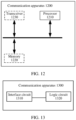
- FIG. 11 is a possible example block diagram of a communication apparatus according to an embodiment of this application.
- the communication apparatus 1100 may include a processing unit 1101 and a transceiver unit 1102.
- the processing unit 1101 is configured to control and manage an action of the communication apparatus 1100.
- the transceiver unit 1102 is configured to support communication between the communication apparatus 1100 and another device.
- the transceiver unit 1102 may include a receiving unit and/or a sending unit, which are respectively configured to perform a receiving operation and a sending operation.
- the communication apparatus 1100 may further include a storage unit, configured to store program code and/or data of the communication apparatus 1100.
- the transceiver unit may be referred to as an input/output unit, a communication unit, or the like, and the transceiver unit may be a transceiver.
- the processing unit may be a processor.
- the transceiver unit may be an input/output interface, an input/output circuit, an input/output pin, or the like, and may also be referred to as an interface, a communication interface, an interface circuit, or the like; and the processing unit may be a processor, a processing circuit, a logic circuit, or the like.
- the apparatus may be the foregoing terminal, network device, satellite, or the like.
- the transceiver unit 1102 is configured to: receive satellite parameter information, where the satellite parameter information includes at least one of the following: satellite ephemeris information, satellite orbit information, and satellite projected track information; send a projection location of a terminal, where the projection location is determined by the processing unit 1101 based on satellite parameter information of a first satellite; and the projection location is determined based on a location of the terminal and orbit information of the first satellite, or is determined based on a location of the terminal and projected track information of the first satellite, where the first satellite is a satellite that communicates with the terminal; and receive a paging message.
- satellite parameter information includes at least one of the following: satellite ephemeris information, satellite orbit information, and satellite projected track information
- send a projection location of a terminal where the projection location is determined by the processing unit 1101 based on satellite parameter information of a first satellite
- the projection location is determined based on a location of the terminal and orbit information of the first satellite, or is determined based on a location of the terminal and projected
- the transceiver unit 1102 is configured to: send satellite parameter information, where the satellite parameter information includes at least one of the following: satellite ephemeris information, satellite orbit information, and satellite projected track information; and receive a projection location of the terminal, where the projection location is determined based on satellite parameter information of a first satellite; and the projection location is determined based on a location of the terminal and orbit information of the first satellite, or is determined based on a location of the terminal and projected track information of the first satellite, where the first satellite is a satellite that communicates with the terminal; and the processing unit 1101 is configured to determine, based on the projected location, a device configured to send a paging message.
- the satellite parameter information includes at least one of the following: satellite ephemeris information, satellite orbit information, and satellite projected track information
- receive a projection location of the terminal where the projection location is determined based on satellite parameter information of a first satellite
- the projection location is determined based on a location of the terminal and orbit information of the first satellite, or is determined
- the projection location indicates an orbit point that is on an orbit of the first satellite and that is closest to the terminal or a point in a neighborhood range of the orbit point; the projection location indicates a track point that is on a projected track of the first satellite and that is closest to the terminal or a point in a neighborhood range of the track point; or the projection location indicates a track segment that is on a projected track of the first satellite and that is closest to the terminal or a track segment in a neighborhood range of the track point.
- the first satellite is a satellite belonging to a ground co-track satellite chain, and the ground co-track satellite chain includes a plurality of satellites that have a same ground projected track.
- the track point is indicated by using one of the following parameters: a distance from a reference point moving along a first projected track to the track point, a satellite motion phase difference accumulated from the reference point moving along the first projected track to the track point, and a latitude difference accumulated from the reference point moving along the first projected track to the track point, where the reference point is any point on the first projected track, and the first projected track is a ground projected track of any ground co-track satellite chain.
- the projection location when the first satellite is not located on the ground co-track satellite chain, the projection location is indicated by using an opening angle between the orbit point closest to the terminal and any point on the orbit of the first satellite relative to the earth center; or when the first satellite is located on the ground co-track satellite chain, the projection location is indicated by using an offset between the track point or the track segment closest to the terminal and the reference point.
- the satellite parameter information further includes a satellite orbit index, and the satellite orbit index indicates the satellite orbit information or the satellite projected track information.
- the projection location further includes a satellite orbit index of the first satellite.
- the satellite parameter information further includes a paging number, and the paging number corresponds to a satellite orbit interval or a satellite track interval.
- a satellite orbit interval of the first satellite is indicated by using an interval between opening angles between any two orbit points on the orbit of the first satellite and any point on the orbit of the first satellite relative to the earth center; or when the first satellite is located on the ground co-track satellite chain, a satellite track interval of the first satellite is indicated by using an interval between offsets between two points on the projected track of the first satellite and the reference point.
- the projection location further includes a paging number corresponding to the first satellite.
- the satellite orbit information includes at least one of the following: a satellite orbit type, satellite altitude information, satellite inclination angle information, satellite ascending node angle information, and satellite perigee angle information.
- the transceiver unit 1102 is configured to send an update message, where the update message includes a projection location of the terminal on an orbit of a second satellite or a location that is of the terminal and that is on a ground projected track of the second satellite.
- the transceiver unit 1102 is configured to receive an update message, where the update message includes a projection location of the terminal on an orbit of a second satellite or a location that is of the terminal and that is on a ground projected track of the second satellite.
- the update message is triggered based on a change of the location of the terminal and a change of the projection location.
- the change of the projection location includes at least one of the following cases: orbit information or projected track information of the satellite on which the terminal camps is changed, a change of an orbit point of the terminal on the orbit of the first satellite exceeds a preset orbit point threshold, a track point of the terminal on the projected track of the first satellite exceeds a preset track point threshold, and a track segment of the terminal on the projected track of the first satellite exceeds a preset track segment threshold.
- the update message further includes a difference parameter, and the difference parameter is changed satellite orbit information of the second satellite relative to the first satellite or changed satellite projected track information of the second satellite relative to the first satellite.
- the difference parameter is an ascending node angle or an orbit number of the second satellite
- the satellites on the ground co-track satellite chain have a same inclination angle and are located on discrete orbits.
- FIG. 12 shows a communication apparatus 1200 further provided in this application.
- the communication apparatus 1200 may be a chip or a chip system.
- the communication apparatus may be located in the device in any one of the foregoing method embodiments, for example, the satellite, the network device, or the terminal, to perform an action corresponding to the device.
- the chip system may include a chip, or may include a chip and another discrete component.
- the communication apparatus 1200 includes a processor 1210.
- the processor 1210 is configured to execute a computer program stored in a memory 1220, to implement actions of the devices in any one of the foregoing method embodiments.
- the communication apparatus 1200 may further include the memory 1220, configured to store the computer program.
- the memory 1220 is coupled to the processor 1210.
- the coupling is an indirect coupling or a communication connection between apparatuses, units, or modules, may be in an electrical form, a mechanical from, or another form, and is used for information exchange between the apparatuses, the units, or the modules.
- the memory 1220 and the processor 1210 are integrated together.
- processors 1210 There may be one or more processors 1210 and one or more memories 1220. This is not limited.
- the communication apparatus 1200 may include or may not include a transceiver 1230.
- a dashed box is used as an example in the figure.
- the communication apparatus 1200 may exchange information with another device through the transceiver 1230.
- the transceiver 1230 may be a circuit, a bus, a transceiver, or any other apparatus that may be configured to exchange information.
- the communication apparatus 1200 may be the first satellite or the ground device in the foregoing method embodiments.
- a specific connection medium between the transceiver 1230, the processor 1210, and the memory 1220 is not limited in this embodiment of this application.
- the memory 1220, the processor 1210, and the transceiver 1230 are connected through a bus in FIG. 12 .
- the bus is represented by using a thick line in FIG. 12 .
- a manner of a connection between other components is merely an example for description, and is not limited thereto.
- the bus may be classified into an address bus, a data bus, a control bus, and the like. For ease of representation, only one bold line indicates the bus in FIG. 12 , but this does not mean that there is only one bus or only one type of bus.
- the processor may be a general purpose processor, a digital signal processor, an application-specific integrated circuit, a field programmable gate array or another programmable logic device, a discrete gate or transistor logic device, or a discrete hardware component, and may implement or execute the methods, steps, and logical block diagrams disclosed in embodiments of this application.
- the general purpose processor may be a microprocessor or any conventional processor or the like. The steps of the method disclosed with reference to embodiments of this application may be directly performed by a hardware processor, or may be performed by a combination of hardware in the processor and a software module.
- the memory may be a nonvolatile memory, such as a hard disk drive (hard disk drive, HDD) or a solid-state drive (solid-state drive, SSD), or may be a volatile memory (volatile memory), such as a random access memory (random access memory, RAM).
- the memory may be any other medium that can be configured to carry or store expected program code in a form of an instruction or a data structure and that can be accessed by a computer, but is not limited thereto.
- the memory in this embodiment of this application may be a circuit or any other apparatus that can implement a storage function, and is configured to store a computer program, program instructions, and/or data.
- An embodiment of this application further provides another communication apparatus 1300, including an interface circuit 1310 and a logic circuit 1320.
- the interface circuit 1310 may be understood as an input/output interface, and may be configured to perform sending and receiving steps of each device in any one of the foregoing method embodiments.
- the logic circuit 1320 may be configured to run code or instructions to perform the method performed by each device in any one of the foregoing embodiments. Details are not described again.
- an embodiment of this application further provides a computer-readable storage medium.
- the computer-readable storage medium stores instructions. When the instructions are executed, the method performed by each device in any one of the foregoing method embodiments is implemented.
- the computer-readable storage medium may include any medium that can store program code, such as a USB flash drive, a removable hard disk drive, a read-only memory, a random access memory, a magnetic disk, or an optical disc.
- an embodiment of this application provides a communication system.
- the communication system includes the satellite, the terminal, and the network device mentioned in any one of the foregoing method embodiments, and the satellite, the terminal, and the network device may be configured to perform the method performed by each device in any one of the foregoing method embodiments.
- this application may be provided as a method, a system, or a computer program product. Therefore, this application may use a form of hardware only embodiments, software only embodiments, or embodiments with a combination of software and hardware. In addition, this application may use a form of a computer program product that is implemented on one or more computer-usable storage media (including but not limited to a magnetic disk memory, a compact disc read-only memory (compact disc read-only memory, CD-ROM), an optical memory, and the like) that include computer-usable program code.
- a computer-usable storage media including but not limited to a magnetic disk memory, a compact disc read-only memory (compact disc read-only memory, CD-ROM), an optical memory, and the like.
- These computer program instructions may be provided for a general-purpose computer, a dedicated computer, an embedded processor, or a processor of another programmable data processing apparatus to generate a machine, so that the instructions executed by a computer or the processor of any other programmable data processing apparatus generate an apparatus for implementing a specific function in one or more procedures in the flowcharts and/or in one or more blocks in the block diagrams.
- these computer program instructions may be stored in a computer-readable memory that can instruct the computer or the another programmable data processing apparatus to work in a specific manner, so that the instructions stored in the computer-readable memory generate an artifact that includes an instruction apparatus.
- the instruction apparatus implements a specified function in one or more processes in the flowcharts and/or in one or more blocks in the block diagrams.
- These computer program instructions may alternatively be loaded onto a computer or another programmable data processing apparatus, so that a series of operation steps are performed on the computer or another programmable apparatus to generate computer-implemented processing. Therefore, the instructions executed on the computer or another programmable apparatus provide steps for implementing a specific function in one or more procedures in the flowcharts and/or in one or more blocks in the block diagrams.
Landscapes
- Engineering & Computer Science (AREA)
- Computer Networks & Wireless Communication (AREA)
- Signal Processing (AREA)
- Physics & Mathematics (AREA)
- Astronomy & Astrophysics (AREA)
- General Physics & Mathematics (AREA)
- Mobile Radio Communication Systems (AREA)
Applications Claiming Priority (2)
| Application Number | Priority Date | Filing Date | Title |
|---|---|---|---|
| CN202210674457.5A CN117279088A (zh) | 2022-06-14 | 2022-06-14 | 一种寻呼方法及通信装置 |
| PCT/CN2023/093202 WO2023241271A1 (zh) | 2022-06-14 | 2023-05-10 | 一种寻呼方法及通信装置 |
Publications (2)
| Publication Number | Publication Date |
|---|---|
| EP4529311A1 true EP4529311A1 (de) | 2025-03-26 |
| EP4529311A4 EP4529311A4 (de) | 2025-08-20 |
Family
ID=89192105
Family Applications (1)
| Application Number | Title | Priority Date | Filing Date |
|---|---|---|---|
| EP23822841.5A Pending EP4529311A4 (de) | 2022-06-14 | 2023-05-10 | Funkrufverfahren und kommunikationsvorrichtung |
Country Status (3)
| Country | Link |
|---|---|
| EP (1) | EP4529311A4 (de) |
| CN (1) | CN117279088A (de) |
| WO (1) | WO2023241271A1 (de) |
Families Citing this family (3)
| Publication number | Priority date | Publication date | Assignee | Title |
|---|---|---|---|---|
| CN120358556A (zh) * | 2024-01-22 | 2025-07-22 | 华为技术有限公司 | 一种通信方法及装置 |
| CN120658299A (zh) * | 2024-03-14 | 2025-09-16 | 华为技术有限公司 | 一种通信方法、系统及相关装置 |
| CN121643858A (zh) * | 2024-09-06 | 2026-03-10 | 华为技术有限公司 | 通信方法及相关装置 |
Family Cites Families (9)
| Publication number | Priority date | Publication date | Assignee | Title |
|---|---|---|---|---|
| CN111194080B (zh) * | 2018-11-14 | 2021-07-09 | 大唐移动通信设备有限公司 | 一种寻呼方法、定位信息发送方法、核心网节点及基站 |
| EP3909327A1 (de) * | 2019-01-11 | 2021-11-17 | Telefonaktiebolaget LM Ericsson (publ) | Vorrichtung und verfahren zur erleichterung der indexbasierten positionierung in einem nicht-terrestrischen netzwerk |
| CN113596995A (zh) * | 2020-04-30 | 2021-11-02 | 大唐移动通信设备有限公司 | 一种随机接入方法及设备 |
| US12108293B2 (en) * | 2020-08-06 | 2024-10-01 | Qualcomm Incorporated | Switching satellites in fixed radio cell |
| WO2022081531A1 (en) * | 2020-10-12 | 2022-04-21 | Intel Corporation | Device location determination in 5g non-terrestrial networks |
| CN114494408A (zh) * | 2020-10-26 | 2022-05-13 | 华为技术有限公司 | 寻星方法及装置 |
| CN113098589B (zh) * | 2021-04-08 | 2022-02-01 | 广州爱浦路网络技术有限公司 | 对卫星终端的寻呼方法、核心网、计算机装置和存储介质 |
| CN113242085B (zh) * | 2021-05-13 | 2022-06-03 | 重庆邮电大学 | 一种低轨卫星网络的终端位置管理方法 |
| CN113328784B (zh) * | 2021-05-27 | 2022-02-01 | 广州爱浦路网络技术有限公司 | 基于5g核心网的低轨卫星的寻呼方法、系统、装置及介质 |
-
2022
- 2022-06-14 CN CN202210674457.5A patent/CN117279088A/zh active Pending
-
2023
- 2023-05-10 EP EP23822841.5A patent/EP4529311A4/de active Pending
- 2023-05-10 WO PCT/CN2023/093202 patent/WO2023241271A1/zh not_active Ceased
Also Published As
| Publication number | Publication date |
|---|---|
| WO2023241271A9 (zh) | 2024-01-25 |
| CN117279088A (zh) | 2023-12-22 |
| EP4529311A4 (de) | 2025-08-20 |
| WO2023241271A1 (zh) | 2023-12-21 |
Similar Documents
| Publication | Publication Date | Title |
|---|---|---|
| US20250044459A1 (en) | Handover method and apparatus in satellite communications | |
| EP4529311A1 (de) | Funkrufverfahren und kommunikationsvorrichtung | |
| US12356262B2 (en) | Cell handover method, electronic device, and storage medium | |
| US12328617B2 (en) | Method and apparatus for wireless communication | |
| CN114557064B (zh) | 一种通信方法及装置 | |
| US20250112688A1 (en) | Inter-satellite link construction method and communication apparatus | |
| EP4529280A1 (de) | Satellitennetzwerk-routingverfahren und kommunikationsvorrichtung | |
| US20250344120A1 (en) | Mobility management method and communication apparatus | |
| WO2023102717A1 (zh) | 通信方法及通信装置 | |
| WO2022227079A1 (zh) | 无线通信方法、终端设备、网络设备及存储介质 | |
| Yun et al. | Main features of 5G new radio for non-terrestrial networks | |
| WO2022061928A1 (zh) | 一种网络选择方法、电子设备及存储介质 | |
| US20240080786A1 (en) | Wireless communication method, terminal device, and network device | |
| CN121753276A (zh) | 用于定位的方法、终端设备和网络设备 | |
| WO2023131088A1 (zh) | 一种信息传输方法、装置及介质 | |
| US20250039834A1 (en) | Communication method and communications apparatus | |
| US20250016736A1 (en) | Wireless communication method and communications apparatus | |
| US20240381189A1 (en) | Wireless communication method and apparatus | |
| WO2025241978A1 (zh) | 一种通信方法及相关装置 | |
| WO2024040393A1 (zh) | 无线通信的方法、终端设备、接入网设备和核心网设备 | |
| WO2025223273A1 (zh) | 一种通信方法及相关装置 | |
| WO2025156960A1 (zh) | 一种通信方法及装置 | |
| CN120456155A (zh) | 通信方法及装置 | |
| CN121690311A (zh) | 一种通信方法及装置 | |
| CN120417012A (zh) | 一种用于无线通信的节点中的方法以及装置 |
Legal Events
| Date | Code | Title | Description |
|---|---|---|---|
| STAA | Information on the status of an ep patent application or granted ep patent |
Free format text: STATUS: THE INTERNATIONAL PUBLICATION HAS BEEN MADE |
|
| PUAI | Public reference made under article 153(3) epc to a published international application that has entered the european phase |
Free format text: ORIGINAL CODE: 0009012 |
|
| STAA | Information on the status of an ep patent application or granted ep patent |
Free format text: STATUS: REQUEST FOR EXAMINATION WAS MADE |
|
| 17P | Request for examination filed |
Effective date: 20241219 |
|
| AK | Designated contracting states |
Kind code of ref document: A1 Designated state(s): AL AT BE BG CH CY CZ DE DK EE ES FI FR GB GR HR HU IE IS IT LI LT LU LV MC ME MK MT NL NO PL PT RO RS SE SI SK SM TR |
|
| A4 | Supplementary search report drawn up and despatched |
Effective date: 20250722 |
|
| RIC1 | Information provided on ipc code assigned before grant |
Ipc: H04W 68/00 20090101AFI20250716BHEP Ipc: H04W 64/00 20090101ALI20250716BHEP Ipc: H04W 84/06 20090101ALI20250716BHEP Ipc: H04W 68/02 20090101ALI20250716BHEP |
|
| DAV | Request for validation of the european patent (deleted) | ||
| DAX | Request for extension of the european patent (deleted) |