EP4524290A1 - Porous catalyst with controlled electric field for electrochemical chlorine generation reaction in extremely low salt condition, and porous catalyst electrode using same - Google Patents
Porous catalyst with controlled electric field for electrochemical chlorine generation reaction in extremely low salt condition, and porous catalyst electrode using same Download PDFInfo
- Publication number
- EP4524290A1 EP4524290A1 EP23803868.1A EP23803868A EP4524290A1 EP 4524290 A1 EP4524290 A1 EP 4524290A1 EP 23803868 A EP23803868 A EP 23803868A EP 4524290 A1 EP4524290 A1 EP 4524290A1
- Authority
- EP
- European Patent Office
- Prior art keywords
- porous catalyst
- catalyst
- porous
- electrode
- platinum
- Prior art date
- Legal status (The legal status is an assumption and is not a legal conclusion. Google has not performed a legal analysis and makes no representation as to the accuracy of the status listed.)
- Pending
Links
Images


Classifications
-
- C—CHEMISTRY; METALLURGY
- C25—ELECTROLYTIC OR ELECTROPHORETIC PROCESSES; APPARATUS THEREFOR
- C25B—ELECTROLYTIC OR ELECTROPHORETIC PROCESSES FOR THE PRODUCTION OF COMPOUNDS OR NON-METALS; APPARATUS THEREFOR
- C25B11/00—Electrodes; Manufacture thereof not otherwise provided for
- C25B11/04—Electrodes; Manufacture thereof not otherwise provided for characterised by the material
- C25B11/051—Electrodes formed of electrocatalysts on a substrate or carrier
- C25B11/073—Electrodes formed of electrocatalysts on a substrate or carrier characterised by the electrocatalyst material
- C25B11/075—Electrodes formed of electrocatalysts on a substrate or carrier characterised by the electrocatalyst material consisting of a single catalytic element or catalytic compound
- C25B11/081—Electrodes formed of electrocatalysts on a substrate or carrier characterised by the electrocatalyst material consisting of a single catalytic element or catalytic compound the element being a noble metal
-
- C—CHEMISTRY; METALLURGY
- C25—ELECTROLYTIC OR ELECTROPHORETIC PROCESSES; APPARATUS THEREFOR
- C25B—ELECTROLYTIC OR ELECTROPHORETIC PROCESSES FOR THE PRODUCTION OF COMPOUNDS OR NON-METALS; APPARATUS THEREFOR
- C25B11/00—Electrodes; Manufacture thereof not otherwise provided for
- C25B11/04—Electrodes; Manufacture thereof not otherwise provided for characterised by the material
- C25B11/051—Electrodes formed of electrocatalysts on a substrate or carrier
- C25B11/073—Electrodes formed of electrocatalysts on a substrate or carrier characterised by the electrocatalyst material
- C25B11/075—Electrodes formed of electrocatalysts on a substrate or carrier characterised by the electrocatalyst material consisting of a single catalytic element or catalytic compound
-
- C—CHEMISTRY; METALLURGY
- C25—ELECTROLYTIC OR ELECTROPHORETIC PROCESSES; APPARATUS THEREFOR
- C25B—ELECTROLYTIC OR ELECTROPHORETIC PROCESSES FOR THE PRODUCTION OF COMPOUNDS OR NON-METALS; APPARATUS THEREFOR
- C25B1/00—Electrolytic production of inorganic compounds or non-metals
- C25B1/01—Products
- C25B1/24—Halogens or compounds thereof
- C25B1/26—Chlorine; Compounds thereof
-
- C—CHEMISTRY; METALLURGY
- C25—ELECTROLYTIC OR ELECTROPHORETIC PROCESSES; APPARATUS THEREFOR
- C25B—ELECTROLYTIC OR ELECTROPHORETIC PROCESSES FOR THE PRODUCTION OF COMPOUNDS OR NON-METALS; APPARATUS THEREFOR
- C25B11/00—Electrodes; Manufacture thereof not otherwise provided for
- C25B11/02—Electrodes; Manufacture thereof not otherwise provided for characterised by shape or form
- C25B11/03—Electrodes; Manufacture thereof not otherwise provided for characterised by shape or form perforated or foraminous
- C25B11/031—Porous electrodes
-
- C—CHEMISTRY; METALLURGY
- C25—ELECTROLYTIC OR ELECTROPHORETIC PROCESSES; APPARATUS THEREFOR
- C25B—ELECTROLYTIC OR ELECTROPHORETIC PROCESSES FOR THE PRODUCTION OF COMPOUNDS OR NON-METALS; APPARATUS THEREFOR
- C25B11/00—Electrodes; Manufacture thereof not otherwise provided for
- C25B11/04—Electrodes; Manufacture thereof not otherwise provided for characterised by the material
- C25B11/051—Electrodes formed of electrocatalysts on a substrate or carrier
- C25B11/052—Electrodes comprising one or more electrocatalytic coatings on a substrate
-
- C—CHEMISTRY; METALLURGY
- C25—ELECTROLYTIC OR ELECTROPHORETIC PROCESSES; APPARATUS THEREFOR
- C25B—ELECTROLYTIC OR ELECTROPHORETIC PROCESSES FOR THE PRODUCTION OF COMPOUNDS OR NON-METALS; APPARATUS THEREFOR
- C25B11/00—Electrodes; Manufacture thereof not otherwise provided for
- C25B11/04—Electrodes; Manufacture thereof not otherwise provided for characterised by the material
- C25B11/051—Electrodes formed of electrocatalysts on a substrate or carrier
- C25B11/055—Electrodes formed of electrocatalysts on a substrate or carrier characterised by the substrate or carrier material
- C25B11/057—Electrodes formed of electrocatalysts on a substrate or carrier characterised by the substrate or carrier material consisting of a single element or compound
- C25B11/061—Metal or alloy
-
- C—CHEMISTRY; METALLURGY
- C25—ELECTROLYTIC OR ELECTROPHORETIC PROCESSES; APPARATUS THEREFOR
- C25B—ELECTROLYTIC OR ELECTROPHORETIC PROCESSES FOR THE PRODUCTION OF COMPOUNDS OR NON-METALS; APPARATUS THEREFOR
- C25B11/00—Electrodes; Manufacture thereof not otherwise provided for
- C25B11/04—Electrodes; Manufacture thereof not otherwise provided for characterised by the material
- C25B11/051—Electrodes formed of electrocatalysts on a substrate or carrier
- C25B11/055—Electrodes formed of electrocatalysts on a substrate or carrier characterised by the substrate or carrier material
- C25B11/057—Electrodes formed of electrocatalysts on a substrate or carrier characterised by the substrate or carrier material consisting of a single element or compound
- C25B11/061—Metal or alloy
- C25B11/063—Valve metal, e.g. titanium
-
- C—CHEMISTRY; METALLURGY
- C25—ELECTROLYTIC OR ELECTROPHORETIC PROCESSES; APPARATUS THEREFOR
- C25B—ELECTROLYTIC OR ELECTROPHORETIC PROCESSES FOR THE PRODUCTION OF COMPOUNDS OR NON-METALS; APPARATUS THEREFOR
- C25B11/00—Electrodes; Manufacture thereof not otherwise provided for
- C25B11/04—Electrodes; Manufacture thereof not otherwise provided for characterised by the material
- C25B11/051—Electrodes formed of electrocatalysts on a substrate or carrier
- C25B11/055—Electrodes formed of electrocatalysts on a substrate or carrier characterised by the substrate or carrier material
- C25B11/057—Electrodes formed of electrocatalysts on a substrate or carrier characterised by the substrate or carrier material consisting of a single element or compound
- C25B11/067—Inorganic compound e.g. ITO, silica or titania
-
- C—CHEMISTRY; METALLURGY
- C25—ELECTROLYTIC OR ELECTROPHORETIC PROCESSES; APPARATUS THEREFOR
- C25B—ELECTROLYTIC OR ELECTROPHORETIC PROCESSES FOR THE PRODUCTION OF COMPOUNDS OR NON-METALS; APPARATUS THEREFOR
- C25B11/00—Electrodes; Manufacture thereof not otherwise provided for
- C25B11/04—Electrodes; Manufacture thereof not otherwise provided for characterised by the material
- C25B11/051—Electrodes formed of electrocatalysts on a substrate or carrier
- C25B11/055—Electrodes formed of electrocatalysts on a substrate or carrier characterised by the substrate or carrier material
- C25B11/069—Electrodes formed of electrocatalysts on a substrate or carrier characterised by the substrate or carrier material consisting of at least one single element and at least one compound; consisting of two or more compounds
-
- C—CHEMISTRY; METALLURGY
- C25—ELECTROLYTIC OR ELECTROPHORETIC PROCESSES; APPARATUS THEREFOR
- C25B—ELECTROLYTIC OR ELECTROPHORETIC PROCESSES FOR THE PRODUCTION OF COMPOUNDS OR NON-METALS; APPARATUS THEREFOR
- C25B11/00—Electrodes; Manufacture thereof not otherwise provided for
- C25B11/04—Electrodes; Manufacture thereof not otherwise provided for characterised by the material
- C25B11/051—Electrodes formed of electrocatalysts on a substrate or carrier
- C25B11/073—Electrodes formed of electrocatalysts on a substrate or carrier characterised by the electrocatalyst material
- C25B11/091—Electrodes formed of electrocatalysts on a substrate or carrier characterised by the electrocatalyst material consisting of at least one catalytic element and at least one catalytic compound; consisting of two or more catalytic elements or catalytic compounds
- C25B11/093—Electrodes formed of electrocatalysts on a substrate or carrier characterised by the electrocatalyst material consisting of at least one catalytic element and at least one catalytic compound; consisting of two or more catalytic elements or catalytic compounds at least one noble metal or noble metal oxide and at least one non-noble metal oxide
Definitions
- the present disclosure relates to a porous catalyst for electrochemical chlorine generation reaction under an extremely low salt condition and a porous catalyst electrode using the same.
- Hypochlorous acid and sodium hypochlorite generated by electrolysis are excellent substances with sterilizing power, organic matter decomposition ability, bleaching, etc. Since they are almost harmless to the human body, they are widely used for sterilizing ship ballast water, restaurants and food materials, swimming pools, medical care, livestock, etc. In addition, they may be obtained by electrolyzing salt water or tap water. Since such hypochlorous acid or sodium hypochlorite may be easily obtained by electrolysis using an insoluble electrode, the electrolysis scheme is widely used.
- a method of improving the life of the electrode by coating an electrode base with platinum or a platinum-group metal compound is mainly used.
- a certain amount or greater of expensive platinum-group metal compound should be used and a uniform coating layer should be formed via multiple coatings.
- reduced economic feasibility occurs due to the use of the significant amount of Expensive material.
- a purpose of the present disclosure is to provide a novel catalyst for electrochemical chlorine generation under an extremely low salt condition and a catalyst electrode using the same.
- a purpose of the present disclosure is to provide a novel catalyst having a reduced used amount of an expensive catalyst material and a catalyst electrode using the same.
- a purpose of the present disclosure is to provide a novel catalyst that has excellent chlorine generation efficiency under an extremely low salt condition even when the used amount of Expensive catalyst material is reduced, and a catalyst electrode using the same.
- the porous catalyst according to the present disclosure has excellent electrochemical chlorine generation effect under an extremely low salt condition.
- a mono-atomic or sub-nanometer-sized platinum-group metal-based catalyst included in the catalyst of the present disclosure has high atomic utilization efficiency compared to a bulk metal catalyst, so that high chlorine generation efficiency may be obtained with a small amount of metal.
- the catalyst electrode of the present disclosure not only may suggest a novel composition of the catalyst but also may exhibit high chlorine generation efficiency under an extremely low salt condition via control of the overall shape of the electrode.
- FIG. 1 is a SEM photograph showing a porous catalyst according to the present disclosure.
- the porous catalyst according to the present disclosure has a structure in which a platinum-group metal catalyst is supported on a porous support including a conductive metal oxide.
- the porous catalyst of the present disclosure has the structure as described above, it has excellent chlorine generation efficiency, especially under an extremely low salt condition smaller than 1 mM.
- the catalyst of the present disclosure since the catalyst of the present disclosure has the structure as described above, it may stably generate chlorine under an extremely low salt condition even when using a very small amount of expensive catalyst material. Therefore, the catalyst of the present disclosure may improve economic efficiency and exhibit an effect equivalent to or superior to that of a conventional catalyst using a large amount of a platinum-group metal.
- the conductive metal oxide may include oxides of various metals such as niobium (Nb), tin (Sn), manganese (Mn), zirconium (Zr), molybdenum (Mo), ruthenium (Ru), osmium (Os), rhodium (Rh), palladium (Pd), tantalum (Ta), titanium (Ti), and cobalt (Co).
- the conductive metal oxide may preferably include tin oxide, niobium oxide, or a mixture thereof.
- the platinum-group metal catalyst may include platinum (Pt), iridium (Ir), ruthenium (Ru), osmium (Os), rhodium (Rh), and palladium (Pd) as a platinum-group metal.
- the platinum-group metal catalyst may include platinum, iridium, or a mixture thereof.
- the porous catalyst of the present disclosure may contain the platinum-group metal catalyst at 0.3 atomic % or smaller based on 100 atomic % of the porous catalyst.
- the porous catalyst of the present disclosure may have a composition of a following Chemical Formula 1.
- Chemical Formula 1 Ir a Pt b Sn c Nb d Ti e O f (a and b satisfy 0 ⁇ a ⁇ 0.3, 0 ⁇ b ⁇ 0.3, and 0 ⁇ a+b ⁇ 0.3, 0.7 ⁇ c+d+e ⁇ 0.95, and f is 2).
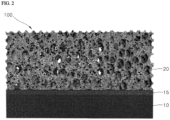
- FIG. 2 is a cross-sectional view schematically showing a porous catalyst electrode 100 of the present disclosure.
- the porous catalyst electrode 100 of the present disclosure includes an electrode base 10; and a porous catalyst coating layer 20 formed on at least a portion of a top surface of the electrode base, wherein the porous catalyst coating layer 20 has a structure in which a metal catalyst including at least one of platinum and iridium is supported on a porous support including a conductive metal oxide. Accordingly, the electrode of the present disclosure has excellent chlorine generation efficiency under an extremely low salt condition smaller than 1 mM.
- the conductive metal oxide may include oxides of various metals such as niobium (Nb), tin (Sn), manganese (Mn), zirconium (Zr), molybdenum (Mo), ruthenium (Ru), osmium (Os), rhodium (Rh), palladium (Pd), tantalum (Ta), titanium (Ti), and cobalt (Co).
- the conductive metal oxide may preferably include tin oxide, niobium oxide, or a mixture thereof.
- the platinum-group metal catalyst may include platinum (Pt), iridium (Ir), ruthenium (Ru), osmium (Os), rhodium (Rh), and palladium (Pd) as a platinum-group metal.
- the platinum-group metal catalyst may include platinum, iridium, or a mixture thereof.
- the porous catalyst of the present disclosure may contain the platinum-group metal catalyst at 0.3 atomic % or smaller based on 100 atomic % of the porous catalyst.
- the porous catalyst of the present disclosure may have a composition of a following Chemical Formula 1.
- Chemical Formula 1 Ir a Pt b Sn c Nb d Ti e O f (a and b satisfy 0 ⁇ a ⁇ 0.3, 0 ⁇ b ⁇ 0.3, and 0 ⁇ a+b ⁇ 0.3, 0.7 ⁇ c+d+e ⁇ 0.95, and f is 2).
- the conductive metal oxide support included in the porous catalyst electrode of the present disclosure may be synthesized using a thermal decomposition method or a hydrothermal synthesis method of a metal precursor.
- a catalyst structure in which a platinum-group metal catalyst is stabilized in a conductive metal oxide framework may be realized using polystyrene beads having a size of about 100 nm or smaller.
- the structure of the porous network may be controlled by changing a content ratio of the noble metal precursor and the polystyrene beads.
- the surface shape of the porous structure changes depending on the content ratio of the noble metal precursor and the polystyrene beads.
- the porous network structure formed in the above manner may easily increase a total catalyst surface area of the electrode.
- the stabilized metal and/or metal oxide catalyst may be present in a sub-nanometer size within the porous catalyst.
- the porous catalyst electrode of the present disclosure may have a Faradaic efficiency of 4.5% or greater, preferably 6% or greater, for the chlorine generation reaction under an extremely low salt condition where a chlorine concentration is 1 mM or smaller.
- porous catalyst electrode as described above may be applied particularly for the purpose of generating chlorine under an extremely low salt condition such as tap water, and may also be applied to other similar fields.
- a 1 mm thick titanium (Ti) electrode base was cut into a size of 10 ⁇ 63 mm 2 .
- the electrode base was soaked in ethyl alcohol, ultrasonically washed, and then washed with pure water using a brush.
- a washing time was 1 minute per time, and foreign substances that were not removed from a surface of the electrode base were removed using a brush.
- porous electrode catalyst according to an embodiment of the present disclosure may be identified as having a Faradaic efficiency of at least 4.5% or greater under the extremely low salt condition.
Landscapes
- Chemical & Material Sciences (AREA)
- Engineering & Computer Science (AREA)
- Chemical Kinetics & Catalysis (AREA)
- Electrochemistry (AREA)
- Materials Engineering (AREA)
- Metallurgy (AREA)
- Organic Chemistry (AREA)
- Inorganic Chemistry (AREA)
- Catalysts (AREA)
- Electrodes For Compound Or Non-Metal Manufacture (AREA)
Abstract
Description
- The present disclosure relates to a porous catalyst for electrochemical chlorine generation reaction under an extremely low salt condition and a porous catalyst electrode using the same.
- Hypochlorous acid and sodium hypochlorite generated by electrolysis are excellent substances with sterilizing power, organic matter decomposition ability, bleaching, etc. Since they are almost harmless to the human body, they are widely used for sterilizing ship ballast water, restaurants and food materials, swimming pools, medical care, livestock, etc. In addition, they may be obtained by electrolyzing salt water or tap water. Since such hypochlorous acid or sodium hypochlorite may be easily obtained by electrolysis using an insoluble electrode, the electrolysis scheme is widely used.
- A method of improving the life of the electrode by coating an electrode base with platinum or a platinum-group metal compound is mainly used. However, in order to improve the life of the electrode, a certain amount or greater of expensive platinum-group metal compound should be used and a uniform coating layer should be formed via multiple coatings. As a result, reduced economic feasibility occurs due to the use of the significant amount of Expensive material.
- A purpose of the present disclosure is to provide a novel catalyst for electrochemical chlorine generation under an extremely low salt condition and a catalyst electrode using the same.
- Furthermore, a purpose of the present disclosure is to provide a novel catalyst having a reduced used amount of an expensive catalyst material and a catalyst electrode using the same.
- In addition, a purpose of the present disclosure is to provide a novel catalyst that has excellent chlorine generation efficiency under an extremely low salt condition even when the used amount of Expensive catalyst material is reduced, and a catalyst electrode using the same.
- Purposes according to the present disclosure are not limited to the above-mentioned purpose. Other purposes and advantages according to the present disclosure that are not mentioned may be understood based on following descriptions, and may be more clearly understood based on embodiments according to the present disclosure. Further, it will be easily understood that the purposes and advantages according to the present disclosure may be realized using means shown in the claims and combinations thereof.
- A porous catalyst according to the present disclosure has a structure in which a platinum-group metal catalyst is supported on a porous support including a conductive metal oxide, and thus has excellent chlorine generation efficiency, specifically in an extremely low salt condition smaller than 1 mM.
- More specifically, the porous catalyst according to the present disclosure has excellent chlorine generation efficiency in an extremely low salt condition even when the platinum-group metal catalyst is contained in an amount of 0.3 atomic % or smaller based on 100 atomic % of the porous catalyst.
- In addition, the porous catalyst according to the present disclosure may preferably have a composition of a following Chemical Formula 1.
[Chemical formula 1] IraPtbSncNbdTieOf
(a and b satisfy 0≤a≤0.3, 0<b≤0.3, and 0<a+b≤0.3, 0.7≤c+d+e≤0.95, and f is 2). - Furthermore, a porous catalyst electrode according to the present disclosure includes an electrode base and a porous catalyst coating layer formed on at least a portion of an upper surface of the electrode base, wherein the electrode according to the present disclosure has excellent chlorine generation efficiency under an extremely low salt condition smaller than 1 mM due to the porous catalyst coating layer.
- Preferably, an intermediate oxide layer may be included between the electrode base and the porous catalyst coating layer.
- The porous catalyst according to the present disclosure has excellent electrochemical chlorine generation effect under an extremely low salt condition.
- In particular, the porous catalyst of the present disclosure has excellent chlorine generation efficiency under an extremely low salt condition even when using a small amount of the metal catalyst.
- In this regard, a mono-atomic or sub-nanometer-sized platinum-group metal-based catalyst included in the catalyst of the present disclosure has high atomic utilization efficiency compared to a bulk metal catalyst, so that high chlorine generation efficiency may be obtained with a small amount of metal.
- Accordingly, the catalyst electrode of the present disclosure has excellent chlorine generation efficiency under an extremely low salt condition even when the amount of expensive catalyst material used is reduced.
- Furthermore, the catalyst electrode of the present disclosure not only may suggest a novel composition of the catalyst but also may exhibit high chlorine generation efficiency under an extremely low salt condition via control of the overall shape of the electrode.
- In addition to the effects as described above, specific effects of the present disclosure are described together with the specific details for carrying out the disclosure below.
-
-
FIG. 1 is a SEM photograph showing a porous catalyst according to an embodiment of the present disclosure. -
FIG. 2 is a cross-sectional view showing a catalyst electrode according to an embodiment of the present disclosure. -
FIG. 3 is a SEM photograph showing a surface shape of a porous structure based on a content ratio of a precious metal precursor and a polystyrene bead (PS). - The above-mentioned purposes, features, and advantages will be described in detail later with reference to the attached drawings, so that those skilled in the art in the technical field to which the present disclosure belongs may easily practice the technical ideas of the present disclosure. In describing the present disclosure, when it is determined that a detailed description of the publicly known technology related to the present disclosure may unnecessarily obscure the gist of the present disclosure, the detailed description thereof will be omitted. Hereinafter, a preferred embodiment according to the present disclosure will be described in detail with reference to the attached drawings. In the drawings, identical reference numerals are used to indicate identical or similar components.
- As used herein, singular expressions include plural expressions, unless the context clearly dictates otherwise. In the present application, terms such as "composed of" or "include" should not be construed as necessarily including all of various components or steps described herein, and should be interpreted as being able to not including some of the components or the steps and further including additional components or steps.
- Hereinafter, a porous catalyst according to some embodiments of the present disclosure and a porous catalyst electrode using the same are described.
-
FIG. 1 is a SEM photograph showing a porous catalyst according to the present disclosure. Referring toFIG. 1 , the porous catalyst according to the present disclosure has a structure in which a platinum-group metal catalyst is supported on a porous support including a conductive metal oxide. - Since the porous catalyst of the present disclosure has the structure as described above, it has excellent chlorine generation efficiency, especially under an extremely low salt condition smaller than 1 mM.
- In addition, since the catalyst of the present disclosure has the structure as described above, it may stably generate chlorine under an extremely low salt condition even when using a very small amount of expensive catalyst material. Therefore, the catalyst of the present disclosure may improve economic efficiency and exhibit an effect equivalent to or superior to that of a conventional catalyst using a large amount of a platinum-group metal.
- The conductive metal oxide may include oxides of various metals such as niobium (Nb), tin (Sn), manganese (Mn), zirconium (Zr), molybdenum (Mo), ruthenium (Ru), osmium (Os), rhodium (Rh), palladium (Pd), tantalum (Ta), titanium (Ti), and cobalt (Co). However, in accordance with the present disclosure, the conductive metal oxide may preferably include tin oxide, niobium oxide, or a mixture thereof.
- In addition, the platinum-group metal catalyst may include platinum (Pt), iridium (Ir), ruthenium (Ru), osmium (Os), rhodium (Rh), and palladium (Pd) as a platinum-group metal. However, preferably, in accordance with the present disclosure, the platinum-group metal catalyst may include platinum, iridium, or a mixture thereof.
- In particular, the porous catalyst of the present disclosure may contain the platinum-group metal catalyst at 0.3 atomic % or smaller based on 100 atomic % of the porous catalyst.
- Preferably, the porous catalyst of the present disclosure may have a composition of a following Chemical Formula 1.
[Chemical formula 1] IraPtbSncNbdTieOf
(a and b satisfy 0≤a≤0.3, 0≤b≤0.3, and 0<a+b≤0.3, 0.7≤c+d+e≤0.95, and f is 2). - Next, the porous catalyst electrode according to an embodiment of the present disclosure will be described.
-
FIG. 2 is a cross-sectional view schematically showing aporous catalyst electrode 100 of the present disclosure. Referring toFIG. 2 , theporous catalyst electrode 100 of the present disclosure includes anelectrode base 10; and a porouscatalyst coating layer 20 formed on at least a portion of a top surface of the electrode base, wherein the porouscatalyst coating layer 20 has a structure in which a metal catalyst including at least one of platinum and iridium is supported on a porous support including a conductive metal oxide. Accordingly, the electrode of the present disclosure has excellent chlorine generation efficiency under an extremely low salt condition smaller than 1 mM. - As described above, the conductive metal oxide may include oxides of various metals such as niobium (Nb), tin (Sn), manganese (Mn), zirconium (Zr), molybdenum (Mo), ruthenium (Ru), osmium (Os), rhodium (Rh), palladium (Pd), tantalum (Ta), titanium (Ti), and cobalt (Co). However, in accordance with the present disclosure, the conductive metal oxide may preferably include tin oxide, niobium oxide, or a mixture thereof.
- In addition, the platinum-group metal catalyst may include platinum (Pt), iridium (Ir), ruthenium (Ru), osmium (Os), rhodium (Rh), and palladium (Pd) as a platinum-group metal. However, preferably, in accordance with the present disclosure, the platinum-group metal catalyst may include platinum, iridium, or a mixture thereof.
- In particular, the porous catalyst of the present disclosure may contain the platinum-group metal catalyst at 0.3 atomic % or smaller based on 100 atomic % of the porous catalyst.
- Preferably, the porous catalyst of the present disclosure may have a composition of a following
Chemical Formula 1.
[Chemical formula 1] IraPtbSncNbdTieOf
(a and b satisfy 0≤a≤0.3, 0≤b≤0.3, and 0<a+b≤0.3, 0.7≤c+d+e≤0.95, and f is 2). - In this regard, the conductive metal oxide support included in the porous catalyst electrode of the present disclosure may be synthesized using a thermal decomposition method or a hydrothermal synthesis method of a metal precursor.
- In particular, in order to form a porous network structure of the conductive metal oxide, a catalyst structure in which a platinum-group metal catalyst is stabilized in a conductive metal oxide framework may be realized using polystyrene beads having a size of about 100 nm or smaller.
- When preparing the catalyst, the structure of the porous network may be controlled by changing a content ratio of the noble metal precursor and the polystyrene beads.
- Referring to
FIG. 3 , it may be identified that the surface shape of the porous structure changes depending on the content ratio of the noble metal precursor and the polystyrene beads. - The porous network structure formed in the above manner may easily increase a total catalyst surface area of the electrode. The stabilized metal and/or metal oxide catalyst may be present in a sub-nanometer size within the porous catalyst.
- The porous catalyst electrode of the present disclosure may have a Faradaic efficiency of 4.5% or greater, preferably 6% or greater, for the chlorine generation reaction under an extremely low salt condition where a chlorine concentration is 1 mM or smaller.
- The porous catalyst electrode as described above may be applied particularly for the purpose of generating chlorine under an extremely low salt condition such as tap water, and may also be applied to other similar fields.
- Hereinafter, the configuration and the effect of the present disclosure will be described in more detail based on a preferred example of the present disclosure. However, this is presented as a preferred implementation of the present disclosure and cannot be interpreted as limiting the present disclosure in any way.
- Since the contents not described here may be sufficiently technically inferred by a person skilled in the art, the description thereof will be omitted.
- A 1 mm thick titanium (Ti) electrode base was cut into a size of 10×63 mm2. The electrode base was soaked in ethyl alcohol, ultrasonically washed, and then washed with pure water using a brush. In this regard, a washing time was 1 minute per time, and foreign substances that were not removed from a surface of the electrode base were removed using a brush.
- An intermediate layer made of titanium (Ti) oxide was formed on the surface of the electrode base, and then, a catalyst layer having a structure and composition as described in Table 1 as set forth below was prepared thereon.
[Table 1] Atomic ratio of metal elements in catalyst layer Example 1 Pt: 2.5 at%, Ir: 2.5 at%, Sn: 95.0 at% / PS bead-free 5 layers Example 2 Pt: 2.5 at%, Ir: 2.5 at%, Sn: 95.0 at% / PS bead-free 5 layers + PS bead-containing 5 layers Example 3 Pt: 2.5 at%, Ir: 2.5 at%, Sn: 95.0 at% / PS bead-free 5 layers + PS bead-containing 10 layers Example 4 Pt: 15.0 at%, Ir: 15.0 at%, Ti: 63.0 at%, Nb: 7.0 at% Example 5 Pt: 2.5 at%, Ir: 2.5 at%, Sn: 71.3 at%, Ti: 21.4 at%, Nb: 2.4 at% / SnO2:NbTiO2 = 3:1 - The chlorine generation efficiency of each of the catalyst electrodes prepared as above was evaluated under the extremely low salt condition. An electrolyte concentration used for the evaluation was 1 mM or smaller.
[Table 2] Voltage change (V) Faradaic efficiency under extremely low salt condition Example 1 13.2 -> 13.7 4.53% Example 2 12.5 -> 12.8 4.91% Example 3 13.5 -> 13.0 6.04% Example 4 14.0 -> 13.6 6.04% Example 5 13.2 -> 13.7 5.66% - In this way, the porous electrode catalyst according to an embodiment of the present disclosure may be identified as having a Faradaic efficiency of at least 4.5% or greater under the extremely low salt condition.
- Although the present disclosure has been described with reference to the accompanying drawings, the present disclosure is not limited by the embodiments disclosed herein and the drawings, and it is obvious that various modifications may be made by those skilled in the art within the scope of the technical idea of the present disclosure. In addition, although the effects based on the configuration of the present disclosure are not explicitly described and illustrated in the description of the embodiment of the present as disclosure above, it is obvious that predictable effects from the configuration should also be recognized.
Claims (13)
- A porous catalyst for a chlorine generation reaction under an extremely low salt condition smaller than 1 mM,
wherein the porous catalyst has a structure in which a platinum-group metal catalyst is supported on a porous support including a conductive metal oxide. - The porous catalyst of claim 1, wherein the conductive metal oxide includes tin oxide, niobium oxide, or a mixture thereof.
- The porous catalyst of claim 1, wherein the platinum-group metal catalyst includes platinum, iridium, or a mixture thereof.
- The porous catalyst of claim 1, wherein the platinum-group metal catalyst is contained in an amount of 0.3 atomic % or smaller based on 100 atomic % of the porous catalyst.
- The porous catalyst of claim 1, wherein the porous catalyst is represented by a following Chemical Formula 1:
[Chemical Formula 1] IraPtbSncNbdTieOf
where a and b satisfy 0≤a≤0.3, 0≤b≤0.3, and 0<a+b≤0.3, 0.7≤c+d+e≤0.95, and f is 2. - A porous catalyst electrode for a chlorine generation reaction under an extremely low salt condition smaller than 1 mM, the porous catalyst electrode comprising:an electrode base; anda porous catalyst coating layer formed on at least a portion of an upper surface of the electrode base,wherein the porous catalyst coating layer has a structure in which a metal catalyst including at least one of platinum and iridium is supported on a porous support including a conductive metal oxide.
- The porous catalyst electrode of claim 6, wherein the electrode base includes titanium or a titanium alloy.
- The porous catalyst electrode of claim 6, wherein the porous catalyst electrode further comprises an intermediate oxide layer disposed between the electrode base and the porous catalyst coating layer.
- The porous catalyst electrode of claim 8, wherein the intermediate oxide layer includes titanium oxide or titanium alloy oxide.
- The porous catalyst electrode of claim 6, wherein the conductive metal oxide includes tin oxide, niobium oxide, or a mixture thereof.
- The porous catalyst electrode of claim 6, wherein the platinum-group metal catalyst includes platinum, iridium, or a mixture thereof.
- The porous catalyst electrode of claim 6, wherein the platinum-group metal catalyst is contained in an amount of 0.3 atomic % or smaller based on 100 atomic % of the porous catalyst.
- The porous catalyst electrode of claim 6, wherein the porous catalyst is represented by a following Chemical Formula 1:
[Chemical Formula 1] IraPtbSncNbdTieOf
where a and b satisfy 0≤a≤0.3, 0≤5b≤0.3, and 0<a+b≤0.3, 0.7≤c+d+e≤0.95, and f is 2.
Applications Claiming Priority (2)
| Application Number | Priority Date | Filing Date | Title |
|---|---|---|---|
| KR1020220058547A KR102886302B1 (en) | 2022-05-12 | 2022-05-12 | Electric field engineered porous catalyst for electro-chlorination at low-salinity conditions and porous catalyst electrode using same |
| PCT/KR2023/006431 WO2023219445A1 (en) | 2022-05-12 | 2023-05-11 | Porous catalyst with controlled electric field for electrochemical chlorine generation reaction in extremely low salt condition, and porous catalyst electrode using same |
Publications (2)
| Publication Number | Publication Date |
|---|---|
| EP4524290A1 true EP4524290A1 (en) | 2025-03-19 |
| EP4524290A4 EP4524290A4 (en) | 2025-09-17 |
Family
ID=88730762
Family Applications (1)
| Application Number | Title | Priority Date | Filing Date |
|---|---|---|---|
| EP23803868.1A Pending EP4524290A4 (en) | 2022-05-12 | 2023-05-11 | Porous catalyst with controlled electric field for electrochemical chlorine generation reaction under extremely low salt conditions and porous catalyst electrode therewith |
Country Status (4)
| Country | Link |
|---|---|
| US (1) | US20250313972A1 (en) |
| EP (1) | EP4524290A4 (en) |
| KR (1) | KR102886302B1 (en) |
| WO (1) | WO2023219445A1 (en) |
Family Cites Families (9)
| Publication number | Priority date | Publication date | Assignee | Title |
|---|---|---|---|---|
| IL73536A (en) * | 1984-09-13 | 1987-12-20 | Eltech Systems Corp | Composite catalytic material particularly for electrolysis electrodes,its manufacture and its use in electrolysis |
| JP2505563B2 (en) * | 1989-01-30 | 1996-06-12 | 石福金属興業株式会社 | Electrode for electrolysis |
| DE102013202144A1 (en) * | 2013-02-08 | 2014-08-14 | Bayer Materialscience Ag | Electrocatalyst, electrode coating and electrode for the production of chlorine |
| KR101854737B1 (en) * | 2017-04-07 | 2018-05-04 | 서울대학교 산학협력단 | Catalyst and method of producing catalyst |
| JP6588816B2 (en) * | 2015-12-22 | 2019-10-09 | 石福金属興業株式会社 | Chlorine generating electrode |
| KR101812008B1 (en) * | 2016-03-15 | 2017-12-27 | (주)엘켐텍 | An electrolyzer having a porous 3-dimensional mono-polar electrodes, and water treatment method using the electrolyzer having the porous 3-dimensional mono-polar electrodes |
| JP7097042B2 (en) * | 2017-12-27 | 2022-07-07 | 石福金属興業株式会社 | Electrode for chlorine generation |
| IT201800003533A1 (en) * | 2018-03-14 | 2019-09-14 | Industrie De Nora Spa | ELECTRODE FOR ELECTROCHLORATION PROCESSES |
| KR20190129369A (en) * | 2018-05-10 | 2019-11-20 | 엘지전자 주식회사 | Electrode containing carrier and catalyst |
-
2022
- 2022-05-12 KR KR1020220058547A patent/KR102886302B1/en active Active
-
2023
- 2023-05-11 EP EP23803868.1A patent/EP4524290A4/en active Pending
- 2023-05-11 US US18/864,956 patent/US20250313972A1/en active Pending
- 2023-05-11 WO PCT/KR2023/006431 patent/WO2023219445A1/en not_active Ceased
Also Published As
| Publication number | Publication date |
|---|---|
| KR102886302B1 (en) | 2025-11-13 |
| KR102886302B9 (en) | 2026-01-09 |
| EP4524290A4 (en) | 2025-09-17 |
| US20250313972A1 (en) | 2025-10-09 |
| KR20230158885A (en) | 2023-11-21 |
| WO2023219445A1 (en) | 2023-11-16 |
Similar Documents
| Publication | Publication Date | Title |
|---|---|---|
| AU2009315689B2 (en) | Electrode for electrolysis cell | |
| JP5968899B2 (en) | Anode for electrolysis of chlorine | |
| TWI409364B (en) | Cathode for hydrogen generation | |
| JP7814931B2 (en) | Electrodes for electrolytic generation of gases | |
| KR20140013326A (en) | Metal oxide electrode for water electrolysis and manufacturing method thereof | |
| JPS62500459A (en) | Composite catalyst material for electrolytic electrodes and its manufacturing method | |
| JP7330490B2 (en) | Electrodes for ozone generation | |
| US20250313972A1 (en) | Porous catalyst with controlled electric field for electrochemical chlorine generation reaction in extremely low salt condition, and porous catalyst electrode using same | |
| EP4273301B1 (en) | Hypochlorous acid generating electrode | |
| KR102648323B1 (en) | Pt-Ru-Ti catalyst electrode for ballast water electrolysis | |
| JPH0238672B2 (en) | ||
| SU1584752A3 (en) | Method of producing chlorine and sodium hydroxide | |
| EP4636134A1 (en) | Positive electrode for chlorine generation electrolysis | |
| EP4481088A1 (en) | Catalytic anodes and processes for use in electro-chlorination | |
| JPH0238670B2 (en) | ||
| JPH0238671B2 (en) | ||
| RU2789597C2 (en) | Electrode for electrolytic gas extraction | |
| JPS6152384A (en) | Electrode for electrolyzing seawater | |
| KR20240177736A (en) | Catalytic anodes and processes for use in electro-chlorination | |
| EP4522785A2 (en) | Electrode for electrolytic evolution of gas | |
| JP2021530619A (en) | How to improve the performance of nickel electrodes | |
| KR20210129937A (en) | Pyrochlore-type metal oxide based catalytic electrode for electrolysis of ballast water and preparation method thereof | |
| HK1158274B (en) | Electrode for electrolysis cell |
Legal Events
| Date | Code | Title | Description |
|---|---|---|---|
| STAA | Information on the status of an ep patent application or granted ep patent |
Free format text: STATUS: THE INTERNATIONAL PUBLICATION HAS BEEN MADE |
|
| PUAI | Public reference made under article 153(3) epc to a published international application that has entered the european phase |
Free format text: ORIGINAL CODE: 0009012 |
|
| STAA | Information on the status of an ep patent application or granted ep patent |
Free format text: STATUS: REQUEST FOR EXAMINATION WAS MADE |
|
| 17P | Request for examination filed |
Effective date: 20241211 |
|
| AK | Designated contracting states |
Kind code of ref document: A1 Designated state(s): AL AT BE BG CH CY CZ DE DK EE ES FI FR GB GR HR HU IE IS IT LI LT LU LV MC ME MK MT NL NO PL PT RO RS SE SI SK SM TR |
|
| DAV | Request for validation of the european patent (deleted) | ||
| DAX | Request for extension of the european patent (deleted) | ||
| A4 | Supplementary search report drawn up and despatched |
Effective date: 20250819 |
|
| RIC1 | Information provided on ipc code assigned before grant |
Ipc: C25B 11/081 20210101AFI20250812BHEP Ipc: C25B 11/067 20210101ALI20250812BHEP Ipc: C25B 11/061 20210101ALI20250812BHEP Ipc: C25B 11/052 20210101ALI20250812BHEP Ipc: C25B 11/031 20210101ALI20250812BHEP Ipc: C25B 1/26 20060101ALI20250812BHEP Ipc: C25B 11/069 20210101ALI20250812BHEP |