EP4523859A1 - Ausgaberoboter - Google Patents
Ausgaberoboter Download PDFInfo
- Publication number
- EP4523859A1 EP4523859A1 EP24189326.2A EP24189326A EP4523859A1 EP 4523859 A1 EP4523859 A1 EP 4523859A1 EP 24189326 A EP24189326 A EP 24189326A EP 4523859 A1 EP4523859 A1 EP 4523859A1
- Authority
- EP
- European Patent Office
- Prior art keywords
- door
- delivery robot
- storage
- shelf
- link
- Prior art date
- Legal status (The legal status is an assumption and is not a legal conclusion. Google has not performed a legal analysis and makes no representation as to the accuracy of the status listed.)
- Pending
Links
Images










Classifications
-
- B—PERFORMING OPERATIONS; TRANSPORTING
- B25—HAND TOOLS; PORTABLE POWER-DRIVEN TOOLS; MANIPULATORS
- B25J—MANIPULATORS; CHAMBERS PROVIDED WITH MANIPULATION DEVICES
- B25J11/00—Manipulators not otherwise provided for
- B25J11/008—Manipulators for service tasks
-
- E—FIXED CONSTRUCTIONS
- E05—LOCKS; KEYS; WINDOW OR DOOR FITTINGS; SAFES
- E05F—DEVICES FOR MOVING WINGS INTO OPEN OR CLOSED POSITION; CHECKS FOR WINGS; WING FITTINGS NOT OTHERWISE PROVIDED FOR, CONCERNED WITH THE FUNCTIONING OF THE WING
- E05F15/00—Power-operated mechanisms for wings
- E05F15/60—Power-operated mechanisms for wings using electrical actuators
- E05F15/603—Power-operated mechanisms for wings using electrical actuators using rotary electromotors
- E05F15/611—Power-operated mechanisms for wings using electrical actuators using rotary electromotors for swinging wings
- E05F15/63—Power-operated mechanisms for wings using electrical actuators using rotary electromotors for swinging wings operated by swinging arms
-
- A—HUMAN NECESSITIES
- A47—FURNITURE; DOMESTIC ARTICLES OR APPLIANCES; COFFEE MILLS; SPICE MILLS; SUCTION CLEANERS IN GENERAL
- A47B—TABLES; DESKS; OFFICE FURNITURE; CABINETS; DRAWERS; GENERAL DETAILS OF FURNITURE
- A47B96/00—Details of cabinets, racks or shelf units not covered by a single one of groups A47B43/00 - A47B95/00; General details of furniture
- A47B96/02—Shelves
- A47B96/025—Shelves with moving elements, e.g. movable extensions or link elements
-
- B—PERFORMING OPERATIONS; TRANSPORTING
- B25—HAND TOOLS; PORTABLE POWER-DRIVEN TOOLS; MANIPULATORS
- B25J—MANIPULATORS; CHAMBERS PROVIDED WITH MANIPULATION DEVICES
- B25J13/00—Controls for manipulators
- B25J13/08—Controls for manipulators by means of sensing devices, e.g. viewing or touching devices
-
- B—PERFORMING OPERATIONS; TRANSPORTING
- B25—HAND TOOLS; PORTABLE POWER-DRIVEN TOOLS; MANIPULATORS
- B25J—MANIPULATORS; CHAMBERS PROVIDED WITH MANIPULATION DEVICES
- B25J19/00—Accessories fitted to manipulators, e.g. for monitoring, for viewing; Safety devices combined with or specially adapted for use in connection with manipulators
- B25J19/02—Sensing devices
-
- B—PERFORMING OPERATIONS; TRANSPORTING
- B25—HAND TOOLS; PORTABLE POWER-DRIVEN TOOLS; MANIPULATORS
- B25J—MANIPULATORS; CHAMBERS PROVIDED WITH MANIPULATION DEVICES
- B25J5/00—Manipulators mounted on wheels or on carriages
- B25J5/007—Manipulators mounted on wheels or on carriages mounted on wheels
-
- B—PERFORMING OPERATIONS; TRANSPORTING
- B25—HAND TOOLS; PORTABLE POWER-DRIVEN TOOLS; MANIPULATORS
- B25J—MANIPULATORS; CHAMBERS PROVIDED WITH MANIPULATION DEVICES
- B25J9/00—Programme-controlled manipulators
- B25J9/0009—Constructional details, e.g. manipulator supports, bases
-
- B—PERFORMING OPERATIONS; TRANSPORTING
- B60—VEHICLES IN GENERAL
- B60P—VEHICLES ADAPTED FOR LOAD TRANSPORTATION OR TO TRANSPORT, TO CARRY, OR TO COMPRISE SPECIAL LOADS OR OBJECTS
- B60P3/00—Vehicles adapted to transport, to carry or to comprise special loads or objects
- B60P3/007—Vehicles adapted to transport, to carry or to comprise special loads or objects for delivery of small articles, e.g. milk, frozen articles
-
- E—FIXED CONSTRUCTIONS
- E05—LOCKS; KEYS; WINDOW OR DOOR FITTINGS; SAFES
- E05B—LOCKS; ACCESSORIES THEREFOR; HANDCUFFS
- E05B47/00—Operating or controlling locks or other fastening devices by electric or magnetic means
- E05B47/0001—Operating or controlling locks or other fastening devices by electric or magnetic means with electric actuators; Constructional features thereof
-
- E—FIXED CONSTRUCTIONS
- E05—LOCKS; KEYS; WINDOW OR DOOR FITTINGS; SAFES
- E05D—HINGES OR SUSPENSION DEVICES FOR DOORS, WINDOWS OR WINGS
- E05D15/00—Suspension arrangements for wings
- E05D15/40—Suspension arrangements for wings supported on arms movable in vertical planes
- E05D15/46—Suspension arrangements for wings supported on arms movable in vertical planes with two pairs of pivoted arms
-
- E—FIXED CONSTRUCTIONS
- E05—LOCKS; KEYS; WINDOW OR DOOR FITTINGS; SAFES
- E05F—DEVICES FOR MOVING WINGS INTO OPEN OR CLOSED POSITION; CHECKS FOR WINGS; WING FITTINGS NOT OTHERWISE PROVIDED FOR, CONCERNED WITH THE FUNCTIONING OF THE WING
- E05F15/00—Power-operated mechanisms for wings
- E05F15/60—Power-operated mechanisms for wings using electrical actuators
- E05F15/603—Power-operated mechanisms for wings using electrical actuators using rotary electromotors
- E05F15/611—Power-operated mechanisms for wings using electrical actuators using rotary electromotors for swinging wings
- E05F15/627—Power-operated mechanisms for wings using electrical actuators using rotary electromotors for swinging wings operated by flexible elongated pulling elements, e.g. belts, chains or cables
-
- B—PERFORMING OPERATIONS; TRANSPORTING
- B60—VEHICLES IN GENERAL
- B60J—WINDOWS, WINDSCREENS, NON-FIXED ROOFS, DOORS, OR SIMILAR DEVICES FOR VEHICLES; REMOVABLE EXTERNAL PROTECTIVE COVERINGS SPECIALLY ADAPTED FOR VEHICLES
- B60J5/00—Doors
- B60J5/02—Doors arranged at the vehicle front
-
- E—FIXED CONSTRUCTIONS
- E05—LOCKS; KEYS; WINDOW OR DOOR FITTINGS; SAFES
- E05F—DEVICES FOR MOVING WINGS INTO OPEN OR CLOSED POSITION; CHECKS FOR WINGS; WING FITTINGS NOT OTHERWISE PROVIDED FOR, CONCERNED WITH THE FUNCTIONING OF THE WING
- E05F15/00—Power-operated mechanisms for wings
- E05F15/70—Power-operated mechanisms for wings with automatic actuation
-
- E—FIXED CONSTRUCTIONS
- E05—LOCKS; KEYS; WINDOW OR DOOR FITTINGS; SAFES
- E05Y—INDEXING SCHEME ASSOCIATED WITH SUBCLASSES E05D AND E05F, RELATING TO CONSTRUCTION ELEMENTS, ELECTRIC CONTROL, POWER SUPPLY, POWER SIGNAL OR TRANSMISSION, USER INTERFACES, MOUNTING OR COUPLING, DETAILS, ACCESSORIES, AUXILIARY OPERATIONS NOT OTHERWISE PROVIDED FOR, APPLICATION THEREOF
- E05Y2201/00—Constructional elements; Accessories therefor
- E05Y2201/40—Motors; Magnets; Springs; Weights; Accessories therefor
- E05Y2201/43—Motors
Definitions
- the present disclosure relates to a delivery robot equipped with a door that may open and close a body including a storage for storing an item therein.
- Such robot for the daily life is being developed to provide a specific service (e.g., shopping, serving, conversation, cleaning, and the like) in response to a user command.
- a specific service e.g., shopping, serving, conversation, cleaning, and the like
- travel and communication functions are important for the robot for the daily life and the robot for the daily life is difficult to be distributed when a manufacturing cost thereof is too high.
- a delivery robot that may transport food or a small item.
- a dish or a delivery item may be placed on a shelf disposed in the robot, and the robot may transport the dish or the delivery item to a customer or a service provider.
- the robot may be used in a limited space such as a restaurant, but the delivery robot that is used in a hotel or that has to move a predetermined distance may move to a location where a manager is not nearby.
- the delivery robot with a long travel distance must move such that the item does not fall from the shelf, so that there is a need for the delivery robot that takes safety into account, such as detecting a surrounding obstacle when operating unmanned.
- the present disclosure is to provide a delivery robot with a door that may open and close a body including a storage for storing an item therein.
- a delivery robot including a body housing including a storage defined therein and a body opening defined in a front surface thereof, and a door that operates in a closed state to cover the body opening or an open state to open the body opening, wherein the door includes a door panel that covers the body opening at the front surface of the body housing in the closed state and slides in a lateral direction of the body housing in the open state, a first door link having a first end pivotably coupled to the door panel and a second end pivotably coupled to the body housing, and a motor that provides a pivoting force to the first door link, wherein the door panel has different angles in the open state and the closed state.
- the door panel may include a first edge located at one side of the body opening in the closed state and moving to the other side of the body opening in the open state, and the first end of the first door link may be coupled to the first edge.
- the first end of the first door link may be bent in a direction of the first edge of the door panel.
- the second door link may include a bent portion bent in a U-shape such that the first end and the second end face the same direction.
- the door panel may include a front door portion located at one surface of the body housing and a side door portion curved laterally from the one surface, and the first end of the second door link may be coupled to and located between the front door portion and the side door portion.
- the second end of the second door link may be pivotably coupled to the body housing adjacent to an end of the body opening.
- the second door link may include a pair of second door links disposed at an upper side and a lower side of the door panel, respectively.
- the delivery robot may further include a middle shelf partitioning the storage into an upper storage section and a lower storage section and detachable from the body housing, the door may include an upper door that opens and closes the upper storage section based on the middle shelf, and a lower door that opens and closes the lower storage section based on the middle shelf, and one of the pair of second door links coupled to the door panel may be located in a lateral direction of the middle shelf.
- the delivery robot may further include a first pulley connected to the motor, a second pulley connected to the first door link, and a flat belt forming a closed curve surrounding the first pulley and the second pulley.
- the door may include a sensing protrusion protruding from one side of an outer circumferential surface of the second pulley, a closing detection sensor in contact with the sensing protrusion when the door panel is closed, and an opening detection sensor in contact with the sensing protrusion when the door panel is open.
- the first door link may pivot in a first pivot direction and switch the door panel from the closed state to the open state
- the door may include a locking lever located in the first pivot direction of the first door link in the closed state, and a locking motor that removes the locking lever from a pivoting range of the first door link when switching to the open state, and the locking lever may be removable from the pivoting range of the first door link when pressed manually.
- the door may include four doors arranged 2x2 in a vertical direction and a left and right direction, a door located on a left side and a door located on a right side may operate in symmetrical directions, and the delivery robot may include a controller that selectively operates the four doors based on a partitioned shape of the storage inside the body housing.
- the delivery robot in the present disclosure may have the door that may open and close the storage, and may prevent the door from opening via the locking device when moving, thereby safely delivering the item.
- the delivery robot in the present disclosure may safely open and close the door in the limited space by moving the pivoting range thereof along the outer surface of the body when the door is opened.
- the link that operates the door of the delivery robot in the present disclosure has an excellent aesthetic appearance by minimizing exposure to the outside and does not interfere with other members.
- the delivery robot in the present disclosure may partition the inside of the storage as needed and increase the utilization of the internal space via the plurality of doors that may be opened and closed selectively.
- the delivery robot in the present disclosure may detect whether the shelf and the partition have been attached or detached to selectively operate the plurality of doors depending on a storage partitioning state of the doors.
- the delivery robot in the present disclosure may be equipped with the internal camera and thus determine whether the item is stored inside to open and close the door.
- the robot can perform autonomous driving through artificial intelligence.
- Autonomous driving refers to a technique in which a movable object such as a robot can autonomously determine an optimal path by itself and can move while avoiding collision with an obstacle.
- the autonomous driving technique currently being applied may include a technique in which the movable object (e.g., a robot) can travel while maintaining a current driving lane, a technique in which the movable object can travel while automatically adjusting a driving speed such as adaptive cruise control, a technique in which the movable object can automatically travel along a predetermined route, and a driving technique in which, after a destination is decided, a route to the destination is automatically set.
- Map data may include object identification information for various objects disposed in a space where the robot moves.
- the map data may include object identification information for fixed objects such as a wall and a door, and other object identification information for movable objects such as a flowerpot and a desk.
- the object identification information may include a name, a type, a distance, a location, etc.
- the various devices 400 may be connected in a wired or wireless manner with the delivery robot 100, the mobile terminal 300, the robot control system 200, and the like via the 5G network 500.
- FIG. 2 is a block diagram for illustrating a configuration of the delivery robot 100 according to an embodiment of the present disclosure
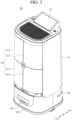
- FIG. 3 is a front perspective view of the delivery robot 100 according to an embodiment of the present disclosure.
- the components shown in FIG. 2 are not essential for implementing the delivery robot 100, so that the number of components of the delivery robot 100 described herein may be greater or smaller than the number of components listed above.
- the delivery robot 100 in the present disclosure may include a door 120, the traveling unit 170, a sensor 160, an output unit 150, an input unit 190, a controller 180, a transceiver 185, and a power supply 189.
- the door 120 may selectively open the inside of the storage by opening and closing an opening of the body 110 defined in one side of the body 110.
- the body housing 111 may be positioned such that a camera 193, a LIDAR 162, a proximity sensor 161, and the like that are exposed may be positioned to face the travel direction.
- the opening of the body 110 for inserting and withdrawing the item may be positioned to face a direction opposite to the travel direction.
- the present disclosure is characterized by opening and closing the storage 115 inside the body 110 to store and withdraw the item, so that a direction the door 120 faces will be described as a forward direction, and a direction opposite thereto, that is, the travel direction, will be described as a rearward direction.
- the delivery robot 100 has the cylindrical body 110, as shown in FIG. 3 , and most of a front area is devoted to the opening of the body 110 covered with the door 120 for smooth insertion and withdrawal of the item.
- Laser may damage human vision because light with a wavelength in a range from 600 to 1000 nm is used.
- the LIDAR 162 uses a wavelength greater than the above range, and is used in measurement of not only the distance to the target object, but also a speed and a direction of movement, and a temperature, and surrounding atmospheric substance analysis and concentration measurement.
- the traveling unit 170 as a means for moving the delivery robot 100, may include wheels or legs, and may include a wheel driver and a leg driver that control them.
- the wheels may include a main wheel 171 (see FIG. 14 ) for fast travel, a caster 173 for changing a direction, an auxiliary caster for stable travel to prevent a loaded item L from falling while traveling, and the like.
- the transceiver 185 may include a wired or wireless communication module that may be in communication with the robot control system 200.
- the transceiver 185 may have modules related to global system for mobile communication (GSM), code division multi access (CDMA), long term evolution (LTE), 5G, wireless LAN (WLAN), wireless-fidelity (Wi-Fi), Bluetooth, radio frequency identification (RFID), infrared data association (IrDA), ZigBee, and near field communication (NFC) communication.
- GSM global system for mobile communication
- CDMA code division multi access
- LTE long term evolution
- 5G wireless LAN
- WLAN wireless-fidelity
- Bluetooth Bluetooth
- RFID radio frequency identification
- IrDA infrared data association
- ZigBee ZigBee
- NFC near field communication
- the input unit 190 may include a user input unit for receiving information from the user.
- the input unit 190 may include a camera 193 for inputting an image signal and a microphone 191 for receiving an audio signal.
- the camera 193 or the microphone 191 may be treated as a sensor, and the signal obtained from the camera 193 or the microphone 191 may be referred to as sensing data or sensor information.
- the storage 115 may further include an internal camera 195 (see FIG. 17 ) to detect presence or absence of the item inside.
- the internal camera 195 may include a plurality of internal cameras to detect all partitioned storage sections 115a, 115b, 115c, and 115d, respectively.
- cameras with different functions may be disposed.
- a wide-angle camera, an infrared camera, and the like may be disposed.
- the camera may play a role in sensing a surrounding object.
- the user input unit 192 may recognize the user command via voice recognition. That is, a voice recognition device that extracts the user command by analyzing voice collected by the microphone 191 may also serve as the user input unit 192.
- the input unit 190 may include an item information input unit.
- the item information input unit may receive size information, weight information, destination information, information on a transport requester, and the like of the item.
- the item information input unit may include a code reader.
- the memory may store information necessary to perform the calculation using the artificial intelligence, machine learning, and an artificial neural network.
- the memory may store a deep neural network model.
- the deep neural network model may be used to infer a result value for new input data other than training data, and the inferred value may be used as basis for determination to perform a certain operation.
- the power supply 189 receives external power and internal power under control of the processor 180 and supplies the power to each component of the delivery robot 100.
- Such power supply 189 may include a battery, and the battery may be a built-in battery or a replaceable battery.
- the battery may be charged using a wired or wireless charging scheme, and the wireless charging scheme may include a magnetic induction scheme or a magnetic resonance scheme.
- the controller 180 is a module that controls the components of the delivery robot 100.
- the controller 180 may refer to a data processing device built into hardware that has a physically structured circuit to perform a function expressed as codes or instructions included in a program.
- Examples of the data processing device built into the hardware may include a microprocessor, a central processing unit (CPU), a processor core, a multiprocessor, an application-specific integrated circuit (ASIC), and a field programmable gate array (FPGA), but the scope of the present disclosure may not be limited thereto.
- the controller 180 may collect at least one of quantity information, weight information, size information, delivery order information, and security level information of an item L to be disposed in the storage 115.
- the controller 180 may collect the above-described information via the input/output unit 170.
- An input of the input/output unit 170 may also include a touch input on a display.
- the controller 180 may transmit information of the item L loaded in the storage 115 to the mobile terminal (300 in FIG. 1 ) via the transceiver 185.
- the present disclosure may include a plurality of doors 120a, 120b, 120c, and 120d, and the doors may be divided from each other in a left and right direction so as to be opened and closed symmetrically in the left and right direction such that a turning radius does not increase when being opened and closed.
- doors There may be two doors including one door on the left and one door on the right, or there may be four doors 120a, 120b, 120c, and 120d as shown in FIG. 3 . Alternatively, there may be six doors divided vertically into three layers.
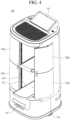
- FIGS. 4 and 5 are diagrams illustrating a state in which the door 120 of the delivery robot 100 according to an embodiment of the present disclosure is opened.
- the respective doors 120a, 120b, 120c, and 120d may operate individually, and when the partition 133 is omitted, left and right doors may be opened simultaneously and open one storage section.
- the embodiment in FIG. 5 is a case in which the storage 115 is not partitioned but is constructed as one large space. In the corresponding embodiment, all doors 120a, 120b, 120c, and 120d may be opened simultaneously.
- FIG. 6 is a view showing the inside of the storage 115 of the delivery robot 100 according to an embodiment of the present disclosure, and shows a state in which the door panel 121 is removed.
- the delivery robot 100 may include the middle shelf 132 that divides the storage 115 in the vertical direction and the partition 133 that divides the storage 115 in the left and right direction.
- the delivery robot 100 of the present embodiment may include one middle shelf 132 and two partitions 133, and the storage 115 may be divided into up to four storage sections 115a, 115b, 115c, and 115d as shown in FIG. 6 using one middle shelf 132 and two partitions 133.
- the partitions 133 that divide the upper storage section 115e and the lower storage section 115f in the left and right direction may be inserted along guide grooves 1323 defined in the middle shelf 132. Unlike the middle shelf 132, the partition 133 does not support a weight of the item, so that a thickness thereof may be relatively smaller than that of the middle shelf 132.
- the guide grooves 1323 may be defined in both top and bottom surfaces of the middle shelf 132.
- Guide grooves 1125 into which the partitions 133 are respectively inserted may be defined in top and bottom surfaces of the storage 115.
- the partition 133 may be inserted into the storage, that is, rearwards, or withdrawn forwards along the guide groove 1323.
- the pair of partitions 133 may be inserted into the upper storage section 115e and the lower storage section 115f, respectively, and the pair of partitions 133 may be independently detachable.
- FIG. 7 is a conceptual diagram illustrating a method for partitioning the storage of the delivery robot 100 according to an embodiment of the present disclosure. As shown in (a) in FIG. 7 , the storage may be partitioned into four storage sections 115a, 115b, 115c, and 115d using the one middle shelf 132 and the two partitions 133.
- one middle shelf 132 and one partition 133 may be used to use one of the upper storage section 115e and the lower storage section 115f as a connected space and the other as a partitioned space.
- door drivers of upper doors 120a and 120b that cover the upper storage section 115e may be located at upper sides of the door panels 121a and 121b, that is, at an upper portion of the storage 115.
- Door drivers of the lower doors 120c and 120d that cover the lower storage section 115f may be located at lower sides of the door panels 121c and 121d, that is, at a lower portion of the storage 115.
- the door driver may be disposed on a driver plate 125, and some components thereof may be disposed on one surface of the driver plate 125 and the remaining components thereof may be disposed on the other surface, or a thick member such as the motor 122 may be disposed on the door driver plate 125 by defining a hole in the door driver plate 125.
- pulleys 1231 and 1232, a flat belt 124, and door sensors 1641 and 1642 may be located on one surface of the door driver plate 125, and the door links 128 and 129 may be located on the other surface of the door driver plate 125.
- the motor 122 may be disposed by defining the hole in the door driver plate 125 considering the thickness of the motor 122.
- the other surface of the door driver plate 125 on which the door links 128 and 129 are located is disposed to face the storage 115.
- the door panel 121 as a member that covers the body storage 115, may form a continuous surface with the body housing 111 in a closed state to constitute an outer appearance of the body 110.
- the door panel 121 may be formed slightly wider in the left and right direction on a front surface of the body housing 111 to facilitate the storage and reception of the item.
- the door panel 121 may extend beyond the front surface of the body housing 111 and may be bent in a lateral direction.
- an edge in a closing direction of the door panel 121 is referred to as a first door edge 1211 and an edge in an opening direction of the door panel 121 is referred to as a second door edge 1212.
- the motor 122 may be directly connected to the link, but may include the pair of pulleys 1231 and 1232 and the flat belt 124 surrounding the pair of pulleys 1231 and 1232, as shown in FIG. 9 .
- the flat belt 124 synchronizes the pair of pulleys 1231 and 1232.
- the first pulley 1231 connected to the motor 122 rotates, and the flat belt 124 moves along an outer circumferential surface of the first pulley 1231.
- a rotational force is transmitted via the flat belt 124 to rotate the second pulley 1232, and the second pulley 1232 is coupled to a second end 1282 of the first door link 128.
- the first door link 128 may pivot around a rotation axis of the second pulley 1232 based on the rotation of the second pulley 1232, and the first end 1281 of the first door link 128 may pivot while drawing an arc that is centered around the rotation axis of the second pulley 1232.
- a direction in which the first door link 128 pivots in the direction in which the door panel 121 opens is referred to as a first pivot direction
- a direction in which the first door link 128 pivots in the direction in which the door panel 121 closes is referred to as a second pivot direction.
- the first pivot direction may be clockwise or counterclockwise.
- the first pivot direction of the first door link 128 shown on a left side in FIG. 8 is counterclockwise and the second pivot direction thereof is clockwise.
- the flat belt 124 has a tape shape with no protrusion formed on the belt, and no teeth are also formed on outer surfaces of the first pulley 1231 and the second pulley 1232.
- the flat belt 124 may move using a friction force between the flat belt 124 and the first pulley 1231 and the second pulley 1232, and when an external force greater than the friction force is applied, the flat belt 124 may slip with the second pulley 1232.
- the door panel 121 When an object or a hand is caught in the door 120, the door panel 121 is not able to move and the second pulley 1232 is not able to rotate.
- the rotation of the second pulley 1232 is limited, the slip occurs with the flat belt 124. That is, even when the motor 122 rotates the first pulley 1231, the second pulley 1232 may not rotate.
- the second pulley 1232 may include a sensing protrusion 1233 protruding from an outer circumferential surface thereof. A location of the sensing protrusion 1233 may vary depending on the rotation of the second pulley 1232. A closing detection sensor 1641 in contact with the sensing protrusion 1233 in the closed state and an opening detection sensor 1642 in contact with the sensing protrusion 1233 in the open state may be included.
- the first end 1281 of the first door link 128 may be pivotably coupled to the door panel 121. Because the door drivers of the upper doors 120a and 120b are located at the upper side of the storage 115, the first end 1281 of the first door link 128 may be coupled to an upper end of the door panel 121. The door drivers of the lower doors 120c and 120d are located at the lower side of the storage 115, so that the first end 1281 of the first door link 128 may be coupled to a lower end of the door panel 121.
- the first door edge 1211 of the door panel 121 may be located at a center of the body opening in the closed state and located at a side of the body opening in the open state.
- the first end 1281 of the first door link 128 may be coupled to the first door edge 1211 of the door panel 121 to move along the body opening without interfering with the body housing 111 when switching from the closed state to the open state.
- the second door link 129 may pivot to change the angle of the door panel 121.
- the second door link 129 may pivot in the same direction as the first door link 128, and the door panel 121 may be switched between the closed and open states via linkage of the pair of door links 128 and 129.
- the first door link 128 and the second door link 129 pivot in a form in which a quadrangle with four sides of the first distance D1, the second distance D2, the first spacing L1, and the second spacing L2 is formed and a shape of the quadrangle changes as an inner angle of the quadrangle changes.
- the first door link 128 When switching from the closed state to the open state, the first door link 128 receives the pivoting force of the motor 122 and the first end 1281 pivots along a first trajectory Tl.
- the first door link 128 pushes the door panel 121 outwards (the opening direction), and the first end 1291 of the second door link 129 coupled to the door panel 121 pivots along a second trajectory T2 while maintaining the first distance D1 from the first end 1281 of the first door link 128.
- FIG. 10 is a diagram showing trajectories of the door 120 based on the first spacing L1 of the first door link 128 and the second spacing L2 of the second door link 129.
- (a) is a diagram showing that both ends of the first door link 128 according to the embodiment in FIG. 9 . are disposed to have the first spacing L1 therebetween, and both ends of the second door link 129 are disposed to have the second spacing L2 therebetween.
- (b) shows a case in which a first spacing L1' is greater than the first spacing L1 in the embodiment in (a), and
- (c) shows a case in which a second spacing L2" is greater than the second spacing L2 in the embodiment in (a).
- the door 120 may be opened laterally while maintaining a horizontal state of the door panel 121.
- the door 120 becomes the hinged door, and when the first spacing L1" is smaller than the second spacing L2" as shown in (c) in FIG. 10 , the door panel 121 may pivot while maintaining the horizontal direction or the second door edge 1212 may rather protrude forward.
- the first spacing L1 of the first door link 128 is slightly greater than the second spacing L2 of the second door link 129 as shown in (a).
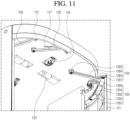
- FIG. 11 is a bottom view of the door driver of the delivery robot 100 according to an embodiment of the present disclosure.
- the first door link 128 may have a shape in which a first portion 1283 located at the first end 1281 and a second portion 1284 located in a direction of the second end 1282 are bent at a predetermined angle.
- the first portion 1283 is located adjacent to the first end 1281 and has a relatively smaller length than the second portion 1284.
- the first portion 1283 of the first door link 128 is exposed to the outside when the door 120 is open. It is desirable to place the first portion 1283 close to an inner surface of the door panel 121 such that the first portion 1283 exposed to the outside is visible as little as possible.
- the first portion 1283 of the first door link 128 may be bent toward the first door edge 1211 of the door panel 121.
- the first end 1281 may be disposed parallel to the inner surface of the door panel 121 in the closed state and may pivot in the open state, so that the first end 1281 may be spaced apart from the inner surface of the door panel 121, but may be closer to the door panel 121 than when the first portion and the second portion 1284 are straight to reduce a degree of exposure to the outside.
- the second door link 129 may be bent in a U shape, so that the first end 1291 and the second end 1292 may face the same direction.
- the second end 1292 of the second door link 129 may be located at the side of the body housing 111 in the open state as shown in FIG. 8 and move the second edge 1212 of the door rearwards.
- the second door link 129 may include a U-shaped bent portion 1295 ( FIG. 11 ), and the first end 1291 and the second end 1292 may face the same direction.
- a first portion 1293 including the first end 1291 is a portion that leads the pivoting movement of the second door link 129, so that the first portion 1293 may be greater than a second portion 1294 including the second end 1292, and the second portion 1294 may have a length to avoid the interference with the body housing 111.
- the body housing 111 may be located between the first portion 1293 and the second portion 1294 of the second door link 129, like the door 120b on the left side in FIG. 8 .
- the second door link 129 is not directly connected to the motor 122, but guides the door panel 121 to open in the determined trajectory without shaking.
- the first door link 128 is located only at the upper or lower side of the door panel 121 because of the arrangement of the motor 122, but the second door link 129 may be coupled to both the upper and lower sides of the door panel 121 (see FIG. 5 ).
- the second door link 129 may be located at the vertical center of the storage 115 in addition to the upper and lower sides thereof.
- a pair of second door links 129 located at the vertical center of the storage 115 may be arranged in the vertical direction, and one may be connected to the upper door 120a and 120b and the other may be connected to the lower door 120c and 120d.
- the second door links 129 may be located at both sides of the middle shelf 132, and the middle shelf 132 may include grooves at left and right sides thereof to provide space for the second door link 129 to pivot.
- a link cover 1351 to cover the second door link 129 may be further included such that the second door link 129 is not exposed, and the link cover 1351 may serve as the shelf support 135 that supports the middle shelf 132 (see FIG. 12 ).
- the slip may occur between the second pulley 1232 and the flat belt 124 and the door panel 121 may be opened. Additionally, a third party other than an item recipient may forcibly open the door 120 and take the item.
- a locking device to lock the door 120 is needed.
- a locking lever 127 that limits the pivoting of the first door link 128 may be disposed.
- the locking lever 127 may be selectively introduced and withdrawn along the trajectory of the first door link 128.
- the locking lever 127 may be located in the first pivot direction for switching the locked state to the open state.
- the locking motor 122 that controls the locking lever 127 to be selectively located in the first pivot direction of the first door link 128 may operate to protrude the locking lever 127 when the closing detection sensor 1641 is turned on, and may introduce the locking lever 127 such that the first door link 128 may pivot in the first pivot direction when a command to open the door 120 is input (see the right door 120b in FIG. 11 ).
- the lock lever 127 may be manually introduced to release the locking in an emergency situation in which the door 120 must be opened manually.
- a thin, long member like a ruler is inserted into the upper end or the lower end of the door panel 121 and pushes the lock lever 127, the lock lever 127 may be introduced without interference with the first door link 128 and the door panel 121 may be opened manually.
- the middle shelf 132 that partitions the storage 115 of the present disclosure in the vertical direction and the partition 133 that partitions the storage 115 in the left and right direction may be included, and the middle shelf 132 and the partition 133 may be optionally coupled to the body housing 111.
- a method for coupling the middle shelf 132 and the partition 133 to each other will be described in detail.
- FIG. 12 is a diagram showing a method for coupling the middle shelf 132 of the delivery robot 100 according to an embodiment of the present disclosure. As shown in FIG. 12 , the middle shelf 132 may be inserted and coupled from the front using a slide scheme.
- the shelf supports 135 that support the middle shelf 132 may be disposed at both sides of the storage 115.
- the middle shelf 132 may be concavely recessed at left and right sides thereof to include shelf rails 1325, and the middle shelf 132 may be inserted with the shelf supports 135 located on the shelf rails 1325.
- the shelf rail 1325 may be recessed with a depth corresponding to a protruding height of the shelf support 135.
- the second door links 129 may be located not only at top and bottom of the storage 115, but also at the vertical center of the storage 115, and may be disposed at the left and right sides of the middle shelf 132.
- the shelf support 135 may include the link cover 1351 that covers the second door link 129 to prevent interference with the second door link 129 when the middle shelf 132 is fastened to the storage 115.
- the link cover 1351 may protect the second door link 129 from being damaged, and when the middle shelf 132 is removed from the storage 115 as shown in FIG. 12 , the link cover 1351 may minimize exposure of the second door link 129 to the outside.
- the link cover 1351 may be disposed in the front adjacent to the body opening of the shelf support 135.
- the link cover 1351 may protrude corresponding to a motion range of the second door link 129.
- the shelf rail 1325 of the middle shelf 132 must be able to pass through an entire sections of the link cover 1351, so that the shelf rail 1325 may have a depth corresponding to a protruding height of the link cover 1351.
- the shelf support 135 may be equipped with an elastic sensor 134 to detect whether the middle shelf 132 is mounted. When the middle shelf 132 is inserted, the elastic sensor 134 may be pressed and detect that the middle shelf 132 has been coupled to the shelf support 135.
- the elastic sensor 134 may also be used to detect whether the partition 133, which will be described later, has been mounted.
- the elastic sensor that detects the mounting of the middle shelf 132 is referred to as a first elastic sensor 134a and the elastic sensor of the partition 133 is referred to as a second elastic sensor 134b.
- the first elastic sensor 134a and the second elastic sensor 134b may have the same configuration as shown in FIG. 13 , with only a difference in arrangement locations.
- the first elastic sensor 134a may be located inside the shelf support 135 so as to recognize full insertion of the middle shelf 132.
- the first elastic sensor 134a may be located inside the shelf support 135, but only an elastic latch 1344 may protrude from the shelf support 135.
- an inner portion (a rear portion) of the shelf support 135 where the first elastic sensor 134a is located is referred to as a sensor cover 1352.
- the sensor cover 1352 generates a signal by being in contact with an inner surface of the shelf rail 1325 of the middle shelf 132.
- the shelf rail 1325 is recessed with the depth corresponding to the protruding height of the link cover 1351 located at a front end of the shelf support 135, so that the sensor cover 1352 may also protrude to have the same height as the link cover 1351.
- a portion 1353 located between the sensor cover 1352 and the link cover 1351 of the shelf support 135 may have the same height as the sensor cover 1352 and the link cover 1351, but to maximally use the space of the storage 115 when removing the middle shelf 132 as shown in FIG. 5 , the portion 1353 located between the sensor cover 1352 and the link cover 1351 may have a concavely recessed shape.
- FIG. 13 is an exploded view of the elastic sensor 134 of the delivery robot 100 according to an embodiment of the present disclosure
- FIG. 14 shows an operation of the first elastic sensor 134a of the delivery robot 100 according to an embodiment of the present disclosure.
- the elastic sensor 134 may include a sensor housing 1341, the elastic latch 1344, a torsion spring 1343, and a switch 1345.
- the elastic latch 1344 is a plate-shaped member including a curved surface, and only a portion thereof exposed to the outside of the sensor housing 1341 needs to include the curved surface, but in the embodiment, the elastic latch 1344 is formed in a circular shape.
- a guide protrusion 1346 inserted into a guide slot 1342 defined in the sensor housing 1341 is included. As the guide protrusion 1346 moves along the guide slot 1342, a degree of exposure of the elastic latch 1344 from the sensor housing 1341 may vary.
- the torsion spring 1343 presses the elastic latch 1344 in an outward direction of the sensor housing 1341, so that the guide protrusion 1346 is positioned at one end (a lower side in the drawing) of the guide slot 1342 as shown in (a) in FIG. 14 .
- the torsion spring 1343 is deformed and the elastic latch 1344 is retracted into the sensor housing 1341.
- the elastic latch 1344 may include the switch 1345 that is pressed by the guide protrusion 1346 inserted into the guide slot 1342 to generate the signal. As shown in (b) in FIG. 14 , when the elastic latch 1344 is pressed, the guide protrusion 1346 may move along an extension direction of the guide slot 1342 and then press the switch 1345.
- a first locking groove 1326 may be disposed adjacent to a rear end of the middle shelf 132.
- the first locking groove 1326 defined in the middle shelf 132 corresponding to a shape of a protruding surface of the elastic latch 1344 may be included. As shown in (b) in FIG. 14 , when the first locking groove 1326 reaches the location of the elastic latch 1344, the torsion spring 1343 presses the elastic latch 1344, causing the elastic latch 1344 to protrude and to be inserted into the first locking groove 1326.
- the elastic latch 1344 protrudes to the maximum when the middle shelf 132 is not in contact therewith, and is retracted when the end of the middle shelf 132 comes into contact therewith.
- the elastic latch 1344 may be maintained in a maximally pressurized state in contact with the shelf rail 1325 of the middle shelf 132 until reaching the first locking groove 1326, and may protrude by a depth of the first locking groove 1326 when reaching the first locking groove 1326.
- the elastic latch 1344 may be pressed and separated from the first locking groove 1326.
- the middle shelf 132 may be pulled out from the storage 115 manually.
- One surface 1321 of the middle shelf 132 of the present disclosure may have a flat surface as shown in FIG. 12 , but the other surface 1322 may include a cup holder 1324 as shown in (b) in FIG. 15 .
- a cup has a great height compared to a bottom area and thus has a risk of flipping when the delivery robot 100 moves, so that the cup holder 1324 may be equipped in the middle shelf 132 itself to prevent the cup from flipping.
- the sliding shelf 131 may automatically protrude forwards when the door 120 is opened.
- a pair of sliding shelves 131 may be disposed to partition the lower storage section 115f in the left and right direction with the partition 133.
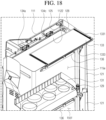
- FIG. 24 is an exploded perspective view showing the sliding shelf 131 and a shelf driver 137 of the delivery robot 100 according to an embodiment of the present disclosure.
- the sliding shelf 131 of the present disclosure may be located at the bottom of the lower storage section 115f.
- the sliding shelf 131 may slide in the front and rear direction on the storage base 1123 that constitutes a lower end of the storage 115.
- a space of the lower storage section 115f may become smaller than that of the upper storage section 115e corresponding to a vertical level of the sliding shelf 131.
- liquid may spill into the storage 115 while the delivery robot 100 is traveling or the sliding shelf 131 is being driven.
- the partition groove 1323 into which the partition 133 is inserted is recessed downwardly of the storage base 1123, the liquid may be guided to flow forwards along the partition groove 1323, thereby being prevented from flowing downwardly of the storage base 1123 via the driving hole 1124.
- the driving hole 1124 may form a step 1123s to be located higher than other portions of the storage base 1123. Additionally, a bump 1124s that prevents the inflow of the liquid may be formed around the driving hole 1124.
- a fall preventing wall 1312 may be included at a rear portion of the sliding shelf 131 to prevent the item located on the sliding shelf 131 from falling rearwards and moving to the storage base 1123 when the sliding shelf 131 is driven forwards.
- the fall preventing wall 1312 may be designed to have a height equal to or greater than 20mm.
- FIG. 27 relates to a safety control method of the sliding shelf 131 of the delivery robot 100 according to an embodiment of the present disclosure.
- the shelf driver 137 may break down because of overload.
- the linear actuator 1373 may have a circuit configuration that automatically short-circuits when the smallest and greatest lengths are reached for driving safety. Therefore, when an end point is reached, the linear actuator 1373 is short-circuited, so that a voltage measured at the linear actuator 1373 becomes 0.
- FIGS. 28 and 29 are diagrams illustrating the driver of the sliding shelf 131 of the delivery robot 100 according to another embodiment of the present disclosure.
- the sliding shelf 131 may be extended via a shelf link 1378 connected to the door 120.
- One end of the shelf link 1378 may be coupled to the door 120 and the other end thereof may be coupled to the sliding shelf 131.
- the door links 128 and 129 may pivot to pull the sliding shelf 131 forwards.
- the structure of the sliding shelf 131 using the shelf link 1378 has an advantage of being driven together with the door 120 without the linear actuator 1373 or the sliding motor 1374 for driving the shelf.
- the motor 122 that drives the door 120 there is a risk of overloading the motor 122 that drives the door 120, and the sliding shelf 131 may be extended when the lower door 120 is opened regardless of whether the middle shelf 132 has been mounted.
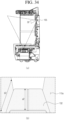
- FIG. 30 is a front view showing the storage 115 of the delivery robot 100 according to an embodiment of the present disclosure.
- the delivery robot 100 may further be equipped with the internal camera 195 inside the storage 115.
- the storage 115 of the present disclosure may be used by being partitioned into the plurality of sections depending on a situation, so that the internal camera 195 that may observe the inside of all of the plurality of partitioned storage sections 115a, 115b, 115c, and 115d is needed.
- the delivery robot 100 of the present disclosure is partitioned into up to four storage sections 115.
- each internal camera 195 is disposed in each of the four storage sections 115, a cost may increase excessively. Accordingly, the delivery robot 100 of the present disclosure uses two internal cameras 195a and 195b disposed at centers of the upper storage section 115e and the lower storage section 115f, respectively.
- the first internal camera 195a of the upper storage section 115e and the second internal camera 195b of the lower storage section 115f observe the upper storage section 115e and the lower storage section 115f, respectively.
- the inside of the storage 115 may be observed using only the lower internal camera 195b, thereby reducing power consumption.
- the internal camera 195 is located at the center in the horizontal direction of the storage 115, so that the location of the internal camera 195 may overlap the location where the partition 133 is inserted.
- the partition 133 there is no partition 133 in the storage 115, there is no difficulty in identifying whether there is the item by observing the upper storage section 115e and the lower storage section 115f with one internal camera 195a or 195b, but when the partition 133 is inserted, both left and right sides must be observed simultaneously.
- FIG. 31 is a diagram showing an image captured by the internal camera 195a located in the upper storage section 115e depending on whether there is the partition 133 of the delivery robot 100 according to an embodiment of the present disclosure.
- the second elastic sensor 134b may detect the presence of the partition 133, and the controller 180 may distinguish left and right images captured by the internal camera 195 from each other to determine whether there is the item for each of the storage sections 115a and 115b.
- the controller 180 may determine the image captured by the internal camera 195a as an image for one storage section 115e and determine whether there is the item.
- FIG. 32 is a conceptual diagram showing an angle of view of the internal camera 195 of the delivery robot 100 according to an embodiment of the present disclosure.
- the partition 133 of the delivery robot 100 is thinner than the middle shelf 132 and thus does not obscure the view much, but as a distance thereof from the internal camera 195 gets smaller, the view of the internal camera 195 may be obscured.
- an inner end of the partition 133 may be disposed to be spaced apart from the internal camera 195 by a predetermined distance C.
- a camera mounting portion 1127 that is defined as a rear surface of the storage 115 is concavely recessed may be included.
- the separation distance between the internal camera 195 and the end of the partition 133 may vary depending on the angle of view of the internal camera 195 and the thickness of the partition 133, but an angle of view of a 35mm-70mm standard camera is in a range from 34° to 63° in the horizontal direction.
- the internal camera 195 of the delivery robot 100 may be disposed to be spaced apart from the partition 133 by a distance equal to or greater than 3 times the thickness of the partition 133.
- the internal camera 195 when installing the partition 133 with the thickness of 10mm, the internal camera 195 may be disposed to be spaced apart from the partition 133 by a distance of 40mm.
- the internal camera 195 in the present disclosure is tilted downward as shown in FIG. 31 , so that an actual distance from the partition 133 along a center line of the angle of view may be greater than 40mm.
- the internal camera 195 may be tilted downwards so as to observe an entirety of the shelf up to a rear end of the shelf (a right side in the drawing).
- An inclination of the first internal camera 195a may vary because the view of the internal camera 195a varies depending on a vertical level of the first internal camera 195a from the middle shelf 132, but an experiment was conducted based on a case in which the internal camera 195 is disposed at a vertical level of about 180 mm from the middle shelf 132. In the present experiment, a length of the middle shelf 132 in the front and rear direction is about 450mm.
- a height h2 of the second internal camera 195b from the sliding shelf 131 may be smaller than a height h1 of the first internal camera 195a from the middle shelf 132 (h1> h2).
- the second internal camera 195b must be able to detect the item dropped on the storage base 1123 when the sliding shelf 131 is extended. Therefore, the second internal camera 195b may have a height of h1 from the storage base 1123 so as to detect the storage base 1123 up to a rear end thereof, and the height h2 from the storage base 1123 may be smaller than h1.
- FIG. 33 is a diagram showing a case of capturing an image in a state in which the internal camera 195 of the delivery robot 100 is tilted 20° downwards according to an embodiment of the present disclosure
- FIG. 34 is a diagram showing a case of capturing an image in a state in which the internal camera 195 of the delivery robot 100 is tilted 30° downwards according to an embodiment of the present disclosure.
- the upper storage section 115e is captured as shown in (b).
- the upper storage section 115e is captured as shown in (b).
- a captured range b of a side portion of the storage 115 may also become greater at 30° than at 20° (b1 ⁇ b2).
- the captured range a1 is smaller than the length of the middle shelf 132 and the rear end of the middle shelf 132 is not within the angle of view, so that the observation is difficult. Because the captured range a2 of the middle shelf 132 is expanded when the internal camera 195 is tilted by 30° as shown in FIG. 34 , an optimal angle of view of the internal camera 195 is set to 30° in the present embodiment.
- the angle of view of the internal camera 195 may vary depending on a size of the storage, and may be set to be in a range between 25° and 35°.
- the camera mounting portion 1127 in which the internal camera 195 is mounted may be recessed from a rear inner surface of the storage 115 while forming an inclined surface 1127.
- the inclined surface 1127 may have an inclination equal to or greater than the angle of view of the camera so as not to obscure the view of the internal camera 195, and the inclined surface 1127 may be formed such that a lower side is steeper than an upper side because the internal camera 195 in the present disclosure is inclined downward.
- the internal camera 195 may observe the outside of the door 120 when the door 120 is open.
- the camera 193 located on the outer side of the delivery robot 100 is located only on a side opposite to the door 120, which is in the travel direction, and thus is not able to determine whether a person or an obstacle is located in the direction of the door 120.
- the internal camera 195 may detect whether the person or the obstacle is located outside the door 120 when the sliding shelf 131 must be extended while the door 120 is open.
- the controller may extend the sliding shelf 131 after confirming that there is no obstacle outside the door 120 based on the image of the internal camera 195.
- the internal camera 195 may detect the loading of the item and match the storage 115 where the item is stored with the request of the customer.
- the delivery robot 100 in the present disclosure may partition the inside of the storage 115 as needed and increase the utilization of the internal space via the plurality of doors 120 that may be opened and closed selectively.
- the delivery robot 100 in the present disclosure may detect whether the shelf and the partition 133 have been attached or detached to selectively operate the plurality of doors 120 depending on the storage partitioning state of the doors 120.
- the delivery robot 100 in the present disclosure may store the partition 133 inside the storage of the delivery robot 100 when not using the partition 133.
- the delivery robot 100 in the present disclosure may be equipped with the sliding shelf 131 to improve the convenience in putting in and taking out the item.
- the delivery robot 100 in the present disclosure may reduce the failure rate of the delivery robot 100 by preventing the liquid from flowing into the electronic component located under the sliding shelf 131.
- the sliding shelf 131 of the delivery robot 100 in the present disclosure may be easily removable and thus may be easily maintained.
- the delivery robot 100 in the present disclosure may be equipped with the internal camera 195 and thus determine whether the item is stored inside to open and close the door 120.
- the delivery robot 100 in the present disclosure may detect whether there is the person outside the delivery robot 100, thereby checking whether it is safe in advance when extending the sliding shelf 131.
Landscapes
- Engineering & Computer Science (AREA)
- Mechanical Engineering (AREA)
- Robotics (AREA)
- Human Computer Interaction (AREA)
- Health & Medical Sciences (AREA)
- Public Health (AREA)
- Transportation (AREA)
- Manipulator (AREA)
Applications Claiming Priority (1)
| Application Number | Priority Date | Filing Date | Title |
|---|---|---|---|
| KR1020230123438A KR20250040407A (ko) | 2023-09-15 | 2023-09-15 | 배송로봇 |
Publications (1)
| Publication Number | Publication Date |
|---|---|
| EP4523859A1 true EP4523859A1 (de) | 2025-03-19 |
Family
ID=91959222
Family Applications (1)
| Application Number | Title | Priority Date | Filing Date |
|---|---|---|---|
| EP24189326.2A Pending EP4523859A1 (de) | 2023-09-15 | 2024-07-18 | Ausgaberoboter |
Country Status (3)
| Country | Link |
|---|---|
| US (1) | US20250092729A1 (de) |
| EP (1) | EP4523859A1 (de) |
| KR (1) | KR20250040407A (de) |
Families Citing this family (1)
| Publication number | Priority date | Publication date | Assignee | Title |
|---|---|---|---|---|
| JP1787090S (ja) * | 2023-12-15 | 2024-12-17 | 配送ロボット |
Citations (5)
| Publication number | Priority date | Publication date | Assignee | Title |
|---|---|---|---|---|
| US20200223632A1 (en) * | 2019-01-11 | 2020-07-16 | St Engineering Aethon, Inc. | Autonomous Mobile Delivery Robot And Chain Of Custody System |
| WO2020209426A1 (ko) * | 2019-04-11 | 2020-10-15 | 엘지전자 주식회사 | 적재 모듈 및 이를 구비한 운반 로봇 |
| CN213165406U (zh) * | 2020-08-14 | 2021-05-11 | 上海擎朗智能科技有限公司 | 一种服务机器人 |
| CN219008998U (zh) * | 2023-01-13 | 2023-05-12 | 中铭谷智能机器人(广东)有限公司 | 一种配送机器人 |
| CN219258110U (zh) * | 2022-07-18 | 2023-06-27 | 深圳十一空间机器人有限公司 | 一种用于配送机器人具有可自动开关门的储物箱体 |
-
2023
- 2023-09-15 KR KR1020230123438A patent/KR20250040407A/ko active Pending
-
2024
- 2024-04-30 US US18/650,931 patent/US20250092729A1/en active Pending
- 2024-07-18 EP EP24189326.2A patent/EP4523859A1/de active Pending
Patent Citations (5)
| Publication number | Priority date | Publication date | Assignee | Title |
|---|---|---|---|---|
| US20200223632A1 (en) * | 2019-01-11 | 2020-07-16 | St Engineering Aethon, Inc. | Autonomous Mobile Delivery Robot And Chain Of Custody System |
| WO2020209426A1 (ko) * | 2019-04-11 | 2020-10-15 | 엘지전자 주식회사 | 적재 모듈 및 이를 구비한 운반 로봇 |
| CN213165406U (zh) * | 2020-08-14 | 2021-05-11 | 上海擎朗智能科技有限公司 | 一种服务机器人 |
| CN219258110U (zh) * | 2022-07-18 | 2023-06-27 | 深圳十一空间机器人有限公司 | 一种用于配送机器人具有可自动开关门的储物箱体 |
| CN219008998U (zh) * | 2023-01-13 | 2023-05-12 | 中铭谷智能机器人(广东)有限公司 | 一种配送机器人 |
Also Published As
| Publication number | Publication date |
|---|---|
| KR20250040407A (ko) | 2025-03-24 |
| US20250092729A1 (en) | 2025-03-20 |
Similar Documents
| Publication | Publication Date | Title |
|---|---|---|
| US9535421B1 (en) | Mobile delivery robot with interior cargo space | |
| JP2021501731A (ja) | 家庭用自律式アイテム回収及び輸送ロボットシステム | |
| KR102771778B1 (ko) | 인공지능 이동 로봇 | |
| EP4523859A1 (de) | Ausgaberoboter | |
| EP4523866A1 (de) | Ausgaberoboter | |
| EP4524853A1 (de) | Ausgaberoboter | |
| EP4524058A1 (de) | Ausgaberoboter | |
| US20210302971A1 (en) | Devices, systems and methods for autonomous robot navigation and secure package delivery | |
| KR200496080Y1 (ko) | 다양한 종류와 형태의 물품을 적재할 수 있는 생체인증 연동제어형 실내 자율주행로봇 | |
| EP4464646B1 (de) | Transportroboter | |
| KR20210026595A (ko) | 로봇이 관리자 모드로 이동하는 방법 및 이를 구현하는 로봇 | |
| CN118636126A (zh) | 机器人引领方法、电子设备和存储介质 | |
| KR102021948B1 (ko) | 안내 로봇 | |
| US20250334972A1 (en) | Transport robot, transport means, and control method therefor | |
| EP4523858A1 (de) | Transportroboter | |
| EP4506210A1 (de) | Transportroboter | |
| EP4563292A1 (de) | Fahrroboter | |
| EP4574350A1 (de) | Fahrroboter | |
| EP4549108A1 (de) | Servierroboter | |
| EP4566768A1 (de) | Transportroboter | |
| KR20250174038A (ko) | 운송 로봇 | |
| KR20250022075A (ko) | 서빙 로봇 | |
| KR20250044301A (ko) | 주행로봇 | |
| CN118625801A (zh) | 机器人引领方法、电子设备和存储介质 |
Legal Events
| Date | Code | Title | Description |
|---|---|---|---|
| PUAI | Public reference made under article 153(3) epc to a published international application that has entered the european phase |
Free format text: ORIGINAL CODE: 0009012 |
|
| STAA | Information on the status of an ep patent application or granted ep patent |
Free format text: STATUS: REQUEST FOR EXAMINATION WAS MADE |
|
| 17P | Request for examination filed |
Effective date: 20240718 |
|
| AK | Designated contracting states |
Kind code of ref document: A1 Designated state(s): AL AT BE BG CH CY CZ DE DK EE ES FI FR GB GR HR HU IE IS IT LI LT LU LV MC ME MK MT NL NO PL PT RO RS SE SI SK SM TR |
|
| RAP1 | Party data changed (applicant data changed or rights of an application transferred) |
Owner name: BEAR ROBOTICS KOREA, INC. |