EP4517876A1 - Zusammensetzung, anode und batterie - Google Patents
Zusammensetzung, anode und batterie Download PDFInfo
- Publication number
- EP4517876A1 EP4517876A1 EP24196740.5A EP24196740A EP4517876A1 EP 4517876 A1 EP4517876 A1 EP 4517876A1 EP 24196740 A EP24196740 A EP 24196740A EP 4517876 A1 EP4517876 A1 EP 4517876A1
- Authority
- EP
- European Patent Office
- Prior art keywords
- core
- satisfied
- battery
- composition
- following condition
- Prior art date
- Legal status (The legal status is an assumption and is not a legal conclusion. Google has not performed a legal analysis and makes no representation as to the accuracy of the status listed.)
- Pending
Links
Images
Classifications
-
- H—ELECTRICITY
- H01—ELECTRIC ELEMENTS
- H01M—PROCESSES OR MEANS, e.g. BATTERIES, FOR THE DIRECT CONVERSION OF CHEMICAL ENERGY INTO ELECTRICAL ENERGY
- H01M4/00—Electrodes
- H01M4/02—Electrodes composed of, or comprising, active material
- H01M4/36—Selection of substances as active materials, active masses, active liquids
- H01M4/362—Composites
- H01M4/366—Composites as layered products
-
- H—ELECTRICITY
- H01—ELECTRIC ELEMENTS
- H01M—PROCESSES OR MEANS, e.g. BATTERIES, FOR THE DIRECT CONVERSION OF CHEMICAL ENERGY INTO ELECTRICAL ENERGY
- H01M10/00—Secondary cells; Manufacture thereof
- H01M10/05—Accumulators with non-aqueous electrolyte
- H01M10/052—Li-accumulators
-
- H—ELECTRICITY
- H01—ELECTRIC ELEMENTS
- H01M—PROCESSES OR MEANS, e.g. BATTERIES, FOR THE DIRECT CONVERSION OF CHEMICAL ENERGY INTO ELECTRICAL ENERGY
- H01M4/00—Electrodes
- H01M4/02—Electrodes composed of, or comprising, active material
- H01M4/13—Electrodes for accumulators with non-aqueous electrolyte, e.g. for lithium-accumulators; Processes of manufacture thereof
- H01M4/131—Electrodes based on mixed oxides or hydroxides, or on mixtures of oxides or hydroxides, e.g. LiCoOx
-
- H—ELECTRICITY
- H01—ELECTRIC ELEMENTS
- H01M—PROCESSES OR MEANS, e.g. BATTERIES, FOR THE DIRECT CONVERSION OF CHEMICAL ENERGY INTO ELECTRICAL ENERGY
- H01M4/00—Electrodes
- H01M4/02—Electrodes composed of, or comprising, active material
- H01M4/13—Electrodes for accumulators with non-aqueous electrolyte, e.g. for lithium-accumulators; Processes of manufacture thereof
- H01M4/133—Electrodes based on carbonaceous material, e.g. graphite-intercalation compounds or CFx
-
- H—ELECTRICITY
- H01—ELECTRIC ELEMENTS
- H01M—PROCESSES OR MEANS, e.g. BATTERIES, FOR THE DIRECT CONVERSION OF CHEMICAL ENERGY INTO ELECTRICAL ENERGY
- H01M4/00—Electrodes
- H01M4/02—Electrodes composed of, or comprising, active material
- H01M4/13—Electrodes for accumulators with non-aqueous electrolyte, e.g. for lithium-accumulators; Processes of manufacture thereof
- H01M4/134—Electrodes based on metals, Si or alloys
-
- H—ELECTRICITY
- H01—ELECTRIC ELEMENTS
- H01M—PROCESSES OR MEANS, e.g. BATTERIES, FOR THE DIRECT CONVERSION OF CHEMICAL ENERGY INTO ELECTRICAL ENERGY
- H01M4/00—Electrodes
- H01M4/02—Electrodes composed of, or comprising, active material
- H01M4/36—Selection of substances as active materials, active masses, active liquids
- H01M4/362—Composites
- H01M4/364—Composites as mixtures
-
- H—ELECTRICITY
- H01—ELECTRIC ELEMENTS
- H01M—PROCESSES OR MEANS, e.g. BATTERIES, FOR THE DIRECT CONVERSION OF CHEMICAL ENERGY INTO ELECTRICAL ENERGY
- H01M4/00—Electrodes
- H01M4/02—Electrodes composed of, or comprising, active material
- H01M4/36—Selection of substances as active materials, active masses, active liquids
- H01M4/38—Selection of substances as active materials, active masses, active liquids of elements or alloys
- H01M4/386—Silicon or alloys based on silicon
-
- H—ELECTRICITY
- H01—ELECTRIC ELEMENTS
- H01M—PROCESSES OR MEANS, e.g. BATTERIES, FOR THE DIRECT CONVERSION OF CHEMICAL ENERGY INTO ELECTRICAL ENERGY
- H01M4/00—Electrodes
- H01M4/02—Electrodes composed of, or comprising, active material
- H01M4/36—Selection of substances as active materials, active masses, active liquids
- H01M4/38—Selection of substances as active materials, active masses, active liquids of elements or alloys
- H01M4/387—Tin or alloys based on tin
-
- H—ELECTRICITY
- H01—ELECTRIC ELEMENTS
- H01M—PROCESSES OR MEANS, e.g. BATTERIES, FOR THE DIRECT CONVERSION OF CHEMICAL ENERGY INTO ELECTRICAL ENERGY
- H01M4/00—Electrodes
- H01M4/02—Electrodes composed of, or comprising, active material
- H01M4/36—Selection of substances as active materials, active masses, active liquids
- H01M4/48—Selection of substances as active materials, active masses, active liquids of inorganic oxides or hydroxides
- H01M4/483—Selection of substances as active materials, active masses, active liquids of inorganic oxides or hydroxides for non-aqueous cells
-
- H—ELECTRICITY
- H01—ELECTRIC ELEMENTS
- H01M—PROCESSES OR MEANS, e.g. BATTERIES, FOR THE DIRECT CONVERSION OF CHEMICAL ENERGY INTO ELECTRICAL ENERGY
- H01M4/00—Electrodes
- H01M4/02—Electrodes composed of, or comprising, active material
- H01M4/36—Selection of substances as active materials, active masses, active liquids
- H01M4/48—Selection of substances as active materials, active masses, active liquids of inorganic oxides or hydroxides
- H01M4/485—Selection of substances as active materials, active masses, active liquids of inorganic oxides or hydroxides of mixed oxides or hydroxides for inserting or intercalating light metals, e.g. LiTi2O4 or LiTi2OxFy
-
- H—ELECTRICITY
- H01—ELECTRIC ELEMENTS
- H01M—PROCESSES OR MEANS, e.g. BATTERIES, FOR THE DIRECT CONVERSION OF CHEMICAL ENERGY INTO ELECTRICAL ENERGY
- H01M4/00—Electrodes
- H01M4/02—Electrodes composed of, or comprising, active material
- H01M4/36—Selection of substances as active materials, active masses, active liquids
- H01M4/58—Selection of substances as active materials, active masses, active liquids of inorganic compounds other than oxides or hydroxides, e.g. sulfides, selenides, tellurides, halogenides or LiCoFy; of polyanionic structures, e.g. phosphates, silicates or borates
- H01M4/583—Carbonaceous material, e.g. graphite-intercalation compounds or CFx
- H01M4/587—Carbonaceous material, e.g. graphite-intercalation compounds or CFx for inserting or intercalating light metals
-
- H—ELECTRICITY
- H01—ELECTRIC ELEMENTS
- H01M—PROCESSES OR MEANS, e.g. BATTERIES, FOR THE DIRECT CONVERSION OF CHEMICAL ENERGY INTO ELECTRICAL ENERGY
- H01M4/00—Electrodes
- H01M4/02—Electrodes composed of, or comprising, active material
- H01M4/36—Selection of substances as active materials, active masses, active liquids
- H01M4/60—Selection of substances as active materials, active masses, active liquids of organic compounds
- H01M4/602—Polymers
-
- H—ELECTRICITY
- H01—ELECTRIC ELEMENTS
- H01M—PROCESSES OR MEANS, e.g. BATTERIES, FOR THE DIRECT CONVERSION OF CHEMICAL ENERGY INTO ELECTRICAL ENERGY
- H01M4/00—Electrodes
- H01M4/02—Electrodes composed of, or comprising, active material
- H01M4/62—Selection of inactive substances as ingredients for active masses, e.g. binders, fillers
-
- H—ELECTRICITY
- H01—ELECTRIC ELEMENTS
- H01M—PROCESSES OR MEANS, e.g. BATTERIES, FOR THE DIRECT CONVERSION OF CHEMICAL ENERGY INTO ELECTRICAL ENERGY
- H01M4/00—Electrodes
- H01M4/02—Electrodes composed of, or comprising, active material
- H01M4/62—Selection of inactive substances as ingredients for active masses, e.g. binders, fillers
- H01M4/624—Electric conductive fillers
- H01M4/625—Carbon or graphite
-
- H—ELECTRICITY
- H01—ELECTRIC ELEMENTS
- H01M—PROCESSES OR MEANS, e.g. BATTERIES, FOR THE DIRECT CONVERSION OF CHEMICAL ENERGY INTO ELECTRICAL ENERGY
- H01M4/00—Electrodes
- H01M4/02—Electrodes composed of, or comprising, active material
- H01M2004/021—Physical characteristics, e.g. porosity, surface area
-
- H—ELECTRICITY
- H01—ELECTRIC ELEMENTS
- H01M—PROCESSES OR MEANS, e.g. BATTERIES, FOR THE DIRECT CONVERSION OF CHEMICAL ENERGY INTO ELECTRICAL ENERGY
- H01M4/00—Electrodes
- H01M4/02—Electrodes composed of, or comprising, active material
- H01M2004/026—Electrodes composed of, or comprising, active material characterised by the polarity
- H01M2004/027—Negative electrodes
-
- Y—GENERAL TAGGING OF NEW TECHNOLOGICAL DEVELOPMENTS; GENERAL TAGGING OF CROSS-SECTIONAL TECHNOLOGIES SPANNING OVER SEVERAL SECTIONS OF THE IPC; TECHNICAL SUBJECTS COVERED BY FORMER USPC CROSS-REFERENCE ART COLLECTIONS [XRACs] AND DIGESTS
- Y02—TECHNOLOGIES OR APPLICATIONS FOR MITIGATION OR ADAPTATION AGAINST CLIMATE CHANGE
- Y02E—REDUCTION OF GREENHOUSE GAS [GHG] EMISSIONS, RELATED TO ENERGY GENERATION, TRANSMISSION OR DISTRIBUTION
- Y02E60/00—Enabling technologies; Technologies with a potential or indirect contribution to GHG emissions mitigation
- Y02E60/10—Energy storage using batteries
Definitions
- the present disclosure relates to a composition, an anode and a battery. More particularly, the present disclosure relates to a composition, an anode and a battery which can improve the safety, service life, stability and capacity of the battery.
- the current goals of research and development of batteries are to achieve the demands of high energy density, high working voltage, fast charging speed and long cycle life.
- the commonly used materials for anodes are carbon or graphite nowadays.
- the carbon or graphite which mostly has a layered structure, cannot withstand the rapid intercalation and deintercalation of ions. Therefore, it is prone to an irreversible collapse of the structure, resulting in reducing the capacity and storage life. It is also prone to polarization when the current density is too high, which makes the lithium ion be reduced into lithium metal and form lithium dendrite on the surface of the electrode pieces, resulting in short circuit in the battery and the safety concerns.
- a composition includes a core-shell structure.
- the core-shell structure includes a core material and a shell material.
- the shell material is farther away from a center of the core-shell structure than the core material.
- the core material includes a structural element oxide.
- the structural element oxide includes a structural element.
- the structural element includes at least two selected from the group consisting of lithium, titanium, niobium, cobalt, copper, tin, silicon, iron, manganese and nickel.
- the shell material includes a mixed material.
- the mixed material includes a modified silicon material.
- the modified silicon material includes a silicon material and a polymer.
- a particle diameter of the core material at D50 is cD50
- the following condition can be satisfied: 100.0 nm ⁇ cD50 ⁇ 80000.0 nm.
- a particle diameter of the silicon material at D50 is sD50
- the following condition can be satisfied: 10.0 nm ⁇ sD50 ⁇ 3000.0 nm.
- a particle diameter of the core material at D50 is cD50
- a particle diameter of the silicon material at D50 is sD50
- the following condition can be satisfied: 1.0 ⁇ cD50/sD50 ⁇ 8000.0.
- a weight of the core material in the core-shell structure can be larger than a weight of the silicon material in the core-shell structure.
- the structural element oxide can be a niobium-titanium complex oxide.
- a weight of the niobium-titanium complex oxide relative to the core-shell structure is Wtn
- a weight of the silicon material relative to the core-shell structure is Ws
- niobium-titanium complex oxide can be a doped niobium-titanium complex oxide.
- the doped niobium-titanium complex oxide can include at least one doped element
- the at least one doped element can be at least one selected from the group consisting of lithium, manganese, magnesium, iron, copper, cobalt, gallium, tantalum, tungsten, fluorine, phosphorus, sodium and molybdenum.
- the at least one doped element can be at least one selected from the group consisting of lithium, manganese, magnesium, iron, copper, fluorine and phosphorus.
- the at least two types of monomers can include a first monomer and a second monomer.
- the first monomer can include a siloxane group
- the second monomer can include a carboxyl group or an ester group.
- the first monomer can be closer to the silicon material than the second monomer.
- composition of the foregoing aspect wherein the silicon material and the polymer can be covalent bonded.
- the mixed material can further include a carbon material.
- an anode includes the aforementioned composition.
- the following condition can be satisfied: 0.1 ⁇ tWc/tWs ⁇ 100.0.
- a battery includes the aforementioned anode.
- VMax a maximum among a discharge volumetric capacity of a first cycle to a discharge volumetric capacity of a twentieth cycle of the battery
- n90E20 when a total number of Coulombic efficiency greater than 90% and smaller than 110% in first twenty cycles of the battery is n90E20, the following condition can be satisfied: 15 ⁇ n90E20 ⁇ 20.
- a composition includes a core-shell structure.
- the core-shell structure includes a core material and a shell material.
- the shell material is farther away from a center of the core-shell structure than the core material.
- the core material includes a structural element oxide.
- the structural element oxide includes a niobium-titanium complex oxide.
- the shell material includes a mixed material.
- the mixed material includes a silicon material. When a covering ratio of the silicon material relative to the core material is PCs, the following condition is satisfied: 20.0% ⁇ PCs ⁇ 100.0%.
- composition of the foregoing aspect when a total number of particles of the niobium-titanium complex oxide in the core-shell structure is Qtn, and a total number of particles of the silicon material in the core-shell structure is Qs, the following condition can be satisfied: 0.1 ⁇ Log(Qs/Qtn) ⁇ 10.0.
- the covering ratio of the silicon material relative to the core material is PCs
- the following condition can be satisfied: 40.0% ⁇ PCs ⁇ 95.0%.
- the following condition can be satisfied: 2.5 ⁇ Log(Qs/Qtn) ⁇ 7.5.
- a particle diameter of the niobium-titanium complex oxide is Dtn
- a particle diameter of the silicon material at D50 is sD50
- niobium-titanium complex oxide can be a doped niobium-titanium complex oxide.
- the doped niobium-titanium complex oxide can include at least one doped element, and the at least one doped element can be at least one selected from the group consisting of lithium, manganese, magnesium, iron, copper, fluorine and phosphorus.
- a weight of the niobium-titanium complex oxide relative to the core-shell structure is Wtn
- a weight of the silicon material relative to the core-shell structure is Ws
- an anode includes the aforementioned composition.
- a battery includes the aforementioned anode.
- a composition includes a core-shell structure.
- the core-shell structure includes a core material and a shell material.
- the shell material is farther away from a center of the core-shell structure than the core material.
- the core material is at least one selected from the group consisting of a carbon active material, a structural element mixed oxide and a tin alloy.
- the shell material includes a mixed material.
- the mixed material includes a modified silicon material.
- the modified silicon material includes a silicon material and a polymer.
- the polymer includes a siloxane group.
- the particle diameter of the core material at D50 is cD50
- the particle diameter of the silicon material at D50 is sD50
- the following condition can be satisfied: 50.0 ⁇ cD50/sD50 ⁇ 500.0.
- a composition which includes a core-shell structure.
- the core-shell structure includes a core material and a shell material.
- the shell material is farther away from a center of the core-shell structure than the core material.
- the center can represent a core of the core-shell structure in the three-dimensional space.
- the core material includes a structural element oxide.
- the structural element oxide includes a structural element.
- the structural element includes at least two selected from the group consisting of lithium, titanium, niobium, cobalt, copper, tin, silicon, iron, manganese and nickel.
- the shell material includes a mixed material.
- the mixed material includes a modified silicon material.
- the modified silicon material includes a silicon material and a polymer.
- the core material includes a structural element oxide.
- the structural element oxide includes a niobium-titanium complex oxide.
- the shell material includes a mixed material.
- the mixed material includes a silicon material.
- the core material is at least one selected from the group consisting of a carbon active material, a structural element mixed oxide and a tin alloy.
- the shell material includes a mixed material.
- the mixed material includes a modified silicon material.
- the modified silicon material includes a silicon material and a polymer.
- the polymer includes a siloxane group.
- the present disclosure uses the principles of opposite electrical attraction and heteroaggregation, so the core material with a relatively large particle diameter and the shell material with a relatively small particle diameter forms the core-shell structure by a self-assembly method. It not only simplifies the manufacturing process and increases the overall contact area of the core material and the shell material, but is also favorable for strengthening the stability of the core-shell structure and increasing the energy density.
- the core material can be a compound formed by at least two of the structural element. It can have high conductivity, which is favorable for strengthening the fast charging performance and effectively reduce the resistance value of the battery. It can also have high mechanical stability, which is favorable for the battery to adapt to larger current density and maintain the integrity of the overall structure.
- the shell material can include the silicon material.
- the surface of the silicon material can be modified by the polymer, so that the polymer forms an elastic film around the outer of the silicon material, which effectively provides a binding effect and is favorable for reducing the problem of cracking caused by dramatic volume changes of the silicon material.
- the polymer can be conductive, it is favorable for increasing the dispersion degree of the silicon material. It covers the outer surface of the core material more evenly and tightly and improves the covering ratio, which avoids excessive agglomeration of the silicon material resulting in poor conductivity in the internal area. It is less prone to oxidation and reduction which leads to an irreversible capacity loss.
- the core material is selected from the carbon active material, which is favorable for improving the conductivity of the silicon material.
- the core material is selected from the structural element mixed oxide or the tin alloy, which is favorable for improving the charging stability and overall capacity of the battery.
- a covering ratio of the silicon material relative to the core material is PCs
- the following condition is satisfied: 20.0% ⁇ PCs ⁇ 100.0%.
- the covering ratio of the silicon material By increasing the covering ratio of the silicon material, it not only reduces the stress caused by the volume expansion of the silicon material due to agglomeration, but also increases the dispersion of the silicon material. It can be more evenly and tightly covered on the outer surface of the core material to increase the overall contact area between the core material and the silicon material, which is favorable for improving the conductivity and energy density.
- the following condition can be satisfied: 40.0% ⁇ PCs ⁇ 95.0%.
- the following condition can be satisfied: 25.0% ⁇ PCs ⁇ 98.0%.
- the following condition can be satisfied: 30.0% ⁇ PCs ⁇ 96.0%. Moreover, the following condition can be satisfied: 35.0% ⁇ PCs ⁇ 94.0%. Moreover, the following condition can be satisfied: 40.0% ⁇ PCs ⁇ 92.0%. Moreover, the following condition can be satisfied: 45.0% ⁇ PCs ⁇ 90.0%.
- a particle diameter of the core material at D50 is cD50
- a particle diameter of the silicon material at D50 is sD50
- the following condition is satisfied: 1.0 ⁇ cD50/sD50 ⁇ 8000.0.
- the silicon material covering the outer surface layer of the core material more evenly and tightly.
- the following condition can be satisfied: 50.0 ⁇ cD50/sD50 ⁇ 500.0.
- the following condition can be satisfied: 10.0 ⁇ cD50/sD50 ⁇ 5000.0.
- the following condition can be satisfied: 20.0 ⁇ cD50/sD50 ⁇ 1000.0.
- the following condition can be satisfied: 30.0 ⁇ cD50/sD50 ⁇ 800.0. Moreover, the following condition can be satisfied: 35.0 ⁇ cD50/sD50 ⁇ 500.0. Moreover, the following condition can be satisfied: 40.0 ⁇ cD50/sD50 ⁇ 300.0.
- the particle diameter of the core material at D50 is cD50
- the following condition can be satisfied: 100.0 nm ⁇ cD50 ⁇ 80000.0 nm.
- the core material With suitable particle diameter, it is favorable for reducing the time required for ion conduction and enhancing the rate performance.
- the following condition can be satisfied: 200.0 nm ⁇ cD50 ⁇ 70000.0 nm.
- the following condition can be satisfied: 400.0 nm ⁇ cD50 ⁇ 50000.0 nm.
- the following condition can be satisfied: 600.0 nm ⁇ cD50 ⁇ 40000.0 nm.
- the following condition can be satisfied: 800.0 nm ⁇ cD50 ⁇ 30000.0 nm.
- the following condition can be satisfied: 1000.0 nm ⁇ cD50 ⁇ 20000.0 nm.
- the particle diameter of the silicon material at D50 is sD50
- the following condition can be satisfied: 10.0 nm ⁇ sD50 ⁇ 3000.0 nm.
- the silicon material with smaller particle diameter it is favorable for reducing the stress caused by the volume expansion of the silicon material.
- the following condition can be satisfied: 10.0 nm ⁇ sD50 ⁇ 10000.0 nm.
- the following condition can be satisfied: 10.0 nm ⁇ sD50 ⁇ 2000.0 nm.
- the following condition can be satisfied: 10.0 nm ⁇ sD50 ⁇ 1000.0 nm.
- the following condition can be satisfied: 10.0 nm ⁇ sD50 ⁇ 500.0 nm.
- the following condition can be satisfied: 20.0 nm ⁇ sD50 ⁇ 400.0 nm. Moreover, the following condition can be satisfied: 30.0 nm ⁇ sD50 ⁇ 300.0 nm. Moreover, the following condition can be satisfied: 40.0 nm ⁇ sD50 ⁇ 250.0 nm. Moreover, the following condition can be satisfied: 50.0 nm ⁇ sD50 ⁇ 200.0 nm. Moreover, the following condition can be satisfied: 60.0 nm ⁇ sD50 ⁇ 150.0 nm. Moreover, the following condition can be satisfied: 70.0 nm ⁇ sD50 ⁇ 100.0 nm.
- a weight of the core material in the core-shell structure can be larger than a weight of the silicon material in the core-shell structure.
- the structural element oxide can be a niobium-titanium complex oxide.
- the crystal volume change is small and high mechanical stability is obtained. Therefore, it can adapt to larger current density and maintain the integrity of the overall structure, which avoids the problem of poor cycle life of the battery due to structural damage.
- niobium-titanium complex oxide When a weight of the niobium-titanium complex oxide relative to the core-shell structure is Wtn, and a weight of the silicon material relative to the core-shell structure is Ws, the following condition can be satisfied: 10.0 ⁇ Wtn/Ws ⁇ 500.0.
- the niobium-titanium complex oxide and the silicon material By combining the niobium-titanium complex oxide and the silicon material in a suitable ratio, it is favorable for improving the charging efficiency and energy density of the battery.
- the following condition can be satisfied: 20.0 ⁇ Wtn/Ws ⁇ 300.0. Therefore, it is favorable for strengthening the stability and increasing the energy density of the battery during the high current charging and discharging process.
- the following condition can be satisfied: 25.0 ⁇ Wtn/Ws ⁇ 280.0.
- the following condition can be satisfied: 30.0 ⁇ WtnNVs ⁇ 260.0. Moreover, the following condition can be satisfied: 35.0 ⁇ Wtn/Ws ⁇ 240.0. Moreover, the following condition can be satisfied: 38.0 ⁇ Wtn/Ws ⁇ 220.0. Moreover, the following condition can be satisfied: 40.0 ⁇ Wtn/Ws ⁇ 210.0.
- the niobium-titanium complex oxide can be a doped niobium-titanium complex oxide.
- the doped niobium-titanium complex oxide can include at least one doped element.
- the at least one doped element can be at least one selected from the group consisting of lithium, manganese, magnesium, iron, copper, cobalt, gallium, tantalum, tungsten, fluorine, phosphorus, sodium and molybdenum.
- the at least one doped element can be at least one selected from the group consisting of lithium, manganese, magnesium, iron, copper, fluorine and phosphorus.
- the polymer can be polymerized from at least two types of monomers.
- the at least two types of monomers can include a first monomer and a second monomer.
- the first monomer can include a siloxane group.
- the second monomer can include a carboxyl group or an ester group.
- the first monomer can be closer to the silicon material than the second monomer.
- the silicon material and the polymer can be covalent bonded.
- the protective layer of the high molecular weight polymer is formed. Through the elasticity of the high molecular weight polymer, it can adapt to the dramatic volume changes of the silicon material and maintain the integrity of the overall structure during charging and discharging.
- the mixed material can further include a carbon material.
- a carbon material By adding the carbon material to the shell material, it is favorable for improving the conductive efficiency of the battery.
- a total number of particles of the niobium-titanium complex oxide in the core-shell structure is Qtn
- a total number of particles of the silicon material in the core-shell structure is Qs
- the following condition can be satisfied: 0.1 ⁇ Log(Qs/Qtn) ⁇ 10.0.
- the following condition can be satisfied: 0.5 ⁇ Log(Qs/Qtn) ⁇ 9.0. Moreover, the following condition can be satisfied: 1.0 ⁇ Log(Qs/Qtn) ⁇ 8.0. Moreover, the following condition can be satisfied: 1.5 ⁇ Log(Qs/Qtn) ⁇ 7.0. Moreover, the following condition can be satisfied: 2.0 ⁇ Log(Qs/Qtn) ⁇ 6.0. Moreover, the following condition can be satisfied: 3.0 ⁇ Log(Qs/Qtn) ⁇ 6.5. Moreover, the following condition can be satisfied: 3.2 ⁇ Log(Qs/Qtn) ⁇ 6.0.
- the following condition can be satisfied: 20.0 ⁇ Dtn/sD50 ⁇ 500.0.
- the following condition can be satisfied: 25.0 ⁇ Dtn/sD50 ⁇ 450.0.
- the following condition can be satisfied: 30.0 ⁇ Dtn/sD50 ⁇ 400.0.
- the following condition can be satisfied: 35.0 ⁇ Dtn/sD50 ⁇ 350.0.
- the following condition can be satisfied: 40.0 ⁇ Dtn/sD50 ⁇ 300.0.
- the following condition can be satisfied: 45.0 ⁇ DtnIsD50 ⁇ 250.0.
- an anode which includes the aforementioned composition.
- the following condition can be satisfied: 0.1 ⁇ tWc/tWs ⁇ 100.0.
- the following condition can be satisfied: 0.2 ⁇ tWc/tWs ⁇ 80.0.
- the following condition can be satisfied: 0.4 ⁇ tWc/tWs ⁇ 60.0.
- the following condition can be satisfied: 0.6 ⁇ tWc/tWs ⁇ 50.0.
- the following condition can be satisfied: 0.7 ⁇ tWc/tWs ⁇ 40.0.
- the following condition can be satisfied: 0.8 ⁇ tWc/tWs ⁇ 30.0.
- a battery which includes the aforementioned anode.
- VMax a maximum among a discharge volumetric capacity of a first cycle to a discharge volumetric capacity of a twentieth cycle of the battery.
- VMax a maximum among a discharge volumetric capacity of a first cycle to a discharge volumetric capacity of a twentieth cycle of the battery.
- the following condition can be satisfied: 160 mAh/cm 3 ⁇ VMax ⁇ 700 mAh/cm 3 . Moreover, the following condition can be satisfied: 180 mAh/cm 3 ⁇ VMax ⁇ 680 mAh/cm 3 . Moreover, the following condition can be satisfied: 200 mAh/cm 3 ⁇ VMax ⁇ 650 mAh/cm 3 .
- a discharge volumetric capacity of a fifth cycle of the battery is V5
- a discharge volumetric capacity of a tenth cycle of the battery is V10
- the following condition can be satisfied: 0.85 ⁇ V10/V5.
- the capacity difference between the fifth cycle and the short-term cycle times of the battery it is favorable for determining the durability of the battery.
- the following condition can be satisfied: 0.88 ⁇ V10/V5 ⁇ 1.30.
- the following condition can be satisfied: 0.90 ⁇ V10/V5 ⁇ 1.25.
- the following condition can be satisfied: 0.92 ⁇ V10/V5 ⁇ 1.20.
- the following condition can be satisfied: 0.95 ⁇ V10/V5 ⁇ 1.15.
- the following condition can be satisfied: 0.98 ⁇ V10/V5 ⁇ 1.10.
- the discharge volumetric capacity of the fifth cycle of the battery is V5
- a discharge volumetric capacity of a fiftieth cycle of the battery is V50
- the following condition can be satisfied: 0.80 ⁇ V50/V5.
- the capacity difference between the fifth cycle and the mid-term cycle times of the battery it is favorable for determining the durability of the battery.
- the following condition can be satisfied: 0.85 ⁇ V50/V5 ⁇ 1.30.
- the following condition can be satisfied: 0.88 ⁇ V50/V5 ⁇ 1.25.
- the following condition can be satisfied: 0.90 ⁇ V50/V5 ⁇ 1.20.
- the following condition can be satisfied: 0.92 ⁇ V50N5 ⁇ 1.15.
- the following condition can be satisfied: 0.95 ⁇ V50/V5 ⁇ 1.10.
- the discharge volumetric capacity of the fifth cycle of the battery is V5
- a discharge volumetric capacity of a one-hundredth cycle of the battery is V100
- the following condition can be satisfied: 0.70 ⁇ V100/V5.
- the capacity difference between the fifth cycle and the long-term cycle times of the battery it is favorable for being taken as the basis for determining the battery life.
- the following condition can be satisfied: 0.75 ⁇ V100/V5 ⁇ 1.35.
- the following condition can be satisfied: 0.80 ⁇ V100/V5 ⁇ 1.30.
- the following condition can be satisfied: 0.85 ⁇ V100/V5 ⁇ 1.25.
- the following condition can be satisfied: 0.90 ⁇ V100/V5 ⁇ 1.20.
- the following condition can be satisfied: 0.95 ⁇ V100/V5 ⁇ 1.15.
- the composition can include the core-shell structure and an auxiliary material.
- the core-shell structure can include the core material and the shell material.
- the main portion of the shell material is farther away from the center of the core-shell structure than the core material, which can also be the shell material surrounds around the core material. If the particle surface of the core material includes a porous structure, part of the shell material can also be located in the porous structure of the particle surface.
- the aforementioned main portion can represent over 50 percentage of all the shell material.
- the core material can be the structural element oxide, the carbon active material or the tin alloy, wherein the structural element oxide can include the structural element complex oxide and the structural element mixed oxide.
- the structural element complex oxide can include the structural element.
- the structural element can be a compound formed by at least two elements selected from lithium, titanium, niobium, cobalt, copper, tin, silicon, iron, manganese and nickel, such as lithium-titanium complex oxide, niobium-titanium complex oxide, or tin-based complex oxide.
- the structural element complex oxide can include a compound formed by at least three of the structural element.
- the structural element mixed oxide can include the structural element.
- the structural element can be selected from lithium, titanium, niobium, cobalt, copper, tin, silicon, iron, manganese and nickel.
- the structural element mixed oxide can be a compound formed by at least two oxides including the structural element, such as a mixture of tin oxide and nickel oxide, a mixture of tin oxide and titanium oxide, a mixture of tin oxide and cobalt oxide, a mixture of tin oxide and manganese oxide, a mixture of silicon oxide and lithium oxide, a mixture of silicon oxide and titanium oxide, a mixture of silicon oxide and tin oxide, or a mixture of silicon oxide and iron oxide.
- the structural element mixed oxide can be a compound formed by at least three oxides including the structural element.
- the carbon active material can be graphite, graphene, carbon microbeads, hard carbon or soft carbon.
- the shell material can be the mixed material.
- the mixed material can include the modified silicon material and the carbon material, wherein the modified silicon material can include the silicon material and the auxiliary material.
- the formation of the core-shell structure can be achieved by adding the core material and the shell material into the solvent to form a colloidal solution.
- the core material and the shell material can attract each other in the solution.
- the shell material can be tightly distributed around the core material to form the core-shell structure.
- the electrical properties and electricity of the core material or the shell material can be changed by adjusting the electrolyte added into the solution, the pH value of the solution, etc.
- the core material can be positively charged and the shell material can be negatively charged to attract each other, or the core material can be negatively charged and the shell material can be positively charged to attract each other.
- the shell material can use surface-modified silicon material to make it electrically charged, and attract each other with the core material with different electrical properties.
- a layer of carbon material can be further covered around the periphery of the core material.
- the covering ratio of the silicon material is relative to the core material, which is positively related to the weight ratio of the core-shell structure precursor added until it reaches saturation.
- the covering ratio can be calculated by the following method: a surface image of the core-shell structure is generated by scanning electron microscopy (SEM) technology. Then, through energy dispersive X-ray (EDX) imaging analysis, the position distribution image of the regional surface elements is obtained.
- the surface image of the core-shell structure and the position distribution image of the regional surface elements are overlapped, and then the imaging software (such as imaged) is used to analyze the color, brightness and shape differences of the overlapped image.
- the particle diameter of the core material is set as R ( ⁇ m), and the proportion of the area occupied by the silicon material is analyzed within the area of 0.02 ⁇ R 2 ( ⁇ m 2 ) to obtain the covering ratio of the silicon material relative to the core material.
- TEM transmission electron microscopy
- the position distribution image of the regional surface elements can be obtained through X-ray photoelectron spectroscopy (XPS) imaging analysis.
- XPS X-ray photoelectron spectroscopy
- the core-shell structure an independent core-shell structure which is completely visible is selected, and the core-shell structure with no obvious defects and the shell material being relatively evenly distributed is selected.
- the area selected for analysis must include the center of the sphere.
- the single particle diameter of the core material is calculated as the average of the measured longest side and shortest side.
- the particle diameter and the covering ratio obtained by this method are both measured and calculated from two-dimensional images.
- a ratio of the total number of particles of the shell material and the core material is Np.
- the core material and the shell material are set to be spheres and the total number of particles of the core material is set to be 1.
- a particle diameter of the core material is R.
- a particle diameter of the shell material is r.
- the shell material is distributed on the surface of the core material in a sphere packing way.
- the surface area of the virtual spherical shell formed by the center of the sphere of the shell material is A.
- the surface area of an equilateral triangle formed by the centers of the spheres of three adjacent shell material spheres is a. Each equilateral triangle contributes 0.5 the shell material.
- a covering ratio of the shell material is PC.
- the core material is the niobium-titanium complex oxide and the shell material is the silicon material
- the total number of particles of the niobium-titanium complex oxide in the core-shell structure is Qtn
- the total number of particles of the silicon material in the core-shell structure is Qs
- Np Qs/Qtn.
- the niobium-titanium complex oxide can include a non-doped niobium-titanium complex oxide and a doped niobium-titanium complex oxide.
- a constitution of the non-doped niobium-titanium complex oxide at least includes a niobium element, a titanium element and an oxygen element.
- the niobium-titanium complex oxide includes a plurality of compounds, which can be further represented by the following chemical formula: Ti x Nb y O z ; wherein z ⁇ 4x+5y.
- a crystal structure of the niobium-titanium complex oxide can be a cubic crystal system, a monoclinic crystal system, an orthorhombic crystal system, a ReO 3 -type lattice or a layered structure.
- the doped niobium-titanium complex oxide can be at least one compound selected from the aforementioned non-doped niobium-titanium complex oxides which are doped with at least one type of element, and the doped niobium-titanium complex oxide can be further represented by the following chemical formula: Ti (x-a) M1 a Nb (y-b) M2 b O (z-c) M3 c ; wherein M1, M2 and M3 are the doped elements, 0 ⁇ a ⁇ x, 0 ⁇ b ⁇ y, and 0 ⁇ c ⁇ z.
- the change of structure can be resulted from adjusting the doped elements or the ratio of the doped elements.
- At least one type of auxiliary material can be further selected to cover or fill a surface or pores of the niobium-titanium complex oxide.
- the lithium-titanium complex oxide can include non-doped lithium-titanium complex oxide and doped lithium-titanium complex oxide.
- the composition of the non-doped lithium-titanium complex oxide at least includes lithium element, titanium element and oxygen element.
- the lithium-titanium complex oxide includes a plurality kinds of compounds, such as Li 4 Ti 5 O 12 , LiTi 2 O 4 , Li 2 Ti 3 O 7 and Li 2 TiO 3 .
- the doped lithium-titanium complex oxide can be selected from at least one of the aforementioned compounds of the non-doped lithium-titanium complex oxide doped with the at least one doped element, and the structure can be changed by adjusting the doped elements or the ratio of the doped elements. At least one type of auxiliary material can be further selected to cover or fill the surface or holes of the lithium-titanium complex oxide.
- the doped element can be any element selected from group IA, group IIA, group IVB, group VB, group VIB, group VIIB, group VIIIB, group IB, group IIB, group IIIA, group IVA, group VA, group VIA and group VIIA, which can be further selected from at least one of Li, B, F, Na, Mg, Al, Si, P, S, Cl, Ca, V, Cr, Mn, Fe, Co, Ni, Cu, Zn, Ga, As, Br, Zr, Mo, Sb, I, Ta, W or Bi. It is favorable for improving the conductivity of the doped niobium-titanium complex oxide by selecting and being doped with the elements of high conductivity or the relatively light elements, and the quick charging performance of the battery can be improved and the energy density can be enhanced.
- the tin-based complex oxide can include tin-nickel complex oxide, tin-iron complex oxide, tin-copper complex oxide, tin-titanium complex oxide, tin-niobium complex oxide, tin-cobalt complex oxide, tin-silicon complex oxide, tin-manganese complex oxide or tin-lithium complex oxide.
- the tin alloy can include tin-phosphorus alloy, tin-sulfur alloy, tin-antimony alloy, tin-cobalt-sulfur alloy, tin-antimony-sulfur alloy or tin-copper-phosphorus alloy.
- the modified silicon material can include the silicon material and the auxiliary material.
- the silicon material and the auxiliary material can form a mixture.
- the silicon material and the auxiliary material can also form chemical bonds.
- the silicon material and the auxiliary material can also form layered structure.
- the auxiliary material can be selected as the polymer.
- the polymer can form the layered structure around the periphery of the silicon material by a chemical bonding way or a physical mixing way.
- the polymer is polymerized from the at least two types of monomers.
- the at least two types of monomers can include the first monomer and the second monomer.
- the first monomer includes the siloxane group.
- the second monomer includes the carboxyl group or the ester group.
- the first monomer is closer to the silicon material than the second monomer.
- the polymer can be formed by the covalent bonding of the addition polymerization and copolymerization of the first monomer, which has unsaturated alkenyl group or acrylate group, and the second monomer, which has unsaturated alkenyl group or has unsaturated acrylate group.
- a crosslinking agent can be further added into the polymer, which makes the linear polymer forms crosslinking structure by bonding and crosslinking with each other.
- the silicon material can be silicon, silicon oxide, silicon-carbon composite or silicon alloy.
- the particle diameter of the silicon material at D50 is sD50, and sD50 can be 20 nm, 50 nm, 80 nm, 100 nm, 150 nm, 200 nm, 250 nm, 300 nm, 350 nm, 400 nm, 450 nm, 500 nm, 800 nm, 1000 nm, 1500 nm, 2000 nm, 2500 nm or 3000 nm.
- the siloxy compound can further be but not limited to the following structure: (R) 3 -Si-(CH 2 ) n -X-(CH 2 ) m -A, wherein R is selected from a group consisting of methoxy group, ethoxy group and siloxy group, X is methyl group or oxygen, A is selected from a group consisting of ethenyl group, acrylate group and methacrylate group, and n and m satisfy the following condition: 0 ⁇ n+m ⁇ 10.
- the siloxy compound can include: triethoxysilylmethyl 2-methylprop-2-enoate, 2-trimethylsilyloxyethyl 2-methylprop-2-enoate, 3-trimethoxysilylpropyl 2-methylprop-2-enoate (MPS), 4-trimethoxysilylbutyl 2-methylprop-2-enoate, 5-trimethoxysilylpentyl 2-methylprop-2-enoate, 6-trimethoxysilylhexyl 2-methylprop-2-enoate, 7-trimethoxysilylheptyl 2-methylprop-2-enoate, 8-trimethoxysilyloctyl 2-methylprop-2-enoate, 9-trimethoxysilylnonyl 2-methylprop-2-enoate, 10-trimethoxysilyldecyl 2-methylprop-2-enoate, tris(trimethylsilyloxy)silylmethyl 2-methylprop-2-enoate, and 3-tris(trimethylsilyloxy)silyl
- Silanol group (Si-OH) with activity can be formed by the hydrolysis reaction of the siloxy compound and perform a condensation reaction with the silicon material, especially forming the silicon oxide on the surface by the oxidant.
- the siloxane with the structure of Si-O-Si can be formed.
- the Si-H bond on the surface of the silicon material can be oxidized into silanol group (Si-OH), or the silicon can be oxidized into silicon dioxide by the oxidant, which is favorable for forming the oxidizing layer at the surface of the silicon material.
- the second monomer can include the carboxyl group or the ester group, such as 2-(dimethylamino)ethyl 2-methylprop-2- enoate (DMAEMA), methyl 2-methylprop-2-enoate (MMA), methyl prop-2-enoate (MA), 2-ethylhexyl prop-2-enoate (2EHA), prop-2-enoic acid (AA), 2-methylpropyl 2-methylprop-2-enoate (IBMA), benzyl 2-methylprop-2-enoate (BZMA), oxolan-2-ylmethyl prop-2-enoate (THFA), 2-(2-ethoxyethoxy)ethyl prop-2-enoate (EDGA), dodecyl prop-2-enoate (LA) or a combination of the aforementioned monomers.
- DMAEMA 2-(dimethylamino)ethyl 2-methylprop-2- enoate
- MMA methyl 2-methylprop-2-enoate
- MA 2-ethylhe
- the crosslinking agent can help the linear polymers crosslinks and bonds with each other to form a network structure.
- the crosslinking agent can be any terminally ethylenically unsaturated compound, which can include: 2,2',2",2′′′-(ethane-1,2-diyldinitrilo) tetraacetic acid (EDTA), ethoxylated-9 trimethylolpropane triacrylate (TMP9EOTA), 2-(2-methylprop-2-enoyloxy)ethyl 2-methylprop-2-enoate, 2-[2-(2-methylprop-2-enoyloxy)ethoxy]ethyl 2-methylprop-2-enoate, 2-[2-[2-(2-methylprop-2-enoyloxy)ethoxy]ethoxy]ethyl 2-methylprop-2-enoate, 2-[2-[2-[2-[2-[2-(2-methylprop-2-enoyloxy)ethoxy]ethoxy]ethyl 2-methylprop-2-eno
- the silicon-carbon composite can include a layered structure of silicon surrounded by carbon shell, a silicon-carbon yolk-shell structure and a porous structure.
- the layered structure of silicon surrounded by carbon shell is to cover the carbon shell around the silicon material by pyrolysis in the absence of oxygen.
- the silicon-carbon yolk-shell structure is to generate silicon oxide on the surface of silicon, and cover a layer of carbon shell around the silicon material by pyrolysis in the absence of oxygen. Then, silicon oxide is removed by hydrofluoric acid (HF) to make silicon particles break into tiny nano-particles.
- the porous structure is manufactured by the materials with low self-diffusion coefficients or adding foaming materials and through sintering or electrochemical corrosion, so as to carbonize the intermediate product to form a silicon carbide ceramic porous material.
- the carbon material can be formed by carbonizing the carbon-containing precursor through heat treatment.
- the carbon-containing precursor can include organic compounds, and the organic compounds can further include carbohydrates, asphalts or an organic polymer.
- the carbon conductive material can be graphite, carbon microbeads, carbon fibers, hard carbon, soft carbon, KS6, SFG6, graphene, acetylene black, ketjenblack, carbon black, Super P or carbon nanotube (CNT).
- the auxiliary material can include polymers, metals, alloys, non-metal oxides, metal oxides, fluorides, organic compounds, adhesives, conductive agents or additives.
- the niobium-titanium complex oxide is represented by TNO
- 3-trimethoxysilylpropyl 2-methylprop-2-enoate is represented by MPS
- 2-(dimethylamino)ethyl 2-methylprop-2- enoate is represented by DMAEMA
- prop-2-enoic acid is represented by AA
- methyl 2-methylprop-2-enoate is represented by MMA
- methyl prop-2-enoate is represented by MA
- 2-ethylhexyl prop-2-enoate is represented by 2EHA.
- all the related configurations of the core material and the shell material in the composition can be further made into the core-shell structure, the electrode piece and the battery for charging and discharging tests according to the correlated ratios.
- only part of the related configurations is shown, and it is marked as "-" in the tables when there is no data or it cannot be calculated.
- the adhesive can be poly(1,1-difluoroethylene) (PVDF), styrene-butadiene rubber (SBR), poly(methylene) (PE), poly(ethenol) (PVA), poly(1-ethenylpyrrolidin-2-one) (PVP), poly(1-methylethylene) (PP), poly(1-acrylonitrile) (PAN), carboxymethyl cellulose (CMC), poly(1,1,2,2-tetrafluoroethylene) (PTFE), ethylene propylene diene monomer (EPDM), hypalon polyethylene rubber (CSM) or alginic acid made of mono alduronic acid by linear polymerization.
- PVDF poly(1,1-difluoroethylene)
- SBR styrene-butadiene rubber
- PE poly(methylene)
- PVA poly(ethenol)
- PVP poly(1-ethenylpyrrolidin-2-one)
- PAN poly(1-methyl
- the conductive agent can be graphite, KS6, SFG6, graphene, acetylene black, ketjenblack, carbon black, super P, carbon nanotube (CNT), carbon microbeads, carbon fibers, hard carbon, soft carbon, aluminium, nickel, titanium dioxide, potassium hexatitanate (PHT) or the combination thereof.
- the additives can be carbonate ester compounds, lactone cyclic esters, cyclic compounds with ether groups, aromatic compounds, phosphorus compounds, boron compounds, inorganic oxides or the combination thereof. It is favorable for improving the efficacy of the battery by adding proper amount of additives.
- the SEI membrane composition is improved, the efficacy under high temperature and high voltage is enhanced, the ion transportation ability is enhanced, the impedance of the electrolyte is reduced, the stability of cycles is improved, the integrity of the cathode and anode materials is maintained, and the electrochemical stability is enhanced.
- the anode material can include the core-shell structure, the auxiliary material, compounds including lithium metal, oxides including lithium metal, lithium metal or the combination thereof.
- the metal salts can include lithium inorganic acid salts, such as LiPF 6 , LiBF 4 , LiSbF 6 , LiAsF 6 , LiClO 4 , LiC 4 BO 8 , LiTFSI, LiFSI, LiNO 3 or LiGaCl 4 ; lithium sulfonate salts with fluorine, such as LiCF 3 SO 3 , LiN(C 2 F 5 SO 2 ) 2 , LiN(CF 3 SO 2 ) 2 or LiC(CF 3 SO 2 ) 3 ; LiBF 2 (C 2 O 4 ) (LiDFOB), LiB(C 2 O 4 ) 2 (LiBOB) or the combination thereof.
- the aforementioned metal salts can have various oxidation states.
- the cathode material can include lithium or a lithium complex metal oxide with at least one metal, such as LiFePO 4 , LiMnO 2 , LiMn 2 O 4 , LiCoO 2 , LiNiO 2 , LiNiCoO 2 , LiNiMnO 4 , LiCoMnO 2 , LiCoMnO 4 , LiNiCoMnO 2 , LiNiCoMnO 4 or the combination thereof.
- the aforementioned lithium complex metal oxide can have various oxidation states.
- the electrolyte can be combinations of metal salts, additives and organic solvents.
- the composition ratio of the organic solvents can be larger than the composition ratio of the additives.
- the condition of the electrolyte can be liquid, gel or solid.
- the additives and the organic solvents of the electrolyte can be physically mixed, or at least one of the following additives and the organic solvent monomers can be selected as a precursor for polymerization.
- the organic solvents can be carbonate esters, carboxylate esters, ethers, sulfides or the combination thereof.
- the aforementioned organic solvents can also be used as the additives.
- the structure of the organic solvents can include polymerizable olefin groups, which can be the monomers of the precursor of the second structure.
- polymerizable olefin groups can be the monomers of the precursor of the second structure.
- it can be 2H-1,3-dioxol-2-one (vinylene carbonate; VC), 4-vinyl-1,3-dioxolan-2-one (vinylethylene carbonate; VEC), 1,3-dithiole-2-thione (vinylene trithiocarbonate), 2,5-dihydrothiophene-1,1-dioxide, 1-ethenylsulfonylethene, prop-1-ene-1,3-sultone, cyclic additives with ether groups or additives of aromatic compounds.
- the organic solvents of the carbonate esters can be a compound in which the hydrogen atoms of the hydroxyl group in the carbonic acid are partially or wholly substituted by alkyl groups. It can be divided into the cyclic carbonate esters and the linear carbonate esters.
- the linear carbonate esters can include: dimethyl carbonate (DMC), diethyl carbonate (DEC), dipropyl carbonate (DPC), ethyl methyl carbonate (EMC), methyl propyl carbonate (MPC), ethyl propyl carbonate (EPC), methyl 2,2,2-trifluoroethyl carbonate (FEMC).
- the cyclic carbonate esters can include: 1,3-dioxolan-2-one (ethylene carbonate; EC), 4-methyl-1,3-dioxolan-2-one (propylene carbonate; PC), 1,3-dioxan-2-one (trimethylene carbonate; TMC), 4-ethyl-1,3-dioxolan-2-one (1,2-butylene carbonate), (4R,5S)-4,5-dimethyl-1,3-dioxolan-2-one (cis-2,3-butylene carbonate), 1,2-pentylene carbonate, 2,3-pentylene carbonate, 2H-1,3-dioxol-2-one (vinylene carbonate; VC), 4-vinyl-1,3-dioxolan-2-one (vinylethylene carbonate; VEC), 4-fluoro-1,3-dioxolan-2-one (fluoroethylene carbonate; FEC), trans-4,5-difluoro-1,3-
- the organic solvents of the carboxylate esters can be manufactured by the esterification of alcohols and carboxyl acids. It can be methyl acetate, ethyl acetate, propyl acetate, methyl propionate, ethyl propionate, propyl propionate, methyl butyrate, ethyl butyrate, lactone or the combination thereof.
- the lactone can further include 1-oxacycloalkan-2-one structure, which means a compound having hydroxyl groups and carboxyl acids, and the monomers of cyclic carboxylate esters are formed by the intramolecular condensation.
- oxiran-2-one ⁇ -acetolactone
- oxetan-2-one ⁇ -propiolactone
- oxolan-2-one ⁇ -butyrolactone
- 5-methyloxolan-2-one ⁇ -valerolactone ⁇
- oxan-2-one ⁇ -valerolactone
- 5-ethyloxolan-2-one ⁇ -caproiactone
- oxepan-2-one ⁇ -caprolactone
- D-glucono-1,5-lactone ⁇ -gluconofactone
- the organic solvents of the ethers can be oxolane (THF), 2-methyloxolane (2-MeTHF), 1,3-dioxolane (DOL), 4-methyl-1,3-dioxolane (4-MeDOL), dimethoxymethane (DMM), 1,2-dimethoxyethane (DME), 2,2-dimethoxypropane (DMP), 1,2-bis(2-cyanoethoxy)ethane (DENE), 1-methoxy-2-(2-methoxyethoxy)ethane (DG) or the combination thereof.
- THF oxolane
- 2-MeTHF 2-methyloxolane
- DOL 1,3-dioxolane
- DM dimethoxymethane
- DME 1,2-dimethoxyethane
- DMP 2,2-dimethoxypropane
- DENE 1,2-bis(2-cyanoethoxy)e
- the compounds with sulfone group can include: 2,5-dihydrothiophene-1,1-dioxide, 1-ethenylsulfonylethene.
- the compounds with sulfonate group can be divided into mesylate (CH 3 SO 2 O - ), trifluoromethanesulfonate (CF 3 SO 2 O - ), p-toluenesulfonyl group (Tosyl), which can include 1-methylsulfonyloxyethane, methyl 4-methylbenzenesulfonate, oxathiolane 2,2-dione, prop-1-ene-1,3-sultone, 1,3,2-dioxathiane 2,2-dioxide or the combination thereof.
- mesylate CH 3 SO 2 O -
- CF 3 SO 2 O - trifluoromethanesulfonate
- Tosyl p-toluenesulfonyl group
- the lactone cyclic ester can be two compounds, which are the same as or different from each other, both include hydroxy acid, and form polycyclic diester monomers by esterification condensation. It can include: 1,4-dioxane-2,5-dione (glycolide), 3,6-dimethyl-1,4-dioxane-2,5-dione (lactide) or the combination thereof.
- the 3,6-dimethyl-1,4-dioxane-2,5-dione can be further divided into (R,R)-3,6-dimethyl-1,4-dioxane-2,5-dione (LL-lactide), (S,S)-3,6-dimethyl-1,4-dioxane-2,5-dione (DD-lactide), or (meso)-3,6-dimethyl-1,4-dioxane-2,5-dione (DL-lactide).
- it can be a carboxylic acid compound with hydroxyl group, which can directly form the polymer by copolymerization without ring-opening reaction. It can include: 2-hydroxyacetic acid (glycolic acid), 3-hydroxypropanoic acid (lactic acid), 4-hydroxybutanoic acid, 5-hydroxyvaleric acid or the combination thereof.
- the additives of the cyclic compounds with ether groups can be crown ether.
- the crown ether has vinyloxy groups (-CH 2 CH 2 O-) as the main repeating unit, which can include: 1,4,7-trioxonane (9-crown-3), 1,4,7,10-tetraoxacyclododecane (12-crown-4), 1,4,7,10,13-pentaoxacyclopentadecane (15-crown-5), 1,4,7,10,13,16-hexaoxacyclooctadecane (18-crown-6), 1,4,7,10,13,16,19-heptaoxacycloheneicosane (21-crown-7), 6,7,9,10,17,18,20,21-octahydrodibenzo[b,k][1,4,7,10,13,16]hexaoxacyclooctadecine (dibenzo-18-crown
- the additives of the aromatic compounds can include methoxybenzene, 1-ethynyl-4-methoxybenzene, tert-butylbenzene, fluorobenzene, 1,2-difluorobenzene, 1,1'-oxydibenzene, 1,4-diphenyl benzene, 2-fluoro-4-(2-methyl-2-propanyl)aniline, N-[3-(trimethoxysilyl)propyl]aniline or the combination thereof.
- the additives of the phosphorus compounds can be tris(trimethylsilyl) phosphite (TMSPi), tris(2,2,2-trifluoroethyl) phosphite, triphenyl phosphite, 1,3,5,2,4,6-triazatriphosphorine-2-ethoxy-2,4,4,6,6-pentafluoro-2,2,4,4,6,6-hexahydro or the combination thereof.
- TMSPi tris(trimethylsilyl) phosphite
- tris(2,2,2-trifluoroethyl) phosphite tris(2,2,2-trifluoroethyl) phosphite
- triphenyl phosphite 1,3,5,2,4,6-triazatriphosphorine-2-ethoxy-2,4,4,6,6-pentafluoro-2,2,4,4,6,6-hexahydro or the combination thereof.
- the additives of the boron compounds can be trimethyl borate, tris(trimethylsilyl) borate, 2,4,6-trimethyl-1,3,5,2,4,6-trioxatriborinane or the combination thereof.
- the additives of the inorganic oxides can be complex materials such as LiLaZrO, LiLaZrTaO, LiLaTiO, LiPO, LiPOF, LiTiPO, LiAIGeP, LiAlTiPO, LiGePSO, LiSnPSO, PbZrTiO, PbLaZrTiO, or BaTiO.
- the aforementioned additives of the inorganic oxides can have various oxidation states, or can be Al 2 O 3 , TiO 2 , SiO 2 , SnO 2 , NiO, ZnO, CaO, MgO, ZrO 2 , CeO 2 , Y 2 O 3 , etc.
- the crystallinity of the polymer electrolyte can be reduced, and the ion conductivity and the physical mechanical strength of the electrolyte can be enhanced, which is favorable for increasing the cycle life of the battery.
- the separator can be a thin film with porous structure, and can include a single layer or multiple layers of fibers of polyolefins, polyamides, polyesters, such as polyethylene (PE), polypropylene (PP), polyethylene terephthalate (PET), acrylonitrile butadiene styrene copolymer (ABS) or epoxy resin.
- the surface thereof can include an inorganic ceramic composite film of at least one of Mg(OH) 2 , MgO, BaSO 4 , SnO 2 , NiO, CaO, Al 2 O 3 , ZnO, SiO 2 , TiO 2 or the combination thereof.
- the aforementioned inorganic ceramic composite film can have various oxidation states.
- the weight of the anode calculated herein does not include the weight of the current collector.
- the cycles of the battery are defined as the battery is in a condition of a commercial product, and the first test under the aforementioned condition is taken as the first cycle of the present disclosure.
- One complete discharging and charging test is taken as one cycle, and the number of the cycles is accumulated accordingly.
- the capacity can be obtained by measuring the charging capacity of the battery and the discharging capacity of the battery.
- the methods for calculating the capacity can be divided into the volumetric capacity (mAh/cm 3 ) and the gravimetric capacity (mAh/g).
- the volumetric capacity means the capacity provided by the electrode piece per cubic centimeter in a battery, and the volume of the current collector should be deducted as calculating the volumetric capacity.
- the gravimetric capacity means the capacity provided by the electrode piece per gram in a battery, and the weight of the current collector should be deducted as calculating the gravimetric capacity.
- the electrode piece can be the cathode piece or the anode piece.
- the current collector can be a metal foil or a substrate made by a conductive polymer.
- the metal foil can be selected from aluminum, copper, titanium, nickel, tantalum, stainless steel or an alloy made by the aforementioned metals.
- the C-rate (C) can represent the current of the battery being fully discharged for one hour.
- C can be the unit of the charging and discharging current of the battery.
- the voltage range to measure the battery can be chosen according to the redox potential of the materials of the cathode and anode to obtain a relatively proper voltage range.
- the voltage range can be chosen as 0 V - 5.0 V.
- it can be chosen as 0 V - 3.0 V.
- it can be chosen as 1.0 V - 4.5 V.
- it can be chosen as 2.5 V - 4.5 V.
- the discharge volumetric capacity can be represent as CiVj
- the discharge gravimetric capacity can be represent as CiGj
- i represents the current for charging and discharging in the unit of C
- j represents the number of cycle of charging and discharging of the battery.
- the total number of Coulombic efficiency satisfying a certain percentage range can be represented as nxCyEz, wherein x represents the lower limit of the certain percentage range, y represents the current for charging and discharging in the unit of C, and z represents the stopped number of cycle of charging and discharging of the battery.
- the average of Coulombic efficiencies can be represented as aCyEz, wherein y represents the current for charging and discharging in the unit of C, and z represents the stopped number of cycle of charging and discharging of the battery.
- the diameter of particles and the diameter distribution thereof can be obtained by measuring the amplitude corresponding to the time of the scattering light from the particles undergoing Brownian motion by dynamic light scattering.
- the diameter distribution is the distribution of diameter of the particles with different sizes in the samples to be tested. According to the ratio of the distribution of each diameter and the accumulated percentage based on volume, the function of cumulative particle size distribution can be obtained. For example: a diameter as the percentage of cumulative particle size distribution reaching 50% is D50, which represents that there are 50% particles in the sample to be tested having the diameter less than the diameter of D50. D10, D90 have the similar definitions. D50 is the standard of estimating the particle diameter if there is no special indication.
- the anode piece can be manufactured by the methods of coating on single layer or double layers, vacuum coating or composite structures.
- the roughness is an arithmetical mean height of the surface of the surface characteristic parameter Sa ( ⁇ m) according to ISO 251781.
- the region for measuring the roughness is set for an area being at least larger than 10000 ⁇ m 2 .
- the average height of the surface is the arithmetical mean of the height of each point Z(x,y) in the region.
- the conductivity is measured by the electrochemical impedance spectroscopy (EIS) method.
- EIS electrochemical impedance spectroscopy
- An alternating current of 1 Hz to 100 Hz and the amplitude of 50 mV is applied to the polymer or the electrolyte.
- the electrochemical stability is measured by linear sweep voltammetry (LSV).
- LSV linear sweep voltammetry
- the scanning speed is 0.1 V/s and it is repeatedly tested under the condition of the Li/Li + relative voltage between -5 V to 5 V, and the results of the relationship changes between the current and potential corresponding thereto can be obtained.
- the battery assembly can include a battery case, a spring, a spacer, a lid, a tab, a cap.
- the bipolar battery can include the electrode pieces of the bipolar battery and electrolyte.
- the electrode pieces of the bipolar battery is a cathode at one side, which includes cathode materials, and an anode at the other side, which includes anode materials.
- the two electrode pieces of the bipolar battery are connected through the electrolyte (the electrolyte contacts the cathode of one bipolar battery electrode piece and the anode of the other bipolar battery electrode piece) to form the bipolar battery unit, and a plurality of the bipolar battery units are connected in series to form the bipolar battery.
- the battery can be a primary cell or a secondary cell.
- the electrochemical carrier of the primary cell or the secondary cell can be at least one of a button type carrier, a winding type carrier or a stacking type carrier. It can be applied to the portable electronic products, such as digital cameras, mobile phones, notebook computers, console handles and other devices which need to be light and thin, or applied to the power storage industries with large-scale, such as light electric cars and electric cars.
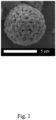
- Fig. 1 is a scanning electron microscopy image of a core-shell structure surface of the battery according to the comparative embodiment.
- the comparative embodiment is a battery.
- An anode thereof includes a composition.
- the composition includes the core-shell structure.
- the core-shell structure includes a core material and a shell material. The shell material is farther away from a center of the core-shell structure than the core material.
- the core material includes a structural element oxide.
- the structural element oxide includes a niobium-titanium complex oxide.
- the shell material includes a silicon material.
- the particle diameter of the niobium-titanium complex oxide is Dtn
- the particle diameter of the silicon material at D50 is sD50
- tWc 1.00
- tWs 0.05
- tWc/tWs 20.0.
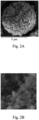
- Fig. 2A is a scanning electron microscopy image of a core-shell structure surface of the battery according to the 1st embodiment.
- Fig. 2B is a scanning electron microscopy image of the core-shell structure surface in an area of 0.02 ⁇ R 2 ⁇ m 2 according to the 1st embodiment.
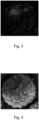
- Fig. 3 is an element distribution image of the core-shell structure surface according to the 1st embodiment.
- Fig. 4 is an overlapping result of the scanning electron microscopy image and the element distribution image of the core-shell structure surface according to the 1st embodiment.
- the 1st embodiment is a battery.
- An anode thereof includes a composition.
- the composition includes the core-shell structure.
- the core-shell structure includes a core material and a shell material. The shell material is farther away from a center of the core-shell structure than the core material.
- the core material includes a structural element oxide.
- the structural element oxide includes a niobium-titanium complex oxide.
- the shell material includes a mixed material.
- the mixed material includes a modified silicon material.
- the modified silicon material includes a silicon material and a polymer.
- the polymer is polymerized from at least two types of monomers.
- the at least two types of monomers include a first monomer and a second monomer.
- the first monomer is MPS
- the second monomer is DMAEMA.
- the particle diameter of the niobium-titanium complex oxide is Dtn
- the particle diameter of the silicon material at D50 is sD50
- the 2nd embodiment is a battery.
- An anode thereof includes a composition.
- the composition includes a core-shell structure.
- the core-shell structure includes a core material and a shell material. The shell material is farther away from a center of the core-shell structure than the core material.
- the core material includes a structural element oxide.
- the structural element oxide includes a niobium-titanium complex oxide.
- the shell material includes a mixed material.
- the mixed material includes a modified silicon material.
- the modified silicon material includes a silicon material and a polymer.
- the polymer is polymerized from at least two types of monomers.
- the at least two types of monomers include a first monomer and a second monomer.
- the first monomer is MPS
- the second monomer is DMAEMA.
- the 3rd embodiment is a battery.
- An anode thereof includes a composition.
- the composition includes a core-shell structure.
- the core-shell structure includes a core material and a shell material. The shell material is farther away from a center of the core-shell structure than the core material.
- the core material includes a structural element oxide.
- the structural element oxide includes a niobium-titanium complex oxide.
- the shell material includes a mixed material.
- the mixed material includes a modified silicon material.
- the modified silicon material includes a silicon material and a polymer.
- the polymer is polymerized from at least two types of monomers.
- the at least two types of monomers include a first monomer and a second monomer.
- the first monomer is MPS
- the second monomer is DMAEMA.
- the 4th embodiment is a battery.
- An anode thereof includes a composition.
- the composition includes a core-shell structure.
- the core-shell structure includes a core material and a shell material. The shell material is farther away from a center of the core-shell structure than the core material.
- the core material includes a structural element oxide.
- the structural element oxide includes a niobium-titanium complex oxide.
- the shell material includes a mixed material.
- the mixed material includes a modified silicon material.
- the modified silicon material includes a silicon material and a polymer.
- the polymer is polymerized from at least two types of monomers.
- the at least two types of monomers include a first monomer and a second monomer.
- the first monomer is MPS
- the second monomer is DMAEMA.
- the 5th embodiment is a battery.
- An anode thereof includes a composition.
- the composition includes a core-shell structure.
- the core-shell structure includes a core material and a shell material. The shell material is farther away from a center of the core-shell structure than the core material.
- the core material includes a structural element oxide.
- the structural element oxide includes a niobium-titanium complex oxide.
- the shell material includes a mixed material.
- the mixed material includes a modified silicon material.
- the modified silicon material includes a silicon material and a polymer.
- the polymer is polymerized from at least two types of monomers.
- the at least two types of monomers include a first monomer and a second monomer.
- the first monomer is MPS
- the second monomer is DMAEMA.
- the 6th embodiment is a battery.
- An anode thereof includes a composition.
- the composition includes a core-shell structure.
- the core-shell structure includes a core material and a shell material. The shell material is farther away from a center of the core-shell structure than the core material.
- the core material includes a structural element oxide.
- the structural element oxide includes a niobium-titanium complex oxide.
- the shell material includes a mixed material.
- the mixed material includes a modified silicon material.
- the modified silicon material includes a silicon material and a polymer.
- the polymer is polymerized from at least two types of monomers.
- the at least two types of monomers include a first monomer and a second monomer.
- the first monomer is MPS
- the second monomer is DMAEMA.
- the 7th embodiment is a battery.
- An anode thereof includes a composition.
- the composition includes a core-shell structure.
- the core-shell structure includes a core material and a shell material. The shell material is farther away from a center of the core-shell structure than the core material.
- the core material includes a structural element oxide.
- the structural element oxide includes a niobium-titanium complex oxide.
- the shell material includes a mixed material.
- the mixed material includes a modified silicon material.
- the modified silicon material includes a silicon material and a polymer.
- the polymer is polymerized from at least two types of monomers.
- the at least two types of monomers include a first monomer and a second monomer.
- the first monomer is MPS
- the second monomer is DMAEMA.
- the 8th embodiment is a battery.
- An anode thereof includes a composition.
- the composition includes a core-shell structure.
- the core-shell structure includes a core material and a shell material. The shell material is farther away from a center of the core-shell structure than the core material.
- the core material includes a structural element oxide.
- the structural element oxide includes a niobium-titanium complex oxide.
- the shell material includes a mixed material.
- the mixed material includes a modified silicon material.
- the modified silicon material includes a silicon material and a polymer.
- the polymer is polymerized from at least two types of monomers.
- the at least two types of monomers include a first monomer and a second monomer.
- the first monomer is MPS
- the second monomer is DMAEMA.
- the 9th embodiment is a battery.
- An anode thereof includes a composition.
- the composition includes a core-shell structure.
- the core-shell structure includes a core material and a shell material. The shell material is farther away from a center of the core-shell structure than the core material.
- the core material includes a structural element oxide.
- the structural element oxide includes a niobium-titanium complex oxide.
- the shell material includes a mixed material.
- the mixed material includes a modified silicon material.
- the modified silicon material includes a silicon material and a polymer.
- the polymer is polymerized from at least two types of monomers.
- the at least two types of monomers include a first monomer and a second monomer.
- the first monomer is MPS
- the second monomer is DMAEMA.
- the 10th embodiment is a battery.
- An anode thereof includes a composition.
- the composition includes a core-shell structure.
- the core-shell structure includes a core material and a shell material. The shell material is farther away from a center of the core-shell structure than the core material.
- the core material includes a structural element oxide.
- the structural element oxide includes a niobium-titanium complex oxide.
- the shell material includes a mixed material.
- the mixed material includes a modified silicon material.
- the modified silicon material includes a silicon material and a polymer.
- the polymer is polymerized from at least two types of monomers.
- the at least two types of monomers include a first monomer and a second monomer.
- the first monomer is MPS
- the second monomer is DMAEMA.
- the 11th embodiment is a battery.
- An anode thereof includes a composition.
- the composition includes a core-shell structure.
- the core-shell structure includes a core material and a shell material. The shell material is farther away from a center of the core-shell structure than the core material.
- the core material includes a structural element oxide.
- the structural element oxide includes a lithium-titanium complex oxide.
- the shell material includes a mixed material.
- the mixed material includes a modified silicon material.
- the modified silicon material includes a silicon material and a polymer.
- the polymer is polymerized from at least two types of monomers.
- the at least two types of monomers include a first monomer and a second monomer.
- the first monomer is MPS
- the second monomer is AA.
- the 12th embodiment is a battery.
- An anode thereof includes a composition.
- the composition includes a core-shell structure.
- the core-shell structure includes a core material and a shell material. The shell material is farther away from a center of the core-shell structure than the core material.
- the core material includes a structural element oxide.
- the structural element oxide includes a structural element complex oxide.
- the shell material includes a mixed material.
- the mixed material includes a modified silicon material.
- the modified silicon material includes a silicon material and a polymer.
- the polymer is polymerized from at least two types of monomers.
- the at least two types of monomers include a first monomer and a second monomer.
- the first monomer is MPS
- the second monomer is MMA.
- the 13th embodiment is a battery.
- An anode thereof includes a composition.
- the composition includes a core-shell structure.
- the core-shell structure includes a core material and a shell material. The shell material is farther away from a center of the core-shell structure than the core material.
- the core material includes a structural element oxide.
- the structural element oxide includes a structural element complex oxide.
- the shell material includes a mixed material.
- the mixed material includes a modified silicon material.
- the modified silicon material includes a silicon material and a polymer.
- the polymer is polymerized from at least two types of monomers.
- the at least two types of monomers include a first monomer and a second monomer.
- the first monomer is MPS
- the second monomer is MA.
- the 14th embodiment is a battery.
- An anode thereof includes a composition.
- the composition includes a core-shell structure.
- the core-shell structure includes a core material and a shell material. The shell material is farther away from a center of the core-shell structure than the core material.
- the core material includes a carbon active material.
- the carbon active material includes graphite.
- the shell material includes a mixed material.
- the mixed material includes a modified silicon material.
- the modified silicon material includes a silicon material and a polymer.
- the polymer is polymerized from at least two types of monomers.
- the at least two types of monomers include a first monomer and a second monomer.
- the first monomer is MPS
- the second monomer is 2EHA.
Landscapes
- Chemical & Material Sciences (AREA)
- Chemical Kinetics & Catalysis (AREA)
- Electrochemistry (AREA)
- General Chemical & Material Sciences (AREA)
- Composite Materials (AREA)
- Engineering & Computer Science (AREA)
- Inorganic Chemistry (AREA)
- Materials Engineering (AREA)
- Manufacturing & Machinery (AREA)
- Battery Electrode And Active Subsutance (AREA)
- Silicon Compounds (AREA)
- Inorganic Compounds Of Heavy Metals (AREA)
Applications Claiming Priority (1)
| Application Number | Priority Date | Filing Date | Title |
|---|---|---|---|
| US202363579965P | 2023-09-01 | 2023-09-01 |
Publications (1)
| Publication Number | Publication Date |
|---|---|
| EP4517876A1 true EP4517876A1 (de) | 2025-03-05 |
Family
ID=92583345
Family Applications (1)
| Application Number | Title | Priority Date | Filing Date |
|---|---|---|---|
| EP24196740.5A Pending EP4517876A1 (de) | 2023-09-01 | 2024-08-27 | Zusammensetzung, anode und batterie |
Country Status (6)
| Country | Link |
|---|---|
| US (1) | US20260074195A1 (de) |
| EP (1) | EP4517876A1 (de) |
| JP (1) | JP2025036342A (de) |
| KR (1) | KR20250033970A (de) |
| CN (1) | CN119560516A (de) |
| TW (1) | TW202512556A (de) |
Citations (6)
| Publication number | Priority date | Publication date | Assignee | Title |
|---|---|---|---|---|
| US20200194785A1 (en) * | 2018-12-13 | 2020-06-18 | Samsung Electronics Co., Ltd. | Negative active material, lithium secondary battery including the negative active material, and method of preparing the negative active material |
| US20210296650A1 (en) * | 2020-03-19 | 2021-09-23 | Global Graphene Group, Inc. | Conducting polymer network-protected cathode active materials for lithium secondary batteries |
| WO2022178246A1 (en) * | 2021-02-19 | 2022-08-25 | The Regents Of The University Of California | Long-cycle-life, high-capacity silicon anodes and methods of making and using the same |
| CN116190588A (zh) * | 2021-11-26 | 2023-05-30 | 三星Sdi株式会社 | 复合负极活性物质、包括其的负极和锂电池 |
| US20230238571A1 (en) * | 2022-01-27 | 2023-07-27 | Global Graphene Group, Inc. | Conducting Polymer/Inorganic Hybrid Solid-State Electrolytes, Lithium Batteries Containing Same, and Production Processes |
| CN117199251A (zh) * | 2022-06-08 | 2023-12-08 | 星欧光学股份有限公司 | 电池材料、负极、电池与电池制备方法 |
Family Cites Families (5)
| Publication number | Priority date | Publication date | Assignee | Title |
|---|---|---|---|---|
| JP6011785B2 (ja) * | 2012-07-20 | 2016-10-19 | 住友金属鉱山株式会社 | 非水電解質二次電池用正極活物質およびその製造方法 |
| JP6382649B2 (ja) * | 2013-09-20 | 2018-08-29 | 株式会社東芝 | 非水電解質二次電池用負極活物質材料、非水電解質電池、電池パック及び車両 |
| JP6102837B2 (ja) * | 2014-06-20 | 2017-03-29 | 住友金属鉱山株式会社 | 被覆リチウム−ニッケル複合酸化物粒子及び被覆リチウム−ニッケル複合酸化物粒子の製造方法 |
| JPWO2021090656A1 (de) * | 2019-11-07 | 2021-05-14 | ||
| JP7109494B2 (ja) * | 2020-03-10 | 2022-07-29 | 三洋化成工業株式会社 | リチウムイオン電池用電極 |
-
2024
- 2024-08-15 US US18/805,689 patent/US20260074195A1/en active Pending
- 2024-08-27 EP EP24196740.5A patent/EP4517876A1/de active Pending
- 2024-08-28 KR KR1020240116080A patent/KR20250033970A/ko active Pending
- 2024-08-29 JP JP2024147719A patent/JP2025036342A/ja active Pending
- 2024-08-30 TW TW113132943A patent/TW202512556A/zh unknown
- 2024-08-30 CN CN202411207718.8A patent/CN119560516A/zh active Pending
Patent Citations (7)
| Publication number | Priority date | Publication date | Assignee | Title |
|---|---|---|---|---|
| US20200194785A1 (en) * | 2018-12-13 | 2020-06-18 | Samsung Electronics Co., Ltd. | Negative active material, lithium secondary battery including the negative active material, and method of preparing the negative active material |
| US20210296650A1 (en) * | 2020-03-19 | 2021-09-23 | Global Graphene Group, Inc. | Conducting polymer network-protected cathode active materials for lithium secondary batteries |
| WO2022178246A1 (en) * | 2021-02-19 | 2022-08-25 | The Regents Of The University Of California | Long-cycle-life, high-capacity silicon anodes and methods of making and using the same |
| CN116190588A (zh) * | 2021-11-26 | 2023-05-30 | 三星Sdi株式会社 | 复合负极活性物质、包括其的负极和锂电池 |
| US20230170476A1 (en) * | 2021-11-26 | 2023-06-01 | Samsung Sdi Co., Ltd. | Composite anode active material, anode and lithium battery including the same |
| US20230238571A1 (en) * | 2022-01-27 | 2023-07-27 | Global Graphene Group, Inc. | Conducting Polymer/Inorganic Hybrid Solid-State Electrolytes, Lithium Batteries Containing Same, and Production Processes |
| CN117199251A (zh) * | 2022-06-08 | 2023-12-08 | 星欧光学股份有限公司 | 电池材料、负极、电池与电池制备方法 |
Also Published As
| Publication number | Publication date |
|---|---|
| JP2025036342A (ja) | 2025-03-14 |
| US20260074195A1 (en) | 2026-03-12 |
| CN119560516A (zh) | 2025-03-04 |
| TW202512556A (zh) | 2025-03-16 |
| KR20250033970A (ko) | 2025-03-10 |
Similar Documents
| Publication | Publication Date | Title |
|---|---|---|
| CN116349050A (zh) | 电解液、二次电池、电池模块、电池包和用电装置 | |
| KR20150027686A (ko) | 리튬 이차 전지용 전극 및 이를 포함하는 리튬 이차 전지 | |
| US8563179B2 (en) | Nonaqueous secondary battery | |
| EP4636839A2 (de) | Zusammensetzung, anode und batterie | |
| EP4369433A1 (de) | Kathode für lithiumsekundärbatterie und lithiumsekundärbatterie damit | |
| US10340514B2 (en) | Negative electrode for lithium ion secondary battery, and lithium ion secondary battery | |
| KR102949828B1 (ko) | 배터리 물질, 애노드, 배터리 및 배터리의 제조방법 | |
| EP4517876A1 (de) | Zusammensetzung, anode und batterie | |
| EP4191706A2 (de) | Lithiumsekundärbatterie | |
| EP4700844A1 (de) | Anodenzusammensetzung, anode und batterie | |
| TWI885599B (zh) | 組成物、負極與電池 | |
| TW202610079A (zh) | 負極組成物、負極與電池 | |
| BR102025005789A2 (pt) | Composição, ânodo e bateria | |
| KR20240175245A (ko) | 리튬 이차 전지 | |
| KR20260031683A (ko) | 양극 및 이를 포함하는 리튬 이차 전지 | |
| CN121885567A (zh) | 可再充电锂电池 | |
| KR20260062977A (ko) | 이차 전지, 이의 제조 방법 및 이차 전지를 포함하는 장치 | |
| JP2024504152A (ja) | リチウム二次電池用非水電解液およびそれを含むリチウム二次電池 |
Legal Events
| Date | Code | Title | Description |
|---|---|---|---|
| PUAI | Public reference made under article 153(3) epc to a published international application that has entered the european phase |
Free format text: ORIGINAL CODE: 0009012 |
|
| STAA | Information on the status of an ep patent application or granted ep patent |
Free format text: STATUS: REQUEST FOR EXAMINATION WAS MADE |
|
| 17P | Request for examination filed |
Effective date: 20240827 |
|
| AK | Designated contracting states |
Kind code of ref document: A1 Designated state(s): AL AT BE BG CH CY CZ DE DK EE ES FI FR GB GR HR HU IE IS IT LI LT LU LV MC ME MK MT NL NO PL PT RO RS SE SI SK SM TR |