EP4517875A1 - Positivelektrodenaktivmaterial und herstellungsverfahren dafür, sekundärbatterie und elektrische vorrichtung - Google Patents
Positivelektrodenaktivmaterial und herstellungsverfahren dafür, sekundärbatterie und elektrische vorrichtung Download PDFInfo
- Publication number
- EP4517875A1 EP4517875A1 EP23896104.9A EP23896104A EP4517875A1 EP 4517875 A1 EP4517875 A1 EP 4517875A1 EP 23896104 A EP23896104 A EP 23896104A EP 4517875 A1 EP4517875 A1 EP 4517875A1
- Authority
- EP
- European Patent Office
- Prior art keywords
- active material
- positive active
- optionally
- lithium
- ppm
- Prior art date
- Legal status (The legal status is an assumption and is not a legal conclusion. Google has not performed a legal analysis and makes no representation as to the accuracy of the status listed.)
- Pending
Links
Images

Classifications
-
- H—ELECTRICITY
- H01—ELECTRIC ELEMENTS
- H01M—PROCESSES OR MEANS, e.g. BATTERIES, FOR THE DIRECT CONVERSION OF CHEMICAL ENERGY INTO ELECTRICAL ENERGY
- H01M4/00—Electrodes
- H01M4/02—Electrodes composed of, or comprising, active material
- H01M4/36—Selection of substances as active materials, active masses, active liquids
- H01M4/48—Selection of substances as active materials, active masses, active liquids of inorganic oxides or hydroxides
- H01M4/52—Selection of substances as active materials, active masses, active liquids of inorganic oxides or hydroxides of nickel, cobalt or iron
- H01M4/525—Selection of substances as active materials, active masses, active liquids of inorganic oxides or hydroxides of nickel, cobalt or iron of mixed oxides or hydroxides containing iron, cobalt or nickel for inserting or intercalating light metals, e.g. LiNiO2, LiCoO2 or LiCoOxFy
-
- C—CHEMISTRY; METALLURGY
- C01—INORGANIC CHEMISTRY
- C01G—COMPOUNDS CONTAINING METALS NOT COVERED BY SUBCLASSES C01D OR C01F
- C01G53/00—Compounds of nickel
- C01G53/80—Compounds containing nickel, with or without oxygen or hydrogen, and containing one or more other elements
- C01G53/84—Hydroxides
-
- C—CHEMISTRY; METALLURGY
- C01—INORGANIC CHEMISTRY
- C01G—COMPOUNDS CONTAINING METALS NOT COVERED BY SUBCLASSES C01D OR C01F
- C01G53/00—Compounds of nickel
- C01G53/40—Complex oxides containing nickel and at least one other metal element
- C01G53/42—Complex oxides containing nickel and at least one other metal element containing alkali metals, e.g. LiNiO2
-
- C—CHEMISTRY; METALLURGY
- C01—INORGANIC CHEMISTRY
- C01G—COMPOUNDS CONTAINING METALS NOT COVERED BY SUBCLASSES C01D OR C01F
- C01G53/00—Compounds of nickel
- C01G53/40—Complex oxides containing nickel and at least one other metal element
- C01G53/42—Complex oxides containing nickel and at least one other metal element containing alkali metals, e.g. LiNiO2
- C01G53/44—Complex oxides containing nickel and at least one other metal element containing alkali metals, e.g. LiNiO2 containing manganese
- C01G53/50—Complex oxides containing nickel and at least one other metal element containing alkali metals, e.g. LiNiO2 containing manganese of the type (MnO2)n-, e.g. Li(NixMn1-x)O2 or Li(MyNixMn1-x-y)O2
- C01G53/502—Complex oxides containing nickel and at least one other metal element containing alkali metals, e.g. LiNiO2 containing manganese of the type (MnO2)n-, e.g. Li(NixMn1-x)O2 or Li(MyNixMn1-x-y)O2 containing lithium and cobalt
- C01G53/504—Complex oxides containing nickel and at least one other metal element containing alkali metals, e.g. LiNiO2 containing manganese of the type (MnO2)n-, e.g. Li(NixMn1-x)O2 or Li(MyNixMn1-x-y)O2 containing lithium and cobalt with the molar ratio of nickel with respect to all the metals other than alkali metals higher than or equal to 0.5, e.g. Li(MzNixCoyMn1-x-y-z)O2 with x ≥ 0.5
- C01G53/506—Complex oxides containing nickel and at least one other metal element containing alkali metals, e.g. LiNiO2 containing manganese of the type (MnO2)n-, e.g. Li(NixMn1-x)O2 or Li(MyNixMn1-x-y)O2 containing lithium and cobalt with the molar ratio of nickel with respect to all the metals other than alkali metals higher than or equal to 0.5, e.g. Li(MzNixCoyMn1-x-y-z)O2 with x ≥ 0.5 with the molar ratio of nickel with respect to all the metals other than alkali metals higher than or equal to 0.8, e.g. Li(MzNixCoyMn1-x-y-z)O2 with x ≥ 0.8
-
- H—ELECTRICITY
- H01—ELECTRIC ELEMENTS
- H01M—PROCESSES OR MEANS, e.g. BATTERIES, FOR THE DIRECT CONVERSION OF CHEMICAL ENERGY INTO ELECTRICAL ENERGY
- H01M10/00—Secondary cells; Manufacture thereof
- H01M10/05—Accumulators with non-aqueous electrolyte
-
- H—ELECTRICITY
- H01—ELECTRIC ELEMENTS
- H01M—PROCESSES OR MEANS, e.g. BATTERIES, FOR THE DIRECT CONVERSION OF CHEMICAL ENERGY INTO ELECTRICAL ENERGY
- H01M10/00—Secondary cells; Manufacture thereof
- H01M10/05—Accumulators with non-aqueous electrolyte
- H01M10/052—Li-accumulators
- H01M10/0525—Rocking-chair batteries, i.e. batteries with lithium insertion or intercalation in both electrodes; Lithium-ion batteries
-
- H—ELECTRICITY
- H01—ELECTRIC ELEMENTS
- H01M—PROCESSES OR MEANS, e.g. BATTERIES, FOR THE DIRECT CONVERSION OF CHEMICAL ENERGY INTO ELECTRICAL ENERGY
- H01M4/00—Electrodes
- H01M4/02—Electrodes composed of, or comprising, active material
- H01M4/13—Electrodes for accumulators with non-aqueous electrolyte, e.g. for lithium-accumulators; Processes of manufacture thereof
- H01M4/131—Electrodes based on mixed oxides or hydroxides, or on mixtures of oxides or hydroxides, e.g. LiCoOx
-
- H—ELECTRICITY
- H01—ELECTRIC ELEMENTS
- H01M—PROCESSES OR MEANS, e.g. BATTERIES, FOR THE DIRECT CONVERSION OF CHEMICAL ENERGY INTO ELECTRICAL ENERGY
- H01M4/00—Electrodes
- H01M4/02—Electrodes composed of, or comprising, active material
- H01M4/13—Electrodes for accumulators with non-aqueous electrolyte, e.g. for lithium-accumulators; Processes of manufacture thereof
- H01M4/139—Processes of manufacture
- H01M4/1391—Processes of manufacture of electrodes based on mixed oxides or hydroxides, or on mixtures of oxides or hydroxides, e.g. LiCoOx
-
- H—ELECTRICITY
- H01—ELECTRIC ELEMENTS
- H01M—PROCESSES OR MEANS, e.g. BATTERIES, FOR THE DIRECT CONVERSION OF CHEMICAL ENERGY INTO ELECTRICAL ENERGY
- H01M4/00—Electrodes
- H01M4/02—Electrodes composed of, or comprising, active material
- H01M4/36—Selection of substances as active materials, active masses, active liquids
- H01M4/362—Composites
- H01M4/366—Composites as layered products
-
- H—ELECTRICITY
- H01—ELECTRIC ELEMENTS
- H01M—PROCESSES OR MEANS, e.g. BATTERIES, FOR THE DIRECT CONVERSION OF CHEMICAL ENERGY INTO ELECTRICAL ENERGY
- H01M4/00—Electrodes
- H01M4/02—Electrodes composed of, or comprising, active material
- H01M4/36—Selection of substances as active materials, active masses, active liquids
- H01M4/48—Selection of substances as active materials, active masses, active liquids of inorganic oxides or hydroxides
- H01M4/50—Selection of substances as active materials, active masses, active liquids of inorganic oxides or hydroxides of manganese
- H01M4/505—Selection of substances as active materials, active masses, active liquids of inorganic oxides or hydroxides of manganese of mixed oxides or hydroxides containing manganese for inserting or intercalating light metals, e.g. LiMn2O4 or LiMn2OxFy
-
- C—CHEMISTRY; METALLURGY
- C01—INORGANIC CHEMISTRY
- C01P—INDEXING SCHEME RELATING TO STRUCTURAL AND PHYSICAL ASPECTS OF SOLID INORGANIC COMPOUNDS
- C01P2002/00—Crystal-structural characteristics
- C01P2002/50—Solid solutions
- C01P2002/52—Solid solutions containing elements as dopants
-
- C—CHEMISTRY; METALLURGY
- C01—INORGANIC CHEMISTRY
- C01P—INDEXING SCHEME RELATING TO STRUCTURAL AND PHYSICAL ASPECTS OF SOLID INORGANIC COMPOUNDS
- C01P2004/00—Particle morphology
- C01P2004/51—Particles with a specific particle size distribution
-
- C—CHEMISTRY; METALLURGY
- C01—INORGANIC CHEMISTRY
- C01P—INDEXING SCHEME RELATING TO STRUCTURAL AND PHYSICAL ASPECTS OF SOLID INORGANIC COMPOUNDS
- C01P2004/00—Particle morphology
- C01P2004/60—Particles characterised by their size
- C01P2004/61—Micrometer sized, i.e. from 1-100 micrometer
-
- C—CHEMISTRY; METALLURGY
- C01—INORGANIC CHEMISTRY
- C01P—INDEXING SCHEME RELATING TO STRUCTURAL AND PHYSICAL ASPECTS OF SOLID INORGANIC COMPOUNDS
- C01P2004/00—Particle morphology
- C01P2004/80—Particles consisting of a mixture of two or more inorganic phases
- C01P2004/82—Particles consisting of a mixture of two or more inorganic phases two phases having the same anion, e.g. both oxidic phases
- C01P2004/84—Particles consisting of a mixture of two or more inorganic phases two phases having the same anion, e.g. both oxidic phases one phase coated with the other
-
- C—CHEMISTRY; METALLURGY
- C01—INORGANIC CHEMISTRY
- C01P—INDEXING SCHEME RELATING TO STRUCTURAL AND PHYSICAL ASPECTS OF SOLID INORGANIC COMPOUNDS
- C01P2004/00—Particle morphology
- C01P2004/80—Particles consisting of a mixture of two or more inorganic phases
- C01P2004/82—Particles consisting of a mixture of two or more inorganic phases two phases having the same anion, e.g. both oxidic phases
- C01P2004/84—Particles consisting of a mixture of two or more inorganic phases two phases having the same anion, e.g. both oxidic phases one phase coated with the other
- C01P2004/86—Thin layer coatings, i.e. the coating thickness being less than 0.1 time the particle radius
-
- C—CHEMISTRY; METALLURGY
- C01—INORGANIC CHEMISTRY
- C01P—INDEXING SCHEME RELATING TO STRUCTURAL AND PHYSICAL ASPECTS OF SOLID INORGANIC COMPOUNDS
- C01P2006/00—Physical properties of inorganic compounds
- C01P2006/11—Powder tap density
-
- C—CHEMISTRY; METALLURGY
- C01—INORGANIC CHEMISTRY
- C01P—INDEXING SCHEME RELATING TO STRUCTURAL AND PHYSICAL ASPECTS OF SOLID INORGANIC COMPOUNDS
- C01P2006/00—Physical properties of inorganic compounds
- C01P2006/40—Electric properties
-
- H—ELECTRICITY
- H01—ELECTRIC ELEMENTS
- H01M—PROCESSES OR MEANS, e.g. BATTERIES, FOR THE DIRECT CONVERSION OF CHEMICAL ENERGY INTO ELECTRICAL ENERGY
- H01M4/00—Electrodes
- H01M4/02—Electrodes composed of, or comprising, active material
- H01M2004/021—Physical characteristics, e.g. porosity, surface area
-
- H—ELECTRICITY
- H01—ELECTRIC ELEMENTS
- H01M—PROCESSES OR MEANS, e.g. BATTERIES, FOR THE DIRECT CONVERSION OF CHEMICAL ENERGY INTO ELECTRICAL ENERGY
- H01M4/00—Electrodes
- H01M4/02—Electrodes composed of, or comprising, active material
- H01M2004/026—Electrodes composed of, or comprising, active material characterised by the polarity
- H01M2004/028—Positive electrodes
-
- H—ELECTRICITY
- H01—ELECTRIC ELEMENTS
- H01M—PROCESSES OR MEANS, e.g. BATTERIES, FOR THE DIRECT CONVERSION OF CHEMICAL ENERGY INTO ELECTRICAL ENERGY
- H01M2220/00—Batteries for particular applications
- H01M2220/20—Batteries in motive systems, e.g. vehicle, ship, plane
-
- Y—GENERAL TAGGING OF NEW TECHNOLOGICAL DEVELOPMENTS; GENERAL TAGGING OF CROSS-SECTIONAL TECHNOLOGIES SPANNING OVER SEVERAL SECTIONS OF THE IPC; TECHNICAL SUBJECTS COVERED BY FORMER USPC CROSS-REFERENCE ART COLLECTIONS [XRACs] AND DIGESTS
- Y02—TECHNOLOGIES OR APPLICATIONS FOR MITIGATION OR ADAPTATION AGAINST CLIMATE CHANGE
- Y02E—REDUCTION OF GREENHOUSE GAS [GHG] EMISSIONS, RELATED TO ENERGY GENERATION, TRANSMISSION OR DISTRIBUTION
- Y02E60/00—Enabling technologies; Technologies with a potential or indirect contribution to GHG emissions mitigation
- Y02E60/10—Energy storage using batteries
Definitions
- the present application relates to the technical field of lithium batteries, and in particular, to a positive active material and a preparation method therefor, and a secondary battery and an electrical device including the positive active material.
- lithium-ion batteries have been widely used in energy storage power systems such as hydropower, thermal power, wind power and solar power stations, as well as a plurality of fields such as power tools, electric bicycles, electric motorcycles, electric vehicles, military equipment, and aerospace.
- energy storage power systems such as hydropower, thermal power, wind power and solar power stations
- a plurality of fields such as power tools, electric bicycles, electric motorcycles, electric vehicles, military equipment, and aerospace.
- higher requirements have been put forward for their energy density, cycle performance and safety performance.
- the positive electrode material is an important component of the lithium-ion batteries. It not only affects the safety and cost of the batteries, but also is a key factor that directly determines the electrochemical performance and life of the batteries.
- common positive electrode materials include layered structure materials (such as lithium cobalt oxide, lithium manganese oxide, and lithium nickel oxide), spinel structure materials, polyanion materials and ternary materials, etc.
- layered lithium-rich ternary positive electrode materials are a type of positive electrode material that has attracted much attention in recent years.
- the present application is made in view of the above-mentioned problems, and aims to provide a positive active material with improved structural stability and high compaction density, and to provide a preparation method for the positive active material, as well as a positive electrode plate, a secondary battery and an electrical device including the positive active material of the present application.
- the positive active material is in a shape of particles, including a lithium-rich layer extending from a particle surface to an interior of the particle.
- a ratio of an average Li element content per unit area in the lithium-rich layer to an average Li element content per unit area in the non-lithium-rich layer is (> 1 to 1.5): 1, and optionally (1.05 to 1.2): 1.
- the present application at least includes the following beneficial effects:
- the positive active material satisfies the above formula, the positive active material has good structural stability, and the lithium-rich layer structure of the positive active material can maintain a stable layered structure in the charge and discharge process, inhibit the inter-layer migration of Ni, and reduce oxygen release, thereby improving the cycle performance and safety performance of the battery.
- the Dv50 of the positive active material is 5 to 15 ⁇ m, optionally 8 to 10 ⁇ m.
- the positive active material has good structural stability, and the lithium-rich layer structure of the positive active material can maintain a stable layered structure in the charge and discharge process, inhibit the inter-layer migration of Ni, and reduce oxygen release, thereby improving the cycle performance and safety performance of the battery.
- a lithium-nickel mixing degree of the positive active material is ⁇ 5%, optionally ⁇ 3%.
- the lithium-rich layer structure of the positive active material of the present application effectively reduces the lithium-nickel mixing degree of the positive active material, maintains the stability of the layered structure, and thus improves the cycle performance and safety performance of the battery.
- a weight ratio of the M1 element to the M2 element in the positive active material is 1:0.1 to 1:1, optionally 1:0.1 to 1:0.5.
- the structural stability of the material can be improved, thereby improving the cycle performance and safety performance of the battery.
- the positive active material further has a coating, and a chemical formula of the coating is Li e CoO 2 , where 0 ⁇ e ⁇ 1.
- the coating Li e CoO 2 can effectively prevent the electrolyte solution from having side reactions on the surface of the positive active material, reduce oxygen release, and further improve the cycle performance and safety performance of the battery.
- the coating has a thickness of 0.01 to 0.2 ⁇ m, optionally 0.05 to 0.1 ⁇ m.
- the coating has a thickness within the above range, it can effectively prevent the electrolyte solution from having side reactions on the surface of the positive active material, thereby further improving the cycle performance and safety performance of the battery.
- a weight ratio of the coating to the positive active material is (0.002 to 0.02):1, optionally (0.005-0.012):1.
- the weight ratio of the coating to the positive active material satisfies the above range, the cycle performance and safety performance of the battery are effectively improved.
- (Dv90-Dv10)/Dv50 of the positive active material is ⁇ 1.1, optionally ⁇ 1.2.
- the filling degree between particles is high, the dispersibility is good, and the energy density of the battery can be effectively improved.
- a compaction density of the positive active material under a pressure of 5000 kg/1.33 cm 2 is ⁇ 3.4 g/cm 3 .
- the positive active material has a high compaction density, which can effectively improve the energy density of the battery.
- a second aspect of the present application provides a preparation method for a positive active material, the method includes the following steps:
- the positive active material with the lithium-rich layer structure prepared by the above method not only has a high compaction density, which can effectively improve the energy density of the battery, but also has improved structural stability and effectively prevents the electrolyte solution from having side reactions on the surface of the positive active material, thereby improving the cycle performance and safety performance of the battery.
- the compound containing the M1 element is one or more of an oxide, hydroxide, carbonate, oxalate or nitrate containing the M1 element, and an amount of the M1 element added in the step S1) is 2000 to 5000 ppm, optionally 3000 to 4000 ppm, based on a weight of the precursor of the positive active material; and the compound containing the M2 element is one or more of an oxide, hydroxide, carbonate, oxalate or nitrate containing the M2 element, and an amount of the M2 element added in the step S1) is 200 to 2000 ppm, optionally 400 to 1000 ppm, based on the weight of the precursor of the positive active material.
- the obtained positive active material can have improved structural stability, thereby improving the cycle performance and safety performance of the battery.
- the soluble Co-containing compound is selected from one or more of Co(CH 3 COO) 2 , CoC 2 O 4 , CoSO 4 , Co(NO 3 ) 2 or CoCl 2 , and an amount of Co element added in the step S2) is 1000 to 20000 ppm, optionally 5000 to 13000 ppm, based on a weight of the precursor of the positive active material; and the soluble Li-containing compound is selected from one or more of Li 2 SO 4 , LiNO 3 , LiC 2 O 4 , CH 3 COOLi or LiCl, and an amount of Li element added in the step S2) is 500 to 5000 ppm, optionally 1000 to 1500 ppm, based on the weight of the precursor of the positive active material.
- a water washing temperature is 0 to 100 °C, optionally 5 to 50 °C, and water washing time is 1 to 30 min, optionally 2 to 5 min.
- the drying is vacuum drying, and a drying temperature is 40 to 120 °C, optionally 80 to 100 °C, and drying time is 6 to 24 h, optionally 12 to 18 h.
- the method further includes step S3): mixing the positive active material obtained in step S2) with a Co-containing compound and a Li-containing compound, sintering at a temperature of 500 to 800 °C, optionally 550 to 750 °C, for sintering time of 5 to 15 h, optionally 5 to 10 h, and in an air or O 2 sintering atmosphere, to obtain a positive active material with a coating, where a chemical formula of the coating is Li e CoO 2 , where 0 ⁇ e ⁇ 1.
- a coating layer can be formed on the positive active material, effectively preventing the electrolyte solution from having side reactions on the surface of the positive active material, reducing oxygen release, and further improving the cycle performance and safety performance of the battery.
- the Co-containing compound is selected from at least one of Co 3 O 4 , Co(OH) 2 , CoO, CoOOH, Co(CH 3 COO) 2 , CoC 2 O 4 or CoCO 3 , Dv50 of particles of the Co-containing compound is 0.001 to 10 ⁇ m, optionally 0.001 to 1 ⁇ m, and an amount of Co element added in the step S3) is 500 to 20000 ppm, optionally 2000 to 15000 ppm, based on the weight of the precursor of the positive active material; and the Li-containing compound is selected from at least one of LiOH ⁇ H 2 O, Li 2 CO 3 , Li 2 SO 4 , LiNO 3 , LiC 2 O 4 or CH 3 COOLi, Dv50 of particles of the Li-containing compound is 0.001 to 1 ⁇ m, optionally 0.01 to 0.05 ⁇ m, and an amount of Li element added in the step S3) is 100 to 3000 ppm, optionally 500 to 1500 ppm, based on the
- a third aspect of the present application provides a secondary battery, including the positive active material of the first aspect of the present application or the positive active material prepared by the method of the second aspect of the present application or a positive electrode plate of the third aspect of the present application.
- a fourth aspect of the present application provides an electrical device, including the secondary battery selected from the fourth aspect of the present application.
- the electrical device of the present application includes the secondary battery provided by the present application, and thus has at least the same advantages as the secondary battery.
- Range disclosed in the present application is limited in the form of lower limit and upper limit, and given range is limited by selecting a lower limit and an upper limit, and the selected lower limit and upper limit define the boundary of a special range.
- the range limited in this way may include end values or not include end values, and may be combined arbitrarily, that is, any lower limit may be combined with any upper limit to form a range. For example, if the range of 60 to 120 and 80 to 110 is listed for a particular parameter, it is understood that the range of 60 to 110 and 80 to 120 is also expected.
- any embodiments and optional embodiments in the present application may be combined with each other to form a new technical solution.
- any technical features and optional technical features in the present application may be combined with each other to form a new technical solution.
- the method includes steps (a) and (b), which means that the method may include steps (a) and (b) performed sequentially, or may include steps (b) and (a) performed sequentially.
- the method may further include step (c), which means that step (c) may be added to the method in any order, for example, the method may include steps (a), (b) and (c), or may include steps (a), (c) and (b), or may include steps (c), (a) and (b), etc.
- the term "or” is inclusive.
- the phrase “A or B” means “A, B, or both A and B “. More specifically, any of the following conditions satisfies the condition "A or B”: A is true (or exists) and B is false (or does not exist); A is false (or does not exist) and B is true (or exists); or both A and B are true (or exist).
- the electrochemical properties of materials are usually improved by surface coating, ion doping and other means.
- the positive active material is in a shape of particles, including a lithium-rich layer extending from a particle surface to an interior of the particle.
- a ratio of an average Li element content per unit area in the lithium-rich layer to an average Li element content per unit area in the non-lithium-rich layer is (> 1 to 1.5):1, and optionally (1.05 to 1.2):1.
- the positive active material has a lithium-rich layer structure, which can maintain a stable layered structure of the positive active material in the charge and discharge process, promote Ni to migrate within the layer, and effectively reduce the lithium-nickel mixing degree, and at the same time, the vacancy clusters formed by the migration of Ni can fix the activated lattice oxygen and reduce oxygen release, thereby improving the cycle performance and safety performance of the battery.
- the M1 and M2 elements doped in the positive active material can stabilize the lattice structure, and effectively improve the structural stability of the positive active material, thereby further improving the cycle performance and safety performance of the battery.
- a ratio of an average Li element content per unit area in the lithium-rich layer to an average Li element content per unit area in a non-lithium-rich layer is, for example, at least 1.01:1, at least 1.05:1, at least 1.1:1, at least 1.18:1, at least 1.2:1, at least 1.3:1, at least 1.4:1 or at least 1.5:1.
- the Li content and distribution change in the positive active material can be obtained by using the technology commonly used to detect the Li content known in the art, for example, using the PHI NanoTOFII time-of-flight secondary mass spectrometer of Ulvac-Phi Company of Japan to obtain the Li content and distribution change in the material.
- the positive active material satisfies the above formula, the positive active material has good structural stability, and the lithium-rich layer structure of the positive active material can maintain a stable layered structure in the charge and discharge process, inhibit the inter-layer migration of Ni, and reduce oxygen release, thereby improving the cycle performance and safety performance of the battery.
- the k is, for example, greater than 0.001, greater than 0.01, greater than 0.08, greater than 0.1, greater than 0.2, greater than 0.3, greater than 0.4, greater than 0.5 or greater than 0.6.
- the thickness t of the lithium-rich layer extending from the particle surface to the interior of the particle of the positive active material is, for example, greater than 0.00475 ⁇ m, greater than 0.0475 ⁇ m, greater than 0.38 ⁇ m, greater than 0.95 ⁇ m, greater than 1.425 ⁇ m, greater than 1.9 ⁇ m or greater than 2.85 ⁇ m.
- the Dv50 of the positive active material is 5 to 15 ⁇ m, optionally 8 to 10 ⁇ m.
- the positive active material has good structural stability, and the lithium-rich layer structure of the positive active material can maintain a stable layered structure in the charge and discharge process, inhibit the inter-layer migration of Ni, and reduce oxygen release, thereby improving the cycle performance and safety performance of the battery.
- a lithium-nickel mixing degree of the positive active material is ⁇ 5%, optionally ⁇ 3%. In other embodiments, the lithium-nickel mixing degree of the positive active material is, for example, ⁇ 5%, ⁇ 4%, ⁇ 3.5%, ⁇ 3%, ⁇ 2.5%, ⁇ 2%, ⁇ 1.5% or ⁇ 1%. Since the radius of Ni 2+ is very close to that of Li + , Ni 2+ in the transition metal layer can easily migrate to the lithium layer and occupy the site of lithium, causing cation mixing (i.e., lithium-nickel mixing), resulting in poor structural stability of the positive active material. The performance of the positive active material decreases as the degree of cation mixing increases.
- the lithium-rich layer structure of the positive active material of the present application can promote intra-layer migration of Ni and inhibit its inter-layer migration, effectively reduce the lithium-nickel mixing degree, and maintain the stability of the layered structure, and at the same time, the vacancy clusters formed by Ni migration can fix the activated lattice oxygen and reduce oxygen release, thereby improving the cycle performance and safety performance of the battery.
- the D8 Advance X-ray diffractometer (XRD) of Bruker Corporation of Germany can be used to obtain the XRD spectrum of the positive active material, and the lithium-nickel mixing degree value of the positive active material can be obtained through open-source software (i.e., GSAS software).
- XRD D8 Advance X-ray diffractometer
- a weight ratio of the M1 element to the M2 element in the positive active material is 1:0.1 to 1:1, optionally 1:0.1 to 1:0.5.
- the structural stability of the material can be improved, thereby improving the cycle performance and safety performance of the battery.
- the amount of the M1 element and the M2 element is measured by a detection technique commonly used to measure the content of doping elements known in the art, such as inductively coupled plasma emission spectroscopy (ICP).
- ICP inductively coupled plasma emission spectroscopy
- the positive active material further has a coating, and the chemical formula of which is Li e CoO 2 , where 0 ⁇ e ⁇ 1.
- the coating Li e CoO 2 can effectively prevent the electrolyte solution from having side reactions on the surface of the positive active material, reduce oxygen release, and further improve the cycle performance and safety performance of the battery.
- the coating has a thickness of 0.01 to 0.2 ⁇ m, optionally 0.05 to 0.1 ⁇ m.
- the coating has a thickness within the above range, it can effectively prevent the electrolyte solution from having side reactions on the surface of the positive active material, thereby further improving the cycle performance and safety performance of the battery.
- a weight ratio of the coating to the positive active material is (0.002 to 0.02):1, optionally (0.005 to 0.012):1.
- the weight ratio of the coating to the positive active material satisfies the above range, the cycle performance and safety performance of the battery are effectively improved.
- (Dv90-Dv10)/Dv50 of the positive active material is ⁇ 1.1, optionally ⁇ 1.2.
- the filling degree between particles is high, the dispersibility is good, and the energy density of the battery can be effectively improved.
- the Dv10, Dv50 and Dv90 are the particle diameters of the positive active material measured by volume-based particle size distribution, where the Dv10 is the corresponding particle diameter when the cumulative volume percentage of the sample reaches 10%, the Dv50 is the corresponding particle diameter when the cumulative volume percentage of the sample reaches 50%, and the Dv90 is the corresponding particle diameter when the cumulative volume percentage of the sample reaches 90% in a volume-based particle size distribution.
- a second aspect of the present application provides a preparation method for a positive active material, the method includes the following steps:
- the positive active material with the lithium-rich layer structure prepared by the above method not only has a high compaction density, which can effectively improve the energy density of the battery, but also has improved structural stability and effectively prevents the electrolyte solution from having side reactions on the surface of the positive active material, thereby improving the cycle performance and safety performance of the battery.
- a low-temperature co-heating temperature is, for example, 200 to 250 °C.
- a molar ratio of the Li element in the lithium source to the metal element in the precursor of the positive active material is 1.2 to 1.5, optionally 1.25 to 1.4, the metal element is Ni, Co and Mn, a sintering temperature is 600 to 850 °C, sintering time is 9 to 12 h, and a sintering atmosphere is air or oxygen, optionally oxygen.
- the molar ratio of the Li element to the metal element in the precursor, the sintering temperature and the sintering time can make the obtained positive active material have a high compaction density and improved structural stability.
- the compound containing the M1 element is one or more of oxide, hydroxide, carbonate, oxalate or nitrate containing the M1 element, and an amount of the M1 element added in the step S1) is 2000 to 5000 ppm, optionally 3000 to 4000 ppm, based on the weight of the precursor of the positive active material; and the compound containing the M2 element is one or more of oxide, hydroxide, carbonate, oxalate or nitrate containing the M2 element, and an amount of the M2 element added in the step S1) is 200 to 2000 ppm, optionally 400 to 1000 ppm, based on the weight of the precursor of the positive active material.
- the soluble Co-containing compound is selected from one or more of Co(CH 3 COO) 2 , CoC 2 O 4 , CoSO 4 , Co(NO 3 ) 2 or CoCl 2 , and an amount of Co element added in the step S2) is 1000 to 20000 ppm, optionally 5000 to 13000 ppm, based on the weight of the precursor of the positive active material; and the soluble Li-containing compound is selected from one or more of Li 2 SO 4 , LiNO 3 , LiC 2 O 4 , CH 3 COOLi or LiCl, and an amount of Li element added in the step S2) is 500 to 5000 ppm, optionally 1000 to 1500 ppm, based on the weight of the precursor of the positive active material.
- a positive active material having a lithium-rich layer structure can be obtained, thereby improving the cycle performance and safety performance of the battery.
- a water washing temperature is 0 to 100 °C, optionally 5 to 50 °C, and further optionally 10 to 30 °C, and water washing time is 1 to 30 min, optionally 2 to 5 min.
- the drying is vacuum drying, and a drying temperature is 40 to 120 °C, optionally 80 to 100 °C, and drying time is 6 to 24 h, optionally 12 to 18 h.
- the lithium source is selected from at least one of LiOH ⁇ H 2 O, Li 2 CO 3 , Li 2 SO 4 , LiNO 3 , LiC 2 O 4 or CH 3 COOLi, optionally at least one of LiOH ⁇ H 2 O, Li 2 SO 4 or LiNO 3 .
- the method further includes step S3): mixing the positive active material obtained in the step S2) with a Co-containing compound and a Li-containing compound, sintering at a temperature of 500 to 800 °C, optionally 550 to 750 °C, for sintering time of 5 to 15 h, optionally 5 to 10 h, and in an air or O 2 sintering atmosphere, to obtain a positive active material having a coating, where the chemical formula of the coating is Li e CoO 2 , where 0 ⁇ e ⁇ 1.
- a coating layer can be formed on the positive active material, and the coating layer can effectively prevent the electrolyte solution from having side reactions on the surface of the positive active material, reduce oxygen release, and thus further improve the cycle performance and safety performance of the battery.
- the Co-containing compound is selected from at least one of Co 3 O 4 , Co(OH) 2 , CoO, CoOOH, Co(CH 3 COO) 2 , CoC 2 O 4 or CoCO 3
- the Dv50 of particles of the Co-containing compound is 0.001 to 10 ⁇ m, optionally 0.001 to 1 ⁇ m
- an amount of the Co element added in the step S3) is 500 to 20000 ppm, optionally 2000 to 15000 ppm, based on the weight of the precursor of the positive active material
- the Li-containing compound is selected from at least one of LiOH ⁇ H 2 O, Li 2 CO 3 , Li 2 SO 4 , LiNO 3 , LiC 2 O 4 or CH 3 COOLi
- the Dv50 of particles of the Li-containing compound is 0.001 to 1 ⁇ m, optionally 0.01 to 0.05 ⁇ m
- an amount of Li element added in the step S3) is 100 to 3000 ppm, optionally 500 to 1500 ppm
- a third aspect of the present application provides a positive electrode plate, which includes a positive current collector and a positive film layer arranged on at least one surface of the positive current collector, the positive film layer includes the positive active material of the first aspect of the present application or the positive active material prepared by the method of the second aspect of the present application, and a content of the positive active material in the positive film layer is more than 10 wt%, based on the total weight of the positive electrode film layer.
- a fourth aspect of the present application provides a secondary battery, which includes the positive active material of the first aspect of the present application or the positive active material prepared by the method of the second aspect of the present application or the positive electrode plate of the third aspect of the present application.
- a fifth aspect of the present application provides an electrical device, which includes the secondary battery selected from the fourth aspect of the present application.
- the secondary battery may be in the form of a battery cell, a battery module, or a battery pack.
- the battery module and the battery pack may include a battery cell, and the battery pack may also include a battery module.
- battery cells may be assembled into a battery module. In some embodiments, the battery cells may be assembled into a battery pack. In some embodiments, battery modules may be assembled into a battery pack.
- the secondary battery in the form of a battery cell
- a battery module in the form of a battery cell
- a battery pack in the form of a battery pack
- an electrical device of the present application is described below with due reference to the drawings.
- a secondary battery In an embodiment of the present application, provided is a secondary battery.
- the secondary battery includes a positive electrode plate, a negative electrode plate, an electrolyte and a separator.
- active ions are intercalated and de-intercalated back and forth between the positive electrode plate and the negative electrode plate.
- the electrolyte plays the role of conducting ions between the positive electrode plate and the negative electrode plate.
- the separator is arranged between the positive electrode plate and the negative electrode plate, mainly to prevent the positive and negative electrodes from short-circuiting, and allow ions to pass through. In the present application, the filling rate of the battery is 90% to 95%.
- the positive electrode plate includes a positive current collector and a positive film layer disposed on at least one surface of the positive current collector, and the positive film layer includes a positive active material according to the first aspect of the present application.
- the positive current collector is provided with two opposite surfaces in a thickness direction of the positive current collector, and the positive film layer is disposed on either or both of the two opposite surfaces of the positive current collector.
- the positive current collector may be metal foil or a composite current collector.
- the metal foil aluminum foil may be used.
- the composite current collector may include a polymer material base layer and a metal layer formed on at least one surface of the polymer material base layer.
- the composite current collector may be formed by forming a metal material (aluminum, aluminum alloy, nickel, nickel alloy, titanium, titanium alloy, silver and silver alloy, etc.) on a polymer material substrate (such as a substrate of polypropylene (PP), polyethylene terephthalate (PET), polybutylene terephthalate (PBT), polystyrene (PS), polyethylene (PE), etc.).
- PP polypropylene
- PET polyethylene terephthalate
- PBT polybutylene terephthalate
- PS polystyrene
- PE polyethylene
- the positive active material may be the positive active material of the first aspect of the present application.
- the weight ratio of the positive active material in the positive film layer is 80 to 100 wt%, based on the total weight of the positive electrode film layer.
- the positive film layer may also optionally include a binder.
- the binder may include at least one of polyvinylidene fluoride (PVDF), polytetrafluoroethylene (PTFE), a vinylidene fluoride-tetrafluoroethylene-propylene terpolymer, a vinylidene fluoride-hexafluoropropylene-tetrafluoroethylene terpolymer, a tetrafluoroethylene-hexafluoropropylene copolymer, and fluorine-containing acrylate resin.
- PVDF polyvinylidene fluoride
- PTFE polytetrafluoroethylene
- PTFE polytetrafluoroethylene
- the weight ratio of the binder in the positive film layer is 0 to 20 wt%, based on the total weight of the positive electrode film layer.
- the positive film layer may further optionally include a conductive agent.
- the conductive agent may include at least one of superconducting carbon, acetylene black, carbon black, Ketjen black, carbon dots, carbon nanotubes, graphene or carbon nanofibers.
- the weight ratio of the conductive agent in the positive film layer is 0 wt% to 20 wt%, based on the total weight of the positive electrode film layer.
- the positive electrode plate may be prepared by the following method: the foregoing components for preparing the positive electrode plate, such as the positive active material, the conductive agent, the binder and any other components are dispersed in a solvent (such as N-methyl-pyrrolidone) to form a positive electrode slurry, where the positive electrode slurry has a solid content of 40 wt% to 80 wt%, and the viscosity at room temperature is adjusted to 5000 to 25000 mPa•s; and the positive current collector is coated with the positive electrode slurry, and after drying, cold pressing and other processes, the positive electrode plate can be obtained, where a coating areal density of the positive electrode powder per unit area is 150 to 350 mg/m 2 , and the compaction density of the positive electrode plate is 3.0 to 3.6 g/cm 3 , optionally 3.3 to 3.5 g/cm 3 .
- the negative electrode plate includes a negative current collector and a negative film layer disposed on at least one surface of the negative current collector, and the negative film layer includes a negative active material.
- the negative current collector is provided with two opposite surfaces in a thickness direction of the negative current collector, and the negative film layer is disposed on either or both of the two opposite surfaces of the negative current collector.
- the negative current collector may be metal foil or a composite current collector.
- the metal foil copper foil may be used.
- the composite current collector may include a polymer material base layer and a metal layer formed on at least one surface of the polymer material substrate.
- the composite current collector may be formed by forming a metal material (copper, copper alloy, nickel, nickel alloy, titanium, titanium alloy, silver and silver alloy, etc.) on a polymer material substrate (such as a substrate of polypropylene (PP), polyethylene terephthalate (PET), polybutylene terephthalate (PBT), polystyrene (PS), polyethylene (PE), etc.).
- PP polypropylene
- PET polyethylene terephthalate
- PBT polybutylene terephthalate
- PS polystyrene
- PE polyethylene
- the negative active material may be a negative active material for a battery known in the art.
- the negative active material may include at least one of the following materials: artificial graphite, natural graphite, soft carbon, hard carbon, silicon-based material, tin-based material, lithium titanate, etc.
- the silicon-based material may be selected from at least one of elemental silicon, silicon oxide compounds, silicon-carbon composites, silicon-nitrogen composites, or silicon alloys.
- the tin-based material may be selected from at least one of elemental tin, tin oxide compounds, or tin alloys.
- the present application is not limited to these materials, and other traditional materials that can be used as negative active materials for batteries may also be used.
- the negative active material may have an average particle size (D 10 ) of 1 ⁇ m to 15 ⁇ m, preferably 4 ⁇ m to 9 ⁇ m, an average particle size (D 50 ) of 12 ⁇ m to 22 ⁇ m, preferably 14 ⁇ m to 17 ⁇ m, and an average particle size (D 90 ) of 26 ⁇ m to 40 ⁇ m, preferably 30 ⁇ m to 37 ⁇ m.
- D 10 is the corresponding particle diameter when the cumulative volume distribution percentage of the sample reaches 10%
- D 50 is the corresponding particle diameter when the cumulative volume distribution percentage of the sample reaches 50%
- D 90 is the corresponding particle diameter when the cumulative volume distribution percentage of the sample reaches 90% in a volume-based particle size distribution.
- the weight ratio of the negative active material in the negative film layer is 70 to 100 wt%, based on the total weight of the negative electrode film layer.
- the negative film layer may further optionally include a binder.
- the binder may be selected from at least one of styrene-butadiene rubber (SBR), polyacrylic acid (PAA), sodium polyacrylate (PAAS), polyacrylamide (PAM), polyvinyl alcohol (PVA), sodium alginate (SA), polymethacrylic acid (PMAA) or carboxymethyl chitosan (CMCS).
- SBR styrene-butadiene rubber
- PAA polyacrylic acid
- PAAS sodium polyacrylate
- PAM polyacrylamide
- PVA polyvinyl alcohol
- SA sodium alginate
- PMAA polymethacrylic acid
- CMCS carboxymethyl chitosan
- the negative film layer may further optionally include a conductive agent.
- the conductive agent may be selected from at least one of superconducting carbon, acetylene black, carbon black, Ketjen black, carbon dots, carbon nanotubes, graphene or carbon nanofibers.
- the weight ratio of the conductive agent in the negative film layer is 0 to 20 wt%, based on the total weight of the negative electrode film layer.
- the negative film layer may further include other additives, such as a thickener (such as sodium carboxymethyl cellulose (CMC-Na)), etc.
- a thickener such as sodium carboxymethyl cellulose (CMC-Na)
- the weight ratio of the other additives in the negative film layer is 0 to 15 wt%, based on the total weight of the negative electrode film layer.
- the negative electrode plate may be prepared by the following method: the components for preparing the negative electrode plate, such as the negative active material, the conductive agent, the binder and any other components are dispersed in a solvent (such as deionized water) to form a negative electrode slurry, where the solid content of the negative electrode slurry is 30 to 70 wt%, and the viscosity at room temperature is adjusted to 2000 to 10000 mPa•s; and the negative current collector is coated with the negative electrode slurry, and after drying, cold pressing and other processes, the negative electrode plate can be obtained.
- the negative electrode powder coating unit area density is 75 to 220 mg/m 2
- the compaction density of the negative electrode plate is 1.2 to 2.0 g/m 3 .
- the electrolyte plays the role of conducting ions between the positive electrode plate and the negative electrode plate.
- the present application has no specific limitation on the type of electrolyte, which can be selected according to needs.
- the electrolyte may be in a liquid state, gel state or solid state.
- the electrolyte is an electrolyte solution, which includes an electrolyte salt and a solvent.
- the electrolyte salt may be selected from at least one of lithium hexafluorophosphate, lithium tetrafluoroborate, lithium perchlorate, lithium hexafluoroarsenate, lithium bis(fluorosulfonyl)imide, lithium bis(trifluoromethanesulfonyl)imide, lithium trifluoromethanesulfonate, lithium difluorophosphate, lithium difluoro(oxalato) borate, lithium bis(oxalato)borate, lithium difluoro(bisoxalato)phosphate, or lithium tetrafluoro(oxalato)phosphate.
- the concentration of the electrolyte salt is typically 0.5 to 5 mol/L.
- the solvent may be at least one selected from ethylene carbonate, propylene carbonate, ethyl methyl carbonate, diethyl carbonate, dimethyl carbonate, dipropyl carbonate, methyl propyl carbonate, ethylene propyl carbonate, butylene carbonate, fluoroethylene carbonate, methyl formate, methyl acetate, ethyl acetate, propyl acetate, methyl propionate, ethyl propionate, propyl propionate, methyl butyrate, ethyl butyrate, 1,4-butyrolactone, sulfolane, methyl sulfonyl methane, ethyl methyl sulfone, or (ethylsulfonyl)ethane.
- the secondary battery may include an outer package, which may be used to encapsulate an electrode assembly and the electrolyte described above.
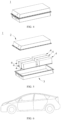
- FIG. 1 is a secondary battery 5 of a prismatic structure as an example.
- the outer package may include a housing 51 and a cover plate 53, where the housing 51 may include a bottom plate and a side plate connected to the bottom plate, and the bottom plate and the side plate enclose an accommodation cavity.
- the housing 51 has an opening communicating to the accommodation cavity, and the cover plate 53 can cover the opening to close the accommodation cavity.
- the positive electrode plate, the negative electrode plate and the separator can form an electrode assembly 52 through a winding process or a lamination process.
- the electrode assembly 52 is encapsulated in the accommodation cavity.
- the electrolyte solution is infiltrated in the electrode assembly 52.
- the number of electrode assemblies 52 contained in the secondary battery 5 may be one or more, and a person skilled in the art can select according to specific actual needs.
- the secondary battery may be assembled into a battery module, there may be one or more secondary batteries in the battery module, and the specific number may be selected by a person skilled in the art according to the application and capacity of the battery module.
- FIG. 3 is a battery module 4 as an example.
- a plurality of secondary batteries 5 may be arranged in sequence along the length direction of the battery module 4. Of course, they may also be arranged in any other manner. Further, the plurality of secondary batteries 5 may be fixed by fasteners.
- the battery module 4 may further include a housing with an accommodating space, and the plurality of secondary batteries 5 are accommodated in the accommodating space.
- the foregoing battery module may further be assembled into a battery pack, there may be one or more battery modules in the battery pack, and the specific number may be selected by a person skilled in the art according to the application and capacity of the battery pack.
- FIG. 4 and FIG. 5 are battery packs 1 as an example.
- the battery pack 1 may include a battery box and a plurality of battery modules 4 disposed in the battery box.
- the battery box includes an upper box body 2 and a lower box body 3, and the upper box body 2 can cover the lower box body 3 and form a closed space for accommodating the battery modules 4.
- the plurality of battery modules 4 may be arranged in the battery box in any manner.
- the present application further provides an electrical device, which includes at least one of the secondary battery, battery module, or battery pack provided in the present application.
- the secondary battery, battery module, or battery pack may be used as a power source for the electrical device, and may also be used as an energy storage unit for the electrical device.
- the electrical device may include mobile devices (such as mobile phones, laptops, etc.), electric vehicles (such as pure electric vehicles, hybrid electric vehicles, plug-in hybrid electric vehicles, electric bicycles, electric scooters, electric golf carts, electric trucks, etc.), electric trains, ships and satellites, energy storage systems, etc., but is not limited to these.
- the secondary battery, the battery module or the battery pack may be selected according to the use needs of the electrical device.
- FIG. 6 is an electrical device as an example.
- the electrical device is a pure electric vehicle, a hybrid electric vehicle, or a plug-in hybrid electric vehicle, etc.
- a battery pack or a battery module may be used.
- the device may be a mobile phone, a tablet computer, a laptop, etc.
- a secondary battery may be used as a power source.
- Preparing the precursor of the positive active material (Ni 0.9 Co 0.05 Mn 0.05 (OH) 2 ) by a hydroxide co-precipitation method by controlling the pH value of the reaction to 11.30, the ammonia concentration to 4.0 g/L, the reaction time to 20 h and the stirring rate to 300 r/min, with a particle diameter Dv50 of 9.5 ⁇ m.
- PVDF polyvinylidene difluoride
- NMP N-methyl-pyrrolidone
- the aluminum foil is coated with the slurry, and drying and cold pressing are performed to form a positive electrode plate.
- the coating amount is 0.01 g/cm 2
- the compaction density is 3.5 g/ cm 3 .
- Electrode plate A 0.5 mm lithium metal sheet is used as a negative electrode plate.
- Ethylene carbonate (EC), ethyl methyl carbonate (EMC), and diethyl carbonate (DEC) are mixed in a volume ratio of 1:1:1, and then LiPF 6 is uniformly dissolved in the above solution to obtain an electrolyte solution, where the concentration of LiPF 6 is 1 mol/L.
- the separator is Cellgard 2400 purchased from Cellgard.
- buttons cell CR2032 button battery
- PVDF polyvinylidene difluoride
- NMP N-methyl-pyrrolidone
- the negative active material artificial graphite, hard carbon, a conductive agent acetylene black, a binder styrene butadiene rubber (SBR), and a thickener sodium carboxymethyl cellulose (CMC-Na) are mixed uniformly in deionized water at a weight ratio of 90:5:2:2:1, coated on copper foil, dried, and cold pressed to obtain a negative electrode plate.
- the coating amount is 0.124 g/cm 2 and the compaction density is 1.6 g/cm 3 .
- Ethylene carbonate (EC), ethyl methyl carbonate (EMC), and diethyl carbonate (DEC) are mixed in a volume ratio of 1:1:1, and then LiPF 6 is uniformly dissolved in the above solution to obtain an electrolyte solution, where the concentration of LiPF 6 is 1 mol/L.
- the positive electrode plate, separator, and negative electrode plate described above are stacked in order, with the separator placed between the positive and negative electrodes for isolation, and then wound to obtain a bare cell.
- the bare cell is placed in an outer package, the electrolyte solution is injected, and packaging is performed to obtain a full battery (hereinafter referred to as a "full battery").
- the length ⁇ width ⁇ height of the full battery 90 mm ⁇ 30 mm ⁇ 60 mm, and the filling rate of the battery is 91.0%.
- step S1 in the preparation of the positive active material, in step S1), the molar ratio of Li/Me is 1.2:1, and in step S2), the amount of Li element added is 1200 ppm.
- step S1 in the preparation of the positive active material, in step S1), the molar ratio of Li/Me is 1.25:1, and the amount of Li element added in step S2) is 1500 ppm.
- step S1 in the preparation of the positive active material, in step S1), the molar ratio of Li/Me is 1.35:1, and in step S2), the amount of Li element added is 1800 ppm.
- step S1 in the preparation of the positive active material, in step S1), the molar ratio of Li/Me is 1.38:1, and in step S2), the amount of Li element added is 2000 ppm.
- step S1 in the preparation of the positive active material, in step S1), the molar ratio of Li/Me is 1.4:1, and in step S2), the amount of Li element added is 2500 ppm.
- step S1 in the preparation of the positive active material, in step S1), the molar ratio of Li/Me is 1.5:1, and in step S2), the amount of Li element added is 3000 ppm.
- step S1 zirconium dioxide (ZrO 2 ) and magnesium sulfate (MgSO 4 ) are used, where the amount of Zr element is 2000 ppm and the amount of Mg element is 200 ppm, based on the weight of the precursor of the positive active material; and the molar ratio of lithium hydroxide, the precursor of the positive active material, ZrO 2 to MgSO 4 is 1.3:1:0.0021: 0.0008.
- step S1 tungstic acid (H 2 WO 4 ) and titanium dioxide (TiO 2 ) are used, where the amount of W element is 3000 ppm and the amount of Ti element is 1500 ppm, based on the weight of the precursor of the positive active material; and the molar ratio of lithium hydroxide, the precursor of the positive active material, H 2 WO 4 , and TiO2 is 1.3:1:0.0016:0.0031.
- step S1 molybdenum trioxide (MoO 3 ) and calcium carbonate (CaCO 3 ) are used, where the amount of Mo element is 2000 ppm and the amount of Ca element is 2000 ppm, based on the weight of the precursor of the positive active material; and the molar ratio of lithium hydroxide, the precursor of the positive active material, MoO 3 , and CaCO 3 is 1.3:1:0.0020:0.0050.
- MoO 3 molybdenum trioxide
- CaCO 3 calcium carbonate
- step S1 the low-temperature co-heating temperature is 200 °C.
- the low-temperature co-heating temperature is 400 °C.
- step S2 in the preparation of the positive active material, in step S2), the water washing temperature is 20 °C, and the water washing time is 2 min.
- step S2 in the preparation of the positive active material, in step S2), the water washing temperature is 30 °C, and the water washing time is 1 min.
- the positive active material obtained in Embodiment 1 is mixed with CoOOH and CH 3 COOLi in a slant mixer at a weight ratio of 1:0.0140:0.0094, where the Dv50 of CoOOH particles was 0.05 ⁇ m and the amount of the Co element was 9000 ppm, the Dv50 of CH 3 COOLi particles is 0.01 ⁇ m and the amount of the Li element was 1000 ppm, and then the materials are placed in a kiln for sintering at a sintering temperature of 600 °C, sintering time of 8 h, and a sintering atmosphere of oxygen. After cooling, the obtained coating is Li 0.6 CoO 2 .
- the positive active material is mixed with CoOOH and CH 3 COOLi in a slant mixer at a weight ratio of 1:0.0023:0.0047, where the amount of Co element is 1500 ppm, and the amount of Li element is 500 ppm.
- the positive active material is mixed with CoOOH and CH 3 COOLi in a slant mixer at a weight ratio of 1:0.0062:0.0094, where the amount of Co element is 4000 ppm, and the amount of Li element is 1000 ppm.
- the positive active material is mixed with CoOOH and CH 3 COOLi in a slant mixer at a weight ratio of 1:0.0163:0.0141, where the amount of Co element is 10500 ppm, and the amount of Li element is 1500 ppm.
- the positive active material is mixed with CoOOH and CH 3 COOLi in a slant mixer at a weight ratio of 1:0.0264:0.0282, wherein the amount of Co element is 17000 ppm, and the amount of Li element is 3000 ppm.
- the precursor of the positive active material is prepared in the same manner as in Embodiment 1.
- the molar ratio of lithium hydroxide, the precursor of the positive active material, Nb 2 O 5 , to Al 2 O 3 is 1.05:1:0.0020:0.0036.
- the materials are then placed in a kiln for sintering at a sintering temperature of 780 °C and sintering time of 12 h in a sintering atmosphere of oxygen.
- the positive active material Li 1.03 Ni 0.8950 Co 0.0497 Mn 0.0497 Nb 0.002 Al 0.0036 O 2 is obtained by mechanical crushing, with a particle diameter Dv50 of 9.5 ⁇ m.
- the particle size of the positive active material is determined according to GB/T 19077.1-2016/ISO 13320:2009 (particle size distribution laser diffraction method). A clean beaker is taken, an appropriate amount of the above positive active material is added, an appropriate amount of pure water is added, and the mixture is ultrasonicated at 120 W/5 min to ensure that the material powder is completely dispersed in the water.
- the solution is poured into an injection tower of a laser particle size analyzer (Malvern Company, model: Mastersizer3000) and then circulated to a test optical path system, the particles are irradiated by the laser beam, and the particle size distribution characteristics of the particles (shading degree: 8% to 12%) can be obtained by receiving and measuring the energy distribution of the scattered light, and the corresponding values of Dv10, Dv50, and Dv90 are read.
- a laser particle size analyzer Malvern Company, model: Mastersizer3000
- the obtained positive electrode material is mixed with a conductive resin, and after solidification, the mixture is thinned on an ion thinning instrument (instrument company: Leica, Germany, model: RES102). The thinned sample is placed in a time-of-flight secondary mass spectrometer (instrument company: Ulvac-Phi, Japan, model: PHI NanoTOFII).
- a primary ion source (Bi source) is used to bombard the cross section of the positive electrode material and excite ions on the cross section of the material.
- An ion collector is used to collect the ions.
- the obtained positive electrode powder material is fully ground and placed on a groove of an XRD diffractometer slide.
- the slide is placed in an XRD diffractometer (Instrument Company: Bruker, Germany, Model: D8 Advance), and the positive electrode material is scanned at a scanning speed of 1 °/min to collect the obtained XRD spectrum.
- the raw data of the XRD spectrum is imported into the GSAS refinement software (open source software), and the XRD spectrum is refined using the Reitveld refinement method, and finally the lithium-nickel mixing degree value is calculated.
- a certain amount of powder is taken and put in a special compaction mold, then the mold is put on a compaction density instrument.
- the button battery is charged at 0.1 C to 4.3 V, then is charged at a constant voltage of 4.3 V to a current ⁇ 0.05mA, and stands for 2 min, the charging capacity at this time is recorded as C0, then the button battery is discharged at 0.1 C to 2.8 V, and the discharge capacity at this time is the initial gram capacity recorded as D0.
- the initial efficiency is calculated according to D0/C0*100%.
- the full battery stands for 5 min, is discharged to 2.8 V at 1/3 C, stands for 5 min, is charged to 4.25 V at 1/3 C, then is charged at a constant voltage of 4.25 V to a current ⁇ 0.05C, stands for 5 min, and then is discharged to 2.8 V at 1/3 C.
- the discharge capacity at this time is the initial gram capacity, recorded as D0.
- the full battery is charged to 4.25 V at a constant current of 1 C, then charged at a constant voltage of 4.25 V until the current drops to 0.05 C, and then discharged to 2.8 V at a constant current of 1 C to obtain the first-cycle specific discharge capacity (C dl ); the charge and discharge is repeated until the 300th cycle, and the specific discharge capacity of the lithium-ion battery after n cycles is recorded as C dn .
- Capacity retention rate specific discharge capacity after n cycles (C dn )/first-cycle specific discharge capacity (C dl ).
- the full battery is charged to 4.25 V at a constant current of 1 C, then charged at a constant voltage of 4.25 V until the current drops to 0.05 C, and then discharged to 2.8 V at a constant current of 1 C to obtain the first-cycle specific discharge capacity (C dl ); the charge and discharge is repeated until the 300th cycle, and the specific discharge capacity of the lithium-ion battery after n cycles is recorded as C dn .
- Capacity retention rate specific discharge capacity after n cycles (C dn )/first-cycle specific discharge capacity (C dl ).
- the full battery with 100% state of charge (SOC) is stored.
- the open circuit voltage (OCV) and AC internal resistance (IMP) of the battery cell are measured before, during and after storage to monitor SOC, and the volume of the battery cell is measured.
- the full battery after every 48 hours of storage is taken out and stands for 1 hour, then OCV and IMP are tested, and the volume of the battery cell is measured by the water displacement method after cooling to room temperature.
- the battery cell After each volume test, the battery cell is recharged at a constant current of 1 C to 4.25 V, and then charged at a constant voltage of 4.25 V until the current drops to 0.05 C. After the recharging is completed, the battery cell is put into the furnace to continue testing.
- the volume of the battery cell is measured, and the increase in the volume of the battery cell after storage relative to the volume of the battery cell before storage, i.e., the gas production, is calculated.
- the positive active material of the present application has a high compaction density, so that the battery has a high energy density; on the other hand, the positive active material of the present application has a lithium-rich layer structure, which can maintain excellent structural stability in the charge and discharge process, effectively reduce the lithium-nickel mixing degree, effectively prevent the electrolyte solution from having side reactions on the surface of the positive active material, reduce oxygen release, and greatly improve the cycle performance and safety performance of the battery.
- the formation of the coating Li e CoO 2 on the surface of the positive active material of the present application can further effectively prevent the electrolyte solution from having side reactions on the surface of the positive active material, thereby further improving the cycle performance and safety performance of the battery.
Landscapes
- Chemical & Material Sciences (AREA)
- Chemical Kinetics & Catalysis (AREA)
- Electrochemistry (AREA)
- General Chemical & Material Sciences (AREA)
- Engineering & Computer Science (AREA)
- Organic Chemistry (AREA)
- Inorganic Chemistry (AREA)
- Manufacturing & Machinery (AREA)
- Materials Engineering (AREA)
- Composite Materials (AREA)
- Battery Electrode And Active Subsutance (AREA)
Applications Claiming Priority (2)
| Application Number | Priority Date | Filing Date | Title |
|---|---|---|---|
| CN202211525557.8A CN115863571B (zh) | 2022-12-01 | 2022-12-01 | 正极活性材料及其制备方法、二次电池和用电装置 |
| PCT/CN2023/111442 WO2024113942A1 (zh) | 2022-12-01 | 2023-08-07 | 正极活性材料及其制备方法、二次电池和用电装置 |
Publications (2)
| Publication Number | Publication Date |
|---|---|
| EP4517875A1 true EP4517875A1 (de) | 2025-03-05 |
| EP4517875A4 EP4517875A4 (de) | 2025-10-08 |
Family
ID=85668610
Family Applications (1)
| Application Number | Title | Priority Date | Filing Date |
|---|---|---|---|
| EP23896104.9A Pending EP4517875A4 (de) | 2022-12-01 | 2023-08-07 | Positivelektrodenaktivmaterial und herstellungsverfahren dafür, sekundärbatterie und elektrische vorrichtung |
Country Status (4)
| Country | Link |
|---|---|
| US (1) | US20250246622A1 (de) |
| EP (1) | EP4517875A4 (de) |
| CN (1) | CN115863571B (de) |
| WO (1) | WO2024113942A1 (de) |
Families Citing this family (7)
| Publication number | Priority date | Publication date | Assignee | Title |
|---|---|---|---|---|
| CN115863571B (zh) * | 2022-12-01 | 2025-02-18 | 宁德时代新能源科技股份有限公司 | 正极活性材料及其制备方法、二次电池和用电装置 |
| CN121484059A (zh) * | 2023-04-27 | 2026-02-06 | 宁德时代新能源科技股份有限公司 | 正极活性材料、及其制备方法、正极极片、二次电池和用电装置 |
| CN119029166B (zh) * | 2023-05-26 | 2026-01-30 | 宁德时代新能源科技股份有限公司 | 正极活性材料及其制备方法、正极极片、电池及用电设备 |
| CN119069656B (zh) * | 2023-05-31 | 2026-01-27 | 宁德时代新能源科技股份有限公司 | 正极活性材料及其制备方法、包含其的正极极片、电池和用电装置 |
| CN119275250B (zh) * | 2023-07-07 | 2025-09-26 | 宁德时代新能源科技股份有限公司 | 正极活性材料及其制备方法、电池单体和用电装置 |
| CN119650611B (zh) * | 2023-09-15 | 2025-09-23 | 宁德时代新能源科技股份有限公司 | 正极活性材料及其制备方法、正极极片、电池和用电装置 |
| CN117423827A (zh) * | 2023-09-15 | 2024-01-19 | 宁波容百新能源科技股份有限公司 | 一种正极活性材料及其制备方法和锂离子电池 |
Family Cites Families (13)
| Publication number | Priority date | Publication date | Assignee | Title |
|---|---|---|---|---|
| JP5421865B2 (ja) * | 2010-06-30 | 2014-02-19 | 株式会社日立製作所 | リチウムイオン二次電池 |
| FR2970376B1 (fr) * | 2011-01-07 | 2013-01-25 | Commissariat Energie Atomique | Materiau d'electrode positive biphase pour accumulateur au lithium et son procede de synthese |
| WO2016053054A1 (ko) * | 2014-10-02 | 2016-04-07 | 주식회사 엘지화학 | 리튬 이차전지용 양극활물질, 이의 제조방법 및 이를 포함하는 리튬 이차전지 |
| JP6554799B2 (ja) * | 2015-01-29 | 2019-08-07 | 住友金属鉱山株式会社 | 非水系電解質二次電池用正極活物質とその製造方法、および非水系電解質二次電池 |
| KR101790890B1 (ko) * | 2016-09-23 | 2017-10-26 | 주식회사 엘지화학 | Li 리치 안티페로브스카이트 코팅 LCO계 리튬 복합체, 이의 제조방법, 이를 포함하는 양극 활물질 및 리튬 이차 전지 |
| CN109449438A (zh) * | 2018-11-30 | 2019-03-08 | 林奈(中国)新能源有限公司 | 四元正极材料、制备方法和用途 |
| CN111384372B (zh) | 2018-12-29 | 2021-03-23 | 宁德时代新能源科技股份有限公司 | 一种高压实密度正极材料及电化学储能装置 |
| KR102328693B1 (ko) * | 2019-10-18 | 2021-11-19 | 포항공과대학교 산학협력단 | 리튬 이차 전지용 양극 활물질 및 그 제조 방법 |
| CN118099391A (zh) * | 2019-10-18 | 2024-05-28 | Ecopro Bm有限公司 | 锂二次电池用正极活性物质、其制备方法以及包含其的锂二次电池 |
| CN113437263A (zh) * | 2020-03-23 | 2021-09-24 | 飞翼新能源公司 | 锂镍钴锰铝氧化物 |
| CN113437264A (zh) * | 2020-03-23 | 2021-09-24 | 飞翼新能源公司 | 一种锂离子电池氧化物正极材料及其制备方法 |
| CN114843495A (zh) * | 2022-05-26 | 2022-08-02 | 临沂大学 | 一种锂缺陷高镍富锂层状材料及其制备方法 |
| CN115863571B (zh) * | 2022-12-01 | 2025-02-18 | 宁德时代新能源科技股份有限公司 | 正极活性材料及其制备方法、二次电池和用电装置 |
-
2022
- 2022-12-01 CN CN202211525557.8A patent/CN115863571B/zh active Active
-
2023
- 2023-08-07 EP EP23896104.9A patent/EP4517875A4/de active Pending
- 2023-08-07 WO PCT/CN2023/111442 patent/WO2024113942A1/zh not_active Ceased
-
2025
- 2025-03-19 US US19/083,813 patent/US20250246622A1/en active Pending
Also Published As
| Publication number | Publication date |
|---|---|
| CN115863571A (zh) | 2023-03-28 |
| WO2024113942A1 (zh) | 2024-06-06 |
| CN115863571B (zh) | 2025-02-18 |
| EP4517875A4 (de) | 2025-10-08 |
| US20250246622A1 (en) | 2025-07-31 |
Similar Documents
| Publication | Publication Date | Title |
|---|---|---|
| US12391575B2 (en) | Positive electrode active material and preparation method thereof, positive electrode plate, lithium-ion secondary battery, and battery module, battery pack, and apparatus containing such lithium-ion secondary battery | |
| EP3933981B1 (de) | Positives aktives elektrodenmaterial und verfahren zu seiner herstellung, positive elektrodenplatte, lithiumionen-sekundärbatterie und batteriemodul, batteriepack, und vorrichtung, die eine solche lithiumionen-sekundärbatterie enthält | |
| EP4517875A1 (de) | Positivelektrodenaktivmaterial und herstellungsverfahren dafür, sekundärbatterie und elektrische vorrichtung | |
| EP3951946B1 (de) | Positivelektroden-aktivmaterial, positive elektrodenplatte, lithium-ionen-sekundarbatterie und vorrichtung | |
| KR20220092558A (ko) | 이차 전지 및 이차 전지를 포함하는 장치 | |
| US12230810B2 (en) | Secondary battery and apparatus containing the same | |
| EP4117057B1 (de) | Lithium-ionen-sekundärbatterie, batteriemodul, batteriepack und angetriebenes gerät | |
| EP3885321A1 (de) | Positives aktives material und elektrochemische vorrichtung damit | |
| EP4358182A1 (de) | Modifiziertes lithiumreiches manganbasiertes material, modifikationsverfahren für lithiumreiches manganbasiertes material, sekundärbatterie und elektrische vorrichtung | |
| EP2115801A2 (de) | Lithium-titanat sowie lithium-zellen und batterien damit | |
| US11682788B2 (en) | Secondary battery and apparatus containing such secondary battery | |
| CN118525386B (zh) | 一种复合正极材料、其制备方法、二次电池、电池模块、电池包和用电装置 | |
| CN118043997B (zh) | 正极材料及其制备方法、具备其的二次电池 | |
| US20240413317A1 (en) | Positive electrode active material and preparation method thereof, positive electrode plate, secondary battery, battery module, battery pack, and electric apparatus | |
| EP4138158B1 (de) | Positives verbundstoff-elektrodenmaterial und herstellungsverfahren dafür, sekundärbatterie, batteriegruppe mit sekundärbatterie und elektrisches gerät einschliesslich sekundärbatterie | |
| EP4510230A1 (de) | Positivelektrodenaktivmaterial, herstellungsverfahren dafür, sekundärbatterie und elektrische vorrichtung | |
| US20250246623A1 (en) | Positive electrode material and preparation method therefor, secondary battery comprising same, and power consuming device | |
| EP4546460A1 (de) | Sekundärbatterie, batteriemodul, batteriepack und elektrische vorrichtung | |
| US20240254003A1 (en) | Positive electrode active material with core-shell structure and preparation method thereof, positive electrode plate, secondary battery, battery module, battery pack, and electric apparatus | |
| CN118696435B (zh) | 正极活性材料及其制备方法、正极极片、二次电池和用电装置 | |
| EP4682979A1 (de) | Verfahren zur herstellung eines positivelektrodenmaterials, positivelektrodenmaterial, positivelektrodenfolie, batterie und elektrische vorrichtung | |
| CN118486792B (zh) | 正极活性材料及其制备方法、正极极片、二次电池和用电装置 | |
| CN117941101B (zh) | 正极活性材料及其制备方法、极片、二次电池及用电装置 | |
| WO2023184511A1 (zh) | 正极活性材料、其制备方法以及包含其的正极极片、二次电池及用电装置 | |
| EP4550475A1 (de) | Kohlenstoffhaltiges material und herstellungsverfahren dafür sowie sekundärbatterie und elektrische vorrichtung damit |
Legal Events
| Date | Code | Title | Description |
|---|---|---|---|
| STAA | Information on the status of an ep patent application or granted ep patent |
Free format text: STATUS: THE INTERNATIONAL PUBLICATION HAS BEEN MADE |
|
| PUAI | Public reference made under article 153(3) epc to a published international application that has entered the european phase |
Free format text: ORIGINAL CODE: 0009012 |
|
| STAA | Information on the status of an ep patent application or granted ep patent |
Free format text: STATUS: REQUEST FOR EXAMINATION WAS MADE |
|
| 17P | Request for examination filed |
Effective date: 20241128 |
|
| AK | Designated contracting states |
Kind code of ref document: A1 Designated state(s): AL AT BE BG CH CY CZ DE DK EE ES FI FR GB GR HR HU IE IS IT LI LT LU LV MC ME MK MT NL NO PL PT RO RS SE SI SK SM TR |
|
| A4 | Supplementary search report drawn up and despatched |
Effective date: 20250908 |
|
| RIC1 | Information provided on ipc code assigned before grant |
Ipc: H01M 4/36 20060101AFI20250902BHEP Ipc: H01M 4/525 20100101ALI20250902BHEP Ipc: H01M 4/505 20100101ALI20250902BHEP Ipc: H01M 4/485 20100101ALI20250902BHEP Ipc: H01M 10/0525 20100101ALI20250902BHEP Ipc: C01G 53/00 20250101ALI20250902BHEP Ipc: H01M 4/02 20060101ALI20250902BHEP |
|
| DAV | Request for validation of the european patent (deleted) | ||
| DAX | Request for extension of the european patent (deleted) |