EP4516384A1 - Denitrierungsvorrichtung - Google Patents
Denitrierungsvorrichtung Download PDFInfo
- Publication number
- EP4516384A1 EP4516384A1 EP23811376.5A EP23811376A EP4516384A1 EP 4516384 A1 EP4516384 A1 EP 4516384A1 EP 23811376 A EP23811376 A EP 23811376A EP 4516384 A1 EP4516384 A1 EP 4516384A1
- Authority
- EP
- European Patent Office
- Prior art keywords
- nox removal
- flue gas
- reducing agent
- flow
- duct
- Prior art date
- Legal status (The legal status is an assumption and is not a legal conclusion. Google has not performed a legal analysis and makes no representation as to the accuracy of the status listed.)
- Pending
Links
Images
Classifications
-
- B—PERFORMING OPERATIONS; TRANSPORTING
- B01—PHYSICAL OR CHEMICAL PROCESSES OR APPARATUS IN GENERAL
- B01D—SEPARATION
- B01D53/00—Separation of gases or vapours; Recovering vapours of volatile solvents from gases; Chemical or biological purification of waste gases, e.g. engine exhaust gases, smoke, fumes, flue gases, aerosols
- B01D53/34—Chemical or biological purification of waste gases
- B01D53/92—Chemical or biological purification of waste gases of engine exhaust gases
- B01D53/94—Chemical or biological purification of waste gases of engine exhaust gases by catalytic processes
- B01D53/9404—Removing only nitrogen compounds
- B01D53/9409—Nitrogen oxides
- B01D53/9431—Processes characterised by a specific device
-
- B—PERFORMING OPERATIONS; TRANSPORTING
- B01—PHYSICAL OR CHEMICAL PROCESSES OR APPARATUS IN GENERAL
- B01D—SEPARATION
- B01D53/00—Separation of gases or vapours; Recovering vapours of volatile solvents from gases; Chemical or biological purification of waste gases, e.g. engine exhaust gases, smoke, fumes, flue gases, aerosols
- B01D53/34—Chemical or biological purification of waste gases
- B01D53/74—General processes for purification of waste gases; Apparatus or devices specially adapted therefor
- B01D53/86—Catalytic processes
- B01D53/8621—Removing nitrogen compounds
- B01D53/8625—Nitrogen oxides
- B01D53/8631—Processes characterised by a specific device
-
- B—PERFORMING OPERATIONS; TRANSPORTING
- B01—PHYSICAL OR CHEMICAL PROCESSES OR APPARATUS IN GENERAL
- B01D—SEPARATION
- B01D53/00—Separation of gases or vapours; Recovering vapours of volatile solvents from gases; Chemical or biological purification of waste gases, e.g. engine exhaust gases, smoke, fumes, flue gases, aerosols
- B01D53/34—Chemical or biological purification of waste gases
- B01D53/74—General processes for purification of waste gases; Apparatus or devices specially adapted therefor
- B01D53/86—Catalytic processes
- B01D53/90—Injecting reactants
-
- B—PERFORMING OPERATIONS; TRANSPORTING
- B01—PHYSICAL OR CHEMICAL PROCESSES OR APPARATUS IN GENERAL
- B01F—MIXING, e.g. DISSOLVING, EMULSIFYING OR DISPERSING
- B01F23/00—Mixing according to the phases to be mixed, e.g. dispersing or emulsifying
- B01F23/20—Mixing gases with liquids
- B01F23/21—Mixing gases with liquids by introducing liquids into gaseous media
- B01F23/213—Mixing gases with liquids by introducing liquids into gaseous media by spraying or atomising of the liquids
-
- B—PERFORMING OPERATIONS; TRANSPORTING
- B01—PHYSICAL OR CHEMICAL PROCESSES OR APPARATUS IN GENERAL
- B01F—MIXING, e.g. DISSOLVING, EMULSIFYING OR DISPERSING
- B01F25/00—Flow mixers; Mixers for falling materials, e.g. solid particles
- B01F25/30—Injector mixers
- B01F25/31—Injector mixers in conduits or tubes through which the main component flows
- B01F25/313—Injector mixers in conduits or tubes through which the main component flows wherein additional components are introduced in the centre of the conduit
- B01F25/3131—Injector mixers in conduits or tubes through which the main component flows wherein additional components are introduced in the centre of the conduit with additional mixing means other than injector mixers, e.g. screens, baffles or rotating elements
-
- B—PERFORMING OPERATIONS; TRANSPORTING
- B01—PHYSICAL OR CHEMICAL PROCESSES OR APPARATUS IN GENERAL
- B01F—MIXING, e.g. DISSOLVING, EMULSIFYING OR DISPERSING
- B01F25/00—Flow mixers; Mixers for falling materials, e.g. solid particles
- B01F25/30—Injector mixers
- B01F25/31—Injector mixers in conduits or tubes through which the main component flows
- B01F25/313—Injector mixers in conduits or tubes through which the main component flows wherein additional components are introduced in the centre of the conduit
- B01F25/3133—Injector mixers in conduits or tubes through which the main component flows wherein additional components are introduced in the centre of the conduit characterised by the specific design of the injector
- B01F25/31331—Perforated, multi-opening, with a plurality of holes
-
- B—PERFORMING OPERATIONS; TRANSPORTING
- B01—PHYSICAL OR CHEMICAL PROCESSES OR APPARATUS IN GENERAL
- B01F—MIXING, e.g. DISSOLVING, EMULSIFYING OR DISPERSING
- B01F25/00—Flow mixers; Mixers for falling materials, e.g. solid particles
- B01F25/40—Static mixers
- B01F25/42—Static mixers in which the mixing is affected by moving the components jointly in changing directions, e.g. in tubes provided with baffles or obstructions
- B01F25/43—Mixing tubes, e.g. wherein the material is moved in a radial or partly reversed direction
- B01F25/431—Straight mixing tubes with baffles or obstructions that do not cause substantial pressure drop; Baffles therefor
- B01F25/4316—Straight mixing tubes with baffles or obstructions that do not cause substantial pressure drop; Baffles therefor the baffles being flat pieces of material, e.g. intermeshing, fixed to the wall or fixed on a central rod
- B01F25/43163—Straight mixing tubes with baffles or obstructions that do not cause substantial pressure drop; Baffles therefor the baffles being flat pieces of material, e.g. intermeshing, fixed to the wall or fixed on a central rod in the form of small flat plate-like elements
-
- F—MECHANICAL ENGINEERING; LIGHTING; HEATING; WEAPONS; BLASTING
- F01—MACHINES OR ENGINES IN GENERAL; ENGINE PLANTS IN GENERAL; STEAM ENGINES
- F01N—GAS-FLOW SILENCERS OR EXHAUST APPARATUS FOR MACHINES OR ENGINES IN GENERAL; GAS-FLOW SILENCERS OR EXHAUST APPARATUS FOR INTERNAL-COMBUSTION ENGINES
- F01N3/00—Exhaust or silencing apparatus having means for purifying, rendering innocuous, or otherwise treating exhaust
- F01N3/08—Exhaust or silencing apparatus having means for purifying, rendering innocuous, or otherwise treating exhaust for rendering innocuous
- F01N3/10—Exhaust or silencing apparatus having means for purifying, rendering innocuous, or otherwise treating exhaust for rendering innocuous by thermal or catalytic conversion of noxious components of exhaust
- F01N3/24—Exhaust or silencing apparatus having means for purifying, rendering innocuous, or otherwise treating exhaust for rendering innocuous by thermal or catalytic conversion of noxious components of exhaust characterised by constructional aspects of converting apparatus
- F01N3/28—Construction of catalytic reactors
- F01N3/2892—Exhaust flow directors or the like, e.g. upstream of catalytic device
-
- F—MECHANICAL ENGINEERING; LIGHTING; HEATING; WEAPONS; BLASTING
- F23—COMBUSTION APPARATUS; COMBUSTION PROCESSES
- F23J—REMOVAL OR TREATMENT OF COMBUSTION PRODUCTS OR COMBUSTION RESIDUES; FLUES
- F23J15/00—Arrangements of devices for treating smoke or fumes
- F23J15/006—Layout of treatment plant
-
- B—PERFORMING OPERATIONS; TRANSPORTING
- B01—PHYSICAL OR CHEMICAL PROCESSES OR APPARATUS IN GENERAL
- B01D—SEPARATION
- B01D2251/00—Reactants
- B01D2251/20—Reductants
- B01D2251/206—Ammonium compounds
- B01D2251/2062—Ammonia
-
- B—PERFORMING OPERATIONS; TRANSPORTING
- B01—PHYSICAL OR CHEMICAL PROCESSES OR APPARATUS IN GENERAL
- B01D—SEPARATION
- B01D2251/00—Reactants
- B01D2251/20—Reductants
- B01D2251/206—Ammonium compounds
- B01D2251/2067—Urea
-
- B—PERFORMING OPERATIONS; TRANSPORTING
- B01—PHYSICAL OR CHEMICAL PROCESSES OR APPARATUS IN GENERAL
- B01D—SEPARATION
- B01D2257/00—Components to be removed
- B01D2257/40—Nitrogen compounds
- B01D2257/404—Nitrogen oxides other than dinitrogen oxide
-
- B—PERFORMING OPERATIONS; TRANSPORTING
- B01—PHYSICAL OR CHEMICAL PROCESSES OR APPARATUS IN GENERAL
- B01D—SEPARATION
- B01D2258/00—Sources of waste gases
- B01D2258/02—Other waste gases
- B01D2258/0283—Flue gases
-
- B—PERFORMING OPERATIONS; TRANSPORTING
- B01—PHYSICAL OR CHEMICAL PROCESSES OR APPARATUS IN GENERAL
- B01J—CHEMICAL OR PHYSICAL PROCESSES, e.g. CATALYSIS OR COLLOID CHEMISTRY; THEIR RELEVANT APPARATUS
- B01J21/00—Catalysts comprising the elements, oxides, or hydroxides of magnesium, boron, aluminium, carbon, silicon, titanium, zirconium, or hafnium
- B01J21/06—Silicon, titanium, zirconium or hafnium; Oxides or hydroxides thereof
- B01J21/063—Titanium; Oxides or hydroxides thereof
-
- F—MECHANICAL ENGINEERING; LIGHTING; HEATING; WEAPONS; BLASTING
- F01—MACHINES OR ENGINES IN GENERAL; ENGINE PLANTS IN GENERAL; STEAM ENGINES
- F01N—GAS-FLOW SILENCERS OR EXHAUST APPARATUS FOR MACHINES OR ENGINES IN GENERAL; GAS-FLOW SILENCERS OR EXHAUST APPARATUS FOR INTERNAL-COMBUSTION ENGINES
- F01N2240/00—Combination or association of two or more different exhaust treating devices, or of at least one such device with an auxiliary device, not covered by indexing codes F01N2230/00 or F01N2250/00, one of the devices being
- F01N2240/20—Combination or association of two or more different exhaust treating devices, or of at least one such device with an auxiliary device, not covered by indexing codes F01N2230/00 or F01N2250/00, one of the devices being a flow director or deflector
-
- F—MECHANICAL ENGINEERING; LIGHTING; HEATING; WEAPONS; BLASTING
- F01—MACHINES OR ENGINES IN GENERAL; ENGINE PLANTS IN GENERAL; STEAM ENGINES
- F01N—GAS-FLOW SILENCERS OR EXHAUST APPARATUS FOR MACHINES OR ENGINES IN GENERAL; GAS-FLOW SILENCERS OR EXHAUST APPARATUS FOR INTERNAL-COMBUSTION ENGINES
- F01N2340/00—Dimensional characteristics of the exhaust system, e.g. length, diameter or volume of the exhaust apparatus; Spatial arrangements of exhaust apparatuses
- F01N2340/02—Distance of the exhaust apparatus to the engine or between two exhaust apparatuses
-
- F—MECHANICAL ENGINEERING; LIGHTING; HEATING; WEAPONS; BLASTING
- F01—MACHINES OR ENGINES IN GENERAL; ENGINE PLANTS IN GENERAL; STEAM ENGINES
- F01N—GAS-FLOW SILENCERS OR EXHAUST APPARATUS FOR MACHINES OR ENGINES IN GENERAL; GAS-FLOW SILENCERS OR EXHAUST APPARATUS FOR INTERNAL-COMBUSTION ENGINES
- F01N2570/00—Exhaust treating apparatus eliminating, absorbing or adsorbing specific elements or compounds
- F01N2570/14—Nitrogen oxides
-
- F—MECHANICAL ENGINEERING; LIGHTING; HEATING; WEAPONS; BLASTING
- F01—MACHINES OR ENGINES IN GENERAL; ENGINE PLANTS IN GENERAL; STEAM ENGINES
- F01N—GAS-FLOW SILENCERS OR EXHAUST APPARATUS FOR MACHINES OR ENGINES IN GENERAL; GAS-FLOW SILENCERS OR EXHAUST APPARATUS FOR INTERNAL-COMBUSTION ENGINES
- F01N2610/00—Adding substances to exhaust gases
- F01N2610/02—Adding substances to exhaust gases the substance being ammonia or urea
-
- F—MECHANICAL ENGINEERING; LIGHTING; HEATING; WEAPONS; BLASTING
- F01—MACHINES OR ENGINES IN GENERAL; ENGINE PLANTS IN GENERAL; STEAM ENGINES
- F01N—GAS-FLOW SILENCERS OR EXHAUST APPARATUS FOR MACHINES OR ENGINES IN GENERAL; GAS-FLOW SILENCERS OR EXHAUST APPARATUS FOR INTERNAL-COMBUSTION ENGINES
- F01N2610/00—Adding substances to exhaust gases
- F01N2610/14—Arrangements for the supply of substances, e.g. conduits
- F01N2610/1453—Sprayers or atomisers; Arrangement thereof in the exhaust apparatus
-
- F—MECHANICAL ENGINEERING; LIGHTING; HEATING; WEAPONS; BLASTING
- F23—COMBUSTION APPARATUS; COMBUSTION PROCESSES
- F23J—REMOVAL OR TREATMENT OF COMBUSTION PRODUCTS OR COMBUSTION RESIDUES; FLUES
- F23J2215/00—Preventing emissions
- F23J2215/10—Nitrogen; Compounds thereof
Definitions
- the present disclosure relates to a NOx removal device.
- HRSG heat recovery steam generators
- a flue gas discharged from a gas turbine or the like passes through in a duct, heat exchange between the flue gas and water or steam in heat transfer tubes is performed to generate steam.
- a plurality of heat exchangers having a number of heat transfer tubes through which water or steam flows, a NOx removal device that removes nitrogen oxides (NOx) in the flue gas, and the like are installed inside the duct of a heat recovery steam generator.
- a reducing agent for example, ammonia or urea water
- a reaction device for example, a NOx removal catalyst
- nitrogen oxides in the flue gas are removed.
- a mixing device that mixes the flue gas with the reducing agent may be installed downstream of the injecting nozzle and upstream of the reaction device (for example, Patent Literature 1).
- Patent Literature 1 discloses a NOx removal device in which a mixing device having a plurality of triangular plates is provided upstream of the reaction device.
- the flue gas containing the injected reducing agent passes through a mixing device, thereby a gas vortex occurs downstream of the mixing device, and due to this vortex, the flue gas and the reducing agent are mixed with each other.
- the fluid in which the flue gas and the reducing agent are mixed with each other passes through the reaction device arranged downstream of the mixing device, and thereby nitrogen oxides therein are removed.
- the mixture fluid of the flue gas and the reducing agent that has passed through the mixing device and then flows through a duct has unevenness in flow velocities at respective positions in a flow path cross section. If the mixture fluid of the flue gas and the reducing agent flows into the reaction device in such a state, this will cause unevenness in the amount of the mixture fluid flowing into respective positions in the reaction device. If unevenness occurs in the amount of the mixture fluid flowing into the reaction device, this may reduce the NOx removal efficiency of the reaction device.
- the concentration of the reducing agent is not equalized when the flue gas containing the injected reducing agent flows into the mixing device, this may prevent suitable mixture of the flue gas with the reducing agent in the mixing device. If suitable mixture of the flue gas with the reducing agent is prevented, this may reduce the NOx removal efficiency of the reaction device.
- the present disclosure has been made in view of such circumstances and intends to provide a NOx removal device that can improve NOx removal efficiency.
- the NOx removal device of the present disclosure employs the following solutions.
- a NOx removal device is a NOx removal device provided inside a duct through which a flue gas flows in a predetermined direction
- the NOx removal device includes: an injection part configured to inject a reducing agent to the flue gas flowing through the duct, the reducing agent serving to reduce nitrogen oxide contained in the flue gas; a mixing part provided downstream of the injection part and configured to form a vortex about a center axis extending in the predetermined direction to mix the flue gas flowing through the duct and the reducing agent with each other; and a flow-straightening part provided downstream of the mixing part and over the entire region of a flow path cross section of the duct and configured to provide a resistance against a flow of a mixture fluid, the flue gas and the reducing agent being mixed in the mixture fluid.
- the injection part has a reducing agent pipe extending in an intersecting direction that is a direction intersecting the predetermined direction, the reducing agent flowing through inside the reducing agent pipe, and a nozzle provided in a side face of the reducing agent pipe and configured to inject the reducing agent into the duct, the distance from the injection part to the mixing part is 10 times or greater and 30 times or less of the outer diameter of the reducing agent pipe, and the distance from the mixing part to the flow-straightening part is longer than the distance from the injection part to the mixing part.
- NOx removal efficiency can be improved.
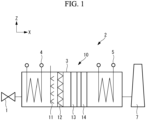
- the heat recovery steam generator 2 is a horizontal type heat recovery steam generator in which the flue gas flows in the X-axis direction (predetermined direction).
- the X-axis direction which is the direction in which the flue gas flows, is the horizontal direction.
- the heat recovery steam generator 2 includes a duct 3 that is provided extending in the X-axis direction and inside which the flue gas flows through, a NOx removal device 10 that is provided inside the duct 3 and removes nitrogen oxides (NOx) contained in the flue gas, and a first heat exchange unit 4 and a second heat exchange unit 5 provided inside the duct 3.
- the first heat exchange unit 4 and the second heat exchange unit 5 have a plurality of heat transfer tubes (not illustrated) provided extending in the vertical direction (Z-axis direction) so as to intersect with the flue gas flow direction.
- the first heat exchange unit 4 and the second heat exchange unit 5 recover heat of the flue gas via heat exchange between a heat medium (for example, water or steam) flowing through inside the heat transfer tubes and the flue gas.
- a heat medium for example, water or steam
- the first heat exchange unit 4 is provided upstream of the NOx removal device 10.
- the first heat exchange unit 4 may be a superheater that superheats the heat medium flowing through inside the heat transfer tubes.
- the second heat exchange unit 5 is provided downstream of the NOx removal device 10.
- the second heat exchange unit 5 may be evaporator that evaporates the heat medium flowing through inside the heat transfer tubes.
- a high-temperature combustion flue gas (flue gas) discharged from a combustion engine 1 is introduced into the duct 3 from the inlet of the duct 3, passes through the first heat exchange unit 4, the NOx removal device 10, and the second heat exchange unit 5 in order, and is then discharged from a stack 7 via the outlet of the duct 3.
- the NOx removal device 10 supplies a reducing agent such as ammonia or urea water that serves to reduce nitrogen oxides to the flue gas flowing through the duct 3, promotes the reaction between nitrogen oxides (NOx) and the reducing agent in the flue gas supplied with the reducing agent by using a catalyst action of the NOx removal catalyst 13, and thereby remove or reduce nitrogen oxides in the flue gas.
- a reducing agent such as ammonia or urea water that serves to reduce nitrogen oxides to the flue gas flowing through the duct 3
- NOx nitrogen oxides
- an ammonia gas as the reducing agent
- the reducing agent according to the present disclosure is not limited to an ammonia gas.
- ammonia in a liquid state may be used, or reducing agents other than ammonia may be used.
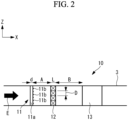
- the NOx removal device 10 includes an ammonia injection part (injection part) 11, a mixer 12, a NOx removal catalyst (flow-straightening part) 13, and an ammonia decomposition catalyst 14 inside the duct 3 that are arranged in this order from the upstream of the flue gas flow.
- the ammonia injection part 11 has an ammonia pipe (reducing agent pipe) 11a extending in the Z-axis direction and a plurality of injection nozzles (nozzle) 11b provided on the side face of the ammonia pipe 11a.
- the ammonia injection part 11 injects an ammonia gas along the X-axis direction into the duct 3 from the plurality of injection nozzles 11b and thereby injects ammonia to the flue gas flowing through the duct 3.
- the ammonia pipe 11a has a circular tube shape. In the ammonia pipe 11a, ammonia flows through inside thereof.
- the outer diameter d of the ammonia pipe 11a is a predetermined length.
- the plurality of injection nozzles 11b are arranged aligned at a predetermined interval along the extending direction of the ammonia pipe 11a (that is, the Z-axis direction).
- Each of the injection nozzles 11b may be a circular hole formed in the side face of the ammonia pipe 11a.
- An ammonia gas is injected from the injection nozzles 11b at a predetermined injection pressure.
- the diameter of the injection hole of each injection nozzle 11b is, for example, 3 mm to 6 mm.
- the injection nozzle 11b injects an ammonia gas in a conical shape. Note that the diameter of the injection hole or the injection manner of the injection nozzle 11b described above is an example and is not limited thereto.
- the NOx removal catalyst 13 is arranged so as to cover substantially the entire region of the flow path cross section of the duct 3.
- the NOx removal catalyst 13 has, for example, a rectangular frame part (not illustrated) having a rectangular cylindrical shape and a plurality of catalysts (not illustrated) provided inside the rectangular frame part.
- a honeycomb shape or a corrugated board shape where the flue gas can pass in the X-axis direction are illustrated as an example, but the shape is not limited thereto.
- the catalyst facilitates a reduction reaction of nitrogen oxides (NOx) contained in the flue gas (combustion gas) passing through inside thereof to remove at least a part of the NOx.
- the component of the catalyst is, for example, titanium oxide based.
- the ammonia decomposition catalyst 14 is arranged so as to cover substantially the entire region of the flow path cross section of the duct 3.
- the ammonia decomposition catalyst 14 decomposes ammonia contained in the flue gas and thereby removes ammonia out of the flue gas.
- ammonia decomposition catalyst 14 since the ammonia decomposition catalyst 14 is provided downstream of the NOx removal catalyst 13, ammonia in the flue gas that is left unreacted with the NOx removal catalyst 13 can be decomposed by the ammonia decomposition catalyst 14.
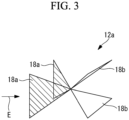
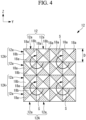
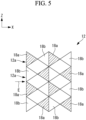
- the mixer 12 is arranged so as to cover substantially the entire region of the flow path cross section of the duct 3. As illustrated in Fig. 3 and Fig. 4 , the mixer 12 includes a plurality of mixing parts 12A that form swirl flows S each swirling about the center axis extending in the X-axis direction. Further, each of the mixing parts 12A has a plurality of (in the present embodiment, four, as an example) cells 12a. That is, the mixing part 12A combines a plurality of cells 12a to form one swirl flow (vortex) S. The swirl flow S is formed at substantially the center of the mixing part 12A.
- the flue gas passing through the mixer 12 (in details, the flue gas with ammonia injected) flows as a plurality of swirl flows S in the space downstream of the mixer 12. In such a way, the mixer 12 forms the swirl flows S to mix the flue gas flowing through the duct and ammonia.
- a plurality of (in the present embodiment, two, as an example) mixing parts are arranged aligned in the Z-axis direction, and a plurality of (in the present embodiment, two, as an example) mixing parts are arranged aligned in the Y-axis direction.
- a plurality of (in the present embodiment, two, as an example) mixing parts are also arranged aligned in the X-axis direction. That is, the mixing part 12A is arranged in two sets in the X-axis direction.
- the number of mixing parts 12A is an example and is not limited to the number in the present embodiment.
- the mixing part 12A has a plurality of (in the present embodiment, two, as an example) cells 12a arranged aligned in the Z-axis direction (first intersecting direction) and the Y-axis direction (second intersecting direction).
- the cells 12a have a regular shape.
- a plurality of cells are arranged aligned in the Z-axis direction and a plurality of cells (in the present embodiment, two, as an example) are arranged aligned in the Y-axis direction with respect to one mixing part 12A.
- the cells 12a adjacent in the Z-axis direction and the Y-axis direction are arranged so as to have orientations rotated relative to each other by 90 degrees about the central axis extending in the X-axis direction.
- the length in the Z-axis direction of the cell 12a is a length D.
- the length in the X-axis direction of the cell 12a is a length L.
- the size of the cell 12a influences the size of a vortex formed downstream of the mixer 12. That is, the cell 12a determines the size of the formed vortex.
- the cell 12a has four triangular and plate-like plate parts 18.
- the four plate parts 18 have the same shape.
- the four plate parts 18 have two upstream plate parts 18a arranged upstream of the center point in the X-axis direction of the cell 12a and two downstream plate parts 18b arranged downstream of the center point.
- the two upstream plate parts 18a are arranged so as to form two opposing faces of a virtual quadrangular pyramid whose vertex is arranged downstream.
- the two upstream plate parts 18a are arranged so that the vertexes thereof arranged most-downstream are in contact with each other.
- the two downstream plate parts 18b are arranged so as to form two opposing faces of a virtual quadrangular pyramid whose vertex is arranged upstream.
- the two downstream plate parts 18b are arranged so that the vertexes thereof arranged most-upstream are in contact with each other.
- the most-downstream arranged vertex of the upstream plate part 18a and the most-upstream arranged vertex of the downstream plate part 18b are in contact with each other. Further, the upstream plate part 18a and the downstream plate part 18b are arranged so as to have orientations rotated relative to each other by 90 degrees about the central axis extending in the X-axis direction.
- the structure of the mixer 12 is not limited to the structure described above.
- the mixer 12 may be of any structure in which regular shapes that cause a swirl flow in combination of a plurality of flat faces or curved faces are aligned and arranged.
- each plate part 18 is not limited to a triangular shape and may be, for example, a trapezoidal shape.
- the upstream plate part 18a is arranged so that the shorter edge (the shorter of a pair of parallel edges) is located downstream, and the downstream plate part 18b is arranged so that the shorter edge is located upstream.
- the shorter edges (the shorter of a pair of parallel edges) of two upstream plate parts 18a and the shorter edges of two downstream plate parts 18b are connected so as to form a square. That is, a square plate part to which all the shorter edges of four plate parts 18 are connected is provided.
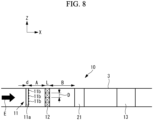
- the distance B from the mixer 12 to the NOx removal catalyst 13 is longer than the distance A from the ammonia injection part 11 to the mixer 12.
- the distance B is the distance from the downstream end of the mixer 12 to the upstream end of the NOx removal catalyst 13.
- the distance A is the distance from the downstream end of the ammonia injection part 11 to the upstream end of the mixer 12.
- the distance A from the ammonia injection part 11 (in detail, the downstream end of the ammonia pipe 11a) to the mixer 12 is a length of 10 times or greater and 30 times or less of the outer diameter d of the ammonia pipe 11a. That is, Equation (1) below is established. 10 d ⁇ A ⁇ 30d
- the distance B from the mixer 12 to the NOx removal catalyst 13 is longer than a length of five times the length D in the Z-axis direction of the cell 12a. That is, Equation (2) below is established. Note that, in the present embodiment, since the length in the Y-axis direction of the cell 12a and the length in the Z-axis direction of the cell 12a are the same, the length in the Y-axis direction of the cell 12a may be the length D. B/D > 5
- a fluid that has passed through the mixer 12 (a mixture fluid in which the flue gas and ammonia are mixed) forms a swirl flow in a space downstream of the mixer 12. Therefore, the flue gas and the reducing agent are better mixed with each other in the space from the mixer 12 to the NOx removal catalyst 13 in which a swirl flow is formed than in the space from the ammonia injection part 11 to the mixer 12.
- the distance B from the mixer 12 to the NOx removal catalyst 13 is longer than the distance A from the ammonia injection part 11 to the mixer 12. Accordingly, since the length of the space from the mixer 12 to the NOx removal catalyst 13 can be longer, the flue gas and ammonia can be suitably mixed with each other. Therefore, since a NOx removal reaction suitably occurs in the NOx removal catalyst 13, the NOx removal efficiency can be improved.
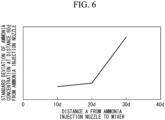
- the vertical axis of Fig. 6 represents the standard deviation of ammonia concentrations at a position spaced away from the ammonia injection part 11 by 60d (the length of 60 times the outer diameter length d of the ammonia pipe 11a), and the horizontal axis of Fig. 6 represents the distance A from the ammonia injection part 11 to the mixer 12 as a length based on the outer diameter d of the ammonia pipe 11a. Further, Fig. 6 illustrates a case where the distance B from the mixer 12 to the NOx removal catalyst 13 is 30d.
- a smaller value of the distance A results in a smaller standard deviation of ammonia concentrations. That is, a smaller value of the distance A results in a smaller unevenness in the ammonia concentrations, and the mixture is facilitated.
- the standard deviation decreases sharply in a range of the distance A from 30d to 20d.
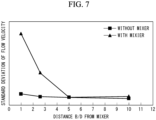
- the distance B from the mixer 12 to the NOx removal catalyst 13 is five times longer than the length D in the Z-axis direction of the cell 12a. Accordingly, since the distance B from the mixer 12 to the NOx removal catalyst 13 can be longer, the mixture fluid with the swirl flow being sufficiently attenuated (with swirl force being sufficiently weakened) reaches the NOx removal catalyst 13. Therefore, the mixture fluid can be caused to flow into the NOx removal catalyst 13 in a state where unevenness in flow velocities at respective positions in the flow path cross section of the duct 3 is suppressed. Thus, a mixture fluid in an equalized state can be supplied to the NOx removal catalyst 13. Thus, since a NOx removal reaction suitably occurs in the NOx removal catalyst 13, the NOx removal efficiency can be improved.
- the effect of improvement in NOx removal efficiency will be described in detail with reference to the graph of Fig. 7 .
- the vertical axis of Fig. 7 represents the standard deviation of flow velocities of the mixture fluid, and the horizontal axis of Fig. 7 represents the value of B/D.
- the distance A from the ammonia injection part 11 to the mixer 12 is 10 times or greater of the outer diameter d of the ammonia pipe 11a. Accordingly, since ammonia injected from the injection nozzle 11b flows into the mixer 12 in a suitably diffused state, the flue gas and ammonia can be suitably mixed with each other in the mixer 12. Therefore, the NOx removal efficiency can be improved. Further, in the present embodiment, the distance A from the ammonia injection part 11 to the mixer 12 is 30 times or less of the outer diameter d of the ammonia pipe 11a. Accordingly, the entire length of the duct 3 can be shorter. Therefore, the NOx removal device 10 can be reduced in size. As described above, in the present embodiment, the mixing performance in the mixer 12 can be improved, and the NOx removal device 10 can be reduced in size.
- a high-pressure heat exchange unit (heat exchanger) 21 that is a resistive element may be provided between the mixer 12 and the NOx removal catalyst 13.
- the NOx removal catalyst 13 is provided downstream of the high-pressure heat exchange unit 21.
- the high-pressure heat exchange unit 21 has heat transfer tubes (not illustrated) inside which a heat medium flows through and causes heat exchange between the heat medium flowing through inside the heat transfer tubes and the flue gas flowing through outside the heat transfer tubes in the same manner as the first heat exchange unit 4 and the second heat exchange unit 5.
- the distance between the mixer 12 and the high-pressure heat exchange unit 21 is the distance B. That is, the distance from the mixer 12 to the high-pressure heat exchange unit 21 (distance B) is set longer than the length of five times the length D in the Z-axis direction of the cell 12a of the mixer 12.
- the distance B of the present embodiment may be any distance between the mixer 12 and a resistive element (for example, the NOx removal catalyst 13 or the high-pressure heat exchange unit 21) arranged downstream of the mixer 12 and most-upstream.
- the resistive element is an object arranged so as to cover substantially the entire region of the flow path sectional area of the duct 3 and providing a resistance against the flue gas flowing through the duct 3 (in detail, the flue gas with ammonia injected).
- the resistive element is an object that significantly attenuates a swirl flow occurring in the mixer 12.
- the resistive element may be, for example, an ammonia decomposition catalyst that decomposes ammonia or a CO decomposition catalyst that decomposes carbon monoxide other than the NOx removal catalyst 13 or the high-pressure heat exchange unit 21 described in the above embodiments.
- a mixture fluid flows into the high-pressure heat exchange unit 21 in a state where unevenness is suppressed
- a state where unevenness in flow velocities of the mixture fluid is sufficiently suppressed can also be obtained downstream of the high-pressure heat exchange unit 21. Therefore, a mixture fluid in an equalized state can be caused to flow also into the NOx removal catalyst 13 arranged downstream of the high-pressure heat exchange unit 21. Therefore, since a NOx removal reaction suitably occurs in the NOx removal catalyst 13, the NOx removal efficiency can be improved.
- the NOx removal device is provided inside the horizontal type duct through which the flue gas flows in the horizontal direction
- the present disclosure is not limited thereto.
- the NOx removal device may be provided inside the vertical type duct through which the flue gas flows in the vertical direction.
- the NOx removal device described in the embodiment illustrated above is understood as follows, for example.
- the NOx removal device is a NOx removal device (10) provided inside a duct (3) through which a flue gas flows in a predetermined direction (X-axis direction), and the NOx removal device includes: an injection part (11) configured to inject a reducing agent to the flue gas flowing through the duct, the reducing agent serving to reduce nitrogen oxide contained in the flue gas; a mixing part (12) provided downstream of the injection part and configured to form a vortex about a center axis extending in the predetermined direction to mix the flue gas flowing through the duct and the reducing agent with each other; and a flow-straightening part (13, 21) provided downstream of the mixing part and over the entire region of a flow path cross section of the duct and configured to provide a resistance against a flow of a mixture fluid, the flue gas and the reducing agent being mixed in the mixture fluid.
- the injection part has a reducing agent pipe extending in an intersecting direction that is a direction intersecting the predetermined direction, the reducing agent flowing through inside the reducing agent pipe, and a nozzle provided in a side face of the reducing agent pipe and configured to inject the reducing agent into the duct, the distance (A) from the injection part to the mixing part is 10 times or greater and 30 times or less of the outer diameter (d) of the reducing agent pipe, and the distance (B) from the mixing part to the flow-straightening part is longer than the distance (A) from the injection part to the mixing part.
- a fluid that has passed through the mixing part forms a vortex in a space downstream of the mixing part. Therefore, the flue gas and the reducing agent are better mixed with each other in the space from the mixing part to the flow-straightening part in which a vortex is formed than in the space from the injection part to the mixing part.
- the distance from the mixing part to the flow-straightening part is longer than the distance from the injection part to the mixing part. Accordingly, since the length from the mixing part to the flow-straightening part can be longer, the flue gas and the reducing agent can be suitably mixed with each other. Therefore, since a NOx removal reaction suitably occurs in the NOx removal catalyst, the NOx removal efficiency can be improved.
- a state where unevenness in flow velocities of the mixture fluid is sufficiently suppressed can also be obtained downstream of the flow-straightening part. Therefore, for example, when the flow-straightening part is a heat exchanger or the like and a NOx removal catalyst is provided downstream of the heat exchanger, the state where unevenness in flow velocities of the mixture fluid is sufficiently suppressed is obtained also downstream of the heat exchanger, and this causes the mixture fluid in an equalized state to flow into the NOx removal catalyst. Therefore, since a NOx removal reaction suitably occurs in the NOx removal catalyst, the NOx removal efficiency can be improved.
- the distance from the injection part to the mixing part is 10 times or greater of the outer diameter d of the reducing agent pipe. Accordingly, since a reducing agent injected from the nozzle flows into the mixing part in a suitably diffused state, the flue gas and the reducing agent can be suitably mixed with each other in the mixer. Therefore, the NOx removal efficiency can be improved. Further, in the above configuration, the distance from the injection part to the mixing part is 30 times or less of the outer diameter of the reducing agent pipe. Accordingly, the entire length of the duct can be shorter. Therefore, the NOx removal device can be reduced in size. As described above, in the above configuration, the mixing performance in the mixing part can be improved, and the NOx removal device can be reduced in size.
- the mixing part has a plurality of cells (12a) determining the size of a vortex to be formed, and the distance (B) from the mixing part to the flow-straightening part is longer than a length of five times a length (D) in an intersecting direction of each of the cells, the intersecting direction being a direction intersecting the predetermined direction.
- the distance from the mixing part to the flow-straightening part is five times longer than the length in the intersecting direction of the cell.
- the mixture fluid with the vortex formed in the mixing part being sufficiently attenuated reaches the flow-straightening part. Therefore, the mixture fluid can be caused to flow into the flow-straightening part in a state where unevenness in flow velocities at respective positions in the flow path cross section is suppressed.
- the flow-straightening part is a NOx removal catalyst
- the mixture fluid in an equalized state flows into the NOx removal catalyst, a NOx removal reaction suitably occurs in the NOx removal catalyst, and therefore the NOx removal efficiency can be improved.
- the flow-straightening part has a NOx removal catalyst (13) configured to remove nitrogen oxide contained in the flue gas when the mixture fluid passes through the NOx removal catalyst.
- the mixture fluid can be caused to flow into the NOx removal catalyst in a state where unevenness in flow velocities at respective positions in the flow path cross section is suppressed. Therefore, the mixture fluid in an equalized state flows into the NOx removal catalyst, a NOx removal reaction suitably occurs in the NOx removal catalyst, and therefore the NOx removal efficiency can be improved.
- the NOx removal device in the above first aspect or second aspect, includes a NOx removal catalyst (13) arranged downstream of the flow-straightening part and configured to remove nitrogen oxide contained in the flue gas when the mixture fluid passes through the NOx removal catalyst, and the flow-straightening part has a heat exchanger (21) comprising a heat transfer tube inside which water or steam flows through and configured to perform heat exchange between water or steam flowing through the heat transfer tube and the flue gas flowing through the duct.
Landscapes
- Chemical & Material Sciences (AREA)
- Engineering & Computer Science (AREA)
- Chemical Kinetics & Catalysis (AREA)
- Environmental & Geological Engineering (AREA)
- Health & Medical Sciences (AREA)
- Biomedical Technology (AREA)
- Oil, Petroleum & Natural Gas (AREA)
- General Chemical & Material Sciences (AREA)
- Analytical Chemistry (AREA)
- Combustion & Propulsion (AREA)
- General Engineering & Computer Science (AREA)
- Mechanical Engineering (AREA)
- Toxicology (AREA)
- Dispersion Chemistry (AREA)
- Exhaust Gas Treatment By Means Of Catalyst (AREA)
- Treating Waste Gases (AREA)
Applications Claiming Priority (2)
| Application Number | Priority Date | Filing Date | Title |
|---|---|---|---|
| JP2022086027 | 2022-05-26 | ||
| PCT/JP2023/006075 WO2023228495A1 (ja) | 2022-05-26 | 2023-02-20 | 脱硝装置 |
Publications (2)
| Publication Number | Publication Date |
|---|---|
| EP4516384A1 true EP4516384A1 (de) | 2025-03-05 |
| EP4516384A4 EP4516384A4 (de) | 2025-09-10 |
Family
ID=88918883
Family Applications (1)
| Application Number | Title | Priority Date | Filing Date |
|---|---|---|---|
| EP23811376.5A Pending EP4516384A4 (de) | 2022-05-26 | 2023-02-20 | Denitrierungsvorrichtung |
Country Status (7)
| Country | Link |
|---|---|
| US (1) | US20250144568A1 (de) |
| EP (1) | EP4516384A4 (de) |
| JP (1) | JPWO2023228495A1 (de) |
| KR (1) | KR20250003928A (de) |
| CN (1) | CN119173330A (de) |
| TW (1) | TWI877579B (de) |
| WO (1) | WO2023228495A1 (de) |
Family Cites Families (14)
| Publication number | Priority date | Publication date | Assignee | Title |
|---|---|---|---|---|
| JPS58143826A (ja) * | 1982-02-22 | 1983-08-26 | Babcock Hitachi Kk | 廃熱ボイラ組込み脱硝装置 |
| JPH0631826A (ja) | 1992-07-22 | 1994-02-08 | Hitachi Chem Co Ltd | 積層板の製造方法 |
| JPH0631826U (ja) | 1992-10-08 | 1994-04-26 | 三菱重工業株式会社 | 流体流れの混合装置 |
| JPH10165769A (ja) * | 1996-12-11 | 1998-06-23 | Babcock Hitachi Kk | 脱硝装置 |
| WO2006061912A1 (ja) * | 2004-12-10 | 2006-06-15 | Babcock-Hitachi Kabushiki Kaisha | 排煙脱硝装置と排煙脱硝方法 |
| JP2009108726A (ja) * | 2007-10-29 | 2009-05-21 | Mitsubishi Heavy Ind Ltd | 排ガス浄化装置 |
| JP2010071240A (ja) * | 2008-09-19 | 2010-04-02 | Tokyo Roki Co Ltd | 内燃機関用の排ガス浄化装置、及び旋回流発生装置 |
| JP5523807B2 (ja) * | 2009-08-05 | 2014-06-18 | 三菱重工業株式会社 | 排ガス処理装置 |
| CN102512954A (zh) * | 2011-12-23 | 2012-06-27 | 东方电气集团东方锅炉股份有限公司 | 余热锅炉烟气脱硝装置 |
| JP5812900B2 (ja) * | 2012-02-29 | 2015-11-17 | 三菱重工業株式会社 | 流体混合装置及び乾式排ガス処理装置 |
| JP6108461B2 (ja) * | 2013-10-09 | 2017-04-05 | ヤンマー株式会社 | 排気浄化装置 |
| JP6542568B2 (ja) * | 2015-04-15 | 2019-07-10 | 三菱日立パワーシステムズインダストリー株式会社 | 流体の混合装置及び該流体の混合装置を備えた脱硝装置 |
| JP2019143495A (ja) * | 2018-02-16 | 2019-08-29 | 三菱日立パワーシステムズ株式会社 | 脱硝装置及びこれを備えた排熱回収ボイラ、ガスタービン複合発電プラント並びに脱硝方法 |
| KR102159083B1 (ko) * | 2020-06-09 | 2020-09-23 | 주식회사 이엠코 | 복합화력발전소 배가스 처리장치 |
-
2023
- 2023-02-20 KR KR1020247038746A patent/KR20250003928A/ko active Pending
- 2023-02-20 WO PCT/JP2023/006075 patent/WO2023228495A1/ja not_active Ceased
- 2023-02-20 JP JP2024522914A patent/JPWO2023228495A1/ja active Pending
- 2023-02-20 US US18/867,102 patent/US20250144568A1/en active Pending
- 2023-02-20 EP EP23811376.5A patent/EP4516384A4/de active Pending
- 2023-02-20 CN CN202380042424.1A patent/CN119173330A/zh active Pending
- 2023-03-07 TW TW112108205A patent/TWI877579B/zh active
Also Published As
| Publication number | Publication date |
|---|---|
| US20250144568A1 (en) | 2025-05-08 |
| TWI877579B (zh) | 2025-03-21 |
| KR20250003928A (ko) | 2025-01-07 |
| JPWO2023228495A1 (de) | 2023-11-30 |
| TW202345958A (zh) | 2023-12-01 |
| CN119173330A (zh) | 2024-12-20 |
| EP4516384A4 (de) | 2025-09-10 |
| WO2023228495A1 (ja) | 2023-11-30 |
Similar Documents
| Publication | Publication Date | Title |
|---|---|---|
| US8017084B1 (en) | Ammonia injection grid for a selective catalytic reduction system | |
| EP1712751B1 (de) | Statischer Mischer | |
| CN107614091B (zh) | 废气混合装置 | |
| JP5594368B2 (ja) | アンモニア注入装置 | |
| JP6542568B2 (ja) | 流体の混合装置及び該流体の混合装置を備えた脱硝装置 | |
| CN101450293B (zh) | 鳍片式钝体静态混合装置 | |
| CN109070026B (zh) | 用于排气后处理系统的混合器 | |
| JP3296069B2 (ja) | 流体の混合装置 | |
| EP4516384A1 (de) | Denitrierungsvorrichtung | |
| EP2248577A1 (de) | Mischvorrichtung für Fluide mit Injektionslanze | |
| AU2017292601A1 (en) | Dual mixer for exhaust gas aftertreatment systems | |
| CN104066498B (zh) | 用于还原剂制备的混合装置 | |
| JP2006181424A (ja) | ガス混合器 | |
| JP3554997B2 (ja) | 排ガス脱硝装置 | |
| JP3858132B2 (ja) | 排ガス脱硝システムのアンモニア注入装置 | |
| CN213132696U (zh) | 用于燃煤电厂scr脱硝的前置式三角翼型静态混合器 | |
| US10012125B2 (en) | Dual mixer for exhaust aftertreatment systems | |
| CN209237721U (zh) | 一种静态混合器 | |
| JP5835962B2 (ja) | 排ガスダクト及びこれを備えた脱硝装置 | |
| JP2013180227A (ja) | 流体混合装置及び乾式排ガス処理装置 | |
| CN107304702B (zh) | 用于内燃机废气后处理系统的混合装置 | |
| JP2025145075A (ja) | 排ガス処理装置 | |
| JP3735504B2 (ja) | 排ガス混合器 | |
| WO2025022786A1 (ja) | 脱硝装置 | |
| WO2024202659A1 (ja) | 還元剤注入装置 |
Legal Events
| Date | Code | Title | Description |
|---|---|---|---|
| STAA | Information on the status of an ep patent application or granted ep patent |
Free format text: STATUS: THE INTERNATIONAL PUBLICATION HAS BEEN MADE |
|
| PUAI | Public reference made under article 153(3) epc to a published international application that has entered the european phase |
Free format text: ORIGINAL CODE: 0009012 |
|
| STAA | Information on the status of an ep patent application or granted ep patent |
Free format text: STATUS: REQUEST FOR EXAMINATION WAS MADE |
|
| 17P | Request for examination filed |
Effective date: 20241126 |
|
| AK | Designated contracting states |
Kind code of ref document: A1 Designated state(s): AL AT BE BG CH CY CZ DE DK EE ES FI FR GB GR HR HU IE IS IT LI LT LU LV MC ME MK MT NL NO PL PT RO RS SE SI SK SM TR |
|
| DAV | Request for validation of the european patent (deleted) | ||
| DAX | Request for extension of the european patent (deleted) | ||
| A4 | Supplementary search report drawn up and despatched |
Effective date: 20250811 |
|
| RIC1 | Information provided on ipc code assigned before grant |
Ipc: B01D 53/86 20060101AFI20250805BHEP Ipc: B01D 53/90 20060101ALI20250805BHEP Ipc: F01N 3/02 20060101ALI20250805BHEP Ipc: F01N 3/08 20060101ALI20250805BHEP Ipc: B01J 21/06 20060101ALI20250805BHEP Ipc: B01F 25/40 20220101ALI20250805BHEP Ipc: F23J 15/00 20060101ALI20250805BHEP |