EP4506938A2 - Mehrkanalsignalcodierungsverfahren und codierer - Google Patents
Mehrkanalsignalcodierungsverfahren und codierer Download PDFInfo
- Publication number
- EP4506938A2 EP4506938A2 EP24202620.1A EP24202620A EP4506938A2 EP 4506938 A2 EP4506938 A2 EP 4506938A2 EP 24202620 A EP24202620 A EP 24202620A EP 4506938 A2 EP4506938 A2 EP 4506938A2
- Authority
- EP
- European Patent Office
- Prior art keywords
- parameter
- current frame
- channel
- signal
- channel signal
- Prior art date
- Legal status (The legal status is an assumption and is not a legal conclusion. Google has not performed a legal analysis and makes no representation as to the accuracy of the status listed.)
- Pending
Links
Images


Classifications
-
- G—PHYSICS
- G10—MUSICAL INSTRUMENTS; ACOUSTICS
- G10L—SPEECH ANALYSIS TECHNIQUES OR SPEECH SYNTHESIS; SPEECH RECOGNITION; SPEECH OR VOICE PROCESSING TECHNIQUES; SPEECH OR AUDIO CODING OR DECODING
- G10L19/00—Speech or audio signals analysis-synthesis techniques for redundancy reduction, e.g. in vocoders; Coding or decoding of speech or audio signals, using source filter models or psychoacoustic analysis
- G10L19/008—Multichannel audio signal coding or decoding using interchannel correlation to reduce redundancy, e.g. joint-stereo, intensity-coding or matrixing
-
- G—PHYSICS
- G10—MUSICAL INSTRUMENTS; ACOUSTICS
- G10L—SPEECH ANALYSIS TECHNIQUES OR SPEECH SYNTHESIS; SPEECH RECOGNITION; SPEECH OR VOICE PROCESSING TECHNIQUES; SPEECH OR AUDIO CODING OR DECODING
- G10L19/00—Speech or audio signals analysis-synthesis techniques for redundancy reduction, e.g. in vocoders; Coding or decoding of speech or audio signals, using source filter models or psychoacoustic analysis
- G10L19/02—Speech or audio signals analysis-synthesis techniques for redundancy reduction, e.g. in vocoders; Coding or decoding of speech or audio signals, using source filter models or psychoacoustic analysis using spectral analysis, e.g. transform vocoders or subband vocoders
- G10L19/022—Blocking, i.e. grouping of samples in time; Choice of analysis windows; Overlap factoring
-
- G—PHYSICS
- G10—MUSICAL INSTRUMENTS; ACOUSTICS
- G10L—SPEECH ANALYSIS TECHNIQUES OR SPEECH SYNTHESIS; SPEECH RECOGNITION; SPEECH OR VOICE PROCESSING TECHNIQUES; SPEECH OR AUDIO CODING OR DECODING
- G10L19/00—Speech or audio signals analysis-synthesis techniques for redundancy reduction, e.g. in vocoders; Coding or decoding of speech or audio signals, using source filter models or psychoacoustic analysis
- G10L19/02—Speech or audio signals analysis-synthesis techniques for redundancy reduction, e.g. in vocoders; Coding or decoding of speech or audio signals, using source filter models or psychoacoustic analysis using spectral analysis, e.g. transform vocoders or subband vocoders
- G10L19/032—Quantisation or dequantisation of spectral components
-
- G—PHYSICS
- G10—MUSICAL INSTRUMENTS; ACOUSTICS
- G10L—SPEECH ANALYSIS TECHNIQUES OR SPEECH SYNTHESIS; SPEECH RECOGNITION; SPEECH OR VOICE PROCESSING TECHNIQUES; SPEECH OR AUDIO CODING OR DECODING
- G10L25/00—Speech or voice analysis techniques not restricted to a single one of groups G10L15/00 - G10L21/00
- G10L25/03—Speech or voice analysis techniques not restricted to a single one of groups G10L15/00 - G10L21/00 characterised by the type of extracted parameters
-
- H—ELECTRICITY
- H04—ELECTRIC COMMUNICATION TECHNIQUE
- H04S—STEREOPHONIC SYSTEMS
- H04S2420/00—Techniques used stereophonic systems covered by H04S but not provided for in its groups
- H04S2420/01—Enhancing the perception of the sound image or of the spatial distribution using head related transfer functions [HRTF's] or equivalents thereof, e.g. interaural time difference [ITD] or interaural level difference [ILD]
-
- H—ELECTRICITY
- H04—ELECTRIC COMMUNICATION TECHNIQUE
- H04S—STEREOPHONIC SYSTEMS
- H04S3/00—Systems employing more than two channels, e.g. quadraphonic
Definitions
- This application relates to the audio signal encoding field, and more specifically, to a multi-channel signal encoding method and an encoder.
- stereo has a sense of direction and a sense of distribution of acoustic sources, and can improve clarity, intelligibility, and a sense of immediacy of sound, and therefore is popular with people.
- Stereo processing technologies mainly include mid/side (MS) encoding, intensity stereo (IS) encoding, and parametric stereo (PS) encoding.
- mid/side transformation is performed on two signals based on inter-channel coherence, and energy of channels is mainly concentrated in a mid channel, so that inter-channel redundancy is eliminated.
- reduction of a code rate depends on coherence between input signals. When coherence between a left-channel signal and a right-channel signal is poor, the left-channel signal and the right-channel signal need to be transmitted separately.
- high-frequency components of a left-channel signal and a right-channel signal are simplified based on a feature that a human auditory system is insensitive to a phase difference between high-frequency components (for example, components above 2 kHz) of channels.
- high-frequency components for example, components above 2 kHz
- the IS encoding technology is effective only for high-frequency components. If the IS encoding technology is extended to a low frequency, severe man-made noise is caused.
- the PS encoding is an encoding scheme based on a binaural auditory model.
- x L is a left-channel time-domain signal
- x R is a right-channel time-domain signal
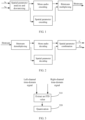
- an encoder side converts a stereo signal into a mono signal and a few spatial parameters (or spatial perception parameters) that describe a spatial sound field.
- a decoder side restores a stereo signal with reference to the spatial parameters.
- the PS encoding has a higher compression ratio. Therefore, in the PS encoding, a higher encoding gain can be obtained on a premise that relatively good sound quality is maintained.
- the PS encoding can be performed in full audio bandwidth, and can well restore a spatial perception effect of stereo.
- multi-channel parameters include inter-channel coherence (IC), an inter-channel level difference (ILD), an inter-channel time difference (ITD), an overall phase difference (OPD), an inter-channel phase difference (IPD), and the like.
- IC describes inter-channel cross-correlation or coherence. This parameter determines perception of a sound field range, and can improve a sense of space and sound stability of an audio signal.
- the ILD is used to distinguish a horizontal azimuth of a stereo acoustic source, and describes an inter-channel energy difference. This parameter affects frequency components of an entire spectrum.
- the ITD and the IPD are spatial parameters that represent a horizontal orientation of an acoustic source, and describe inter-channel time and phase differences.
- the ILD, the ITD, and the IPD can determine perception of human ears for a location of an acoustic source, can be used to effectively determine a sound field location, and plays an important part in restoration of a stereo signal.
- a multi-channel parameter calculated according to an existing PS encoding scheme is always unstable (a multi-channel parameter value frequently and sharply changes).
- a downmixed signal calculated based on such a multi-channel parameter is discontinuous.
- quality of stereo obtained on the decoder side is poor. For example, an acoustic image of the stereo played on the decoder side jitters frequently, and even auditory freezing occurs.
- This application provides a multi-channel signal encoding method and an encoder, to improve stability of a multi-channel parameter in PS encoding, thereby improving encoding quality of an audio signal.
- a multi-channel signal encoding method including:
- the multi-channel parameter of the current frame is determined based on comprehensive consideration of the characteristic parameter of the current frame and the difference between the current frame and the previous K frames. This determining manner is more proper. Compared with a manner of directly reusing a multi-channel parameter of a previous frame for the current frame, this manner can better ensure accuracy of inter-channel information of a multi-channel signal.
- the determining a multi-channel parameter of the current frame based on the difference parameter and a characteristic parameter of the current frame includes: if the difference parameter meets a first preset condition, determining the multi-channel parameter of the current frame based on the characteristic parameter of the current frame
- the difference parameter is an absolute value of a difference between the initial multi-channel parameter of the current frame and a multi-channel parameter of a previous frame of the current frame, and the first preset condition is that the difference parameter is greater than a preset first threshold.
- the difference parameter is a product of the initial multi-channel parameter of the current frame and a multi-channel parameter of a previous frame of the current frame, and the first preset condition is that the difference parameter is less than or equal to 0.
- the determining the multi-channel parameter of the current frame based on the characteristic parameter of the current frame includes: determining the multi-channel parameter of the current frame based on a correlation parameter of the current frame, where the correlation parameter is used to represent a degree of correlation between the current frame and the previous frame of the current frame.
- the method further includes: determining the correlation parameter based on a target channel signal in the multi-channel signal of the current frame and a target channel signal in a multi-channel signal of the previous frame
- the determining the correlation parameter based on a target channel signal in the multi-channel signal of the current frame and a target channel signal in a multi-channel signal of the previous frame includes: determining the correlation parameter based on a frequency domain parameter of the target channel signal in the multi-channel signal of the current frame and a frequency domain parameter of the target channel signal in the multi-channel signal of the previous frame, where the frequency domain parameter is at least one of a frequency domain amplitude value and a frequency domain coefficient of the target channel signal.
- the method further includes: determining the correlation parameter based on a pitch period of the current frame and a pitch period of the previous frame.
- the determining the multi-channel parameter of the current frame based on the characteristic parameter of the current frame includes: if the characteristic parameter meets a second preset condition, determining the multi-channel parameter of the current frame based on multi-channel parameters of previous T frames of the current frame, where T is an integer greater than or equal to 1.
- the determining the multi-channel parameter of the current frame based on multi-channel parameters of previous T frames of the current frame includes: determining the multi-channel parameters of the previous T frames as the multi-channel parameter of the current frame, where T is equal to 1.
- the determining the multi-channel parameter of the current frame based on multi-channel parameters of previous T frames of the current frame includes: determining the multi-channel parameter of the current frame based on a change trend of the multi-channel parameters of the previous T frames, where T is greater than or equal to 2.
- the characteristic parameter includes at least one of the correlation parameter and a peak-to-average ratio parameter of the current frame, where the correlation parameter is used to represent the degree of correlation between the current frame and the previous frame of the current frame, and the peak-to-average ratio parameter is used to represent a peak-to-average ratio of a signal of at least one channel in the multi-channel signal of the current frame; and the second preset condition is that the characteristic parameter is greater than a preset threshold.
- the initial multi-channel parameter of the current frame includes at least one of the following: an initial inter-channel coherence IC value of the current frame, an initial inter-channel time difference ITD value of the current frame, an initial inter-channel phase difference IPD value of the current frame, an initial overall phase difference OPD value of the current frame, and an initial inter-channel level difference ILD value of the current frame.
- the characteristic parameter of the current frame includes at least one of the following parameters of the current frame: the correlation parameter, the peak-to-average ratio parameter, a signal-to-noise ratio parameter, and a spectrum tilt parameter, where the correlation parameter is used to represent the degree of correlation between the current frame and the previous frame, the peak-to-average ratio parameter is used to represent the peak-to-average ratio of the signal of the at least one channel in the multi-channel signal of the current frame, the signal-to-noise ratio parameter is used to represent a signal-to-noise ratio of a signal of at least one channel in the multi-channel signal of the current frame, and the spectrum tilt parameter is used to represent a spectrum tilt degree of a signal of at least one channel in the multi-channel signal of the current frame.
- the correlation parameter is used to represent the degree of correlation between the current frame and the previous frame
- the peak-to-average ratio parameter is used to represent the peak-to-average ratio of the signal of the at least one channel in the multi-channel signal of the current frame
- an encoder including:
- the multi-channel parameter of the current frame is determined based on comprehensive consideration of the characteristic parameter of the current frame and the difference between the current frame and the previous K frames. This determining manner is more proper. Compared with a manner of directly reusing a multi-channel parameter of a previous frame for the current frame, this manner can better ensure accuracy of inter-channel information of a multi-channel signal.
- the third determining unit is specifically configured to: if the difference parameter meets a first preset condition, determine the multi-channel parameter of the current frame based on the characteristic parameter of the current frame.
- the difference parameter is an absolute value of a difference between the initial multi-channel parameter of the current frame and a multi-channel parameter of a previous frame of the current frame, and the first preset condition is that the difference parameter is greater than a preset first threshold.
- the difference parameter is a product of the initial multi-channel parameter of the current frame and a multi-channel parameter of a previous frame of the current frame, and the first preset condition is that the difference parameter is less than or equal to 0.
- the third determining unit is specifically configured to determine the multi-channel parameter of the current frame based on a correlation parameter of the current frame, where the correlation parameter is used to represent a degree of correlation between the current frame and the previous frame of the current frame.
- the encoder further includes: a fourth determining unit, configured to determine the correlation parameter based on a target channel signal in the multi-channel signal of the current frame and a target channel signal in a multi-channel signal of the previous frame.
- the fourth determining unit is specifically configured to determine the correlation parameter based on a frequency domain parameter of the target channel signal in the multi-channel signal of the current frame and a frequency domain parameter of the target channel signal in the multi-channel signal of the previous frame, where the frequency domain parameter is at least one of a frequency domain amplitude value and a frequency domain coefficient of the target channel signal.
- the encoder further includes: a fifth determining unit, configured to determine the correlation parameter based on a pitch period of the current frame and a pitch period of the previous frame.
- the third determining unit is specifically configured to: if the characteristic parameter meets a second preset condition, determine the multi-channel parameter of the current frame based on multi-channel parameters of previous T frames of the current frame, where T is an integer greater than or equal to 1.
- the third determining unit is specifically configured to determine the multi-channel parameters of the previous T frames as the multi-channel parameter of the current frame, where T is equal to 1.
- the third determining unit is specifically configured to determine the multi-channel parameter of the current frame based on a change trend of the multi-channel parameters of the previous T frames, where T is greater than or equal to 2.
- the characteristic parameter includes at least one of the correlation parameter and a peak-to-average ratio parameter of the current frame, where the correlation parameter is used to represent the degree of correlation between the current frame and the previous frame of the current frame, and the peak-to-average ratio parameter is used to represent a peak-to-average ratio of a signal of at least one channel in the multi-channel signal of the current frame; and the second preset condition is that the characteristic parameter is greater than a preset threshold.
- the initial multi-channel parameter of the current frame includes at least one of the following: an initial inter-channel coherence IC value of the current frame, an initial inter-channel time difference ITD value of the current frame, an initial inter-channel phase difference IPD value of the current frame, an initial overall phase difference OPD value of the current frame, and an initial inter-channel level difference ILD value of the current frame.
- the characteristic parameter of the current frame includes at least one of the following parameters of the current frame: the correlation parameter, the peak-to-average ratio parameter, a signal-to-noise ratio parameter, and a spectrum tilt parameter, where the correlation parameter is used to represent the degree of correlation between the current frame and the previous frame, the peak-to-average ratio parameter is used to represent the peak-to-average ratio of the signal of the at least one channel in the multi-channel signal of the current frame, the signal-to-noise ratio parameter is used to represent a signal-to-noise ratio of a signal of at least one channel in the multi-channel signal of the current frame, and the spectrum tilt parameter is used to represent a spectrum tilt degree of a signal of at least one channel in the multi-channel signal of the current frame.
- the correlation parameter is used to represent the degree of correlation between the current frame and the previous frame
- the peak-to-average ratio parameter is used to represent the peak-to-average ratio of the signal of the at least one channel in the multi-channel signal of the current frame
- an encoder including a memory and a processor.
- the memory is configured to store a program
- the processor is configured to execute the program.
- the processor performs the method in the first aspect.
- a computer-readable medium stores program code to be executed by an encoder.
- the program code includes an instruction used to perform the method in the first aspect.
- the multi-channel parameter of the current frame is determined based on comprehensive consideration of the characteristic parameter of the current frame and the difference between the current frame and the previous K frames. This determining manner is more proper. Compared with a manner of directly reusing the multi-channel parameter of the previous frame for the current frame, this manner can better ensure accuracy of inter-channel information of a multi-channel signal.
- a stereo signal may also be referred to as a multi-channel signal.
- multi-channel signal The foregoing briefly describes functions and meanings of multi-channel parameters of the multi-channel signal: an ILD, an ITD, and an IPD.
- ILD functions and meanings of multi-channel parameters of the multi-channel signal: an ILD, an ITD, and an IPD.
- IPD functions and meanings of multi-channel parameters of the multi-channel signal: an ILD, an ITD, and an IPD.
- the following describes the ILD, the ITD, and the IPD in a more detailed manner by using an example in which a signal picked up by a first microphone is a first-channel signal and a signal picked up by a second microphone is a second-channel signal.
- the ILD describes an energy difference between the first-channel signal and the second-channel signal. Usually, a ratio of energy of a left channel to energy of a right channel is calculated, and then the ratio is converted into a logarithm-domain value. For example, if an ILD value is greater than 0, it indicates that energy of the first-channel signal is higher than energy of the second-channel signal; if an ILD value is equal to 0, it indicates that energy of the first-channel signal is equal to energy of the second-channel signal; or if an ILD value is less than 0, it indicates that energy of the first-channel signal is less than energy of the second-channel signal.
- the ILD is less than 0, it indicates that energy of the first-channel signal is higher than energy of the second-channel signal; if the ILD is equal to 0, it indicates that energy of the first-channel signal is equal to energy of the second-channel signal; or if the ILD is greater than 0, it indicates that energy of the first-channel signal is less than energy of the second-channel signal. It should be understood that the foregoing values are merely examples, and a relationship between the ILD value and the energy difference between the first-channel signal and the second-channel signal may be defined based on experience or an actual requirement.
- the ITD describes a time difference between the first-channel signal and the second-channel signal, namely, a difference between a time at which sound generated by an acoustic source arrives at the first microphone and a time at which the sound generated by the acoustic source arrives at the second microphone.
- an ITD value is greater than 0, it indicates that the time at which the sound generated by the acoustic source arrives at the first microphone is earlier than the time at which the sound generated by the acoustic source arrives at the second microphone; if an ITD value is equal to 0, it indicates that the sound generated by the acoustic source simultaneously arrives at the first microphone and the second microphone; or if an ITD value is less than 0, it indicates that the time at which the sound generated by the acoustic source arrives at the first microphone is later than the time at which the sound generated by the acoustic source arrives at the second microphone.
- the ITD is less than 0, it indicates that the time at which the sound generated by the acoustic source arrives at the first microphone is earlier than the time at which the sound generated by the acoustic source arrives at the second microphone; if the ITD is equal to 0, it indicates that the sound generated by the acoustic source simultaneously arrives at the first microphone and the second microphone; or if the ITD is greater than 0, it indicates that the time at which the sound generated by the acoustic source arrives at the first microphone is later than the time at which the sound generated by the acoustic source arrives at the second microphone. It should be understood that the foregoing values are merely examples, and a relationship between the ITD value and the time difference between the first-channel signal and the second-channel signal may be defined based on experience or an actual requirement.
- the IPD describes a phase difference between the first-channel signal and the second-channel signal. This parameter is usually used together with the ITD to restore phase information of a multi-channel signal on a decoder side.
- an existing multi-channel parameter calculation manner causes discontinuity of a multi-channel parameter.
- a multi-channel signal includes a left-channel signal and a right-channel signal
- a multi-channel parameter is an ITD value.
- an ITD value may be calculated in a plurality of manners.
- the ITD value may be calculated in time domain, or the ITD value may be calculated in frequency domain.
- FIG. 3 is a schematic flowchart of a time-domain-based ITD value calculation method. The method in FIG. 3 includes the following steps.
- T 1 is an opposite number of an index value corresponding to max(C n (i)); otherwise, T 1 is an index value corresponding to max(C p (i)), where i is an index value of the cross-correlation function, x R is the right-channel time-domain signal, x L is the left-channel time-domain signal, T max is corresponding to a maximum ITD value at different sampling rates, and Length is a frame length.
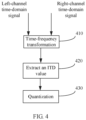
- FIG. 4 is a schematic flowchart of a frequency-domain-based ITD value calculation method. The method in FIG. 4 includes the following steps.
- a time-domain signal may be transformed into a frequency-domain signal by using a technology such as discrete Fourier transform (DFT) or modified discrete cosine transform (MDCT).
- DFT discrete Fourier transform
- MDCT modified discrete cosine transform
- time-frequency transformation may be performed on the input left-channel time-domain signal and right-channel time-domain signal by using DFT transformation.
- L frequency bins of a frequency-domain signal may be divided into a plurality of sub-bands.
- An index value of a frequency bin included in a b th sub-band is A b-1 ⁇ k ⁇ A b - 1 .
- a peak value of a cross correlation coefficient of a multi-channel signal of a current frame is relatively small, a calculated ITD value may be considered inaccurate. In this case, the ITD value of the current frame is zeroed. Due to impact of factors such as background noise, reverberation, and multi-party speaking, an ITD value calculated according to an existing PS encoding scheme is frequently zeroed. As a result, the ITD value frequently and sharply changes, and inter-frame discontinuity is caused for a downmixed signal calculated based on such an ITD value, and consequently acoustic quality of a multi-channel signal is poor.
- a feasible processing manner is as follows: When a calculated multi-channel parameter of a current frame is considered inaccurate, a multi-channel parameter of a previous frame of the current frame may be reused. In this processing manner, the problem that a multi-channel parameter frequently and sharply changes can be well resolved. However, this processing manner may cause the following problem: If signal quality of the current frame is relatively good, the calculated multi-channel parameter of the current frame is usually relatively accurate. In this case, if the processing manner is still used, the multi-channel parameter of the previous frame may still be reused as a multi-channel parameter of the current frame, and the relatively accurate multi-channel parameter of the current frame is discarded. As a result, inter-channel information of a multi-channel signal is inaccurate.
- FIG. 5 is a schematic flowchart of a multi-channel signal encoding method according to an embodiment of this application. The method in FIG. 5 includes the following steps.
- the multi-channel signal may be a dual-channel signal, a three-channel signal, or a signal of more than three channels.
- the multi-channel signal may include a left-channel signal and a right-channel signal.
- the multi-channel signal may include a left-channel signal, a middle-channel signal, a right-channel signal, and a rear-channel signal.
- the initial multi-channel parameter of the current frame may be used to represent correlation between multi-channel signals.
- the initial multi-channel parameter of the current frame includes at least one of the following: an initial IC value of the current frame, an initial ITD value of the current frame, an initial IPD value of the current frame, an initial OPD value of the current frame, an initial ILD value of the current frame, and the like.
- the initial multi-channel parameter of the current frame may be calculated in a plurality of manners.
- a multi-channel parameter is an ITD value.
- the time-domain-based ITD value calculation manner shown in FIG. 3 or the frequency-domain-based ITD value calculation manner in FIG. 4 may be used in step 520.
- previous K frames appearing in the following are previous K frames of a current frame
- a previous frame appearing in the following is a previous frame of a current frame.
- the multi-channel parameter (including the initial multi-channel parameter) may be represented in a form of a numerical value. Therefore, the multi-channel parameter may also be referred to as a multi-channel parameter value.
- the characteristic parameter of the current frame may include a mono parameter of the current frame.
- the mono parameter may be used to represent a feature of a signal of a channel in the multi-channel signal of the current frame.
- the determining a multi-channel parameter of the current frame in step 540 may include: modifying the initial multi-channel parameter to obtain the multi-channel parameter of the current frame.
- the characteristic parameter of the current frame is the mono parameter of the current frame.
- Step 540 may include: modifying the initial multi-channel parameter of the current frame based on the difference parameter and the mono parameter of the current frame, to obtain the multi-channel parameter of the current frame.
- the characteristic parameter of the current frame includes at least one of the following parameters of the current frame: a correlation parameter, a peak-to-average ratio parameter, a signal-to-noise ratio parameter, and a spectrum tilt parameter.
- the correlation parameter is used to represent a degree of correlation between the current frame and a previous frame.
- the peak-to-average ratio parameter is used to represent a peak-to-average ratio of a signal of at least one channel in the multi-channel signal of the current frame.
- the signal-to-noise ratio parameter is used to represent a signal-to-noise ratio of a signal of at least one channel in the multi-channel signal of the current frame.
- the spectrum tilt parameter is used to represent a spectrum tilt degree or a spectral energy change trend of a signal of at least one channel in the multi-channel signal of the current frame.
- operations such as mono audio encoding, spatial parameter encoding, and bitstream multiplexing, shown in FIG. 1 may be performed.
- operations such as mono audio encoding, spatial parameter encoding, and bitstream multiplexing, shown in FIG. 1 may be performed.
- a specific encoding scheme refer to the prior art.
- the multi-channel parameter of the current frame is determined based on comprehensive consideration of the characteristic parameter of the current frame and the difference between the current frame and the previous K frames. This determining manner is more proper. Compared with a manner of directly reusing a multi-channel parameter of the previous frame for the current frame, this manner can better ensure accuracy of inter-channel information of a multi-channel signal.
- step 540 The following describes an implementation of step 540 in detail.
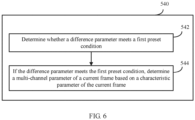
- step 540 may include: if the difference parameter meets a first preset condition, adjusting a value of the initial multi-channel parameter of the current frame based on a value of the characteristic parameter of the current frame, to obtain the multi-channel parameter of the current frame.
- step 540 may include: if the characteristic parameter of the current frame meets a first preset condition, adjusting a value of the initial multi-channel parameter of the current frame based on a value of the difference parameter, to obtain the multi-channel parameter of the current frame.
- the first preset condition may be one condition, or may be a combination of a plurality of conditions. In addition, if the first preset condition is met, determining may be further performed based on another condition. If all conditions are met, a subsequent step is performed.
- step 540 may include the following substeps:
- the difference parameter may be defined in a plurality of manners. Different manners of defining the difference parameter may be corresponding to different first preset conditions. The following describes in detail the difference parameter and the first preset condition corresponding to the difference parameter.
- the difference parameter may be a difference between the initial multi-channel parameter of the current frame and the multi-channel parameter of the previous frame, or an absolute value of the difference.
- the first preset condition may be that the difference parameter is greater than a preset first threshold.
- the first threshold may be 0.3 to 0.7 times of a target value.
- the first threshold may be 0.5 times of the target value.
- the target value is a multi-channel parameter whose absolute value is larger in the multi-channel parameter of the previous frame and the initial multi-channel parameter of the current frame.
- the difference parameter may be a difference between the initial multi-channel parameter of the current frame and an average value of the multi-channel parameters of the previous K frames, or an absolute value of the difference.
- the first preset condition may be that the difference parameter is greater than a preset first threshold.
- the first threshold may be 0.3 to 0.7 times of a target value.
- the first threshold may be 0.5 times of the target value.
- the target value is a multi-channel parameter whose absolute value is larger in the multi-channel parameter of the previous frame and the initial multi-channel parameter of the current frame.
- the difference parameter may be a product of the initial multi-channel parameter of the current frame and the multi-channel parameter of the previous frame, and the first preset condition may be that the difference parameter is less than or equal to 0.
- step 544 The following describes a specific implementation of step 544 in detail.
- step 544 may include: determining the multi-channel parameter of the current frame based on the correlation parameter and/or the spectrum tilt parameter of the current frame, where the correlation parameter is used to represent the degree of correlation between the current frame and the previous frame, and the spectrum tilt parameter is used to represent the spectrum tilt degree or the spectral energy change trend of the signal of the at least one channel in the multi-channel signal of the current frame.
- step 544 may include: determining the multi-channel parameter of the current frame based on the correlation parameter and/or the peak-to-average ratio parameter of the current frame, where the correlation parameter is used to represent the degree of correlation between the current frame and the previous frame, and the peak-to-average ratio parameter is used to represent the peak-to-average ratio of the signal of the at least one channel in the multi-channel signal of the current frame.
- the correlation parameter may be used to represent the degree of correlation between the current frame and the previous frame.
- the degree of correlation between the current frame and the previous frame may be represented in a plurality of manners. Different representation manners may be corresponding to different manners of calculating the correlation parameter. The following provides detailed descriptions with reference to specific embodiments.
- the degree of correlation between the current frame and the previous frame may be represented by using a degree of correlation between a target channel signal in the multi-channel signal of the current frame and a target channel signal in a multi-channel signal of the previous frame. It should be understood that the target channel signal of the current frame is corresponding to the target channel signal of the previous frame.
- the target channel signal of the current frame is a left-channel signal
- the target channel signal of the previous frame is a left-channel signal
- the target channel signal of the previous frame is a right-channel signal
- the target channel signal of the previous frame includes a left-channel signal and a right-channel signal
- the target channel signal of the previous frame includes a left-channel signal and a right-channel signal.
- the target channel signal may be a target channel time-domain signal or a target channel frequency-domain signal.
- the target channel signal is a frequency-domain signal.
- the determining the correlation parameter based on the target channel signal in the multi-channel signal of the current frame and the target channel signal in the multi-channel signal of the previous frame may specifically include: determining the correlation parameter based on a frequency domain parameter of the target channel signal in the multi-channel signal of the current frame and a frequency domain parameter of the target channel signal in the multi-channel signal of the previous frame, where the frequency domain parameter of the target channel signal includes a frequency domain amplitude value and/or a frequency domain coefficient of the target channel signal.
- the frequency domain amplitude value of the target channel signal may be frequency domain amplitude values of some or all sub-bands of the target channel signal.
- the frequency domain amplitude value of the target channel signal may be frequency domain amplitude values of sub-bands in a low frequency part of the target channel signal.
- the target channel signal is a left-channel frequency-domain signal.
- a low frequency part of the left-channel frequency-domain signal includes M sub-bands, and each sub-band includes N frequency domain amplitude values
- the M normalized cross-correlation values may be determined as the correlation parameter of the current frame and the previous frame; or a sum of the M normalized cross-correlation values or an average value of the M normalized cross-correlation values may be determined as the correlation parameter of the current frame.
- the foregoing manner of calculating the correlation parameter based on the frequency domain amplitude value may be replaced with a manner of calculating the correlation parameter based on the frequency domain coefficient.
- the foregoing manner of calculating the correlation parameter based on the frequency domain amplitude value may be replaced with a manner of calculating the correlation parameter based on an absolute value of the frequency domain coefficient.
- the multi-channel signal of the current frame may be a multi-channel signal of one or more subframes of the current frame.
- the multi-channel signal of the previous frame may be a multi-channel signal of one or more subframes of the previous frame.
- the correlation parameter may be calculated based on all multi-channel signals of the current frame and all multi-channel signals of the previous frame, or may be calculated based on a multi-channel signal of one or some subframes of the current frame and a multi-channel signal of one or some subframes of the previous frame.
- the target channel signal includes a left-channel time-domain signal and a right-channel time-domain signal.
- the maximum normalized cross-correlation value calculated in the foregoing formula may be used as the correlation parameter of the current frame.
- the multi-channel signal of the current frame may be a multi-channel signal of one or more subframes of the current frame.
- the multi-channel signal of the previous frame may be a multi-channel signal of one or more subframes of the previous frame.
- a plurality of maximum normalized cross-correlation values that are in a one-to-one correspondence with a plurality of subframes may be calculated based on the foregoing formula by using a subframe as a unit.
- one or more of the plurality of maximum normalized cross-correlation values, a sum of the plurality of maximum normalized cross-correlation values, or an average value of the plurality of maximum normalized cross-correlation values is used as the correlation parameter of the current frame.
- the foregoing provides the manner of calculating the correlation parameter based on the time-domain signal.
- the following describes in detail a manner of calculating the correlation parameter based on a pitch period.
- the degree of correlation between the current frame and the previous frame may be represented by using a degree of correlation between a pitch period of the current frame and a pitch period of the previous frame.
- the correlation parameter may be determined based on the pitch period of the current frame and the pitch period of the previous frame.
- the pitch period of the current frame or the previous frame may include a pitch period of each subframe of the current frame or the previous frame.
- the pitch period of the current frame or a pitch period of each subframe of the current frame, and the pitch period of the previous frame or a pitch period of each subframe of the previous frame may be calculated based on an existing pitch period algorithm. Then, a deviation value between the pitch period of the current frame and the pitch period of each subframe of the previous frame or a deviation value between the pitch period of each subframe of the current frame and the pitch period of each subframe of the previous frame is calculated. Then, the calculated pitch period deviation value may be used as the correlation parameter of the current frame and the previous frame.
- the peak-to-average ratio parameter of the current frame may be used to represent the peak-to-average ratio of the signal of the at least one channel in the multi-channel signal of the current frame.
- the multi-channel signal includes a left-channel signal and a right-channel signal.
- the peak-to-average ratio parameter may be a peak-to-average ratio of the left-channel signal, or may be a peak-to-average ratio of the right-channel signal, or may be a combination of a peak-to-average ratio of the left-channel signal and a peak-to-average ratio of the right-channel signal.
- the peak-to-average ratio parameter may be calculated in a plurality of manners.
- the peak-to-average ratio parameter may be calculated based on a frequency domain amplitude value of a frequency-domain signal.
- the peak-to-average ratio parameter may be calculated based on a frequency domain coefficient of a frequency-domain signal or an absolute value of the frequency domain coefficient.
- the frequency domain amplitude value of the frequency-domain signal may be frequency domain amplitude values of some or all sub-bands of the frequency-domain signal.
- the frequency domain amplitude value of the frequency-domain signal may be frequency domain amplitude values of sub-bands in a low frequency part of the frequency-domain signal.
- a left-channel frequency-domain signal is used as an example. Assuming that a low frequency part of the left-channel frequency-domain signal includes M sub-bands, and each sub-band includes N frequency domain amplitude values, a peak-to-average ratio of the N frequency domain amplitude values of each sub-band may be calculated, to obtain M peak-to-average ratios that are in a one-to-one correspondence with the M sub-bands. Then, the M peak-to-average ratios, a sum of the M peak-to-average ratios, or an average value of the M peak-to-average ratios are/is used as the peak-to-average ratio parameter of the current frame.
- a ratio of a maximum frequency domain amplitude value of each sub-band to a sum of the N frequency domain amplitude values of each sub-band may be used as a peak-to-average ratio.
- the maximum frequency domain amplitude value may be compared with a product of the preset threshold and the sum of the N frequency domain amplitude values of each sub-band, or the maximum frequency domain amplitude value may be compared with a product of the preset threshold and an average value of the N frequency domain amplitude values of each sub-band.
- the multi-channel signal of the current frame may be a multi-channel signal of one or more subframes of the current frame.
- the characteristic parameter of the current frame may further include the signal-to-noise ratio parameter of the current frame.
- the following describes the signal-to-noise ratio parameter in detail.
- the signal-to-noise ratio parameter of the current frame may be used to represent the signal-to-noise ratio or a signal-to-noise ratio feature of the signal of the at least one channel in the multi-channel signal of the current frame.
- the signal-to-noise ratio parameter of the current frame may include one or more parameters.
- a specific parameter selection manner is not limited in this embodiment of this application.
- the signal-to-noise ratio parameter of the current frame may include at least one of a sub-band signal-to-noise ratio, a modified sub-band signal-to-noise ratio, a segmental signal-to-noise ratio, a modified segmental signal-to-noise ratio, a full-band signal-to-noise ratio, and a modified full-band signal-to-noise ratio of the multi-channel signal, and another parameter that can represent a signal-to-noise ratio feature of the multi-channel signal.
- the signal-to-noise ratio parameter of the current frame may be calculated by using all signals in the multi-channel signal.
- the signal-to-noise ratio parameter of the current frame may be calculated by using some signals in the multi-channel signal.
- the signal-to-noise ratio parameter of the current frame may be calculated by adaptively selecting a signal of any channel in the multi-channel signal.
- weighted averaging may be first performed on data representing the multi-channel signal, to form a new signal, and then the signal-to-noise ratio parameter of the current frame is represented by using a signal-to-noise ratio of the new signal.
- the characteristic parameter of the current frame may further include the spectrum tilt parameter of the current frame.
- the spectrum tilt parameter of the current frame may be used to represent the spectrum tilt degree or the spectral energy change trend of the signal of the at least one channel in the multi-channel signal of the current frame. It should be understood that a larger spectrum tilt degree indicates weaker signal voicing, and a smaller spectrum tilt degree indicates stronger signal voicing.
- the following describes in detail a manner of determining the multi-channel parameter of the current frame based on the characteristic parameter of the current frame in step 544.
- it may be determined, based on the characteristic parameter of the current frame, whether to reuse the multi-channel parameter of the previous frame for the current frame.
- the multi-channel parameter of the previous frame is reused for the current frame.
- the initial multi-channel parameter of the current frame is used as the multi-channel parameter of the current frame.
- a processing manner used when the characteristic parameter does not meet the second preset condition is not specifically limited in this embodiment of this application.
- the initial multi-channel parameter may be modified in another existing manner.
- the multi-channel parameter of the current frame is determined based on the change trend of the multi-channel parameters of the previous T frames.
- the initial multi-channel parameter of the current frame is used as the multi-channel parameter of the current frame.
- a processing manner used when the characteristic parameter does not meet the second preset condition is not specifically limited in this embodiment of this application.
- the initial multi-channel parameter may be modified in another existing manner.
- the second preset condition may be one condition, or may be a combination of a plurality of conditions. In addition, if the second preset condition is met, determining may be further performed based on another condition. If all conditions are met, a subsequent step is performed.
- the multi-channel parameter of the current frame may be determined based on the change trend of the multi-channel parameters of the previous T frames in a plurality of manners.
- the multi-channel parameter is an ITD value.
- the second preset condition may be defined in a plurality of manners, and setting of the second preset condition is related to selection of the characteristic parameter. This is not specifically limited in this embodiment of this application.
- the characteristic parameter is the correlation parameter and/or the peak-to-average ratio parameter
- the correlation parameter is an average value of correlation values of the multi-channel signal of the current frame and the multi-channel signal of the previous frame in sub-bands
- the peak-to-average ratio parameter is an average value of peak-to-average ratios of the multi-channel signal of the current frame in the sub-bands.
- the second preset condition may be one or more of the following conditions:
- the second threshold may be greater than the fourth threshold, and the fourth threshold may be less than the fifth threshold; or the third threshold may be greater than the sixth threshold, and the sixth threshold may be less than the seventh threshold.
- the characteristic parameter includes the peak-to-average ratio parameter
- the second preset condition includes that the peak-to-average ratio parameter is greater than or equal to a preset threshold
- a value relationship between the peak-to-average ratio parameter and the preset threshold needs to be determined.
- a process of comparing the peak-to-average ratio parameter with the preset threshold may be converted into comparison between a peak value of peak-to-average ratios and a target value.
- the target value may be a product of the preset threshold and an average value of the peak-to-average ratios, or may be a product of the preset threshold and a sum of parameters used to calculate the peak-to-average ratios.
- the parameters used to calculate the peak-to-average ratios are frequency domain amplitude values of sub-bands, and each sub-band includes N frequency domain amplitude values.
- a maximum frequency domain amplitude value of each sub-band may be compared with a product of the preset threshold and a sum of the N frequency domain amplitude values of each sub-band, or a maximum frequency domain amplitude value of each sub-band may be compared with a product of the preset threshold and an average value of the N frequency domain amplitude values of each sub-band.
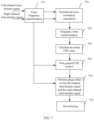
- FIG. 7 is described mainly by using an example in which a multi-channel signal of a current frame includes a left-channel signal and a right-channel signal, and a multi-channel parameter is an ITD value.
- a multi-channel parameter is an ITD value.
- FIG. 7 is a schematic flowchart of a multi-channel signal encoding method according to an embodiment of this application. It should be understood that processing steps or operations shown in FIG. 7 are merely examples, and other operations or variations of the operations in FIG. 7 may be further performed in this embodiment of this application. In addition, the steps in FIG. 7 may be performed in a sequence different from that shown in FIG. 7 , and some operations in FIG. 7 may not need to be performed.
- the method in FIG. 7 includes the following steps.
- steps 760 and 770 For implementations of steps 760 and 770, refer to the prior art. Details are not described herein.
- Step 750 is corresponding to step 540 in FIG. 5 . Any implementation provided in step 530 may be used for step 750. The following lists several optional implementations.
- Step 1 Divide a low frequency part of the left-channel frequency-domain signal of the current frame into M sub-bands, where each sub-band includes N frequency domain amplitude values.
- represents a j th frequency domain amplitude value of an i th sub-band in a low frequency part of a left-channel frequency-domain signal of the
- the correlation parameter of the current frame and the previous frame is obtained through calculation in step 2.
- the correlation parameter may be a normalized cross-correlation value of each sub-band, or may be an average value of normalized cross-correlation values of the sub-bands.
- Step 3 Calculate a peak-to-average ratio of each sub-band of the current frame.
- step 2 and step 3 may be performed simultaneously, or may be performed sequentially.
- the peak-to-average ratio of each sub-band may be represented by using a ratio of a peak value of the frequency domain amplitude values of each sub-band to an average value of the frequency domain amplitude values of each sub-band, or may be represented by using a ratio of a peak value of the frequency domain amplitude values of each sub-band to a sum of the frequency domain amplitude values of the sub-band. This can reduce calculation complexity.
- a peak-to-average ratio parameter of a multi-channel signal of the current frame may be obtained through calculation in step 3.
- the peak-to-average ratio parameter may be the peak-to-average ratio of each sub-band, a sum of peak-to-average ratios of the sub-bands, or an average value of peak-to-average ratios of the sub-bands.
- Step 4 If the initial ITD value of the current frame and an ITD value of the previous frame meet a first preset condition, determine, based on the correlation parameter and/or a peak-to-average ratio parameter of the current frame, whether to reuse the ITD value of the previous frame for the current frame.
- the first preset condition may be:
- the first preset condition may be one condition, or may be a combination of a plurality of conditions. In addition, if the first preset condition is met, determining may be further performed based on another condition. If all conditions are met, a subsequent step is performed.
- the determining, based on the correlation parameter and/or a peak-to-average ratio parameter of the current frame, whether to reuse the ITD value of the previous frame for the current frame may be specifically: determining whether the correlation parameter and/or the peak-to-average ratio parameter of the current frame meet/meets a second preset condition; and if the correlation parameter and/or the peak-to-average ratio parameter of the current frame meet/meets the second preset condition, reusing the ITD value of the previous frame for the current frame.
- the second preset condition may be:
- the first threshold is greater than the third threshold, and the third threshold is less than the fourth threshold; or the second threshold is greater than the fifth threshold, and the fifth threshold is less than the sixth threshold.
- the second preset condition may be one condition, or may be a combination of a plurality of conditions. In addition, if the second preset condition is met, determining may be further performed based on another condition. If all conditions are met, a subsequent step is performed.
- the foregoing described left-channel frequency-domain signal of the current frame may be a left-channel frequency-domain signal of one or some subframes of the current frame
- the foregoing described left-channel frequency-domain signal of the previous frame may be a left-channel frequency-domain signal of one or some subframes of the previous frame.
- the correlation parameter may be calculated by using a parameter of the current frame and a parameter of the previous frame, or may be calculated by using a parameter of one or some subframes of the current frame and a parameter of one or some subframes of the previous frame.
- the peak-to-average ratio parameter may be calculated by using a parameter of the current frame, or may be calculated by using a parameter of one or some subframes of the current frame.
- a difference between the implementation 2 and the foregoing implementation is as follows: In the foregoing implementation, the correlation parameter of the current frame and the previous frame is calculated based on the frequency domain amplitude values of the sub-bands, but in the implementation 2, the correlation parameter of the current frame and the previous frame is calculated based on a frequency domain coefficient of a sub-band or an absolute value of the frequency domain coefficient.
- a specific implementation process of the implementation 2 is similar to that of the foregoing implementation. Details are not described herein.
- the peak-to-average ratio parameter is calculated based on the frequency domain amplitude values of the sub-bands, but in the implementation 3, the peak-to-average ratio parameter is calculated based on an absolute value of a frequency domain coefficient of a sub-band.
- a specific implementation process of the implementation 3 is similar to that of the foregoing implementation. Details are not described herein.
- a difference between the implementation 4 and the foregoing implementation is as follows: In the foregoing implementation, the correlation parameter and/or the peak-to-average ratio parameter are/is calculated based on the left-channel frequency-domain signal, but in the implementation 4, the correlation parameter and/or the peak-to-average ratio parameter are/is calculated based on a right-channel frequency-domain signal.
- a specific implementation process of the implementation 4 is similar to that of the foregoing implementation. Details are not described herein.
- a difference between the implementation 5 and the foregoing implementation is as follows: In the foregoing implementation, the correlation parameter and/or the peak-to-average ratio parameter are/is calculated based on the left-channel frequency-domain signal or the right-channel frequency-domain signal, but in the implementation 5, the correlation parameter and/or the peak-to-average ratio parameter are/is calculated based on the left-channel frequency-domain signal and the right-channel frequency-domain signal.
- a group of correlation parameter and/or peak-to-average ratio parameter may be calculated based on the left-channel frequency-domain signal, and then a group of correlation parameter and/or peak-to-average ratio parameter is calculated by using the right-channel frequency-domain signal. Then, a larger one of the two groups of parameters may be selected as a final correlation parameter and/or peak-to-average ratio parameter.
- Another process of the implementation 5 is similar to that of the foregoing implementation. Details are not described herein.
- the correlation parameter is calculated based on the frequency-domain signals, but in the implementation 6, the correlation parameter is calculated based on time-domain signals.
- left-channel time-domain signal and the right-channel time-domain signal herein may be all left-channel signals and right-channel signals of the current frame, or may be a left-channel signal and a right-channel signal of one or some subframes of the current frame.
- a difference between the implementation 7 and the foregoing implementation is as follows: In the foregoing implementation, it needs to be determined whether to reuse the ITD value of the previous frame for the current frame, but in the implementation 7, it needs to be determined whether to estimate the ITD value of the current frame based on a change trend of ITD values of previous T frames of the current frame, where T is an integer greater than or equal to 2.
- a difference between the implementation 8 and the foregoing implementation is as follows: In the foregoing implementation, the correlation parameter of the current frame and the previous frame is calculated based on the time/frequency signals of the current frame and the previous frame, but in the implementation 8, the correlation parameter is calculated based on pitch periods of the current frame and the previous frame.
- a pitch period of the current frame and a pitch period of the corresponding previous frame may be calculated based on an existing pitch period algorithm; a deviation between the pitch period of the current frame and the pitch period of the previous frame is calculated; and the deviation between the pitch period of the current frame and the pitch period of the previous frame is used as the correlation parameter of the current frame and the previous frame.
- the deviation between the pitch period of the current frame and the pitch period of the previous frame may be a deviation between an overall pitch period of the current frame and an overall pitch period of the previous frame, or may be a deviation between a pitch period of one or some subframes of the current frame and a pitch period of one or some subframes of the previous frame, or may be a sum of deviations between pitch periods of some subframes of the current frame and pitch periods of some subframes of the previous frame, or may be an average value of deviations between pitch periods of some subframes of the current frame and pitch periods of some subframes of the previous frame.
- the ITD value of the current frame is determined based on the correlation parameter and/or the peak-to-average ratio parameter, but in the implementation 9, the ITD value of the current frame is determined based on the correlation parameter and/or a spectrum tilt parameter.
- a second preset condition may be: a correlation value of the correlation parameter of the current frame and the previous frame is greater than a threshold, and/or a spectrum tilt value of the spectrum tilt parameter is less than a threshold (it should be understood that a larger spectrum tilt value indicates weaker signal voicing, and a smaller spectrum tilt value indicates stronger signal voicing).
- a difference between the implementation 10 and the foregoing implementation is as follows: In the foregoing implementation, the ITD value of the current frame is calculated, but in the implementation 10, an IPD value of the current frame is calculated. It should be understood that the ITD value-related calculation process in steps 710 to 770 needs to be replaced with an IPD value-related process. For a manner of calculating the IPD value, refer to the prior art. Details are not described herein.
- the apparatus embodiments may be used to perform the foregoing methods. Therefore, for a part not described in detail, refer to the foregoing method embodiments.
- FIG. 8 is a schematic block diagram of an encoder according to an embodiment of this application.
- An encoder 800 in FIG. 8 includes:
- the multi-channel parameter of the current frame is determined based on comprehensive consideration of the characteristic parameter of the current frame and the difference between the current frame and the previous K frames. This determining manner is more proper. Compared with a manner of directly reusing a multi-channel parameter of a previous frame for the current frame, this manner can better ensure accuracy of inter-channel information of a multi-channel signal.
- the third determining unit 840 is specifically configured to: if the difference parameter meets a first preset condition, determine the multi-channel parameter of the current frame based on the characteristic parameter of the current frame.
- the difference parameter is an absolute value of a difference between the initial multi-channel parameter of the current frame and a multi-channel parameter of a previous frame of the current frame, and the first preset condition is that the difference parameter is greater than a preset first threshold.
- the difference parameter is a product of the initial multi-channel parameter of the current frame and a multi-channel parameter of a previous frame of the current frame, and the first preset condition is that the difference parameter is less than or equal to 0.
- the third determining unit 840 is specifically configured to determine the multi-channel parameter of the current frame based on a correlation parameter of the current frame, where the correlation parameter is used to represent a degree of correlation between the current frame and the previous frame of the current frame.
- the third determining unit 840 is specifically configured to determine the multi-channel parameter of the current frame based on a peak-to-average ratio parameter of the current frame, where the peak-to-average ratio parameter is used to represent a peak-to-average ratio of a signal of at least one channel in the multi-channel signal of the current frame.
- the third determining unit 840 is specifically configured to determine the multi-channel parameter of the current frame based on a correlation parameter and a peak-to-average ratio parameter of the current frame, where the correlation parameter is used to represent a degree of correlation between the current frame and the previous frame of the current frame, and the peak-to-average ratio parameter is used to represent a peak-to-average ratio of a signal of at least one channel in the multi-channel signal of the current frame.
- the encoder further includes: a fourth determining unit, configured to determine the correlation parameter based on a target channel signal in the multi-channel signal of the current frame and a target channel signal in a multi-channel signal of the previous frame.
- a fourth determining unit configured to determine the correlation parameter based on a target channel signal in the multi-channel signal of the current frame and a target channel signal in a multi-channel signal of the previous frame.
- the fourth determining unit is specifically configured to determine the correlation parameter based on a frequency domain parameter of the target channel signal in the multi-channel signal of the current frame and a frequency domain parameter of the target channel signal in the multi-channel signal of the previous frame, where the frequency domain parameter is at least one of a frequency domain amplitude value and a frequency domain coefficient of the target channel signal.
- the encoder further includes: a fifth determining unit, configured to determine the correlation parameter based on a pitch period of the current frame and a pitch period of the previous frame.
- the third determining unit 840 is specifically configured to: if the characteristic parameter meets a second preset condition, determine the multi-channel parameter of the current frame based on multi-channel parameters of previous T frames of the current frame, where T is an integer greater than or equal to 1.
- the third determining unit 840 is specifically configured to determine the multi-channel parameters of the previous T frames as the multi-channel parameter of the current frame, where T is equal to 1.
- the third determining unit 840 is specifically configured to determine the multi-channel parameter of the current frame based on a change trend of the multi-channel parameters of the previous T frames, where T is greater than or equal to 2.
- the characteristic parameter includes the correlation parameter and/or the peak-to-average ratio parameter of the current frame, where the correlation parameter is used to represent the degree of correlation between the current frame and the previous frame of the current frame, and the peak-to-average ratio parameter is used to represent the peak-to-average ratio of the signal of the at least one channel in the multi-channel signal of the current frame; and the second preset condition is that the characteristic parameter is greater than a preset threshold.
- the initial multi-channel parameter of the current frame includes at least one of the following: an initial inter-channel coherence IC value of the current frame, an initial inter-channel time difference ITD value of the current frame, an initial inter-channel phase difference IPD value of the current frame, an initial overall phase difference OPD value of the current frame, and an initial inter-channel level difference ILD value of the current frame.
- the characteristic parameter of the current frame includes at least one of the following parameters of the current frame: the correlation parameter, the peak-to-average ratio parameter, a signal-to-noise ratio parameter, and a spectrum tilt parameter, where the correlation parameter is used to represent the degree of correlation between the current frame and the previous frame, the peak-to-average ratio parameter is used to represent the peak-to-average ratio of the signal of the at least one channel in the multi-channel signal of the current frame, the signal-to-noise ratio parameter is used to represent a signal-to-noise ratio of a signal of at least one channel in the multi-channel signal of the current frame, and the spectrum tilt parameter is used to represent a spectrum tilt degree of a signal of at least one channel in the multi-channel signal of the current frame.
- the correlation parameter is used to represent the degree of correlation between the current frame and the previous frame
- the peak-to-average ratio parameter is used to represent the peak-to-average ratio of the signal of the at least one channel in the multi-channel signal of the current frame
- FIG. 9 is a schematic block diagram of an encoder according to an embodiment of this application.
- An encoder 900 in FIG. 9 includes:
- the multi-channel parameter of the current frame is determined based on comprehensive consideration of the characteristic parameter of the current frame and the difference between the current frame and the previous K frames. This determining manner is more proper. Compared with a manner of directly reusing a multi-channel parameter of a previous frame for the current frame, this manner can better ensure accuracy of inter-channel information of a multi-channel signal.
- the processor 920 is specifically configured to: if the difference parameter meets a first preset condition, determine the multi-channel parameter of the current frame based on the characteristic parameter of the current frame.
- the difference parameter is an absolute value of a difference between the initial multi-channel parameter of the current frame and a multi-channel parameter of a previous frame of the current frame, and the first preset condition is that the difference parameter is greater than a preset first threshold.
- the difference parameter is a product of the initial multi-channel parameter of the current frame and a multi-channel parameter of a previous frame of the current frame, and the first preset condition is that the difference parameter is less than or equal to 0.
- the processor 920 is specifically configured to determine the multi-channel parameter of the current frame based on a correlation parameter of the current frame, where the correlation parameter is used to represent a degree of correlation between the current frame and the previous frame of the current frame.
- the processor 920 is specifically configured to determine the multi-channel parameter of the current frame based on a peak-to-average ratio parameter of the current frame, where the peak-to-average ratio parameter is used to represent a peak-to-average ratio of a signal of at least one channel in the multi-channel signal of the current frame.
- the processor 920 is specifically configured to determine the multi-channel parameter of the current frame based on a correlation parameter and a peak-to-average ratio parameter of the current frame, where the correlation parameter is used to represent a degree of correlation between the current frame and the previous frame of the current frame, and the peak-to-average ratio parameter is used to represent a peak-to-average ratio of a signal of at least one channel in the multi-channel signal of the current frame.
- the processor 920 is further configured to determine the correlation parameter based on a target channel signal in the multi-channel signal of the current frame and a target channel signal in a multi-channel signal of the previous frame.
- the processor 920 is specifically configured to determine the correlation parameter based on a frequency domain parameter of the target channel signal in the multi-channel signal of the current frame and a frequency domain parameter of the target channel signal in the multi-channel signal of the previous frame, where the frequency domain parameter is a frequency domain amplitude value of the target channel signal.
- the processor 920 is specifically configured to determine the correlation parameter based on a frequency domain parameter of the target channel signal in the multi-channel signal of the current frame and a frequency domain parameter of the target channel signal in the multi-channel signal of the previous frame, where the frequency domain parameter is a frequency domain coefficient of the target channel signal.
- the processor 920 is specifically configured to determine the correlation parameter based on a frequency domain parameter of the target channel signal in the multi-channel signal of the current frame and a frequency domain parameter of the target channel signal in the multi-channel signal of the previous frame, where the frequency domain parameter is a frequency domain amplitude value and a frequency domain coefficient of the target channel signal.
- the processor 920 is further configured to determine the correlation parameter based on a pitch period of the current frame and a pitch period of the previous frame.
- the processor 920 is specifically configured to: if the characteristic parameter meets a second preset condition, determine the multi-channel parameter of the current frame based on multi-channel parameters of previous T frames of the current frame, where T is an integer greater than or equal to 1.
- the processor 920 is specifically configured to determine the multi-channel parameters of the previous T frames as the multi-channel parameter of the current frame, where T is equal to 1.
- the processor 920 is specifically configured to determine the multi-channel parameter of the current frame based on a change trend of the multi-channel parameters of the previous T frames, where T is greater than or equal to 2.
- the characteristic parameter includes the correlation parameter and/or the peak-to-average ratio parameter of the current frame, where the correlation parameter is used to represent the degree of correlation between the current frame and the previous frame of the current frame, and the peak-to-average ratio parameter is used to represent the peak-to-average ratio of the signal of the at least one channel in the multi-channel signal of the current frame; and the second preset condition is that the characteristic parameter is greater than a preset threshold.
- the initial multi-channel parameter of the current frame includes at least one of the following: an initial inter-channel coherence IC value of the current frame, an initial inter-channel time difference ITD value of the current frame, an initial inter-channel phase difference IPD value of the current frame, an initial overall phase difference OPD value of the current frame, and an initial inter-channel level difference ILD value of the current frame.
- the characteristic parameter of the current frame includes at least one of the following parameters of the current frame: the correlation parameter, the peak-to-average ratio parameter, a signal-to-noise ratio parameter, and a spectrum tilt parameter, where the correlation parameter is used to represent the degree of correlation between the current frame and the previous frame, the peak-to-average ratio parameter is used to represent the peak-to-average ratio of the signal of the at least one channel in the multi-channel signal of the current frame, the signal-to-noise ratio parameter is used to represent a signal-to-noise ratio of a signal of at least one channel in the multi-channel signal of the current frame, and the spectrum tilt parameter is used to represent a spectrum tilt degree of a signal of at least one channel in the multi-channel signal of the current frame.
- the correlation parameter is used to represent the degree of correlation between the current frame and the previous frame
- the peak-to-average ratio parameter is used to represent the peak-to-average ratio of the signal of the at least one channel in the multi-channel signal of the current frame
- a and/or B may indicate the following three cases: A exists alone, both A and B exist, and B exists alone.
- the character "/" in this specification usually indicates that associated objects are in an "or" relationship.
- the disclosed system, apparatus, and method may be implemented in other manners.
- the described apparatus embodiments are merely examples.
- the unit division is merely logical function division and may be other division during actual implementation.
- a plurality of units or components may be combined or integrated into another system, or some features may be ignored or not performed.
- the displayed or discussed mutual couplings or direct couplings or communication connections may be implemented by using some interfaces.
- the indirect couplings or communication connections between the apparatuses or units may be implemented in electrical, mechanical, or other forms.
- the units described as separate parts may or may not be physically separated, and parts displayed as units may or may not be physical units; in other words, may be located in one place, or may be distributed on a plurality of network units. Some or all of the units may be selected based on actual requirements to achieve the objectives of the solutions of the embodiments.
- the functional units in the embodiments of this application may be integrated into one processing unit, or each of the units may exist alone physically, or two or more units may be integrated into one unit.
- the computer software product is stored in a storage medium, and includes several instructions for instructing a computer device (that may be a personal computer, a server, a network device, or the like) to perform all or some of the steps of the methods described in the embodiments of this application.
- the storage medium includes any medium that can store program code, such as a USB flash drive, a removable hard disk, a read-only memory (ROM), a random access memory (RAM), a magnetic disk, or an optical disc.
- Embodiment 1 A multi-channel signal encoding method, comprising:
- Embodiment 2 The method according to embodiment 1, wherein the determining a multi-channel parameter of the current frame based on the difference parameter and a characteristic parameter of the current frame comprises: if the difference parameter meets a first preset condition, determining the multi-channel parameter of the current frame based on the characteristic parameter of the current frame.
- Embodiment 3 The method according to embodiment 2, wherein the difference parameter is an absolute value of a difference between the initial multi-channel parameter of the current frame and a multi-channel parameter of a previous frame of the current frame, and the first preset condition is that the difference parameter is greater than a preset first threshold.
- Embodiment 4 The method according to embodiment 2, wherein the difference parameter is a product of the initial multi-channel parameter of the current frame and a multi-channel parameter of a previous frame of the current frame, and the first preset condition is that the difference parameter is less than or equal to 0.
- Embodiment 5 The method according to any one of embodiments 2 to 4, wherein the determining the multi-channel parameter of the current frame based on the characteristic parameter of the current frame comprises: determining the multi-channel parameter of the current frame based on a correlation parameter of the current frame, wherein the correlation parameter is used to represent a degree of correlation between the current frame and the previous frame of the current frame.
- Embodiment 6 The method according to embodiment 5, wherein the method further comprises: determining the correlation parameter based on a target channel signal in the multi-channel signal of the current frame and a target channel signal in a multi-channel signal of the previous frame.
- Embodiment 7 The method according to embodiment 6, wherein the determining the correlation parameter based on a target channel signal in the multi-channel signal of the current frame and a target channel signal in a multi-channel signal of the previous frame comprises: determining the correlation parameter based on a frequency domain parameter of the target channel signal in the multi-channel signal of the current frame and a frequency domain parameter of the target channel signal in the multi-channel signal of the previous frame, wherein the frequency domain parameter is at least one of a frequency domain amplitude value and a frequency domain coefficient of the target channel signal.
- Embodiment 8 The method according to embodiment 5, wherein the method further comprises: determining the correlation parameter based on a pitch period of the current frame and a pitch period of the previous frame.
- Embodiment 9 The method according to any one of embodiments 2 to 8, wherein the determining the multi-channel parameter of the current frame based on the characteristic parameter of the current frame comprises: if the characteristic parameter meets a second preset condition, determining the multi-channel parameter of the current frame based on multi-channel parameters of previous T frames of the current frame, wherein T is an integer greater than or equal to 1.
- Embodiment 10 The method according to embodiment 9, wherein the determining the multi-channel parameter of the current frame based on multi-channel parameters of previous T frames of the current frame comprises: determining the multi-channel parameters of the previous T frames as the multi-channel parameter of the current frame, wherein T is equal to 1.
- Embodiment 11 The method according to embodiment 9, wherein the determining the multi-channel parameter of the current frame based on multi-channel parameters of previous T frames of the current frame comprises: determining the multi-channel parameter of the current frame based on a change trend of the multi-channel parameters of the previous T frames, wherein T is greater than or equal to 2.
- Embodiment 12 The method according to any one of embodiments 9 to 11, wherein the characteristic parameter of the current frame comprises at least one of the correlation parameter and a peak-to-average ratio parameter of the current frame, wherein the correlation parameter is used to represent the degree of correlation between the current frame and the previous frame of the current frame, and the peak-to-average ratio parameter is used to represent a peak-to-average ratio of a signal of at least one channel in the multi-channel signal of the current frame; and the second preset condition is that the characteristic parameter is greater than a preset threshold.
- Embodiment 13 The method according to any one of embodiments 1 to 12, wherein the initial multi-channel parameter of the current frame comprises at least one of the following: an initial inter-channel coherence IC value of the current frame, an initial inter-channel time difference ITD value of the current frame, an initial inter-channel phase difference IPD value of the current frame, an initial overall phase difference OPD value of the current frame, and an initial inter-channel level difference ILD value of the current frame.
- Embodiment 14 The method according to any one of embodiments 1 to 13, wherein the characteristic parameter of the current frame comprises at least one of the following parameters of the current frame: the correlation parameter, the peak-to-average ratio parameter, a signal-to-noise ratio parameter, and a spectrum tilt parameter, wherein the correlation parameter is used to represent the degree of correlation between the current frame and the previous frame, the peak-to-average ratio parameter is used to represent the peak-to-average ratio of the signal of the at least one channel in the multi-channel signal of the current frame, the signal-to-noise ratio parameter is used to represent a signal-to-noise ratio of a signal of at least one channel in the multi-channel signal of the current frame, and the spectrum tilt parameter is used to represent a spectrum tilt degree of a signal of at least one channel in the multi-channel signal of the current frame.
- the correlation parameter is used to represent the degree of correlation between the current frame and the previous frame
- the peak-to-average ratio parameter is used to represent the peak-to-average ratio of the
- Embodiment 15 An encoder, comprising:
- Embodiment 16 The encoder according to embodiment 15, wherein the third determining unit is specifically configured to: if the difference parameter meets a first preset condition, determine the multi-channel parameter of the current frame based on the characteristic parameter of the current frame.
- Embodiment 17 The encoder according to embodiment 16, wherein the difference parameter is an absolute value of a difference between the initial multi-channel parameter of the current frame and a multi-channel parameter of a previous frame of the current frame, and the first preset condition is that the difference parameter is greater than a preset first threshold.
- Embodiment 18 The encoder according to embodiment 16, wherein the difference parameter is a product of the initial multi-channel parameter of the current frame and a multi-channel parameter of a previous frame of the current frame, and the first preset condition is that the difference parameter is less than or equal to 0.
- Embodiment 19 The encoder according to any one of embodiments 16 to 18, wherein the third determining unit is specifically configured to determine the multi-channel parameter of the current frame based on a correlation parameter of the current frame, wherein the correlation parameter is used to represent a degree of correlation between the current frame and the previous frame of the current frame.
- Embodiment 20 The encoder according to embodiment 19, wherein the encoder further comprises: a fourth determining unit, configured to determine the correlation parameter based on a target channel signal in the multi-channel signal of the current frame and a target channel signal in a multi-channel signal of the previous frame.
- a fourth determining unit configured to determine the correlation parameter based on a target channel signal in the multi-channel signal of the current frame and a target channel signal in a multi-channel signal of the previous frame.
- Embodiment 21 The encoder according to embodiment 20, wherein the fourth determining unit is specifically configured to determine the correlation parameter based on a frequency domain parameter of the target channel signal in the multi-channel signal of the current frame and a frequency domain parameter of the target channel signal in the multi-channel signal of the previous frame, wherein the frequency domain parameter is at least one of a frequency domain amplitude value and a frequency domain coefficient of the target channel signal.
- Embodiment 22 The encoder according to embodiment 19, wherein the encoder further comprises: a fifth determining unit, configured to determine the correlation parameter based on a pitch period of the current frame and a pitch period of the previous frame.
- a fifth determining unit configured to determine the correlation parameter based on a pitch period of the current frame and a pitch period of the previous frame.
- Embodiment 23 The encoder according to any one of embodiments 16 to 22, wherein the third determining unit is specifically configured to: if the characteristic parameter meets a second preset condition, determine the multi-channel parameter of the current frame based on multi-channel parameters of previous T frames of the current frame, wherein T is an integer greater than or equal to 1.
- Embodiment 24 The encoder according to embodiment 23, wherein the third determining unit is specifically configured to determine the multi-channel parameters of the previous T frames as the multi-channel parameter of the current frame, wherein T is equal to 1.
- Embodiment 25 The encoder according to embodiment 23, wherein the third determining unit is specifically configured to determine the multi-channel parameter of the current frame based on a change trend of the multi-channel parameters of the previous T frames, wherein T is greater than or equal to 2.
- Embodiment 26 The encoder according to any one of embodiments 23 to 25, wherein the characteristic parameter comprises at least one of the correlation parameter and a peak-to-average ratio parameter of the current frame, wherein the correlation parameter is used to represent the degree of correlation between the current frame and the previous frame of the current frame, and the peak-to-average ratio parameter is used to represent a peak-to-average ratio of a signal of at least one channel in the multi-channel signal of the current frame; and the second preset condition is that the characteristic parameter is greater than a preset threshold.
- Embodiment 27 The encoder according to any one of embodiments 15 to 26, wherein the initial multi-channel parameter of the current frame comprises at least one of the following: an initial inter-channel coherence IC value of the current frame, an initial inter-channel time difference ITD value of the current frame, an initial inter-channel phase difference IPD value of the current frame, an initial overall phase difference OPD value of the current frame, and an initial inter-channel level difference ILD value of the current frame.
- Embodiment 28 The encoder according to any one of embodiments 15 to 27, wherein the characteristic parameter of the current frame comprises at least one of the following parameters of the current frame: the correlation parameter, the peak-to-average ratio parameter, a signal-to-noise ratio parameter, and a spectrum tilt parameter, wherein the correlation parameter is used to represent the degree of correlation between the current frame and the previous frame, the peak-to-average ratio parameter is used to represent the peak-to-average ratio of the signal of the at least one channel in the multi-channel signal of the current frame, the signal-to-noise ratio parameter is used to represent a signal-to-noise ratio of a signal of at least one channel in the multi-channel signal of the current frame, and the spectrum tilt parameter is used to represent a spectrum tilt degree of a signal of at least one channel in the multi-channel signal of the current frame.
- the correlation parameter is used to represent the degree of correlation between the current frame and the previous frame
- the peak-to-average ratio parameter is used to represent the peak-to-average ratio of
Landscapes
- Engineering & Computer Science (AREA)
- Physics & Mathematics (AREA)
- Signal Processing (AREA)
- Acoustics & Sound (AREA)
- Audiology, Speech & Language Pathology (AREA)
- Health & Medical Sciences (AREA)
- Computational Linguistics (AREA)
- Human Computer Interaction (AREA)
- Multimedia (AREA)
- Spectroscopy & Molecular Physics (AREA)
- Mathematical Physics (AREA)
- Compression, Expansion, Code Conversion, And Decoders (AREA)
- Compression Or Coding Systems Of Tv Signals (AREA)
- Stereophonic System (AREA)
Applications Claiming Priority (4)
| Application Number | Priority Date | Filing Date | Title |
|---|---|---|---|
| CN201610652506.XA CN107731238B (zh) | 2016-08-10 | 2016-08-10 | 多声道信号的编码方法和编码器 |
| EP17838306.3A EP3493203B1 (de) | 2016-08-10 | 2017-02-22 | Verfahren zum codieren von mehrkanalsignalen und codierer |
| EP22179454.8A EP4120252B1 (de) | 2016-08-10 | 2017-02-22 | Mehrkanal-signal-encoder und computerlesbares medium |
| PCT/CN2017/074419 WO2018028170A1 (zh) | 2016-08-10 | 2017-02-22 | 多声道信号的编码方法和编码器 |
Related Parent Applications (3)
| Application Number | Title | Priority Date | Filing Date |
|---|---|---|---|
| EP22179454.8A Division-Into EP4120252B1 (de) | 2016-08-10 | 2017-02-22 | Mehrkanal-signal-encoder und computerlesbares medium |
| EP22179454.8A Division EP4120252B1 (de) | 2016-08-10 | 2017-02-22 | Mehrkanal-signal-encoder und computerlesbares medium |
| EP17838306.3A Division EP3493203B1 (de) | 2016-08-10 | 2017-02-22 | Verfahren zum codieren von mehrkanalsignalen und codierer |
Publications (2)
| Publication Number | Publication Date |
|---|---|
| EP4506938A2 true EP4506938A2 (de) | 2025-02-12 |
| EP4506938A3 EP4506938A3 (de) | 2025-03-19 |
Family
ID=61161463
Family Applications (3)
| Application Number | Title | Priority Date | Filing Date |
|---|---|---|---|
| EP22179454.8A Active EP4120252B1 (de) | 2016-08-10 | 2017-02-22 | Mehrkanal-signal-encoder und computerlesbares medium |
| EP17838306.3A Active EP3493203B1 (de) | 2016-08-10 | 2017-02-22 | Verfahren zum codieren von mehrkanalsignalen und codierer |
| EP24202620.1A Pending EP4506938A3 (de) | 2016-08-10 | 2017-02-22 | Mehrkanalsignalcodierungsverfahren und codierer |
Family Applications Before (2)
| Application Number | Title | Priority Date | Filing Date |
|---|---|---|---|
| EP22179454.8A Active EP4120252B1 (de) | 2016-08-10 | 2017-02-22 | Mehrkanal-signal-encoder und computerlesbares medium |
| EP17838306.3A Active EP3493203B1 (de) | 2016-08-10 | 2017-02-22 | Verfahren zum codieren von mehrkanalsignalen und codierer |
Country Status (12)
| Country | Link |
|---|---|
| US (4) | US11133014B2 (de) |
| EP (3) | EP4120252B1 (de) |
| JP (5) | JP6768924B2 (de) |
| KR (3) | KR102205596B1 (de) |
| CN (1) | CN107731238B (de) |
| AU (4) | AU2017310759B2 (de) |
| CA (1) | CA3033225C (de) |
| ES (1) | ES2928335T3 (de) |
| PL (1) | PL4120252T3 (de) |
| PT (1) | PT4120252T (de) |
| RU (1) | RU2705427C1 (de) |
| WO (1) | WO2018028170A1 (de) |
Families Citing this family (23)
| Publication number | Priority date | Publication date | Assignee | Title |
|---|---|---|---|---|
| US12453853B2 (en) | 2013-01-21 | 2025-10-28 | Cala Health, Inc. | Multi-modal stimulation for treating tremor |
| CN108355242B (zh) | 2013-01-21 | 2022-04-15 | 卡拉健康公司 | 用于控制震颤的设备和方法 |
| WO2015187712A1 (en) | 2014-06-02 | 2015-12-10 | Cala Health, Inc. | Systems and methods for peripheral nerve stimulation to treat tremor |
| CN112915380B (zh) | 2015-06-10 | 2025-01-21 | 卡拉健康公司 | 用于外周神经刺激以利用可拆卸治疗和监测单元治疗震颤的系统和方法 |
| CN108135537B (zh) | 2015-07-31 | 2021-11-16 | 卡拉健康公司 | 用于治疗骨关节炎的系统、装置和方法 |
| US10603482B2 (en) | 2015-09-23 | 2020-03-31 | Cala Health, Inc. | Systems and methods for peripheral nerve stimulation in the finger or hand to treat hand tremors |
| EP3405251A4 (de) | 2016-01-21 | 2019-08-28 | Cala Health, Inc. | Systeme, verfahren und vorrichtungen zur peripheren neuromodulation zur behandlung von erkrankungen im zusammenhang mit blasenhyperaktivität |
| CN107731238B (zh) | 2016-08-10 | 2021-07-16 | 华为技术有限公司 | 多声道信号的编码方法和编码器 |
| CN117959601A (zh) | 2016-08-25 | 2024-05-03 | 卡拉健康公司 | 通过周围神经刺激治疗心脏机能障碍的系统和方法 |
| EP3606604A4 (de) | 2017-04-03 | 2020-12-16 | Cala Health, Inc. | Systeme, verfahren und vorrichtungen zur peripheren neuromodulation zur behandlung von erkrankungen im zusammenhang mit überaktiver blase |
| CN108877815B (zh) | 2017-05-16 | 2021-02-23 | 华为技术有限公司 | 一种立体声信号处理方法及装置 |
| WO2019143790A1 (en) | 2018-01-17 | 2019-07-25 | Cala Health, Inc. | Systems and methods for treating inflammatory bowel disease through peripheral nerve stimulation |
| CN110556118B (zh) | 2018-05-31 | 2022-05-10 | 华为技术有限公司 | 立体声信号的编码方法和装置 |
| CN110556116B (zh) | 2018-05-31 | 2021-10-22 | 华为技术有限公司 | 计算下混信号和残差信号的方法和装置 |
| EP4616792A3 (de) * | 2018-09-26 | 2025-12-03 | Cala Health, Inc. | Neurostimulationssysteme für prädiktive therapie |
| CN109243471B (zh) * | 2018-09-26 | 2022-09-23 | 杭州联汇科技股份有限公司 | 一种快速编码广播用数字音频的方法 |
| CN112233682B (zh) * | 2019-06-29 | 2024-07-16 | 华为技术有限公司 | 一种立体声编码方法、立体声解码方法和装置 |
| US12251560B1 (en) | 2019-08-13 | 2025-03-18 | Cala Health, Inc. | Connection quality determination for wearable neurostimulation systems |
| US11890468B1 (en) | 2019-10-03 | 2024-02-06 | Cala Health, Inc. | Neurostimulation systems with event pattern detection and classification |
| CN115346537B (zh) * | 2021-05-14 | 2024-11-29 | 华为技术有限公司 | 一种音频编码、解码方法及装置 |
| CN115410584A (zh) * | 2021-05-28 | 2022-11-29 | 华为技术有限公司 | 多声道音频信号的编码方法和装置 |
| EP4443911A4 (de) * | 2021-12-03 | 2025-02-19 | Beijing Xiaomi Mobile Software Co., Ltd. | Stereoaudiosignalverarbeitungsverfahren und vorrichtung/speichermedium/-vorrichtung |
| CN115691515A (zh) * | 2022-07-12 | 2023-02-03 | 南京拓灵智能科技有限公司 | 一种音频编解码方法及装置 |
Family Cites Families (63)
| Publication number | Priority date | Publication date | Assignee | Title |
|---|---|---|---|---|
| US5659520A (en) * | 1995-04-24 | 1997-08-19 | Sonatech, Inc. | Super short baseline navigation using phase-delay processing of spread-spectrum-coded reply signals |
| US6168568B1 (en) * | 1996-10-04 | 2001-01-02 | Karmel Medical Acoustic Technologies Ltd. | Phonopneumograph system |
| CN1432176A (zh) * | 2000-04-24 | 2003-07-23 | 高通股份有限公司 | 用于预测量化有声语音的方法和设备 |
| KR101021079B1 (ko) * | 2002-04-22 | 2011-03-14 | 코닌클리케 필립스 일렉트로닉스 엔.브이. | 파라메트릭 다채널 오디오 표현 |
| CN100539742C (zh) * | 2002-07-12 | 2009-09-09 | 皇家飞利浦电子股份有限公司 | 多声道音频信号编解码方法和装置 |
| CA2992125C (en) * | 2004-03-01 | 2018-09-25 | Dolby Laboratories Licensing Corporation | Reconstructing audio signals with multiple decorrelation techniques and differentially coded parameters |
| US8843378B2 (en) | 2004-06-30 | 2014-09-23 | Fraunhofer-Gesellschaft Zur Foerderung Der Angewandten Forschung E.V. | Multi-channel synthesizer and method for generating a multi-channel output signal |
| KR100745688B1 (ko) * | 2004-07-09 | 2007-08-03 | 한국전자통신연구원 | 다채널 오디오 신호 부호화/복호화 방법 및 장치 |
| SE0402650D0 (sv) * | 2004-11-02 | 2004-11-02 | Coding Tech Ab | Improved parametric stereo compatible coding of spatial audio |
| RU2393550C2 (ru) * | 2005-06-30 | 2010-06-27 | ЭлДжи ЭЛЕКТРОНИКС ИНК. | Устройство и способ кодирования и декодирования звукового сигнала |
| RU2473062C2 (ru) * | 2005-08-30 | 2013-01-20 | ЭлДжи ЭЛЕКТРОНИКС ИНК. | Способ кодирования и декодирования аудиосигнала и устройство для его осуществления |
| EP1953736A4 (de) * | 2005-10-31 | 2009-08-05 | Panasonic Corp | Stereo-codierungseinrichtung und stereosignal-prädiktionsverfahren |
| US7839948B2 (en) * | 2005-12-02 | 2010-11-23 | Qualcomm Incorporated | Time slicing techniques for variable data rate encoding |
| DE602006010323D1 (de) * | 2006-04-13 | 2009-12-24 | Fraunhofer Ges Forschung | Audiosignaldekorrelator |
| CN101506874B (zh) * | 2006-09-13 | 2011-12-07 | 日本电信电话株式会社 | 情感检测方法、情感检测装置 |
| GB2453117B (en) * | 2007-09-25 | 2012-05-23 | Motorola Mobility Inc | Apparatus and method for encoding a multi channel audio signal |
| KR101505831B1 (ko) * | 2007-10-30 | 2015-03-26 | 삼성전자주식회사 | 멀티 채널 신호의 부호화/복호화 방법 및 장치 |
| CN101188878B (zh) * | 2007-12-05 | 2010-06-02 | 武汉大学 | 立体声音频信号的空间参数量化及熵编码方法和所用系统 |
| US8239210B2 (en) * | 2007-12-19 | 2012-08-07 | Dts, Inc. | Lossless multi-channel audio codec |
| EP2301020B1 (de) * | 2008-07-11 | 2013-01-02 | Fraunhofer-Gesellschaft zur Förderung der angewandten Forschung e.V. | Vorrichtung und verfahren zur kodierung/dekodierung eines tonsignals anhand eines aliasing-schaltschemas |
| WO2010036062A2 (en) * | 2008-09-25 | 2010-04-01 | Lg Electronics Inc. | A method and an apparatus for processing a signal |
| US8666752B2 (en) * | 2009-03-18 | 2014-03-04 | Samsung Electronics Co., Ltd. | Apparatus and method for encoding and decoding multi-channel signal |
| CN102307323B (zh) * | 2009-04-20 | 2013-12-18 | 华为技术有限公司 | 对多声道信号的声道延迟参数进行修正的方法 |
| CN101582262B (zh) * | 2009-06-16 | 2011-12-28 | 武汉大学 | 一种空间音频参数帧间预测编解码方法 |
| CN102025892A (zh) * | 2009-09-16 | 2011-04-20 | 索尼株式会社 | 镜头转换检测方法及装置 |
| WO2011034377A2 (en) * | 2009-09-17 | 2011-03-24 | Lg Electronics Inc. | A method and an apparatus for processing an audio signal |
| MX2012003785A (es) * | 2009-09-29 | 2012-05-22 | Fraunhofer Ges Forschung | Decodificador de señal de audio, codificador de señal de audio, metodo para proveer una representacion de señal de mezcla ascendente, metodo para proveer una representacion de señal de mezcla descendente, programa de computadora y cadena de bits usando un valor de parametro de correlacion-inter-objeto-comun. |
| MY153337A (en) * | 2009-10-20 | 2015-01-29 | Fraunhofer Ges Forschung | Apparatus for providing an upmix signal representation on the basis of a downmix signal representation,apparatus for providing a bitstream representing a multi-channel audio signal,methods,computer program and bitstream using a distortion control signaling |
| CN102157151B (zh) * | 2010-02-11 | 2012-10-03 | 华为技术有限公司 | 一种多声道信号编码方法、解码方法、装置和系统 |
| EP2537374A4 (de) * | 2010-02-17 | 2014-03-19 | Ericsson Telefon Ab L M | Femto-basisstation, stromsparender koordinationsknoten, drahtloses kommunikationssystem und computerprogramm |
| EP2375410B1 (de) * | 2010-03-29 | 2017-11-22 | Fraunhofer-Gesellschaft zur Förderung der angewandten Forschung e.V. | Räumlicher Audioprozessor und Verfahren zur Bereitstellung räumlicher Parameter basierend auf einem akustischen Eingangssignal |
| US9112591B2 (en) * | 2010-04-16 | 2015-08-18 | Samsung Electronics Co., Ltd. | Apparatus for encoding/decoding multichannel signal and method thereof |
| US8305099B2 (en) | 2010-08-31 | 2012-11-06 | Nxp B.V. | High speed full duplex test interface |
| CN103026406B (zh) * | 2010-09-28 | 2014-10-08 | 华为技术有限公司 | 用于对已解码多通道音频信号或已解码立体声信号进行后处理的装置和方法 |
| CN103180899B (zh) * | 2010-11-17 | 2015-07-22 | 松下电器(美国)知识产权公司 | 立体声信号的编码装置、解码装置、编码方法及解码方法 |
| US9424852B2 (en) * | 2011-02-02 | 2016-08-23 | Telefonaktiebolaget Lm Ericsson (Publ) | Determining the inter-channel time difference of a multi-channel audio signal |
| KR101572034B1 (ko) * | 2011-05-19 | 2015-11-26 | 돌비 레버러토리즈 라이쎈싱 코오포레이션 | 파라메트릭 오디오 코딩 방식들의 포렌식 검출 |
| CN102800317B (zh) * | 2011-05-25 | 2014-09-17 | 华为技术有限公司 | 信号分类方法及设备、编解码方法及设备 |
| KR101580240B1 (ko) * | 2012-02-17 | 2016-01-04 | 후아웨이 테크놀러지 컴퍼니 리미티드 | 다채널 오디오 신호를 인코딩하는 파라메트릭 인코더 |
| WO2013149671A1 (en) * | 2012-04-05 | 2013-10-10 | Huawei Technologies Co., Ltd. | Multi-channel audio encoder and method for encoding a multi-channel audio signal |
| CN104364843B (zh) * | 2012-06-14 | 2017-03-29 | 杜比国际公司 | 解码系统、重构方法和设备、编码系统、方法和设备及音频发布系统 |
| US20140086416A1 (en) * | 2012-07-15 | 2014-03-27 | Qualcomm Incorporated | Systems, methods, apparatus, and computer-readable media for three-dimensional audio coding using basis function coefficients |
| WO2014013294A1 (en) | 2012-07-19 | 2014-01-23 | Nokia Corporation | Stereo audio signal encoder |
| KR20140017338A (ko) * | 2012-07-31 | 2014-02-11 | 인텔렉추얼디스커버리 주식회사 | 오디오 신호 처리 장치 및 방법 |
| ES3059160T3 (en) | 2012-11-13 | 2026-03-19 | Samsung Electronics Co Ltd | Apparatus for determining encoding mode |
| WO2014108738A1 (en) * | 2013-01-08 | 2014-07-17 | Nokia Corporation | Audio signal multi-channel parameter encoder |
| CN110379434B (zh) * | 2013-02-21 | 2023-07-04 | 杜比国际公司 | 用于参数化多声道编码的方法 |
| US9659569B2 (en) * | 2013-04-26 | 2017-05-23 | Nokia Technologies Oy | Audio signal encoder |
| KR20160015280A (ko) * | 2013-05-28 | 2016-02-12 | 노키아 테크놀로지스 오와이 | 오디오 신호 인코더 |
| US9412385B2 (en) * | 2013-05-28 | 2016-08-09 | Qualcomm Incorporated | Performing spatial masking with respect to spherical harmonic coefficients |
| CN104282309A (zh) * | 2013-07-05 | 2015-01-14 | 杜比实验室特许公司 | 丢包掩蔽装置和方法以及音频处理系统 |
| EP2838086A1 (de) * | 2013-07-22 | 2015-02-18 | Fraunhofer-Gesellschaft zur Förderung der angewandten Forschung e.V. | Reduktion von Kammfilterartefakten in einem Mehrkanal-Downmix mit adaptivem Phasenabgleich |
| EP2830051A3 (de) * | 2013-07-22 | 2015-03-04 | Fraunhofer-Gesellschaft zur Förderung der angewandten Forschung e.V. | Audiocodierer, Audiodecodierer, Verfahren und Computerprogramm mit gemeinsamen codierten Restsignalen |
| CN104681029B (zh) * | 2013-11-29 | 2018-06-05 | 华为技术有限公司 | 立体声相位参数的编码方法及装置 |
| EP2928210A1 (de) * | 2014-04-03 | 2015-10-07 | Oticon A/s | Binaurales Hörgerätesystem mit binauraler Rauschunterdrückung |
| EP3441966A1 (de) * | 2014-07-23 | 2019-02-13 | PCMS Holdings, Inc. | System und verfahren zur ermittlung von audiocontext in augmented reality anwendungen |
| TWI602172B (zh) * | 2014-08-27 | 2017-10-11 | 弗勞恩霍夫爾協會 | 使用參數以加強隱蔽之用於編碼及解碼音訊內容的編碼器、解碼器及方法 |
| US9595269B2 (en) * | 2015-01-19 | 2017-03-14 | Qualcomm Incorporated | Scaling for gain shape circuitry |
| EP3067887A1 (de) * | 2015-03-09 | 2016-09-14 | Fraunhofer-Gesellschaft zur Förderung der angewandten Forschung e.V. | Audiocodierer zur codierung eines mehrkanalsignals und audiodecodierer zur decodierung eines codierten audiosignals |
| JP6721977B2 (ja) * | 2015-12-15 | 2020-07-15 | パナソニック インテレクチュアル プロパティ コーポレーション オブ アメリカPanasonic Intellectual Property Corporation of America | 音声音響信号符号化装置、音声音響信号復号装置、音声音響信号符号化方法、及び、音声音響信号復号方法 |
| PL3503097T3 (pl) * | 2016-01-22 | 2024-03-11 | Fraunhofer-Gesellschaft zur Förderung der angewandten Forschung e.V. | Urządzenie oraz sposób do enkodowania lub dekodowania sygnału wielokanałowego z wykorzystaniem ponownego próbkowania w dziedzinie widmowej |
| US9978381B2 (en) * | 2016-02-12 | 2018-05-22 | Qualcomm Incorporated | Encoding of multiple audio signals |
| CN107731238B (zh) | 2016-08-10 | 2021-07-16 | 华为技术有限公司 | 多声道信号的编码方法和编码器 |
-
2016
- 2016-08-10 CN CN201610652506.XA patent/CN107731238B/zh active Active
-
2017
- 2017-02-22 EP EP22179454.8A patent/EP4120252B1/de active Active
- 2017-02-22 EP EP17838306.3A patent/EP3493203B1/de active Active
- 2017-02-22 KR KR1020197005937A patent/KR102205596B1/ko active Active
- 2017-02-22 ES ES17838306T patent/ES2928335T3/es active Active
- 2017-02-22 EP EP24202620.1A patent/EP4506938A3/de active Pending
- 2017-02-22 CA CA3033225A patent/CA3033225C/en active Active
- 2017-02-22 AU AU2017310759A patent/AU2017310759B2/en active Active
- 2017-02-22 JP JP2019507137A patent/JP6768924B2/ja active Active
- 2017-02-22 PT PT221794548T patent/PT4120252T/pt unknown
- 2017-02-22 KR KR1020217001206A patent/KR102367538B1/ko active Active
- 2017-02-22 PL PL22179454.8T patent/PL4120252T3/pl unknown
- 2017-02-22 KR KR1020227005726A patent/KR102486604B1/ko active Active
- 2017-02-22 WO PCT/CN2017/074419 patent/WO2018028170A1/zh not_active Ceased
- 2017-02-22 RU RU2019106315A patent/RU2705427C1/ru active
-
2019
- 2019-02-11 US US16/272,397 patent/US11133014B2/en active Active
-
2020
- 2020-09-23 JP JP2020158348A patent/JP7091411B2/ja active Active
- 2020-11-12 AU AU2020267256A patent/AU2020267256B2/en active Active
-
2021
- 2021-08-20 US US17/408,116 patent/US11935548B2/en active Active
-
2022
- 2022-06-15 JP JP2022096616A patent/JP7443423B2/ja active Active
- 2022-08-17 AU AU2022218507A patent/AU2022218507B2/en active Active
-
2024
- 2024-01-23 US US18/419,794 patent/US12334084B2/en active Active
- 2024-02-21 JP JP2024024588A patent/JP7727032B2/ja active Active
- 2024-07-30 AU AU2024205199A patent/AU2024205199B2/en active Active
-
2025
- 2025-05-23 US US19/217,301 patent/US20250342845A1/en active Pending
- 2025-08-07 JP JP2025132508A patent/JP2025170283A/ja active Pending
Also Published As
Similar Documents
| Publication | Publication Date | Title |
|---|---|---|
| US12334084B2 (en) | Multi-channel signal encoding method and encoder | |
| US11217257B2 (en) | Method for encoding multi-channel signal and encoder | |
| HK40002235A (en) | Method for encoding multi-channel signal and encoder | |
| HK40002235B (en) | Method for encoding multi-channel signal and encoder | |
| HK40001825B (en) | Method for encoding multi-channel signal and encoder |
Legal Events
| Date | Code | Title | Description |
|---|---|---|---|
| PUAI | Public reference made under article 153(3) epc to a published international application that has entered the european phase |
Free format text: ORIGINAL CODE: 0009012 |
|
| STAA | Information on the status of an ep patent application or granted ep patent |
Free format text: STATUS: THE APPLICATION HAS BEEN PUBLISHED |
|
| AC | Divisional application: reference to earlier application |
Ref document number: 3493203 Country of ref document: EP Kind code of ref document: P Ref document number: 4120252 Country of ref document: EP Kind code of ref document: P |
|
| AK | Designated contracting states |
Kind code of ref document: A2 Designated state(s): AL AT BE BG CH CY CZ DE DK EE ES FI FR GB GR HR HU IE IS IT LI LT LU LV MC MK MT NL NO PL PT RO RS SE SI SK SM TR |
|
| PUAL | Search report despatched |
Free format text: ORIGINAL CODE: 0009013 |
|
| AK | Designated contracting states |
Kind code of ref document: A3 Designated state(s): AL AT BE BG CH CY CZ DE DK EE ES FI FR GB GR HR HU IE IS IT LI LT LU LV MC MK MT NL NO PL PT RO RS SE SI SK SM TR |
|
| RIC1 | Information provided on ipc code assigned before grant |
Ipc: G10L 19/008 20130101AFI20250213BHEP |
|
| STAA | Information on the status of an ep patent application or granted ep patent |
Free format text: STATUS: REQUEST FOR EXAMINATION WAS MADE |
|
| 17P | Request for examination filed |
Effective date: 20250919 |