EP4502053A1 - Thermoplastic elastomer composition, thermally conductive sheet, and heat-dissipating structure - Google Patents
Thermoplastic elastomer composition, thermally conductive sheet, and heat-dissipating structure Download PDFInfo
- Publication number
- EP4502053A1 EP4502053A1 EP23774849.6A EP23774849A EP4502053A1 EP 4502053 A1 EP4502053 A1 EP 4502053A1 EP 23774849 A EP23774849 A EP 23774849A EP 4502053 A1 EP4502053 A1 EP 4502053A1
- Authority
- EP
- European Patent Office
- Prior art keywords
- mass
- thermoplastic elastomer
- thermally conductive
- elastomer composition
- parts
- Prior art date
- Legal status (The legal status is an assumption and is not a legal conclusion. Google has not performed a legal analysis and makes no representation as to the accuracy of the status listed.)
- Pending
Links
Images
Classifications
-
- C—CHEMISTRY; METALLURGY
- C09—DYES; PAINTS; POLISHES; NATURAL RESINS; ADHESIVES; COMPOSITIONS NOT OTHERWISE PROVIDED FOR; APPLICATIONS OF MATERIALS NOT OTHERWISE PROVIDED FOR
- C09K—MATERIALS FOR MISCELLANEOUS APPLICATIONS, NOT PROVIDED FOR ELSEWHERE
- C09K5/00—Heat-transfer, heat-exchange or heat-storage materials, e.g. refrigerants; Materials for the production of heat or cold by chemical reactions other than by combustion
- C09K5/08—Materials not undergoing a change of physical state when used
- C09K5/14—Solid materials, e.g. powdery or granular
-
- C—CHEMISTRY; METALLURGY
- C08—ORGANIC MACROMOLECULAR COMPOUNDS; THEIR PREPARATION OR CHEMICAL WORKING-UP; COMPOSITIONS BASED THEREON
- C08L—COMPOSITIONS OF MACROMOLECULAR COMPOUNDS
- C08L23/00—Compositions of homopolymers or copolymers of unsaturated aliphatic hydrocarbons having only one carbon-to-carbon double bond; Compositions of derivatives of such polymers
- C08L23/02—Compositions of homopolymers or copolymers of unsaturated aliphatic hydrocarbons having only one carbon-to-carbon double bond; Compositions of derivatives of such polymers not modified by chemical after-treatment
- C08L23/16—Ethylene-propylene or ethylene-propylene-diene copolymers
-
- C—CHEMISTRY; METALLURGY
- C08—ORGANIC MACROMOLECULAR COMPOUNDS; THEIR PREPARATION OR CHEMICAL WORKING-UP; COMPOSITIONS BASED THEREON
- C08K—Use of inorganic or non-macromolecular organic substances as compounding ingredients
- C08K3/00—Use of inorganic substances as compounding ingredients
- C08K3/18—Oxygen-containing compounds, e.g. metal carbonyls
- C08K3/20—Oxides; Hydroxides
- C08K3/22—Oxides; Hydroxides of metals
-
- C—CHEMISTRY; METALLURGY
- C08—ORGANIC MACROMOLECULAR COMPOUNDS; THEIR PREPARATION OR CHEMICAL WORKING-UP; COMPOSITIONS BASED THEREON
- C08L—COMPOSITIONS OF MACROMOLECULAR COMPOUNDS
- C08L53/00—Compositions of block copolymers containing at least one sequence of a polymer obtained by reactions only involving carbon-to-carbon unsaturated bonds; Compositions of derivatives of such polymers
- C08L53/02—Compositions of block copolymers containing at least one sequence of a polymer obtained by reactions only involving carbon-to-carbon unsaturated bonds; Compositions of derivatives of such polymers of vinyl-aromatic monomers and conjugated dienes
- C08L53/025—Compositions of block copolymers containing at least one sequence of a polymer obtained by reactions only involving carbon-to-carbon unsaturated bonds; Compositions of derivatives of such polymers of vinyl-aromatic monomers and conjugated dienes modified
-
- C—CHEMISTRY; METALLURGY
- C08—ORGANIC MACROMOLECULAR COMPOUNDS; THEIR PREPARATION OR CHEMICAL WORKING-UP; COMPOSITIONS BASED THEREON
- C08L—COMPOSITIONS OF MACROMOLECULAR COMPOUNDS
- C08L9/00—Compositions of homopolymers or copolymers of conjugated diene hydrocarbons
- C08L9/06—Copolymers with styrene
-
- H—ELECTRICITY
- H01—ELECTRIC ELEMENTS
- H01M—PROCESSES OR MEANS, e.g. BATTERIES, FOR THE DIRECT CONVERSION OF CHEMICAL ENERGY INTO ELECTRICAL ENERGY
- H01M10/00—Secondary cells; Manufacture thereof
- H01M10/60—Heating or cooling; Temperature control
- H01M10/61—Types of temperature control
- H01M10/613—Cooling or keeping cold
-
- C—CHEMISTRY; METALLURGY
- C08—ORGANIC MACROMOLECULAR COMPOUNDS; THEIR PREPARATION OR CHEMICAL WORKING-UP; COMPOSITIONS BASED THEREON
- C08J—WORKING-UP; GENERAL PROCESSES OF COMPOUNDING; AFTER-TREATMENT NOT COVERED BY SUBCLASSES C08B, C08C, C08F, C08G or C08H
- C08J2325/00—Characterised by the use of homopolymers or copolymers of compounds having one or more unsaturated aliphatic radicals, each having only one carbon-to-carbon double bond, and at least one being terminated by an aromatic carbocyclic ring; Derivatives of such polymers
- C08J2325/02—Homopolymers or copolymers of hydrocarbons
- C08J2325/04—Homopolymers or copolymers of styrene
- C08J2325/08—Copolymers of styrene
-
- C—CHEMISTRY; METALLURGY
- C08—ORGANIC MACROMOLECULAR COMPOUNDS; THEIR PREPARATION OR CHEMICAL WORKING-UP; COMPOSITIONS BASED THEREON
- C08J—WORKING-UP; GENERAL PROCESSES OF COMPOUNDING; AFTER-TREATMENT NOT COVERED BY SUBCLASSES C08B, C08C, C08F, C08G or C08H
- C08J2353/00—Characterised by the use of block copolymers containing at least one sequence of a polymer obtained by reactions only involving carbon-to-carbon unsaturated bonds; Derivatives of such polymers
- C08J2353/02—Characterised by the use of block copolymers containing at least one sequence of a polymer obtained by reactions only involving carbon-to-carbon unsaturated bonds; Derivatives of such polymers of vinyl aromatic monomers and conjugated dienes
-
- C—CHEMISTRY; METALLURGY
- C08—ORGANIC MACROMOLECULAR COMPOUNDS; THEIR PREPARATION OR CHEMICAL WORKING-UP; COMPOSITIONS BASED THEREON
- C08J—WORKING-UP; GENERAL PROCESSES OF COMPOUNDING; AFTER-TREATMENT NOT COVERED BY SUBCLASSES C08B, C08C, C08F, C08G or C08H
- C08J2423/00—Characterised by the use of homopolymers or copolymers of unsaturated aliphatic hydrocarbons having only one carbon-to-carbon double bond; Derivatives of such polymers
- C08J2423/02—Characterised by the use of homopolymers or copolymers of unsaturated aliphatic hydrocarbons having only one carbon-to-carbon double bond; Derivatives of such polymers not modified by chemical after treatment
- C08J2423/16—Ethene-propene or ethene-propene-diene copolymers
-
- C—CHEMISTRY; METALLURGY
- C08—ORGANIC MACROMOLECULAR COMPOUNDS; THEIR PREPARATION OR CHEMICAL WORKING-UP; COMPOSITIONS BASED THEREON
- C08K—Use of inorganic or non-macromolecular organic substances as compounding ingredients
- C08K3/00—Use of inorganic substances as compounding ingredients
- C08K3/18—Oxygen-containing compounds, e.g. metal carbonyls
- C08K3/20—Oxides; Hydroxides
- C08K3/22—Oxides; Hydroxides of metals
- C08K2003/2227—Oxides; Hydroxides of metals of aluminium
-
- C—CHEMISTRY; METALLURGY
- C08—ORGANIC MACROMOLECULAR COMPOUNDS; THEIR PREPARATION OR CHEMICAL WORKING-UP; COMPOSITIONS BASED THEREON
- C08K—Use of inorganic or non-macromolecular organic substances as compounding ingredients
- C08K2201/00—Specific properties of additives
- C08K2201/001—Conductive additives
-
- C—CHEMISTRY; METALLURGY
- C08—ORGANIC MACROMOLECULAR COMPOUNDS; THEIR PREPARATION OR CHEMICAL WORKING-UP; COMPOSITIONS BASED THEREON
- C08K—Use of inorganic or non-macromolecular organic substances as compounding ingredients
- C08K3/00—Use of inorganic substances as compounding ingredients
- C08K3/01—Use of inorganic substances as compounding ingredients characterized by their specific function
- C08K3/013—Fillers, pigments or reinforcing additives
-
- C—CHEMISTRY; METALLURGY
- C08—ORGANIC MACROMOLECULAR COMPOUNDS; THEIR PREPARATION OR CHEMICAL WORKING-UP; COMPOSITIONS BASED THEREON
- C08K—Use of inorganic or non-macromolecular organic substances as compounding ingredients
- C08K5/00—Use of organic ingredients
- C08K5/0008—Organic ingredients according to more than one of the "one dot" groups of C08K5/01 - C08K5/59
- C08K5/0066—Flame-proofing or flame-retarding additives
-
- C—CHEMISTRY; METALLURGY
- C08—ORGANIC MACROMOLECULAR COMPOUNDS; THEIR PREPARATION OR CHEMICAL WORKING-UP; COMPOSITIONS BASED THEREON
- C08K—Use of inorganic or non-macromolecular organic substances as compounding ingredients
- C08K7/00—Use of ingredients characterised by shape
- C08K7/16—Solid spheres
-
- Y—GENERAL TAGGING OF NEW TECHNOLOGICAL DEVELOPMENTS; GENERAL TAGGING OF CROSS-SECTIONAL TECHNOLOGIES SPANNING OVER SEVERAL SECTIONS OF THE IPC; TECHNICAL SUBJECTS COVERED BY FORMER USPC CROSS-REFERENCE ART COLLECTIONS [XRACs] AND DIGESTS
- Y02—TECHNOLOGIES OR APPLICATIONS FOR MITIGATION OR ADAPTATION AGAINST CLIMATE CHANGE
- Y02E—REDUCTION OF GREENHOUSE GAS [GHG] EMISSIONS, RELATED TO ENERGY GENERATION, TRANSMISSION OR DISTRIBUTION
- Y02E60/00—Enabling technologies; Technologies with a potential or indirect contribution to GHG emissions mitigation
- Y02E60/10—Energy storage using batteries
Definitions
- the present invention relates to a thermoplastic elastomer composition, and a thermally conductive sheet and a heat-dissipating structure using the same.
- a secondary battery module for example, a lithium ion secondary battery (hereinafter, also referred to as "secondary battery") and with the increase in density of elements constituting an electronic or electric circuit board, the amount of heat generated from the secondary battery, the electronic or electric circuit board, or the like has been increased.
- a heat-dissipating sheet has been used as a medium for efficiently releasing such heat (see, for example, Patent Document 1).
- a secondary battery, an electronic or electric circuit board, or the like used in a cold region or the like it may be necessary to heat these units to a predetermined operation temperature before operating these units until the predetermined operation temperature is reached, and in this case, it may be necessary to supply heat to the secondary battery or the electronic or electric circuit board from the outside by a heater or the like.
- a heater or the like In order to increase a contact area by enhancing shape conformability of such a heater to a surface of the secondary battery or the electronic or electric circuit board, and to improve thermal conductivity (heat dissipation and heat absorption), development of a thermally conductive sheet having improved flexibility has been carried out.
- Patent Document 1 Japanese Unexamined Patent Application, First Publication No. 2017-069341
- thermoplastic elastomer composition capable of being deformed in a flexible manner to follow the surface shape of the heating element.
- the present invention has been made in view of such a background, and an object of the present invention is to provide a thermoplastic elastomer composition having high flexibility and capable of being easily deformed in accordance with a surface shape of an application object, and to provide a thermally conductive sheet and a heat-dissipating structure using the same.
- the present invention is configured as follows.
- thermoplastic elastomer composition is a thermoplastic elastomer composition containing a base polymer containing a styrene-based thermoplastic elastomer and an ethylene-propylene-based rubber, and a thermally conductive filler, in which the thermoplastic elastomer composition contains 200 parts by mass or more and 4,000 parts by mass or less of the thermally conductive filler with respect to 100 parts by mass of the base polymer.
- thermoplastic elastomer composition containing a base polymer containing a styrene-based thermoplastic elastomer and an ethylene-propylene-based rubber, and a thermally conductive filler
- thermoplastic elastomer composition contains 200 parts by mass or more and 4,000 parts by mass or less of the thermally conductive filler with respect to 100 parts by mass of the base polymer, it is possible to constitute a thermoplastic elastomer composition having excellent thermal conductivity, having high flexibility, and capable of being easily deformed in accordance with a surface shape of an application object.
- the thermally conductive filler in the present invention is a filler having a thermal conductivity higher than that of the base polymer.
- the ethylene-propylene-based rubber may have an ethylene content in a range of 50% by mass or more and 80% by mass or less.
- the ethylene-propylene-based rubber may be an ethylene-propylene-diene terpolymer.
- thermoplastic elastomer composition in a case where the base polymer is set to 100% by mass, the styrene-based thermoplastic elastomer may be contained in a range of 50% by mass or more and 75% by mass or less.
- the thermally conductive filler may contain at least one of metal, a metal oxide, a metal hydroxide, a metal nitride, or carbon.
- the thermally conductive filler may contain aluminum oxide.
- the thermally conductive filler may be spherical particles or rounded particles.
- the thermally conductive sheet according to another aspect of the present invention is obtained by molding the thermoplastic elastomer composition according to each of the above-described items into a sheet shape.
- the thermally conductive sheet according to the above-described item is attached to a surface of a heating element.
- the heating element may be a lithium ion secondary battery.
- thermoplastic elastomer composition having high flexibility and capable of being easily deformed in accordance with a surface shape of an application object, and to provide a thermally conductive sheet and a heat-dissipating structure using the same.
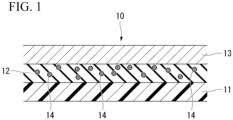
- FIG. 1 is a cross-sectional view showing a heat-dissipating structure to which a thermally conductive sheet according to an embodiment of the present invention is attached.
- thermoplastic elastomer composition the thermally conductive sheet, and the heat-dissipating structure according to the embodiment of the present invention will be described with reference to the drawings.
- Each embodiment to be described below is specifically described for better understanding of the gist of the invention, and does not limit the present invention unless otherwise specified.
- a portion serving as a main part may be enlarged in some cases in order to make the features of the present invention easy to understand, and a dimensional ratio or the like of each component is not always the same as an actual one.
- thermoplastic elastomer composition (Thermoplastic elastomer composition)
- thermoplastic elastomer composition is a thermoplastic elastomer composition containing a thermally conductive filler with a base polymer containing a styrene-based thermoplastic elastomer and an ethylene-propylene-based rubber, in which the thermally conductive filler is contained in an amount of 200 parts by mass or more and 4,000 parts by mass or less with respect to 100 parts by mass of the base polymer.
- thermoplastic elastomer constituting the thermoplastic elastomer composition
- a block copolymer including a polymer containing a vinyl aromatic compound and a polymer containing a conjugated diene compound, and a hydrogenated block copolymer obtained by adding hydrogen to the block copolymer are exemplary examples.
- the styrene-based thermoplastic elastomer is a thermoplastic block copolymer having a basic structural unit including a block (hard segment) consisting of polystyrene and a block (soft segment) which imparts rubber elasticity, and forms a polymer having various structures depending on difference of the soft segment.
- the soft segment of the styrene-based thermoplastic elastomer for example, styrene-butadiene-styrene (SBS), styrene-isoprene-styrene (SIS), styrene-vinyl polyisoprene-styrene (vinyl SIS), styrene-ethylene-butylene-styrene (SEBS), styrene-ethylene-propylene-styrene (SEP), styrene-ethylene-ethylene propylene-styrene (SEEPS), and hydrogenated vinyl SIS are exemplary examples.
- SBS styrene-butadiene-styrene
- SIS styrene-isoprene-styrene
- VSIS styrene-vinyl polyisoprene-styrene
- SEBS styrene-ethylene-
- the above-described soft segment may be used alone or in combination of two or more kinds thereof.
- it is preferable to include the hydrogenated block copolymer it is more preferable to include any one or both of SEEPS or hydrogenated vinyl SIS, and it is still more preferable to include hydrogenated vinyl SIS.
- a styrene content (ST%) contained in 100% by mass of the styrene-based thermoplastic elastomer is not particularly limited, but is preferably 10% by mass or more and 60% by mass or less, and more preferably 15% by mass or more and 40% by mass or less.
- a number-average molecular weight thereof is not particularly limited, but is, for example, 60,000 or more and 400,000 or less.
- the styrene-based thermoplastic elastomer can be easily obtained from a commercially available product.
- styrene-butadiene thermoplastic elastomers TR1086, TR1600, TR2000, TR2001, TR2003, TR2250, TR2500, TR2601, TR2630, TR2787, and TR2827, which are SBS
- styrene-isoprene thermoplastic elastomers (SIS5002, SIS5229, SIS5250, SIS5403, and SIS5506, which are SIS) manufactured by JSR Corporation
- SEPTON series (1020 which is SEP; 2002, 2004F, 2005, 2006, 2063, and 2104, which are SEPS; 4033, 4044, 4055, 4077, and 4099, which are SEEPS; 8004, 8006, and 8007L, which are SEBS, and HG252 which is SEEPS-OH
- KURARAY CO., LTD. HG252 which is SEEPS-OH
- the ethylene-propylene-based rubber constituting the thermoplastic elastomer composition is not particularly limited as long as it is a rubber obtained by copolymerizing mainly an ethylene monomer and a propylene monomer.
- ethylene-propylene-based rubber for example, ethylene-propylene rubber (EPM) and ethylene-propylene-diene rubber (EPDM) are exemplary examples. These may be used alone or in combination of two or more kinds thereof.
- EPM ethylene-propylene rubber
- EPDM ethylene-propylene-diene rubber
- an ethylene-propylene-diene terpolymer is preferably used.
- diene component of the ethylene-propylene-based rubber for example, 5-ethylidene-2-norbomene, dicyclopentadiene, 1,4-hexadiene, methyltetrahydroindene, 5-methylene-2-norbomene, and 1,5-cyclooctadiene are exemplary examples.
- a content of the diene component is not particularly specified, but is, for example, 1% to 15% by mass with respect to 100% by mass of the ethylene-propylene-based rubber.
- An ethylene content in the ethylene-propylene-based rubber is not particularly limited, but is, for example, preferably 50% by mass or more and 80% by mass or less, and more preferably 40% by mass or more and 70% by mass or less, because it is easy to obtain as a commercially available product.
- the ethylene content is preferably 40% by mass or more and 65% by mass or less.
- the ethylene content can be determined by ASTM D 3900 which is a standard of the American Society for Testing and Materials (ASTM).
- a polymerization method of such an ethylene-propylene-based rubber is not particularly limited, and for example, a generally known polymerization method such as a method using a vanadium catalyst or a metallocene catalyst can be applied.
- a Mooney viscosity measured using a Mooney viscometer which is a viscosity of the ethylene-propylene-based rubber, is not particularly limited.
- the Mooney viscosity ML1 + 4 (125°C) is in a range of 10 or more and 100 or less, melt-kneading with the styrene-based thermoplastic elastomer is easily performed, which is preferable.
- the "Mooney viscosity ML 1+4 (125°C)" described above is a Mooney viscosity measured by the Mooney viscometer at 125°C using a large rotor in accordance with ASTM D 1646, after pre-heating for 1 minute and rotation start for 4 minutes.
- the ethylene-propylene-based rubber can be easily obtained from a commercially available product.
- a commercially available product for example, EP331, EP342, EP251, EP65, EP35, EP33, T7241, EP21, EP51, EP25, EP22, EP24, EP123, EP103AF, EP107F, EP57F/C, EP27, EP93, EP11, EP96, EP501EC, EP98, and EP104E, which are EP rubbers manufactured by JSR Corporation; and EPT0045, 2060M, 3045, 3070, 3091, 3092M, 3110M, X-3042E, 3062EM, 3072EM, 3090EM, X-4010M, 4021, 4045, 4045M, 4070, 8030M, 9090M, 8120E, X-3012P, 3092PM, 3072PM, K-9720, and PX-049PEM, which are EP rubbers manufactured by Mitsui Chemicals, Inc. are exemplary examples. Among these, one kind or two or
- thermally conductive filler constituting the thermoplastic elastomer composition
- metal a metal oxide, a metal hydroxide, a metal nitride, and carbon are exemplary examples.
- metal gold, silver, copper, aluminum, tungsten, titanium, nickel, iron, and an alloy of two or more of these metals are exemplary examples.
- the metal oxide of the thermally conductive filler for example, aluminum oxide, magnesium oxide, beryllium oxide, zinc oxide, silicon oxide, titanium oxide, and the like are exemplary examples.
- the metal hydroxide for example, aluminum hydroxide is an exemplary example.
- the metal nitride for example, aluminum nitride, boron nitride, silicon nitride, and the like are exemplary examples.
- the carbon for example, graphite, a carbon fiber, a fullerene, graphene, a carbon nanotube, and the like are exemplary examples.
- aluminum oxide is particularly preferable as the thermally conductive filler from the viewpoint that it is inexpensive and easily available.
- the thermally conductive filler preferably includes one kind or two or more kinds of the above-described material examples; more preferably includes one kind or two or more kinds of the metal oxide, the metal hydroxide, or the metal nitride; and particularly preferably includes aluminum oxide.
- a shape of the thermally conductive filler may be particulate, and from the viewpoint of imparting excellent shape conformability and high thermal conductivity to the thermoplastic elastomer composition, it is preferable to use spherical particles, disk-like particles, particles having a rounded shape with less corners (rounded particles), or amorphous particles.
- an average particle diameter (d50) of the thermally conductive filler is preferably 0.5 ⁇ m or more and 120 ⁇ m or less, more preferably 3 ⁇ m or more and 100 ⁇ m or less, and still more preferably 5 ⁇ m or more and 90 ⁇ m or less.
- the average particle diameter of the thermally conductive filler is less than 0.5 ⁇ m, the viscosity of the mixed material is likely to increase during the kneading, and there is a concern that the filling property of the thermally conductive filler with respect to the base polymer is lowered.
- the average particle diameter thereof is more than 120 ⁇ m, the surface of the thermally conductive sheet obtained by processing the thermoplastic elastomer composition is likely to be uneven, and there is a concern that processability is deteriorated.
- the average particle diameter (d50) referred to herein means a particle diameter at an integrated value of 50% in a particle size distribution obtained by a laser diffraction/scattering method.
- the thermally conductive filler may have a plurality of peaks in the particle size distribution. Therefore, the thermally conductive filler may include a plurality of kinds of filler particles having different average particle diameters (d50). In a case where the thermally conductive filler includes two kinds of filler particles having different average particle diameters (d50), for example, it is preferable that a peak on a small particle diameter side is in a range of 0.3 ⁇ m or more and 10 ⁇ m or less and a peak on a large particle diameter side is in a range of 20 ⁇ m or more and 100 ⁇ m or less.
- the thermally conductive filler includes three kinds of filler particles, that is, large particles, medium particles, and small particles having different average particle diameters (d50)
- a peak on a small particle diameter side is in a range of 0.01 ⁇ m or more and 1 ⁇ m or less
- a peak on a medium particle diameter side is in a range of 1 ⁇ m or more and 60 ⁇ m or less
- a peak on a large particle diameter side is in a range of 10 ⁇ m or more and 100 ⁇ m or less (provided that, d50 of the large particles > d50 of the medium particles).
- a content of each of the particles in 100% by mass of the thermally conductive filler is not particularly limited, but for example, in a case where a content of the large particles is 45% to 65% by mass, a content of the medium particles is 20% to 40% by mass, and a content of the small particles is 10% to 30% by mass (provided that, the sum of the contents of the large particles, the medium particles, and the small particles is 100% by mass), a thermoplastic elastomer composition having favorable flexuosity can be obtained.
- the thermally conductive filler can be easily obtained from a commercially available product.
- a commercially available product of the aluminum oxide as the thermally conductive filler for example, in a case of spherical particles, alumina beads CB-P02, CB-P05, CB-P07, CB-P10, CB-P15, CB-P40, CB-A20S, CB-A30S, CB-A40, CB-A50S, or the like manufactured by SHOWA DENKO K.K.; and spherical alumina DAM-03, DAM-05, DAM-07, DAM-10, DAM-20, DAM-45, DAM-70, DAM-90, or the like manufactured by Denka Company Limited are exemplary examples.
- Advanced Alumina AA-03, AA-04, AA-05, AA-07, AA-1.5, AA-2, AA-5, AA-18, or the like manufactured by Sumitomo Chemical Industry Company Limited is an exemplary example.
- rounded alumina AS-10, AS-20, AS-30, AS-40, AS-50, AS-400, or the like manufactured by SHOWA DENKO K.K. is an exemplary example.
- electro-fused alumina RW and WA manufactured by SHOWA DENKO K.K.; and AM-21, AM-210, AM-27, ALM-41-0 1, ALM-43, or the like which is a regular soda or low soda crushed product manufactured by Sumitomo Chemical Industry Company Limited are exemplary examples.
- AM-41-01, AL-43A, AL420A, or the like is an exemplary example. Among these, one kind or two or more kinds thereof can be used in combination.
- thermally conductive fillers other than the aluminum oxide can also be easily obtained from a commercially available product.
- thermoplastic elastomer composition according to the present embodiment is formed by kneading the thermally conductive filler with the base polymer containing the styrene-based thermoplastic elastomer and the ethylene-propylene-based rubber described above.
- a content proportion of the styrene-based thermoplastic elastomer contained in 100 parts by mass of the base polymer is preferably 50 parts by mass or more and 75 parts by mass or less, and more preferably 55 parts by mass or more and 70 parts by mass or less.
- the content proportion of the styrene-based thermoplastic elastomer is within these ranges, in the formation of the thermally conductive sheet using the thermoplastic elastomer composition according to the present embodiment, a balance between the flexibility and the strength can be improved.
- a content proportion of the ethylene-propylene-based rubber contained in 100 parts by mass of the base polymer is preferably 25 parts by mass or more and 50 parts by mass or less, and more preferably 30 parts by mass or more and 45 parts by mass or less. In a case of being within these ranges, in the formation of the thermally conductive sheet using the thermoplastic elastomer composition according to the present embodiment, the balance between the flexibility and the strength can be improved.
- the thermoplastic elastomer composition according to the present embodiment may further contain a flame retardant.
- a flame retardant for example, one kind or two or more kinds of a hydrated metal-based flame retardant such as aluminum hydroxide and magnesium hydroxide, a phosphorus-based flame retardant, a silicone-based flame retardant, and a bromine-based flame retardant can be used in combination.
- a phosphorus-based flame retardant is preferably used.
- a blending proportion of the flame retardant is 10 parts by mass or more and 300 parts by mass or less, preferably 50 parts by mass or more and 200 parts by mass or less with respect to 100 parts by mass of the base polymer containing the styrene-based thermoplastic elastomer and the ethylene-propylene-based rubber.
- the blending proportion of the flame retardant is less than 10 parts by mass, the effect of flame retardancy is low, and in a case where the blending proportion is more than 300 parts by mass, it is difficult to uniformly disperse the flame retardant in the thermoplastic elastomer composition.
- the thermoplastic elastomer composition according to the present embodiment may further contain a paraffin-based oil.
- a content proportion of the paraffin-based oil is preferably in a range of 20 parts by mass or more and 500 parts by mass or less, and more preferably in a range of 200 parts by mass or more and 400 parts by mass or less with respect to 100 parts by mass of the base polymer containing the styrene-based thermoplastic elastomer and the ethylene-propylene-based rubber.
- the paraffin-based oil preferably has a kinematic viscosity of 30 to 1,000 mm 2 /sec at 40°C, and more preferably has a kinematic viscosity of 50 to 500 mm 2 /sec at 40°C.
- the paraffin-based oil can be easily obtained from a commercially available product.
- a commercially available product for example, SUNPURE LW70, LW500, P22, P32, or P100 manufactured by JAPAN SUN OIL COMPANY, LTD.; and Diana Process Oil PW-32, PW-90, or PW-380, or the like are exemplary examples. Among these, one kind or two or more kinds thereof can be used in combination.
- thermoplastic elastomer composition in addition to the above-described components, as long as the effect of being easily collapsed under a load is not impaired, for example, one kind or two or more kinds of a crosslinking agent (organic peroxide-based crosslinking agent), a crosslinking assistant (triaryl isocyanurate (TAIC) or the like), an antioxidant (for example, a phenol-based antioxidant, a hindered phenol-based antioxidant, or the like), an internal lubricant (stearic acid, calcium stearate, or the like), or an external lubricant (sodium oleate or the like) may be added in combination.
- a crosslinking agent organic peroxide-based crosslinking agent
- TAIC triaryl isocyanurate
- an antioxidant for example, a phenol-based antioxidant, a hindered phenol-based antioxidant, or the like
- an internal lubricant stearic acid, calcium stearate, or the like
- thermoplastic elastomer composition is not particularly limited, and a known method for producing a mixed resin can be applied.
- the respective constituent materials described above can be melted and kneaded using a heating kneading machine such as a uniaxial or biaxial extruder, a roll kneading machine, a Banbury mixer, and a kneader to produce the thermoplastic elastomer composition.
- thermoplastic elastomer composition since the thermally conductive filler is contained in an amount of 200 parts by mass or more and 4,000 parts by mass or less with respect to 100 parts by mass of the base polymer containing the styrene-based thermoplastic elastomer and the ethylene-propylene-based rubber, it is possible to constitute a thermoplastic elastomer composition having excellent thermal conductivity, having high flexibility, and capable of being easily deformed in accordance with a surface shape of an application object.
- the thermal conductivity of the thermoplastic elastomer composition is, for example, 0.5 W/m ⁇ K or more, and a compression elastic modulus thereof is 0.2 N/mm 2 or less.
- the content of the thermally conductive filler is, for example, 40% by mass or more and 98% by mass or less in 100% by mass of the thermoplastic elastomer composition.
- thermoplastic elastomer composition according to the present embodiment is molded into a sheet shape by performing press molding, extrusion molding, or injection molding, thereby obtaining the thermally conductive sheet according to the present embodiment.
- a thickness of the thermally conductive sheet according to the present embodiment is not particularly limited as long as the sheet has a uniform thickness, and for example, the thickness may be 0.05 mm or more and 10.0 mm or less, preferably 0.5 mm or more and 5 mm or less.
- FIG. 1 is a cross-sectional view of a heat-dissipating structure to which a thermally conductive sheet according to an embodiment of the present invention is attached.
- a thermally conductive sheet 12 obtained by molding the thermoplastic elastomer composition into a sheet shape is provided on an upper surface of a heating element 11, and a heat mass member or a heat dissipation member, which can absorb heat, is provided as a member 13 on an upper surface of the thermally conductive sheet 12.
- Thermally conductive fillers 14 are dispersed in the thermally conductive sheet 12.
- the thermally conductive sheet 12 in which the thermally conductive fillers 14 are dispersed is provided on the upper surface of the heating element 11 which is an integrated circuit on a printed circuit board, and the member 13 which is a heat sink is provided on the upper surface of the thermally conductive sheet 12.
- the integrated circuit on the printed circuit board has been described as the heating element of the heat-dissipating structure, but the heat-dissipating structure is not limited thereto.
- the heating element of the heat-dissipating structure may be, for example, a portion other than the integrated circuit of the electronic or electric circuit board, a lithium ion secondary battery cell, a heater for heating an apparatus in a low-temperature state to a predetermined operating temperature, or the like.
- thermoplastic elastomer compositions of Examples 1 to 23 and Comparative Examples 1 to 3 of the present invention which were produced as samples, are shown below.
- Compositional proportions of each sample are shown in Tables 1 and 2.
- Each component shown in Tables 1 and 2 was weighed, kneaded using two rolls, and molded into a thermally conductive sheet having a thickness of 1.0 mm and a thermally conductive sheet having a thickness of 2.0 mm using a compression press, and the thermal conductivity sheets were used for each evaluation.
- the numerical values of the styrene-based thermoplastic elastomer and the ethylene-propylene-based rubber in Table 1 indicate a content proportion (part by mass) of the styrene-based thermoplastic elastomer and a content proportion of the ethylene-propylene-based rubber with respect to 100 parts by mass of the base polymer containing the styrene-based thermoplastic elastomer and the ethylene-propylene-based rubber.
- the numerical value of the thermally conductive filler and other fillers indicates a content (part by mass) of the thermally conductive filler and the other fillers with respect to 100 parts by mass of the base polymer.
- the numerical value of the paraffin-based oil indicates a content proportion (part by mass) with respect to 100 parts by mass of the base polymer.
- the numerical value of the flame retardant indicates a blending proportion (part by mass) of the flame retardant with respect to 100 parts by mass of the base polymer.
- thermoplastic resin composition The raw materials were roll-kneaded at 145°C to obtain a thermoplastic resin composition, and the thermoplastic resin composition was molded into a thermally conductive sheet having a desired thickness using a press molding machine set at 145°C.
- the thermal conductivity at a measurement temperature of 50°C was measured by a steady state comparative-longitudinal heat flow method based on JIS H7903: 2008.
- Each sample was molded into a circular sheet having a diameter of 28 mm ⁇ 1 mm and a thickness of 2 mm ⁇ 0.5 mm, and the sheet was sandwiched between a pair of smooth polyethylene terephthalate sheets. Thereafter, a compression test round plate jig ( ⁇ : 10 cm) was set in a tensile tester, and a reaction force (test force) in a case of compressing the sample at a room temperature of 25°C at 1 mm/min was measured. From a change in thickness in a case where the reaction force was changed from 10 N to 20 N, a compression elastic modulus was obtained.
- Table 2 shows the results of the thermal conductivity, compression elastic modulus, and flame retardancy evaluations.
- "-" in the flame retardancy evaluation indicates a result of not satisfying any class standard.
- thermoplastic elastomer composition having excellent thermal conductivity and compression elastic modulus could be obtained.
- thermoplastic elastomer composition having high flexibility and capable of being easily deformed in accordance with a surface shape of an application object, and to provide a thermally conductive sheet and a heat-dissipating structure using the same.
Landscapes
- Chemical & Material Sciences (AREA)
- Chemical Kinetics & Catalysis (AREA)
- Organic Chemistry (AREA)
- Medicinal Chemistry (AREA)
- Polymers & Plastics (AREA)
- Health & Medical Sciences (AREA)
- Engineering & Computer Science (AREA)
- Physics & Mathematics (AREA)
- Combustion & Propulsion (AREA)
- Thermal Sciences (AREA)
- Materials Engineering (AREA)
- Manufacturing & Machinery (AREA)
- Electrochemistry (AREA)
- General Chemical & Material Sciences (AREA)
- Compositions Of Macromolecular Compounds (AREA)
Abstract
Description
- The present invention relates to a thermoplastic elastomer composition, and a thermally conductive sheet and a heat-dissipating structure using the same.
- Priority is claimed on
Japanese Patent Application No. 2022-048879, filed March 24, 2022 - In recent years, with the increase in energy of a secondary battery module, for example, a lithium ion secondary battery (hereinafter, also referred to as "secondary battery") and with the increase in density of elements constituting an electronic or electric circuit board, the amount of heat generated from the secondary battery, the electronic or electric circuit board, or the like has been increased. A heat-dissipating sheet has been used as a medium for efficiently releasing such heat (see, for example, Patent Document 1).
- On the other hand, for a secondary battery, an electronic or electric circuit board, or the like used in a cold region or the like, it may be necessary to heat these units to a predetermined operation temperature before operating these units until the predetermined operation temperature is reached, and in this case, it may be necessary to supply heat to the secondary battery or the electronic or electric circuit board from the outside by a heater or the like. In order to increase a contact area by enhancing shape conformability of such a heater to a surface of the secondary battery or the electronic or electric circuit board, and to improve thermal conductivity (heat dissipation and heat absorption), development of a thermally conductive sheet having improved flexibility has been carried out.
- [Patent Document 1]
Japanese Unexamined Patent Application, First Publication No. 2017-069341 - However, since the thermally conductive sheet disclosed in Patent Document 1 has a complicated layer structure, it is difficult to process the thermally conductive sheet to be in close contact with a heating element having a complicated surface shape. There has been a demand for a thermoplastic elastomer composition capable of being deformed in a flexible manner to follow the surface shape of the heating element.
- The present invention has been made in view of such a background, and an object of the present invention is to provide a thermoplastic elastomer composition having high flexibility and capable of being easily deformed in accordance with a surface shape of an application object, and to provide a thermally conductive sheet and a heat-dissipating structure using the same.
- In order to achieve the above objective, the present invention is configured as follows.
- That is, the thermoplastic elastomer composition according to one aspect of the present invention is a thermoplastic elastomer composition containing a base polymer containing a styrene-based thermoplastic elastomer and an ethylene-propylene-based rubber, and a thermally conductive filler, in which the thermoplastic elastomer composition contains 200 parts by mass or more and 4,000 parts by mass or less of the thermally conductive filler with respect to 100 parts by mass of the base polymer.
- According to the present invention, in the thermoplastic elastomer composition containing a base polymer containing a styrene-based thermoplastic elastomer and an ethylene-propylene-based rubber, and a thermally conductive filler, since the thermoplastic elastomer composition contains 200 parts by mass or more and 4,000 parts by mass or less of the thermally conductive filler with respect to 100 parts by mass of the base polymer, it is possible to constitute a thermoplastic elastomer composition having excellent thermal conductivity, having high flexibility, and capable of being easily deformed in accordance with a surface shape of an application object.
- The thermally conductive filler in the present invention is a filler having a thermal conductivity higher than that of the base polymer.
- In the thermoplastic elastomer composition according to one aspect of the present invention, the ethylene-propylene-based rubber may have an ethylene content in a range of 50% by mass or more and 80% by mass or less.
- In the thermoplastic elastomer composition according to one aspect of the present invention, the ethylene-propylene-based rubber may be an ethylene-propylene-diene terpolymer.
- In the thermoplastic elastomer composition according to one aspect of the present invention, in a case where the base polymer is set to 100% by mass, the styrene-based thermoplastic elastomer may be contained in a range of 50% by mass or more and 75% by mass or less.
- In the thermoplastic elastomer composition according to one aspect of the present invention, the thermally conductive filler may contain at least one of metal, a metal oxide, a metal hydroxide, a metal nitride, or carbon.
- In the thermoplastic elastomer composition according to one aspect of the present invention, the thermally conductive filler may contain aluminum oxide.
- In the thermoplastic elastomer composition according to one aspect of the present invention, the thermally conductive filler may be spherical particles or rounded particles.
- The thermally conductive sheet according to another aspect of the present invention is obtained by molding the thermoplastic elastomer composition according to each of the above-described items into a sheet shape.
- In the heat-dissipating structure according to still another aspect of the present invention, the thermally conductive sheet according to the above-described item is attached to a surface of a heating element.
- In addition, in the heat-dissipating structure according to still another aspect of the present invention, the heating element may be a lithium ion secondary battery.
- According to the above-described aspects of the present invention, it is possible to provide a thermoplastic elastomer composition having high flexibility and capable of being easily deformed in accordance with a surface shape of an application object, and to provide a thermally conductive sheet and a heat-dissipating structure using the same.
-
FIG. 1 is a cross-sectional view showing a heat-dissipating structure to which a thermally conductive sheet according to an embodiment of the present invention is attached. - Hereinafter, the thermoplastic elastomer composition, the thermally conductive sheet, and the heat-dissipating structure according to the embodiment of the present invention will be described with reference to the drawings. Each embodiment to be described below is specifically described for better understanding of the gist of the invention, and does not limit the present invention unless otherwise specified. In addition, in the drawings used in the following description, for convenience, a portion serving as a main part may be enlarged in some cases in order to make the features of the present invention easy to understand, and a dimensional ratio or the like of each component is not always the same as an actual one.
- The thermoplastic elastomer composition according to the present embodiment is a thermoplastic elastomer composition containing a thermally conductive filler with a base polymer containing a styrene-based thermoplastic elastomer and an ethylene-propylene-based rubber, in which the thermally conductive filler is contained in an amount of 200 parts by mass or more and 4,000 parts by mass or less with respect to 100 parts by mass of the base polymer.
- As the styrene-based thermoplastic elastomer constituting the thermoplastic elastomer composition, a block copolymer including a polymer containing a vinyl aromatic compound and a polymer containing a conjugated diene compound, and a hydrogenated block copolymer obtained by adding hydrogen to the block copolymer are exemplary examples.
- The styrene-based thermoplastic elastomer is a thermoplastic block copolymer having a basic structural unit including a block (hard segment) consisting of polystyrene and a block (soft segment) which imparts rubber elasticity, and forms a polymer having various structures depending on difference of the soft segment.
- As the soft segment of the styrene-based thermoplastic elastomer, for example, styrene-butadiene-styrene (SBS), styrene-isoprene-styrene (SIS), styrene-vinyl polyisoprene-styrene (vinyl SIS), styrene-ethylene-butylene-styrene (SEBS), styrene-ethylene-propylene-styrene (SEP), styrene-ethylene-ethylene propylene-styrene (SEEPS), and hydrogenated vinyl SIS are exemplary examples.
- The above-described soft segment may be used alone or in combination of two or more kinds thereof. In addition, from the viewpoint that filling property of the filler described later is favorable, it is preferable to include the hydrogenated block copolymer, it is more preferable to include any one or both of SEEPS or hydrogenated vinyl SIS, and it is still more preferable to include hydrogenated vinyl SIS. A styrene content (ST%) contained in 100% by mass of the styrene-based thermoplastic elastomer is not particularly limited, but is preferably 10% by mass or more and 60% by mass or less, and more preferably 15% by mass or more and 40% by mass or less. A number-average molecular weight thereof is not particularly limited, but is, for example, 60,000 or more and 400,000 or less.
- The styrene-based thermoplastic elastomer can be easily obtained from a commercially available product. As the commercially available product, for example, styrene-butadiene thermoplastic elastomers (TR1086, TR1600, TR2000, TR2001, TR2003, TR2250, TR2500, TR2601, TR2630, TR2787, and TR2827, which are SBS) manufactured by JSR Corporation; styrene-isoprene thermoplastic elastomers (SIS5002, SIS5229, SIS5250, SIS5403, and SIS5506, which are SIS) manufactured by JSR Corporation; SEPTON series (1020 which is SEP; 2002, 2004F, 2005, 2006, 2063, and 2104, which are SEPS; 4033, 4044, 4055, 4077, and 4099, which are SEEPS; 8004, 8006, and 8007L, which are SEBS, and HG252 which is SEEPS-OH) manufactured by KURARAY CO., LTD.; and HYBRAR series (5125, 5127, and 7135R, which are vinyl SIS (hydrogenated SIS); and 7125F and 7311F, which are vinyl SEPS (hydrogenated SEPS)) manufactured by KURARAY CO., LTD. are exemplary examples. Among these, one kind or two or more kinds thereof can be used in combination.
- The ethylene-propylene-based rubber constituting the thermoplastic elastomer composition is not particularly limited as long as it is a rubber obtained by copolymerizing mainly an ethylene monomer and a propylene monomer. As the ethylene-propylene-based rubber, for example, ethylene-propylene rubber (EPM) and ethylene-propylene-diene rubber (EPDM) are exemplary examples. These may be used alone or in combination of two or more kinds thereof. As the ethylene-propylene-based rubber, an ethylene-propylene-diene terpolymer is preferably used.
- As a diene component of the ethylene-propylene-based rubber, for example, 5-ethylidene-2-norbomene, dicyclopentadiene, 1,4-hexadiene, methyltetrahydroindene, 5-methylene-2-norbomene, and 1,5-cyclooctadiene are exemplary examples. A content of the diene component is not particularly specified, but is, for example, 1% to 15% by mass with respect to 100% by mass of the ethylene-propylene-based rubber.
- An ethylene content in the ethylene-propylene-based rubber is not particularly limited, but is, for example, preferably 50% by mass or more and 80% by mass or less, and more preferably 40% by mass or more and 70% by mass or less, because it is easy to obtain as a commercially available product. In addition, from the viewpoint of flexibility of a thermally conductive sheet obtained by processing the thermoplastic elastomer composition into a sheet shape in a low-temperature environment of a room temperature or lower, the ethylene content is preferably 40% by mass or more and 65% by mass or less. The ethylene content can be determined by ASTM D 3900 which is a standard of the American Society for Testing and Materials (ASTM).
- A polymerization method of such an ethylene-propylene-based rubber is not particularly limited, and for example, a generally known polymerization method such as a method using a vanadium catalyst or a metallocene catalyst can be applied.
- A Mooney viscosity measured using a Mooney viscometer, which is a viscosity of the ethylene-propylene-based rubber, is not particularly limited. In a case where the Mooney viscosity ML1 + 4 (125°C) is in a range of 10 or more and 100 or less, melt-kneading with the styrene-based thermoplastic elastomer is easily performed, which is preferable. The "Mooney viscosity ML 1+4 (125°C)" described above is a Mooney viscosity measured by the Mooney viscometer at 125°C using a large rotor in accordance with ASTM D 1646, after pre-heating for 1 minute and rotation start for 4 minutes.
- The ethylene-propylene-based rubber can be easily obtained from a commercially available product. As the commercially available product, for example, EP331, EP342, EP251, EP65, EP35, EP33, T7241, EP21, EP51, EP25, EP22, EP24, EP123, EP103AF, EP107F, EP57F/C, EP27, EP93, EP11, EP96, EP501EC, EP98, and EP104E, which are EP rubbers manufactured by JSR Corporation; and EPT0045, 2060M, 3045, 3070, 3091, 3092M, 3110M, X-3042E, 3062EM, 3072EM, 3090EM, X-4010M, 4021, 4045, 4045M, 4070, 8030M, 9090M, 8120E, X-3012P, 3092PM, 3072PM, K-9720, and PX-049PEM, which are EP rubbers manufactured by Mitsui Chemicals, Inc. are exemplary examples. Among these, one kind or two or more kinds thereof can be used in combination.
- As the thermally conductive filler constituting the thermoplastic elastomer composition, metal, a metal oxide, a metal hydroxide, a metal nitride, and carbon are exemplary examples. As the metal, gold, silver, copper, aluminum, tungsten, titanium, nickel, iron, and an alloy of two or more of these metals are exemplary examples.
- As the metal oxide of the thermally conductive filler, for example, aluminum oxide, magnesium oxide, beryllium oxide, zinc oxide, silicon oxide, titanium oxide, and the like are exemplary examples. In addition, as the metal hydroxide, for example, aluminum hydroxide is an exemplary example. In addition, as the metal nitride, for example, aluminum nitride, boron nitride, silicon nitride, and the like are exemplary examples. Furthermore, as the carbon, for example, graphite, a carbon fiber, a fullerene, graphene, a carbon nanotube, and the like are exemplary examples. Among these, aluminum oxide is particularly preferable as the thermally conductive filler from the viewpoint that it is inexpensive and easily available.
- The thermally conductive filler preferably includes one kind or two or more kinds of the above-described material examples; more preferably includes one kind or two or more kinds of the metal oxide, the metal hydroxide, or the metal nitride; and particularly preferably includes aluminum oxide.
- A shape of the thermally conductive filler may be particulate, and from the viewpoint of imparting excellent shape conformability and high thermal conductivity to the thermoplastic elastomer composition, it is preferable to use spherical particles, disk-like particles, particles having a rounded shape with less corners (rounded particles), or amorphous particles.
- From the viewpoint of imparting excellent shape conformability and high thermal conductivity to the thermoplastic elastomer composition, an average particle diameter (d50) of the thermally conductive filler is preferably 0.5 µm or more and 120 µm or less, more preferably 3 µm or more and 100 µm or less, and still more preferably 5 µm or more and 90 µm or less.
- In a case where the average particle diameter of the thermally conductive filler is less than 0.5 µm, the viscosity of the mixed material is likely to increase during the kneading, and there is a concern that the filling property of the thermally conductive filler with respect to the base polymer is lowered. In addition, in a case where the average particle diameter thereof is more than 120 µm, the surface of the thermally conductive sheet obtained by processing the thermoplastic elastomer composition is likely to be uneven, and there is a concern that processability is deteriorated.
- The average particle diameter (d50) referred to herein means a particle diameter at an integrated value of 50% in a particle size distribution obtained by a laser diffraction/scattering method.
- From the viewpoint of ensuring both filling property and processability, the thermally conductive filler may have a plurality of peaks in the particle size distribution. Therefore, the thermally conductive filler may include a plurality of kinds of filler particles having different average particle diameters (d50). In a case where the thermally conductive filler includes two kinds of filler particles having different average particle diameters (d50), for example, it is preferable that a peak on a small particle diameter side is in a range of 0.3 µm or more and 10 µm or less and a peak on a large particle diameter side is in a range of 20 µm or more and 100 µm or less.
- In addition, in a case where the thermally conductive filler includes three kinds of filler particles, that is, large particles, medium particles, and small particles having different average particle diameters (d50), it is preferable that a peak on a small particle diameter side is in a range of 0.01 µm or more and 1 µm or less, a peak on a medium particle diameter side is in a range of 1 µm or more and 60 µm or less, and a peak on a large particle diameter side is in a range of 10 µm or more and 100 µm or less (provided that, d50 of the large particles > d50 of the medium particles).
- In addition, a content of each of the particles in 100% by mass of the thermally conductive filler is not particularly limited, but for example, in a case where a content of the large particles is 45% to 65% by mass, a content of the medium particles is 20% to 40% by mass, and a content of the small particles is 10% to 30% by mass (provided that, the sum of the contents of the large particles, the medium particles, and the small particles is 100% by mass), a thermoplastic elastomer composition having favorable flexuosity can be obtained.
- The thermally conductive filler can be easily obtained from a commercially available product. As a commercially available product of the aluminum oxide as the thermally conductive filler, for example, in a case of spherical particles, alumina beads CB-P02, CB-P05, CB-P07, CB-P10, CB-P15, CB-P40, CB-A20S, CB-A30S, CB-A40, CB-A50S, or the like manufactured by SHOWA DENKO K.K.; and spherical alumina DAM-03, DAM-05, DAM-07, DAM-10, DAM-20, DAM-45, DAM-70, DAM-90, or the like manufactured by Denka Company Limited are exemplary examples. In a case of polyhedral alumina, Advanced Alumina AA-03, AA-04, AA-05, AA-07, AA-1.5, AA-2, AA-5, AA-18, or the like manufactured by Sumitomo Chemical Industry Company Limited is an exemplary example. In a case of rounded particles, rounded alumina AS-10, AS-20, AS-30, AS-40, AS-50, AS-400, or the like manufactured by SHOWA DENKO K.K. is an exemplary example. In a case of amorphous particles, electro-fused alumina RW and WA manufactured by SHOWA DENKO K.K.; and AM-21, AM-210, AM-27, ALM-41-0 1, ALM-43, or the like which is a regular soda or low soda crushed product manufactured by Sumitomo Chemical Industry Company Limited are exemplary examples. In a case of coarse products, AL-41-01, AL-43A, AL420A, or the like is an exemplary example. Among these, one kind or two or more kinds thereof can be used in combination.
- All of the mentioned thermally conductive fillers other than the aluminum oxide can also be easily obtained from a commercially available product.
- The thermoplastic elastomer composition according to the present embodiment is formed by kneading the thermally conductive filler with the base polymer containing the styrene-based thermoplastic elastomer and the ethylene-propylene-based rubber described above.
- A content of the thermally conductive filler with respect to the base polymer is in a range of 200 parts by mass or more and 4,000 parts by mass or less with respect to 100 parts by mass of the base polymer. The content of the thermally conductive filler is preferably 300 parts by mass or more and 3,500 parts by mass or less, and more preferably 500 parts by mass or more and 3,000 parts by mass or less. In a case where the content of the thermally conductive filler is less than 200 parts by mass, a thermal conductivity of the thermoplastic elastomer composition is excessively low. In addition, in a case where the content of the thermally conductive filler is more than 4,000 parts by mass, there is a concern that, in a case of forming the thermally conductive sheet from the thermoplastic elastomer composition, cracks are likely to occur due to low plasticity.
- In addition, a content proportion of the styrene-based thermoplastic elastomer contained in 100 parts by mass of the base polymer is preferably 50 parts by mass or more and 75 parts by mass or less, and more preferably 55 parts by mass or more and 70 parts by mass or less. In a case where the content proportion of the styrene-based thermoplastic elastomer is within these ranges, in the formation of the thermally conductive sheet using the thermoplastic elastomer composition according to the present embodiment, a balance between the flexibility and the strength can be improved.
- In addition, a content proportion of the ethylene-propylene-based rubber contained in 100 parts by mass of the base polymer is preferably 25 parts by mass or more and 50 parts by mass or less, and more preferably 30 parts by mass or more and 45 parts by mass or less. In a case of being within these ranges, in the formation of the thermally conductive sheet using the thermoplastic elastomer composition according to the present embodiment, the balance between the flexibility and the strength can be improved.
- In order to improve flame retardancy, fire resistance, and flame resistance, the thermoplastic elastomer composition according to the present embodiment may further contain a flame retardant. As the flame retardant in the thermoplastic elastomer composition according to the present embodiment, for example, one kind or two or more kinds of a hydrated metal-based flame retardant such as aluminum hydroxide and magnesium hydroxide, a phosphorus-based flame retardant, a silicone-based flame retardant, and a bromine-based flame retardant can be used in combination. Among these, from the viewpoint that high flame retardancy can be imparted while maintaining the flexibility, a phosphorus-based flame retardant is preferably used.
- A blending proportion of the flame retardant is 10 parts by mass or more and 300 parts by mass or less, preferably 50 parts by mass or more and 200 parts by mass or less with respect to 100 parts by mass of the base polymer containing the styrene-based thermoplastic elastomer and the ethylene-propylene-based rubber. In a case where the blending proportion of the flame retardant is less than 10 parts by mass, the effect of flame retardancy is low, and in a case where the blending proportion is more than 300 parts by mass, it is difficult to uniformly disperse the flame retardant in the thermoplastic elastomer composition.
- In order to further improve the flexibility, the thermoplastic elastomer composition according to the present embodiment may further contain a paraffin-based oil. A content proportion of the paraffin-based oil is preferably in a range of 20 parts by mass or more and 500 parts by mass or less, and more preferably in a range of 200 parts by mass or more and 400 parts by mass or less with respect to 100 parts by mass of the base polymer containing the styrene-based thermoplastic elastomer and the ethylene-propylene-based rubber. By setting the content proportion of the paraffin-based oil to be 20 parts by mass or more and 500 parts by mass or less, it is possible to prevent the paraffin-based oil from bleeding out while maintaining the flexibility of the thermoplastic elastomer composition.
- The paraffin-based oil preferably has a kinematic viscosity of 30 to 1,000 mm2/sec at 40°C, and more preferably has a kinematic viscosity of 50 to 500 mm2/sec at 40°C.
- The paraffin-based oil can be easily obtained from a commercially available product. As the commercially available product, for example, SUNPURE LW70, LW500, P22, P32, or P100 manufactured by JAPAN SUN OIL COMPANY, LTD.; and Diana Process Oil PW-32, PW-90, or PW-380, or the like are exemplary examples. Among these, one kind or two or more kinds thereof can be used in combination.
- In the thermoplastic elastomer composition according to the present embodiment, in addition to the above-described components, as long as the effect of being easily collapsed under a load is not impaired, for example, one kind or two or more kinds of a crosslinking agent (organic peroxide-based crosslinking agent), a crosslinking assistant (triaryl isocyanurate (TAIC) or the like), an antioxidant (for example, a phenol-based antioxidant, a hindered phenol-based antioxidant, or the like), an internal lubricant (stearic acid, calcium stearate, or the like), or an external lubricant (sodium oleate or the like) may be added in combination.
- A method for producing the thermoplastic elastomer composition according to the present embodiment is not particularly limited, and a known method for producing a mixed resin can be applied. For example, the respective constituent materials described above can be melted and kneaded using a heating kneading machine such as a uniaxial or biaxial extruder, a roll kneading machine, a Banbury mixer, and a kneader to produce the thermoplastic elastomer composition.
- As described above, with the thermoplastic elastomer composition according to the present embodiment, since the thermally conductive filler is contained in an amount of 200 parts by mass or more and 4,000 parts by mass or less with respect to 100 parts by mass of the base polymer containing the styrene-based thermoplastic elastomer and the ethylene-propylene-based rubber, it is possible to constitute a thermoplastic elastomer composition having excellent thermal conductivity, having high flexibility, and capable of being easily deformed in accordance with a surface shape of an application object. The thermal conductivity of the thermoplastic elastomer composition is, for example, 0.5 W/m·K or more, and a compression elastic modulus thereof is 0.2 N/mm2 or less. In addition, the content of the thermally conductive filler is, for example, 40% by mass or more and 98% by mass or less in 100% by mass of the thermoplastic elastomer composition.
- The thermoplastic elastomer composition according to the present embodiment is molded into a sheet shape by performing press molding, extrusion molding, or injection molding, thereby obtaining the thermally conductive sheet according to the present embodiment. A thickness of the thermally conductive sheet according to the present embodiment is not particularly limited as long as the sheet has a uniform thickness, and for example, the thickness may be 0.05 mm or more and 10.0 mm or less, preferably 0.5 mm or more and 5 mm or less.
-
FIG. 1 is a cross-sectional view of a heat-dissipating structure to which a thermally conductive sheet according to an embodiment of the present invention is attached. - In a heat-dissipating
structure 10, a thermallyconductive sheet 12 obtained by molding the thermoplastic elastomer composition into a sheet shape is provided on an upper surface of aheating element 11, and a heat mass member or a heat dissipation member, which can absorb heat, is provided as amember 13 on an upper surface of the thermallyconductive sheet 12. Thermallyconductive fillers 14 are dispersed in the thermallyconductive sheet 12. As a specific example, the thermallyconductive sheet 12 in which the thermallyconductive fillers 14 are dispersed is provided on the upper surface of theheating element 11 which is an integrated circuit on a printed circuit board, and themember 13 which is a heat sink is provided on the upper surface of the thermallyconductive sheet 12. - In the above-described embodiment, the integrated circuit on the printed circuit board has been described as the heating element of the heat-dissipating structure, but the heat-dissipating structure is not limited thereto. The heating element of the heat-dissipating structure may be, for example, a portion other than the integrated circuit of the electronic or electric circuit board, a lithium ion secondary battery cell, a heater for heating an apparatus in a low-temperature state to a predetermined operating temperature, or the like.
- Although a description was given of one embodiment of the present invention above, this embodiment is presented as an example and is not intended to limit the scope of the invention. It is possible to implement the embodiment in various other forms and to make various omissions, substitutions, and modifications in a range not departing from the gist of the invention. The embodiment and variations thereof are included within the invention described the scope of the claims and equivalents thereof as well as being included within the scope and the gist of the invention.
- Hereinafter, the thermal conductivity, the compression elastic modulus, and the evaluation of flame retardancy class in the UL94 standard of thermoplastic elastomer compositions of Examples 1 to 23 and Comparative Examples 1 to 3 of the present invention, which were produced as samples, are shown below. Compositional proportions of each sample are shown in Tables 1 and 2. Each component shown in Tables 1 and 2 was weighed, kneaded using two rolls, and molded into a thermally conductive sheet having a thickness of 1.0 mm and a thermally conductive sheet having a thickness of 2.0 mm using a compression press, and the thermal conductivity sheets were used for each evaluation.
- The numerical values of the styrene-based thermoplastic elastomer and the ethylene-propylene-based rubber in Table 1 indicate a content proportion (part by mass) of the styrene-based thermoplastic elastomer and a content proportion of the ethylene-propylene-based rubber with respect to 100 parts by mass of the base polymer containing the styrene-based thermoplastic elastomer and the ethylene-propylene-based rubber. In Table 2, the numerical value of the thermally conductive filler and other fillers indicates a content (part by mass) of the thermally conductive filler and the other fillers with respect to 100 parts by mass of the base polymer. The numerical value of the paraffin-based oil indicates a content proportion (part by mass) with respect to 100 parts by mass of the base polymer. The numerical value of the flame retardant indicates a blending proportion (part by mass) of the flame retardant with respect to 100 parts by mass of the base polymer.
TABLE 1 Styrene-based thermoplastic elastomer Ethylene-propylene-based rubber Polypropylene A-1 A-2 A-3 A-4 B-1 B-2 B-3 B-4 C-1 SEEPS (styrene content: 30% by mass) Unhydrogenated vinyl SIS (styrene content: 20% by mass) SEPS (styrene content: 20% by mass) SEPS (styrene content: 33% by mass) EPM (ML1 +4 (100°C) :40 EPDM (ML1 + 4 (125°C): 24 EPDM (ML1 + 4 (125°C): 26 EPDM (ML1 + 4 (125°C): 23 MFR: 1.5 (g/10 min) Example 1 70 30 Example 2 70 30 Example 3 70 30 Example 4 65 35 Example 5 65 35 Example 6 65 35 Example 7 65 35 Example 8 65 35 Example 9 65 35 Example 10 65 35 Example 11 65 35 Example 12 65 35 Example 13 65 35 Example 14 60 40 Example 15 60 40 Example 16 60 40 Example 17 60 40 Example 18 60 40 Example 19 60 40 Example 20 60 40 Example 21 60 40 Example 22 65 35 Example 23 65 35 Comparative Example 1 100 Comparative Example 2 80 20 Comparative Example 3 80 20 
-
- 1. Raw materials used for preparing sample
- [Styrene-based thermoplastic elastomer]
- (A-1) SEEPS: styrene-ethylene/ethylene-propylene-styrene block copolymer (styrene content: 30% by mass) (hydrogenated product of styrene-butadiene/isoprene-styrene)
- (A-2) Unhydrogenated vinyl SIS: styrene-isoprene-styrene block copolymer (styrene content: 20% by mass)
- (A-3) SEPS: styrene-ethylene-propylene-styrene block copolymer (hydrogenated SIS) (styrene content: 20% by mass)
- (A-4) SEPS: styrene-ethylene-propylene-styrene block copolymer (hydrogenated SIS) (styrene content: 33% by mass)
- [Ethylene-propylene-based rubber]
- (B-1) EPM: ethylene-propylene rubber (ML1 + 4 (100°C): 40, (ethylene content: 52% by mass))
- (B-2) EPDM: ethylene-propylene-diene rubber (ML1 + 4 (125°C): 24, diene component: ENB (5-ethylidene-2-norbomene) (diene content: 8.1% by mass) (ethylene content: 51% by mass))
- (B-3) EPDM: ethylene-propylene-diene rubber (ML1 + 4 (125°C): 26, diene component: ENB (5-ethylidene-2-norbomene) (diene content: 5.8% by mass) (ethylene content: 61% by mass))
- (B-4) EPDM: ethylene-propylene-diene rubber (EP51 (ML1 + 4 (125°C): 23, diene component: ENB, diene content: 5.8% by mass, ethylene content: 67% by mass))
- [Polypropylene]
(C-1) PP: polypropylene (MFR: 1.5 (g/10 min)) - [Thermally conductive filler]
- (D-1) Spherical aluminum oxide (tri-dispersed, average particle diameter: 29 µm, BET specific surface area: 1.2 m2/g, peak of particle size distribution frequency: 70.8 µm, 3.9 µm, and 0.5 µm)
- (D-2) Rounded granular aluminum oxide (bi-dispersed, average particle diameter: 17.0 µm, BET specific surface area: 0.65 m2/g, peak of particle size distribution frequency: 22.5 µm and 1.8 µm)
- (D-3) Rounded granular aluminum oxide (mono-dispersed, average particle diameter: 39 µm, BET specific surface area: 0.5 m2/g)
- (D-4) Amorphous aluminum oxide: average particle diameter: 95 µm
- (D-5) Amorphous aluminum oxide: average particle diameter: 37 µm
- [Other fillers]
- (E-1) Titanium oxide: particle diameter: 0.15 µm
- [Paraffin-based oil]
- (F-1) Kinematic viscosity: 95 mm2/sec (@ 40°C)
- (F-2) Kinematic viscosity: 381 mm2/sec (@ 40°C)
- [Flame retardant]
- (G-1) Non-halogenated phosphate ester (tricresyl phosphate): TCP, manufactured by DAIHACHI Chemical
- (G-2) Non-halogenated condensed phosphate ester (non-halogenated phosphate ester): DAIGUARD-880, manufactured by DAIHACHI Chemical
- [Styrene-based thermoplastic elastomer]
- 2. Sample forming conditions
- The raw materials were roll-kneaded at 145°C to obtain a thermoplastic resin composition, and the thermoplastic resin composition was molded into a thermally conductive sheet having a desired thickness using a press molding machine set at 145°C.
- The thermal conductivity at a measurement temperature of 50°C was measured by a steady state comparative-longitudinal heat flow method based on JIS H7903: 2008.
- Each sample was molded into a circular sheet having a diameter of 28 mm ± 1 mm and a thickness of 2 mm ± 0.5 mm, and the sheet was sandwiched between a pair of smooth polyethylene terephthalate sheets. Thereafter, a compression test round plate jig (ϕ: 10 cm) was set in a tensile tester, and a reaction force (test force) in a case of compressing the sample at a room temperature of 25°C at 1 mm/min was measured. From a change in thickness in a case where the reaction force was changed from 10 N to 20 N, a compression elastic modulus was obtained.
- In accordance with the Underwriters Laboratories Inc. (UL) flame retardancy standard, UL94, a burning line was drawn at 1 inch and 4 inches from the end part of each sample, one end part was applied with a flame for 30 seconds, and a combustion rate between the burning lines of the intermediate 3 inches was measured. In addition, at the lower end center of each sample, after applying the flame to the sample about ten times, the sample was separated from the 6-inch flame, and the combustion time of the sample was measured. The combustion time, the growing time, and the presence or absence of ignition of a cotton wool placed under the 12 inches were recorded to specify the flame retardancy class.
- Table 2 shows the results of the thermal conductivity, compression elastic modulus, and flame retardancy evaluations. In addition, "-" in the flame retardancy evaluation indicates a result of not satisfying any class standard.
- According to the results shown in Table 2, all the samples of Examples 1 to 23 had a thermal conductivity of 0.5 W/m·K or more and a compression elastic modulus of 2 or less, and it was found that the thermally conductive sheet having both excellent thermal conductivity and shape conformability with less deformation due to the compression could be realized. In addition, it was found that, in the sample to which the flame retardant was added, the flame retardancy satisfying the UL94 standard could be imparted. On the other hand, in Comparative Examples 1 to 3 of the related art, the compression elastic modulus was more than 2, and there was a concern that, in a case of being bent according to the shape of the object, the strain was increased and the crack was generated. From the above-described results, the effect of the present invention was confirmed.
- Some of Examples described above contained the paraffin-based oil and the flame retardant, but the paraffin-based oil and the flame retardant were not essential components of the thermoplastic elastomer composition according to the embodiment of the present invention. Even in a case where the paraffin-based oil and the flame retardant were not contained, the thermoplastic elastomer composition having excellent thermal conductivity and compression elastic modulus could be obtained.
- According to the present invention, it is possible to provide a thermoplastic elastomer composition having high flexibility and capable of being easily deformed in accordance with a surface shape of an application object, and to provide a thermally conductive sheet and a heat-dissipating structure using the same.
-
- 10: heat-dissipating structure
- 11: heating element
- 12: thermally conductive sheet
- 13: member (heat mass member or heat dissipation member)
- 14: thermally conductive filler
Claims (10)
- A thermoplastic elastomer composition comprising:a base polymer containing a styrene-based thermoplastic elastomer and an ethylene-propylene-based rubber; anda thermally conductive filler,wherein the thermoplastic elastomer composition contains 200 parts by mass or more and 4,000 parts by mass or less of the thermally conductive filler with respect to 100 parts by mass of the base polymer.
- The thermoplastic elastomer composition according to Claim 1,
wherein the ethylene-propylene-based rubber has an ethylene content in a range of 50% by mass or more and 80% by mass or less. - The thermoplastic elastomer composition according to Claim 1 or 2,
wherein the ethylene-propylene-based rubber is an ethylene-propylene-diene terpolymer. - The thermoplastic elastomer composition according to any one of Claims 1 to 3,
wherein, in a case where the base polymer is set to 100 parts by mass, the styrene-based thermoplastic elastomer is contained in a range of 50 parts by mass or more and 75 parts by mass or less. - The thermoplastic elastomer composition according to any one of Claims 1 to 4,
wherein the thermally conductive filler contains at least one of metal, a metal oxide, a metal hydroxide, a metal nitride, or carbon. - The thermoplastic elastomer composition according to Claim 5,
wherein the thermally conductive filler contains aluminum oxide. - The thermoplastic elastomer composition according to any one of Claims 1 to 6,
wherein the thermally conductive filler is spherical particles or rounded particles. - A thermally conductive sheet obtained by molding the thermoplastic elastomer composition according to any one of Claims 1 to 7 into a sheet shape.
- A heat-dissipating structure in which the thermally conductive sheet according to Claim 8 is attached to a surface of a heating element.
- The heat-dissipating structure according to Claim 9,
wherein the heating element is a lithium ion secondary battery.
Applications Claiming Priority (2)
| Application Number | Priority Date | Filing Date | Title |
|---|---|---|---|
| JP2022048879A JP7833934B2 (en) | 2022-03-24 | 2022-03-24 | Thermoplastic elastomer composition, thermally conductive sheet, heat dissipation structure |
| PCT/JP2023/010820 WO2023182254A1 (en) | 2022-03-24 | 2023-03-20 | Thermoplastic elastomer composition, thermally conductive sheet, and heat-dissipating structure |
Publications (2)
| Publication Number | Publication Date |
|---|---|
| EP4502053A1 true EP4502053A1 (en) | 2025-02-05 |
| EP4502053A4 EP4502053A4 (en) | 2026-03-11 |
Family
ID=88100931
Family Applications (1)
| Application Number | Title | Priority Date | Filing Date |
|---|---|---|---|
| EP23774849.6A Pending EP4502053A4 (en) | 2022-03-24 | 2023-03-20 | THERMOPLASTIC ELASTOMER COMPOSITION, THERMALLY CONDUCTIVE FILM AND HEAT-DISSIPLING STRUCTURE |
Country Status (6)
| Country | Link |
|---|---|
| US (1) | US20250179283A1 (en) |
| EP (1) | EP4502053A4 (en) |
| JP (1) | JP7833934B2 (en) |
| CN (1) | CN118556105A (en) |
| TW (1) | TW202402931A (en) |
| WO (1) | WO2023182254A1 (en) |
Families Citing this family (2)
| Publication number | Priority date | Publication date | Assignee | Title |
|---|---|---|---|---|
| KR102727676B1 (en) * | 2024-02-29 | 2024-11-08 | 주식회사 테크온 | thermal interface material for mobile application processor chip and thermal interface seat containing the same |
| KR102752509B1 (en) * | 2024-02-29 | 2025-01-10 | 주식회사 테크온 | thermal interface material for mobile application processor chip and thermal interface seat containing the same |
Family Cites Families (12)
| Publication number | Priority date | Publication date | Assignee | Title |
|---|---|---|---|---|
| JP2005075895A (en) * | 2003-08-29 | 2005-03-24 | Riken Technos Corp | Thermoplastic elastomer composition and molded article thereof |
| JP5466431B2 (en) * | 2009-06-03 | 2014-04-09 | 旭化成イーマテリアルズ株式会社 | Method for producing thermally conductive molded body and thermally conductive sheet |
| JP2011127053A (en) * | 2009-12-21 | 2011-06-30 | Sekisui Chem Co Ltd | Resin sheet and laminate |
| JP2013194148A (en) * | 2012-03-21 | 2013-09-30 | Mitsubishi Chemicals Corp | Heat conductive material |
| JP2016065196A (en) * | 2014-06-11 | 2016-04-28 | 積水化学工業株式会社 | Foamable composition and foam |
| JP6523012B2 (en) * | 2015-03-30 | 2019-05-29 | 古河電気工業株式会社 | Heat-resistant silane cross-linked resin molded product and heat-resistant silane cross-linkable resin composition, method for producing them, silane master batch, and heat-resistant product |
| JP2017069341A (en) | 2015-09-29 | 2017-04-06 | 積水化学工業株式会社 | Thermal conductive sheet for electronic equipment |
| JP2017186548A (en) * | 2016-03-31 | 2017-10-12 | 積水化学工業株式会社 | Thermally conductive foam sheet for electronic equipment |
| CN108676212A (en) * | 2018-05-18 | 2018-10-19 | 深圳市金菱通达电子有限公司 | The non-silicon heat-conducting pad that suitable optical module uses |
| KR102175916B1 (en) * | 2018-08-29 | 2020-11-06 | (주)웹스 | A Light Sheet Having Insulation and Heat Dissipation for Secondary Cell Battery Pack and A Sheet Manufacturing Method |
| JP7178661B2 (en) * | 2019-02-21 | 2022-11-28 | 東洋紡株式会社 | Thermally conductive insulating rubber composition, thermally conductive insulating rubber molding and method for producing the same |
| JP6889796B1 (en) | 2020-09-15 | 2021-06-18 | 株式会社 日立産業制御ソリューションズ | Vehicle travel management system, control center, vehicle control device, vehicle travel management program and vehicle travel management method |
-
2022
- 2022-03-24 JP JP2022048879A patent/JP7833934B2/en active Active
-
2023
- 2023-03-20 WO PCT/JP2023/010820 patent/WO2023182254A1/en not_active Ceased
- 2023-03-20 CN CN202380016386.2A patent/CN118556105A/en active Pending
- 2023-03-20 EP EP23774849.6A patent/EP4502053A4/en active Pending
- 2023-03-20 US US18/842,159 patent/US20250179283A1/en active Pending
- 2023-03-22 TW TW112110696A patent/TW202402931A/en unknown
Also Published As
| Publication number | Publication date |
|---|---|
| US20250179283A1 (en) | 2025-06-05 |
| JP7833934B2 (en) | 2026-03-23 |
| WO2023182254A1 (en) | 2023-09-28 |
| TW202402931A (en) | 2024-01-16 |
| JP2023142150A (en) | 2023-10-05 |
| EP4502053A4 (en) | 2026-03-11 |
| CN118556105A (en) | 2024-08-27 |
Similar Documents
| Publication | Publication Date | Title |
|---|---|---|
| US11136484B2 (en) | Thermally conductive sheet | |
| EP4502053A1 (en) | Thermoplastic elastomer composition, thermally conductive sheet, and heat-dissipating structure | |
| EP2751203B1 (en) | Flame retardant thermoplastic composition of polycarbonate and polypropylene | |
| JP6746540B2 (en) | Heat conduction sheet | |
| JP2009149769A (en) | Elastomer composition, elastomer molded body, and heat dissipation sheet | |
| US20220002608A1 (en) | Thermally Conductive Resin Sheet, Laminated Heat Dissipation Sheet, Heat Dissipation Circuit Board, and Power Semiconductor Device | |
| JP2019038997A (en) | Resin sheet and resin sheet with adhesive layer | |
| JP5323432B2 (en) | Molded body for heat conduction | |
| JP2003313431A (en) | Thermally conductive resin composition, sheet, electronic component using the same, semiconductor device, display device, and plasma display panel | |
| CN111511832B (en) | Heat-conducting elastomer composition and heat-conducting molded article | |
| JP6133257B2 (en) | Highly heat conductive insulating crosslinkable composition, high heat conductive insulating crosslinkable composition, high heat conductive insulating crosslinkable molded body, and method for producing the same | |
| JP6978639B1 (en) | Thermally conductive resin sheet | |
| JP6062339B2 (en) | High thermal conductive admixture for electric and electronic devices, high thermal conductive molded article for electric and electronic devices, and high thermal conductive laminated sheet for electric and electronic devices and method for producing the same | |
| JP2017043673A (en) | Resin composition and sheet thereof | |
| JP7488636B2 (en) | Thermally conductive resin sheet | |
| JP6182256B1 (en) | Resin molded body | |
| JP7361191B2 (en) | Olefin rubber composition | |
| CN110746732A (en) | Resin composition and sheet containing resin composition | |
| JP7542317B2 (en) | Thermally conductive resin sheet | |
| JP2014224200A (en) | Highly thermally conductive mixture and highly thermally conductive molded body | |
| WO2026079423A1 (en) | Resin sheet | |
| JP2025148871A (en) | Silane-crosslinkable thermally conductive resin composition, silane-crosslinked thermally conductive resin molded body, thermally conductive crosslinked resin molded article, and method for manufacturing silane-crosslinkable thermally conductive resin composition and silane-crosslinked thermally conductive resin molded body | |
| JP2018119063A (en) | Resin composition and sheet composed of resin composition |
Legal Events
| Date | Code | Title | Description |
|---|---|---|---|
| STAA | Information on the status of an ep patent application or granted ep patent |
Free format text: STATUS: THE INTERNATIONAL PUBLICATION HAS BEEN MADE |
|
| PUAI | Public reference made under article 153(3) epc to a published international application that has entered the european phase |
Free format text: ORIGINAL CODE: 0009012 |
|
| STAA | Information on the status of an ep patent application or granted ep patent |
Free format text: STATUS: REQUEST FOR EXAMINATION WAS MADE |
|
| 17P | Request for examination filed |
Effective date: 20240904 |
|
| AK | Designated contracting states |
Kind code of ref document: A1 Designated state(s): AL AT BE BG CH CY CZ DE DK EE ES FI FR GB GR HR HU IE IS IT LI LT LU LV MC ME MK MT NL NO PL PT RO RS SE SI SK SM TR |
|
| DAV | Request for validation of the european patent (deleted) | ||
| DAX | Request for extension of the european patent (deleted) | ||
| A4 | Supplementary search report drawn up and despatched |
Effective date: 20260209 |
|
| RIC1 | Information provided on ipc code assigned before grant |
Ipc: C08L 53/02 20060101AFI20260203BHEP Ipc: C08L 23/16 20060101ALI20260203BHEP Ipc: C08K 3/22 20060101ALI20260203BHEP Ipc: C08J 5/18 20060101ALI20260203BHEP Ipc: C08K 3/013 20180101ALI20260203BHEP Ipc: C09K 5/14 20060101ALI20260203BHEP Ipc: H01M 10/613 20140101ALI20260203BHEP |