EP4496033A1 - Positivelektrodenaktivmaterial, herstellungsverfahren, sekundärbatterie und elektrische vorrichtung - Google Patents
Positivelektrodenaktivmaterial, herstellungsverfahren, sekundärbatterie und elektrische vorrichtung Download PDFInfo
- Publication number
- EP4496033A1 EP4496033A1 EP22966685.4A EP22966685A EP4496033A1 EP 4496033 A1 EP4496033 A1 EP 4496033A1 EP 22966685 A EP22966685 A EP 22966685A EP 4496033 A1 EP4496033 A1 EP 4496033A1
- Authority
- EP
- European Patent Office
- Prior art keywords
- positive electrode
- ion
- active material
- electrode active
- prussian blue
- Prior art date
- Legal status (The legal status is an assumption and is not a legal conclusion. Google has not performed a legal analysis and makes no representation as to the accuracy of the status listed.)
- Pending
Links
Images

Classifications
-
- H—ELECTRICITY
- H01—ELECTRIC ELEMENTS
- H01M—PROCESSES OR MEANS, e.g. BATTERIES, FOR THE DIRECT CONVERSION OF CHEMICAL ENERGY INTO ELECTRICAL ENERGY
- H01M4/00—Electrodes
- H01M4/02—Electrodes composed of, or comprising, active material
- H01M4/36—Selection of substances as active materials, active masses, active liquids
- H01M4/58—Selection of substances as active materials, active masses, active liquids of inorganic compounds other than oxides or hydroxides, e.g. sulfides, selenides, tellurides, halogenides or LiCoFy; of polyanionic structures, e.g. phosphates, silicates or borates
- H01M4/5825—Oxygenated metallic salts or polyanionic structures, e.g. borates, phosphates, silicates, olivines
-
- H—ELECTRICITY
- H01—ELECTRIC ELEMENTS
- H01M—PROCESSES OR MEANS, e.g. BATTERIES, FOR THE DIRECT CONVERSION OF CHEMICAL ENERGY INTO ELECTRICAL ENERGY
- H01M4/00—Electrodes
- H01M4/02—Electrodes composed of, or comprising, active material
- H01M4/36—Selection of substances as active materials, active masses, active liquids
- H01M4/58—Selection of substances as active materials, active masses, active liquids of inorganic compounds other than oxides or hydroxides, e.g. sulfides, selenides, tellurides, halogenides or LiCoFy; of polyanionic structures, e.g. phosphates, silicates or borates
-
- C—CHEMISTRY; METALLURGY
- C01—INORGANIC CHEMISTRY
- C01C—AMMONIA; CYANOGEN; COMPOUNDS THEREOF
- C01C3/00—Cyanogen; Compounds thereof
- C01C3/08—Simple or complex cyanides of metals
- C01C3/12—Simple or complex iron cyanides
-
- C—CHEMISTRY; METALLURGY
- C01—INORGANIC CHEMISTRY
- C01P—INDEXING SCHEME RELATING TO STRUCTURAL AND PHYSICAL ASPECTS OF SOLID INORGANIC COMPOUNDS
- C01P2002/00—Crystal-structural characteristics
- C01P2002/50—Solid solutions
- C01P2002/52—Solid solutions containing elements as dopants
- C01P2002/54—Solid solutions containing elements as dopants one element only
-
- C—CHEMISTRY; METALLURGY
- C01—INORGANIC CHEMISTRY
- C01P—INDEXING SCHEME RELATING TO STRUCTURAL AND PHYSICAL ASPECTS OF SOLID INORGANIC COMPOUNDS
- C01P2004/00—Particle morphology
- C01P2004/60—Particles characterised by their size
- C01P2004/61—Micrometer sized, i.e. from 1-100 micrometer
-
- C—CHEMISTRY; METALLURGY
- C01—INORGANIC CHEMISTRY
- C01P—INDEXING SCHEME RELATING TO STRUCTURAL AND PHYSICAL ASPECTS OF SOLID INORGANIC COMPOUNDS
- C01P2006/00—Physical properties of inorganic compounds
- C01P2006/12—Surface area
-
- C—CHEMISTRY; METALLURGY
- C01—INORGANIC CHEMISTRY
- C01P—INDEXING SCHEME RELATING TO STRUCTURAL AND PHYSICAL ASPECTS OF SOLID INORGANIC COMPOUNDS
- C01P2006/00—Physical properties of inorganic compounds
- C01P2006/40—Electric properties
-
- H—ELECTRICITY
- H01—ELECTRIC ELEMENTS
- H01M—PROCESSES OR MEANS, e.g. BATTERIES, FOR THE DIRECT CONVERSION OF CHEMICAL ENERGY INTO ELECTRICAL ENERGY
- H01M10/00—Secondary cells; Manufacture thereof
- H01M10/05—Accumulators with non-aqueous electrolyte
- H01M10/054—Accumulators with insertion or intercalation of metals other than lithium, e.g. with magnesium or aluminium
-
- H—ELECTRICITY
- H01—ELECTRIC ELEMENTS
- H01M—PROCESSES OR MEANS, e.g. BATTERIES, FOR THE DIRECT CONVERSION OF CHEMICAL ENERGY INTO ELECTRICAL ENERGY
- H01M4/00—Electrodes
- H01M4/02—Electrodes composed of, or comprising, active material
- H01M2004/021—Physical characteristics, e.g. porosity, surface area
-
- H—ELECTRICITY
- H01—ELECTRIC ELEMENTS
- H01M—PROCESSES OR MEANS, e.g. BATTERIES, FOR THE DIRECT CONVERSION OF CHEMICAL ENERGY INTO ELECTRICAL ENERGY
- H01M4/00—Electrodes
- H01M4/02—Electrodes composed of, or comprising, active material
- H01M4/13—Electrodes for accumulators with non-aqueous electrolyte, e.g. for lithium-accumulators; Processes of manufacture thereof
- H01M4/136—Electrodes based on inorganic compounds other than oxides or hydroxides, e.g. sulfides, selenides, tellurides, halogenides or LiCoFy
-
- Y—GENERAL TAGGING OF NEW TECHNOLOGICAL DEVELOPMENTS; GENERAL TAGGING OF CROSS-SECTIONAL TECHNOLOGIES SPANNING OVER SEVERAL SECTIONS OF THE IPC; TECHNICAL SUBJECTS COVERED BY FORMER USPC CROSS-REFERENCE ART COLLECTIONS [XRACs] AND DIGESTS
- Y02—TECHNOLOGIES OR APPLICATIONS FOR MITIGATION OR ADAPTATION AGAINST CLIMATE CHANGE
- Y02E—REDUCTION OF GREENHOUSE GAS [GHG] EMISSIONS, RELATED TO ENERGY GENERATION, TRANSMISSION OR DISTRIBUTION
- Y02E60/00—Enabling technologies; Technologies with a potential or indirect contribution to GHG emissions mitigation
- Y02E60/10—Energy storage using batteries
Definitions
- the present application relates to the field of material technology, and more particularly, to a positive electrode active material, a preparation method, a secondary battery, and an electrical device.
- secondary batteries are widely used in energy storage power systems such as hydropower, firepower, wind power and solar power stations, as well as in a variety of fields such as electric tools, electric bicycles, electric motorcycles, electric vehicles, military equipment, aerospace, and so on. Due to a great development of secondary batteries, higher requirements have been put forward for their energy density, cycle performance, and safety performance.
- a Prussian blue analog is a promising positive electrode active material for many next-generation metal ion batteries due to its excellent electrochemical performance.
- borohydride will be used as a reducing reagent sometimes. The borohydride will react with water when heated at high temperature, releasing a large amount of hydrogen, and creating a greater security risks; moreover, a strong alkali generated by the reaction will react with the Prussian blue analog, causing part of metal elements therein to precipitate, and thus destroying a structural stability of the Prussian blue analog, resulting in a significant decrease in its electrical performance. Therefore, the existing Prussian blue analog still needs to be improved.
- the present disclosure is made in view of the foregoing subject matter, and its purpose is to provide a positive electrode active material including a boron-doped Prussian blue analog, which improves a stability of the positive electrode active material, and thus improving a cycle performance of a corresponding secondary battery; and a preparation method of the positive electrode active material is simple in operation, mild in reaction conditions, and convenient for industrial application .
- the present disclosure provides a positive electrode active material, a preparation method, a secondary battery, and an electrical device.
- a first aspect of the present disclosure provides a positive electrode active material, including a boron-doped Prussian blue analog; and the Prussian blue analog has a chemical formula of A a M b M' c (CN) 6 ⁇ dH 2 O, in which A includes at least one of an alkali metal cation, an alkaline earth metal cation, Zn 2+ , and Al 3+ , M and M' each independently includes at least one of Ni ion, Cu ion, Fe ion, Mn ion, Co ion, and Zn ion, and H 2 O is coordination water, 0 ⁇ a ⁇ 2, 0 ⁇ b ⁇ 1, 0 ⁇ c ⁇ 1, 0 ⁇ d ⁇ 2.
- the positive electrode active material of the present disclosure improves the stability of the positive electrode active material, and thus improving the cycle performance of the corresponding secondary battery by including a boron-doped Prussian blue analog, in which carbon element in the Prussian blue analog is replaced with boron element, causing electrons in a boron-nitrogen bond to be localized to nitrogen element, which results in an increase in surface charge of the nitrogen element, and an increase in a degree of orbital overlap, a decrease in length, and an increase in a covalency of a M-nitrogen chemical bond.
- a content of the boron element is 0.001%-20%, optionally 2%-15.5%, based on a weight of the positive electrode active material. Therefore, by limiting the content of the boron element, the stability of the positive electrode active material is further improved, and thus the cycle performance of the corresponding secondary battery is improved.
- a molar ratio of boron element to M element is (0.001-2):1, optionally (0.1-0.8): 1 in the positive electrode active material. Therefore, by limiting the molar ratio of boron element to M element, the stability of the positive electrode active material is further improved, and thus the cycle performance of the corresponding secondary battery is improved.
- a weight ratio of boron element to carbon element is (0.001-800):1, optionally (0.1-8):1 in the positive electrode active material. Therefore, by limiting the weight ratio of boron element to carbon element, the stability of the positive electrode active material is further improved, and thus the cycle performance of the corresponding secondary battery is improved.
- A includes at least one of sodium ion, magnesium ion, and potassium ion in the positive electrode active material. Therefore, the stability of the positive electrode active material is further improved, and thus the cycle performance of the corresponding secondary battery is improved.
- the positive electrode active material satisfies at least one of the following characteristics:
- the stability of the positive electrode active material is further improved, and thus the cycle performance of the corresponding secondary battery is improved.
- a second aspect of the present disclosure provides a preparation method of a positive electrode active material, including:
- the preparation method is simple in operation, mild in reaction conditions, and convenient for industrial application;
- the boron-containing compound used may reduce oxidized high valence metal ions (such as M or M') in the Prussian blue analog, avoiding a loss of A ion, and thus improving the stability of the positive electrode active material.
- the mixed solvent is a mixture of water and an organic solvent miscible with water. Therefore, the stability of the positive electrode active material prepared is further improved.
- a volume ratio of the water to the organic solvent is (0.001-3): 1. Therefore, the stability of the positive electrode active material prepared is further improved.
- the boron-containing compound has a formula of Q(BH 4 ) x , in which Q is an alkali metal ion, an alkaline earth metal ion, an aluminum ion, and a zinc ion, and x is a valence state of Q. Therefore, the stability of the positive electrode active material prepared is further improved.
- a molar ratio of the boron-containing compound to the Prussian blue analog is (0.5-2): 1, optionally (0.5-1): 1. Therefore, the stability of the positive electrode active material prepared is further improved.
- a temperature of the mixing is -10°C to 30°C, optionally 0°C to 25°C; and a time of the mixing is 0 to 2 hours, optionally 0.5 to 1.5 hours. Therefore, the stability of the positive electrode active material prepared is further improved.
- a third aspect of the present disclosure provides a secondary battery, which is characterized by including the positive electrode active material according to the first aspect of the present disclosure or the positive electrode active material prepared by the method according to the second aspect of the present disclosure. Therefore, the secondary battery has excellent cycle performance.
- the secondary battery is a sodium ion secondary battery.
- a fourth aspect of the present disclosure provides an electrical device, including the secondary battery according to any one of claims 13 to 14.
- the positive electrode active material of the present disclosure improves the stability of the positive electrode active material, and thus improving the cycle performance of the corresponding secondary battery by including a boron-doped Prussian blue analog; and the preparation method is simple in operation, mild in reaction conditions, and convenient for industrial application.
- range is defined by a lower limit and an upper limit, and a given range is defined by selecting a lower limit and an upper limit, while the selected lower limit and upper limit define the boundaries of a particular range.
- a range defined in such a manner may include or not include the end values, which may be arbitrarily combined. That is, any lower limit may be combined with any upper limit to form a range. For example, if ranges of 60 to 120 and 80 to 110 are specified for a particular parameter, it can be understood that ranges of 60 to 110 and 80 to 120 are also expected.
- a numerical range of "a to b" means an abbreviated representation of a combination of any real numbers between a and b, where a and b are both real numbers.
- a numerical range "0 to 5" means that all real numbers between 0 and 5 are all listed herein, and "0 to 5" is merely an abbreviated representation of combinations of these numbers.
- a certain parameter is an integer which is more than or equal to 2, it is equivalent to disclosing that the parameter is, for example, an integer of 2, 3, 4, 5, 6, 7, 8, 9, 10, 11, or 12, etc.
- the method includes steps (a) and (b), and this indicates that the method may include steps (a) and (b) performed sequentially or may include steps (b) and (a) performed sequentially.
- the method may further include a step (c)
- the step (c) may be added to the method in any order, for example, the method may include steps (a), (b), and (c), and it may also include steps (a), (c), and (b) or may include steps (c), (a), and (b).
- the term "or” is inclusive.
- the phrase “A or B” means “A, B, or both A and B”. More specifically, any of following conditions satisfies the condition "A or B”: A is true (or present) and B is false (or not present); A is false (or not present) and B is true (or present); or both A and B are true (or present).
- a Prussian blue analog is a promising positive electrode active material for many next-generation metal ion batteries due to its excellent electrochemical performance.
- borohydride will be used as a reducing reagent. The borohydride will react with water when heated at high temperature, releasing a large amount of hydrogen, and creating a greater security risks; moreover, a strong alkali generated by the reaction will react with the Prussian blue analog, causing part of metal elements therein to precipitate, and thus destroying a structural stability of the Prussian blue analog, resulting in a significant decrease in its electrical performance. Therefore, the existing Prussian blue analog still needs to be improved.
- a first aspect of the present disclosure provides a positive electrode active material, which includes a boron-doped Prussian blue analog; and the Prussian blue analog has a chemical formula of A a M b M' c (CN) 6 ⁇ dH 2 O, in which A includes at least one of an alkali metal cation, an alkaline earth metal cation, Zn 2+ , and Al 3+ , M and M' each independently includes at least one of Ni ion, Cu ion, Fe ion, Mn ion, Co ion, and Zn ion, and H 2 O is coordination water, 0 ⁇ a ⁇ 2, 0 ⁇ b ⁇ 1, 0 ⁇ c ⁇ 1,0 ⁇ d ⁇ 2.
- the positive electrode active material of the present disclosure improves the stability of the positive electrode active material, and thus improving the cycle performance of the corresponding secondary battery by including a boron-doped Prussian blue analog, in which carbon element in the Prussian blue analog is replaced with boron element, causing electrons in a boron-nitrogen bond to be localized to a nitrogen element, which results in an increase in surface charge of the nitrogen element, and an increase in a degree of orbital overlap, a decrease in length, and an increase in a covalency of a M-nitrogen chemical bond.
- the "boron” generally refers to boron (B) element.
- the "doping” means that B element may be attached to a surface of the Prussian analog, and may enter into the interior of the structure of the Prussian analog, for example, be doped into a bulk structure of the Prussian analog.
- a content of the boron element is 0.001%-20%, optionally 2%-15.5%, and further optionally 3.0%-7.5%, based on a weight of the positive electrode active material. Therefore, by limiting the content of the boron element, the stability of the positive electrode active material is further improved, and thus the cycle performance of the corresponding secondary battery is improved.
- the content of each element mentioned refers to its percentage by weight of each element in the positive electrode active material, measured according to inductively coupled plasma emission spectrometry.
- a molar ratio of boron element to M element is (0.001-2):1, optionally (0.1-0.8): 1, and further optionally (0.4-0.6:1) in the positive electrode active material, which is measured according to inductively coupled plasma emission spectrometry. Therefore, by limiting the molar ratio of the boron element to M element, the stability of the positive electrode active material is further improved, and thus the cycle performance of the corresponding secondary battery is improved.
- a weight ratio of boron element to carbon element is (0.001-800):1, optionally (0.1-8):1, optionally (0.1-0.9):1, and further optionally (0.7-0.9):1 in the positive electrode active material. Therefore, by limiting the weight ratio of boron element to carbon element, the stability of the positive electrode active material is further improved, and thus the cycle performance of the corresponding secondary battery is improved.
- a content of carbon element is 2%-23%, optionally 5%-21%, and further optionally 10%-14%, based on a weight of the positive electrode active material.
- a content of nitrogen element is 26%-27%, based on a weight of the positive electrode active material.
- A includes at least one of sodium ion, magnesium ion, and potassium ion, optionally sodium ion or potassium ion in the positive electrode active material. Therefore, the stability of the positive electrode active material is further improved, and thus the cycle performance of the corresponding secondary battery is improved.
- M in the positive electrode active material, M includes at least one of Fe and Mn; and M' includes at least one of Fe and Mn. M and M' may be the same or different, preferably the same.
- the Prussian blue analog includes at least one of Na 2 NiFe(CN) 6 , Na 2 ZnFe(CN) 6 , Na 2 CoFe(CN) 6 , Na 2 FeFe(CN) 6 , Na 2 MnFe(CN) 6 , K 2 NiFe(CN) 6 , K 2 ZnFe(CN) 6 , K 2 CoFe(CN) 6 , K 2 FeFe(CN) 6 , K 2 MnFe(CN) 6 , Li 2 NiFe(CN) 6 , Li 2 ZnFe(CN) 6 , Li 2 CoFe(CN) 6 , Li 2 FeFe(CN) 6 , Li 2 MnFe(CN) 6 , optionally includes at least one of Na 2 FeFe(CN) 6 , K 2 FeFe(CN) 6 , and Li 2 FeFe(CN) 6 .
- the positive electrode active material satisfies at least one of the following characteristics:
- the stability of the positive electrode active material is further improved, and thus the cycle performance of the corresponding secondary battery is improved.
- the term "average volume particle diameter D v50" has a well-known meaning in the art, and may be measured using instruments and methods known in the art. For example, it may be measured, using a laser particle size analyzer (such as Master Size 3000) with reference to GB/T 19077-2016 particle size distribution laser diffraction method.
- a laser particle size analyzer such as Master Size 3000
- a second aspect of the present disclosure provides a preparation method of a positive electrode active material, including:
- the preparation method is simple in operation, mild in reaction conditions, and convenient for industrial application;
- the boron-containing compound used may reduce oxidized high valence metal ions (such as M or M') in the Prussian blue analog, avoiding a loss of A ion, and thus improving the stability of the positive electrode active material.
- the Prussian blue analog is applicable to the above-mentioned technical features of the first aspect of the present disclosure with respect to the Prussian blue analog and the compositions thereof.
- the positive electrode active material is applicable to the above-mentioned technical features with respect to the positive electrode active material.
- the mixed solvent is a mixture of water and an organic solvent miscible with water. Therefore, the stability of the positive electrode active material prepared is further improved.
- the organic solvent is generally any compound miscible with water known to those skilled in the art, including, but not limited to, at least one of methanol, ethanol, acetonitrile, ethylene glycol, acetone, ethyl ether, tetrahydrofuran, methyltetrahydrofuran, pyridine, 1,4-dioxane, N-methyl pyrrolidone, and N,N-dimethylformamide, and optionally including at least one of ethanol, methanol, tetrahydrofuran, and methyltetrahydrofuran, further optionally ethanol, methanol, or a combination thereof.
- a volume ratio of the water to the organic solvent is (0.001-3): 1. Therefore, the stability of the positive electrode active material prepared is further improved.
- the boron-containing compound in step (2), has a formula of Q(BH 4 ) x , in which Q includes at least one of an alkali metal ion, an alkaline earth metal ion, an aluminum ion, and a zinc ion, optionally includes at least one of alkali metal ions and alkaline earth metal ions, and x is a valence state of Q. Therefore, the stability of the positive electrode active material prepared is further improved.
- Q ion in the boron-containing compound is the same as the A ion in the Prussian blue analog.
- the Prussian blue analog has the chemical formula of Na a M b M' c (CN) 6 ⁇ dH 2 O (where a, M, b, M', c, and d have the above definitions)
- the boron-containing compound used is sodium borohydride. Therefore, the doping of unnecessary metal ions into the positive electrode active material or the secondary battery may be further reduced.
- the boron-containing compound includes at least one of NaBH 4 , KBH 4 , Al(BH 4 ) 3 , Ca(BH 4 ) 2 , and Mg(BH 4 ) 2 , optionally NaBH 4 , KBH 4 , or a combination thereof.
- a molar ratio of the boron-containing compound to the Prussian blue analog is (0.5-2): 1, optionally (0.5-1): 1. Therefore, the stability of the prepared positive electrode active material is further improved.
- a temperature of the mixing is -10°C to 30°C, optionally 0°C to 25°C; and a time of the mixing is 0 to 2 hours, optionally 0.5 to 1.5 hours. Therefore, the stability of the prepared positive electrode active material is further improved.
- a third aspect of the present disclosure provides a secondary battery, including the positive electrode active material according to the first aspect of the present disclosure or the positive electrode active material prepared by the method according to the second aspect of the present disclosure. Therefore, the secondary battery has excellent cycle performance.
- the secondary battery is a metal ion secondary battery including, but not limited to, at least one of a sodium ion battery, a lithium ion battery, a potassium ion battery, a magnesium ion battery, an aluminum ion battery, and a zinc ion battery.
- the secondary battery is a sodium ion secondary battery or a potassium ion secondary battery, optionally a sodium ion secondary battery.
- a fourth aspect of the present disclosure provides an electrical device, including the secondary battery according to the third aspect of the present disclosure.
- the assemblies, material types, or contents of the batteries mentioned are applicable to all ion batteries at the same time.
- a secondary battery is provided.
- the secondary battery includes a positive electrode sheet, a negative electrode sheet, an electrolyte, and a separator.
- active ions are intercalated and deintercalated between the positive electrode sheet and the negative electrode sheet.
- the electrolyte serves to conduct active ions between the positive electrode sheet and the negative electrode sheet.
- the separator is arranged between the positive electrode sheet and the negative electrode sheet, and mainly serves to prevent short circuit between the positive and negative electrode, and at the same time, it can enable the ions to pass through.
- the positive electrode sheet includes a positive electrode current collector and a positive electrode film layer disposed on at least one surface of the positive electrode current collector, the positive electrode film layer including a positive electrode active material of the first aspect of the present disclosure.
- the positive electrode current collector has two surfaces opposed to each other in its own thickness direction.
- the positive electrode film layer is arranged on either or both of the two surfaces opposed to the positive electrode current collector.
- the positive electrode current collector may be a metal foil or a composite current collector.
- a metal foil a copper foil may be used.
- the composite current collector may include a polymer material base layer and a metal layer formed on at least one surface of the polymer material substrate.
- the composite current collector may be formed by forming a metallic material on a substrate of a polymer material substrate.
- the metallic material includes, but is not limited to, aluminum, aluminum alloy, nickel, nickel alloy, titanium, titanium alloy, silver, and silver alloy, etc.
- the substrate of the polymer material includes a substrate of polypropylene (PP), polyethylene terephthalate (PET), polybutylene terephthalate (PBT), polystyrene (PS), and polyethylene (PE), etc.
- the positive electrode active material may include a positive electrode active material known in the art for batteries.
- the positive electrode film layer may further optionally include a binder.
- the binder may include at least one of polyvinylidene fluoride (PVDF), polytetrafluoroethylene (PTFE), a vinylidene fluoride-tetrafluoroethylene-propylene terpolymer, a vinylidene fluoride-hexafluoropropylene-tetrafluoroethylene terpolymer, a tetrafluoroethylene-hexafluoropropylene copolymer, and a fluorine-containing acrylate resin.
- PVDF polyvinylidene fluoride
- PTFE polytetrafluoroethylene
- a weight ratio of the binder in the positive electrode film layer is 0-20 wt%, based on the total weight of the positive electrode film layer.
- the positive electrode film layer further optionally includes other conductive agent.
- the conductive agent may include at least one of superconducting carbon, carbon black (such as acetylene black or Ketjen black), carbon dots, carbon nanotubes, graphene and carbon nanofibers.
- a weight ratio of the conductive agent in the positive electrode film layer is 0-20 wt%, based on the total weight of the positive electrode film layer.
- the positive electrode sheet can be prepared by dispersing the above-mentioned components for preparing a positive electrode sheet, such as a positive electrode active material, a conductive agent, a binder and any other components, in a solvent (such as N-methyl pyrrolidone) to form a positive electrode slurry, in which a solid content of the positive electrode slurry is 40-80wt%, and the viscosity at room temperature is adjusted to 5000-250000mPa ⁇ s; coating the positive electrode slurry on the surface of the positive electrode current collector; and after drying and cold pressing by the cold-rolling mill to form the positive electrode sheet.
- the compacted density of the positive electrode sheet is 2.0 to 3.6 g/cm 3 , optionally 2.3 to 3.5 g/cm 3 .
- the negative electrode sheet includes a negative electrode current collector and a negative electrode film layer disposed on at least one surface of the negative electrode current collector, the negative electrode film layer includes a negative electrode active material.
- the negative electrode current collector has two surfaces opposed to each other in its own thickness direction.
- the negative electrode film layer is arranged on either or both of the two surfaces opposed to each other of the negative electrode current collector.
- the negative current collector may be a metal foil or a composite current collector.
- a metal foil a copper foil may be used.
- the composite current collector may include a polymer material base layer and a metal layer formed on at least one surface of the polymer material substrate.
- the composite current collector may be formed by forming a metallic material on a substrate of a polymer material.
- the metallic material includes, but is not limited to, copper, copper alloys, nickel, nickel alloy, titanium, titanium alloy, silver, and silver alloy, etc.
- the substrate of the polymer material includes, but is not limited to, a substrate of polypropylene (PP), polyethylene terephthalate (PET), polybutylene terephthalate (PBT), polystyrene (PS), and polyethylene (PE), etc.
- the thickness of the negative current collector is usually 3 ⁇ m to 5 ⁇ m.
- the negative electrode active material of the secondary battery can be a negative electrode active material known in the art for batteries.
- the negative electrode active material may include at least one of the following materials: artificial graphite, natural graphite, acetylene black, mesocarbon microbeads (MCMB), soft carbon, hard carbon, silicon-based materials, tin-based materials, and lithium titanate, etc.
- the silicon-based material may be selected from at least one of elemental silicon, silicon-oxygen compounds, silicon-carbon complexes, silicon-nitrogen complexes, and silicon alloys.
- the tin-based material may be selected from at least one of elemental tin, tin oxide compounds, and tin alloys.
- the present disclosure is not limited to these materials, and other conventional materials that can be used as a negative electrode active material for a battery can also be used. These negative electrode active materials may be used alone or in combination of two or more.
- the weight ratio of the negative electrode active material in the negative electrode film layer is 70-100 wt%, based on the total weight of the negative electrode film layer.
- the negative electrode film layer may further optionally include a binder.
- the binder may be selected from at least one of styrene butadiene rubber (SBR), polyacrylic acid (PAA), sodium polyacrylate (PAAS), polyacrylamide (PAM), polyvinyl alcohol (PVA), sodium alginate (SA), polymethylmethacrylic acid (PMAA), and carboxymethyl chitosan (CMCS).
- SBR styrene butadiene rubber
- PAA polyacrylic acid
- PAAS sodium polyacrylate
- PAM polyacrylamide
- PVA polyvinyl alcohol
- SA sodium alginate
- PMAA polymethylmethacrylic acid
- CMCS carboxymethyl chitosan
- the negative electrode film layer further optionally includes other conductive agent.
- the conductive agent may be selected from at least one of superconducting carbon, carbon black (such as acetylene black or Ketjen black), carbon dots, carbon nanotubes, graphene, and carbon nanofibers.
- the weight ratio of the conductive agent in the negative electrode film layer is 0-20 wt%, based on the total weight of the negative electrode film layer.
- the negative electrode film layer may optionally include other additives, such as thickeners (such as sodium carboxymethylcellulose (CMC-Na)) and the like.
- the weight ratio of the other additives in the negative electrode film layer is 0 to 15 wt%, based on the total weight of the negative electrode film layer.
- the negative electrode sheet can be prepared in the following manner: dispersing the above-mentioned components used for preparing the negative electrode sheet, such as the negative electrode active material, the conductive agent, the binder and any other components in a solvent (such as deionized water) to form a negative electrode slurry, in which a solid content of the negative electrode slurry is 30-70wt%, and the viscosity at room temperature is adjusted to 2000-10000mPa ⁇ s; coating the obtained negative electrode slurry on the negative electrode current collector; and obtaining an negative electrode sheet after drying and cold pressing such as roll pressing.
- the compacted density of the negative electrode sheet is 1.2 to 2.0 g/cm 3 .
- the electrolyte serves to conduct ions between the positive electrode sheet and the negative electrode sheet.
- the type of the electrolyte is not specifically limited in the present disclosure, and can be selected according to requirements.
- the electrolyte can be liquid, gel, or all-solid.
- the electrolyte employs an electrolyte solution.
- the electrolyte solution includes an electrolyte salt and a solvent.
- the electrolyte salt of the lithium ion battery may be selected from one or more of lithium hexafluorophosphate (LiPF 6 ), lithium tetrafluoroborate (LiBF 4 ), lithium perchlorate (LiClO 4 ), lithium hexafluoroarsenate (LiAsF 6 ), lithium bis(fluorosulfonyl)imide (LiFSI), lithium bis(trifluoromethanesulphonimide) (LiTFSI), lithium trifluoromethanesulphonate (LiTFS), lithium difluorooxalate borate ( LiDFOB), Lithium borate dioxalate (LiBOB), lithium difluorophosphate (LiPO 2 F 2 ), lithium difluorodioxalate phosphate (LiDFOP), and lithium tetrafluoroxalate phosphate (LiTFOP).
- the concentration of the electrolyte salt is typically 0.5 to 5
- the electrolyte salt of the sodium ion battery may be selected from one or more of sodium hexafluorophosphate, sodium bis(fluorosulfonyl)imide, sodium bis(trifluoromethanesulfonyl)imide, sodium trifluoromethanesulfonate, sodium tetrafluoroborate, sodium difluorophosphate, sodium perchlorate, and sodium chloride.
- the electrolyte salt used in other metal ion batteries is basically compatible with the electrolyte salt used in the above-mentioned lithium ion or sodium ion batteries. It is only to replace the original cations with the corresponding metal cations.
- the solvent may be selected from one or more of fluoroethylene carbonate (FEC), ethylene carbonate (EC), propylene carbonate (PC), ethyl methyl carbonate (EMC), diethyl carbonate (DEC) ), dimethyl carbonate (DMC), dipropyl carbonate (DPC), methylpropyl carbonate (MPC), ethylpropyl carbonate (EPC), butylene carbonate (BC), methyl formate (MF), methyl acetate (MA), ethyl acetate (EA), propyl acetate (PA), methyl propionate (MP), ethyl propionate (EP), propyl propionate (PP), methyl butyrate (MB) , ethyl butyrate (EB), 1,4-butyrolactone (GBL), sulfolane (SF), dimethyl sulfone (MSM), methyl ethyl sulfone (EMS), and diethyl s
- FEC
- the electrolyte solution further optionally includes an additive.
- the additive may include a negative electrode film-forming additive, a positive electrode film-forming additive, and may further include an additive capable of improving certain properties of the battery, for example, an additive for improving overcharge properties of the battery, an additive for improving high-temperature or low-temperature properties of the battery, etc.
- the secondary battery may include a separator.
- the type of the separator is not particular limited in the present disclosure. Any known porous structure separator having good chemical stability and mechanical stability may be selected.
- the material of the separator may be selected from at least one of glass fiber, non-woven fabric, polyethylene, polypropylene, and polyvinylidene fluoride.
- the separator may be a single-layer film or a multi-layer composite film, without particular limitation.
- the materials of each layer may be the same or different, without particular limitation.
- the thickness of the separator is 6 to 40 ⁇ m, optionally 12 to 20 ⁇ m.
- the secondary battery may include an outer package.
- the outer package may be used to encapsulate the electrode assembly and the electrolyte.
- the outer package of the secondary battery may be a hard case such as a hard plastic case, an aluminum case, a steel case, and the like.
- the outer package of the secondary battery may also be a soft package, such as a pouch-type package.
- the material of the soft package may be plastic, as plastic, polypropylene, polybutylene terephthalate, polybutylene succinate, etc may be listed.
- the shape of the secondary battery is not particularly limited in the present disclosure, and may be cylindrical, square or any other shape.
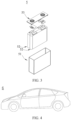
- FIG. 2 is a secondary battery 5 having a square structure as one example.
- the outer package may include a housing 51 and a cover plate 53.
- the housing 51 may include a bottom plate and a side plate connected to the bottom plate, and the bottom plate and the side plate are enclosed to form a receiving cavity.
- the housing 51 has an opening communicating with the receiving cavity.
- the cover plate 53 may be covered on the opening to enclose the receiving cavity.
- the positive electrode sheet, the negative electrode sheet, and the separator may be formed the electrode assembly 52 by a winding process or a lamination process.
- An electrode assembly 52 is encapsulated within the receiving cavity.
- the electrolyte solution is infiltrated into the electrode assembly 52.
- the number of the electrode assemblies 52 contained in the secondary battery 5 may be one or more, and can be chose according to specific actual requirements for those skilled in the art.
- the secondary batteries may be assembled into a battery module.
- the number of secondary batteries contained in the battery module may be one or more. The specific number may be selected by those skilled in the art according to the application and capacity of the battery module.
- the battery module may further include a housing having an accommodating space in which the plurality of secondary batteries 5 are accommodated.
- the above-mentioned battery modules may also be assembled into a battery pack.
- the number of battery modules contained in the battery pack may be one or more. The specific number may be selected by those skilled in the art according to the application and capacity of the battery pack.
- the battery pack may include a battery box and a plurality of battery modules arranged in the battery box.
- the battery box includes an upper box body and a lower box body.
- the upper box body can cover the lower box body and forms an enclosed space for accommodating the battery module.
- the plurality of battery modules may be arranged in the battery box in an arbitrary manner.
- the electrical device the secondary battery, the battery module, or the battery pack can be selected according to its use requirements.
- FIG. 4 is an example of an electrical device.
- the electrical device may be a pure electric vehicle, a hybrid electric vehicle, or a plug-in hybrid electric vehicle, etc.
- the battery pack or the battery module can be used.
- the device as another example may be a cell phone, a tablet, a laptop, and the like.
- the device is typically required to be lightweight and thin, and may employ a secondary battery as a power source.
- Example 1 The steps of preparing Example 1 were repeated, with a difference that in step 2.2, the amount of sodium borohydride were changed, see Table 1.
- Example 1 Compared with Example 1, the difference was that the boron-containing compound and Prussian blue analog were different, see Table 1.
- Example 1 The steps of preparing Example 1 were repeated, with a difference that in step 2.2, sodium borohydride were added at -10°C, 10°C, and 30°C respectively.
- Example 1 The steps of preparing Example 1 were repeated, with a difference that in step 2.1, the volume ratio of water to ethanol were adjusted to 0.5:1, 2:1, and 3:1 respectively.
- Example 1 The steps of preparing Example 1 were repeated, with a difference that in step 2.2, the time of the stirring were 0.5 hours and 1.5 hours respectively.
- Sodium ferrocyanide Na 4 Fe(CN) 6 ⁇ 10H 2 O (an aqueous solution with a concentration of 0.4mol/L), a cyanide of transition metal M', was mixed with FeSO 4 , a compound containing transition metal M, according to a stoichiometric ratio of 1:1, then heated and stirred at 80°C for 5 hours to obtain a suspended aqueous solution of a Prussian blue analog; after lowered to room temperature, it was washed with deionized water for 3 times, and then filtered and dried to obtain a Prussian blue analog having a chemical formula of Na 2 FeFe(CN) 6 ⁇ 2H 2 O.
- Example 1 Main preparation conditions and product parameters of each Example and Comparative Example Groups Boron-contai ning compound Prussian blue analog Molar ratio (borohydride:Pr ussian blue analog) Mass percenta ge of B element Mass percenta ge of carbon element Molar ratio of B:M D v50 ( ⁇ m) Comparat ive Example 1 None Na 2 FeFe(CN) 6 ⁇ 2H 2 O / 0 23.03% / 2.3
- Example 3 NaBH 4 Na 2 FeFe(CN) 6 ⁇ 2H 2 O 0.5:1 10.50% 12.06% 0.5:1 2.7
- the positive electrode active material, the conductive carbon black SP, and the binder PVDF of preparation Example 1 were dispersed into the solvent N-methyl pyrrolidone (NMP) according to a weight ratio of 90:10:10 and mixed evenly to obtain the positive electrode slurry; the positive electrode slurry was coated evenly on the positive electrode current collector aluminum foil, and the positive electrode sheet was obtained after drying and cold pressing.
- the coating amount per unit area was 0.27 g/1540.25 mm 2 .
- the negative elctrode active material hard carbon, the conductive agent carbon black, the binder styrene butadiene rubber (SBR), and the thickener carboxymethylcellulose sodium (CMC) were dissolved in the solvent deionized water according to a weight ratio of 97.2:0.8:0.8: 1.2, and the negative electrode slurry was obtained under the action of the vacuum stirrer; the negative electrode slurry was coated evenly on the copper foil; dried the copper foil at room temperature and then transferred to an oven for drying at 120 °C for 1 hour. Then the negative electrode sheet was obtained after cool pressing and slitting, and a coating amount per unit area thereof was 0.17g/1540.25mm 2 .
- a thickness of 12 ⁇ m glass fiber separator with 50% porosity was selected.
- the organic solvent was a mixed solution containing ethylene carbonate (EC) and ethyl methyl carbonate (EMC), in which a volume ratio of EC/EMC was 3:7.
- EC ethylene carbonate
- EMC ethyl methyl carbonate
- a volume ratio of EC/EMC was 3:7.
- argon atmosphere glove box H 2 O ⁇ 0.1 ppm, O 2 ⁇ 0.1 ppm
- 12.5% of sufficiently dried NaPF 6 was dissolved in an organic solvent and mixed evenly to obtain an electrolyte solution.
- the concentration of lithium salt was 1 mol/L.
- the positive electrode sheet, the separator, and the negative electrode sheet was stacked in order, allowing the separator being between the positive electrode sheet and the negative electrode sheet to play a role of separating, it was rolled into a square bare electric core, and loaded into the aluminum-plastic film, baked at 80 °C to remove water, 10g of the corresponding non-aqueous electrolyte solution was injected, the aluminum-plastic film was sealed, and then after standing, hot and cold pressing, chemical formation, clamping, volume separation and other processes, a finished battery with a capacity of 4000mAh was obtained.
- the preparation method of the secondary battery was similar to that of the secondary battery of Example 1, but the positive electrode active materials of the corresponding preparation Examples were used.
- the battery corresponding to Example 1 was charged at a constant current of 1C to a voltage of 4.0V and then charged at a constant voltage of 4.0V to a current of 0.05C at 25°C, stood for 5 minutes and then discharged at 1C to a voltage of 1.5V The obtained capacity was recorded as an initial capacity C 0 .
- the above steps were repeated, and the discharge capacity Cn of the battery after the nth cycle was recorded at the same time.
- the capacity retention of the battery corresponding to Example 1 in Table 2 was the data measured after 400 cycles under the above test conditions, that is, the value of P400.
- the testing procedures of Comparative Example 1 and other Examples were the same as above.
- Example 2 The batteries of each Example and Comparative Example were prepared separately according to the above method, and the cycle performance parameters were measured. The results were shown in Table 2 below. Table 2 Cycle performance of batteries of each Example and Comparative Example Example number Cycle performance P400 Comparative Example 1 80.0% Example 1 93.5% Example 2 97.2% Example 3 99.6% Example 4 95.3% Example 5 84.5% Example 6 89.0% Example 7 98.2% Example 8 83% Example 9 93.6% Example 10 95.7% Example 11 99.1% Example 12 98.2% Example 13 97.9% Example 14 91.2% Example 15 98.9% Example 16 98.2%
- the positive electrode active material of the present disclosure is structurally stabilized by doping with boron when the content of boron reaches the range of the present disclosure, resulting in a high level of capacity retention of the corresponding batteries after cycling for 400 cycles, for example up to 99.6%.
Landscapes
- Chemical & Material Sciences (AREA)
- Organic Chemistry (AREA)
- Inorganic Chemistry (AREA)
- Toxicology (AREA)
- General Health & Medical Sciences (AREA)
- Health & Medical Sciences (AREA)
- General Chemical & Material Sciences (AREA)
- Electrochemistry (AREA)
- Chemical Kinetics & Catalysis (AREA)
- Engineering & Computer Science (AREA)
- Manufacturing & Machinery (AREA)
- Materials Engineering (AREA)
- Crystallography & Structural Chemistry (AREA)
- Battery Electrode And Active Subsutance (AREA)
- Secondary Cells (AREA)
Applications Claiming Priority (1)
| Application Number | Priority Date | Filing Date | Title |
|---|---|---|---|
| PCT/CN2022/134626 WO2024113080A1 (zh) | 2022-11-28 | 2022-11-28 | 一种正极活性材料、制法、二次电池和用电装置 |
Publications (2)
| Publication Number | Publication Date |
|---|---|
| EP4496033A1 true EP4496033A1 (de) | 2025-01-22 |
| EP4496033A4 EP4496033A4 (de) | 2025-09-24 |
Family
ID=91322640
Family Applications (1)
| Application Number | Title | Priority Date | Filing Date |
|---|---|---|---|
| EP22966685.4A Pending EP4496033A4 (de) | 2022-11-28 | 2022-11-28 | Positivelektrodenaktivmaterial, herstellungsverfahren, sekundärbatterie und elektrische vorrichtung |
Country Status (4)
| Country | Link |
|---|---|
| US (1) | US20250070165A1 (de) |
| EP (1) | EP4496033A4 (de) |
| CN (2) | CN121709603A (de) |
| WO (1) | WO2024113080A1 (de) |
Family Cites Families (3)
| Publication number | Priority date | Publication date | Assignee | Title |
|---|---|---|---|---|
| CN109841832B (zh) * | 2017-11-29 | 2021-05-04 | 宁德时代新能源科技股份有限公司 | 正极片及电化学电池 |
| CN112259730B (zh) * | 2020-12-08 | 2021-05-04 | 江苏时代新能源科技有限公司 | 普鲁士蓝类过渡金属氰化物及其制备方法与应用 |
| CN115377412B (zh) * | 2022-09-29 | 2025-08-26 | 广东邦普循环科技有限公司 | 高导电性普鲁士蓝类正极材料的制备方法及其应用 |
-
2022
- 2022-11-28 EP EP22966685.4A patent/EP4496033A4/de active Pending
- 2022-11-28 CN CN202511848286.3A patent/CN121709603A/zh active Pending
- 2022-11-28 WO PCT/CN2022/134626 patent/WO2024113080A1/zh not_active Ceased
- 2022-11-28 CN CN202280094453.8A patent/CN118974973B/zh active Active
-
2024
- 2024-11-08 US US18/942,135 patent/US20250070165A1/en active Pending
Also Published As
| Publication number | Publication date |
|---|---|
| CN118974973B (zh) | 2026-02-03 |
| US20250070165A1 (en) | 2025-02-27 |
| WO2024113080A1 (zh) | 2024-06-06 |
| CN118974973A (zh) | 2024-11-15 |
| CN121709603A (zh) | 2026-03-20 |
| EP4496033A4 (de) | 2025-09-24 |
Similar Documents
| Publication | Publication Date | Title |
|---|---|---|
| KR102502618B1 (ko) | 이차 전지, 이차 전지를 포함하는 전지 모듈, 전지 팩 및 장치 | |
| KR102938713B1 (ko) | 양극 활성재료 및 이의 제조방법, 이차 전지, 전지 모듈, 전지팩과 장치 | |
| US12288880B2 (en) | Positive active material, lithium ion secondary battery, battery module, battery pack and electric device | |
| EP3800707B1 (de) | Sekundärbatterie und entsprechendes batteriemodul, batteriepack und gerät | |
| EP3951943A1 (de) | Sekundärzelle und vorrichtung mit der sekundärzelle | |
| CN115133020B (zh) | 锰酸锂正极活性材料及包含其的正极极片、二次电池、电池模块、电池包和用电装置 | |
| KR102514891B1 (ko) | 이차 전지 및 이를 포함하는 장치 | |
| JP2023505133A (ja) | 二次電池及び当該二次電池を含む装置 | |
| JP2024504217A (ja) | 二次電池、電池モジュール、電池パック及び電力消費装置 | |
| CN119948644A (zh) | 正极活性材料及其制备方法、正极极片、电池和用电装置 | |
| CN117013047A (zh) | 锂离子电池、电池模块、电池包、及用电装置 | |
| EP4715937A1 (de) | Elektrolyt, batterie und elektrische vorrichtung | |
| EP4325616B1 (de) | Sekundärbatterie, batteriemodul, batteriepack und elektrische vorrichtung | |
| CN119895617A (zh) | 电解液、二次电池和用电装置 | |
| EP4276934A1 (de) | Positivelektrodenplatte und lithium-ionen-batterie mit der elektrodenplatte | |
| WO2025020497A1 (zh) | 二次电池及用电装置 | |
| KR102730621B1 (ko) | 캐소드 슬러리, 캐소드 극판, 리튬 이온 전지, 전지 모듈, 전지 팩 및 전기 장치 | |
| EP4496033A1 (de) | Positivelektrodenaktivmaterial, herstellungsverfahren, sekundärbatterie und elektrische vorrichtung | |
| EP4087004B1 (de) | Elektrolyt, sekundärbatterie, batteriemodul, batteriepack und vorrichtung | |
| KR20250135309A (ko) | 전해액, 배터리 및 전기기기 | |
| KR20230172520A (ko) | 전해액, 이차 전지, 전지 모듈, 전지 팩 및 전기 장치 | |
| CN119725418B (zh) | 正极浆料、正极极片及其制备方法、二次电池和用电装置 | |
| US12160003B2 (en) | Electrode assembly and secondary battery comprising the same, battery module, battery pack and electrical device | |
| CN119230711B (zh) | 阴极极片、电池和用电设备 | |
| EP4280302A1 (de) | Sekundärbatterie, herstellungsverfahren für zugehöriges positivelektrodenaktivmaterial, batteriemodul, batteriepack und elektrische vorrichtung |
Legal Events
| Date | Code | Title | Description |
|---|---|---|---|
| STAA | Information on the status of an ep patent application or granted ep patent |
Free format text: STATUS: THE INTERNATIONAL PUBLICATION HAS BEEN MADE |
|
| PUAI | Public reference made under article 153(3) epc to a published international application that has entered the european phase |
Free format text: ORIGINAL CODE: 0009012 |
|
| STAA | Information on the status of an ep patent application or granted ep patent |
Free format text: STATUS: REQUEST FOR EXAMINATION WAS MADE |
|
| 17P | Request for examination filed |
Effective date: 20241014 |
|
| AK | Designated contracting states |
Kind code of ref document: A1 Designated state(s): AL AT BE BG CH CY CZ DE DK EE ES FI FR GB GR HR HU IE IS IT LI LT LU LV MC ME MK MT NL NO PL PT RO RS SE SI SK SM TR |
|
| RAP1 | Party data changed (applicant data changed or rights of an application transferred) |
Owner name: CONTEMPORARY AMPEREX TECHNOLOGY(HONG KONG) LIMITED |
|
| A4 | Supplementary search report drawn up and despatched |
Effective date: 20250822 |
|
| RIC1 | Information provided on ipc code assigned before grant |
Ipc: H01M 4/58 20100101AFI20250818BHEP Ipc: C01C 3/12 20060101ALI20250818BHEP |
|
| DAV | Request for validation of the european patent (deleted) | ||
| DAX | Request for extension of the european patent (deleted) |