EP4489402A2 - Parameterableitung für intraprädiktion - Google Patents
Parameterableitung für intraprädiktion Download PDFInfo
- Publication number
- EP4489402A2 EP4489402A2 EP24214296.6A EP24214296A EP4489402A2 EP 4489402 A2 EP4489402 A2 EP 4489402A2 EP 24214296 A EP24214296 A EP 24214296A EP 4489402 A2 EP4489402 A2 EP 4489402A2
- Authority
- EP
- European Patent Office
- Prior art keywords
- samples
- chroma
- luma
- sample
- neighbouring
- Prior art date
- Legal status (The legal status is an assumption and is not a legal conclusion. Google has not performed a legal analysis and makes no representation as to the accuracy of the status listed.)
- Pending
Links
Images






Classifications
-
- H—ELECTRICITY
- H04—ELECTRIC COMMUNICATION TECHNIQUE
- H04N—PICTORIAL COMMUNICATION, e.g. TELEVISION
- H04N19/00—Methods or arrangements for coding, decoding, compressing or decompressing digital video signals
- H04N19/50—Methods or arrangements for coding, decoding, compressing or decompressing digital video signals using predictive coding
- H04N19/593—Methods or arrangements for coding, decoding, compressing or decompressing digital video signals using predictive coding involving spatial prediction techniques
-
- H—ELECTRICITY
- H04—ELECTRIC COMMUNICATION TECHNIQUE
- H04N—PICTORIAL COMMUNICATION, e.g. TELEVISION
- H04N19/00—Methods or arrangements for coding, decoding, compressing or decompressing digital video signals
- H04N19/10—Methods or arrangements for coding, decoding, compressing or decompressing digital video signals using adaptive coding
- H04N19/102—Methods or arrangements for coding, decoding, compressing or decompressing digital video signals using adaptive coding characterised by the element, parameter or selection affected or controlled by the adaptive coding
- H04N19/103—Selection of coding mode or of prediction mode
-
- H—ELECTRICITY
- H04—ELECTRIC COMMUNICATION TECHNIQUE
- H04N—PICTORIAL COMMUNICATION, e.g. TELEVISION
- H04N19/00—Methods or arrangements for coding, decoding, compressing or decompressing digital video signals
- H04N19/10—Methods or arrangements for coding, decoding, compressing or decompressing digital video signals using adaptive coding
- H04N19/102—Methods or arrangements for coding, decoding, compressing or decompressing digital video signals using adaptive coding characterised by the element, parameter or selection affected or controlled by the adaptive coding
- H04N19/103—Selection of coding mode or of prediction mode
- H04N19/105—Selection of the reference unit for prediction within a chosen coding or prediction mode, e.g. adaptive choice of position and number of pixels used for prediction
-
- H—ELECTRICITY
- H04—ELECTRIC COMMUNICATION TECHNIQUE
- H04N—PICTORIAL COMMUNICATION, e.g. TELEVISION
- H04N19/00—Methods or arrangements for coding, decoding, compressing or decompressing digital video signals
- H04N19/10—Methods or arrangements for coding, decoding, compressing or decompressing digital video signals using adaptive coding
- H04N19/102—Methods or arrangements for coding, decoding, compressing or decompressing digital video signals using adaptive coding characterised by the element, parameter or selection affected or controlled by the adaptive coding
- H04N19/132—Sampling, masking or truncation of coding units, e.g. adaptive resampling, frame skipping, frame interpolation or high-frequency transform coefficient masking
-
- H—ELECTRICITY
- H04—ELECTRIC COMMUNICATION TECHNIQUE
- H04N—PICTORIAL COMMUNICATION, e.g. TELEVISION
- H04N19/00—Methods or arrangements for coding, decoding, compressing or decompressing digital video signals
- H04N19/10—Methods or arrangements for coding, decoding, compressing or decompressing digital video signals using adaptive coding
- H04N19/169—Methods or arrangements for coding, decoding, compressing or decompressing digital video signals using adaptive coding characterised by the coding unit, i.e. the structural portion or semantic portion of the video signal being the object or the subject of the adaptive coding
- H04N19/17—Methods or arrangements for coding, decoding, compressing or decompressing digital video signals using adaptive coding characterised by the coding unit, i.e. the structural portion or semantic portion of the video signal being the object or the subject of the adaptive coding the unit being an image region, e.g. an object
- H04N19/176—Methods or arrangements for coding, decoding, compressing or decompressing digital video signals using adaptive coding characterised by the coding unit, i.e. the structural portion or semantic portion of the video signal being the object or the subject of the adaptive coding the unit being an image region, e.g. an object the region being a block, e.g. a macroblock
-
- H—ELECTRICITY
- H04—ELECTRIC COMMUNICATION TECHNIQUE
- H04N—PICTORIAL COMMUNICATION, e.g. TELEVISION
- H04N19/00—Methods or arrangements for coding, decoding, compressing or decompressing digital video signals
- H04N19/10—Methods or arrangements for coding, decoding, compressing or decompressing digital video signals using adaptive coding
- H04N19/169—Methods or arrangements for coding, decoding, compressing or decompressing digital video signals using adaptive coding characterised by the coding unit, i.e. the structural portion or semantic portion of the video signal being the object or the subject of the adaptive coding
- H04N19/186—Methods or arrangements for coding, decoding, compressing or decompressing digital video signals using adaptive coding characterised by the coding unit, i.e. the structural portion or semantic portion of the video signal being the object or the subject of the adaptive coding the unit being a colour or a chrominance component
-
- H—ELECTRICITY
- H04—ELECTRIC COMMUNICATION TECHNIQUE
- H04N—PICTORIAL COMMUNICATION, e.g. TELEVISION
- H04N19/00—Methods or arrangements for coding, decoding, compressing or decompressing digital video signals
- H04N19/10—Methods or arrangements for coding, decoding, compressing or decompressing digital video signals using adaptive coding
- H04N19/189—Methods or arrangements for coding, decoding, compressing or decompressing digital video signals using adaptive coding characterised by the adaptation method, adaptation tool or adaptation type used for the adaptive coding
-
- H—ELECTRICITY
- H04—ELECTRIC COMMUNICATION TECHNIQUE
- H04N—PICTORIAL COMMUNICATION, e.g. TELEVISION
- H04N19/00—Methods or arrangements for coding, decoding, compressing or decompressing digital video signals
- H04N19/60—Methods or arrangements for coding, decoding, compressing or decompressing digital video signals using transform coding
- H04N19/61—Methods or arrangements for coding, decoding, compressing or decompressing digital video signals using transform coding in combination with predictive coding
Definitions
- This patent document relates to video processing techniques, devices and systems.
- CCLM cross-component linear model
- the described methods may be applied to both the existing video coding standards (e.g., High Efficiency Video Coding (HEVC)) and future video coding standards (e.g., Versatile Video Coding (WC)) or codecs.
- HEVC High Efficiency Video Coding
- WC Versatile Video Coding
- the disclosed technology may be used to provide a method for video processing.
- the method comprises: determining, for a conversion between a current video block of a video that is a chroma block and a coded representation of the video, parameters of cross-component linear model (CCLM) prediction mode based on chroma samples that are selected based on W available above-neighboring samples, W being an integer; and performing the conversion based on the determining.
- CCLM cross-component linear model
- the disclosed technology may be used to provide a method for video processing.
- the method comprises: determining, for a conversion between a current video block of a video that is a chroma block and a coded representation of the video, parameters of cross-component linear model (CCLM) prediction mode based on chroma samples that are selected based on H available left-neighboring samples of the current video block; and performing the conversion based on the determining.
- CCLM cross-component linear model
- the disclosed technology may be used to provide a method for video processing.
- the method comprises: determining, for a conversion between a current video block of a video that is a chroma block and a coded representation of the video, parameters of a cross-component linear model (CCLM) based on two or four chroma samples and/or corresponding luma samples; and performing the conversion based on the determining.
- CCLM cross-component linear model
- the disclosed technology may be used to provide a method for video processing.
- the method comprises: selecting, for a conversion between a current video block of a video that is a chroma block and a coded representation of the video, chroma samples based on a position rule, the chroma samples used to derive parameters of a cross-component linear model (CCLM); and performing the conversion based on the determining, wherein the position rule specifies to select the chroma samples that are located within an above row and/or a left column of the current video block.
- CCLM cross-component linear model
- the disclosed technology may be used to provide a method for video processing.
- the method comprises: determining, for a conversion between a current video block of a video that is a chroma block and a coded representation of the video, positions at which luma samples are downsampled, wherein the downsampled luma samples are used to determine parameters of a cross-component linear model (CCLM) based on chroma samples and downsampled luma samples, wherein the downsampled luma samples are at positions corresponding to positions of the chroma samples that are used to derive the parameters of the CCLM; and performing the conversion based on the determining.
- CCLM cross-component linear model
- the disclosed technology may be used to provide a method for video processing.
- the method comprises: determining, for a conversion between a current video block of a video that is a chroma block and a coded representation of the video, a method to derive parameters of a cross-component linear model (CCLM) using chroma samples and luma samples based on a coding condition associated with the current video block; and performing the conversion based on the determining.
- CCLM cross-component linear model
- the disclosed technology may be used to provide a method for video processing.
- the method comprises: determining, for a conversion between a current video block of a video that is a chroma block and a coded representation of the video, whether to derive maximum values and/or minimum values of a luma component and a chroma component that are used to derive parameters of a cross-component linear model (CCLM) based on availability of a left-neighboring block and an above-neighboring block of the current video block; and performing the conversion based on the determining.
- CCLM cross-component linear model
- the above-described method is embodied in the form of processor-executable code and stored in a computer-readable program medium.
- a device that is configured or operable to perform the above-described method.
- the device may include a processor that is programmed to implement this method.
- a video decoder apparatus may implement a method as described herein.
- Video codecs typically include an electronic circuit or software that compresses or decompresses digital video, and are continually being improved to provide higher coding efficiency.
- a video codec converts uncompressed video to a compressed format or vice versa.
- the compressed format usually conforms to a standard video compression specification, e.g., the High Efficiency Video Coding (HEVC) standard (also known as H.265 or MPEG-H Part 2), the Versatile Video Coding (VVC) standard to be finalized, or other current and/or future video coding standards.
- HEVC High Efficiency Video Coding
- VVC Versatile Video Coding
- Embodiments of the disclosed technology may be applied to existing video coding standards (e.g., HEVC, H.265) and future standards to improve runtime performance.
- Section headings are used in the present document to improve readability of the description and do not in any way limit the discussion or the embodiments (and/or implementations) to the respective sections only.
- Cross-component prediction is a form of the chroma-to-luma prediction approach that has a well-balanced trade-off between complexity and compression efficiency improvement.
- pred C ( i, j ) represents the predicted chroma samples in a CU and rec L ' ( i, j ) represents the downsampled reconstructed luma samples of the same CU for color formats 4:2:0 or 4:2:2 while rec L ' ( i, j ) represents the reconstructed luma samples of the same CU for color format 4:4:4.
- L(n) represents the down-sampled (for color formats 4:2:0 or 4:2:2) or original (for color format 4:4:4) top and left neighboring reconstructed luma samples
- C ( n ) represents the top and left neighboring reconstructed chroma samples
- value of N is equal to twice of the minimum of width and height of the current chroma coding block.
- FIG. 1 shows the location of the left and above reconstructed samples and the sample of the current block involved in the CCLM mode.
- this regression error minimization computation is performed as part of the decoding process, not just as an encoder search operation, so no syntax is used to convey the ⁇ and ⁇ values.
- the CCLM prediction mode also includes prediction between the two chroma components, e.g., the Cr (red-difference) component is predicted from the Cb (blue-difference) component.
- resi Cb ' ( i, j ) presents the reconstructed Cb residue sample at position (i,j).
- Cb ( n ) represents the neighboring reconstructed Cb samples
- Cr ( n ) represents the neighboring reconstructed Cr samples
- ⁇ is equal to ⁇ (Cb( n ) ⁇ Cb ( n )) » 9.
- the CCLM luma-to-chroma prediction mode is added as one additional chroma intra prediction mode.
- one more RD cost check for the chroma components is added for selecting the chroma intra prediction mode.
- intra prediction modes other than the CCLM luma-to-chroma prediction mode is used for the chroma components of a CU
- CCLM Cb-to-Cr prediction is used for Cr component prediction.
- the single model CCLM mode employs one linear model for predicting the chroma samples from the luma samples for the whole CU, while in MMLM, there can be two models.
- neighboring luma samples and neighboring chroma samples of the current block are classified into two groups, each group is used as a training set to derive a linear model (i.e., a particular ⁇ and ⁇ are derived for a particular group). Furthermore, the samples of the current luma block are also classified based on the same rule for the classification of neighboring luma samples.
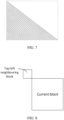
- FIG. 2 shows an example of classifying the neighboring samples into two groups.
- Threshold is calculated as the average value of the neighboring reconstructed luma samples.
- Pred c x y ⁇ 1 ⁇ Rec L ′ x y + ⁇ 1 if Rec L ′ x y ⁇ Threshold
- Pred c x y ⁇ 2 ⁇ Rec L ′ x y + ⁇ 2 if Rec L ′ x y > Threshold
- the reconstructed luma block needs to be downsampled to match the size of the chroma signal.
- the downsampling assumes the "type 0" phase relationship as shown in FIG. 3A for the positions of the chroma samples relative to the positions of the luma samples, e.g., collocated sampling horizontally and interstitial sampling vertically.
- the exemplary 6-tap downsampling filter defined in (6) is used as the default filter for both the single model CCLM mode and the multiple model CCLM mode.
- the encoder can alternatively select one of four additional luma downsampling filters to be applied for prediction in a CU, and send a filter index to indicate which of these is used.
- the four selectable luma downsampling filters for the MMLM mode as shown in FIG.
- MDLM Multi-directional LM
- MDLM multi-directional LM
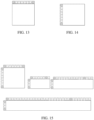
- two additional CCLM modes are proposed: LM-A, where the linear model parameters are derived only based on the top-neighboring (or above-neighboring) samples as shown in FIG. 4A
- LM-L where the linear model parameters are derived only based on the left-neighboring samples as shown in FIG. 4B .
- This existing implementation proposes to replace the LMS algorithm of the linear model parameters ⁇ and ⁇ by a straight line equation, so called two-point method.
- the 2 points (couple of Luma and Chroma) (A, B) are the minimum and maximum values inside the set of neighboring Luma samples as depicted in FIG. 5 .
- the division operation needed in the derivation of ⁇ is avoided and replaced by multiplications and shifts as below:
- S is set equal to iShift
- ⁇ is set equal to a
- ⁇ is set equal to b.
- g_aiLMDivTableLow and g_aiLMDivTableHigh are two tables each with 512 entries, wherein each entry stores a 16-bit integer.
- This implementation is also simpler than the current VTM implementation because shift S always has the same value.
- CCLM as in JEM is adopted in VTM-2.0, but MM-CCLM in JEM is not adopted in VTM-2.0. MDLM and simplified CCLM have been adopted into VTM-3.0.
- LIC Local Illumination Compensation
- CU inter-mode coded coding unit
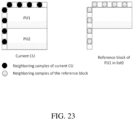
- a least square error method is employed to derive the parameters a and b by using the neighbouring samples of the current CU and their corresponding reference samples. More specifically, as illustrated in FIG. 23 , the subsampled (2:1 subsampling) neighbouring samples of the CU and the corresponding pixels (identified by motion information of the current CU or sub-CU) in the reference picture are used. The IC parameters are derived and applied for each prediction direction separately.
- the LIC flag is copied from neighbouring blocks, in a way similar to motion information copy in merge mode; otherwise, an LIC flag is signalled for the CU to indicate whether LIC applies or not.
- LIC When LIC is enabled for a pciture, addtional CU level RD check is needed to determine whether LIC is applied or not for a CU.
- MR-SAD mean-removed sum of absolute diffefference
- MR-SATD mean-removed sum of absolute Hadamard-transformed difference
- LIC is disabled for the entire picture when there is no obvious illumination change between a current picture and its reference pictures.
- histograms of a current picture and every reference picture of the current picture are calculated at the encoder. If the histogram difference between the current picture and every reference picture of the current picture is smaller than a given threshold, LIC is disabled for the current picture; otherwise, LIC is enabled for the current picture.
- Embodiments of the presently disclosed technology overcome drawbacks of existing implementations, thereby providing video coding with higher coding efficiencies and lower computational complexity.
- Simplified linear model derivations for cross-component prediction may enhance both existing and future video coding standards, is elucidated in the following examples described for various implementations.
- the examples of the disclosed technology provided below explain general concepts, and are not meant to be interpreted as limiting. In an example, unless explicitly indicated to the contrary, the various features described in these examples may be combined.
- LM method includes, but is not limited to, the LM mode in JEM or VTM, and MMLM mode in JEM, left-LM mode which only uses left neighboring samples to derive the linear model, the above-LM mode which only uses above neighboring samples to derive the linear model or other kinds of methods which utilize luma reconstruction samples to derive chroma prediction blocks. All LM modes which are not the LM-L nor the LM-A are called normal LM modes.
- Shift(x, s) ( x + off ) » s
- off is an integer such as 0 or 2 s-1 .
- the height and width of a current chroma block are denoted H and W, respectively.
- FIG. 6 shows an example of neighboring samples of the current chroma block. Let the coordinate of the top-left sample of the current chroma block be denoted as (x, y). Then, the neighboring chroma samples (as shown in FIG. 6 ) are denoted as:
- Example 1 The parameters ⁇ and ⁇ in LM methods are derived from chroma samples at two or more specific positions.
- Example 2 Sets of parameters in CCLM mode can be firstly derived and then combined to form the final linear model parameter used for coding one block.
- ⁇ 1 and ⁇ 1 are derived from a group of chroma samples at specific positions denoted as Group 1
- ⁇ 2 and ⁇ 2 are derived from a group of chroma samples at specific positions denoted as Group 2
- ... , ⁇ N and ⁇ N are derived from a group of chroma samples at specific positions denoted as Group N
- the final ⁇ and ⁇ can be derived from ( ⁇ 1 , ⁇ 1 ), ... ( ⁇ N , ⁇ N ).
- Example 3 Suppose two chroma sample values denoted as C0 and C1, and their corresponding luma sample values denoted as L0 and L1 ( L0 ⁇ L1) are inputs.
- bit depths of luma samples and chroma samples are denoted BL and BC.
- One or more simplifications for this implementation include:
- One single chroma block may use multiple linear models and the selection of multiple linear model is dependent on the position of chroma samples within the chroma block.
- Example 5 It is proposed that the neighboring samples (including chroma samples and their corresponding luma samples, which may be down-sampled) are divided into N groups.
- their corresponding chroma values are denoted as MaxC k and MinC k , respectively.
- Example 6 It is proposed that whether and how to apply LM-L and LM-A mode may depend on the width (W) and height (H) of the current block.
- Example 7 A flag is signaled to indicate whether CCLM mode is applied.
- the context used in arithmetic coding to code the flag may depend on whether the top-left neighboring block as shown in FIG. 8 applies CCLM mode or not.
- Example 8 Indications or codewords of DM and LM modes may be coded in different orders from sequence to sequence/picture to picture/tile to tile/block to block.
- samples may be located beyond the range of 2 ⁇ W above neighboring samples or 2 ⁇ H left neighboring samples as shown in FIG. 6 .
- Example 10 the chroma neighboring samples and their corresponding luma samples (may be down-sampled) are down-sampled before deriving the linear model parameters ⁇ and ⁇ as disclosed in Examples 1-7.
- the width and height of the current chroma block is W and H.
- Example 11 Neighboring downsampled/originally reconstructed samples and/or downsampled/originally reconstructed samples may be further refined before being used in the linear model prediction process or cross-color component prediction process.
- Example 12 It is proposed to select other neighboring or downsampled neighboring samples based on the largest neighboring or downsampled neighboring sample in a given set of neighboring or downsampled neighboring samples.
- Example 13 In above examples, luma and chroma may be switched. Alternatively, luma color component may be replaced by the main color component (e.g., G), and chroma color component may be replaced by dependent color component (e.g., B or R).
- main color component e.g., G
- chroma color component may be replaced by dependent color component (e.g., B or R).
- Example 14 Selection of locations of chroma samples (and/or corresponding luma samples) may depend on the coded mode information.
- top-right row is available, or when 1st top-right sample is available.
- Example 15 In above examples, luma and chroma may be switched. Alternatively, luma color component may be replaced by the main color component (e.g., G), and chroma color component may be replaced by dependent color component (e.g., B or R).
- main color component e.g., G
- chroma color component may be replaced by dependent color component (e.g., B or R).
- Example 16 It is proposed to select the above neighbouring chroma samples (and/or their corresponding luma samples which may be down-sampled) based on a first position offset value (denoted as F) and a step value (denoted as S). Suppose the width of available above neighbouring samples to be used is W.
- Example 17 It is proposed to select the left neighbouring chroma samples (and/or their corresponding luma samples which may be down-sampled) based on a first position offset value (denoted as F) and a step value (denoted as S). Suppose the height of available left neighbouring samples to be used is H.
- Example 18 It is proposed two or four neighbouring chroma samples (and/or their corresponding luma samples which may be down-sampled) are selected to derive the linear model parameters.
- Example 19 In all above examples, the selected chroma samples shall be located within the above row (i.e., with W samples) as depicted in FIG. 10 , and/or the left column (i.e., with H samples) wherein W and H are the width and height of the current block.
- Whether to derive the maximum/minimum values of luma and chroma components used to derive CCLM parameters may depend on the availability of left and above neighbours. For example, the maximum/minimum values for luma and chroma components used to derive CCLM parameters may not be derived if both the left and above neighbouring blocks are unavailable.
- the proposed method to derive the parameters used in CCLM may be used to derive the parameters used in LIC or other coding tools that relies on linear model.
- cross-component prediction mode is proposed wherein the chroma samples are predicted with corresponding reconstructed luma samples according to the prediction model, as shown in Eq. 12.
- Pred C ( x, y ) denotes a prediction sample of chroma.
- ⁇ and ⁇ are two model parameters.
- Rec'L ( x, y ) is a down-sampled luma sample.
- Pred C x y ⁇ ⁇ Rec L ′ x y + ⁇ ,
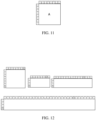
- a six-tap filter is introduced for the luma down-sampled process for block A in FIG. 11 , as shown in Eq. 13.
- Rec L ′ x y 2 ⁇ Rec L 2 x , 2 y + 2 ⁇ Rec L 2 x , 2 y + 1 + Rec L 2 x ⁇ 1,2 y + Rec L 2 x + 1,2 y + Rec L 2 x ⁇ 1,2 y + 1 + Rec L 2 x + 1,2 y + 1 + Rec L 2 x + 1,2 y + 1 + 4 ⁇ 3 .
- the above surrounding luma reference samples shaded in FIG. 11 are down-sampled with a 3-tap filter, as shown in Eq. 14.
- the left surrounding luma reference samples are down-sampled according to Eq. 15. If the left or above samples are not available, a 2-tap filter defined in Eq. 16 and Eq. 17 will be used.
- the surrounding luma reference samples are down sampled to the equal size to the chroma reference samples.
- the size is denoted as width and height.
- To derive ⁇ and ⁇ only two or four neighboring samples are involved.
- a look-up table is applied to avoid the division operation when deriving ⁇ and ⁇ . The derivation methods is illustrated below.
- FIG. 16 shows an example of lookup tables with 128, 64 and 32 entries and each entry is represented by 16 bits.
- the 2-point LM derivation process is simplified as shown in Table 1 and FIG. 17 with 64 entries. It should be noted that the first entry may not be stored into the table.
- each entry in the exemplary tables are designed to be with 16 bits, it can be easily transformed to a number with less bits (such as 8 bits or 12 bits).
- maxLuma and minLuma may indicate the maximum and minimum luma samples values of selected positions. Alternatively, they may indicate a function of maximum and minimum luma samples values of selected positions, such as averaging. When there are only 4 positions selected, they may also indicate the average of two larger luma values and average of two smaller luma values. Further note that in FIG. 17 , maxChroma and minChroma represents the chroma values corresponding to maxLuma and minLuma.
- the block width and height of current chroma block is W and H, respectively.
- the top-left coordinate of current chroma block is [0, 0].
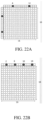
- the two left samples' coordinates are [-1, floor(H/4)] and [-1, floor (3*H/4)].
- the selected samples are painted in red as depicted in FIG. 22A .
- the 4 samples are sorted according to luma sample intensity and classified into 2 group.
- the two larger samples and two smaller samples are respectively averaged.
- Cross component prediction model is derived with the 2 averaged points.
- the maximum and minimum value of the four samples are used to derive the LM parameters.
- the four selected above samples' coordinates are [W/8, -1], [W/8 + W/4, -1], [W/8 + 2*W/4, -1], and [W/8 + 3*W/4 , -1].
- the selected samples are painted in red as depicted in FIG. 22B
- the four selected left samples' coordinates are [-1, H/8], [-1, H/8 + H/4], [-1, H/8 + 2*H/4, -1], and [-1, H/8 + 3*H/4].
- W' is the available number of above neighbouring samples, which can be 2*W.
- H' is the available number of left neighbouring samples, which can be 2*H.
- the four selected left samples' coordinates are [-1, H'/8], [-1, H'/8 + H'/4], [-1, H'/8 + 2*H'/4, -1], and [-1, H'/8 + 3*H'/4 ].
- the number of available neighbouring chroma samples on the top and top-right numTopSamp and the number of available neighbouring chroma samples on the left and left-below nLeftSamp are derived as follows:
- variable cntN and array pickPosN[] with N being replaced by L and T are derived as follows:
- variable cntN and array pickPosN[] with N being replaced by L and T are derived as follows:
- the number of available neighbouring chroma samples on the top and top-right numTopSamp and the number of available neighbouring chroma samples on the left and left-below nLeftSamp are derived as follows:
- variable cntN and array pickPosN[] with N being replaced by L and T are derived as follows:
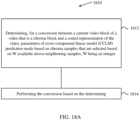
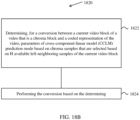
- FIG. 18A shows a flowchart of an exemplary method for video processing.
- the method 1810 includes, at step 1812, determining, for a conversion between a current video block of a video that is a chroma block and a coded representation of the video, parameters of cross-component linear model (CCLM) based on chroma samples that are selected based on W available above-neighboring samples, W being an integer.
- the method 1810 further includes, at step 1814, performing the conversion based on the determining.
- CCLM cross-component linear model
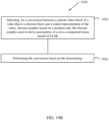
- FIG. 18B shows a flowchart of an exemplary method for video processing.
- the method 1820 includes, at step 1822, determining, for a conversion between a current video block of a video that is a chroma block and a coded representation of the video, parameters of cross-component linear model (CCLM) prediction mode based on chroma samples that are selected based on H available left-neighboring samples of the current video block.
- the method 1820 further includes, at step 1824, performing the conversion based on the determining.
- CCLM cross-component linear model
- FIG. 19A shows a flowchart of an exemplary method for video processing.
- the method 1910 includes, at step 1912, determining, for a conversion between a current video block of a video that is a chroma block and a coded representation of the video, parameters of a cross-component linear model (CCLM) based on two or four chroma samples and/or corresponding luma samples.
- the method 1910 further includes, at step 1914, performing the conversion based on the determining.
- CCLM cross-component linear model
- FIG. 19B shows a flowchart of an exemplary method for video processing.
- the method 1920 includes, at step 1922, selecting, for a conversion between a current video block of a video that is a chroma block and a coded representation of the video, chroma samples based on a position rule, the chroma samples used to derive parameters of a cross-component linear model (CCLM).
- the method 1920 further includes, at step 1924, performing the conversion based on the determining.
- the position rule specifies to select the chroma samples that are located within an above row and/or a left column of the current video block.
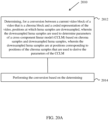
- FIG. 20A shows a flowchart of an exemplary method for video processing.
- the method 2010 includes, at step 2012, determining, for a conversion between a current video block of a video that is a chroma block and a coded representation of the video, positions at which luma samples are downsampled, wherein the downsampled luma samples are used to determine parameters of a cross-component linear model (CCLM) based on chroma samples and downsampled luma samples, wherein the downsampled luma samples are at positions corresponding to positions of the chroma samples that are used to derive the parameters of the CCLM.
- the method 2010 further includes, at step 2014, performing the conversion based on the determining.
- CCLM cross-component linear model
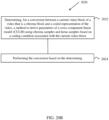
- FIG. 20B shows a flowchart of an exemplary method for video processing.
- the method 2020 includes, at step 2022, determining, for a conversion between a current video block of a video that is a chroma block and a coded representation of the video, a method to derive parameters of a cross-component linear model (CCLM) using chroma samples and luma samples based on a coding condition associated with the current video block.
- the method 2020 further includes, at step 2024, performing the conversion based on the determining.
- CCLM cross-component linear model
- FIG. 20C shows a flowchart of an exemplary method for video processing.
- the method 2030 includes, at step 2032, determining, for a conversion between a current video block of a video that is a chroma block and a coded representation of the video, whether to derive maximum values and/or minimum values of a luma component and a chroma component that are used to derive parameters of a cross-component linear model (CCLM) based on availability of a left-neighboring block and an above-neighboring block of the current video block.
- the method 2030 further includes, at step 2034, performing the conversion based on the determining.
- CCLM cross-component linear model
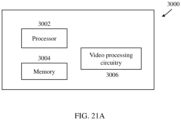
- FIG. 21A is a block diagram of a video processing apparatus 3000.
- the apparatus 3000 may be used to implement one or more of the methods described herein.
- the apparatus 3000 may be embodied in a smartphone, tablet, computer, Internet of Things (IoT) receiver, and so on.
- the apparatus 3000 may include one or more processors 3002, one or more memories 3004 and video processing hardware 3006.
- the processor(s) 3002 may be configured to implement one or more methods (including, but not limited to, methods as shown FIGS. 18 to 29C) described in the present document.
- the memory (memories) 3004 may be used for storing data and code used for implementing the methods and techniques described herein.
- the video processing hardware 3006 may be used to implement, in hardware circuitry, some techniques described in the present document.
- FIG. 21B is another example of a block diagram of a video processing system in which disclosed techniques may be implemented.
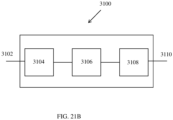
- FIG. 21B is a block diagram showing an example video processing system 3100 in which various techniques disclosed herein may be implemented.
- the system 3100 may include input 3102 for receiving video content.
- the video content may be received in a raw or uncompressed format, e.g., 8 or 10 bit multi-component pixel values, or may be in a compressed or encoded format.
- the input 3102 may represent a network interface, a peripheral bus interface, or a storage interface. Examples of network interface include wired interfaces such as Ethernet, passive optical network (PON), etc. and wireless interfaces such as Wi-Fi or cellular interfaces.
- the system 3100 may include a coding component 3104 that may implement the various coding or encoding methods described in the present document.
- the coding component 3104 may reduce the average bitrate of video from the input 3102 to the output of the coding component 3104 to produce a coded representation of the video.
- the coding techniques are therefore sometimes called video compression or video transcoding techniques.
- the output of the coding component 3104 may be either stored, or transmitted via a communication connected, as represented by the component 3106.
- the stored or communicated bitstream (or coded) representation of the video received at the input 3102 may be used by the component 3108 for generating pixel values or displayable video that is sent to a display interface 3110.
- the process of generating user-viewable video from the bitstream representation is sometimes called video decompression.
- certain video processing operations are referred to as "coding" operations or tools, it will be appreciated that the coding tools or operations are used at an encoder and corresponding decoding tools or operations that reverse the results of the coding will be performed by
- peripheral bus interface or a display interface may include universal serial bus (USB) or high definition multimedia interface (HDMI) or Displayport, and so on.
- storage interfaces include SATA (serial advanced technology attachment), PCI, IDE interface, and the like.
- the video coding methods may be implemented using an apparatus that is implemented on a hardware platform as described with respect to FIG. 21A or 21B .
- Implementations of the subject matter and the functional operations described in this patent document can be implemented in various systems, digital electronic circuitry, or in computer software, firmware, or hardware, including the structures disclosed in this specification and their structural equivalents, or in combinations of one or more of them. Implementations of the subject matter described in this specification can be implemented as one or more computer program products, i.e., one or more modules of computer program instructions encoded on a tangible and non-transitory computer readable medium for execution by, or to control the operation of, data processing apparatus.
- the computer readable medium can be a machine-readable storage device, a machine-readable storage substrate, a memory device, a composition of matter effecting a machine-readable propagated signal, or a combination of one or more of them.
- data processing unit or “data processing apparatus” encompasses all apparatus, devices, and machines for processing data, including by way of example a programmable processor, a computer, or multiple processors or computers.
- the apparatus can include, in addition to hardware, code that creates an execution environment for the computer program in question, e.g., code that constitutes processor firmware, a protocol stack, a database management system, an operating system, or a combination of one or more of them.
- a computer program (also known as a program, software, software application, script, or code) can be written in any form of programming language, including compiled or interpreted languages, and it can be deployed in any form, including as a stand-alone program or as a module, component, subroutine, or other unit suitable for use in a computing environment.
- a computer program does not necessarily correspond to a file in a file system.
- a program can be stored in a portion of a file that holds other programs or data (e.g., one or more scripts stored in a markup language document), in a single file dedicated to the program in question, or in multiple coordinated files (e.g., files that store one or more modules, sub programs, or portions of code).
- a computer program can be deployed to be executed on one computer or on multiple computers that are located at one site or distributed across multiple sites and interconnected by a communication network.
- the processes and logic flows described in this specification can be performed by one or more programmable processors executing one or more computer programs to perform functions by operating on input data and generating output.
- the processes and logic flows can also be performed by, and apparatus can also be implemented as, special purpose logic circuitry, e.g., an FPGA (field programmable gate array) or an ASIC (application specific integrated circuit).
- processors suitable for the execution of a computer program include, by way of example, both general and special purpose microprocessors, and any one or more processors of any kind of digital computer.
- a processor will receive instructions and data from a read only memory or a random access memory or both.
- the essential elements of a computer are a processor for performing instructions and one or more memory devices for storing instructions and data.
- a computer will also include, or be operatively coupled to receive data from or transfer data to, or both, one or more mass storage devices for storing data, e.g., magnetic, magneto optical disks, or optical disks.
- mass storage devices for storing data, e.g., magnetic, magneto optical disks, or optical disks.
- a computer need not have such devices.
- Computer readable media suitable for storing computer program instructions and data include all forms of nonvolatile memory, media and memory devices, including by way of example semiconductor memory devices, e.g., EPROM, EEPROM, and flash memory devices.
- semiconductor memory devices e.g., EPROM, EEPROM, and flash memory devices.
- the processor and the memory can be supplemented by, or incorporated in, special purpose logic circuitry.
- Embodiment 1 A method for video processing, comprising:
- Embodiment 2 The method of embodiment 1, wherein the corresponding luma samples are obtained by down-sampling.
- Embodiment 3 The method of embodiment 1, wherein a maxY, a maxC, a minY, and a minC are derived firstly and are used to derive the parameters.
- Embodiment 4 The method of embodiment 3, wherein the parameters are derived based on 2-point approach.
- Embodiment 5 The method of embodiment 3, wherein the two chroma samples are selected to derive the maxY, the maxC, the minY and the minC, and wherein the minY is set to be the smaller luma sample value, the minC is its corresponding chroma sample value, the maxY is set to be the larger luma sample value, and the maxC is its corresponding chroma sample value.
- Embodiment 6 The method of embodiment 3, wherein the four chroma samples are selected to derive the maxY, the maxC, the minY and the minC, and wherein the four chroma samples and the corresponding luma samples are divided into two arrays G0 and G1, each array including two chroma samples and their corresponding luma samples.
- Embodiment 7 The method of embodiment 6, wherein the two arrays G0 and G1 include one of following sets:
- Embodiment 8 The method of embodiment 7, wherein upon a comparison of two luma sample values of G0[0] and GO[1], a chroma sample and its corresponding luma sample of G0[0] are swamped with those of GO[1].
- Embodiment 9 The method of embodiment 8, wherein the chroma sample and its corresponding luma sample of G0[0] are swamped with those of GO[1] in a case that a luma sample value of G0[0] is greater than a luma sample value of G0[1].
- Embodiment 10 The method of embodiment 7, wherein upon a comparison of two luma sample values of G1 [0] and G1 [1], a chroma sample and its corresponding luma sample of G1[0] are swamped with those of G1[1].
- Embodiment 11 The method of embodiment 10, wherein the chroma sample and its corresponding luma sample of G1[0] are swamped with those of G1[1] in a case that a luma sample value of G1[0] is greater than a luma sample value of G1[1].
- Embodiment 12 The method of embodiment 6, wherein upon a comparison of two luma sample values of G0[0] and G1[1], chroma samples and its corresponding luma samples of G0 are swamped with those of G1.
- Embodiment 13 The method of embodiment 12, wherein the chroma samples and its corresponding luma samples of G0 are swamped with those of G1 in a case that a luma sample value of G0[0] is greater than a luma sample value of G1[1].
- Embodiment 14 The method of embodiment 7, wherein upon a comparison of two luma sample values of G0[1] and G1[0], a chroma sample and its corresponding luma sample of GO[1] are swamped with those of G1[0].
- Embodiment 15 The method of embodiment 14, wherein the chroma sample and its corresponding luma sample of GO[1] are swamped with those of G1[0] in a case that a luma sample value of G0[1] is greater than a luma sample value of G1[0].
- Embodiment 16 The method of embodiment 7, wherein upon a comparison of two luma sample values of G0[0], GO[1], G1[0], and G1[1], following swamping operations are selectively conducted in an order: i) a swamping operation of a chroma sample and its corresponding luma sample of G0[0] with those of GO[1], ii) a swamping operation of a chroma sample and its corresponding luma sample of G1 [0] with those of G1[1], iii) a swamping operation of chroma samples and its corresponding luma samples of G0 with those of G1, and iv) a swamping operation of a chroma sample and its corresponding luma sample of GO[1] with those of G1[0].
- Embodiment 17 The method of embodiment 7 or 16, wherein maxY is calculated based on a sum of luma sample values of G1[0] and G1[1], and maxC is calculated based on a sum of chroma sample values of G1[0] and G1[1].
- Embodiment 18 The method of embodiment 7 or 16, wherein maxY is calculated based on an average of luma sample values of G1[0] and G1[1], and maxC is calculated based on an average of chroma sample values of G1[0] and G1 [1].
- Embodiment 19 The method of embodiment 7 or 16, wherein minY is calculated based on a sum of luma sample values of G0[0] and GO[1], and minC is calculated based on a sum of chroma sample values of G0[0] and GO[1].
- Embodiment 20 The method of embodiment 7 or 16, wherein minY is calculated based on an average of luma sample values of G0[0] and GO[1], and minC is calculated based on an average of chroma sample values of G0[0] and GO[1].
- Embodiment 21 The method of any of embodiments 17 to 20, wherein the calculations of maxY and maxC or the calculations of minY and minC are conducted after any one of swamping operations that are performed upon a comparison of two luma sample values of G0[0], GO[1], G1 [0] and G1 [1], wherein the swamping operations include: i) a swamping operation of a chroma sample and its corresponding luma sample of G1 [0] with those of G1 [1], ii) a swamping operation of chroma samples and corresponding luma samples of G0 with those of G1, iii) a swamping operation of a chroma sample and its corresponding luma sample of G0[1] with those of G1[0], or iv) a swamping operation of chroma samples and corresponding luma samples of G0[0] with those of GO[1].
- Embodiment 22 The method of embodiment 1, wherein in a case that there are only two chroma samples are available, a padding is performed on the two available chroma samples to provide the four chroma samples, and also performed on the two corresponding available luma samples to provide the four luma samples.
- Embodiment 23 The method of embodiment 22, wherein the four chroma samples include the two available chroma samples and two padding chroma samples that are copied from the two available chroma samples, and the four corresponding luma samples include the two available luma samples and two padding luma samples that are copied from the two available luma samples.
- Embodiment 24 The method of embodiment 7, wherein S0, S1, S2, S3 are chroma samples and corresponding luma samples are selected in a given order within an above row and/or a left column of the current video block.
- Embodiment 25 A method for video processing, comprising:
- Embodiment 26 The method of embodiment 25, wherein the above row and the left column have W samples and H samples, respectively, W and H being a width and a height of the current video block, respectively.
- Embodiment 27 The method of embodiment 26, wherein the position rule is applied for the current video block coded with a normal CCLM mode that is different from a first CCLM mode that uses only above-neighboring samples to derive the parameters of the cross-component linear model and from a second CCLM mode that uses only left-neighboring samples to derive the parameters of the cross-component linear model.
- Embodiment 28 The method of embodiment 26, wherein the position rule specifies to select the chroma samples that are located within the above row and an above-right row of the current video block.
- Embodiment 29 The method of embodiment 28, wherein the above row and the above-right row have W samples and H samples, respectively, W and H being a width and a height of the current video block, respectively.
- Embodiment 30 The method of embodiment 28, wherein only available samples within the above row and the above-right row are selected.
- Embodiment 31 The method of embodiment 28, wherein the position rule is applied for the current video block coded with a first CCLM mode that uses only above-neighboring samples to derive the parameters of the cross-component linear model.
- Embodiment 32 The method of embodiment 28, wherein the position rule is applied to a case that the above-row is available and the left column is unavailable and that the current video block is coded with a normal CCLM mode that is different from a first CCLM mode that uses only above-neighboring samples to derive the parameters of the CCLM and from a second CCLM mode that uses only left-neighboring samples to derive the parameters of the cross-component linear model.
- Embodiment 33 The method of any of embodiments 26-32, wherein numSampT is set based on a rule specifying that numSampT is set equal to nTbW in a case that above neighboring samples are available and numSampT is set equal to 0 in a case that the above neighboring samples are not available, and wherein numSampT represents the number of chroma samples within an above neighboring row used to derive the parameters of the cross-component linear model and nTbW represents an width of the current video block.
- Embodiment 34 The method of embodiment 33, wherein the rule is applied for the current video block coded with a normal CCLM mode that is different from a first CCLM mode that uses only above-neighboring samples to derive the CCLM and from a second CCLM mode that uses only left-neighboring samples to derive the parameters of the cross-component linear model.
- Embodiment 35 The method of any of embodiments 26-32, wherein numSampT is set based on a rule specifying that numSampT is set equal to nTbW + Min( numTopRight, nTbH) in a case that above neighboring samples are available and the current video block is coded with a first CCLM mode that uses only above-neighboring samples to derive the parameters of the cross-component linear model, and that otherwise the numSampT is set equal to 0, and wherein numSampT represents the number of chroma samples within an above neighboring row used to derive the parameters of the cross-component linear model, nTbW and nTbH represent a width and a height of the current block, respectively, and numTopRight represents the number of available top right neighgoring samples.
- Embodiment 36 The method of embodiment 25, wherein the position rule specifies to select the chroma samples that are located within the left column and a below-left column of the current video block.
- Embodiment 37 The method of embodiment 36, wherein the left column and the below-left column have H samples and W samples, respectively, W and H being a width and a height of the current video block, respectively.
- Embodiment 38 The method of embodiment 36, wherein only available samples within the left column and the below-left column are selected.
- Embodiment 39 The method of embodiment 36, wherein the position rule is applied for the current video block coded with a second CCLM mode that uses only left-neighboring samples to derive the parameters of the cross-component linear model.
- Embodiment 40 The method of embodiment 36, wherein the position rule is applied to a case that the above-row is unavailable and the left-column is available and that the current video block is coded with a normal CCLM mode that is different from a first CCLM mode that uses only above-neighboring samples to derive the parameters of the CCLM and from a second CCLM mode that uses only left-neighboring samples to derive the parameters of the cross-component linear model.
- Embodiment 41 The method of any of embodiments 36-40, wherein numSampL is set based on a rule specifying that numSampL is set equal to nTbH in a case that left neighboring samples are available and otherwise numSampL is set equal to 0, and wherein numSampL represents the number of chroma samples within a left neighboring column used to derive the parameters of the cross-component linear model and nTbH represents a height of the current video block.
- Embodiment 42 The method of embodiment 41, wherein the rule is applied for the current video block coded with a normal CCLM mode that is different from a first CCLM mode that uses only above-neighboring samples to derive the parameters of the cross-component linear model and from a second CCLM mode that uses only left-neighboring samples to derive the parameters of the cross-component linear model.
- Embodiment 43 The method of any of embodiments 36-40, wherein numSampL is set based on a rule specifying that numSampL is set equal to nTbH + Min( numLeftBelow, nTbW) in a case that left neighboring samples are available and the current video block is coded with a second CCLM mode that uses only left-neighboring samples to derive the parameters of the cross-component linear model and that otherwise numSampL is set equal to 0, and wherein numSampL represents the number of chroma samples within a left neighboring column used to derive the parameters of the cross-component linear model, nTbW and nTbH represent a width and a height of the current block, respectively, and numLeftBelow represents the number of available below-left neighgoring samples.
- Embodiment 44 The method of any of embodiments 25-43, wherein luma samples corresponding to selected chroma samples are used to derive the parameters of the cross-component linear model.
- Embodiment 45 The method of embodiment 44, wherein the luma samples are derived by downsampling.
- Embodiment 46 The method of any of embodiments 1-45, wherein the performing of the conversion includes generating the coded representation from the current block.
- Embodiment 47 The method of any of embodiments 1-45, wherein the performing of the conversion includes generating the current block from the coded representation.
- Embodiment 48 The method of any of embodiments 1-47, wherein the CCLM used down-sampled collocated luma component samples to derive prediction values of chroma component samples of the current block based on a linear model including the parameters of the cross-component linear model.
- Embodiment 49 An apparatus in a video system comprising a processor and a non-transitory memory with instructions thereon, wherein the instructions upon execution by the processor, cause the processor to implement the method recited in one or more of embodiments 1 to 48.
- Embodiment 50 A computer program product stored on a non-transitory computer readable media, the computer program product including program code for carrying out the method recited in one or more of embodiments 1 to 48.
Landscapes
- Engineering & Computer Science (AREA)
- Multimedia (AREA)
- Signal Processing (AREA)
- Compression Or Coding Systems Of Tv Signals (AREA)
- Color Television Systems (AREA)
Applications Claiming Priority (7)
| Application Number | Priority Date | Filing Date | Title |
|---|---|---|---|
| CN2019075993 | 2019-02-24 | ||
| CN2019076195 | 2019-02-26 | ||
| CN2019079396 | 2019-03-24 | ||
| CN2019079431 | 2019-03-25 | ||
| CN2019079769 | 2019-03-26 | ||
| PCT/CN2020/076362 WO2020169102A1 (en) | 2019-02-24 | 2020-02-24 | Parameter derivation for intra prediction |
| EP20759225.4A EP3903493B9 (de) | 2019-02-24 | 2020-02-24 | Parameterableitung für intraprädiktion |
Related Parent Applications (2)
| Application Number | Title | Priority Date | Filing Date |
|---|---|---|---|
| EP20759225.4A Division EP3903493B9 (de) | 2019-02-24 | 2020-02-24 | Parameterableitung für intraprädiktion |
| EP20759225.4A Division-Into EP3903493B9 (de) | 2019-02-24 | 2020-02-24 | Parameterableitung für intraprädiktion |
Publications (2)
| Publication Number | Publication Date |
|---|---|
| EP4489402A2 true EP4489402A2 (de) | 2025-01-08 |
| EP4489402A3 EP4489402A3 (de) | 2025-03-19 |
Family
ID=72144156
Family Applications (2)
| Application Number | Title | Priority Date | Filing Date |
|---|---|---|---|
| EP24214296.6A Pending EP4489402A3 (de) | 2019-02-24 | 2020-02-24 | Parameterableitung für intraprädiktion |
| EP20759225.4A Active EP3903493B9 (de) | 2019-02-24 | 2020-02-24 | Parameterableitung für intraprädiktion |
Family Applications After (1)
| Application Number | Title | Priority Date | Filing Date |
|---|---|---|---|
| EP20759225.4A Active EP3903493B9 (de) | 2019-02-24 | 2020-02-24 | Parameterableitung für intraprädiktion |
Country Status (14)
| Country | Link |
|---|---|
| US (2) | US10939128B2 (de) |
| EP (2) | EP4489402A3 (de) |
| JP (1) | JP7123268B2 (de) |
| KR (1) | KR102472756B1 (de) |
| CN (2) | CN113491121B (de) |
| AU (2) | AU2020226566A1 (de) |
| BR (1) | BR112021015017B1 (de) |
| CA (1) | CA3128769C (de) |
| MX (1) | MX392417B (de) |
| MY (1) | MY204594A (de) |
| PH (1) | PH12021551868A1 (de) |
| SG (1) | SG11202108289PA (de) |
| WO (1) | WO2020169102A1 (de) |
| ZA (1) | ZA202105403B (de) |
Families Citing this family (29)
| Publication number | Priority date | Publication date | Assignee | Title |
|---|---|---|---|---|
| TWI829721B (zh) | 2018-07-15 | 2024-01-21 | 大陸商北京字節跳動網絡技術有限公司 | 跨分量幀內預測模式導出 |
| PL3815377T3 (pl) | 2018-07-16 | 2023-05-08 | Huawei Technologies Co., Ltd. | Koder wideo, dekoder wideo oraz odpowiednie sposoby kodowania i dekodowania |
| CN116347109A (zh) | 2018-08-17 | 2023-06-27 | 北京字节跳动网络技术有限公司 | 一种处理视频数据的方法和装置 |
| CN117478883A (zh) | 2018-09-12 | 2024-01-30 | 北京字节跳动网络技术有限公司 | 交叉分量线性模型中的尺寸相关的下采样 |
| WO2020094057A1 (en) | 2018-11-06 | 2020-05-14 | Beijing Bytedance Network Technology Co., Ltd. | Position based intra prediction |
| CN113170122B (zh) | 2018-12-01 | 2023-06-27 | 北京字节跳动网络技术有限公司 | 帧内预测的参数推导 |
| PH12021551289A1 (en) | 2018-12-07 | 2022-03-21 | Beijing Bytedance Network Tech Co Ltd | Context-based intra prediction |
| CN113196771B (zh) | 2018-12-21 | 2023-12-22 | 北京字节跳动网络技术有限公司 | 基于运动矢量精度的运动矢量范围 |
| CN113261291B (zh) | 2018-12-22 | 2024-07-26 | 北京字节跳动网络技术有限公司 | 基于多个参数的两步交叉分量预测模式 |
| MY207950A (en) | 2019-02-22 | 2025-03-31 | Beijing Bytedance Network Tech Co Ltd | Neighboring sample selection for intra prediction |
| CN113491121B (zh) | 2019-02-24 | 2022-12-06 | 北京字节跳动网络技术有限公司 | 对视频数据进行编解码的方法、设备及计算机可读介质 |
| WO2020182093A1 (en) | 2019-03-08 | 2020-09-17 | Beijing Bytedance Network Technology Co., Ltd. | Signaling of reshaping information in video processing |
| CN113767631B (zh) | 2019-03-24 | 2023-12-15 | 北京字节跳动网络技术有限公司 | 用于帧内预测的参数推导中的条件 |
| PH12021552544A1 (en) | 2019-04-18 | 2022-07-04 | Beijing Bytedance Network Tech Co Ltd | Restriction on applicability of cross component mode |
| BR112021019675A2 (pt) | 2019-04-23 | 2021-12-07 | Beijing Bytedance Network Tech Co Ltd | Método para processamento de mídia visual, aparelho codificador de vídeo, aparelho decodificador de vídeo, e, mídia legível por computador |
| WO2020224629A1 (en) | 2019-05-08 | 2020-11-12 | Beijing Bytedance Network Technology Co., Ltd. | Conditions for applicability of cross-component coding |
| EP3973707A4 (de) | 2019-06-22 | 2022-08-31 | Beijing Bytedance Network Technology Co., Ltd. | Syntaxelement zur chroma-restskalierung |
| CN114128280B (zh) | 2019-07-07 | 2023-11-14 | 北京字节跳动网络技术有限公司 | 色度残差缩放的信令通知 |
| KR20220065758A (ko) | 2019-09-20 | 2022-05-20 | 베이징 바이트댄스 네트워크 테크놀로지 컴퍼니, 리미티드 | 코딩 블록의 스케일링 프로세스 |
| WO2021083257A1 (en) | 2019-10-29 | 2021-05-06 | Beijing Bytedance Network Technology Co., Ltd. | Cross-component adaptive loop filter |
| CN114930832B (zh) | 2019-11-30 | 2025-10-28 | 抖音视界(北京)有限公司 | 跨分量自适应滤波和子块编解码 |
| WO2021115235A1 (en) | 2019-12-08 | 2021-06-17 | Beijing Bytedance Network Technology Co., Ltd. | Cross-component prediction using multiple components |
| JP7393550B2 (ja) | 2019-12-11 | 2023-12-06 | 北京字節跳動網絡技術有限公司 | クロス成分適応ループフィルタリングのためのサンプルパディング |
| CN115176475B (zh) | 2019-12-31 | 2026-02-06 | 抖音视界有限公司 | 多参考线色度预测 |
| EP4173290A4 (de) | 2020-06-30 | 2024-01-10 | Beijing Bytedance Network Technology Co., Ltd. | Grenzposition für adaptive schleifenfilterung |
| US12309400B2 (en) * | 2020-09-30 | 2025-05-20 | Qualcomm Incorporated | Fixed bit depth processing for cross-component linear model (CCLM) mode in video coding |
| CN117121481A (zh) | 2021-03-17 | 2023-11-24 | 抖音视界有限公司 | 单独树编解码限制 |
| US12501059B2 (en) * | 2022-05-17 | 2025-12-16 | Tencent America LLC | Systems and methods for determining chroma samples in an intra prediction mode of video coding |
| US12519975B2 (en) * | 2022-06-06 | 2026-01-06 | Tencent America LLC | Signaling method for scaling parameter in chroma from luma intra prediction mode |
Family Cites Families (111)
| Publication number | Priority date | Publication date | Assignee | Title |
|---|---|---|---|---|
| KR101138392B1 (ko) | 2004-12-30 | 2012-04-26 | 삼성전자주식회사 | 색차 성분의 상관관계를 이용한 컬러 영상의 부호화,복호화 방법 및 그 장치 |
| US20080089411A1 (en) | 2006-10-16 | 2008-04-17 | Nokia Corporation | Multiple-hypothesis cross-layer prediction |
| JP2010135864A (ja) | 2007-03-29 | 2010-06-17 | Toshiba Corp | 画像符号化方法及び装置並びに画像復号化方法及び装置 |
| CN101877785A (zh) | 2009-04-29 | 2010-11-03 | 祝志怡 | 一种基于混合预测的视频编码方法 |
| US9288500B2 (en) | 2011-05-12 | 2016-03-15 | Texas Instruments Incorporated | Luma-based chroma intra-prediction for video coding |
| JP2013034163A (ja) | 2011-06-03 | 2013-02-14 | Sony Corp | 画像処理装置及び画像処理方法 |
| US9654785B2 (en) | 2011-06-09 | 2017-05-16 | Qualcomm Incorporated | Enhanced intra-prediction mode signaling for video coding using neighboring mode |
| US9693070B2 (en) | 2011-06-24 | 2017-06-27 | Texas Instruments Incorporated | Luma-based chroma intra-prediction for video coding |
| PH12013502456A1 (en) | 2011-06-27 | 2014-01-20 | Sun Patent Trust | Image coding method, image decoding method, image coding apparatus, image decoding apparatus, and image coding-decoding apparatus |
| TW201309036A (zh) | 2011-06-28 | 2013-02-16 | Samsung Electronics Co Ltd | 使用亮度成分影像的預測色度成分影像用的裝置與方法 |
| PL2728869T3 (pl) | 2011-06-30 | 2022-02-28 | Sun Patent Trust | Sposób dekodowania obrazów |
| KR101588144B1 (ko) | 2011-07-12 | 2016-01-22 | 인텔 코포레이션 | 루마 기반 크로마 인트라 예측 |
| GB2495942B (en) | 2011-10-25 | 2014-09-03 | Canon Kk | Method and apparatus for processing components of an image |
| CN103096055B (zh) | 2011-11-04 | 2016-03-30 | 华为技术有限公司 | 一种图像信号帧内预测及解码的方法和装置 |
| US9344722B2 (en) | 2011-11-18 | 2016-05-17 | Futurewei Technologies, Inc. | Scanning of prediction residuals in high efficiency video coding |
| WO2013102293A1 (en) | 2012-01-04 | 2013-07-11 | Mediatek Singapore Pte. Ltd. | Improvements of luma-based chroma intra prediction |
| EP2805496B1 (de) | 2012-01-19 | 2016-12-21 | Huawei Technologies Co., Ltd. | Referenzpixelreduktion für intra-lm-prädiktion |
| WO2013155662A1 (en) | 2012-04-16 | 2013-10-24 | Mediatek Singapore Pte. Ltd. | Methods and apparatuses of simplification for intra chroma lm mode |
| CN103379321B (zh) | 2012-04-16 | 2017-02-01 | 华为技术有限公司 | 视频图像分量的预测方法和装置 |
| WO2014010943A1 (ko) | 2012-07-10 | 2014-01-16 | 한국전자통신연구원 | 영상 부호화/복호화 방법 및 장치 |
| CN103916673B (zh) | 2013-01-06 | 2017-12-22 | 华为技术有限公司 | 基于双向预测的编码方法、解码方法和装置 |
| US9736487B2 (en) | 2013-03-26 | 2017-08-15 | Mediatek Inc. | Method of cross color intra prediction |
| US10003815B2 (en) | 2013-06-03 | 2018-06-19 | Qualcomm Incorporated | Hypothetical reference decoder model and conformance for cross-layer random access skipped pictures |
| KR102127603B1 (ko) | 2013-10-07 | 2020-06-26 | 브이아이디 스케일, 인크. | 다계층 비디오 코딩을 위해 조합된 확장성 프로세싱 |
| MX360669B (es) | 2014-03-06 | 2018-11-13 | Samsung Electronics Co Ltd | Método de decodificación de imágenes y dispositivo para el mismo, y método de codificación de imágenes y dispositivo para el mismo. |
| KR102284995B1 (ko) | 2014-06-19 | 2021-08-04 | 브이아이디 스케일, 인크. | 3차원 기반 컬러 매핑에서의 모델 파라미터 최적화를 위한 시스템 및 방법 |
| US10200700B2 (en) | 2014-06-20 | 2019-02-05 | Qualcomm Incorporated | Cross-component prediction in video coding |
| US9838662B2 (en) * | 2014-10-10 | 2017-12-05 | Qualcomm Incorporated | Harmonization of cross-component prediction and adaptive color transform in video coding |
| WO2016066028A1 (en) | 2014-10-28 | 2016-05-06 | Mediatek Singapore Pte. Ltd. | Method of guided cross-component prediction for video coding |
| JP2017537539A (ja) | 2014-11-05 | 2017-12-14 | サムスン エレクトロニクス カンパニー リミテッド | サンプル単位予測符号化装置及びその方法 |
| KR20170101983A (ko) | 2014-12-31 | 2017-09-06 | 노키아 테크놀로지스 오와이 | 스케일러블 비디오 코딩 및 디코딩을 위한 계층 간 예측 |
| WO2016115708A1 (en) | 2015-01-22 | 2016-07-28 | Mediatek Singapore Pte. Ltd. | Methods for chroma component coding with separate intra prediction mode |
| WO2016115981A1 (en) | 2015-01-22 | 2016-07-28 | Mediatek Singapore Pte. Ltd. | Method of video coding for chroma components |
| US20180115787A1 (en) | 2015-04-12 | 2018-04-26 | Lg Electronics Inc. | Method for encoding and decoding video signal, and apparatus therefor |
| EP3273692A4 (de) | 2015-06-10 | 2018-04-04 | Samsung Electronics Co., Ltd. | Verfahren und vorrichtung zur codierung und decodierung von bildern unter verwendung von syntaxsignalisierung zur adaptiven gewichtsvorhersage |
| US10148977B2 (en) | 2015-06-16 | 2018-12-04 | Futurewei Technologies, Inc. | Advanced coding techniques for high efficiency video coding (HEVC) screen content coding (SCC) extensions |
| CA2988107A1 (en) | 2015-06-19 | 2016-12-22 | Nokia Technologies Oy | An apparatus, a method and a computer program for video coding and decoding |
| EP4404572A3 (de) | 2015-07-08 | 2024-10-16 | InterDigital Madison Patent Holdings, SAS | Verbesserte chroma-codierung mit kreuzebenenfilterung |
| US20170016972A1 (en) | 2015-07-13 | 2017-01-19 | Siemens Medical Solutions Usa, Inc. | Fast Prospective Motion Correction For MR Imaging |
| CN108293136B (zh) | 2015-09-23 | 2022-12-30 | 诺基亚技术有限公司 | 编码360度全景视频的方法、装置和计算机可读存储介质 |
| JP2017538381A (ja) * | 2015-10-09 | 2017-12-21 | テレフオンアクチーボラゲット エルエム エリクソン(パブル) | ビデオ符号化における成分間予測 |
| US20170150176A1 (en) | 2015-11-25 | 2017-05-25 | Qualcomm Incorporated | Linear-model prediction with non-square prediction units in video coding |
| WO2017139937A1 (en) | 2016-02-18 | 2017-08-24 | Mediatek Singapore Pte. Ltd. | Advanced linear model prediction for chroma coding |
| FI20165256A7 (fi) | 2016-03-24 | 2017-09-25 | Nokia Technologies Oy | Laitteisto, menetelmä ja tietokoneohjelma videokoodaukseen ja -dekoodaukseen |
| US9948930B2 (en) | 2016-05-17 | 2018-04-17 | Arris Enterprises Llc | Template matching for JVET intra prediction |
| CN109155863B (zh) | 2016-05-20 | 2022-09-20 | 松下电器(美国)知识产权公司 | 编码装置、解码装置、编码方法及解码方法 |
| CN109314782A (zh) | 2016-05-24 | 2019-02-05 | 夏普株式会社 | 用于帧内预测编码的系统和方法 |
| WO2017205703A1 (en) | 2016-05-25 | 2017-11-30 | Arris Enterprises Llc | Improved weighted angular prediction coding for intra coding |
| WO2017205621A1 (en) | 2016-05-25 | 2017-11-30 | Arris Enterprises Llc | Jvet coding block structure with asymmetrical partitioning |
| WO2017205704A1 (en) | 2016-05-25 | 2017-11-30 | Arris Enterprises Llc | General block partitioning method |
| US10567808B2 (en) | 2016-05-25 | 2020-02-18 | Arris Enterprises Llc | Binary ternary quad tree partitioning for JVET |
| CA3025488A1 (en) | 2016-05-25 | 2017-11-30 | Arris Enterprises Llc | Weighted angular prediction for intra coding |
| CN114979648B (zh) | 2016-05-27 | 2024-02-13 | 松下电器(美国)知识产权公司 | 编码方法、解码方法、及编码和解码方法 |
| US10484712B2 (en) | 2016-06-08 | 2019-11-19 | Qualcomm Incorporated | Implicit coding of reference line index used in intra prediction |
| FI20165547A1 (fi) | 2016-06-30 | 2018-12-31 | Nokia Technologies Oy | Laitteisto, menetelmä ja tietokoneohjelma videokoodausta ja videokoodauksen purkua varten |
| WO2018016381A1 (en) | 2016-07-22 | 2018-01-25 | Sharp Kabushiki Kaisha | Systems and methods for coding video data using adaptive component scaling |
| WO2018021374A1 (ja) | 2016-07-29 | 2018-02-01 | パナソニック インテレクチュアル プロパティ コーポレーション オブ アメリカ | 符号化装置、復号装置、符号化方法及び復号方法 |
| KR20190031250A (ko) | 2016-08-10 | 2019-03-25 | 파나소닉 인텔렉츄얼 프로퍼티 코포레이션 오브 아메리카 | 부호화 장치, 복호 장치, 부호화 방법 및 복호 방법 |
| WO2018030293A1 (ja) | 2016-08-10 | 2018-02-15 | パナソニック インテレクチュアル プロパティ コーポレーション オブ アメリカ | 符号化装置、復号装置、符号化方法及び復号方法 |
| WO2018030294A1 (ja) | 2016-08-10 | 2018-02-15 | パナソニック インテレクチュアル プロパティ コーポレーション オブ アメリカ | 符号化装置、復号装置、符号化方法及び復号方法 |
| US10326986B2 (en) | 2016-08-15 | 2019-06-18 | Qualcomm Incorporated | Intra video coding using a decoupled tree structure |
| US10368107B2 (en) | 2016-08-15 | 2019-07-30 | Qualcomm Incorporated | Intra video coding using a decoupled tree structure |
| US10390015B2 (en) * | 2016-08-26 | 2019-08-20 | Qualcomm Incorporated | Unification of parameters derivation procedures for local illumination compensation and cross-component linear model prediction |
| US10419757B2 (en) | 2016-08-31 | 2019-09-17 | Qualcomm Incorporated | Cross-component filter |
| US10652575B2 (en) | 2016-09-15 | 2020-05-12 | Qualcomm Incorporated | Linear model chroma intra prediction for video coding |
| US10382781B2 (en) | 2016-09-28 | 2019-08-13 | Qualcomm Incorporated | Interpolation filters for intra prediction in video coding |
| GB2555788A (en) | 2016-11-08 | 2018-05-16 | Nokia Technologies Oy | An apparatus, a method and a computer program for video coding and decoding |
| US10477240B2 (en) | 2016-12-19 | 2019-11-12 | Qualcomm Incorporated | Linear model prediction mode with sample accessing for video coding |
| WO2018116925A1 (ja) | 2016-12-21 | 2018-06-28 | シャープ株式会社 | イントラ予測画像生成装置、画像復号装置、および画像符号化装置 |
| US10674165B2 (en) | 2016-12-21 | 2020-06-02 | Arris Enterprises Llc | Constrained position dependent intra prediction combination (PDPC) |
| JP2020031252A (ja) | 2016-12-22 | 2020-02-27 | シャープ株式会社 | 画像復号装置及び画像符号化装置 |
| GB2574733B (en) | 2016-12-28 | 2020-05-06 | Arris Entpr Llc | Improved video bitstream coding |
| WO2018125972A1 (en) | 2016-12-28 | 2018-07-05 | Arris Enterprises Llc | Adaptive unequal weight planar prediction |
| US20180199062A1 (en) | 2017-01-11 | 2018-07-12 | Qualcomm Incorporated | Intra prediction techniques for video coding |
| US11025903B2 (en) | 2017-01-13 | 2021-06-01 | Qualcomm Incorporated | Coding video data using derived chroma mode |
| US10694181B2 (en) | 2017-01-27 | 2020-06-23 | Qualcomm Incorporated | Bilateral filters in video coding with reduced complexity |
| US10542264B2 (en) | 2017-04-04 | 2020-01-21 | Arris Enterprises Llc | Memory reduction implementation for weighted angular prediction |
| WO2018199001A1 (ja) | 2017-04-28 | 2018-11-01 | シャープ株式会社 | 画像復号装置及び画像符号化装置 |
| US10602180B2 (en) | 2017-06-13 | 2020-03-24 | Qualcomm Incorporated | Motion vector prediction |
| WO2018236031A1 (ko) | 2017-06-21 | 2018-12-27 | 엘지전자(주) | 인트라 예측 모드 기반 영상 처리 방법 및 이를 위한 장치 |
| US11184636B2 (en) | 2017-06-28 | 2021-11-23 | Sharp Kabushiki Kaisha | Video encoding device and video decoding device |
| US10992941B2 (en) | 2017-06-29 | 2021-04-27 | Dolby Laboratories Licensing Corporation | Integrated image reshaping and video coding |
| WO2019006363A1 (en) | 2017-06-30 | 2019-01-03 | Vid Scale, Inc. | LOCAL LIGHTING COMPENSATION USING GENERALIZED BI-PREDICTION |
| CN116760979A (zh) | 2017-07-05 | 2023-09-15 | 艾锐势有限责任公司 | 对视频编码、解码的方法和计算机可读存储器或存储装置 |
| CN109274969B (zh) | 2017-07-17 | 2020-12-22 | 华为技术有限公司 | 色度预测的方法和设备 |
| KR20200027013A (ko) | 2017-07-24 | 2020-03-11 | 애리스 엔터프라이지즈 엘엘씨 | 인트라 모드 jvet 코딩 |
| CN115174911B (zh) | 2017-07-24 | 2025-06-20 | 艾锐势有限责任公司 | 帧内模式jvet编译方法 |
| JP6994868B2 (ja) | 2017-08-09 | 2022-01-14 | パナソニック インテレクチュアル プロパティ コーポレーション オブ アメリカ | 符号化装置、復号装置、符号化方法、および復号方法 |
| US10701402B2 (en) | 2017-10-02 | 2020-06-30 | Arris Enterprises Llc | System and method for reducing blocking artifacts and providing improved coding efficiency |
| EP3682637A1 (de) | 2017-10-09 | 2020-07-22 | ARRIS Enterprises LLC | Adaptive planare vorhersage mit ungleichen gewichten |
| US10965941B2 (en) | 2017-10-09 | 2021-03-30 | Qualcomm Incorporated | Position-dependent prediction combinations in video coding |
| GB2567249A (en) | 2017-10-09 | 2019-04-10 | Canon Kk | New sample sets and new down-sampling schemes for linear component sample prediction |
| DE112018005899T5 (de) | 2017-12-18 | 2020-08-13 | Arris Enterprises Llc | System und Verfahren zum Konstruieren einer Ebene für planare Prädiktion |
| GB2571313B (en) * | 2018-02-23 | 2022-09-21 | Canon Kk | New sample sets and new down-sampling schemes for linear component sample prediction |
| US20190313108A1 (en) | 2018-04-05 | 2019-10-10 | Qualcomm Incorporated | Non-square blocks in video coding |
| US10609402B2 (en) | 2018-05-02 | 2020-03-31 | Tencent America LLC | Method and apparatus for prediction and transform for small blocks |
| US20190342546A1 (en) | 2018-05-03 | 2019-11-07 | FG Innovation Company Limited | Device and method for coding video data based on different reference sets in linear model prediction |
| EP4322533A3 (de) | 2018-06-29 | 2024-03-06 | Beijing Bytedance Network Technology Co., Ltd. | Überprüfung der reihenfolge von bewegungskandidaten in lut |
| CN116708833A (zh) | 2018-07-02 | 2023-09-05 | Lg电子株式会社 | 编解码和发送方法及存储介质 |
| PL3815377T3 (pl) | 2018-07-16 | 2023-05-08 | Huawei Technologies Co., Ltd. | Koder wideo, dekoder wideo oraz odpowiednie sposoby kodowania i dekodowania |
| CN109005408B (zh) | 2018-08-01 | 2020-05-29 | 北京奇艺世纪科技有限公司 | 一种帧内预测方法、装置及电子设备 |
| MX2021003853A (es) | 2018-10-05 | 2021-09-08 | Huawei Tech Co Ltd | Método y dispositivo de intrapredicción. |
| WO2020094057A1 (en) | 2018-11-06 | 2020-05-14 | Beijing Bytedance Network Technology Co., Ltd. | Position based intra prediction |
| US11197005B2 (en) | 2018-11-08 | 2021-12-07 | Qualcomm Incorporated | Cross-component prediction for video coding |
| US11178396B2 (en) | 2018-11-14 | 2021-11-16 | Tencent America LLC | Constrained intra prediction and unified most probable mode list generation |
| CN113170122B (zh) | 2018-12-01 | 2023-06-27 | 北京字节跳动网络技术有限公司 | 帧内预测的参数推导 |
| PH12021551289A1 (en) | 2018-12-07 | 2022-03-21 | Beijing Bytedance Network Tech Co Ltd | Context-based intra prediction |
| US11095921B2 (en) * | 2018-12-18 | 2021-08-17 | Tencent America LLC | Method and apparatus for video encoding or decoding |
| BR122021012456B1 (pt) | 2019-01-15 | 2022-03-22 | Lg Electronics Inc | Método de decodificação de uma imagem realizado por um aparelho de decodificação, método de codificação de uma imagem realizado por um aparelho de codificação, aparelho de decodificação para decodificação de imagem, aparelho de codificação para codificação de imagem e mídia de armazenamento digital legível por computador não transitória |
| MY207950A (en) | 2019-02-22 | 2025-03-31 | Beijing Bytedance Network Tech Co Ltd | Neighboring sample selection for intra prediction |
| CN113491121B (zh) | 2019-02-24 | 2022-12-06 | 北京字节跳动网络技术有限公司 | 对视频数据进行编解码的方法、设备及计算机可读介质 |
-
2020
- 2020-02-24 CN CN202080016185.9A patent/CN113491121B/zh active Active
- 2020-02-24 CA CA3128769A patent/CA3128769C/en active Active
- 2020-02-24 WO PCT/CN2020/076362 patent/WO2020169102A1/en not_active Ceased
- 2020-02-24 KR KR1020217025170A patent/KR102472756B1/ko active Active
- 2020-02-24 JP JP2021547843A patent/JP7123268B2/ja active Active
- 2020-02-24 MX MX2021009894A patent/MX392417B/es unknown
- 2020-02-24 PH PH1/2021/551868A patent/PH12021551868A1/en unknown
- 2020-02-24 EP EP24214296.6A patent/EP4489402A3/de active Pending
- 2020-02-24 BR BR112021015017-0A patent/BR112021015017B1/pt active IP Right Grant
- 2020-02-24 CN CN202211461592.8A patent/CN115967810A/zh active Pending
- 2020-02-24 MY MYPI2021004444A patent/MY204594A/en unknown
- 2020-02-24 SG SG11202108289PA patent/SG11202108289PA/en unknown
- 2020-02-24 AU AU2020226566A patent/AU2020226566A1/en not_active Abandoned
- 2020-02-24 EP EP20759225.4A patent/EP3903493B9/de active Active
- 2020-08-14 US US16/993,487 patent/US10939128B2/en active Active
-
2021
- 2021-01-29 US US17/162,813 patent/US11729405B2/en active Active
- 2021-07-29 ZA ZA2021/05403A patent/ZA202105403B/en unknown
-
2022
- 2022-11-08 AU AU2022268297A patent/AU2022268297B2/en active Active
Also Published As
| Publication number | Publication date |
|---|---|
| CN113491121A (zh) | 2021-10-08 |
| EP3903493A4 (de) | 2022-07-06 |
| EP4489402A3 (de) | 2025-03-19 |
| EP3903493A1 (de) | 2021-11-03 |
| US10939128B2 (en) | 2021-03-02 |
| MY204594A (en) | 2024-09-05 |
| SG11202108289PA (en) | 2021-08-30 |
| MX392417B (es) | 2025-03-24 |
| MX2021009894A (es) | 2022-05-18 |
| AU2020226566A1 (en) | 2021-08-19 |
| WO2020169102A1 (en) | 2020-08-27 |
| AU2022268297B2 (en) | 2024-02-22 |
| EP3903493B9 (de) | 2025-10-22 |
| EP3903493B1 (de) | 2024-12-18 |
| BR112021015017A2 (pt) | 2021-10-26 |
| CN115967810A (zh) | 2023-04-14 |
| KR102472756B1 (ko) | 2022-12-01 |
| US11729405B2 (en) | 2023-08-15 |
| PH12021551868A1 (en) | 2022-05-23 |
| KR20210127157A (ko) | 2021-10-21 |
| US20210152837A1 (en) | 2021-05-20 |
| BR112021015017B1 (pt) | 2022-07-26 |
| ZA202105403B (en) | 2022-01-26 |
| US20200382800A1 (en) | 2020-12-03 |
| AU2022268297A1 (en) | 2022-12-15 |
| JP2022517136A (ja) | 2022-03-04 |
| CN113491121B (zh) | 2022-12-06 |
| JP7123268B2 (ja) | 2022-08-22 |
| CA3128769C (en) | 2023-01-24 |
| CA3128769A1 (en) | 2020-08-27 |
Similar Documents
| Publication | Publication Date | Title |
|---|---|---|
| EP3903493B1 (de) | Parameterableitung für intraprädiktion | |
| US12184865B2 (en) | Multi-parameters based intra prediction | |
| US11115655B2 (en) | Neighboring sample selection for intra prediction | |
| US11595687B2 (en) | Context-based intra prediction | |
| US11902507B2 (en) | Parameter derivation for intra prediction | |
| US11438581B2 (en) | Conditions in parameter derivation for intra prediction | |
| WO2020192717A1 (en) | Parameter derivation for inter prediction |
Legal Events
| Date | Code | Title | Description |
|---|---|---|---|
| PUAI | Public reference made under article 153(3) epc to a published international application that has entered the european phase |
Free format text: ORIGINAL CODE: 0009012 |
|
| STAA | Information on the status of an ep patent application or granted ep patent |
Free format text: STATUS: THE APPLICATION HAS BEEN PUBLISHED |
|
| AC | Divisional application: reference to earlier application |
Ref document number: 3903493 Country of ref document: EP Kind code of ref document: P |
|
| AK | Designated contracting states |
Kind code of ref document: A2 Designated state(s): AL AT BE BG CH CY CZ DE DK EE ES FI FR GB GR HR HU IE IS IT LI LT LU LV MC MK MT NL NO PL PT RO RS SE SI SK SM TR |
|
| REG | Reference to a national code |
Ref country code: DE Ref legal event code: R079 Free format text: PREVIOUS MAIN CLASS: H04N0019610000 Ipc: H04N0019186000 |
|
| PUAL | Search report despatched |
Free format text: ORIGINAL CODE: 0009013 |
|
| RIN1 | Information on inventor provided before grant (corrected) |
Inventor name: WANG, YUE Inventor name: LIU, HONGBIN Inventor name: XU, JIZHENG Inventor name: ZHANG, LI Inventor name: ZHANG, KAI |
|
| AK | Designated contracting states |
Kind code of ref document: A3 Designated state(s): AL AT BE BG CH CY CZ DE DK EE ES FI FR GB GR HR HU IE IS IT LI LT LU LV MC MK MT NL NO PL PT RO RS SE SI SK SM TR |
|
| RIC1 | Information provided on ipc code assigned before grant |
Ipc: H04N 19/593 20140101ALI20250212BHEP Ipc: H04N 19/176 20140101ALI20250212BHEP Ipc: H04N 19/172 20140101ALI20250212BHEP Ipc: H04N 19/159 20140101ALI20250212BHEP Ipc: H04N 19/103 20140101ALI20250212BHEP Ipc: H04N 19/186 20140101AFI20250212BHEP |
|
| STAA | Information on the status of an ep patent application or granted ep patent |
Free format text: STATUS: REQUEST FOR EXAMINATION WAS MADE |
|
| 17P | Request for examination filed |
Effective date: 20250702 |