EP4489401A2 - Intraprädiktionsmodus-abbildungsvorrichtung - Google Patents
Intraprädiktionsmodus-abbildungsvorrichtung Download PDFInfo
- Publication number
- EP4489401A2 EP4489401A2 EP24210152.5A EP24210152A EP4489401A2 EP 4489401 A2 EP4489401 A2 EP 4489401A2 EP 24210152 A EP24210152 A EP 24210152A EP 4489401 A2 EP4489401 A2 EP 4489401A2
- Authority
- EP
- European Patent Office
- Prior art keywords
- intra
- prediction
- mode
- prediction mode
- current block
- Prior art date
- Legal status (The legal status is an assumption and is not a legal conclusion. Google has not performed a legal analysis and makes no representation as to the accuracy of the status listed.)
- Pending
Links
Images







Classifications
-
- E—FIXED CONSTRUCTIONS
- E05—LOCKS; KEYS; WINDOW OR DOOR FITTINGS; SAFES
- E05B—LOCKS; ACCESSORIES THEREFOR; HANDCUFFS
- E05B75/00—Handcuffs ; Finger cuffs; Leg irons; Handcuff holsters; Means for locking prisoners in automobiles
-
- H—ELECTRICITY
- H04—ELECTRIC COMMUNICATION TECHNIQUE
- H04N—PICTORIAL COMMUNICATION, e.g. TELEVISION
- H04N19/00—Methods or arrangements for coding, decoding, compressing or decompressing digital video signals
- H04N19/10—Methods or arrangements for coding, decoding, compressing or decompressing digital video signals using adaptive coding
- H04N19/102—Methods or arrangements for coding, decoding, compressing or decompressing digital video signals using adaptive coding characterised by the element, parameter or selection affected or controlled by the adaptive coding
- H04N19/103—Selection of coding mode or of prediction mode
- H04N19/11—Selection of coding mode or of prediction mode among a plurality of spatial predictive coding modes
-
- H—ELECTRICITY
- H04—ELECTRIC COMMUNICATION TECHNIQUE
- H04N—PICTORIAL COMMUNICATION, e.g. TELEVISION
- H04N19/00—Methods or arrangements for coding, decoding, compressing or decompressing digital video signals
- H04N19/10—Methods or arrangements for coding, decoding, compressing or decompressing digital video signals using adaptive coding
- H04N19/134—Methods or arrangements for coding, decoding, compressing or decompressing digital video signals using adaptive coding characterised by the element, parameter or criterion affecting or controlling the adaptive coding
- H04N19/146—Data rate or code amount at the encoder output
- H04N19/147—Data rate or code amount at the encoder output according to rate distortion criteria
-
- H—ELECTRICITY
- H04—ELECTRIC COMMUNICATION TECHNIQUE
- H04N—PICTORIAL COMMUNICATION, e.g. TELEVISION
- H04N19/00—Methods or arrangements for coding, decoding, compressing or decompressing digital video signals
- H04N19/10—Methods or arrangements for coding, decoding, compressing or decompressing digital video signals using adaptive coding
- H04N19/134—Methods or arrangements for coding, decoding, compressing or decompressing digital video signals using adaptive coding characterised by the element, parameter or criterion affecting or controlling the adaptive coding
- H04N19/157—Assigned coding mode, i.e. the coding mode being predefined or preselected to be further used for selection of another element or parameter
-
- H—ELECTRICITY
- H04—ELECTRIC COMMUNICATION TECHNIQUE
- H04N—PICTORIAL COMMUNICATION, e.g. TELEVISION
- H04N19/00—Methods or arrangements for coding, decoding, compressing or decompressing digital video signals
- H04N19/10—Methods or arrangements for coding, decoding, compressing or decompressing digital video signals using adaptive coding
- H04N19/134—Methods or arrangements for coding, decoding, compressing or decompressing digital video signals using adaptive coding characterised by the element, parameter or criterion affecting or controlling the adaptive coding
- H04N19/157—Assigned coding mode, i.e. the coding mode being predefined or preselected to be further used for selection of another element or parameter
- H04N19/159—Prediction type, e.g. intra-frame, inter-frame or bidirectional frame prediction
-
- H—ELECTRICITY
- H04—ELECTRIC COMMUNICATION TECHNIQUE
- H04N—PICTORIAL COMMUNICATION, e.g. TELEVISION
- H04N19/00—Methods or arrangements for coding, decoding, compressing or decompressing digital video signals
- H04N19/10—Methods or arrangements for coding, decoding, compressing or decompressing digital video signals using adaptive coding
- H04N19/169—Methods or arrangements for coding, decoding, compressing or decompressing digital video signals using adaptive coding characterised by the coding unit, i.e. the structural portion or semantic portion of the video signal being the object or the subject of the adaptive coding
- H04N19/17—Methods or arrangements for coding, decoding, compressing or decompressing digital video signals using adaptive coding characterised by the coding unit, i.e. the structural portion or semantic portion of the video signal being the object or the subject of the adaptive coding the unit being an image region, e.g. an object
- H04N19/176—Methods or arrangements for coding, decoding, compressing or decompressing digital video signals using adaptive coding characterised by the coding unit, i.e. the structural portion or semantic portion of the video signal being the object or the subject of the adaptive coding the unit being an image region, e.g. an object the region being a block, e.g. a macroblock
-
- H—ELECTRICITY
- H04—ELECTRIC COMMUNICATION TECHNIQUE
- H04N—PICTORIAL COMMUNICATION, e.g. TELEVISION
- H04N19/00—Methods or arrangements for coding, decoding, compressing or decompressing digital video signals
- H04N19/10—Methods or arrangements for coding, decoding, compressing or decompressing digital video signals using adaptive coding
- H04N19/189—Methods or arrangements for coding, decoding, compressing or decompressing digital video signals using adaptive coding characterised by the adaptation method, adaptation tool or adaptation type used for the adaptive coding
- H04N19/196—Methods or arrangements for coding, decoding, compressing or decompressing digital video signals using adaptive coding characterised by the adaptation method, adaptation tool or adaptation type used for the adaptive coding being specially adapted for the computation of encoding parameters, e.g. by averaging previously computed encoding parameters
-
- H—ELECTRICITY
- H04—ELECTRIC COMMUNICATION TECHNIQUE
- H04N—PICTORIAL COMMUNICATION, e.g. TELEVISION
- H04N19/00—Methods or arrangements for coding, decoding, compressing or decompressing digital video signals
- H04N19/10—Methods or arrangements for coding, decoding, compressing or decompressing digital video signals using adaptive coding
- H04N19/189—Methods or arrangements for coding, decoding, compressing or decompressing digital video signals using adaptive coding characterised by the adaptation method, adaptation tool or adaptation type used for the adaptive coding
- H04N19/196—Methods or arrangements for coding, decoding, compressing or decompressing digital video signals using adaptive coding characterised by the adaptation method, adaptation tool or adaptation type used for the adaptive coding being specially adapted for the computation of encoding parameters, e.g. by averaging previously computed encoding parameters
- H04N19/198—Methods or arrangements for coding, decoding, compressing or decompressing digital video signals using adaptive coding characterised by the adaptation method, adaptation tool or adaptation type used for the adaptive coding being specially adapted for the computation of encoding parameters, e.g. by averaging previously computed encoding parameters including smoothing of a sequence of encoding parameters, e.g. by averaging, by choice of the maximum, minimum or median value
-
- H—ELECTRICITY
- H04—ELECTRIC COMMUNICATION TECHNIQUE
- H04N—PICTORIAL COMMUNICATION, e.g. TELEVISION
- H04N19/00—Methods or arrangements for coding, decoding, compressing or decompressing digital video signals
- H04N19/46—Embedding additional information in the video signal during the compression process
- H04N19/463—Embedding additional information in the video signal during the compression process by compressing encoding parameters before transmission
-
- H—ELECTRICITY
- H04—ELECTRIC COMMUNICATION TECHNIQUE
- H04N—PICTORIAL COMMUNICATION, e.g. TELEVISION
- H04N19/00—Methods or arrangements for coding, decoding, compressing or decompressing digital video signals
- H04N19/50—Methods or arrangements for coding, decoding, compressing or decompressing digital video signals using predictive coding
- H04N19/593—Methods or arrangements for coding, decoding, compressing or decompressing digital video signals using predictive coding involving spatial prediction techniques
-
- H—ELECTRICITY
- H04—ELECTRIC COMMUNICATION TECHNIQUE
- H04N—PICTORIAL COMMUNICATION, e.g. TELEVISION
- H04N19/00—Methods or arrangements for coding, decoding, compressing or decompressing digital video signals
- H04N19/70—Methods or arrangements for coding, decoding, compressing or decompressing digital video signals characterised by syntax aspects related to video coding, e.g. related to compression standards
-
- H—ELECTRICITY
- H04—ELECTRIC COMMUNICATION TECHNIQUE
- H04N—PICTORIAL COMMUNICATION, e.g. TELEVISION
- H04N19/00—Methods or arrangements for coding, decoding, compressing or decompressing digital video signals
- H04N19/90—Methods or arrangements for coding, decoding, compressing or decompressing digital video signals using coding techniques not provided for in groups H04N19/10-H04N19/85, e.g. fractals
- H04N19/91—Entropy coding, e.g. variable length coding [VLC] or arithmetic coding
-
- H—ELECTRICITY
- H04—ELECTRIC COMMUNICATION TECHNIQUE
- H04N—PICTORIAL COMMUNICATION, e.g. TELEVISION
- H04N19/00—Methods or arrangements for coding, decoding, compressing or decompressing digital video signals
- H04N19/60—Methods or arrangements for coding, decoding, compressing or decompressing digital video signals using transform coding
- H04N19/61—Methods or arrangements for coding, decoding, compressing or decompressing digital video signals using transform coding in combination with predictive coding
Definitions
- the present invention relates to an intra-prediction mode mapping method and a device using the method, and more particularly, to an encoding and decoding method and apparatus.
- HD images high definition (HD) images and ultra-high definition (UHD) images
- UHD ultra-high definition
- video data has increasingly high resolution and high quality
- an amount of data is increased, relative to existing video data.
- transmission of image data using a medium such as an existing wired/wireless wideband circuit or storing video data using an existing storage medium increases transmission costs and storage costs.
- highly efficient video compression techniques may be utilized.
- Video compression techniques may include various techniques such as an inter-prediction technique of predicting a pixel value included in a current picture from a previous or subsequent picture of the current picture, an intra-prediction technique of predicting a pixel value included in a current picture using pixel information of the current picture, an entropy encoding technique of allocating a short code to a value having high frequency and allocating a long code to a value having low frequency, and the like.
- Video data may be effectively compressed and transmitted or stored through such video compression techniques.
- a first aspect of the present invention provides an intra-prediction mode mapping method to increase video encoding efficiency.
- a second aspect of the present provides an apparatus for performing an intra-prediction mode mapping method to increase video encoding efficiency.
- an intra-prediction method may include: decoding flag information indicating whether one of a plurality of candidate intra-prediction modes with respect to a current block and an intra-prediction mode of the current block are identical; and when one of a plurality of candidate intra-prediction modes with respect to a current block and an intra-prediction mode of the current block are not identical, decoding a syntax element including information regarding the intra-prediction mode of the current block to derive the intra-prediction mode of the current block, wherein, the decoding of a syntax element including information regarding the intra-prediction mode of the current block to derive the intra-prediction mode of the current block is performed based on a table including intra-prediction mode information, the table is a table mapping intra-prediction modes and index information of the intra-prediction modes, and, in the table, when an intra-prediction mode is a planar mode, the intra-prediction mode is mapped to an index 0, when an intra-prediction mode is a DC mode, the intra-prediction mode is mapped
- the syntax element including information regarding an intra-prediction mode of a current block may be a value coded using fixed 5 bits, and the 5-bit information may indicate one of the remaining intra-prediction mode information, excluding a plurality of candidate intra-prediction modes with respect to the current block.
- the plurality of candidate intra-prediction modes with respect to the current block may be three different intra-prediction modes derived based on intra-prediction modes derived based on neighbor blocks of the current block and an additional intra-prediction mode.
- the flag information may indicate that one of the candidate intra-prediction modes of the current block and the intra-prediction mode of the current block are identical, and when the flag information is 0, the flag information may indicate that the plurality of candidate intra-prediction modes of the current block and the intra-prediction mode of the current block are not identical.
- the decoding of a syntax element including information regarding the intra-prediction mode of the current block to derive the intra-prediction mode of the current block may include: deriving the other remaining thirty-two intra-prediction mode information, excluding three intra-prediction modes as a plurality of candidate intra-prediction modes with respect to the current block, in the table; mapping syntax element including information regarding the intra-prediction mode of the current block to the other remaining thirty-two intra-prediction mode information; and setting one intra-prediction mode, among the other remaining thirty-two intra-prediction mode information, mapped to the syntax element, as an intra-prediction mode of the current block.
- a video decoding apparatus may include: an entropy-decoding module configured to decode flag information indicating whether one of a plurality of candidate intra-prediction modes with respect to a current block and an intra-prediction mode of the current block are identical, and configured to decode a syntax element including information regarding the intra-prediction mode of the current block to derive the intra-prediction mode of the current block, when one of a plurality of candidate intra-prediction modes with respect to a current block and an intra-prediction mode of the current block are not identical; and a prediction module configured to derive the intra-prediction mode of the current block based on the decoded syntax element, when one of a plurality of candidate intra-prediction modes with respect to a current block and an intra-prediction mode of the current block are not identical, wherein the table is a table mapping intra-prediction modes and index information of the intra-prediction modes, and, in the table, when an intra-prediction mode is a planar mode, the intra-prediction mode is
- the syntax element may be a value coded using fixed 5 bits, and the 5-bit information may indicate one of the remaining intra-prediction mode information, excluding a plurality of candidate intra-prediction modes with respect to the current block.
- the plurality of candidate intra-prediction modes with respect to the current block may be three different intra-prediction modes derived based on intra-prediction modes derived based on neighbor blocks of the current block and an additional intra-prediction mode.
- the flag information may indicate that one of the candidate intra-prediction modes of the current block and the intra-prediction mode of the current block are identical, and when the flag information is 0, the flag information may indicate that the plurality of candidate intra-prediction modes of the current block and the intra-prediction mode of the current block are not identical.
- the prediction module may derive the other remaining thirty-two intra-prediction mode information, excluding three intra-prediction modes as a plurality of candidate intra-prediction modes with respect to the current block, in the table, map syntax element including information regarding the intra-prediction mode of the current block to the other remaining thirty-two intra-prediction mode information, and set one intra-prediction mode, among the other remaining thirty-two intra-prediction mode information, mapped to the syntax element, as an intra-prediction mode of the current block.
- the intra-prediction mode mapping method and apparatus using the method according to embodiments of the present invention may encode and decode intra-prediction mode information with a small number of bits, thus increasing video coding efficiency.
- elements disclosed in the embodiments and drawings of the present invention are independently illustrated to show different characteristic functions, and it does not mean that each element is configured as separated hardware or a single software component. Namely, for the sake of explanation, respective elements are arranged to be included, and at least two of the respective elements may be incorporated into a single element or a single element may be divided into a plurality of elements to perform a function, and the integrated embodiment and divided embodiment of the respective elements are included in the scope of the present invention unless it diverts from the essence of the present invention.
- some of the elements may be optional to merely enhance the performance, rather than being essential to perform a constitutional function.
- the present invention may be implemented by using only the elements requisite for implement the essence of the present invention, excluding elements used to merely enhance the performance, and a structure including only the essential elements excluding the optional elements merely used to enhance the performance is also included in the scope of the present invention.
- FIG. 1 is a block diagram illustrating an encoding apparatus according to an embodiment of the present invention.
- an encoding apparatus includes a partition module 100, a prediction module 110, an intra-prediction module 103, an inter-prediction module 106, a transformation module 115, a quantization module 120, a rearrangement module 125, an entropy encoding module 130, a dequantization module 135, an inverse-transform module 140, a filter module 145, and a memory 150.
- the encoding apparatus may be implemented by a video encoding method described in an exemplary embodiment of the present invention, but operations of some elements may not be performed for fast real-time encoding in order to reduce complexity of an encoder.
- a method of selecting an optimum intra-encoding method using every intra-prediction mode method to perform encoding in real time a method of selecting one of a partial limited number of intra-prediction modes, as a final intra-prediction mode may be used.
- prediction blocks may be limitedly used.
- a unit of a block processed by the encoding apparatus may be a coding unit performing encoding, a prediction unit performing prediction, and a transform unit performing transformation.
- a coding unit may be expressed as CU (coding unit)
- a prediction unit may be expressed as PU (prediction unit)
- a transform unit may be expressed as TU (transform unit).
- the partition module 100 may partition a single picture into a plurality of combinations of a coding block, a prediction block, and a transform block, and select one of the plurality of combinations of a coding block, a prediction block and a transform block to split a picture.
- a recursive tree structure such as a QuadTree structure may be used.
- a meaning of a coding block may be used as a meaning of a block performing decoding, as well as a meaning of a block performing encoding.
- a prediction block may be a unit performing intra-prediction or inter-prediction.
- the block performing intra-prediction may be a square block having a size such as 2Nx2N or NxN, or may be a rectangular block using short distance intra-prediction (SDIP).
- SDIP short distance intra-prediction
- a square block such as 2Nx2N or NxN performing intra-prediction a rectangular block such as 2NxN or Nx2N obtained by bisecting a square prediction block to have the same shape, or prediction asymmetric motion partitioning (AMP) having an asymmetrical form may be used.
- AMP prediction asymmetric motion partitioning
- a method for performing transformation by the transform module 115 may vary depending on a shape of a prediction block.
- the prediction module 110 may include an intra-prediction module 103 performing intra-prediction and an inter-prediction module 106 performing inter-prediction. Whether to use inter-prediction or intra-prediction on a prediction block may be determined.
- a processing unit subjected to prediction and a unit of a processing block for which a prediction method is determined may be different.
- a prediction mode may be determined based on a prediction block, and a process of performing prediction may be performed based on a transform block.
- a residual value (residual block) between a generated prediction block and the original block may be input to the transform module 115.
- prediction mode information, motion vector information, or the like, used for prediction may be encoded by the entropy encoding module 130 together with the residual value and delivered to the decoder.
- the original block may be encoded as is and transmitted to the decoding module, without performing prediction through the prediction module 110.
- PCM pulse coded modulation
- the intra-prediction module 103 may generate an intra-predicted block based on a reference pixel existing around a current block (block as a prediction target).
- an intra-predicted block with respect to the current block may be generated using a plurality of intra-prediction modes and one of the prediction blocks may be selectively used as a prediction block of the current block.
- an intra-prediction mode may include a directional prediction mode using reference pixel information according to a prediction direction and a non-directional mode not using directional information in performing prediction.
- a mode for predicting luminance information and a mode for predicting chrominance information may be different.
- intra-prediction mode information predicting luminance information or predicted luminance signal information may be utilized.
- the intra-prediction mode of the neighbor block used to encode the intra-prediction mode of the current block in 1) and 2) may be defined as a term of a candidate intra-prediction mode and used.
- a pre-set particular intra-prediction mode value may be set as an intra-prediction mode value to predict an intra-prediction mode of the current block.
- the intra-prediction module 103 may generate an intra-predicted block based on a reference pixel information around the current block as pixel information of a current picture. Since a neighbor block of the current block is a block on which inter-prediction has been performed, and thus, a reference pixel is a pixel obtained by restoring a predicted pixel by performed inter-prediction. In such a case, the current block may be intra-predicted using a pixel of the neighbor block on which intra-prediction has been performed without using the corresponding pixel. Namely, when the reference pixel is not available, the unavailable reference pixel may be replaced with a different pixel so as to be used.
- a prediction block may include a plurality of transform blocks.
- intra-prediction may be performed on the prediction block based on a pixel existing on the left of the prediction block, a pixel existing on a left upper side of the prediction block, and a pixel existing in an upper side of the prediction block.
- intra-prediction may be performed using a reference pixel determine based on the transform blocks.
- a single coding block may be partitioned into a plurality of prediction blocks, and only on a minimum coding block corresponding to a coding block having a minimum size, intra-prediction may be performed using NxN partitioning by which a single coding block is split into four square prediction blocks.
- a prediction block may be generated after applying a mode dependent intra smoothing (MDIS) filter on a reference pixel according to an intra-prediction mode.
- MDIS mode dependent intra smoothing
- Types of MDIS filter applied to the reference pixel may vary.
- the MDIS filter an additional filter applied to an intra-predicted block after performing intra-prediction, may be used to reduce a difference existing between the reference pixel and the intra-predicted block generated after prediction is performed.
- various filtering may be performed on a partial row included in the reference pixel and the intra-predicted block according to directivity of an intra-prediction mode.
- the number of available intra-prediction modes may vary.
- the number of available intra-prediction modes may vary according to a size of a current block as a target of intra-prediction.
- a size of the current block may be determined and available intra-prediction modes may be determined accordingly to perform intra-prediction.
- the inter-prediction module 106 may perform prediction with reference to information of a block included in at least one of a previous picture or a subsequent picture of a current picture.
- the inter-prediction module 106 may include a reference picture interpolating module, a motion estimating module, and a motion compensating module.
- a residual block including residual information as a difference value between a generated predicted block (intra-predicted block or inter-predicted block) which has been generated by the prediction module 110 and the original block may be generated.
- the generated residual block may be input to the transform module 115.
- the transform module 115 may transform the original block and the residual block including the residual information of the predicted block through a transform method such as discrete cosine transform (DCT) or discrete sine transform (DST). Whether to apply DCT or DST to transform the residual block may be determined based on intra-prediction mode information of the prediction block used to generate the residual block and size information of the prediction block. Namely, the transform module 115 may differently apply a transform method according to a size of a prediction block and a prediction method.
- DCT discrete cosine transform
- DST discrete sine transform
- the rearrangement module 125 may rearrange a coefficient value with respect the quantized residual value.
- the rearrangement module 125 may change a two-dimensional (2D) block type coefficient into a one-dimensional (1D) vector form through a coefficient scanning method.
- the rearrangement module 125 may scan from a DC coefficient up to a coefficient of a high frequency domain by using a zigzag scan method to change them into a 1D vector form.
- a vertical scan method of scanning 2D block type coefficients in a column direction or a horizontal scan method of scanning 2D block type coefficients in a row direction, rather than the zigzag scan method may be used. Namely, which one of the zigzag scan method, the vertical scan method, and the horizontal scan method is to be used may be determined according to a size of a transform unit and an intra-prediction mode.
- the entropy encoding module 130 may receive various types of information such as residual value coefficient information of a coding block and block type information, prediction mode information, partitioning unit information, prediction block information and transmission unit information, motion vector information, reference frame information, block interpolation information, filtering information, and the like, from the rearrangement module 125 and the prediction module 110, and perform entropy encoding thereon based on a predetermined coding method. Also, the entropy encoding module 130 may entropy-encode a coefficient value of a coding unit input from the rearrangement module 125.
- the entropy encoding module 130 may perform entropy coding through a high efficiency binarization (HEB) method using CABAC or a high throughput binarization (HTB) method utilizing CAVLC factor binarization method for bypass coding of CABAC.
- HEB high efficiency binarization
- HTB high throughput binarization
- the entropy-encoding module 130 performs binarization on intra-prediction mode information to encode the intra-prediction mode information of the current block.
- the entropy-encoding module 130 may include a codeword mapping module for performing such a binarization operation, and binarization may be performed variously according to a size of a prediction block performing intra-prediction.
- the codeword mapping module may adaptively generate a codeword mapping table through binarization operation or may have a codeword mapping table stored therein in advance.
- the entropy-encoding module 130 may express the intra-prediction mode information of the current block using a codeNum mapping module performing codeNum mapping and a codeword mapping module performing codeword mapping.
- the codeNum mapping module and the codeword mapping module may generate a codeNum mapping table and a codeword mapping table, or may have a codeNum mapping table and a codeword mapping table stored therein.
- the dequantization module 135 and the inverse-transform module 140 may dequantize the values quantized by the quantization module 120 and inverse-transforms values transformed by the transform module 115. Residual values generated by the dequantization module 135 and the inverse-transform module 140 may be added with the prediction block predicted through the motion estimation module, the motion compensation module, and the intra-prediction module included in the prediction module to generate a reconstructed block.
- the offset compensation module may compensate for an offset with an original image by pixels with respect to a deblocked image.
- a method of dividing pixels included in an image into a predetermined number of regions, determining a region in which offset is to be performed, and applying offset to the corresponding region, or a method of applying offset in consideration of edge information of each pixel may be used.
- the ALF may perform filtering based on a value obtained by comparing the filtered reconstructed image and the original image. Pixels included in an image may be divided into a predetermined group, a filter to be applied to a corresponding group may be determined to differentially filtering each group. Information regarding whether to apply the ALF may be transmitted by coding unit (CU), and a size and a coefficient of the ALF to be applied may be vary according to each block.
- the ALF may have various shapes, and the number of coefficients included in the filter may also vary. Filtering-related information (filter coefficient information, ALF ON/OFF information, filter shape information) of the ALF may be included in a form of bit stream in a predetermined parameter set and transmitted.
- the memory 150 may store a reconstructed block or picture calculated through the filter module 145, and the stored reconstruction block or picture may be provided to the prediction module 110 when inter-prediction is performed.
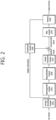
- FIG. 2 is a block diagram illustrating a decoder according to an embodiment of the present invention.
- the decoder may include an entropy decoding module 210, a rearrangement module 215, a dequantization module 220, an inverse-transform module 225, a prediction module 230, a filter module 235, and a memory 240.
- the input bit stream may be decoded in a procedure opposite to that of the encoder.
- the entropy decoding module 210 may perform entropy decoding in a procedure opposite to that of the entropy coding by the entropy coding module of the encoder.
- Information for generating a prediction block, among the information decoded by the entropy decoding module 210 may be provided to the prediction module 230, and the residual value obtained after performing the entropy decoding by the entropy decoding module may be input to the rearrangement module 215.
- the entropy decoding module 210 may perform inverse-transform using at least one of the HEB method using CABAC and HTB method utilizing a CALVAC factor coding method.
- the rearrangement module 215 may perform rearranging based on the method of rearranging an entropy-decoded bit stream by the entropy decoding module 210. Coefficients expressed in the form of a 1D vector may be reconstructed into coefficients in the form of a 2D block and realigned.
- the rearrangement module 215 may be provided with information related to coefficient scanning performed in the encoding module, and perform rearrangement through a method of reversely scanning based on the scanning order performed in the corresponding encoding module.
- the dequantization module 220 may perform dequantization based on a quantization parameter provided from the encoder and the realigned coefficient value of the block.
- the transform may be performed based on coding unit (CU), rather than based on the transform unit (TU).
- CU coding unit
- TU transform unit
- intra-prediction when a size of a prediction block and a size of a transform block are equal, intra-prediction is performed on a prediction block based on pixels existing on the left of the prediction block, pixels existing in left upper side of the prediction block, and pixels existing in an upper side of the prediction block.
- intra-prediction when a transform block is included in a prediction block, intra-prediction may be performed by using a reference pixel based on the transform block.
- intra-prediction using NxN partitioning only on a minimum coding block may be used.
- the intra-prediction module may generate a prediction block based on pixel information of the current picture.
- intra-prediction may be performed based on intra-prediction mode information of the prediction block provided from the encoder.
- the intra-prediction module may include an MDIS filter, a reference pixel interpolation module, and a DC filter.
- the MDIS filter is a part performing filtering on a reference pixel of a current block, and whether to apply the filter may be determined according to a prediction mode of a current PU and applied.
- MDIS filtering may be performed on the reference pixel of the current block by using the prediction mode of the prediction block and the MDIS filter information provided from the encoder.
- the MDIS filter may not be applied. Also, like the encoder, after generating a prediction block, filtering may be performed additionally together with a reference pixel.
- the reconstructed block or picture may be provided to the filter module 235.
- the filter module 235 may include a deblocking filter, an offset compensation module, and an ALF.
- the ALF may perform filtering based on a value obtained by comparing the image reconstructed after filtering and the original image. Based on information whether ALF has been applied, ALF coefficient information, and the like, provided from the encoder, ALF may be applied to a CU. Such ALF information may be included in a specific parameter set and provided.
- An intra-prediction mode of a current prediction block may be predicted from an intra-prediction mode of a neighbor block.
- Such a prediction method of an intra-prediction mode is called a most probable mode (MPM).
- a first MPM and a second MPM may be set based on an intra-prediction mode of a block existing on the left and in an upper side of the current block or an intra-prediction mode used frequently, and when an intra-prediction mode of the current block is identical to at least one of intra-prediction modes of the first MPM and the second MPM, information prev_intra_pred_flag indicating that the intra intra-prediction mode of the current block is identical to the intra-prediction mode of the MPM is used, and to which of the intra-prediction modes among the first MPM and the second MPM the intra-prediction mode of the prediction block is identical may be indicated through mpm_idx information.
- the intra-prediction mode of the MPM is not identical to the intra-prediction mode of the current block, information
- FIG. 3 is a flow chart illustrating a method for decoding an intra-prediction mode of a current prediction unit according to an embodiment of the present invention.
- the foregoing prev_intra_pred flag information may be decoded to decode intra-prediction mode information of the current block (step S300).
- step S300 It is determined whether the decoded prev_intra_pred flag information is 1 or 0 (step S300).
- the prev_intra_pred flag information when the prev_intra_pred flag information is 1, it is determined that the MPM and the intra-prediction mode of the current block are identical, and when the prev_intra_pred flag information is 0, it is determined that the MPM and the intra-prediction mode of the current block are different.
- any other binarization method or information display method with respect to the prev_intra_pred flag information may also be used.
- the mpm_idx may be decoded to obtain information regarding to which of intra-prediction modes of the first MPM and the second MPM the intra-prediction mode of the current block is identical (step S320).
- rem_intra_luma_pred_mode remaining mode information, may be decoded to obtain intra-prediction mode information of the current block (step S330).
- codeword information mapped to the intra-prediction mode may be used.
- Table 1 shows Exp-Golomb encoding method, one of methods of binarizing intra-prediction mode information. [Table 1] codeword codenum 1 0 010 1 011 2 00100 3 00101 4 00110 5 ... ...
- code numbers are smaller on the codeword mapping table, they may be mapped to shorter codewords. Namely, it can be seen that, when a short codeword is mapped to frequently generated information, the same information may be expressed with a shorter bit stream, and thus, encoding/decoding efficiency may increase.
- Table 2 shows order of intra-prediction modes according to an embodiment of the present invention. Table 2 may be expressed like Table 3. [Table 2] Intra prediction mode Associated names 0 Intra_Planar 1 Intar_DC 2 Intra_Vertical 3 Intra_Hotizontal otherwise (4...34) Intra_Angular [Table 3] Intra prediction mode Associated names 0 Intra_Planar 1 Intar_DC otherwise (2...34) Intra_Angular
- Table 4 shows mapping between intra-prediction modes and codewords.
- codewords are randomly set and information regarding an intra-prediction mode of a current picture may be mapped using any other codewords within the scope of the essence of the present invention.
- Intra prediction mode Associated names Codeword 0 Intra_Planar 1 1 Intar_DC 010 2 Intra_Horizontal 011 3 Intar_Vertical 00100 otherwise (4...34) Intra_Angular ...
- shorter codewords may be mapped to frequently generated intra-prediction modes, and thus, frequently generated intra-prediction modes may have shorter codewords.
- a shortest codeword or first mapped codeword based on generated order may be defined as a first codeword, and second, third, fourth, and nth codewords, or the like, may be expressed in sequence. Namely, a length of the nth codeword may be shorter than or equal to that of (n+1)th codeword, but the length of the nth codeword may not be greater than that of the (n+1)th codeword (here, n is an integer).
- a planer mode or a DC mode non-directional intra-prediction mode among intra-prediction modes, are frequently used, while a directional intra-prediction mode occurs relatively unfrequently.
- a shorter codeword is mapped to a non-directional intra-prediction mode and a codeword longer than a codeword mapped to a non-directional intra-prediction mode is mapped to a directional intra-prediction mode, thereby increasing video encoding and decoding efficiency.
- Table 5 and Table 6 show various binary coding methods according to intra-prediction modes according to an embodiment of the present invention.
- Intra prediction mode Prefix(unary code) Remainder(fixed length) 0-1 0 x (1 bit) 2-5 10 xx (2 bits) 6-9 110 xx (2 bits) 10-18 111 xxx (3 bits)
- Intra prediction mode Prefix(unary code) Remainder(fixed length) 0-1 0 x (1 bit) 2-5 10 xx (2 bits) 6-13 110 xx (2 bits) 14-21 1110 xxx (3 bits) 22-34 1111 xxxx (4 bits)
- Table 5 shows a binarization method for expressing intra-prediction modes in case of using 19 modes as intra-prediction modes
- Table 6 shows a binarization method for expressing intra-prediction modes in case of using 35 modes as intra-prediction modes.
- a unary code and a fixed length may be used as a binary coding method for expressing intra-prediction modes of a current block.
- a prefix using a unary code may be fixed to 0 and a fixed length for discriminating between 0 and 1, intra-prediction modes, may be expressed by 1 bit with 0 or 1.
- intra-prediction modes are 2 to 5
- a prefix using a unary code may be fixed to 10 and a fixed length for discriminating among the intra-prediction modes 2 to 5 may be expressed by 2 bits.
- codewords and intra-prediction modes may be mapped using a unary code and a fixed length.
- Table 6 may also binarize intra-prediction mode information in this manner to express the same.
- Table 5 and Table 6 may also use a method in which a number of an intra-prediction mode is smaller, it is generated as a shorter codeword when binarized.
- a frequently generated intra-prediction mode in an intra-prediction mode having a smaller number, corresponding information may be expressed with a small amount of bits, increasing coding efficiency.
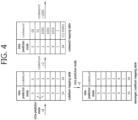
- FIG. 4 is a conceptual view illustrating a method for encoding an intra-prediction mode according to an embodiment of the present invention.
- a codeNum mapping table may be used in encoding an intra-prediction mode.
- t-th determined intra-prediction mode and (t-1)th intra-prediction mode in the codeNum mapping table are swapped to raise a ranking of the frequently generated intra-prediction mode in the codeNum mapping table, whereby when a subsequent intra-prediction mode is positioned in the frequently generated intra-prediction mode, a smaller number of codeNum may be allocated. As a result, a shorter codeword may be mapped to the corresponding codeNum.
- the codeNum mapping table rearranged by raising the codeNum ranking of the t-th intra-prediction mode may be used when an intra-prediction is performed on a next prediction block.
- the determined intra-prediction mode is 2, and codeNum 2 mapped to the #2 intra-prediction mode is read from the codeNum mapping table and a codeword ("1000") mapped to the #2 codeNum in the codeword mapping table is output as a result value of the #2 intra-prediction mode.
- the #2 intra-prediction mode and the immediately upper #1 intra-prediction mode are swapped, so that the codeNum for the #2 intra-prediction mode is corrected to #1 and the codeNum for the #1 intra-prediction mode is corrected to #2.
- the rearranged codeNum mapping table is used to intra-prediction mode coding of a next prediction block.
- whether to swap t-th and (t-1)th intra-prediction modes is determined based on frequency of each of the t-th and (t-1)th intra-prediction modes.
- the t-th and (t-1)th intra-prediction modes are swapped and the rearranged codeNum mapping table may be used when intra-prediction is performed on a next prediction block.
- the frequency of the t-th intra-prediction mode is smaller than that of the (t-1)th intra-prediction mode, the two intra-prediction modes are not swapped and a current codeNum mapping table may be used when intra-prediction is performed on a next prediction block.
- frequency of every intra-prediction mode may be reduced at the same rate periodically.
- a process (for example, for determining a codeword) other than the swapping process with respect to an intra-prediction mode based on frequency may be the same as the foregoing embodiment (namely, swapping immediately without using frequency).
- intra-prediction mode numbers and codeNum numbers of the codeNum mapping table are identical, but in another embodiment, an initial codeNum mapping table mapping intra-prediction mode numbers and codeNum may be predetermined and codeNum numbers different from those of intra-prediction modes may be mapped to intra-prediction modes.
- the intra-prediction mode when a certain intra-prediction mode is determined, the intra-prediction mode may be mapped to a codeNum value of the codeNum mapping table.
- the mapped codeNum value may be mapped to a codeword value through a codeword mapping table.
- FIG. 5 is a conceptual view illustrating a method for decoding an intra-prediction mode according to an embodiment of the present invention.
- the decoder has an initial codeword mapping table and an initial codeNum mapping table identical to those of the encoder.
- the decoder reads a codeword from a bit stream and obtains a mapped codeNum value from the codeword mapping table based on the corresponding codeword, and when an intra-prediction mode mapped to the codeNum is obtained from the codeNum mapping table, the decoder may finally determine an intra-prediction mode of a current block.
- swapping may be performed on the intra-prediction mode in the codeNum mapping table.
- a value of the initial codeNum mapping table is important.
- a table may be re-initialized in a certain unit such as a slice or a frame, swapping needs to be performed after initialization to generate a codeNum mapping table reflecting the characters of a current slice or frame.
- it is important to map a smaller codeNum value to a frequently generated intra-prediction mode value in configuring a codeNum mapping table mapping intra-prediction modes and codeNum values.
- a smaller codeNum number is mapped to a more frequently generated intra-prediction mode number, and as a result, a length of a codeword with respect to the intra-prediction mode may be reduced to obtain coding efficiency.
- FIG. 6 is a conceptual view illustrating a case using a codeNum mapping table differently according to an embodiment of the present invention.
- binary-coding may be performed without using an MPM.
- a method of rearranging codeNum mapping table based on intra-prediction mode information of blocks existing on the left and in an upper side of a specific prediction block, without generating flag information for an MPM may be used.
- an intra-prediction mode of blocks existing on the left and in the upper side are 2 and 3, respectively, a method of configuring a codeNum mapping table in which 2 and 3 are positioned in an upper portion of the codeNum mapping table and the other remaining intra-prediction modes are backed may be used.
- a method in which intra-prediction modes of the blocks existing on the left and the upper side are positioned in upper portion on the codeNum mapping table, and thereafter, the other remaining intra-prediction modes, excluding the intra-prediction modes of the blocks existing on the left and the upper side, are disposed on the codeNum mapping table may be used to generate a codeword corresponding to the intra-prediction mode.
- an intra-prediction mode of a specific prediction block is highly likely to be identical to at least one of intra-prediction modes of the blocks existing on the left and/or the upper side of the specific prediction block.
- rearranging of the foregoing codeNum mapping table may be minimized by disposing a relatively frequently generated intra-prediction mode in an upper portion of the codeNum mapping table.
- the frequently generated intra-prediction mode may be an intra-prediction mode of the blocks existing on the left and/or the upper side of the specific prediction block or may not.
- the frequently generated intra-prediction mode is an intra-prediction mode of blocks existing on the left and/or upper side of the specific prediction block, a probability of rearrangement is relatively reduced, preventing unnecessary rearrangement.
- the frequently generated intra-prediction mode is not an intra-prediction mode of blocks existing on the left and/or upper side of the specific prediction block, when the codeNum mapping table is rearranged by positioning an intra-prediction mode of the blocks existing on the left and/or upper side of the specific prediction block in an upper portion of the codeNum mapping table and backing the other remaining intra-prediction modes, a frequently generated intra-prediction mode among the other remaining intra-prediction modes needs to be mapped to a relatively small codeNum in order to be allocated a shorter codeword.
- the frequently generated intra-prediction mode may be allocated a smaller codeNum number, in terms of compression performance and/or complexity.
- binary-coding in binary-coding an intra-prediction mode, binary-coding may be performed using an MPM.
- a codeword with respect to an MPM may be allocated using a method of rearranging a codeNum mapping table based on intra-prediction mode information of a first MPM and a second MPM of a specific prediction block without generating flag information for the MPMs.
- intra-prediction modes of the first MPM and the second MPM are 2 and 3, respectively, a codeNum mapping table may be configured by positioning 2 and 3 in an upper portion of the codeNum mapping table and backing other intra-prediction modes.
- Other processes may be the same as those of the embodiment of positioning the intra-prediction mode of the blocks existing on the left and the upper side of a specific prediction block in an upper portion of a codeNum mapping table.
- different number of intra-prediction modes may be used according to a size of a prediction block.
- Table 7 show the number of intra-prediction modes that may be used according to sizes of a prediction block. [Table 7] log2PUSize intraPredModeNum 2 (4x4) 11, 18, or 19 3 (8x8) 35 4 (16x16) 35 5 (32x32) 35 6 (64x64) 11, 18, or 19
- a size of a prediction block is 4x4 or 64x64, eleven, eighteen, nineteen intra-prediction modes may be used. Also, when sizes of a prediction block are 16x16, 32x32, and 64x64, thirty-five intra-prediction modes may be used.
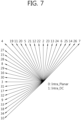
- FIG. 7 is a view illustrating non-directional intra-prediction modes and directional intra-prediction modes when 35 intra-prediction modes are used according to an embodiment of the present invention.
- the modes may be planar, DC, Ver+x (x is an integer between -8 to 8), or Hor+x (x is an integer from -7 to 8).
- FIG. 8 is a view illustrating non-directional intra-prediction modes and directional intra-prediction modes when 19 intra-prediction modes are used according to an embodiment of the present invention.
- the modes may be planar, DC, Ver+2x (x is an integer between -4 to 4), or Hor+2x (x is an integer from -3 to 4). Namely, unlike the case of using 35 intra-prediction modes in FIG. 7 , in case of using the 19 intra-prediction modes, a method of selecting only intra-prediction modes with respect to an angle movement by multiple of 2 each time in vertical and horizontal directions.
- a method of performing intra-prediction using intra-prediction modes from 0 to 17, excluding 18 intra-prediction mode may be used.
- FIG. 9 is a view illustrating non-directional intra-prediction modes and directional intra-prediction modes when 11 intra-prediction modes are used according to an embodiment of the present invention.
- 11 intra-prediction modes and 19 intra-prediction modes may be used in a 64x64 block or 4x4 block.
- a size of a prediction block is 64x64, it may mean that there is no need to partition the corresponding block into smaller (for example, 32x32, 16x16, or the like), and it may be determined that there is no significant change in pixel values of the corresponding block.
- prediction values with respect to the most intra-prediction modes are obtained to be similar, not significantly making a difference in performance of each mode having similar directivity.
- inter-prediction may be performed using any one of the 11 intra-prediction modes, 18 intra-prediction modes, and 19 intra-prediction modes with respect to a 64x64 prediction block.
- prediction values of the 35 intra-prediction modes may be similar, and thus, inter-prediction may be performed using one of 11 intra-prediction modes, 18 intra-prediction modes, and 19 intra-prediction modes as in the prediction block having the size of 64x64, rather than using all of the 35 intra-prediction modes.
- coding efficiency may be increased by generating a codeNum mapping table with respect to a remaining mode excluding the MPMs.
- an MPM used in an embodiment of the present invention is used as having a general concept of a candidate intra-prediction mode predicting an intra-prediction mode value of a current block, and a most probable remaining mode (MPRM) having a similar concept may also be used and included in the scope of the present invention, but only an MPM will be described for the purposes of description.
- MPRM most probable remaining mode
- FIG. 10 is a conceptual view illustrating a codeNum mapping method with respect to remaining intra-prediction mode excluding MPM according to an embodiment of the present invention.
- codeNum mapping may be performed on the other remaining intra-prediction modes excluding 2, 4, and 5, in the codeNum mapping table. Namely, in remaining mode coding, an intra-prediction mode corresponding to an MPM is not selected, and thus, codeNum values may be assigned only to remaining modes excluding the MPMs. The codeNum values may be mapped to codewords by using a codeword mapping table. In this manner, codewords are mapped only to intra-prediction modes corresponding to remaining modes, an unnecessary waste of codewords may be prevented, increasing coding efficiency.
- codeNum may be generated based on an input codeword, and intra-prediction mode information may be decoded using a codeNum mapping table in which intra-prediction modes, excluding intra-prediction modes corresponding to MPMs, are mapped.
- FIG. 10 illustrates a case of using 11 intra-prediction modes.
- intra-prediction is performed on a prediction block using 11 intra-prediction modes and 3 MPMs are used, codewords may be mapped to 8 remaining intra-prediction modes.
- codewords with respect to remaining 8 intra-prediction modes may be mapped by a 3-bit code length.
- Table 9 shows remaining intra-prediction modes by a fixed length according to an embodiment of the present invention. [Table 9] codeNum Codeword 0 000 1 001 2 010 3 011 4 100 5 101 6 110 7 111
- the number of intra-prediction modes of a current block may be generated by an exponentiation of 2 of the number of corresponding remaining intra-prediction modes, namely, it may be determined that the remaining modes are expressed by fixed lengths of respective exponent bits.
- the number of MPMs is assumed to be 3, and when the number of MPMs is different, the number of intra-prediction modes used for intra-prediction of a prediction block may be changed.
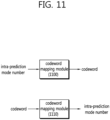
- FIG. 11 is a conceptual view illustrating portions of a video encoding apparatus and a video decoding apparatus respectively performing encoding and decoding of an intra-prediction mode according to an embodiment of the present invention.
- a codeword mapping module 1100 of a video encoding apparatus may receive an intra-prediction mode number and generate a codeword.
- the codeword mapping module 1100 may have a codeword mapping table stored therein or may perform a binarization operation to generate a codeword mapping table.
- the codeword mapping module 1100 may be included in a entropy coding module and operate.
- a codeword mapping module 1110 of a video decoding apparatus receives a codeword and generate the input codeword as an intra-prediction mode number based on a codeword mapping table included in the codeword mapping module 1110.
- a codeNum mapping module 1200 and a codeword mapping module 1220 may be included in a video encoding apparatus.
- the codeNum mapping module 1200 of the video encoding apparatus may receive an intra-prediction mode number and output a codeNum.
- the codeNum mapping and codeword mapping according to the embodiments as described above may be performed, and a more frequently generated intra-prediction mode number may be mapped to a smaller codeNum number.
- the codeNum mapping module may perform codeNum mapping on remaining intra-prediction modes excluding an intra-prediction mode corresponding to the MPM.
- a video decoding apparatus may include a codeword mapping module 1240 and a codeNum mapping module 1260.
- the codeword mapping module 1240 may output a codeNum based on an input codeword, and the codeNum mapping module 1260 may receive the codeNum and output an intra-prediction mode number.
- the codeword mapping module 1240 may include a codeword mapping table for performing codeword mapping, and the codeNum mapping module 1260 may include a codeNum mapping table for outputting an intra-prediction mode number based on a received codeNum.
- the codeword mapping table and the codeNum mapping module may be stored in advance or adaptively generated.
Landscapes
- Engineering & Computer Science (AREA)
- Multimedia (AREA)
- Signal Processing (AREA)
- Computing Systems (AREA)
- Theoretical Computer Science (AREA)
- Compression Or Coding Systems Of Tv Signals (AREA)
- Measuring Pulse, Heart Rate, Blood Pressure Or Blood Flow (AREA)
Applications Claiming Priority (5)
| Application Number | Priority Date | Filing Date | Title |
|---|---|---|---|
| KR20120006841 | 2012-01-20 | ||
| EP19158903.5A EP3512197B8 (de) | 2012-01-20 | 2013-01-17 | Intraprädiktionsmodusbildgebungsverfahren |
| EP13738183.6A EP2806642B1 (de) | 2012-01-20 | 2013-01-17 | Intraprädiktionsmodus-abbildungsverfahren und vorrichtung zur verwendung des verfahrens |
| PCT/KR2013/000370 WO2013109066A1 (ko) | 2012-01-20 | 2013-01-17 | 화면 내 예측 모드 매핑 방법 및 이러한 방법을 사용하는 장치 |
| EP20178263.8A EP3723369B1 (de) | 2012-01-20 | 2013-01-17 | Intraprädiktionsmodus-abbildungsvorrichtung |
Related Parent Applications (3)
| Application Number | Title | Priority Date | Filing Date |
|---|---|---|---|
| EP13738183.6A Division EP2806642B1 (de) | 2012-01-20 | 2013-01-17 | Intraprädiktionsmodus-abbildungsverfahren und vorrichtung zur verwendung des verfahrens |
| EP19158903.5A Division EP3512197B8 (de) | 2012-01-20 | 2013-01-17 | Intraprädiktionsmodusbildgebungsverfahren |
| EP20178263.8A Division EP3723369B1 (de) | 2012-01-20 | 2013-01-17 | Intraprädiktionsmodus-abbildungsvorrichtung |
Publications (2)
| Publication Number | Publication Date |
|---|---|
| EP4489401A2 true EP4489401A2 (de) | 2025-01-08 |
| EP4489401A3 EP4489401A3 (de) | 2025-03-05 |
Family
ID=48995986
Family Applications (4)
| Application Number | Title | Priority Date | Filing Date |
|---|---|---|---|
| EP24210152.5A Pending EP4489401A3 (de) | 2012-01-20 | 2013-01-17 | Intraprädiktionsmodus-abbildungsvorrichtung |
| EP20178263.8A Active EP3723369B1 (de) | 2012-01-20 | 2013-01-17 | Intraprädiktionsmodus-abbildungsvorrichtung |
| EP19158903.5A Active EP3512197B8 (de) | 2012-01-20 | 2013-01-17 | Intraprädiktionsmodusbildgebungsverfahren |
| EP13738183.6A Active EP2806642B1 (de) | 2012-01-20 | 2013-01-17 | Intraprädiktionsmodus-abbildungsverfahren und vorrichtung zur verwendung des verfahrens |
Family Applications After (3)
| Application Number | Title | Priority Date | Filing Date |
|---|---|---|---|
| EP20178263.8A Active EP3723369B1 (de) | 2012-01-20 | 2013-01-17 | Intraprädiktionsmodus-abbildungsvorrichtung |
| EP19158903.5A Active EP3512197B8 (de) | 2012-01-20 | 2013-01-17 | Intraprädiktionsmodusbildgebungsverfahren |
| EP13738183.6A Active EP2806642B1 (de) | 2012-01-20 | 2013-01-17 | Intraprädiktionsmodus-abbildungsverfahren und vorrichtung zur verwendung des verfahrens |
Country Status (18)
| Country | Link |
|---|---|
| US (10) | US9554130B2 (de) |
| EP (4) | EP4489401A3 (de) |
| JP (8) | JP6013513B2 (de) |
| KR (1) | KR101569086B1 (de) |
| CN (6) | CN109413423B (de) |
| CY (1) | CY1123375T1 (de) |
| DK (2) | DK3723369T3 (de) |
| ES (2) | ES2999360T3 (de) |
| FI (1) | FI3723369T3 (de) |
| HR (2) | HRP20241747T1 (de) |
| HU (2) | HUE069817T2 (de) |
| LT (2) | LT3512197T (de) |
| PL (2) | PL3512197T3 (de) |
| PT (2) | PT3512197T (de) |
| RS (2) | RS66348B1 (de) |
| SI (2) | SI3723369T1 (de) |
| SM (2) | SMT202400515T1 (de) |
| WO (1) | WO2013109066A1 (de) |
Families Citing this family (68)
| Publication number | Priority date | Publication date | Assignee | Title |
|---|---|---|---|---|
| KR20110113561A (ko) * | 2010-04-09 | 2011-10-17 | 한국전자통신연구원 | 적응적인 필터를 이용한 인트라 예측 부호화/복호화 방법 및 그 장치 |
| EP2685724B1 (de) | 2011-03-06 | 2020-04-29 | LG Electronics Inc. | Methode und Vorrichtung zur Intraprädiktion von Chrominanz-Blöcken unter Verwendung von Luminanz-Bildpunkten |
| US9210438B2 (en) * | 2012-01-20 | 2015-12-08 | Sony Corporation | Logical intra mode naming in HEVC video coding |
| RS66348B1 (sr) | 2012-01-20 | 2025-01-31 | Dolby Laboratories Licensing Corp | Uređaj za mapiranje režima intra predikcije |
| CN105556970B (zh) * | 2013-07-12 | 2019-01-11 | 三星电子株式会社 | 使用修正矢量推导的视频编码方法及其设备、视频解码方法及其设备 |
| CN105100814B (zh) | 2014-05-06 | 2020-07-14 | 同济大学 | 图像编码、解码方法及装置 |
| KR102596896B1 (ko) * | 2015-01-15 | 2023-11-01 | 주식회사 케이티 | 비디오 신호 처리 방법 및 장치 |
| WO2016136106A1 (ja) * | 2015-02-27 | 2016-09-01 | Kddi株式会社 | 符号化装置及び復号装置 |
| CN115134594B (zh) | 2015-06-05 | 2024-07-23 | 杜比实验室特许公司 | 用于执行帧间预测的图像编解码方法、比特流存储方法 |
| US10750174B2 (en) | 2015-08-28 | 2020-08-18 | Kt Corporation | Method and device for deriving a prediction sample in decoding/encoding video signal using binary and quad trees |
| KR20180058224A (ko) * | 2015-10-22 | 2018-05-31 | 엘지전자 주식회사 | 영상 코딩 시스템에서 모델링 기반 영상 디코딩 방법 및 장치 |
| WO2017222237A1 (ko) | 2016-06-22 | 2017-12-28 | 한국전자통신연구원 | 화면 내 예측 방법 및 장치 |
| CN117201808A (zh) * | 2016-08-01 | 2023-12-08 | 韩国电子通信研究院 | 图像编码/解码方法和装置以及存储比特流的记录介质 |
| CN109952761B (zh) * | 2016-09-20 | 2022-04-15 | 株式会社Kt | 用于处理视频信号的方法和装置 |
| WO2018066863A1 (ko) * | 2016-10-04 | 2018-04-12 | 한국전자통신연구원 | 영상 부호화/복호화 방법, 장치 및 비트스트림을 저장한 기록 매체 |
| WO2018117892A1 (en) | 2016-12-23 | 2018-06-28 | Huawei Technologies Co., Ltd. | An intra-prediction apparatus for extending a set of predetermined directional intra-prediction modes |
| CN115733973B (zh) * | 2016-12-23 | 2026-01-30 | 华为技术有限公司 | 一种用于矩形视频编码块的编码方法、装置及计算机可读存储介质 |
| EP3349451A1 (de) * | 2017-01-11 | 2018-07-18 | Thomson Licensing | Verfahren und vorrichtung zur auswahl eines codierungsmodus zur verwendung bei der codierung/decodierung eines restblocks |
| US10630978B2 (en) * | 2017-05-12 | 2020-04-21 | Blackberry Limited | Methods and devices for intra-coding in video compression |
| US10630974B2 (en) * | 2017-05-30 | 2020-04-21 | Google Llc | Coding of intra-prediction modes |
| CN107623848B (zh) * | 2017-09-04 | 2019-11-19 | 浙江大华技术股份有限公司 | 一种视频编码方法及装置 |
| WO2019189903A1 (ja) * | 2018-03-30 | 2019-10-03 | 日本放送協会 | 画像符号化装置、画像復号装置、及びプログラム |
| US11303929B2 (en) * | 2018-04-02 | 2022-04-12 | Lg Electronics Inc. | Image coding method using lookup table for intra prediction mode and apparatus therefor |
| US10999604B2 (en) * | 2018-04-13 | 2021-05-04 | Mediatek Inc. | Adaptive implicit transform setting |
| US11477474B2 (en) * | 2018-06-08 | 2022-10-18 | Mediatek Inc. | Methods and apparatus for multi-hypothesis mode reference and constraints |
| WO2020003282A1 (en) | 2018-06-29 | 2020-01-02 | Beijing Bytedance Network Technology Co., Ltd. | Managing motion vector predictors for video coding |
| CN110662052B (zh) | 2018-06-29 | 2022-07-08 | 北京字节跳动网络技术有限公司 | 更新查找表(lut)的条件 |
| KR102680903B1 (ko) | 2018-06-29 | 2024-07-04 | 베이징 바이트댄스 네트워크 테크놀로지 컴퍼니, 리미티드 | Hmvp 후보를 병합/amvp에 추가할 때의 부분/풀 프루닝 |
| KR102627814B1 (ko) | 2018-06-29 | 2024-01-23 | 베이징 바이트댄스 네트워크 테크놀로지 컴퍼니, 리미티드 | 룩업 테이블의 업데이트: fifo, 제약된 fifo |
| SG11202013028PA (en) | 2018-06-29 | 2021-01-28 | Beijing Bytedance Network Technology Co Ltd | Interaction between lut and amvp |
| EP4322533A3 (de) | 2018-06-29 | 2024-03-06 | Beijing Bytedance Network Technology Co., Ltd. | Überprüfung der reihenfolge von bewegungskandidaten in lut |
| KR102840294B1 (ko) | 2018-06-29 | 2025-07-30 | 두인 비전 컴퍼니 리미티드 | 하나 또는 다수의 룩업 테이블들을 사용하여 이전에 코딩된 모션 정보를 순서대로 저장하고 이를 사용하여 후속 블록들을 코딩하는 개념 |
| WO2020003265A1 (en) | 2018-06-29 | 2020-01-02 | Beijing Bytedance Network Technology Co., Ltd. | Conditions of usage of luts |
| CN110677669B (zh) | 2018-07-02 | 2021-12-07 | 北京字节跳动网络技术有限公司 | 具有lic的lut |
| US10284866B1 (en) * | 2018-07-02 | 2019-05-07 | Tencent America LLC | Method and apparatus for video coding |
| CN112567741A (zh) * | 2018-07-13 | 2021-03-26 | Lg电子株式会社 | 图像编码系统中使用帧内预测信息的图像解码方法和装置 |
| KR102637083B1 (ko) * | 2018-07-14 | 2024-02-15 | 엘지전자 주식회사 | 영상 코딩 시스템에서 인트라 예측 관련 정보를 사용하는 영상 디코딩 방법 및 그 장치 |
| WO2020053798A1 (en) | 2018-09-12 | 2020-03-19 | Beijing Bytedance Network Technology Co., Ltd. | Conditions for starting checking hmvp candidates depend on total number minus k |
| WO2020053394A1 (en) * | 2018-09-13 | 2020-03-19 | Fraunhofer-Gesellschaft zur Förderung der angewandten Forschung e.V. | Affine linear weighted intra predictions |
| WO2020055291A1 (en) * | 2018-09-13 | 2020-03-19 | Huawei Technologies Co., Ltd. | Method and apparatus for wide-angle intra-prediction |
| KR102822624B1 (ko) * | 2018-10-05 | 2025-06-18 | 엘지전자 주식회사 | Mpm 리스트를 사용하는 인트라 예측 기반 영상 코딩 방법 및 그 장치 |
| WO2022140718A1 (en) * | 2020-12-22 | 2022-06-30 | Qualcomm Incorporated | Decoder side intra mode derivation for most probable mode list construction in video coding |
| US11671589B2 (en) * | 2020-12-22 | 2023-06-06 | Qualcomm Incorporated | Decoder side intra mode derivation for most probable mode list construction in video coding |
| US11109023B2 (en) * | 2018-11-27 | 2021-08-31 | Tencent America LLC | Intra mode selection in intra prediction |
| CN111010578B (zh) * | 2018-12-28 | 2022-06-24 | 北京达佳互联信息技术有限公司 | 一种帧内帧间联合预测的方法、装置以及存储介质 |
| KR102648159B1 (ko) | 2019-01-10 | 2024-03-18 | 베이징 바이트댄스 네트워크 테크놀로지 컴퍼니, 리미티드 | Lut 업데이트의 호출 |
| WO2020143824A1 (en) | 2019-01-13 | 2020-07-16 | Beijing Bytedance Network Technology Co., Ltd. | Interaction between lut and shared merge list |
| CN113330739B (zh) | 2019-01-16 | 2025-01-10 | 北京字节跳动网络技术有限公司 | Lut中的运动候选的插入顺序 |
| WO2020182167A1 (en) * | 2019-03-12 | 2020-09-17 | Zhejiang Dahua Technology Co., Ltd. | Systems and methods for image coding |
| WO2020197038A1 (ko) | 2019-03-22 | 2020-10-01 | 엘지전자 주식회사 | 영상 코딩 시스템에서 인트라 서브 파티션 기반의 인트라 예측 방법 및 장치 |
| CN113615193B (zh) | 2019-03-22 | 2024-06-25 | 北京字节跳动网络技术有限公司 | Merge列表构建和其他工具之间的交互 |
| AU2020245002B2 (en) * | 2019-03-23 | 2023-03-30 | Lg Electronics Inc. | Method for coding image on basis of intra prediction using MPM list and apparatus therefor |
| WO2020197202A1 (ko) * | 2019-03-26 | 2020-10-01 | 엘지전자 주식회사 | Mpm 리스트에 기반한 인트라 예측 방법 및 그 장치 |
| CN118488193B (zh) | 2019-04-10 | 2025-03-18 | 北京达佳互联信息技术有限公司 | 用于视频解码的方法和电子装置 |
| CN115499669B (zh) | 2019-04-25 | 2023-08-29 | 北京达佳互联信息技术有限公司 | 对视频信号进行编码的双向光流方法、计算设备和存储介质 |
| WO2020228670A1 (en) | 2019-05-10 | 2020-11-19 | Beijing Bytedance Network Technology Co., Ltd. | Luma based secondary transform matrix selection for video processing |
| WO2020235960A1 (ko) * | 2019-05-22 | 2020-11-26 | 엘지전자 주식회사 | Bdpcm 에 대한 영상 디코딩 방법 및 그 장치 |
| CN117354521A (zh) | 2019-06-07 | 2024-01-05 | 北京字节跳动网络技术有限公司 | 视频比特流中的简化二次变换的有条件信令 |
| CN112118450B (zh) * | 2019-06-21 | 2022-03-29 | 杭州海康威视数字技术股份有限公司 | 预测模式的解码、编码方法及装置 |
| CN116866574A (zh) * | 2019-06-25 | 2023-10-10 | 日本放送协会 | 帧内预测装置、图像解码装置及程序 |
| CN114208183B (zh) | 2019-08-03 | 2025-01-10 | 北京字节跳动网络技术有限公司 | 视频的缩减二次变换中基于位置的模式导出 |
| WO2021032045A1 (en) | 2019-08-17 | 2021-02-25 | Beijing Bytedance Network Technology Co., Ltd. | Context modeling of side information for reduced secondary transforms in video |
| US11310511B2 (en) | 2019-10-09 | 2022-04-19 | Tencent America LLC | Method and apparatus for video coding |
| MX2022005385A (es) | 2019-11-05 | 2022-07-11 | Lg Electronics Inc | Método y dispositivo para procesar información de imagen para la codificación de imágenes/video. |
| SI4044599T1 (sl) * | 2019-11-05 | 2024-05-31 | Lg Electronics Inc. | Metoda in naprava za kodiranje slik/videozapisov |
| US11425402B2 (en) * | 2020-07-20 | 2022-08-23 | Meta Platforms, Inc. | Cross-codec encoding optimizations for video transcoding |
| US12160561B2 (en) * | 2021-08-02 | 2024-12-03 | Tencent America LLC | Method and apparatus for improved intra prediction |
| JP2026513444A (ja) * | 2023-03-30 | 2026-04-27 | オッポ広東移動通信有限公司 | 符号化及び復号化方法、ビットストリーム、エンコーダ、デコーダ及び記憶媒体 |
Family Cites Families (31)
| Publication number | Priority date | Publication date | Assignee | Title |
|---|---|---|---|---|
| KR101017094B1 (ko) * | 2002-06-11 | 2011-02-25 | 노키아 코포레이션 | 인트라 코딩에 기반한 공간 예측 |
| US7369707B2 (en) * | 2003-10-28 | 2008-05-06 | Matsushita Electric Industrial Co., Ltd. | Intra-picture prediction coding method |
| JP4515886B2 (ja) * | 2003-10-28 | 2010-08-04 | パナソニック株式会社 | 面内予測符号化方法 |
| BR122019021946B1 (pt) * | 2007-06-29 | 2024-02-06 | Velos Media International Limited | Dispositivo de codificação de imagem para codificar imagens de entrada e dispositivo de decodificação de imagem para decodificar dados de imagens codificados |
| JP5166339B2 (ja) | 2008-03-28 | 2013-03-21 | 三星電子株式会社 | 画像のイントラ予測モード情報の符号化及び/又は復号化方法及び装置 |
| KR20090103675A (ko) * | 2008-03-28 | 2009-10-01 | 삼성전자주식회사 | 영상의 인트라 예측 모드 부호화/복호화 방법 및 장치 |
| CN101350927B (zh) * | 2008-07-29 | 2011-07-13 | 北京中星微电子有限公司 | 帧内预测选择最优预测模式的方法及装置 |
| KR101567974B1 (ko) * | 2009-01-05 | 2015-11-10 | 에스케이 텔레콤주식회사 | 블록 모드 부호화/복호화 방법 및 장치와 그를 이용한 영상부호화/복호화 방법 및 장치 |
| CN101494792A (zh) * | 2009-01-15 | 2009-07-29 | 北京航空航天大学 | 一种基于边缘特征的h.264/avc帧内预测方法 |
| KR100991138B1 (ko) * | 2009-04-16 | 2010-11-01 | 한양대학교 산학협력단 | 부호화기 및 부호화기의 후보 모드 결정 방법 |
| KR101702553B1 (ko) * | 2009-07-04 | 2017-02-03 | 에스케이 텔레콤주식회사 | 영상 부호화/복호화 방법 및 장치 |
| KR101507344B1 (ko) | 2009-08-21 | 2015-03-31 | 에스케이 텔레콤주식회사 | 가변 길이 부호를 이용한 인트라 예측모드 부호화 방법과 장치, 및 이를 위한기록 매체 |
| JP5746182B2 (ja) * | 2009-09-14 | 2015-07-08 | トムソン ライセンシングThomson Licensing | イントラ予測モードの効率的なビデオ符号化及び復号化方法及び装置 |
| CN102045560B (zh) * | 2009-10-23 | 2013-08-07 | 华为技术有限公司 | 一种视频编解码方法及设备 |
| KR101138736B1 (ko) * | 2009-11-25 | 2012-04-24 | 한양대학교 산학협력단 | 부호화기 및 부호화기의 후보 모드 결정 방법 |
| EP2536151A4 (de) * | 2010-02-10 | 2014-03-19 | Lg Electronics Inc | Verfahren und vorrichtung zur verarbeitung eines videosignals |
| JP5798556B2 (ja) | 2010-07-15 | 2015-10-21 | シャープ株式会社 | 復号装置、符号化装置 |
| KR20140071507A (ko) * | 2010-08-17 | 2014-06-11 | 엠앤케이홀딩스 주식회사 | 예측 블록 생성 장치 |
| KR20120070479A (ko) * | 2010-12-21 | 2012-06-29 | 한국전자통신연구원 | 화면 내 예측 방향 정보 부호화/복호화 방법 및 그 장치 |
| US9654785B2 (en) * | 2011-06-09 | 2017-05-16 | Qualcomm Incorporated | Enhanced intra-prediction mode signaling for video coding using neighboring mode |
| GB2494468B (en) * | 2011-09-12 | 2014-01-15 | Canon Kk | Method and device for encoding or decoding information representing prediction modes |
| EP3139596B1 (de) * | 2011-09-13 | 2019-09-25 | HFI Innovation Inc. | Verfahren und vorrichtung zur intramodalen codierung in hevc |
| KR101575777B1 (ko) | 2011-10-07 | 2015-12-14 | 주식회사 팬택자산관리 | 복수개의 후보 화면 내 예측 모드를 이용한 화면 내 예측 모드의 부호화/복호화 방법 및 이러한 방법을 사용하는 장치 |
| ES3030007T3 (en) * | 2011-10-18 | 2025-06-26 | Lg Electronics Inc | Image decoding method, image encoding method, computer-readable storage medium and transmission method of data for an image |
| MX2014003707A (es) * | 2011-10-24 | 2014-07-28 | Intercode Pte Ltd | Metodo y aparato para la decodificacion del modo de prediccion intra. |
| PT3917147T (pt) | 2011-10-24 | 2025-10-16 | Gensquare Llc | Aparelho de descodificação de imagem |
| US9154796B2 (en) * | 2011-11-04 | 2015-10-06 | Qualcomm Incorporated | Intra-mode video coding |
| KR101654446B1 (ko) * | 2012-01-13 | 2016-09-05 | 샤프 가부시키가이샤 | 화상 복호 장치, 화상 부호화 장치 및 부호화 데이터의 데이터 구조 |
| CN103220506B (zh) * | 2012-01-19 | 2015-11-25 | 华为技术有限公司 | 一种编解码方法和设备 |
| RS66348B1 (sr) | 2012-01-20 | 2025-01-31 | Dolby Laboratories Licensing Corp | Uređaj za mapiranje režima intra predikcije |
| US9210438B2 (en) | 2012-01-20 | 2015-12-08 | Sony Corporation | Logical intra mode naming in HEVC video coding |
-
2013
- 2013-01-17 RS RS20241427A patent/RS66348B1/sr unknown
- 2013-01-17 DK DK20178263.8T patent/DK3723369T3/da active
- 2013-01-17 ES ES20178263T patent/ES2999360T3/es active Active
- 2013-01-17 SM SM20240515T patent/SMT202400515T1/it unknown
- 2013-01-17 EP EP24210152.5A patent/EP4489401A3/de active Pending
- 2013-01-17 JP JP2014553250A patent/JP6013513B2/ja active Active
- 2013-01-17 CN CN201811037425.4A patent/CN109413423B/zh active Active
- 2013-01-17 FI FIEP20178263.8T patent/FI3723369T3/fi active
- 2013-01-17 CN CN201380006073.5A patent/CN104081770B/zh active Active
- 2013-01-17 HU HUE20178263A patent/HUE069817T2/hu unknown
- 2013-01-17 SI SI201332094T patent/SI3723369T1/sl unknown
- 2013-01-17 RS RS20201053A patent/RS60786B1/sr unknown
- 2013-01-17 CN CN201811036708.7A patent/CN108777795B/zh active Active
- 2013-01-17 SI SI201331785T patent/SI3512197T1/sl unknown
- 2013-01-17 WO PCT/KR2013/000370 patent/WO2013109066A1/ko not_active Ceased
- 2013-01-17 PL PL19158903T patent/PL3512197T3/pl unknown
- 2013-01-17 CN CN201811037057.3A patent/CN109413429B/zh active Active
- 2013-01-17 EP EP20178263.8A patent/EP3723369B1/de active Active
- 2013-01-17 HR HRP20241747TT patent/HRP20241747T1/hr unknown
- 2013-01-17 LT LTEP19158903.5T patent/LT3512197T/lt unknown
- 2013-01-17 CN CN201811037422.0A patent/CN109194961B/zh active Active
- 2013-01-17 US US14/368,224 patent/US9554130B2/en active Active
- 2013-01-17 HU HUE19158903A patent/HUE050473T2/hu unknown
- 2013-01-17 CN CN201811036710.4A patent/CN109413428B/zh active Active
- 2013-01-17 KR KR1020130005333A patent/KR101569086B1/ko active Active
- 2013-01-17 DK DK19158903.5T patent/DK3512197T5/da active
- 2013-01-17 ES ES19158903T patent/ES2820297T3/es active Active
- 2013-01-17 EP EP19158903.5A patent/EP3512197B8/de active Active
- 2013-01-17 SM SM20200489T patent/SMT202000489T1/it unknown
- 2013-01-17 PL PL20178263.8T patent/PL3723369T3/pl unknown
- 2013-01-17 LT LTEP20178263.8T patent/LT3723369T/lt unknown
- 2013-01-17 PT PT191589035T patent/PT3512197T/pt unknown
- 2013-01-17 PT PT201782638T patent/PT3723369T/pt unknown
- 2013-01-17 EP EP13738183.6A patent/EP2806642B1/de active Active
-
2016
- 2016-09-21 JP JP2016184854A patent/JP6334634B2/ja active Active
-
2017
- 2017-01-05 US US15/399,077 patent/US9854239B2/en active Active
- 2017-11-14 US US15/812,567 patent/US9986238B2/en active Active
-
2018
- 2018-04-20 US US15/958,452 patent/US10158852B2/en active Active
- 2018-04-26 JP JP2018085406A patent/JP6681937B2/ja active Active
- 2018-10-26 US US16/171,834 patent/US10616575B2/en active Active
-
2020
- 2020-02-20 US US16/796,543 patent/US10863173B2/en active Active
- 2020-03-24 JP JP2020053113A patent/JP6895555B2/ja active Active
- 2020-09-02 CY CY20201100824T patent/CY1123375T1/el unknown
- 2020-09-10 HR HRP20201449TT patent/HRP20201449T1/hr unknown
- 2020-10-19 US US17/074,234 patent/US11412216B2/en active Active
-
2021
- 2021-06-07 JP JP2021095240A patent/JP7094425B2/ja active Active
-
2022
- 2022-06-21 JP JP2022099531A patent/JP7282239B2/ja active Active
- 2022-07-05 US US17/857,772 patent/US11750803B2/en active Active
-
2023
- 2023-05-16 JP JP2023080852A patent/JP7524403B2/ja active Active
- 2023-07-17 US US18/222,821 patent/US12047564B2/en active Active
-
2024
- 2024-06-11 US US18/740,370 patent/US12513289B2/en active Active
- 2024-07-17 JP JP2024114022A patent/JP7822430B2/ja active Active
Also Published As
Similar Documents
| Publication | Publication Date | Title |
|---|---|---|
| US12513289B2 (en) | Intra prediction mode mapping method and device using the method | |
| US11375233B2 (en) | Method for partitioning block and decoding device | |
| HK40120903A (en) | Intra prediction mode mapping device | |
| HK40029296A (en) | Intra prediction mode mapping device | |
| HK40029296B (en) | Intra prediction mode mapping device |
Legal Events
| Date | Code | Title | Description |
|---|---|---|---|
| PUAI | Public reference made under article 153(3) epc to a published international application that has entered the european phase |
Free format text: ORIGINAL CODE: 0009012 |
|
| STAA | Information on the status of an ep patent application or granted ep patent |
Free format text: STATUS: REQUEST FOR EXAMINATION WAS MADE |
|
| 17P | Request for examination filed |
Effective date: 20241031 |
|
| AC | Divisional application: reference to earlier application |
Ref document number: 2806642 Country of ref document: EP Kind code of ref document: P Ref document number: 3512197 Country of ref document: EP Kind code of ref document: P Ref document number: 3723369 Country of ref document: EP Kind code of ref document: P |
|
| AK | Designated contracting states |
Kind code of ref document: A2 Designated state(s): AL AT BE BG CH CY CZ DE DK EE ES FI FR GB GR HR HU IE IS IT LI LT LU LV MC MK MT NL NO PL PT RO RS SE SI SK SM TR |
|
| REG | Reference to a national code |
Ref country code: DE Ref legal event code: R079 Free format text: PREVIOUS MAIN CLASS: H04N0019593000 Ipc: H04N0019105000 |
|
| PUAL | Search report despatched |
Free format text: ORIGINAL CODE: 0009013 |
|
| STAA | Information on the status of an ep patent application or granted ep patent |
Free format text: STATUS: EXAMINATION IS IN PROGRESS |
|
| AK | Designated contracting states |
Kind code of ref document: A3 Designated state(s): AL AT BE BG CH CY CZ DE DK EE ES FI FR GB GR HR HU IE IS IT LI LT LU LV MC MK MT NL NO PL PT RO RS SE SI SK SM TR |
|
| RIC1 | Information provided on ipc code assigned before grant |
Ipc: H04N 19/593 20140101ALI20250127BHEP Ipc: H04N 19/61 20140101ALI20250127BHEP Ipc: H04N 19/169 20140101ALI20250127BHEP Ipc: H04N 19/157 20140101ALI20250127BHEP Ipc: H04N 19/463 20140101ALI20250127BHEP Ipc: H04N 19/13 20140101ALI20250127BHEP Ipc: H04N 19/70 20140101ALI20250127BHEP Ipc: H04N 19/196 20140101ALI20250127BHEP Ipc: H04N 19/11 20140101ALI20250127BHEP Ipc: H04N 19/105 20140101AFI20250127BHEP |
|
| 17Q | First examination report despatched |
Effective date: 20250212 |
|
| P01 | Opt-out of the competence of the unified patent court (upc) registered |
Free format text: CASE NUMBER: APP_8066/2025 Effective date: 20250218 |
|
| REG | Reference to a national code |
Ref country code: HK Ref legal event code: DE Ref document number: 40120903 Country of ref document: HK |