EP4489124A1 - Positivelektrodenaktivmaterial für eine sekundärbatterie mit wasserfreiem elektrolyt und sekundärbatterie mit wasserfreiem elektrolyt - Google Patents
Positivelektrodenaktivmaterial für eine sekundärbatterie mit wasserfreiem elektrolyt und sekundärbatterie mit wasserfreiem elektrolyt Download PDFInfo
- Publication number
- EP4489124A1 EP4489124A1 EP22928931.9A EP22928931A EP4489124A1 EP 4489124 A1 EP4489124 A1 EP 4489124A1 EP 22928931 A EP22928931 A EP 22928931A EP 4489124 A1 EP4489124 A1 EP 4489124A1
- Authority
- EP
- European Patent Office
- Prior art keywords
- positive electrode
- aqueous electrolyte
- electrolyte secondary
- secondary battery
- composite oxide
- Prior art date
- Legal status (The legal status is an assumption and is not a legal conclusion. Google has not performed a legal analysis and makes no representation as to the accuracy of the status listed.)
- Pending
Links
Images
Classifications
-
- H—ELECTRICITY
- H01—ELECTRIC ELEMENTS
- H01M—PROCESSES OR MEANS, e.g. BATTERIES, FOR THE DIRECT CONVERSION OF CHEMICAL ENERGY INTO ELECTRICAL ENERGY
- H01M4/00—Electrodes
- H01M4/02—Electrodes composed of, or comprising, active material
- H01M4/36—Selection of substances as active materials, active masses, active liquids
- H01M4/48—Selection of substances as active materials, active masses, active liquids of inorganic oxides or hydroxides
- H01M4/52—Selection of substances as active materials, active masses, active liquids of inorganic oxides or hydroxides of nickel, cobalt or iron
- H01M4/525—Selection of substances as active materials, active masses, active liquids of inorganic oxides or hydroxides of nickel, cobalt or iron of mixed oxides or hydroxides containing iron, cobalt or nickel for inserting or intercalating light metals, e.g. LiNiO2, LiCoO2 or LiCoOxFy
-
- C—CHEMISTRY; METALLURGY
- C01—INORGANIC CHEMISTRY
- C01G—COMPOUNDS CONTAINING METALS NOT COVERED BY SUBCLASSES C01D OR C01F
- C01G53/00—Compounds of nickel
- C01G53/40—Complex oxides containing nickel and at least one other metal element
- C01G53/42—Complex oxides containing nickel and at least one other metal element containing alkali metals, e.g. LiNiO2
- C01G53/44—Complex oxides containing nickel and at least one other metal element containing alkali metals, e.g. LiNiO2 containing manganese
- C01G53/50—Complex oxides containing nickel and at least one other metal element containing alkali metals, e.g. LiNiO2 containing manganese of the type (MnO2)n-, e.g. Li(NixMn1-x)O2 or Li(MyNixMn1-x-y)O2
- C01G53/502—Complex oxides containing nickel and at least one other metal element containing alkali metals, e.g. LiNiO2 containing manganese of the type (MnO2)n-, e.g. Li(NixMn1-x)O2 or Li(MyNixMn1-x-y)O2 containing lithium and cobalt
- C01G53/504—Complex oxides containing nickel and at least one other metal element containing alkali metals, e.g. LiNiO2 containing manganese of the type (MnO2)n-, e.g. Li(NixMn1-x)O2 or Li(MyNixMn1-x-y)O2 containing lithium and cobalt with the molar ratio of nickel with respect to all the metals other than alkali metals higher than or equal to 0.5, e.g. Li(MzNixCoyMn1-x-y-z)O2 with x ≥ 0.5
- C01G53/506—Complex oxides containing nickel and at least one other metal element containing alkali metals, e.g. LiNiO2 containing manganese of the type (MnO2)n-, e.g. Li(NixMn1-x)O2 or Li(MyNixMn1-x-y)O2 containing lithium and cobalt with the molar ratio of nickel with respect to all the metals other than alkali metals higher than or equal to 0.5, e.g. Li(MzNixCoyMn1-x-y-z)O2 with x ≥ 0.5 with the molar ratio of nickel with respect to all the metals other than alkali metals higher than or equal to 0.8, e.g. Li(MzNixCoyMn1-x-y-z)O2 with x ≥ 0.8
-
- H—ELECTRICITY
- H01—ELECTRIC ELEMENTS
- H01M—PROCESSES OR MEANS, e.g. BATTERIES, FOR THE DIRECT CONVERSION OF CHEMICAL ENERGY INTO ELECTRICAL ENERGY
- H01M10/00—Secondary cells; Manufacture thereof
- H01M10/05—Accumulators with non-aqueous electrolyte
- H01M10/052—Li-accumulators
- H01M10/0525—Rocking-chair batteries, i.e. batteries with lithium insertion or intercalation in both electrodes; Lithium-ion batteries
-
- H—ELECTRICITY
- H01—ELECTRIC ELEMENTS
- H01M—PROCESSES OR MEANS, e.g. BATTERIES, FOR THE DIRECT CONVERSION OF CHEMICAL ENERGY INTO ELECTRICAL ENERGY
- H01M4/00—Electrodes
- H01M4/02—Electrodes composed of, or comprising, active material
- H01M4/13—Electrodes for accumulators with non-aqueous electrolyte, e.g. for lithium-accumulators; Processes of manufacture thereof
- H01M4/131—Electrodes based on mixed oxides or hydroxides, or on mixtures of oxides or hydroxides, e.g. LiCoOx
-
- H—ELECTRICITY
- H01—ELECTRIC ELEMENTS
- H01M—PROCESSES OR MEANS, e.g. BATTERIES, FOR THE DIRECT CONVERSION OF CHEMICAL ENERGY INTO ELECTRICAL ENERGY
- H01M4/00—Electrodes
- H01M4/02—Electrodes composed of, or comprising, active material
- H01M4/36—Selection of substances as active materials, active masses, active liquids
- H01M4/362—Composites
- H01M4/366—Composites as layered products
-
- H—ELECTRICITY
- H01—ELECTRIC ELEMENTS
- H01M—PROCESSES OR MEANS, e.g. BATTERIES, FOR THE DIRECT CONVERSION OF CHEMICAL ENERGY INTO ELECTRICAL ENERGY
- H01M4/00—Electrodes
- H01M4/02—Electrodes composed of, or comprising, active material
- H01M4/36—Selection of substances as active materials, active masses, active liquids
- H01M4/48—Selection of substances as active materials, active masses, active liquids of inorganic oxides or hydroxides
- H01M4/50—Selection of substances as active materials, active masses, active liquids of inorganic oxides or hydroxides of manganese
- H01M4/505—Selection of substances as active materials, active masses, active liquids of inorganic oxides or hydroxides of manganese of mixed oxides or hydroxides containing manganese for inserting or intercalating light metals, e.g. LiMn2O4 or LiMn2OxFy
-
- C—CHEMISTRY; METALLURGY
- C01—INORGANIC CHEMISTRY
- C01P—INDEXING SCHEME RELATING TO STRUCTURAL AND PHYSICAL ASPECTS OF SOLID INORGANIC COMPOUNDS
- C01P2002/00—Crystal-structural characteristics
- C01P2002/50—Solid solutions
- C01P2002/52—Solid solutions containing elements as dopants
-
- C—CHEMISTRY; METALLURGY
- C01—INORGANIC CHEMISTRY
- C01P—INDEXING SCHEME RELATING TO STRUCTURAL AND PHYSICAL ASPECTS OF SOLID INORGANIC COMPOUNDS
- C01P2004/00—Particle morphology
- C01P2004/80—Particles consisting of a mixture of two or more inorganic phases
-
- C—CHEMISTRY; METALLURGY
- C01—INORGANIC CHEMISTRY
- C01P—INDEXING SCHEME RELATING TO STRUCTURAL AND PHYSICAL ASPECTS OF SOLID INORGANIC COMPOUNDS
- C01P2006/00—Physical properties of inorganic compounds
- C01P2006/40—Electric properties
-
- H—ELECTRICITY
- H01—ELECTRIC ELEMENTS
- H01M—PROCESSES OR MEANS, e.g. BATTERIES, FOR THE DIRECT CONVERSION OF CHEMICAL ENERGY INTO ELECTRICAL ENERGY
- H01M4/00—Electrodes
- H01M4/02—Electrodes composed of, or comprising, active material
- H01M2004/021—Physical characteristics, e.g. porosity, surface area
-
- H—ELECTRICITY
- H01—ELECTRIC ELEMENTS
- H01M—PROCESSES OR MEANS, e.g. BATTERIES, FOR THE DIRECT CONVERSION OF CHEMICAL ENERGY INTO ELECTRICAL ENERGY
- H01M4/00—Electrodes
- H01M4/02—Electrodes composed of, or comprising, active material
- H01M2004/026—Electrodes composed of, or comprising, active material characterised by the polarity
- H01M2004/028—Positive electrodes
-
- Y—GENERAL TAGGING OF NEW TECHNOLOGICAL DEVELOPMENTS; GENERAL TAGGING OF CROSS-SECTIONAL TECHNOLOGIES SPANNING OVER SEVERAL SECTIONS OF THE IPC; TECHNICAL SUBJECTS COVERED BY FORMER USPC CROSS-REFERENCE ART COLLECTIONS [XRACs] AND DIGESTS
- Y02—TECHNOLOGIES OR APPLICATIONS FOR MITIGATION OR ADAPTATION AGAINST CLIMATE CHANGE
- Y02E—REDUCTION OF GREENHOUSE GAS [GHG] EMISSIONS, RELATED TO ENERGY GENERATION, TRANSMISSION OR DISTRIBUTION
- Y02E60/00—Enabling technologies; Technologies with a potential or indirect contribution to GHG emissions mitigation
- Y02E60/10—Energy storage using batteries
Definitions
- the present disclosure relates to a technique for a positive electrode active material for a non-aqueous electrolyte secondary battery and the non-aqueous electrolyte secondary battery.
- a non-aqueous electrolyte secondary battery in which the non-aqueous electrolyte secondary battery includes a positive electrode, a negative electrode, and a non-aqueous electrolyte, and performs charging and discharging by moving lithium ions and the like between the positive electrode and the negative electrode.
- Patent Literatures 1 to 11 propose a non-aqueous electrolyte secondary battery using a lithium-containing composite oxide containing W as a positive electrode active material for the non-aqueous electrolyte secondary battery.
- An object of the present disclosure is to provide a positive electrode active material for a non-aqueous electrolyte secondary battery capable of suppressing the amount of gas generated at the time of initial charging and discharging of the battery and reducing DC resistance (DCIR) of the battery, and a non-aqueous electrolyte secondary battery including the positive electrode active material for the non-aqueous electrolyte secondary battery.
- DCIR DC resistance
- a positive electrode active material for a non-aqueous electrolyte secondary battery includes a composite oxide containing at least one element of Ni, Mn, Co, and Al, W, and Li, an intermediate layer formed on the composite oxide, the intermediate layer not containing W and containing at least one element of Ca, P, and B, and a coating layer formed on the intermediate layer, the coating layer containing W.
- a non-aqueous electrolyte secondary battery includes a positive electrode having the positive electrode active material for the non-aqueous electrolyte secondary battery.
- a positive electrode active material for a non-aqueous electrolyte secondary battery capable of suppressing the amount of gas generated at the time of initial charging and discharging of the battery and reducing DC resistance of the battery, and a non-aqueous electrolyte secondary battery including the positive electrode active material for the non-aqueous electrolyte secondary battery.
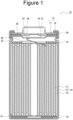
- FIG. 1 is a cross-sectional view of a non-aqueous electrolyte secondary battery as an example of an embodiment.
- FIG. 1 is a schematic cross-sectional view showing an example of a non-aqueous electrolyte secondary battery according to an embodiment.
- a non-aqueous electrolyte secondary battery 10 illustrated in FIG. 1 includes a winding-type electrode assembly 14 formed by winding a positive electrode 11 and a negative electrode 12 with a separator 13 interposed therebetween, a non-aqueous electrolyte, insulating plates 18 and 19 that are respectively disposed above and below the electrode assembly 14, and a battery case 15 housing the above-described members.
- the battery case 15 includes a bottomed cylindrical case body 16 and a sealing assembly 17 that closes an opening of the case body 16.
- an electrode assembly having another form such as a stacked electrode assembly in which positive electrodes and negative electrodes are alternately stacked with separators interposed therebetween, may be applied.
- the battery case 15 include metal cases having a cylindrical shape, a square shape, a coin shape, a button shape, or the like, and resin cases (so-called laminated type) formed by lamination with a resin sheet.
- the non-aqueous electrolyte contains, for example, a non-aqueous solvent and an electrolyte salt dissolved in the non-aqueous solvent.
- the non-aqueous solvent include esters, ethers, nitriles, amides, and a mixture of two or more thereof.
- the non-aqueous solvent may contain a halogen-substituted product in which at least some hydrogen in a solvent described above is substituted with a halogen atom such as fluorine.
- the electrolyte salt include lithium salts such as LiPF 6 . Note that the non-aqueous electrolyte is not limited to the liquid electrolyte, and may be a solid electrolyte in which a gel polymer or the like is used.
- the case body 16 is, for example, a bottomed cylindrical metal container.
- a gasket 28 is provided between the case body 16 and the sealing assembly 17 to ensure the sealing performance inside the battery.
- the case body 16 has a projecting portion 22 in which, for example, a part of the side part of the case body 16 protrudes inwards to support the sealing assembly 17.
- the projecting portion 22 is preferably formed in an annular shape in the circumferential direction of the case body 16, and supports the sealing assembly 17 on the upper surface thereof.
- the sealing assembly 17 is structured by layering, in sequence from the electrode assembly 14 side, a filter 23, a lower vent member 24, an insulating member 25, an upper vent member 26, and a cap 27.
- Each member included in the sealing assembly 17 has, for example, a disk shape or a ring shape, and the members excluding the insulating member 25 are electrically connected to each other.
- the lower vent member 24 and the upper vent member 26 are connected to each other at the respective center regions, and the insulating member 25 is interposed between the respective peripheral portions.
- the lower vent member 24 When the internal pressure of the non-aqueous electrolyte secondary battery 10 increases due to heat generated by an internal short circuit or the like, for example, the lower vent member 24 is deformed so as to push the upper vent member 26 up toward the cap 27 side and breaks, and thus the current pathway between the lower vent member 24 and the upper vent member 26 is cut off. When the internal pressure is further increased, the upper vent member 26 is broken, and gas is discharged through the opening of the cap 27.
- a positive electrode lead 20 attached to the positive electrode 11 extends through a through-hole of the insulating plate 18 toward a side of the sealing assembly 17, and a negative electrode lead 21 attached to the negative electrode 12 extends through the outside of the insulating plate 19 toward the bottom side of the case body 16.
- the positive electrode lead 20 is connected to the lower surface of the filter 23, which is the bottom plate of the sealing assembly 17, by welding or the like, and the cap 27, which is electrically connected to the filter 23 and is the top plate of the sealing assembly 17, serves as a positive electrode terminal.
- the negative electrode lead 21 is connected to a bottom inner surface of the case body 16 by welding or the like, and the case body 16 becomes a negative electrode terminal.
- the positive electrode 11 includes a positive electrode current collector such as a metal foil and a positive electrode mixture layer formed on the positive electrode current collector.
- a positive electrode current collector such as a metal foil and a positive electrode mixture layer formed on the positive electrode current collector.
- the positive electrode mixture layer includes, for example, a positive electrode active material, a binding agent, and a conductive agent.
- the positive electrode 11 is obtained by, for example, applying a positive electrode mixture slurry containing a positive electrode active material, a binding agent, a conductive agent, and the like onto a positive electrode current collector, drying the positive electrode current collector, forming a positive electrode mixture layer on the positive electrode current collector, and rolling the positive electrode mixture layer.
- the positive electrode active material includes composite particles having a composite oxide, an intermediate layer formed on the composite oxide, and a coating layer formed on the intermediate layer.
- the composite oxide contains at least one element of Ni, Mn, Co, and Al, and contains W and Li.
- a ratio of Ni, Mn, Co, and Al in the composite oxide is, for example, preferably greater than or equal to 75 mol%, and more preferably greater than or equal to 85 mol%, with respect to a total molar amount of metal elements excluding Li, from the viewpoint of increasing the capacity of the battery, suppressing deterioration in charging and discharging cycle characteristics, and the like.
- a ratio of W in the composite oxide is, for example, preferably greater than or equal to 0.01 mol%, and more preferably greater than or equal to 0.05 mol%, with respect to a total molar amount of metal elements except Li, from the viewpoint that an amount of gas generated at the time of initial charging and discharging of the battery can be further suppressed, DC resistance of the battery can be further reduced, or the like.
- An example of a suitable composite oxide includes a composite oxide represented by a general formula: Li 1+x Ma (1-z )Mb z W y O 2 (in the formula, Ma is at least one of Ni, Mn, Co, and Al, Mb is at least one of Ti, Zr, Nb, Ta, Mo, Sb, Bi, Ca, Sr, Mg, Y, Sc, and V, and x, y, and z are 0.02 ⁇ x ⁇ 0.07, 0.0005 ⁇ y ⁇ 0.01, and 0 ⁇ z ⁇ 0.1).
- An example of a more suitable composite oxide includes a composite oxide represented by a general formula: Li 1+x Ni q Mc (1-q-z )Mb z W y O 2 (in the formula, Ma is at least one of Mn, Co, and Al, Mb is at least one of Ti, Zr, Nb, Ta, Mo, Sb, Bi, Ca, Sr, Mg, Y, Sc, and V, and x, y, and z are 0.02 ⁇ x ⁇ 0.07, 0.7 ⁇ q ⁇ 0.95, 0.0005 ⁇ y ⁇ 0.01, and 0 ⁇ z ⁇ 0.1).
- the intermediate layer formed on the composite oxide is an intermediate layer that does not contain W and contains at least one element of Ca, P, and B.
- W is contained in the intermediate layer
- the amount of gas generated at the time of initial charging and discharging of the battery or DC resistance of the battery increases as compared with a case in which W is not contained in the intermediate layer.
- a ratio of the molar amount of Ca, P, and B contained in the intermediate layer to the total molar amount of the composite oxide is, for example, preferably in the range of 0.01 mol% to 1 mol%, and more preferably in the range of 0.05 mol% to 0.5 mol% from the viewpoint of further suppressing the amount of gas generated at the time of initial charging and discharging of the battery or further reducing DC resistance of the battery.
- the thickness of the intermediate layer is preferably in the range of 5 nm to 200 nm.
- the thickness of the intermediate layer is less than 5 nm, a side reaction of the composite oxide under the intermediate layer is likely to occur at the time of charging and discharging, and thus the amount of gas generated at the time of initial charging and discharging of the battery or DC resistance of the battery may increase as compared with a case in which the thickness of the intermediate layer is greater than or equal to 5 nm.
- the thickness of the intermediate layer exceeds 200 nm, the intermediate layer becomes a resistance component, so that a charging-and-discharging reaction of the composite oxide is inhibited, which may lead to deterioration in battery capacity.
- the thickness of the intermediate layer can be measured as follows.
- the positive electrode 11 or a composite particle is embedded in a resin, a cross section of the composite particle is exposed by cross section polisher (CP) processing or the like, and the cross section is imaged using a scanning electron microscope (SEM). Then, 30 composite particles are randomly selected from the cross-sectional SEM image. The thickness of the intermediate layer of each of the selected 30 composite particles is measured, and the average value thereof is calculated. Then, this average value is taken as the thickness of the intermediate layer.
- CP cross section polisher
- SEM scanning electron microscope
- a coating rate of the intermediate layer covering the composite oxide is, for example, preferably greater than or equal to 75%, and more preferably greater than or equal to 85%.
- the coating rate of the intermediate layer is less than 75%, a side reaction of the composite oxide under the intermediate layer is likely to occur at the time of charging and discharging, and thus the amount of gas generated at the time of initial charging and discharging of the battery or the DC resistance of the battery may increase as compared with a case in which the coating rate of the intermediate layer is greater than or equal to 75%.
- the coating rate of the intermediate layer formed on the composite oxide is measured by X-ray photoelectron spectroscopy (XPS).
- the coating rate is calculated from the molar fraction of the element (Ca, P, and B) of the intermediate layer with respect to a total molar amount of a metal element of the composite oxide (when the molar fraction of Ca, P, and B is 1, the surface coating rate is 100%).
- the coating layer formed on the intermediate layer is a coating layer containing W.
- the presence of the coating layer containing W on the intermediate layer suppresses the amount of gas generated at the time of initial charging and discharging of the battery and reduces the DC resistance of the battery as compared with a case in which the coating layer containing W is not present.
- a ratio of the molar amount of W in the coating layer to the total molar amount of the composite oxide is preferably in the range of 0.05 mol% to 1 mol%, and more preferably in the range of 0.05 mol% to 0.5 mol% from the viewpoint of further suppressing the amount of gas generated at the time of initial charging and discharging of the battery, further reducing the DC resistance of the battery, and the like.
- the coating rate of the coating layer formed on the intermediate layer is, for example, preferably in the range of 10% to 40%, and more preferably in the range of 10% to 25%. If the coating rate of the coating layer becomes too high, the coating layer may inhibit the charging-and-discharging reaction of the composite oxide, leading to deterioration in battery capacity.
- the coating rate of the coating layer is measured by X-ray photoelectron spectroscopy. Specifically, the coating rate is calculated from the molar fraction of the element (W) of the coating layer with respect to the total molar amount of the metal element of the composite oxide and the element (Ca, P, and B) of the intermediate layer.
- Confirmation of the composition of the composite oxide can be performed by, for example, Rietveld analysis on parameters obtained by inductively coupled plasma emission spectrometry, X-ray photoelectron spectroscopy, and powder X-ray diffraction.
- Qualitative and quantitative analysis of the intermediate layer and the coating layer can be performed by X-ray photoelectron spectroscopy, inductively coupled plasma emission spectroscopy, an electronic probe macroanalyzer (EPMA), or the like.
- the analysis by EPMA is, for example, a method of exposing a cross section of a sample to be analyzed and analyzing the cross section of the sample by EPMA mapping (cross section EPMA mapping analysis).
- hydroxide or oxide containing at least one element of Ni, Mn, Co, and Al, a Li compound, and a W compound are mixed, and the mixture thereof is fired to obtain a composite oxide containing at least one element of Ni, Mn, Co, and Al, W, and Li.
- an alkaline solution such as sodium hydroxide is added dropwise while stirring an aqueous solution such as Ni salt, Co salt, and Al salt so as to adjust pH to the alkali side (for example, 8.5 to 11.5), thereby precipitating (coprecipitating) a composite hydroxide containing Ni, Co, Al, or the like.
- the Li compound is, for example, lithium hydroxide, lithium carbonate, or the like.
- the W compound is tungsten oxide such as WO 3 .
- the firing temperature of the mixture is, for example, in the range of 500°C to 900°C, and the firing time is, for example, in the range of 1 hour to 20 hours.
- a compound containing at least one element of Ca, P, and B is deposited on the surface of the obtained composite oxide.
- the deposition method may be a wet method or a dry method, but the wet method is preferable in that the coating rate of the intermediate layer can be increased.
- a solution containing the compound containing at least one element of Ca, P, and B is dropped or sprayed onto the obtained composite oxide.
- particles in which an intermediate layer containing at least one element of Ca, P, and B is formed on the surface of the composite oxide are obtained.
- the obtained composite oxide is put into the solution containing the compound containing at least one element of Ca, P, and B, and then is stirred. After the mixture thereof is stirred, solution is filtered so as to obtain particles in which the intermediate layer containing at least one element of Ca, P, and B is formed on the surface of the composite oxide.
- the solution containing the compound containing at least one element of Ca, P, and B is preferably an alkaline solution so that the compound is easily dissolved.
- the compound containing Ca is, for example, calcium hydroxide, calcium phosphate, calcium dihydrogen phosphate, hydroxyapatite, calcium carbonate, calcium acetate, or calcium oxide
- the compound containing P is, for example, phosphoric acid, lithium phosphate, phosphonic acid, calcium phosphate, calcium dihydrogen phosphate, or hydroxyapatite
- the compound containing B is, for example, boric acid, lithium metaborate, or lithium tetraborate.
- the particles obtained as described above may be heated and dried under reduced pressure.
- the heating and drying temperature is, for example, in the range of 100°C to 300°C
- the heating and drying time is, for example, in the range of 1 hour to 5 hours.
- the deposition method may be a wet method or a dry method. However, when the coating rate of the coating layer is high, the battery capacity and the like are affected, and thus the dry method is preferable from the viewpoint of suppressing the coating rate of the coating layer.
- the obtained particles and the compound containing W are mixed, and the mixture thereof is heated and dried under reduced pressure.
- the W compound is tungsten oxide such as WOs.
- the heating and drying temperature is, for example, in the range of 100°C to 300°C, and the heating and drying time is, for example, in the range of 1 hour to 5 hours. As described above, it is possible to obtain the composite particle of the present embodiment in which the coating layer containing W is formed on the surface of the intermediate layer formed on the composite oxide.
- Examples of the conductive agent included in the positive electrode mixture layer include fibrous carbon such as carbon black, acetylene black, Ketjenblack, graphene, and carbon nanotube, and carbon materials such as graphite.
- Examples of the binding agent contained in the positive electrode mixture layer include a fluororesin such as polytetrafluoroethylene (PTFE) or polyvinylidene fluoride (PVdF), polyacrylonitrile (PAN), a polyimide-based resin, an acrylic resin, a polyolefin-based resin, styrene-butadiene rubber (SBR), carboxymethyl cellulose (CMC) or a salt thereof, polyacrylic acid (PAA) or a salt thereof (PAA-Na, PAA-K, and the like, or a partially neutralized salt may be used), polyethylene oxide (PEO), and polyvinyl alcohol (PVA).
- PTFE polytetrafluoroethylene
- PVdF polyvinylidene fluoride
- the negative electrode 12 includes, for example, a negative electrode current collector such as a metal foil and a negative electrode mixture layer formed on the negative electrode current collector.
- the negative electrode current collector may be, for example, a foil of a metal, such as copper, that is stable in a potential range of the negative electrode, a film in which the metal is disposed on its surface layer.
- the negative electrode mixture layer contains, for example, a negative electrode active material, a binding agent, and the like.
- the negative electrode 12 is obtained by, for example, applying a negative electrode mixture slurry containing a negative electrode active material, a binding agent, and the like onto a negative electrode current collector and drying the negative electrode current collector so as to form a negative electrode mixture layer on the negative electrode current collector, and rolling the negative electrode mixture layer.
- the negative electrode mixture layer may be provided on one surface of the negative electrode current collector, or may be provided on both surfaces of the negative electrode current collector.
- the negative electrode active material is, for example, a material capable of occluding and releasing lithium ions, and specific examples thereof include a carbon material, a metal capable of forming an alloy with lithium, and an alloy compound containing the metal.
- a carbon material natural graphite, non-graphitizable carbon, graphites such as artificial graphite, cokes, and the like can be used.
- the alloy compound include a compound containing at least one metal capable of forming an alloy with lithium.
- An element capable of forming an alloy with lithium is preferably silicon or tin, and silicon oxide, tin oxide, or the like in which silicon and tin are bonded to oxygen can also be used.
- a mixture of the carbon material and a compound of silicon or tin can be used.
- lithium titanate or the like can also be used.
- the same material as the positive electrode 11 may be used.
- the negative electrode mixture layer may contain a conductive agent.
- the same conductive agent as the positive electrode 11 may be used.
- the separator 13 for example, a porous sheet having an ion permeation property and an insulation property is used. Specific examples of the porous sheet include a fine porous thin film, a woven fabric, and a non-woven fabric.
- olefin-based resins such as polyethylene and polypropylene, cellulose, and the like are suitable.
- the separator 13 may be a laminate including a cellulose fiber layer and a thermoplastic resin fiber layer such as an olefin-based resin.
- the separator may be a multilayer separator including a polyethylene layer and a polypropylene layer, and a separator may be used that has a surface to which a material such as an aramid-based resin or a ceramic is applied.
- a composite oxide containing Ni, Mn, Nb, W, and Li (general formula: LiNi 0.82 Mn 0.18 TO 0.0025 W 0.005 O 2 ) was added to water, the mixture thereof was stirred, and then the solution was filtered by suction. Thereafter, a solution (concentration: 0.02 mol/L) in which calcium dihydrogen phosphate was dissolved was added and filtered again. The obtained filtered product and tungsten oxide were mixed at a molar ratio of 1:0.001, and the mixture thereof was dried at 180°C for 2 hours under reduced pressure, thereby obtaining composite particles.
- a positive electrode mixture slurry After mixing 98 parts by mass of the positive electrode active material, 1 part by mass of acetylene black (AB) as a conductive agent, and 1 part by mass of polyvinylidene fluoride as a binding agent, an appropriate amount of N-methyl-2-pyrrolidone (NMP) was added to prepare a positive electrode mixture slurry. Next, the positive electrode mixture slurry was applied onto both surfaces of a positive electrode current collector formed of an aluminum foil, and a coating film was dried and then rolled using a rolling roller. As such, a positive electrode in which a positive electrode mixture layer was formed on both surfaces of the positive electrode current collector was manufactured.
- NMP N-methyl-2-pyrrolidone
- a negative electrode mixture slurry 98 parts by mass of graphite, 1 part by mass of carboxymethyl cellulose (CMC), and 1 part by mass of styrene-butadiene rubber (SBR) were mixed to prepare a negative electrode mixture slurry.
- the negative electrode mixture slurry was applied onto both surfaces of a negative electrode current collector formed of a copper foil, and a coating film was dried and then rolled using a rolling roller. As such, a negative electrode in which a negative electrode mixture layer was formed on both surfaces of the negative electrode current collector was manufactured.
- Ethylene carbonate (EC), dimethyl carbonate (DMC), and ethyl methyl carbonate (EMC) were mixed at a volume ratio of 20:75:5.
- LiPF 6 was dissolved in the mixed solvent so as to attain a concentration of 1.3 mol/L to prepare a non-aqueous electrolyte.
- Each of the positive electrode and the negative electrode was cut into a predetermined size, an electrode lead was attached thereto, and the positive electrode and the negative electrode were wound with a separator interposed therebetween, thereby producing a winding-type electrode assembly.
- the electrode assembly was housed in an aluminum laminate film, and the non-aqueous electrolyte was injected and sealed. This was used as a non-aqueous electrolyte secondary battery of the first embodiment.
- the composite particle was obtained by the same method as in the first embodiment, except that a solution in which borate salt was dissolved (B concentration: 0.6 mol/L, pH: 10) was used instead of a solution in which calcium dihydrogen phosphate was dissolved in the preparation of the composite particles.
- B concentration: 0.6 mol/L, pH: 10 a solution in which borate salt was dissolved
- calcium dihydrogen phosphate was dissolved in the preparation of the composite particles.
- an intermediate layer containing B and not containing W was formed on the composite oxide containing Ni, Mn, Nb, W, and Li, and a coating layer containing W was formed on the intermediate layer.
- the non-aqueous electrolyte secondary battery was produced in the same manner as in the first embodiment, except that the composite particles were used as a positive electrode active material.
- the non-aqueous electrolyte secondary battery was produced in the same manner as in the first embodiment, except that the composite oxide containing Ni, Mn, Nb, W, and Li used in the first embodiment was used as a positive electrode active material.
- the composite oxide containing Ni, Mn, Nb, W, and Li used in the first embodiment and tungsten oxide were mixed at a molar ratio of 1 :0.001, and the mixture thereof was dried at 180°C for 2 hours under reduced pressure, thereby obtaining composite particles.
- the non-aqueous electrolyte secondary battery was produced in the same manner as in the first embodiment, except that the composite particles were used as a positive electrode active material.
- the composite oxide containing Ni, Mn, Nb, W, and Li (general formula: LiNi 0.82 Mn 0.18 TO 0.0025 W 0.005 O 2 ) was added to water, the mixture thereof was stirred, and then the solution was filtered by suction. Thereafter, a solution (concentration: 0.02 mol/L) in which calcium dihydrogen phosphate was dissolved was added and filtered again. The obtained filtered product was dried at 180°C for 2 hours under reduced pressure, thereby obtaining composite particles.
- the non-aqueous electrolyte secondary battery was produced in the same manner as in the first embodiment, except that the composite particles were used as a positive electrode active material.
- the filtered product obtained in the first embodiment and boric acid were mixed at a molar ratio of 1:0.01, and the mixture thereof was dried at 180°C for 2 hours under reduced pressure, thereby obtaining composite particles.
- the intermediate layer containing Ca and P and not containing W was formed on the composite oxide containing Ni, Mn, Nb, W, and Li, and a coating layer containing B and not containing W was formed on the intermediate layer.
- the non-aqueous electrolyte secondary battery was produced in the same manner as in the first embodiment, except that the composite particles were used as a positive electrode active material.
- a composite oxide containing Ni, Mn, Nb, Ca, W, and Li (general formula: LiNi 0.82 Mn 0.18 Nb 0.0025 W 0.005 Ca 0.0075 O 2 ) and boric acid were mixed at a molar ratio of 1:0.0025, and the mixture thereof was heated at 300°C for 2 hours under an oxygen atmosphere, thereby obtaining composite particles.
- the non-aqueous electrolyte secondary battery was produced in the same manner as in the first embodiment, except that the composite particles were used as a positive electrode active material.
- the composite oxide used in the fifth comparative example was added to water and stirred, and then this solution was filtered by suction. Thereafter, a solution (W concentration: 0.06 mol/L, pH: 11) in which tungsten oxide was dissolved was added, and suction filtration was performed again. The obtained filtered product and tungsten oxide were mixed at a molar ratio of 1:0.001, and the mixture thereof was dried at 180°C for 2 hours under reduced pressure, thereby obtaining composite particles.
- the non-aqueous electrolyte secondary battery was produced in the same manner as in the first embodiment, except that the composite particles were used as a positive electrode active material.
- the volumes of the non-aqueous electrolyte secondary batteries of the respective embodiments and the respective comparative examples were measured by the Archimedes method. Then, under an environmental temperature of 25°C, the non-aqueous electrolyte secondary batteries of the respective embodiments and the respective comparative examples were charged at a constant voltage at a constant current of 0.5 C until a voltage reached 4.2 V, and then charged at a constant voltage until the current reached 0.05 C. Thereafter, each of the batteries was subjected to constant current discharge at a constant current of 0.5 C until the battery voltage reached 2.5 V Then, the volumes of the non-aqueous electrolyte secondary batteries of the respective embodiments and the respective comparative examples after charging and discharging were measured by the Archimedes method.
- the amount of gas generated at the time of initial charging and discharging was calculated by subtracting the volume of the non-aqueous electrolyte secondary battery measured before charging and discharging from the volume of the non-aqueous electrolyte secondary battery measured after charging and discharging.
- the Archimedes method is a method in which an object to be measured (in this example, a non-aqueous electrolyte secondary battery) is immersed in a liquid medium (for example, distilled water, alcohol, and the like), and buoyancy received by the object to be measured is measured so as to determine the volume of the object to be measured.
- Table 1 shows the gas generation amount and the DC resistance of the battery at the time of initial charging and discharging in each of the embodiments and the comparative examples.
- Table 1 Constituent elements of composite oxide Constituent elements of intermediate layer Constituent elements of coating layer Gas generation amount [ml] DC resistance [ ⁇ ] First embodiment Ni, Mn, W, Nb, Li Ca, P W 0.030 1.92 Second embodiment Ni, Mn, W, Nb, Li B W 0.025 2.00 First comparative example Ni, Mn, W, Nb, Li - - 0.063 1.88 Second comparative example Ni, Mn, W, Nb, Li - W 0.062 1.80 Third comparative example Ni, Mn, W, Nb, Li - Ca, P 0.025 2.18 Fourth comparative example Ni, Mn, W, Nb, Li Ca, P B 0.026 2.08 Fifth comparative example Ni, Mn, W, Nb, Ca, Li - B 0.037 2.14 Sixth comparative example Ni, Mn, W, Nb, Ca, Li W W
- the amount of gas generated at the time of initial charging and discharging was small, and the DC resistance of the battery showed a low value.
- the amount of gas generated at the time of initial charging and discharging was increased, or the DC resistance of the battery was increased, so that it was not possible to achieve both suppression of the amount of gas generated at the time of initial charging and discharging of the battery and reduction of the DC resistance of the battery.
Landscapes
- Chemical & Material Sciences (AREA)
- Chemical Kinetics & Catalysis (AREA)
- Electrochemistry (AREA)
- General Chemical & Material Sciences (AREA)
- Composite Materials (AREA)
- Inorganic Chemistry (AREA)
- Engineering & Computer Science (AREA)
- Materials Engineering (AREA)
- Organic Chemistry (AREA)
- Manufacturing & Machinery (AREA)
- Battery Electrode And Active Subsutance (AREA)
Applications Claiming Priority (2)
| Application Number | Priority Date | Filing Date | Title |
|---|---|---|---|
| JP2022029605 | 2022-02-28 | ||
| PCT/JP2022/045844 WO2023162414A1 (ja) | 2022-02-28 | 2022-12-13 | 非水電解質二次電池用正極活物質及び非水電解質二次電池 |
Publications (2)
| Publication Number | Publication Date |
|---|---|
| EP4489124A1 true EP4489124A1 (de) | 2025-01-08 |
| EP4489124A4 EP4489124A4 (de) | 2025-12-24 |
Family
ID=87765477
Family Applications (1)
| Application Number | Title | Priority Date | Filing Date |
|---|---|---|---|
| EP22928931.9A Pending EP4489124A4 (de) | 2022-02-28 | 2022-12-13 | Positivelektrodenaktivmaterial für eine sekundärbatterie mit wasserfreiem elektrolyt und sekundärbatterie mit wasserfreiem elektrolyt |
Country Status (5)
| Country | Link |
|---|---|
| US (1) | US20250167226A1 (de) |
| EP (1) | EP4489124A4 (de) |
| JP (1) | JPWO2023162414A1 (de) |
| CN (1) | CN118679601A (de) |
| WO (1) | WO2023162414A1 (de) |
Family Cites Families (8)
| Publication number | Priority date | Publication date | Assignee | Title |
|---|---|---|---|---|
| JP6760140B2 (ja) * | 2017-03-06 | 2020-09-23 | トヨタ自動車株式会社 | リチウムイオン二次電池用正極材料の製造方法およびリチウムイオン二次電池用正極材料 |
| CN107895793B (zh) * | 2017-10-23 | 2021-02-02 | 格林美(无锡)能源材料有限公司 | 一种钨掺杂硼化物包覆的锂电池正极材料及其制备方法 |
| CN111056577B (zh) * | 2018-10-16 | 2022-08-16 | 三星Sdi株式会社 | 基于镍的活性材料前体、其制备方法、基于镍的活性材料、和锂二次电池 |
| JP7100808B2 (ja) * | 2019-02-08 | 2022-07-14 | トヨタ自動車株式会社 | リチウムイオン二次電池と活物質材料の製造方法 |
| CN111430679B (zh) * | 2019-11-27 | 2023-03-21 | 蜂巢能源科技有限公司 | 锂离子电池的正极材料及其制备方法 |
| CN113853700B (zh) * | 2020-03-20 | 2024-08-09 | 株式会社Lg化学 | 二次电池用正极活性材料和包含其的锂二次电池 |
| CN113764633B (zh) * | 2021-07-21 | 2023-05-09 | 广西师范大学 | 一种表面改性锂离子电池正极材料及其制备方法 |
| CN113903918B (zh) * | 2021-09-27 | 2022-05-03 | 蜂巢能源科技(马鞍山)有限公司 | 一种正极材料及其制备方法和锂离子电池 |
-
2022
- 2022-12-13 JP JP2024502852A patent/JPWO2023162414A1/ja active Pending
- 2022-12-13 WO PCT/JP2022/045844 patent/WO2023162414A1/ja not_active Ceased
- 2022-12-13 CN CN202280091373.7A patent/CN118679601A/zh active Pending
- 2022-12-13 US US18/839,615 patent/US20250167226A1/en active Pending
- 2022-12-13 EP EP22928931.9A patent/EP4489124A4/de active Pending
Also Published As
| Publication number | Publication date |
|---|---|
| US20250167226A1 (en) | 2025-05-22 |
| WO2023162414A1 (ja) | 2023-08-31 |
| JPWO2023162414A1 (de) | 2023-08-31 |
| EP4489124A4 (de) | 2025-12-24 |
| CN118679601A (zh) | 2024-09-20 |
Similar Documents
| Publication | Publication Date | Title |
|---|---|---|
| US20120251878A1 (en) | Lithium secondary battery and manufacturing method therefor | |
| CN109844999B (zh) | 蓄电元件和蓄电元件的制造方法 | |
| EP4550460A1 (de) | Sekundärbatterie mit nichtwässrigem elektrolyten | |
| EP4456196A1 (de) | Positivelektrodenaktivmaterial für sekundärbatterie und verfahren zur herstellung eines positivelektrodenaktivmaterials für sekundärbatterie | |
| EP3876332A1 (de) | Sekundärbatterie | |
| JP7320019B2 (ja) | 非水電解液二次電池およびその製造方法 | |
| JP7320020B2 (ja) | 非水電解液二次電池およびその製造方法 | |
| EP4489124A1 (de) | Positivelektrodenaktivmaterial für eine sekundärbatterie mit wasserfreiem elektrolyt und sekundärbatterie mit wasserfreiem elektrolyt | |
| CN112640164A (zh) | 非水电解质二次电池用负极活性物质、非水电解质二次电池用负极、以及非水电解质二次电池 | |
| US12322798B2 (en) | Positive electrode active material for secondary battery, and secondary battery | |
| US20230197948A1 (en) | Positive electrode active material for nonaqueous electrolyte secondary batteries, and nonaqueous electrolyte secondary battery | |
| CN119731797A (zh) | 二次电池用负极、二次电池、以及二次电池用负极的制造方法 | |
| EP3926711A1 (de) | Positivelektrode und sekundärbatterie | |
| EP4513594A1 (de) | Positivelektrodenaktivmaterial für sekundärbatterien mit wasserfreiem elektrolyt und sekundärbatterie mit wasserfreiem elektrolyt | |
| EP4593116A1 (de) | Positivelektrodenaktivmaterial für sekundärbatterie und sekundärbatterie | |
| CN113498559A (zh) | 非水电解质二次电池 | |
| EP4485575A1 (de) | Positivelektrodenaktivmaterial für eine sekundärbatterie mit wasserfreiem elektrolyt und sekundärbatterie mit wasserfreiem elektrolyt | |
| EP4693440A1 (de) | Positivelektrodenaktivmaterial für sekundärbatterien mit wasserfreiem elektrolyt und sekundärbatterie mit wasserfreiem elektrolyt | |
| EP4593117A1 (de) | Positivelektrodenaktivmaterial für sekundärbatterien und sekundärbatterie | |
| EP4629335A1 (de) | Elektrodenaktivmaterial für sekundärbatterien und sekundärbatterie | |
| EP4024530B1 (de) | Positivelektrodenaktivmaterial für sekundärbatterien mit wasserfreiem elektrolyt und sekundärbatterie mit wasserfreiem elektrolyt | |
| EP4459694A1 (de) | Positivelektrode für sekundärbatterie und verfahren zur herstellung eines positivelektrodenaktivmaterials für sekundärbatterie | |
| WO2025070060A1 (ja) | 正極活物質、及び二次電池 | |
| JPWO2020003605A1 (ja) | 電極構造体及び非水電解質二次電池 | |
| CN118922961A (zh) | 非水电解质二次电池用正极活性物质 |
Legal Events
| Date | Code | Title | Description |
|---|---|---|---|
| STAA | Information on the status of an ep patent application or granted ep patent |
Free format text: STATUS: THE INTERNATIONAL PUBLICATION HAS BEEN MADE |
|
| PUAI | Public reference made under article 153(3) epc to a published international application that has entered the european phase |
Free format text: ORIGINAL CODE: 0009012 |
|
| STAA | Information on the status of an ep patent application or granted ep patent |
Free format text: STATUS: REQUEST FOR EXAMINATION WAS MADE |
|
| 17P | Request for examination filed |
Effective date: 20240902 |
|
| AK | Designated contracting states |
Kind code of ref document: A1 Designated state(s): AL AT BE BG CH CY CZ DE DK EE ES FI FR GB GR HR HU IE IS IT LI LT LU LV MC ME MK MT NL NO PL PT RO RS SE SI SK SM TR |
|
| DAV | Request for validation of the european patent (deleted) | ||
| DAX | Request for extension of the european patent (deleted) | ||
| A4 | Supplementary search report drawn up and despatched |
Effective date: 20251121 |
|
| RIC1 | Information provided on ipc code assigned before grant |
Ipc: H01M 4/525 20100101AFI20251117BHEP Ipc: C01G 53/00 20250101ALI20251117BHEP Ipc: H01M 4/36 20060101ALI20251117BHEP Ipc: H01M 4/505 20100101ALI20251117BHEP Ipc: H01M 10/0525 20100101ALI20251117BHEP Ipc: H01M 4/131 20100101ALI20251117BHEP Ipc: C01G 53/506 20250101ALI20251117BHEP Ipc: H01M 4/02 20060101ALN20251117BHEP |