EP4487751A1 - Geschirrspülmaschine - Google Patents
Geschirrspülmaschine Download PDFInfo
- Publication number
- EP4487751A1 EP4487751A1 EP23763642.8A EP23763642A EP4487751A1 EP 4487751 A1 EP4487751 A1 EP 4487751A1 EP 23763642 A EP23763642 A EP 23763642A EP 4487751 A1 EP4487751 A1 EP 4487751A1
- Authority
- EP
- European Patent Office
- Prior art keywords
- unit
- light
- dishwasher
- casing
- manipulation
- Prior art date
- Legal status (The legal status is an assumption and is not a legal conclusion. Google has not performed a legal analysis and makes no representation as to the accuracy of the status listed.)
- Pending
Links
Images







Classifications
-
- A—HUMAN NECESSITIES
- A47—FURNITURE; DOMESTIC ARTICLES OR APPLIANCES; COFFEE MILLS; SPICE MILLS; SUCTION CLEANERS IN GENERAL
- A47L—DOMESTIC WASHING OR CLEANING; SUCTION CLEANERS IN GENERAL
- A47L15/00—Washing or rinsing machines for crockery or tableware
- A47L15/42—Details
- A47L15/4251—Details of the casing
- A47L15/4257—Details of the loading door
-
- A—HUMAN NECESSITIES
- A47—FURNITURE; DOMESTIC ARTICLES OR APPLIANCES; COFFEE MILLS; SPICE MILLS; SUCTION CLEANERS IN GENERAL
- A47L—DOMESTIC WASHING OR CLEANING; SUCTION CLEANERS IN GENERAL
- A47L15/00—Washing or rinsing machines for crockery or tableware
- A47L15/42—Details
- A47L15/4293—Arrangements for programme selection, e.g. control panels; Indication of the selected programme, programme progress or other parameters of the programme, e.g. by using display panels
-
- A—HUMAN NECESSITIES
- A47—FURNITURE; DOMESTIC ARTICLES OR APPLIANCES; COFFEE MILLS; SPICE MILLS; SUCTION CLEANERS IN GENERAL
- A47L—DOMESTIC WASHING OR CLEANING; SUCTION CLEANERS IN GENERAL
- A47L15/00—Washing or rinsing machines for crockery or tableware
- A47L15/42—Details
- A47L15/4251—Details of the casing
- A47L15/4257—Details of the loading door
- A47L15/4261—Connections of the door to the casing, e.g. door hinges
-
- A—HUMAN NECESSITIES
- A47—FURNITURE; DOMESTIC ARTICLES OR APPLIANCES; COFFEE MILLS; SPICE MILLS; SUCTION CLEANERS IN GENERAL
- A47L—DOMESTIC WASHING OR CLEANING; SUCTION CLEANERS IN GENERAL
- A47L15/00—Washing or rinsing machines for crockery or tableware
- A47L15/42—Details
- A47L15/4251—Details of the casing
- A47L15/4274—Arrangement of electrical components, e.g. control units or cables
Definitions
- the present disclosure relates to a dishwasher. More specifically, the present disclosure relates to a dishwasher having an input unit configured to may temporarily stop an operation of the dishwasher and is disposed at a position at which a user may conveniently touch the input unit even during an operation of the dishwasher.
- a dishwasher is a device that washes dishes by spraying washing water on the dish as a washing target stored therein.
- detergents may be contained in the washing water used for washing.
- the dishwasher includes a washing tub that defines a washing space, a dish rack that accommodates therein the washing target while being disposed in the washing tub, a spraying arm that sprays washing water into the dish rack, and a sump that stores therein the washing water and supplies the washing water to the spraying arm.
- the dishwasher may be equipped with a manipulation unit through which the user may input a command for operation of the dishwasher.
- the user may generally input a command signal to the dishwasher by touching a button disposed on the manipulation unit.
- a manipulation button for manipulating the dishwasher is disposed on an upper surface of the door as the most convenient position for the user to access the manipulation button.
- the dishwasher is generally positioned indoors in a built-in scheme. Therefore, when the manipulation button is located on the upper surface of the door that opens and closes the washing space of the dishwasher, it may be most convenient for the user to touch the manipulation button. For this reason, the manipulation button is generally disposed on the upper surface of the door.
- the upper surface of the door When the door is closed, the upper surface of the door may be screened by an interior structure, or an upper end structure of the dishwasher such that the manipulation button may not be accessed by the user.
- a structure is generally adopted in which the operation of the dishwasher is stopped for the user's safety when the user opens the door while the dishwasher is in operation. Therefore, while the dishwasher is in operation, the user may stop the operation of the dishwasher by opening the door.
- the operation of the dishwasher is stopped as soon as the door is opened. That is, a washing water spray device and a heated steam spray device disposed inside the dishwasher are still operating when the door is opened. Thus, when the user opens the door, there is a risk that the washing water, the heated steam and substance floating inside the dishwasher may splash onto the user.
- this input unit needs to be disposed in a position at which the user may easily access the input unit even during the operation of the dishwasher rather than on the upper end of the door as a position at which the user cannot touch the input unit during the operation of the dishwasher.
- a display device may be implemented using a light-emitting unit so that the user may recognize the position of the input unit with the naked eye even under a dark environment.
- a sensing unit configured to recognizes the user's touch is provided separately from the light-emitting unit. Therefore, the user recognizes a user input position through the light-emitting unit, and touches the sensing unit which is separate from the light-emitting unit to input a command signal to stop the dishwasher.
- the light-emitting unit requires a space in which a light-emitting device such as a LED is installed. Therefore, the light-emitting unit and the sensing unit configured to detects the user's touch cannot be disposed at the same position.
- the user intends to input the command signal to pause the dishwasher by touching the sensing unit configured to indicates a user input position.
- the sensing unit configured to indicates a user input position.
- the light-emitting unit and the sensing unit are not located at the same position.
- the user may touch the light-emitting unit.
- the command signal may not be input to the dishwasher.
- a separate mark indicating a position of the sensing unit may be disposed at the position of the sensing unit.
- a purpose of the present disclosure is to provide a dishwasher with an input unit configured to may temporarily stop the operation of the dishwasher and may be disposed in a position at which the user may conveniently touch the input unit even during the operation of the dishwasher.
- a purpose of the present disclosure is to provide a dishwasher having a structure that allows the user to touch the light-emitting unit even when the light-emitting unit configured to displays the user touch position and the sensing unit configured to detects the user's touch are spaced from each other to stop the operation of the dishwasher.
- a purpose of the present disclosure is to provide a dishwasher with a structure that enhances design aesthetics of the dishwasher by omitting a separate mark indicating the position of the sensing unit configured to detects the user's touch.
- a manipulation unit configured to receives a user's command signal may be installed at the upper end of the door of the dishwasher according to an embodiment.
- the manipulation unit may include a first input unit, a second input unit, a timer, and a handle.
- the first input unit may be provided in the manipulation unit and may receive a user's manipulation command.
- the first input unit may be mounted so as to face in a frontward direction of the dishwasher. Accordingly, the first input unit may be disposed in the manipulation unit such that a front surface of the first input unit to face a front panel.
- the second input unit may receive the user's operation command and may be mounted to face upwardly of the dishwasher. Accordingly, the second input unit may be disposed in the manipulation unit such that an upper surface of the second input unit may face an upper panel.
- a timer may provide the user with a time remaining until washing is completed, for example. Therefore, the timer may be equipped with a time display that displays the time remaining until the washing is completed. The timer may be disposed inside the manipulation unit so that a front surface of the time display faces the front panel.
- the handle may have at least a portion mounted in the manipulation unit and have an open portion of a lower surface thereof.
- a recess extending in a lateral direction of the door may be defined between an upper end of the outer panel and the manipulation unit.
- the open portion of the lower surface of the handle may communicate with the recess. Accordingly, the user may conveniently open or close the door by placing his/her hand into the handle through the recess and the open portion of the lower surface of the handle.
- the first input unit may receive a command to temporarily stop the dishwasher.
- the first input unit may recognize the touch and the dishwasher stops the operation.
- the user touches the portion of the front panel of the manipulation unit corresponding to the position of the first input unit the first input unit recognizes the touch and the dishwasher operates again.
- the first input unit may include a light-emitting unit, a sensing unit, and a conductive member.
- the light-emitting unit may emit the light to guide the user to the touch position. Since the light emitted from the light-emitting unit passes through the front panel made of a semi-transmissive material, the user may see the position of the light with his or her eyes and know the touch position.
- the sensing unit may be spaced away from the light-emitting unit and may detect the command signal from the user.
- the user's command signal may be sensed by the sensing unit, for example, in a capacitive touch recognition scheme.
- the sensing unit may detect change in current when the user's hand touches the front panel and sense the user's command signal based on the detected change.
- the conductive member may be electrically connected to the sensing unit and may transmit the user's command signal to the sensing unit.
- the conductive member may be made of a carbon material.
- the present disclosure is not limited thereto, and the conductive member may be manufactured using other conductive materials.
- the door may include a manipulation unit configured to receive a manipulation command from a user; and a first input unit disposed in the manipulation unit, wherein the first input unit may include a light-emitting unit configured to radiate light in a frontward direction of the door to guide the user to a touch position; a sensing unit disposed at a position spaced apart from a potion of the light-emitting unit and configured to detect a command signal from the user; and a conductive member electrically connected to the sensing unit so as to transmit the command signal of the user to the sensing unit.
- the conductive member may be disposed in front of the sensing unit and contacts a front surface of the sensing unit, wherein the conductive member may be disposed in front of the light-emitting unit, and passes light emitted from the light-emitting unit therethrough.
- the command signal of the user may be input to the light-emitting unit of the first input unit, and wherein the input command signal may be transmitted to from the light-emitting unit to the sensing unit through the conductive member.
- the first input unit may be disposed in the manipulation unit so that the light-emitting unit faces in a frontward direction of the door in a state in which the door closes the washing space.
- the conductive member may be formed to surround the light-emitting unit and cover the sensing unit.
- the first input unit may include a casing coupled to the manipulation unit, and constructed to accommodate therein the light-emitting unit and the sensing unit, wherein the conductive member may be disposed on an outer side surface of the casing; and a circuit board accommodated in the casing, wherein the light-emitting unit and the sensing unit may be mounted on the circuit board.
- the casing may have a first through-hole defined at a position of the casing corresponding to a position at which the light-emitting unit is disposed, wherein light emitted from the light-emitting unit passes through the first through-hole; and a second through-hole defined at a position of the casing corresponding to a position at which the sensing unit is disposed, wherein the sensing unit may be inserted into the second through-hole.
- the conductive member may include a light diffusion sheet disposed thereon at a position corresponding to a position at which the light-emitting unit may be disposed, wherein the light diffusion sheet may be made of a transmissive or semi-transmissive material through which the light emitted from the light-emitting unit passes.
- the casing may include a mounting guide protruding from an inner side surface of the casing to extend across a board receiving space of the casing, wherein the mounting guide guides a mounting position of the circuit board; and a first support protrusion protruding from an inner surface of the casing inwardly of the casing so as to support the circuit board.
- the casing may further include a second support protrusion protruding from a front outer surface of the casing and contacting an inner surface of the manipulation unit so as to support the casing.
- the manipulation unit may include a front panel constituting a front surface of the manipulation unit, wherein the casing may be disposed on an inner side surface of the front panel; and a lower panel bent from a lower end of the front panel and constituting a lower surface of the manipulation unit, wherein the front panel includes a first support protruding from the inner side surface thereof so as to support the bottom of the casing.
- the conductive member may be disposed between the front panel and the casing, wherein one side surface of the conductive member contacts the inner side surface of the front panel, and the other side surface of the model contacts the sensing unit.
- the manipulation unit may further include a handle having at least a portion received in the manipulation unit, wherein a portion of a lower surface of the handle may be open, wherein a through-hole may be defined in the lower panel of the manipulation unit at a position corresponding to a position where the open portion of the handle may be positioned.
- the casing may be positioned to be spaced apart from the handle by a predetermined distance in a lateral direction of the dishwasher.
- the manipulation unit may further include a reinforcing rib protruding from an inner upper surface of the lower panel, wherein an end of the reinforcing rib may be coupled to the inner side surface of the front panel.
- the light-emitting unit having a certain volume and the sensing unit having a certain volume may be spaced apart from each other and may be electrically connected to each other via the conductive member.
- the user may recognize the light-emitting unit based on the light therefrom, and touch the position where the light-emitting unit is located, so that the command signal may be input to the sensing unit via the conductive member.
- the user may conveniently pause or cancel the pause and restart the dishwasher by touching the position of the light-emitting unit.
- the surface of the manipulation unit may simple and neat, thereby enhancing the aesthetics of the design.
- the first input unit is disposed in the manipulation unit so as to face in the frontward direction of the door.
- the user may recognize the position of the first input unit and touch the first input unit without interference from other parts of the dishwasher or indoor structures to conveniently stop the operation of the dishwasher.
- first, second, etc. are used to describe various components, these components are not limited by these terms. These terms are merely used to distinguish one component from another component. Thus, unless specifically stated to the contrary, the first component may be the second component.
- a and/or B means A, B, or A and B, unless otherwise specified, and "C to D” means C inclusive to D inclusive unless otherwise specified.
- vertical direction refers to the vertical direction of the dishwasher when the dishwasher is installed for daily use.
- Left and right direction means the direction perpendicular to the vertical direction.
- the front-back direction means a direction perpendicular to both the vertical direction and the left-right direction.
- Bilateral direction or “lateral direction” has the same meaning as the left-right direction, and these terms may be used interchangeably with each other in the present disclosure.
- FIG. 1 is a schematic cross-sectional view of a dishwasher according to one embodiment.
- the dishwasher may include a housing that defines an outer appearance, a tub 2 disposed inside the housing and having a washing space 21 defined therein for accommodating therein a dish as a washing target, a door 3 pivotably coupled to a base 8 to selectively open and close the washing space 21, a sump 4 disposed under the tub 2 to store therein washing water, a dish rack 5 disposed in the washing space of the tub 2 to store therein the washing targets, and spraying arms 6, 7, and 9 that spray the washing water toward the washing target stored in the dish rack 5.
- the dish may be, for example, a bowl, a plate, a spoon, chopsticks, or other cooking utensils.
- the tub 2 has the washing space 21 defined therein to accommodates the dish therein, and the dish rack 5 and the spraying arms 6, 7, and 9 may be received in the washing space 21.
- the tub 2 has one open surface, and one open surface may be opened and closed by the door 3.
- the door 3 is pivotably connected to the housing to selectively open and close the washing space 21.
- a bottom of the door 3 may be hinged-coupled to the housing.
- the door 3 may pivot around the hinge to open and close the tub 2.
- the dish rack 5 may extend from the washing space of the dishwasher, and the dish rack 5 having extended from the washing space may be supported by the door 3.
- the sump 4 includes a storage 41 that stores therein the washing water, a sump cover 42 that separates the storage 41 from the tub 2, a water supply unit 43 that supplies washing water from an external source to the storage 41, a water discharger 44 that discharges the washing water in the storage 41 to the outside, and a water supply pump 45 and a flow path 46 for supplying the washing water in the storage 41 to the spraying arms 6, 7, and 9.
- the sump cover 42 may be disposed on a top of the sump 4, and may distinguish the tub 2 from the sump 4. Furthermore, the sump cover 42 may have a plurality of collection holes defined therein through which the washing water sprayed into the washing space 21 through the spraying arms 6, 7, and 9 is collected.
- the washing water sprayed from the spraying arms 6, 7, and 9 falls to the bottom of the washing space 21, and may be collected to the storage 41 of the sump 4 through the holes of the sump cover 42.
- the water supply pump 45 may be disposed on a side or a bottom of the storage 41 and may supply the washing water to the spraying arms 6, 7, and 9.
- One end of the water supply pump 45 may be connected to the storage 41 and the other end thereof may be connected to the supply flow path 46.
- An impeller 451 and a motor 453 may be provided inside the water supply pump 45. When power is supplied to the motor 453, the impeller 451 rotates, such that the washing water from the storage 41 may be supplied to the spraying arms 6, 7, and 9 through the supply flow path 46.
- the supply flow path 46 may selectively supply the washing water supplied from the water supply pump 45 to the spraying arms 6, 7, and 9.
- the supply flow path 46 may include a first supply flow path 461 connected to the lower spraying arm 6, a second supply flow path 463 connected to the upper spraying arm 7 and a top nozzle 9, and a supply flow path switching valve 465 that selectively opens and closes the supply flow paths 461 and 467.
- the supply flow path switching valve 465 may control the supply flow paths 461 and 463 to be opened sequentially or to be opened simultaneously.
- the washing space 21 may receive therein at least one dish rack 5 for storing therein dishes.
- FIG. 1 shows a dishwasher equipped with two dish racks 2. However, the present disclosure is not limited thereto.
- the dishwasher may include only one dish rack or three or more dish racks.
- the number of spraying arms may vary depending on the number of dish racks.
- the dish rack 5 may include a lower rack 51 and an upper rack 53 for storing dishes therein.
- the lower rack 51 may be disposed in the washing space 21, and the dish may be stored therein.
- the upper rack 53 may be disposed on top of the lower rack 51 and may accommodate a dish therein.
- a top rack may be disposed in a space between a top of the upper rack 53 and the top nozzle 9, and a dish may be stored therein.
- the lower rack 51 may be located on top of the sump 4, and the upper rack 53 may be located on top of the lower rack 51.
- Each of the lower rack 51, the upper rack 53, and the top rack may be configured to extend from the washing space through the open surface of the tub 2.
- a rail-type support may be disposed on an inner side surface of the tub 2, and wheels may be disposed at bottoms of the racks 51 and 53.
- the user may extend the dish rack 5 from the washing space to the outside and may store the dishes therein or take out dishes that have been washed therefrom.
- the spraying arm may be provided in the inner space of the tub 2 and may spray the washing water toward the dish in the dish rack 5.
- the spraying arm may include the lower spraying arm 6, the upper spraying arm 7, and the top nozzle 9.
- the lower spraying arm 6 may be pivotably disposed under the lower rack 51 and may spray the washing water on the dish.
- the upper spraying arm 7 may be pivotably disposed between the lower rack 51 and the upper rack 53 and may spray the washing water on the dish.
- the lower spraying arm 6 may be pivotably mounted at the sump cover 42 and may spray the washing water toward the dish stored in the lower rack 51.
- the upper spraying arm 7 may be located on top of the lower spraying arm 6 and may spray the washing water toward the dish stored in the upper rack 53.
- the top nozzle 9 is provided in a top of the washing space 21 and may spray the washing water onto the lower rack 51 and the upper rack 53.
- the first supply flow path 461 may supply the washing water to the lower spraying arm 6, and the second supply flow path 463 may supply the washing water to the upper spraying arm 7 and the top nozzle 9.
- the dishwasher may include the base 8.
- the base 8 may be disposed under the tub 2, and the tub 2 may be mounted thereon.
- the base 8 may provide a space to accommodate the sump 4 therein, and may provide a space to accommodate therein various devices such as the pump, a dry wind supply device, and other devices provided in the dishwasher.
- the base 8 may have an outer wall for supporting the entire dishwasher.
- the space for accommodating therein the various devices may be defined by the outer wall.
- FIG. 2 is a perspective view of a dishwasher according to one embodiment.
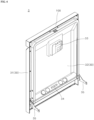
- FIG. 3 is a front perspective view of the door 3 according to one embodiment.
- FIG. 4 is a rear perspective view of the door 3 of FIG. 3 .
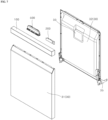
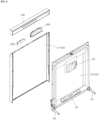
- the door 3 opens and closes the tub 2 having the washing space 21 defined therein, and may include a door body 30, a manipulation unit 100, and a hinge 35.
- the door body 30 may occupy a significant area of the door 3 and may open and close a front open surface of the tub 2.
- the hinge 35 may be mounted on a bottom of the door body 30 and may be composed a pair of hinges respectively disposed at both opposing sides of the door body 30.
- the hinge 35 may be pivotably mounted on the bottom of the tub 2, and the door 3 may pivot with respect to the tub 2 around the hinge 35, so that the door 3 may close or open the tub 2.
- the door body 30 may be formed by combining an outer panel 31 and a liner 32 with each other.
- the outer panel 31 may constitute an outer portion of the door 3, and the manipulation unit 100, which will be described later, may be mounted on an upper end of the outer panel 31.
- the liner 32 may be disposed between the outer panel 31 and the tub 2 and may be combined with the outer panel 31.
- the liner 32 may act as a seal between the door body 30 of the door 3 and the tub 2 to prevent the washing water in the washing space of the tub 2 from leaking out of the washing space of the dishwasher when the door 3 has pivoted to close the open surface of the tub 2.
- the liner 32 may be mounted on an inner surface of the door 3 to act as the seal between the tub 2 and the door 3.
- a receiving device 33 receiving and storing therein detergents, etc. may be disposed on an inner surface of the liner 32.
- the detergent contained in the receiving device 33 may be input into the washing space of the tub 2 in an amount required to washing the dish during the washing process and may be mixed with the washing water in the washing space.
- the hinges 35 may be installed on both opposing outer sides of a lower end portion of the liner 32, respectively.
- a steam injection unit 34 may be disposed on the lower end of the liner 32 and may inject the steam into the washing space of the tub 2 during the operation of the dishwasher.
- the steam injection unit 34 may be mounted on an inner surface of the lower end of the liner 32 which faces the washing space 21, so that a nozzle thereof faces the washing space 21 in the tub 2. Furthermore, the manipulation unit 100 may be mounted on an upper end of the liner 32.
- the manipulation unit 100 may be disposed on the door 3 and may receive a manipulation command from the user.
- the manipulation unit 100 may have an elongate rectangular bar shape.
- the manipulation unit may be mounted on the upper end of the door body 30.
- the manipulation unit 100 may be mounted on the upper end of the door body 30.
- the manipulation unit 100 may be coupled to the upper end of each of the outer panel 31 and the liner 32 which constitute the door body 30. Accordingly, when the outer panel 31 and the liner 32 are coupled to each other, the manipulation unit 100 may be located on the upper end of a combination of the outer panel 31 and the liner 32.
- the manipulation unit 100 may serve as a handle which the user may hold when opening and closing the door 3.
- the upper end of the outer panel 31 may have an inclined surface and the manipulation unit 100 may be coupled to an upper end of the inclined surface.
- a recess may extend in a lateral direction of the door 3 and may be defined between an upper end of a non-inclined front surface of the outer panel 31 and the manipulation unit 100.
- the user may hold the bottom of the manipulation unit 100 through the recess and may rotate the door 3 of the dishwasher around the hinge 3 to open or close the front open surface of the tub.
- a handle 500 with an open bottom which will be described later may be mounted on the manipulation unit 100.
- the manipulation unit 100 may receive a manipulation command.
- the manipulation unit 100 may operate in a touch recognition scheme. Accordingly, the manipulation unit 100 may be provided with an input unit configured to receives a user's manipulation command.
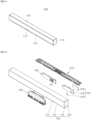
- FIG. 5 is a perspective view showing the manipulation unit 100 according to one embodiment.
- FIG. 6 is an exploded perspective view showing the manipulation unit 100 according to one embodiment.
- the manipulation unit 100 may have the elongate rectangular bar shape, may have an inner space defined therein for accommodating therein parts, and may have an open one surface. The open surface may be closed with the liner 32 when the manipulation unit 100 is mounted on the door 3.
- the manipulation unit 100 may be formed by combining panels with each other such that the space for accommodating therein components is defined by the panels. These panels may include a front panel 110, a lower panel 120, an upper panel 130, and a side panel 140. In this regard, a rear surface of the manipulation unit 100 may be open.
- the front panel 110 may constitute a front surface of the manipulation unit 100, and a casing 240 may be disposed on an inner side surface of the front panel.
- the lower panel 120 may be bent from the front panel 110 and may constitute a lower surface of the manipulation unit 100.
- the front panel 110 may constitute the front portion of the manipulation unit 100, the lower panel 120 may constitute a bottom of the manipulation unit 100, and the upper panel 130 may constitute a top of the manipulation unit 100, and the side panel 140 may block each of both opposing sides of the manipulation unit 100.
- the front panel 110, the lower panel 120, the upper panel 130, and the side panels 140 may be combined with each other to form an outer appearance of the manipulation unit 100.
- the space in which the components are accommodated may be defined by the front panel 110, the lower panel 120, the upper panel 130, and the side panels 140.
- the manipulation unit 100 may operate, for example, in a capacitive touch input scheme. Accordingly, the user may input a command signal to the dishwasher by touching the manipulation unit 100.
- Each of the panels of the manipulation unit 100 may be semi-transmissive. Thus, each of the panels of the manipulation unit 100 ensures that the parts contained in the inner space are not visible to a viewer from a design perspective. Light emitted from the light-emitting unit 210 may pass through each panel and may be perceived by the user.
- each of the panels forming the outer appearance of the manipulation unit 100 may be made of, for example, ABS material which may be semi-transmissive so that the light passes through the ABA material while the components contained in the inner space defined by the panels made of the ABA material are not visible to the user.
- the manipulation unit 100 may include a first input unit 200, a second input unit 410, a timer 420, and the handle 500.
- the first input unit 200 may be included in the manipulation unit 100 and may receive a user's manipulation command.
- the first input unit 200 may be oriented so as to face in a frontward direction of the dishwasher. Accordingly, the first input unit 200 may be positioned in the inner space defined by the panels of the manipulation unit 100 such that a front surface of the first input unit 200 faces the front panel 110.
- the second input unit 410 may receive a user's manipulation command and may be oriented so as to face upwardly of the dishwasher. Accordingly, the second input unit 410200 may be positioned in the inner space defined by the panels of the manipulation unit 100 such that an upper surface thereof faces the upper panel 130.
- the second input unit 410 may receive general command signals related to the operation of the dishwasher. Therefore, the second input unit 410 may include devices for receiving power on/off, setting of a washing time, a command for input or discharge of the washing water, and other various command, a marker for providing information related to input of a manipulation command to the user, and a lighting device that indicates an operation status of the dishwasher.
- the second input unit 410 is oriented so as to face upwardly while being disposed on the upper end of the door 3, the user opens the door 3 and conveniently touches the upper panel 130 facing the second input unit 410 to control the operation of the dishwasher.
- the timer 420 may provide the user with, for example, a time remaining until the washing is completed. Accordingly, the timer 420 may be provided with a time display 421 that displays the time remaining until the washing is completed.
- the timer 420 may be positioned in the inner space defined by the panels of the manipulation unit 100 such that a front surface thereof having the time display 421 faces the front panel 110.
- the second input unit 410 oriented so as to face upwardly of the door 3 cannot be visible to the user. This is because when the door 3 is closed, the second input unit 410 is screened with a top of the housing of the dishwasher or an indoor structure.
- the time display 421 of the timer 420 may be oriented such that a display face thereof faces the front surface of the door 3.
- the user may recognize time information while the dishwasher is operating.
- time display 421 of the timer 420 may be oriented such that the display face thereof faces the front surface of the door 3, the user may visually recognize the time information provided from the timer 420 even when the door 3 is closed.
- the handle 500 may have at least a portion mounted in the manipulation unit 100 and have an open lower surface.
- the recess may extend in the lateral direction of the door 3 and may be defined between the upper end of the non-inclined front surface of the outer panel 31 and the manipulation unit 100.
- the recess may communicate with the open lower surface of the handle 500. Accordingly, the user may conveniently open or close the door 3 by inserting his or her hand into the handle 500 through the recess and the open bottom of the handle.
- FIG. 7 is a front exploded perspective view of the door 3 according to one embodiment.
- FIG. 8 is a rear exploded perspective view of the door of FIG. 7 .
- FIG. 9 is a perspective view showing the first input unit 200 according to one embodiment.
- FIG. 10 is an exploded perspective view of FIG. 9 .
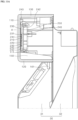
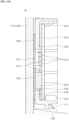
- FIG. 11A is an enlarged cross-sectional view of a portion of the door 3 according to one embodiment.
- FIG. 11B is an enlarged cross-sectional view of a portion A in FIG. 11A .
- the first input unit 200 may include a light-emitting unit 210, a sensing unit 220, and a conductive member 230.
- the light-emitting unit 210 may emit light in a frontward direction of the door 3 to guide the user to a touch position. Since the light emitted from the light-emitting unit 210 passes through the front panel 110 made of the semi-transmissive material, the user may see the position of the light with his or her eyes and know the touch position.
- the light-emitting unit 210 may be embodied as, for example, an LED (light emitting diode).
- the light-emitting unit 210 may have a structure in which a plurality of LEDs are arranged to be spaced apart from each other.
- the front surface of the first input unit 200 faces the rear surface of the front panel 110 constituting the front portion of the manipulation unit 100.
- the front surface of the first input unit 200 faces in the frontward direction of the door 3.
- the light-emitting unit 210 may radiate light in the frontward direction of the dishwasher. Therefore, in a state in which the door 3 is closed, the light from the light-emitting unit 210 may be emitted to an outside out of the dishwasher without being disturbed by a structure disposed on top of the dishwasher or the parts constituting the top of the dishwasher itself.
- the sensing unit 220 may be disposed at a position spaced apart from a position of the light-emitting unit 210 and may sense a command signal from the user.
- the user's command signal may be sensed by the sensing unit 220 in, for example, a capacitive touch recognition scheme. That is, the sensing unit 220 may detect change in current when the user's hand touches the front panel 110 and sense the user's command signal based on the detected change.
- Each of the light-emitting unit 210 and the sensing unit 220 may occupy a certain volume. Therefore, it is difficult for the light-emitting unit 210 and the sensing unit 220 to be located at the same position in the first input unit 200. For this reason, in an embodiment, the light-emitting unit 210 and the sensing unit 220 may be respectively disposed at positions spaced apart from each other in the first input unit 200.
- the sensing unit 220 In order for the sensing unit 220 to detect the user's command signal, the user needs to accurately touch a position of the front panel 110a overlapping, in a front-rear direction, a position where the sensing unit 220 is disposed.
- the user may recognize the touch position of the light-emitting unit 210 based on the light from the light-emitting unit 210.
- a command signal should be input to the sensing unit 220 located at the position spaced from the light-emitting unit 210.
- the sensing unit 220 should be electrically connected to the light-emitting unit 210.
- the first input unit 200 may be provided with the conductive member 230 that electrically connects the light-emitting unit 210 and the sensing unit 220 to each other.
- the conductive member 230 may be made of a conductive material and may have a form of a thin film. Since the light-emitting unit 210 and the sensing unit 220 are electrically connected to each other via the conductive member 230, the sensing unit 220 spaced from the light-emitting unit 210 may receive the user's command signal when the user touches the light-emitting unit 210.
- the user's command signal may be input to the light-emitting unit 210 of the first input unit 200 of the manipulation unit 100, and the input command signal may be transmitted to the sensing unit 220 through the conductive member 230.
- the light-emitting unit 210 having a certain volume and the sensing unit 220 having a certain volume may be spaced apart from each other and may be electrically connected to each other via the conductive member 230.
- the user may recognize the light-emitting unit 210 based on the light therefrom, and touch the position where the light-emitting unit 210 is located, so that the command signal may be input to the sensing unit 220 via the conductive member 230.
- the user may conveniently pause or cancel the pause and restart the dishwasher by touching the position of the light-emitting unit 210.
- the surface of the manipulation unit 100 may simple and neat, thereby enhancing the aesthetics of the design.
- the conductive member 230 may be disposed in front of the sensing unit 220 and may contact a front surface of the sensing unit 220, and may be disposed in front of the light-emitting unit 210, and may pass the light emitted from the light-emitting unit 210 therethrough.
- a light diffusion sheet 231 may be disposed on a position of the conductive member 230 overlapping, in the front-rear direction, the light-emitting unit 210.
- the command signal may be transmitted to the sensing unit 220 through the conductive member 230.
- the first input unit 200 may be disposed in the inner space of the manipulation unit 100 so that the light-emitting unit 210 faces in the frontward direction of the door 3 when the door 3 is closed.
- the first input unit 200 may be mounted in the manipulation unit 100 so that the front surface thereof faces the rear surface of the front panel 110 of the manipulation unit 100.
- the light emitted from the light-emitting unit 210 is directed the frontward direction of the door 3.
- the light emitted from the light-emitting unit 210 travels in the frontward direction of the door 3 without interference with other parts of the dishwasher or indoor structures, so that the user may touch the light-emitting unit 210 without opening the door 3.
- the user recognizes the position of the light-emitting unit 210 with his eyes without opening the door 3 and touches the light-emitting unit 210 to stop the operation of the dishwasher.
- the first input unit 200 is disposed in the manipulation unit 100 so as to face in the frontward direction of the door 3.
- the user may recognize the position of the first input unit 200 and touch the first input unit 200 without interference from other parts of the dishwasher or indoor structures to conveniently stop the operation of the dishwasher.
- the conductive member 230 may be formed to surround the light-emitting unit 210 and cover the sensing unit 220.
- the conductive member 230 may be constructed such that an area thereof corresponding to the light-emitting unit 210 is larger than an area of the light-emitting unit 210. Therefore, due to the conductive member 230, an effective touch area to the user may be larger than the area of the light-emitting unit 210, so that the user may touch the light-emitting unit 210 or a position adjacent to the light-emitting unit 210 in a relatively large area to input the command signal.
- the conductive member 230 may be constructed such that an area thereof corresponding to the sensing unit 220 may be larger than the area of the sensing unit 220. Therefore, the contact area between the conductive member 230 and the sensing unit 220 may be maximized. Thus, a possibility at which the command fails to be sent from the conductive member 230 to the sensing unit 220 due to poor contact between the conductive a portion and the sensing unit 220 may be significantly reduced.
- the sensing unit 220 may be made of a material with high elastic deformation. Therefore, the sensing unit 220 may be manufactured to have a relatively large volume and may be disposed in the manipulation unit 100. The sensing unit 220 may elastically deform so as to adhere to the conductive member 230. Accordingly, occurrence of contact failure between the conductive member and the sensing unit 220 may be suppressed.
- the first input unit 200 may include a casing 240 and a circuit board 250.
- the casing 240 may be coupled to the manipulation unit 100, and may accommodate therein the light-emitting unit 210 and the sensing unit 220.
- the conductive member 230 may be disposed on an outer side surface of the casing 240. When the casing 240 is mounted in the inner space of the manipulation unit 100, the conductive member 230 may be disposed between the front panel 110 and the casing 240.
- one side surface of the conductive member 230 may be in contact with the inner side surface of the front panel 110, while the other side surface thereof may be in contact with the sensing unit 220. Accordingly, when the user touches the position of the front panel 110 corresponding to the light-emitting unit 210, the command signal may be transmitted to the sensing unit 220 through the front panel 110 and the conductive member 230.
- the circuit board 250 may be accommodated in the casing 240.
- the light-emitting unit 210 and the sensing unit 220 may be mounted on the circuit board.
- the circuit board 250 may be connected to a control unit provided in the dishwasher and may transmit the command signal input from the user to the control unit.
- a first through-hole 244 and a second through-hole 245 may be defined in the casing 240.
- the first through-hole 244 may be formed at a position corresponding to a position where the light-emitting unit 210 is disposed, and may be provided to allow light emitted from the light-emitting unit 210 to pass therethrough.
- the second through-hole 245 may be formed at a position corresponding to a position where the sensing unit 220 is disposed, and the sensing unit 220 may be inserted into the second through-hole.
- the first through-hole 244 and the second through-hole 245 may be covered with the conductive member 230 disposed on the front surface of the casing 240.
- the light emitted from the light-emitting unit 210 may pass through the casing 240 through the first through-hole 244 and be directed in a frontward direction of the manipulation unit 100.
- the sensing unit 220 may extend through the casing 240 through the second through-hole 245, and the front surface of the sensing unit 220 may be in contact with the conductive member 230.
- the conductive member 230 may include the light diffusion sheet 231.
- the light diffusion sheet 231 may be disposed at a position corresponding to a position where the light-emitting unit 210 is disposed and may be made of a transmissive or semi-transmissive material so that the light emitted from the light-emitting unit 210 may pass therethrough.
- the light diffusion sheet 231 may allow the light emitted from the light-emitting unit 210 to be spread uniformly. Accordingly, the light having passed through the light diffusion sheet 231 may have a uniform pattern and uniform illuminance throughout the optical diffusion sheet.
- the light diffusion sheet 231 may be made of a conductive material. Therefore, when the user touches a position of the front panel corresponding to the position of the light-emitting unit 210, a command signal may be input to the light diffusion sheet 231 and then may be transmitted from there light diffusion sheet to the sensing unit 220.
- the light diffusion sheet 231 is transmissive or semi-transmissive and is made of the conductive material
- the light diffusion sheet 231 may be made of, for example, indium thin oxide (ITO).
- the liner 32 of the door 3 may extend upwardly beyond the upper end of the outer panel 31. Due to this structure, a space where the manipulation unit 100 may be mounted may be formed on top of the upper end of the outer panel 31 and on a front surface of the upper end of the liner 32.
- the manipulation unit 100 may be disposed in the space defined on top of the upper end of the outer panel 31 and on a front surface of the upper end of the liner 32 and may be coupled to each of the outer panel 31 and the liner 32. Due to this structure, the user may conveniently access the manipulation unit 100 and may easily touch the manipulation unit 100 to control the operation of the dishwasher.
- a rear portion of the manipulation unit 100 may be coupled to the front surface of the upper end of the liner 32.
- the manipulation unit 100 may be firmly coupled to the liner 32 via a coupling member such as a bolt, and may be detachably coupled to each other.
- an inserted protrusion 161 may protrude downwardly from a bottom of the lower panel of the manipulation unit 100, and the inserted protrusion 161 may be inserted into a hole formed in the upper end of the outer panel 31.
- the manipulation unit 100 may be fastened to the upper end of the outer panel 31 via the inserted protrusion 161.
- the manipulation unit 100 In mounting the manipulation unit 100 on the door 3, first, the manipulation unit 100 may be installed on top of the outer panel 31 while the inserted protrusion 161 is inserted into the hole formed in the upper end of the outer panel 31, and then, the manipulation unit 100 and the liner 32 may be coupled to each other using a coupling member. Accordingly, the manipulation unit 100 may be stably and firmly mounted on a top of the door 3.
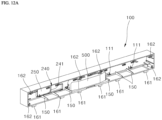
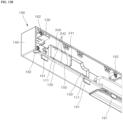
- FIG. 12A is a perspective view showing the manipulation unit 100 and parts mounted in the manipulation unit 100 according to an embodiment.
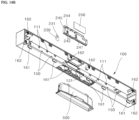
- FIG. 12B is a view of FIG. 12A in a different view direction from a view direction of FIG. 12A .
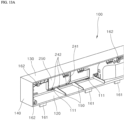
- FIG. 13A is an enlarged view of a portion of FIG. 12A .
- FIG. 13B is an enlarged view of a portion of FIG. 12B .
- FIG. 14A is an exploded perspective view of FIG. 12A .
- FIG. 14B is an exploded perspective view of FIG. 12B .
- FIG. 15 is a perspective view of FIG. 14A in a different view direction from a view direction of FIG. 14A .
- the casing 240 may be provided with a mounting guide 241 and a first support protrusion 242.
- the mounting guide 241 may protrude from the inner side surface of the casing 240 so as to extend across a board receiving space of the casing 240, and may guide a mounting position of the circuit board 250.
- a portion of the circuit board 250 may be fitted with the mounting guide 241 such that the circuit board 250 may be stably received in the board receiving space of the casing 240.
- the circuit board 250 may be received in the receiving space of the casing 240. Therefore, this receiving space may be formed to have a space corresponding to the shape of the circuit board 250.
- the mounting guide 241 may have an inclined portion, and the circuit board 250 may have an inclinedly extending groove at a position corresponding to a position of the inclined surface of the mounting guide 241. Due to this structure, an alignment between the circuit board 250 and the mounting guide 241 when the circuit board 250 is fitted with the mounting guide 241 may be easily achieved based on the inclined portions. Accordingly, the worker assembling the first input unit 200 may conveniently mount the circuit board 250 into the casing 240 while achieving the alignment between the circuit board 250 and the mounting guide 241 based on the inclined portion of the mounting guide 241.
- the first support protrusion 242 may protrude from the inner surface of the casing 240 inwardly of the casing 240 and may support the circuit board 250.
- the first support protrusion 242 may be provided in aa shape of a hook.
- the circuit board 250 may be fitted into the board receiving space of the casing 240 while being engaged with the first support protrusion 242.
- the first support protrusion 242 may prevent the circuit board 250 from being removed from the casing 240 so that the circuit board 250 may be maintained in the firmly fitted into the board receiving space of the casing 240.
- the first support protrusion 242 may be formed at each of lower and upper ends of the casing 240, and may protrude inwardly of the casing 240.
- the first support protrusion 242 formed at the upper end of the casing 240 may be provided to be elastically deformable.
- the first support protrusion 242 formed at the upper end of the casing elastically deforms, and thus the circuit board 250 may be fitted into the board receiving space.
- the first support protrusion 242 at the upper end may be restored to its original shape.
- the upper and lower first support protrusions 242 may elastically press and support the rear surface of the circuit board 250. Accordingly, the circuit board 250 may be stably supported by the upper and lower first support protrusions 242.
- a gap may occur between an outer edge of the circuit board 250 and the casing 240. Through this gap, moisture from the tub 2 may flow into the sensing unit 220.
- the moisture flowing into the sensing unit 220 may deteriorate the performance of the sensing unit 220 or cause malfunction or failure thereof. Therefore, it is necessary to prevent the inflow of the moisture into the sensing unit 220.
- the gap between the edge of the circuit board 250 and the casing 240 may be sealed to prevent the moisture from flowing into the sensing unit 220 through the gap.
- This sealing structure may be implemented, for example, by placing a sealing member made of silicon on the edge of the circuit board 250.
- silicon may be applied into the gap between the edge of the circuit board 250 and the casing 240 to form a sealing structure.
- the manipulation unit 100 may include an inserted protrusion 161 and a fastening hole 162.
- the inserted protrusion 161 may protrude from the lower panel 120 of the manipulation unit 100 and may be provided in a plural manner.
- the inserted protrusions 161 may be arranged to be spaced apart from each other in a longitudinal direction of the manipulation unit 100.
- the inserted protrusion 161 may be inserted into a hole formed in the upper end of the outer panel 31, and thus the manipulation unit 100 may be coupled to the outer panel 31.
- the fastening hole 162 may be formed in the rear surface of the rear panel of the manipulation unit 100 and may face toward the liner 32, and may be provided in a plural manner.
- the fastening holes 162 may be arranged to be spaced apart from each other in the longitudinal direction of the manipulation unit 100.
- a coupling member such as a bolt may be fastened into the fastening hole 162.
- the coupling member may be inserted into and pass through each of the hole formed at the front surface of the upper end of the liner 32 and the fastening hole 162, and thus may couple the manipulation unit 100 to the liner 32.
- the inserted protrusion 161 may be inserted into the hole formed in the upper end of the outer panel 31, and thus the manipulation unit 100 may be coupled to the outer panel 31.
- the coupling member may be inserted into and pass through each of the hole formed at the front surface of the upper end of the liner 32 and the fastening hole 162, and thus may couple the manipulation unit 100 to the liner 32. Due to this structure, the manipulation unit 100 may be stably mounted on the door 3.
- the front panel 110 of the manipulation unit 100 may constitute the front surface of the manipulation unit 100, and the casing 240 may be mounted on the rear surface of the front panel.
- the lower panel 120 of the manipulation unit 100 may be bent from the front panel 110 and constitute the lower surface of the manipulation unit 100.
- the front panel 110 may include a first support 111 that protrudes from the inner side surface thereof and supports the bottom of the casing 240.
- a plurality of first supports may be arranged in the longitudinal direction of the manipulation unit 100.
- the casing 240 may be maintained in the mounted state inside the manipulation unit 100 while being supported on the first supports 111.
- the first support 111 may be provided in a hook shape. Therefore, when the worker places the casing 240 at the mounting position of the manipulation unit 100 and presses the casing, the casing 240 may be mounted in the manipulation unit 100 so as to be held by the first supports 111. Thus, the first support 111 may prevent the casing 240 from being removed from the manipulation unit 100 so that the casing 240 may be maintained in the mounted state in the manipulation unit 100.
- the handle 500 may be accommodated in the inner space defined by the panels of the manipulation unit 100 and may have a lower surface having an open portion.
- a through-hole 121 may be formed in the lower panel 120 of the manipulation unit 100 at a position thereof overlapping a position where the open portion of the lower surface of the handle 500 is disposed.
- the handle 500 may be disposed in the inner space of the manipulation unit 100, the user may put his hand into the manipulation unit 100 through the through-hole 121 and the open portion of the lower surface of the handle 500, and grab the handle, and rotate the door 3 to open or close the open front surface of the tub.
- the handle 500 may be located at a center of the upper end of the door 3 and a center of the manipulation unit 100 for the user's convenience and to ensure that a uniform force is transmitted to each of the pair of hinges 35 to rotate the door 3 smoothly to open or close the washing space.
- the through-hole 121 may also be disposed in the central of the manipulation unit 100.
- the casing 240 and the handle 500 may be disposed at the same position. Thus, due to the respective volumes of the casing 240 and the handle 500, a total volume of the door 3 may increase.
- the user may put his/her hand through the open portion of the handle 500 and grasp the handle such that the thumb come into unintentional contact with the first input unit 200 positioned at the same position as the handle or at a position adjacent thereto. Such contact may cause the dishwasher to unintentionally stop the operation or resume the operation from a stopped state.
- the casing 240 may be positioned to be spaced apart from the handle 500 by a predetermined distance in the lateral direction of the dishwasher. Accordingly, the casing 240 may be disposed adjacent to one of both opposing ends in the lateral direction of the manipulation unit 100 so as to be spaced away from the center of the manipulation unit 100.
- a distance in the dishwasher's lateral direction between the casing 240 and the handle 500 should be large so as to prevent the user's thumb from unintentionally contacting the first input unit 200 when the user holds the handle 500.
- the first input unit 200 may be disposed on a left side of the handle 500 in a rear view of the manipulation unit 100. In another embodiment, the first input unit 200 may be disposed on a right side of the handle 500 in the rear view of the manipulation unit 100. Even in this case, a distance in the dishwasher's lateral direction between the casing 240 and the handle 500 should be large so as to prevent the user's thumb from unintentionally contacting the first input unit 200 when the user holds the handle 500.
- the manipulation unit 100 Since other parts may be mounted in the inner space of the manipulation unit 100, it may be useful for the manipulation unit 100 to be provided with a plurality of positions at which the first input unit 200 is mounted. Accordingly, in the manipulation unit 100, the first input unit 200 may be mounted on either the left or right side of the handle 500, thereby diversifying the position of the first input unit 200 in the manipulation unit 100 to increase space use efficiency in the manipulation unit 100.
- the first support 111 for supporting the first input unit 200 may be disposed on the right side of the handle 500, and this first support 111 may be provided in a plural manner.
- the plurality of first supports 111 may be arranged so as to be spaced form each other by a predetermined distance in the longitudinal direction of the manipulation unit 100 along an entirety of the manipulation unit 100 except for a position where the handle 500 is disposed.
- the casing 240 may include a second support protrusion 243.
- the second support protrusion 243 may protrude upwardly from the outer side surface of the casing 240 and may support the casing 240 while contacting the inner side surface of the manipulation unit 100.
- the second support protrusion 243 may be provided in a plural manner.
- the second support protrusions 243 protruding upwardly of the casing 240 may be in contact with the front panel of the manipulation unit 100 so as to support the casing 240.
- the first supports 111 protruding from the front panel of the manipulation unit 100 may be in contact with the bottom of the casing 240 to support the casing 240.
- the casing 240 may be stably supported by the second supports 243 and the first supports 111 and thus may be maintained in the mounted state in the manipulation unit 100.
- the manipulation unit 100 may further include a reinforcing rib 150.
- the reinforcing rib 150 may protrude upwardly from an inner upper surface of the lower panel 120 and an end of the rib 150 may be coupled to the inner side surface of the front panel 110.
- a plurality of reinforcing ribs 150 may be provided, and the reinforcing ribs 150 may be arranged so as to be spaced from each other by a predetermined spacing in the longitudinal direction of the manipulation unit 100, that is, in the lateral direction of the door 3.
- the lower panel 120 may support loads of a plurality of components accommodated in the manipulation unit 100, including the first input unit 200. Additionally, the lower panel 120 needs to be stably coupled to the outer panel 31. For this reason, the lower panel 120 should not be deformed under an external force.
Landscapes
- Washing And Drying Of Tableware (AREA)
Applications Claiming Priority (2)
| Application Number | Priority Date | Filing Date | Title |
|---|---|---|---|
| KR1020220027872A KR20230130819A (ko) | 2022-03-04 | 2022-03-04 | 식기세척기 |
| PCT/KR2023/001754 WO2023167443A1 (ko) | 2022-03-04 | 2023-02-07 | 식기세척기 |
Publications (2)
| Publication Number | Publication Date |
|---|---|
| EP4487751A1 true EP4487751A1 (de) | 2025-01-08 |
| EP4487751A4 EP4487751A4 (de) | 2025-06-18 |
Family
ID=87883989
Family Applications (1)
| Application Number | Title | Priority Date | Filing Date |
|---|---|---|---|
| EP23763642.8A Pending EP4487751A4 (de) | 2022-03-04 | 2023-02-07 | Geschirrspülmaschine |
Country Status (4)
| Country | Link |
|---|---|
| US (1) | US20250160606A1 (de) |
| EP (1) | EP4487751A4 (de) |
| KR (1) | KR20230130819A (de) |
| WO (1) | WO2023167443A1 (de) |
Families Citing this family (1)
| Publication number | Priority date | Publication date | Assignee | Title |
|---|---|---|---|---|
| US12575710B2 (en) * | 2024-06-13 | 2026-03-17 | Whirlpool Corporation | Dishwasher with door assembly |
Family Cites Families (14)
| Publication number | Priority date | Publication date | Assignee | Title |
|---|---|---|---|---|
| DE10326684A1 (de) * | 2003-06-03 | 2004-12-23 | Ego Control Systems Gmbh + Co. Kg | Sensorvorrichtung |
| KR20050074213A (ko) * | 2004-01-13 | 2005-07-18 | 동양매직 주식회사 | 식기 세척기의 물튐 방지 장치 및 그 방법 |
| JP2010146780A (ja) * | 2008-12-17 | 2010-07-01 | Panasonic Corp | 家庭電化製品の入力表示装置 |
| KR20110100383A (ko) * | 2010-03-04 | 2011-09-14 | 삼성전자주식회사 | 빌트인 타입의 식기세척기 |
| EP2458060B1 (de) * | 2010-11-29 | 2016-02-17 | Electrolux Home Products Corporation N.V. | Steuertafelanordnung für Haushaltanwendungen und Haushaltanwendung mit einer derartigen Steuertafelanordnung |
| KR101880082B1 (ko) * | 2012-03-27 | 2018-07-20 | 삼성전자주식회사 | 세탁기 |
| DE102012223779A1 (de) * | 2012-12-19 | 2014-06-26 | BSH Bosch und Siemens Hausgeräte GmbH | Haushaltsgerät mit kapazitivem Bedienpanel und Verfahren zu seiner Herstellung |
| DE102016113162A1 (de) * | 2015-07-28 | 2017-02-02 | Schott Ag | Bedienblende für ein Haushaltsgerät mit zumindest einer Benutzerschnittstelle, Haushaltsgerät und Verfahren zur Herstellung der Bedienblende mit Benutzerschnittstelle |
| KR102416688B1 (ko) * | 2016-01-06 | 2022-07-05 | 엘지전자 주식회사 | 식기세척기 |
| KR101815383B1 (ko) * | 2016-06-30 | 2018-01-30 | 엘지전자 주식회사 | 냉장고 및 냉장고 디스플레이 어셈블리 |
| DE102016216035A1 (de) * | 2016-08-25 | 2018-03-01 | E.G.O. Elektro-Gerätebau GmbH | Elektrogerät, Anordnung eines solchen Elektrogeräts mit einer Blende und Verfahren zur Herstellung einer solchen Anordnung |
| DE102020210758A1 (de) * | 2020-08-25 | 2022-03-03 | BSH Hausgeräte GmbH | Blendenverbund für eine Geschirrspülmaschine, Verfahren zur Montage eines Blendenverbunds sowie Geschirrspülmaschine mit einem solchen Blendenverbund |
| JP7647776B2 (ja) * | 2021-02-02 | 2025-03-18 | 株式会社村田製作所 | 電子部品の製造方法 |
| US12011133B2 (en) * | 2021-06-21 | 2024-06-18 | Haier Us Appliance Solutions, Inc. | Retention clip for a circuit board edge connector |
-
2022
- 2022-03-04 KR KR1020220027872A patent/KR20230130819A/ko active Pending
-
2023
- 2023-02-07 US US18/843,607 patent/US20250160606A1/en active Pending
- 2023-02-07 WO PCT/KR2023/001754 patent/WO2023167443A1/ko not_active Ceased
- 2023-02-07 EP EP23763642.8A patent/EP4487751A4/de active Pending
Also Published As
| Publication number | Publication date |
|---|---|
| WO2023167443A1 (ko) | 2023-09-07 |
| KR20230130819A (ko) | 2023-09-12 |
| US20250160606A1 (en) | 2025-05-22 |
| EP4487751A4 (de) | 2025-06-18 |
Similar Documents
| Publication | Publication Date | Title |
|---|---|---|
| EP2893864B1 (de) | Haushaltsgerät mit Anzeigeeinheit | |
| KR101836592B1 (ko) | 냉장고 | |
| EP2355686B1 (de) | Konsolenanordnung für eine geschirrspülvorrichtung und zugeordnetes gerät | |
| KR102416688B1 (ko) | 식기세척기 | |
| US20080225016A1 (en) | Control panel and washing machine having the same | |
| CN207987545U (zh) | 电器设备 | |
| JP6591736B2 (ja) | 操作パネル及び洗濯機 | |
| US20250160606A1 (en) | Dishwasher | |
| CN217040028U (zh) | 一种洗碗机 | |
| JP2022031524A (ja) | 冷蔵庫 | |
| US11547001B2 (en) | Consumer appliance and touch panel interface | |
| CN114569036B (zh) | 洗碗机及其控制方法 | |
| KR102280561B1 (ko) | 컨트롤 패널 장치 및 이를 구비한 세탁기 | |
| WO2020135376A1 (zh) | 一种衣物处理装置 | |
| RU2850040C2 (ru) | Устройство для обработки белья | |
| KR102671181B1 (ko) | 식기세척기 |
Legal Events
| Date | Code | Title | Description |
|---|---|---|---|
| STAA | Information on the status of an ep patent application or granted ep patent |
Free format text: STATUS: THE INTERNATIONAL PUBLICATION HAS BEEN MADE |
|
| PUAI | Public reference made under article 153(3) epc to a published international application that has entered the european phase |
Free format text: ORIGINAL CODE: 0009012 |
|
| STAA | Information on the status of an ep patent application or granted ep patent |
Free format text: STATUS: REQUEST FOR EXAMINATION WAS MADE |
|
| 17P | Request for examination filed |
Effective date: 20241003 |
|
| AK | Designated contracting states |
Kind code of ref document: A1 Designated state(s): AL AT BE BG CH CY CZ DE DK EE ES FI FR GB GR HR HU IE IS IT LI LT LU LV MC ME MK MT NL NO PL PT RO RS SE SI SK SM TR |
|
| DAV | Request for validation of the european patent (deleted) | ||
| DAX | Request for extension of the european patent (deleted) | ||
| A4 | Supplementary search report drawn up and despatched |
Effective date: 20250520 |
|
| RIC1 | Information provided on ipc code assigned before grant |
Ipc: A47L 15/42 20060101AFI20250514BHEP |