EP4484318A1 - Öffnungsvorrichtung für eine verpackung und verpackung mit einer öffnungsvorrichtung - Google Patents
Öffnungsvorrichtung für eine verpackung und verpackung mit einer öffnungsvorrichtung Download PDFInfo
- Publication number
- EP4484318A1 EP4484318A1 EP24182317.8A EP24182317A EP4484318A1 EP 4484318 A1 EP4484318 A1 EP 4484318A1 EP 24182317 A EP24182317 A EP 24182317A EP 4484318 A1 EP4484318 A1 EP 4484318A1
- Authority
- EP
- European Patent Office
- Prior art keywords
- lid
- opening device
- radial protrusion
- rim
- end portion
- Prior art date
- Legal status (The legal status is an assumption and is not a legal conclusion. Google has not performed a legal analysis and makes no representation as to the accuracy of the status listed.)
- Pending
Links
Images

Classifications
-
- B—PERFORMING OPERATIONS; TRANSPORTING
- B65—CONVEYING; PACKING; STORING; HANDLING THIN OR FILAMENTARY MATERIAL
- B65D—CONTAINERS FOR STORAGE OR TRANSPORT OF ARTICLES OR MATERIALS, e.g. BAGS, BARRELS, BOTTLES, BOXES, CANS, CARTONS, CRATES, DRUMS, JARS, TANKS, HOPPERS, FORWARDING CONTAINERS; ACCESSORIES, CLOSURES, OR FITTINGS THEREFOR; PACKAGING ELEMENTS; PACKAGES
- B65D5/00—Rigid or semi-rigid containers of polygonal cross-section, e.g. boxes, cartons or trays, formed by folding or erecting one or more blanks made of paper
- B65D5/42—Details of containers or of foldable or erectable container blanks
- B65D5/72—Contents-dispensing means
- B65D5/74—Spouts
- B65D5/746—Spouts formed separately from the container
-
- B—PERFORMING OPERATIONS; TRANSPORTING
- B65—CONVEYING; PACKING; STORING; HANDLING THIN OR FILAMENTARY MATERIAL
- B65D—CONTAINERS FOR STORAGE OR TRANSPORT OF ARTICLES OR MATERIALS, e.g. BAGS, BARRELS, BOTTLES, BOXES, CANS, CARTONS, CRATES, DRUMS, JARS, TANKS, HOPPERS, FORWARDING CONTAINERS; ACCESSORIES, CLOSURES, OR FITTINGS THEREFOR; PACKAGING ELEMENTS; PACKAGES
- B65D55/00—Accessories for container closures not otherwise provided for
- B65D55/02—Locking devices; Means for discouraging or indicating unauthorised opening or removal of closure
- B65D55/024—Closures in which a part has to be ruptured to gain access to the contents
-
- B—PERFORMING OPERATIONS; TRANSPORTING
- B65—CONVEYING; PACKING; STORING; HANDLING THIN OR FILAMENTARY MATERIAL
- B65D—CONTAINERS FOR STORAGE OR TRANSPORT OF ARTICLES OR MATERIALS, e.g. BAGS, BARRELS, BOTTLES, BOXES, CANS, CARTONS, CRATES, DRUMS, JARS, TANKS, HOPPERS, FORWARDING CONTAINERS; ACCESSORIES, CLOSURES, OR FITTINGS THEREFOR; PACKAGING ELEMENTS; PACKAGES
- B65D2401/00—Tamper-indicating means
- B65D2401/15—Tearable part of the closure
Definitions
- the present invention relates to an opening device for a package, preferentially a package having a main body formed from a multilayer packaging material, filled with a pourable product, even more particular filled with a pourable food product.
- the present invention also relates to a package, preferentially a package having a main body formed from a multilayer packaging material, filled with a pourable product, even more particular filled with a pourable food product, and comprising an opening device.
- liquid or pourable food products such as fruit juice, UHT (ultra-high-temperature treated) milk, wine, tomato sauce, etc.
- packages in particular sealed packages, made of sterilized packaging material.
- a typical example is the parallelepiped-shaped package for pourable food products known as Tetra Brik Aseptic (registered trademark), which is made by sealing and folding a laminated strip packaging material.
- the packaging material has a multilayer structure comprising a carton and/or paper base layer, covered on both sides with layers of heat-seal plastic material, e.g. polyethylene.
- the packaging material also comprises a layer of oxygen-barrier material, e.g. an aluminum foil, which is superimposed on a layer of heat-seal plastic material, and is in turn covered with another layer of heat-seal plastic material forming the inner face of the package eventually contacting the food product.
- Some of the known packages also comprise an opening device, which is configured to allow for a controlled outpouring of the pourable product from the package.
- Such packages are e.g. described in the European patent application EP-A-4001150 by the same Applicant.
- the European patent application describes packages comprising a main body having a designated pour opening and an opening device arranged on the main body about the designated pour opening and configured to allow for a controlled outpouring of the pourable product.
- the opening device comprises a collar having a pouring outlet and a lid removably connected to the collar so as to selectively close and open the pouring outlet.
- the lid is controllable between a closed position and an open position in which the lid, respectively, closes and opens a pouring outlet of the collar. Prior to the first-time control of the lid from the closed position to the open position, the lid is rupturably sealed to the collar. This allows to guarantee that the pourable product is secured from the outer environment.
- the user needs to exert a force such that the lid separates from the collar.
- an opening device according to the independent claim.
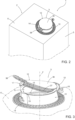
- Number 1 indicates as a whole a package comprising:
- main body 2 may be filled with a pourable product, preferentially a pourable food product, such as milk, milk-drinks, yoghurt, yoghurt-drinks, wine, juice, beverages with pulp, tomato sauce, sugar, salt, etc.
- a pourable food product such as milk, milk-drinks, yoghurt, yoghurt-drinks, wine, juice, beverages with pulp, tomato sauce, sugar, salt, etc.
- main body 2 may have a designated pour opening (not shown and known as such) configured to allow for an outflow of the pourable product from main body 2 and opening device 3 may be arranged and/or arrangeable about the designated pour opening and configured to allow for a controlled outpouring of the pourable product from main body 2.
- a designated pour opening (not shown and known as such) configured to allow for an outflow of the pourable product from main body 2
- opening device 3 may be arranged and/or arrangeable about the designated pour opening and configured to allow for a controlled outpouring of the pourable product from main body 2.
- main body 2 may be obtained from a packaging material, preferentially a composite packaging material, having a multilayer structure (not shown and known as such).
- the packaging material may be provided in the form of a web and/or a sheet.
- main body 2 may be obtained by forming a tube from the packaging material, longitudinally sealing the tube, filling the tube with the pourable product and by transversally sealing and cutting the tube.
- the packaging material may be sterilized and/or cleaned prior to forming, longitudinally sealing, filling and transversally sealing and cutting the tube.
- the packaging material may comprise at least one layer of fibrous material, such as e.g. paper or cardboard, and at least two layers of heat-seal plastic material, e.g. polyethylene, interposing the layer of fibrous material in between one another.
- fibrous material such as e.g. paper or cardboard
- heat-seal plastic material e.g. polyethylene
- the packaging material may also comprise a layer of gas- and light-barrier material, e.g. aluminum foil or ethylene vinyl alcohol (EVOH) film, in particular being arranged between one of the layers of the heat-seal plastic material and the layer of fibrous material.
- the packaging material may also comprise a further layer of heat-seal plastic material being interposed between the layer of gas- and light-barrier material and the layer of fibrous material.
- opening device(s) 3 may be applied to the packaging material prior to arranging the packaging material within or during advancement of the packaging material through a packaging machine for forming, filling and sealing main body(ies) 2 from the packaging material carrying opening device(s) 3.
- opening device(s) 3 may be applied to the packaging material during the formation of main body (ies) 2 from the packaging material.
- opening device(s) 3 may occur by means of a molding process and/or adhesive bonding and/or ultrasonic sealing.
- opening device(s) 3 may be molded to the packaging material.
- main body 2 may extend along a longitudinal axis A, a first transversal axis B perpendicular to longitudinal axis A and a second transversal axis C perpendicular to longitudinal axis A and to first transversal axis B.
- the size of package 2 along longitudinal axis A may be larger than the size of package 2 along first transversal axis B and second transversal axis C.
- main body 2 may be parallelepiped-shaped.
- main body 2 comprises a first wall portion 4, preferentially transversal, more preferentially perpendicular, to longitudinal axis A, from which main body 2 extends along longitudinal axis A.
- first wall portion 4 may define a support surface of package 1, in particular of main body 2, which is designed to be put in contact with a support, such as e.g. a shelf, when, in use, being e.g. exposed within a sales point or when being stored.
- a support such as e.g. a shelf
- main body 2 may also comprise a side wall 5 being (fixedly) connected to first wall portion 4, which may extend from first wall portion 4, preferentially along longitudinal axis A.
- main body 2 may also comprise a second wall portion 6 opposite to first wall portion 4 and being (fixedly) connected to side wall 5.
- side wall 5 may be interposed between first wall portion 4 and second wall portion 6.
- main body 2 when main body 2 is arranged on a support second wall portion 6 defines a top wall portion.
- second wall portion 6 may be inclined with respect to first wall portion 4 and/or longitudinal axis A.
- second wall portion 6 may define a slanted top.
- first wall portion 4 and second wall portion 6 may be parallel to one another.
- second wall portion 6 carries opening device 3, preferentially because second wall portion 6 may comprise the designated pour opening.
- opening device 3 comprises at least:
- lid 12 may be controllable between at least a closed position (see Figures 1 and 2 ) in which lid 12 is configured to close pouring outlet 11, in particular for impeding an outflow of the pourable product through pouring outlet 11, and an open position (see Figures 4 and 5 ) in which lid 12 is configured to open pouring outlet 11 (i.e. lid 12 is detached from pouring outlet 11), in particular for allowing an outflow of the pourable product through pouring outlet 11.
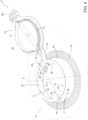
- collar 10 comprises a rim 13 (see Figures 3 to 5 ) delimiting pouring outlet 11.
- lid 12 is rupturably fixed to collar 10, preferentially rim 13, in particular prior to a first-time control of lid 12 from the closed position to the open position.
- lid 12 is connected to collar 10, e.g. by means of a rupturable coupling membrane.
- collar 10, lid 12 and the rupturable coupling membrane may be made as a single piece.
- collar 10, lid 12 and the rupturable coupling membrane may be obtained by molding plastic material.
- Figure 3 shows a step during the first-time control of lid 12 from the closed position to the open position.
- lid 12 may comprise an interaction portion 21 rupturably fixed to rim 13, preferentially by means of the coupling membrane.
- a shape of interaction portion 21 and/or of the coupling membrane may be (substantially) the same as a shape of rim 13.
- lid 12 may be rupturably fixed in an irreversible manner to collar 10, in particular rim 13. After the first-time control of lid 12 from the closed position to the open position, it is again possible to control lid 12 in the closed position and to establish contact between lid 12 and collar 11, preferentially rim 13, but lid 12 is not connected to collar 10 anymore.
- the coupling membrane may be configured to (irreversibly) rupture during the first-time control of lid 12 from the closed position to the open position.
- package 1 is immediately after its formation in an initial configuration in which lid 12 is in the closed position.
- Package 1 is distributed and/or sold to a consumer while being in the initial configuration.
- opening device 3 may also comprise a base frame 14 coupled and/or couplable to main body 2, in particular to second wall portion 6.
- collar 10 extends from base frame 14.
- opening device 3 may also comprise:
- opening device 3 may also comprise a tamper-evidence element 17 configured to indicate to a user that lid 12 has been controlled at least once from the closed position to the open position.
- tamper-evidence element 17 may be connected to lid 12 and collar 10 and/or base frame 14, in the specific case shown to lid 12 and collar 10. Additionally, upon the first-time control of lid 12 from the closed position to the open position, tamper-evidence element 17 ruptures.
- tamper-evidence element 17 may comprise a weaking section 18 configured to rupture and dividing tamper-evidence element 17 into two portions. According to some other solutions, weaking section 18 may be attached to collar 10 and/or base frame 14 or to lid 12.
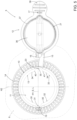
- rim 13 comprises a first end portion 19 and a second end portion 20 opposite to first portion 19.
- First end portion 19 may define a front portion of rim 13 and second end portion 20 may define a back portion of rim 13.
- lid 12 is configured to detach from first end portion 19 towards second end portion 20. In other words, during at least the first-time control of lid 12 form the closed position to the open position, lid 12 detaches at the beginning from first end portion 19 and at the end from second end portion 20.
- lid 12 is configured to move along an opening axis E, preferentially opening axis E extending from first end portion 19 to second end portion 20.
- collar 10 may comprise a center axis F.
- collar 10 may extend, preferentially from base frame 14, along center axis F.
- pouring outlet 11 and rim 13 may be arranged at a first axial end of collar 10 with respect to center axis F.
- collar 10 may delimit (and/or comprises) a flow channel 22 for the pourable product.
- collar 10 and/or rim 13 may be mirror symmetric with respect to a symmetry plane H1 comprising center axis F.
- symmetry plane H1 may comprise opening axis E.
- collar 10 and/or rim 13 may be mirror symmetric with respect to a further symmetry plane comprising center axis F and being perpendicular to symmetry plane H1.
- second end portion 20 comprises a radial protrusion 30.
- radial protrusion 30 is a notch and/or an indentation/ and or a slot obtained in rim 13 and extending away from center axis F.
- radial protrusion 30 allows to reduce a detachment force, i.e. the force needed to finally and completely separate lid 12 and collar 11 from each other, compared to the case of an end portion having a circular shape.
- a reduction of the detachment force corresponds e.g. to a reduction of the deformation of collar 11 and/or a reduction of the possibility of a product splash.
- first end portion 19 may comprise an auxiliary radial protrusion 31.
- auxiliary radial protrusion 31 is a notch and/or an indentation/ and or a slot obtained in rim 13 and extending away from center axis F.
- auxiliary radial protrusion 31 allows to reduce an opening force, i.e. the force needed to initially separate lid 12 and collar 11 from each other.
- radial protrusion 30 and auxiliary radial protrusion 31 may extend along opposite directions with respect to opening axis E.
- lid 12 detaches at the beginning from first end portion 19, preferentially auxiliary radial protrusion 31, and at the end from second end portion 20, preferentially radial protrusion 30.
- radial protrusion 30 may be curved.
- auxiliary radial protrusion 31 may be curved.
- radial protrusion 30 and auxiliary radial protrusion 31 may have a (slightly) different shape.
- radial protrusion 30 and auxiliary radial protrusion 31 may have the same shape.
- an imaginary line L connecting radial protrusion 30 and auxiliary radial protrusion 31 with one another intersects center axis F and/or may be parallel to opening axis E.
- an angular difference between a first radial position of radial protrusion 30 with respect to center axis F and a second radial position of auxiliary radial protrusion 31 with respect to center axis F may (substantially) equal 180°.
- tethering element 15 may be connected to a portion of collar 10 carrying second end portion 20, preferentially radial protrusion 30.
- rim 13 may comprise a first half section 32 comprising first end portion 19 and a second half section 33 comprising second end portion 20.
- first half section 32 and second half section 33 may be divided by a further plane H2, preferentially further plane H2 being perpendicular to symmetry plane H1 and comprising center axis F.
- radial protrusion 30 may extend between a first connection portion 40 and a second connection portion 41 of rim 13, preferentially of second half-section 33.
- first connection portion 40 and second connection portion 41 may define points in which rim 13 has a change in its profile, particularly in its curvature with respect to center axis F.
- radial protrusion 30 may be radially more distanced from center axis F than the other portions of second half section 33 (i.e. all the other portions of second half section 33 not corresponding to radial protrusion 30).
- a first maximum radial distance of radial protrusion 30 from center axis F may be larger than a first auxiliary radial distance of the other portions of second half section 33 from center axis F.
- the first maximum radial distance is to be construed in view of the zone of radial protrusion 30 that is the radially more distanced from center axis F and considering an inner face of radial protrusion 30 facing center axis F.
- the first auxiliary radial distance of the other portions of second half section 33 from center axis F is determined considering a respective inner face of second half section 33 being different from radial protrusion 30.
- a second maximum radial distance of auxiliary radial protrusion 30 from center axis F may be larger than a second auxiliary radial distance of the other portions of first half section 32 from center axis F.
- second maximum radial distance and second auxiliary radial distance can be construed in an analogous manner as one can construe the terms first maximum radial distance and first auxiliary radial distance, in this case, with respect to auxiliary radial protrusion 31 and the portions of first half section 32 being different from auxiliary radial protrusion 31.
- radial protrusion 30 may be interposed between two auxiliary sections 34 of rim 13, preferentially of second half section 33.
- first connection portion 40 may connect one auxiliary section 34 to radial protrusion 30 and second connection portion 41 may connect the other auxiliary section 34 to radial protrusion 30.
- first connection portion 40 and second connection portion 41 may be convex (in particular, when considering the shape of first connection portion 40 and second connection portion 41 from center axis F and auxiliary portions 34 and radial protrusion 30 may be concave (in particular, when considering the shape of auxiliary portions 34 and radial protrusion 30 from center axis F.
- radial protrusion 30 may define a first curvature.
- radial protrusion 30 may be described (at least approximated) by an arc-shaped section of a first circle and the first curvature may be defined as a respective first radius of the first circle.
- auxiliary sections 34 may define respective second curvatures.
- the respective second curvatures may equal one another.
- Each auxiliary section 34 may be described by an arc-shaped section of a respective second circle and each second curvature may be defined as the respective second radius of the second circle.
- first curvature may be different from each one of the second curvatures.
- the first radius may be different from, more preferentially smaller than, each one of the second radii.
- auxiliary radial protrusion 31 may be interposed between two auxiliary sections 35 of rim 13, preferentially of first half section 32.
- auxiliary radial protrusion 31 may define a third curvature.
- Auxiliary radial protrusion 31 may be described (at least approximated) by an arc-shaped section of a third circle and the third curvature may be defined as the respective third radius of the respective third circle.
- auxiliary sections 35 may define respective fourth curvatures.
- the respective fourth curvatures may equal one another.
- Each auxiliary section 35 may be described (at least approximated) by an arc-shaped section of a respective fourth circle and each fourth curvature may be defined as the respective fourth radius of the respective fourth circle.
- the third curvature is different from each one of the fourth curvatures.
- the third radius may be different, more preferentially smaller, than each one of the fourth radii.
- first radius and third radius may be (slightly) different from one another.
- third radius is smaller than first radius.
- first radius and third radius may equal one another.
- lid 12 may comprise at least a cover portion 36 configured to cover pouring outlet 11 with lid 12 being arranged in the closed position.
- cover portion 36 may be (substantially) planar.
- lid 12 may comprise an annular protrusion 37 protruding from lid 12, preferentially cover portion 36, and into flow channel 22 with lid 12 being in the closed position.
- annular protrusion 37 may comprise interaction portion 21.
- annular protrusion 37 may have a shape (substantially) equal to the shape of rim 13.
- lid 12 may also comprises a gripping element 38 protruding, in particular laterally protruding, from cover portion 36, and preferentially being configured to allow the consumer to grip gripping element 38 so that the consumer can control lid 12 between the closed position and the open position.
- gripping element 38 may comprise ribs improving the gripping properties of gripping element 38.
- the outpouring of the pourable product from package 1 requires controlling lid 12 from the closed position to the open position so as to open the pouring outlet.
- the first-time lid 12 is controlled from the closed position to the open position, lid 12 is detached from rim 13. Thereby, radial protrusion 30 allows a decrease of the detachment force compared to known opening devices.
- lid 12 When lid 12 is newly positioned in the closed position, lid 12 is in contact with rim 13, but is not connected to rim 13 anymore.
- opening device 3 and/or of package 1 according to the present invention will be clear from the foregoing description.
- radial protrusion 30 allows to decrease the detachment force, i.e. the force that is needed to detach lid 12 from rim 13 at radial protrusion 30. This allows e.g. to reduce the deformation of collar 11.
Landscapes
- Engineering & Computer Science (AREA)
- Mechanical Engineering (AREA)
- Closures For Containers (AREA)
Applications Claiming Priority (1)
| Application Number | Priority Date | Filing Date | Title |
|---|---|---|---|
| IT102023000013506A IT202300013506A1 (it) | 2023-06-29 | 2023-06-29 | Dispositivo di apertura per un pacchetto e pacchetto avente un dispositivo di apertura |
Publications (1)
| Publication Number | Publication Date |
|---|---|
| EP4484318A1 true EP4484318A1 (de) | 2025-01-01 |
Family
ID=87889531
Family Applications (1)
| Application Number | Title | Priority Date | Filing Date |
|---|---|---|---|
| EP24182317.8A Pending EP4484318A1 (de) | 2023-06-29 | 2024-06-14 | Öffnungsvorrichtung für eine verpackung und verpackung mit einer öffnungsvorrichtung |
Country Status (5)
| Country | Link |
|---|---|
| EP (1) | EP4484318A1 (de) |
| AU (1) | AU2024310800A1 (de) |
| IT (1) | IT202300013506A1 (de) |
| MX (1) | MX2025011979A (de) |
| WO (1) | WO2025002856A1 (de) |
Citations (6)
| Publication number | Priority date | Publication date | Assignee | Title |
|---|---|---|---|---|
| JPS63102660U (de) * | 1986-12-22 | 1988-07-04 | ||
| EP1279609B1 (de) * | 2001-07-27 | 2006-02-01 | Tetra Laval Holdings & Finance SA | Öffnungsmittel an einer Verpackung für fliessfähige Nahrungsmittel und damit ausgestattete Verpackung |
| JP6190589B2 (ja) * | 2012-12-27 | 2017-08-30 | 株式会社吉野工業所 | 詰め替え容器 |
| JP6458349B2 (ja) * | 2014-03-31 | 2019-01-30 | 凸版印刷株式会社 | 注出口栓および包装容器 |
| EP4001150A1 (de) | 2020-11-16 | 2022-05-25 | Tetra Laval Holdings & Finance S.A. | Deckel-ausguss-anordnung für eine verpackung und verpackung mit einer deckel-ausguss-anordnung |
| US20230182972A1 (en) * | 2020-05-27 | 2023-06-15 | Tetra Laval Holdings & Finance S.A. | Lid-spout assembly for a package and package having a lid-spout assembly |
-
2023
- 2023-06-29 IT IT102023000013506A patent/IT202300013506A1/it unknown
-
2024
- 2024-06-14 WO PCT/EP2024/066625 patent/WO2025002856A1/en active Pending
- 2024-06-14 AU AU2024310800A patent/AU2024310800A1/en active Pending
- 2024-06-14 EP EP24182317.8A patent/EP4484318A1/de active Pending
-
2025
- 2025-10-07 MX MX2025011979A patent/MX2025011979A/es unknown
Patent Citations (6)
| Publication number | Priority date | Publication date | Assignee | Title |
|---|---|---|---|---|
| JPS63102660U (de) * | 1986-12-22 | 1988-07-04 | ||
| EP1279609B1 (de) * | 2001-07-27 | 2006-02-01 | Tetra Laval Holdings & Finance SA | Öffnungsmittel an einer Verpackung für fliessfähige Nahrungsmittel und damit ausgestattete Verpackung |
| JP6190589B2 (ja) * | 2012-12-27 | 2017-08-30 | 株式会社吉野工業所 | 詰め替え容器 |
| JP6458349B2 (ja) * | 2014-03-31 | 2019-01-30 | 凸版印刷株式会社 | 注出口栓および包装容器 |
| US20230182972A1 (en) * | 2020-05-27 | 2023-06-15 | Tetra Laval Holdings & Finance S.A. | Lid-spout assembly for a package and package having a lid-spout assembly |
| EP4001150A1 (de) | 2020-11-16 | 2022-05-25 | Tetra Laval Holdings & Finance S.A. | Deckel-ausguss-anordnung für eine verpackung und verpackung mit einer deckel-ausguss-anordnung |
Also Published As
| Publication number | Publication date |
|---|---|
| AU2024310800A1 (en) | 2025-10-09 |
| WO2025002856A1 (en) | 2025-01-02 |
| MX2025011979A (es) | 2025-11-03 |
| IT202300013506A1 (it) | 2024-12-29 |
Similar Documents
| Publication | Publication Date | Title |
|---|---|---|
| EP3919404B1 (de) | Deckel-ausguss-anordnung für eine verpackung, verpackung mit einer deckel-ausguss-anordnung und verfahren zum formen einer deckel-ausguss-anordnung | |
| EP3892563A1 (de) | Ausguss für eine verpackung, deckel/ausguss-anordnung für eine verpackung und verpackung mit einem ausguss | |
| EP3892562B1 (de) | Deckelanordnung für eine verpackung, deckelausgussgruppe für eine verpackung und verpackung damit | |
| EP3892559B1 (de) | Deckel/ausguss-anordnung für eine verpackung und verpackung damit | |
| EP3915893B1 (de) | Deckel-ausguss-anordnung für eine verpackung und verpackung mit einer deckel-ausguss-anordnung | |
| EP3892564A1 (de) | Ausguss für eine verpackung, deckel/ausguss-anordnung für eine verpackung und verpackung mit einem ausguss | |
| EP4159631B1 (de) | Öffnungsvorrichtung für eine verpackung, form zum formen einer öffnungsvorrichtung für eine verpackung und verpackung mit einer öffnungsvorrichtung | |
| US12473123B2 (en) | Lid-spout assembly for a package and package having a lid-spout assembly | |
| EP3915894A1 (de) | Deckel-ausguss-anordnung für eine verpackung und verpackung mit einer deckel-ausguss-anordnung | |
| EP4484318A1 (de) | Öffnungsvorrichtung für eine verpackung und verpackung mit einer öffnungsvorrichtung | |
| EP4159634B1 (de) | Öffnungsvorrichtung für eine verpackung, form zum formen einer öffnungsvorrichtung für eine verpackung und verpackung mit einer öffnungsvorrichtung | |
| EP4159633A1 (de) | Öffnungsvorrichtung für eine verpackung, form zum formen einer öffnungsvorrichtung für eine verpackung und verpackung mit einer öffnungsvorrichtung | |
| EP4177181B1 (de) | Öffnungsvorrichtung für eine verpackung und verpackung mit einer öffnungsvorrichtung | |
| EP4159402B1 (de) | Öffnungsvorrichtung für eine verpackung, form zum formen einer öffnungsvorrichtung für eine verpackung und verpackung mit einer öffnungsvorrichtung | |
| EP4480842A2 (de) | Öffnungsvorrichtung für eine verpackung, form zum formen einer öffnungsvorrichtung und verpackung mit einer öffnungsvorrichtung | |
| EP4079652B1 (de) | Öffnungsvorrichtung für eine verpackung und verpackung mit einer öffnungsvorrichtung | |
| EP4159632A1 (de) | Öffnungsvorrichtung für eine verpackung, form zum formen einer öffnungsvorrichtung für eine verpackung und verpackung mit einer öffnungsvorrichtung | |
| EP4238880A1 (de) | Deckelanordnung für eine verpackung, deckelausgussgruppe für eine verpackung und verpackung mit einer deckelausgussgruppe | |
| EP4001149A1 (de) | Öffnungsvorrichtung für eine verpackung und verpackung mit einer öffnungsvorrichtung |
Legal Events
| Date | Code | Title | Description |
|---|---|---|---|
| PUAI | Public reference made under article 153(3) epc to a published international application that has entered the european phase |
Free format text: ORIGINAL CODE: 0009012 |
|
| STAA | Information on the status of an ep patent application or granted ep patent |
Free format text: STATUS: THE APPLICATION HAS BEEN PUBLISHED |
|
| AK | Designated contracting states |
Kind code of ref document: A1 Designated state(s): AL AT BE BG CH CY CZ DE DK EE ES FI FR GB GR HR HU IE IS IT LI LT LU LV MC ME MK MT NL NO PL PT RO RS SE SI SK SM TR |
|
| STAA | Information on the status of an ep patent application or granted ep patent |
Free format text: STATUS: REQUEST FOR EXAMINATION WAS MADE |
|
| 17P | Request for examination filed |
Effective date: 20250701 |